Request Free Sample ×

Kindly complete the form below to receive a free sample of this Report

* Please use a valid business email

Leading companies partner with us for data-driven Insights

clients tt-cursor
Hero Background
English
Chinese
French
Japanese
Korean
German
Spanish

Osteoarthritis Therapeutics Market Analysis

ID: MRFR/Pharma/1078-HCR
90 Pages
Nidhi Mandole
March 2026

Osteoarthritis Market Research Report Information By Type (Hip Osteoarthritis, and Spinal Osteoarthritis), By Diagnosis (Imagining, and Joint Fluid Analysis), By Treatment (Medication, Surgery, Therapy), By End-User (Hospitals, and Medical Institutes) and By Region (North America, Europe, Asia-Pacific, And Rest Of The World) - Growth & Industry Forecast 2025 To 2035

Share:
Download PDF ×

We do not share your information with anyone. However, we may send you emails based on your report interest from time to time. You may contact us at any time to opt-out.

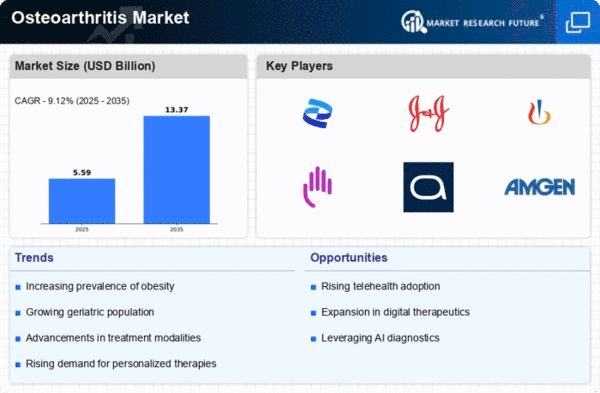
Osteoarthritis Market Infographic
Purchase Options

Market Analysis

In-depth Analysis of Osteoarthritis Market Industry Landscape

Osteoarthritis cases are rising sharply around the world, which is good for business. Millions of people all over the world have osteoarthritis. It takes place when joint tissue goes down. Therefore, we need better medicines and fresh approaches to deal with illnesses. Population age changes the size of businesses all the time. Growing older makes osteoarthritis more possible, which can make joint health problems worse. Markets change as the number of older people rises, which helps doctors make treatments that meet the needs of older people. This company is also benefiting from fresh medicines that alter how osteoarthritis works. It changes market trends and helps make new ways to heal when people look for treatments that do more than just cover up symptoms and get to the root reasons of illness. Pain relief is a big part of healing osteoarthritis, and it changes how the market works. What kind of care people want and how well they do are affected by new pain management options such as painkillers, skin medicines, and ways that don't involve drugs. The business is greatly affected by changes in medical imaging technology. Magnesium-semiconductor imaging (MRI) and x-rays are significant ways to find and monitor osteoarthritis. They assist the market in selecting early spotting and customized treatment plans. Unlike other markets, this one is looking into ways to fix cartilage using regenerative medicine. New findings in stem cell therapy, platelet-rich plasma (PRP), tissue engineering, and PRP are making treatments that help the body heal itself better. These changes have an impact on how we treat illnesses and keep our joints healthy. Osteoarthritis still needs pain killers and NSAIDs to be managed, which changes how the market works. Being able to get both over-the-counter and prescription drugs changes the types of treatments that can be used, which in turn changes the market trends for pain relief methods that use drugs. Additionally, the market share grows since there are more medical and surgical options for osteoarthritis. Other types of treatments include surgery, joint replacement surgeries, and minimally invasive procedures. When dealing with later stages of the disease, these affect how the market makes choices. Finding out about the other health issues that can happen along with osteoarthritis is working out well. Using joint care to treat obesity, diabetes, and heart disease changes market trends and makes osteoarthritis healthier generally.


Author
Author Profile
Nidhi Mandole
Senior Research Analyst

She is an extremely curious individual currently working in Healthcare and Medical Devices Domain. Nidhi is comfortably versed in data centric research backed by healthcare educational background. She leverages extensive data mining and analytics tools such as Primary and Secondary Research, Statistical Analysis, Machine Learning, Data Modelling. Her key role also involves Technical Sales Support, Client Interaction and Project management within the Healthcare team. Lastly, she showcases extensive affinity towards learning new skills and remain fascinated in implementing them.

Leave a Comment

FAQs

What is the current valuation of the Osteoarthritis Market as of 2024?

<p>The Osteoarthritis Market was valued at 5.12 USD Billion in 2024.</p>

What is the projected market size for the Osteoarthritis Market in 2035?

<p>The market is projected to reach 13.37 USD Billion by 2035.</p>

What is the expected CAGR for the Osteoarthritis Market during the forecast period 2025 - 2035?

<p>The expected CAGR for the Osteoarthritis Market during this period is 9.12%.</p>

Which companies are the key players in the Osteoarthritis Market?

Key players include Pfizer, Johnson &amp; Johnson, Novartis, and AbbVie, among others.

How is the Osteoarthritis Market segmented by type of osteoarthritis?

<p>The market segments include Knee Osteoarthritis, Hip Osteoarthritis, Hand Osteoarthritis, and Spinal Osteoarthritis.</p>

What were the valuations for Knee Osteoarthritis in 2024 and its projected value in 2035?

<p>Knee Osteoarthritis was valued at 1.54 USD Billion in 2024 and is projected to reach 4.05 USD Billion by 2035.</p>

What are the projected values for pharmacological treatment in the Osteoarthritis Market?

<p>Pharmacological treatment was valued at 1.54 USD Billion in 2024 and is expected to reach 3.92 USD Billion by 2035.</p>

How does the market perform in terms of severity levels of osteoarthritis?

The market segments by severity include Mild, Moderate, and Severe Osteoarthritis, with Moderate Osteoarthritis projected to grow significantly.

What is the market outlook for older adults suffering from osteoarthritis?

The segment for older adults was valued at 3.07 USD Billion in 2024 and is projected to reach 8.98 USD Billion by 2035.

What treatment types are included in the Osteoarthritis Market segmentation?

The market is segmented into Pharmacological Treatment, Non-Pharmacological Treatment, Surgical Treatment, and Rehabilitation.

Market Summary

According to Market Research Future analysis, the Osteoarthritis Market size was valued at USD 5.12 Billion in 2024. The market is projected to grow from USD 5.58 Billion in 2025 to USD 13.37 Billion by 2035, exhibiting a CAGR of 9.12% during the forecast period 2025–2035. North America led the market with over 50.78% share, generating around USD 2.6 billion in revenue.
 
Rapid population aging and increasing obesity prevalence are major drivers of Osteoarthritis Market growth, accelerating joint degeneration and treatment demand. Expanding diagnosis rates, improved access to therapies, and growing awareness further support adoption of pharmacological, biologic, and rehabilitation solutions globally.
 
According to World Health Organization, over 528 million people globally live with osteoarthritis, while Institute for Health Metrics and Evaluation reports a 113% increase since 1990.

Key Market Trends & Highlights

The Osteoarthritis Market is experiencing transformative growth driven by innovative treatment approaches and demographic shifts.

  • North America leads in the Osteoarthritis Market Size, accounting for over 50.78% global revenue in 2024. Europe osteoarthritis market valued at USD 1.52 billion, reflecting increasing demand for advanced treatment solutions. Pharmacological treatments dominate with 54% share, supported by increasing biologics adoption and pain management demand.

Market Size & Forecast

2024 Market Size 5.12 (USD Billion)
2035 Market Size 13.37 (USD Billion)
CAGR (2025 - 2035) 9.12%
Largest Regional Market Share in 2024 North America

Major Players

Companies such as <a href="https://www.pfizer.com/news/articles/the_facts_about_osteoarthritis">Pfizer </a>(US), Johnson &amp; Johnson (US), <a href="https://www.novartis.com/news/novartis-receives-fda-fast-track-designation-lna043-osteoarthritis-knee">Novartis </a>(CH), Bristol-Myers Squibb (US), AbbVie (US), Amgen (US), Sanofi (FR), GlaxoSmithKline (GB), Roche (CH) are some of the major participants in the global market.

Market Trends

The Osteoarthritis Market is currently experiencing notable transformations driven by various factors. Increasing awareness regarding joint health and the rising prevalence of osteoarthritis among aging populations are contributing to a heightened demand for effective treatment options. Furthermore, advancements in medical technology and the development of innovative therapies are reshaping the landscape of this market.

Pharmaceutical companies are focusing on research and development to introduce novel drugs and biologics that target the underlying causes of osteoarthritis, rather than merely alleviating symptoms. This shift towards more comprehensive treatment approaches appears to be a pivotal trend in the Osteoarthritis Market. In addition, the growing emphasis on personalized medicine is influencing treatment strategies, as healthcare providers seek to tailor interventions to individual patient needs.

The integration of digital health solutions, such as telemedicine and mobile health applications, is also gaining traction, enabling patients to manage their conditions more effectively. As the Osteoarthritis Market evolves, stakeholders must remain vigilant to emerging trends and adapt their strategies accordingly to meet the changing demands of patients and healthcare systems.

Rise of Biologics and Targeted Therapies

The Osteoarthritis Market is witnessing a shift towards biologics and targeted therapies that aim to address the root causes of the condition. These innovative treatments focus on modulating the immune response and promoting cartilage repair, potentially offering more effective solutions compared to traditional pain management approaches.

According to European Centre for Disease Prevention and Control, musculoskeletal disorders affect over 120 million people across Europe, driving demand for advanced biologics.

Personalized Treatment Approaches

There is a growing trend towards personalized treatment strategies in the Osteoarthritis Market. Healthcare providers are increasingly recognizing the importance of tailoring interventions based on individual patient profiles, which may enhance treatment efficacy and improve patient outcomes.

United Nations Population Fund reports that people aged 65+ will exceed 1.6 billion globally by 2050, increasing demand for personalized osteoarthritis care.

Integration of Digital Health Solutions

The incorporation of digital health technologies is transforming the Osteoarthritis Market. Telemedicine and mobile applications are becoming essential tools for patient management, allowing for better monitoring of symptoms and facilitating communication between patients and healthcare professionals.

UNICEF digital health expansion initiatives indicate telehealth adoption increased over 38% globally in chronic disease management. Additionally, Médecins Sans Frontières reports digital monitoring improving treatment adherence in chronic musculoskeletal conditions, strengthening demand for remote osteoarthritis management platforms.

Osteoarthritis Market Market Drivers

Market Growth Projections

The Global Osteoarthritis Market Industry is poised for substantial growth, with projections indicating a market size of 5.12 USD Billion in 2024 and an anticipated increase to 13.4 USD Billion by 2035. This growth trajectory suggests a robust demand for osteoarthritis treatments and management solutions.
 
The compound annual growth rate (CAGR) of 9.12% from 2025 to 2035 reflects the increasing recognition of osteoarthritis as a significant public health issue. As stakeholders in the healthcare sector respond to this demand, the market is likely to witness innovations and enhancements in treatment options, further solidifying its growth potential.

Growing Awareness and Education

The rising awareness and education surrounding osteoarthritis are crucial drivers of the Global Osteoarthritis Market Industry. Public health campaigns and educational initiatives are increasingly informing individuals about the disease, its risk factors, and management strategies.
 
This heightened awareness encourages early diagnosis and treatment, which can lead to better health outcomes. Moreover, healthcare professionals are receiving enhanced training on osteoarthritis management, further promoting effective treatment options. As patients become more informed about their condition, they are more likely to seek medical advice and treatment, thereby driving market growth and fostering a proactive approach to managing osteoarthritis.

Increased Healthcare Expenditure

Growing healthcare expenditure across various regions is likely to bolster the Global Osteoarthritis Market Industry. As countries invest more in healthcare infrastructure and services, the availability and accessibility of osteoarthritis treatments improve. For instance, nations with higher healthcare budgets are more capable of funding advanced therapies and technologies.
 
This trend is particularly evident in developed economies, where healthcare spending is projected to rise significantly in the coming years. The increased allocation of resources towards chronic disease management, including osteoarthritis, suggests a favorable environment for market expansion, potentially leading to a compound annual growth rate (CAGR) of 9.12% from 2025 to 2035.

Advancements in Treatment Options

Innovations in treatment modalities for osteoarthritis are propelling the Global Osteoarthritis Market Industry forward. Recent developments in pharmaceuticals, biologics, and regenerative medicine offer new avenues for managing symptoms and improving patient outcomes.
 
For instance, the introduction of disease-modifying osteoarthritis drugs (DMOADs) aims to slow disease progression, which could alter the treatment landscape. Furthermore, minimally invasive surgical techniques are gaining traction, providing patients with effective alternatives to traditional surgery. These advancements not only enhance the quality of life for patients but also contribute to market growth, as healthcare providers seek to adopt the latest evidence-based practices.

Rising Prevalence of Osteoarthritis

The increasing prevalence of osteoarthritis globally is a primary driver of the Global Osteoarthritis Market Industry. As populations age, the incidence of osteoarthritis is expected to rise significantly. In 2024, the market is projected to reach 5.12 USD Billion, reflecting the growing need for effective treatments and management strategies.
 
The World Health Organization indicates that osteoarthritis affects approximately 10% of the global population over 60 years, highlighting the urgency for innovative solutions. This trend is likely to continue, with projections suggesting that by 2035, the market could expand to 13.4 USD Billion, driven by the aging demographic and the associated healthcare demands.

Emerging Markets and Demographic Shifts

Emerging markets are becoming increasingly significant in the Global Osteoarthritis Market Industry due to demographic shifts and economic development. Countries in Asia-Pacific and Latin America are witnessing rapid urbanization and an increase in life expectancy, leading to a higher prevalence of osteoarthritis.
 
As these regions develop economically, there is a growing demand for healthcare services and treatments. This trend is expected to create new opportunities for market players, as they seek to cater to the unique needs of these populations. The expansion into emerging markets could play a pivotal role in achieving the projected market growth, with a CAGR of 9.12% anticipated from 2025 to 2035.

Market Segment Insights

By Type of Osteoarthritis: Knee Osteoarthritis (Largest) vs. Hip Osteoarthritis (Fastest-Growing)

The Osteoarthritis Market is significantly shaped by its different types, with Knee Osteoarthritis leading in market share, accounting for 62% of the market share among the segments. This dominance can be attributed to its high prevalence, especially among older demographics and those engaged in high-impact activities. Meanwhile, Hip Osteoarthritis is emerging as a fast-growing segment, driven by increasing incidence rates and rising awareness surrounding joint health. As the population ages, these market dynamics reflect a shifting focus towards effective management strategies.

Knee Osteoarthritis (Dominant) vs. Hip Osteoarthritis (Emerging)

Knee Osteoarthritis is the most prevalent type, largely impacting the quality of life and mobility for millions of sufferers. Its characteristics include pain primarily in the knee joint, stiffness, and swelling, which intensifies with physical activity. This segment benefits from various treatment options ranging from conservative management to surgical interventions, reflecting its dominant position. Conversely, Hip Osteoarthritis is gaining traction as an emerging segment, characterized by pain and stiffness in the hip joint, which can severely restrict movement. This segment's growth is supported by increased research investments, innovative therapies, and a greater emphasis on preventive care, making it a substantial area of focus for stakeholders in the osteoarthritis market.

By Treatment Type: Pharmacological Treatment (Largest) vs. Non-Pharmacological Treatment (Fastest-Growing)

In the Osteoarthritis Market, the treatment type segment is notably diverse, comprising pharmacological, non-pharmacological, surgical, and rehabilitation methods. Among these, pharmacological treatments command the largest share, accounting for 54% of the market share, due to their widespread usage and effective pain management capabilities. Non-pharmacological treatments are gaining traction rapidly, attributed to an increasing preference for holistic care approaches that emphasize lifestyle modifications and physical therapy.

Pharmacological Treatment (Dominant) vs. Non-Pharmacological Treatment (Emerging)

Pharmacological treatment is the dominant segment in the Osteoarthritis market, primarily comprising non-steroidal anti-inflammatory drugs (NSAIDs), corticosteroids, and analgesics, which provide relief to patients effectively. On the other hand, non-pharmacological treatment is emerging as a significant segment, focusing on therapies such as physiotherapy, acupuncture, and dietary management. This segment reflects a shift towards patient-centered care, emphasizing natural and lifestyle adjustments instead of relying solely on medication. As awareness of the benefits of these alternatives grows, the non-pharmacological treatment segment is expected to experience robust growth.

By Severity Level: Moderate Osteoarthritis (Largest) vs. Severe Osteoarthritis (Fastest-Growing)

In the Osteoarthritis Market, the distribution of market share among severity levels reveals that Moderate Osteoarthritis holds the largest share, accounting for 57% of the market share. This segment is characterized by a significant number of patients managing chronic pain and requires ongoing treatment. Conversely, Severe Osteoarthritis, characterized by debilitating symptoms and limited mobility, has emerged as a growing segment due to increased awareness and diagnosis of severe conditions. With an aging population and rising obesity rates, these demographic factors contribute to this growth trajectory. Growth trends indicate that while Moderate Osteoarthritis remains stable in market dominance, Severe Osteoarthritis is gaining momentum as advancements in treatment options and patient management strategies evolve. The increasing prevalence of risk factors such as obesity and an aging demographic is propelling demand in this segment. Furthermore, innovative therapies and patient-centric care models are making severe treatment options more accessible, encouraging more patients to seek intervention, further boosting the segment’s growth.

Moderate Osteoarthritis (Dominant) vs. Severe Osteoarthritis (Emerging)

Moderate Osteoarthritis remains the dominant player in the severity level segment, comprising a substantial portion of the overall Osteoarthritis Market. This segment is characterized by symptoms such as joint pain, stiffness, and reduced range of motion, but patients often maintain a level of functionality, allowing for more conservative management options. On the other hand, Severe Osteoarthritis is emerging as a critical segment, driven by significant patient needs and treatment requirements. Patients in this group often experience chronic pain and functional limitations, necessitating more aggressive interventions such as surgical options and advanced therapeutic modalities. The divergence in treatment approaches for moderate and severe cases illustrates the evolving landscape of healthcare solutions available, shaped by patient demographics and treatment innovations.

By Age Group: Older Adults (Largest) vs. Middle-Aged Adults (Fastest-Growing)

The Osteoarthritis Market exhibits varying levels of prevalence across different age groups. Older adults represent the largest share, accounting for 64% of the market, consistently exhibiting the highest incidence of osteoarthritis due to age-related wear and tear on jointsThis demographic, typically aged 65 and above, contributes significantly to the demand for osteoarthritis treatments and management solutions as their need for pain relief and mobility enhancement continues to soar. In contrast, Middle-Aged Adults, particularly those between 45 and 64 years, showcase an increasing trend in the market as they increasingly suffer from osteoarthritis symptoms attributed to lifestyle factors, obesity, and previous joint injuries. The growth trends in the Osteoarthritis Market demonstrate a notable surge, particularly in the Middle-Aged Adults segment, which is becoming increasingly recognized as a crucial early-stage demographic for osteoarthritis treatment. This age group is driving growth as more individuals seek proactive management solutions to mitigate symptoms before they worsen. Factors fueling this upward trend include heightened awareness about joint health, increased diagnosis rates, and a growing inclination towards preventive healthcare measures, which positions them as emerging players in this market landscape.

Older Adults: Dominant vs. Middle-Aged Adults: Emerging

The Older Adults segment in the Osteoarthritis Market is characterized by a high prevalence of arthritis, primarily driven by the natural aging process, which leads to a gradual degradation of joint tissues. This segment is often associated with chronic pain and reduced mobility, prompting a strong demand for medical interventions such as pharmaceutical treatments and physical therapy options. As the population ages, this segment remains dominant, shaping market trends and product offerings significantly. Conversely, Middle-Aged Adults are emerging as a vital segment in the market, influenced by lifestyle factors such as sedentary behavior and obesity, which are contributing to earlier onset of osteoarthritis symptoms. This group exhibits a proactive approach to joint care, often seeking new therapies and products that promote joint health, thus influencing market dynamics and pushing for innovations in treatment options.

Get more detailed insights about Osteoarthritis Market Research Report – Forecast Till 2035

Regional Insights

North America : Market Leader in Osteoarthritis

North America leads in the Osteoarthritis Market Size, accounting for over 50.78% of the global revenue in 2024. The region's growth is driven by an aging population, increasing obesity rates, and heightened awareness of osteoarthritis treatments. Regulatory support and advancements in medical technology further catalyze market expansion, with a focus on innovative therapies and patient-centric solutions.

The competitive landscape is robust, featuring key players such as Pfizer, Johnson & Johnson, and AbbVie. The U.S. remains the largest market, supported by extensive healthcare infrastructure and research initiatives. Companies are investing in R&D to develop novel treatments, ensuring a dynamic market environment that addresses the evolving needs of patients and healthcare providers.

Europe : Emerging Market with Growth Potential

Europe's osteoarthritis market is valued at 1.52B, reflecting a growing demand for effective treatments. Factors such as an aging demographic, rising healthcare expenditure, and increasing prevalence of obesity contribute to market growth. Regulatory frameworks in the EU are evolving to support innovative therapies, enhancing patient access to advanced treatments.

Leading countries like Germany, France, and the UK are at the forefront of this market, with a competitive landscape featuring major players like Novartis and Roche. The presence of strong healthcare systems and ongoing clinical trials further bolster the market. As companies focus on personalized medicine and biologics, Europe is set to become a key player in The Osteoarthritis.

Asia-Pacific : Rapidly Growing Market Segment

The Asia-Pacific region, with a market size of 0.88B, is experiencing rapid growth in the osteoarthritis sector. Factors such as increasing urbanization, lifestyle changes, and a rising elderly population are driving demand for osteoarthritis treatments. Governments are also implementing health initiatives to address the rising burden of chronic diseases, including osteoarthritis. Countries like Japan, China, and Australia are leading the market, with a mix of local and international players.

Companies such as Amgen and Sanofi are expanding their presence, focusing on innovative therapies and partnerships. The competitive landscape is evolving, with an emphasis on research and development to meet the unique needs of the region's diverse population.

Middle East and Africa : Emerging Market with Challenges

The Middle East and Africa (MEA) region, with a market size of 0.16B, presents unique challenges and opportunities in the osteoarthritis market. Factors such as limited healthcare access, varying economic conditions, and a growing prevalence of lifestyle-related diseases impact market growth. However, increasing awareness and government initiatives to improve healthcare infrastructure are positive signs for the future.

Countries like South Africa and the UAE are leading the market, with a focus on improving treatment access and quality. The competitive landscape includes both local and international players, but the market remains underdeveloped compared to other regions. As healthcare systems evolve, there is potential for growth in innovative treatment options and patient care.

Key Players and Competitive Insights

The Osteoarthritis Market is currently characterized by a dynamic competitive landscape, driven by an increasing prevalence of the condition and a growing demand for effective treatment options. Key players such as Pfizer (US), Johnson & Johnson (US), and AbbVie (US) are strategically positioned to leverage their extensive research and development capabilities, focusing on innovative therapies and biologics.
 
These companies are actively pursuing partnerships and collaborations to enhance their product portfolios, thereby shaping a competitive environment that emphasizes both innovation and patient-centric solutions.In terms of business tactics, companies are increasingly localizing manufacturing and optimizing supply chains to enhance efficiency and reduce costs. The market appears moderately fragmented, with a mix of established pharmaceutical giants and emerging biotech firms. The collective influence of these key players is significant, as they not only drive technological advancements but also set industry standards that smaller companies often follow.
 

In November Pfizer (US) announced a strategic partnership with a leading biotech firm to co-develop a novel gene therapy aimed at osteoarthritis treatment. This collaboration is expected to accelerate the development timeline and enhance the therapeutic options available to patients, indicating Pfizer's commitment to innovation in the osteoarthritis space. Such partnerships may also provide Pfizer with a competitive edge in a market that increasingly values cutting-edge solutions.
 

In October Johnson & Johnson (US) launched a new digital health platform designed to support osteoarthritis patients in managing their condition through personalized treatment plans. This initiative reflects the company's focus on integrating technology into healthcare, potentially improving patient outcomes and engagement. By leveraging digital tools, Johnson & Johnson aims to differentiate itself in a crowded market, aligning with current trends towards digitalization in healthcare.
 

In September AbbVie (US) expanded its clinical trial program for a promising new biologic therapy targeting osteoarthritis. This expansion not only underscores AbbVie's commitment to advancing treatment options but also positions the company to capture a larger market share as the therapy progresses through regulatory pathways. The strategic emphasis on clinical research and development is likely to enhance AbbVie's reputation as a leader in innovative osteoarthritis treatments.
 

As of December current competitive trends in the Osteoarthritis Market include a pronounced shift towards digitalization, sustainability, and the integration of artificial intelligence in treatment protocols. Strategic alliances are increasingly shaping the landscape, enabling companies to pool resources and expertise. Looking ahead, competitive differentiation is expected to evolve, with a greater emphasis on innovation and technology rather than solely on price. Companies that can reliably navigate supply chain complexities while delivering cutting-edge solutions are likely to emerge as leaders in this evolving market.

Key Companies in the Osteoarthritis Market include

Industry Developments

Robexera, the first generic robenacoxib medication, will be available in 2023, according to Krka. It is intended to treat pain and inflammation brought on by soft tissue surgery and persistent osteoarthritis (OA) in dogs. A once-daily dosage schedule for Robexera, a COX2 NSAID formulation, provides anti-inflammatory pain relief2,3,4.  The medicine comes in the form of a chewable tablet with flavoring to make it easier for pet owners to administer. It comes in four strengths for ease of administering, and each pack includes a set of PIL sheets that can be converted into prescription envelopes, color-coded boxes, and perforated blisters.

The U.S. Food and Drug Administration (U.S. FDA) has granted Zydus Lifesciences final permission in 2023 to produce and distribute 50 mg/200 mcg and 75 mg/200 mcg of Misoprostol Delayed Release Tablets USP, as well as 0.5 mg and 1 mg of Varenicline tablets. Arthrotec Delayed-Release tablets are the reference listed drug (RLD) for Diclofenac Sodium and Misoprostol Delayed Release Tablets. These tablets are intended to treat rheumatoid arthritis and osteoarthritis in individuals who are at high risk of developing stomach or intestinal ulcers. According to Zydus, the medication would be produced at the group's Ahmedabad formulation manufacturing facility.

The product's annual sales in the United States were $13 million, according to the business, which cited IQVIA MAT March 2023 numbers.

September 2022: StemOne, the off-the-shelf cell therapy product by Alkem Laboratories, received regulatory approval from the Drug Controller General of India (DCGI) for its launch in India. This product is being launched in collaboration with Stempeutics, which aims to treat knee osteoarthritis, a degenerative joint disease.

August 2022: Shionogi & Co., Ltd. and Grünenthal GmbH have entered into a licensing agreement to jointly market and commercialize injectable resiniferatoxin in Japan. Resiniferatoxin is a pipeline product developed by Grünenthal, and it is intended to treat pain caused by osteoarthritis of the knee. The licensing agreement will allow the companies to bring the product to market in Japan, offering a new treatment option for patients with knee osteoarthritis.

Future Outlook

Osteoarthritis Market Future Outlook

The Osteoarthritis Market is projected to grow at a 9.12% CAGR from 2025 to 2035, driven by increasing prevalence, advancements in treatment options, and rising healthcare expenditure.

New opportunities lie in:

  • <p>Development of personalized treatment plans leveraging AI analytics. Expansion of telehealth services for remote patient monitoring. Investment in <a title="regenerative medicine" href="https://www.marketresearchfuture.com/reports/regenerative-medicine-market-2220" target="_blank" rel="noopener">regenerative medicine</a> technologies for joint repair.</p>

By 2035, the Osteoarthritis Market is expected to achieve substantial growth, reflecting evolving treatment paradigms and increased patient engagement.

Market Segmentation

Osteoarthritis Market End Use Outlook

  • Hospitals
  • Clinics
  • Home Care
  • Rehabilitation Centers

Osteoarthritis Market Application Outlook

  • Pain Management
  • Joint Function Improvement
  • Physical Therapy
  • Surgical Intervention

Osteoarthritis Market Product Type Outlook

  • Pharmaceuticals
  • Medical Devices
  • Therapeutic Equipment
  • Nutraceuticals

Osteoarthritis Market Treatment Type Outlook

  • Non-Surgical
  • Surgical
  • Physical Therapy
  • Medication

Report Scope

MARKET SIZE 2024 5.12(USD Billion)
MARKET SIZE 2025 5.58(USD Billion)
MARKET SIZE 2035 13.37(USD Billion)
COMPOUND ANNUAL GROWTH RATE (CAGR) 9.12% (2025 - 2035)
REPORT COVERAGE Revenue Forecast, Competitive Landscape, Growth Factors, and Trends
BASE YEAR 2024
Market Forecast Period 2025 - 2035
Historical Data 2019 - 2024
Market Forecast Units USD Billion
Key Companies Profiled Pfizer (US), Johnson & Johnson (US), Novartis (CH), Bristol-Myers Squibb (US), AbbVie (US), Amgen (US), Sanofi (FR), GlaxoSmithKline (GB), Roche (CH)
Segments Covered Application, End Use, Product Type, Treatment Type
Key Market Opportunities Advancements in personalized medicine and digital therapeutics enhance treatment options in the Osteoarthritis Market.
Key Market Dynamics Rising demand for innovative therapies drives competitive forces and technological advancements in the Osteoarthritis Market.
Countries Covered North America, Europe, APAC, South America, MEA

FAQs

What is the current valuation of the Osteoarthritis Market as of 2024?

<p>The Osteoarthritis Market was valued at 5.12 USD Billion in 2024.</p>

What is the projected market size for the Osteoarthritis Market in 2035?

<p>The market is projected to reach 13.37 USD Billion by 2035.</p>

What is the expected CAGR for the Osteoarthritis Market during the forecast period 2025 - 2035?

<p>The expected CAGR for the Osteoarthritis Market during this period is 9.12%.</p>

Which companies are the key players in the Osteoarthritis Market?

Key players include Pfizer, Johnson &amp; Johnson, Novartis, and AbbVie, among others.

How is the Osteoarthritis Market segmented by type of osteoarthritis?

<p>The market segments include Knee Osteoarthritis, Hip Osteoarthritis, Hand Osteoarthritis, and Spinal Osteoarthritis.</p>

What were the valuations for Knee Osteoarthritis in 2024 and its projected value in 2035?

<p>Knee Osteoarthritis was valued at 1.54 USD Billion in 2024 and is projected to reach 4.05 USD Billion by 2035.</p>

What are the projected values for pharmacological treatment in the Osteoarthritis Market?

<p>Pharmacological treatment was valued at 1.54 USD Billion in 2024 and is expected to reach 3.92 USD Billion by 2035.</p>

How does the market perform in terms of severity levels of osteoarthritis?

The market segments by severity include Mild, Moderate, and Severe Osteoarthritis, with Moderate Osteoarthritis projected to grow significantly.

What is the market outlook for older adults suffering from osteoarthritis?

The segment for older adults was valued at 3.07 USD Billion in 2024 and is projected to reach 8.98 USD Billion by 2035.

What treatment types are included in the Osteoarthritis Market segmentation?

The market is segmented into Pharmacological Treatment, Non-Pharmacological Treatment, Surgical Treatment, and Rehabilitation.

  1. SECTION I: EXECUTIVE SUMMARY AND KEY HIGHLIGHTS |
    1. EXECUTIVE SUMMARY | |
      1. Market Overview | |
      2. Key Findings | |
      3. Market Segmentation | |
      4. Competitive Landscape | |
      5. Challenges and Opportunities | |
      6. Future Outlook 2
  2. SECTION II: SCOPING, METHODOLOGY AND MARKET STRUCTURE |
    1. MARKET INTRODUCTION | |
      1. Definition | |
      2. Scope of the study | | |
    2. RESEARCH METHODOLOGY | |
      1. Overview | |
      2. Data Mining | |
      3. Secondary Research | |
      4. Primary Research | | |
      5. Forecasting Model | |
      6. Market Size Estimation | | |
      7. Data Triangulation | |
      8. Validation 3
  3. SECTION III: QUALITATIVE ANALYSIS |
    1. MARKET DYNAMICS | |
      1. Overview | |
      2. Drivers | |
      3. Restraints | |
      4. Opportunities |
    2. MARKET FACTOR ANALYSIS | |
      1. Value chain Analysis | |
      2. Porter's Five Forces Analysis | | |
      3. COVID-19 Impact Analysis | | |
  4. SECTION IV: QUANTITATIVE ANALYSIS |
    1. Healthcare, BY Type of Osteoarthritis (USD Billion) | |
      1. Knee Osteoarthritis | |
      2. Hip Osteoarthritis | |
      3. Hand Osteoarthritis | |
      4. Spinal Osteoarthritis |
    2. Healthcare, BY Treatment Type (USD Billion) | |
      1. Pharmacological Treatment | |
      2. Non-Pharmacological Treatment | |
      3. Surgical Treatment | |
      4. Rehabilitation |
    3. Healthcare, BY Severity Level (USD Billion) | |
      1. Mild Osteoarthritis | |
      2. Moderate Osteoarthritis | |
      3. Severe Osteoarthritis |
    4. Healthcare, BY Age Group (USD Billion) | |
      1. Young Adults | |
      2. Middle-Aged Adults | |
      3. Older Adults |
    5. Healthcare, BY Region (USD Billion) | |
      1. North America | | |
      2. Europe | | |
      3. APAC | | |
      4. South America | | |
      5. MEA | | |
  5. SECTION V: COMPETITIVE ANALYSIS |
    1. Competitive Landscape | |
      1. Overview | |
      2. Competitive Analysis | |
      3. Market share Analysis | |
      4. Major Growth Strategy in the Healthcare | |
      5. Competitive Benchmarking | |
      6. Leading Players in Terms of Number of Developments in the Healthcare | |
      7. Key developments and growth strategies | | |
      8. Major Players Financial Matrix | | |
    2. Company Profiles | |
      1. Pfizer (US) | | |
      2. Johnson & Johnson (US) | | |
      3. Novartis (CH) | | |
      4. Bristol-Myers Squibb (US) | | |
      5. AbbVie (US) | | |
      6. Amgen (US) | | |
      7. Sanofi (FR) | | |
      8. GlaxoSmithKline (GB) | | |
      9. Roche (CH) | | |
    3. Appendix | |
      1. References | |
      2. Related Reports 6 LIST OF FIGURES |
    4. MARKET SYNOPSIS |
    5. NORTH AMERICA MARKET ANALYSIS |
    6. US MARKET ANALYSIS BY TYPE OF OSTEOARTHRITIS |
    7. US MARKET ANALYSIS BY TREATMENT TYPE |
    8. US MARKET ANALYSIS BY SEVERITY LEVEL |
    9. US MARKET ANALYSIS BY AGE GROUP |
    10. CANADA MARKET ANALYSIS BY TYPE OF OSTEOARTHRITIS |
    11. CANADA MARKET ANALYSIS BY TREATMENT TYPE |
    12. CANADA MARKET ANALYSIS BY SEVERITY LEVEL |
    13. CANADA MARKET ANALYSIS BY AGE GROUP |
    14. EUROPE MARKET ANALYSIS |
    15. GERMANY MARKET ANALYSIS BY TYPE OF OSTEOARTHRITIS |
    16. GERMANY MARKET ANALYSIS BY TREATMENT TYPE |
    17. GERMANY MARKET ANALYSIS BY SEVERITY LEVEL |
    18. GERMANY MARKET ANALYSIS BY AGE GROUP |
    19. UK MARKET ANALYSIS BY TYPE OF OSTEOARTHRITIS |
    20. UK MARKET ANALYSIS BY TREATMENT TYPE |
    21. UK MARKET ANALYSIS BY SEVERITY LEVEL |
    22. UK MARKET ANALYSIS BY AGE GROUP |
    23. FRANCE MARKET ANALYSIS BY TYPE OF OSTEOARTHRITIS |
    24. FRANCE MARKET ANALYSIS BY TREATMENT TYPE |
    25. FRANCE MARKET ANALYSIS BY SEVERITY LEVEL |
    26. FRANCE MARKET ANALYSIS BY AGE GROUP |
    27. RUSSIA MARKET ANALYSIS BY TYPE OF OSTEOARTHRITIS |
    28. RUSSIA MARKET ANALYSIS BY TREATMENT TYPE |
    29. RUSSIA MARKET ANALYSIS BY SEVERITY LEVEL |
    30. RUSSIA MARKET ANALYSIS BY AGE GROUP |
    31. ITALY MARKET ANALYSIS BY TYPE OF OSTEOARTHRITIS |
    32. ITALY MARKET ANALYSIS BY TREATMENT TYPE |
    33. ITALY MARKET ANALYSIS BY SEVERITY LEVEL |
    34. ITALY MARKET ANALYSIS BY AGE GROUP |
    35. SPAIN MARKET ANALYSIS BY TYPE OF OSTEOARTHRITIS |
    36. SPAIN MARKET ANALYSIS BY TREATMENT TYPE |
    37. SPAIN MARKET ANALYSIS BY SEVERITY LEVEL |
    38. SPAIN MARKET ANALYSIS BY AGE GROUP |
    39. REST OF EUROPE MARKET ANALYSIS BY TYPE OF OSTEOARTHRITIS |
    40. REST OF EUROPE MARKET ANALYSIS BY TREATMENT TYPE |
    41. REST OF EUROPE MARKET ANALYSIS BY SEVERITY LEVEL |
    42. REST OF EUROPE MARKET ANALYSIS BY AGE GROUP |
    43. APAC MARKET ANALYSIS |
    44. CHINA MARKET ANALYSIS BY TYPE OF OSTEOARTHRITIS |
    45. CHINA MARKET ANALYSIS BY TREATMENT TYPE |
    46. CHINA MARKET ANALYSIS BY SEVERITY LEVEL |
    47. CHINA MARKET ANALYSIS BY AGE GROUP |
    48. INDIA MARKET ANALYSIS BY TYPE OF OSTEOARTHRITIS |
    49. INDIA MARKET ANALYSIS BY TREATMENT TYPE |
    50. INDIA MARKET ANALYSIS BY SEVERITY LEVEL |
    51. INDIA MARKET ANALYSIS BY AGE GROUP |
    52. JAPAN MARKET ANALYSIS BY TYPE OF OSTEOARTHRITIS |
    53. JAPAN MARKET ANALYSIS BY TREATMENT TYPE |
    54. JAPAN MARKET ANALYSIS BY SEVERITY LEVEL |
    55. JAPAN MARKET ANALYSIS BY AGE GROUP |
    56. SOUTH KOREA MARKET ANALYSIS BY TYPE OF OSTEOARTHRITIS |
    57. SOUTH KOREA MARKET ANALYSIS BY TREATMENT TYPE |
    58. SOUTH KOREA MARKET ANALYSIS BY SEVERITY LEVEL |
    59. SOUTH KOREA MARKET ANALYSIS BY AGE GROUP |
    60. MALAYSIA MARKET ANALYSIS BY TYPE OF OSTEOARTHRITIS |
    61. MALAYSIA MARKET ANALYSIS BY TREATMENT TYPE |
    62. MALAYSIA MARKET ANALYSIS BY SEVERITY LEVEL |
    63. MALAYSIA MARKET ANALYSIS BY AGE GROUP |
    64. THAILAND MARKET ANALYSIS BY TYPE OF OSTEOARTHRITIS |
    65. THAILAND MARKET ANALYSIS BY TREATMENT TYPE |
    66. THAILAND MARKET ANALYSIS BY SEVERITY LEVEL |
    67. THAILAND MARKET ANALYSIS BY AGE GROUP |
    68. INDONESIA MARKET ANALYSIS BY TYPE OF OSTEOARTHRITIS |
    69. INDONESIA MARKET ANALYSIS BY TREATMENT TYPE |
    70. INDONESIA MARKET ANALYSIS BY SEVERITY LEVEL |
    71. INDONESIA MARKET ANALYSIS BY AGE GROUP |
    72. REST OF APAC MARKET ANALYSIS BY TYPE OF OSTEOARTHRITIS |
    73. REST OF APAC MARKET ANALYSIS BY TREATMENT TYPE |
    74. REST OF APAC MARKET ANALYSIS BY SEVERITY LEVEL |
    75. REST OF APAC MARKET ANALYSIS BY AGE GROUP |
    76. SOUTH AMERICA MARKET ANALYSIS |
    77. BRAZIL MARKET ANALYSIS BY TYPE OF OSTEOARTHRITIS |
    78. BRAZIL MARKET ANALYSIS BY TREATMENT TYPE |
    79. BRAZIL MARKET ANALYSIS BY SEVERITY LEVEL |
    80. BRAZIL MARKET ANALYSIS BY AGE GROUP |
    81. MEXICO MARKET ANALYSIS BY TYPE OF OSTEOARTHRITIS |
    82. MEXICO MARKET ANALYSIS BY TREATMENT TYPE |
    83. MEXICO MARKET ANALYSIS BY SEVERITY LEVEL |
    84. MEXICO MARKET ANALYSIS BY AGE GROUP |
    85. ARGENTINA MARKET ANALYSIS BY TYPE OF OSTEOARTHRITIS |
    86. ARGENTINA MARKET ANALYSIS BY TREATMENT TYPE |
    87. ARGENTINA MARKET ANALYSIS BY SEVERITY LEVEL |
    88. ARGENTINA MARKET ANALYSIS BY AGE GROUP |
    89. REST OF SOUTH AMERICA MARKET ANALYSIS BY TYPE OF OSTEOARTHRITIS |
    90. REST OF SOUTH AMERICA MARKET ANALYSIS BY TREATMENT TYPE |
    91. REST OF SOUTH AMERICA MARKET ANALYSIS BY SEVERITY LEVEL |
    92. REST OF SOUTH AMERICA MARKET ANALYSIS BY AGE GROUP |
    93. MEA MARKET ANALYSIS |
    94. GCC COUNTRIES MARKET ANALYSIS BY TYPE OF OSTEOARTHRITIS |
    95. GCC COUNTRIES MARKET ANALYSIS BY TREATMENT TYPE |
    96. GCC COUNTRIES MARKET ANALYSIS BY SEVERITY LEVEL |
    97. GCC COUNTRIES MARKET ANALYSIS BY AGE GROUP |
    98. SOUTH AFRICA MARKET ANALYSIS BY TYPE OF OSTEOARTHRITIS |
    99. SOUTH AFRICA MARKET ANALYSIS BY TREATMENT TYPE |
    100. SOUTH AFRICA MARKET ANALYSIS BY SEVERITY LEVEL |
    101. SOUTH AFRICA MARKET ANALYSIS BY AGE GROUP |
    102. REST OF MEA MARKET ANALYSIS BY TYPE OF OSTEOARTHRITIS |
    103. REST OF MEA MARKET ANALYSIS BY TREATMENT TYPE |
    104. REST OF MEA MARKET ANALYSIS BY SEVERITY LEVEL |
    105. REST OF MEA MARKET ANALYSIS BY AGE GROUP |
    106. KEY BUYING CRITERIA OF HEALTHCARE |
    107. RESEARCH PROCESS OF MRFR |
    108. DRO ANALYSIS OF HEALTHCARE |
    109. DRIVERS IMPACT ANALYSIS: HEALTHCARE |
    110. RESTRAINTS IMPACT ANALYSIS: HEALTHCARE |
    111. SUPPLY / VALUE CHAIN: HEALTHCARE |
    112. HEALTHCARE, BY TYPE OF OSTEOARTHRITIS, 2024 (% SHARE) |
    113. HEALTHCARE, BY TYPE OF OSTEOARTHRITIS, 2024 TO 2035 (USD Billion) |
    114. HEALTHCARE, BY TREATMENT TYPE, 2024 (% SHARE) |
    115. HEALTHCARE, BY TREATMENT TYPE, 2024 TO 2035 (USD Billion) |
    116. HEALTHCARE, BY SEVERITY LEVEL, 2024 (% SHARE) |
    117. HEALTHCARE, BY SEVERITY LEVEL, 2024 TO 2035 (USD Billion) |
    118. HEALTHCARE, BY AGE GROUP, 2024 (% SHARE) |
    119. HEALTHCARE, BY AGE GROUP, 2024 TO 2035 (USD Billion) |
    120. BENCHMARKING OF MAJOR COMPETITORS 7 LIST OF TABLES |
    121. LIST OF ASSUMPTIONS | |
      1. |
    122. North America MARKET SIZE ESTIMATES; FORECAST | |
      1. BY TYPE OF OSTEOARTHRITIS, 2025-2035 (USD Billion) | |
      2. BY TREATMENT TYPE, 2025-2035 (USD Billion) | |
      3. BY SEVERITY LEVEL, 2025-2035 (USD Billion) | |
      4. BY AGE GROUP, 2025-2035 (USD Billion) |
    123. US MARKET SIZE ESTIMATES; FORECAST | |
      1. BY TYPE OF OSTEOARTHRITIS, 2025-2035 (USD Billion) | |
      2. BY TREATMENT TYPE, 2025-2035 (USD Billion) | |
      3. BY SEVERITY LEVEL, 2025-2035 (USD Billion) | |
      4. BY AGE GROUP, 2025-2035 (USD Billion) |
    124. Canada MARKET SIZE ESTIMATES; FORECAST | |
      1. BY TYPE OF OSTEOARTHRITIS, 2025-2035 (USD Billion) | |
      2. BY TREATMENT TYPE, 2025-2035 (USD Billion) | |
      3. BY SEVERITY LEVEL, 2025-2035 (USD Billion) | |
      4. BY AGE GROUP, 2025-2035 (USD Billion) |
    125. Europe MARKET SIZE ESTIMATES; FORECAST | |
      1. BY TYPE OF OSTEOARTHRITIS, 2025-2035 (USD Billion) | |
      2. BY TREATMENT TYPE, 2025-2035 (USD Billion) | |
      3. BY SEVERITY LEVEL, 2025-2035 (USD Billion) | |
      4. BY AGE GROUP, 2025-2035 (USD Billion) |
    126. Germany MARKET SIZE ESTIMATES; FORECAST | |
      1. BY TYPE OF OSTEOARTHRITIS, 2025-2035 (USD Billion) | |
      2. BY TREATMENT TYPE, 2025-2035 (USD Billion) | |
      3. BY SEVERITY LEVEL, 2025-2035 (USD Billion) | |
      4. BY AGE GROUP, 2025-2035 (USD Billion) |
    127. UK MARKET SIZE ESTIMATES; FORECAST | |
      1. BY TYPE OF OSTEOARTHRITIS, 2025-2035 (USD Billion) | |
      2. BY TREATMENT TYPE, 2025-2035 (USD Billion) | |
      3. BY SEVERITY LEVEL, 2025-2035 (USD Billion) | |
      4. BY AGE GROUP, 2025-2035 (USD Billion) |
    128. France MARKET SIZE ESTIMATES; FORECAST | |
      1. BY TYPE OF OSTEOARTHRITIS, 2025-2035 (USD Billion) | |
      2. BY TREATMENT TYPE, 2025-2035 (USD Billion) | |
      3. BY SEVERITY LEVEL, 2025-2035 (USD Billion) | |
      4. BY AGE GROUP, 2025-2035 (USD Billion) |
    129. Russia MARKET SIZE ESTIMATES; FORECAST | |
      1. BY TYPE OF OSTEOARTHRITIS, 2025-2035 (USD Billion) | |
      2. BY TREATMENT TYPE, 2025-2035 (USD Billion) | |
      3. BY SEVERITY LEVEL, 2025-2035 (USD Billion) | |
      4. BY AGE GROUP, 2025-2035 (USD Billion) |
    130. Italy MARKET SIZE ESTIMATES; FORECAST | |
      1. BY TYPE OF OSTEOARTHRITIS, 2025-2035 (USD Billion) | |
      2. BY TREATMENT TYPE, 2025-2035 (USD Billion) | |
      3. BY SEVERITY LEVEL, 2025-2035 (USD Billion) | |
      4. BY AGE GROUP, 2025-2035 (USD Billion) |
    131. Spain MARKET SIZE ESTIMATES; FORECAST | |
      1. BY TYPE OF OSTEOARTHRITIS, 2025-2035 (USD Billion) | |
      2. BY TREATMENT TYPE, 2025-2035 (USD Billion) | |
      3. BY SEVERITY LEVEL, 2025-2035 (USD Billion) | |
      4. BY AGE GROUP, 2025-2035 (USD Billion) |
    132. Rest of Europe MARKET SIZE ESTIMATES; FORECAST | |
      1. BY TYPE OF OSTEOARTHRITIS, 2025-2035 (USD Billion) | |
      2. BY TREATMENT TYPE, 2025-2035 (USD Billion) | |
      3. BY SEVERITY LEVEL, 2025-2035 (USD Billion) | |
      4. BY AGE GROUP, 2025-2035 (USD Billion) |
    133. APAC MARKET SIZE ESTIMATES; FORECAST | |
      1. BY TYPE OF OSTEOARTHRITIS, 2025-2035 (USD Billion) | |
      2. BY TREATMENT TYPE, 2025-2035 (USD Billion) | |
      3. BY SEVERITY LEVEL, 2025-2035 (USD Billion) | |
      4. BY AGE GROUP, 2025-2035 (USD Billion) |
    134. China MARKET SIZE ESTIMATES; FORECAST | |
      1. BY TYPE OF OSTEOARTHRITIS, 2025-2035 (USD Billion) | |
      2. BY TREATMENT TYPE, 2025-2035 (USD Billion) | |
      3. BY SEVERITY LEVEL, 2025-2035 (USD Billion) | |
      4. BY AGE GROUP, 2025-2035 (USD Billion) |
    135. India MARKET SIZE ESTIMATES; FORECAST | |
      1. BY TYPE OF OSTEOARTHRITIS, 2025-2035 (USD Billion) | |
      2. BY TREATMENT TYPE, 2025-2035 (USD Billion) | |
      3. BY SEVERITY LEVEL, 2025-2035 (USD Billion) | |
      4. BY AGE GROUP, 2025-2035 (USD Billion) |
    136. Japan MARKET SIZE ESTIMATES; FORECAST | |
      1. BY TYPE OF OSTEOARTHRITIS, 2025-2035 (USD Billion) | |
      2. BY TREATMENT TYPE, 2025-2035 (USD Billion) | |
      3. BY SEVERITY LEVEL, 2025-2035 (USD Billion) | |
      4. BY AGE GROUP, 2025-2035 (USD Billion) |
    137. South Korea MARKET SIZE ESTIMATES; FORECAST | |
      1. BY TYPE OF OSTEOARTHRITIS, 2025-2035 (USD Billion) | |
      2. BY TREATMENT TYPE, 2025-2035 (USD Billion) | |
      3. BY SEVERITY LEVEL, 2025-2035 (USD Billion) | |
      4. BY AGE GROUP, 2025-2035 (USD Billion) |
    138. Malaysia MARKET SIZE ESTIMATES; FORECAST | |
      1. BY TYPE OF OSTEOARTHRITIS, 2025-2035 (USD Billion) | |
      2. BY TREATMENT TYPE, 2025-2035 (USD Billion) | |
      3. BY SEVERITY LEVEL, 2025-2035 (USD Billion) | |
      4. BY AGE GROUP, 2025-2035 (USD Billion) |
    139. Thailand MARKET SIZE ESTIMATES; FORECAST | |
      1. BY TYPE OF OSTEOARTHRITIS, 2025-2035 (USD Billion) | |
      2. BY TREATMENT TYPE, 2025-2035 (USD Billion) | |
      3. BY SEVERITY LEVEL, 2025-2035 (USD Billion) | |
      4. BY AGE GROUP, 2025-2035 (USD Billion) |
    140. Indonesia MARKET SIZE ESTIMATES; FORECAST | |
      1. BY TYPE OF OSTEOARTHRITIS, 2025-2035 (USD Billion) | |
      2. BY TREATMENT TYPE, 2025-2035 (USD Billion) | |
      3. BY SEVERITY LEVEL, 2025-2035 (USD Billion) | |
      4. BY AGE GROUP, 2025-2035 (USD Billion) |
    141. Rest of APAC MARKET SIZE ESTIMATES; FORECAST | |
      1. BY TYPE OF OSTEOARTHRITIS, 2025-2035 (USD Billion) | |
      2. BY TREATMENT TYPE, 2025-2035 (USD Billion) | |
      3. BY SEVERITY LEVEL, 2025-2035 (USD Billion) | |
      4. BY AGE GROUP, 2025-2035 (USD Billion) |
    142. South America MARKET SIZE ESTIMATES; FORECAST | |
      1. BY TYPE OF OSTEOARTHRITIS, 2025-2035 (USD Billion) | |
      2. BY TREATMENT TYPE, 2025-2035 (USD Billion) | |
      3. BY SEVERITY LEVEL, 2025-2035 (USD Billion) | |
      4. BY AGE GROUP, 2025-2035 (USD Billion) |
    143. Brazil MARKET SIZE ESTIMATES; FORECAST | |
      1. BY TYPE OF OSTEOARTHRITIS, 2025-2035 (USD Billion) | |
      2. BY TREATMENT TYPE, 2025-2035 (USD Billion) | |
      3. BY SEVERITY LEVEL, 2025-2035 (USD Billion) | |
      4. BY AGE GROUP, 2025-2035 (USD Billion) |
    144. Mexico MARKET SIZE ESTIMATES; FORECAST | |
      1. BY TYPE OF OSTEOARTHRITIS, 2025-2035 (USD Billion) | |
      2. BY TREATMENT TYPE, 2025-2035 (USD Billion) | |
      3. BY SEVERITY LEVEL, 2025-2035 (USD Billion) | |
      4. BY AGE GROUP, 2025-2035 (USD Billion) |
    145. Argentina MARKET SIZE ESTIMATES; FORECAST | |
      1. BY TYPE OF OSTEOARTHRITIS, 2025-2035 (USD Billion) | |
      2. BY TREATMENT TYPE, 2025-2035 (USD Billion) | |
      3. BY SEVERITY LEVEL, 2025-2035 (USD Billion) | |
      4. BY AGE GROUP, 2025-2035 (USD Billion) |
    146. Rest of South America MARKET SIZE ESTIMATES; FORECAST | |
      1. BY TYPE OF OSTEOARTHRITIS, 2025-2035 (USD Billion) | |
      2. BY TREATMENT TYPE, 2025-2035 (USD Billion) | |
      3. BY SEVERITY LEVEL, 2025-2035 (USD Billion) | |
      4. BY AGE GROUP, 2025-2035 (USD Billion) |
    147. MEA MARKET SIZE ESTIMATES; FORECAST | |
      1. BY TYPE OF OSTEOARTHRITIS, 2025-2035 (USD Billion) | |
      2. BY TREATMENT TYPE, 2025-2035 (USD Billion) | |
      3. BY SEVERITY LEVEL, 2025-2035 (USD Billion) | |
      4. BY AGE GROUP, 2025-2035 (USD Billion) |
    148. GCC Countries MARKET SIZE ESTIMATES; FORECAST | |
      1. BY TYPE OF OSTEOARTHRITIS, 2025-2035 (USD Billion) | |
      2. BY TREATMENT TYPE, 2025-2035 (USD Billion) | |
      3. BY SEVERITY LEVEL, 2025-2035 (USD Billion) | |
      4. BY AGE GROUP, 2025-2035 (USD Billion) |
    149. South Africa MARKET SIZE ESTIMATES; FORECAST | |
      1. BY TYPE OF OSTEOARTHRITIS, 2025-2035 (USD Billion) | |
      2. BY TREATMENT TYPE, 2025-2035 (USD Billion) | |
      3. BY SEVERITY LEVEL, 2025-2035 (USD Billion) | |
      4. BY AGE GROUP, 2025-2035 (USD Billion) |
    150. Rest of MEA MARKET SIZE ESTIMATES; FORECAST | |
      1. BY TYPE OF OSTEOARTHRITIS, 2025-2035 (USD Billion) | |
      2. BY TREATMENT TYPE, 2025-2035 (USD Billion) | |
      3. BY SEVERITY LEVEL, 2025-2035 (USD Billion) | |
      4. BY AGE GROUP, 2025-2035 (USD Billion) |
    151. PRODUCT LAUNCH/PRODUCT DEVELOPMENT/APPROVAL | |
      1. |
    152. ACQUISITION/PARTNERSHIP | |

Healthcare Market Segmentation

Healthcare By Type of Osteoarthritis (USD Billion, 2025-2035)

  • Knee Osteoarthritis
  • Hip Osteoarthritis
  • Hand Osteoarthritis
  • Spinal Osteoarthritis

Healthcare By Treatment Type (USD Billion, 2025-2035)

  • Pharmacological Treatment
  • Non-Pharmacological Treatment
  • Surgical Treatment
  • Rehabilitation

Healthcare By Severity Level (USD Billion, 2025-2035)

  • Mild Osteoarthritis
  • Moderate Osteoarthritis
  • Severe Osteoarthritis

Healthcare By Age Group (USD Billion, 2025-2035)

  • Young Adults
  • Middle-Aged Adults
  • Older Adults
Infographic

Free Sample Request

Kindly complete the form below to receive a free sample of this Report

Get Free Sample

Customer Strories

Compare Licence

×
Features License Type
Single User Multiuser License Enterprise User
Price $4,950 $5,950 $7,250
Maximum User Access Limit 1 User Upto 10 Users Unrestricted Access Throughout the Organization
Free Customization
Direct Access to Analyst
Deliverable Format
Platform Access
Discount on Next Purchase 10% 15% 15%
Printable Versions