Request Free Sample ×

Kindly complete the form below to receive a free sample of this Report

* Please use a valid business email

Leading companies partner with us for data-driven Insights

clients tt-cursor
Hero Background

Molluscicides Market

ID: MRFR/Agri/3813-HCR
110 Pages
Snehal Singh
December 2024

Molluscicides Market Size, Share, Industry Trend & Analysis Research Report Information By Type (Chemical Metaldehyde, Methiocarb, Ferric Phosphate, Biological, and Others), By Form (Dry and Liquid), By Crop Type (Vegetables & Fruits, Cereals & Grains, Oilseeds & Pulses, Ornaments and Turf, and Others), and By Region (North America, Europe, Asia-Pacific, and Rest Of The World) – Forecast Till 2035

Share:
Download PDF ×

We do not share your information with anyone. However, we may send you emails based on your report interest from time to time. You may contact us at any time to opt-out.

Molluscicides Market Infographic
Purchase Options

Molluscicides Market Summary

As per MRFR analysis, the Molluscicides Market Size was estimated at 812.5 USD Million in 2024. The Molluscicides industry is projected to grow from 866.26 in 2025 to 1466.02 by 2035, exhibiting a compound annual growth rate (CAGR) of 5.47% during the forecast period 2025 - 2035.

Key Market Trends & Highlights

The Molluscicides Market is experiencing a notable shift towards sustainable practices and innovative solutions.

  • The market is witnessing a significant shift towards biopesticides, driven by increasing consumer demand for environmentally friendly products.
  • Technological advancements in pest management are enhancing the efficacy and application of molluscicides, particularly in the agriculture segment.
  • North America remains the largest market, while the Asia-Pacific region is emerging as the fastest-growing area for molluscicide applications.
  • Key market drivers include rising agricultural production needs and regulatory support for sustainable practices, particularly in the liquid segment.

Market Size & Forecast

2024 Market Size 812.5 (USD Million)
2035 Market Size 1466.02 (USD Million)
CAGR (2025 - 2035) 5.47%

Major Players

BASF SE (DE), Bayer AG (DE), Syngenta AG (CH), FMC Corporation (US), ADAMA Agricultural Solutions Ltd. (IL), Nufarm Limited (AU), Sumitomo Chemical Co., Ltd. (JP), UPL Limited (IN), Isagro S.p.A. (IT)

Our Impact
Enabled $4.3B Revenue Impact for Fortune 500 and Leading Multinationals
Partnering with 2000+ Global Organizations Each Year
30K+ Citations by Top-Tier Firms in the Industry

Molluscicides Market Trends

Biopesticides

Molluscicides Market Drivers

Market Growth Projections

The Global Molluscicides Industry is poised for substantial growth, with projections indicating an increase from 0.56 USD Billion in 2024 to 1.36 USD Billion by 2035. This growth trajectory suggests a compound annual growth rate of 8.41% from 2025 to 2035. The expansion of the market is likely driven by various factors, including rising agricultural demands, technological advancements, and increased awareness of sustainable practices. As the industry adapts to changing consumer preferences and regulatory landscapes, the potential for growth remains robust, positioning molluscicides as a vital component of modern agricultural practices.

Regulatory Support for Biopesticides

Regulatory frameworks increasingly favor the use of biopesticides, which include certain molluscicides, within the Global Molluscicides Industry. Governments worldwide are implementing policies that promote the development and use of biopesticides as part of integrated pest management strategies. This regulatory support is crucial in encouraging manufacturers to invest in research and development of safer and more effective molluscicides. As a result, the market is likely to witness a surge in biopesticide adoption, aligning with global sustainability goals and enhancing the overall growth trajectory of the molluscicides sector.

Rising Demand for Sustainable Agriculture

The Global Molluscicides Industry experiences a notable increase in demand for sustainable agricultural practices. Farmers are increasingly seeking environmentally friendly solutions to manage pest populations, including mollusks. This shift is driven by consumer preferences for organic produce and the need to comply with stringent regulations on chemical usage. As a result, the market is projected to grow from 0.56 USD Billion in 2024 to 1.36 USD Billion by 2035, reflecting a compound annual growth rate of 8.41% from 2025 to 2035. This trend underscores the importance of developing molluscicides that align with sustainable farming practices.

Technological Advancements in Formulations

Innovations in molluscicide formulations significantly influence the Global Molluscicides Industry. Advances in biotechnology and chemistry have led to the development of more effective and targeted molluscicides, which minimize non-target effects and enhance efficacy. For instance, the introduction of bio-based molluscicides derived from natural sources has gained traction, appealing to environmentally conscious consumers. These technological advancements not only improve pest control but also align with the growing demand for sustainable agricultural solutions. As the industry evolves, the integration of cutting-edge technologies is likely to drive market growth and expand the range of available products.

Growing Awareness of Food Safety and Quality

Consumer awareness regarding food safety and quality is a driving force in the Global Molluscicides Industry. As consumers become more informed about the potential health risks associated with chemical residues in food, there is a growing preference for products that are free from harmful substances. This trend is prompting farmers to adopt molluscicides that are less harmful to human health and the environment. Consequently, the demand for safer molluscicide options is expected to rise, influencing manufacturers to innovate and provide products that meet these evolving consumer expectations.

Increasing Crop Losses Due to Mollusk Infestations

The Global Molluscicides Industry is significantly impacted by the rising incidence of crop losses attributed to mollusk infestations. Various crops, including vegetables and fruits, face threats from pests such as snails and slugs, which can lead to substantial economic losses for farmers. Reports indicate that these infestations can reduce crop yields by up to 30%, prompting farmers to seek effective molluscicide solutions. As awareness of the economic implications of these pests grows, the demand for molluscicides is expected to rise, further propelling market growth in the coming years.

Market Segment Insights

By Application: Agriculture (Largest) vs. Aquaculture (Fastest-Growing)

In the Molluscicides Market, the application of molluscicides is primarily dominated by the agriculture sector, which holds the largest market share. This segment is crucial for controlling pest populations that threaten crop yields, thus ensuring food security and quality. Horticulture also contributes significantly to the overall market, benefitting from effective molluscicides that protect gardens and ornamental plants from various molluscan pests, while public health applications play an essential role in managing harmful snails and slugs that can transmit diseases.

Agriculture (Dominant) vs. Aquaculture (Emerging)

Agriculture remains the dominant application segment in the Molluscicides Market, as it addresses the need for integrated pest management solutions in crop production. This segment benefits from established practices and continuous innovations in molluscicide formulations. In contrast, aquaculture is emerging as a fast-growing application due to the rising demand for seafood and the necessity to maintain healthy aquatic environments. The focus on sustainable practices in aquaculture is driving research into effective molluscicides that can mitigate the impact of pest species without harming fish and other aquatic life. Together, these segments illustrate the varied applications of molluscicides, responding to both traditional and emerging needs.

By Formulation Type: Granular (Largest) vs. Liquid (Fastest-Growing)

The molluscicides market showcases a diverse range of formulation types, with granular formulations currently leading in market share. This can be attributed to their ease of application and effectiveness in providing long-lasting control against molluscan pests. Granular molluscicides, being popular among agricultural players, have been utilized extensively in various crops, enhancing their position in the market. In contrast, liquid formulations have been rapidly gaining traction, particularly in areas where precision application is required. This segment appeals to both commercial growers and residential users who prefer targeted approaches to pest management.

Granular (Dominant) vs. Liquid (Emerging)

Granular molluscicides stand out as the dominant formulation type in the market, preferred for their prolonged efficacy and ease of usage. Farmers and crop producers favor this type due to its effectiveness across diverse environmental conditions and its ability to minimize run-off. In contrast, liquid molluscicides are emerging as a noteworthy contender, experiencing rapid growth driven by innovations that enhance their application efficiency. This formulation type is particularly favored in integrated pest management systems where accuracy is crucial. Both formulations are critical in the molluscicides market, yet each serves distinct purposes that cater to different user needs.

By Target Organism: Snails (Largest) vs. Slugs (Fastest-Growing)

In the Molluscicides Market, the target organisms exhibit distinct market share distributions, with snails constituting the largest segment. This dominance can be attributed to their widespread presence in agricultural settings, leading to increased demand for effective control solutions. In contrast, slugs represent a rapidly growing segment due to changing agricultural practices that focus on environmentally friendly and effective molluscicides. These trends highlight the importance of addressing each organism's unique control needs in the market landscape.

Snails (Dominant) vs. Slugs (Emerging)

Snails hold a dominant position in the Molluscicides Market, largely due to their impact on various crops and the demand for effective pest management strategies. The broad variety of snail species found across different regions emphasizes the need for targeted solutions. Conversely, slugs are emerging as a significant concern for farmers, particularly in regions with shifting climate conditions that favor their proliferation. Innovative products that target slug populations effectively are gaining traction, reflecting a shift towards integrated pest management approaches. These dynamics suggest a robust competition between segments as companies strive to meet diverse agricultural needs.

By Mode of Action: Contact (Largest) vs. Ingestion (Fastest-Growing)

In the Molluscicides Market, the 'Mode of Action' segment is primarily divided into three distinct categories: Contact, Ingestion, and Systemic. Among these, Contact molluscicides hold the largest market share, capitalizing on their effectiveness in directly targeting and eliminating mollusks upon contact. Ingestion molluscicides are gaining traction as well, representing the fastest-growing segment due to their efficiency in being consumed by pests and translating into lethal outcomes, which resonates well with sustainability-oriented usage trends.

Contact: Dominant vs. Ingestion: Emerging

Contact molluscicides are characterized by their mode of action, where they eliminate pests through direct contact, making them highly effective for immediate pest control in various agricultural settings. These products are often preferred for their speed and immediate results. On the other hand, Ingestion molluscicides, which require the target pest to ingest the formulation, are emerging as a vital segment due to their progressive adoption in integrated pest management strategies, emphasizing long-term efficacy while minimizing environmental impact. As the market evolves, the balance between these two approaches will dictate future trends and product development in the Molluscicides Market.

By Regulatory Status: Registered (Largest) vs. Pending Approval (Fastest-Growing)

In the Molluscicides Market, the regulatory status plays a significant role in defining the landscape of product availability and usage. Currently, the majority of molluscicides are registered, accounting for the largest share in the market. This status not only allows for widespread utilization across various agricultural sectors but also indicates a level of trust and efficacy established by regulatory bodies. Meanwhile, the pending approval segment is rapidly gaining traction, reflecting an increasing number of products entering the regulatory pipeline, highlighting manufacturers' response to emerging pest control needs.

Registered (Dominant) vs. Banned (Emerging)

The registered segment of molluscicides stands as the dominant force in the market, characterized by a range of widely accepted products that have undergone rigorous testing and evaluation. This status ensures that these products are not only effective but also compliant with safety standards, driving higher adoption rates among users. In contrast, the banned segment, though currently limited, poses an emerging concern as regulations tighten and environmental impacts come under scrutiny. Companies are increasingly aware of the need to innovate or reformulate their products to adhere to stricter regulations, creating challenges but also opportunities for growth within the segment.

Get more detailed insights about Molluscicides Market

Regional Insights

North America : Market Leader in Molluscicides

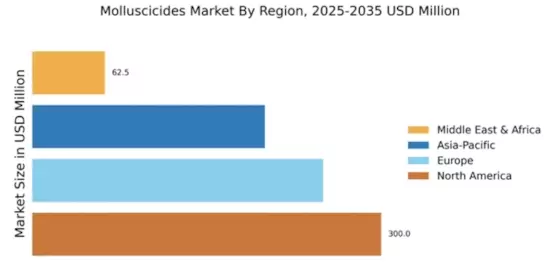
North America is poised to maintain its leadership in the molluscicides market, holding a significant share of 300.0 million in 2024. The region's growth is driven by increasing agricultural activities, rising awareness of pest control, and stringent regulations promoting eco-friendly solutions. The demand for effective molluscicides is further fueled by the need to protect crops from invasive species, ensuring food security and sustainability. The United States and Canada are the leading countries in this market, with major players like BASF SE, Bayer AG, and FMC Corporation actively participating. The competitive landscape is characterized by innovation and strategic partnerships aimed at developing advanced molluscicides. The presence of established companies ensures a robust supply chain, catering to the growing agricultural sector's needs.

Europe : Emerging Market Dynamics

Europe's molluscicides market is projected to reach 250.0 million by 2025, driven by increasing agricultural productivity and a shift towards sustainable farming practices. Regulatory frameworks in the EU are becoming more stringent, promoting the use of biopesticides and environmentally friendly solutions. This regulatory support is crucial for market growth, as it encourages innovation and the development of new products that meet safety standards. Leading countries in this region include Germany, France, and the UK, where companies like Syngenta AG and ADAMA Agricultural Solutions Ltd. are prominent. The competitive landscape is marked by a focus on research and development, with firms investing in new formulations and technologies. The presence of key players ensures a dynamic market, responding effectively to the evolving agricultural needs.

Asia-Pacific : Rapid Growth Potential

The Asia-Pacific region is witnessing rapid growth in the molluscicides market, projected to reach 200.0 million by 2025. This growth is driven by increasing agricultural production, rising pest infestations, and a growing awareness of the importance of pest control. Countries in this region are adopting modern agricultural practices, which are essential for enhancing crop yields and ensuring food security. Regulatory support for sustainable agricultural practices is also a key driver of market growth. China, India, and Australia are the leading countries in this market, with significant contributions from companies like Nufarm Limited and Sumitomo Chemical Co., Ltd. The competitive landscape is evolving, with local and international players vying for market share. The presence of key players fosters innovation and the introduction of new products tailored to regional agricultural needs.

Middle East and Africa : Emerging Market Opportunities

The Middle East and Africa region is gradually emerging in the molluscicides market, with a projected size of 62.5 million by 2025. The growth is driven by increasing agricultural activities and the need for effective pest management solutions. The region faces challenges such as limited access to advanced agricultural technologies, but there is a growing recognition of the importance of pest control in enhancing food production and security. Regulatory frameworks are evolving to support sustainable agricultural practices. Countries like South Africa and Kenya are leading the market, with local and international companies exploring opportunities in this region. The competitive landscape is characterized by a mix of established players and new entrants, focusing on developing products that cater to local agricultural needs. The presence of key players is crucial for driving innovation and market growth.

Molluscicides Market Regional Image

Key Players and Competitive Insights

The Molluscicides Market is currently characterized by a competitive landscape that is both dynamic and multifaceted. Key growth drivers include the increasing demand for sustainable agricultural practices and the rising prevalence of molluscan pests that threaten crop yields. Major players such as BASF SE (DE), Bayer AG (DE), and Syngenta AG (CH) are strategically positioned to leverage innovation and technological advancements. For instance, BASF SE (DE) has focused on developing environmentally friendly formulations, while Bayer AG (DE) emphasizes integrated pest management solutions. These strategies collectively enhance their competitive edge, fostering a market environment that prioritizes sustainability and efficiency.In terms of business tactics, companies are increasingly localizing manufacturing to reduce costs and optimize supply chains. The competitive structure of the market appears moderately fragmented, with several key players exerting influence over regional markets. This fragmentation allows for a diverse range of products and solutions, catering to varying agricultural needs across different geographies. The collective influence of these players shapes market dynamics, as they compete not only on product efficacy but also on sustainability and regulatory compliance.

In November Syngenta AG (CH) announced a partnership with a leading agricultural technology firm to enhance its digital pest management solutions. This collaboration aims to integrate AI-driven analytics into their molluscicide offerings, potentially revolutionizing how farmers monitor and manage pest populations. The strategic importance of this move lies in its alignment with the growing trend towards precision agriculture, which seeks to optimize resource use and minimize environmental impact.Similarly, in October 2025, FMC Corporation (US) launched a new line of molluscicides that utilize biopesticide technology. This innovation not only addresses the efficacy concerns associated with traditional chemical molluscicides but also aligns with the increasing regulatory pressures for safer agricultural inputs. The introduction of biopesticides could position FMC Corporation (US) as a leader in sustainable pest management solutions, appealing to environmentally conscious consumers and regulators alike.Moreover, in September 2025, ADAMA Agricultural Solutions Ltd. (IL) expanded its product portfolio by acquiring a niche player specializing in organic molluscicides. This acquisition is indicative of a broader trend towards diversification and the integration of organic solutions into conventional pest management strategies. By enhancing its product offerings, ADAMA Agricultural Solutions Ltd. (IL) is likely to capture a larger market share, particularly among organic farmers seeking effective molluscicide options.

As of December current competitive trends in the Molluscicides Market are increasingly defined by digitalization, sustainability, and the integration of AI technologies. Strategic alliances are becoming pivotal in shaping the landscape, as companies seek to enhance their technological capabilities and market reach. Looking ahead, competitive differentiation is expected to evolve, with a pronounced shift from price-based competition to a focus on innovation, technological advancements, and supply chain reliability. This transition underscores the importance of developing sustainable and effective solutions that meet the evolving demands of the agricultural sector.

Key Companies in the Molluscicides Market include

Industry Developments

October 2020: The acquisition of Agrinos (US), a privately held technical pioneer in biological crop inputs, by American Vanguard Corporation was announced. The business would then be able to increase the variety of products it offers in North America.

August 2020: An agreement between Marrone Bio Innovations and Vive Crop Protection (Canada) for the extraction of active components for the molluscicides market was announced.

January 2020: To enhance its production capacity in the Asia Pacific area, BASF SE opened a new crop protection facility in Singapore. This will meet the growing demand for high-quality items for farming from the local farmers.

Future Outlook

Molluscicides Market Future Outlook

The Molluscicides is projected to grow at a 5.47% CAGR from 2025 to 2035, driven by increasing agricultural demands and environmental sustainability initiatives.

New opportunities lie in:

  • Development of biopesticide formulations targeting specific mollusc species.
  • Expansion into emerging markets with tailored product offerings.
  • Investment in precision application technologies to enhance efficacy and reduce waste.

By 2035, the molluscicides market is expected to achieve robust growth, reflecting evolving agricultural practices and consumer preferences.

Market Segmentation

Molluscicides Market Application Outlook

  • Agriculture
  • Horticulture
  • Aquaculture
  • Public Health

Molluscicides Market Mode of Action Outlook

  • Contact
  • Ingestion
  • Systemic

Molluscicides Market Target Organism Outlook

  • Snails
  • Slugs
  • Other Gastropods

Molluscicides Market Formulation Type Outlook

  • Granular
  • Liquid
  • Pellet
  • Emulsifiable Concentrate

Molluscicides Market Regulatory Status Outlook

  • Registered
  • Pending Approval
  • Banned

Report Scope

MARKET SIZE 2024 812.5(USD Million)
MARKET SIZE 2025 866.26(USD Million)
MARKET SIZE 2035 1466.02(USD Million)
COMPOUND ANNUAL GROWTH RATE (CAGR) 5.47% (2025 - 2035)
REPORT COVERAGE Revenue Forecast, Competitive Landscape, Growth Factors, and Trends
BASE YEAR 2024
Market Forecast Period 2025 - 2035
Historical Data 2019 - 2024
Market Forecast Units USD Million
Key Companies Profiled BASF SE (DE), Bayer AG (DE), Syngenta AG (CH), FMC Corporation (US), ADAMA Agricultural Solutions Ltd. (IL), Nufarm Limited (AU), Sumitomo Chemical Co., Ltd. (JP), UPL Limited (IN), Isagro S.p.A. (IT)
Segments Covered Application, Formulation Type, Target Organism, Mode of Action, Regulatory Status
Key Market Opportunities Advancements in biopesticides and regulatory support enhance growth potential in the Molluscicides Market.
Key Market Dynamics Rising environmental regulations drive innovation and demand for sustainable molluscicides in agricultural practices.
Countries Covered North America, Europe, APAC, South America, MEA

Market Highlights

Author
Author
Author Profile
Snehal Singh LinkedIn
Manager - Research
High acumen in analyzing complex macro & micro markets with more than 6 years of work experience in the field of market research. By implementing her analytical skills in forecasting and estimation into market research reports, she has expertise in Packaging, Construction, and Equipment domains. She handles a team size of 20-25 resources and ensures smooth running of the projects, associated marketing activities, and client servicing.
Co-Author
Co-Author Profile
Varsha More LinkedIn
Senior Research Analyst
Experienced business professional with a demonstrated history of working in the CFnB industry. Skilled in market research, and market estimation. Strong professional with a Masters focused in marketing management.
Leave a Comment

FAQs

What is the current valuation of the Molluscicides Market as of 2024?

<p>The Molluscicides Market was valued at 812.5 USD Million in 2024.</p>

What is the projected market valuation for the Molluscicides Market in 2035?

<p>The market is projected to reach 1466.02 USD Million by 2035.</p>

What is the expected CAGR for the Molluscicides Market during the forecast period 2025 - 2035?

<p>The expected CAGR for the Molluscicides Market during 2025 - 2035 is 5.47%.</p>

Which companies are considered key players in the Molluscicides Market?

<p>Key players in the market include BASF SE, Bayer AG, Syngenta AG, FMC Corporation, and others.</p>

What are the primary applications of molluscicides in the market?

<p>The primary applications include Agriculture, Horticulture, Aquaculture, and Public Health, with Agriculture valued at 300.0 to 550.0 USD Million.</p>

How is the Molluscicides Market segmented by formulation type?

<p>The market is segmented into Granular, Liquid, Pellet, and Emulsifiable Concentrate, with Liquid valued at 325.0 to 590.0 USD Million.</p>

What target organisms are primarily addressed by molluscicides?

The primary target organisms include Snails, Slugs, and Other Gastropods, with Snails valued at 300.0 to 550.0 USD Million.

What modes of action are utilized by molluscicides in the market?

Molluscicides operate through Contact, Ingestion, and Systemic modes, with Ingestion valued at 325.0 to 590.0 USD Million.

What is the regulatory status of molluscicides in the market?

The regulatory status includes Registered, Pending Approval, and Banned, with Registered products valued at 500.0 to 900.0 USD Million.

How does the market performance of molluscicides in 2024 compare to projections for 2035?

The market performance in 2024 at 812.5 USD Million is expected to grow to 1466.02 USD Million by 2035.

Download Free Sample

Kindly complete the form below to receive a free sample of this Report

Compare Licence

×
Features License Type
Single User Multiuser License Enterprise User
Price $4,950 $5,950 $7,250
Maximum User Access Limit 1 User Upto 10 Users Unrestricted Access Throughout the Organization
Free Customization
Direct Access to Analyst
Deliverable Format
Platform Access
Discount on Next Purchase 10% 15% 15%
Printable Versions