×
Hero Background
English
Chinese
French
Japanese
Korean
German
Spanish

Organic Baby Food Market Trends

ID: MRFR/FnB/1082-CR
197 Pages
Snehal Singh
July 2018

Organic Baby Food Market Research Report Information By Product Type (Prepared Baby Food, Milk Formula, Dried Baby Food and Others), By Ingredients (Grains & Cereals, Dairy and Vegetables and Fruits), By Distribution Channel (Store-Based and Non-Store Based), and By Region (North America, Europe, Asia-Pacific, And Rest Of The World) – Market Forecast Till 2035

Share:
Download PDF ×

We do not share your information with anyone. However, we may send you emails based on your report interest from time to time. You may contact us at any time to opt-out.

Organic Baby Food Market Infographic
Purchase Options

Market Trends

Key Emerging Trends in the Organic Baby Food Market

The Organic Baby Food Market is showing changes that mirror current customer tastes and needs. The growing emphasis on health and fitness is leading parents to pick organic baby products. As knowledge of organic goods' health advantages rises, more parents want infant food without pesticides, synthetic chemicals, or GMOs. This trend follows a tendency toward clean diet and natural baby nourishment.

The rise in food production transparency and traceability is another trend. Consumers want to know where baby food components come from, how it's made, and the supply chain. This trend prompts brands to highlight organic certification, origin, and the lack of harmful substances on their packaging. This transparency creates confidence with consumers who appreciate understanding what goes into their babies' nourishment.

Flavor innovation is also trending in organic baby food. Parents today want distinct flavor profiles for their newborns, not bland ones. Superfoods and exotic fruits are being added to tastes and ingredient combinations by brands. This trend pleases kids' taste senses and supports the increased interest in introducing newborns to a variety of healthful foods early on.

With more parents choosing ready-to-eat and portable organic baby food, convenience drives market trends. Busy lives and dual-income homes drive demand for portable, easy-to-use infant food. Brands are responding with pouches and single-serving containers for easy feeding.

Organic Baby Food Market sustainability is becoming a major trend, reflecting environmental concerns. Consumers are increasingly more ecologically mindful, even their newborn selections. Environmentally conscious parents prefer brands with sustainable packaging, sourcing, and production. This trend indicates a shift toward holistic infant food sustainability.

E-commerce is impacting market trends by giving customers easy access to a variety of organic baby food items. Online platforms let parents compare brands, read reviews, and make educated choices. The simplicity of doorstep delivery boosts e-commerce in organic baby food.

Also notable is social media and digital platforms' effect. Online forums and platforms are helping parents share experiences, seek advice, and learn about infant care trends, like organic baby food. Social media is being used by brands to engage parents, provide information, and promote brand loyalty, making organic infant nutrition debates vibrant and participatory.

Author
Snehal Singh
Assistant Manager - Research

High acumen in analyzing complex macro & micro markets with more than 6 years of work experience in the field of market research. By implementing her analytical skills in forecasting and estimation into market research reports, she has expertise in Packaging, Construction, and Equipment domains. She handles a team size of 20-25 resources and ensures smooth running of the projects, associated marketing activities, and client servicing.

Leave a Comment

FAQs

What is the current valuation of The Global Organic Baby Food?

The market valuation was 12.8 USD Billion in 2024.

What is the projected market size for The Global Organic Baby Food by 2035?

The market is projected to reach 37.9 USD Billion by 2035.

What is the expected CAGR for The Global Organic Baby Food during the forecast period 2025 - 2035?

The expected CAGR is 10.37% during the forecast period 2025 - 2035.

Which segment of The Global Organic Baby Food had the highest valuation in 2024?

In 2024, the Milk Formula segment had a valuation of 4.8 USD Billion.

What are the projected valuations for the Prepared Baby Food segment by 2035?

The Prepared Baby Food segment is projected to reach 11.52 USD Billion by 2035.

Which ingredient category is expected to dominate The Global Organic Baby Food?

Vegetables and Fruits are projected to dominate with a valuation of 18.88 USD Billion by 2035.

What distribution channel is anticipated to have the largest market share in 2035?

The Store-Based distribution channel is expected to reach 24.0 USD Billion by 2035.

Who are the key players in The Global Organic Baby Food?

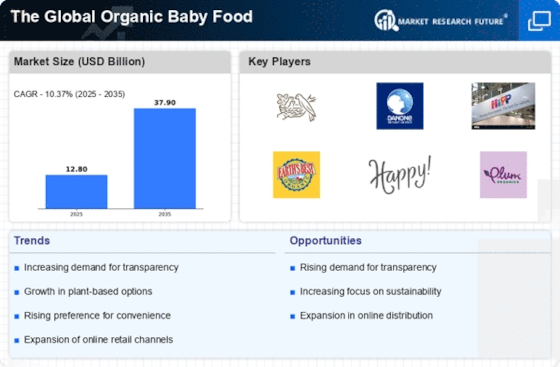
Key players include Nestle, Danone, Hipp, Earth's Best, Happy Baby, Plum Organics, Baby Gourmet, and Little Spoon.

What is the valuation of the Dried Baby Food segment in 2024?

The Dried Baby Food segment had a valuation of 2.56 USD Billion in 2024.

How does the Non-Store-Based distribution channel compare to Store-Based in 2035?

By 2035, the Non-Store-Based channel is projected to reach 13.9 USD Billion, significantly lower than the Store-Based channel.

Market Summary

As per MRFR analysis, The Global Organic Baby Food Market was estimated at 12.8 USD Billion in 2024. The organic baby food industry is projected to grow from 14.13 USD Billion in 2025 to 37.9 USD Billion by 2035, exhibiting a compound annual growth rate (CAGR) of 10.37 during the forecast period 2025 - 2035.

Key Market Trends & Highlights

The Global Organic Baby Food Market is experiencing robust growth driven by health consciousness and sustainability initiatives.

  • North America remains the largest market for organic baby food, reflecting a strong demand for health-conscious products.
  • Asia-Pacific is identified as the fastest-growing region, indicating a rising trend in organic consumption among parents.
  • Prepared baby food dominates the market, while the milk formula segment is witnessing the fastest growth due to increasing health awareness.
  • Key market drivers include health awareness among parents and sustainability initiatives, which are shaping consumer preferences.

Market Size & Forecast

2024 Market Size 12.8 (USD Billion)
2035 Market Size 37.9 (USD Billion)
CAGR (2025 - 2035) 10.37%
Largest Regional Market Share in 2024 North America

Major Players

<p>Nestle (CH), Danone (FR), Hipp (DE), Earth's Best (US), Happy Baby (US), Plum Organics (US), Baby Gourmet (CA), Little Spoon (US)</p>

Market Trends

The Global Organic Baby Food Market is currently experiencing a notable transformation, driven by a growing awareness among parents regarding the nutritional value of organic products. This shift appears to stem from an increasing concern for health and wellness, as caregivers seek to provide their infants with food that is free from harmful chemicals and additives. The market seems to be expanding as more brands emerge, offering a diverse range of organic options that cater to various dietary needs and preferences. Additionally, the rise of e-commerce platforms has facilitated easier access to organic baby food, allowing consumers to explore and purchase products from the comfort of their homes. Moreover, The Global Organic Baby Food Market is likely to witness further growth as sustainability becomes a focal point for consumers. Parents are increasingly inclined to support brands that prioritize environmentally friendly practices, such as sustainable sourcing and eco-friendly packaging. This trend suggests that companies may need to adapt their strategies to align with the values of their target audience. As the market evolves, it is essential for stakeholders to remain attuned to these changing dynamics, ensuring that they meet the demands of health-conscious consumers while also addressing broader environmental concerns.

Health Consciousness

There is a growing trend among parents to prioritize health and nutrition for their children. This focus on organic ingredients reflects a desire to avoid harmful additives and chemicals, leading to increased demand for organic baby food.

Sustainability Initiatives

Brands are increasingly adopting sustainable practices, such as eco-friendly packaging and responsible sourcing. This trend indicates a shift towards environmental consciousness among consumers, who prefer products that align with their values.

E-commerce Growth

The rise of online shopping platforms is transforming how consumers access organic baby food. This trend suggests that convenience and accessibility are becoming key factors in purchasing decisions, allowing parents to explore a wider range of products.

Organic Baby Food Market Market Drivers

E-commerce Expansion

The rapid expansion of e-commerce platforms is transforming The Global Organic Baby Food Industry. With the convenience of online shopping, parents are increasingly turning to digital channels to purchase organic baby food. Recent statistics indicate that online sales of organic baby food have surged, accounting for nearly 30% of total sales in some regions. This shift towards e-commerce not only broadens the market reach for brands but also enhances accessibility for consumers. As more parents embrace online shopping, the industry is likely to witness continued growth, driven by the ease of purchasing organic products from the comfort of their homes.

Innovative Product Offerings

Innovation in product offerings is a significant driver for The Global Organic Baby Food Industry. Manufacturers are continuously developing new and diverse organic baby food products to cater to the evolving preferences of parents. This includes the introduction of unique flavors, textures, and packaging solutions that appeal to both parents and infants. Recent market analysis indicates that innovative products, such as organic baby snacks and ready-to-eat meals, are gaining traction among consumers. This trend towards innovation is likely to enhance market competitiveness and attract a broader consumer base, ultimately contributing to the growth of the organic baby food sector.

Health Awareness Among Parents

The increasing health awareness among parents appears to be a pivotal driver for The Global Organic Baby Food Industry. Parents are becoming more discerning about the nutritional content of the food they provide to their children. This trend is reflected in the rising demand for organic baby food products, which are perceived as healthier alternatives to conventional options. According to recent data, the organic baby food segment has experienced a growth rate of approximately 10% annually, indicating a robust shift towards organic consumption. This heightened focus on health is likely to continue influencing purchasing decisions, as parents seek products that align with their values of health and wellness for their children.

Sustainability and Ethical Consumption

Sustainability initiatives are increasingly shaping consumer preferences in The Global Organic Baby Food Industry. As environmental concerns gain prominence, parents are more inclined to choose products that are sustainably sourced and produced. This shift is not merely a trend but appears to be a fundamental change in consumer behavior. Data suggests that a significant portion of consumers is willing to pay a premium for organic baby food that adheres to ethical production practices. This inclination towards sustainability is likely to drive innovation within the industry, as brands strive to meet the expectations of environmentally conscious consumers.

Regulatory Support for Organic Products

Regulatory support for organic products is a crucial driver in The Global Organic Baby Food Industry. Governments worldwide are implementing stringent regulations to ensure the safety and quality of organic food products. This regulatory framework not only instills consumer confidence but also encourages manufacturers to adhere to organic standards. As a result, the market is witnessing an influx of certified organic baby food products, which are increasingly favored by health-conscious parents. The presence of robust regulatory support is likely to foster growth in the organic segment, as it reassures consumers about the integrity of the products they purchase.

Market Segment Insights

By Type: Prepared Baby Food (Largest) vs. Milk Formula (Fastest-Growing)

<p>The Global Organic Baby Food Market exhibits a diverse landscape, with the 'Prepared Baby Food' segment commanding a significant market share. This segment is well-received by consumers for its convenience and wide range of flavors and nutritional options tailored for infants. In contrast, 'Milk Formula' has emerged as a key player, showing robust growth due to parents' increasing awareness about organic nutrition and the shift towards healthier feeding options for their babies. This growing segment reflects the changing dynamics of consumer preferences in the organic food space.</p>

<p>Prepared Baby Food (Dominant) vs. Milk Formula (Emerging)</p>

<p>Prepared Baby Food remains the dominant segment in The Global Organic Baby Food Market, primarily due to its ready-to-eat convenience and rich variety. This segment appeals to busy parents who seek nutritious and safe meals for their children without the hassle of preparation. On the other hand, Milk Formula is viewed as an emerging segment, gaining traction as more parents recognize its organic benefits and the importance of tailored nutrition for their infants. The rising demand for organic and responsibly-sourced ingredients in formula products is driving its rapid expansion, highlighting a preference shift towards premium, health-focused options.</p>

By Ingredients: Grains & Cereals (Largest) vs. Vegetables and Fruits (Fastest-Growing)

<p>In The Global Organic Baby Food Market, the 'Ingredients' segment is prominently defined by its subcategories: Grains & Cereals, Dairy, Vegetables, and Fruits. Grains & Cereals holds the largest share, serving as a staple component for infant nutrition due to their rich carbohydrate content and easy digestibility. Dairy follows closely, providing essential nutrients that support the growth and development of infants. Vegetables and Fruits, while currently positioned third, are increasingly gaining popularity as parents lean towards more plant-based diets for their children, thus shaping the market dynamics.</p>

<p>Grains & Cereals: Dominant vs. Vegetables and Fruits: Emerging</p>

<p>Grains & Cereals are recognized as the dominant ingredient in organic baby foods, offering a wide range of options such as rice cereals and oatmeal which appeal to parents seeking nutritious and convenient feeding solutions. Their established presence is bolstered by the perception of safety and quality that organic products provide. On the other hand, Vegetables and Fruits represent an emerging focus within this market, driven by the increasing awareness of the health benefits of plant-based diets. These segments are capitalizing on trends such as clean labeling and organic sourcing, as parents prioritize wholesome, recognizable ingredients. As a result, the preference for vegetable and fruit purees is accelerating, reflecting a shift towards diversity in dietary choices for infants.</p>

By Distribution Channel: Store-Based (Largest) vs. Non-Store-Based (Fastest-Growing)

<p>In The Global Organic Baby Food Market, the Store-Based distribution channel remains the dominant player, accounting for a significant portion of the market share. This channel includes traditional retail stores, supermarkets, and hypermarkets, providing consumers with the tangible experience of selecting products and immediate access. With an increasing trend towards organic lifestyles, consumers are increasingly drawn to stores that offer dedicated organic sections, boosting the market position of store-based distribution in the organic baby food segment. Conversely, the Non-Store-Based distribution channel is emerging rapidly, capitalizing on the digitalization of retail. E-commerce platforms and direct-to-consumer websites are gaining popularity, especially among tech-savvy parents who prefer the convenience of online shopping. The rise of subscription services for baby food also contributes to this segment's fastest growth, as it simplifies purchasing processes and offers tailored options for organic baby food, appealing to a growing demographic of eco-conscious families.</p>

<p>Distribution Channel: Store-Based (Dominant) vs. Non-Store-Based (Emerging)</p>

<p>The Store-Based distribution channel in The Global Organic Baby Food Market is characterized by its widespread reach and accessibility, making it the preferred choice for many consumers. This channel's strength lies in its ability to deliver a hands-on shopping experience where parents can personally evaluate organic products. With increased focus on health and nutrition, retail stores with organic sections cater to a larger market base. In contrast, the Non-Store-Based channel, which includes online platforms, is distinguished by its rapid growth and innovation, driven by changes in consumer behavior. As more parents opt for the convenience of online purchasing, this channel enhances accessibility to organic baby food, offering a wide range of products and delivery options that resonate with modern lifestyle needs.</p>

Get more detailed insights about Organic Baby Food Market Research Report - Forecast to 2035

Regional Insights

By region, the study provides the market insights for organic baby food into North America, Europe, Asia-Pacific and Rest of the World. North America organic baby food market accounted for USD 4.8 billion in 2022 with a share of around 45.80% and is expected to exhibit a significant CAGR growth during the study period because there are many market players and more consumer spending power in these areas. A growing market for various baby food products has been fueled by the region's booming organic food industry.

Leading companies are also utilizing tactical actions to boost sales of their line of baby food products in these areas.

Further, the major countries studied in the market report for organic baby food are: The U.S, Canada, Germany, France, UK, Italy, Spain, China, Japan, India, Australia, South Korea, and Brazil.

Europe organic baby food market accounts for the second-largest market share due to the rising demand for infant food products with clean labels and sustainability. Over the past few years, consumer preferences for infant food have evolved towards purchasing safer, healthier, and organic items. Thus, the region's growth will be fueled by the rising demand for items that are organic, non-GMO, lactose-free, and made from plants. Further, the UK mmarket of organic baby food held the largest market share, and the Germany organic baby food industry was the fastest growing market in the region.

Asia Pacific organic baby food Market is expected to grow at the fastest CAGR from 2022 to 2030 because organic products are becoming more popular with consumers. The demand for organic products is being driven by customers' rising disposable budgets and evolving lifestyles. Furthermore, the forecast for the Asia-Pacific region will improve with the growth of the super industry. Moreover, China organic baby food industry held the largest market share, and the India organic baby food was the fastest growing market in the region.

Key Players and Competitive Insights

The Global Organic Baby Food is currently characterized by a dynamic competitive landscape, driven by increasing consumer demand for healthier, organic options for infants. Key players such as Nestle (CH), Danone (FR), and Hipp (DE) are strategically positioned to leverage this trend through innovation and regional expansion. Nestle (CH) has focused on enhancing its product portfolio with organic offerings, while Danone (FR) emphasizes sustainability in its sourcing and production processes. Hipp (DE) continues to strengthen its market presence through partnerships with local suppliers, ensuring high-quality ingredients. Collectively, these strategies not only enhance brand loyalty but also shape a competitive environment that prioritizes health and sustainability.

In terms of business tactics, companies are increasingly localizing manufacturing to reduce supply chain complexities and enhance responsiveness to market demands. The market structure appears moderately fragmented, with several players vying for market share, yet the influence of major companies remains substantial. This competitive structure allows for a diverse range of products, catering to varying consumer preferences while fostering innovation across the sector.

In August 2025, Nestle (CH) announced the launch of a new line of organic baby food products specifically designed for infants with dietary restrictions. This strategic move is indicative of Nestle's commitment to inclusivity and health, potentially capturing a niche market segment that has been underserved. By addressing specific dietary needs, Nestle not only broadens its consumer base but also reinforces its position as a leader in the organic baby food sector.

In September 2025, Danone (FR) unveiled a partnership with a tech startup to integrate AI-driven analytics into its supply chain management. This initiative aims to enhance operational efficiency and reduce waste, aligning with Danone's sustainability goals. The integration of advanced technology into traditional supply chains could significantly improve product availability and reduce costs, thereby strengthening Danone's competitive edge in the market.

In July 2025, Hipp (DE) expanded its distribution network in Asia by collaborating with local retailers to increase accessibility to its organic products. This strategic expansion not only enhances Hipp's market presence but also reflects a growing trend of international companies tapping into emerging markets. By localizing its distribution, Hipp is likely to gain a competitive advantage in regions where organic baby food demand is on the rise.

As of October 2025, the competitive trends in The Global Organic Baby Food are increasingly defined by digitalization, sustainability, and technological integration. Strategic alliances are becoming more prevalent, allowing companies to pool resources and expertise to innovate more effectively. Looking ahead, competitive differentiation is expected to evolve from traditional price-based competition to a focus on innovation, technology, and supply chain reliability, as companies strive to meet the growing consumer demand for high-quality, organic products.

Key Companies in the Organic Baby Food Market market include

Industry Developments

April 2021: Happy Baby Savory Blends, a new pouch line from Happy Family Organics, was introduced. These goods were designed with babies and toddlers older than six months in mind.

March 2021: Plum Organics, a top-tier, organic baby food and children's snack brand, was purchased by Sun-Maid Growers of California from Campbell Soup Company. Sun-Maid wants to improve its market position in the baby food sector through this acquisition.

Future Outlook

Organic Baby Food Market Future Outlook

<p>The Global Organic Baby Food Market is projected to grow at a 10.37% CAGR from 2024 to 2035, driven by increasing health consciousness and demand for organic products.</p>

New opportunities lie in:

  • <p>Expansion into online retail platforms for direct-to-consumer sales.</p>
  • <p>Development of subscription-based organic baby food services.</p>
  • <p>Investment in sustainable packaging solutions to enhance brand appeal.</p>

<p>By 2035, the market is expected to solidify its position as a leader in the organic food sector.</p>

Market Segmentation

Organic Baby Food Market Type Outlook

  • Prepared Baby Food
  • Milk Formula
  • Dried Baby Food
  • Others

Organic Baby Food Market Ingredients Outlook

  • Grains & Cereals
  • Dairy
  • Vegetables and Fruits

Organic Baby Food Market Distribution Channel Outlook

  • Store-Based
  • Non-Store-Based

Report Scope

MARKET SIZE 202412.8(USD Billion)
MARKET SIZE 202514.13(USD Billion)
MARKET SIZE 203537.9(USD Billion)
COMPOUND ANNUAL GROWTH RATE (CAGR)10.37% (2024 - 2035)
REPORT COVERAGERevenue Forecast, Competitive Landscape, Growth Factors, and Trends
BASE YEAR2024
Market Forecast Period2025 - 2035
Historical Data2019 - 2024
Market Forecast UnitsUSD Billion
Key Companies ProfiledMarket analysis in progress
Segments CoveredMarket segmentation analysis in progress
Key Market OpportunitiesGrowing consumer preference for clean-label products drives innovation in The Global Organic Baby Food.
Key Market DynamicsRising consumer demand for organic products drives innovation and competition in the organic baby food sector.
Countries CoveredNorth America, Europe, APAC, South America, MEA

FAQs

What is the current valuation of The Global Organic Baby Food?

The market valuation was 12.8 USD Billion in 2024.

What is the projected market size for The Global Organic Baby Food by 2035?

The market is projected to reach 37.9 USD Billion by 2035.

What is the expected CAGR for The Global Organic Baby Food during the forecast period 2025 - 2035?

The expected CAGR is 10.37% during the forecast period 2025 - 2035.

Which segment of The Global Organic Baby Food had the highest valuation in 2024?

In 2024, the Milk Formula segment had a valuation of 4.8 USD Billion.

What are the projected valuations for the Prepared Baby Food segment by 2035?

The Prepared Baby Food segment is projected to reach 11.52 USD Billion by 2035.

Which ingredient category is expected to dominate The Global Organic Baby Food?

Vegetables and Fruits are projected to dominate with a valuation of 18.88 USD Billion by 2035.

What distribution channel is anticipated to have the largest market share in 2035?

The Store-Based distribution channel is expected to reach 24.0 USD Billion by 2035.

Who are the key players in The Global Organic Baby Food?

Key players include Nestle, Danone, Hipp, Earth's Best, Happy Baby, Plum Organics, Baby Gourmet, and Little Spoon.

What is the valuation of the Dried Baby Food segment in 2024?

The Dried Baby Food segment had a valuation of 2.56 USD Billion in 2024.

How does the Non-Store-Based distribution channel compare to Store-Based in 2035?

By 2035, the Non-Store-Based channel is projected to reach 13.9 USD Billion, significantly lower than the Store-Based channel.

  1. Executive Summary
  2. Market Introduction
    1. Definition 21
    2. Scope of the Study 21
    3. Assumptions 22
    4. Market Structure 22
    5. Key Takeaways 23
    6. Key Buying Criteria 23
  3. Research Methodology
    1. Research Process 25
    2. Primary Research 26
    3. Secondary Research 27
    4. Market Size Estimation 27
    5. Forecast Model 28
  4. Market Dynamics
    1. Introduction 30
    2. Drivers 30
      1. Increasing demand for convenience food 30
      2. Climate change and need of sustainable agriculture 32
      3. Easier raw material availability and efficiency in production 32
      4. Rising demand of organic products 32
      5. Trend of food traceability 33
      6. Drivers Impact Analysis 33
    3. Restraints 34
      1. Higher price of organic baby food 34
      2. Lack of awareness about organic baby food 34
      3. Low shelf life of organic baby food 34
      4. Restraints Impact Analysis 35
    4. Opportunities 35
      1. Huge investments in R&D and new product developments 35
      2. Government initiatives and funding to support the farmers 35
      3. Increasing demand of clean label products 36
    5. Challenges 36
      1. Huge capital investments and certifications 36
    6. Mega Trends 37
      1. Import & Export Scenario 37
    7. Innovation in application and process 38
  5. Market Factor Analysis
    1. Value Chain Analysis 43
    2. Supply Chain Analysis 44
    3. Porter’s Five Forces Analysis 45
      1. Threat of New Entrants 45
      2. Threat of Substitutes 46
      3. Bargaining Power of Buyers 46
      4. Bargaining Power of Suppliers 47
      5. Intensity of Rivalry 47
  6. Organic Baby Food Market, By Product Type
    1. Overview 49
      1. Ready to eat 49
      2. Milk Formula 49
      3. Dried Baby Food 49
      4. Others 49
  7. Organic Baby Food Market, By Ingredients
    1. Overview 55
      1. Grains & Cereals 55
      2. Dairy 55
      3. Vegetables 55
      4. Fruits 55
      5. Others 55
  8. Organic Baby Food Market, By Distribution Channel
    1. Overview 62
      1. Store Based 62
      2. Non-store Based 62
  9. Global Organic Baby Food Market, By Region
    1. Introduction 66
    2. North America 67
  10. Organic Baby Food Market, By Product Type
  11. Organic Baby Food Market, By Ingredients
  12. Organic Baby Food Market, By Distribution Channel
  13. North America Organic Baby Food Market, By Country 67
  14. Organic Baby Food Market, By Product Type
  15. Organic Baby Food Market, By Ingredients
  16. Organic Baby Food Market, By Distribution Channel
  17. North America Organic Baby Food Market, By Product Type 68
  18. Organic Baby Food Market, By Product Type
  19. Organic Baby Food Market, By Ingredients
  20. Organic Baby Food Market, By Distribution Channel
  21. North America Organic Baby Food Market, By Ingredients Type 69
  22. Organic Baby Food Market, By Product Type
  23. Organic Baby Food Market, By Ingredients
  24. Organic Baby Food Market, By Distribution Channel
  25. North America Organic Baby Food Market, By Distribution Channel 71
  26. Organic Baby Food Market, By Product Type
  27. Organic Baby Food Market, By Ingredients
  28. Organic Baby Food Market, By Distribution Channel
  29. U.S. 72
  30. Organic Baby Food Market, By Product Type
  31. Organic Baby Food Market, By Ingredients
  32. Organic Baby Food Market, By Distribution Channel
  33. Canada 75
  34. Organic Baby Food Market, By Product Type
  35. Organic Baby Food Market, By Ingredients
  36. Organic Baby Food Market, By Distribution Channel
  37. Mexico 78
  38. Organic Baby Food Market, By Product Type
  39. Organic Baby Food Market, By Ingredients
  40. Organic Baby Food Market, By Distribution Channel
    1. Europe 81
  41. Organic Baby Food Market, By Product Type
  42. Organic Baby Food Market, By Ingredients
  43. Organic Baby Food Market, By Distribution Channel
  44. Europe Organic Baby Food Market, By Country 81
  45. Organic Baby Food Market, By Product Type
  46. Organic Baby Food Market, By Ingredients
  47. Organic Baby Food Market, By Distribution Channel
  48. Europe Organic Baby Food Market, By Product Type 83
  49. Organic Baby Food Market, By Product Type
  50. Organic Baby Food Market, By Ingredients
  51. Organic Baby Food Market, By Distribution Channel
  52. Europe Organic Baby Food Market, By Ingredients Type 84
  53. Organic Baby Food Market, By Product Type
  54. Organic Baby Food Market, By Ingredients
  55. Organic Baby Food Market, By Distribution Channel
  56. Europe Organic Baby Food Market, By Distribution Channel 85
  57. Organic Baby Food Market, By Product Type
  58. Organic Baby Food Market, By Ingredients
  59. Organic Baby Food Market, By Distribution Channel
  60. U.K 86
  61. Organic Baby Food Market, By Product Type
  62. Organic Baby Food Market, By Ingredients
  63. Organic Baby Food Market, By Distribution Channel
  64. Germany 89
  65. Organic Baby Food Market, By Product Type
  66. Organic Baby Food Market, By Ingredients
  67. Organic Baby Food Market, By Distribution Channel
  68. France 92
  69. Organic Baby Food Market, By Product Type
  70. Organic Baby Food Market, By Ingredients
  71. Organic Baby Food Market, By Distribution Channel
  72. Italy 95
  73. Organic Baby Food Market, By Product Type
  74. Organic Baby Food Market, By Ingredients
  75. Organic Baby Food Market, By Distribution Channel
  76. Spain 99
  77. Organic Baby Food Market, By Product Type
  78. Organic Baby Food Market, By Ingredients
  79. Organic Baby Food Market, By Distribution Channel
  80. Russia 102
  81. Organic Baby Food Market, By Product Type
  82. Organic Baby Food Market, By Ingredients
  83. Organic Baby Food Market, By Distribution Channel
  84. Rest of Europe 105
  85. Organic Baby Food Market, By Product Type
  86. Organic Baby Food Market, By Ingredients
  87. Organic Baby Food Market, By Distribution Channel
    1. Asia-Pacific 108
  88. Organic Baby Food Market, By Product Type
  89. Organic Baby Food Market, By Ingredients
  90. Organic Baby Food Market, By Distribution Channel
  91. Asia-Pacific Organic Baby Food Market, By Country 108
  92. Organic Baby Food Market, By Product Type
  93. Organic Baby Food Market, By Ingredients
  94. Organic Baby Food Market, By Distribution Channel
  95. Asia-Pacific Organic Baby Food Market, By Product Type 109
  96. Organic Baby Food Market, By Product Type
  97. Organic Baby Food Market, By Ingredients
  98. Organic Baby Food Market, By Distribution Channel
  99. Asia-Pacific Organic Baby Food Market, By Ingredients Type 110
  100. Organic Baby Food Market, By Product Type
  101. Organic Baby Food Market, By Ingredients
  102. Organic Baby Food Market, By Distribution Channel
  103. Asia-Pacific Organic Baby Food Market, By Distribution Channel 111
  104. Organic Baby Food Market, By Product Type
  105. Organic Baby Food Market, By Ingredients
  106. Organic Baby Food Market, By Distribution Channel
  107. China 112
  108. Organic Baby Food Market, By Product Type
  109. Organic Baby Food Market, By Ingredients
  110. Organic Baby Food Market, By Distribution Channel
  111. India 116
  112. Organic Baby Food Market, By Product Type
  113. Organic Baby Food Market, By Ingredients
  114. Organic Baby Food Market, By Distribution Channel
  115. Japan 119
  116. Organic Baby Food Market, By Product Type
  117. Organic Baby Food Market, By Ingredients
  118. Organic Baby Food Market, By Distribution Channel
  119. Australia 122
  120. Organic Baby Food Market, By Product Type
  121. Organic Baby Food Market, By Ingredients
  122. Organic Baby Food Market, By Distribution Channel
  123. New Zealand 126
  124. Organic Baby Food Market, By Product Type
  125. Organic Baby Food Market, By Ingredients
  126. Organic Baby Food Market, By Distribution Channel
  127. Indonesia 129
  128. Organic Baby Food Market, By Product Type
  129. Organic Baby Food Market, By Ingredients
  130. Organic Baby Food Market, By Distribution Channel
  131. Rest of APAC 132
  132. Organic Baby Food Market, By Product Type
  133. Organic Baby Food Market, By Ingredients
  134. Organic Baby Food Market, By Distribution Channel
    1. Latin America 135
  135. Organic Baby Food Market, By Product Type
  136. Organic Baby Food Market, By Ingredients
  137. Organic Baby Food Market, By Distribution Channel
  138. Latin America Organic Baby Food Market, By Country 135
  139. Organic Baby Food Market, By Product Type
  140. Organic Baby Food Market, By Ingredients
  141. Organic Baby Food Market, By Distribution Channel
  142. Latin America Organic Baby Food Market, By Product Type 136
  143. Organic Baby Food Market, By Product Type
  144. Organic Baby Food Market, By Ingredients
  145. Organic Baby Food Market, By Distribution Channel
  146. Latin America Organic Baby Food Market, By Ingredients Type 137
  147. Organic Baby Food Market, By Product Type
  148. Organic Baby Food Market, By Ingredients
  149. Organic Baby Food Market, By Distribution Channel
  150. Latin America Organic Baby Food Market, By Distribution Channel 139
  151. Organic Baby Food Market, By Product Type
  152. Organic Baby Food Market, By Ingredients
  153. Organic Baby Food Market, By Distribution Channel
  154. Brazil 140
  155. Organic Baby Food Market, By Product Type
  156. Organic Baby Food Market, By Ingredients
  157. Organic Baby Food Market, By Distribution Channel
  158. Argentina 143
  159. Organic Baby Food Market, By Product Type
  160. Organic Baby Food Market, By Ingredients
  161. Organic Baby Food Market, By Distribution Channel
  162. Rest of Latin America 146
  163. Organic Baby Food Market, By Product Type
  164. Organic Baby Food Market, By Ingredients
  165. Organic Baby Food Market, By Distribution Channel
    1. Middle East & Africa 149
  166. Organic Baby Food Market, By Product Type
  167. Organic Baby Food Market, By Ingredients
  168. Organic Baby Food Market, By Distribution Channel
  169. Middle East & Africa Organic Baby Food Market, By Country 149
  170. Organic Baby Food Market, By Product Type
  171. Organic Baby Food Market, By Ingredients
  172. Organic Baby Food Market, By Distribution Channel
  173. Middle East & Africa Organic Baby Food Market, By Product Type 150
  174. Organic Baby Food Market, By Product Type
  175. Organic Baby Food Market, By Ingredients
  176. Organic Baby Food Market, By Distribution Channel
  177. Middle East & Africa Organic Baby Food Market, By Ingredients Type 151
  178. Organic Baby Food Market, By Product Type
  179. Organic Baby Food Market, By Ingredients
  180. Organic Baby Food Market, By Distribution Channel
  181. Middle East & Africa Organic Baby Food Market, By Distribution Channel 152
  182. Organic Baby Food Market, By Product Type
  183. Organic Baby Food Market, By Ingredients
  184. Organic Baby Food Market, By Distribution Channel
  185. Middle East 153
  186. Organic Baby Food Market, By Product Type
  187. Organic Baby Food Market, By Ingredients
  188. Organic Baby Food Market, By Distribution Channel
  189. Africa 157
  190. Organic Baby Food Market, By Product Type
  191. Organic Baby Food Market, By Ingredients
  192. Organic Baby Food Market, By Distribution Channel
  193. Competitive Landscape
    1. Introduction 162
  194. Company Profiles
    1. Danone SA 166
      1. Overview 166
      2. Company Snapshot 166
      3. Product Portfolio 167
      4. Business Strategies 167
      5. Key Developments 167
      6. SWOT Analysis 168
    2. Hero Group 169
      1. Overview 169
      2. Company Snapshot 169
      3. HERO GROUP Product Portfolio 170
      4. Business Strategies 170
      5. Key Developments 170
      6. SWOT Analysis 171
    3. Abbott Laboratories 172
      1. Overview 172
      2. Company Snapshot 172
      3. Product Portfolio 173
      4. Business Strategies 173
      5. Key Developments 173
      6. SWOT Analysis 174
    4. Kraft Heinz Foods 175
      1. Overview 175
      2. Company Snapshot 175
      3. Business Strategies 175
      4. Key Developments 176
    5. Nestle S.A. 177
      1. Overview 177
      2. Company Snapshot 177
      3. Business Strategies 177
      4. Key Developments 178
      5. SWOT Analysis 178
    6. Hain Celestial Group 179
      1. Overview 179
      2. Company Snapshot 179
      3. Product Portfolio 180
      4. Business Strategies 180
      5. Key Developments 180
    7. Bellamy’s Australia 181
      1. Overview 181
      2. Company Snapshot 181
      3. Business Strategies 181
      4. Key Developments 181
    8. Plum Inc. 182
      1. Overview 182
      2. Company Snapshot 182
      3. Product Portfolio 182

Organic Baby Food Market Segmentation

Market Segmentation Overview

  • Detailed segmentation data will be available in the full report
  • Comprehensive analysis by multiple parameters
  • Regional and country-level breakdowns
  • Market size forecasts by segment
Infographic

Free Sample Request

Kindly complete the form below to receive a free sample of this Report

Get Free Sample

Customer Strories

Compare Licence

×
Features License Type
Single User Multiuser License Enterprise User
Price $4,950 $5,950 $7,250
Maximum User Access Limit 1 User Upto 10 Users Unrestricted Access Throughout the Organization
Free Customization
Direct Access to Analyst
Deliverable Format
Platform Access
Discount on Next Purchase 10% 15% 15%
Printable Versions