×
  • Cat-intel
  • MedIntelliX
  • Resources
  • About Us
  • Hero Background
    English
    Chinese
    French
    Japanese
    Korean
    German
    Spanish

    Organic Aerogel Market Trends

    ID: MRFR/CnM/18553-HCR
    128 Pages
    Chitranshi Jaiswal
    October 2025

    Organic Aerogel Market Research Report Information By Type (Carbon Aerogel, Polymer Aerogel, and Others), By Application (Oil and Gas, Building Insulation, Transportation, Aerospace and Defense Materials, and Others), And By Region (North America, Europe, Asia-Pacific, And Rest Of The World) –Market Forecast Till 2035

    Share:
    Download PDF ×

    We do not share your information with anyone. However, we may send you emails based on your report interest from time to time. You may contact us at any time to opt-out.

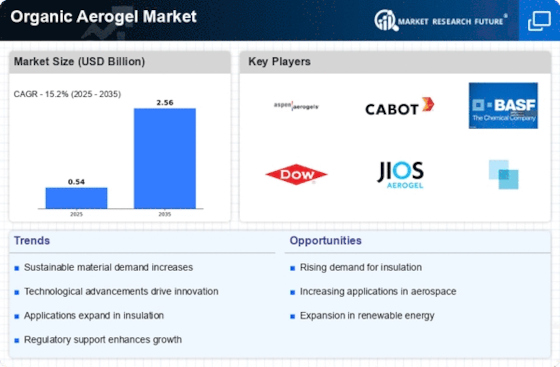
    Organic Aerogel Market Infographic
    Purchase Options

    Market Trends

    Key Emerging Trends in the Organic Aerogel Market

    The organic aerogel market is witnessing notable trends that are reshaping its landscape and driving growth across various industries. One significant trend is the increasing demand for organic aerogels in the aerospace and defense sector. Organic aerogels, known for their lightweight, high surface area, and excellent thermal insulation properties, are utilized in aerospace applications such as insulation for spacecraft, thermal protection for aircraft components, and lightweight structural materials for satellites. With the growing emphasis on fuel efficiency, performance optimization, and cost reduction in the aerospace industry, the demand for organic aerogels is on the rise. Moreover, advancements in aerogel manufacturing technologies and material science are leading to the development of advanced organic aerogels with enhanced properties, further driving their adoption in aerospace applications. Additionally, there is a growing trend towards the use of organic aerogels in the energy sector. Organic aerogels are utilized in energy storage and conversion applications such as batteries, supercapacitors, and catalysis due to their high porosity, surface area, and electrical conductivity. With increasing demand for renewable energy sources and energy-efficient technologies, the demand for organic aerogels as electrode materials in energy storage devices is experiencing significant growth. Moreover, organic aerogels are being explored for use in catalytic converters and fuel cells to improve energy conversion efficiency and reduce environmental impact, further driving their adoption in the energy sector. Furthermore, there is a growing trend towards the use of organic aerogels in the construction and building materials industry. Organic aerogels are utilized as lightweight and highly insulating materials for thermal insulation, soundproofing, and fire protection in buildings and infrastructure. With increasing awareness about energy conservation, sustainable construction practices, and stringent building codes, the demand for organic aerogels as eco-friendly insulation materials is increasing. Moreover, organic aerogels offer advantages such as reduced energy consumption, improved indoor comfort, and enhanced fire safety, driving their adoption in the construction industry. Moreover, technological advancements and innovations are driving the growth of the organic aerogel market. Manufacturers are investing in research and development to develop advanced aerogel formulations, fabrication techniques, and application methods that offer improved performance, durability, and cost-effectiveness. Moreover, advancements in nanotechnology, polymer chemistry, and material processing are enabling the production of organic aerogels with tailored properties and functionalities for specific applications. Additionally, innovations in aerogel composites and hybrid materials are expanding the scope of organic aerogel usage in new and emerging industries, further driving market growth. Additionally, there is a growing trend towards sustainability and environmental conservation in the organic aerogel market. Manufacturers are focusing on developing eco-friendly aerogel formulations using renewable and biodegradable materials, reducing energy consumption and waste generation during production, and implementing green manufacturing practices. Moreover, organic aerogels offer environmental benefits such as energy efficiency, carbon footprint reduction, and recyclability, making them attractive choices for environmentally conscious consumers and industries. As a result, companies in the organic aerogel market are investing in sustainability initiatives and eco-labeling to differentiate their products and meet growing consumer demand for green alternatives. Furthermore, regulatory compliance and quality assurance are shaping the dynamics of the organic aerogel market. Regulatory agencies are imposing stricter standards and regulations on the use of chemicals and materials in various industries, necessitating compliance with safety, environmental, and health requirements for organic aerogel products. Moreover, customers are increasingly demanding certifications such as ISO, UL, and ASTM compliance to ensure product quality, performance, and reliability. As a result, companies in the organic aerogel market are investing in quality management systems, testing facilities, and certification programs to meet regulatory requirements and customer expectations.


    Author
    Chitranshi Jaiswal
    Research Analyst Level I

    In her 3 years of experience in the market research field, she has handled critical cross-domain projects. She has an in-depth knowledge of market estimation & analysis, problem-solving, primary as well as secondary research, and team management.She holds an engineering degree and is an MBA professional from a well-known university, capable of evaluating the market and competitive conditions. An exceptional strategist with excellent communication skills and a passion for delivering cutting-edge & practical insights for the market. Proficient in multi-tasking, and can successfully deal with competing demands, while maintaining complete confidentiality. Generated business through active client and project development, networking, and high-quality responses. Her knowledge and skills have helped in making solid business decisions, securing funding from investors, and avoiding business failures.

    Leave a Comment

    FAQs

    How much is the organic aerogel market?

    Organic Aerogel Market crossed a valuation of USD 0.54 Billion in 2024

    What is the growth rate of the organic aerogel market?

    Organic Aerogel Market is projected to register a CAGR of 15.2% from 2025-2035

    Which region held the largest market share in the organic aerogel market?

    North America had the largest share of the global market

    Who are the key players in the organic aerogel market?

    The key players in the market are Aspen Aerogels (US), Cabot Corporation (US), Aerogel Technologies (US), Nanotech Co. Ltd. (China), Armacell (Germany), Guangdong Alison Hi-Tech (China), Active Aerogels (Portugal), Enersens (France), JIOS Aerogel (South Korea), and BASF (Germany), and Others.

    Which type led the organic aerogel market?

    The carbon aerogel category dominated the market in 2024.

    Which application had the largest market share in the organic aerogel market?

    Oil and gas had the largest share of the global market.

    Market Summary

    As per Market Research Future Analysis, the Global Organic Aerogel Market was valued at USD 0.54 Billion in 2024 and is projected to reach USD 2.56 Billion by 2035, growing at a CAGR of 15.20% from 2025 to 2035. The market is driven by the increasing adoption of electronics and the demand for thermal insulation. Organic aerogels are favored for their sustainability, lightweight nature, and biocompatibility, making them suitable for various applications, including biomedical uses and energy-efficient construction.

    Key Market Trends & Highlights

    The Organic Aerogel Market is witnessing significant growth due to several key trends.

    • Market Size in 2024: USD 0.54 Billion; projected to reach USD 2.56 Billion by 2035.
    • CAGR from 2025 to 2035: 15.20%; driven by demand for thermal insulation and electronics.
    • Carbon aerogel segment dominated the market; polymer aerogel expected to be the fastest-growing segment.
    • North America holds the largest market share; Asia-Pacific expected to grow at the fastest CAGR.

    Market Size & Forecast

    2024 Market Size USD 0.54 Billion
    2035 Market Size USD 2.56 Billion
    CAGR (2024-2035) 15.20%
    Largest Regional Market Share in 2024 North America.

    Major Players

    Key players include Aspen Aerogels (US), Cabot Corporation (US), Aerogel Technologies (US), Nanotech Co. Ltd. (China), Armacell (Germany), and BASF (Germany).

    Market Trends

    Increasing focus on sustainable materials is driving market growth

    Energy conservation objectives can be met using lightweight materials, increasing vehicle fuel economy, and lowering handling and transit energy requirements.

    Biocompatible qualities can be designed into organic aerogels, making them appropriate for various biomedical applications. Their compatibility with biological systems makes them more useful for tissue engineering, medication delivery, and other medicinal applications. Drug delivery and carriage can be effectively achieved using organic aerogels. The regulated medication release made possible by their porous structure enhances the efficacy of medicinal treatments. With targeted medication delivery systems, this capacity is very helpful for reducing adverse effects and improving therapeutic results.

    Organic aerogels are renowned for being incredibly light and having a low density. Weight reduction is essential for improving fuel efficiency in the automobile and aerospace industries. Incorporating organic aerogels into structural and insulating components can help cars and airplanes fly lighter overall. Organic aerogels have outstanding qualities for heat insulation. Using organic aerogels as thermal insulators in components like spacecraft and aircraft insulation can assist in stabilizing internal temperatures and protect sensitive electronics in the aerospace industry, where significant temperature swings are prevalent.

    Furthermore, the United States' crude oil production, which accounts for 17% of the world's output, rose by 1.3% in 2021, according to Enerdata. Furthermore, Russia surpassed Saudi Arabia's crude oil output by around 1.5% to become the second-largest producer of crude oil globally.

    The Ministry of Economy, Trade, and Industry (Meti) of Japan projects that LPG use would reach 13.1 million tons in 2026–2027, up 4.3 percent from the demand estimate of 12.6 million tons in 2021–2022. Thus driving the Organic Aerogel market revenue.

    Organic Aerogel Market Market Drivers

    Market Growth Projections

    The Global Organic Aerogel Market Industry is poised for substantial growth, with projections indicating a market size of 0.54 USD Billion in 2024 and an anticipated increase to 2.55 USD Billion by 2035. This growth trajectory reflects a compound annual growth rate of 15.17% from 2025 to 2035, driven by factors such as rising demand for lightweight materials, advancements in manufacturing technologies, and expanding applications across various sectors. The market's evolution is indicative of the increasing recognition of organic aerogels as a critical component in achieving sustainability and efficiency in multiple industries.

    Rising Environmental Concerns

    Increasing awareness of environmental issues is driving the Global Organic Aerogel Market Industry as industries seek sustainable alternatives to traditional materials. Organic aerogels, derived from renewable resources, present a viable solution to reduce carbon footprints and enhance energy efficiency. For instance, their application in building insulation can significantly lower energy consumption, aligning with global initiatives to combat climate change. This shift towards sustainable materials is likely to attract investments and foster innovation within the organic aerogel sector, contributing to an expected market valuation of 2.55 USD Billion by 2035.

    Government Support and Regulations

    Government initiatives and regulations promoting the use of sustainable materials are significantly influencing the Global Organic Aerogel Market Industry. Policies aimed at reducing greenhouse gas emissions and enhancing energy efficiency are encouraging industries to adopt organic aerogels as a viable alternative to conventional materials. For instance, various countries are implementing incentives for the construction sector to utilize eco-friendly insulation materials, thereby fostering demand for organic aerogels. This supportive regulatory environment is likely to enhance market growth, as companies align their practices with governmental sustainability goals.

    Expanding Applications in Energy Sector

    The Global Organic Aerogel Market Industry is witnessing a surge in applications within the energy sector, particularly in oil and gas, renewable energy, and energy storage. Organic aerogels are utilized for thermal insulation in pipelines and storage tanks, enhancing energy efficiency and safety. Furthermore, their role in energy storage systems, such as batteries and supercapacitors, is gaining traction due to their lightweight and high surface area properties. This diversification of applications is expected to drive market growth, as industries increasingly recognize the benefits of organic aerogels in optimizing energy consumption and storage solutions.

    Growing Demand for Lightweight Materials

    The Global Organic Aerogel Market Industry is experiencing heightened demand for lightweight materials across various sectors, including aerospace, automotive, and construction. As industries strive to enhance energy efficiency and reduce emissions, organic aerogels, known for their low density and superior thermal insulation properties, are increasingly favored. For instance, the aerospace sector is integrating organic aerogels into insulation systems, contributing to weight reduction and improved fuel efficiency. This trend is projected to drive the market's growth, with the industry expected to reach 0.54 USD Billion in 2024 and potentially expand significantly by 2035.

    Advancements in Manufacturing Technologies

    Innovations in manufacturing technologies are propelling the Global Organic Aerogel Market Industry forward. Techniques such as sol-gel processing and supercritical drying have enhanced the production efficiency and scalability of organic aerogels. These advancements not only lower production costs but also improve product quality, making organic aerogels more accessible to various applications. For example, the development of environmentally friendly production methods aligns with global sustainability goals, further boosting market potential. As a result, the market is anticipated to grow at a compound annual growth rate of 15.17% from 2025 to 2035, indicating robust future prospects.

    Market Segment Insights

    Organic Aerogel Type Insights

    Based on type, the Organic Aerogel Market segmentation includes carbon aerogel, polymer aerogel, and others. The carbon aerogel segment dominated the market. Carbon aerogels' large surface area, porosity, and electrical conductivity are well-known. These characteristics make them ideal materials for batteries and supercapacitors, two types of energy storage devices, because carbon aerogels have a huge surface area for charge storage and quick electron transport, so they can improve these devices' functionality.

    The polymer aerogel segment is expected to be the fastest-growing segment of the organic aerogel market during the forecast period. Polymer aerogels are extremely effective thermal insulation materials in architecture and construction applications because of their low thermal conductivity. They can save heating and cooling expenses and improve energy efficiency by acting as insulation in windows, roofs, and walls.

    Figure 1: Organic Aerogel Market, by Type, 2022 & 2032 (USD Billion)

    Source: Secondary Research, Primary Research, Market Research Future Database and Analyst Review

    Organic Aerogel Application Insights

    Based on application, the Organic Aerogel Market segmentation includes oil and gas, building insulation, transportation, aerospace and defense materials, and others. The oil and gas category has the largest market share. Thermally sensitive equipment in oil and gas operations is protected from heat using organic aerogels. Components such as control systems, valves, and other parts that might be subjected to high temperatures should be insulated during production, refining, or processing.

    Throughout the forecast period, the organic aerogel market’s building insulation segment is anticipated to grow at the quickest rate. Polymer aerogels can be used in roofing systems as insulation. Their outstanding thermal insulating qualities and lightweight design help to keep a building's temperature steady. Using organic aerogels as roof insulation helps lower the energy used for heating and cooling.

    Get more detailed insights about Organic Aerogel Market Research Report — Global Forecast till 2035

    Regional Insights

    By region, the study provides market insights into North America, Europe, Asia-Pacific, and the Rest of the World. The North American organic aerogel market area will dominate this market, owing to organic aerogels and the aerospace and defense sectors in North America's wide use of other innovative materials. Due to their lightweight and insulating qualities, organic aerogels are appealing for usage in aerospace applications, from spaceship insulation to military aircraft components.

    Further, the major countries studied in the market report are The US, Canada, Germany, France, the UK, Italy, Spain, China, Japan, India, Australia, South Korea, and Brazil.

    Figure 2: ORGANIC AEROGEL MARKET SHARE BY REGION 2022 (USD Billion)

    ORGANIC AEROGEL MARKET SHARE BY REGION 2022

    Source: Secondary Research, Primary Research, Market Research Future Database and Analyst Review

    Europe's Organic Aerogel market accounts for the second-largest market share due to the environmental impact of items gaining greater awareness among European consumers. Growth in the market might be driven by customer preferences for creative and environmentally friendly solutions as knowledge of sustainable materials like organic aerogels rises. Further, the Germany Organic Aerogel market held the largest market share, and the UK Organic Aerogel market was the fastest-growing market in the European region.

    The Asia-Pacific Organic Aerogel Market is expected to grow at the fastest CAGR from 2023 to 2032. This is due to Asia Pacific's rapid industrialization and economic growth, which is driving demand for sophisticated materials in several industries. Manufacturing, construction, and the automobile industries are among the industries driving the need for lightweight, high-performance materials like organic aerogels. Moreover, China’s Organic Aerogel market held the largest market share, and the Indian Organic Aerogel market was the fastest-growing market in the Asia-Pacific region.

    Key Players and Competitive Insights

    Major players are investing significantly in R&D to broaden their product offerings, contributing to the Organic Aerogel market's continued expansion. Market players are also engaging in various strategic initiatives to increase their worldwide presence. Significant developments in the industry include introducing new products, contracts, mergers and acquisitions, increased investment, and cooperation with other businesses. The Organic Aerogel sector must provide affordable products to grow and thrive in an increasingly competitive and developing market environment.

    Manufacturing locally to reduce operating costs is one of the primary business strategies manufacturers use in the global Organic Aerogel industry to assist customers and expand the market sector. The Organic Aerogel sector has provided some of the biggest medical benefits recently. Major players in the Organic Aerogel market, including Aspen Aerogels (US), Cabot Corporation (US), Aerogel Technologies (US), Nanotech Co. Ltd. (China), Armacell (Germany), Guangdong Alison Hi-Tech (China), Active Aerogels (Portugal), Enersens (France), JIOS Aerogel (South Korea), and BASF (Germany), and others, are attempting to increase market demand by investing in research and development operations.

    Performance materials and specialty chemicals are supplied by Cabot Corp. (Cabot). Inkjet colorants, aerogel, specialty compounds, fumed metal oxides, cesium formate drilling fluids, fine cesium chemicals, rubber, and specialty grade carbon blacks, and activated carbon are among its offerings. The business sells its products to many clients, such as tire manufacturers, water treatment facilities, food and beverage processors, coal-fired utilities, pharmaceutical firms, and catalyst manufacturers. In January 2022, the highly insulating silica aerogel manufactured by Cabot Corporation was used to repair Darmstadt, Germany's Mathildenhöhe, an artists' colony newly inducted onto the UNESCO World Heritage list.

    Svenska Aerogel Holding AB is a holding corporation. The company develops, produces, and distributes recyclable aerogel-based materials with unique designs for industrial uses through its subsidiaries. Aerogel-based products from Svenska Aerogel Holding are used in plaster, paint and ink, insulation, and concrete, among other applications. Svenska Aerogel and a top global company in the process industry inked a collaboration agreement in February 2023 to maximize the usage of quartzite in the client's product. Throughout the trial stage, Svenska Aerogel promised to provide 30 tonnes of quartzene annually.

    Key Companies in the Organic Aerogel Market market include

    Industry Developments

    February 2022: Bulloch County's Southern Gateway Commerce Park will house a state-of-the-art manufacturing facility for Aspen Aerogels, Inc., a pioneer in aerogel-based sustainability and electrification solutions. Production at Aspen's new site in Statesboro is expected to start in late 2023, and the company intends to invest at least $325 million there.

    September 2022: The Battery Show featured the latest innovations from JIOS Aerogel, a leader in developing vital parts for Lithium-ion battery systems. The biggest show for North America's advanced battery manufacturing industry is The Battery Show, which takes place in Michigan, USA.

    Future Outlook

    Organic Aerogel Market Future Outlook

    The Organic Aerogel Market is projected to grow at a 15.20% CAGR from 2025 to 2035, driven by advancements in insulation technologies, increased demand in aerospace, and environmental regulations.

    New opportunities lie in:

    • Develop innovative organic aerogel composites for enhanced thermal insulation in construction.
    • Explore applications in lightweight automotive components to improve fuel efficiency.
    • Invest in R&D for eco-friendly production methods to meet sustainability standards.

    By 2035, the Organic Aerogel Market is expected to achieve substantial growth, reflecting its critical role in various industries.

    Market Segmentation

    Organic Aerogel Type Outlook

    • Carbon Aerogel
    • Polymer Aerogel
    • Others

    Organic Aerogel Regional Outlook

    North America
    • US
    • Canada

    Organic Aerogel Application Outlook

    • Oil and Gas
    • Building Insulation
    • Transportation
    • Aerospace and Defense Materials
    • Others

    Report Scope

    Report Attribute/Metric Details
    Market Size 2024 USD 0.54 Billion
    Market Size 2035 2.56 (Value (USD Billion))
    Compound Annual Growth Rate (CAGR) 15.20% (2025 - 2035)
    Base Year 2024
    Market Forecast Period 2025 - 2035
    Historical Data 2018- 2022
    Market Forecast Units Value (USD Billion)
    Report Coverage Revenue Forecast, Market Competitive Landscape, Growth Factors, and Trends
    Segments Covered Type, Application, and Region
    Geographies Covered North America, Europe, Asia Pacific, and the Rest of the World
    Countries Covered The US, Canada, Germany, France, UK, Italy, Spain, China, Japan, India, Australia, South Korea, and Brazil
    Key Companies Profiled  Aspen Aerogels (US), Cabot Corporation (US), Aerogel Technologies (US), Nanotech Co. Ltd. (China), Armacell (Germany), Guangdong Alison Hi-Tech (China), Active Aerogels (Portugal), Enersens (France), JIOS Aerogel (South Korea), and BASF (Germany)
    Key Market Opportunities ·       Growing need in the gas and oil sector and advancements in nanotechnology and material science
    Key Market Dynamics ·       Growing adoption of electronics and increasing need for thermal insulation
    Market Size 2025 0.62 (Value (USD Billion))

    FAQs

    How much is the organic aerogel market?

    Organic Aerogel Market crossed a valuation of USD 0.54 Billion in 2024

    What is the growth rate of the organic aerogel market?

    Organic Aerogel Market is projected to register a CAGR of 15.2% from 2025-2035

    Which region held the largest market share in the organic aerogel market?

    North America had the largest share of the global market

    Who are the key players in the organic aerogel market?

    The key players in the market are Aspen Aerogels (US), Cabot Corporation (US), Aerogel Technologies (US), Nanotech Co. Ltd. (China), Armacell (Germany), Guangdong Alison Hi-Tech (China), Active Aerogels (Portugal), Enersens (France), JIOS Aerogel (South Korea), and BASF (Germany), and Others.

    Which type led the organic aerogel market?

    The carbon aerogel category dominated the market in 2024.

    Which application had the largest market share in the organic aerogel market?

    Oil and gas had the largest share of the global market.

    1. SECTION I: EXECUTIVE SUMMARY AND KEY HIGHLIGHTS
      1. | 1.1 EXECUTIVE SUMMARY
      2. | | 1.1.1 Market Overview
      3. | | 1.1.2 Key Findings
      4. | | 1.1.3 Market Segmentation
      5. | | 1.1.4 Competitive Landscape
      6. | | 1.1.5 Challenges and Opportunities
      7. | | 1.1.6 Future Outlook
    2. SECTION II: SCOPING, METHODOLOGY AND MARKET STRUCTURE
      1. | 2.1 MARKET INTRODUCTION
      2. | | 2.1.1 Definition
      3. | | 2.1.2 Scope of the study
      4. | | | 2.1.2.1 Research Objective
      5. | | | 2.1.2.2 Assumption
      6. | | | 2.1.2.3 Limitations
      7. | 2.2 RESEARCH METHODOLOGY
      8. | | 2.2.1 Overview
      9. | | 2.2.2 Data Mining
      10. | | 2.2.3 Secondary Research
      11. | | 2.2.4 Primary Research
      12. | | | 2.2.4.1 Primary Interviews and Information Gathering Process
      13. | | | 2.2.4.2 Breakdown of Primary Respondents
      14. | | 2.2.5 Forecasting Model
      15. | | 2.2.6 Market Size Estimation
      16. | | | 2.2.6.1 Bottom-Up Approach
      17. | | | 2.2.6.2 Top-Down Approach
      18. | | 2.2.7 Data Triangulation
      19. | | 2.2.8 Validation
    3. SECTION III: QUALITATIVE ANALYSIS
      1. | 3.1 MARKET DYNAMICS
      2. | | 3.1.1 Overview
      3. | | 3.1.2 Drivers
      4. | | 3.1.3 Restraints
      5. | | 3.1.4 Opportunities
      6. | 3.2 MARKET FACTOR ANALYSIS
      7. | | 3.2.1 Value chain Analysis
      8. | | 3.2.2 Porter's Five Forces Analysis
      9. | | | 3.2.2.1 Bargaining Power of Suppliers
      10. | | | 3.2.2.2 Bargaining Power of Buyers
      11. | | | 3.2.2.3 Threat of New Entrants
      12. | | | 3.2.2.4 Threat of Substitutes
      13. | | | 3.2.2.5 Intensity of Rivalry
      14. | | 3.2.3 COVID-19 Impact Analysis
      15. | | | 3.2.3.1 Market Impact Analysis
      16. | | | 3.2.3.2 Regional Impact
      17. | | | 3.2.3.3 Opportunity and Threat Analysis
    4. SECTION IV: QUANTITATIVE ANALYSIS
      1. | 4.1 Chemicals and Materials, BY Type (USD Billion)
      2. | | 4.1.1 Carbon Aerogel
      3. | | 4.1.2 Polymer Aerogel
      4. | | 4.1.3 Others
      5. | 4.2 Chemicals and Materials, BY Application (USD Billion)
      6. | | 4.2.1 Oil and Gas
      7. | | 4.2.2 Building Insulation
      8. | | 4.2.3 Transportation
      9. | | 4.2.4 Aerospace and Defense Materials
      10. | | 4.2.5 Others
      11. | 4.3 Chemicals and Materials, BY Region (USD Billion)
      12. | | 4.3.1 North America
      13. | | | 4.3.1.1 US
      14. | | | 4.3.1.2 Canada
      15. | | 4.3.2 Europe
      16. | | | 4.3.2.1 Germany
      17. | | | 4.3.2.2 UK
      18. | | | 4.3.2.3 France
      19. | | | 4.3.2.4 Russia
      20. | | | 4.3.2.5 Italy
      21. | | | 4.3.2.6 Spain
      22. | | | 4.3.2.7 Rest of Europe
      23. | | 4.3.3 APAC
      24. | | | 4.3.3.1 China
      25. | | | 4.3.3.2 India
      26. | | | 4.3.3.3 Japan
      27. | | | 4.3.3.4 South Korea
      28. | | | 4.3.3.5 Malaysia
      29. | | | 4.3.3.6 Thailand
      30. | | | 4.3.3.7 Indonesia
      31. | | | 4.3.3.8 Rest of APAC
      32. | | 4.3.4 South America
      33. | | | 4.3.4.1 Brazil
      34. | | | 4.3.4.2 Mexico
      35. | | | 4.3.4.3 Argentina
      36. | | | 4.3.4.4 Rest of South America
      37. | | 4.3.5 MEA
      38. | | | 4.3.5.1 GCC Countries
      39. | | | 4.3.5.2 South Africa
      40. | | | 4.3.5.3 Rest of MEA
    5. SECTION V: COMPETITIVE ANALYSIS
      1. | 5.1 Competitive Landscape
      2. | | 5.1.1 Overview
      3. | | 5.1.2 Competitive Analysis
      4. | | 5.1.3 Market share Analysis
      5. | | 5.1.4 Major Growth Strategy in the Chemicals and Materials
      6. | | 5.1.5 Competitive Benchmarking
      7. | | 5.1.6 Leading Players in Terms of Number of Developments in the Chemicals and Materials
      8. | | 5.1.7 Key developments and growth strategies
      9. | | | 5.1.7.1 New Product Launch/Service Deployment
      10. | | | 5.1.7.2 Merger & Acquisitions
      11. | | | 5.1.7.3 Joint Ventures
      12. | | 5.1.8 Major Players Financial Matrix
      13. | | | 5.1.8.1 Sales and Operating Income
      14. | | | 5.1.8.2 Major Players R&D Expenditure. 2023
      15. | 5.2 Company Profiles
      16. | | 5.2.1 Aspen Aerogels (US)
      17. | | | 5.2.1.1 Financial Overview
      18. | | | 5.2.1.2 Products Offered
      19. | | | 5.2.1.3 Key Developments
      20. | | | 5.2.1.4 SWOT Analysis
      21. | | | 5.2.1.5 Key Strategies
      22. | | 5.2.2 Cabot Corporation (US)
      23. | | | 5.2.2.1 Financial Overview
      24. | | | 5.2.2.2 Products Offered
      25. | | | 5.2.2.3 Key Developments
      26. | | | 5.2.2.4 SWOT Analysis
      27. | | | 5.2.2.5 Key Strategies
      28. | | 5.2.3 BASF SE (DE)
      29. | | | 5.2.3.1 Financial Overview
      30. | | | 5.2.3.2 Products Offered
      31. | | | 5.2.3.3 Key Developments
      32. | | | 5.2.3.4 SWOT Analysis
      33. | | | 5.2.3.5 Key Strategies
      34. | | 5.2.4 Dow Inc. (US)
      35. | | | 5.2.4.1 Financial Overview
      36. | | | 5.2.4.2 Products Offered
      37. | | | 5.2.4.3 Key Developments
      38. | | | 5.2.4.4 SWOT Analysis
      39. | | | 5.2.4.5 Key Strategies
      40. | | 5.2.5 JIOS Aerogel (KR)
      41. | | | 5.2.5.1 Financial Overview
      42. | | | 5.2.5.2 Products Offered
      43. | | | 5.2.5.3 Key Developments
      44. | | | 5.2.5.4 SWOT Analysis
      45. | | | 5.2.5.5 Key Strategies
      46. | | 5.2.6 Aerogel Technologies (US)
      47. | | | 5.2.6.1 Financial Overview
      48. | | | 5.2.6.2 Products Offered
      49. | | | 5.2.6.3 Key Developments
      50. | | | 5.2.6.4 SWOT Analysis
      51. | | | 5.2.6.5 Key Strategies
      52. | | 5.2.7 Nano High-Tech (CN)
      53. | | | 5.2.7.1 Financial Overview
      54. | | | 5.2.7.2 Products Offered
      55. | | | 5.2.7.3 Key Developments
      56. | | | 5.2.7.4 SWOT Analysis
      57. | | | 5.2.7.5 Key Strategies
      58. | | 5.2.8 Enersens (FR)
      59. | | | 5.2.8.1 Financial Overview
      60. | | | 5.2.8.2 Products Offered
      61. | | | 5.2.8.3 Key Developments
      62. | | | 5.2.8.4 SWOT Analysis
      63. | | | 5.2.8.5 Key Strategies
      64. | | 5.2.9 SABIC (SA)
      65. | | | 5.2.9.1 Financial Overview
      66. | | | 5.2.9.2 Products Offered
      67. | | | 5.2.9.3 Key Developments
      68. | | | 5.2.9.4 SWOT Analysis
      69. | | | 5.2.9.5 Key Strategies
      70. | 5.3 Appendix
      71. | | 5.3.1 References
      72. | | 5.3.2 Related Reports
    6. LIST OF FIGURES
      1. | 6.1 MARKET SYNOPSIS
      2. | 6.2 NORTH AMERICA MARKET ANALYSIS
      3. | 6.3 US MARKET ANALYSIS BY TYPE
      4. | 6.4 US MARKET ANALYSIS BY APPLICATION
      5. | 6.5 CANADA MARKET ANALYSIS BY TYPE
      6. | 6.6 CANADA MARKET ANALYSIS BY APPLICATION
      7. | 6.7 EUROPE MARKET ANALYSIS
      8. | 6.8 GERMANY MARKET ANALYSIS BY TYPE
      9. | 6.9 GERMANY MARKET ANALYSIS BY APPLICATION
      10. | 6.10 UK MARKET ANALYSIS BY TYPE
      11. | 6.11 UK MARKET ANALYSIS BY APPLICATION
      12. | 6.12 FRANCE MARKET ANALYSIS BY TYPE
      13. | 6.13 FRANCE MARKET ANALYSIS BY APPLICATION
      14. | 6.14 RUSSIA MARKET ANALYSIS BY TYPE
      15. | 6.15 RUSSIA MARKET ANALYSIS BY APPLICATION
      16. | 6.16 ITALY MARKET ANALYSIS BY TYPE
      17. | 6.17 ITALY MARKET ANALYSIS BY APPLICATION
      18. | 6.18 SPAIN MARKET ANALYSIS BY TYPE
      19. | 6.19 SPAIN MARKET ANALYSIS BY APPLICATION
      20. | 6.20 REST OF EUROPE MARKET ANALYSIS BY TYPE
      21. | 6.21 REST OF EUROPE MARKET ANALYSIS BY APPLICATION
      22. | 6.22 APAC MARKET ANALYSIS
      23. | 6.23 CHINA MARKET ANALYSIS BY TYPE
      24. | 6.24 CHINA MARKET ANALYSIS BY APPLICATION
      25. | 6.25 INDIA MARKET ANALYSIS BY TYPE
      26. | 6.26 INDIA MARKET ANALYSIS BY APPLICATION
      27. | 6.27 JAPAN MARKET ANALYSIS BY TYPE
      28. | 6.28 JAPAN MARKET ANALYSIS BY APPLICATION
      29. | 6.29 SOUTH KOREA MARKET ANALYSIS BY TYPE
      30. | 6.30 SOUTH KOREA MARKET ANALYSIS BY APPLICATION
      31. | 6.31 MALAYSIA MARKET ANALYSIS BY TYPE
      32. | 6.32 MALAYSIA MARKET ANALYSIS BY APPLICATION
      33. | 6.33 THAILAND MARKET ANALYSIS BY TYPE
      34. | 6.34 THAILAND MARKET ANALYSIS BY APPLICATION
      35. | 6.35 INDONESIA MARKET ANALYSIS BY TYPE
      36. | 6.36 INDONESIA MARKET ANALYSIS BY APPLICATION
      37. | 6.37 REST OF APAC MARKET ANALYSIS BY TYPE
      38. | 6.38 REST OF APAC MARKET ANALYSIS BY APPLICATION
      39. | 6.39 SOUTH AMERICA MARKET ANALYSIS
      40. | 6.40 BRAZIL MARKET ANALYSIS BY TYPE
      41. | 6.41 BRAZIL MARKET ANALYSIS BY APPLICATION
      42. | 6.42 MEXICO MARKET ANALYSIS BY TYPE
      43. | 6.43 MEXICO MARKET ANALYSIS BY APPLICATION
      44. | 6.44 ARGENTINA MARKET ANALYSIS BY TYPE
      45. | 6.45 ARGENTINA MARKET ANALYSIS BY APPLICATION
      46. | 6.46 REST OF SOUTH AMERICA MARKET ANALYSIS BY TYPE
      47. | 6.47 REST OF SOUTH AMERICA MARKET ANALYSIS BY APPLICATION
      48. | 6.48 MEA MARKET ANALYSIS
      49. | 6.49 GCC COUNTRIES MARKET ANALYSIS BY TYPE
      50. | 6.50 GCC COUNTRIES MARKET ANALYSIS BY APPLICATION
      51. | 6.51 SOUTH AFRICA MARKET ANALYSIS BY TYPE
      52. | 6.52 SOUTH AFRICA MARKET ANALYSIS BY APPLICATION
      53. | 6.53 REST OF MEA MARKET ANALYSIS BY TYPE
      54. | 6.54 REST OF MEA MARKET ANALYSIS BY APPLICATION
      55. | 6.55 KEY BUYING CRITERIA OF CHEMICALS AND MATERIALS
      56. | 6.56 RESEARCH PROCESS OF MRFR
      57. | 6.57 DRO ANALYSIS OF CHEMICALS AND MATERIALS
      58. | 6.58 DRIVERS IMPACT ANALYSIS: CHEMICALS AND MATERIALS
      59. | 6.59 RESTRAINTS IMPACT ANALYSIS: CHEMICALS AND MATERIALS
      60. | 6.60 SUPPLY / VALUE CHAIN: CHEMICALS AND MATERIALS
      61. | 6.61 CHEMICALS AND MATERIALS, BY TYPE, 2024 (% SHARE)
      62. | 6.62 CHEMICALS AND MATERIALS, BY TYPE, 2024 TO 2035 (USD Billion)
      63. | 6.63 CHEMICALS AND MATERIALS, BY APPLICATION, 2024 (% SHARE)
      64. | 6.64 CHEMICALS AND MATERIALS, BY APPLICATION, 2024 TO 2035 (USD Billion)
      65. | 6.65 BENCHMARKING OF MAJOR COMPETITORS
    7. LIST OF TABLES
      1. | 7.1 LIST OF ASSUMPTIONS
      2. | | 7.1.1
      3. | 7.2 North America MARKET SIZE ESTIMATES; FORECAST
      4. | | 7.2.1 BY TYPE, 2025-2035 (USD Billion)
      5. | | 7.2.2 BY APPLICATION, 2025-2035 (USD Billion)
      6. | 7.3 US MARKET SIZE ESTIMATES; FORECAST
      7. | | 7.3.1 BY TYPE, 2025-2035 (USD Billion)
      8. | | 7.3.2 BY APPLICATION, 2025-2035 (USD Billion)
      9. | 7.4 Canada MARKET SIZE ESTIMATES; FORECAST
      10. | | 7.4.1 BY TYPE, 2025-2035 (USD Billion)
      11. | | 7.4.2 BY APPLICATION, 2025-2035 (USD Billion)
      12. | 7.5 Europe MARKET SIZE ESTIMATES; FORECAST
      13. | | 7.5.1 BY TYPE, 2025-2035 (USD Billion)
      14. | | 7.5.2 BY APPLICATION, 2025-2035 (USD Billion)
      15. | 7.6 Germany MARKET SIZE ESTIMATES; FORECAST
      16. | | 7.6.1 BY TYPE, 2025-2035 (USD Billion)
      17. | | 7.6.2 BY APPLICATION, 2025-2035 (USD Billion)
      18. | 7.7 UK MARKET SIZE ESTIMATES; FORECAST
      19. | | 7.7.1 BY TYPE, 2025-2035 (USD Billion)
      20. | | 7.7.2 BY APPLICATION, 2025-2035 (USD Billion)
      21. | 7.8 France MARKET SIZE ESTIMATES; FORECAST
      22. | | 7.8.1 BY TYPE, 2025-2035 (USD Billion)
      23. | | 7.8.2 BY APPLICATION, 2025-2035 (USD Billion)
      24. | 7.9 Russia MARKET SIZE ESTIMATES; FORECAST
      25. | | 7.9.1 BY TYPE, 2025-2035 (USD Billion)
      26. | | 7.9.2 BY APPLICATION, 2025-2035 (USD Billion)
      27. | 7.10 Italy MARKET SIZE ESTIMATES; FORECAST
      28. | | 7.10.1 BY TYPE, 2025-2035 (USD Billion)
      29. | | 7.10.2 BY APPLICATION, 2025-2035 (USD Billion)
      30. | 7.11 Spain MARKET SIZE ESTIMATES; FORECAST
      31. | | 7.11.1 BY TYPE, 2025-2035 (USD Billion)
      32. | | 7.11.2 BY APPLICATION, 2025-2035 (USD Billion)
      33. | 7.12 Rest of Europe MARKET SIZE ESTIMATES; FORECAST
      34. | | 7.12.1 BY TYPE, 2025-2035 (USD Billion)
      35. | | 7.12.2 BY APPLICATION, 2025-2035 (USD Billion)
      36. | 7.13 APAC MARKET SIZE ESTIMATES; FORECAST
      37. | | 7.13.1 BY TYPE, 2025-2035 (USD Billion)
      38. | | 7.13.2 BY APPLICATION, 2025-2035 (USD Billion)
      39. | 7.14 China MARKET SIZE ESTIMATES; FORECAST
      40. | | 7.14.1 BY TYPE, 2025-2035 (USD Billion)
      41. | | 7.14.2 BY APPLICATION, 2025-2035 (USD Billion)
      42. | 7.15 India MARKET SIZE ESTIMATES; FORECAST
      43. | | 7.15.1 BY TYPE, 2025-2035 (USD Billion)
      44. | | 7.15.2 BY APPLICATION, 2025-2035 (USD Billion)
      45. | 7.16 Japan MARKET SIZE ESTIMATES; FORECAST
      46. | | 7.16.1 BY TYPE, 2025-2035 (USD Billion)
      47. | | 7.16.2 BY APPLICATION, 2025-2035 (USD Billion)
      48. | 7.17 South Korea MARKET SIZE ESTIMATES; FORECAST
      49. | | 7.17.1 BY TYPE, 2025-2035 (USD Billion)
      50. | | 7.17.2 BY APPLICATION, 2025-2035 (USD Billion)
      51. | 7.18 Malaysia MARKET SIZE ESTIMATES; FORECAST
      52. | | 7.18.1 BY TYPE, 2025-2035 (USD Billion)
      53. | | 7.18.2 BY APPLICATION, 2025-2035 (USD Billion)
      54. | 7.19 Thailand MARKET SIZE ESTIMATES; FORECAST
      55. | | 7.19.1 BY TYPE, 2025-2035 (USD Billion)
      56. | | 7.19.2 BY APPLICATION, 2025-2035 (USD Billion)
      57. | 7.20 Indonesia MARKET SIZE ESTIMATES; FORECAST
      58. | | 7.20.1 BY TYPE, 2025-2035 (USD Billion)
      59. | | 7.20.2 BY APPLICATION, 2025-2035 (USD Billion)
      60. | 7.21 Rest of APAC MARKET SIZE ESTIMATES; FORECAST
      61. | | 7.21.1 BY TYPE, 2025-2035 (USD Billion)
      62. | | 7.21.2 BY APPLICATION, 2025-2035 (USD Billion)
      63. | 7.22 South America MARKET SIZE ESTIMATES; FORECAST
      64. | | 7.22.1 BY TYPE, 2025-2035 (USD Billion)
      65. | | 7.22.2 BY APPLICATION, 2025-2035 (USD Billion)
      66. | 7.23 Brazil MARKET SIZE ESTIMATES; FORECAST
      67. | | 7.23.1 BY TYPE, 2025-2035 (USD Billion)
      68. | | 7.23.2 BY APPLICATION, 2025-2035 (USD Billion)
      69. | 7.24 Mexico MARKET SIZE ESTIMATES; FORECAST
      70. | | 7.24.1 BY TYPE, 2025-2035 (USD Billion)
      71. | | 7.24.2 BY APPLICATION, 2025-2035 (USD Billion)
      72. | 7.25 Argentina MARKET SIZE ESTIMATES; FORECAST
      73. | | 7.25.1 BY TYPE, 2025-2035 (USD Billion)
      74. | | 7.25.2 BY APPLICATION, 2025-2035 (USD Billion)
      75. | 7.26 Rest of South America MARKET SIZE ESTIMATES; FORECAST
      76. | | 7.26.1 BY TYPE, 2025-2035 (USD Billion)
      77. | | 7.26.2 BY APPLICATION, 2025-2035 (USD Billion)
      78. | 7.27 MEA MARKET SIZE ESTIMATES; FORECAST
      79. | | 7.27.1 BY TYPE, 2025-2035 (USD Billion)
      80. | | 7.27.2 BY APPLICATION, 2025-2035 (USD Billion)
      81. | 7.28 GCC Countries MARKET SIZE ESTIMATES; FORECAST
      82. | | 7.28.1 BY TYPE, 2025-2035 (USD Billion)
      83. | | 7.28.2 BY APPLICATION, 2025-2035 (USD Billion)
      84. | 7.29 South Africa MARKET SIZE ESTIMATES; FORECAST
      85. | | 7.29.1 BY TYPE, 2025-2035 (USD Billion)
      86. | | 7.29.2 BY APPLICATION, 2025-2035 (USD Billion)
      87. | 7.30 Rest of MEA MARKET SIZE ESTIMATES; FORECAST
      88. | | 7.30.1 BY TYPE, 2025-2035 (USD Billion)
      89. | | 7.30.2 BY APPLICATION, 2025-2035 (USD Billion)
      90. | 7.31 PRODUCT LAUNCH/PRODUCT DEVELOPMENT/APPROVAL
      91. | | 7.31.1
      92. | 7.32 ACQUISITION/PARTNERSHIP
      93. | | 7.32.1

    Organic Aerogel Market Segmentation


    Organic Aerogel Type Outlook (USD Billion, 2018-2032)

    • Carbon Aerogel
    • Polymer Aerogel
    • Others

    Organic Aerogel Application Outlook (USD Billion, 2018-2032)

    • Oil and Gas
    • Building Insulation
    • Transportation
    • Aerospace and Defense Materials
    • Others

    Organic Aerogel Regional Outlook (USD Billion, 2018-2032)

    • North America Outlook (USD Billion, 2018-2032)
      • North America Organic Aerogel by Type
        • Carbon Aerogel
        • Polymer Aerogel
        • Others
      • North America Organic Aerogel by Application
        • Oil and Gas
        • Building Insulation
        • Transportation
        • Aerospace and Defense Materials
        • Others
      • US Outlook (USD Billion, 2018-2032)
      • US Organic Aerogel by Type
        • Carbon Aerogel
        • Polymer Aerogel
        • Others
      • US Organic Aerogel by Application
        • Oil and Gas
        • Building Insulation
        • Transportation
        • Aerospace and Defense Materials
        • Others
      • CANADA Outlook (USD Billion, 2018-2032)
      • CANADA Organic Aerogel by Type
        • Carbon Aerogel
        • Polymer Aerogel
        • Others
      • CANADA Organic Aerogel by Application
        • Oil and Gas
        • Building Insulation
        • Transportation
        • Aerospace and Defense Materials
        • Others
      • Europe Outlook (USD Billion, 2018-2032)
        • Europe Organic Aerogel by Type
          • Carbon Aerogel
          • Polymer Aerogel
          • Others
        • Europe Organic Aerogel by Application
          • Oil and Gas
          • Building Insulation
          • Transportation
          • Aerospace and Defense Materials
          • Others
        • Germany Outlook (USD Billion, 2018-2032)
        • Germany Organic Aerogel by Type
          • Carbon Aerogel
          • Polymer Aerogel
          • Others
        • Germany Organic Aerogel by Application
          • Oil and Gas
          • Building Insulation
          • Transportation
          • Aerospace and Defense Materials
          • Others
        • France Outlook (USD Billion, 2018-2032)
        • France Organic Aerogel by Type
          • Carbon Aerogel
          • Polymer Aerogel
          • Others
        • France Organic Aerogel by Application
          • Oil and Gas
          • Building Insulation
          • Transportation
          • Aerospace and Defense Materials
          • Others
        • UK Outlook (USD Billion, 2018-2032)
        • UK Organic Aerogel by Type
          • Carbon Aerogel
          • Polymer Aerogel
          • Others
        • UK Organic Aerogel by Application
          • Oil and Gas
          • Building Insulation
          • Transportation
          • Aerospace and Defense Materials
          • Others
        • ITALY Outlook (USD Billion, 2018-2032)
        • ITALY Organic Aerogel by Type
          • Carbon Aerogel
          • Polymer Aerogel
          • Others
        • ITALY Organic Aerogel by Application
          • Oil and Gas
          • Building Insulation
          • Transportation
          • Aerospace and Defense Materials
          • Others
        • SPAIN Outlook (USD Billion, 2018-2032)
        • Spain Organic Aerogel by Type
          • Carbon Aerogel
          • Polymer Aerogel
          • Others
        • Spain Organic Aerogel by Application
          • Oil and Gas
          • Building Insulation
          • Transportation
          • Aerospace and Defense Materials
          • Others
        • Rest Of Europe Outlook (USD Billion, 2018-2032)
        • Rest Of Europe Organic Aerogel by Type
          • Carbon Aerogel
          • Polymer Aerogel
          • Others
        • REST OF EUROPE Organic Aerogel by Application
          • Oil and Gas
          • Building Insulation
          • Transportation
          • Aerospace and Defense Materials
          • Others
        • Asia-Pacific Outlook (USD Billion, 2018-2032)
          • Asia-Pacific Organic Aerogel by Type
            • Carbon Aerogel
            • Polymer Aerogel
            • Others
          • Asia-Pacific Organic Aerogel by Application
            • Oil and Gas
            • Building Insulation
            • Transportation
            • Aerospace and Defense Materials
            • Others
          • China Outlook (USD Billion, 2018-2032)
          • China Organic Aerogel by Type
            • Carbon Aerogel
            • Polymer Aerogel
            • Others
          • China Organic Aerogel by Application
            • Oil and Gas
            • Building Insulation
            • Transportation
            • Aerospace and Defense Materials
            • Others
          • Japan Outlook (USD Billion, 2018-2032)
          • Japan Organic Aerogel by Type
            • Carbon Aerogel
            • Polymer Aerogel
            • Others
          • Japan Organic Aerogel by Application
            • Oil and Gas
            • Building Insulation
            • Transportation
            • Aerospace and Defense Materials
            • Others
          • India Outlook (USD Billion, 2018-2032)
          • India Organic Aerogel by Type
            • Carbon Aerogel
            • Polymer Aerogel
            • Others
          • India Organic Aerogel by Application
            • Oil and Gas
            • Building Insulation
            • Transportation
            • Aerospace and Defense Materials
            • Others
          • Australia Outlook (USD Billion, 2018-2032)
          • Australia Organic Aerogel by Type
            • Carbon Aerogel
            • Polymer Aerogel
            • Others
          • Australia Organic Aerogel by Application
            • Oil and Gas
            • Building Insulation
            • Transportation
            • Aerospace and Defense Materials
            • Others
          • Rest of Asia-Pacific Outlook (USD Billion, 2018-2032)
          • Rest of Asia-Pacific Organic Aerogel by Type
            • Carbon Aerogel
            • Polymer Aerogel
            • Others
          • Rest of Asia-Pacific Organic Aerogel by Application
            • Oil and Gas
            • Building Insulation
            • Transportation
            • Aerospace and Defense Materials
            • Others
          • Rest of the World Outlook (USD Billion, 2018-2032)
            • Rest of the World Organic Aerogel by Type
              • Carbon Aerogel
              • Polymer Aerogel
              • Others
            • Rest of the World Organic Aerogel by Application
              • Oil and Gas
              • Building Insulation
              • Transportation
              • Aerospace and Defense Materials
              • Others
            • Middle East Outlook (USD Billion, 2018-2032)
            • Middle East Organic Aerogel by Type
              • Carbon Aerogel
              • Polymer Aerogel
              • Others
            • Middle East Organic Aerogel by Application
              • Oil and Gas
              • Building Insulation
              • Transportation
              • Aerospace and Defense Materials
              • Others
            • Africa Outlook (USD Billion, 2018-2032)
            • Africa Organic Aerogel by Type
              • Carbon Aerogel
              • Polymer Aerogel
              • Others
            • Africa Organic Aerogel by Application
              • Oil and Gas
              • Building Insulation
              • Transportation
              • Aerospace and Defense Materials
              • Others
            • Latin America Outlook (USD Billion, 2018-2032)
            • Latin America Organic Aerogel by Type
              • Carbon Aerogel
              • Polymer Aerogel
              • Others
            • Latin America Organic Aerogel by Application
              • Oil and Gas
              • Building Insulation
              • Transportation
              • Aerospace and Defense Materials
              • Others
    Infographic

    Free Sample Request

    Kindly complete the form below to receive a free sample of this Report

    Get Free Sample

    Customer Strories

    “I am very pleased with how market segments have been defined in a relevant way for my purposes (such as "Portable Freezers & refrigerators" and "last-mile"). In general the report is well structured. Thanks very much for your efforts.”

    Victoria Milne

    Founder
    Case Study
    Chemicals and Materials

    Compare Licence

    ×
    Features License Type
    Single User Multiuser License Enterprise User
    Price $4,950 $5,950 $7,250
    Maximum User Access Limit 1 User Upto 10 Users Unrestricted Access Throughout the Organization
    Free Customization
    Direct Access to Analyst
    Deliverable Format
    Platform Access
    Discount on Next Purchase 10% 15% 15%
    Printable Versions