×
Request Free Sample ×

Kindly complete the form below to receive a free sample of this Report

* Please use a valid business email

Leading companies partner with us for data-driven Insights

clients tt-cursor
Hero Background
English
Chinese
French
Japanese
Korean
German
Spanish

Oral Cancer Diagnostics Market Trends

ID: MRFR/MED/6614-CR
121 Pages
Rahul Gotadki
July 2019

Oral Cancer Diagnostics Market Research Report Information by Indication (Oral Squamous Cell Carcinoma, Oral Verrucous Carcinoma, Mucoepidermoid Carcinoma, Oral Cavity Lymphomas), Diagnosis Type (Endoscopy, Biopsy, X-Ray and Computed Tomography (CT), Positron Emission Tomography (PET), Magnetic Resonance Imaging (MRI), Ultrasonography, Fluorescence Imaging), End User (Hospitals and Clinics, Research and Academic Institutes) - Forecast till 2035

Share:
Download PDF ×

We do not share your information with anyone. However, we may send you emails based on your report interest from time to time. You may contact us at any time to opt-out.

Oral Cancer Diagnostics Market Infographic
×
Oral Cancer Diagnostics Market Infographic Full View
Purchase Options

Market Trends

Key Emerging Trends in the Oral Cancer Diagnostics Market

Oral cancer is a growing concern worldwide, prompting the need for more effective diagnostic methods to address this global health challenge. One such promising tool is the use of toluidine blue dye, which has shown remarkable potential in diagnosing oral cancer and identifying potential lesions with an impressively low false negative rate. Alongside this innovative approach, complementary methods like brush biopsy and fluorescence imaging contribute to the arsenal of advanced technologies that are enhancing oral cancer detection. These advancements signal substantial growth in the oral cancer diagnostics market.

The landscape of oral cancer diagnostics is undergoing a significant transformation with a surge in research activities. Recent studies have uncovered a multitude of biomarkers present in saliva, demonstrating great potential for diagnosing various oral diseases. This breakthrough discovery opens up new avenues for early screening, accurate diagnosis, prognosis evaluation, and effective therapy monitoring for both oral and systemic diseases. The evolving nature of this field presents an attractive prospect for clinicians and researchers actively involved in clinical diagnosis and screening.

The utilization of toluidine blue dye is a noteworthy advancement in the realm of oral cancer diagnostics. This dye has emerged as a valuable tool in the diagnosis of oral cancer and potential lesions. Its notable feature of a very low false negative rate enhances its reliability as a diagnostic aid. As part of the evolving diagnostic landscape, methods like brush biopsy and fluorescence imaging complement the capabilities of toluidine blue dye, contributing to a comprehensive approach in detecting and addressing oral cancer.

Brush biopsy, another contemporary method, involves the collection of cells from the oral tissue for examination. This technique aids in the identification of abnormal cells, assisting in the early diagnosis of oral cancer. Fluorescence imaging is another innovative approach that utilizes light to detect abnormalities in the oral tissues. It enhances visualization and aids in the identification of potential areas of concern, further contributing to the accuracy of oral cancer diagnosis.

The surge in research within the field of oral cancer diagnostics is a pivotal development. Recent studies have focused on exploring biomarkers present in saliva, presenting a non-invasive and accessible means of diagnosing various oral diseases. Saliva biomarkers offer a promising avenue for early detection, allowing for timely intervention and management. This research-driven approach contributes to the continual improvement of diagnostic methods, ensuring a more comprehensive understanding of oral diseases and their systemic implications.

The evolving landscape of oral cancer diagnostics not only benefits patients through early detection and improved treatment outcomes but also presents opportunities for clinicians and researchers. The integration of advanced technologies, such as toluidine blue dye, brush biopsy, and fluorescence imaging, into diagnostic practices reflects the commitment to enhancing accuracy and efficiency in oral cancer detection. As research efforts progress, the field holds the promise of even more sophisticated diagnostic tools and approaches, further solidifying its role in global healthcare. Clinicians and researchers engaged in clinical diagnosis and screening are poised to play a vital role in shaping the future of oral cancer diagnostics, ensuring better outcomes for individuals facing this health challenge.
Author
Rahul Gotadki
Assistant Manager

He holds an experience of about 7+ years in Market Research and Business Consulting, working under the spectrum of Life Sciences and Healthcare domains. Rahul conceptualizes and implements a scalable business strategy and provides strategic leadership to the clients. His expertise lies in market estimation, competitive intelligence, pipeline analysis, customer assessment, etc. In addition to the above, his other responsibility includes strategic tracking of high growth markets & advising clients on the potential areas of focus they could direct their business initiatives

Leave a Comment

FAQs

What is the projected market CAGR for the forecast period of 2022-2030?

The projected CAGR is 4.8% during the forecast period.

What would be the end valuation by 2032?

The valuation would be USD 2.98 Billion.

What are the end users included in the report?

The report has discussions of hospitals & clinics, research & academic institutes, and others.

What is the diagnosis type discussed in the report?

The discussion has a biopsy, endoscopy, computed tomography (CT), X-ray, magnetic resonance imaging (MRI), positron emission tomography (PET), fluorescence imaging, ultrasonography, and others.

Which region would dominate the market?

The American Oral Cancer Diagnostics Market would dominate the global market.

Market Summary

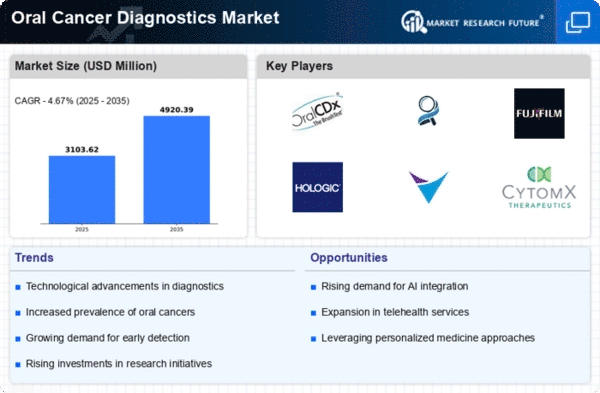
As per MRFR analysis, the Oral Cancer Diagnostics Market Size was estimated at 2965.15 USD Million in 2024. The Oral Cancer Diagnostics industry is projected to grow from 3137.59 USD Million in 2025 to 4920.39 USD Million by 2035, exhibiting a compound annual growth rate (CAGR) of 4.67 during the forecast period 2025 - 2035.

Key Market Trends & Highlights

The Oral Cancer Diagnostics Market is poised for substantial growth driven by technological advancements and increasing awareness.

  • Technological advancements in diagnostics are reshaping the Oral Cancer Diagnostics Market, particularly in North America.
  • Growing awareness and preventive measures are contributing to a heightened demand for diagnostic solutions in the Asia-Pacific region.
  • The Diagnostic Imaging segment remains the largest, while the Molecular Diagnostics segment is experiencing rapid growth.
  • Key market drivers include rising incidence of oral cancer and increased funding for cancer research, which are likely to propel market expansion.

Market Size & Forecast

2024 Market Size 2965.15 (USD Million)
2035 Market Size 4920.39 (USD Million)
CAGR (2025 - 2035) 4.67%
Largest Regional Market Share in 2024 North America

Major Players

<p>OralCDx (US), MediSpectra (US), Fujifilm (JP), Hologic (US), Veracyte (US), CytomX Therapeutics (US), GSK (GB), Abbott Laboratories (US), Roche (CH)</p>

Market Trends

The Oral Cancer Diagnostics Market is currently experiencing a transformative phase, driven by advancements in technology and an increasing awareness of oral health. The integration of innovative diagnostic tools, such as molecular imaging and artificial intelligence, appears to enhance the accuracy and efficiency of early detection. This shift is crucial, as early diagnosis significantly improves treatment outcomes and patient survival rates. Furthermore, the rising prevalence of oral cancer, attributed to factors such as tobacco use and changing dietary habits, underscores the necessity for effective diagnostic solutions. As healthcare systems evolve, the demand for comprehensive screening programs and patient education initiatives is likely to grow, fostering a more proactive approach to oral health management. In addition, the Oral Cancer Diagnostics Market is witnessing a surge in research and development activities aimed at discovering novel biomarkers and diagnostic techniques. Collaborations between academic institutions and industry players seem to be pivotal in driving innovation. Moreover, regulatory bodies are increasingly focusing on streamlining approval processes for new diagnostic tools, which may facilitate quicker market entry. This dynamic environment suggests that stakeholders must remain agile and responsive to emerging trends and technologies to capitalize on the opportunities within this market.

Technological Advancements in Diagnostics

The Oral Cancer Diagnostics Market is increasingly influenced by technological innovations. The emergence of advanced imaging techniques and molecular diagnostics is enhancing the precision of oral cancer detection. These technologies not only improve diagnostic accuracy but also facilitate earlier intervention, which is crucial for better patient outcomes.

Growing Awareness and Preventive Measures

There is a notable increase in public awareness regarding oral cancer and its risk factors. Educational campaigns and preventive health initiatives are encouraging individuals to seek regular screenings. This trend is likely to drive demand for diagnostic services, as more people recognize the importance of early detection.

Regulatory Support for New Technologies

Regulatory agencies are becoming more supportive of innovative diagnostic solutions in the Oral Cancer Diagnostics Market. Streamlined approval processes for new technologies may encourage the development and adoption of cutting-edge diagnostic tools. This regulatory environment could foster a more competitive landscape, benefiting both patients and healthcare providers.

Oral Cancer Diagnostics Market Market Drivers

Increase in Risk Factors

The increase in risk factors associated with oral cancer, such as tobacco use, alcohol consumption, and poor oral hygiene, is a notable driver for the Global Oral Cancer Diagnostics Market Industry. As lifestyles evolve, the prevalence of these risk factors continues to rise, leading to a higher incidence of oral cancer. This trend necessitates the development and implementation of effective diagnostic tools to identify the disease at an early stage. Consequently, the market is poised for growth, as healthcare providers and patients alike recognize the importance of early detection and intervention.

Market Growth Projections

The Global Oral Cancer Diagnostics Market Industry is projected to experience substantial growth in the coming years. With a market size of 0.86 USD Billion in 2024, it is expected to expand to 3.43 USD Billion by 2035, reflecting a robust CAGR of 13.39% from 2025 to 2035. This growth is driven by various factors, including technological advancements, increasing awareness, and government support. As the market evolves, the demand for innovative diagnostic solutions will likely continue to rise, positioning the industry for a promising future.

Growing Awareness and Education

The rising awareness and education regarding oral cancer significantly impact the Global Oral Cancer Diagnostics Market Industry. Health campaigns and educational programs aimed at informing the public about the risks and symptoms of oral cancer have led to increased screening and early diagnosis. This heightened awareness encourages individuals to seek medical advice sooner, thereby improving survival rates. As educational initiatives continue to expand globally, the demand for effective diagnostic solutions is expected to rise, contributing to the overall growth of the market in the coming years.

Rising Incidence of Oral Cancer

The increasing prevalence of oral cancer globally is a primary driver for the Global Oral Cancer Diagnostics Market Industry. According to health statistics, the incidence of oral cancer is projected to rise, with estimates suggesting that by 2024, the market could reach 0.86 USD Billion. This alarming trend necessitates enhanced diagnostic methods and technologies, prompting healthcare providers to invest in advanced diagnostic tools. The growing awareness of oral cancer symptoms and the importance of early detection further contribute to market growth, as patients seek timely diagnosis and treatment options.

Government Initiatives and Funding

Government initiatives aimed at combating oral cancer play a crucial role in the Global Oral Cancer Diagnostics Market Industry. Various health organizations and government bodies are increasingly allocating funds for research and development in oral cancer diagnostics. These initiatives often include public awareness campaigns, screening programs, and subsidies for diagnostic technologies. Such support not only enhances the availability of diagnostic tools but also encourages innovation within the industry. As a result, the market is likely to experience robust growth, with a projected CAGR of 13.39% from 2025 to 2035.

Technological Advancements in Diagnostic Tools

Technological innovations in diagnostic tools significantly influence the Global Oral Cancer Diagnostics Market Industry. The introduction of advanced imaging techniques, such as fluorescence imaging and molecular diagnostics, enhances the accuracy of oral cancer detection. These technologies facilitate earlier diagnosis, which is crucial for effective treatment. As the market evolves, it is anticipated that the integration of artificial intelligence and machine learning will further refine diagnostic processes. This shift towards more sophisticated diagnostic solutions is expected to drive market growth, with projections indicating a market size of 3.43 USD Billion by 2035.

Market Segment Insights

By Application: Diagnostic Imaging (Largest) vs. Molecular Diagnostics (Fastest-Growing)

<p>The Oral Cancer Diagnostics Market is segmented into various applications, with Diagnostic Imaging holding the largest share due to its widespread adoption in early detection and diagnosis. Other significant segments include Biopsy and Histopathology, which also play crucial roles in confirming diagnoses. Molecular Diagnostics, though currently smaller in market share, presents a promising alternative, capitalizing on advancements in technology that enhance the accuracy and speed of cancer detection.</p>

<p>Diagnostic Imaging (Dominant) vs. Molecular Diagnostics (Emerging)</p>

<p>Diagnostic Imaging, including techniques like X-ray and MRI, remains the dominant application in the Oral Cancer Diagnostics Market, offering clear imaging capabilities that facilitate early detection of tumors. In contrast, Molecular Diagnostics represents an emerging field, utilizing genetic profiling and biomarker analysis to provide unprecedented insights into cancer at the molecular level. The rising prevalence of oral cancer and increasing awareness of its early detection are propelling both segments forward. Diagnostic Imaging benefits from established protocols and regulatory approvals, while Molecular Diagnostics is fueled by innovation and potential to personalize treatment strategies. Together, they exemplify the market's evolution towards integrated and advanced diagnostic solutions.</p>

By Test Type: Saliva Test (Largest) vs. Tissue Biopsy (Fastest-Growing)

<p>In the Oral Cancer Diagnostics Market, the Saliva Test has emerged as the largest segment, capturing significant market attention due to its non-invasive nature and ease of collection. Following closely is the Tissue Biopsy segment, which, while traditionally favored for its accuracy, has gained traction as the fastest-growing segment. As healthcare providers increasingly recognize the importance of early detection, these tests are being adopted more widely, shifting the market dynamics. Growth trends within this segment are primarily driven by technological advancements and a growing emphasis on personalized medicine. Innovations in diagnostic techniques, such as molecular testing and liquid biopsy technology, contribute to the rising acceptance of various oral cancer tests. Furthermore, increasing awareness about oral cancer and its associated risk factors among the population fuels demand, leading to an expanded market reach for saliva and tissue biopsy tests.</p>

<p>Saliva Test (Dominant) vs. Blood Test (Emerging)</p>

<p>The Saliva Test stands out as the dominant force in the Oral Cancer Diagnostics Market due to its convenience and non-invasive collection method, appealing to both patients and healthcare professionals alike. This test allows for easy sample collection and has shown effectiveness in detecting biomarkers related to oral cancer. In contrast, the Blood Test segment represents an emerging trend as researchers explore its potential for identifying cancer through circulating tumor DNA and other biomarkers in the bloodstream. Despite being less prevalent compared to saliva tests, blood tests are attracting interest due to advancements in technology and growing patient acceptance of blood-based diagnostics.</p>

By End User: Hospitals (Largest) vs. Diagnostic Laboratories (Fastest-Growing)

<p>In the Oral Cancer Diagnostics Market, the 'End User' segment is primarily composed of Hospitals, Diagnostic Laboratories, Research Institutions, Dental Clinics, and Home Care Settings. Among these, Hospitals hold the largest share, attributed to their comprehensive facilities and access to specialized diagnostic equipment. Diagnostic Laboratories are increasingly capturing market share due to their ability to offer rapid and precise testing services. Additionally, Research Institutions contribute significantly to the innovation and adoption of new diagnostic methods, while Dental Clinics and Home Care Settings play crucial roles in patient referrals and at-home diagnostic solutions.</p>

<p>Hospitals (Dominant) vs. Diagnostic Laboratories (Emerging)</p>

<p>Hospitals dominate the Oral Cancer Diagnostics market, providing a wide array of diagnostic technologies and coordinating care among various specialists. They typically have established protocols for oral cancer screenings and treatment, supported by robust healthcare infrastructure. In contrast, Diagnostic Laboratories are emerging as vital players, driven by advancements in molecular diagnostics and an increasing focus on early detection of oral cancer. These laboratories offer specialized tests that can provide faster results compared to traditional methods, appealing to patients and healthcare providers alike. Their agility in adopting new technologies positions them strongly for future growth in this dynamic market.</p>

Get more detailed insights about Oral Cancer Diagnostics Market Research Report - Forecast till 2035

Regional Insights

North America : Market Leader in Diagnostics

North America is poised to maintain its leadership in the Oral Cancer Diagnostics Market, holding a significant market share of $1480.0M in 2024. The region's growth is driven by increasing awareness of oral cancer, advancements in diagnostic technologies, and supportive regulatory frameworks. The demand for early detection methods is rising, fueled by initiatives from health organizations promoting regular screenings and preventive care. The competitive landscape in North America is robust, featuring key players such as OralCDx, Hologic, and Abbott Laboratories. The U.S. is the leading country, supported by a strong healthcare infrastructure and significant investments in research and development. The presence of innovative companies and a focus on improving diagnostic accuracy further enhance the region's market position.

Europe : Emerging Market Potential

Europe is witnessing a growing interest in the Oral Cancer Diagnostics Market, with a market size of $850.0M in 2024. Factors such as an aging population, increased prevalence of oral cancer, and advancements in diagnostic technologies are driving this growth. Regulatory bodies are also emphasizing the importance of early detection, leading to increased funding for research and development in this field. Leading countries in Europe include Germany, the UK, and France, where healthcare systems are increasingly adopting innovative diagnostic solutions. Key players like GSK and Roche are actively involved in the market, contributing to advancements in diagnostic accuracy and patient outcomes. The competitive landscape is evolving, with a focus on collaboration between public and private sectors to enhance diagnostic capabilities.

Asia-Pacific : Rapidly Growing Market

The Asia-Pacific region is emerging as a significant player in the Oral Cancer Diagnostics Market, with a market size of $500.0M in 2024. The growth is driven by increasing awareness of oral health, rising disposable incomes, and government initiatives aimed at improving healthcare access. The demand for advanced diagnostic tools is on the rise, supported by a growing population and urbanization trends. Countries like Japan, China, and India are leading the market, with a mix of local and international players such as Fujifilm and MediSpectra. The competitive landscape is characterized by innovation and partnerships aimed at enhancing diagnostic technologies. As healthcare systems evolve, the focus on early detection and preventive care is expected to drive further growth in this region.

Middle East and Africa : Emerging Healthcare Landscape

The Middle East and Africa region is gradually developing its Oral Cancer Diagnostics Market, with a market size of $135.15M in 2024. The growth is fueled by increasing healthcare investments, rising awareness of oral health issues, and government initiatives aimed at improving cancer detection rates. Regulatory bodies are beginning to implement frameworks that support the adoption of advanced diagnostic technologies. Leading countries in this region include South Africa and the UAE, where healthcare systems are increasingly integrating innovative diagnostic solutions. The presence of key players is growing, with companies looking to expand their footprint in this emerging market. As the region continues to develop, the focus on improving healthcare access and early detection will be crucial for market growth.

Key Players and Competitive Insights

The Oral Cancer Diagnostics Market is currently characterized by a dynamic competitive landscape, driven by technological advancements and an increasing emphasis on early detection methods. Key players such as OralCDx (US), Hologic (US), and Fujifilm (JP) are strategically positioned to leverage innovation and partnerships to enhance their market presence. OralCDx (US) focuses on its proprietary oral brush biopsy technology, which allows for non-invasive sampling and rapid results, thereby appealing to both healthcare providers and patients. Hologic (US) has been expanding its diagnostic portfolio through strategic acquisitions, enhancing its capabilities in molecular diagnostics, which is crucial for early oral cancer detection. Fujifilm (JP) is investing in digital imaging technologies, aiming to integrate AI into its diagnostic processes, which could significantly improve accuracy and efficiency in oral cancer diagnostics.

In terms of business tactics, companies are increasingly localizing manufacturing to reduce costs and optimize supply chains. The market appears moderately fragmented, with several players vying for market share, yet the influence of major companies is substantial. This competitive structure fosters innovation as companies strive to differentiate their offerings through advanced technologies and improved patient outcomes.

In November 2025, Hologic (US) announced the launch of a new molecular diagnostic test specifically designed for the early detection of oral squamous cell carcinoma. This test utilizes advanced biomarker analysis, which is expected to enhance diagnostic accuracy and speed. The strategic importance of this launch lies in Hologic's commitment to addressing unmet needs in oral cancer diagnostics, potentially positioning the company as a leader in this niche market.

In October 2025, Fujifilm (JP) entered into a partnership with a leading AI technology firm to develop an innovative imaging solution for oral cancer detection. This collaboration aims to harness machine learning algorithms to improve the interpretation of diagnostic images. The strategic significance of this partnership is profound, as it not only enhances Fujifilm's technological capabilities but also aligns with the growing trend of integrating AI into healthcare diagnostics, which could lead to better patient outcomes.

In September 2025, OralCDx (US) expanded its distribution network by partnering with several dental practices across North America. This strategic move is likely to increase accessibility to its diagnostic solutions, thereby enhancing early detection rates of oral cancer. By broadening its reach, OralCDx (US) is positioning itself to capture a larger market share while promoting awareness of the importance of early diagnosis.

As of December 2025, the competitive trends in the Oral Cancer Diagnostics Market are increasingly defined by digitalization, sustainability, and the integration of AI technologies. Strategic alliances are becoming more prevalent, as companies recognize the value of collaboration in driving innovation. Looking ahead, competitive differentiation is expected to evolve, shifting from price-based competition to a focus on technological advancements and supply chain reliability. This transition underscores the importance of innovation in maintaining a competitive edge in the market.

Key Companies in the Oral Cancer Diagnostics Market include

Industry Developments

In 2018, G.E. Healthcare announced its business expansion by partnering with F. Hoffman La Roche to develop an integrated diagnostics platform for oncology.

In 2019, Hitachi announced the approval from Food and Drug Administration (FDA) for its new technology Lumina 3 Tesla (3T) MRI scanner.

Future Outlook

Oral Cancer Diagnostics Market Future Outlook

<p>The Oral Cancer Diagnostics Market is projected to grow at a 4.67% CAGR from 2024 to 2035, driven by technological advancements, increasing awareness, and rising incidence rates.</p>

New opportunities lie in:

  • <p>Development of AI-driven diagnostic tools for early detection.</p>
  • <p>Expansion of telehealth services for remote consultations.</p>
  • <p>Partnerships with dental clinics for integrated screening programs.</p>

<p>By 2035, the market is expected to achieve substantial growth, enhancing diagnostic capabilities globally.</p>

Market Segmentation

Oral Cancer Diagnostics Market End User Outlook

  • Hospitals
  • Diagnostic Laboratories
  • Research Institutions
  • Dental Clinics
  • Home Care Settings

Oral Cancer Diagnostics Market Test Type Outlook

  • Saliva Test
  • Tissue Biopsy
  • Blood Test
  • Urine Test
  • Oral Rinse Test

Oral Cancer Diagnostics Market Application Outlook

  • Diagnostic Imaging
  • Biopsy
  • Molecular Diagnostics
  • Endoscopy
  • Histopathology

Report Scope

MARKET SIZE 20242965.15(USD Million)
MARKET SIZE 20253137.59(USD Million)
MARKET SIZE 20354920.39(USD Million)
COMPOUND ANNUAL GROWTH RATE (CAGR)4.67% (2024 - 2035)
REPORT COVERAGERevenue Forecast, Competitive Landscape, Growth Factors, and Trends
BASE YEAR2024
Market Forecast Period2025 - 2035
Historical Data2019 - 2024
Market Forecast UnitsUSD Million
Key Companies ProfiledOralCDx (US), MediSpectra (US), Fujifilm (JP), Hologic (US), Veracyte (US), CytomX Therapeutics (US), GSK (GB), Abbott Laboratories (US), Roche (CH)
Segments CoveredApplication, Test Type, End User
Key Market OpportunitiesIntegration of artificial intelligence in early detection enhances accuracy in the Oral Cancer Diagnostics Market.
Key Market DynamicsTechnological advancements in diagnostic tools are enhancing early detection and treatment options for oral cancer.
Countries CoveredNorth America, Europe, APAC, South America, MEA

FAQs

What is the projected market CAGR for the forecast period of 2022-2030?

The projected CAGR is 4.8% during the forecast period.

What would be the end valuation by 2032?

The valuation would be USD 2.98 Billion.

What are the end users included in the report?

The report has discussions of hospitals &amp; clinics, research &amp; academic institutes, and others.

What is the diagnosis type discussed in the report?

The discussion has a biopsy, endoscopy, computed tomography (CT), X-ray, magnetic resonance imaging (MRI), positron emission tomography (PET), fluorescence imaging, ultrasonography, and others.

Which region would dominate the market?

The American Oral Cancer Diagnostics Market would dominate the global market.

  1. SECTION I: EXECUTIVE SUMMARY AND KEY HIGHLIGHTS
    1. | 1.1 EXECUTIVE SUMMARY
  2. SECTION II: SCOPING, METHODOLOGY AND MARKET STRUCTURE
    1. | 2.1 MARKET INTRODUCTION
    2. | 2.2 RESEARCH METHODOLOGY
  3. SECTION III: QUALITATIVE ANALYSIS
    1. | 3.1 MARKET DYNAMICS
    2. | 3.2 MARKET FACTOR ANALYSIS
  4. SECTION IV: QUANTITATIVE ANALYSIS
    1. | 4.1 Healthcare, BY Application (USD Million)
    2. | 4.2 Healthcare, BY Test Type (USD Million)
    3. | 4.3 Healthcare, BY End User (USD Million)
    4. | 4.4 Healthcare, BY Region (USD Million)
  5. SECTION V: COMPETITIVE ANALYSIS
    1. | 5.1 Competitive Landscape
    2. | 5.2 Company Profiles
    3. | 5.3 Appendix

Oral Cancer Diagnostics Market Segmentation

Market Segmentation Overview

  • Detailed segmentation data will be available in the full report
  • Comprehensive analysis by multiple parameters
  • Regional and country-level breakdowns
  • Market size forecasts by segment
Infographic

Free Sample Request

Kindly complete the form below to receive a free sample of this Report

Get Free Sample

Customer Strories

Compare Licence

×
Features License Type
Single User Multiuser License Enterprise User
Price $4,950 $5,950 $7,250
Maximum User Access Limit 1 User Upto 10 Users Unrestricted Access Throughout the Organization
Free Customization
Direct Access to Analyst
Deliverable Format
Platform Access
Discount on Next Purchase 10% 15% 15%
Printable Versions