
Request Free Sample ×

Kindly complete the form below to receive a free sample of this Report

* Please use a valid business email

Leading companies partner with us for data-driven Insights

clients tt-cursor
Hero Background
English
Chinese
French
Japanese
Korean
German
Spanish

Optical Transport Network Market Share

ID: MRFR/ICT/1062-CR
143 Pages
Ankit Gupta
April 2020

Optical Transport Network Market Research Report Information By Technology (Wavelength Division Multiplexer [WDM], Dense Wavelength Division Multiplexer [DWDM], And Others), By Service (Network Design, Network Support, And Others), By Component (Optical Switch, Optical Packet Platform, And Others), By End-user (IT/Telecom, Healthcare, Retail, Government, And Others) And By Region (North America, Asia Pacific, Europe, And Rest Of The World) –Market Forecast Till 2035.

Share:
Download PDF ×

We do not share your information with anyone. However, we may send you emails based on your report interest from time to time. You may contact us at any time to opt-out.

Optical Transport Network Market Infographic
Purchase Options

Market Share

Introduction: Navigating the Competitive Landscape of Optical Transport Networks

The Optical Transport Network (OTN) market is experiencing an unprecedented level of competition. This is the result of a combination of rapidly evolving technology, changing regulatory frameworks, and increasing customer demand for high-quality, seamless connections. The main players, including system manufacturers, IT service providers, and network operators, are competing to be the first to offer new services and solutions, based on new technologies such as artificial intelligence, automation, and IoT integration. The emergence of new companies, especially AI start-ups, is causing established players to rapidly adapt. As the focus on sustainable development increases, green infrastructure initiatives are reshaping the market, with further differentiation between the market players. The most significant growth opportunities are in Asia-Pacific and North America, where strategic deployments are in line with the increasing demand for high-capacity, low-latency connections. This market is set for major transformations and will continue to evolve significantly by 2024–25.

Competitive Positioning

Full-Suite Integrators

These vendors offer comprehensive solutions that integrate various aspects of optical transport networks, providing end-to-end services.

Vendor Competitive Edge Solution Focus Regional Focus
Huawei Technologies Co. Ltd Strong R&D and global presence Optical networking solutions Asia, Europe, Africa
Cisco System Inc. Leader in networking technology IP and optical integration Global
NOKIA Innovative optical networking solutions Optical transport and IP networks Global
Ciena Corporation Focus on adaptive networking Optical transport solutions North America, Europe
Alcatel-Lucent SA Strong legacy in telecom solutions Optical networking and services Global

Specialized Technology Vendors

These vendors focus on niche technologies within the optical transport space, offering specialized products and solutions.

Vendor Competitive Edge Solution Focus Regional Focus
Infinera Innovative photonic integrated circuits Intelligent transport networks Global
ADVA Optical Networking Expertise in open networking Optical transport and synchronization Europe, North America
Fujitsu Ltd Strong in optical networking hardware Optical transport systems Asia, North America
ADTRAN Focus on broadband access solutions Optical transport and access North America
Aliathon Technology Ltd Specialized in optical transport technology Optical transport solutions Europe

Infrastructure & Equipment Providers

These vendors provide essential infrastructure and equipment necessary for building and maintaining optical transport networks.

Vendor Competitive Edge Solution Focus Regional Focus
ZTE Corp Cost-effective solutions Telecom equipment and services Asia, Europe, Africa
Aten Technology Inc. Focus on connectivity solutions KVM and AV over IP solutions Global
Allied Telesyn Reliable networking solutions Networking and optical solutions Asia, North America
Britestream Networks Inc. Specialized in video transport Video transport solutions North America
NCIPHER SECURITY, LLC Focus on security solutions Network security for transport Global
Advanced Micro Devices Inc. High-performance computing solutions Semiconductors for networking Global

Emerging Players & Regional Champions

  • IT specializes in high-capacity optical transport solutions with a focus on SDN. Recently it signed a contract to improve the backbone of a large North American telecommunications provider. The technology is a challenge to established players such as Cisco and Nokia, offering more flexible and scalable solutions.
  • ADVA (Germany): Provides a wide range of OTN products, including optical transport and network synchronization. A recent project with a European service provider upgraded the metropolitan area network. Openness and interoperability are a key part of ADVA’s strategy, and this makes it a strong competitor to traditional vendors.
  • Ciena (US): Known for its intelligent solutions, Ciena has been expanding its OTN portfolio with a focus on automation and analytics. Recent deployments include a partnership with a leading Asian telco to build a next-generation optical network. The company's software-based approach is a clear advantage over legacy systems.
  • Then the prestigious Finnish company, whose name is a byword for high-quality equipment, whose OSN WaveSuite software makes its network management and administration more efficient. It has recently won a contract to modernize the telecommunications system of a country in the Middle East, thus strengthening its position against competitors like the Chinese company Huawei.
  • ekinops (France): Its activity is centred on optical transport and access solutions, particularly for operators and enterprises. In recent times it has launched a new range of OTN products aimed at small and medium-sized operators, offering a cost-effective alternative to the products of the big vendors, thanks to its tailor-made solutions for the needs of these operators.

Regional Trends: In 2023, the OTN solutions will be widely adopted in the emerging markets of Asia and Africa, mainly driven by the increasing demand for high-speed Internet and data services. In addition, the popularity of SDN and automation will make the operators of these emerging markets differentiate themselves with their own technology and cost advantages. In terms of network standards, the shift from proprietary to open standards will also give the smaller operators a better way to compete with the giants.

Collaborations & M&A Movements

  • Cisco and Nokia entered a partnership to enhance their optical transport solutions, aiming to improve network efficiency and reduce operational costs in response to increasing demand for high-capacity data transmission.
  • Ciena acquired the optical networking division of a smaller tech firm to bolster its portfolio and strengthen its competitive positioning in the OTN market amid rising competition from established players.
  • Infinera and ZTE announced a collaboration to develop next-generation optical transport systems, focusing on integrating advanced photonic technologies to meet the growing bandwidth requirements of telecom operators.

Competitive Summary Table

Capability Leading Players Remarks
High Capacity Transmission Cisco, Huawei The Cisco NCS 1004 platform supports up to 1.2 Tb/s per slot, which shows the company’s strength in high-capacity solutions. The OptiXtra series of products offer flexible bandwidth allocation and are widely used by telecommunications operators.
Network Automation Nokia, Ciena The AVA AI platform enhances automation through predictive analytics, which reduces operating costs. The Blue Planet software provides end-to-end automation, which has been successfully implemented in various large-scale networks.
Interoperability Infinera, ADVA DTN-X has been known for its interoperability with legacy systems. This facilitates migration. FSP 3000 has been recognized for its open architecture, which enables it to easily connect with third-party solutions.
Sustainability Initiatives Cisco, Nokia CISCO is committed to reducing its carbon footprint and has therefore implemented energy-efficient technologies in its OTN solutions. The same is true of NOKIA, which has been recognized for its efforts to reduce the energy consumption of its networks.
Scalability Ciena, Huawei The WaveLogic technology allows for a scalability of bandwidth that grows with the needs of customers. The CloudFabric solution supports a scalability of the network architecture, allowing operators to expand their services.
Security Features Juniper Networks, Cisco Juniper's security features for the OTN products are of the most advanced type, and have been adopted by several government agencies. The security features of Cisco's OTN products are based on a layered design, and they are very effective in preventing cyber attacks.

Conclusion: Navigating OTN's Competitive Landscape

The Optical Transport Networks (OTN) market in 2023 is characterized by intense competition and a high degree of fragmentation, with both the historical and the new players fighting for market share. The trends in the regional markets are characterized by a strong emphasis on advanced functionality, especially in North America and Asia-Pacific, where the demand for high-capacity, reliable transport solutions is growing. The vendors strategically position themselves by using artificial intelligence, automation and green solutions to increase their operational efficiency and customer satisfaction. As the market evolves, the ability to offer flexible solutions that adapt to changing network demands will be crucial to maintaining leadership. This will not only be a source of differentiation, but also a source of competitive advantage in a rapidly changing landscape.


Author
Author Profile
Ankit Gupta
Team Lead - Research

Ankit Gupta is a seasoned market intelligence and strategic research professional with over six plus years of experience in the ICT and Semiconductor industries. With academic roots in Telecom, Marketing, and Electronics, he blends technical insight with business strategy. Ankit has led 200+ projects, including work for Fortune 500 clients like Microsoft and Rio Tinto, covering market sizing, tech forecasting, and go-to-market strategies. Known for bridging engineering and enterprise decision-making, his insights support growth, innovation, and investment planning across diverse technology markets.

Leave a Comment

FAQs

What is the projected market valuation of the Optical Transport Network (OTN) Market by 2035?

<p>The Optical Transport Network (OTN) Market is projected to reach a valuation of 42.73 USD Billion by 2035.</p>

What was the market valuation of the Optical Transport Network (OTN) Market in 2024?

<p>In 2024, the Optical Transport Network (OTN) Market had a valuation of 19.42 USD Billion.</p>

What is the expected CAGR for the Optical Transport Network (OTN) Market during the forecast period 2025 - 2035?

<p>The expected CAGR for the Optical Transport Network (OTN) Market during the forecast period 2025 - 2035 is 7.43%.</p>

Which companies are considered key players in the Optical Transport Network (OTN) Market?

<p>Key players in the Optical Transport Network (OTN) Market include Cisco Systems, Huawei Technologies, Nokia, Ciena Corporation, and Juniper Networks.</p>

What are the projected revenues for the Wavelength Division Multiplexer (WDM) segment by 2035?

<p>The Wavelength Division Multiplexer (WDM) segment is projected to generate revenues of 17.0 USD Billion by 2035.</p>

How much is the Optical Packet Platform component expected to be valued at by 2035?

<p>The Optical Packet Platform component is expected to be valued at 18.0 USD Billion by 2035.</p>

What is the anticipated revenue for the Network Support service segment by 2035?

The Network Support service segment is anticipated to reach revenues of 18.0 USD Billion by 2035.

What is the projected market size for the IT/Telecom end-user segment by 2035?

The IT/Telecom end-user segment is projected to reach a market size of 16.0 USD Billion by 2035.

What revenue growth is expected for the Optical Transport Network (OTN) Market components from 2024 to 2035?

The Optical Transport Network (OTN) Market components are expected to grow significantly, with the Optical Switch segment projected to reach 13.5 USD Billion by 2035.

What are the projected revenues for the Others category in the Dense Wavelength Division Multiplexer (DWDM) segment by 2035?

The Others category in the Dense Wavelength Division Multiplexer (DWDM) segment is projected to generate revenues of 7.73 USD Billion by 2035.

Market Summary

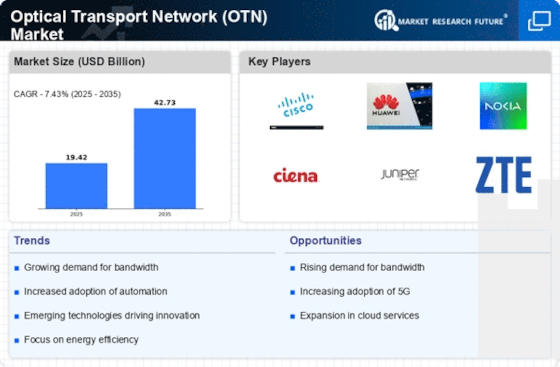
As per Market Research Future analysis, the Optical Transport Network Market (OTN) Market Size was estimated at 19.42 USD Billion in 2024. The OTN industry is projected to grow from 20.86 USD Billion in 2025 to 42.73 USD Billion by 2035, exhibiting a compound annual growth rate (CAGR) of 7.43% during the forecast period 2025 - 2035

Key Market Trends & Highlights

The Optical Transport Network Market (OTN) market is poised for substantial growth driven by technological advancements and increasing demand for connectivity.

  • North America remains the largest market for Optical Transport Networks, driven by robust infrastructure and technological innovation. The Asia-Pacific region is emerging as the fastest-growing market, fueled by rapid urbanization and increasing internet penetration. Wavelength Division Multiplexing (WDM) continues to dominate the market, while Dense Wavelength Division Multiplexing (DWDM) is experiencing the fastest growth due to its efficiency. Rising demand for high-speed connectivity and the growth of Internet of Things (IoT) are key drivers propelling the OTN market forward.

Market Size & Forecast

2024 Market Size 19.42 (USD Billion)
2035 Market Size 42.73 (USD Billion)
CAGR (2025 - 2035) 7.43%
Largest Regional Market Share in 2024 North America

Major Players

<a title="Cisco Systems" href="https://www.cisco.com/site/us/en/products/networking/optical-networking/index.html" target="_blank" rel="noopener">Cisco Systems</a> (US), Huawei Technologies (CN), Nokia (FI), Ciena Corporation (US), <a title="Juniper Networks" href="https://www.juniper.net/content/dam/www/assets/white-papers/us/en/optical-transport-network-otn-and-or-multi-protocol-label.pdf" target="_blank" rel="noopener">Juniper Networks</a> (US), ZTE Corporation (CN), ADVA Optical Networking (DE), Infinera Corporation (US), Mitsubishi Electric (JP)

Market Trends

The Optical Transport Network Market (OTN) Market is currently experiencing a transformative phase, driven by the increasing demand for high-capacity data transmission and the proliferation of cloud-based services. As organizations seek to enhance their network infrastructure, OTN technology emerges as a viable solution, offering improved bandwidth efficiency and reliability. This market is characterized by rapid advancements in optical networking technologies, which facilitate seamless integration of various data formats and protocols. Furthermore, the growing emphasis on network security and the need for robust disaster recovery solutions are propelling investments in OTN systems. In addition, the rise of Internet of Things (IoT) applications and the expansion of 5G networks are likely to further stimulate growth within the Optical Transport Network Market (OTN) Market. As more devices connect to the internet, the demand for efficient data transport solutions becomes increasingly critical. The market appears poised for continued evolution, with innovations in optical components and network management tools enhancing operational capabilities. Stakeholders in this sector must remain vigilant to emerging trends and technological advancements to maintain competitive advantages and meet the evolving needs of end-users. This optical transport network market analysis provides a comprehensive assessment of market size, growth drivers, and competitive dynamics from 2025 to 2035. The optical transport network market share is dominated by North America, followed by Europe and Asia Pacific. Key optical transport network market trends include the rapid adoption of 800G transmission and increasing deployment in data center interconnects. The US optical transport network market leads North America, driven by strong investments in 5G, cloud infrastructure, and data center expansion.

Increased Adoption of Cloud Services

The shift towards cloud computing is driving the Optical Transport Network Market (OTN) Market, as businesses require reliable and high-speed data transmission to support their operations. This trend indicates a growing reliance on OTN solutions to facilitate seamless connectivity between data centers and end-users.

Expansion of 5G Infrastructure

The rollout of 5G technology is significantly impacting the Optical Transport Network Market (OTN) Market. Enhanced mobile broadband and ultra-reliable low-latency communication necessitate advanced optical transport solutions, suggesting a robust demand for OTN systems to support this next-generation network.

Focus on Network Security

As cyber threats become increasingly sophisticated, the Optical Transport Network Market (OTN) Market is witnessing a heightened focus on security measures. Organizations are investing in OTN technologies that offer enhanced encryption and secure data transmission, indicating a shift towards more secure networking solutions.

Optical Transport Network Market Market Drivers

Emergence of 5G Technology

The rollout of 5G technology is poised to have a transformative impact on the Optical Transport Network Market (OTN) Market. As telecommunications providers upgrade their infrastructure to support 5G networks, the demand for high-capacity optical transport solutions is expected to rise. 5G networks require enhanced data throughput and reduced latency, which OTN technologies are designed to deliver. Recent projections suggest that the global 5G infrastructure market could exceed 700 billion dollars by 2026, indicating a substantial investment in optical transport systems to support this next-generation technology. The integration of OTN with 5G networks not only facilitates faster data transmission but also enhances network reliability, making it a crucial component in the evolution of mobile communications.

Growth of Internet of Things (IoT)

The proliferation of Internet of Things (IoT) devices is significantly influencing the Optical Transport Network Market (OTN) Market. With billions of devices expected to be connected in the coming years, the demand for efficient data transport solutions is likely to escalate. IoT applications, ranging from smart cities to industrial automation, require seamless and reliable connectivity to function optimally. The OTN technology, with its ability to handle large volumes of data traffic and provide low-latency communication, is well-suited to meet these demands. Market analysis indicates that the number of connected IoT devices could reach over 75 billion by 2025, creating a substantial opportunity for OTN solutions to facilitate the necessary data transport infrastructure. This growth trajectory underscores the importance of OTN in supporting the expanding IoT ecosystem.

Increased Focus on Network Reliability

In an era where digital services are integral to business operations, the Optical Transport Network Market (OTN) Market is witnessing an increased focus on network reliability. Organizations are prioritizing the need for resilient and fault-tolerant network solutions to ensure uninterrupted service delivery. OTN technologies offer advanced features such as automatic protection switching and error correction, which enhance network reliability and performance. As enterprises increasingly rely on digital platforms for their operations, the demand for dependable transport networks is likely to grow. Market trends indicate that investments in network reliability solutions are expected to rise, with companies seeking to mitigate risks associated with network failures. This emphasis on reliability positions the OTN Market as a vital player in maintaining the integrity of modern communication systems.

Rising Demand for High-Speed Connectivity

The Optical Transport Network Market (OTN) Market is experiencing a surge in demand for high-speed connectivity solutions. As data consumption continues to escalate, driven by the proliferation of streaming services, online gaming, and cloud applications, the need for robust and efficient transport networks becomes paramount. According to recent data, the global bandwidth demand is projected to increase by over 30% annually, necessitating advanced optical transport solutions. This trend compels service providers to invest in OTN technologies that can support higher data rates and lower latency, thereby enhancing user experience. Furthermore, the shift towards remote work and digital transformation initiatives across various sectors further amplifies the need for reliable and high-capacity networks, positioning the OTN Market as a critical enabler of modern communication infrastructure.

Adoption of Advanced Network Management Solutions

The Optical Transport Network Market (OTN) Market is benefiting from the adoption of advanced network management solutions. As networks become more complex, the need for sophisticated management tools to monitor and optimize performance is becoming increasingly apparent. These solutions enable operators to gain real-time insights into network performance, facilitating proactive maintenance and reducing downtime. The integration of artificial intelligence and machine learning into network management is also gaining traction, allowing for predictive analytics and automated decision-making. This trend is likely to enhance operational efficiency and reduce operational costs for service providers. Market forecasts suggest that the demand for advanced network management solutions will continue to grow, further driving the evolution of the OTN Market as it adapts to the challenges of modern telecommunications.

Market Segment Insights

By Technology: Wavelength Division Multiplexer (WDM) (Largest) vs. Dense Wavelength Division Multiplexer (DWDM) (Fastest-Growing)

In the Optical Transport Network Market (OTN) market, the distribution of market share among technology segments reveals a clear dominance of Wavelength Division Multiplexers (WDM), which serve as the backbone of optical communication. However, Dense Wavelength Division Multiplexers (DWDM) are rapidly emerging, capturing a significant share as demand for higher capacity and efficiency grows in communication networks. Other technologies in this segment are also present but hold a comparatively smaller market share, showcasing the high preference for WDM and DWDM solutions for enhanced data transfer capabilities. As advancements in fiber-optic technology continue, the OTN market sees a potential surge in the adoption of DWDM due to its superior performance in transmitting large amounts of data over longer distances. Other technologies are ripe for growth, driven by the increasing need for robust and reliable optical networks, which cater to the demands of cloud computing, <a href="https://www.marketresearchfuture.com/reports/big-data-market-7846">big data</a>, and high-definition streaming services. This growth is indicative of a shift in how networks operate, leaning heavily towards more efficient wavelength management solutions.

Technology: Wavelength Division Multiplexer (WDM) (Dominant) vs. Dense Wavelength Division Multiplexer (DWDM) (Emerging)

The Wavelength Division Multiplexer (WDM) stands as the dominant technology within the Optical Transport Network Market (OTN) market, known for its proven capabilities in increasing bandwidth transmission over existing fiber networks. WDM technology allows multiple wavelengths of light to be transmitted through a single <a href="https://www.marketresearchfuture.com/reports/fibre-optic-cable-market-1072">optical fiber</a>, maximizing the use of available bandwidth. In contrast, the Dense Wavelength Division Multiplexer (DWDM) is an emerging technology that further enhances capacity by allowing even more channels within the same wavelength range. This makes DWDM particularly suitable for high-capacity applications, such as large data centers and telecommunications. While WDM is widely adopted, DWDM's advanced architecture is paving the way for future-proof networking, aligning with the growing demands for data capacity and speed.

By Service: Network Design (Largest) vs. Network Support (Fastest-Growing)

In the Optical Transport Network Market (OTN) market, the service segment is prominently characterized by its distribution among three key values: Network Design, Network Support, and Others. Network Design holds the largest share, leveraging robust infrastructure and advanced design strategies that cater to high-capacity networks. Meanwhile, Network Support, while smaller in share, is rapidly gaining traction as organizations seek reliable support services to ensure optimal network performance. The Other category, including various niche services, also contributes to the overall segment but does not match the influence of the top two.

Network Design (Dominant) vs. Network Support (Emerging)

Network Design plays a dominant role within the Optical Transport Network Market (OTN) market, focusing on creating optimized frameworks that enhance data transmission capabilities and overall network efficiency. This segment benefits from advancements in optical technology and increased bandwidth requirements, making it essential for service providers. Conversely, Network Support is emerging as a vital component, reflecting a growing demand for end-to-end management services, troubleshooting, and maintenance solutions. As networks become more complex, the need for reliable support is escalating, positioning this segment for significant growth. The interplay between these two segments indicates a healthy market dynamic, with design leading the way and support rising in prominence.

By Component: Optical Switch (Largest) vs. Optical Packet Platform (Fastest-Growing)

In the Optical Transport Network Market (OTN) market, the component segment comprises of Optical Switches, Optical Packet Platforms, and other ancillary devices. Among these, Optical Switches dominate the market with their substantial share, providing essential routing capabilities that optimize data flow in networks. Optical Packet Platforms, while smaller in market share, are witnessing rapid adoption due to increasing data traffic demands and the shift towards more flexible and efficient optical networks. As such, their growth trajectory is impressive compared to other components.

Optical Switch (Dominant) vs. Optical Packet Platform (Emerging)

Optical Switches are pivotal in the OTN ecosystem, renowned for their ability to enable efficient data transmission and management across networks. They offer high reliability, scalability, and performance, making them the top choice for carriers and corporations alike. Conversely, Optical Packet Platforms represent an emerging technology focused on providing high-speed packet processing capabilities. Their rapid evolution is driven by the need for enhanced bandwidth, improved network efficiency, and flexible service delivery. Both segment values crucially contribute to the modernization of the OTN landscape, with Optical Switches anchoring the current infrastructure while Optical Packet Platforms usher in innovative advancements.

By End-user: IT/Telecom (Largest) vs. Healthcare (Fastest-Growing)

In the Optical Transport Network Market (OTN) Market, the IT and Telecom segments account for the largest share, driven by the continuous demand for high-performance data transmission. These sectors are crucial as they require robust network infrastructures to support growing data traffic. Following this, Healthcare is emerging as a significant player due to its increasing reliance on <a href="https://www.marketresearchfuture.com/reports/telemedicine-market-2216">telemedicine</a> and electronic health records, which necessitate secure and efficient networking solutions. Other segments, including Retail and Government, also contribute to market dynamics but with comparatively smaller shares.

IT/Telecom: Dominant vs. Healthcare: Emerging

The IT and Telecom sectors are dominant players in the Optical Transport Network Market, driven by the need for efficient data handling and network scalability. With the rise in internet consumption and digital transformation, these sectors leverage OTN technologies to enhance connectivity and data flow. On the other hand, the Healthcare segment is emerging rapidly, fueled by the integration of advanced technology in patient care, like telehealth services. These advancements require reliable and high-quality communication networks, creating a growing demand for optical transport solutions. The synergy between OTN technology and these sectors indicates a promising trajectory for future growth.

Get more detailed insights about Optical Transport Network Market Research Report - Global Forecast till 2035

Regional Insights

By region, the analysis offers market insights into North America, Asia Pacific, Europe, and the Rest of the World. The North American Optical Transport Network Market (OTN) market is expected to lead the market during the forecast period. Due to the use of high-speed communication technologies in the core network, such as Wavelength Division Multiplexer (WDM) and 100G coherent technology, the market in North American countries has grown. The US optical transport network market leads North America, driven by strong investments in 5G, cloud infrastructure, and data center expansion. The Canada optical transport network market is witnessing steady growth due to increasing broadband penetration and government digital initiatives.

Further, the key countries considered in the market report are The US, Canada, German, France, the UK, Spain, Italy, China, Japan, India, South Korea, Brazil, and Australia.

Figure 3: OPTICAL TRANSPORT NETWORK (OTN) MARKET SHARE BY REGION 2022 (USD Billion)

Europe Optical Transport Network Market (OTN) market accounts for the second-highest market share. This is due to the demand for fast and dependable connectivity in Europe due to increasing internet penetration and the growing popularity of cloud-based services. OTN makes it possible to connect quickly and securely to support cloud services and data center interconnectivity by allowing the transportation of massive amounts of data over long distances. Further, the German Optical Transport Network Market (OTN) market held the largest market share, and the UK Optical Transport Network Market (OTN) market was the fastest-growing market in the European region. The UK optical transport network market is expanding due to increasing cloud adoption and growing data center interconnect requirements. The Germany optical transport network market held the largest share in Europe, supported by strong industrial digitalization and telecom investments. The France optical transport network market is growing steadily due to rising demand for high-speed broadband and enterprise networking.

The Asia Pacific Optical Transport Network Market (OTN) Market is expected to grow at the fastest CAGR from 2023 to 2032. The Asia Pacific regional market is growing due to an increasing population, quick industrialization, and the adoption of new technology. The fact that the Internet is used for many different purposes, such as commercial transactions, online gaming, social networking, video conferencing, and online shopping, is another important aspect of the market for optical transport networks. The APAC optical transport network market is expected to grow at the fastest CAGR, supported by rapid industrialization and rising data traffic. The China optical transport network market held the largest share in the Asia Pacific region, supported by large-scale 5G and backbone network deployments. The India optical transport network market is the fastest-growing in the region, driven by expanding telecom networks and data center investments. The Japan optical transport network market benefits from advanced telecom infrastructure and early adoption of high-capacity optical technologies. The South Korea optical transport network market is driven by nationwide 5G rollout and strong government support for digital infrastructure.

Moreover, China’s Optical Transport Network Market (OTN) market held the largest market share, and the Indian Optical Transport Network Market (OTN) market was the fastest-growing market in the Asia Pacific region.

Key Players and Competitive Insights

The Optical Transport Network Market (OTN) market is growing due to comprehensive R&D efforts by key industry participants to broaden their product ranges. Significant market developments can occur through agreements, mergers and acquisitions, increased investments, and cooperation with other organizations. Important industrial companies also meticulously plan several initiatives to increase their footprint. The optical transport network (OTN) industry must offer services at fair costs to expand and survive in an increasingly challenging and competitive market environment.
Local production to cut operating costs is one of the primary strategies businesses use to serve customers and expand the market sector in the Optical Transport Network Market (OTN) market. Recently, the Optical Transport Network Market (OTN) market has greatly helped the Retail industry. Major corporations in the Optical Transport Network Market (OTN) market, including Huawei Technologies Co. Ltd (China), ZTE Corp (China), Cisco System Inc. (US), NOKIA (Espoo), Ciena Corporation (US), and others, are trying to surge market demand by spending on research and development processes.
Huawei is a multinational technology company with its main office in Shenzhen, Guangdong. This company manufactures, develops, markets, and distributes rooftop solar products, consumer electronics, smart gadgets, and telecom equipment. Ren Zhengfei, a former officer in the People's Liberation Army (PLA), created the company in 1987. Huawei's business has grown from its initial focus on producing phone switches to include the construction of telecommunications networks, the provision of operational and consulting services and equipment to businesses both inside and outside of China, and the production of communications products for the consumer market.
In December 2022, Huawei presented its new strategy for optical transport networks at the Huawei Optical Innovation Forum. To build eco-friendly and simple optical networks and provide all-pervasive premium connectivity, this new vision is focused on delivering the optical transport network (OTN) to edge nodes. This will help operators succeed financially.
Network infrastructure and cutting-edge technologies are the areas of business for Nokia Corp (Nokia), a communications and information technology firm. It provides services for fixed networks, mobile devices, BSS/OSS, IP routing, optical networks, private networks, data centers, radio controllers, network implementation, the Internet of Things, and 5G. Nokia also provides application services, management, analytics, and network security. Mobile network operators, businesses, the government, the public sector, financial services, retail, energy and resources, healthcare, logistics, manufacturing, and transportation industries are just a few sectors Nokia serves.
In addition to North America, Asia-Pacific, and Latin America, the corporation also conducts business in Europe, the Middle East, and Africa. Espoo, Finland, serves as the home office for Nokia.
In April Nokia announced that it had added new indoor and outdoor solutions for businesses and communications service providers to its portfolio of mobile transport products. With Nokia's increased Wavence range, there is a complete microwave solution available for all application scenarios.

Key Companies in the Optical Transport Network Market include

Industry Developments

  • Q2 2024: Ciena Unveils Next-Gen 800G Optical Transport Platform to Accelerate Network Modernization Ciena announced the launch of its new 800G optical transport platform, designed to help service providers and data center operators meet growing bandwidth demands with greater efficiency and scalability.
  • Q2 2024: Nokia launches new generation of optical transport solutions for 5G and cloud era Nokia introduced a new suite of optical transport solutions aimed at supporting 5G rollouts and cloud infrastructure, featuring enhanced capacity and automation capabilities.
  • Q3 2024: Fujitsu Launches 1FINITY Ultra Optical Transport Platform for Next-Gen Networks Fujitsu announced the commercial availability of its 1FINITY Ultra optical transport platform, targeting high-capacity, low-latency applications for telecom and hyperscale data center customers.
  • Q3 2024: ZTE and China Mobile Complete Commercial Deployment of 400G OTN in Beijing ZTE and China Mobile announced the successful commercial deployment of a 400G Optical Transport Network Market (OTN) in Beijing, enhancing backbone network capacity for the region.
  • Q4 2024: Huawei Launches Industry’s First 1.2T OTN Platform for Metro Networks Huawei unveiled a 1.2 terabit per second OTN platform, claiming an industry first for metro network applications, to address surging data traffic in urban areas.
  • Q4 2024: Infinera Announces New ICE-X Coherent Pluggable Solutions for Optical Transport Infinera launched its ICE-X coherent pluggable solutions, enabling flexible, high-capacity optical transport for service providers and data center operators.
  • Q1 2025: Ciena and Orange Announce Partnership to Deploy 800G Optical Transport in Europe Ciena and Orange announced a partnership to deploy 800G optical transport technology across Orange’s European backbone, aiming to boost network speed and efficiency.
  • Q1 2025: Nokia and Google Cloud Partner to Advance Optical Transport for AI Data Centers Nokia and Google Cloud announced a partnership to develop advanced optical transport solutions tailored for the high-bandwidth, low-latency needs of AI-driven data centers.
  • Q2 2025: Fujitsu Wins Major Optical Transport Contract with NTT Communications Fujitsu secured a contract to supply its latest optical transport solutions to NTT Communications, supporting the expansion of NTT’s high-capacity backbone network.
  • Q2 2025: ZTE Launches 800G OTN Solution for Global Carriers ZTE announced the global launch of its 800G OTN solution, targeting international carriers seeking to upgrade their long-haul and metro networks.
  • Q3 2025: Huawei and China Telecom Complete World’s First 1.2T OTN Field Trial Huawei and China Telecom announced the successful completion of the world’s first 1.2T OTN field trial, demonstrating ultra-high-speed data transmission over existing fiber infrastructure.
  • Q3 2025: Infinera Expands Manufacturing Facility to Meet Growing Demand for Optical Transport Solutions Infinera announced the expansion of its manufacturing facility to increase production capacity for its optical transport solutions, citing rising global demand.

Future Outlook

Optical Transport Network Market Future Outlook

The Optical Transport Network Market (OTN) Market is projected to grow at a 7.43% CAGR from 2025 to 2035, driven by increasing bandwidth demands and advancements in optical technologies.

New opportunities lie in:

  • <p>Development of AI-driven network management solutions Expansion of 5G infrastructure integration services Launch of energy-efficient optical transport systems</p>

By 2035, the OTN market is expected to achieve robust growth, driven by technological advancements and increasing global connectivity.

Market Segmentation

Optical Transport Network Market Service Outlook

  • Network Design
  • Network Support
  • Others

Optical Transport Network Market End-user Outlook

  • IT/Telecom
  • Healthcare
  • Retail
  • Government
  • Others

Optical Transport Network Market Component Outlook

  • Optical Switch
  • Optical Packet Platform
  • Others

Optical Transport Network Market Technology Outlook

  • Wavelength Division Multiplexer (WDM)
  • Dense Wavelength Division Multiplexer (DWDM)
  • Others

Report Scope

MARKET SIZE 2024 19.42(USD Billion)
MARKET SIZE 2025 20.86(USD Billion)
MARKET SIZE 2035 42.73(USD Billion)
COMPOUND ANNUAL GROWTH RATE (CAGR) 7.43% (2025 - 2035)
REPORT COVERAGE Revenue Forecast, Competitive Landscape, Growth Factors, and Trends
BASE YEAR 2024
Market Forecast Period 2025 - 2035
Historical Data 2019 - 2024
Market Forecast Units USD Billion
Key Companies Profiled Cisco Systems (US), Huawei Technologies (CN), Nokia (FI), Ciena Corporation (US), Juniper Networks (US), ZTE Corporation (CN), ADVA Optical Networking (DE), Infinera Corporation (US), Mitsubishi Electric (JP)
Segments Covered Technology, Service, Component, End-user, Region
Key Market Opportunities Integration of advanced optical technologies enhances capacity and efficiency in the Optical Transport Network (OTN) Market.
Key Market Dynamics Rising demand for high-capacity data transmission drives innovation in Optical Transport Network technologies and infrastructure.
Countries Covered North America, Europe, APAC, South America, MEA

FAQs

What is the projected market valuation of the Optical Transport Network (OTN) Market by 2035?

<p>The Optical Transport Network (OTN) Market is projected to reach a valuation of 42.73 USD Billion by 2035.</p>

What was the market valuation of the Optical Transport Network (OTN) Market in 2024?

<p>In 2024, the Optical Transport Network (OTN) Market had a valuation of 19.42 USD Billion.</p>

What is the expected CAGR for the Optical Transport Network (OTN) Market during the forecast period 2025 - 2035?

<p>The expected CAGR for the Optical Transport Network (OTN) Market during the forecast period 2025 - 2035 is 7.43%.</p>

Which companies are considered key players in the Optical Transport Network (OTN) Market?

<p>Key players in the Optical Transport Network (OTN) Market include Cisco Systems, Huawei Technologies, Nokia, Ciena Corporation, and Juniper Networks.</p>

What are the projected revenues for the Wavelength Division Multiplexer (WDM) segment by 2035?

<p>The Wavelength Division Multiplexer (WDM) segment is projected to generate revenues of 17.0 USD Billion by 2035.</p>

How much is the Optical Packet Platform component expected to be valued at by 2035?

<p>The Optical Packet Platform component is expected to be valued at 18.0 USD Billion by 2035.</p>

What is the anticipated revenue for the Network Support service segment by 2035?

The Network Support service segment is anticipated to reach revenues of 18.0 USD Billion by 2035.

What is the projected market size for the IT/Telecom end-user segment by 2035?

The IT/Telecom end-user segment is projected to reach a market size of 16.0 USD Billion by 2035.

What revenue growth is expected for the Optical Transport Network (OTN) Market components from 2024 to 2035?

The Optical Transport Network (OTN) Market components are expected to grow significantly, with the Optical Switch segment projected to reach 13.5 USD Billion by 2035.

What are the projected revenues for the Others category in the Dense Wavelength Division Multiplexer (DWDM) segment by 2035?

The Others category in the Dense Wavelength Division Multiplexer (DWDM) segment is projected to generate revenues of 7.73 USD Billion by 2035.

  1. SECTION I: EXECUTIVE SUMMARY AND KEY HIGHLIGHTS
    1. | 1.1 EXECUTIVE SUMMARY
    2. | | 1.1.1 Market Overview
    3. | | 1.1.2 Key Findings
    4. | | 1.1.3 Market Segmentation
    5. | | 1.1.4 Competitive Landscape
    6. | | 1.1.5 Challenges and Opportunities
    7. | | 1.1.6 Future Outlook
  2. SECTION II: SCOPING, METHODOLOGY AND MARKET STRUCTURE
    1. | 2.1 MARKET INTRODUCTION
    2. | | 2.1.1 Definition
    3. | | 2.1.2 Scope of the study
    4. | | | 2.1.2.1 Research Objective
    5. | | | 2.1.2.2 Assumption
    6. | | | 2.1.2.3 Limitations
    7. | 2.2 RESEARCH METHODOLOGY
    8. | | 2.2.1 Overview
    9. | | 2.2.2 Data Mining
    10. | | 2.2.3 Secondary Research
    11. | | 2.2.4 Primary Research
    12. | | | 2.2.4.1 Primary Interviews and Information Gathering Process
    13. | | | 2.2.4.2 Breakdown of Primary Respondents
    14. | | 2.2.5 Forecasting Model
    15. | | 2.2.6 Market Size Estimation
    16. | | | 2.2.6.1 Bottom-Up Approach
    17. | | | 2.2.6.2 Top-Down Approach
    18. | | 2.2.7 Data Triangulation
    19. | | 2.2.8 Validation
  3. SECTION III: QUALITATIVE ANALYSIS
    1. | 3.1 MARKET DYNAMICS
    2. | | 3.1.1 Overview
    3. | | 3.1.2 Drivers
    4. | | 3.1.3 Restraints
    5. | | 3.1.4 Opportunities
    6. | 3.2 MARKET FACTOR ANALYSIS
    7. | | 3.2.1 Value chain Analysis
    8. | | 3.2.2 Porter's Five Forces Analysis
    9. | | | 3.2.2.1 Bargaining Power of Suppliers
    10. | | | 3.2.2.2 Bargaining Power of Buyers
    11. | | | 3.2.2.3 Threat of New Entrants
    12. | | | 3.2.2.4 Threat of Substitutes
    13. | | | 3.2.2.5 Intensity of Rivalry
    14. | | 3.2.3 COVID-19 Impact Analysis
    15. | | | 3.2.3.1 Market Impact Analysis
    16. | | | 3.2.3.2 Regional Impact
    17. | | | 3.2.3.3 Opportunity and Threat Analysis
  4. SECTION IV: QUANTITATIVE ANALYSIS
    1. | 4.1 Information and Communications Technology, BY Technology (USD Billion)
    2. | | 4.1.1 Wavelength Division Multiplexer (WDM)
    3. | | 4.1.2 Dense Wavelength Division Multiplexer (DWDM)
    4. | | 4.1.3 Others
    5. | 4.2 Information and Communications Technology, BY Service (USD Billion)
    6. | | 4.2.1 Network Design
    7. | | 4.2.2 Network Support
    8. | | 4.2.3 Others
    9. | 4.3 Information and Communications Technology, BY Component (USD Billion)
    10. | | 4.3.1 Optical Switch
    11. | | 4.3.2 Optical Packet Platform
    12. | | 4.3.3 Others
    13. | 4.4 Information and Communications Technology, BY End-user (USD Billion)
    14. | | 4.4.1 IT/Telecom
    15. | | 4.4.2 Healthcare
    16. | | 4.4.3 Retail
    17. | | 4.4.4 Government
    18. | | 4.4.5 Others
    19. | 4.5 Information and Communications Technology, BY Region (USD Billion)
    20. | | 4.5.1 North America
    21. | | | 4.5.1.1 US
    22. | | | 4.5.1.2 Canada
    23. | | 4.5.2 Europe
    24. | | | 4.5.2.1 Germany
    25. | | | 4.5.2.2 UK
    26. | | | 4.5.2.3 France
    27. | | | 4.5.2.4 Russia
    28. | | | 4.5.2.5 Italy
    29. | | | 4.5.2.6 Spain
    30. | | | 4.5.2.7 Rest of Europe
    31. | | 4.5.3 APAC
    32. | | | 4.5.3.1 China
    33. | | | 4.5.3.2 India
    34. | | | 4.5.3.3 Japan
    35. | | | 4.5.3.4 South Korea
    36. | | | 4.5.3.5 Malaysia
    37. | | | 4.5.3.6 Thailand
    38. | | | 4.5.3.7 Indonesia
    39. | | | 4.5.3.8 Rest of APAC
    40. | | 4.5.4 South America
    41. | | | 4.5.4.1 Brazil
    42. | | | 4.5.4.2 Mexico
    43. | | | 4.5.4.3 Argentina
    44. | | | 4.5.4.4 Rest of South America
    45. | | 4.5.5 MEA
    46. | | | 4.5.5.1 GCC Countries
    47. | | | 4.5.5.2 South Africa
    48. | | | 4.5.5.3 Rest of MEA
  5. SECTION V: COMPETITIVE ANALYSIS
    1. | 5.1 Competitive Landscape
    2. | | 5.1.1 Overview
    3. | | 5.1.2 Competitive Analysis
    4. | | 5.1.3 Market share Analysis
    5. | | 5.1.4 Major Growth Strategy in the Information and Communications Technology
    6. | | 5.1.5 Competitive Benchmarking
    7. | | 5.1.6 Leading Players in Terms of Number of Developments in the Information and Communications Technology
    8. | | 5.1.7 Key developments and growth strategies
    9. | | | 5.1.7.1 New Product Launch/Service Deployment
    10. | | | 5.1.7.2 Merger & Acquisitions
    11. | | | 5.1.7.3 Joint Ventures
    12. | | 5.1.8 Major Players Financial Matrix
    13. | | | 5.1.8.1 Sales and Operating Income
    14. | | | 5.1.8.2 Major Players R&D Expenditure. 2023
    15. | 5.2 Company Profiles
    16. | | 5.2.1 Cisco Systems (US)
    17. | | | 5.2.1.1 Financial Overview
    18. | | | 5.2.1.2 Products Offered
    19. | | | 5.2.1.3 Key Developments
    20. | | | 5.2.1.4 SWOT Analysis
    21. | | | 5.2.1.5 Key Strategies
    22. | | 5.2.2 Huawei Technologies (CN)
    23. | | | 5.2.2.1 Financial Overview
    24. | | | 5.2.2.2 Products Offered
    25. | | | 5.2.2.3 Key Developments
    26. | | | 5.2.2.4 SWOT Analysis
    27. | | | 5.2.2.5 Key Strategies
    28. | | 5.2.3 Nokia (FI)
    29. | | | 5.2.3.1 Financial Overview
    30. | | | 5.2.3.2 Products Offered
    31. | | | 5.2.3.3 Key Developments
    32. | | | 5.2.3.4 SWOT Analysis
    33. | | | 5.2.3.5 Key Strategies
    34. | | 5.2.4 Ciena Corporation (US)
    35. | | | 5.2.4.1 Financial Overview
    36. | | | 5.2.4.2 Products Offered
    37. | | | 5.2.4.3 Key Developments
    38. | | | 5.2.4.4 SWOT Analysis
    39. | | | 5.2.4.5 Key Strategies
    40. | | 5.2.5 Juniper Networks (US)
    41. | | | 5.2.5.1 Financial Overview
    42. | | | 5.2.5.2 Products Offered
    43. | | | 5.2.5.3 Key Developments
    44. | | | 5.2.5.4 SWOT Analysis
    45. | | | 5.2.5.5 Key Strategies
    46. | | 5.2.6 ZTE Corporation (CN)
    47. | | | 5.2.6.1 Financial Overview
    48. | | | 5.2.6.2 Products Offered
    49. | | | 5.2.6.3 Key Developments
    50. | | | 5.2.6.4 SWOT Analysis
    51. | | | 5.2.6.5 Key Strategies
    52. | | 5.2.7 ADVA Optical Networking (DE)
    53. | | | 5.2.7.1 Financial Overview
    54. | | | 5.2.7.2 Products Offered
    55. | | | 5.2.7.3 Key Developments
    56. | | | 5.2.7.4 SWOT Analysis
    57. | | | 5.2.7.5 Key Strategies
    58. | | 5.2.8 Infinera Corporation (US)
    59. | | | 5.2.8.1 Financial Overview
    60. | | | 5.2.8.2 Products Offered
    61. | | | 5.2.8.3 Key Developments
    62. | | | 5.2.8.4 SWOT Analysis
    63. | | | 5.2.8.5 Key Strategies
    64. | | 5.2.9 Mitsubishi Electric (JP)
    65. | | | 5.2.9.1 Financial Overview
    66. | | | 5.2.9.2 Products Offered
    67. | | | 5.2.9.3 Key Developments
    68. | | | 5.2.9.4 SWOT Analysis
    69. | | | 5.2.9.5 Key Strategies
    70. | 5.3 Appendix
    71. | | 5.3.1 References
    72. | | 5.3.2 Related Reports
  6. LIST OF FIGURES
    1. | 6.1 MARKET SYNOPSIS
    2. | 6.2 NORTH AMERICA MARKET ANALYSIS
    3. | 6.3 US MARKET ANALYSIS BY TECHNOLOGY
    4. | 6.4 US MARKET ANALYSIS BY SERVICE
    5. | 6.5 US MARKET ANALYSIS BY COMPONENT
    6. | 6.6 US MARKET ANALYSIS BY END-USER
    7. | 6.7 CANADA MARKET ANALYSIS BY TECHNOLOGY
    8. | 6.8 CANADA MARKET ANALYSIS BY SERVICE
    9. | 6.9 CANADA MARKET ANALYSIS BY COMPONENT
    10. | 6.10 CANADA MARKET ANALYSIS BY END-USER
    11. | 6.11 EUROPE MARKET ANALYSIS
    12. | 6.12 GERMANY MARKET ANALYSIS BY TECHNOLOGY
    13. | 6.13 GERMANY MARKET ANALYSIS BY SERVICE
    14. | 6.14 GERMANY MARKET ANALYSIS BY COMPONENT
    15. | 6.15 GERMANY MARKET ANALYSIS BY END-USER
    16. | 6.16 UK MARKET ANALYSIS BY TECHNOLOGY
    17. | 6.17 UK MARKET ANALYSIS BY SERVICE
    18. | 6.18 UK MARKET ANALYSIS BY COMPONENT
    19. | 6.19 UK MARKET ANALYSIS BY END-USER
    20. | 6.20 FRANCE MARKET ANALYSIS BY TECHNOLOGY
    21. | 6.21 FRANCE MARKET ANALYSIS BY SERVICE
    22. | 6.22 FRANCE MARKET ANALYSIS BY COMPONENT
    23. | 6.23 FRANCE MARKET ANALYSIS BY END-USER
    24. | 6.24 RUSSIA MARKET ANALYSIS BY TECHNOLOGY
    25. | 6.25 RUSSIA MARKET ANALYSIS BY SERVICE
    26. | 6.26 RUSSIA MARKET ANALYSIS BY COMPONENT
    27. | 6.27 RUSSIA MARKET ANALYSIS BY END-USER
    28. | 6.28 ITALY MARKET ANALYSIS BY TECHNOLOGY
    29. | 6.29 ITALY MARKET ANALYSIS BY SERVICE
    30. | 6.30 ITALY MARKET ANALYSIS BY COMPONENT
    31. | 6.31 ITALY MARKET ANALYSIS BY END-USER
    32. | 6.32 SPAIN MARKET ANALYSIS BY TECHNOLOGY
    33. | 6.33 SPAIN MARKET ANALYSIS BY SERVICE
    34. | 6.34 SPAIN MARKET ANALYSIS BY COMPONENT
    35. | 6.35 SPAIN MARKET ANALYSIS BY END-USER
    36. | 6.36 REST OF EUROPE MARKET ANALYSIS BY TECHNOLOGY
    37. | 6.37 REST OF EUROPE MARKET ANALYSIS BY SERVICE
    38. | 6.38 REST OF EUROPE MARKET ANALYSIS BY COMPONENT
    39. | 6.39 REST OF EUROPE MARKET ANALYSIS BY END-USER
    40. | 6.40 APAC MARKET ANALYSIS
    41. | 6.41 CHINA MARKET ANALYSIS BY TECHNOLOGY
    42. | 6.42 CHINA MARKET ANALYSIS BY SERVICE
    43. | 6.43 CHINA MARKET ANALYSIS BY COMPONENT
    44. | 6.44 CHINA MARKET ANALYSIS BY END-USER
    45. | 6.45 INDIA MARKET ANALYSIS BY TECHNOLOGY
    46. | 6.46 INDIA MARKET ANALYSIS BY SERVICE
    47. | 6.47 INDIA MARKET ANALYSIS BY COMPONENT
    48. | 6.48 INDIA MARKET ANALYSIS BY END-USER
    49. | 6.49 JAPAN MARKET ANALYSIS BY TECHNOLOGY
    50. | 6.50 JAPAN MARKET ANALYSIS BY SERVICE
    51. | 6.51 JAPAN MARKET ANALYSIS BY COMPONENT
    52. | 6.52 JAPAN MARKET ANALYSIS BY END-USER
    53. | 6.53 SOUTH KOREA MARKET ANALYSIS BY TECHNOLOGY
    54. | 6.54 SOUTH KOREA MARKET ANALYSIS BY SERVICE
    55. | 6.55 SOUTH KOREA MARKET ANALYSIS BY COMPONENT
    56. | 6.56 SOUTH KOREA MARKET ANALYSIS BY END-USER
    57. | 6.57 MALAYSIA MARKET ANALYSIS BY TECHNOLOGY
    58. | 6.58 MALAYSIA MARKET ANALYSIS BY SERVICE
    59. | 6.59 MALAYSIA MARKET ANALYSIS BY COMPONENT
    60. | 6.60 MALAYSIA MARKET ANALYSIS BY END-USER
    61. | 6.61 THAILAND MARKET ANALYSIS BY TECHNOLOGY
    62. | 6.62 THAILAND MARKET ANALYSIS BY SERVICE
    63. | 6.63 THAILAND MARKET ANALYSIS BY COMPONENT
    64. | 6.64 THAILAND MARKET ANALYSIS BY END-USER
    65. | 6.65 INDONESIA MARKET ANALYSIS BY TECHNOLOGY
    66. | 6.66 INDONESIA MARKET ANALYSIS BY SERVICE
    67. | 6.67 INDONESIA MARKET ANALYSIS BY COMPONENT
    68. | 6.68 INDONESIA MARKET ANALYSIS BY END-USER
    69. | 6.69 REST OF APAC MARKET ANALYSIS BY TECHNOLOGY
    70. | 6.70 REST OF APAC MARKET ANALYSIS BY SERVICE
    71. | 6.71 REST OF APAC MARKET ANALYSIS BY COMPONENT
    72. | 6.72 REST OF APAC MARKET ANALYSIS BY END-USER
    73. | 6.73 SOUTH AMERICA MARKET ANALYSIS
    74. | 6.74 BRAZIL MARKET ANALYSIS BY TECHNOLOGY
    75. | 6.75 BRAZIL MARKET ANALYSIS BY SERVICE
    76. | 6.76 BRAZIL MARKET ANALYSIS BY COMPONENT
    77. | 6.77 BRAZIL MARKET ANALYSIS BY END-USER
    78. | 6.78 MEXICO MARKET ANALYSIS BY TECHNOLOGY
    79. | 6.79 MEXICO MARKET ANALYSIS BY SERVICE
    80. | 6.80 MEXICO MARKET ANALYSIS BY COMPONENT
    81. | 6.81 MEXICO MARKET ANALYSIS BY END-USER
    82. | 6.82 ARGENTINA MARKET ANALYSIS BY TECHNOLOGY
    83. | 6.83 ARGENTINA MARKET ANALYSIS BY SERVICE
    84. | 6.84 ARGENTINA MARKET ANALYSIS BY COMPONENT
    85. | 6.85 ARGENTINA MARKET ANALYSIS BY END-USER
    86. | 6.86 REST OF SOUTH AMERICA MARKET ANALYSIS BY TECHNOLOGY
    87. | 6.87 REST OF SOUTH AMERICA MARKET ANALYSIS BY SERVICE
    88. | 6.88 REST OF SOUTH AMERICA MARKET ANALYSIS BY COMPONENT
    89. | 6.89 REST OF SOUTH AMERICA MARKET ANALYSIS BY END-USER
    90. | 6.90 MEA MARKET ANALYSIS
    91. | 6.91 GCC COUNTRIES MARKET ANALYSIS BY TECHNOLOGY
    92. | 6.92 GCC COUNTRIES MARKET ANALYSIS BY SERVICE
    93. | 6.93 GCC COUNTRIES MARKET ANALYSIS BY COMPONENT
    94. | 6.94 GCC COUNTRIES MARKET ANALYSIS BY END-USER
    95. | 6.95 SOUTH AFRICA MARKET ANALYSIS BY TECHNOLOGY
    96. | 6.96 SOUTH AFRICA MARKET ANALYSIS BY SERVICE
    97. | 6.97 SOUTH AFRICA MARKET ANALYSIS BY COMPONENT
    98. | 6.98 SOUTH AFRICA MARKET ANALYSIS BY END-USER
    99. | 6.99 REST OF MEA MARKET ANALYSIS BY TECHNOLOGY
    100. | 6.100 REST OF MEA MARKET ANALYSIS BY SERVICE
    101. | 6.101 REST OF MEA MARKET ANALYSIS BY COMPONENT
    102. | 6.102 REST OF MEA MARKET ANALYSIS BY END-USER
    103. | 6.103 KEY BUYING CRITERIA OF INFORMATION AND COMMUNICATIONS TECHNOLOGY
    104. | 6.104 RESEARCH PROCESS OF MRFR
    105. | 6.105 DRO ANALYSIS OF INFORMATION AND COMMUNICATIONS TECHNOLOGY
    106. | 6.106 DRIVERS IMPACT ANALYSIS: INFORMATION AND COMMUNICATIONS TECHNOLOGY
    107. | 6.107 RESTRAINTS IMPACT ANALYSIS: INFORMATION AND COMMUNICATIONS TECHNOLOGY
    108. | 6.108 SUPPLY / VALUE CHAIN: INFORMATION AND COMMUNICATIONS TECHNOLOGY
    109. | 6.109 INFORMATION AND COMMUNICATIONS TECHNOLOGY, BY TECHNOLOGY, 2024 (% SHARE)
    110. | 6.110 INFORMATION AND COMMUNICATIONS TECHNOLOGY, BY TECHNOLOGY, 2024 TO 2035 (USD Billion)
    111. | 6.111 INFORMATION AND COMMUNICATIONS TECHNOLOGY, BY SERVICE, 2024 (% SHARE)
    112. | 6.112 INFORMATION AND COMMUNICATIONS TECHNOLOGY, BY SERVICE, 2024 TO 2035 (USD Billion)
    113. | 6.113 INFORMATION AND COMMUNICATIONS TECHNOLOGY, BY COMPONENT, 2024 (% SHARE)
    114. | 6.114 INFORMATION AND COMMUNICATIONS TECHNOLOGY, BY COMPONENT, 2024 TO 2035 (USD Billion)
    115. | 6.115 INFORMATION AND COMMUNICATIONS TECHNOLOGY, BY END-USER, 2024 (% SHARE)
    116. | 6.116 INFORMATION AND COMMUNICATIONS TECHNOLOGY, BY END-USER, 2024 TO 2035 (USD Billion)
    117. | 6.117 BENCHMARKING OF MAJOR COMPETITORS
  7. LIST OF TABLES
    1. | 7.1 LIST OF ASSUMPTIONS
    2. | | 7.1.1
    3. | 7.2 North America MARKET SIZE ESTIMATES; FORECAST
    4. | | 7.2.1 BY TECHNOLOGY, 2025-2035 (USD Billion)
    5. | | 7.2.2 BY SERVICE, 2025-2035 (USD Billion)
    6. | | 7.2.3 BY COMPONENT, 2025-2035 (USD Billion)
    7. | | 7.2.4 BY END-USER, 2025-2035 (USD Billion)
    8. | 7.3 US MARKET SIZE ESTIMATES; FORECAST
    9. | | 7.3.1 BY TECHNOLOGY, 2025-2035 (USD Billion)
    10. | | 7.3.2 BY SERVICE, 2025-2035 (USD Billion)
    11. | | 7.3.3 BY COMPONENT, 2025-2035 (USD Billion)
    12. | | 7.3.4 BY END-USER, 2025-2035 (USD Billion)
    13. | 7.4 Canada MARKET SIZE ESTIMATES; FORECAST
    14. | | 7.4.1 BY TECHNOLOGY, 2025-2035 (USD Billion)
    15. | | 7.4.2 BY SERVICE, 2025-2035 (USD Billion)
    16. | | 7.4.3 BY COMPONENT, 2025-2035 (USD Billion)
    17. | | 7.4.4 BY END-USER, 2025-2035 (USD Billion)
    18. | 7.5 Europe MARKET SIZE ESTIMATES; FORECAST
    19. | | 7.5.1 BY TECHNOLOGY, 2025-2035 (USD Billion)
    20. | | 7.5.2 BY SERVICE, 2025-2035 (USD Billion)
    21. | | 7.5.3 BY COMPONENT, 2025-2035 (USD Billion)
    22. | | 7.5.4 BY END-USER, 2025-2035 (USD Billion)
    23. | 7.6 Germany MARKET SIZE ESTIMATES; FORECAST
    24. | | 7.6.1 BY TECHNOLOGY, 2025-2035 (USD Billion)
    25. | | 7.6.2 BY SERVICE, 2025-2035 (USD Billion)
    26. | | 7.6.3 BY COMPONENT, 2025-2035 (USD Billion)
    27. | | 7.6.4 BY END-USER, 2025-2035 (USD Billion)
    28. | 7.7 UK MARKET SIZE ESTIMATES; FORECAST
    29. | | 7.7.1 BY TECHNOLOGY, 2025-2035 (USD Billion)
    30. | | 7.7.2 BY SERVICE, 2025-2035 (USD Billion)
    31. | | 7.7.3 BY COMPONENT, 2025-2035 (USD Billion)
    32. | | 7.7.4 BY END-USER, 2025-2035 (USD Billion)
    33. | 7.8 France MARKET SIZE ESTIMATES; FORECAST
    34. | | 7.8.1 BY TECHNOLOGY, 2025-2035 (USD Billion)
    35. | | 7.8.2 BY SERVICE, 2025-2035 (USD Billion)
    36. | | 7.8.3 BY COMPONENT, 2025-2035 (USD Billion)
    37. | | 7.8.4 BY END-USER, 2025-2035 (USD Billion)
    38. | 7.9 Russia MARKET SIZE ESTIMATES; FORECAST
    39. | | 7.9.1 BY TECHNOLOGY, 2025-2035 (USD Billion)
    40. | | 7.9.2 BY SERVICE, 2025-2035 (USD Billion)
    41. | | 7.9.3 BY COMPONENT, 2025-2035 (USD Billion)
    42. | | 7.9.4 BY END-USER, 2025-2035 (USD Billion)
    43. | 7.10 Italy MARKET SIZE ESTIMATES; FORECAST
    44. | | 7.10.1 BY TECHNOLOGY, 2025-2035 (USD Billion)
    45. | | 7.10.2 BY SERVICE, 2025-2035 (USD Billion)
    46. | | 7.10.3 BY COMPONENT, 2025-2035 (USD Billion)
    47. | | 7.10.4 BY END-USER, 2025-2035 (USD Billion)
    48. | 7.11 Spain MARKET SIZE ESTIMATES; FORECAST
    49. | | 7.11.1 BY TECHNOLOGY, 2025-2035 (USD Billion)
    50. | | 7.11.2 BY SERVICE, 2025-2035 (USD Billion)
    51. | | 7.11.3 BY COMPONENT, 2025-2035 (USD Billion)
    52. | | 7.11.4 BY END-USER, 2025-2035 (USD Billion)
    53. | 7.12 Rest of Europe MARKET SIZE ESTIMATES; FORECAST
    54. | | 7.12.1 BY TECHNOLOGY, 2025-2035 (USD Billion)
    55. | | 7.12.2 BY SERVICE, 2025-2035 (USD Billion)
    56. | | 7.12.3 BY COMPONENT, 2025-2035 (USD Billion)
    57. | | 7.12.4 BY END-USER, 2025-2035 (USD Billion)
    58. | 7.13 APAC MARKET SIZE ESTIMATES; FORECAST
    59. | | 7.13.1 BY TECHNOLOGY, 2025-2035 (USD Billion)
    60. | | 7.13.2 BY SERVICE, 2025-2035 (USD Billion)
    61. | | 7.13.3 BY COMPONENT, 2025-2035 (USD Billion)
    62. | | 7.13.4 BY END-USER, 2025-2035 (USD Billion)
    63. | 7.14 China MARKET SIZE ESTIMATES; FORECAST
    64. | | 7.14.1 BY TECHNOLOGY, 2025-2035 (USD Billion)
    65. | | 7.14.2 BY SERVICE, 2025-2035 (USD Billion)
    66. | | 7.14.3 BY COMPONENT, 2025-2035 (USD Billion)
    67. | | 7.14.4 BY END-USER, 2025-2035 (USD Billion)
    68. | 7.15 India MARKET SIZE ESTIMATES; FORECAST
    69. | | 7.15.1 BY TECHNOLOGY, 2025-2035 (USD Billion)
    70. | | 7.15.2 BY SERVICE, 2025-2035 (USD Billion)
    71. | | 7.15.3 BY COMPONENT, 2025-2035 (USD Billion)
    72. | | 7.15.4 BY END-USER, 2025-2035 (USD Billion)
    73. | 7.16 Japan MARKET SIZE ESTIMATES; FORECAST
    74. | | 7.16.1 BY TECHNOLOGY, 2025-2035 (USD Billion)
    75. | | 7.16.2 BY SERVICE, 2025-2035 (USD Billion)
    76. | | 7.16.3 BY COMPONENT, 2025-2035 (USD Billion)
    77. | | 7.16.4 BY END-USER, 2025-2035 (USD Billion)
    78. | 7.17 South Korea MARKET SIZE ESTIMATES; FORECAST
    79. | | 7.17.1 BY TECHNOLOGY, 2025-2035 (USD Billion)
    80. | | 7.17.2 BY SERVICE, 2025-2035 (USD Billion)
    81. | | 7.17.3 BY COMPONENT, 2025-2035 (USD Billion)
    82. | | 7.17.4 BY END-USER, 2025-2035 (USD Billion)
    83. | 7.18 Malaysia MARKET SIZE ESTIMATES; FORECAST
    84. | | 7.18.1 BY TECHNOLOGY, 2025-2035 (USD Billion)
    85. | | 7.18.2 BY SERVICE, 2025-2035 (USD Billion)
    86. | | 7.18.3 BY COMPONENT, 2025-2035 (USD Billion)
    87. | | 7.18.4 BY END-USER, 2025-2035 (USD Billion)
    88. | 7.19 Thailand MARKET SIZE ESTIMATES; FORECAST
    89. | | 7.19.1 BY TECHNOLOGY, 2025-2035 (USD Billion)
    90. | | 7.19.2 BY SERVICE, 2025-2035 (USD Billion)
    91. | | 7.19.3 BY COMPONENT, 2025-2035 (USD Billion)
    92. | | 7.19.4 BY END-USER, 2025-2035 (USD Billion)
    93. | 7.20 Indonesia MARKET SIZE ESTIMATES; FORECAST
    94. | | 7.20.1 BY TECHNOLOGY, 2025-2035 (USD Billion)
    95. | | 7.20.2 BY SERVICE, 2025-2035 (USD Billion)
    96. | | 7.20.3 BY COMPONENT, 2025-2035 (USD Billion)
    97. | | 7.20.4 BY END-USER, 2025-2035 (USD Billion)
    98. | 7.21 Rest of APAC MARKET SIZE ESTIMATES; FORECAST
    99. | | 7.21.1 BY TECHNOLOGY, 2025-2035 (USD Billion)
    100. | | 7.21.2 BY SERVICE, 2025-2035 (USD Billion)
    101. | | 7.21.3 BY COMPONENT, 2025-2035 (USD Billion)
    102. | | 7.21.4 BY END-USER, 2025-2035 (USD Billion)
    103. | 7.22 South America MARKET SIZE ESTIMATES; FORECAST
    104. | | 7.22.1 BY TECHNOLOGY, 2025-2035 (USD Billion)
    105. | | 7.22.2 BY SERVICE, 2025-2035 (USD Billion)
    106. | | 7.22.3 BY COMPONENT, 2025-2035 (USD Billion)
    107. | | 7.22.4 BY END-USER, 2025-2035 (USD Billion)
    108. | 7.23 Brazil MARKET SIZE ESTIMATES; FORECAST
    109. | | 7.23.1 BY TECHNOLOGY, 2025-2035 (USD Billion)
    110. | | 7.23.2 BY SERVICE, 2025-2035 (USD Billion)
    111. | | 7.23.3 BY COMPONENT, 2025-2035 (USD Billion)
    112. | | 7.23.4 BY END-USER, 2025-2035 (USD Billion)
    113. | 7.24 Mexico MARKET SIZE ESTIMATES; FORECAST
    114. | | 7.24.1 BY TECHNOLOGY, 2025-2035 (USD Billion)
    115. | | 7.24.2 BY SERVICE, 2025-2035 (USD Billion)
    116. | | 7.24.3 BY COMPONENT, 2025-2035 (USD Billion)
    117. | | 7.24.4 BY END-USER, 2025-2035 (USD Billion)
    118. | 7.25 Argentina MARKET SIZE ESTIMATES; FORECAST
    119. | | 7.25.1 BY TECHNOLOGY, 2025-2035 (USD Billion)
    120. | | 7.25.2 BY SERVICE, 2025-2035 (USD Billion)
    121. | | 7.25.3 BY COMPONENT, 2025-2035 (USD Billion)
    122. | | 7.25.4 BY END-USER, 2025-2035 (USD Billion)
    123. | 7.26 Rest of South America MARKET SIZE ESTIMATES; FORECAST
    124. | | 7.26.1 BY TECHNOLOGY, 2025-2035 (USD Billion)
    125. | | 7.26.2 BY SERVICE, 2025-2035 (USD Billion)
    126. | | 7.26.3 BY COMPONENT, 2025-2035 (USD Billion)
    127. | | 7.26.4 BY END-USER, 2025-2035 (USD Billion)
    128. | 7.27 MEA MARKET SIZE ESTIMATES; FORECAST
    129. | | 7.27.1 BY TECHNOLOGY, 2025-2035 (USD Billion)
    130. | | 7.27.2 BY SERVICE, 2025-2035 (USD Billion)
    131. | | 7.27.3 BY COMPONENT, 2025-2035 (USD Billion)
    132. | | 7.27.4 BY END-USER, 2025-2035 (USD Billion)
    133. | 7.28 GCC Countries MARKET SIZE ESTIMATES; FORECAST
    134. | | 7.28.1 BY TECHNOLOGY, 2025-2035 (USD Billion)
    135. | | 7.28.2 BY SERVICE, 2025-2035 (USD Billion)
    136. | | 7.28.3 BY COMPONENT, 2025-2035 (USD Billion)
    137. | | 7.28.4 BY END-USER, 2025-2035 (USD Billion)
    138. | 7.29 South Africa MARKET SIZE ESTIMATES; FORECAST
    139. | | 7.29.1 BY TECHNOLOGY, 2025-2035 (USD Billion)
    140. | | 7.29.2 BY SERVICE, 2025-2035 (USD Billion)
    141. | | 7.29.3 BY COMPONENT, 2025-2035 (USD Billion)
    142. | | 7.29.4 BY END-USER, 2025-2035 (USD Billion)
    143. | 7.30 Rest of MEA MARKET SIZE ESTIMATES; FORECAST
    144. | | 7.30.1 BY TECHNOLOGY, 2025-2035 (USD Billion)
    145. | | 7.30.2 BY SERVICE, 2025-2035 (USD Billion)
    146. | | 7.30.3 BY COMPONENT, 2025-2035 (USD Billion)
    147. | | 7.30.4 BY END-USER, 2025-2035 (USD Billion)
    148. | 7.31 PRODUCT LAUNCH/PRODUCT DEVELOPMENT/APPROVAL
    149. | | 7.31.1
    150. | 7.32 ACQUISITION/PARTNERSHIP
    151. | | 7.32.1

Information and Communications Technology Market Segmentation

Information and Communications Technology By Technology (USD Billion, 2025-2035)

  • Wavelength Division Multiplexer (WDM)
  • Dense Wavelength Division Multiplexer (DWDM)
  • Others

Information and Communications Technology By Service (USD Billion, 2025-2035)

  • Network Design
  • Network Support
  • Others

Information and Communications Technology By Component (USD Billion, 2025-2035)

  • Optical Switch
  • Optical Packet Platform
  • Others

Information and Communications Technology By End-user (USD Billion, 2025-2035)

  • IT/Telecom
  • Healthcare
  • Retail
  • Government
  • Others
Infographic

Free Sample Request

Kindly complete the form below to receive a free sample of this Report

Get Free Sample

Customer Strories

Compare Licence

×
Features License Type
Single User Multiuser License Enterprise User
Price $4,950 $5,950 $7,250
Maximum User Access Limit 1 User Upto 10 Users Unrestricted Access Throughout the Organization
Free Customization
Direct Access to Analyst
Deliverable Format
Platform Access
Discount on Next Purchase 10% 15% 15%
Printable Versions