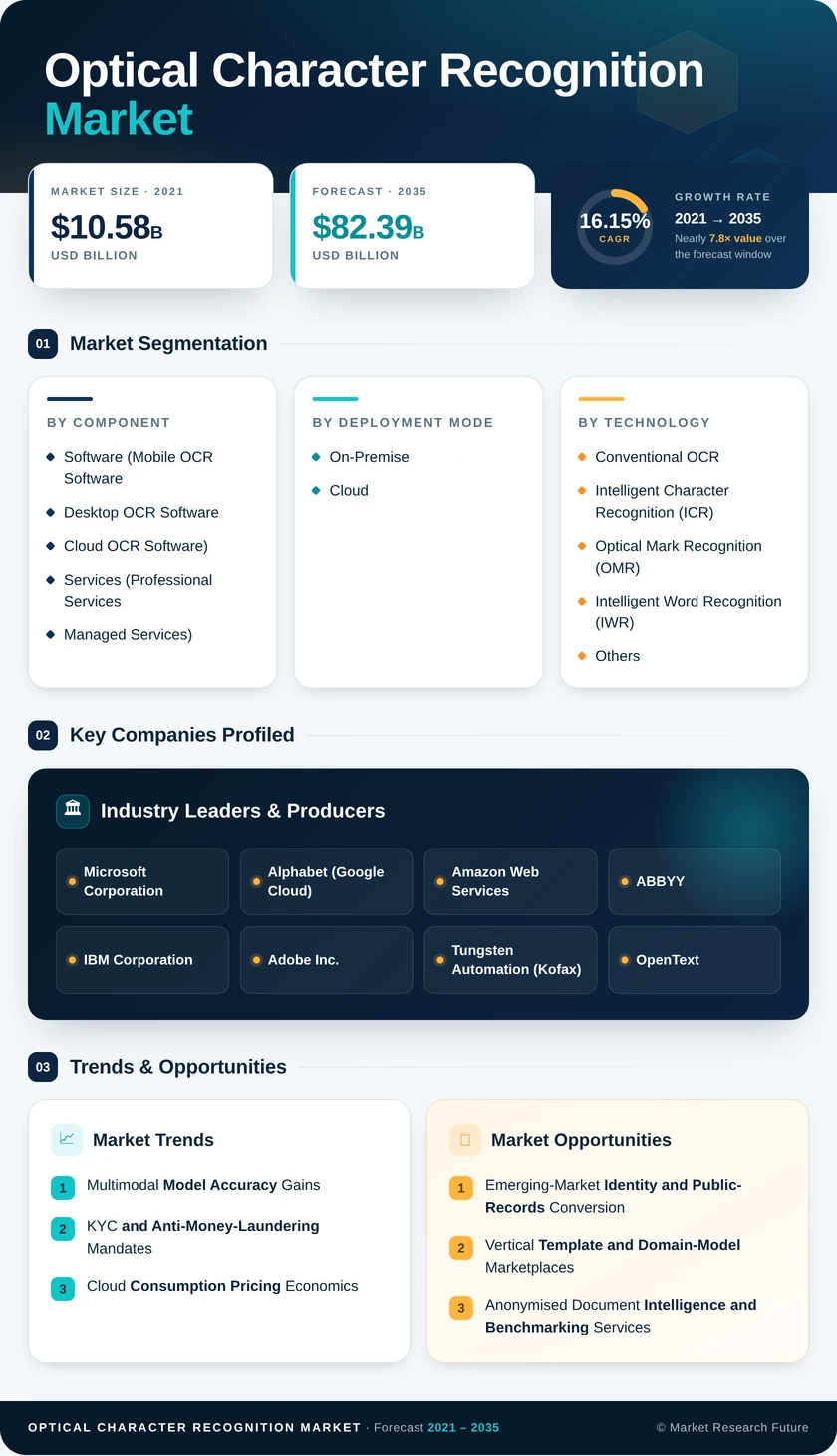
Segmentation Quick Reference
| Dimension | Sub-Segments | Dominant Segment | Fastest Growing Segment |
| By Component | Software (Mobile OCR Software, Desktop OCR Software, Cloud OCR Software); Services (Professional Services, Managed Services) | Software — 71.90% revenue share (2025) | Services — 18.58% CAGR (2026–2035) |
| By Deployment Mode | On-Premise; Cloud | Cloud — 60.64% revenue share (2025) | On-Premise — 14.37% CAGR (2026–2035) |
| By Technology | Conventional OCR; Intelligent Character Recognition (ICR); Optical Mark Recognition (OMR); Intelligent Word Recognition (IWR); Others | Conventional OCR — 65.47% revenue share (2025) | Intelligent Character Recognition (ICR) — 20.28% CAGR (2026–2035) |
| By Application | Invoice and Bill Processing; Identity Verification and KYC; Document Management and Archiving; Banking Cheque Processing; Packaging and Label Recognition; Others | Invoice and Bill Processing — 30.13% revenue share (2025) | Identity Verification and KYC — 19.10% CAGR (2026–2035) |
| By End-Use Industry | BFSI; Retail and E-commerce; Government; Healthcare; Education; Transportation and Logistics; Manufacturing; Others | BFSI — 23.81% revenue share (2025) | Healthcare — 20.81% CAGR (2026–2035) |
Market Segmentation Overview
By Component
| Sub-Segment | Key Trend |
| Software | Licence mix shifting from perpetual desktop to subscription and API consumption |
| Mobile OCR Software | Embedded SDKs移 into consumer apps for in-session document capture |
| Desktop OCR Software | Retained for regulated back-office workstations and archival batch runs |
| Cloud OCR Software | Fastest-scaling software line as batch workloads move to elastic endpoints |
| Services | Buyers pay for accuracy outcomes rather than tooling alone |
| Professional Services | Industry lexicons and regulatory templates built into extraction pipelines |
| Managed Services | Subscription retraining as document formats drift year to year |
Software carries 71.90% of 2025 revenue, but Services grows faster at 18.58% because deployment value now depends on domain tuning that most buyers cannot staff internally. Inside software, Cloud OCR Software is displacing Desktop OCR Software as scanning moves off dedicated workstations. Within services, Managed Services outpaces Professional Services: healthcare and banking integrators have discovered that vertical lexicons need continuous maintenance, not a one-time build.
By Deployment Mode
| Sub-Segment | Key Trend |
| On-Premise | Retained for cheque imaging, classified records, and residency-bound workloads |
| Cloud | Default for variable-volume processing with automatic model refresh |
Cloud holds 60.64% of 2025 revenue because elastic capacity matches the bursty nature of document arrival, and buyers inherit model improvements without upgrade projects. On-Premise nevertheless grows at 14.37% as data-residency rules in European and Gulf public-sector procurement rule out cross-border processing. Containerised engines running inside customer data centres have made the two modes complementary, with sensitive workloads local and post-processing remote.
By Technology
| Sub-Segment | Key Trend |
| Conventional OCR | Commoditising on price while retaining the largest page volumes |
| Intelligent Character Recognition (ICR) | Deep-learning handwriting accuracy clearing commercial thresholds |
| Optical Mark Recognition (OMR) | Steady demand from examinations, surveys and ballot processing |
| Intelligent Word Recognition (IWR) | Handles short free-text and margin annotations alongside ICR |
| Others | Specialised symbol and mark capture bundled into platform suites |
Conventional OCR keeps 65.47% of revenue on typed invoices, statements and printed forms. Intelligent Character Recognition (ICR) grows fastest at 20.28% because cursive and semi-structured forms were the workloads that manual keying could never economically clear. Optical Mark Recognition (OMR) and Intelligent Word Recognition (IWR) are increasingly sold as modules within the same platform rather than as standalone engines, which suppresses their independent revenue while sustaining their utility.
By Application
| Sub-Segment | Key Trend |
| Invoice and Bill Processing | Cost per invoice falling sharply where accuracy clears 90% |
| Identity Verification and KYC | Paired with facial matching for minutes-long mobile onboarding |
| Document Management and Archiving | Mature but persistent as firms make legacy repositories searchable |
| Banking Cheque Processing | Declining volumes offset by unavoidable clearing obligations |
| Packaging and Label Recognition | Serialisation and traceability rules pull capture onto production lines |
| Others | Legal discovery, transcript conversion and proof-of-delivery capture |
Invoice and Bill Processing leads at 30.13% of 2025 revenue because its business case is measurable in cost per document. Identity Verification and KYC expands fastest at 19.10%, since anti-money-laundering supervision made document capture a gating step in account opening rather than an optimisation. Banking Cheque Processing shrinks in volume but not in obligation, while Packaging and Label Recognition extends capture beyond finance departments into manufacturing quality workflows.
By End-Use Industry
| Sub-Segment | Key Trend |
| BFSI | Documentary evidence embedded in lending, onboarding and audit processes |
| Retail and E-commerce | Supplier invoice and returns volumes drive back-office automation |
| Government | Civil registry conversion procured through multi-year tenders |
| Healthcare | Claims and clinical-record conversion under interoperability rules |
| Education | Examination scoring and transcript conversion at seasonal peaks |
| Transportation and Logistics | Customs and freight paperwork crossing multiple jurisdictions |
| Manufacturing | Quality records and component labelling tied to traceability rules |
| Others | Legal, energy and hospitality document estates |
BFSI holds 23.81% of 2025 revenue because banks must retain and evidence nearly every customer interaction. Healthcare grows fastest at 20.81%, driven by interoperability mandates that require structured access to records currently held as scans, plus claim-denial rates tied directly to keying errors. Transportation and Logistics follows closely as customs modernisation forces bills of lading into structured form, whereas Government and Education demand arrives in tender-shaped bursts rather than continuous renewal.


 Noah Malgeri
Co-Founder

 Peter Groot koerkamp
Account and Business Manager

 Younghwan Choi
Senior Retail Manager

 Mark Irwin
Management Consultant

 Akif Moroglu
Strategy & Business Development Director

 Guilherme Gomes Martins
Product Management Director

 Joseph Aguayo
Sales Operations & Pricing Manager

 La Terria Dodd
Program Support Specialist

 Rob Kooiker
Group Product Manager HVAC & Fire Protection GMA