Ophthalmology Surgical Device Market (2026 - 2035)

ID: MRFR/HC/40593-HCR 200 Pages Rahul Gotadki Last Updated: October 22, 2026
Ophthalmology Surgical Device Market Research Report: By Device Type (Lasers, Surgical Instruments, Keratoplasty Devices, Intraocular Implants), By Application (Cataract Surgery, Refractive Surgery, Glaucoma Surgery, Retinal Surgery), By End User (Hospitals, Ambulatory Surgical Centers, Ophthalmic Clinics), By Technology (Manual Technology, Computer-assisted Technology, Robotic-assisted Technology) and By Regional (North America, Europe, South America, Asia Pacific, Middle East and Africa) - Growth & Industry Forecast 2026 To 2035
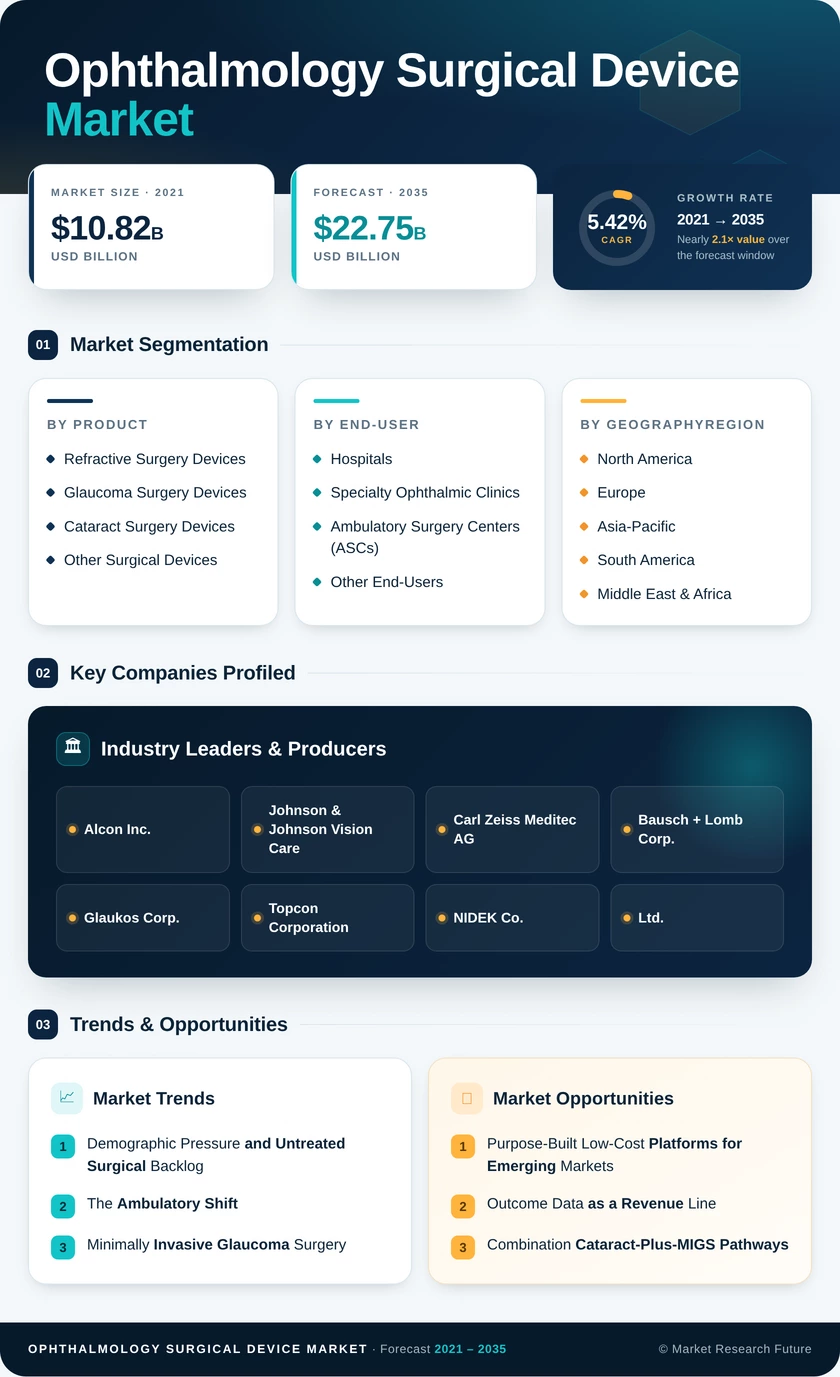
Ophthalmology Surgical Device Market
Market Size
Forecast Period2026-2035
CAGR (2026-2035)5.42%
2025 Market SizeUSD 13.41 Billion
2035 Market SizeUSD 22.75 Billion
Key Players
Alcon Inc.
Johnson & Johnson Vision Care
Carl Zeiss Meditec AG
Bausch + Lomb Corp.
Glaukos Corp.
Topcon Corporation
Opportunities
  • Purpose-Built Low-Cost Platforms for Emerging Markets
  • Outcome Data as a Revenue Line
  • Combination Cataract-Plus-MIGS Pathways
  1. 1 Market Overview |
    1. 1.1 Study Assumptions & Market Definition |
    2. 1.2 Scope of the Study |
    3. 1.3 Research Methodology
  2. 2 Market Summary & Key Report Takeaways |
    1. 2.1 By Product |
    2. 2.2 By End-User |
    3. 2.3 By Region
  3. 3 Market Size & Forecast (2021–2035) |
    1. 3.1 Historical Market Size (2021–2024) |
    2. 3.2 Base Year Assessment (2025) |
    3. 3.3 Forecast Market Size (2026–2035) |
    4. 3.4 Year-over-Year Growth Analysis
  4. 4 Market Dynamics — Driver Impact Analysis |
    1. 4.1 Demographic Pressure and Untreated Surgical Backlog |
    2. 4.2 The Ambulatory Shift |
    3. 4.3 Minimally Invasive Glaucoma Surgery |
    4. 4.4 Image Guidance and Digital Workflow
  5. 5 Market Dynamics — Restraints Impact Analysis |
    1. 5.1 Public Capital Rationing |
    2. 5.2 Ophthalmic Surgeon Shortage |
    3. 5.3 Regulatory Cost Loading in Europe
  6. 6 Market Opportunity Analysis |
    1. 6.1 Purpose-Built Low-Cost Platforms for Emerging Markets |
    2. 6.2 Outcome Data as a Revenue Line |
    3. 6.3 Combination Cataract-Plus-MIGS Pathways |
    4. 6.4 Retina Franchise Expansion |
    5. 6.5 Refurbishment-as-a-Service |
    6. 6.6 Industry Value Chain Analysis |
    7. 6.7 Porter's Five Forces Analysis
  7. 7 Regional Market Share & Country-Level Analysis |
    1. 7.1 North America | |
      1. 7.1.1 US | |
      2. 7.1.2 Canada | |
      3. 7.1.3 Mexico |
    2. 7.2 Europe | |
      1. 7.2.1 Germany | |
      2. 7.2.2 UK | |
      3. 7.2.3 France | |
      4. 7.2.4 Italy | |
      5. 7.2.5 Spain | |
      6. 7.2.6 Nordic Countries | |
      7. 7.2.7 Russia | |
      8. 7.2.8 Rest of Europe |
    3. 7.3 Asia-Pacific | |
      1. 7.3.1 China | |
      2. 7.3.2 India | |
      3. 7.3.3 Japan | |
      4. 7.3.4 South Korea | |
      5. 7.3.5 ASEAN | |
      6. 7.3.6 Rest of Asia-Pacific |
    4. 7.4 South America | |
      1. 7.4.1 Brazil | |
      2. 7.4.2 Argentina | |
      3. 7.4.3 Rest of South America |
    5. 7.5 Middle East & Africa | |
      1. 7.5.1 Saudi Arabia | |
      2. 7.5.2 UAE | |
      3. 7.5.3 South Africa | |
      4. 7.5.4 Egypt | |
      5. 7.5.5 Rest of Middle East & Africa
  8. 8 Future Outlook (2026–2035) |
    1. 8.1 Algorithmic Surgical Planning |
    2. 8.2 Razor-and-Blade Economics Deepen |
    3. 8.3 Robotics and Assisted Micromanipulation |
    4. 8.4 Sustainability in the Operating Theatre
  9. 9 Market Segmentation Analysis |
    1. 9.1 By Product | |
      1. 9.1.1 Refractive Surgery Devices | |
      2. 9.1.2 Glaucoma Surgery Devices | |
      3. 9.1.3 Cataract Surgery Devices | |
      4. 9.1.4 Other Surgical Devices |
    2. 9.2 By End-User | |
      1. 9.2.1 Hospitals | |
      2. 9.2.2 Specialty Ophthalmic Clinics | |
      3. 9.2.3 Ambulatory Surgery Centers (ASCs) | |
      4. 9.2.4 Other End-Users |
    3. 9.3 By Region
  10. 10 Competitive Landscape |
    1. 10.1 Market Concentration Analysis (2026) |
    2. 10.2 Competitive Benchmarking Matrix |
    3. 10.3 Company Profiles | |
      1. 10.3.1 Alcon Inc. | |
      2. 10.3.2 Johnson & Johnson Vision Care | |
      3. 10.3.3 Carl Zeiss Meditec AG | |
      4. 10.3.4 Bausch + Lomb Corp. | |
      5. 10.3.5 Glaukos Corp. | |
      6. 10.3.6 Topcon Corporation | |
      7. 10.3.7 NIDEK Co., Ltd. | |
      8. 10.3.8 HOYA Surgical Optics | |
      9. 10.3.9 STAAR Surgical Company | |
      10. 10.3.10 Iridex Corporation | |
      11. 10.3.11 Ziemer Ophthalmic Systems | |
      12. 10.3.12 Lumenis Ltd.
  11. 11 Recent News & Developments
  12. 12 Report Scope & Methodology |
    1. 12.1 Study Period & Base Year |
    2. 12.2 Data Sources & Estimation Framework |
    3. 12.3 Abbreviations
  13. 13 Detailed Sources & Citations
  14. 14 Frequently Asked Questions (FAQs)
  15. 15 LIST OF TABLES
  16. 16 LIST OF FIGURES

Segmentation Quick Reference

DimensionSub-SegmentsDominant SegmentFastest Growing Segment
By ProductRefractive Surgery Devices; Glaucoma Surgery Devices; Cataract Surgery Devices; Other Surgical DevicesCataract Surgery DevicesGlaucoma Surgery Devices
By End-UserHospitals; Specialty Ophthalmic Clinics; Ambulatory Surgery Centers (ASCs); Other End-UsersHospitalsAmbulatory Surgery Centers (ASCs)
By RegionNorth America; Europe; Asia-Pacific; South America; Middle East & AfricaNorth AmericaAsia-Pacific


Market Segmentation Overview

By Product

Sub-SegmentKey Trend
Refractive Surgery DevicesShift toward lens-based correction alongside excimer and femtosecond laser platforms
Glaucoma Surgery DevicesIndication broadening for micro-invasive stents into mild and moderate disease
Cataract Surgery DevicesPremium intraocular lens attach rates lifting revenue per procedure
Other Surgical DevicesSmall-gauge vitrectomy and wide-angle visualization gaining posterior-segment share


Product economics increasingly favor whoever controls the consumable. Cataract remains the volume anchor while glaucoma supplies the growth, and manufacturers are deliberately structuring portfolios so that a single console pulls through implants, packs, and viscoelastics across multiple procedure types.

By End-User

Sub-SegmentKey Trend
HospitalsRetaining complex and emergency case mix while ceding routine volume
Specialty Ophthalmic ClinicsSurgeon-owned practices monetizing premium self-pay service lines
Ambulatory Surgery Centers (ASCs)Throughput-optimized purchasing and per-procedure pricing models
Other End-UsersMilitary, academic and NGO programs favoring durability and serviceability


Channel fragmentation is forcing portfolio bifurcation. Flagship platforms continue selling into tertiary hospitals, while stripped-down, fast-cycling systems are engineered specifically for ambulatory buyers whose purchase logic starts and ends with cases per hour.

By Region

Sub-SegmentKey Trend
North AmericaASC migration and consumer-funded premium optics upgrades
EuropeMDR-driven fleet refresh and independent-sector cataract outsourcing
Asia-PacificPublic blindness-control programs and domestic manufacturing scale-up
South AmericaCampaign-driven public volume plus certified refurbished equipment tiers
Middle East & AfricaSovereign health infrastructure investment and donor-funded delivery


Regional strategy diverges sharply along payer structure. Mature markets reward mix enrichment and workflow software, whereas high-growth geographies reward affordability, serviceability, and the ability to supply consumables reliably through volatile procurement cycles.




Download PDF ×

We do not share your information with anyone. However, we may send you emails based on your report interest from time to time. You may contact us at any time to opt-out.