Request Free Sample ×

Kindly complete the form below to receive a free sample of this Report

* Please use a valid business email

Leading companies partner with us for data-driven Insights

clients tt-cursor
Hero Background
English
Chinese
French
Japanese
Korean
German
Spanish

Oncology Drugs Market Trends

ID: MRFR/Pharma/10833-HCR
135 Pages
Vikita Thakur
Last Updated: April 06, 2026

Oncology Drugs Market Research Report: Size, Share, Trend Analysis By Drug Type (Chemotherapy Drugs, Targeted Therapy Drugs, Immunotherapy Drugs, Hormonal Therapy Drugs), By Therapeutic Area (Breast Cancer, Lung Cancer, Colorectal Cancer, Prostate Cancer, Leukemia), By Route of Administration (Oral, Intravenous, Subcutaneous, Intramuscular), By Patient Demographics (Adult, Pediatric, Geriatric) and By Regional (North America, Europe, South America, Asia Pacific, Middle East and Africa) - Growth Outlook & Industry Forecast 2025 To 2035

Share:
Download PDF ×

We do not share your information with anyone. However, we may send you emails based on your report interest from time to time. You may contact us at any time to opt-out.

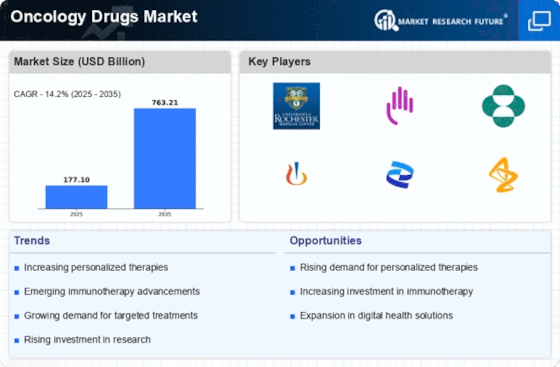
Oncology Drugs Market Infographic
Purchase Options

Market Trends

Key Emerging Trends in the Oncology Drugs Market

Precision medicine is one of the factors driving market trends within this industry. Cancer genomics and molecular diagnostics have advanced our understanding regarding genetic / molecular characteristics pertaining to cancer. There is an upswing in targeted therapy adoption which focuses on specific types of cancer cells according to their genetic composition. Companion diagnostics guide healthcare professionals about those patients most likely responder to a certain targeted therapy leading to effective therapeutic interventions that are tailored appropriately. The market has experienced increased development especially when it comes to biosimilars related to treating tumors in particular areas. However, as patents begin expiring over several biologic anti-cancer drugs their entrance will boost competition hence making treatment more affordable for patients through biosimilar introductions into this space. Biosimilar oncological products offer similar efficacy and safety profiles like their original counterparts, thus making them a cheaper alternative and therefore promoting the overall affordability of cancer care. Another key development in this industry is combination treatments to improve treatment effectiveness and overcome resistance. In many malignancies, immunotherapy combined with chemotherapy, targeted treatment, or other immunotherapeutic drugs improves survival and response. Combination medicines demonstrate cancer's complexity and the necessity for multi-modal approaches that may improve treatment outcomes. Additionally, oral oncolytics development innovations are happening in the market along with patient-centric drug delivery methods. This means that individuals can get treated at home without necessarily going to hospitals which also makes it convenient for patients. Availability of oral oncolytics is transforming treatment paradigms by providing options other than traditional intravenous chemotherapy while also increasing PA to prescribed regimens. Additionally, wearable devices and smart pill technologies represent patient-centric drug delivery systems which have been receiving considerable attention in that they allow real-time monitoring while enhancing patients’ experience throughout their medication schedule.

The rise of CAR-T cell therapy is completely revolving around oncology treatment. A patient’s own immune cells are modified to recognize and attack cancer cells in CAR-T cell therapies. This innovative method has been very successful, particularly with leukemia and lymphoma. The approval and continuous advancement of CAR-T treatments also demonstrate the potential for personalized medicine and genetically engineered therapeutics to change standard of care in oncology.

Focus on rare and orphan cancers in the context of oncology drugs market is gaining pace. Among which common types attract more attention; however, drug development for rare or orphan cancers often remains challenging due to smaller number of patients available for clinical trials. Yet this area is being promoted through various incentives, regulatory assistance, and progress on precision medicine thereby giving hope to those suffering from these forms of rare or underserved cancer.

Author
Author Profile
Vikita Thakur
Senior Research Analyst

She holds an experience of about 5+ years in market research and business consulting projects for sectors such as life sciences, medical devices, and healthcare IT. She possesses a robust background in data analysis, market estimation, competitive intelligence, pipeline analysis market trend identification, and consumer behavior insights. Her expertise lies in technical Sales support, client interaction and project management, designing and implementing market research studies, conducting competitive analysis, and synthesizing complex data into actionable recommendations that drive business growth.

Leave a Comment

FAQs

What is the current valuation of the Oncology Drugs Market as of 2024?

<p>The Oncology Drugs Market was valued at 177.1 USD Billion in 2024.</p>

What is the projected market valuation for the market in 2035?

The market is projected to reach 763.21 USD Billion by 2035.

What is the expected CAGR for the Oncology Drugs Market during the forecast period 2025 - 2035?

<p>The expected CAGR for the Oncology Drugs Market during 2025 - 2035 is 14.2%.</p>

Which companies are considered key players in the market?

Key players include Roche, Bristol-Myers Squibb, Merck &amp; Co., Novartis, Pfizer, AstraZeneca, Johnson &amp; Johnson, Amgen, and Gilead Sciences.

What are the major segments of the Oncology Drugs Market by type?

<p>The major segments by type include Chemotherapy Drugs, Targeted Therapy Drugs, Immunotherapy Drugs, and Hormonal Therapy Drugs.</p>

How do the revenues of Targeted Therapy Drugs compare to those of Chemotherapy Drugs?

<p>Targeted Therapy Drugs are projected to generate revenues of 250.0 USD Billion, surpassing Chemotherapy Drugs at 190.0 USD Billion.</p>

What is the revenue projection for Immunotherapy Drugs by 2035?

<p>Immunotherapy Drugs are expected to reach a valuation of 220.0 USD Billion by 2035.</p>

Which therapeutic area is projected to have the highest revenue in the market?

Lung Cancer is projected to generate the highest revenue, reaching 180.0 USD Billion by 2035.

What is the expected revenue for Pediatric oncology drugs by 2035?

<p>Pediatric oncology drugs are projected to reach a valuation of 120.0 USD Billion by 2035.</p>

What routes of administration are most prevalent in the Oncology Drugs Market?

<p>The most prevalent routes of administration include Intravenous, Oral, Subcutaneous, and Intramuscular.</p>

Market Summary

April 01, 2026- According to Market Research Future analysis, the Oncology Drugs Market Size was valued at USD 177.1 Billion in 2024 & the market is projected to grow from USD 202.26 Billion in 2025 to USD 763.21 Billion by 2035, registering a CAGR of 14.2% during the forecast period 2025–2035. North America led the market with over 45% share, generating around USD 79.70 billion in revenue. Oncology drugs market growth is driven by rising global cancer incidence, increasing investments in research and development, and advancements in targeted and immunotherapy treatments. Expanding access to early diagnosis and personalized medicine is further accelerating demand for innovative cancer therapies worldwide.
 
WHO reported approximately 20 million new cancer cases and 9.7 million deaths in 2022, while IHME estimates cancer contributes to over 250 million DALYs globally, highlighting a significant disease burden and driving continuous demand for advanced oncology drugs and therapies.

Key Market Trends & Highlights

The Oncology Drugs Market is experiencing robust growth driven by innovative therapies and increasing cancer prevalence.

  • North America dominates with over 45% share driven by strong R&D investments and advanced healthcare infrastructure supporting oncology innovation. Europe holds 30% share with USD 53.13 billion market size supported by strong regulatory framework and increasing cancer prevalence. Nearly 20 million new cancer cases reported globally (WHO), significantly increasing demand for innovative oncology therapies and treatments worldwide. Advancements in immunotherapy and targeted therapies are improving survival rates and accelerating adoption of precision oncology treatments globally.

Market Size & Forecast

2024 Market Size 177.1 (USD Billion)
2035 Market Size 763.21 (USD Billion)
CAGR (2025 - 2035) 14.20%
Largest Regional Market Share in 2024 North America

Major Players

Companies such as Roche (CH), Bristol-Myers Squibb (US), Merck &amp; Co. (US), Novartis (CH), Pfizer (US), <a href="https://www.astrazeneca.com/our-therapy-areas/oncology/medicines-portfolio-and-pipeline.html">AstraZeneca </a>(GB), Johnson &amp; Johnson (US), Amgen (US), Gilead Sciences (US) are some of the major participants in the global market.

Market Trends

The Oncology Drugs Market is currently experiencing a dynamic evolution, driven by advancements in research and development, as well as an increasing understanding of cancer biology. Pharmaceutical companies are focusing on innovative therapies, including targeted treatments and immunotherapies, which appear to offer improved efficacy and reduced side effects compared to traditional chemotherapy. This shift towards personalized medicine is reshaping treatment paradigms, as healthcare providers seek to tailor therapies to individual patient profiles.

Furthermore, the growing prevalence of cancer globally is prompting a surge in demand for effective oncology drugs, leading to heightened competition among manufacturers. In addition, regulatory agencies are adapting to the rapid pace of innovation, streamlining approval processes for new oncology drugs. This regulatory flexibility may facilitate quicker access to novel therapies for patients, potentially transforming the treatment landscape.

Collaborations between biotech firms and established pharmaceutical companies are also becoming more common, as they aim to leverage complementary strengths in drug development. Overall, the market is poised for continued growth, with a focus on innovative solutions that address unmet medical needs and improve patient outcomes.

Rise of Targeted Therapies

The Oncology Drugs Market is witnessing a notable increase in the development and adoption of targeted therapies. These treatments are designed to specifically attack cancer cells while sparing healthy tissue, which may lead to fewer side effects and improved patient quality of life. As research progresses, the identification of specific biomarkers is enhancing the ability to match patients with the most effective therapies, thereby optimizing treatment outcomes.

WHO reports cancer cases are expected to rise to over 35 million by 2050, while precision medicine approaches targeting genetic mutations have improved survival rates by 20–30% in certain cancers, significantly accelerating adoption of biomarker-based targeted therapies globally.

Expansion of Immunotherapy

Immunotherapy is emerging as a transformative approach within the Oncology Drugs Market. By harnessing the body's immune system to combat cancer, these therapies are showing promise in treating various malignancies. The growing body of evidence supporting the efficacy of immunotherapeutic agents is likely to drive further investment and research, potentially leading to new treatment options for patients.

CDC highlights immunotherapy has increased 5-year survival rates in melanoma patients from 25% to over 50%, while global immunotherapy clinical trials have exceeded 5,000 active studies, reflecting strong investment and expanding adoption of immune-based cancer treatments worldwide.

Increased Focus on Combination Therapies

Combination therapies are gaining traction in the Oncology Drugs Market as a strategy to enhance treatment efficacy. By utilizing multiple agents that target different pathways, these approaches may overcome resistance mechanisms and improve overall patient outcomes. This trend reflects a broader understanding of cancer as a complex disease, necessitating multifaceted treatment strategies.

PAHO and WHO data indicate combination therapies can improve treatment efficacy by up to 30% compared to monotherapy, while reducing resistance rates significantly, supporting widespread adoption of multi-drug oncology regimens and driving innovation in cancer treatment strategies globally.

Oncology Drugs Market Market Drivers

Growing Incidence of Cancer

The rising incidence of cancer worldwide is a primary driver of the Oncology Drugs Market. According to recent statistics, cancer cases are projected to increase significantly, with estimates suggesting that by 2040, the number of new cancer cases could reach 29.5 million annually. This alarming trend necessitates the development and availability of effective oncology drugs, thereby propelling market growth.
 
The increasing prevalence of risk factors such as obesity, smoking, and an aging population further exacerbates this situation. As healthcare systems strive to address this growing burden, investments in oncology drug research and development are likely to intensify, fostering innovation and expanding treatment options within the market.

Advancements in Precision Medicine

Advancements in precision medicine are transforming the Oncology Drugs Market by enabling more personalized treatment approaches. The integration of genomic profiling and biomarker testing allows for the identification of specific cancer types and their unique characteristics. This tailored approach not only enhances treatment efficacy but also minimizes adverse effects, leading to improved patient outcomes.
 
The market for precision oncology drugs is expected to witness substantial growth, with projections indicating a compound annual growth rate of over 10% in the coming years. As healthcare providers increasingly adopt these innovative strategies, the demand for precision oncology drugs is likely to surge, further driving the market.

Rising Investment in Cancer Research

Rising investment in cancer research is significantly influencing the Oncology Drugs Market. Governments, private organizations, and philanthropic entities are increasingly allocating funds to support cancer research initiatives.
 
In 2023, global funding for cancer research reached approximately 200 billion USD, reflecting a commitment to advancing treatment options and improving patient care. This influx of capital fosters innovation, enabling the development of new oncology drugs and therapies. As research progresses, the market is likely to benefit from a continuous stream of novel treatments, enhancing the overall landscape of cancer care.

Increasing Patient Awareness and Advocacy

Increasing patient awareness and advocacy for cancer treatment options is driving the Oncology Drugs Market. Patients are becoming more informed about their treatment choices, leading to a demand for innovative oncology drugs. Advocacy groups play a pivotal role in educating patients about available therapies and clinical trials, thereby empowering them to make informed decisions.
 
This heightened awareness is likely to translate into increased utilization of oncology drugs, as patients actively seek out the latest treatment options. Consequently, the market is expected to experience growth as more patients engage with healthcare providers to explore advanced therapies.

Regulatory Support and Accelerated Approvals

Regulatory support for oncology drugs is a crucial driver of the Oncology Drugs Market. Regulatory agencies are increasingly implementing expedited approval pathways for innovative cancer therapies, recognizing the urgent need for effective treatments. Initiatives such as the FDA's Breakthrough Therapy Designation and Priority Review programs facilitate faster access to promising drugs.
 
This supportive regulatory environment encourages pharmaceutical companies to invest in oncology research and development, leading to a more robust pipeline of new therapies. As a result, the market is expected to expand, with a growing number of novel drugs entering the market to address unmet medical needs.

Market Segment Insights

By Type: Chemotherapy Drugs (Largest) vs. Immunotherapy Drugs (Fastest-Growing)

The distribution of market share among various drug types shows that chemotherapy drugs hold the largest share at 38%, providing a critical backbone for cancer treatment even as new therapies emerge. Targeted Therapy Drugs follow closely, capitalizing on their specificity to cancer cells, while Immunotherapy Drugs are rapidly gaining traction due to their innovative approach, though they currently hold a smaller share. Hormonal Therapy Drugs, while effective in specific cancers, are relatively limited in their overall oncology market presence compared to these other segments.

Chemotherapy Drugs (Dominant) vs. Immunotherapy Drugs (Emerging)

Chemotherapy Drugs remain the dominant force in the market, known for their ability to target rapidly dividing cancer cells, though they come with significant side effects. Their established use in various forms of cancer treatment provides a sense of reliability and familiarity among oncologists. Conversely, <a href="https://www.marketresearchfuture.com/reports/cancer-immunotherapy-market-592">Cancer Immunotherapy </a>Drugs represent the emerging frontier, leveraging the body's own immune system to fight cancer. Their personalized approach is leading to a revolution in treatment options, particularly for malignancies that have resisted traditional therapies, propelling them into a stronger competitive position. As research advances, Immunotherapy Drugs are set to further transform the landscape of oncology.

By Therapeutic Area: Breast Cancer (Largest) vs. Lung Cancer (Fastest-Growing)

The market is characterized by a varied distribution of shares across different therapeutic areas. Breast cancer remains the largest segment in the oncology drugs market, with a 26% share, driven by its high prevalence and the continuous introduction of innovative therapies. Meanwhile, lung cancer is emerging as the fastest-growing segment due to increasing awareness about early diagnosis and advancements in targeted therapies, which are drawing significant investment from pharmaceutical companies. Furthermore, the oncology market size is influenced by factors such as rising incidences of cancer globally, the increasing number of clinical trials, and a robust pipeline of therapies tailored for specific genetic markers. Prostate and colorectal cancer segments are also gaining attention, albeit at a slower growth pace. As treatment options evolve, the focus remains not just on quantity but also on improving patient outcomes and experiences.

Breast Cancer (Dominant) vs. Lung Cancer (Emerging)

Breast cancer has established itself as the dominant therapeutic area in the market, owing to its highly prevalent nature and extensive research leading to innovative treatment solutions. This includes monoclonal antibodies and hormone therapies that have transformed patient outcomes. The oncology market size is characterized by a wealth of product options, highlighting the commitment to addressing the complexities of breast cancer. In contrast, lung cancer is viewed as an emerging segment, rapidly gaining ground through novel therapies targeting specific genetic mutations and immunotherapy options. With a growing prevalence and rising research investments, stakeholders are increasingly optimistic about the lung cancer therapeutic landscape's potential, positioning it to become a prominent player in the oncology field.

By Route of Administration: Oral (Largest) vs. Intravenous (Fastest-Growing)

The oncology drugs market is characterized by diverse routes of administration, with the oral segment holding the largest share at 44%. Oral administration is preferred due to its convenience and ease of use for patients, allowing for self-administration, minimizing the need for frequent hospital visits. In contrast, the intravenous route is gaining momentum and is noted as the fastest-growing segment. Its position is driven by the need for rapid drug delivery and the increasing complexity of treatment regimens that require precise dosage administration.

Oral (Dominant) vs. Intravenous (Emerging)

The oral route of administration remains dominant in the market as it offers patients the advantages of convenience and adherence. Oral oncology drugs, often in the form of tablets or capsules, empower patients with self-management options while reducing dependence on healthcare facilities. Conversely, intravenous administration is emerging as a crucial method, particularly for aggressive therapies and biologic agents that necessitate immediate systemic exposure. This method ensures controlled drug delivery and a quick onset of action, catering to specific treatments that require precise dosing and monitoring, further catering to the evolving landscape of cancer treatment protocols.

By Patient Demographics: Adult (Largest) vs. Pediatric (Fastest-Growing)

The adult demographic holds a substantial share in the Oncology Drugs Market at 72%, primarily attributed to the higher prevalence of cancer among older populations. Adults are often diagnosed with a variety of cancer types, which leads to a robust pipeline of oncology drugs tailored specifically for their treatment. Meanwhile, the pediatric demographic is gaining traction as awareness and diagnosis of cancers in younger populations rise, supported by advancements in research and treatment options. Pediatric cancers, though less common, are increasingly prioritized due to specialized therapeutic needs.

Adult (Dominant) vs. Pediatric (Emerging)

The adult segment remains the dominant force in the market, driven by the significant burden of cancer in populations aged 18 and older. This demographic encompasses a wide array of cancers, including lung, colorectal, and breast cancer, each necessitating innovative treatment modalities. Conversely, the pediatric segment, while emerging, showcases a growing focus on developing chemotherapy regimens and targeted therapies specifically designed for children. Enhanced research funding and tailored clinical trials contribute to the rapid development of effective treatments for pediatric cancers, indicating a shift in anticancer drug market dynamics as stakeholders recognize the urgent need for specialized oncology drugs for younger patients.

Get more detailed insights about Oncology Drugs Market Research Report 2035

Regional Insights

North America : Oncology Innovation Leader

North America leads in the Oncology Drugs Market size, accounting for over 45% of the global revenue in 2024. The region's growth is driven by advanced healthcare infrastructure, high R&D investments, and a strong pipeline of innovative therapies. Regulatory support from agencies like the FDA accelerates drug approvals, enhancing anticancer drug market dynamics. The increasing prevalence of cancer and rising healthcare expenditure further fuel demand for oncology treatments.

CDC reports over 1.9 million new cancer cases annually in the U.S., with cancer causing nearly 600,000 deaths per year, while healthcare spending exceeds USD 4.5 trillion, supporting high adoption of advanced oncology drugs and innovative therapies.

The United States is the leading country in this region, hosting major pharmaceutical companies such as Merck & Co., Bristol-Myers Squibb, and Pfizer. The competitive landscape is characterized by continuous innovation and strategic collaborations among key players. Canada also contributes significantly, focusing on personalized medicine and expanding access to cutting-edge therapies. The presence of robust clinical trial networks supports the development of new oncology drugs.

Europe : Regulatory Framework and Growth

Europe Oncology Drugs Market size was valued at USD 53.13 billion in 2024, making it the second-largest regional market with a 30% share. The region benefits from a strong regulatory framework that encourages innovation while ensuring patient safety. The European Medicines Agency (EMA) plays a crucial role in expediting the approval of new therapies, particularly for rare cancers. Increasing cancer incidence and a growing aging population are key drivers of oncology drug market growth, alongside rising healthcare investments across member states.

WHO Europe reports cancer accounts for nearly 1 in 5 deaths (~20%), with over 3.7 million new cancer cases annually, while expanding screening programs and faster drug approvals are significantly boosting demand for oncology treatments across the region.

Leading countries in Europe include Germany, France, and the United Kingdom, which are home to several prominent pharmaceutical companies like Roche and AstraZeneca. The competitive landscape is marked by a mix of established players and emerging biotech firms focusing on novel therapies. Collaborative efforts between public and private sectors enhance research capabilities, fostering a dynamic environment for oncology drug development.

Asia-Pacific : Rapidly Growing Market

The Asia-Pacific region is witnessing rapid growth in the oncology drugs market, driven by increasing cancer prevalence and improving healthcare infrastructure. This region accounts for approximately 20% of the global oncology drug market share. Countries like China and India are at the forefront, with rising investments in healthcare and a growing focus on research and development. Regulatory bodies are also becoming more supportive, streamlining approval processes for new therapies, which is crucial for anticancer drugs market expansion.

China is the largest market in the region, with significant contributions from local pharmaceutical companies and multinational corporations. India follows closely, with a burgeoning biotech sector focused on affordable cancer treatments. The competitive landscape is evolving, with a mix of established players and innovative startups. Collaborations between domestic and international firms are enhancing the development of targeted therapies, positioning the region as a key player in The market.

Middle East and Africa : Emerging Market Potential

The Middle East and Africa (MEA) region is gradually emerging as a potential market for oncology drugs, currently holding about 5% of the global share. The growth is driven by increasing cancer awareness, rising healthcare expenditures, and improving access to treatment. Governments are implementing policies to enhance healthcare infrastructure and attract investments in the pharma oncology sector, which is crucial for anticancer drugs market development.

The region's diverse demographics and varying healthcare systems present both challenges and opportunities for oncology drug manufacturers. Leading countries in the MEA region include South Africa, the UAE, and Saudi Arabia, where there is a growing presence of both local and international pharmaceutical companies. The competitive landscape is characterized by partnerships and collaborations aimed at improving access to innovative therapies. As the region continues to develop its healthcare capabilities, the demand for oncology drugs is expected to rise significantly, driven by an increasing patient population and evolving treatment paradigms.

Key Players and Competitive Insights

The Global Oncology Drugs Market is a dynamic segment of the pharma oncology industry characterized by rapid advancements in drug development, regulatory frameworks, and treatment paradigms. The competitive landscape of this market is shaped by various cancer pharmaceutical companies that strive to innovate and offer cutting-edge therapies that address unmet medical needs in cancer care. With an increasing incidence of cancer and the demand for personalized medicine, companies actively engage in research and development, partnerships, and strategic alliances.
 
This competitive environment is influenced by technological innovation, market access strategies, and the global regulatory landscape, all of which are crucial for success in this specialized and high-stakes market. Companies also face challenges such as pricing pressures, robust competition from generics, and evolving healthcare policies, which require them to adopt agile and adaptive strategies to maintain a competitive edge.Pfizer has established a significant presence in the Global Oncology Drugs Market through its diverse portfolio of oncology products.
 
The company’s strengths lie in its strong research capabilities and extensive expertise in drug development, enabling it to offer innovative solutions that cater to various cancer types. Pfizer's commitment to personalized medicine sets it apart, as the company invests in targeted therapies and combination treatments aimed at improving patient outcomes. Its pipeline of oncology drugs demonstrates a strong focus on addressing critical areas in cancer treatment, which positions Pfizer favorably in a crowded marketplace. With strategic collaborations and partnerships, Pfizer continues to strengthen its market position while effectively navigating the challenges of pricing and accessibility in the evolving oncology landscape.
 
Roche, a leading player in the Global Oncology Drugs Market, is renowned for its robust portfolio of targeted therapies and immunotherapies that have transformed cancer treatment. The company's strengths lie in its continuous investment in research and development, along with a comprehensive understanding of molecular biology, which enables it to innovate and bring forth therapies that are tailored to the genetic profiles of tumors. Roche's key oncology products, including those designed for breast cancer, lung cancer, and hematologic malignancies, have solidified its market presence.
 
The company has engaged in strategic mergers and acquisitions to enhance its offerings and expand its capabilities in oncology. Roche’s focus on diagnostics and personalized treatment approaches ensures comprehensive cancer management, allowing it to maintain a leadership position in the global market while addressing the complexities of cancer care through innovative and effective solutions.

Key Companies in the Oncology Drugs Market include

Industry Developments

Recent developments in the Global Oncology Drugs Market have centered on ongoing advancements in treatment options, with companies like Pfizer, Roche, Gilead Sciences, and Eli Lilly leading the way in innovative therapies. Notably, in September 2023, Bristol Myers Squibb received accelerated approval for its new treatment targeting lung cancer, reflecting an increasing focus on personalized medicine. The market also observed strong growth, driven by rising incidences of cancer globally, which produced a higher demand for novel therapies from major players like Johnson and Johnson and AbbVie. 

Significant mergers and acquisitions have been reported, with Novartis acquiring a biotechnology firm specializing in cancer treatments in June 2023 to bolster its oncology portfolio, while Merck and Regeneron Pharmaceuticals announced a strategic collaboration aimed at enhancing their immunotherapy development initiatives in August 2023. Seattle Genetics has also seen a surge in market valuation due to its recent FDA approvals for innovative oncology drugs. The continuous influx of investments and partnerships in the oncology sector signifies a robust and evolving landscape, with companies striving to enhance patient outcomes and expand their therapeutic frameworks globally.

Future Outlook

Oncology Drugs Market Future Outlook

The Oncology Drugs Market size is projected to reach USD 763.21 Billion by 2035, growing at a CAGR of 14.2%, driven by advancements in targeted therapies, immunotherapy, and personalized medicine.

New opportunities lie in:

  • <p>Expansion of telehealth services for oncology consultations Development of AI-driven drug discovery platforms Investment in combination therapy research for enhanced efficacy</p>

By 2035, the Oncology Drugs Market is expected to achieve substantial growth and innovation.

Market Segmentation

Oncology Drugs Market Type Outlook

  • Chemotherapy Drugs
  • Targeted Therapy Drugs
  • Immunotherapy Drugs
  • Hormonal Therapy Drugs

Oncology Drugs Market Therapeutic Area Outlook

  • Breast Cancer
  • Lung Cancer
  • Colorectal Cancer
  • Prostate Cancer
  • Leukemia

Oncology Drugs Market Patient Demographics Outlook

  • Adult
  • Pediatric
  • Geriatric

Oncology Drugs Market Route of Administration Outlook

  • Oral
  • Intravenous
  • Subcutaneous
  • Intramuscular

Report Scope

MARKET SIZE 2024 177.1(USD Billion)
MARKET SIZE 2025 202.26 (USD Billion)
MARKET SIZE 2035 763.21 (USD Billion)
COMPOUND ANNUAL GROWTH RATE (CAGR) 14.2% (2025 - 2035)
REPORT COVERAGE Revenue Forecast, Competitive Landscape, Growth Factors, and Trends
BASE YEAR 2024
Market Forecast Period 2025 - 2035
Historical Data 2019 - 2024
Market Forecast Units USD Billion
Key Companies Profiled Roche (CH), Bristol-Myers Squibb (US), Merck & Co. (US), Novartis (CH), Pfizer (US), AstraZeneca (GB), Johnson & Johnson (US), Amgen (US), Gilead Sciences (US)
Segments Covered Drug Type, Therapeutic Area, Route of Administration, Patient Demographics, Regional
Key Market Opportunities Advancements in personalized medicine and immunotherapy are reshaping the market landscape.
Key Market Dynamics Rising demand for targeted therapies drives innovation and competition in the market.
Countries Covered North America, Europe, APAC, South America, MEA

FAQs

What is the current valuation of the Oncology Drugs Market as of 2024?

<p>The Oncology Drugs Market was valued at 177.1 USD Billion in 2024.</p>

What is the projected market valuation for the market in 2035?

The market is projected to reach 763.21 USD Billion by 2035.

What is the expected CAGR for the Oncology Drugs Market during the forecast period 2025 - 2035?

<p>The expected CAGR for the Oncology Drugs Market during 2025 - 2035 is 14.2%.</p>

Which companies are considered key players in the market?

Key players include Roche, Bristol-Myers Squibb, Merck &amp; Co., Novartis, Pfizer, AstraZeneca, Johnson &amp; Johnson, Amgen, and Gilead Sciences.

What are the major segments of the Oncology Drugs Market by type?

<p>The major segments by type include Chemotherapy Drugs, Targeted Therapy Drugs, Immunotherapy Drugs, and Hormonal Therapy Drugs.</p>

How do the revenues of Targeted Therapy Drugs compare to those of Chemotherapy Drugs?

<p>Targeted Therapy Drugs are projected to generate revenues of 250.0 USD Billion, surpassing Chemotherapy Drugs at 190.0 USD Billion.</p>

What is the revenue projection for Immunotherapy Drugs by 2035?

<p>Immunotherapy Drugs are expected to reach a valuation of 220.0 USD Billion by 2035.</p>

Which therapeutic area is projected to have the highest revenue in the market?

Lung Cancer is projected to generate the highest revenue, reaching 180.0 USD Billion by 2035.

What is the expected revenue for Pediatric oncology drugs by 2035?

<p>Pediatric oncology drugs are projected to reach a valuation of 120.0 USD Billion by 2035.</p>

What routes of administration are most prevalent in the Oncology Drugs Market?

<p>The most prevalent routes of administration include Intravenous, Oral, Subcutaneous, and Intramuscular.</p>

  1. SECTION I: EXECUTIVE SUMMARY AND KEY HIGHLIGHTS |
    1. EXECUTIVE SUMMARY | |
      1. Market Overview | |
      2. Key Findings | |
      3. Market Segmentation | |
      4. Competitive Landscape | |
      5. Challenges and Opportunities | |
      6. Future Outlook 2
  2. SECTION II: SCOPING, METHODOLOGY AND MARKET STRUCTURE |
    1. MARKET INTRODUCTION | |
      1. Definition | |
      2. Scope of the study | | |
    2. RESEARCH METHODOLOGY | |
      1. Overview | |
      2. Data Mining | |
      3. Secondary Research | |
      4. Primary Research | | |
      5. Forecasting Model | |
      6. Market Size Estimation | | |
      7. Data Triangulation | |
      8. Validation 3
  3. SECTION III: QUALITATIVE ANALYSIS |
    1. MARKET DYNAMICS | |
      1. Overview | |
      2. Drivers | |
      3. Restraints | |
      4. Opportunities |
    2. MARKET FACTOR ANALYSIS | |
      1. Value chain Analysis | |
      2. Porter's Five Forces Analysis | | |
      3. COVID-19 Impact Analysis | | |
  4. SECTION IV: QUANTITATIVE ANALYSIS |
    1. Healthcare, BY Type (USD Billion) | |
      1. Chemotherapy Drugs | |
      2. Targeted Therapy Drugs | |
      3. Immunotherapy Drugs | |
      4. Hormonal Therapy Drugs |
    2. Healthcare, BY Therapeutic Area (USD Billion) | |
      1. Breast Cancer | |
      2. Lung Cancer | |
      3. Colorectal Cancer | |
      4. Prostate Cancer | |
      5. Leukemia |
    3. Healthcare, BY Route of Administration (USD Billion) | |
      1. Oral | |
      2. Intravenous | |
      3. Subcutaneous | |
      4. Intramuscular |
    4. Healthcare, BY Patient Demographics (USD Billion) | |
      1. Adult | |
      2. Pediatric | |
      3. Geriatric |
    5. Healthcare, BY Region (USD Billion) | |
      1. North America | | |
      2. Europe | | |
      3. APAC | | |
      4. South America | | |
      5. MEA | | |
  5. SECTION V: COMPETITIVE ANALYSIS |
    1. Competitive Landscape | |
      1. Overview | |
      2. Competitive Analysis | |
      3. Market share Analysis | |
      4. Major Growth Strategy in the Healthcare | |
      5. Competitive Benchmarking | |
      6. Leading Players in Terms of Number of Developments in the Healthcare | |
      7. Key developments and growth strategies | | |
      8. Major Players Financial Matrix | | |
    2. Company Profiles | |
      1. Roche (CH) | | |
      2. Bristol-Myers Squibb (US) | | |
      3. Merck & Co. (US) | | |
      4. Novartis (CH) | | |
      5. Pfizer (US) | | |
      6. AstraZeneca (GB) | | |
      7. Johnson & Johnson (US) | | |
      8. Amgen (US) | | |
      9. Gilead Sciences (US) | | |
    3. Appendix | |
      1. References | |
      2. Related Reports 6 LIST OF FIGURES |
    4. MARKET SYNOPSIS |
    5. NORTH AMERICA MARKET ANALYSIS |
    6. US MARKET ANALYSIS BY TYPE |
    7. US MARKET ANALYSIS BY THERAPEUTIC AREA |
    8. US MARKET ANALYSIS BY ROUTE OF ADMINISTRATION |
    9. US MARKET ANALYSIS BY PATIENT DEMOGRAPHICS |
    10. CANADA MARKET ANALYSIS BY TYPE |
    11. CANADA MARKET ANALYSIS BY THERAPEUTIC AREA |
    12. CANADA MARKET ANALYSIS BY ROUTE OF ADMINISTRATION |
    13. CANADA MARKET ANALYSIS BY PATIENT DEMOGRAPHICS |
    14. EUROPE MARKET ANALYSIS |
    15. GERMANY MARKET ANALYSIS BY TYPE |
    16. GERMANY MARKET ANALYSIS BY THERAPEUTIC AREA |
    17. GERMANY MARKET ANALYSIS BY ROUTE OF ADMINISTRATION |
    18. GERMANY MARKET ANALYSIS BY PATIENT DEMOGRAPHICS |
    19. UK MARKET ANALYSIS BY TYPE |
    20. UK MARKET ANALYSIS BY THERAPEUTIC AREA |
    21. UK MARKET ANALYSIS BY ROUTE OF ADMINISTRATION |
    22. UK MARKET ANALYSIS BY PATIENT DEMOGRAPHICS |
    23. FRANCE MARKET ANALYSIS BY TYPE |
    24. FRANCE MARKET ANALYSIS BY THERAPEUTIC AREA |
    25. FRANCE MARKET ANALYSIS BY ROUTE OF ADMINISTRATION |
    26. FRANCE MARKET ANALYSIS BY PATIENT DEMOGRAPHICS |
    27. RUSSIA MARKET ANALYSIS BY TYPE |
    28. RUSSIA MARKET ANALYSIS BY THERAPEUTIC AREA |
    29. RUSSIA MARKET ANALYSIS BY ROUTE OF ADMINISTRATION |
    30. RUSSIA MARKET ANALYSIS BY PATIENT DEMOGRAPHICS |
    31. ITALY MARKET ANALYSIS BY TYPE |
    32. ITALY MARKET ANALYSIS BY THERAPEUTIC AREA |
    33. ITALY MARKET ANALYSIS BY ROUTE OF ADMINISTRATION |
    34. ITALY MARKET ANALYSIS BY PATIENT DEMOGRAPHICS |
    35. SPAIN MARKET ANALYSIS BY TYPE |
    36. SPAIN MARKET ANALYSIS BY THERAPEUTIC AREA |
    37. SPAIN MARKET ANALYSIS BY ROUTE OF ADMINISTRATION |
    38. SPAIN MARKET ANALYSIS BY PATIENT DEMOGRAPHICS |
    39. REST OF EUROPE MARKET ANALYSIS BY TYPE |
    40. REST OF EUROPE MARKET ANALYSIS BY THERAPEUTIC AREA |
    41. REST OF EUROPE MARKET ANALYSIS BY ROUTE OF ADMINISTRATION |
    42. REST OF EUROPE MARKET ANALYSIS BY PATIENT DEMOGRAPHICS |
    43. APAC MARKET ANALYSIS |
    44. CHINA MARKET ANALYSIS BY TYPE |
    45. CHINA MARKET ANALYSIS BY THERAPEUTIC AREA |
    46. CHINA MARKET ANALYSIS BY ROUTE OF ADMINISTRATION |
    47. CHINA MARKET ANALYSIS BY PATIENT DEMOGRAPHICS |
    48. INDIA MARKET ANALYSIS BY TYPE |
    49. INDIA MARKET ANALYSIS BY THERAPEUTIC AREA |
    50. INDIA MARKET ANALYSIS BY ROUTE OF ADMINISTRATION |
    51. INDIA MARKET ANALYSIS BY PATIENT DEMOGRAPHICS |
    52. JAPAN MARKET ANALYSIS BY TYPE |
    53. JAPAN MARKET ANALYSIS BY THERAPEUTIC AREA |
    54. JAPAN MARKET ANALYSIS BY ROUTE OF ADMINISTRATION |
    55. JAPAN MARKET ANALYSIS BY PATIENT DEMOGRAPHICS |
    56. SOUTH KOREA MARKET ANALYSIS BY TYPE |
    57. SOUTH KOREA MARKET ANALYSIS BY THERAPEUTIC AREA |
    58. SOUTH KOREA MARKET ANALYSIS BY ROUTE OF ADMINISTRATION |
    59. SOUTH KOREA MARKET ANALYSIS BY PATIENT DEMOGRAPHICS |
    60. MALAYSIA MARKET ANALYSIS BY TYPE |
    61. MALAYSIA MARKET ANALYSIS BY THERAPEUTIC AREA |
    62. MALAYSIA MARKET ANALYSIS BY ROUTE OF ADMINISTRATION |
    63. MALAYSIA MARKET ANALYSIS BY PATIENT DEMOGRAPHICS |
    64. THAILAND MARKET ANALYSIS BY TYPE |
    65. THAILAND MARKET ANALYSIS BY THERAPEUTIC AREA |
    66. THAILAND MARKET ANALYSIS BY ROUTE OF ADMINISTRATION |
    67. THAILAND MARKET ANALYSIS BY PATIENT DEMOGRAPHICS |
    68. INDONESIA MARKET ANALYSIS BY TYPE |
    69. INDONESIA MARKET ANALYSIS BY THERAPEUTIC AREA |
    70. INDONESIA MARKET ANALYSIS BY ROUTE OF ADMINISTRATION |
    71. INDONESIA MARKET ANALYSIS BY PATIENT DEMOGRAPHICS |
    72. REST OF APAC MARKET ANALYSIS BY TYPE |
    73. REST OF APAC MARKET ANALYSIS BY THERAPEUTIC AREA |
    74. REST OF APAC MARKET ANALYSIS BY ROUTE OF ADMINISTRATION |
    75. REST OF APAC MARKET ANALYSIS BY PATIENT DEMOGRAPHICS |
    76. SOUTH AMERICA MARKET ANALYSIS |
    77. BRAZIL MARKET ANALYSIS BY TYPE |
    78. BRAZIL MARKET ANALYSIS BY THERAPEUTIC AREA |
    79. BRAZIL MARKET ANALYSIS BY ROUTE OF ADMINISTRATION |
    80. BRAZIL MARKET ANALYSIS BY PATIENT DEMOGRAPHICS |
    81. MEXICO MARKET ANALYSIS BY TYPE |
    82. MEXICO MARKET ANALYSIS BY THERAPEUTIC AREA |
    83. MEXICO MARKET ANALYSIS BY ROUTE OF ADMINISTRATION |
    84. MEXICO MARKET ANALYSIS BY PATIENT DEMOGRAPHICS |
    85. ARGENTINA MARKET ANALYSIS BY TYPE |
    86. ARGENTINA MARKET ANALYSIS BY THERAPEUTIC AREA |
    87. ARGENTINA MARKET ANALYSIS BY ROUTE OF ADMINISTRATION |
    88. ARGENTINA MARKET ANALYSIS BY PATIENT DEMOGRAPHICS |
    89. REST OF SOUTH AMERICA MARKET ANALYSIS BY TYPE |
    90. REST OF SOUTH AMERICA MARKET ANALYSIS BY THERAPEUTIC AREA |
    91. REST OF SOUTH AMERICA MARKET ANALYSIS BY ROUTE OF ADMINISTRATION |
    92. REST OF SOUTH AMERICA MARKET ANALYSIS BY PATIENT DEMOGRAPHICS |
    93. MEA MARKET ANALYSIS |
    94. GCC COUNTRIES MARKET ANALYSIS BY TYPE |
    95. GCC COUNTRIES MARKET ANALYSIS BY THERAPEUTIC AREA |
    96. GCC COUNTRIES MARKET ANALYSIS BY ROUTE OF ADMINISTRATION |
    97. GCC COUNTRIES MARKET ANALYSIS BY PATIENT DEMOGRAPHICS |
    98. SOUTH AFRICA MARKET ANALYSIS BY TYPE |
    99. SOUTH AFRICA MARKET ANALYSIS BY THERAPEUTIC AREA |
    100. SOUTH AFRICA MARKET ANALYSIS BY ROUTE OF ADMINISTRATION |
    101. SOUTH AFRICA MARKET ANALYSIS BY PATIENT DEMOGRAPHICS |
    102. REST OF MEA MARKET ANALYSIS BY TYPE |
    103. REST OF MEA MARKET ANALYSIS BY THERAPEUTIC AREA |
    104. REST OF MEA MARKET ANALYSIS BY ROUTE OF ADMINISTRATION |
    105. REST OF MEA MARKET ANALYSIS BY PATIENT DEMOGRAPHICS |
    106. KEY BUYING CRITERIA OF HEALTHCARE |
    107. RESEARCH PROCESS OF MRFR |
    108. DRO ANALYSIS OF HEALTHCARE |
    109. DRIVERS IMPACT ANALYSIS: HEALTHCARE |
    110. RESTRAINTS IMPACT ANALYSIS: HEALTHCARE |
    111. SUPPLY / VALUE CHAIN: HEALTHCARE |
    112. HEALTHCARE, BY TYPE, 2024 (% SHARE) |
    113. HEALTHCARE, BY TYPE, 2024 TO 2035 (USD Billion) |
    114. HEALTHCARE, BY THERAPEUTIC AREA, 2024 (% SHARE) |
    115. HEALTHCARE, BY THERAPEUTIC AREA, 2024 TO 2035 (USD Billion) |
    116. HEALTHCARE, BY ROUTE OF ADMINISTRATION, 2024 (% SHARE) |
    117. HEALTHCARE, BY ROUTE OF ADMINISTRATION, 2024 TO 2035 (USD Billion) |
    118. HEALTHCARE, BY PATIENT DEMOGRAPHICS, 2024 (% SHARE) |
    119. HEALTHCARE, BY PATIENT DEMOGRAPHICS, 2024 TO 2035 (USD Billion) |
    120. BENCHMARKING OF MAJOR COMPETITORS 7 LIST OF TABLES |
    121. LIST OF ASSUMPTIONS | |
      1. |
    122. North America MARKET SIZE ESTIMATES; FORECAST | |
      1. BY TYPE, 2025-2035 (USD Billion) | |
      2. BY THERAPEUTIC AREA, 2025-2035 (USD Billion) | |
      3. BY ROUTE OF ADMINISTRATION, 2025-2035 (USD Billion) | |
      4. BY PATIENT DEMOGRAPHICS, 2025-2035 (USD Billion) |
    123. US MARKET SIZE ESTIMATES; FORECAST | |
      1. BY TYPE, 2025-2035 (USD Billion) | |
      2. BY THERAPEUTIC AREA, 2025-2035 (USD Billion) | |
      3. BY ROUTE OF ADMINISTRATION, 2025-2035 (USD Billion) | |
      4. BY PATIENT DEMOGRAPHICS, 2025-2035 (USD Billion) |
    124. Canada MARKET SIZE ESTIMATES; FORECAST | |
      1. BY TYPE, 2025-2035 (USD Billion) | |
      2. BY THERAPEUTIC AREA, 2025-2035 (USD Billion) | |
      3. BY ROUTE OF ADMINISTRATION, 2025-2035 (USD Billion) | |
      4. BY PATIENT DEMOGRAPHICS, 2025-2035 (USD Billion) |
    125. Europe MARKET SIZE ESTIMATES; FORECAST | |
      1. BY TYPE, 2025-2035 (USD Billion) | |
      2. BY THERAPEUTIC AREA, 2025-2035 (USD Billion) | |
      3. BY ROUTE OF ADMINISTRATION, 2025-2035 (USD Billion) | |
      4. BY PATIENT DEMOGRAPHICS, 2025-2035 (USD Billion) |
    126. Germany MARKET SIZE ESTIMATES; FORECAST | |
      1. BY TYPE, 2025-2035 (USD Billion) | |
      2. BY THERAPEUTIC AREA, 2025-2035 (USD Billion) | |
      3. BY ROUTE OF ADMINISTRATION, 2025-2035 (USD Billion) | |
      4. BY PATIENT DEMOGRAPHICS, 2025-2035 (USD Billion) |
    127. UK MARKET SIZE ESTIMATES; FORECAST | |
      1. BY TYPE, 2025-2035 (USD Billion) | |
      2. BY THERAPEUTIC AREA, 2025-2035 (USD Billion) | |
      3. BY ROUTE OF ADMINISTRATION, 2025-2035 (USD Billion) | |
      4. BY PATIENT DEMOGRAPHICS, 2025-2035 (USD Billion) |
    128. France MARKET SIZE ESTIMATES; FORECAST | |
      1. BY TYPE, 2025-2035 (USD Billion) | |
      2. BY THERAPEUTIC AREA, 2025-2035 (USD Billion) | |
      3. BY ROUTE OF ADMINISTRATION, 2025-2035 (USD Billion) | |
      4. BY PATIENT DEMOGRAPHICS, 2025-2035 (USD Billion) |
    129. Russia MARKET SIZE ESTIMATES; FORECAST | |
      1. BY TYPE, 2025-2035 (USD Billion) | |
      2. BY THERAPEUTIC AREA, 2025-2035 (USD Billion) | |
      3. BY ROUTE OF ADMINISTRATION, 2025-2035 (USD Billion) | |
      4. BY PATIENT DEMOGRAPHICS, 2025-2035 (USD Billion) |
    130. Italy MARKET SIZE ESTIMATES; FORECAST | |
      1. BY TYPE, 2025-2035 (USD Billion) | |
      2. BY THERAPEUTIC AREA, 2025-2035 (USD Billion) | |
      3. BY ROUTE OF ADMINISTRATION, 2025-2035 (USD Billion) | |
      4. BY PATIENT DEMOGRAPHICS, 2025-2035 (USD Billion) |
    131. Spain MARKET SIZE ESTIMATES; FORECAST | |
      1. BY TYPE, 2025-2035 (USD Billion) | |
      2. BY THERAPEUTIC AREA, 2025-2035 (USD Billion) | |
      3. BY ROUTE OF ADMINISTRATION, 2025-2035 (USD Billion) | |
      4. BY PATIENT DEMOGRAPHICS, 2025-2035 (USD Billion) |
    132. Rest of Europe MARKET SIZE ESTIMATES; FORECAST | |
      1. BY TYPE, 2025-2035 (USD Billion) | |
      2. BY THERAPEUTIC AREA, 2025-2035 (USD Billion) | |
      3. BY ROUTE OF ADMINISTRATION, 2025-2035 (USD Billion) | |
      4. BY PATIENT DEMOGRAPHICS, 2025-2035 (USD Billion) |
    133. APAC MARKET SIZE ESTIMATES; FORECAST | |
      1. BY TYPE, 2025-2035 (USD Billion) | |
      2. BY THERAPEUTIC AREA, 2025-2035 (USD Billion) | |
      3. BY ROUTE OF ADMINISTRATION, 2025-2035 (USD Billion) | |
      4. BY PATIENT DEMOGRAPHICS, 2025-2035 (USD Billion) |
    134. China MARKET SIZE ESTIMATES; FORECAST | |
      1. BY TYPE, 2025-2035 (USD Billion) | |
      2. BY THERAPEUTIC AREA, 2025-2035 (USD Billion) | |
      3. BY ROUTE OF ADMINISTRATION, 2025-2035 (USD Billion) | |
      4. BY PATIENT DEMOGRAPHICS, 2025-2035 (USD Billion) |
    135. India MARKET SIZE ESTIMATES; FORECAST | |
      1. BY TYPE, 2025-2035 (USD Billion) | |
      2. BY THERAPEUTIC AREA, 2025-2035 (USD Billion) | |
      3. BY ROUTE OF ADMINISTRATION, 2025-2035 (USD Billion) | |
      4. BY PATIENT DEMOGRAPHICS, 2025-2035 (USD Billion) |
    136. Japan MARKET SIZE ESTIMATES; FORECAST | |
      1. BY TYPE, 2025-2035 (USD Billion) | |
      2. BY THERAPEUTIC AREA, 2025-2035 (USD Billion) | |
      3. BY ROUTE OF ADMINISTRATION, 2025-2035 (USD Billion) | |
      4. BY PATIENT DEMOGRAPHICS, 2025-2035 (USD Billion) |
    137. South Korea MARKET SIZE ESTIMATES; FORECAST | |
      1. BY TYPE, 2025-2035 (USD Billion) | |
      2. BY THERAPEUTIC AREA, 2025-2035 (USD Billion) | |
      3. BY ROUTE OF ADMINISTRATION, 2025-2035 (USD Billion) | |
      4. BY PATIENT DEMOGRAPHICS, 2025-2035 (USD Billion) |
    138. Malaysia MARKET SIZE ESTIMATES; FORECAST | |
      1. BY TYPE, 2025-2035 (USD Billion) | |
      2. BY THERAPEUTIC AREA, 2025-2035 (USD Billion) | |
      3. BY ROUTE OF ADMINISTRATION, 2025-2035 (USD Billion) | |
      4. BY PATIENT DEMOGRAPHICS, 2025-2035 (USD Billion) |
    139. Thailand MARKET SIZE ESTIMATES; FORECAST | |
      1. BY TYPE, 2025-2035 (USD Billion) | |
      2. BY THERAPEUTIC AREA, 2025-2035 (USD Billion) | |
      3. BY ROUTE OF ADMINISTRATION, 2025-2035 (USD Billion) | |
      4. BY PATIENT DEMOGRAPHICS, 2025-2035 (USD Billion) |
    140. Indonesia MARKET SIZE ESTIMATES; FORECAST | |
      1. BY TYPE, 2025-2035 (USD Billion) | |
      2. BY THERAPEUTIC AREA, 2025-2035 (USD Billion) | |
      3. BY ROUTE OF ADMINISTRATION, 2025-2035 (USD Billion) | |
      4. BY PATIENT DEMOGRAPHICS, 2025-2035 (USD Billion) |
    141. Rest of APAC MARKET SIZE ESTIMATES; FORECAST | |
      1. BY TYPE, 2025-2035 (USD Billion) | |
      2. BY THERAPEUTIC AREA, 2025-2035 (USD Billion) | |
      3. BY ROUTE OF ADMINISTRATION, 2025-2035 (USD Billion) | |
      4. BY PATIENT DEMOGRAPHICS, 2025-2035 (USD Billion) |
    142. South America MARKET SIZE ESTIMATES; FORECAST | |
      1. BY TYPE, 2025-2035 (USD Billion) | |
      2. BY THERAPEUTIC AREA, 2025-2035 (USD Billion) | |
      3. BY ROUTE OF ADMINISTRATION, 2025-2035 (USD Billion) | |
      4. BY PATIENT DEMOGRAPHICS, 2025-2035 (USD Billion) |
    143. Brazil MARKET SIZE ESTIMATES; FORECAST | |
      1. BY TYPE, 2025-2035 (USD Billion) | |
      2. BY THERAPEUTIC AREA, 2025-2035 (USD Billion) | |
      3. BY ROUTE OF ADMINISTRATION, 2025-2035 (USD Billion) | |
      4. BY PATIENT DEMOGRAPHICS, 2025-2035 (USD Billion) |
    144. Mexico MARKET SIZE ESTIMATES; FORECAST | |
      1. BY TYPE, 2025-2035 (USD Billion) | |
      2. BY THERAPEUTIC AREA, 2025-2035 (USD Billion) | |
      3. BY ROUTE OF ADMINISTRATION, 2025-2035 (USD Billion) | |
      4. BY PATIENT DEMOGRAPHICS, 2025-2035 (USD Billion) |
    145. Argentina MARKET SIZE ESTIMATES; FORECAST | |
      1. BY TYPE, 2025-2035 (USD Billion) | |
      2. BY THERAPEUTIC AREA, 2025-2035 (USD Billion) | |
      3. BY ROUTE OF ADMINISTRATION, 2025-2035 (USD Billion) | |
      4. BY PATIENT DEMOGRAPHICS, 2025-2035 (USD Billion) |
    146. Rest of South America MARKET SIZE ESTIMATES; FORECAST | |
      1. BY TYPE, 2025-2035 (USD Billion) | |
      2. BY THERAPEUTIC AREA, 2025-2035 (USD Billion) | |
      3. BY ROUTE OF ADMINISTRATION, 2025-2035 (USD Billion) | |
      4. BY PATIENT DEMOGRAPHICS, 2025-2035 (USD Billion) |
    147. MEA MARKET SIZE ESTIMATES; FORECAST | |
      1. BY TYPE, 2025-2035 (USD Billion) | |
      2. BY THERAPEUTIC AREA, 2025-2035 (USD Billion) | |
      3. BY ROUTE OF ADMINISTRATION, 2025-2035 (USD Billion) | |
      4. BY PATIENT DEMOGRAPHICS, 2025-2035 (USD Billion) |
    148. GCC Countries MARKET SIZE ESTIMATES; FORECAST | |
      1. BY TYPE, 2025-2035 (USD Billion) | |
      2. BY THERAPEUTIC AREA, 2025-2035 (USD Billion) | |
      3. BY ROUTE OF ADMINISTRATION, 2025-2035 (USD Billion) | |
      4. BY PATIENT DEMOGRAPHICS, 2025-2035 (USD Billion) |
    149. South Africa MARKET SIZE ESTIMATES; FORECAST | |
      1. BY TYPE, 2025-2035 (USD Billion) | |
      2. BY THERAPEUTIC AREA, 2025-2035 (USD Billion) | |
      3. BY ROUTE OF ADMINISTRATION, 2025-2035 (USD Billion) | |
      4. BY PATIENT DEMOGRAPHICS, 2025-2035 (USD Billion) |
    150. Rest of MEA MARKET SIZE ESTIMATES; FORECAST | |
      1. BY TYPE, 2025-2035 (USD Billion) | |
      2. BY THERAPEUTIC AREA, 2025-2035 (USD Billion) | |
      3. BY ROUTE OF ADMINISTRATION, 2025-2035 (USD Billion) | |
      4. BY PATIENT DEMOGRAPHICS, 2025-2035 (USD Billion) |
    151. PRODUCT LAUNCH/PRODUCT DEVELOPMENT/APPROVAL | |
      1. |
    152. ACQUISITION/PARTNERSHIP | |

Healthcare Market Segmentation

Healthcare By Type (USD Billion, 2025-2035)

  • Chemotherapy Drugs
  • Targeted Therapy Drugs
  • Immunotherapy Drugs
  • Hormonal Therapy Drugs

Healthcare By Therapeutic Area (USD Billion, 2025-2035)

  • Breast Cancer
  • Lung Cancer
  • Colorectal Cancer
  • Prostate Cancer
  • Leukemia

Healthcare By Route of Administration (USD Billion, 2025-2035)

  • Oral
  • Intravenous
  • Subcutaneous
  • Intramuscular

Healthcare By Patient Demographics (USD Billion, 2025-2035)

  • Adult
  • Pediatric
  • Geriatric
Infographic

Free Sample Request

Kindly complete the form below to receive a free sample of this Report

Get Free Sample

Customer Strories

Compare Licence

×
Features License Type
Single User Multiuser License Enterprise User
Price $4,950 $5,950 $7,250
Maximum User Access Limit 1 User Upto 10 Users Unrestricted Access Throughout the Organization
Free Customization
Direct Access to Analyst
Deliverable Format
Platform Access
Discount on Next Purchase 10% 15% 15%
Printable Versions