Request Free Sample ×

Kindly complete the form below to receive a free sample of this Report

* Please use a valid business email

Leading companies partner with us for data-driven Insights

clients tt-cursor
Hero Background
English
Chinese
French
Japanese
Korean
German
Spanish

Oilwell Spacer fluid Market Analysis

ID: MRFR/EnP/8934-HCR
111 Pages
Anshula Mandaokar
March 2026

Oilwell Spacer Fluid Market Research Report Information By Type (Water-Based Oil Well Spacer Fluids and Oil-Based Oil Well Spacer Fluids), Application (Onshore and Offshore) and Region (North America, South America, Europe, Asia- Pacific and Middle East & Africa) - Forecast till 2035

Share:
Download PDF ×

We do not share your information with anyone. However, we may send you emails based on your report interest from time to time. You may contact us at any time to opt-out.

Oilwell spacer fluid Market Infographic
Purchase Options

Market Analysis

In-depth Analysis of Oilwell spacer fluid Market Industry Landscape

The dynamics and growth prospects of the Oilwell Spacer Fluids market are influenced by a number of factors that are both diverse and interrelated with respect to their nature. Amongst some main drivers include global energy demand, which is fuelled by continuous exploration plus production activities going on in the oil & gas industry globally today. It's crucial to note that as the hydrocarbon needs persist, oilwell spacer fluids play a very vital role in drilling activities. The oilwell spacer fluids market is significantly affected by technological advances and innovative approaches being used in drilling procedures. In the ever-changing world of the petroleum industry, there is always a need to explore more efficient and cost-effective ways of getting crude oil and natural gas from such regions as deep water or even unconventional reservoirs. Advanced formulations of spacer fluids have been developed to address key challenges such as borehole stability, reservoir protection, and compatibility with drilling fluids. On the other hand, environmental regulations, as well as sustainability concerns, have increasingly become some of the important factors affecting the oilwell spacer fluids market. There is a growing recognition of the need to reduce the environmental effects of drilling. Moreover, volatility in crude prices also affects the overall economy, thus having an impact on the oilwell spacer fluids market, too. Oil and gas companies' exploration and production budgets are sensitive to changes in oil prices, affecting their investment decisions toward drilling activities. Other factors that affect the dynamics of the market for oilwell spacer include geopolitical factors and regional trends. Various areas have dissimilar geological characteristics and regulatory environments, along with particular drilling processes, because these have both direct plus indirect effects on the industry's growth potential, thus making countries within different geographic areas be affected differently by these influences across such regions. Some of these challenges may be addressed through specific spacers made for them, like formation types (carbonate vs sand), hole depths (shallow vs deep), or reservoir conditions (pressure/temperature). The oilwell spacer fluids market has been influenced by recent developments in drilling technologies, as well as the exploration of unconventional resources, such as shale and tight gas. Since these resources are unconventional, they call for specific drilling methods that have to be complemented with certain fluids. To sum up, the oilwell spacer fluids market is a dynamic arena driven by combined global and regional factors. Energy demand, technological advances, environmental concerns, economic situations and regional trends define the dynamics of this industry. As the petroleum industry continues to evolve, advanced environmentally friendly spacer fluids will remain in demand, hence offering manufacturers an opportunity to adapt and innovate while responding to shifting dynamics in the exploration and production industry.


Author
Author Profile
Anshula Mandaokar
Team Lead - Research

Anshula Mandaokar holds an academic degree in Chemical Engineering and has been contributing to the field for more than 5 years. She has expertise in Market Research and Business Consulting and serves as a Team Lead for a reputed Market Research firm under the Chemicals and Materials domain spectrum. She has worked on multiple projects, generating explicit results in a quick turnaround time. Her understanding of data interpretation justifies her role as a leader.

Leave a Comment

FAQs

What is the current valuation of the Oilwell Spacer Fluids Market?

<p>As of 2024, the Oilwell Spacer Fluids Market was valued at 151.87 USD Billion.</p>

What is the projected market size for the Oilwell Spacer Fluids Market by 2035?

<p>The market is projected to reach 290.46 USD Billion by 2035.</p>

What is the expected CAGR for the Oilwell Spacer Fluids Market during the forecast period?

<p>The expected CAGR for the Oilwell Spacer Fluids Market from 2025 to 2035 is 6.07%.</p>

Which companies are considered key players in the Oilwell Spacer Fluids Market?

<p>Key players include Halliburton, Schlumberger, Baker Hughes, and Weatherford International.</p>

What are the two main types of spacer fluids in the market?

<p>The two main types of spacer fluids are water-based and oil-based, each valued at approximately 75.93 USD Billion and 75.94 USD Billion respectively in 2024.</p>

How does the onshore application segment compare to the offshore segment in terms of market valuation?

In 2024, the onshore application segment was valued at 90.0 USD Billion, while the offshore segment was valued at 61.87 USD Billion.

What is the significance of the projected growth from 2025 to 2035 for the Oilwell Spacer Fluids Market?

The projected growth indicates a robust expansion, with the market expected to nearly double from 151.87 USD Billion in 2024 to 290.46 USD Billion by 2035.

How do the valuations of water-based and oil-based spacer fluids compare?

Water-based spacer fluids were valued at 75.93 USD Billion, while oil-based spacer fluids had a slightly higher valuation at 75.94 USD Billion in 2024.

What factors might influence the growth of the Oilwell Spacer Fluids Market in the coming years?

Factors such as increasing drilling activities and advancements in fluid technology may influence the market's growth during the forecast period.

What is the expected trend for the offshore application segment by 2035?

The offshore application segment is expected to grow, with a projected valuation of 120.46 USD Billion by 2035.

Market Summary

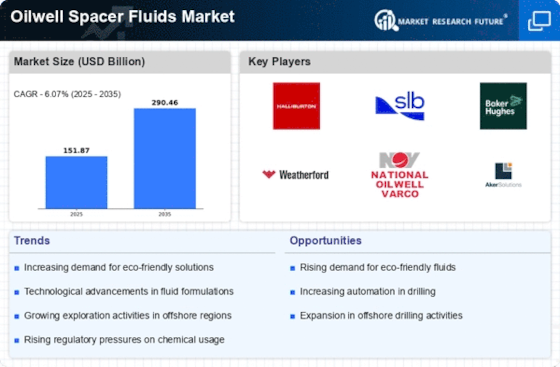
As per Market Research Future analysis, the Oilwell Spacer Fluid Market Size was estimated at 151.87 USD Billion in 2024. The Oilwell Spacer Fluids industry is projected to grow from 161.09 USD Billion in 2025 to 290.46 USD Billion by 2035, exhibiting a compound annual growth rate (CAGR) of 6.07% during the forecast period 2025 - 2035

Key Market Trends & Highlights

The Oilwell Spacer Fluid Market is poised for growth driven by technological advancements and increasing demand for oil and gas exploration.

  • Technological advancements are enhancing the efficiency and effectiveness of oilwell spacer fluids, particularly in North America. Sustainability initiatives are gaining traction, influencing the development of eco-friendly spacer fluid formulations in the Asia-Pacific region. The water-based segment remains the largest, while the oil-based segment is experiencing rapid growth due to evolving drilling techniques. Increasing demand for oil and gas exploration, alongside regulatory compliance and environmental standards, are key drivers shaping the market.

Market Size & Forecast

2024 Market Size 151.87 (USD Billion)
2035 Market Size 290.46 (USD Billion)
CAGR (2025 - 2035) 6.07%
Largest Regional Market Share in 2024 North America

Major Players

<a href="https://www.halliburton.com/en/resources/gom-baraklean-wellbore-cleanout-spacers-accelerate-deepwater-displacement">Halliburton</a> (US), Baker Hughes (US), Weatherford International (US), National Oilwell Varco (US), Aker Solutions (NO), Cameron International (US), Tenaris (AR), FMC Technologies (US), <a href="https://glossary.slb.com/terms/s/spacer_fluid.aspx">Schlumberger</a> (US)

Market Trends

The Oilwell Spacer Fluid Market is currently experiencing a dynamic evolution, driven by various factors that influence the oil and gas industry. The increasing demand for efficient drilling operations and the need for enhanced wellbore stability are pivotal in shaping the market landscape. Spacer fluids serve as a crucial component in cementing operations, ensuring the proper placement of cement and preventing contamination. As the industry continues to prioritize safety and environmental considerations, the formulation of spacer fluids is adapting to meet these emerging standards. Furthermore, advancements in technology are likely to enhance the performance characteristics of these fluids, potentially leading to more effective solutions for operators. In addition to technological advancements, the Oilwell Spacer Fluid Market is also influenced by regional dynamics and regulatory frameworks. Different regions exhibit varying levels of exploration and production activities, which can impact the demand for spacer fluids. Moreover, the ongoing shift towards sustainable practices may drive innovation in fluid formulations, as companies seek to minimize their environmental footprint. Overall, the market appears poised for growth, with opportunities arising from both traditional oil and gas operations and the increasing focus on renewable energy sources. Stakeholders in the industry must remain vigilant to adapt to these changes and leverage potential growth avenues.

Technological Advancements

The Oilwell Spacer Fluid Market is witnessing a surge in technological innovations that enhance fluid performance. New formulations and additives are being developed to improve the efficiency of spacer fluids, ensuring better cement placement and reducing the risk of contamination. These advancements may lead to more reliable drilling operations, thereby attracting greater investment in exploration activities.

Sustainability Initiatives

There is a growing emphasis on sustainability within the Oilwell Spacer Fluid Market. Companies are increasingly focusing on developing eco-friendly fluid formulations that minimize environmental impact. This trend reflects a broader industry shift towards responsible practices, which could influence purchasing decisions and regulatory compliance.

Regional Market Variations

The demand for oilwell spacer fluids varies significantly across different regions, influenced by local exploration and production activities. Regions with robust oil and gas operations are likely to see heightened demand, while emerging markets may present new opportunities. Understanding these regional dynamics is essential for stakeholders aiming to capitalize on market potential.

Oilwell spacer fluid Market Market Drivers

Expansion of Oil and Gas Infrastructure

The expansion of oil and gas infrastructure is a critical driver for the Oilwell Spacer Fluid Market. As new pipelines, refineries, and processing facilities are developed, the need for effective drilling and completion fluids becomes paramount. This infrastructure growth is particularly pronounced in emerging markets, where energy demand is escalating. The construction of new drilling sites necessitates the use of spacer fluids to ensure proper cementing and well integrity. Furthermore, the ongoing maintenance and upgrading of existing facilities also contribute to the demand for these fluids. As investments in infrastructure continue to rise, the market for oilwell spacer fluids is expected to experience substantial growth.

Increasing Demand for Oil and Gas Exploration

The Oilwell Spacer Fluid Market is experiencing a surge in demand due to the increasing exploration and production activities in the oil and gas sector. As countries seek to enhance their energy security, investments in drilling operations are on the rise. This trend is particularly evident in regions with untapped reserves, where companies are deploying advanced drilling techniques. The demand for spacer fluids, which serve to separate drilling mud from cement, is expected to grow as operators aim to improve well integrity and reduce operational risks. According to recent estimates, the oil and gas exploration sector is projected to grow at a compound annual growth rate of approximately 5% over the next few years, further driving the need for effective spacer fluids.

Rising Investment in Renewable Energy Sources

While the Oilwell Spacer Fluid Market is primarily associated with traditional oil and gas operations, the rising investment in renewable energy sources is indirectly influencing the market. As energy companies diversify their portfolios to include renewable projects, there is a growing need for efficient drilling solutions in both conventional and unconventional resources. This diversification may lead to increased demand for spacer fluids that can be utilized in various applications, including geothermal energy extraction. The integration of renewable energy initiatives with traditional oil and gas operations could create new opportunities for spacer fluid manufacturers, potentially expanding their market reach and product offerings.

Technological Innovations in Drilling Techniques

Technological advancements in drilling techniques are significantly influencing the Oilwell Spacer Fluid Market. Innovations such as horizontal drilling and hydraulic fracturing have transformed the landscape of oil and gas extraction. These methods require specialized spacer fluids that can withstand high pressures and temperatures, ensuring optimal performance during drilling operations. The introduction of smart fluids, which can adapt their properties based on environmental conditions, is also gaining traction. As operators increasingly adopt these advanced techniques, the demand for high-quality spacer fluids is likely to rise. The market for these innovative solutions is expected to expand, reflecting the industry's shift towards more efficient and effective drilling practices.

Regulatory Compliance and Environmental Standards

The Oilwell Spacer Fluid Market is being shaped by stringent regulatory compliance and environmental standards. Governments and regulatory bodies are imposing stricter guidelines on drilling operations to minimize environmental impact. This has led to an increased focus on the formulation of spacer fluids that are not only effective but also environmentally friendly. Companies are investing in research and development to create biodegradable and non-toxic spacer fluids that meet these regulations. As a result, the market is witnessing a shift towards sustainable solutions, which could potentially enhance the reputation of operators and reduce liabilities associated with environmental breaches. The emphasis on compliance is likely to drive innovation and growth in the spacer fluids segment.

Market Segment Insights

By Type: Water-based (Largest) vs. Oil-based (Fastest-Growing)

In the Oilwell Spacer Fluid Market, water-based fluids hold the largest market share, primarily due to their widespread use and cost-effectiveness. These fluids are preferred for their compatibility with various drilling operations, as they provide efficient performance while minimizing environmental impact. On the other hand, oil-based fluids, although representing a smaller market share, showcase significant growth potential driven by advancements in formulation which enhance their performance in extreme conditions. This evolving demand speaks to the shift in preferences among operators seeking specialized solutions for complex drilling challenges.

Oilwell Spacer Fluids: Water-based (Dominant) vs. Oil-based (Emerging)

Water-based spacer fluids are recognized as the dominant choice in the Oilwell Spacer Fluid Market, largely attributed to their affordability and eco-friendliness. They offer excellent cleaning properties and are often employed to facilitate the efficient removal of debris and improve cementing operations. In contrast, oil-based spacer fluids are emerging rapidly, gaining traction for their superior performance in high-temperature and high-pressure environments. This segment appeals to operators looking for improved hole-cleaning capabilities and enhanced wellbore stability during drilling. As more players recognize the unique benefits of oil-based options, their market position is expected to strengthen, catering to complex drilling needs.

By Application: Onshore (Largest) vs. Offshore (Fastest-Growing)

In the Oilwell Spacer Fluid Market, the distribution of market share favors onshore applications significantly. Onshore activities account for a substantial portion of the market, primarily due to the established infrastructure and ongoing drilling activities in regions rich in oil reserves. Offshore applications, however, are catching up rapidly, driven by technological advances and increasing investments in marine exploration. The growing need for energy, particularly from untapped offshore reserves, is contributing to a shift in focus towards these applications, even as onshore remains dominant. As the industry evolves, the offshore segment is witnessing the fastest growth. This surge is primarily due to the rising demand for spacer fluids that can operate effectively in challenging offshore conditions. Companies are investing in research and development to enhance the performance of these fluids against the unique challenges posed by deepwater drilling. The push for renewable energy sources and the need for efficient extraction methods are further propelling growth in the offshore sector, positioning it as a critical area for future investment and development.

Application: Onshore (Dominant) vs. Offshore (Emerging)

The onshore application segment remains dominant in the Oilwell Spacer Fluid Market, characterized by a well-established operational framework and consistent demand driven by expansive drilling activities. Onshore spacer fluids are designed for a variety of drilling environments, ensuring optimal performance within traditional oil and gas extraction methods. This segment benefits from established supply chains and lower operational costs compared to offshore operations. Conversely, the offshore application segment is emerging rapidly, fueled by technological innovations and increasing exploration of deeper reserves. Offshore spacer fluids are specifically formulated to withstand aggressive marine conditions and ensure wellbore stability. As energy companies seek to capitalize on untapped resources beneath the ocean, the quality and reliability of offshore spacer fluids are of utmost importance, thus driving this market segment's growth.

Get more detailed insights about Oilwell spacer fluid Market Research Report - Global Forecast till 2035

Regional Insights

North America : Market Leader in Oilwell Fluids

North America is the largest market for oilwell spacer fluids, accounting for approximately 45% of the global market share. The region's growth is driven by increasing drilling activities, technological advancements, and stringent regulations promoting safe drilling practices. The U.S. is the primary contributor, with Canada following as the second-largest market, holding around 15% of the share. Regulatory support and investment in infrastructure further bolster demand. The competitive landscape in North America is robust, featuring key players such as Halliburton, Schlumberger, and Baker Hughes. These companies leverage advanced technologies and extensive distribution networks to maintain their market positions. The presence of established oil and gas companies enhances the region's attractiveness for new entrants, fostering innovation and competition. The focus on sustainable practices is also shaping the market dynamics, pushing companies to develop eco-friendly spacer fluids.

Europe : Emerging Market with Regulations

Europe is witnessing a growing demand for oilwell spacer fluids, driven by increasing offshore drilling activities and regulatory frameworks aimed at enhancing safety and environmental standards. The region holds approximately 25% of the global market share, with the UK and Norway being the largest contributors. The European Union's stringent regulations on drilling practices are acting as catalysts for market growth, encouraging investments in advanced fluid technologies. Leading countries in Europe include the UK, Norway, and Germany, where major players like Aker Solutions and Tenaris are actively involved. The competitive landscape is characterized by a mix of established companies and innovative startups focusing on sustainable solutions. The presence of regulatory bodies ensures compliance and promotes the adoption of advanced technologies, further enhancing the market's growth potential.

Asia-Pacific : Rapid Growth in Emerging Markets

Asia-Pacific is rapidly emerging as a significant market for oilwell spacer fluids, driven by increasing energy demands and expanding exploration activities. The region holds approximately 20% of the global market share, with China and India leading the charge. Government initiatives to boost domestic oil production and reduce dependency on imports are key growth drivers, alongside investments in infrastructure and technology. China and India are the primary markets in this region, with a growing presence of international players like Schlumberger and Baker Hughes. The competitive landscape is evolving, with local companies also entering the market, enhancing competition. The focus on sustainable practices and regulatory compliance is shaping the market dynamics, pushing for innovative solutions in spacer fluid technologies. The region's growth potential is significant, driven by both demand and regulatory support.

Middle East and Africa : Resource-Rich Market Potential

The Middle East and Africa region is characterized by its rich oil reserves, making it a crucial market for oilwell spacer fluids. This region holds approximately 10% of the global market share, with countries like Saudi Arabia and the UAE leading in demand. The growth is driven by ongoing exploration and production activities, supported by government initiatives to enhance oil recovery and efficiency in drilling operations. Saudi Arabia and the UAE are the primary markets, with significant investments in oil infrastructure and technology. The competitive landscape features both local and international players, including Weatherford and National Oilwell Varco. The region's focus on technological advancements and sustainable practices is shaping the market, with a growing emphasis on eco-friendly solutions in spacer fluid formulations. The potential for growth remains high, driven by both resource availability and regulatory support.

Key Players and Competitive Insights

The Oilwell Spacer Fluids Market is characterized by a dynamic competitive landscape, driven by the increasing demand for efficient drilling operations and the need for enhanced wellbore stability. Key players such as Halliburton (US), Schlumberger (US), and Baker Hughes (US) are at the forefront, each adopting distinct strategies to solidify their market positions. Halliburton (US) emphasizes innovation in fluid formulations, focusing on environmentally friendly solutions, while Schlumberger (US) leverages its extensive technological expertise to enhance operational efficiencies. Baker Hughes (US) appears to be concentrating on strategic partnerships to expand its service offerings, thereby enhancing its competitive edge. Collectively, these strategies contribute to a competitive environment that is increasingly focused on technological advancement and sustainability.

In terms of business tactics, companies are localizing manufacturing to reduce costs and improve supply chain efficiency. The market structure is moderately fragmented, with several players vying for market share. However, the influence of major companies is substantial, as they set industry standards and drive innovation. This competitive structure allows for a diverse range of products and services, catering to various customer needs while fostering a climate of continuous improvement.

In August 2025, Halliburton (US) announced the launch of a new line of bio-based spacer fluids designed to minimize environmental impact during drilling operations. This strategic move not only aligns with global sustainability trends but also positions Halliburton (US) as a leader in eco-friendly solutions within the oil and gas sector. The introduction of these fluids is likely to attract environmentally conscious clients, enhancing Halliburton's market share.

In September 2025, Schlumberger (US) unveiled a digital platform aimed at optimizing drilling operations through real-time data analytics. This initiative underscores Schlumberger's commitment to digital transformation, enabling clients to make informed decisions that enhance operational efficiency. By integrating advanced analytics into their service offerings, Schlumberger (US) is poised to improve customer satisfaction and operational outcomes, thereby reinforcing its competitive position.

In July 2025, Baker Hughes (US) entered into a strategic partnership with a leading technology firm to develop AI-driven solutions for wellbore management. This collaboration is indicative of Baker Hughes' focus on integrating cutting-edge technology into its service portfolio. The partnership is expected to yield innovative solutions that enhance drilling precision and reduce operational risks, further solidifying Baker Hughes' reputation as a technology leader in the oilwell spacer fluids market.

As of October 2025, the competitive trends in the Oilwell Spacer Fluids Market are increasingly defined by digitalization, sustainability, and the integration of artificial intelligence. Strategic alliances are becoming more prevalent, as companies recognize the value of collaboration in driving innovation. Looking ahead, competitive differentiation is likely to evolve from traditional price-based competition to a focus on technological advancements, sustainable practices, and reliable supply chains. This shift suggests that companies that prioritize innovation and adaptability will be better positioned to thrive in the evolving market landscape.

Key Companies in the Oilwell spacer fluid Market include

Industry Developments

In 2019 August, Halliburton got nine contracts for offshore projects in West Africa. This contract includes completions, drilling, cementing, and well-testing services. With this contract, the company strengthens its presence in the African market.

Oilwell Spacer Fluids Market dynamics

Drivers

Drivers play a huge role in increasing the demand for the products. In the Global Oilwell Spacer Fluids industry, many drivers drive the demand of the Global Oilwell Spacer Fluids industry. One of the major drivers in the Global Oilwell Spacer Fluids industry is the increasing investment in the production of the Oil & gas industry. The oil & gas industry is a huge part of the developed countries.

According to the data released by the Department for Promotion of Industry and Internal Trade Policy (DPIIT), the oil & gas sector attracted FDI worth US$ 7.91 billion between April 2000 and December 2020 in India. This industry contributes highly to economic development. As a result, the governments are focusing on this sector. Additionally, technological advancement in cementing will also drive the Global Oilwell Spacer Fluids industry.

Opportunities

With the rapid urbanization, the demand for oil & gas industries is rapidly increasing. The developed regions are focusing on producing oil and gas in a safe and effective procedure. Oilwell Spacer Fluids Market is used in the oil & gas sector. So development in the oil & gas sector will bring opportunities for the Global Oilwell Spacer Fluids industry.

Restraints

The manufacturing process of oilwell spacer fluids can be complicated, and it can be a Global Oilwell Spacer Fluids Market restraint. Apart from that, various government regulations on the production of oil& gas due to environmental concerns can hamper the Global Oilwell Spacer Fluids industry. 

Challenges

The underdeveloped regions are not aware of Oilwell Spacer Fluids. Lack of awareness in these regions can be a major challenge for the Global Oilwell Spacer Fluids industry. The market key players are trying to overcome these challenges to boost the Global Oilwell Spacer Fluids industry size in the future.

Oilwell Spacer Fluids Market Cumulative growth analysis

The Global Oilwell Spacer Fluids industry will witness significant growth in the coming years. The demand for the Global Oilwell Spacer Fluids industry has increased over the years, and it will continue to grow in the forecast period with a CAGR of 5.01%.

Future Outlook

Oilwell spacer fluid Market Future Outlook

The Oilwell Spacer Fluid Market is projected to grow at a 6.07% CAGR from 2025 to 2035, driven by increasing drilling activities and technological advancements.

New opportunities lie in:

  • <p>Development of eco-friendly spacer fluid formulations Integration of real-time monitoring technologies Expansion into emerging markets with high drilling potential</p>

By 2035, the market is expected to achieve robust growth, positioning itself as a key player in the oil and gas sector.

Market Segmentation

Oilwell spacer fluid Market Type Outlook

  • Water-based
  • Oil-based

Oilwell spacer fluid Market Application Outlook

  • Onshore
  • Offshore

Report Scope

MARKET SIZE 2024 151.87(USD Billion)
MARKET SIZE 2025 161.09(USD Billion)
MARKET SIZE 2035 290.46(USD Billion)
COMPOUND ANNUAL GROWTH RATE (CAGR) 6.07% (2025 - 2035)
REPORT COVERAGE Revenue Forecast, Competitive Landscape, Growth Factors, and Trends
BASE YEAR 2024
Market Forecast Period 2025 - 2035
Historical Data 2019 - 2024
Market Forecast Units USD Billion
Key Companies Profiled Halliburton (US), Schlumberger (US), Baker Hughes (US), Weatherford International (US), National Oilwell Varco (US), Aker Solutions (NO), Cameron International (US), Tenaris (AR), FMC Technologies (US)
Segments Covered Type
Key Market Opportunities Advancements in environmentally friendly formulations drive growth in the Oilwell Spacer Fluids Market.
Key Market Dynamics Rising demand for efficient drilling operations drives innovation in oilwell spacer fluids and enhances competitive dynamics.
Countries Covered North America, Europe, APAC, South America, MEA

FAQs

What is the current valuation of the Oilwell Spacer Fluids Market?

<p>As of 2024, the Oilwell Spacer Fluids Market was valued at 151.87 USD Billion.</p>

What is the projected market size for the Oilwell Spacer Fluids Market by 2035?

<p>The market is projected to reach 290.46 USD Billion by 2035.</p>

What is the expected CAGR for the Oilwell Spacer Fluids Market during the forecast period?

<p>The expected CAGR for the Oilwell Spacer Fluids Market from 2025 to 2035 is 6.07%.</p>

Which companies are considered key players in the Oilwell Spacer Fluids Market?

<p>Key players include Halliburton, Schlumberger, Baker Hughes, and Weatherford International.</p>

What are the two main types of spacer fluids in the market?

<p>The two main types of spacer fluids are water-based and oil-based, each valued at approximately 75.93 USD Billion and 75.94 USD Billion respectively in 2024.</p>

How does the onshore application segment compare to the offshore segment in terms of market valuation?

In 2024, the onshore application segment was valued at 90.0 USD Billion, while the offshore segment was valued at 61.87 USD Billion.

What is the significance of the projected growth from 2025 to 2035 for the Oilwell Spacer Fluids Market?

The projected growth indicates a robust expansion, with the market expected to nearly double from 151.87 USD Billion in 2024 to 290.46 USD Billion by 2035.

How do the valuations of water-based and oil-based spacer fluids compare?

Water-based spacer fluids were valued at 75.93 USD Billion, while oil-based spacer fluids had a slightly higher valuation at 75.94 USD Billion in 2024.

What factors might influence the growth of the Oilwell Spacer Fluids Market in the coming years?

Factors such as increasing drilling activities and advancements in fluid technology may influence the market's growth during the forecast period.

What is the expected trend for the offshore application segment by 2035?

The offshore application segment is expected to grow, with a projected valuation of 120.46 USD Billion by 2035.

  1. SECTION I: EXECUTIVE SUMMARY AND KEY HIGHLIGHTS
    1. | 1.1 EXECUTIVE SUMMARY
    2. | | 1.1.1 Market Overview
    3. | | 1.1.2 Key Findings
    4. | | 1.1.3 Market Segmentation
    5. | | 1.1.4 Competitive Landscape
    6. | | 1.1.5 Challenges and Opportunities
    7. | | 1.1.6 Future Outlook
  2. SECTION II: SCOPING, METHODOLOGY AND MARKET STRUCTURE
    1. | 2.1 MARKET INTRODUCTION
    2. | | 2.1.1 Definition
    3. | | 2.1.2 Scope of the study
    4. | | | 2.1.2.1 Research Objective
    5. | | | 2.1.2.2 Assumption
    6. | | | 2.1.2.3 Limitations
    7. | 2.2 RESEARCH METHODOLOGY
    8. | | 2.2.1 Overview
    9. | | 2.2.2 Data Mining
    10. | | 2.2.3 Secondary Research
    11. | | 2.2.4 Primary Research
    12. | | | 2.2.4.1 Primary Interviews and Information Gathering Process
    13. | | | 2.2.4.2 Breakdown of Primary Respondents
    14. | | 2.2.5 Forecasting Model
    15. | | 2.2.6 Market Size Estimation
    16. | | | 2.2.6.1 Bottom-Up Approach
    17. | | | 2.2.6.2 Top-Down Approach
    18. | | 2.2.7 Data Triangulation
    19. | | 2.2.8 Validation
  3. SECTION III: QUALITATIVE ANALYSIS
    1. | 3.1 MARKET DYNAMICS
    2. | | 3.1.1 Overview
    3. | | 3.1.2 Drivers
    4. | | 3.1.3 Restraints
    5. | | 3.1.4 Opportunities
    6. | 3.2 MARKET FACTOR ANALYSIS
    7. | | 3.2.1 Value chain Analysis
    8. | | 3.2.2 Porter's Five Forces Analysis
    9. | | | 3.2.2.1 Bargaining Power of Suppliers
    10. | | | 3.2.2.2 Bargaining Power of Buyers
    11. | | | 3.2.2.3 Threat of New Entrants
    12. | | | 3.2.2.4 Threat of Substitutes
    13. | | | 3.2.2.5 Intensity of Rivalry
    14. | | 3.2.3 COVID-19 Impact Analysis
    15. | | | 3.2.3.1 Market Impact Analysis
    16. | | | 3.2.3.2 Regional Impact
    17. | | | 3.2.3.3 Opportunity and Threat Analysis
  4. SECTION IV: QUANTITATIVE ANALYSIS
    1. | 4.1 Energy & Power, BY Type (USD Billion)
    2. | | 4.1.1 Water-based
    3. | | 4.1.2 Oil-based
    4. | 4.2 Energy & Power, BY Application (USD Billion)
    5. | | 4.2.1 Onshore
    6. | | 4.2.2 Offshore
    7. | 4.3 Energy & Power, BY Region (USD Billion)
    8. | | 4.3.1 North America
    9. | | | 4.3.1.1 US
    10. | | | 4.3.1.2 Canada
    11. | | 4.3.2 Europe
    12. | | | 4.3.2.1 Germany
    13. | | | 4.3.2.2 UK
    14. | | | 4.3.2.3 France
    15. | | | 4.3.2.4 Russia
    16. | | | 4.3.2.5 Italy
    17. | | | 4.3.2.6 Spain
    18. | | | 4.3.2.7 Rest of Europe
    19. | | 4.3.3 APAC
    20. | | | 4.3.3.1 China
    21. | | | 4.3.3.2 India
    22. | | | 4.3.3.3 Japan
    23. | | | 4.3.3.4 South Korea
    24. | | | 4.3.3.5 Malaysia
    25. | | | 4.3.3.6 Thailand
    26. | | | 4.3.3.7 Indonesia
    27. | | | 4.3.3.8 Rest of APAC
    28. | | 4.3.4 South America
    29. | | | 4.3.4.1 Brazil
    30. | | | 4.3.4.2 Mexico
    31. | | | 4.3.4.3 Argentina
    32. | | | 4.3.4.4 Rest of South America
    33. | | 4.3.5 MEA
    34. | | | 4.3.5.1 GCC Countries
    35. | | | 4.3.5.2 South Africa
    36. | | | 4.3.5.3 Rest of MEA
  5. SECTION V: COMPETITIVE ANALYSIS
    1. | 5.1 Competitive Landscape
    2. | | 5.1.1 Overview
    3. | | 5.1.2 Competitive Analysis
    4. | | 5.1.3 Market share Analysis
    5. | | 5.1.4 Major Growth Strategy in the Energy & Power
    6. | | 5.1.5 Competitive Benchmarking
    7. | | 5.1.6 Leading Players in Terms of Number of Developments in the Energy & Power
    8. | | 5.1.7 Key developments and growth strategies
    9. | | | 5.1.7.1 New Product Launch/Service Deployment
    10. | | | 5.1.7.2 Merger & Acquisitions
    11. | | | 5.1.7.3 Joint Ventures
    12. | | 5.1.8 Major Players Financial Matrix
    13. | | | 5.1.8.1 Sales and Operating Income
    14. | | | 5.1.8.2 Major Players R&D Expenditure. 2023
    15. | 5.2 Company Profiles
    16. | | 5.2.1 Halliburton (US)
    17. | | | 5.2.1.1 Financial Overview
    18. | | | 5.2.1.2 Products Offered
    19. | | | 5.2.1.3 Key Developments
    20. | | | 5.2.1.4 SWOT Analysis
    21. | | | 5.2.1.5 Key Strategies
    22. | | 5.2.2 Schlumberger (US)
    23. | | | 5.2.2.1 Financial Overview
    24. | | | 5.2.2.2 Products Offered
    25. | | | 5.2.2.3 Key Developments
    26. | | | 5.2.2.4 SWOT Analysis
    27. | | | 5.2.2.5 Key Strategies
    28. | | 5.2.3 Baker Hughes (US)
    29. | | | 5.2.3.1 Financial Overview
    30. | | | 5.2.3.2 Products Offered
    31. | | | 5.2.3.3 Key Developments
    32. | | | 5.2.3.4 SWOT Analysis
    33. | | | 5.2.3.5 Key Strategies
    34. | | 5.2.4 Weatherford International (US)
    35. | | | 5.2.4.1 Financial Overview
    36. | | | 5.2.4.2 Products Offered
    37. | | | 5.2.4.3 Key Developments
    38. | | | 5.2.4.4 SWOT Analysis
    39. | | | 5.2.4.5 Key Strategies
    40. | | 5.2.5 National Oilwell Varco (US)
    41. | | | 5.2.5.1 Financial Overview
    42. | | | 5.2.5.2 Products Offered
    43. | | | 5.2.5.3 Key Developments
    44. | | | 5.2.5.4 SWOT Analysis
    45. | | | 5.2.5.5 Key Strategies
    46. | | 5.2.6 Aker Solutions (NO)
    47. | | | 5.2.6.1 Financial Overview
    48. | | | 5.2.6.2 Products Offered
    49. | | | 5.2.6.3 Key Developments
    50. | | | 5.2.6.4 SWOT Analysis
    51. | | | 5.2.6.5 Key Strategies
    52. | | 5.2.7 Cameron International (US)
    53. | | | 5.2.7.1 Financial Overview
    54. | | | 5.2.7.2 Products Offered
    55. | | | 5.2.7.3 Key Developments
    56. | | | 5.2.7.4 SWOT Analysis
    57. | | | 5.2.7.5 Key Strategies
    58. | | 5.2.8 Tenaris (AR)
    59. | | | 5.2.8.1 Financial Overview
    60. | | | 5.2.8.2 Products Offered
    61. | | | 5.2.8.3 Key Developments
    62. | | | 5.2.8.4 SWOT Analysis
    63. | | | 5.2.8.5 Key Strategies
    64. | | 5.2.9 FMC Technologies (US)
    65. | | | 5.2.9.1 Financial Overview
    66. | | | 5.2.9.2 Products Offered
    67. | | | 5.2.9.3 Key Developments
    68. | | | 5.2.9.4 SWOT Analysis
    69. | | | 5.2.9.5 Key Strategies
    70. | 5.3 Appendix
    71. | | 5.3.1 References
    72. | | 5.3.2 Related Reports
  6. LIST OF FIGURES
    1. | 6.1 MARKET SYNOPSIS
    2. | 6.2 NORTH AMERICA MARKET ANALYSIS
    3. | 6.3 US MARKET ANALYSIS BY TYPE
    4. | 6.4 US MARKET ANALYSIS BY APPLICATION
    5. | 6.5 CANADA MARKET ANALYSIS BY TYPE
    6. | 6.6 CANADA MARKET ANALYSIS BY APPLICATION
    7. | 6.7 EUROPE MARKET ANALYSIS
    8. | 6.8 GERMANY MARKET ANALYSIS BY TYPE
    9. | 6.9 GERMANY MARKET ANALYSIS BY APPLICATION
    10. | 6.10 UK MARKET ANALYSIS BY TYPE
    11. | 6.11 UK MARKET ANALYSIS BY APPLICATION
    12. | 6.12 FRANCE MARKET ANALYSIS BY TYPE
    13. | 6.13 FRANCE MARKET ANALYSIS BY APPLICATION
    14. | 6.14 RUSSIA MARKET ANALYSIS BY TYPE
    15. | 6.15 RUSSIA MARKET ANALYSIS BY APPLICATION
    16. | 6.16 ITALY MARKET ANALYSIS BY TYPE
    17. | 6.17 ITALY MARKET ANALYSIS BY APPLICATION
    18. | 6.18 SPAIN MARKET ANALYSIS BY TYPE
    19. | 6.19 SPAIN MARKET ANALYSIS BY APPLICATION
    20. | 6.20 REST OF EUROPE MARKET ANALYSIS BY TYPE
    21. | 6.21 REST OF EUROPE MARKET ANALYSIS BY APPLICATION
    22. | 6.22 APAC MARKET ANALYSIS
    23. | 6.23 CHINA MARKET ANALYSIS BY TYPE
    24. | 6.24 CHINA MARKET ANALYSIS BY APPLICATION
    25. | 6.25 INDIA MARKET ANALYSIS BY TYPE
    26. | 6.26 INDIA MARKET ANALYSIS BY APPLICATION
    27. | 6.27 JAPAN MARKET ANALYSIS BY TYPE
    28. | 6.28 JAPAN MARKET ANALYSIS BY APPLICATION
    29. | 6.29 SOUTH KOREA MARKET ANALYSIS BY TYPE
    30. | 6.30 SOUTH KOREA MARKET ANALYSIS BY APPLICATION
    31. | 6.31 MALAYSIA MARKET ANALYSIS BY TYPE
    32. | 6.32 MALAYSIA MARKET ANALYSIS BY APPLICATION
    33. | 6.33 THAILAND MARKET ANALYSIS BY TYPE
    34. | 6.34 THAILAND MARKET ANALYSIS BY APPLICATION
    35. | 6.35 INDONESIA MARKET ANALYSIS BY TYPE
    36. | 6.36 INDONESIA MARKET ANALYSIS BY APPLICATION
    37. | 6.37 REST OF APAC MARKET ANALYSIS BY TYPE
    38. | 6.38 REST OF APAC MARKET ANALYSIS BY APPLICATION
    39. | 6.39 SOUTH AMERICA MARKET ANALYSIS
    40. | 6.40 BRAZIL MARKET ANALYSIS BY TYPE
    41. | 6.41 BRAZIL MARKET ANALYSIS BY APPLICATION
    42. | 6.42 MEXICO MARKET ANALYSIS BY TYPE
    43. | 6.43 MEXICO MARKET ANALYSIS BY APPLICATION
    44. | 6.44 ARGENTINA MARKET ANALYSIS BY TYPE
    45. | 6.45 ARGENTINA MARKET ANALYSIS BY APPLICATION
    46. | 6.46 REST OF SOUTH AMERICA MARKET ANALYSIS BY TYPE
    47. | 6.47 REST OF SOUTH AMERICA MARKET ANALYSIS BY APPLICATION
    48. | 6.48 MEA MARKET ANALYSIS
    49. | 6.49 GCC COUNTRIES MARKET ANALYSIS BY TYPE
    50. | 6.50 GCC COUNTRIES MARKET ANALYSIS BY APPLICATION
    51. | 6.51 SOUTH AFRICA MARKET ANALYSIS BY TYPE
    52. | 6.52 SOUTH AFRICA MARKET ANALYSIS BY APPLICATION
    53. | 6.53 REST OF MEA MARKET ANALYSIS BY TYPE
    54. | 6.54 REST OF MEA MARKET ANALYSIS BY APPLICATION
    55. | 6.55 KEY BUYING CRITERIA OF ENERGY & POWER
    56. | 6.56 RESEARCH PROCESS OF MRFR
    57. | 6.57 DRO ANALYSIS OF ENERGY & POWER
    58. | 6.58 DRIVERS IMPACT ANALYSIS: ENERGY & POWER
    59. | 6.59 RESTRAINTS IMPACT ANALYSIS: ENERGY & POWER
    60. | 6.60 SUPPLY / VALUE CHAIN: ENERGY & POWER
    61. | 6.61 ENERGY & POWER, BY TYPE, 2024 (% SHARE)
    62. | 6.62 ENERGY & POWER, BY TYPE, 2024 TO 2035 (USD Billion)
    63. | 6.63 ENERGY & POWER, BY APPLICATION, 2024 (% SHARE)
    64. | 6.64 ENERGY & POWER, BY APPLICATION, 2024 TO 2035 (USD Billion)
    65. | 6.65 BENCHMARKING OF MAJOR COMPETITORS
  7. LIST OF TABLES
    1. | 7.1 LIST OF ASSUMPTIONS
    2. | | 7.1.1
    3. | 7.2 North America MARKET SIZE ESTIMATES; FORECAST
    4. | | 7.2.1 BY TYPE, 2025-2035 (USD Billion)
    5. | | 7.2.2 BY APPLICATION, 2025-2035 (USD Billion)
    6. | 7.3 US MARKET SIZE ESTIMATES; FORECAST
    7. | | 7.3.1 BY TYPE, 2025-2035 (USD Billion)
    8. | | 7.3.2 BY APPLICATION, 2025-2035 (USD Billion)
    9. | 7.4 Canada MARKET SIZE ESTIMATES; FORECAST
    10. | | 7.4.1 BY TYPE, 2025-2035 (USD Billion)
    11. | | 7.4.2 BY APPLICATION, 2025-2035 (USD Billion)
    12. | 7.5 Europe MARKET SIZE ESTIMATES; FORECAST
    13. | | 7.5.1 BY TYPE, 2025-2035 (USD Billion)
    14. | | 7.5.2 BY APPLICATION, 2025-2035 (USD Billion)
    15. | 7.6 Germany MARKET SIZE ESTIMATES; FORECAST
    16. | | 7.6.1 BY TYPE, 2025-2035 (USD Billion)
    17. | | 7.6.2 BY APPLICATION, 2025-2035 (USD Billion)
    18. | 7.7 UK MARKET SIZE ESTIMATES; FORECAST
    19. | | 7.7.1 BY TYPE, 2025-2035 (USD Billion)
    20. | | 7.7.2 BY APPLICATION, 2025-2035 (USD Billion)
    21. | 7.8 France MARKET SIZE ESTIMATES; FORECAST
    22. | | 7.8.1 BY TYPE, 2025-2035 (USD Billion)
    23. | | 7.8.2 BY APPLICATION, 2025-2035 (USD Billion)
    24. | 7.9 Russia MARKET SIZE ESTIMATES; FORECAST
    25. | | 7.9.1 BY TYPE, 2025-2035 (USD Billion)
    26. | | 7.9.2 BY APPLICATION, 2025-2035 (USD Billion)
    27. | 7.10 Italy MARKET SIZE ESTIMATES; FORECAST
    28. | | 7.10.1 BY TYPE, 2025-2035 (USD Billion)
    29. | | 7.10.2 BY APPLICATION, 2025-2035 (USD Billion)
    30. | 7.11 Spain MARKET SIZE ESTIMATES; FORECAST
    31. | | 7.11.1 BY TYPE, 2025-2035 (USD Billion)
    32. | | 7.11.2 BY APPLICATION, 2025-2035 (USD Billion)
    33. | 7.12 Rest of Europe MARKET SIZE ESTIMATES; FORECAST
    34. | | 7.12.1 BY TYPE, 2025-2035 (USD Billion)
    35. | | 7.12.2 BY APPLICATION, 2025-2035 (USD Billion)
    36. | 7.13 APAC MARKET SIZE ESTIMATES; FORECAST
    37. | | 7.13.1 BY TYPE, 2025-2035 (USD Billion)
    38. | | 7.13.2 BY APPLICATION, 2025-2035 (USD Billion)
    39. | 7.14 China MARKET SIZE ESTIMATES; FORECAST
    40. | | 7.14.1 BY TYPE, 2025-2035 (USD Billion)
    41. | | 7.14.2 BY APPLICATION, 2025-2035 (USD Billion)
    42. | 7.15 India MARKET SIZE ESTIMATES; FORECAST
    43. | | 7.15.1 BY TYPE, 2025-2035 (USD Billion)
    44. | | 7.15.2 BY APPLICATION, 2025-2035 (USD Billion)
    45. | 7.16 Japan MARKET SIZE ESTIMATES; FORECAST
    46. | | 7.16.1 BY TYPE, 2025-2035 (USD Billion)
    47. | | 7.16.2 BY APPLICATION, 2025-2035 (USD Billion)
    48. | 7.17 South Korea MARKET SIZE ESTIMATES; FORECAST
    49. | | 7.17.1 BY TYPE, 2025-2035 (USD Billion)
    50. | | 7.17.2 BY APPLICATION, 2025-2035 (USD Billion)
    51. | 7.18 Malaysia MARKET SIZE ESTIMATES; FORECAST
    52. | | 7.18.1 BY TYPE, 2025-2035 (USD Billion)
    53. | | 7.18.2 BY APPLICATION, 2025-2035 (USD Billion)
    54. | 7.19 Thailand MARKET SIZE ESTIMATES; FORECAST
    55. | | 7.19.1 BY TYPE, 2025-2035 (USD Billion)
    56. | | 7.19.2 BY APPLICATION, 2025-2035 (USD Billion)
    57. | 7.20 Indonesia MARKET SIZE ESTIMATES; FORECAST
    58. | | 7.20.1 BY TYPE, 2025-2035 (USD Billion)
    59. | | 7.20.2 BY APPLICATION, 2025-2035 (USD Billion)
    60. | 7.21 Rest of APAC MARKET SIZE ESTIMATES; FORECAST
    61. | | 7.21.1 BY TYPE, 2025-2035 (USD Billion)
    62. | | 7.21.2 BY APPLICATION, 2025-2035 (USD Billion)
    63. | 7.22 South America MARKET SIZE ESTIMATES; FORECAST
    64. | | 7.22.1 BY TYPE, 2025-2035 (USD Billion)
    65. | | 7.22.2 BY APPLICATION, 2025-2035 (USD Billion)
    66. | 7.23 Brazil MARKET SIZE ESTIMATES; FORECAST
    67. | | 7.23.1 BY TYPE, 2025-2035 (USD Billion)
    68. | | 7.23.2 BY APPLICATION, 2025-2035 (USD Billion)
    69. | 7.24 Mexico MARKET SIZE ESTIMATES; FORECAST
    70. | | 7.24.1 BY TYPE, 2025-2035 (USD Billion)
    71. | | 7.24.2 BY APPLICATION, 2025-2035 (USD Billion)
    72. | 7.25 Argentina MARKET SIZE ESTIMATES; FORECAST
    73. | | 7.25.1 BY TYPE, 2025-2035 (USD Billion)
    74. | | 7.25.2 BY APPLICATION, 2025-2035 (USD Billion)
    75. | 7.26 Rest of South America MARKET SIZE ESTIMATES; FORECAST
    76. | | 7.26.1 BY TYPE, 2025-2035 (USD Billion)
    77. | | 7.26.2 BY APPLICATION, 2025-2035 (USD Billion)
    78. | 7.27 MEA MARKET SIZE ESTIMATES; FORECAST
    79. | | 7.27.1 BY TYPE, 2025-2035 (USD Billion)
    80. | | 7.27.2 BY APPLICATION, 2025-2035 (USD Billion)
    81. | 7.28 GCC Countries MARKET SIZE ESTIMATES; FORECAST
    82. | | 7.28.1 BY TYPE, 2025-2035 (USD Billion)
    83. | | 7.28.2 BY APPLICATION, 2025-2035 (USD Billion)
    84. | 7.29 South Africa MARKET SIZE ESTIMATES; FORECAST
    85. | | 7.29.1 BY TYPE, 2025-2035 (USD Billion)
    86. | | 7.29.2 BY APPLICATION, 2025-2035 (USD Billion)
    87. | 7.30 Rest of MEA MARKET SIZE ESTIMATES; FORECAST
    88. | | 7.30.1 BY TYPE, 2025-2035 (USD Billion)
    89. | | 7.30.2 BY APPLICATION, 2025-2035 (USD Billion)
    90. | 7.31 PRODUCT LAUNCH/PRODUCT DEVELOPMENT/APPROVAL
    91. | | 7.31.1
    92. | 7.32 ACQUISITION/PARTNERSHIP
    93. | | 7.32.1

Energy & Power Market Segmentation

Energy & Power By Type (USD Billion, 2025-2035)

  • Water-based
  • Oil-based

Energy & Power By Application (USD Billion, 2025-2035)

  • Onshore
  • Offshore
Infographic

Free Sample Request

Kindly complete the form below to receive a free sample of this Report

Get Free Sample

Customer Strories

Compare Licence

×
Features License Type
Single User Multiuser License Enterprise User
Price $4,950 $5,950 $7,250
Maximum User Access Limit 1 User Upto 10 Users Unrestricted Access Throughout the Organization
Free Customization
Direct Access to Analyst
Deliverable Format
Platform Access
Discount on Next Purchase 10% 15% 15%
Printable Versions