×
Request Free Sample ×

Kindly complete the form below to receive a free sample of this Report

* Please use a valid business email

Leading companies partner with us for data-driven Insights

clients tt-cursor
Hero Background
English
Chinese
French
Japanese
Korean
German
Spanish

Oil and Gas Upstream Projects Market Size

ID: MRFR/EnP/14665-HCR
128 Pages
Chitranshi Jaiswal
October 2025

Oil and Gas Upstream Projects Market Research Report Information By Application (Exploration and Drilling, Completion and Procedure, and Others), By Deployment (Onshore and Offshore), By Region (North America, Europe, Asia-Pacific, And Rest Of The World) –Market Forecast Till 2035

Share:
Download PDF ×

We do not share your information with anyone. However, we may send you emails based on your report interest from time to time. You may contact us at any time to opt-out.

Oil Gas Upstream Projects Market Infographic
Purchase Options

Oil Gas Upstream Projects Size

Oil Gas Upstream Projects Market Growth Projections and Opportunities

It is quite imperative to note that the oil and gas upstream projects market faces a number of factors which altogether form its dynamics in the energy sector. A major factor behind this is the world’s demand for hydrocarbons, especially oil and natural gas fuelled by increased industrialization, economic growth, and energy consumption globally. The market dynamics largely depend on the exploitation, production of these resources that ensures meeting growing energetic needs at several economies. A number of geopolitical factors contribute to the market specifics and dynamics that govern oil and gas upstream projects. The chances and conditions associated with exploration, production are affected by Geopolitical events such as geospatial politics which includes regulation rendered to the oil-producing nations. The orientation is influenced by geopolitical strains, trade deals and political stability of areas rich in hydrocarbon deposits hence the general investment climate for upstream projects. Technological innovations and developments in exploration and production methods greatly contribute to the market dynamics. New developments in seismic images, drilling technologies and reservoir management form an integral part of the changing canvas for upstream projects. It is this promise from the constant drive to increase recovery rates, reduce exploration risks and make operations efficient which guarantees that upstream ventures remain economically viable. The environment and regulatory factors are key driving forces governing the market dynamics of oil and gas upstream projects. The dynamics are also influenced by the requirements for compliance with environmental standards, safety regulations, and permitting procedural steps. Although preferences of downstream businesses play an important role in making decisions, growing attention to sustainable practices, emissions reduction, and environmental protection factors influence companies involved up the chain. Crude oil price movements play a major role in determining how the dynamics of market develop for upstream projects on oils and gas features. Their dynamics are shaped by world oil supply and demand, geopolitical factors as well as economic circumstances. One of the oil price sensitivity is upstream project investments, which may alter exploration budgets and development cost feasibility affecting profitability. The energy transition also plays a substantial role in dynamically evolving market demands, with the focus on renewable sources. The relationships are determined by the deliberate choice on behalf of oil and gas firms to diversify their portfolios, invest in renewable projects as well as reorganize according to evolving consumer preferences for innovative alternatives energy. With a new landscape of hope for energy that drives towards sustainability, investing in upstream projects becomes increasingly burdensome.
Oil Gas Upstream Projects Market Size Graph
Author
Chitranshi Jaiswal
Research Analyst Level I

In her 3 years of experience in the market research field, she has handled critical cross-domain projects. She has an in-depth knowledge of market estimation & analysis, problem-solving, primary as well as secondary research, and team management.She holds an engineering degree and is an MBA professional from a well-known university, capable of evaluating the market and competitive conditions. An exceptional strategist with excellent communication skills and a passion for delivering cutting-edge & practical insights for the market. Proficient in multi-tasking, and can successfully deal with competing demands, while maintaining complete confidentiality. Generated business through active client and project development, networking, and high-quality responses. Her knowledge and skills have helped in making solid business decisions, securing funding from investors, and avoiding business failures.

Leave a Comment

FAQs

How much is the oil and gas upstream projects market?

The Oil and Gas Upstream Projects Market size was valued at significant value in 2022.

What is the growth rate of the oil and gas upstream projects market?

The global market is projected to grow at a CAGR of 19.08% during the forecast period, 2023-2032.

Which region held the largest market share in the oil and gas upstream projects market?

North America had the largest share in the global market

Who are the key players in the oil and gas upstream projects market?

The key players in the market are Archer Ltd., ATB Holding Spa, Atlas Copco AB, Flowserve Corp., Dril Quip Inc., AXON Pressure Products Inc., Evolution Oil Tools Inc., Forum Energy Technologies Inc., General Electric Co., Seadrill Ltd., SPX FLOW Inc., Siemens AG, Halliburton Co., NOV Inc., Schlumberger Ltd., Sumitomo Corp., Weatherford International Plc, Geometrics Inc., and Helmerich and Payne Inc.

Which application led the oil and gas upstream projects market?

The exploration and drilling category dominated the market in 2022.

Which deployment had the largest market share in the oil and gas upstream projects market?

The offshore category had the largest share in the global market.

Market Summary

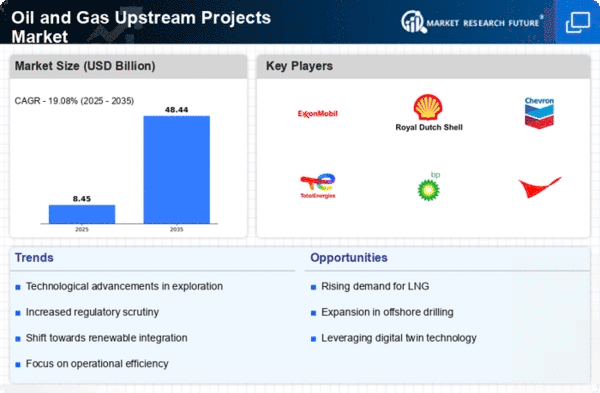
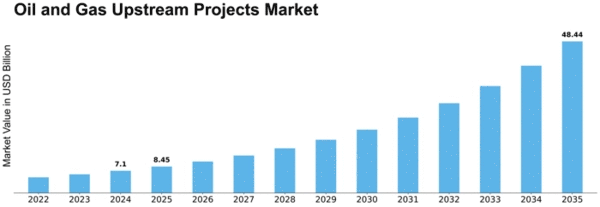
As per MRFR analysis, the Oil Gas Upstream Projects Market was estimated at 7.1 USD Billion in 2024. The Oil Gas Upstream Projects industry is projected to grow from 8.45 USD Billion in 2025 to 48.44 USD Billion by 2035, exhibiting a compound annual growth rate (CAGR) of 19.08 during the forecast period 2025 - 2035.

Key Market Trends & Highlights

The Oil Gas Upstream Projects Market is currently experiencing a dynamic shift driven by technological advancements and sustainability initiatives.

  • North America remains the largest market for oil and gas upstream projects, driven by robust exploration activities.
  • Asia-Pacific is emerging as the fastest-growing region, fueled by increasing energy demand and investment in infrastructure.
  • The exploration segment continues to dominate the market, while the development segment is witnessing rapid growth due to technological innovations.
  • Rising energy demand and geopolitical factors are key drivers influencing the market's trajectory.

Market Size & Forecast

2024 Market Size 7.1 (USD Billion)
2035 Market Size 48.44 (USD Billion)
CAGR (2025 - 2035) 19.08%
Largest Regional Market Share in 2024 North America

Major Players

ExxonMobil (US), Royal Dutch Shell (GB), Chevron (US), TotalEnergies (FR), BP (GB), ConocoPhillips (US), Eni (IT), Equinor (NO), Petrobras (BR)

Market Trends

The Oil Gas Upstream Projects Market is currently experiencing a dynamic phase characterized by evolving technologies and shifting geopolitical landscapes. Companies are increasingly investing in advanced exploration techniques and digital solutions to enhance operational efficiency and reduce costs. The focus on sustainability and environmental considerations is also reshaping project development, as stakeholders seek to balance profitability with ecological responsibility. Furthermore, the market appears to be influenced by fluctuating energy demands and the transition towards renewable sources, prompting traditional players to adapt their strategies accordingly. In December 2025, the Oil Gas Upstream Projects Market reflects a complex interplay of factors that could shape its future trajectory. The ongoing emphasis on innovation, coupled with regulatory changes and market volatility, suggests that companies must remain agile and responsive. As the industry navigates these challenges, collaboration among stakeholders, including governments and private entities, may play a crucial role in driving sustainable growth and ensuring energy security for the coming years.

Technological Advancements

The integration of cutting-edge technologies in the Oil Gas Upstream Projects Market is transforming exploration and production processes. Innovations such as artificial intelligence, machine learning, and advanced data analytics are enhancing decision-making and operational efficiency. These developments not only streamline workflows but also contribute to cost reduction and improved safety measures.

Sustainability Initiatives

There is a growing emphasis on sustainability within the Oil Gas Upstream Projects Market, as companies strive to minimize their environmental impact. This trend includes the adoption of cleaner extraction methods and the implementation of carbon capture technologies. Stakeholders are increasingly recognizing the importance of aligning their operations with global sustainability goals.

Geopolitical Influences

The Oil Gas Upstream Projects Market is significantly affected by geopolitical dynamics, which can lead to fluctuations in supply and demand. Political stability in key producing regions, trade agreements, and international relations play a vital role in shaping market conditions. Companies must remain vigilant and adaptable to navigate these complexities.

Oil Gas Upstream Projects Market Market Drivers

Rising Global Energy Demand

The Global Oil and Gas Upstream Projects Market Industry is experiencing a surge in demand driven by increasing global energy consumption. As economies expand, particularly in developing regions, the need for oil and gas resources intensifies. In 2024, the market is valued at approximately 235.94 USD Billion, reflecting the urgent requirement for exploration and production activities. This trend is expected to continue, with projections indicating a market size of 541.32 USD Billion by 2035. The compound annual growth rate of 7.84% from 2025 to 2035 underscores the necessity for upstream investments to meet future energy needs.

Market Segment Insights

By Project Type: Exploration (Largest) vs. Development (Fastest-Growing)

In the Oil Gas Upstream Projects Market, the distribution of project types reveals that exploration activities hold the largest market share, primarily driven by the need for new reserves amid depleting existing ones. Development projects follow closely, as companies invest in bringing these wells into production. Production projects remain critical for ensuring regular supply and revenue generation, while decommissioning projects are vital for the safe and environmentally responsible closure of aging oil and gas facilities. Overall, the segmentation illustrates a strong reliance on exploration, supplemented by increasing development initiatives.

Exploration (Dominant) vs. Development (Emerging)

Exploration projects are dominant in the Oil Gas Upstream Projects Market, as they are foundational to discovering new resources. Companies engage in extensive geological surveys and drill testing to identify viable sites for oil and gas extraction. On the other hand, development projects represent an emerging focus, where advancements in technology enable faster and more efficient extraction methods, thus enhancing project viability. This duality illustrates the sector's dynamic nature, with exploration ensuring future resource availability while development optimizes existing assets for improved yield and profitability.

By Resource Type: Conventional Oil (Largest) vs. Natural Gas (Fastest-Growing)

In the Oil Gas Upstream Projects Market, the resource type segment is predominantly led by Conventional Oil, which captures a significant share of the market due to its established extraction processes and extensive infrastructure. Following this, Natural Gas shows promising growth, benefiting from increased demand for cleaner energy sources and advancements in extraction technologies. Unconventional Oil and Natural Gas Liquids, while notable, hold smaller shares comparatively but are crucial for diversifying energy supplies. The growth trends within this segment are driven by a shift towards cleaner energy, with Natural Gas witnessing rapid adoption as a transition fuel. Investments in extraction technologies for Unconventional Oil are also on the rise, reflecting a broader trend towards maximizing resource efficiency. The movement towards sustainability is reshaping the market as operators seek to balance traditional resource extraction with emerging green technologies, paving the way for innovative developments in Natural Gas and Liquids.

Conventional Oil (Dominant) vs. Natural Gas Liquids (Emerging)

Conventional Oil continues to dominate the Oil Gas Upstream Projects Market, primarily because of its extensive infrastructure and proven technologies that facilitate extraction. This segment benefits from a well-established supply chain and experiences lower operational costs compared to newer oil sources. In contrast, Natural Gas Liquids, while classified as emerging, are gaining attention due to their versatility and potential to be used as feedstock for petrochemical industries. The shifting energy landscape encourages investments into these liquids as companies focus on developing alternative resources to traditional fuels, enabling diversified energy portfolios and reducing carbon footprints. As a result, while Conventional Oil remains essential, Natural Gas Liquids are positioning themselves as vital players in the market.

By Technology: Drilling Technology (Largest) vs. Seismic Technology (Fastest-Growing)

In the Oil Gas Upstream Projects Market, the distribution of technology segment values indicates that Drilling Technology holds the largest share, being integral to operational efficiency and production rates. Seismic Technology, while smaller in market share, is rapidly gaining traction as companies seek to enhance exploration accuracy and reduce drilling risks.

Technology: Drilling Technology (Dominant) vs. Seismic Technology (Emerging)

Drilling Technology stands as the dominant force in the upstream oil and gas sector, leveraging advancements in drilling techniques and equipment to optimize resource extraction. It includes rotary drilling, directional drilling, and hydraulic fracturing technologies that have significantly enhanced production volumes. On the other hand, Seismic Technology is emerging as a vital component for exploration; innovations in 3D and 4D seismic imaging techniques allow for deeper insights into subsurface formations, thus improving the success rate of drilling projects. The convergence of real-time data analytics with seismic technology is positioning it as a critical player in the future landscape of oil and gas exploration.

By Investment Type: Public Investment (Largest) vs. Private Investment (Fastest-Growing)

The Oil Gas Upstream Projects Market exhibits a diverse investment landscape characterized by its distinct segments: Public Investment, Private Investment, Joint Ventures, and Foreign Direct Investment. Public Investment stands out as the largest segment, leveraging government resources to fund large-scale energy projects, thus capturing a significant market share. Conversely, Private Investment is witnessing rapid growth as more private firms engage in upstream activities, driven by increasing oil demand and competitive market dynamics. Growth in the Investment Type segment is influenced by various factors, including technology advancements, favorable government policies, and fluctuating oil prices. Joint Ventures and Foreign Direct Investment also contribute to market robustness, allowing shared risks and enhanced resource access. Companies are exploring innovative partnerships to leverage expertise and expand their operational footprints, driving further momentum in this sector.

Public Investment (Dominant) vs. Private Investment (Emerging)

Public Investment in the Oil Gas Upstream Projects Market is characterized by its significant contributions to exploration and production initiatives backed by government resources. This investment type often drives projects that require substantial capital and offer strategic benefits to national energy security. In contrast, Private Investment has emerged as a dynamic force, focusing on niche opportunities and leveraging flexible funding strategies. These private entities are increasingly engaging in cutting-edge technologies and reduced operational costs, positioning them to capitalize on evolving market conditions. Together, these segments reflect a balanced approach to funding in the oil and gas sector, fostering resilience and adaptability in our energy landscape.

Get more detailed insights about Oil and Gas Upstream Projects Market Research Report — Global Forecast till 2035

Regional Insights

North America : Leading Global Market

North America continues to lead the Oil Gas Upstream Projects Market, holding a significant market share of 3.5 in 2024. The region's growth is driven by technological advancements, increased exploration activities, and favorable regulatory frameworks. The demand for energy, coupled with the push for sustainable practices, has catalyzed investments in innovative extraction methods and infrastructure development. Regulatory support for energy independence further enhances market dynamics. The competitive landscape is characterized by major players such as ExxonMobil, Chevron, and ConocoPhillips, which dominate the market. The U.S. remains a key player, with Texas and North Dakota leading in production. The presence of established companies fosters innovation and efficiency, while new entrants are also emerging, contributing to a dynamic market environment. The region's focus on reducing carbon emissions is shaping future projects, ensuring sustainability in operations.

Europe : Regulatory Frameworks in Focus

Europe's Oil Gas Upstream Projects Market is valued at 1.8, reflecting a steady growth trajectory. The region is increasingly focusing on regulatory frameworks that promote sustainability and energy transition. The European Union's Green Deal and various national policies are driving investments in cleaner technologies and renewable energy integration. This regulatory push is expected to reshape the market, encouraging innovation and efficiency in oil and gas extraction processes. Leading countries such as Norway, the UK, and the Netherlands are at the forefront of this transformation, with major players like BP and TotalEnergies actively participating. The competitive landscape is evolving, with a mix of traditional oil companies and new entrants focusing on sustainable practices. The emphasis on reducing carbon footprints and enhancing energy security is shaping future projects, ensuring that Europe remains a significant player in the global market.

Asia-Pacific : Emerging Market Potential

The Asia-Pacific region, with a market size of 1.5, is witnessing a surge in oil and gas upstream investments. This growth is driven by increasing energy demand, particularly in countries like China and India, where industrialization and urbanization are accelerating. Regulatory reforms aimed at attracting foreign investments and enhancing local production capabilities are also contributing to market expansion. The region's focus on energy security and diversification of energy sources is further catalyzing growth in upstream projects. Key players in the region include major companies like Eni and Equinor, which are actively exploring opportunities in emerging markets. Countries such as Australia and Indonesia are becoming increasingly important in the competitive landscape, with significant investments in exploration and production. The presence of both established and new players is fostering innovation, ensuring that the Asia-Pacific region remains a vital component of The Oil Gas Upstream Projects.

Middle East and Africa : Resource-Rich Opportunities

The Middle East and Africa region, with a market size of 0.3, presents unique opportunities in the Oil Gas Upstream Projects Market. The region is rich in natural resources, and countries like Saudi Arabia and Nigeria are key players in global oil production. The demand for energy continues to rise, driven by population growth and industrial development. Regulatory frameworks are evolving to attract foreign investments, enhancing the region's appeal for upstream projects. Leading countries in the region are focusing on maximizing production efficiency and sustainability. Major players such as Petrobras and Eni are investing in advanced technologies to improve extraction processes. The competitive landscape is characterized by a mix of state-owned enterprises and private companies, all vying for a share of the growing market. The region's strategic importance in global energy supply chains ensures its continued relevance in the oil and gas sector.

Key Players and Competitive Insights

The Oil Gas Upstream Projects Market is currently characterized by a dynamic competitive landscape, driven by factors such as technological advancements, regulatory changes, and a growing emphasis on sustainability. Major players like ExxonMobil (US), Royal Dutch Shell (GB), and TotalEnergies (FR) are strategically positioning themselves through innovation and partnerships, which collectively shape the competitive environment. ExxonMobil (US) focuses on enhancing operational efficiency through digital transformation, while Royal Dutch Shell (GB) emphasizes sustainability initiatives, aiming to reduce carbon emissions across its operations. TotalEnergies (FR) is actively pursuing mergers and acquisitions to bolster its portfolio in renewable energy, indicating a shift towards a more diversified energy strategy.In terms of business tactics, companies are increasingly localizing their operations to optimize supply chains and reduce costs. The market appears moderately fragmented, with key players exerting substantial influence over pricing and operational standards. This competitive structure allows for a variety of strategies to coexist, fostering innovation and responsiveness to market demands.

In November Chevron (US) announced a strategic partnership with a leading technology firm to develop AI-driven solutions for predictive maintenance in offshore drilling operations. This move is likely to enhance operational efficiency and reduce downtime, positioning Chevron (US) as a leader in integrating advanced technologies into traditional oil and gas operations. The partnership underscores the importance of technological innovation in maintaining competitive advantage in a rapidly evolving market.

In October BP (GB) unveiled its ambitious plan to invest $10 billion in renewable energy projects over the next five years, signaling a significant pivot towards sustainability. This investment is expected to not only diversify BP's energy portfolio but also align with global trends towards cleaner energy sources. The strategic importance of this initiative lies in BP's commitment to reducing its carbon footprint, which may enhance its reputation and market position in an increasingly environmentally conscious landscape.

In September Eni (IT) completed the acquisition of a significant stake in a promising offshore oil field in Brazil, which is anticipated to boost its production capacity by 15% over the next two years. This acquisition reflects Eni's strategy to expand its geographical footprint and capitalize on emerging markets, thereby enhancing its competitive positioning in the global arena.

As of December the competitive trends in the Oil Gas Upstream Projects Market are increasingly defined by digitalization, sustainability, and the integration of AI technologies. Strategic alliances are becoming more prevalent, as companies seek to leverage each other's strengths to navigate the complexities of the market. The shift from price-based competition to a focus on innovation, technology, and supply chain reliability is evident, suggesting that future competitive differentiation will hinge on the ability to adapt to these evolving trends.

Key Companies in the Oil Gas Upstream Projects Market include

Industry Developments

May 2022:Foreign firms are being offered a share in the state-owned Oil and Natural Gas Corporation (ONGC) in the KG basin, which is a high-temperature, high-pressure gas discovery. With regard to the ultra-deep finds in Cluster-III of its KG-D5 area, as well as the development of the Deen Dayal West (DDW) block, the business put out an initial offer.

Future Outlook

Oil Gas Upstream Projects Market Future Outlook

The Oil Gas Upstream Projects Market is poised for robust growth at a 19.08% CAGR from 2025 to 2035, driven by technological advancements, increasing energy demand, and investment in sustainable practices.

New opportunities lie in:

  • Development of advanced drilling technologies to enhance efficiency and reduce costs.
  • Expansion of digital oilfield solutions for real-time data analytics and decision-making.
  • Investment in renewable energy integration within upstream operations to diversify revenue streams.

By 2035, the market is expected to achieve substantial growth, reflecting evolving industry dynamics.

Market Segmentation

Oil Gas Upstream Projects Market Technology Outlook

  • Drilling Technology
  • Seismic Technology
  • Production Technology
  • Reservoir Management Technology

Oil Gas Upstream Projects Market Project Type Outlook

  • Exploration
  • Development
  • Production
  • Decommissioning

Oil Gas Upstream Projects Market Resource Type Outlook

  • Conventional Oil
  • Unconventional Oil
  • Natural Gas
  • Natural Gas Liquids

Oil Gas Upstream Projects Market Investment Type Outlook

  • Public Investment
  • Private Investment
  • Joint Ventures
  • Foreign Direct Investment

Report Scope

MARKET SIZE 20247.1(USD Billion)
MARKET SIZE 20258.45(USD Billion)
MARKET SIZE 203548.44(USD Billion)
COMPOUND ANNUAL GROWTH RATE (CAGR)19.08% (2025 - 2035)
REPORT COVERAGERevenue Forecast, Competitive Landscape, Growth Factors, and Trends
BASE YEAR2024
Market Forecast Period2025 - 2035
Historical Data2019 - 2024
Market Forecast UnitsUSD Billion
Key Companies ProfiledExxonMobil (US), Royal Dutch Shell (GB), Chevron (US), TotalEnergies (FR), BP (GB), ConocoPhillips (US), Eni (IT), Equinor (NO), Petrobras (BR)
Segments CoveredProject Type, Resource Type, Technology, Investment Type
Key Market OpportunitiesAdoption of advanced drilling technologies enhances efficiency in the Oil Gas Upstream Projects Market.
Key Market DynamicsTechnological advancements and regulatory shifts drive competition and reshape investment strategies in upstream oil and gas projects.
Countries CoveredNorth America, Europe, APAC, South America, MEA

FAQs

How much is the oil and gas upstream projects market?

The Oil and Gas Upstream Projects Market size was valued at significant value in 2022.

What is the growth rate of the oil and gas upstream projects market?

The global market is projected to grow at a CAGR of 19.08% during the forecast period, 2023-2032.

Which region held the largest market share in the oil and gas upstream projects market?

North America had the largest share in the global market

Who are the key players in the oil and gas upstream projects market?

The key players in the market are Archer Ltd., ATB Holding Spa, Atlas Copco AB, Flowserve Corp., Dril Quip Inc., AXON Pressure Products Inc., Evolution Oil Tools Inc., Forum Energy Technologies Inc., General Electric Co., Seadrill Ltd., SPX FLOW Inc., Siemens AG, Halliburton Co., NOV Inc., Schlumberger Ltd., Sumitomo Corp., Weatherford International Plc, Geometrics Inc., and Helmerich and Payne Inc.

Which application led the oil and gas upstream projects market?

The exploration and drilling category dominated the market in 2022.

Which deployment had the largest market share in the oil and gas upstream projects market?

The offshore category had the largest share in the global market.

  1. SECTION I: EXECUTIVE SUMMARY AND KEY HIGHLIGHTS
    1. | 1.1 EXECUTIVE SUMMARY
    2. | 1.1.1 Market Overview
    3. | 1.1.2 Key Findings
    4. | 1.1.3 Market Segmentation
    5. | 1.1.4 Competitive Landscape
    6. | 1.1.5 Challenges and Opportunities
    7. | 1.1.6 Future Outlook
  2. SECTION II: SCOPING, METHODOLOGY AND MARKET STRUCTURE
    1. | 2.1 MARKET INTRODUCTION
    2. | 2.1.1 Definition
    3. | 2.1.2 Scope of the study
    4. |-- 2.1.2.1 Research Objective
    5. |-- 2.1.2.2 Assumption
    6. |-- 2.1.2.3 Limitations
    7. | 2.2 RESEARCH METHODOLOGY
    8. | 2.2.1 Overview
    9. | 2.2.2 Data Mining
    10. | 2.2.3 Secondary Research
    11. | 2.2.4 Primary Research
    12. |-- 2.2.4.1 Primary Interviews and Information Gathering Process
    13. |-- 2.2.4.2 Breakdown of Primary Respondents
    14. | 2.2.5 Forecasting Model
    15. | 2.2.6 Market Size Estimation
    16. |-- 2.2.6.1 Bottom-Up Approach
    17. |-- 2.2.6.2 Top-Down Approach
    18. | 2.2.7 Data Triangulation
    19. | 2.2.8 Validation
  3. SECTION III: QUALITATIVE ANALYSIS
    1. | 3.1 MARKET DYNAMICS
    2. | 3.1.1 Overview
    3. | 3.1.2 Drivers
    4. | 3.1.3 Restraints
    5. | 3.1.4 Opportunities
    6. | 3.2 MARKET FACTOR ANALYSIS
    7. | 3.2.1 Value chain Analysis
    8. | 3.2.2 Porter's Five Forces Analysis
    9. |-- 3.2.2.1 Bargaining Power of Suppliers
    10. |-- 3.2.2.2 Bargaining Power of Buyers
    11. |-- 3.2.2.3 Threat of New Entrants
    12. |-- 3.2.2.4 Threat of Substitutes
    13. |-- 3.2.2.5 Intensity of Rivalry
    14. | 3.2.3 COVID-19 Impact Analysis
    15. |-- 3.2.3.1 Market Impact Analysis
    16. |-- 3.2.3.2 Regional Impact
    17. |-- 3.2.3.3 Opportunity and Threat Analysis
  4. SECTION IV: QUANTITATIVE ANALYSIS
    1. | 4.1 Energy & Power, BY Project Type (USD Billion)
    2. | 4.1.1 Exploration
    3. | 4.1.2 Development
    4. | 4.1.3 Production
    5. | 4.1.4 Decommissioning
    6. | 4.2 Energy & Power, BY Resource Type (USD Billion)
    7. | 4.2.1 Conventional Oil
    8. | 4.2.2 Unconventional Oil
    9. | 4.2.3 Natural Gas
    10. | 4.2.4 Natural Gas Liquids
    11. | 4.3 Energy & Power, BY Technology (USD Billion)
    12. | 4.3.1 Drilling Technology
    13. | 4.3.2 Seismic Technology
    14. | 4.3.3 Production Technology
    15. | 4.3.4 Reservoir Management Technology
    16. | 4.4 Energy & Power, BY Investment Type (USD Billion)
    17. | 4.4.1 Public Investment
    18. | 4.4.2 Private Investment
    19. | 4.4.3 Joint Ventures
    20. | 4.4.4 Foreign Direct Investment
    21. | 4.5 Energy & Power, BY Region (USD Billion)
    22. | 4.5.1 North America
    23. |-- 4.5.1.1 US
    24. |-- 4.5.1.2 Canada
    25. | 4.5.2 Europe
    26. |-- 4.5.2.1 Germany
    27. |-- 4.5.2.2 UK
    28. |-- 4.5.2.3 France
    29. |-- 4.5.2.4 Russia
    30. |-- 4.5.2.5 Italy
    31. |-- 4.5.2.6 Spain
    32. |-- 4.5.2.7 Rest of Europe
    33. | 4.5.3 APAC
    34. |-- 4.5.3.1 China
    35. |-- 4.5.3.2 India
    36. |-- 4.5.3.3 Japan
    37. |-- 4.5.3.4 South Korea
    38. |-- 4.5.3.5 Malaysia
    39. |-- 4.5.3.6 Thailand
    40. |-- 4.5.3.7 Indonesia
    41. |-- 4.5.3.8 Rest of APAC
    42. | 4.5.4 South America
    43. |-- 4.5.4.1 Brazil
    44. |-- 4.5.4.2 Mexico
    45. |-- 4.5.4.3 Argentina
    46. |-- 4.5.4.4 Rest of South America
    47. | 4.5.5 MEA
    48. |-- 4.5.5.1 GCC Countries
    49. |-- 4.5.5.2 South Africa
    50. |-- 4.5.5.3 Rest of MEA
  5. SECTION V: COMPETITIVE ANALYSIS
    1. | 5.1 Competitive Landscape
    2. | 5.1.1 Overview
    3. | 5.1.2 Competitive Analysis
    4. | 5.1.3 Market share Analysis
    5. | 5.1.4 Major Growth Strategy in the Energy & Power
    6. | 5.1.5 Competitive Benchmarking
    7. | 5.1.6 Leading Players in Terms of Number of Developments in the Energy & Power
    8. | 5.1.7 Key developments and growth strategies
    9. |-- 5.1.7.1 New Product Launch/Service Deployment
    10. |-- 5.1.7.2 Merger & Acquisitions
    11. |-- 5.1.7.3 Joint Ventures
    12. | 5.1.8 Major Players Financial Matrix
    13. |-- 5.1.8.1 Sales and Operating Income
    14. |-- 5.1.8.2 Major Players R&D Expenditure. 2023
    15. | 5.2 Company Profiles
    16. | 5.2.1 ExxonMobil (US)
    17. |-- 5.2.1.1 Financial Overview
    18. |-- 5.2.1.2 Products Offered
    19. |-- 5.2.1.3 Key Developments
    20. |-- 5.2.1.4 SWOT Analysis
    21. |-- 5.2.1.5 Key Strategies
    22. | 5.2.2 Royal Dutch Shell (GB)
    23. |-- 5.2.2.1 Financial Overview
    24. |-- 5.2.2.2 Products Offered
    25. |-- 5.2.2.3 Key Developments
    26. |-- 5.2.2.4 SWOT Analysis
    27. |-- 5.2.2.5 Key Strategies
    28. | 5.2.3 Chevron (US)
    29. |-- 5.2.3.1 Financial Overview
    30. |-- 5.2.3.2 Products Offered
    31. |-- 5.2.3.3 Key Developments
    32. |-- 5.2.3.4 SWOT Analysis
    33. |-- 5.2.3.5 Key Strategies
    34. | 5.2.4 TotalEnergies (FR)
    35. |-- 5.2.4.1 Financial Overview
    36. |-- 5.2.4.2 Products Offered
    37. |-- 5.2.4.3 Key Developments
    38. |-- 5.2.4.4 SWOT Analysis
    39. |-- 5.2.4.5 Key Strategies
    40. | 5.2.5 BP (GB)
    41. |-- 5.2.5.1 Financial Overview
    42. |-- 5.2.5.2 Products Offered
    43. |-- 5.2.5.3 Key Developments
    44. |-- 5.2.5.4 SWOT Analysis
    45. |-- 5.2.5.5 Key Strategies
    46. | 5.2.6 ConocoPhillips (US)
    47. |-- 5.2.6.1 Financial Overview
    48. |-- 5.2.6.2 Products Offered
    49. |-- 5.2.6.3 Key Developments
    50. |-- 5.2.6.4 SWOT Analysis
    51. |-- 5.2.6.5 Key Strategies
    52. | 5.2.7 Eni (IT)
    53. |-- 5.2.7.1 Financial Overview
    54. |-- 5.2.7.2 Products Offered
    55. |-- 5.2.7.3 Key Developments
    56. |-- 5.2.7.4 SWOT Analysis
    57. |-- 5.2.7.5 Key Strategies
    58. | 5.2.8 Equinor (NO)
    59. |-- 5.2.8.1 Financial Overview
    60. |-- 5.2.8.2 Products Offered
    61. |-- 5.2.8.3 Key Developments
    62. |-- 5.2.8.4 SWOT Analysis
    63. |-- 5.2.8.5 Key Strategies
    64. | 5.2.9 Petrobras (BR)
    65. |-- 5.2.9.1 Financial Overview
    66. |-- 5.2.9.2 Products Offered
    67. |-- 5.2.9.3 Key Developments
    68. |-- 5.2.9.4 SWOT Analysis
    69. |-- 5.2.9.5 Key Strategies
    70. | 5.3 Appendix
    71. | 5.3.1 References
    72. | 5.3.2 Related Reports

Energy & Power Market Segmentation

Energy & Power By Project Type (USD Billion, 2025-2035)

  • Exploration
  • Development
  • Production
  • Decommissioning

Energy & Power By Resource Type (USD Billion, 2025-2035)

  • Conventional Oil
  • Unconventional Oil
  • Natural Gas
  • Natural Gas Liquids

Energy & Power By Technology (USD Billion, 2025-2035)

  • Drilling Technology
  • Seismic Technology
  • Production Technology
  • Reservoir Management Technology

Energy & Power By Investment Type (USD Billion, 2025-2035)

  • Public Investment
  • Private Investment
  • Joint Ventures
  • Foreign Direct Investment
Infographic

Free Sample Request

Kindly complete the form below to receive a free sample of this Report

Get Free Sample

Customer Strories

Compare Licence

×
Features License Type
Single User Multiuser License Enterprise User
Price $4,950 $5,950 $7,250
Maximum User Access Limit 1 User Upto 10 Users Unrestricted Access Throughout the Organization
Free Customization
Direct Access to Analyst
Deliverable Format
Platform Access
Discount on Next Purchase 10% 15% 15%
Printable Versions