
Request Free Sample ×

Kindly complete the form below to receive a free sample of this Report

* Please use a valid business email

Leading companies partner with us for data-driven Insights

clients tt-cursor
Hero Background
English
Chinese
French
Japanese
Korean
German
Spanish

Oil & Gas Sensors Market Size

ID: MRFR/EnP/5500-HCR
188 Pages
Chitranshi Jaiswal
March 2026

Oil & Gas Sensors Market Research Report By Type (Pressure Sensors, Temperature Sensors, Flow Sensors, Level Sensors, Chemical Sensors), By Application (Upstream, Midstream, Downstream, Refining, Processing), By Technology (Wireless Sensors, Wired Sensors, Smart Sensors, Optical Sensors), By End Use (Onshore, Offshore) and  By Regional (North America, Europe, South America, Asia Pacific, Middle East and Africa)  - Forecast to 2035

Share:
Download PDF ×

We do not share your information with anyone. However, we may send you emails based on your report interest from time to time. You may contact us at any time to opt-out.

Oil Gas Sensors Market Infographic
Purchase Options

Oil Gas Sensors Size

Oil Gas Sensors Market Growth Projections and Opportunities

The oil and gas industry has been experiencing a paradigm shift in recent years primarily because of advancements in the sensing technology. In general, demand for energy, technological developments and regulatory aspects are some of the factors that have shaped market dynamics of oil and gas sensors. The necessity of these sensors is to ensure operations within the oil and gas sector remain safe as well as efficient and sustainable. One main driver of the sensors market for oil and gas is increasing global energy demand. As the world population increases so does the demand for petroleum products needed to run industries, vehicles or homes. Consequently, advanced sensor technologies have been adopted by oil and gas companies to optimize production processes, monitor equipment health and improve operational efficiency at large due to rising demands. Technological advancements have equally contributed towards shaping market dynamics in oil and gas sensors. These include smart sensor development; internet of things (IoT) integration, where these devices capture real-time data from remote areas on various process variables such as temperature on refinery columns; atomization of data analytics among others. These types of improvements lead to more accurate data which can be used for predictive maintenance hence reducing downtime associated with process failures. Furthermore stringent regulation requirements have necessitated use of sensors in the oil and gas sector. Governments globally impose tough rules aimed at ensuring safety as well as environmental protection in this industry. Consequently, investments into sensor technologies are made by industries mainly to watch out emissions, detect leaks plus complying with set regulations thereby mitigating environmental risks while keeping their social licenses intact. Additionally, asset integrity focus also affects market dynamics relating to oil and gas sensors’ since there is an increased emphasis on worker safety within this field. This technique helps avoid unnecessary accidents arising from pipeline bursts among other related activities which eventually safeguard workers lives. Moreover, the adoption of digitalization strategies in the oil and gas industry also drives the sensors market growth. The incorporation of sensor technology with digital platforms enables real-time data analysis, remote monitoring and decision-making. This transformation in this sector improves both efficiency and resource management that helps to achieve cost optimization.
Oil Gas Sensors Market Size Graph
Author
Author Profile
Chitranshi Jaiswal
Team Lead - Research

Chitranshi is a Team Leader in the Chemicals & Materials (CnM) and Energy & Power (EnP) domains, with 6+ years of experience in market research. She leads and mentors teams to deliver cross-domain projects that equip clients with actionable insights and growth strategies. She is skilled in market estimation, forecasting, competitive benchmarking, and both primary & secondary research, enabling her to turn complex data into decision-ready insights. An engineer and MBA professional, she combines technical expertise with strategic acumen to solve dynamic market challenges. Chitranshi has successfully managed projects that support market entry, investment planning, and competitive positioning, while building strong client relationships. Certified in Advanced Excel & Power BI she leverages data-driven approaches to ensure accuracy, clarity, and impactful outcomes.

Leave a Comment

FAQs

What is the projected market valuation of the Oil & Gas Sensors Market by 2035?

<p>The Oil & Gas Sensors Market is projected to reach a valuation of 23.75 USD Billion by 2035.</p>

What was the market valuation of the Oil & Gas Sensors Market in 2024?

<p>In 2024, the Oil & Gas Sensors Market was valued at 13.81 USD Billion.</p>

What is the expected CAGR for the Oil & Gas Sensors Market during the forecast period 2025 - 2035?

<p>The expected CAGR for the Oil & Gas Sensors Market during the forecast period 2025 - 2035 is 5.05%.</p>

Which segment of the Oil & Gas Sensors Market had the highest valuation in 2024?

<p>In 2024, the Flow Sensors segment had the highest valuation at 3.12 USD Billion.</p>

What are the key applications of Oil & Gas Sensors?

<p>The key applications of Oil & Gas Sensors include Upstream, Midstream, and Downstream, with Upstream valued at 5.52 USD Billion in 2024.</p>

Which technology segment is expected to grow the most in the Oil & Gas Sensors Market?

<p>The Smart Sensors technology segment is expected to grow significantly, with a valuation of 4.15 USD Billion in 2024.</p>

Who are the leading players in the Oil & Gas Sensors Market?

<p>Leading players in the Oil & Gas Sensors Market include Emerson Electric Co., Honeywell International Inc., and Siemens AG.</p>

What was the valuation of the Pressure Sensors segment in 2024?

<p>The Pressure Sensors segment was valued at 2.76 USD Billion in 2024.</p>

How does the Offshore end-use segment compare to Onshore in terms of market valuation?

<p>In 2024, the Offshore end-use segment was valued at 5.53 USD Billion, compared to 8.28 USD Billion for Onshore.</p>

What is the projected growth for the Chemical Sensors segment by 2035?

<p>The Chemical Sensors segment is projected to grow to 6.2 USD Billion by 2035.</p>

Market Summary

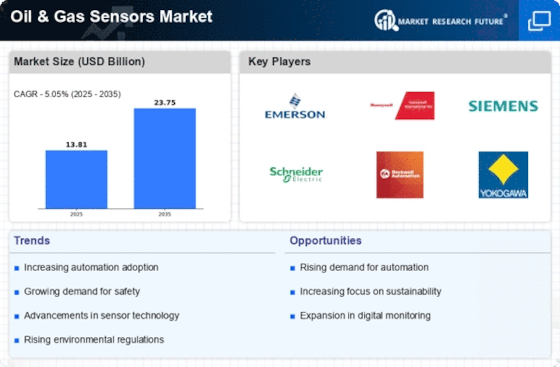
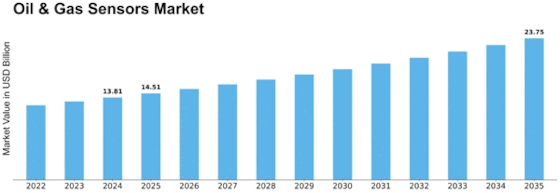
As per Market Research Future analysis, the Oil & Gas Sensors Market Size was estimated at 13.81 USD Billion in 2024. The Oil & Gas Sensors industry is projected to grow from 14.51 USD Billion in 2025 to 23.75 USD Billion by 2035, exhibiting a compound annual growth rate (CAGR) of 5.0% during the forecast period 2025 - 2035

Key Market Trends & Highlights

The Oil and Gas Sensors Market is experiencing robust growth driven by technological advancements and increasing regulatory demands.

  • The integration of IoT technology is transforming operational capabilities in the Oil and Gas Sensors Market. North America remains the largest market, while Asia-Pacific is emerging as the fastest-growing region for sensor applications. Pressure sensors dominate the market, whereas temperature sensors are witnessing the fastest growth due to evolving industry needs. Rising demand for safety and monitoring solutions, coupled with increasing environmental regulations, drives market expansion.

Market Size & Forecast

2024 Market Size 13.81 (USD Billion)
2035 Market Size 23.75 (USD Billion)
CAGR (2025 - 2035) 5.05%
Largest Regional Market Share in 2024 North America

Major Players

Emerson Electric Co. (US), Honeywell International Inc. (US), <a href="https://www.siemens.com/us/en/products/automation/process-instrumentation/oil-and-gas.html">Siemens </a>AG (DE), Schneider Electric SE (FR), Rockwell Automation, Inc. (US), Yokogawa Electric Corporation (JP), KROHNE Group (DE), Endress+Hauser AG (CH), General Electric Company (US)

Market Trends

The Oil & Gas Sensors Market is currently experiencing a transformative phase, driven by advancements in technology and increasing demand for safety and efficiency in operations. The integration of smart sensors and IoT technology is reshaping the landscape, enabling real-time monitoring and data analytics. This evolution not only enhances operational efficiency but also contributes to environmental sustainability by minimizing waste and emissions. As regulatory frameworks become more stringent, the need for reliable and accurate sensing solutions is paramount, prompting companies to invest in innovative sensor technologies. Moreover, the growing emphasis on predictive maintenance is influencing the Oil & Gas Sensors Market. Organizations are increasingly adopting sensors that facilitate early detection of potential failures, thereby reducing downtime and maintenance costs. This trend is further supported by the rising adoption of automation in the sector, which necessitates sophisticated sensing solutions to ensure seamless operations. As the market continues to evolve, stakeholders must remain vigilant to emerging technologies and shifting consumer preferences, which could significantly impact future growth trajectories.

Integration of IoT Technology

The incorporation of Internet of Things (IoT) technology into the Oil & Gas Sensors Market is becoming increasingly prevalent. This trend allows for enhanced connectivity and data sharing, enabling operators to monitor equipment and environmental conditions in real-time. Such advancements facilitate proactive decision-making and improve overall operational efficiency.

Focus on Predictive Maintenance

There is a growing focus on predictive maintenance within the Oil & Gas Sensors Market. Companies are investing in sensors that provide early warnings of equipment failures, which can lead to reduced downtime and lower maintenance costs. This proactive approach is becoming essential for maintaining competitiveness in the industry.

Emphasis on Environmental Compliance

The Oil & Gas Sensors Market is witnessing a heightened emphasis on environmental compliance. As regulations become more stringent, companies are increasingly seeking advanced sensing solutions to monitor emissions and ensure adherence to environmental standards. This trend reflects a broader commitment to sustainability and responsible resource management.

Oil Gas Sensors Market Market Drivers

Growing Focus on Operational Efficiency

The Oil & Gas Sensors Market is significantly influenced by the growing focus on operational efficiency. Companies are increasingly adopting sensor technologies to streamline processes, reduce costs, and enhance productivity. By utilizing advanced sensors, organizations can monitor equipment performance, detect anomalies, and implement predictive maintenance strategies. This proactive approach not only minimizes unplanned downtime but also extends the lifespan of critical assets. The market is projected to expand as organizations recognize the value of investing in sensor technologies to achieve operational excellence, with an expected growth rate of 5.5% over the next few years.

Expansion of Oil and Gas Exploration Activities

The Oil & Gas Sensors Market is witnessing growth due to the expansion of oil and gas exploration activities. As new reserves are discovered and extraction techniques evolve, there is an increasing need for advanced sensor technologies to monitor drilling operations and ensure safety. The rise in exploration activities, particularly in offshore and remote locations, necessitates the deployment of robust sensor systems capable of withstanding harsh conditions. This trend is expected to drive the market forward, with a projected growth rate of around 6.8% in the coming years, as companies seek to enhance their operational capabilities in challenging environments.

Rising Demand for Safety and Monitoring Solutions

The Oil & Gas Sensors Market is experiencing a notable increase in demand for safety and monitoring solutions. This trend is largely driven by the need to enhance operational safety and minimize risks associated with oil and gas extraction and processing. Regulatory bodies are imposing stricter safety standards, compelling companies to invest in advanced sensor technologies. The market for safety sensors is projected to grow at a compound annual growth rate of approximately 6.5% over the next five years. This growth is indicative of the industry's commitment to ensuring worker safety and environmental protection, thereby fostering a more sustainable operational framework.

Technological Advancements in Sensor Technologies

Technological advancements are playing a pivotal role in shaping the Oil & Gas Sensors Market. Innovations such as wireless sensor networks, smart sensors, and advanced data analytics are enhancing the efficiency and accuracy of monitoring systems. These technologies enable real-time data collection and analysis, which is crucial for optimizing operations and reducing downtime. The integration of artificial intelligence and machine learning into sensor systems is expected to further revolutionize the industry. As a result, the market is anticipated to witness a growth rate of around 7% annually, reflecting the increasing reliance on sophisticated sensor technologies for operational excellence.

Increasing Environmental Regulations and Compliance

The Oil & Gas Sensors Market is being shaped by the increasing environmental regulations and compliance requirements. Governments and regulatory agencies are enforcing stringent measures to mitigate the environmental impact of oil and gas operations. This has led to a heightened demand for sensors that can monitor emissions, leaks, and other environmental parameters. Companies are compelled to adopt advanced sensor technologies to ensure compliance with these regulations, thereby avoiding hefty fines and reputational damage. The market for environmental monitoring sensors is expected to grow at a rate of approximately 6% annually, reflecting the industry's commitment to sustainable practices.

Market Segment Insights

By Type: Pressure Sensors (Largest) vs. Temperature Sensors (Fastest-Growing)

The Oil &amp; Gas Sensors Market is characterized by a diverse range of sensor types, with pressure sensors leading the market. These sensors are vital for monitoring and controlling pressure levels in various operations, ensuring safety and efficiency. Temperature sensors also hold a significant share, playing a crucial role in process control. Together, these sensors underpin critical processes in the industry, but the rapid growth of temperature sensors indicates an evolving preference for real-time data and advanced monitoring techniques.

Pressure Sensors (Dominant) vs. Temperature Sensors (Emerging)

<a href="https://www.marketresearchfuture.com/reports/pressure-sensors-market-6096">Pressure sensors</a> are essential in the oil and gas industry, providing accurate readings essential for maintaining safety and operational efficiency. They are widely used in drilling and production processes, making them the dominant technology in this market. However, temperature sensors are emerging as an essential tool, driven by increased demand for enhanced monitoring and control solutions. Their ability to provide real-time temperature data enhances operational reliability, making them a key player in the industry's future, particularly in automated and high-tech applications.

By Application: Upstream (Largest) vs. Midstream (Fastest-Growing)

The Oil &amp; Gas Sensors Market exhibits significant segmentation across its applications, with the upstream segment holding the largest share. This segment encompasses exploration, drilling, and production processes, where efficient sensor technologies are critical for real-time monitoring and operational safety. In contrast, the midstream segment, which deals with the transportation and storage of oil and gas, is experiencing rapid growth due to the rising demand for infrastructure improvements and the increasing intricacy of logistics management. The growth trends in the Oil &amp; Gas Sensors Market are largely driven by the evolving technological landscape and the increasing investments in process automation and safety enhancements. The surge in global energy demands pushes companies to adopt advanced sensor solutions, particularly in the midstream segment, as it navigates regulatory requirements and efficiency standards. Furthermore, the integration of IoT and smart technologies is reshaping both upstream and midstream applications, fostering a more connected and responsive industry.

Application: Upstream (Dominant) vs. Midstream (Emerging)

The upstream application is dominant within the Oil &amp; Gas Sensors Market due to its foundational role in the exploration and production cycles. This segment deploys a wide range of sensors tailored for monitoring drilling parameters, reservoir analysis, and equipment health, which are essential for maximizing output and ensuring safety. As operators face heightened pressures to enhance efficiency, innovations in sensor technology are increasingly prioritized. Conversely, the emerging midstream application focuses on optimizing the transportation and storage facets of the oil and gas supply chain. Advanced sensor solutions in this arena facilitate real-time monitoring of pipeline integrity and flow measurements, thus enhancing operational transparency and reducing risks associated with leaks and environmental hazards.

By Technology: Wireless Sensors (Largest) vs. Smart Sensors (Fastest-Growing)

The Oil &amp; Gas Sensors Market shows a significant distribution in technology segments, with Wireless Sensors holding a commanding share due to their ability to transmit data over long distances without physical connections. This facilitates easier deployment and maintenance in challenging oil and gas environments. Wired Sensors experience a steady demand but are often limited by installation complexity and physical constraints, while Optical Sensors are carving out a niche with advanced monitoring capabilities, despite a smaller market share. Smart Sensors are gradually gaining traction, driven by the demand for integrated, intelligent solutions that enhance operational efficiency.

Technology: Wireless Sensors (Dominant) vs. Smart Sensors (Emerging)

Wireless Sensors stand out as the dominant technology in the Oil &amp; Gas Sensors Market, primarily because they offer unparalleled flexibility and reduced maintenance costs. These sensors are effective in remote monitoring and data acquisition, making them ideal for the industry’s vast and often inaccessible exploration sites. In contrast, Smart Sensors, while still emerging, represent a pivotal shift towards automation and data analytics. They integrate IoT capabilities, allowing for real-time data processing and decision-making. As the industry increasingly prioritizes digital transformation, Smart Sensors are projected to grow rapidly, offering predictive maintenance and enhancing safety protocols, creating new opportunities for optimization in operations.

By End Use: Onshore (Largest) vs. Offshore (Fastest-Growing)

In the Oil &amp; Gas Sensors Market, the onshore segment holds the largest share due to its extensive application in various land-based exploration and production activities. This segment benefits from a wide range of operational requirements, driving robust demand for various sensors essential for monitoring and control. The onshore segment's dominance can be attributed to the established infrastructure and the consistent need for efficient and reliable sensor technologies that enhance operational efficiency.

End Use: Onshore (Dominant) vs. Offshore (Emerging)

The onshore end use segment represents the backbone of the Oil &amp; Gas Sensors Market, characterized by stability and a strong market presence. This segment includes a variety of applications such as crude oil extraction and processing at land-based facilities, thus necessitating extensive sensor deployment for monitoring pressure, temperature, and flow. In contrast, the offshore segment, while currently smaller, is emerging rapidly due to increasing investments in offshore drilling and exploration activities. The demand for advanced sensors in harsh environments is critical for operational safety and efficiency. As technology improves, the offshore segment is expected to see growth driven by its adaptability and innovations in subsea sensor applications.

Get more detailed insights about Oil & Gas Sensors Market Research Report - Global Forecast till 2035

Regional Insights

The Oil & Gas Sensors Market revenue for 2023 stands at 13.15 billion USD, reflecting diverse growth potential across regions. North America dominates with a significant valuation of 5.0 billion USD in 2023, which is projected to rise to 8.0 billion USD by 2032, indicating its major role driven by robust oil exploration and production activities. Europe holds a considerable share, valued at 3.0 billion USD in 2023 and anticipated to grow to 4.5 billion USD, supported by stringent regulations on safety and efficiency.

The APAC region matches Europe with a valuation of 3.0 billion USD this year, showcasing potential driven by increasing energy demands and technological advancements, reaching 5.5 billion USD by 2032.

South America and the MEA regions are smaller, with valuations of 1.0 billion USD and 1.15 billion USD in 2023, rising to 1.7 billion USD and 1.3 billion USD, respectively. Their growth stems from emerging market opportunities in oil and gas exploration. The overall Oil & Gas Sensors Market data indicates strong regional dynamics, backed by advancements in sensor technology and increasing safety regulations across all regions, fueling market growth and offering opportunities for innovation in sensor applications.

Key Players and Competitive Insights

The Oil & Gas Sensors Market is characterized by a dynamic competitive landscape driven by the need for enhanced safety, efficiency, and sustainability in exploration, extraction, and refining processes. Key players in this market are continually innovating and improving their sensor technologies to meet the growing demands for real-time data, regulatory compliance, and operational reliability. With rising concerns over environmental impact and safety incidents, companies are focusing on developing advanced sensors that can monitor various parameters such as pressure, temperature, and gas composition in real-time.
Additionally, the integration of Internet of Things (IoT) technology is enhancing these sensor systems, enabling more sophisticated data analysis and predictive maintenance capabilities, thereby creating opportunities for competitive differentiation and market leadership.
General Electric has established a strong presence in the Oil & Gas Sensors Market through its extensive portfolio of sensor technologies aimed at optimizing operational performance and safety in the oil and gas sector. The company's strengths lie in its deep-rooted expertise in industrial applications, advanced analytics capabilities, and commitment to innovation. General Electric offers high-quality, reliable sensors that are integral to monitoring critical processes in oil and gas operations. Its integrated solutions leverage data intelligence, helping stakeholders make informed decisions and improve efficiency.
Furthermore, partnerships and collaborations in research and development have allowed General Electric to stay at the forefront of sensor technology advancements.
Teledyne Technologies is recognized for its significant contributions to the Oil & Gas Sensors Market, providing specialized sensors that cater to various applications within the industry. The company's strengths include a robust portfolio of high-performance sensing solutions that enhance safety and operational efficiency while tackling complex challenges faced by the oil and gas sector. Teledyne Technologies prides itself on its commitment to quality and precision, ensuring that its sensors meet rigorous industry standards. The company's focus on research and development enables it to introduce innovative products geared towards real-time monitoring and data collection, empowering operators to optimize their processes.
With a solid reputation and a wide range of offerings, Teledyne Technologies continues to be a key player in driving advancements in sensor technology for the oil and gas industry.

Key Companies in the Oil Gas Sensors Market include

Industry Developments

Recent developments in the Oil & Gas Sensors Market reflect significant technological advancements and strategic movements among key players. General Electric and Honeywell have been at the forefront, investing in the integration of IoT solutions to enhance sensor capabilities for monitoring oil and gas processes. Teledyne Technologies and Siemens are increasingly focusing on smart sensors, aiming to improve data accuracy and reduce operational costs.

Significant market activity has also been observed with a rise in acquisitions; however, specific recent mergers involving companies such as Rockwell Automation and ABB have reinforced their positions in the market, indicating a trend toward consolidation to leverage shared technologies and customer bases.

Additionally, Emerson Electric and Yokogawa Electric are exploring partnerships to expand their sensor offerings, driven by the need for compliance with regulatory standards and efficiency. As a result, growth in market valuation is being witnessed, influencing competitive dynamics and prompting other firms, like Bosch and national instruments, to innovate continuously and adapt to changing market demands. Overall, these developments highlight a robust market environment that is evolving rapidly to meet the increasing needs of the oil and gas sector.

Future Outlook

Oil Gas Sensors Market Future Outlook

The Oil &amp; Gas Sensors Market is projected to grow at a 5.05% CAGR from 2025 to 2035, driven by technological advancements, regulatory compliance, and increasing safety measures.

New opportunities lie in:

  • Integration of IoT-enabled sensors for real-time monitoring
  • Development of advanced leak detection systems
  • Expansion into emerging markets with tailored sensor solutions

By 2035, the market is expected to achieve robust growth, driven by innovation and strategic investments.

Market Segmentation

Oil Gas Sensors Market Type Outlook

  • Pressure Sensors
  • Temperature Sensors
  • Flow Sensors
  • Level Sensors
  • Chemical Sensors

Oil Gas Sensors Market End Use Outlook

  • Onshore
  • Offshore

Oil Gas Sensors Market Technology Outlook

  • Wireless Sensors
  • Wired Sensors
  • Smart Sensors
  • Optical Sensors

Oil Gas Sensors Market Application Outlook

  • Upstream
  • Midstream
  • Downstream

Report Scope

MARKET SIZE 2024 13.81(USD Billion)
MARKET SIZE 2025 14.51(USD Billion)
MARKET SIZE 2035 23.75(USD Billion)
COMPOUND ANNUAL GROWTH RATE (CAGR) 5.05% (2025 - 2035)
REPORT COVERAGE Revenue Forecast, Competitive Landscape, Growth Factors, and Trends
BASE YEAR 2024
Market Forecast Period 2025 - 2035
Historical Data 2019 - 2024
Market Forecast Units USD Billion
Key Companies Profiled Emerson Electric Co. (US), Honeywell International Inc. (US), Siemens AG (DE), Schneider Electric SE (FR), Rockwell Automation, Inc. (US), Yokogawa Electric Corporation (JP), KROHNE Group (DE), Endress+Hauser AG (CH), General Electric Company (US)
Segments Covered Type, Application, Technology, End Use, Regional
Key Market Opportunities Integration of advanced analytics and IoT in Oil & Gas Sensors Market enhances operational efficiency and safety.
Key Market Dynamics Technological advancements drive demand for enhanced Oil and Gas sensors, improving safety and operational efficiency.
Countries Covered North America, Europe, APAC, South America, MEA

FAQs

What is the projected market valuation of the Oil & Gas Sensors Market by 2035?

<p>The Oil & Gas Sensors Market is projected to reach a valuation of 23.75 USD Billion by 2035.</p>

What was the market valuation of the Oil & Gas Sensors Market in 2024?

<p>In 2024, the Oil & Gas Sensors Market was valued at 13.81 USD Billion.</p>

What is the expected CAGR for the Oil & Gas Sensors Market during the forecast period 2025 - 2035?

<p>The expected CAGR for the Oil & Gas Sensors Market during the forecast period 2025 - 2035 is 5.05%.</p>

Which segment of the Oil & Gas Sensors Market had the highest valuation in 2024?

<p>In 2024, the Flow Sensors segment had the highest valuation at 3.12 USD Billion.</p>

What are the key applications of Oil & Gas Sensors?

<p>The key applications of Oil & Gas Sensors include Upstream, Midstream, and Downstream, with Upstream valued at 5.52 USD Billion in 2024.</p>

Which technology segment is expected to grow the most in the Oil & Gas Sensors Market?

<p>The Smart Sensors technology segment is expected to grow significantly, with a valuation of 4.15 USD Billion in 2024.</p>

Who are the leading players in the Oil & Gas Sensors Market?

<p>Leading players in the Oil & Gas Sensors Market include Emerson Electric Co., Honeywell International Inc., and Siemens AG.</p>

What was the valuation of the Pressure Sensors segment in 2024?

<p>The Pressure Sensors segment was valued at 2.76 USD Billion in 2024.</p>

How does the Offshore end-use segment compare to Onshore in terms of market valuation?

<p>In 2024, the Offshore end-use segment was valued at 5.53 USD Billion, compared to 8.28 USD Billion for Onshore.</p>

What is the projected growth for the Chemical Sensors segment by 2035?

<p>The Chemical Sensors segment is projected to grow to 6.2 USD Billion by 2035.</p>

  1. SECTION I: EXECUTIVE SUMMARY AND KEY HIGHLIGHTS
    1. | 1.1 EXECUTIVE SUMMARY
    2. | | 1.1.1 Market Overview
    3. | | 1.1.2 Key Findings
    4. | | 1.1.3 Market Segmentation
    5. | | 1.1.4 Competitive Landscape
    6. | | 1.1.5 Challenges and Opportunities
    7. | | 1.1.6 Future Outlook
  2. SECTION II: SCOPING, METHODOLOGY AND MARKET STRUCTURE
    1. | 2.1 MARKET INTRODUCTION
    2. | | 2.1.1 Definition
    3. | | 2.1.2 Scope of the study
    4. | | | 2.1.2.1 Research Objective
    5. | | | 2.1.2.2 Assumption
    6. | | | 2.1.2.3 Limitations
    7. | 2.2 RESEARCH METHODOLOGY
    8. | | 2.2.1 Overview
    9. | | 2.2.2 Data Mining
    10. | | 2.2.3 Secondary Research
    11. | | 2.2.4 Primary Research
    12. | | | 2.2.4.1 Primary Interviews and Information Gathering Process
    13. | | | 2.2.4.2 Breakdown of Primary Respondents
    14. | | 2.2.5 Forecasting Model
    15. | | 2.2.6 Market Size Estimation
    16. | | | 2.2.6.1 Bottom-Up Approach
    17. | | | 2.2.6.2 Top-Down Approach
    18. | | 2.2.7 Data Triangulation
    19. | | 2.2.8 Validation
  3. SECTION III: QUALITATIVE ANALYSIS
    1. | 3.1 MARKET DYNAMICS
    2. | | 3.1.1 Overview
    3. | | 3.1.2 Drivers
    4. | | 3.1.3 Restraints
    5. | | 3.1.4 Opportunities
    6. | 3.2 MARKET FACTOR ANALYSIS
    7. | | 3.2.1 Value chain Analysis
    8. | | 3.2.2 Porter's Five Forces Analysis
    9. | | | 3.2.2.1 Bargaining Power of Suppliers
    10. | | | 3.2.2.2 Bargaining Power of Buyers
    11. | | | 3.2.2.3 Threat of New Entrants
    12. | | | 3.2.2.4 Threat of Substitutes
    13. | | | 3.2.2.5 Intensity of Rivalry
    14. | | 3.2.3 COVID-19 Impact Analysis
    15. | | | 3.2.3.1 Market Impact Analysis
    16. | | | 3.2.3.2 Regional Impact
    17. | | | 3.2.3.3 Opportunity and Threat Analysis
  4. SECTION IV: QUANTITATIVE ANALYSIS
    1. | 4.1 Energy & Power, BY Type (USD Billion)
    2. | | 4.1.1 Pressure Sensors
    3. | | 4.1.2 Temperature Sensors
    4. | | 4.1.3 Flow Sensors
    5. | | 4.1.4 Level Sensors
    6. | | 4.1.5 Chemical Sensors
    7. | 4.2 Energy & Power, BY Application (USD Billion)
    8. | | 4.2.1 Upstream
    9. | | 4.2.2 Midstream
    10. | | 4.2.3 Downstream
    11. | 4.3 Energy & Power, BY Technology (USD Billion)
    12. | | 4.3.1 Wireless Sensors
    13. | | 4.3.2 Wired Sensors
    14. | | 4.3.3 Smart Sensors
    15. | | 4.3.4 Optical Sensors
    16. | 4.4 Energy & Power, BY End Use (USD Billion)
    17. | | 4.4.1 Onshore
    18. | | 4.4.2 Offshore
    19. | 4.5 Energy & Power, BY Region (USD Billion)
    20. | | 4.5.1 North America
    21. | | | 4.5.1.1 US
    22. | | | 4.5.1.2 Canada
    23. | | 4.5.2 Europe
    24. | | | 4.5.2.1 Germany
    25. | | | 4.5.2.2 UK
    26. | | | 4.5.2.3 France
    27. | | | 4.5.2.4 Russia
    28. | | | 4.5.2.5 Italy
    29. | | | 4.5.2.6 Spain
    30. | | | 4.5.2.7 Rest of Europe
    31. | | 4.5.3 APAC
    32. | | | 4.5.3.1 China
    33. | | | 4.5.3.2 India
    34. | | | 4.5.3.3 Japan
    35. | | | 4.5.3.4 South Korea
    36. | | | 4.5.3.5 Malaysia
    37. | | | 4.5.3.6 Thailand
    38. | | | 4.5.3.7 Indonesia
    39. | | | 4.5.3.8 Rest of APAC
    40. | | 4.5.4 South America
    41. | | | 4.5.4.1 Brazil
    42. | | | 4.5.4.2 Mexico
    43. | | | 4.5.4.3 Argentina
    44. | | | 4.5.4.4 Rest of South America
    45. | | 4.5.5 MEA
    46. | | | 4.5.5.1 GCC Countries
    47. | | | 4.5.5.2 South Africa
    48. | | | 4.5.5.3 Rest of MEA
  5. SECTION V: COMPETITIVE ANALYSIS
    1. | 5.1 Competitive Landscape
    2. | | 5.1.1 Overview
    3. | | 5.1.2 Competitive Analysis
    4. | | 5.1.3 Market share Analysis
    5. | | 5.1.4 Major Growth Strategy in the Energy & Power
    6. | | 5.1.5 Competitive Benchmarking
    7. | | 5.1.6 Leading Players in Terms of Number of Developments in the Energy & Power
    8. | | 5.1.7 Key developments and growth strategies
    9. | | | 5.1.7.1 New Product Launch/Service Deployment
    10. | | | 5.1.7.2 Merger & Acquisitions
    11. | | | 5.1.7.3 Joint Ventures
    12. | | 5.1.8 Major Players Financial Matrix
    13. | | | 5.1.8.1 Sales and Operating Income
    14. | | | 5.1.8.2 Major Players R&D Expenditure. 2023
    15. | 5.2 Company Profiles
    16. | | 5.2.1 Emerson Electric Co. (US)
    17. | | | 5.2.1.1 Financial Overview
    18. | | | 5.2.1.2 Products Offered
    19. | | | 5.2.1.3 Key Developments
    20. | | | 5.2.1.4 SWOT Analysis
    21. | | | 5.2.1.5 Key Strategies
    22. | | 5.2.2 Honeywell International Inc. (US)
    23. | | | 5.2.2.1 Financial Overview
    24. | | | 5.2.2.2 Products Offered
    25. | | | 5.2.2.3 Key Developments
    26. | | | 5.2.2.4 SWOT Analysis
    27. | | | 5.2.2.5 Key Strategies
    28. | | 5.2.3 Siemens AG (DE)
    29. | | | 5.2.3.1 Financial Overview
    30. | | | 5.2.3.2 Products Offered
    31. | | | 5.2.3.3 Key Developments
    32. | | | 5.2.3.4 SWOT Analysis
    33. | | | 5.2.3.5 Key Strategies
    34. | | 5.2.4 Schneider Electric SE (FR)
    35. | | | 5.2.4.1 Financial Overview
    36. | | | 5.2.4.2 Products Offered
    37. | | | 5.2.4.3 Key Developments
    38. | | | 5.2.4.4 SWOT Analysis
    39. | | | 5.2.4.5 Key Strategies
    40. | | 5.2.5 Rockwell Automation, Inc. (US)
    41. | | | 5.2.5.1 Financial Overview
    42. | | | 5.2.5.2 Products Offered
    43. | | | 5.2.5.3 Key Developments
    44. | | | 5.2.5.4 SWOT Analysis
    45. | | | 5.2.5.5 Key Strategies
    46. | | 5.2.6 Yokogawa Electric Corporation (JP)
    47. | | | 5.2.6.1 Financial Overview
    48. | | | 5.2.6.2 Products Offered
    49. | | | 5.2.6.3 Key Developments
    50. | | | 5.2.6.4 SWOT Analysis
    51. | | | 5.2.6.5 Key Strategies
    52. | | 5.2.7 KROHNE Group (DE)
    53. | | | 5.2.7.1 Financial Overview
    54. | | | 5.2.7.2 Products Offered
    55. | | | 5.2.7.3 Key Developments
    56. | | | 5.2.7.4 SWOT Analysis
    57. | | | 5.2.7.5 Key Strategies
    58. | | 5.2.8 Endress+Hauser AG (CH)
    59. | | | 5.2.8.1 Financial Overview
    60. | | | 5.2.8.2 Products Offered
    61. | | | 5.2.8.3 Key Developments
    62. | | | 5.2.8.4 SWOT Analysis
    63. | | | 5.2.8.5 Key Strategies
    64. | | 5.2.9 General Electric Company (US)
    65. | | | 5.2.9.1 Financial Overview
    66. | | | 5.2.9.2 Products Offered
    67. | | | 5.2.9.3 Key Developments
    68. | | | 5.2.9.4 SWOT Analysis
    69. | | | 5.2.9.5 Key Strategies
    70. | 5.3 Appendix
    71. | | 5.3.1 References
    72. | | 5.3.2 Related Reports
  6. LIST OF FIGURES
    1. | 6.1 MARKET SYNOPSIS
    2. | 6.2 NORTH AMERICA MARKET ANALYSIS
    3. | 6.3 US MARKET ANALYSIS BY TYPE
    4. | 6.4 US MARKET ANALYSIS BY APPLICATION
    5. | 6.5 US MARKET ANALYSIS BY TECHNOLOGY
    6. | 6.6 US MARKET ANALYSIS BY END USE
    7. | 6.7 CANADA MARKET ANALYSIS BY TYPE
    8. | 6.8 CANADA MARKET ANALYSIS BY APPLICATION
    9. | 6.9 CANADA MARKET ANALYSIS BY TECHNOLOGY
    10. | 6.10 CANADA MARKET ANALYSIS BY END USE
    11. | 6.11 EUROPE MARKET ANALYSIS
    12. | 6.12 GERMANY MARKET ANALYSIS BY TYPE
    13. | 6.13 GERMANY MARKET ANALYSIS BY APPLICATION
    14. | 6.14 GERMANY MARKET ANALYSIS BY TECHNOLOGY
    15. | 6.15 GERMANY MARKET ANALYSIS BY END USE
    16. | 6.16 UK MARKET ANALYSIS BY TYPE
    17. | 6.17 UK MARKET ANALYSIS BY APPLICATION
    18. | 6.18 UK MARKET ANALYSIS BY TECHNOLOGY
    19. | 6.19 UK MARKET ANALYSIS BY END USE
    20. | 6.20 FRANCE MARKET ANALYSIS BY TYPE
    21. | 6.21 FRANCE MARKET ANALYSIS BY APPLICATION
    22. | 6.22 FRANCE MARKET ANALYSIS BY TECHNOLOGY
    23. | 6.23 FRANCE MARKET ANALYSIS BY END USE
    24. | 6.24 RUSSIA MARKET ANALYSIS BY TYPE
    25. | 6.25 RUSSIA MARKET ANALYSIS BY APPLICATION
    26. | 6.26 RUSSIA MARKET ANALYSIS BY TECHNOLOGY
    27. | 6.27 RUSSIA MARKET ANALYSIS BY END USE
    28. | 6.28 ITALY MARKET ANALYSIS BY TYPE
    29. | 6.29 ITALY MARKET ANALYSIS BY APPLICATION
    30. | 6.30 ITALY MARKET ANALYSIS BY TECHNOLOGY
    31. | 6.31 ITALY MARKET ANALYSIS BY END USE
    32. | 6.32 SPAIN MARKET ANALYSIS BY TYPE
    33. | 6.33 SPAIN MARKET ANALYSIS BY APPLICATION
    34. | 6.34 SPAIN MARKET ANALYSIS BY TECHNOLOGY
    35. | 6.35 SPAIN MARKET ANALYSIS BY END USE
    36. | 6.36 REST OF EUROPE MARKET ANALYSIS BY TYPE
    37. | 6.37 REST OF EUROPE MARKET ANALYSIS BY APPLICATION
    38. | 6.38 REST OF EUROPE MARKET ANALYSIS BY TECHNOLOGY
    39. | 6.39 REST OF EUROPE MARKET ANALYSIS BY END USE
    40. | 6.40 APAC MARKET ANALYSIS
    41. | 6.41 CHINA MARKET ANALYSIS BY TYPE
    42. | 6.42 CHINA MARKET ANALYSIS BY APPLICATION
    43. | 6.43 CHINA MARKET ANALYSIS BY TECHNOLOGY
    44. | 6.44 CHINA MARKET ANALYSIS BY END USE
    45. | 6.45 INDIA MARKET ANALYSIS BY TYPE
    46. | 6.46 INDIA MARKET ANALYSIS BY APPLICATION
    47. | 6.47 INDIA MARKET ANALYSIS BY TECHNOLOGY
    48. | 6.48 INDIA MARKET ANALYSIS BY END USE
    49. | 6.49 JAPAN MARKET ANALYSIS BY TYPE
    50. | 6.50 JAPAN MARKET ANALYSIS BY APPLICATION
    51. | 6.51 JAPAN MARKET ANALYSIS BY TECHNOLOGY
    52. | 6.52 JAPAN MARKET ANALYSIS BY END USE
    53. | 6.53 SOUTH KOREA MARKET ANALYSIS BY TYPE
    54. | 6.54 SOUTH KOREA MARKET ANALYSIS BY APPLICATION
    55. | 6.55 SOUTH KOREA MARKET ANALYSIS BY TECHNOLOGY
    56. | 6.56 SOUTH KOREA MARKET ANALYSIS BY END USE
    57. | 6.57 MALAYSIA MARKET ANALYSIS BY TYPE
    58. | 6.58 MALAYSIA MARKET ANALYSIS BY APPLICATION
    59. | 6.59 MALAYSIA MARKET ANALYSIS BY TECHNOLOGY
    60. | 6.60 MALAYSIA MARKET ANALYSIS BY END USE
    61. | 6.61 THAILAND MARKET ANALYSIS BY TYPE
    62. | 6.62 THAILAND MARKET ANALYSIS BY APPLICATION
    63. | 6.63 THAILAND MARKET ANALYSIS BY TECHNOLOGY
    64. | 6.64 THAILAND MARKET ANALYSIS BY END USE
    65. | 6.65 INDONESIA MARKET ANALYSIS BY TYPE
    66. | 6.66 INDONESIA MARKET ANALYSIS BY APPLICATION
    67. | 6.67 INDONESIA MARKET ANALYSIS BY TECHNOLOGY
    68. | 6.68 INDONESIA MARKET ANALYSIS BY END USE
    69. | 6.69 REST OF APAC MARKET ANALYSIS BY TYPE
    70. | 6.70 REST OF APAC MARKET ANALYSIS BY APPLICATION
    71. | 6.71 REST OF APAC MARKET ANALYSIS BY TECHNOLOGY
    72. | 6.72 REST OF APAC MARKET ANALYSIS BY END USE
    73. | 6.73 SOUTH AMERICA MARKET ANALYSIS
    74. | 6.74 BRAZIL MARKET ANALYSIS BY TYPE
    75. | 6.75 BRAZIL MARKET ANALYSIS BY APPLICATION
    76. | 6.76 BRAZIL MARKET ANALYSIS BY TECHNOLOGY
    77. | 6.77 BRAZIL MARKET ANALYSIS BY END USE
    78. | 6.78 MEXICO MARKET ANALYSIS BY TYPE
    79. | 6.79 MEXICO MARKET ANALYSIS BY APPLICATION
    80. | 6.80 MEXICO MARKET ANALYSIS BY TECHNOLOGY
    81. | 6.81 MEXICO MARKET ANALYSIS BY END USE
    82. | 6.82 ARGENTINA MARKET ANALYSIS BY TYPE
    83. | 6.83 ARGENTINA MARKET ANALYSIS BY APPLICATION
    84. | 6.84 ARGENTINA MARKET ANALYSIS BY TECHNOLOGY
    85. | 6.85 ARGENTINA MARKET ANALYSIS BY END USE
    86. | 6.86 REST OF SOUTH AMERICA MARKET ANALYSIS BY TYPE
    87. | 6.87 REST OF SOUTH AMERICA MARKET ANALYSIS BY APPLICATION
    88. | 6.88 REST OF SOUTH AMERICA MARKET ANALYSIS BY TECHNOLOGY
    89. | 6.89 REST OF SOUTH AMERICA MARKET ANALYSIS BY END USE
    90. | 6.90 MEA MARKET ANALYSIS
    91. | 6.91 GCC COUNTRIES MARKET ANALYSIS BY TYPE
    92. | 6.92 GCC COUNTRIES MARKET ANALYSIS BY APPLICATION
    93. | 6.93 GCC COUNTRIES MARKET ANALYSIS BY TECHNOLOGY
    94. | 6.94 GCC COUNTRIES MARKET ANALYSIS BY END USE
    95. | 6.95 SOUTH AFRICA MARKET ANALYSIS BY TYPE
    96. | 6.96 SOUTH AFRICA MARKET ANALYSIS BY APPLICATION
    97. | 6.97 SOUTH AFRICA MARKET ANALYSIS BY TECHNOLOGY
    98. | 6.98 SOUTH AFRICA MARKET ANALYSIS BY END USE
    99. | 6.99 REST OF MEA MARKET ANALYSIS BY TYPE
    100. | 6.100 REST OF MEA MARKET ANALYSIS BY APPLICATION
    101. | 6.101 REST OF MEA MARKET ANALYSIS BY TECHNOLOGY
    102. | 6.102 REST OF MEA MARKET ANALYSIS BY END USE
    103. | 6.103 KEY BUYING CRITERIA OF ENERGY & POWER
    104. | 6.104 RESEARCH PROCESS OF MRFR
    105. | 6.105 DRO ANALYSIS OF ENERGY & POWER
    106. | 6.106 DRIVERS IMPACT ANALYSIS: ENERGY & POWER
    107. | 6.107 RESTRAINTS IMPACT ANALYSIS: ENERGY & POWER
    108. | 6.108 SUPPLY / VALUE CHAIN: ENERGY & POWER
    109. | 6.109 ENERGY & POWER, BY TYPE, 2024 (% SHARE)
    110. | 6.110 ENERGY & POWER, BY TYPE, 2024 TO 2035 (USD Billion)
    111. | 6.111 ENERGY & POWER, BY APPLICATION, 2024 (% SHARE)
    112. | 6.112 ENERGY & POWER, BY APPLICATION, 2024 TO 2035 (USD Billion)
    113. | 6.113 ENERGY & POWER, BY TECHNOLOGY, 2024 (% SHARE)
    114. | 6.114 ENERGY & POWER, BY TECHNOLOGY, 2024 TO 2035 (USD Billion)
    115. | 6.115 ENERGY & POWER, BY END USE, 2024 (% SHARE)
    116. | 6.116 ENERGY & POWER, BY END USE, 2024 TO 2035 (USD Billion)
    117. | 6.117 BENCHMARKING OF MAJOR COMPETITORS
  7. LIST OF TABLES
    1. | 7.1 LIST OF ASSUMPTIONS
    2. | | 7.1.1
    3. | 7.2 North America MARKET SIZE ESTIMATES; FORECAST
    4. | | 7.2.1 BY TYPE, 2025-2035 (USD Billion)
    5. | | 7.2.2 BY APPLICATION, 2025-2035 (USD Billion)
    6. | | 7.2.3 BY TECHNOLOGY, 2025-2035 (USD Billion)
    7. | | 7.2.4 BY END USE, 2025-2035 (USD Billion)
    8. | 7.3 US MARKET SIZE ESTIMATES; FORECAST
    9. | | 7.3.1 BY TYPE, 2025-2035 (USD Billion)
    10. | | 7.3.2 BY APPLICATION, 2025-2035 (USD Billion)
    11. | | 7.3.3 BY TECHNOLOGY, 2025-2035 (USD Billion)
    12. | | 7.3.4 BY END USE, 2025-2035 (USD Billion)
    13. | 7.4 Canada MARKET SIZE ESTIMATES; FORECAST
    14. | | 7.4.1 BY TYPE, 2025-2035 (USD Billion)
    15. | | 7.4.2 BY APPLICATION, 2025-2035 (USD Billion)
    16. | | 7.4.3 BY TECHNOLOGY, 2025-2035 (USD Billion)
    17. | | 7.4.4 BY END USE, 2025-2035 (USD Billion)
    18. | 7.5 Europe MARKET SIZE ESTIMATES; FORECAST
    19. | | 7.5.1 BY TYPE, 2025-2035 (USD Billion)
    20. | | 7.5.2 BY APPLICATION, 2025-2035 (USD Billion)
    21. | | 7.5.3 BY TECHNOLOGY, 2025-2035 (USD Billion)
    22. | | 7.5.4 BY END USE, 2025-2035 (USD Billion)
    23. | 7.6 Germany MARKET SIZE ESTIMATES; FORECAST
    24. | | 7.6.1 BY TYPE, 2025-2035 (USD Billion)
    25. | | 7.6.2 BY APPLICATION, 2025-2035 (USD Billion)
    26. | | 7.6.3 BY TECHNOLOGY, 2025-2035 (USD Billion)
    27. | | 7.6.4 BY END USE, 2025-2035 (USD Billion)
    28. | 7.7 UK MARKET SIZE ESTIMATES; FORECAST
    29. | | 7.7.1 BY TYPE, 2025-2035 (USD Billion)
    30. | | 7.7.2 BY APPLICATION, 2025-2035 (USD Billion)
    31. | | 7.7.3 BY TECHNOLOGY, 2025-2035 (USD Billion)
    32. | | 7.7.4 BY END USE, 2025-2035 (USD Billion)
    33. | 7.8 France MARKET SIZE ESTIMATES; FORECAST
    34. | | 7.8.1 BY TYPE, 2025-2035 (USD Billion)
    35. | | 7.8.2 BY APPLICATION, 2025-2035 (USD Billion)
    36. | | 7.8.3 BY TECHNOLOGY, 2025-2035 (USD Billion)
    37. | | 7.8.4 BY END USE, 2025-2035 (USD Billion)
    38. | 7.9 Russia MARKET SIZE ESTIMATES; FORECAST
    39. | | 7.9.1 BY TYPE, 2025-2035 (USD Billion)
    40. | | 7.9.2 BY APPLICATION, 2025-2035 (USD Billion)
    41. | | 7.9.3 BY TECHNOLOGY, 2025-2035 (USD Billion)
    42. | | 7.9.4 BY END USE, 2025-2035 (USD Billion)
    43. | 7.10 Italy MARKET SIZE ESTIMATES; FORECAST
    44. | | 7.10.1 BY TYPE, 2025-2035 (USD Billion)
    45. | | 7.10.2 BY APPLICATION, 2025-2035 (USD Billion)
    46. | | 7.10.3 BY TECHNOLOGY, 2025-2035 (USD Billion)
    47. | | 7.10.4 BY END USE, 2025-2035 (USD Billion)
    48. | 7.11 Spain MARKET SIZE ESTIMATES; FORECAST
    49. | | 7.11.1 BY TYPE, 2025-2035 (USD Billion)
    50. | | 7.11.2 BY APPLICATION, 2025-2035 (USD Billion)
    51. | | 7.11.3 BY TECHNOLOGY, 2025-2035 (USD Billion)
    52. | | 7.11.4 BY END USE, 2025-2035 (USD Billion)
    53. | 7.12 Rest of Europe MARKET SIZE ESTIMATES; FORECAST
    54. | | 7.12.1 BY TYPE, 2025-2035 (USD Billion)
    55. | | 7.12.2 BY APPLICATION, 2025-2035 (USD Billion)
    56. | | 7.12.3 BY TECHNOLOGY, 2025-2035 (USD Billion)
    57. | | 7.12.4 BY END USE, 2025-2035 (USD Billion)
    58. | 7.13 APAC MARKET SIZE ESTIMATES; FORECAST
    59. | | 7.13.1 BY TYPE, 2025-2035 (USD Billion)
    60. | | 7.13.2 BY APPLICATION, 2025-2035 (USD Billion)
    61. | | 7.13.3 BY TECHNOLOGY, 2025-2035 (USD Billion)
    62. | | 7.13.4 BY END USE, 2025-2035 (USD Billion)
    63. | 7.14 China MARKET SIZE ESTIMATES; FORECAST
    64. | | 7.14.1 BY TYPE, 2025-2035 (USD Billion)
    65. | | 7.14.2 BY APPLICATION, 2025-2035 (USD Billion)
    66. | | 7.14.3 BY TECHNOLOGY, 2025-2035 (USD Billion)
    67. | | 7.14.4 BY END USE, 2025-2035 (USD Billion)
    68. | 7.15 India MARKET SIZE ESTIMATES; FORECAST
    69. | | 7.15.1 BY TYPE, 2025-2035 (USD Billion)
    70. | | 7.15.2 BY APPLICATION, 2025-2035 (USD Billion)
    71. | | 7.15.3 BY TECHNOLOGY, 2025-2035 (USD Billion)
    72. | | 7.15.4 BY END USE, 2025-2035 (USD Billion)
    73. | 7.16 Japan MARKET SIZE ESTIMATES; FORECAST
    74. | | 7.16.1 BY TYPE, 2025-2035 (USD Billion)
    75. | | 7.16.2 BY APPLICATION, 2025-2035 (USD Billion)
    76. | | 7.16.3 BY TECHNOLOGY, 2025-2035 (USD Billion)
    77. | | 7.16.4 BY END USE, 2025-2035 (USD Billion)
    78. | 7.17 South Korea MARKET SIZE ESTIMATES; FORECAST
    79. | | 7.17.1 BY TYPE, 2025-2035 (USD Billion)
    80. | | 7.17.2 BY APPLICATION, 2025-2035 (USD Billion)
    81. | | 7.17.3 BY TECHNOLOGY, 2025-2035 (USD Billion)
    82. | | 7.17.4 BY END USE, 2025-2035 (USD Billion)
    83. | 7.18 Malaysia MARKET SIZE ESTIMATES; FORECAST
    84. | | 7.18.1 BY TYPE, 2025-2035 (USD Billion)
    85. | | 7.18.2 BY APPLICATION, 2025-2035 (USD Billion)
    86. | | 7.18.3 BY TECHNOLOGY, 2025-2035 (USD Billion)
    87. | | 7.18.4 BY END USE, 2025-2035 (USD Billion)
    88. | 7.19 Thailand MARKET SIZE ESTIMATES; FORECAST
    89. | | 7.19.1 BY TYPE, 2025-2035 (USD Billion)
    90. | | 7.19.2 BY APPLICATION, 2025-2035 (USD Billion)
    91. | | 7.19.3 BY TECHNOLOGY, 2025-2035 (USD Billion)
    92. | | 7.19.4 BY END USE, 2025-2035 (USD Billion)
    93. | 7.20 Indonesia MARKET SIZE ESTIMATES; FORECAST
    94. | | 7.20.1 BY TYPE, 2025-2035 (USD Billion)
    95. | | 7.20.2 BY APPLICATION, 2025-2035 (USD Billion)
    96. | | 7.20.3 BY TECHNOLOGY, 2025-2035 (USD Billion)
    97. | | 7.20.4 BY END USE, 2025-2035 (USD Billion)
    98. | 7.21 Rest of APAC MARKET SIZE ESTIMATES; FORECAST
    99. | | 7.21.1 BY TYPE, 2025-2035 (USD Billion)
    100. | | 7.21.2 BY APPLICATION, 2025-2035 (USD Billion)
    101. | | 7.21.3 BY TECHNOLOGY, 2025-2035 (USD Billion)
    102. | | 7.21.4 BY END USE, 2025-2035 (USD Billion)
    103. | 7.22 South America MARKET SIZE ESTIMATES; FORECAST
    104. | | 7.22.1 BY TYPE, 2025-2035 (USD Billion)
    105. | | 7.22.2 BY APPLICATION, 2025-2035 (USD Billion)
    106. | | 7.22.3 BY TECHNOLOGY, 2025-2035 (USD Billion)
    107. | | 7.22.4 BY END USE, 2025-2035 (USD Billion)
    108. | 7.23 Brazil MARKET SIZE ESTIMATES; FORECAST
    109. | | 7.23.1 BY TYPE, 2025-2035 (USD Billion)
    110. | | 7.23.2 BY APPLICATION, 2025-2035 (USD Billion)
    111. | | 7.23.3 BY TECHNOLOGY, 2025-2035 (USD Billion)
    112. | | 7.23.4 BY END USE, 2025-2035 (USD Billion)
    113. | 7.24 Mexico MARKET SIZE ESTIMATES; FORECAST
    114. | | 7.24.1 BY TYPE, 2025-2035 (USD Billion)
    115. | | 7.24.2 BY APPLICATION, 2025-2035 (USD Billion)
    116. | | 7.24.3 BY TECHNOLOGY, 2025-2035 (USD Billion)
    117. | | 7.24.4 BY END USE, 2025-2035 (USD Billion)
    118. | 7.25 Argentina MARKET SIZE ESTIMATES; FORECAST
    119. | | 7.25.1 BY TYPE, 2025-2035 (USD Billion)
    120. | | 7.25.2 BY APPLICATION, 2025-2035 (USD Billion)
    121. | | 7.25.3 BY TECHNOLOGY, 2025-2035 (USD Billion)
    122. | | 7.25.4 BY END USE, 2025-2035 (USD Billion)
    123. | 7.26 Rest of South America MARKET SIZE ESTIMATES; FORECAST
    124. | | 7.26.1 BY TYPE, 2025-2035 (USD Billion)
    125. | | 7.26.2 BY APPLICATION, 2025-2035 (USD Billion)
    126. | | 7.26.3 BY TECHNOLOGY, 2025-2035 (USD Billion)
    127. | | 7.26.4 BY END USE, 2025-2035 (USD Billion)
    128. | 7.27 MEA MARKET SIZE ESTIMATES; FORECAST
    129. | | 7.27.1 BY TYPE, 2025-2035 (USD Billion)
    130. | | 7.27.2 BY APPLICATION, 2025-2035 (USD Billion)
    131. | | 7.27.3 BY TECHNOLOGY, 2025-2035 (USD Billion)
    132. | | 7.27.4 BY END USE, 2025-2035 (USD Billion)
    133. | 7.28 GCC Countries MARKET SIZE ESTIMATES; FORECAST
    134. | | 7.28.1 BY TYPE, 2025-2035 (USD Billion)
    135. | | 7.28.2 BY APPLICATION, 2025-2035 (USD Billion)
    136. | | 7.28.3 BY TECHNOLOGY, 2025-2035 (USD Billion)
    137. | | 7.28.4 BY END USE, 2025-2035 (USD Billion)
    138. | 7.29 South Africa MARKET SIZE ESTIMATES; FORECAST
    139. | | 7.29.1 BY TYPE, 2025-2035 (USD Billion)
    140. | | 7.29.2 BY APPLICATION, 2025-2035 (USD Billion)
    141. | | 7.29.3 BY TECHNOLOGY, 2025-2035 (USD Billion)
    142. | | 7.29.4 BY END USE, 2025-2035 (USD Billion)
    143. | 7.30 Rest of MEA MARKET SIZE ESTIMATES; FORECAST
    144. | | 7.30.1 BY TYPE, 2025-2035 (USD Billion)
    145. | | 7.30.2 BY APPLICATION, 2025-2035 (USD Billion)
    146. | | 7.30.3 BY TECHNOLOGY, 2025-2035 (USD Billion)
    147. | | 7.30.4 BY END USE, 2025-2035 (USD Billion)
    148. | 7.31 PRODUCT LAUNCH/PRODUCT DEVELOPMENT/APPROVAL
    149. | | 7.31.1
    150. | 7.32 ACQUISITION/PARTNERSHIP
    151. | | 7.32.1

Energy & Power Market Segmentation

Energy & Power By Type (USD Billion, 2025-2035)

  • Pressure Sensors
  • Temperature Sensors
  • Flow Sensors
  • Level Sensors
  • Chemical Sensors

Energy & Power By Application (USD Billion, 2025-2035)

  • Upstream
  • Midstream
  • Downstream

Energy & Power By Technology (USD Billion, 2025-2035)

  • Wireless Sensors
  • Wired Sensors
  • Smart Sensors
  • Optical Sensors

Energy & Power By End Use (USD Billion, 2025-2035)

  • Onshore
  • Offshore
Infographic

Free Sample Request

Kindly complete the form below to receive a free sample of this Report

Get Free Sample

Customer Strories

Compare Licence

×
Features License Type
Single User Multiuser License Enterprise User
Price $4,950 $5,950 $7,250
Maximum User Access Limit 1 User Upto 10 Users Unrestricted Access Throughout the Organization
Free Customization
Direct Access to Analyst
Deliverable Format
Platform Access
Discount on Next Purchase 10% 15% 15%
Printable Versions