Request Free Sample ×

Kindly complete the form below to receive a free sample of this Report

* Please use a valid business email

Leading companies partner with us for data-driven Insights

clients tt-cursor
Hero Background
English
Chinese
French
Japanese
Korean
German
Spanish

OEM Patient Monitoring Vital Sign OEM Module Market Share

ID: MRFR/MED/9952-CR
128 Pages
Rahul Gotadki
March 2023

OEM Patient Monitoring and Vital Sign OEM Module Market Research Report Information by Product Type (Hemodynamic Monitoring Devices [Blood Glucose, Cholesterol, Blood Gas & Electrolyte Analyzers/Monitors, Blood Pressure], Neuromonitoring Devices [Electroencephalograph (EEG) Devices, Magnetoencephalograph (MEG) Devices, Intracranial Pressure Monitors (ICP), Transcranial Dopplers (TCD), Cerebral Oximeters, and Near-infrared spectroscopy (NIRS)], Cardiac Monitoring Devices [Electrocardiogram (ECG) Devices, Implantable Loop Recorders (ILR), Cardiac Output Monitoring (COM) Devices, and Event Monitors], Fetal & Neonatal Monitoring Devices [Ultrasound, Electronic Fetal Monitoring Devices, Fetal Doppler Monitoring Devices, and Other Fetal & Neonatal Monitoring Devices], Respiratory Monitoring Devices [Device Type {Capnographs, Anesthesia Monitors, Spirometers, Pulse Oximeters, and Sleep Apnea Monitoring Devices} and Disease Indication {COPD, Sleep Apnea, Asthma, and Others}], Remote Patient Monitoring Devices, Temperature Monitoring Devices and Others), and By Region (North America, Europe, Asia-Pacific, and Rest of the World) - Forecast till 2035

Share:
Download PDF ×

We do not share your information with anyone. However, we may send you emails based on your report interest from time to time. You may contact us at any time to opt-out.

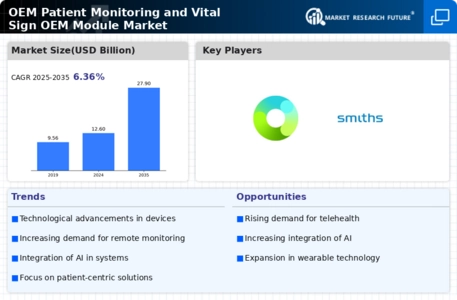
OEM Patient Monitoring Vital Sign OEM Module Market Infographic
Purchase Options

Market Share

OEM Patient Monitoring Vital Sign OEM Module Market Share Analysis

Effective organizations center around continuous advancement in innovation and module improvement. Putting resources into state-of-the-art sensors, availability arrangements, and information handling capacities guarantees that OEM modules stay on the ball, fulfilling the rising need for cutting edge patient monitoring. Perceiving the assorted necessities of healthcare suppliers, organizations stress customization. Offering modules that can be tailored to various healthcare settings, like clinics, facilities, or mobile consideration, improves market positioning by furnishing arrangements that line up with specific end-clients' prerequisites. Consistent joining with Electronic Health Records (EHR) frameworks is an urgent technique. Organizations guarantee their OEM modules can easily move vital sign information to electronic records, advancing interoperability and working with healthcare experts' admittance to complete patient data. Creating competitive valuing models is fundamental. Organizations endeavor to offer smart OEM modules without settling for less on quality, guaranteeing rationality for healthcare foundations while maintaining a good net revenue. Due to the developing pattern of telemedicine and distant patient monitoring, organizations center around integrating powerful remote monitoring capacities into their OEM modules. Empowering healthcare suppliers to remotely follow vital signs adds to expanded reception in current healthcare rehearses. Offering complete after-deals backing and maintenance administrations is an essential objective. Organizations that offer convenient specialized help, standard updates, and productive maintenance administrations upgrade consumer loyalty and empower long haul associations with healthcare OEMs. Perceiving the quick speed of mechanical progresses, organizations take part in consistent improvement and upgradation of their OEM modules. Consistently presenting new highlights, tending to client criticism, and keeping up to date with arising healthcare patterns guarantee the life span and importance of their items on the lookout.


Author
Author Profile
Rahul Gotadki
Research Manager

He holds an experience of about 9+ years in Market Research and Business Consulting, working under the spectrum of Life Sciences and Healthcare domains. Rahul conceptualizes and implements a scalable business strategy and provides strategic leadership to the clients. His expertise lies in market estimation, competitive intelligence, pipeline analysis, customer assessment, etc.

Leave a Comment

FAQs

What is the current market valuation of the OEM Patient Monitoring and Vital Sign OEM Module Market?

<p>As of 2024, the market valuation stands at 12.62 USD Billion.</p>

What is the projected market valuation for the OEM Patient Monitoring and Vital Sign OEM Module Market in 2035?

<p>The market is expected to reach a valuation of 24.87 USD Billion by 2035.</p>

What is the expected CAGR for the OEM Patient Monitoring and Vital Sign OEM Module Market during the forecast period 2025 - 2035?

<p>The market is projected to grow at a CAGR of 6.36% from 2025 to 2035.</p>

Which product segment holds the highest market value in the OEM Patient Monitoring and Vital Sign OEM Module Market?

<p>Cardiac Monitoring Devices recorded a market value of 3.15 USD Billion in 2024.</p>

What is the projected market value for Hemodynamic Monitoring Devices by 2035?

<p>Hemodynamic Monitoring Devices are anticipated to reach a market value of 5.04 USD Billion by 2035.</p>

Who are the key players in the OEM Patient Monitoring and Vital Sign OEM Module Market?

<p>Key players include Philips, GE Healthcare, Siemens Healthineers, and Medtronic, among others.</p>

What is the market value for Remote Patient Monitoring Devices in 2024?

Remote Patient Monitoring Devices had a market value of 1.26 USD Billion in 2024.

How does the market value of Neuromonitoring Devices change from 2024 to 2035?

Neuromonitoring Devices are expected to grow from 1.89 USD Billion in 2024 to 3.78 USD Billion by 2035.

What is the market value for Fetal & Neonatal Monitoring Devices in 2024?

Fetal &amp; Neonatal Monitoring Devices recorded a market value of 1.26 USD Billion in 2024.

What is the expected growth trajectory for Temperature Monitoring Devices by 2035?

Temperature Monitoring Devices are projected to increase from 0.84 USD Billion in 2024 to 1.68 USD Billion by 2035.

Market Summary

As per Market Research Future analysis, the OEM Patient Monitoring and Vital Sign Module Market was estimated at 12.62 USD Billion in 2024. The OEM Patient Monitoring industry is projected to grow from 13.42 USD Billion in 2025 to 24.87 USD Billion by 2035, exhibiting a compound annual growth rate (CAGR) of 6.36% during the forecast period 2025 - 2035

Key Market Trends & Highlights

The OEM Patient Monitoring and Vital Sign OEM Module Market is experiencing robust growth driven by technological advancements and increasing healthcare demands.

  • The rise of telehealth solutions is reshaping patient monitoring practices, particularly in North America. Advancements in wearable technology are enhancing the capabilities of remote patient monitoring devices, especially in the Asia-Pacific region. There is a growing focus on data security and compliance as healthcare providers prioritize patient information protection. The increasing demand for remote patient monitoring and the integration of artificial intelligence in monitoring systems are key drivers of market expansion.

Market Size & Forecast

2024 Market Size 12.62 (USD Billion)
2035 Market Size 24.87 (USD Billion)
CAGR (2025 - 2035) 6.36%
Largest Regional Market Share in 2024 North America

Major Players

Philips (NL), <a title="GE Healthcare" href="https://www.gehealthcare.in/products/patient-monitoring/patient-monitors" target="_blank" rel="noopener">GE Healthcare</a> (US), Siemens Healthineers (DE), <a title="Medtronic" href="https://www.medtronic.com/en-us/healthcare-professionals/products/patient-monitoring/oem-monitoring-solutions.html#aq=%40pagetype%3D%22product-model%22&amp;cq=%40products_group%3D%22OEM%20monitoring%20solutions%22%20OR%20%40ontology_isa%3D%22OEM%20monitoring%20solutions%22" target="_blank" rel="noopener">Medtronic</a> (US), Honeywell (US), Nihon Kohden (JP), Schiller AG (CH), Mindray (CN), Fujifilm (JP)

Market Trends

The OEM Patient Monitoring and Vital Sign OEM Module Market is currently experiencing a transformative phase, driven by advancements in technology and an increasing emphasis on patient-centric care. The integration of sophisticated monitoring systems into healthcare facilities is becoming more prevalent, as these systems enhance the ability to track vital signs in real-time. This shift appears to be influenced by a growing demand for remote patient monitoring solutions, which facilitate continuous observation and timely interventions. Furthermore, the market is witnessing a surge in the adoption of wearable devices, which are designed to provide accurate health data while promoting patient engagement and self-management. In addition to technological innovations, regulatory frameworks are evolving to support the development and deployment of OEM modules. This regulatory landscape seems to encourage manufacturers to invest in research and development, fostering a competitive environment that prioritizes quality and reliability. As healthcare providers increasingly seek to improve patient outcomes, the OEM Patient Monitoring and Vital Sign OEM Module Market is likely to expand, driven by the need for efficient, scalable, and integrated solutions that align with modern healthcare practices. The future of this market appears promising, with potential growth opportunities emerging from collaborations between technology firms and healthcare organizations.

Rise of Telehealth Solutions

The increasing acceptance of telehealth services is reshaping the OEM Patient Monitoring and Vital Sign OEM Module Market. As healthcare providers seek to extend their reach, telehealth platforms are integrating monitoring modules to facilitate remote consultations and continuous patient assessment.

Advancements in Wearable Technology

Innovations in wearable technology are significantly influencing the OEM Patient Monitoring and Vital Sign OEM Module Market. These devices are becoming more sophisticated, offering enhanced accuracy and functionality, which encourages their adoption in both clinical and home settings.

Focus on Data Security and Compliance

With the rise of digital health solutions, there is a heightened focus on data security and regulatory compliance within the OEM Patient Monitoring and Vital Sign OEM Module Market. Manufacturers are prioritizing the development of secure systems that protect patient information while adhering to stringent regulations.

OEM Patient Monitoring Vital Sign OEM Module Market Market Drivers

Growing Focus on Patient-Centric Care

The shift towards patient-centric care is reshaping the OEM Patient Monitoring and Vital Sign OEM Module Market. Healthcare providers are increasingly prioritizing patient engagement and satisfaction, leading to a demand for monitoring solutions that empower patients to take an active role in their health management. This trend is reflected in the rising adoption of user-friendly monitoring devices that provide real-time feedback and data sharing capabilities. As patients become more involved in their care, the need for effective monitoring solutions that align with their preferences and lifestyles grows. Consequently, the OEM Patient Monitoring and Vital Sign OEM Module Market is likely to expand, driven by innovations that enhance patient experience and outcomes.

Rising Prevalence of Chronic Diseases

The OEM Patient Monitoring and Vital Sign OEM Module Market is significantly influenced by the rising prevalence of chronic diseases such as diabetes, cardiovascular disorders, and respiratory conditions. As these diseases become more common, the demand for effective monitoring solutions increases. Data indicates that chronic diseases account for approximately 70% of all deaths worldwide, underscoring the urgent need for continuous monitoring and management. This trend is prompting healthcare providers to invest in OEM patient monitoring solutions that facilitate early detection and intervention. Consequently, the OEM Patient Monitoring and Vital Sign OEM Module Market is likely to see sustained growth as healthcare systems adapt to the challenges posed by chronic disease management.

Increasing Demand for Remote Patient Monitoring

The OEM Patient Monitoring and Vital Sign OEM Module Market is experiencing a notable surge in demand for remote patient monitoring solutions. This trend is largely driven by the need for continuous health monitoring, particularly among chronic disease patients. According to recent data, the market for remote patient monitoring devices is projected to grow at a compound annual growth rate of approximately 25% over the next five years. This growth is indicative of a broader shift towards proactive healthcare management, where patients can be monitored in real-time, reducing the need for frequent hospital visits. As healthcare providers increasingly adopt these technologies, the OEM Patient Monitoring and Vital Sign OEM Module Market is likely to expand, offering innovative solutions that enhance patient care and operational efficiency.

Regulatory Support for Advanced Monitoring Technologies

Regulatory bodies are increasingly supporting the development and adoption of advanced monitoring technologies within the OEM Patient Monitoring and Vital Sign OEM Module Market. Initiatives aimed at streamlining the approval process for innovative medical devices are encouraging manufacturers to invest in research and development. For instance, recent regulatory changes have expedited the pathway for digital health solutions, making it easier for new products to enter the market. This supportive regulatory environment is expected to foster innovation and competition, ultimately benefiting healthcare providers and patients alike. As a result, the OEM Patient Monitoring and Vital Sign OEM Module Market is likely to experience accelerated growth, driven by the introduction of cutting-edge monitoring solutions.

Integration of Artificial Intelligence in Monitoring Systems

The integration of artificial intelligence (AI) into the OEM Patient Monitoring and Vital Sign OEM Module Market is transforming how patient data is analyzed and utilized. AI algorithms can process vast amounts of data from monitoring devices, providing healthcare professionals with actionable insights. This capability not only improves diagnostic accuracy but also enhances predictive analytics, allowing for timely interventions. The market for AI in healthcare is expected to reach USD 36 billion by 2025, reflecting the growing recognition of AI's potential in patient monitoring. As healthcare systems increasingly adopt AI-driven solutions, the OEM Patient Monitoring and Vital Sign OEM Module Market is poised for significant advancements, potentially leading to improved patient outcomes and reduced healthcare costs.

Market Segment Insights

By Product Type: Cardiac Monitoring Devices (Largest) vs. Remote Patient Monitoring Devices (Fastest-Growing)

<p>The OEM Patient Monitoring and Vital Sign OEM Module Market showcases a diverse array of product types, with Cardiac Monitoring Devices holding the largest market share. This segment's significance stems from its critical role in managing heart conditions, driving demand across healthcare settings. Following this, Remote Patient Monitoring Devices are emerging as the fastest-growing segment, propelled by the increasing adoption of telehealth solutions. These devices enable constant monitoring from the comfort of patients' homes, addressing the need for personalized and accessible healthcare services.</p>

<p>Cardiac Monitoring Devices (Dominant) vs. Remote Patient Monitoring Devices (Emerging)</p>

<p>Cardiac Monitoring Devices remain the dominant force within the OEM Patient Monitoring and Vital Sign OEM Module Market due to their essential role in detecting and managing cardiovascular health issues. These devices are integral to both acute and chronic care settings, providing real-time data to healthcare professionals. In contrast, Remote Patient Monitoring Devices represent an emerging segment, capturing the interest of both consumers and providers alike. The growth in this sector is driven by technological advancements and an increased focus on patient-centered care, allowing for better disease management and enhanced patient engagement. As healthcare continues to evolve, these devices are becoming indispensable, making it a strong contender for future market growth.</p>

By End Use: Hospitals (Largest) vs. Home Care (Fastest-Growing)

<p>In the OEM patient monitoring and vital sign OEM module market, hospitals hold a significant share due to their extensive infrastructure and high demand for advanced monitoring solutions. As primary care providers, hospitals require reliable systems to ensure continuous patient monitoring, resulting in a substantial adoption of OEM solutions. Home care, on the other hand, is rapidly gaining traction as more patients prefer remote monitoring systems that enhance their quality of life while reducing hospital visits. This shift toward home-based healthcare is reshaping the market dynamics, highlighting the importance of patient-centered care. The growth trends within this segment reveal not only the stability of hospital demand but also the explosive growth of home care solutions. Several factors are driving this transition, particularly the increasing geriatric population and the rise in chronic diseases that necessitate ongoing monitoring. Technological advancements in patient monitoring devices, coupled with favorable reimbursement policies for home care services, are further fuelling the fastest-growing trend in the home care segment. As a result, vendors are strategically focusing on innovative solutions catered to this evolving market.</p>

<p>Hospitals (Dominant) vs. Home Care (Emerging)</p>

<p>Hospitals remain the dominant segment in the OEM patient monitoring and vital sign OEM module market due to their advanced healthcare infrastructure and the necessity for comprehensive patient monitoring solutions. They deploy a wide range of monitoring devices to properly manage acute and critical conditions effectively. Conversely, the home care market is emerging as a vital alternative, driven by technological innovations and growing patient preferences for convenience. Home care solutions facilitate patient independence and reduce healthcare costs, making them increasingly attractive. With the rise of telehealth and remote patient monitoring technologies, home care is positioned to challenge traditional hospital-centric models, reflecting a shift towards more personalized and accessible health care options.</p>

By Technology: Wireless Monitoring (Largest) vs. Wearable Devices (Fastest-Growing)

<p>In the OEM patient monitoring and vital sign OEM module market, the technology segment exhibits a diverse distribution of market shares with Wireless Monitoring taking the lead. This segment has steadily captured the majority market share due to its ability to fulfill the escalating demand for remote patient care solutions. Wearable Devices, though currently smaller in share, are rapidly expanding as they gain traction among health-conscious consumers and healthcare providers alike, reflecting the burgeoning interest in personal health management. Growth trends in this sector are predominantly driven by technological advancements and increasing consumer preference for remote health monitoring solutions. The surge in telehealth services, compounded by the global pandemic, has further accelerated the adoption of these technologies. Healthcare providers increasingly recognize the benefits of integrating these innovative solutions into their practices, enhancing patient engagement and improving healthcare accessibility while reducing operational costs.</p>

<p>Technology: Wireless Monitoring (Dominant) vs. Wearable Devices (Emerging)</p>

<p>Wireless Monitoring stands out as the dominant technology in the OEM patient monitoring and vital sign OEM module market due to its extensive capabilities for real-time patient data acquisition and transmission. This technology not only enhances patient safety but also increases efficiency within healthcare systems by facilitating remote monitoring and management. Conversely, Wearable Devices are positioned as the emerging technology, rapidly gaining momentum with advances in both hardware and software. These devices empower users with continuous health tracking and personalized data analytics, appealing to a younger demographic and technology-savvy consumers. As these devices become more integrated with healthcare systems, their role in preventive health management and chronic disease monitoring will likely expand, further shaping the landscape of patient care.</p>

By Product Type: Patient Monitors (Largest) vs. Vital Sign Monitors (Fastest-Growing)

<p>In the OEM patient monitoring and vital sign OEM module market, the distribution of market share among product types highlights the prominence of patient monitors as the largest segment. These devices have established a strong foothold due to their critical role in continuous monitoring of patients in various healthcare settings. Vital sign monitors, while holding a smaller share currently, are emerging rapidly in the market, driven by the rising demand for remote patient monitoring and home healthcare solutions.</p>

<p>Patient Monitors (Dominant) vs. Vital Sign Monitors (Emerging)</p>

<p>Patient monitors are considered the dominant segment within the OEM patient monitoring and vital sign OEM module market, characterized by their extensive use in hospitals and clinics for real-time monitoring of vital functions. These devices often integrate advanced technologies, enhancing their accuracy and functionality. In contrast, vital sign monitors represent an emerging opportunity as they become increasingly important in settings such as telemedicine and at-home care. Their ability to provide critical data remotely makes them appealing, especially with the shift towards increased patient engagement and personalized care.</p>

By User Type: Healthcare Professionals (Largest) vs. Patients (Fastest-Growing)

<p>The User Type segment in the OEM patient monitoring and vital sign OEM module market showcases a diverse distribution of stakeholders including healthcare professionals, patients, caregivers, and technicians. Healthcare professionals hold the largest market share, driven by their critical role in the utilization of monitoring technologies for effective patient care. Patients, on the other hand, are emerging as the fastest-growing segment as the healthcare landscape shifts towards more patient-centric models that enable individuals to engage actively in their own health management. This growth indicates a transition in how monitoring solutions are being tailored to satisfy patient needs concerning accessibility and usability. Emerging trends in the OEM patient monitoring and vital sign module market are largely characterized by advancements in technology and increasing demand for remote health monitoring. As telehealth services expand, the significance of patient engagement grows; thus, solutions designed for patients become indispensable for seamless monitoring. An increase in chronic diseases and a rising aging population further bolster this segment's growth. Additionally, caregivers and technicians also play essential roles, albeit with a slightly lesser impact on market growth when compared to the healthcare professionals and patients segments.</p>

<p>Healthcare Professionals (Dominant) vs. Patients (Emerging)</p>

<p>Healthcare professionals are the dominant user group in the OEM patient monitoring and vital sign OEM module market. They rely on these advanced tools not only for patient assessment but also for precise data analysis, enabling informed decisions that enhance patient care outcomes. Their expertise and familiarity with technology contribute significantly to adoption rates of these modules. Conversely, patients represent an emerging group, particularly as healthcare systems strive to adopt personalized and patient-focused approaches. The design of these monitoring devices is increasingly tailored to their needs, highlighting user-friendliness and high accessibility. Recognition of patient autonomy in healthcare decisions has led to innovation in monitoring technology, allowing for better engagement in self-health management. Together, these segments illustrate the critical nature of collaboration between healthcare professionals and patients in achieving optimal health outcomes.</p>

Get more detailed insights about OEM Patient Monitoring and Vital Sign OEM Module Market Research Report—Global Forecast till 2035

Regional Insights

North America : Healthcare Innovation Leader

North America is the largest market for OEM Patient Monitoring and Vital Sign OEM Modules, holding approximately 45% of the global market share. The region's growth is driven by advanced healthcare infrastructure, increasing demand for remote patient monitoring, and stringent regulatory standards that promote innovation. The rise in chronic diseases and an aging population further fuel demand for efficient monitoring solutions. The United States is the leading country in this sector, with major players like GE Healthcare and Medtronic dominating the landscape. Canada also contributes significantly, focusing on enhancing healthcare delivery through technology. The competitive environment is characterized by continuous innovation and partnerships among key players, ensuring a robust supply of advanced monitoring solutions.

Europe : Regulatory Framework Strength

Europe is the second-largest market for OEM Patient Monitoring and Vital Sign OEM Modules, accounting for around 30% of the global market share. The region benefits from a strong regulatory framework that encourages innovation while ensuring patient safety. The increasing prevalence of chronic diseases and the push for digital health solutions are key drivers of market growth. Additionally, government initiatives aimed at improving healthcare access and quality are significant catalysts for demand. Germany and the United Kingdom are the leading countries in this market, with a strong presence of key players like Siemens Healthineers and Philips. The competitive landscape is marked by collaborations between technology firms and healthcare providers, enhancing the development of integrated monitoring solutions. The focus on patient-centric care is reshaping the market dynamics, leading to innovative product offerings.

Asia-Pacific : Emerging Market Potential

Asia-Pacific is witnessing rapid growth in the OEM Patient Monitoring and Vital Sign OEM Module market, holding approximately 20% of the global market share. The region's growth is driven by increasing healthcare expenditure, rising awareness of health monitoring, and a growing elderly population. Additionally, government initiatives to improve healthcare infrastructure and access are significant factors contributing to market expansion. The demand for cost-effective and efficient monitoring solutions is also on the rise. China and Japan are the leading countries in this market, with companies like Nihon Kohden and Mindray playing pivotal roles. The competitive landscape is evolving, with local manufacturers increasingly entering the market, offering innovative solutions tailored to regional needs. The focus on technological advancements and partnerships with healthcare providers is expected to drive further growth in this sector.

Middle East and Africa : Healthcare Transformation Zone

The Middle East and Africa region is gradually emerging in the OEM Patient Monitoring and Vital Sign OEM Module market, accounting for about 5% of the global market share. The growth is primarily driven by increasing investments in healthcare infrastructure, rising awareness of health monitoring, and government initiatives aimed at improving healthcare services. The demand for advanced monitoring solutions is expected to rise as healthcare systems evolve and adapt to new technologies. Countries like South Africa and the UAE are leading the market, with a growing presence of international players. The competitive landscape is characterized by partnerships between local and global companies, enhancing the availability of innovative monitoring solutions. The focus on improving patient outcomes and healthcare delivery is reshaping the market dynamics in this region.

Key Players and Competitive Insights

Major market players are spending a lot of money on R&D to increase their product lines, which will help the market of OEM patient monitoring and vital sign OEM module grow even more. Market participants are also taking a range of strategic initiatives to grow their worldwide footprint, including new product launches, contractual agreements, mergers and acquisitions, increased investments, and collaboration with other organizations. Competitors in the OEM patient monitoring and vital sign OEM module industry must offer cost-effective items to expand and survive in an increasingly competitive and rising market environment.

Sentec AG (Switzerland) is a Swiss medical equipment manufacturing company, which expertise in technologies and products for noninvasive patient monitoring. Sentec AG manufactures digital, integrated sensors, which provide noninvasive, continuous ventilation and oxygenation monitoring. Swisstom (Switzerland), a subsidiary of Sentec AG, offers products smaller in size that can fit into the small spaces of monitor anesthesia machine and ventilator.

In December the company acquired Swisstom. This acquired enhanced Sentec's product and service offering.

Key Companies in the OEM Patient Monitoring Vital Sign OEM Module Market include

Industry Developments

September 2021: Suntech Medical Inc. (US), a subsidiary of Halma plc (UK), acquired Meditech KFT (Hungary), a manufacturer of ambulatory blood pressure monitors based in Budapest, Hungary.January 2020: Suntech Medical Inc. (US) collaborated with Valencell Inc. (US), a leader in manufacturing biometric sensors for wearables, to provide better BP measurement devices.

Future Outlook

OEM Patient Monitoring Vital Sign OEM Module Market Future Outlook

The OEM Patient Monitoring and Vital Sign OEM Module Market is projected to grow at a 6.36% CAGR from 2025 to 2035, driven by technological advancements and increasing healthcare demands.

New opportunities lie in:

  • Integration of AI-driven analytics for predictive monitoring solutions.
  • Development of portable monitoring devices for remote patient management.
  • Expansion into emerging markets with tailored product offerings.

By 2035, the market is expected to achieve robust growth, reflecting evolving healthcare needs and technological innovations.

Market Segmentation

OEM Patient Monitoring Vital Sign OEM Module Market Product Type Outlook

  • Hemodynamic Monitoring Devices
  • Neuromonitoring Devices
  • Cardiac Monitoring Devices
  • Fetal & Neonatal Monitoring Devices
  • Respiratory Monitoring Devices
  • Remote Patient Monitoring Devices
  • Temperature Monitoring Devices
  • Others

Report Scope

MARKET SIZE 2024 12.62(USD Billion)
MARKET SIZE 2025 13.42(USD Billion)
MARKET SIZE 2035 24.87(USD Billion)
COMPOUND ANNUAL GROWTH RATE (CAGR) 6.36% (2025 - 2035)
REPORT COVERAGE Revenue Forecast, Competitive Landscape, Growth Factors, and Trends
BASE YEAR 2024
Market Forecast Period 2025 - 2035
Historical Data 2019 - 2024
Market Forecast Units USD Billion
Key Companies Profiled Philips (NL), GE Healthcare (US), Siemens Healthineers (DE), Medtronic (US), Honeywell (US), Nihon Kohden (JP), Schiller AG (CH), Mindray (CN), Fujifilm (JP)
Segments Covered Product Type, Region
Key Market Opportunities Integration of advanced analytics and artificial intelligence in OEM Patient Monitoring and Vital Sign OEM Module Market.
Key Market Dynamics Technological advancements and regulatory changes drive innovation in the OEM Patient Monitoring and Vital Sign OEM Module Market.
Countries Covered North America, Europe, APAC, South America, MEA

FAQs

What is the current market valuation of the OEM Patient Monitoring and Vital Sign OEM Module Market?

<p>As of 2024, the market valuation stands at 12.62 USD Billion.</p>

What is the projected market valuation for the OEM Patient Monitoring and Vital Sign OEM Module Market in 2035?

<p>The market is expected to reach a valuation of 24.87 USD Billion by 2035.</p>

What is the expected CAGR for the OEM Patient Monitoring and Vital Sign OEM Module Market during the forecast period 2025 - 2035?

<p>The market is projected to grow at a CAGR of 6.36% from 2025 to 2035.</p>

Which product segment holds the highest market value in the OEM Patient Monitoring and Vital Sign OEM Module Market?

<p>Cardiac Monitoring Devices recorded a market value of 3.15 USD Billion in 2024.</p>

What is the projected market value for Hemodynamic Monitoring Devices by 2035?

<p>Hemodynamic Monitoring Devices are anticipated to reach a market value of 5.04 USD Billion by 2035.</p>

Who are the key players in the OEM Patient Monitoring and Vital Sign OEM Module Market?

<p>Key players include Philips, GE Healthcare, Siemens Healthineers, and Medtronic, among others.</p>

What is the market value for Remote Patient Monitoring Devices in 2024?

Remote Patient Monitoring Devices had a market value of 1.26 USD Billion in 2024.

How does the market value of Neuromonitoring Devices change from 2024 to 2035?

Neuromonitoring Devices are expected to grow from 1.89 USD Billion in 2024 to 3.78 USD Billion by 2035.

What is the market value for Fetal & Neonatal Monitoring Devices in 2024?

Fetal &amp; Neonatal Monitoring Devices recorded a market value of 1.26 USD Billion in 2024.

What is the expected growth trajectory for Temperature Monitoring Devices by 2035?

Temperature Monitoring Devices are projected to increase from 0.84 USD Billion in 2024 to 1.68 USD Billion by 2035.

  1. SECTION I: EXECUTIVE SUMMARY AND KEY HIGHLIGHTS
    1. | 1.1 EXECUTIVE SUMMARY
    2. | | 1.1.1 Market Overview
    3. | | 1.1.2 Key Findings
    4. | | 1.1.3 Market Segmentation
    5. | | 1.1.4 Competitive Landscape
    6. | | 1.1.5 Challenges and Opportunities
    7. | | 1.1.6 Future Outlook
  2. SECTION II: SCOPING, METHODOLOGY AND MARKET STRUCTURE
    1. | 2.1 MARKET INTRODUCTION
    2. | | 2.1.1 Definition
    3. | | 2.1.2 Scope of the study
    4. | | | 2.1.2.1 Research Objective
    5. | | | 2.1.2.2 Assumption
    6. | | | 2.1.2.3 Limitations
    7. | 2.2 RESEARCH METHODOLOGY
    8. | | 2.2.1 Overview
    9. | | 2.2.2 Data Mining
    10. | | 2.2.3 Secondary Research
    11. | | 2.2.4 Primary Research
    12. | | | 2.2.4.1 Primary Interviews and Information Gathering Process
    13. | | | 2.2.4.2 Breakdown of Primary Respondents
    14. | | 2.2.5 Forecasting Model
    15. | | 2.2.6 Market Size Estimation
    16. | | | 2.2.6.1 Bottom-Up Approach
    17. | | | 2.2.6.2 Top-Down Approach
    18. | | 2.2.7 Data Triangulation
    19. | | 2.2.8 Validation
  3. SECTION III: QUALITATIVE ANALYSIS
    1. | 3.1 MARKET DYNAMICS
    2. | | 3.1.1 Overview
    3. | | 3.1.2 Drivers
    4. | | 3.1.3 Restraints
    5. | | 3.1.4 Opportunities
    6. | 3.2 MARKET FACTOR ANALYSIS
    7. | | 3.2.1 Value chain Analysis
    8. | | 3.2.2 Porter's Five Forces Analysis
    9. | | | 3.2.2.1 Bargaining Power of Suppliers
    10. | | | 3.2.2.2 Bargaining Power of Buyers
    11. | | | 3.2.2.3 Threat of New Entrants
    12. | | | 3.2.2.4 Threat of Substitutes
    13. | | | 3.2.2.5 Intensity of Rivalry
    14. | | 3.2.3 COVID-19 Impact Analysis
    15. | | | 3.2.3.1 Market Impact Analysis
    16. | | | 3.2.3.2 Regional Impact
    17. | | | 3.2.3.3 Opportunity and Threat Analysis
  4. SECTION IV: QUANTITATIVE ANALYSIS
    1. | 4.1 Healthcare, BY Product Type (USD Billion)
    2. | | 4.1.1 Hemodynamic Monitoring Devices
    3. | | 4.1.2 Neuromonitoring Devices
    4. | | 4.1.3 Cardiac Monitoring Devices
    5. | | 4.1.4 Fetal & Neonatal Monitoring Devices
    6. | | 4.1.5 Respiratory Monitoring Devices
    7. | | 4.1.6 Remote Patient Monitoring Devices
    8. | | 4.1.7 Temperature Monitoring Devices
    9. | | 4.1.8 Others
    10. | 4.2 Healthcare, BY Region (USD Billion)
    11. | | 4.2.1 North America
    12. | | | 4.2.1.1 US
    13. | | | 4.2.1.2 Canada
    14. | | 4.2.2 Europe
    15. | | | 4.2.2.1 Germany
    16. | | | 4.2.2.2 UK
    17. | | | 4.2.2.3 France
    18. | | | 4.2.2.4 Russia
    19. | | | 4.2.2.5 Italy
    20. | | | 4.2.2.6 Spain
    21. | | | 4.2.2.7 Rest of Europe
    22. | | 4.2.3 APAC
    23. | | | 4.2.3.1 China
    24. | | | 4.2.3.2 India
    25. | | | 4.2.3.3 Japan
    26. | | | 4.2.3.4 South Korea
    27. | | | 4.2.3.5 Malaysia
    28. | | | 4.2.3.6 Thailand
    29. | | | 4.2.3.7 Indonesia
    30. | | | 4.2.3.8 Rest of APAC
    31. | | 4.2.4 South America
    32. | | | 4.2.4.1 Brazil
    33. | | | 4.2.4.2 Mexico
    34. | | | 4.2.4.3 Argentina
    35. | | | 4.2.4.4 Rest of South America
    36. | | 4.2.5 MEA
    37. | | | 4.2.5.1 GCC Countries
    38. | | | 4.2.5.2 South Africa
    39. | | | 4.2.5.3 Rest of MEA
  5. SECTION V: COMPETITIVE ANALYSIS
    1. | 5.1 Competitive Landscape
    2. | | 5.1.1 Overview
    3. | | 5.1.2 Competitive Analysis
    4. | | 5.1.3 Market share Analysis
    5. | | 5.1.4 Major Growth Strategy in the Healthcare
    6. | | 5.1.5 Competitive Benchmarking
    7. | | 5.1.6 Leading Players in Terms of Number of Developments in the Healthcare
    8. | | 5.1.7 Key developments and growth strategies
    9. | | | 5.1.7.1 New Product Launch/Service Deployment
    10. | | | 5.1.7.2 Merger & Acquisitions
    11. | | | 5.1.7.3 Joint Ventures
    12. | | 5.1.8 Major Players Financial Matrix
    13. | | | 5.1.8.1 Sales and Operating Income
    14. | | | 5.1.8.2 Major Players R&D Expenditure. 2023
    15. | 5.2 Company Profiles
    16. | | 5.2.1 Philips (NL)
    17. | | | 5.2.1.1 Financial Overview
    18. | | | 5.2.1.2 Products Offered
    19. | | | 5.2.1.3 Key Developments
    20. | | | 5.2.1.4 SWOT Analysis
    21. | | | 5.2.1.5 Key Strategies
    22. | | 5.2.2 GE Healthcare (US)
    23. | | | 5.2.2.1 Financial Overview
    24. | | | 5.2.2.2 Products Offered
    25. | | | 5.2.2.3 Key Developments
    26. | | | 5.2.2.4 SWOT Analysis
    27. | | | 5.2.2.5 Key Strategies
    28. | | 5.2.3 Siemens Healthineers (DE)
    29. | | | 5.2.3.1 Financial Overview
    30. | | | 5.2.3.2 Products Offered
    31. | | | 5.2.3.3 Key Developments
    32. | | | 5.2.3.4 SWOT Analysis
    33. | | | 5.2.3.5 Key Strategies
    34. | | 5.2.4 Medtronic (US)
    35. | | | 5.2.4.1 Financial Overview
    36. | | | 5.2.4.2 Products Offered
    37. | | | 5.2.4.3 Key Developments
    38. | | | 5.2.4.4 SWOT Analysis
    39. | | | 5.2.4.5 Key Strategies
    40. | | 5.2.5 Honeywell (US)
    41. | | | 5.2.5.1 Financial Overview
    42. | | | 5.2.5.2 Products Offered
    43. | | | 5.2.5.3 Key Developments
    44. | | | 5.2.5.4 SWOT Analysis
    45. | | | 5.2.5.5 Key Strategies
    46. | | 5.2.6 Nihon Kohden (JP)
    47. | | | 5.2.6.1 Financial Overview
    48. | | | 5.2.6.2 Products Offered
    49. | | | 5.2.6.3 Key Developments
    50. | | | 5.2.6.4 SWOT Analysis
    51. | | | 5.2.6.5 Key Strategies
    52. | | 5.2.7 Schiller AG (CH)
    53. | | | 5.2.7.1 Financial Overview
    54. | | | 5.2.7.2 Products Offered
    55. | | | 5.2.7.3 Key Developments
    56. | | | 5.2.7.4 SWOT Analysis
    57. | | | 5.2.7.5 Key Strategies
    58. | | 5.2.8 Mindray (CN)
    59. | | | 5.2.8.1 Financial Overview
    60. | | | 5.2.8.2 Products Offered
    61. | | | 5.2.8.3 Key Developments
    62. | | | 5.2.8.4 SWOT Analysis
    63. | | | 5.2.8.5 Key Strategies
    64. | | 5.2.9 Fujifilm (JP)
    65. | | | 5.2.9.1 Financial Overview
    66. | | | 5.2.9.2 Products Offered
    67. | | | 5.2.9.3 Key Developments
    68. | | | 5.2.9.4 SWOT Analysis
    69. | | | 5.2.9.5 Key Strategies
    70. | 5.3 Appendix
    71. | | 5.3.1 References
    72. | | 5.3.2 Related Reports
  6. LIST OF FIGURES
    1. | 6.1 MARKET SYNOPSIS
    2. | 6.2 NORTH AMERICA MARKET ANALYSIS
    3. | 6.3 US MARKET ANALYSIS BY PRODUCT TYPE
    4. | 6.4 CANADA MARKET ANALYSIS BY PRODUCT TYPE
    5. | 6.5 EUROPE MARKET ANALYSIS
    6. | 6.6 GERMANY MARKET ANALYSIS BY PRODUCT TYPE
    7. | 6.7 UK MARKET ANALYSIS BY PRODUCT TYPE
    8. | 6.8 FRANCE MARKET ANALYSIS BY PRODUCT TYPE
    9. | 6.9 RUSSIA MARKET ANALYSIS BY PRODUCT TYPE
    10. | 6.10 ITALY MARKET ANALYSIS BY PRODUCT TYPE
    11. | 6.11 SPAIN MARKET ANALYSIS BY PRODUCT TYPE
    12. | 6.12 REST OF EUROPE MARKET ANALYSIS BY PRODUCT TYPE
    13. | 6.13 APAC MARKET ANALYSIS
    14. | 6.14 CHINA MARKET ANALYSIS BY PRODUCT TYPE
    15. | 6.15 INDIA MARKET ANALYSIS BY PRODUCT TYPE
    16. | 6.16 JAPAN MARKET ANALYSIS BY PRODUCT TYPE
    17. | 6.17 SOUTH KOREA MARKET ANALYSIS BY PRODUCT TYPE
    18. | 6.18 MALAYSIA MARKET ANALYSIS BY PRODUCT TYPE
    19. | 6.19 THAILAND MARKET ANALYSIS BY PRODUCT TYPE
    20. | 6.20 INDONESIA MARKET ANALYSIS BY PRODUCT TYPE
    21. | 6.21 REST OF APAC MARKET ANALYSIS BY PRODUCT TYPE
    22. | 6.22 SOUTH AMERICA MARKET ANALYSIS
    23. | 6.23 BRAZIL MARKET ANALYSIS BY PRODUCT TYPE
    24. | 6.24 MEXICO MARKET ANALYSIS BY PRODUCT TYPE
    25. | 6.25 ARGENTINA MARKET ANALYSIS BY PRODUCT TYPE
    26. | 6.26 REST OF SOUTH AMERICA MARKET ANALYSIS BY PRODUCT TYPE
    27. | 6.27 MEA MARKET ANALYSIS
    28. | 6.28 GCC COUNTRIES MARKET ANALYSIS BY PRODUCT TYPE
    29. | 6.29 SOUTH AFRICA MARKET ANALYSIS BY PRODUCT TYPE
    30. | 6.30 REST OF MEA MARKET ANALYSIS BY PRODUCT TYPE
    31. | 6.31 KEY BUYING CRITERIA OF HEALTHCARE
    32. | 6.32 RESEARCH PROCESS OF MRFR
    33. | 6.33 DRO ANALYSIS OF HEALTHCARE
    34. | 6.34 DRIVERS IMPACT ANALYSIS: HEALTHCARE
    35. | 6.35 RESTRAINTS IMPACT ANALYSIS: HEALTHCARE
    36. | 6.36 SUPPLY / VALUE CHAIN: HEALTHCARE
    37. | 6.37 HEALTHCARE, BY PRODUCT TYPE, 2024 (% SHARE)
    38. | 6.38 HEALTHCARE, BY PRODUCT TYPE, 2024 TO 2035 (USD Billion)
    39. | 6.39 BENCHMARKING OF MAJOR COMPETITORS
  7. LIST OF TABLES
    1. | 7.1 LIST OF ASSUMPTIONS
    2. | | 7.1.1
    3. | 7.2 North America MARKET SIZE ESTIMATES; FORECAST
    4. | | 7.2.1 BY PRODUCT TYPE, 2025-2035 (USD Billion)
    5. | 7.3 US MARKET SIZE ESTIMATES; FORECAST
    6. | | 7.3.1 BY PRODUCT TYPE, 2025-2035 (USD Billion)
    7. | 7.4 Canada MARKET SIZE ESTIMATES; FORECAST
    8. | | 7.4.1 BY PRODUCT TYPE, 2025-2035 (USD Billion)
    9. | 7.5 Europe MARKET SIZE ESTIMATES; FORECAST
    10. | | 7.5.1 BY PRODUCT TYPE, 2025-2035 (USD Billion)
    11. | 7.6 Germany MARKET SIZE ESTIMATES; FORECAST
    12. | | 7.6.1 BY PRODUCT TYPE, 2025-2035 (USD Billion)
    13. | 7.7 UK MARKET SIZE ESTIMATES; FORECAST
    14. | | 7.7.1 BY PRODUCT TYPE, 2025-2035 (USD Billion)
    15. | 7.8 France MARKET SIZE ESTIMATES; FORECAST
    16. | | 7.8.1 BY PRODUCT TYPE, 2025-2035 (USD Billion)
    17. | 7.9 Russia MARKET SIZE ESTIMATES; FORECAST
    18. | | 7.9.1 BY PRODUCT TYPE, 2025-2035 (USD Billion)
    19. | 7.10 Italy MARKET SIZE ESTIMATES; FORECAST
    20. | | 7.10.1 BY PRODUCT TYPE, 2025-2035 (USD Billion)
    21. | 7.11 Spain MARKET SIZE ESTIMATES; FORECAST
    22. | | 7.11.1 BY PRODUCT TYPE, 2025-2035 (USD Billion)
    23. | 7.12 Rest of Europe MARKET SIZE ESTIMATES; FORECAST
    24. | | 7.12.1 BY PRODUCT TYPE, 2025-2035 (USD Billion)
    25. | 7.13 APAC MARKET SIZE ESTIMATES; FORECAST
    26. | | 7.13.1 BY PRODUCT TYPE, 2025-2035 (USD Billion)
    27. | 7.14 China MARKET SIZE ESTIMATES; FORECAST
    28. | | 7.14.1 BY PRODUCT TYPE, 2025-2035 (USD Billion)
    29. | 7.15 India MARKET SIZE ESTIMATES; FORECAST
    30. | | 7.15.1 BY PRODUCT TYPE, 2025-2035 (USD Billion)
    31. | 7.16 Japan MARKET SIZE ESTIMATES; FORECAST
    32. | | 7.16.1 BY PRODUCT TYPE, 2025-2035 (USD Billion)
    33. | 7.17 South Korea MARKET SIZE ESTIMATES; FORECAST
    34. | | 7.17.1 BY PRODUCT TYPE, 2025-2035 (USD Billion)
    35. | 7.18 Malaysia MARKET SIZE ESTIMATES; FORECAST
    36. | | 7.18.1 BY PRODUCT TYPE, 2025-2035 (USD Billion)
    37. | 7.19 Thailand MARKET SIZE ESTIMATES; FORECAST
    38. | | 7.19.1 BY PRODUCT TYPE, 2025-2035 (USD Billion)
    39. | 7.20 Indonesia MARKET SIZE ESTIMATES; FORECAST
    40. | | 7.20.1 BY PRODUCT TYPE, 2025-2035 (USD Billion)
    41. | 7.21 Rest of APAC MARKET SIZE ESTIMATES; FORECAST
    42. | | 7.21.1 BY PRODUCT TYPE, 2025-2035 (USD Billion)
    43. | 7.22 South America MARKET SIZE ESTIMATES; FORECAST
    44. | | 7.22.1 BY PRODUCT TYPE, 2025-2035 (USD Billion)
    45. | 7.23 Brazil MARKET SIZE ESTIMATES; FORECAST
    46. | | 7.23.1 BY PRODUCT TYPE, 2025-2035 (USD Billion)
    47. | 7.24 Mexico MARKET SIZE ESTIMATES; FORECAST
    48. | | 7.24.1 BY PRODUCT TYPE, 2025-2035 (USD Billion)
    49. | 7.25 Argentina MARKET SIZE ESTIMATES; FORECAST
    50. | | 7.25.1 BY PRODUCT TYPE, 2025-2035 (USD Billion)
    51. | 7.26 Rest of South America MARKET SIZE ESTIMATES; FORECAST
    52. | | 7.26.1 BY PRODUCT TYPE, 2025-2035 (USD Billion)
    53. | 7.27 MEA MARKET SIZE ESTIMATES; FORECAST
    54. | | 7.27.1 BY PRODUCT TYPE, 2025-2035 (USD Billion)
    55. | 7.28 GCC Countries MARKET SIZE ESTIMATES; FORECAST
    56. | | 7.28.1 BY PRODUCT TYPE, 2025-2035 (USD Billion)
    57. | 7.29 South Africa MARKET SIZE ESTIMATES; FORECAST
    58. | | 7.29.1 BY PRODUCT TYPE, 2025-2035 (USD Billion)
    59. | 7.30 Rest of MEA MARKET SIZE ESTIMATES; FORECAST
    60. | | 7.30.1 BY PRODUCT TYPE, 2025-2035 (USD Billion)
    61. | 7.31 PRODUCT LAUNCH/PRODUCT DEVELOPMENT/APPROVAL
    62. | | 7.31.1
    63. | 7.32 ACQUISITION/PARTNERSHIP
    64. | | 7.32.1

Healthcare Market Segmentation

Healthcare By Product Type (USD Billion, 2025-2035)

  • Hemodynamic Monitoring Devices
  • Neuromonitoring Devices
  • Cardiac Monitoring Devices
  • Fetal & Neonatal Monitoring Devices
  • Respiratory Monitoring Devices
  • Remote Patient Monitoring Devices
  • Temperature Monitoring Devices
  • Others
Infographic

Free Sample Request

Kindly complete the form below to receive a free sample of this Report

Get Free Sample

Customer Strories

Compare Licence

×
Features License Type
Single User Multiuser License Enterprise User
Price $4,950 $5,950 $7,250
Maximum User Access Limit 1 User Upto 10 Users Unrestricted Access Throughout the Organization
Free Customization
Direct Access to Analyst
Deliverable Format
Platform Access
Discount on Next Purchase 10% 15% 15%
Printable Versions
%>