Request Free Sample ×

Kindly complete the form below to receive a free sample of this Report

* Please use a valid business email

Leading companies partner with us for data-driven Insights

clients tt-cursor
Hero Background
English
Chinese
French
Japanese
Korean
German
Spanish

Nutrigenomics Market Share

ID: MRFR/Pharma/2692-CR
94 Pages
Satyendra Maurya
February 2021

Nutrigenomics Market Research Report By Application (Personalized Nutrition, Disease Prevention, Health Optimization, Fitness and Athletic Performance), By End Use (Healthcare, Dietary Supplements, Food Beverage, Pharmaceuticals), By Product Type (Genetic Testing Kits, Bioinformatics Tools, Nutritional Analysis Software), By Technology (DNA Sequencing, Microarray Analysis, Polymerase Chain Reaction) and By Regional (North America, Europe, South America, Asia Pacific, Middle East and Africa) - Growth & Industry Forecast 2025 To 2035

Share:
Download PDF ×

We do not share your information with anyone. However, we may send you emails based on your report interest from time to time. You may contact us at any time to opt-out.

Nutrigenomics Market Infographic
Purchase Options

Market Share

Nutrigenomics Market Share Analysis

Understanding the Cardiac Implants Market Potential is the foundation for effective market share positioning. Leading extensive research of variables such as segment patterns, the prevalence of cardiovascular disorders, and existing competitors provides considerable knowledge in determining designated approaches. Steady product creation is crucial in a rapidly evolving sector such as cardiac implants. Organizations who invest in inventive effort to create cutting-edge devices with updated features and improved patient outcomes are likely to capture a larger market share. In a competitive market, development may set a company apart. It is critical to ensure that cardiac implants adhere to global standards while also being adaptable to local medical care contexts. Organizations that achieve a balance between standardized quality and limited importance can successfully explore various administrative situations and obtain more widespread recognition among medical care experts and patients. Regarding the basic premise of cardiac implants, strict adherence to administrative rules is essential in order to get key confirmations. Organizations that prioritize consistency demonstrate a commitment to patient well-being, fostering confidence among medical care providers and patients, and establishing a solid market position. Laying out a proficient circulation network is essential for market infiltration. Organizations that decisively line up with legitimate wholesalers or structure partnerships with medical services establishments can guarantee more extensive geological inclusion, arriving at both metropolitan and distant regions where admittance to cardiac consideration might be restricted. Giving logical proof through clinical preliminaries supports the adequacy and wellbeing of cardiac implants. Organizations that put resources into very much planned preliminaries and successfully convey their discoveries through proof-based marketing can fabricate believability, impacting the two doctors' decisions and patients' trust in the items. Because of the lengthy liability associated with cardiac implants, companies can distinguish themselves by providing comprehensive patient assistance services. This might include post-implantation testing, patient education, and assistance with security measures, all with the goal of increasing overall quiet consideration and satisfaction. The combination of digital health arrangements, for instance, remote monitoring and data evaluation, can improve cardiac implants. Organizations that embrace technology to enhance patient care, smooth out operations, and provide constant information contribute to a quieter approach, gaining a significant edge.


Author
Author Profile
Satyendra Maurya
Research Analyst

An accomplished research analyst with high proficiency in market forecasting, data visualization, competitive benchmarking, and others. He holds a pronounced track record in research and consulting projects for sectors such as life sciences, medical devices, and healthcare IT. His capabilities in qualitative and quantitative analysis have resulted in positive client outcomes. Working on niche market trends, opportunities, sales, and forecasted value is part of his skill set.

Leave a Comment

FAQs

What is the projected market valuation of the Nutrigenomics Market by 2035?

<p>The Nutrigenomics Market is projected to reach a valuation of 4.008 USD Billion by 2035.</p>

What was the market valuation of the Nutrigenomics Market in 2024?

<p>In 2024, the Nutrigenomics Market had a valuation of 0.68 USD Billion.</p>

What is the expected CAGR for the Nutrigenomics Market during the forecast period 2025 - 2035?

<p>The expected CAGR for the Nutrigenomics Market during the forecast period 2025 - 2035 is 17.5%.</p>

Which application segment is anticipated to grow the most in the Nutrigenomics Market?

<p>The Personalized Nutrition application segment is anticipated to grow from 0.2 USD Billion in 2024 to 1.2 USD Billion by 2035.</p>

What are the key players in the Nutrigenomics Market?

<p>Key players in the Nutrigenomics Market include Nutrigenomix, DNAfit, 23andMe, Genomind, and Nutrigenomics Ltd.</p>

How does the Disease Prevention segment perform in the Nutrigenomics Market?

<p>The Disease Prevention segment is expected to grow from 0.15 USD Billion in 2024 to 0.9 USD Billion by 2035.</p>

What product type is projected to have the highest growth in the Nutrigenomics Market?

<p>Genetic Testing Kits are projected to grow from 0.25 USD Billion in 2024 to 1.5 USD Billion by 2035.</p>

What end-use segment is expected to see significant growth in the Nutrigenomics Market?

<p>The Healthcare end-use segment is expected to grow from 0.2 USD Billion in 2024 to 1.2 USD Billion by 2035.</p>

Which technology segment is likely to dominate the Nutrigenomics Market?

<p>The Polymerase Chain Reaction technology segment is likely to grow from 0.28 USD Billion in 2024 to 1.6 USD Billion by 2035.</p>

What is the growth outlook for the Nutrigenomics Market in the coming years?

<p>The growth outlook for the Nutrigenomics Market appears robust, with a projected valuation increase to 4.008 USD Billion by 2035.</p>

Market Summary

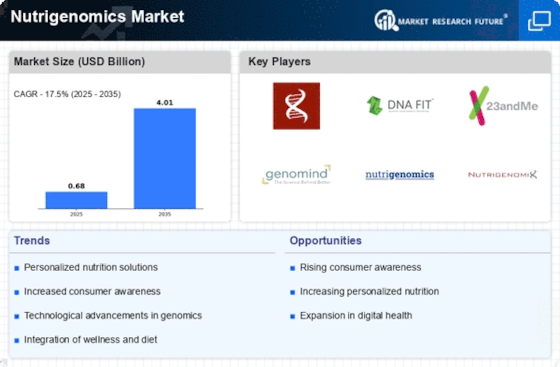
As per Market Research Future analysis, the Nutrigenomics Market Size was estimated at 0.68 USD Billion in 2024. The Nutrigenomics industry is projected to grow from USD 0.799 Billion in 2025 to USD 4.008 Billion by 2035, exhibiting a compound annual growth rate (CAGR) of 17.5% during the forecast period 2025 - 2035

Key Market Trends & Highlights

The Nutrigenomics Market is experiencing robust growth driven by personalized nutrition and technological advancements.

  • The market is increasingly leaning towards personalized nutrition solutions, particularly in North America, which remains the largest market. Technological integration is becoming a pivotal trend, enhancing the efficacy of nutrigenomic applications across various demographics. Collaborative innovations are emerging as a key strategy, especially in the Asia-Pacific region, which is recognized as the fastest-growing market. Rising health awareness and advancements in genetic research are major drivers propelling the demand for disease prevention solutions within the healthcare segment.

Market Size & Forecast

2024 Market Size 0.68 (USD Billion)
2035 Market Size 4.008 (USD Billion)
CAGR (2025 - 2035) 17.5%
Largest Regional Market Share in 2024 North America

Major Players

Nutrigenomix (CA), DNAfit (GB), 23andMe (US), <a href="https://genomind.com/category/press/product/">Genomind </a>(US), Nutrigenomics Ltd (GB), Nutrigenomix Inc (CA), Genetic Health (US), Nutrigenomics Technologies (US)

Market Trends

The Nutrigenomics Market is currently experiencing a notable evolution, driven by advancements in genetic research and an increasing awareness of the relationship between diet and health. This sector appears to be gaining traction as consumers become more informed about personalized nutrition and its potential benefits. The integration of genetic nutrigenetics testing with dietary recommendations is fostering a new paradigm in health management, where individuals can tailor their diets based on their unique genetic profiles. This shift suggests a growing demand for products and services that cater to personalized dietary needs, potentially transforming traditional approaches to nutrition and wellness. Moreover, the Nutrigenomics Market seems poised for further growth as technological innovations continue to emerge. The rise of digital health platforms and mobile applications that facilitate genetic testing and personalized nutrition plans indicates a shift towards more accessible and user-friendly solutions. As consumers increasingly seek out tailored health solutions, the nutrigenomics testing market may witness a surge in collaborations between biotechnology firms and nutrition companies. This collaborative approach could enhance the development of innovative products, thereby expanding the nutrigenomics testing market's reach and appeal to a broader audience. Overall, the Nutrigenomics Market is on a trajectory that suggests a promising future, characterized by increased consumer engagement and technological advancements.

Personalized Nutrition Solutions

The Nutrigenomics Market is witnessing a trend towards personalized nutrition solutions, where dietary recommendations are tailored to individual genetic profiles. This approach allows consumers to optimize their health by aligning their diets with their unique genetic makeup, potentially enhancing overall well-being.

Technological Integration

The integration of advanced technologies, such as mobile applications and digital health platforms, is becoming increasingly prevalent in the Nutrigenomics Market. These tools facilitate genetic testing and provide personalized dietary guidance, making it easier for consumers to access tailored nutrition solutions.

Collaborative Innovations

There is a growing trend of collaboration between biotechnology firms and nutrition companies within the Nutrigenomics Market. This partnership aims to develop innovative products that cater to personalized dietary needs, thereby expanding the nutrigenomics testing market's offerings and enhancing consumer engagement.

Nutrigenomics Market Market Drivers

Rising Health Awareness

The increasing awareness regarding health and wellness among consumers appears to be a pivotal driver for the Nutrigenomics Market. As individuals become more conscious of their dietary choices and their impact on health, the demand for personalized nutrition solutions is likely to surge. This trend is reflected in the growing interest in genetic testing and its implications for tailored dietary recommendations. According to recent data, the market for personalized nutrition is projected to reach substantial figures, indicating a robust growth trajectory. Consumers are increasingly seeking products that align with their genetic profiles, thereby propelling the Nutrigenomics Market forward. This heightened focus on health is not merely a passing trend; it suggests a fundamental shift in consumer behavior towards more informed and health-centric choices.

Advancements in Genetic Research

The rapid advancements in genetic research and biotechnology are significantly influencing the Nutrigenomics Market. Innovations in DNA sequencing technologies and bioinformatics have made it feasible to analyze genetic data with unprecedented accuracy. This progress enables the development of more effective nutrigenomic solutions tailored to individual genetic profiles. As research continues to unveil the intricate relationships between genes and nutrition, the market is likely to witness an influx of new products and services. The potential for personalized dietary recommendations based on genetic insights is becoming increasingly appealing to consumers. Consequently, the Nutrigenomics Market is positioned to benefit from these scientific breakthroughs, which may lead to enhanced consumer engagement and market expansion.

Integration of Technology in Nutrition

The integration of technology into nutrition is transforming the Nutrigenomics Market in profound ways. The proliferation of mobile applications, wearable devices, and online platforms has made it easier for consumers to access personalized nutrition information. These technological advancements facilitate the collection and analysis of genetic data, enabling users to receive tailored dietary recommendations based on their unique genetic profiles. As technology continues to evolve, the Nutrigenomics Market is likely to experience increased engagement from tech-savvy consumers. The convenience and accessibility offered by these innovations may drive higher adoption rates of nutrigenomic solutions. Furthermore, the synergy between technology and nutrition is expected to foster new business models and partnerships, further enhancing the market landscape.

Regulatory Support and Standardization

Regulatory support and the push for standardization are becoming increasingly relevant to the Nutrigenomics Market. As the market expands, the need for clear guidelines and regulations to ensure product safety and efficacy is paramount. Governments and regulatory bodies are beginning to recognize the importance of nutrigenomics, leading to the establishment of frameworks that support research and development in this field. This regulatory backing not only enhances consumer trust but also encourages investment in nutrigenomic innovations. Market data suggests that as standardization efforts progress, the Nutrigenomics Market may witness accelerated growth, as companies will be more inclined to develop products that meet established guidelines. This trend indicates a maturation of the market, paving the way for sustainable growth and increased consumer confidence.

Growing Demand for Preventive Healthcare

The shift towards preventive healthcare is emerging as a significant driver for the Nutrigenomics Market. As healthcare systems worldwide increasingly emphasize prevention over treatment, consumers are seeking proactive measures to maintain their health. Nutrigenomics Market offers a unique approach by providing insights into how individual genetic makeup influences nutritional needs. This preventive strategy aligns with the broader trend of personalized medicine, where tailored interventions are prioritized. Market data indicates that the preventive healthcare sector is expanding rapidly, with consumers willing to invest in solutions that promise long-term health benefits. This growing demand for preventive measures is likely to catalyze the adoption of nutrigenomic products and services, thereby propelling the Nutrigenomics Market to new heights.

Market Segment Insights

By Application: Personalized Nutrition (Largest) vs. Disease Prevention (Fastest-Growing)

In the Nutrigenomics Market, the application segment reveals significant diversity in market share distribution. Personalized Nutrition currently stands out as the largest segment, driven by an increasing demand for tailored dietary recommendations that cater to individual genetic profiles. This approach resonates with health-conscious consumers looking to optimize their nutrition according to their unique biological makeup, leading to greater market penetration compared to other segments. On the other hand, Disease Prevention is recognized as the fastest-growing application within this market. This segment reflects a growing awareness among consumers regarding the role of genetics in health risk reduction. Factors such as rising healthcare costs and a proactive approach towards health management contribute to its rapid advancement, making it an essential area for future research and development in the nutrigenomics landscape.

Personalized Nutrition: Dominant vs. Health Optimization: Emerging

Personalized Nutrition is at the forefront of the Nutrigenomics Market, characterizing itself with its ability to provide individualized dietary solutions based on genetic insights. This segment not only dominates in terms of consumer interest but also benefits from advancements in genomic testing technologies, which empower consumers to make better food choices. In contrast, Health Optimization is emerging as a viable segment, capturing the attention of those looking to achieve peak health through diet and lifestyle choices optimized by genetic information. While Personalized Nutrition thrives on its established position, Health Optimization is gaining traction as more individuals seek to enhance their overall well-being, indicating a dynamic shift in consumer behavior towards genetically-informed health strategies.

By End Use: Healthcare (Largest) vs. Dietary Supplements (Fastest-Growing)

The Nutrigenomics Market shows a diverse distribution of market share across various end uses, with healthcare consistently leading the segment. This sector includes personalized medicine and genetic testing, which play pivotal roles in disease prevention and wellness management. <a href="https://www.marketresearchfuture.com/reports/dietary-supplements-market-1134" target="_blank" title="dietary supplements">Dietary supplements</a>, while presently smaller in share, are rapidly gaining traction as more consumers seek tailored nutritional solutions, thereby shaping the market landscape significantly. As awareness of personalized nutrition increases, so does the demand for dietary supplements formulated based on genetic insights. The pharmaceutical industry is also leveraging nutrigenomics with innovative drug development strategies aiming for precision medication. This convergence of healthcare and dietary supplements reflects a notable trend towards individualized health solutions, indicating a promising future for all stakeholders in this market segment.

Healthcare: Personalized Medicine (Dominant) vs. Dietary Supplements (Emerging)

The healthcare segment, primarily driven by personalized medicine, remains dominant in the Nutrigenomics Market. This sector focuses on using genetic information to tailor medical treatments to individual patients, which enhances efficacy and reduces side effects, making it a key component of modern healthcare. Concurrently, dietary supplements are emerging rapidly, appealing to health-conscious consumers who are increasingly informed about the benefits of tailored nutritional products based on their genetic makeup. This burgeoning interest is supported by ongoing research highlighting the efficacy of nutrigenomic applications in supplementation. As a result, both areas reflect a shift towards precision health solutions, while dietary supplements are poised for significant growth, tapping into a broader consumer base aspiring for optimal wellness.

By Product Type: Genetic Testing Kits (Largest) vs. Bioinformatics Tools (Fastest-Growing)

In the Nutrigenomics Market, Genetic Testing Kits hold the largest share, driven by an increasing awareness among consumers about personalized nutrition. These kits enable individuals to uncover genetic predispositions, leading to tailored diet and wellness plans. Bioinformatics Tools, on the other hand, are rapidly gaining traction as they facilitate the analysis of large genomic datasets, transforming the way nutritional data is interpreted and understood. Nutritional Analysis Software follows closely, providing critical insights into nutrient intake and its alignment with genetic profiles. The growth trends in this segment are largely influenced by technological advancements and a surge in health consciousness. As consumers increasingly seek personalized dietary solutions, the demand for Genetic Testing Kits is expected to remain strong. Simultaneously, Bioinformatics Tools are emerging as essential resources for researchers and healthcare professionals, contributing significantly to the advancements in Nutrigenomics Market. This dual drive creates a dynamic environment where both segments thrive, with Genetic Testing Kits dominating and Bioinformatics Tools evolving rapidly to meet the demands of consumers and professionals alike.

Genetic Testing Kits (Dominant) vs. Nutritional Analysis Software (Emerging)

Genetic Testing Kits are at the forefront of the Nutrigenomics Market due to their ability to provide personalized insights into genetic factors that influence dietary choices. These kits are user-friendly and can be conveniently used at home, appealing to a wide consumer base. On the other hand, Nutritional Analysis Software is seen as an emerging player, offering detailed insights into dietary intake based on genetic predispositions. This software acts as an invaluable tool for healthcare providers and nutritionists, enabling them to formulate personalized diet plans. While Genetic Testing Kits are currently dominant, the growth of Nutritional Analysis Software is driven by an increasing demand for data-driven dietary solutions among health-conscious consumers.

By Technology: DNA Sequencing (Largest) vs. Polymerase Chain Reaction (Fastest-Growing)

<p>In the Nutrigenomics Market, DNA Sequencing holds the largest market share, reflecting its widespread adoption and application in personalized nutrition. Following closely is Polymerase Chain Reaction, which has shown remarkable growth due to its versatility and efficiency in genetic analysis. Microarray Analysis, while significant, is currently overshadowed by these two technologies, emphasizing the emerging dynamics in market preferences.</p>

<p>Technology: DNA Sequencing (Dominant) vs. Polymerase Chain Reaction (Emerging)</p>

<p>DNA Sequencing is recognized as the dominant technology in the Nutrigenomics Market, providing comprehensive insights into genetic profiles that personalize dietary recommendations. Its established presence is marked by robust applications across various sectors, including healthcare and research. Conversely, Polymerase Chain Reaction represents the emerging technology, gaining traction for its rapid and accurate amplification of DNA sequences, thereby enabling more detailed genetic investigations. Its growth is fueled by increasing demand for precise genetic testing in nutrition, driving innovations in nutrigenomics research. As these technologies continue to evolve, they reveal distinct pathways for tailored nutritional solutions.</p>

Get more detailed insights about Nutrigenomics Market Research Report - Global Forecast till 2035

Regional Insights

North America : Leading Innovation and Research

North America is the largest market for nutrigenomics, holding approximately 45% of the global share. The region's growth is driven by increasing consumer awareness of personalized nutrition, advancements in genetic testing technologies, and supportive regulatory frameworks. The U.S. and Canada are the primary contributors, with a growing demand for tailored dietary solutions and health optimization strategies. The competitive landscape is robust, featuring key players like 23andMe, Nutrigenomix, and Genomind. These companies are leveraging cutting-edge research and technology to offer innovative products. The presence of established healthcare systems and a focus on preventive healthcare further enhance market dynamics. As consumer interest in genetic insights continues to rise, the market is expected to expand significantly in the coming years.

Europe : Emerging Market with Regulations

Europe is witnessing a significant rise in the nutrigenomics market, accounting for approximately 30% of the global share. The growth is fueled by increasing health consciousness among consumers, advancements in biotechnology, and supportive regulations from the European Food Safety Authority (EFSA). Countries like Germany and the UK are leading the charge, with a growing emphasis on personalized nutrition and wellness solutions. The competitive landscape in Europe is characterized by a mix of established companies and startups. Key players such as DNAfit and Nutrigenomics Market Ltd are at the forefront, offering innovative genetic testing services. The region's regulatory environment encourages research and development, fostering a culture of innovation. As the demand for personalized health solutions grows, the market is poised for further expansion.

Asia-Pacific : Rapid Growth and Potential

Asia-Pacific is emerging as a significant player in the nutrigenomics market, holding around 20% of the global share. The region's growth is driven by rising disposable incomes, increasing health awareness, and a growing interest in personalized nutrition. Countries like China and India are at the forefront, with a burgeoning demand for health optimization and dietary customization. The competitive landscape is evolving, with both local and international players entering the market. Companies such as GenePlanet and Nutrigenomics Market Technologies are expanding their offerings to cater to the diverse needs of consumers. The region's unique dietary habits and cultural diversity present both challenges and opportunities for market players. As the nutrigenomics trend gains traction, the market is expected to witness substantial growth in the coming years.

Middle East and Africa : Emerging Market with Challenges

The Middle East and Africa region is gradually emerging in the nutrigenomics market, currently holding about 5% of the global share. The growth is driven by increasing health awareness, a rise in lifestyle-related diseases, and a growing interest in personalized nutrition solutions. Countries like South Africa and the UAE are leading the market, with a focus on health optimization and dietary customization. The competitive landscape is still developing, with a mix of local and international players. The presence of key players is limited, but there is a growing interest in genetic testing and personalized health solutions. Challenges such as regulatory hurdles and varying consumer awareness levels may impact growth. However, as the market matures, significant opportunities for expansion are anticipated.

Key Players and Competitive Insights

The Nutrigenomics Market is currently characterized by a dynamic competitive landscape, driven by increasing consumer awareness regarding the relationship between nutrition and genetics. This awareness is fostering a surge in demand for personalized nutrition solutions, which in turn propels innovation among key players. Companies such as 23andMe (US), Nutrigenomix (CA), and DNAfit (GB) are at the forefront, each adopting distinct strategies to enhance their market positioning. 23andMe (US) focuses on integrating genetic testing with health insights, while Nutrigenomix (CA) emphasizes partnerships with healthcare professionals to promote its services. DNAfit (GB) is leveraging digital platforms to expand its reach, indicating a collective shift towards technology-driven solutions that shape the competitive environment. In terms of business tactics, companies are increasingly localizing their manufacturing processes and optimizing supply chains to enhance efficiency and responsiveness to market demands. The Nutrigenomics Market appears moderately fragmented, with several players vying for market share. However, the influence of major companies is substantial, as they set trends and standards that smaller firms often follow. This competitive structure suggests that while there is room for new entrants, established players are likely to maintain a significant advantage through their established networks and resources. In August 2025, 23andMe (US) announced a strategic partnership with a leading health insurance provider to offer genetic testing as part of preventive health measures. This collaboration is poised to enhance the accessibility of nutrigenomic insights to a broader audience, potentially increasing consumer engagement and driving revenue growth. The strategic importance of this partnership lies in its ability to integrate genetic testing into mainstream healthcare, thereby legitimizing the role of nutrigenomics in preventive health strategies. In September 2025, Nutrigenomix (CA) launched a new line of personalized nutrition products tailored for athletes, which underscores its commitment to innovation in the sports nutrition segment. This move not only diversifies its product offerings but also positions the company to capitalize on the growing trend of health-conscious consumers seeking performance-enhancing dietary solutions. The launch reflects a strategic pivot towards niche markets, which may yield higher margins and foster brand loyalty among specific consumer segments. In October 2025, DNAfit (GB) unveiled an AI-driven platform that provides real-time dietary recommendations based on genetic data. This technological advancement signifies a critical step towards personalized nutrition, as it allows users to receive tailored advice that adapts to their lifestyle changes. The strategic importance of this development lies in its potential to enhance user engagement and retention, as consumers increasingly seek personalized solutions that evolve with their needs. As of October 2025, the Nutrigenomics Market is witnessing trends that emphasize digitalization, sustainability, and the integration of artificial intelligence. Strategic alliances are becoming increasingly pivotal, as companies collaborate to enhance their technological capabilities and expand their market reach. Looking ahead, competitive differentiation is likely to evolve from traditional price-based competition towards a focus on innovation, technological advancements, and supply chain reliability. This shift suggests that companies that prioritize these elements will be better positioned to thrive in an increasingly competitive landscape.

Key Companies in the Nutrigenomics Market include

Industry Developments

Recent developments in the Global Nutrigenomics Market have shown significant growth and innovation among key players such as Wellness Within, Metagenics, and Nutrigenomix. In September 2023, Nutraceutical International Corporation further expanded its portfolio by acquiring nutritional product lines, enhancing its offerings in nutrigenomics. The global market is witnessing a rising demand for personalized nutrition, driven by advances in DNA analysis technologies, which has been pivotal in shaping product development strategies among companies like DNAfit and 23andMe. Furthermore, the collaboration of Genetics Unlocked and Genomatix in August 2022 to develop tools for genomic research has strengthened their market position.

The valuation of the nutrigenomics sector continues to rise, with estimates projecting significant growth due to increasing consumer awareness regarding health and wellness. In the past couple of years, events like the partnership between Youngevity International and Nutritional Genomics in May 2021 have also been crucial in enhancing data analytics and tailored nutrition solutions. Major happenings in this evolving market indicate a competitive landscape that is poised for substantial advancements in research and product innovation in the near future.

Future Outlook

Nutrigenomics Market Future Outlook

The Nutrigenomics Market is projected to grow at a 17.5% CAGR from 2025 to 2035, driven by advancements in personalized nutrition, increasing health awareness, and technological innovations.

New opportunities lie in:

  • <p>Development of personalized dietary supplements based on genetic profiles. Integration of AI-driven analytics for customized nutrition plans. Expansion of <a href="https://www.marketresearchfuture.com/reports/nutrigenomics-testing-market-43086" target="_blank" title="nutrigenomics testing">nutrigenomics testing</a> services in healthcare facilities.</p>

By 2035, the Nutrigenomics Market is expected to be a pivotal sector in personalized health solutions.

Market Segmentation

Nutrigenomics Market End Use Outlook

  • Healthcare
  • Dietary Supplements
  • Food
  • Beverage
  • Pharmaceuticals

Nutrigenomics Market Technology Outlook

  • DNA Sequencing
  • Microarray Analysis
  • Polymerase Chain Reaction

Nutrigenomics Market Application Outlook

  • Personalized Nutrition
  • Disease Prevention
  • Health Optimization
  • Fitness and Athletic Performance

Nutrigenomics Market Product Type Outlook

  • Genetic Testing Kits
  • Bioinformatics Tools
  • Nutritional Analysis Software

Report Scope

MARKET SIZE 2024 0.68(USD Billion)
MARKET SIZE 2025 0.799(USD Billion)
MARKET SIZE 2035 4.008(USD Billion)
COMPOUND ANNUAL GROWTH RATE (CAGR) 17.5% (2025 - 2035)
REPORT COVERAGE Revenue Forecast, Competitive Landscape, Growth Factors, and Trends
BASE YEAR 2024
Market Forecast Period 2025 - 2035
Historical Data 2019 - 2024
Market Forecast Units USD Billion
Key Companies Profiled Nutrigenomix (CA), DNAfit (GB), 23andMe (US), Genomind (US), Nutrigenomics Ltd (GB), Nutrigenomix Inc (CA), Genetic Health (US), Nutrigenomics Technologies (US)
Segments Covered Application, End Use, Product Type, Technology, Regional
Key Market Opportunities Integration of personalized nutrition solutions driven by advancements in genetic testing technologies.
Key Market Dynamics Rising consumer interest in personalized nutrition drives innovation and competition in the Nutrigenomics Market.
Countries Covered North America, Europe, APAC, South America, MEA

FAQs

What is the projected market valuation of the Nutrigenomics Market by 2035?

<p>The Nutrigenomics Market is projected to reach a valuation of 4.008 USD Billion by 2035.</p>

What was the market valuation of the Nutrigenomics Market in 2024?

<p>In 2024, the Nutrigenomics Market had a valuation of 0.68 USD Billion.</p>

What is the expected CAGR for the Nutrigenomics Market during the forecast period 2025 - 2035?

<p>The expected CAGR for the Nutrigenomics Market during the forecast period 2025 - 2035 is 17.5%.</p>

Which application segment is anticipated to grow the most in the Nutrigenomics Market?

<p>The Personalized Nutrition application segment is anticipated to grow from 0.2 USD Billion in 2024 to 1.2 USD Billion by 2035.</p>

What are the key players in the Nutrigenomics Market?

<p>Key players in the Nutrigenomics Market include Nutrigenomix, DNAfit, 23andMe, Genomind, and Nutrigenomics Ltd.</p>

How does the Disease Prevention segment perform in the Nutrigenomics Market?

<p>The Disease Prevention segment is expected to grow from 0.15 USD Billion in 2024 to 0.9 USD Billion by 2035.</p>

What product type is projected to have the highest growth in the Nutrigenomics Market?

<p>Genetic Testing Kits are projected to grow from 0.25 USD Billion in 2024 to 1.5 USD Billion by 2035.</p>

What end-use segment is expected to see significant growth in the Nutrigenomics Market?

<p>The Healthcare end-use segment is expected to grow from 0.2 USD Billion in 2024 to 1.2 USD Billion by 2035.</p>

Which technology segment is likely to dominate the Nutrigenomics Market?

<p>The Polymerase Chain Reaction technology segment is likely to grow from 0.28 USD Billion in 2024 to 1.6 USD Billion by 2035.</p>

What is the growth outlook for the Nutrigenomics Market in the coming years?

<p>The growth outlook for the Nutrigenomics Market appears robust, with a projected valuation increase to 4.008 USD Billion by 2035.</p>

  1. SECTION I: EXECUTIVE SUMMARY AND KEY HIGHLIGHTS
    1. | 1.1 EXECUTIVE SUMMARY
    2. | | 1.1.1 Market Overview
    3. | | 1.1.2 Key Findings
    4. | | 1.1.3 Market Segmentation
    5. | | 1.1.4 Competitive Landscape
    6. | | 1.1.5 Challenges and Opportunities
    7. | | 1.1.6 Future Outlook
  2. SECTION II: SCOPING, METHODOLOGY AND MARKET STRUCTURE
    1. | 2.1 MARKET INTRODUCTION
    2. | | 2.1.1 Definition
    3. | | 2.1.2 Scope of the study
    4. | | | 2.1.2.1 Research Objective
    5. | | | 2.1.2.2 Assumption
    6. | | | 2.1.2.3 Limitations
    7. | 2.2 RESEARCH METHODOLOGY
    8. | | 2.2.1 Overview
    9. | | 2.2.2 Data Mining
    10. | | 2.2.3 Secondary Research
    11. | | 2.2.4 Primary Research
    12. | | | 2.2.4.1 Primary Interviews and Information Gathering Process
    13. | | | 2.2.4.2 Breakdown of Primary Respondents
    14. | | 2.2.5 Forecasting Model
    15. | | 2.2.6 Market Size Estimation
    16. | | | 2.2.6.1 Bottom-Up Approach
    17. | | | 2.2.6.2 Top-Down Approach
    18. | | 2.2.7 Data Triangulation
    19. | | 2.2.8 Validation
  3. SECTION III: QUALITATIVE ANALYSIS
    1. | 3.1 MARKET DYNAMICS
    2. | | 3.1.1 Overview
    3. | | 3.1.2 Drivers
    4. | | 3.1.3 Restraints
    5. | | 3.1.4 Opportunities
    6. | 3.2 MARKET FACTOR ANALYSIS
    7. | | 3.2.1 Value chain Analysis
    8. | | 3.2.2 Porter's Five Forces Analysis
    9. | | | 3.2.2.1 Bargaining Power of Suppliers
    10. | | | 3.2.2.2 Bargaining Power of Buyers
    11. | | | 3.2.2.3 Threat of New Entrants
    12. | | | 3.2.2.4 Threat of Substitutes
    13. | | | 3.2.2.5 Intensity of Rivalry
    14. | | 3.2.3 COVID-19 Impact Analysis
    15. | | | 3.2.3.1 Market Impact Analysis
    16. | | | 3.2.3.2 Regional Impact
    17. | | | 3.2.3.3 Opportunity and Threat Analysis
  4. SECTION IV: QUANTITATIVE ANALYSIS
    1. | 4.1 Healthcare, BY Application (USD Billion)
    2. | | 4.1.1 Personalized Nutrition
    3. | | 4.1.2 Disease Prevention
    4. | | 4.1.3 Health Optimization
    5. | | 4.1.4 Fitness and Athletic Performance
    6. | 4.2 Healthcare, BY End Use (USD Billion)
    7. | | 4.2.1 Healthcare
    8. | | 4.2.2 Dietary Supplements
    9. | | 4.2.3 Food
    10. | | 4.2.4 Beverage
    11. | | 4.2.5 Pharmaceuticals
    12. | 4.3 Healthcare, BY Product Type (USD Billion)
    13. | | 4.3.1 Genetic Testing Kits
    14. | | 4.3.2 Bioinformatics Tools
    15. | | 4.3.3 Nutritional Analysis Software
    16. | 4.4 Healthcare, BY Technology (USD Billion)
    17. | | 4.4.1 DNA Sequencing
    18. | | 4.4.2 Microarray Analysis
    19. | | 4.4.3 Polymerase Chain Reaction
    20. | 4.5 Healthcare, BY Region (USD Billion)
    21. | | 4.5.1 North America
    22. | | | 4.5.1.1 US
    23. | | | 4.5.1.2 Canada
    24. | | 4.5.2 Europe
    25. | | | 4.5.2.1 Germany
    26. | | | 4.5.2.2 UK
    27. | | | 4.5.2.3 France
    28. | | | 4.5.2.4 Russia
    29. | | | 4.5.2.5 Italy
    30. | | | 4.5.2.6 Spain
    31. | | | 4.5.2.7 Rest of Europe
    32. | | 4.5.3 APAC
    33. | | | 4.5.3.1 China
    34. | | | 4.5.3.2 India
    35. | | | 4.5.3.3 Japan
    36. | | | 4.5.3.4 South Korea
    37. | | | 4.5.3.5 Malaysia
    38. | | | 4.5.3.6 Thailand
    39. | | | 4.5.3.7 Indonesia
    40. | | | 4.5.3.8 Rest of APAC
    41. | | 4.5.4 South America
    42. | | | 4.5.4.1 Brazil
    43. | | | 4.5.4.2 Mexico
    44. | | | 4.5.4.3 Argentina
    45. | | | 4.5.4.4 Rest of South America
    46. | | 4.5.5 MEA
    47. | | | 4.5.5.1 GCC Countries
    48. | | | 4.5.5.2 South Africa
    49. | | | 4.5.5.3 Rest of MEA
  5. SECTION V: COMPETITIVE ANALYSIS
    1. | 5.1 Competitive Landscape
    2. | | 5.1.1 Overview
    3. | | 5.1.2 Competitive Analysis
    4. | | 5.1.3 Market share Analysis
    5. | | 5.1.4 Major Growth Strategy in the Healthcare
    6. | | 5.1.5 Competitive Benchmarking
    7. | | 5.1.6 Leading Players in Terms of Number of Developments in the Healthcare
    8. | | 5.1.7 Key developments and growth strategies
    9. | | | 5.1.7.1 New Product Launch/Service Deployment
    10. | | | 5.1.7.2 Merger & Acquisitions
    11. | | | 5.1.7.3 Joint Ventures
    12. | | 5.1.8 Major Players Financial Matrix
    13. | | | 5.1.8.1 Sales and Operating Income
    14. | | | 5.1.8.2 Major Players R&D Expenditure. 2023
    15. | 5.2 Company Profiles
    16. | | 5.2.1 Nutrigenomix (CA)
    17. | | | 5.2.1.1 Financial Overview
    18. | | | 5.2.1.2 Products Offered
    19. | | | 5.2.1.3 Key Developments
    20. | | | 5.2.1.4 SWOT Analysis
    21. | | | 5.2.1.5 Key Strategies
    22. | | 5.2.2 DNAfit (GB)
    23. | | | 5.2.2.1 Financial Overview
    24. | | | 5.2.2.2 Products Offered
    25. | | | 5.2.2.3 Key Developments
    26. | | | 5.2.2.4 SWOT Analysis
    27. | | | 5.2.2.5 Key Strategies
    28. | | 5.2.3 23andMe (US)
    29. | | | 5.2.3.1 Financial Overview
    30. | | | 5.2.3.2 Products Offered
    31. | | | 5.2.3.3 Key Developments
    32. | | | 5.2.3.4 SWOT Analysis
    33. | | | 5.2.3.5 Key Strategies
    34. | | 5.2.4 Genomind (US)
    35. | | | 5.2.4.1 Financial Overview
    36. | | | 5.2.4.2 Products Offered
    37. | | | 5.2.4.3 Key Developments
    38. | | | 5.2.4.4 SWOT Analysis
    39. | | | 5.2.4.5 Key Strategies
    40. | | 5.2.5 Nutrigenomics Ltd (GB)
    41. | | | 5.2.5.1 Financial Overview
    42. | | | 5.2.5.2 Products Offered
    43. | | | 5.2.5.3 Key Developments
    44. | | | 5.2.5.4 SWOT Analysis
    45. | | | 5.2.5.5 Key Strategies
    46. | | 5.2.6 Nutrigenomix Inc (CA)
    47. | | | 5.2.6.1 Financial Overview
    48. | | | 5.2.6.2 Products Offered
    49. | | | 5.2.6.3 Key Developments
    50. | | | 5.2.6.4 SWOT Analysis
    51. | | | 5.2.6.5 Key Strategies
    52. | | 5.2.7 Genetic Health (US)
    53. | | | 5.2.7.1 Financial Overview
    54. | | | 5.2.7.2 Products Offered
    55. | | | 5.2.7.3 Key Developments
    56. | | | 5.2.7.4 SWOT Analysis
    57. | | | 5.2.7.5 Key Strategies
    58. | | 5.2.8 Nutrigenomics Technologies (US)
    59. | | | 5.2.8.1 Financial Overview
    60. | | | 5.2.8.2 Products Offered
    61. | | | 5.2.8.3 Key Developments
    62. | | | 5.2.8.4 SWOT Analysis
    63. | | | 5.2.8.5 Key Strategies
    64. | 5.3 Appendix
    65. | | 5.3.1 References
    66. | | 5.3.2 Related Reports
  6. LIST OF FIGURES
    1. | 6.1 MARKET SYNOPSIS
    2. | 6.2 NORTH AMERICA MARKET ANALYSIS
    3. | 6.3 US MARKET ANALYSIS BY APPLICATION
    4. | 6.4 US MARKET ANALYSIS BY END USE
    5. | 6.5 US MARKET ANALYSIS BY PRODUCT TYPE
    6. | 6.6 US MARKET ANALYSIS BY TECHNOLOGY
    7. | 6.7 CANADA MARKET ANALYSIS BY APPLICATION
    8. | 6.8 CANADA MARKET ANALYSIS BY END USE
    9. | 6.9 CANADA MARKET ANALYSIS BY PRODUCT TYPE
    10. | 6.10 CANADA MARKET ANALYSIS BY TECHNOLOGY
    11. | 6.11 EUROPE MARKET ANALYSIS
    12. | 6.12 GERMANY MARKET ANALYSIS BY APPLICATION
    13. | 6.13 GERMANY MARKET ANALYSIS BY END USE
    14. | 6.14 GERMANY MARKET ANALYSIS BY PRODUCT TYPE
    15. | 6.15 GERMANY MARKET ANALYSIS BY TECHNOLOGY
    16. | 6.16 UK MARKET ANALYSIS BY APPLICATION
    17. | 6.17 UK MARKET ANALYSIS BY END USE
    18. | 6.18 UK MARKET ANALYSIS BY PRODUCT TYPE
    19. | 6.19 UK MARKET ANALYSIS BY TECHNOLOGY
    20. | 6.20 FRANCE MARKET ANALYSIS BY APPLICATION
    21. | 6.21 FRANCE MARKET ANALYSIS BY END USE
    22. | 6.22 FRANCE MARKET ANALYSIS BY PRODUCT TYPE
    23. | 6.23 FRANCE MARKET ANALYSIS BY TECHNOLOGY
    24. | 6.24 RUSSIA MARKET ANALYSIS BY APPLICATION
    25. | 6.25 RUSSIA MARKET ANALYSIS BY END USE
    26. | 6.26 RUSSIA MARKET ANALYSIS BY PRODUCT TYPE
    27. | 6.27 RUSSIA MARKET ANALYSIS BY TECHNOLOGY
    28. | 6.28 ITALY MARKET ANALYSIS BY APPLICATION
    29. | 6.29 ITALY MARKET ANALYSIS BY END USE
    30. | 6.30 ITALY MARKET ANALYSIS BY PRODUCT TYPE
    31. | 6.31 ITALY MARKET ANALYSIS BY TECHNOLOGY
    32. | 6.32 SPAIN MARKET ANALYSIS BY APPLICATION
    33. | 6.33 SPAIN MARKET ANALYSIS BY END USE
    34. | 6.34 SPAIN MARKET ANALYSIS BY PRODUCT TYPE
    35. | 6.35 SPAIN MARKET ANALYSIS BY TECHNOLOGY
    36. | 6.36 REST OF EUROPE MARKET ANALYSIS BY APPLICATION
    37. | 6.37 REST OF EUROPE MARKET ANALYSIS BY END USE
    38. | 6.38 REST OF EUROPE MARKET ANALYSIS BY PRODUCT TYPE
    39. | 6.39 REST OF EUROPE MARKET ANALYSIS BY TECHNOLOGY
    40. | 6.40 APAC MARKET ANALYSIS
    41. | 6.41 CHINA MARKET ANALYSIS BY APPLICATION
    42. | 6.42 CHINA MARKET ANALYSIS BY END USE
    43. | 6.43 CHINA MARKET ANALYSIS BY PRODUCT TYPE
    44. | 6.44 CHINA MARKET ANALYSIS BY TECHNOLOGY
    45. | 6.45 INDIA MARKET ANALYSIS BY APPLICATION
    46. | 6.46 INDIA MARKET ANALYSIS BY END USE
    47. | 6.47 INDIA MARKET ANALYSIS BY PRODUCT TYPE
    48. | 6.48 INDIA MARKET ANALYSIS BY TECHNOLOGY
    49. | 6.49 JAPAN MARKET ANALYSIS BY APPLICATION
    50. | 6.50 JAPAN MARKET ANALYSIS BY END USE
    51. | 6.51 JAPAN MARKET ANALYSIS BY PRODUCT TYPE
    52. | 6.52 JAPAN MARKET ANALYSIS BY TECHNOLOGY
    53. | 6.53 SOUTH KOREA MARKET ANALYSIS BY APPLICATION
    54. | 6.54 SOUTH KOREA MARKET ANALYSIS BY END USE
    55. | 6.55 SOUTH KOREA MARKET ANALYSIS BY PRODUCT TYPE
    56. | 6.56 SOUTH KOREA MARKET ANALYSIS BY TECHNOLOGY
    57. | 6.57 MALAYSIA MARKET ANALYSIS BY APPLICATION
    58. | 6.58 MALAYSIA MARKET ANALYSIS BY END USE
    59. | 6.59 MALAYSIA MARKET ANALYSIS BY PRODUCT TYPE
    60. | 6.60 MALAYSIA MARKET ANALYSIS BY TECHNOLOGY
    61. | 6.61 THAILAND MARKET ANALYSIS BY APPLICATION
    62. | 6.62 THAILAND MARKET ANALYSIS BY END USE
    63. | 6.63 THAILAND MARKET ANALYSIS BY PRODUCT TYPE
    64. | 6.64 THAILAND MARKET ANALYSIS BY TECHNOLOGY
    65. | 6.65 INDONESIA MARKET ANALYSIS BY APPLICATION
    66. | 6.66 INDONESIA MARKET ANALYSIS BY END USE
    67. | 6.67 INDONESIA MARKET ANALYSIS BY PRODUCT TYPE
    68. | 6.68 INDONESIA MARKET ANALYSIS BY TECHNOLOGY
    69. | 6.69 REST OF APAC MARKET ANALYSIS BY APPLICATION
    70. | 6.70 REST OF APAC MARKET ANALYSIS BY END USE
    71. | 6.71 REST OF APAC MARKET ANALYSIS BY PRODUCT TYPE
    72. | 6.72 REST OF APAC MARKET ANALYSIS BY TECHNOLOGY
    73. | 6.73 SOUTH AMERICA MARKET ANALYSIS
    74. | 6.74 BRAZIL MARKET ANALYSIS BY APPLICATION
    75. | 6.75 BRAZIL MARKET ANALYSIS BY END USE
    76. | 6.76 BRAZIL MARKET ANALYSIS BY PRODUCT TYPE
    77. | 6.77 BRAZIL MARKET ANALYSIS BY TECHNOLOGY
    78. | 6.78 MEXICO MARKET ANALYSIS BY APPLICATION
    79. | 6.79 MEXICO MARKET ANALYSIS BY END USE
    80. | 6.80 MEXICO MARKET ANALYSIS BY PRODUCT TYPE
    81. | 6.81 MEXICO MARKET ANALYSIS BY TECHNOLOGY
    82. | 6.82 ARGENTINA MARKET ANALYSIS BY APPLICATION
    83. | 6.83 ARGENTINA MARKET ANALYSIS BY END USE
    84. | 6.84 ARGENTINA MARKET ANALYSIS BY PRODUCT TYPE
    85. | 6.85 ARGENTINA MARKET ANALYSIS BY TECHNOLOGY
    86. | 6.86 REST OF SOUTH AMERICA MARKET ANALYSIS BY APPLICATION
    87. | 6.87 REST OF SOUTH AMERICA MARKET ANALYSIS BY END USE
    88. | 6.88 REST OF SOUTH AMERICA MARKET ANALYSIS BY PRODUCT TYPE
    89. | 6.89 REST OF SOUTH AMERICA MARKET ANALYSIS BY TECHNOLOGY
    90. | 6.90 MEA MARKET ANALYSIS
    91. | 6.91 GCC COUNTRIES MARKET ANALYSIS BY APPLICATION
    92. | 6.92 GCC COUNTRIES MARKET ANALYSIS BY END USE
    93. | 6.93 GCC COUNTRIES MARKET ANALYSIS BY PRODUCT TYPE
    94. | 6.94 GCC COUNTRIES MARKET ANALYSIS BY TECHNOLOGY
    95. | 6.95 SOUTH AFRICA MARKET ANALYSIS BY APPLICATION
    96. | 6.96 SOUTH AFRICA MARKET ANALYSIS BY END USE
    97. | 6.97 SOUTH AFRICA MARKET ANALYSIS BY PRODUCT TYPE
    98. | 6.98 SOUTH AFRICA MARKET ANALYSIS BY TECHNOLOGY
    99. | 6.99 REST OF MEA MARKET ANALYSIS BY APPLICATION
    100. | 6.100 REST OF MEA MARKET ANALYSIS BY END USE
    101. | 6.101 REST OF MEA MARKET ANALYSIS BY PRODUCT TYPE
    102. | 6.102 REST OF MEA MARKET ANALYSIS BY TECHNOLOGY
    103. | 6.103 KEY BUYING CRITERIA OF HEALTHCARE
    104. | 6.104 RESEARCH PROCESS OF MRFR
    105. | 6.105 DRO ANALYSIS OF HEALTHCARE
    106. | 6.106 DRIVERS IMPACT ANALYSIS: HEALTHCARE
    107. | 6.107 RESTRAINTS IMPACT ANALYSIS: HEALTHCARE
    108. | 6.108 SUPPLY / VALUE CHAIN: HEALTHCARE
    109. | 6.109 HEALTHCARE, BY APPLICATION, 2024 (% SHARE)
    110. | 6.110 HEALTHCARE, BY APPLICATION, 2024 TO 2035 (USD Billion)
    111. | 6.111 HEALTHCARE, BY END USE, 2024 (% SHARE)
    112. | 6.112 HEALTHCARE, BY END USE, 2024 TO 2035 (USD Billion)
    113. | 6.113 HEALTHCARE, BY PRODUCT TYPE, 2024 (% SHARE)
    114. | 6.114 HEALTHCARE, BY PRODUCT TYPE, 2024 TO 2035 (USD Billion)
    115. | 6.115 HEALTHCARE, BY TECHNOLOGY, 2024 (% SHARE)
    116. | 6.116 HEALTHCARE, BY TECHNOLOGY, 2024 TO 2035 (USD Billion)
    117. | 6.117 BENCHMARKING OF MAJOR COMPETITORS
  7. LIST OF TABLES
    1. | 7.1 LIST OF ASSUMPTIONS
    2. | | 7.1.1
    3. | 7.2 North America MARKET SIZE ESTIMATES; FORECAST
    4. | | 7.2.1 BY APPLICATION, 2025-2035 (USD Billion)
    5. | | 7.2.2 BY END USE, 2025-2035 (USD Billion)
    6. | | 7.2.3 BY PRODUCT TYPE, 2025-2035 (USD Billion)
    7. | | 7.2.4 BY TECHNOLOGY, 2025-2035 (USD Billion)
    8. | 7.3 US MARKET SIZE ESTIMATES; FORECAST
    9. | | 7.3.1 BY APPLICATION, 2025-2035 (USD Billion)
    10. | | 7.3.2 BY END USE, 2025-2035 (USD Billion)
    11. | | 7.3.3 BY PRODUCT TYPE, 2025-2035 (USD Billion)
    12. | | 7.3.4 BY TECHNOLOGY, 2025-2035 (USD Billion)
    13. | 7.4 Canada MARKET SIZE ESTIMATES; FORECAST
    14. | | 7.4.1 BY APPLICATION, 2025-2035 (USD Billion)
    15. | | 7.4.2 BY END USE, 2025-2035 (USD Billion)
    16. | | 7.4.3 BY PRODUCT TYPE, 2025-2035 (USD Billion)
    17. | | 7.4.4 BY TECHNOLOGY, 2025-2035 (USD Billion)
    18. | 7.5 Europe MARKET SIZE ESTIMATES; FORECAST
    19. | | 7.5.1 BY APPLICATION, 2025-2035 (USD Billion)
    20. | | 7.5.2 BY END USE, 2025-2035 (USD Billion)
    21. | | 7.5.3 BY PRODUCT TYPE, 2025-2035 (USD Billion)
    22. | | 7.5.4 BY TECHNOLOGY, 2025-2035 (USD Billion)
    23. | 7.6 Germany MARKET SIZE ESTIMATES; FORECAST
    24. | | 7.6.1 BY APPLICATION, 2025-2035 (USD Billion)
    25. | | 7.6.2 BY END USE, 2025-2035 (USD Billion)
    26. | | 7.6.3 BY PRODUCT TYPE, 2025-2035 (USD Billion)
    27. | | 7.6.4 BY TECHNOLOGY, 2025-2035 (USD Billion)
    28. | 7.7 UK MARKET SIZE ESTIMATES; FORECAST
    29. | | 7.7.1 BY APPLICATION, 2025-2035 (USD Billion)
    30. | | 7.7.2 BY END USE, 2025-2035 (USD Billion)
    31. | | 7.7.3 BY PRODUCT TYPE, 2025-2035 (USD Billion)
    32. | | 7.7.4 BY TECHNOLOGY, 2025-2035 (USD Billion)
    33. | 7.8 France MARKET SIZE ESTIMATES; FORECAST
    34. | | 7.8.1 BY APPLICATION, 2025-2035 (USD Billion)
    35. | | 7.8.2 BY END USE, 2025-2035 (USD Billion)
    36. | | 7.8.3 BY PRODUCT TYPE, 2025-2035 (USD Billion)
    37. | | 7.8.4 BY TECHNOLOGY, 2025-2035 (USD Billion)
    38. | 7.9 Russia MARKET SIZE ESTIMATES; FORECAST
    39. | | 7.9.1 BY APPLICATION, 2025-2035 (USD Billion)
    40. | | 7.9.2 BY END USE, 2025-2035 (USD Billion)
    41. | | 7.9.3 BY PRODUCT TYPE, 2025-2035 (USD Billion)
    42. | | 7.9.4 BY TECHNOLOGY, 2025-2035 (USD Billion)
    43. | 7.10 Italy MARKET SIZE ESTIMATES; FORECAST
    44. | | 7.10.1 BY APPLICATION, 2025-2035 (USD Billion)
    45. | | 7.10.2 BY END USE, 2025-2035 (USD Billion)
    46. | | 7.10.3 BY PRODUCT TYPE, 2025-2035 (USD Billion)
    47. | | 7.10.4 BY TECHNOLOGY, 2025-2035 (USD Billion)
    48. | 7.11 Spain MARKET SIZE ESTIMATES; FORECAST
    49. | | 7.11.1 BY APPLICATION, 2025-2035 (USD Billion)
    50. | | 7.11.2 BY END USE, 2025-2035 (USD Billion)
    51. | | 7.11.3 BY PRODUCT TYPE, 2025-2035 (USD Billion)
    52. | | 7.11.4 BY TECHNOLOGY, 2025-2035 (USD Billion)
    53. | 7.12 Rest of Europe MARKET SIZE ESTIMATES; FORECAST
    54. | | 7.12.1 BY APPLICATION, 2025-2035 (USD Billion)
    55. | | 7.12.2 BY END USE, 2025-2035 (USD Billion)
    56. | | 7.12.3 BY PRODUCT TYPE, 2025-2035 (USD Billion)
    57. | | 7.12.4 BY TECHNOLOGY, 2025-2035 (USD Billion)
    58. | 7.13 APAC MARKET SIZE ESTIMATES; FORECAST
    59. | | 7.13.1 BY APPLICATION, 2025-2035 (USD Billion)
    60. | | 7.13.2 BY END USE, 2025-2035 (USD Billion)
    61. | | 7.13.3 BY PRODUCT TYPE, 2025-2035 (USD Billion)
    62. | | 7.13.4 BY TECHNOLOGY, 2025-2035 (USD Billion)
    63. | 7.14 China MARKET SIZE ESTIMATES; FORECAST
    64. | | 7.14.1 BY APPLICATION, 2025-2035 (USD Billion)
    65. | | 7.14.2 BY END USE, 2025-2035 (USD Billion)
    66. | | 7.14.3 BY PRODUCT TYPE, 2025-2035 (USD Billion)
    67. | | 7.14.4 BY TECHNOLOGY, 2025-2035 (USD Billion)
    68. | 7.15 India MARKET SIZE ESTIMATES; FORECAST
    69. | | 7.15.1 BY APPLICATION, 2025-2035 (USD Billion)
    70. | | 7.15.2 BY END USE, 2025-2035 (USD Billion)
    71. | | 7.15.3 BY PRODUCT TYPE, 2025-2035 (USD Billion)
    72. | | 7.15.4 BY TECHNOLOGY, 2025-2035 (USD Billion)
    73. | 7.16 Japan MARKET SIZE ESTIMATES; FORECAST
    74. | | 7.16.1 BY APPLICATION, 2025-2035 (USD Billion)
    75. | | 7.16.2 BY END USE, 2025-2035 (USD Billion)
    76. | | 7.16.3 BY PRODUCT TYPE, 2025-2035 (USD Billion)
    77. | | 7.16.4 BY TECHNOLOGY, 2025-2035 (USD Billion)
    78. | 7.17 South Korea MARKET SIZE ESTIMATES; FORECAST
    79. | | 7.17.1 BY APPLICATION, 2025-2035 (USD Billion)
    80. | | 7.17.2 BY END USE, 2025-2035 (USD Billion)
    81. | | 7.17.3 BY PRODUCT TYPE, 2025-2035 (USD Billion)
    82. | | 7.17.4 BY TECHNOLOGY, 2025-2035 (USD Billion)
    83. | 7.18 Malaysia MARKET SIZE ESTIMATES; FORECAST
    84. | | 7.18.1 BY APPLICATION, 2025-2035 (USD Billion)
    85. | | 7.18.2 BY END USE, 2025-2035 (USD Billion)
    86. | | 7.18.3 BY PRODUCT TYPE, 2025-2035 (USD Billion)
    87. | | 7.18.4 BY TECHNOLOGY, 2025-2035 (USD Billion)
    88. | 7.19 Thailand MARKET SIZE ESTIMATES; FORECAST
    89. | | 7.19.1 BY APPLICATION, 2025-2035 (USD Billion)
    90. | | 7.19.2 BY END USE, 2025-2035 (USD Billion)
    91. | | 7.19.3 BY PRODUCT TYPE, 2025-2035 (USD Billion)
    92. | | 7.19.4 BY TECHNOLOGY, 2025-2035 (USD Billion)
    93. | 7.20 Indonesia MARKET SIZE ESTIMATES; FORECAST
    94. | | 7.20.1 BY APPLICATION, 2025-2035 (USD Billion)
    95. | | 7.20.2 BY END USE, 2025-2035 (USD Billion)
    96. | | 7.20.3 BY PRODUCT TYPE, 2025-2035 (USD Billion)
    97. | | 7.20.4 BY TECHNOLOGY, 2025-2035 (USD Billion)
    98. | 7.21 Rest of APAC MARKET SIZE ESTIMATES; FORECAST
    99. | | 7.21.1 BY APPLICATION, 2025-2035 (USD Billion)
    100. | | 7.21.2 BY END USE, 2025-2035 (USD Billion)
    101. | | 7.21.3 BY PRODUCT TYPE, 2025-2035 (USD Billion)
    102. | | 7.21.4 BY TECHNOLOGY, 2025-2035 (USD Billion)
    103. | 7.22 South America MARKET SIZE ESTIMATES; FORECAST
    104. | | 7.22.1 BY APPLICATION, 2025-2035 (USD Billion)
    105. | | 7.22.2 BY END USE, 2025-2035 (USD Billion)
    106. | | 7.22.3 BY PRODUCT TYPE, 2025-2035 (USD Billion)
    107. | | 7.22.4 BY TECHNOLOGY, 2025-2035 (USD Billion)
    108. | 7.23 Brazil MARKET SIZE ESTIMATES; FORECAST
    109. | | 7.23.1 BY APPLICATION, 2025-2035 (USD Billion)
    110. | | 7.23.2 BY END USE, 2025-2035 (USD Billion)
    111. | | 7.23.3 BY PRODUCT TYPE, 2025-2035 (USD Billion)
    112. | | 7.23.4 BY TECHNOLOGY, 2025-2035 (USD Billion)
    113. | 7.24 Mexico MARKET SIZE ESTIMATES; FORECAST
    114. | | 7.24.1 BY APPLICATION, 2025-2035 (USD Billion)
    115. | | 7.24.2 BY END USE, 2025-2035 (USD Billion)
    116. | | 7.24.3 BY PRODUCT TYPE, 2025-2035 (USD Billion)
    117. | | 7.24.4 BY TECHNOLOGY, 2025-2035 (USD Billion)
    118. | 7.25 Argentina MARKET SIZE ESTIMATES; FORECAST
    119. | | 7.25.1 BY APPLICATION, 2025-2035 (USD Billion)
    120. | | 7.25.2 BY END USE, 2025-2035 (USD Billion)
    121. | | 7.25.3 BY PRODUCT TYPE, 2025-2035 (USD Billion)
    122. | | 7.25.4 BY TECHNOLOGY, 2025-2035 (USD Billion)
    123. | 7.26 Rest of South America MARKET SIZE ESTIMATES; FORECAST
    124. | | 7.26.1 BY APPLICATION, 2025-2035 (USD Billion)
    125. | | 7.26.2 BY END USE, 2025-2035 (USD Billion)
    126. | | 7.26.3 BY PRODUCT TYPE, 2025-2035 (USD Billion)
    127. | | 7.26.4 BY TECHNOLOGY, 2025-2035 (USD Billion)
    128. | 7.27 MEA MARKET SIZE ESTIMATES; FORECAST
    129. | | 7.27.1 BY APPLICATION, 2025-2035 (USD Billion)
    130. | | 7.27.2 BY END USE, 2025-2035 (USD Billion)
    131. | | 7.27.3 BY PRODUCT TYPE, 2025-2035 (USD Billion)
    132. | | 7.27.4 BY TECHNOLOGY, 2025-2035 (USD Billion)
    133. | 7.28 GCC Countries MARKET SIZE ESTIMATES; FORECAST
    134. | | 7.28.1 BY APPLICATION, 2025-2035 (USD Billion)
    135. | | 7.28.2 BY END USE, 2025-2035 (USD Billion)
    136. | | 7.28.3 BY PRODUCT TYPE, 2025-2035 (USD Billion)
    137. | | 7.28.4 BY TECHNOLOGY, 2025-2035 (USD Billion)
    138. | 7.29 South Africa MARKET SIZE ESTIMATES; FORECAST
    139. | | 7.29.1 BY APPLICATION, 2025-2035 (USD Billion)
    140. | | 7.29.2 BY END USE, 2025-2035 (USD Billion)
    141. | | 7.29.3 BY PRODUCT TYPE, 2025-2035 (USD Billion)
    142. | | 7.29.4 BY TECHNOLOGY, 2025-2035 (USD Billion)
    143. | 7.30 Rest of MEA MARKET SIZE ESTIMATES; FORECAST
    144. | | 7.30.1 BY APPLICATION, 2025-2035 (USD Billion)
    145. | | 7.30.2 BY END USE, 2025-2035 (USD Billion)
    146. | | 7.30.3 BY PRODUCT TYPE, 2025-2035 (USD Billion)
    147. | | 7.30.4 BY TECHNOLOGY, 2025-2035 (USD Billion)
    148. | 7.31 PRODUCT LAUNCH/PRODUCT DEVELOPMENT/APPROVAL
    149. | | 7.31.1
    150. | 7.32 ACQUISITION/PARTNERSHIP
    151. | | 7.32.1

Healthcare Market Segmentation

Healthcare By Application (USD Billion, 2025-2035)

  • Personalized Nutrition
  • Disease Prevention
  • Health Optimization
  • Fitness and Athletic Performance

Healthcare By End Use (USD Billion, 2025-2035)

  • Healthcare
  • Dietary Supplements
  • Food
  • Beverage
  • Pharmaceuticals

Healthcare By Product Type (USD Billion, 2025-2035)

  • Genetic Testing Kits
  • Bioinformatics Tools
  • Nutritional Analysis Software

Healthcare By Technology (USD Billion, 2025-2035)

  • DNA Sequencing
  • Microarray Analysis
  • Polymerase Chain Reaction
Infographic

Free Sample Request

Kindly complete the form below to receive a free sample of this Report

Get Free Sample

Customer Strories

Compare Licence

×
Features License Type
Single User Multiuser License Enterprise User
Price $4,950 $5,950 $7,250
Maximum User Access Limit 1 User Upto 10 Users Unrestricted Access Throughout the Organization
Free Customization
Direct Access to Analyst
Deliverable Format
Platform Access
Discount on Next Purchase 10% 15% 15%
Printable Versions