Request Free Sample ×

Kindly complete the form below to receive a free sample of this Report

* Please use a valid business email

Leading companies partner with us for data-driven Insights

clients tt-cursor
Hero Background
English
Chinese
French
Japanese
Korean
German
Spanish

NPK Fertilizers Market Analysis

ID: MRFR/Agri/7088-HCR
111 Pages
Snehal Singh
April 2026

NPK Fertilizers Market Size, Share, Industry Trend & Analysis Research Report Information By Crop Type (Cereals & Grains, Oilseeds & Pulses, Fruits & Vegetables, and Others), By Mode of Application (Fertigation, Foliar, and Others), By Form (Dry and Liquid), and By Region (North America, Europe, Asia-Pacific, And Rest Of The World) – Forecast Till 2030

Share:
Download PDF ×

We do not share your information with anyone. However, we may send you emails based on your report interest from time to time. You may contact us at any time to opt-out.

NPK Fertilizers Market Infographic
Purchase Options

Market Analysis

NPK Fertilizers (Global, 2024)

Introduction

The NPK fertilizers market is poised for significant evolution as agricultural practices increasingly prioritize efficiency and sustainability. NPK fertilizers, which provide essential nutrients—nitrogen (N), phosphorus (P), and potassium (K)—are critical in enhancing crop yield and quality. As global food demand escalates, driven by population growth and changing dietary preferences, the agricultural sector is under pressure to adopt innovative fertilization techniques that maximize productivity while minimizing environmental impact. This report delves into the dynamics of the NPK fertilizers market, exploring key trends, technological advancements, and regulatory frameworks that shape the landscape. Additionally, it examines the competitive environment, highlighting the strategies employed by leading manufacturers to capture market share and respond to the evolving needs of farmers worldwide. Understanding these factors is essential for stakeholders aiming to navigate the complexities of the NPK fertilizers market and capitalize on emerging opportunities.

PESTLE Analysis

Political
In 2024, government policies regarding agricultural practices and fertilizer usage are increasingly influenced by sustainability initiatives. For instance, the European Union has set a target to reduce nitrogen fertilizer usage by 20% by 2030, which directly impacts the NPK fertilizers market. Additionally, the U.S. government has allocated approximately $1.5 billion in subsidies for sustainable farming practices, which includes the promotion of efficient fertilizer use to minimize environmental impact.
Economic
The global agricultural sector is projected to reach a value of $3.5 trillion in 2024, with fertilizers playing a crucial role in crop yield enhancement. The NPK fertilizers market is expected to benefit from this growth, particularly in developing regions where agricultural productivity is being prioritized. In India, for example, the government has announced a budget of ₹1.2 trillion (approximately $14.5 billion) for agricultural development, which includes investments in fertilizer subsidies and infrastructure.
Social
Consumer awareness regarding food quality and safety is on the rise, with 65% of consumers in a recent survey indicating a preference for sustainably produced food. This shift in consumer behavior is pushing farmers to adopt more environmentally friendly practices, including the use of NPK fertilizers that are optimized for lower environmental impact. Furthermore, educational programs on sustainable agriculture are being implemented in various countries, reaching over 2 million farmers in 2024.
Technological
Advancements in precision agriculture technology are transforming the NPK fertilizers market. In 2024, it is estimated that 30% of farms globally will utilize precision farming techniques, which include soil sensors and data analytics to optimize fertilizer application. This technology not only enhances crop yields but also reduces fertilizer waste, with studies showing that precision application can decrease fertilizer use by up to 15% without compromising yield.
Legal
Regulatory frameworks surrounding fertilizer use are becoming more stringent. In 2024, the U.S. Environmental Protection Agency (EPA) has implemented new regulations that require all NPK fertilizers to meet specific nutrient efficiency standards, affecting approximately 40% of the market. Compliance with these regulations is essential for manufacturers, as non-compliance could result in fines exceeding $500,000 per violation.
Environmental
The environmental impact of fertilizers is under increasing scrutiny, with the global nitrogen runoff contributing to dead zones in oceans estimated at 245,000 square kilometers in 2024. This has led to a push for more sustainable fertilizer practices, with initiatives aimed at reducing nitrogen leaching by 30% in agricultural runoff. Additionally, the adoption of eco-friendly NPK formulations is on the rise, with a projected increase of 25% in the market share of organic fertilizers by 2025.

Porter's Five Forces

Threat of New Entrants
Medium - The NPK fertilizers market has moderate barriers to entry due to the need for significant capital investment in production facilities and technology. Additionally, established brands have strong customer loyalty and distribution networks, which can deter new entrants. However, the growing demand for fertilizers presents opportunities for new players, especially those focusing on sustainable and organic options.
Bargaining Power of Suppliers
Low - The bargaining power of suppliers in the NPK fertilizers market is relatively low. There are numerous suppliers of raw materials such as nitrogen, phosphorus, and potassium, which leads to a competitive supply environment. This abundance allows manufacturers to switch suppliers easily, reducing the suppliers' leverage over pricing and terms.
Bargaining Power of Buyers
High - Buyers in the NPK fertilizers market, including farmers and agricultural businesses, have high bargaining power due to the availability of various fertilizer options and the ability to switch between brands. Price sensitivity is significant, especially in competitive agricultural markets, which forces manufacturers to offer competitive pricing and value-added services to retain customers.
Threat of Substitutes
Medium - The threat of substitutes for NPK fertilizers is moderate. While there are alternative fertilizers and organic options available, many farmers still rely on NPK fertilizers for their effectiveness and efficiency in boosting crop yields. However, the increasing trend towards organic farming and sustainable practices may encourage some farmers to consider substitutes, impacting the market.
Competitive Rivalry
High - The competitive rivalry in the NPK fertilizers market is high, with numerous players vying for market share. Established companies compete on price, product quality, and innovation, while new entrants are trying to carve out niches with unique offerings. This intense competition can lead to price wars and increased marketing expenditures, impacting overall profitability in the sector.

SWOT Analysis

Strengths

  • High nutrient content leading to improved crop yields.
  • Established market presence with strong brand loyalty.
  • Diverse product formulations catering to various crops and soil types.

Weaknesses

  • Dependency on raw material prices which can be volatile.
  • Environmental concerns related to chemical fertilizers.
  • Limited awareness among smallholder farmers about optimal usage.

Opportunities

  • Growing demand for organic and sustainable farming practices.
  • Technological advancements in fertilizer production and application.
  • Expansion into emerging markets with increasing agricultural activities.

Threats

  • Regulatory changes aimed at reducing chemical fertilizer usage.
  • Competition from alternative fertilizers and organic options.
  • Climate change impacting agricultural productivity and fertilizer effectiveness.

Summary

The NPK fertilizers market in 2024 is characterized by strong product offerings and established brand loyalty, but faces challenges such as raw material price volatility and environmental concerns. Opportunities for growth lie in the increasing demand for sustainable practices and technological advancements, while threats include regulatory changes and competition from organic alternatives. Companies must leverage their strengths and address weaknesses to capitalize on emerging opportunities and mitigate potential threats.


Author
Author Profile
Snehal Singh
Manager - Research

High acumen in analyzing complex macro & micro markets with more than 6 years of work experience in the field of market research. By implementing her analytical skills in forecasting and estimation into market research reports, she has expertise in Packaging, Construction, and Equipment domains. She handles a team size of 20-25 resources and ensures smooth running of the projects, associated marketing activities, and client servicing.

Leave a Comment

FAQs

What is the current valuation of the NPK Fertilizers Market as of 2024?

<p>The NPK Fertilizers Market was valued at approximately 24140.39 USD Million in 2024.</p>

What is the projected market valuation for NPK Fertilizers by 2035?

<p>The market is projected to reach a valuation of around 31001.04 USD Million by 2035.</p>

What is the expected CAGR for the NPK Fertilizers Market during the forecast period 2025 - 2035?

<p>The expected CAGR for the NPK Fertilizers Market during the forecast period 2025 - 2035 is 2.3%.</p>

Which crop types are the largest segments in the NPK Fertilizers Market?

<p>Cereals & Grains represent the largest segment, with a valuation increase from 10000.0 to 13000.0 USD Million.</p>

How do the valuations of Oilseeds & Pulses compare to Fruits & Vegetables in the NPK Fertilizers Market?

<p>Oilseeds & Pulses are valued between 6000.0 and 8000.0 USD Million, while Fruits & Vegetables range from 5000.0 to 6000.0 USD Million.</p>

What are the primary modes of application for NPK Fertilizers?

<p>The primary modes of application include Fertigation, valued between 10000.0 and 13000.0 USD Million, and Foliar, ranging from 8000.0 to 10000.0 USD Million.</p>

What forms of NPK Fertilizers are available in the market?

<p>The market offers Dry forms, valued between 14484.39 and 18601.04 USD Million, and Liquid forms, ranging from 9646.0 to 12400.0 USD Million.</p>

Who are the key players in the NPK Fertilizers Market?

<p>Key players include Nutrien, Yara International, CF Industries, and The Mosaic Company, among others.</p>

What is the potential growth outlook for the NPK Fertilizers Market?

<p>The market appears poised for growth, with a projected increase in valuation from 24140.39 USD Million in 2024 to 31001.04 USD Million by 2035.</p>

How does the NPK Fertilizers Market performance vary by segment?

<p>The market performance varies, with Crop Type segments like Cereals & Grains and Oilseeds & Pulses showing substantial valuations.</p>

Market Summary

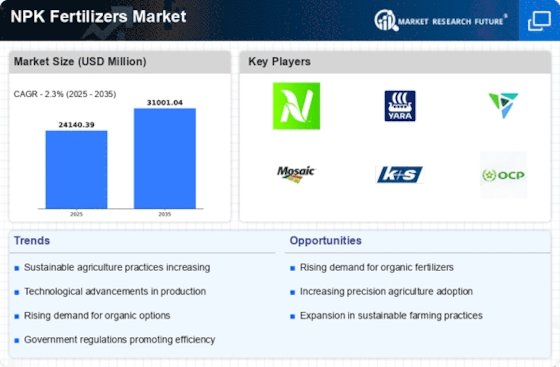
As per Market Research Future analysis, the NPK Fertilizers Market Size was estimated at 24140.39 USD Million in 2024. The NPK Fertilizers industry is projected to grow from 24695.62 USD Million in 2025 to 31001.04 USD Million by 2035, exhibiting a compound annual growth rate (CAGR) of 2.3% during the forecast period 2025 - 2035

Key Market Trends & Highlights

The NPK fertilizers market is experiencing a shift towards sustainable practices and technological advancements.

  • North America remains the largest market for NPK fertilizers, driven by advanced agricultural practices and high demand. Asia-Pacific is the fastest-growing region, reflecting a surge in agricultural investments and modernization efforts. Cereals and grains dominate the market, while oilseeds and pulses are emerging as the fastest-growing segments. Key market drivers include increasing agricultural productivity and rising awareness of soil health, which are shaping industry dynamics.

Market Size & Forecast

2024 Market Size 24140.39 (USD Million)
2035 Market Size 31001.04 (USD Million)
CAGR (2025 - 2035) 2.3%
Largest Regional Market Share in 2024 Asia Pacific

Major Players

<a href="https://www.nutrien.com/">Nutrien (CA)</a>, Yara International (NO), CF Industries (US), The Mosaic Company (US), K+S AG (DE), OCP Group (MA), ICL Group (IL), EuroChem Group (RU), Uralchem (RU)

Market Trends

The NPK Fertilizers Market is currently experiencing a dynamic phase characterized by evolving agricultural practices and increasing demand for efficient crop nutrition solutions. As global populations rise, the necessity for enhanced food production becomes more pressing. This market appears to be influenced by various factors, including advancements in fertilizer technology, environmental regulations, and the growing awareness of sustainable farming practices. Stakeholders in the agricultural sector are increasingly recognizing the importance of balanced nutrient supply, which NPK fertilizers provide, thereby driving market growth. Moreover, the NPK Fertilizers Market seems to be adapting to changing consumer preferences, with a noticeable shift towards organic and eco-friendly products. This trend indicates a potential for innovation in product formulations, as manufacturers strive to meet the demands of environmentally conscious farmers. Additionally, the integration of precision agriculture techniques may further enhance the efficiency of NPK fertilizers, optimizing their application and minimizing waste. As the market evolves, it is likely that collaboration between agricultural scientists and industry players will play a crucial role in shaping future developments.

Sustainable Practices Adoption

The NPK fertilizer market size US continues to expand steadily, supported by strong demand from commercial farming, horticulture, and sustainable agriculture practices, while interest in balanced nutrient solutions keeps market momentum positive. Although NPK fertilizer price per ton USA varies based on formulation, raw material availability, and seasonal demand, buyers increasingly focus on value-driven performance rather than cost alone. Several well-established NPK fertilizer manufacturers USA cater to diverse crop requirements by offering customized blends that improve soil fertility and nutrient efficiency. Farmers often seek guidance on the best NPK fertilizer for crops, which typically depends on soil condition, crop type, and growth stage, making balanced formulations a popular choice. Among them, NPK fertilizer 15-15-15 uses are especially widespread, as this evenly balanced blend supports root development, vegetative growth, and flowering across cereals, vegetables, fruits, and cash crops, making it a preferred option for achieving consistent yields and long-term soil health in the US agricultural landscape.

The NPK Fertilizers Market is witnessing a growing trend towards sustainable agricultural practices. Farmers are increasingly seeking fertilizers that not only enhance crop yield but also minimize environmental impact. This shift is prompting manufacturers to innovate and develop eco-friendly formulations that align with sustainability goals.

Technological Advancements

Technological innovations are significantly influencing the NPK Fertilizers Market. The introduction of precision agriculture tools and smart fertilizers is enabling more efficient nutrient management. These advancements allow for targeted application, reducing waste and improving overall crop productivity.

Rising Demand for Organic Products

There is a noticeable increase in consumer demand for organic produce, which is impacting the NPK Fertilizers Market. As farmers transition towards organic farming methods, the need for organic-compatible fertilizers is becoming more pronounced. This trend is encouraging manufacturers to explore new formulations that cater to this growing segment.

NPK Fertilizers Market Market Drivers

Rising Awareness of Soil Health

There is a growing awareness regarding soil health and its direct correlation with crop productivity, which is influencing the NPK Fertilizers Market. Farmers are increasingly recognizing that healthy soil is fundamental to sustainable agriculture. NPK fertilizers play a vital role in maintaining soil fertility by replenishing essential nutrients that may be depleted over time. Research indicates that soils treated with balanced NPK fertilizers exhibit improved structure and nutrient availability, leading to better crop performance. This heightened awareness is prompting farmers to invest in NPK fertilizers, thereby driving demand within the market. As educational programs and resources become more accessible, the emphasis on soil health is expected to further propel the NPK Fertilizers Market.

Government Initiatives and Subsidies

Government initiatives aimed at boosting agricultural output are playing a pivotal role in the NPK Fertilizers Market. Many governments are implementing subsidy programs to encourage farmers to adopt modern fertilization practices. These initiatives often include financial assistance for purchasing NPK fertilizers, which can significantly reduce the cost burden on farmers. For instance, in several countries, subsidies have led to a marked increase in the adoption of NPK fertilizers, contributing to a rise in overall agricultural productivity. This supportive policy environment is likely to continue fostering growth in the NPK Fertilizers Market, as more farmers seek to optimize their yields through the use of these essential fertilizers.

Increasing Agricultural Productivity

The NPK Fertilizers Market is experiencing a surge in demand due to the pressing need for increased agricultural productivity. As the global population continues to rise, the demand for food production intensifies. NPK fertilizers, which provide essential nutrients such as nitrogen, phosphorus, and potassium, are crucial for enhancing crop yields. According to recent data, the use of NPK fertilizers can increase crop productivity by up to 30%. This trend is particularly evident in regions where traditional farming practices are being supplemented with modern agricultural techniques. Farmers are increasingly recognizing the importance of balanced fertilization, which is driving the growth of the NPK Fertilizers Market.

Growing Demand for Sustainable Agriculture

The increasing demand for sustainable agricultural practices is shaping the NPK Fertilizers Market. Consumers are becoming more conscious of the environmental impact of farming, leading to a preference for products that promote sustainability. NPK fertilizers, particularly those derived from organic sources, are gaining popularity as they align with the principles of sustainable agriculture. The market for organic NPK fertilizers is projected to grow as farmers seek to meet consumer demand for eco-friendly products. This trend is likely to encourage more producers to innovate and develop sustainable NPK fertilizer options, thereby expanding the NPK Fertilizers Market in response to changing consumer preferences.

Technological Innovations in Fertilizer Production

Technological advancements in fertilizer production are significantly impacting the NPK Fertilizers Market. Innovations such as precision agriculture and smart fertilizers are enhancing the efficiency of nutrient delivery to crops. These technologies allow for the precise application of NPK fertilizers, minimizing waste and maximizing crop uptake. Furthermore, the development of slow-release and controlled-release fertilizers is gaining traction, as they provide nutrients to plants over an extended period, reducing the frequency of application. This shift towards more efficient fertilizer use is likely to attract more farmers to the NPK Fertilizers Market, as they seek to optimize their input costs while improving crop yields.

Market Segment Insights

By Crop Type: Cereals & Grains (Largest) vs. Oilseeds & Pulses (Fastest-Growing)

In the NPK fertilizers market, the crop type segment exhibits a diversified share distribution. Cereals and grains take up the largest portion due to their widespread cultivation and global demand for staple foods. On the other hand, oilseeds and pulses are increasingly gaining traction, driven by rising health trends and their pivotal role in sustainable agriculture practices. This dynamic between the established dominance of cereals and the emerging interests in oilseeds and pulses highlights the evolving agricultural landscape.

Cereals &amp; Grains (Dominant) vs. Oilseeds &amp; Pulses (Emerging)

Cereals and grains stand as the dominant segment within the NPK fertilizers market, primarily due to their extensive use in food production and livestock feed. Their robust requirement for fertilizers enhances yield and quality, making them a focal point for farmers. Conversely, oilseeds and pulses are emerging as critical segments, propelled by trends towards plant-based diets and increased consumer awareness regarding health benefits. These crops require tailored fertilization strategies to optimize their growth and nutritional value, contributing to a sustainable agricultural framework. As demand for diverse food sources grows, the focus on oilseeds and pulses is set to rise, indicating a shift in fertilizer application strategies.

By Mode of Application: Fertigation (Largest) vs. Foliar (Fastest-Growing)

In the NPK Fertilizers Market, the mode of application has seen a significant distribution in preference, with <a href="https://www.marketresearchfuture.com/reports/fertigation-market-4540" target="_blank" title="fertigation">fertigation</a> holding the largest share among all application methods. This method allows for the efficient delivery of nutrients directly to the plant's root zone through irrigation systems, thus catering to a large number of farmers and commercial growers. Foliar application, although a smaller segment, is gaining traction among farmers looking for quick nutrient absorption, addressing immediate crop needs.

Fertigation (Dominant) vs. Foliar (Emerging)

Fertigation has emerged as the dominant mode of application in the NPK Fertilizers Market, driven by its efficiency and effectiveness in delivering essential nutrients directly to crops. This method optimizes resource use, reduces wastage, and enhances crop yield, making it highly preferred in large-scale farming. On the other hand, foliar application is gaining ground as an emerging trend, particularly among smallholder farmers who seek immediate solutions to nutrient deficiencies. It allows for targeted application and quick results, which appeals to growers aiming for rapid crop adjustments, especially in high-stress conditions. As awareness grows and technology improves, foliar applications are projected to become more mainstream, further diversifying the market offerings.

By Form: Dry (Largest) vs. Liquid (Fastest-Growing)

In the NPK fertilizers market, the distribution between dry and liquid forms reveals a clear preference for dry fertilizers, which hold the largest market share. This preference can be attributed to the stability and longer shelf life that dry fertilizers offer, making them a common choice among farmers and agricultural businesses. Conversely, liquid NPK fertilizers are gaining traction due to their ease of application and nutrient availability, appealing to a growing segment of environmentally-conscious farmers seeking efficiency and effectiveness in their fertilization processes.

Form: Dry (Dominant) vs. Liquid (Emerging)

Dry NPK fertilizers dominate the market, characterized by their long shelf life and convenience in storage and transportation. They are often preferred for large-scale agricultural applications, where bulk spreading methods are employed. On the other hand, liquid NPK fertilizers represent an emerging market segment, known for their rapid nutrient uptake by plants, which can lead to quicker visible results. This segment is benefiting from innovations in formulation and delivery systems, drawing interest from those looking to adopt more modern agricultural practices. As both segments evolve, the comparative advantages they offer will play a critical role in shaping farmer preferences.

Get more detailed insights about NPK Fertilizers Market Research Report - Forecast till 2035

Regional Insights

By region, the study provides market insights into North America, Europe, Asia-Pacific and the Rest of the World. The Asia-Pacific NPK fertilizers market accounted for USD 10,327.2 million in 2021 and is expected to exhibit a significant CAGR growth during the study period. The agriculture sector in Asia-Pacific is becoming increasingly professional and technologically advanced due to the high demand for NPK fertilizers for wheat, rice, fruits, and vegetable farming. Countries like India, China, and Japan are helping to drive the growth of the NPK fertilizers market.

Further, the major countries studied in the NPK fertilizers market report are: The U.S., Canada, Germany, France, the UK, Italy, Spain, China, Japan, India, Australia, South Korea, and Brazil.

North America NPK fertilizers market accounts for the second-largest market share due to the shortage of arable land, awareness among farmers about the importance of nutrients for crop growth, and growing urbanization are all factors propelling the growth of the NPK fertilizers market in North America. Further, the U.S. NPK fertilizers market held the largest market share, and the Canada NPK fertilizers market was the fastest-growing market in the North American region

The Europe NPK fertilizers market is expected to grow at the fastest CAGR from 2022 to 2030. Introducing and adopting new technology is one of the main factors dominating the market. Moreover, the German NPK fertilizers market held the largest market share, and the U.K. NPK fertilizers market was the fastest-growing market in the Asia-Pacific region

Key Players and Competitive Insights

Major market players are spending a lot on R&D to increase their product lines, which will help the NPK fertilizers market grow even more. Market participants are also taking various strategic initiatives to grow their worldwide footprint, with key market developments such as new product launches, contractual agreements, mergers and acquisitions, increased investments, and collaboration with other organizations. Competitors in the NPK fertilizers industry must offer cost-effective items to expand and survive in an increasingly competitive and rising market environment. One of the primary business strategies manufacturers adopt in the  NPK fertilizers industry to benefit clients and expand the market sector is manufacturing locally to reduce operating costs. The NPK fertilizers industry has provided medicine with some of the most significant benefits in recent years. The NPK fertilizers markets major players such as BASF SE (Germany), Borealis AG (Austria), Coromandel International (India), Yara International (Norway) and others are working on expanding the market demand by investing in research and development activities. BASF SE (Germany) is a  chemical company. In addition to chemicals and plastics, BASF offers various solution functional and agricultural, and oil and gas products in its six segments. As part of its services and products, BASF provides a range of system solutions and services to industries such as chemicals, automotive, construction, agriculture, oil, plastics, electrical, electronics, furniture, and paper. Also, Coromandel International (India) manufactures fertilizers and pesticides. The company manufactures chemical and organic fertilizers, insecticides, fungicides, herbicides, and plant biostimulants. Coromandel introduced a range of Specialty Nutrients products in its quest to offer a complete plant nutrition solution. In addition to insecticides, fungicides, and herbicides, the Crop Protection business markets these products throughout India. Among the fertilizers produced by Coromandel International Ltd, GroShakti Plus was launched in September 2021 to help farmers enhance yields and quality. With GroShakti Plus, farmers can enjoy high-quality products that provide them with perfectly balanced nutrition. GroShakti Plus contains all three major nutrients (NPK). It has the highest nutrient content of complex fertilizers and Phosphorous content.

Key Companies in the NPK Fertilizers Market include

Industry Developments

Industry development in the NPK Fertilizers Market is currently shaped by a move toward specialty formulations and digital integration. Manufacturers are increasingly shifting from standard bulk blends to water-soluble and controlled-release products tailored for precision agriculture.

Technological advancements have introduced PLC-controlled automation in production lines, ensuring precise nutrient batching and reduced waste. Furthermore, the integration of IoT sensors and AI-driven agronomy platforms allows for variable-rate applications, helping farmers optimize soil health while meeting stricter environmental regulations regarding nutrient runoff.

Q2 2024: IFFCO achieves record sales of 365 lakh bottles of nano-fertilizers in 2024-25 IFFCO reported a 47% year-over-year increase in nano-fertilizer sales, reaching 365 lakh bottles sold in the 2024-2025 period, highlighting rapid adoption of precision nutrient solutions in India.

Future Outlook

NPK Fertilizers Market Future Outlook

The NPK <a href="https://www.marketresearchfuture.com/reports/fertilizers-market-68189" target="_blank" title="fertilizers">Fertilizers</a> Market is projected to grow at a 2.3% CAGR from 2024 to 2035, driven by increasing agricultural demand, technological advancements, and sustainable practices.<br>The future of the NPK Fertilizers Market is centered on nutrient efficiency and sustainability. Growth is driven by the global need for food security and a shift toward specialty blends, such as liquid and controlled-release formulations. Innovations in precision agriculture and green ammonia production are helping farmers optimize yields while addressing environmental regulations and reducing nutrient runoff.<br>By 2035, the NPK Fertilizers Market is expected to achieve robust growth, reflecting evolving agricultural needs.

New opportunities lie in:

  • <p>Development of precision agriculture technologies for targeted nutrient application. Expansion into emerging markets with tailored NPK formulations. Investment in eco-friendly production processes to meet regulatory standards.</p>

By 2035, the NPK Fertilizers Market is expected to achieve robust growth, reflecting evolving agricultural needs.

Market Segmentation

NPK Fertilizers Market Form Outlook

  • Dry
  • Liquid

NPK Fertilizers Market Crop Type Outlook

  • Cereals & Grains
  • Oilseeds & Pulses
  • Fruits & Vegetables
  • Others

NPK Fertilizers Market Mode of Application Outlook

  • Fertigation
  • Foliar
  • Others

Report Scope

MARKET SIZE 2024 24140.39(USD Million)
MARKET SIZE 2025 24695.62(USD Million)
MARKET SIZE 2035 31001.04(USD Million)
COMPOUND ANNUAL GROWTH RATE (CAGR) 2.3% (2025 - 2035)
REPORT COVERAGE Revenue Forecast, Competitive Landscape, Growth Factors, and Trends
BASE YEAR 2024
Market Forecast Period 2025 - 2035
Historical Data 2019 - 2024
Market Forecast Units USD Million
Key Companies Profiled Nutrien (CA), Yara International (NO), CF Industries (US), The Mosaic Company (US), K+S AG (DE), OCP Group (MA), ICL Group (IL), EuroChem Group (RU), Uralchem (RU)
Segments Covered Crop Type, Mode of Application, Form, Region
Key Market Opportunities Adoption of precision agriculture technologies enhances efficiency in the NPK Fertilizers Market.
Key Market Dynamics Rising demand for sustainable agriculture drives innovation and competition in the NPK fertilizers market.
Countries Covered North America, Europe, APAC, South America, MEA

FAQs

What is the current valuation of the NPK Fertilizers Market as of 2024?

<p>The NPK Fertilizers Market was valued at approximately 24140.39 USD Million in 2024.</p>

What is the projected market valuation for NPK Fertilizers by 2035?

<p>The market is projected to reach a valuation of around 31001.04 USD Million by 2035.</p>

What is the expected CAGR for the NPK Fertilizers Market during the forecast period 2025 - 2035?

<p>The expected CAGR for the NPK Fertilizers Market during the forecast period 2025 - 2035 is 2.3%.</p>

Which crop types are the largest segments in the NPK Fertilizers Market?

<p>Cereals & Grains represent the largest segment, with a valuation increase from 10000.0 to 13000.0 USD Million.</p>

How do the valuations of Oilseeds & Pulses compare to Fruits & Vegetables in the NPK Fertilizers Market?

<p>Oilseeds & Pulses are valued between 6000.0 and 8000.0 USD Million, while Fruits & Vegetables range from 5000.0 to 6000.0 USD Million.</p>

What are the primary modes of application for NPK Fertilizers?

<p>The primary modes of application include Fertigation, valued between 10000.0 and 13000.0 USD Million, and Foliar, ranging from 8000.0 to 10000.0 USD Million.</p>

What forms of NPK Fertilizers are available in the market?

<p>The market offers Dry forms, valued between 14484.39 and 18601.04 USD Million, and Liquid forms, ranging from 9646.0 to 12400.0 USD Million.</p>

Who are the key players in the NPK Fertilizers Market?

<p>Key players include Nutrien, Yara International, CF Industries, and The Mosaic Company, among others.</p>

What is the potential growth outlook for the NPK Fertilizers Market?

<p>The market appears poised for growth, with a projected increase in valuation from 24140.39 USD Million in 2024 to 31001.04 USD Million by 2035.</p>

How does the NPK Fertilizers Market performance vary by segment?

<p>The market performance varies, with Crop Type segments like Cereals & Grains and Oilseeds & Pulses showing substantial valuations.</p>

  1. SECTION I: EXECUTIVE SUMMARY AND KEY HIGHLIGHTS
    1. | 1.1 EXECUTIVE SUMMARY
    2. | | 1.1.1 Market Overview
    3. | | 1.1.2 Key Findings
    4. | | 1.1.3 Market Segmentation
    5. | | 1.1.4 Competitive Landscape
    6. | | 1.1.5 Challenges and Opportunities
    7. | | 1.1.6 Future Outlook
  2. SECTION II: SCOPING, METHODOLOGY AND MARKET STRUCTURE
    1. | 2.1 MARKET INTRODUCTION
    2. | | 2.1.1 Definition
    3. | | 2.1.2 Scope of the study
    4. | | | 2.1.2.1 Research Objective
    5. | | | 2.1.2.2 Assumption
    6. | | | 2.1.2.3 Limitations
    7. | 2.2 RESEARCH METHODOLOGY
    8. | | 2.2.1 Overview
    9. | | 2.2.2 Data Mining
    10. | | 2.2.3 Secondary Research
    11. | | 2.2.4 Primary Research
    12. | | | 2.2.4.1 Primary Interviews and Information Gathering Process
    13. | | | 2.2.4.2 Breakdown of Primary Respondents
    14. | | 2.2.5 Forecasting Model
    15. | | 2.2.6 Market Size Estimation
    16. | | | 2.2.6.1 Bottom-Up Approach
    17. | | | 2.2.6.2 Top-Down Approach
    18. | | 2.2.7 Data Triangulation
    19. | | 2.2.8 Validation
  3. SECTION III: QUALITATIVE ANALYSIS
    1. | 3.1 MARKET DYNAMICS
    2. | | 3.1.1 Overview
    3. | | 3.1.2 Drivers
    4. | | 3.1.3 Restraints
    5. | | 3.1.4 Opportunities
    6. | 3.2 MARKET FACTOR ANALYSIS
    7. | | 3.2.1 Value chain Analysis
    8. | | 3.2.2 Porter's Five Forces Analysis
    9. | | | 3.2.2.1 Bargaining Power of Suppliers
    10. | | | 3.2.2.2 Bargaining Power of Buyers
    11. | | | 3.2.2.3 Threat of New Entrants
    12. | | | 3.2.2.4 Threat of Substitutes
    13. | | | 3.2.2.5 Intensity of Rivalry
    14. | | 3.2.3 COVID-19 Impact Analysis
    15. | | | 3.2.3.1 Market Impact Analysis
    16. | | | 3.2.3.2 Regional Impact
    17. | | | 3.2.3.3 Opportunity and Threat Analysis
  4. SECTION IV: QUANTITATIVE ANALYSIS
    1. | 4.1 Industrial Automation & Equipment, BY Crop Type (USD Million)
    2. | | 4.1.1 Cereals & Grains
    3. | | 4.1.2 Oilseeds & Pulses
    4. | | 4.1.3 Fruits & Vegetables
    5. | | 4.1.4 Others
    6. | 4.2 Industrial Automation & Equipment, BY Mode of Application (USD Million)
    7. | | 4.2.1 Fertigation
    8. | | 4.2.2 Foliar
    9. | | 4.2.3 Others
    10. | 4.3 Industrial Automation & Equipment, BY Form (USD Million)
    11. | | 4.3.1 Dry
    12. | | 4.3.2 Liquid
    13. | 4.4 Industrial Automation & Equipment, BY Region (USD Million)
    14. | | 4.4.1 North America
    15. | | | 4.4.1.1 US
    16. | | | 4.4.1.2 Canada
    17. | | 4.4.2 Europe
    18. | | | 4.4.2.1 Germany
    19. | | | 4.4.2.2 UK
    20. | | | 4.4.2.3 France
    21. | | | 4.4.2.4 Russia
    22. | | | 4.4.2.5 Italy
    23. | | | 4.4.2.6 Spain
    24. | | | 4.4.2.7 Rest of Europe
    25. | | 4.4.3 APAC
    26. | | | 4.4.3.1 China
    27. | | | 4.4.3.2 India
    28. | | | 4.4.3.3 Japan
    29. | | | 4.4.3.4 South Korea
    30. | | | 4.4.3.5 Malaysia
    31. | | | 4.4.3.6 Thailand
    32. | | | 4.4.3.7 Indonesia
    33. | | | 4.4.3.8 Rest of APAC
    34. | | 4.4.4 South America
    35. | | | 4.4.4.1 Brazil
    36. | | | 4.4.4.2 Mexico
    37. | | | 4.4.4.3 Argentina
    38. | | | 4.4.4.4 Rest of South America
    39. | | 4.4.5 MEA
    40. | | | 4.4.5.1 GCC Countries
    41. | | | 4.4.5.2 South Africa
    42. | | | 4.4.5.3 Rest of MEA
  5. SECTION V: COMPETITIVE ANALYSIS
    1. | 5.1 Competitive Landscape
    2. | | 5.1.1 Overview
    3. | | 5.1.2 Competitive Analysis
    4. | | 5.1.3 Market share Analysis
    5. | | 5.1.4 Major Growth Strategy in the Industrial Automation & Equipment
    6. | | 5.1.5 Competitive Benchmarking
    7. | | 5.1.6 Leading Players in Terms of Number of Developments in the Industrial Automation & Equipment
    8. | | 5.1.7 Key developments and growth strategies
    9. | | | 5.1.7.1 New Product Launch/Service Deployment
    10. | | | 5.1.7.2 Merger & Acquisitions
    11. | | | 5.1.7.3 Joint Ventures
    12. | | 5.1.8 Major Players Financial Matrix
    13. | | | 5.1.8.1 Sales and Operating Income
    14. | | | 5.1.8.2 Major Players R&D Expenditure. 2023
    15. | 5.2 Company Profiles
    16. | | 5.2.1 Nutrien (CA)
    17. | | | 5.2.1.1 Financial Overview
    18. | | | 5.2.1.2 Products Offered
    19. | | | 5.2.1.3 Key Developments
    20. | | | 5.2.1.4 SWOT Analysis
    21. | | | 5.2.1.5 Key Strategies
    22. | | 5.2.2 Yara International (NO)
    23. | | | 5.2.2.1 Financial Overview
    24. | | | 5.2.2.2 Products Offered
    25. | | | 5.2.2.3 Key Developments
    26. | | | 5.2.2.4 SWOT Analysis
    27. | | | 5.2.2.5 Key Strategies
    28. | | 5.2.3 CF Industries (US)
    29. | | | 5.2.3.1 Financial Overview
    30. | | | 5.2.3.2 Products Offered
    31. | | | 5.2.3.3 Key Developments
    32. | | | 5.2.3.4 SWOT Analysis
    33. | | | 5.2.3.5 Key Strategies
    34. | | 5.2.4 The Mosaic Company (US)
    35. | | | 5.2.4.1 Financial Overview
    36. | | | 5.2.4.2 Products Offered
    37. | | | 5.2.4.3 Key Developments
    38. | | | 5.2.4.4 SWOT Analysis
    39. | | | 5.2.4.5 Key Strategies
    40. | | 5.2.5 K+S AG (DE)
    41. | | | 5.2.5.1 Financial Overview
    42. | | | 5.2.5.2 Products Offered
    43. | | | 5.2.5.3 Key Developments
    44. | | | 5.2.5.4 SWOT Analysis
    45. | | | 5.2.5.5 Key Strategies
    46. | | 5.2.6 OCP Group (MA)
    47. | | | 5.2.6.1 Financial Overview
    48. | | | 5.2.6.2 Products Offered
    49. | | | 5.2.6.3 Key Developments
    50. | | | 5.2.6.4 SWOT Analysis
    51. | | | 5.2.6.5 Key Strategies
    52. | | 5.2.7 ICL Group (IL)
    53. | | | 5.2.7.1 Financial Overview
    54. | | | 5.2.7.2 Products Offered
    55. | | | 5.2.7.3 Key Developments
    56. | | | 5.2.7.4 SWOT Analysis
    57. | | | 5.2.7.5 Key Strategies
    58. | | 5.2.8 EuroChem Group (RU)
    59. | | | 5.2.8.1 Financial Overview
    60. | | | 5.2.8.2 Products Offered
    61. | | | 5.2.8.3 Key Developments
    62. | | | 5.2.8.4 SWOT Analysis
    63. | | | 5.2.8.5 Key Strategies
    64. | | 5.2.9 Uralchem (RU)
    65. | | | 5.2.9.1 Financial Overview
    66. | | | 5.2.9.2 Products Offered
    67. | | | 5.2.9.3 Key Developments
    68. | | | 5.2.9.4 SWOT Analysis
    69. | | | 5.2.9.5 Key Strategies
    70. | 5.3 Appendix
    71. | | 5.3.1 References
    72. | | 5.3.2 Related Reports
  6. LIST OF FIGURES
    1. | 6.1 MARKET SYNOPSIS
    2. | 6.2 NORTH AMERICA MARKET ANALYSIS
    3. | 6.3 US MARKET ANALYSIS BY CROP TYPE
    4. | 6.4 US MARKET ANALYSIS BY MODE OF APPLICATION
    5. | 6.5 US MARKET ANALYSIS BY FORM
    6. | 6.6 CANADA MARKET ANALYSIS BY CROP TYPE
    7. | 6.7 CANADA MARKET ANALYSIS BY MODE OF APPLICATION
    8. | 6.8 CANADA MARKET ANALYSIS BY FORM
    9. | 6.9 EUROPE MARKET ANALYSIS
    10. | 6.10 GERMANY MARKET ANALYSIS BY CROP TYPE
    11. | 6.11 GERMANY MARKET ANALYSIS BY MODE OF APPLICATION
    12. | 6.12 GERMANY MARKET ANALYSIS BY FORM
    13. | 6.13 UK MARKET ANALYSIS BY CROP TYPE
    14. | 6.14 UK MARKET ANALYSIS BY MODE OF APPLICATION
    15. | 6.15 UK MARKET ANALYSIS BY FORM
    16. | 6.16 FRANCE MARKET ANALYSIS BY CROP TYPE
    17. | 6.17 FRANCE MARKET ANALYSIS BY MODE OF APPLICATION
    18. | 6.18 FRANCE MARKET ANALYSIS BY FORM
    19. | 6.19 RUSSIA MARKET ANALYSIS BY CROP TYPE
    20. | 6.20 RUSSIA MARKET ANALYSIS BY MODE OF APPLICATION
    21. | 6.21 RUSSIA MARKET ANALYSIS BY FORM
    22. | 6.22 ITALY MARKET ANALYSIS BY CROP TYPE
    23. | 6.23 ITALY MARKET ANALYSIS BY MODE OF APPLICATION
    24. | 6.24 ITALY MARKET ANALYSIS BY FORM
    25. | 6.25 SPAIN MARKET ANALYSIS BY CROP TYPE
    26. | 6.26 SPAIN MARKET ANALYSIS BY MODE OF APPLICATION
    27. | 6.27 SPAIN MARKET ANALYSIS BY FORM
    28. | 6.28 REST OF EUROPE MARKET ANALYSIS BY CROP TYPE
    29. | 6.29 REST OF EUROPE MARKET ANALYSIS BY MODE OF APPLICATION
    30. | 6.30 REST OF EUROPE MARKET ANALYSIS BY FORM
    31. | 6.31 APAC MARKET ANALYSIS
    32. | 6.32 CHINA MARKET ANALYSIS BY CROP TYPE
    33. | 6.33 CHINA MARKET ANALYSIS BY MODE OF APPLICATION
    34. | 6.34 CHINA MARKET ANALYSIS BY FORM
    35. | 6.35 INDIA MARKET ANALYSIS BY CROP TYPE
    36. | 6.36 INDIA MARKET ANALYSIS BY MODE OF APPLICATION
    37. | 6.37 INDIA MARKET ANALYSIS BY FORM
    38. | 6.38 JAPAN MARKET ANALYSIS BY CROP TYPE
    39. | 6.39 JAPAN MARKET ANALYSIS BY MODE OF APPLICATION
    40. | 6.40 JAPAN MARKET ANALYSIS BY FORM
    41. | 6.41 SOUTH KOREA MARKET ANALYSIS BY CROP TYPE
    42. | 6.42 SOUTH KOREA MARKET ANALYSIS BY MODE OF APPLICATION
    43. | 6.43 SOUTH KOREA MARKET ANALYSIS BY FORM
    44. | 6.44 MALAYSIA MARKET ANALYSIS BY CROP TYPE
    45. | 6.45 MALAYSIA MARKET ANALYSIS BY MODE OF APPLICATION
    46. | 6.46 MALAYSIA MARKET ANALYSIS BY FORM
    47. | 6.47 THAILAND MARKET ANALYSIS BY CROP TYPE
    48. | 6.48 THAILAND MARKET ANALYSIS BY MODE OF APPLICATION
    49. | 6.49 THAILAND MARKET ANALYSIS BY FORM
    50. | 6.50 INDONESIA MARKET ANALYSIS BY CROP TYPE
    51. | 6.51 INDONESIA MARKET ANALYSIS BY MODE OF APPLICATION
    52. | 6.52 INDONESIA MARKET ANALYSIS BY FORM
    53. | 6.53 REST OF APAC MARKET ANALYSIS BY CROP TYPE
    54. | 6.54 REST OF APAC MARKET ANALYSIS BY MODE OF APPLICATION
    55. | 6.55 REST OF APAC MARKET ANALYSIS BY FORM
    56. | 6.56 SOUTH AMERICA MARKET ANALYSIS
    57. | 6.57 BRAZIL MARKET ANALYSIS BY CROP TYPE
    58. | 6.58 BRAZIL MARKET ANALYSIS BY MODE OF APPLICATION
    59. | 6.59 BRAZIL MARKET ANALYSIS BY FORM
    60. | 6.60 MEXICO MARKET ANALYSIS BY CROP TYPE
    61. | 6.61 MEXICO MARKET ANALYSIS BY MODE OF APPLICATION
    62. | 6.62 MEXICO MARKET ANALYSIS BY FORM
    63. | 6.63 ARGENTINA MARKET ANALYSIS BY CROP TYPE
    64. | 6.64 ARGENTINA MARKET ANALYSIS BY MODE OF APPLICATION
    65. | 6.65 ARGENTINA MARKET ANALYSIS BY FORM
    66. | 6.66 REST OF SOUTH AMERICA MARKET ANALYSIS BY CROP TYPE
    67. | 6.67 REST OF SOUTH AMERICA MARKET ANALYSIS BY MODE OF APPLICATION
    68. | 6.68 REST OF SOUTH AMERICA MARKET ANALYSIS BY FORM
    69. | 6.69 MEA MARKET ANALYSIS
    70. | 6.70 GCC COUNTRIES MARKET ANALYSIS BY CROP TYPE
    71. | 6.71 GCC COUNTRIES MARKET ANALYSIS BY MODE OF APPLICATION
    72. | 6.72 GCC COUNTRIES MARKET ANALYSIS BY FORM
    73. | 6.73 SOUTH AFRICA MARKET ANALYSIS BY CROP TYPE
    74. | 6.74 SOUTH AFRICA MARKET ANALYSIS BY MODE OF APPLICATION
    75. | 6.75 SOUTH AFRICA MARKET ANALYSIS BY FORM
    76. | 6.76 REST OF MEA MARKET ANALYSIS BY CROP TYPE
    77. | 6.77 REST OF MEA MARKET ANALYSIS BY MODE OF APPLICATION
    78. | 6.78 REST OF MEA MARKET ANALYSIS BY FORM
    79. | 6.79 KEY BUYING CRITERIA OF INDUSTRIAL AUTOMATION & EQUIPMENT
    80. | 6.80 RESEARCH PROCESS OF MRFR
    81. | 6.81 DRO ANALYSIS OF INDUSTRIAL AUTOMATION & EQUIPMENT
    82. | 6.82 DRIVERS IMPACT ANALYSIS: INDUSTRIAL AUTOMATION & EQUIPMENT
    83. | 6.83 RESTRAINTS IMPACT ANALYSIS: INDUSTRIAL AUTOMATION & EQUIPMENT
    84. | 6.84 SUPPLY / VALUE CHAIN: INDUSTRIAL AUTOMATION & EQUIPMENT
    85. | 6.85 INDUSTRIAL AUTOMATION & EQUIPMENT, BY CROP TYPE, 2024 (% SHARE)
    86. | 6.86 INDUSTRIAL AUTOMATION & EQUIPMENT, BY CROP TYPE, 2024 TO 2035 (USD Million)
    87. | 6.87 INDUSTRIAL AUTOMATION & EQUIPMENT, BY MODE OF APPLICATION, 2024 (% SHARE)
    88. | 6.88 INDUSTRIAL AUTOMATION & EQUIPMENT, BY MODE OF APPLICATION, 2024 TO 2035 (USD Million)
    89. | 6.89 INDUSTRIAL AUTOMATION & EQUIPMENT, BY FORM, 2024 (% SHARE)
    90. | 6.90 INDUSTRIAL AUTOMATION & EQUIPMENT, BY FORM, 2024 TO 2035 (USD Million)
    91. | 6.91 BENCHMARKING OF MAJOR COMPETITORS
  7. LIST OF TABLES
    1. | 7.1 LIST OF ASSUMPTIONS
    2. | | 7.1.1
    3. | 7.2 North America MARKET SIZE ESTIMATES; FORECAST
    4. | | 7.2.1 BY CROP TYPE, 2025-2035 (USD Million)
    5. | | 7.2.2 BY MODE OF APPLICATION, 2025-2035 (USD Million)
    6. | | 7.2.3 BY FORM, 2025-2035 (USD Million)
    7. | 7.3 US MARKET SIZE ESTIMATES; FORECAST
    8. | | 7.3.1 BY CROP TYPE, 2025-2035 (USD Million)
    9. | | 7.3.2 BY MODE OF APPLICATION, 2025-2035 (USD Million)
    10. | | 7.3.3 BY FORM, 2025-2035 (USD Million)
    11. | 7.4 Canada MARKET SIZE ESTIMATES; FORECAST
    12. | | 7.4.1 BY CROP TYPE, 2025-2035 (USD Million)
    13. | | 7.4.2 BY MODE OF APPLICATION, 2025-2035 (USD Million)
    14. | | 7.4.3 BY FORM, 2025-2035 (USD Million)
    15. | 7.5 Europe MARKET SIZE ESTIMATES; FORECAST
    16. | | 7.5.1 BY CROP TYPE, 2025-2035 (USD Million)
    17. | | 7.5.2 BY MODE OF APPLICATION, 2025-2035 (USD Million)
    18. | | 7.5.3 BY FORM, 2025-2035 (USD Million)
    19. | 7.6 Germany MARKET SIZE ESTIMATES; FORECAST
    20. | | 7.6.1 BY CROP TYPE, 2025-2035 (USD Million)
    21. | | 7.6.2 BY MODE OF APPLICATION, 2025-2035 (USD Million)
    22. | | 7.6.3 BY FORM, 2025-2035 (USD Million)
    23. | 7.7 UK MARKET SIZE ESTIMATES; FORECAST
    24. | | 7.7.1 BY CROP TYPE, 2025-2035 (USD Million)
    25. | | 7.7.2 BY MODE OF APPLICATION, 2025-2035 (USD Million)
    26. | | 7.7.3 BY FORM, 2025-2035 (USD Million)
    27. | 7.8 France MARKET SIZE ESTIMATES; FORECAST
    28. | | 7.8.1 BY CROP TYPE, 2025-2035 (USD Million)
    29. | | 7.8.2 BY MODE OF APPLICATION, 2025-2035 (USD Million)
    30. | | 7.8.3 BY FORM, 2025-2035 (USD Million)
    31. | 7.9 Russia MARKET SIZE ESTIMATES; FORECAST
    32. | | 7.9.1 BY CROP TYPE, 2025-2035 (USD Million)
    33. | | 7.9.2 BY MODE OF APPLICATION, 2025-2035 (USD Million)
    34. | | 7.9.3 BY FORM, 2025-2035 (USD Million)
    35. | 7.10 Italy MARKET SIZE ESTIMATES; FORECAST
    36. | | 7.10.1 BY CROP TYPE, 2025-2035 (USD Million)
    37. | | 7.10.2 BY MODE OF APPLICATION, 2025-2035 (USD Million)
    38. | | 7.10.3 BY FORM, 2025-2035 (USD Million)
    39. | 7.11 Spain MARKET SIZE ESTIMATES; FORECAST
    40. | | 7.11.1 BY CROP TYPE, 2025-2035 (USD Million)
    41. | | 7.11.2 BY MODE OF APPLICATION, 2025-2035 (USD Million)
    42. | | 7.11.3 BY FORM, 2025-2035 (USD Million)
    43. | 7.12 Rest of Europe MARKET SIZE ESTIMATES; FORECAST
    44. | | 7.12.1 BY CROP TYPE, 2025-2035 (USD Million)
    45. | | 7.12.2 BY MODE OF APPLICATION, 2025-2035 (USD Million)
    46. | | 7.12.3 BY FORM, 2025-2035 (USD Million)
    47. | 7.13 APAC MARKET SIZE ESTIMATES; FORECAST
    48. | | 7.13.1 BY CROP TYPE, 2025-2035 (USD Million)
    49. | | 7.13.2 BY MODE OF APPLICATION, 2025-2035 (USD Million)
    50. | | 7.13.3 BY FORM, 2025-2035 (USD Million)
    51. | 7.14 China MARKET SIZE ESTIMATES; FORECAST
    52. | | 7.14.1 BY CROP TYPE, 2025-2035 (USD Million)
    53. | | 7.14.2 BY MODE OF APPLICATION, 2025-2035 (USD Million)
    54. | | 7.14.3 BY FORM, 2025-2035 (USD Million)
    55. | 7.15 India MARKET SIZE ESTIMATES; FORECAST
    56. | | 7.15.1 BY CROP TYPE, 2025-2035 (USD Million)
    57. | | 7.15.2 BY MODE OF APPLICATION, 2025-2035 (USD Million)
    58. | | 7.15.3 BY FORM, 2025-2035 (USD Million)
    59. | 7.16 Japan MARKET SIZE ESTIMATES; FORECAST
    60. | | 7.16.1 BY CROP TYPE, 2025-2035 (USD Million)
    61. | | 7.16.2 BY MODE OF APPLICATION, 2025-2035 (USD Million)
    62. | | 7.16.3 BY FORM, 2025-2035 (USD Million)
    63. | 7.17 South Korea MARKET SIZE ESTIMATES; FORECAST
    64. | | 7.17.1 BY CROP TYPE, 2025-2035 (USD Million)
    65. | | 7.17.2 BY MODE OF APPLICATION, 2025-2035 (USD Million)
    66. | | 7.17.3 BY FORM, 2025-2035 (USD Million)
    67. | 7.18 Malaysia MARKET SIZE ESTIMATES; FORECAST
    68. | | 7.18.1 BY CROP TYPE, 2025-2035 (USD Million)
    69. | | 7.18.2 BY MODE OF APPLICATION, 2025-2035 (USD Million)
    70. | | 7.18.3 BY FORM, 2025-2035 (USD Million)
    71. | 7.19 Thailand MARKET SIZE ESTIMATES; FORECAST
    72. | | 7.19.1 BY CROP TYPE, 2025-2035 (USD Million)
    73. | | 7.19.2 BY MODE OF APPLICATION, 2025-2035 (USD Million)
    74. | | 7.19.3 BY FORM, 2025-2035 (USD Million)
    75. | 7.20 Indonesia MARKET SIZE ESTIMATES; FORECAST
    76. | | 7.20.1 BY CROP TYPE, 2025-2035 (USD Million)
    77. | | 7.20.2 BY MODE OF APPLICATION, 2025-2035 (USD Million)
    78. | | 7.20.3 BY FORM, 2025-2035 (USD Million)
    79. | 7.21 Rest of APAC MARKET SIZE ESTIMATES; FORECAST
    80. | | 7.21.1 BY CROP TYPE, 2025-2035 (USD Million)
    81. | | 7.21.2 BY MODE OF APPLICATION, 2025-2035 (USD Million)
    82. | | 7.21.3 BY FORM, 2025-2035 (USD Million)
    83. | 7.22 South America MARKET SIZE ESTIMATES; FORECAST
    84. | | 7.22.1 BY CROP TYPE, 2025-2035 (USD Million)
    85. | | 7.22.2 BY MODE OF APPLICATION, 2025-2035 (USD Million)
    86. | | 7.22.3 BY FORM, 2025-2035 (USD Million)
    87. | 7.23 Brazil MARKET SIZE ESTIMATES; FORECAST
    88. | | 7.23.1 BY CROP TYPE, 2025-2035 (USD Million)
    89. | | 7.23.2 BY MODE OF APPLICATION, 2025-2035 (USD Million)
    90. | | 7.23.3 BY FORM, 2025-2035 (USD Million)
    91. | 7.24 Mexico MARKET SIZE ESTIMATES; FORECAST
    92. | | 7.24.1 BY CROP TYPE, 2025-2035 (USD Million)
    93. | | 7.24.2 BY MODE OF APPLICATION, 2025-2035 (USD Million)
    94. | | 7.24.3 BY FORM, 2025-2035 (USD Million)
    95. | 7.25 Argentina MARKET SIZE ESTIMATES; FORECAST
    96. | | 7.25.1 BY CROP TYPE, 2025-2035 (USD Million)
    97. | | 7.25.2 BY MODE OF APPLICATION, 2025-2035 (USD Million)
    98. | | 7.25.3 BY FORM, 2025-2035 (USD Million)
    99. | 7.26 Rest of South America MARKET SIZE ESTIMATES; FORECAST
    100. | | 7.26.1 BY CROP TYPE, 2025-2035 (USD Million)
    101. | | 7.26.2 BY MODE OF APPLICATION, 2025-2035 (USD Million)
    102. | | 7.26.3 BY FORM, 2025-2035 (USD Million)
    103. | 7.27 MEA MARKET SIZE ESTIMATES; FORECAST
    104. | | 7.27.1 BY CROP TYPE, 2025-2035 (USD Million)
    105. | | 7.27.2 BY MODE OF APPLICATION, 2025-2035 (USD Million)
    106. | | 7.27.3 BY FORM, 2025-2035 (USD Million)
    107. | 7.28 GCC Countries MARKET SIZE ESTIMATES; FORECAST
    108. | | 7.28.1 BY CROP TYPE, 2025-2035 (USD Million)
    109. | | 7.28.2 BY MODE OF APPLICATION, 2025-2035 (USD Million)
    110. | | 7.28.3 BY FORM, 2025-2035 (USD Million)
    111. | 7.29 South Africa MARKET SIZE ESTIMATES; FORECAST
    112. | | 7.29.1 BY CROP TYPE, 2025-2035 (USD Million)
    113. | | 7.29.2 BY MODE OF APPLICATION, 2025-2035 (USD Million)
    114. | | 7.29.3 BY FORM, 2025-2035 (USD Million)
    115. | 7.30 Rest of MEA MARKET SIZE ESTIMATES; FORECAST
    116. | | 7.30.1 BY CROP TYPE, 2025-2035 (USD Million)
    117. | | 7.30.2 BY MODE OF APPLICATION, 2025-2035 (USD Million)
    118. | | 7.30.3 BY FORM, 2025-2035 (USD Million)
    119. | 7.31 PRODUCT LAUNCH/PRODUCT DEVELOPMENT/APPROVAL
    120. | | 7.31.1
    121. | 7.32 ACQUISITION/PARTNERSHIP
    122. | | 7.32.1

Industrial Automation & Equipment Market Segmentation

Industrial Automation & Equipment By Crop Type (USD Million, 2025-2035)

  • Cereals & Grains
  • Oilseeds & Pulses
  • Fruits & Vegetables
  • Others

Industrial Automation & Equipment By Mode of Application (USD Million, 2025-2035)

  • Fertigation
  • Foliar
  • Others

Industrial Automation & Equipment By Form (USD Million, 2025-2035)

  • Dry
  • Liquid
Infographic

Free Sample Request

Kindly complete the form below to receive a free sample of this Report

Get Free Sample

Customer Strories

Compare Licence

×
Features License Type
Single User Multiuser License Enterprise User
Price $4,950 $5,950 $7,250
Maximum User Access Limit 1 User Upto 10 Users Unrestricted Access Throughout the Organization
Free Customization
Direct Access to Analyst
Deliverable Format
Platform Access
Discount on Next Purchase 10% 15% 15%
Printable Versions
%>