×
Request Free Sample ×

Kindly complete the form below to receive a free sample of this Report

* Please use a valid business email

Leading companies partner with us for data-driven Insights

clients tt-cursor
Hero Background
English
Chinese
French
Japanese
Korean
German
Spanish

North America Europe Coconut Derivatives Analysis

ID: MRFR/FnB/4888-CR
128 Pages
Pradeep Nandi
August 2018

North America & Europe Coconut Derivatives Market Size, Share, Industry Trend & Analysis Research report: information by type (coconut oil, water, flour, sugar, milk), category (conventional, organic), application (food & beverage, cosmetics, pharmaceuticals), by region Forecast till 2035                                                

Share:
Download PDF ×

We do not share your information with anyone. However, we may send you emails based on your report interest from time to time. You may contact us at any time to opt-out.

North America Europe Coconut Derivatives Infographic
Purchase Options

Market Analysis

In-depth Analysis of North America Europe Coconut Derivatives Industry Landscape

The market trends in the North America and Europe coconut derivatives market have been influenced by various factors, reflecting shifts in consumer preferences, health consciousness, and sustainability concerns. One notable trend is the increasing popularity of coconut-based products as healthier alternatives to traditional ingredients. Consumers in these regions are becoming more mindful of their dietary choices, seeking natural and plant-based options. Coconut derivatives, such as coconut oil, coconut milk, and coconut flour, are perceived as nutritious alternatives due to their unique composition and potential health benefits.

In recent years, there has been a surge in demand for coconut-based products driven by growing awareness of their nutritional properties. Coconut oil, in particular, has gained popularity as a versatile cooking oil and ingredient in various food products. Its high content of medium-chain triglycerides (MCTs) has led to its promotion as a healthier alternative to other cooking oils, such as vegetable or palm oil. This trend is expected to continue as consumers prioritize products perceived to offer health benefits.

Furthermore, the North America and Europe coconut derivatives market is witnessing an expansion beyond traditional applications into new product categories. Coconut milk and coconut cream, for example, are increasingly used in dairy alternatives such as plant-based yogurts, ice creams, and beverages. The creamy texture and subtle flavor of coconut derivatives make them attractive ingredients for vegan and lactose-intolerant consumers seeking dairy-free options.

Sustainability and ethical sourcing have also become key considerations driving market trends in the coconut derivatives industry. Consumers are increasingly concerned about the environmental and social impact of their purchases, leading to a growing demand for sustainably sourced coconut products. Companies in the North America and Europe coconut derivatives market are responding by adopting ethical sourcing practices, such as supporting fair trade initiatives and promoting organic farming methods. This trend reflects a broader shift towards sustainability and transparency in the food industry.

In addition to changing consumer preferences, market trends in the North America and Europe coconut derivatives market are influenced by regulatory developments and technological advancements. Government regulations regarding food labeling, health claims, and import/export requirements can impact market dynamics and product availability. Technological innovations in processing and packaging are also driving improvements in product quality and shelf-life, expanding the range of coconut derivatives available to consumers.

Moreover, the COVID-19 pandemic has had both short-term and long-term effects on the coconut derivatives market in North America and Europe. While disruptions to supply chains and changes in consumer behavior initially impacted sales and distribution channels, the pandemic has also accelerated certain trends such as the demand for health-focused products and online shopping. As the world adapts to the "new normal," the coconut derivatives market is expected to continue evolving in response to changing consumer needs and market dynamics.

Author
Pradeep Nandi
Senior Research Analyst

I have a bachelor's degree in mechanical engineering and an MBA. I have more than two years of expertise in the retail, food, and beverage, chemical, and material industries, and hence have developed a sound cross-domain expertise. A firm believer in lifelong learning and sharing of knowledge. Having a proclivity for hatching ideas and trying to absorb as much information as possible in a short amount of time. Introducing corporates to the data and insight, which enables them to move from probability to possibility, has been my key areas of interest. 

Leave a Comment

FAQs

What is the current valuation of the Europe Coconut Derivatives Market?

The market valuation was 1.95 USD Billion in 2024.

What is the projected market size for the Europe Coconut Derivatives Market by 2035?

The market is projected to reach 2.75 USD Billion by 2035.

What is the expected CAGR for the Europe Coconut Derivatives Market during the forecast period?

The expected CAGR for the market from 2025 to 2035 is 3.19%.

Which segments are included in the Europe Coconut Derivatives Market?

The market includes segments such as Food and Beverage, Cosmetics and Personal Care, Pharmaceuticals, and Household Products.

What are the key players in the Europe Coconut Derivatives Market?

Key players include Coconut Company (GB), Coco Natura (FR), and Coconut Merchant (DE), among others.

How does the Food and Beverage segment perform in terms of valuation?

The Food and Beverage segment was valued at 0.78 USD Billion in 2024 and is expected to reach 0.95 USD Billion by 2035.

What is the valuation trend for Coconut Oil in the market?

Coconut Oil was valued at 0.78 USD Billion in 2024 and is projected to grow to 0.95 USD Billion by 2035.

What is the expected growth for the Coconut Water segment?

Coconut Water was valued at 0.4 USD Billion in 2024 and is anticipated to increase to 0.8 USD Billion by 2035.

What are the projected valuations for organic and conventional coconut derivatives?

Organic coconut derivatives were valued at 0.78 USD Billion in 2024, while conventional derivatives were valued at 1.17 USD Billion.

What forms of coconut derivatives are available in the market?

The market offers coconut derivatives in liquid, powder, and solid forms, with liquid valued at 0.78 USD Billion in 2024.

Market Summary

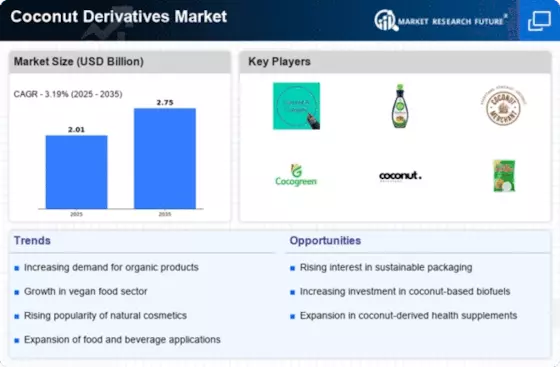
As per analysis, the Europe Coconut Derivatives Market is projected to grow from USD 1.95 Billion in 2024 to USD 2.75 Billion by 2035, exhibiting a compound annual growth rate (CAGR) of 3.19% during the forecast period (2025 - 2035).

Key Market Trends & Highlights

The Europe Coconut Derivatives Market is experiencing robust growth driven by health trends and sustainability.

  • Germany remains the largest market for coconut derivatives, reflecting a strong consumer preference for natural products.
  • The UK is emerging as the fastest-growing region, with increasing demand for coconut-based offerings in various sectors.
  • The Food and Beverage segment dominates the market, while the Cosmetics and Personal Care segment is witnessing rapid expansion.
  • Key market drivers include rising demand for natural ingredients and innovations in product development, particularly in coconut oil and coconut water.

Market Size & Forecast

2024 Market Size 1.95 (USD Billion)
2035 Market Size 2.75 (USD Billion)
CAGR (2025 - 2035) 3.19%

Major Players

<p>Coconut Company (GB), Coco Natura (FR), Coconut Merchant (DE), Coco Green (IT), Coconut Solutions (NL), Coco Delight (ES), Coconut Innovations (SE), Coco Essence (PT)</p>

Market Trends

The Europe Coconut Derivatives Market is currently experiencing a notable transformation, driven by increasing consumer awareness regarding health and wellness. This shift is reflected in the rising demand for coconut-based products, which are perceived as healthier alternatives to traditional ingredients. The market encompasses a diverse range of derivatives, including coconut oil, milk, and flour, each finding applications across various sectors such as food and beverage, cosmetics, and personal care. Furthermore, the growing trend towards plant-based diets is likely to bolster the market, as coconut derivatives align well with vegan and vegetarian lifestyles. In addition, sustainability concerns are becoming increasingly prominent among European consumers. This has led to a heightened interest in ethically sourced and environmentally friendly coconut products. As a result, manufacturers are focusing on sustainable practices, from sourcing to production, to meet the expectations of eco-conscious consumers. The interplay between health trends and sustainability is shaping the future of the Europe Coconut Derivatives Market, suggesting a promising outlook for the industry as it adapts to evolving consumer preferences and regulatory frameworks.

Health and Wellness Focus

The emphasis on health and wellness is a driving force in the Europe Coconut Derivatives Market. Consumers are increasingly seeking natural and nutritious alternatives, leading to a surge in the popularity of coconut-based products. This trend is evident in the rising use of coconut oil and milk in cooking and baking, as well as in the formulation of health supplements.

Sustainability and Ethical Sourcing

Sustainability is becoming a critical factor influencing purchasing decisions in the Europe Coconut Derivatives Market. Consumers are showing a preference for products that are ethically sourced and produced with minimal environmental impact. This trend is prompting companies to adopt sustainable practices throughout their supply chains, from cultivation to distribution.

Diverse Applications Across Industries

Coconut derivatives are finding diverse applications across various industries in Europe. Beyond food and beverage, these products are increasingly utilized in cosmetics and personal care items. The versatility of coconut derivatives is appealing to manufacturers looking to innovate and expand their product offerings, thereby enhancing market growth.

North America Europe Coconut Derivatives Market Drivers

Expansion of E-commerce Channels

The expansion of e-commerce channels is reshaping the landscape of the Europe Coconut Derivatives Market. With the increasing penetration of the internet and the growing popularity of online shopping, consumers are now more inclined to purchase coconut derivatives through digital platforms. This shift is particularly beneficial for niche brands that offer specialized coconut products, as e-commerce provides them with a broader reach and the ability to connect directly with consumers. Recent statistics indicate that online sales of coconut products in Europe have seen a significant uptick, with projections suggesting a growth rate of over 10% in the next few years. This trend not only enhances accessibility but also fosters competition among brands, driving innovation and product variety in the market.

Innovations in Product Development

Innovations in product development are significantly impacting the Europe Coconut Derivatives Market. Companies are increasingly investing in research and development to create new and improved coconut-based products that cater to diverse consumer needs. For instance, the introduction of coconut-derived functional ingredients, such as coconut flour and coconut sugar, has opened new avenues for product differentiation in the health food segment. Furthermore, the rise of plant-based diets has led to an increased incorporation of coconut derivatives in vegan and vegetarian products. This trend is expected to drive market growth, with the coconut flour segment alone anticipated to witness a CAGR of around 6% in the coming years, reflecting the industry's adaptability to evolving consumer preferences.

Rising Demand for Natural Ingredients

The Europe Coconut Derivatives Market is experiencing a notable surge in demand for natural ingredients, driven by a growing consumer preference for clean-label products. This trend is particularly evident in the food and beverage sector, where coconut derivatives such as coconut oil and coconut milk are increasingly favored for their health benefits and versatility. According to recent data, the market for coconut oil in Europe is projected to grow at a compound annual growth rate (CAGR) of approximately 5% over the next five years. This shift towards natural ingredients is not only reshaping product formulations but also influencing the sourcing strategies of manufacturers, who are now prioritizing coconut derivatives that align with consumer expectations for transparency and quality.

Cultural Trends Favoring Coconut Products

Cultural trends favoring coconut products are playing a crucial role in shaping the Europe Coconut Derivatives Market. The increasing popularity of tropical flavors and cuisines has led to a heightened interest in coconut-based products across various food categories. This trend is particularly pronounced in the snack and dessert segments, where coconut derivatives are being incorporated into a wide array of offerings, from coconut chips to coconut-based ice creams. Additionally, the rise of social media has amplified the visibility of coconut products, as influencers and food bloggers showcase innovative recipes featuring coconut derivatives. This cultural shift is expected to sustain market growth, as consumers continue to seek out unique and flavorful options that align with their culinary preferences.

Regulatory Support for Sustainable Practices

Regulatory support for sustainable practices is becoming a pivotal driver in the Europe Coconut Derivatives Market. The European Union has implemented various policies aimed at promoting sustainable agriculture and ethical sourcing of raw materials. These regulations encourage manufacturers to adopt environmentally friendly practices, which, in turn, enhances the appeal of coconut derivatives among eco-conscious consumers. For example, the EU's Green Deal emphasizes the importance of sustainable food systems, which aligns with the growing demand for responsibly sourced coconut products. As a result, companies that prioritize sustainability in their supply chains are likely to gain a competitive edge, potentially increasing their market share in the coconut derivatives sector.

Market Segment Insights

By Application: Food and Beverage (Largest) vs. Cosmetics and Personal Care (Fastest-Growing)

<p>In the Europe Coconut Derivatives Market, the application segment reveals interesting dynamics, with Food and Beverage operations taking the lead in market share due to the increasing consumer preference for natural and health-centered products. This segment heavily utilizes coconut derivatives in cooking oils, dairy alternatives, and sweeteners, creating a robust demand that significantly outweighs others in this analysis. On the other hand, the Cosmetics and Personal Care segment is emerging as a fast-growing player, as the natural properties of coconut derivatives align well with the rising trend towards organic and clean beauty products.</p>

<p>Food and Beverage (Dominant) vs. Pharmaceuticals (Emerging)</p>

<p>The Food and Beverage segment remains dominant due to its consumer-driven demand for healthy and natural ingredients, utilizing coconut derivatives in a variety of applications, from culinary uses to health supplements. In contrast, the Pharmaceuticals segment is gradually evolving, leveraging coconut derivatives for their anti-inflammatory and antimicrobial properties, thus gaining traction among customers seeking alternative treatment options. The rapid growth of wellness-focused products and an increasing awareness of natural remedies are facilitating the pharmaceutical applications of coconut derivatives, marking it as an emerging sector within the market.</p>

By Type: Coconut Oil (Largest) vs. Coconut Water (Fastest-Growing)

<p>In the Europe Coconut Derivatives Market, Coconut Oil holds the largest market share, driven by its versatility in culinary applications and health benefits. Following Coconut Oil, Coconut Water emerges as a significant player due to the rising demand for natural and healthy beverages. Coconut Milk and Coconut Cream also contribute to the market but occupy smaller portions of market share comparatively, showcasing a balanced yet competitive landscape among these derivatives. The growth trends in this segment are largely influenced by changing consumer preferences toward healthier food options and the popularity of plant-based products. Coconut Water is particularly gaining traction as an alternative to sugary drinks, appealing to health-conscious consumers. Additionally, the clean label trend is pushing more brands to incorporate coconut derivatives, further driving growth in this space.</p>

<p>Coconut Oil (Dominant) vs. Coconut Milk (Emerging)</p>

<p>Coconut Oil is a dominant ingredient in the European market, known for its various applications ranging from cooking to cosmetics. Its growing recognition for health benefits and nutritional value solidifies its leading position. On the other hand, Coconut Milk is rapidly emerging as a notable alternative in vegetarian and vegan recipes. As the demand for dairy alternatives increases, Coconut Milk is quickly adapting to consumer needs, gaining popularity among those seeking lactose-free options. Both segments reflect the trend towards natural ingredients, but Coconut Oil currently benefits from wider acceptance and established usage, while Coconut Milk continues to carve out its niche in the evolving market.</p>

By Form: Liquid (Largest) vs. Powder (Fastest-Growing)

<p>In the Europe Coconut Derivatives Market, the 'Form' segment shows a distinct distribution among three key values: Liquid, Powder, and Solid. Liquid coconut derivatives dominate the market due to their extensive application in food and beverage industries, alongside their growing use in health and wellness products. The demand for liquid forms drives a significant portion of market share, making it the most prominent category in Europe. Meanwhile, Powder derivatives are gaining traction, particularly among health-conscious consumers seeking convenient and easily transportable products, which uniquely positions them for growth.</p>

<p>Liquid (Dominant) vs. Powder (Emerging)</p>

<p>Liquid coconut derivatives serve as a versatile and widely accepted form in various applications, catering to sectors such as food, cosmetics, and nutraceuticals. Their ability to blend with numerous ingredients makes them particularly appealing to manufacturers, enhancing their market position as the dominant form in the coconut derivatives category. In contrast, Powdered coconut derivatives are emerging as an attractive alternative for health-oriented consumers. They are particularly sought after for their convenience, extended shelf life, and ease of incorporation into supplements and recipes. As consumer demand for functional food products rises, powdered coconut derivatives are poised to grow significantly in market share, reflecting an evolving landscape in consumer preferences.</p>

By Source: Organic (Largest) vs. Conventional (Fastest-Growing)

<p>In the Europe Coconut Derivatives Market, the 'Source' segment is characterized by a distinct distribution between organic and conventional products. Organic coconut derivatives hold the largest market share, driven by increasing consumer awareness and a growing preference for natural and sustainable products. Conventional coconut derivatives, while smaller in share, are experiencing a notable rise due to their cost-effectiveness and wider availability, catering to various culinary and industrial applications.</p>

<p>Source: Organic (Dominant) vs. Conventional (Emerging)</p>

<p>Organic coconut derivatives are regarded as the dominant force in the market, appealing to health-conscious consumers who prioritize sustainability, leading to a robust demand across food and cosmetic sectors. These products are often perceived as premium offerings due to their eco-friendly farming practices. On the other hand, conventional coconut derivatives are emerging rapidly, gaining traction in sectors where cost drives purchasing decisions. They provide a diverse range of applications yet lack the sustainability appeal that organic products possess, positioning them as valuable alternatives for budget-conscious consumers.</p>

Get more detailed insights about North America and Europe Coconut Derivatives Market Research Report : Forecast to 2035

Regional Insights

Germany : Strong Demand and Innovation Drive Growth

Germany holds a dominant market share of 55% in the European coconut derivatives market, valued at approximately €220 million. Key growth drivers include a rising health consciousness among consumers, leading to increased demand for coconut-based products. Regulatory support for organic and sustainable sourcing has further fueled market expansion. The country’s robust infrastructure and advanced industrial capabilities facilitate efficient distribution and production processes.

UK : Health Trends Boosting Market Growth

The UK coconut derivatives market accounts for 35% of the European share, valued at around €140 million. The growth is driven by a surge in health and wellness trends, with consumers increasingly opting for coconut oil and milk as healthier alternatives. Government initiatives promoting plant-based diets and sustainability are also pivotal. The UK’s well-established retail sector supports the distribution of coconut products across various channels.

France : Culinary Trends Fueling Demand

France captures 30% of the European coconut derivatives market, valued at approximately €120 million. The growth is largely attributed to culinary trends that favor coconut ingredients in gourmet cooking and baking. Regulatory frameworks supporting organic farming and food safety standards enhance consumer trust. The French market is characterized by a strong preference for high-quality, artisanal coconut products, reflecting the nation’s culinary heritage.

Russia : Market Potential in Emerging Economy

Russia holds a 25% share of the European coconut derivatives market, valued at about €100 million. The increasing interest in health and wellness among Russian consumers is driving demand for coconut derivatives. Government policies promoting healthy eating and food diversification are also contributing factors. The market is still developing, with significant potential for growth as awareness of coconut products expands.

Italy : Culinary Innovation and Health Focus

Italy represents 20% of the European coconut derivatives market, valued at approximately €80 million. The growth is driven by culinary innovation, with coconut products being integrated into traditional Italian recipes. Regulatory support for organic products and health-focused initiatives are enhancing market appeal. The competitive landscape includes local players and international brands, with a focus on quality and sustainability.

Spain : Diverse Applications in Food Industry

Spain accounts for 15% of the European coconut derivatives market, valued at around €60 million. The market is expanding due to diverse applications in the food industry, particularly in vegan and health-conscious segments. Government initiatives promoting sustainable agriculture and food innovation are key growth drivers. The competitive landscape features both local and international brands, with a focus on quality and authenticity.

Rest of Europe : Diverse Markets with Unique Needs

The Rest of Europe holds a 15% share of the coconut derivatives market, valued at approximately €60 million. This sub-region is characterized by fragmented markets with varying consumer preferences and regulatory environments. Growth is driven by increasing health awareness and the popularity of plant-based diets. Local players are adapting to unique market needs, creating opportunities for niche products and innovations.

Key Players and Competitive Insights

The Coconut Derivatives Market in Europe is characterized by a dynamic competitive landscape, driven by increasing consumer demand for natural and organic products. Key players are actively engaging in strategies that emphasize innovation, sustainability, and regional expansion. Companies such as Coconut Company (GB), Coco Natura (FR), and Coconut Merchant (DE) are at the forefront, each adopting distinct operational focuses that collectively shape the market's competitive environment. For instance, Coconut Company (GB) has been investing in product diversification, while Coco Natura (FR) emphasizes sustainable sourcing practices, and Coconut Merchant (DE) is enhancing its digital presence to capture a broader customer base.

In terms of business tactics, localizing manufacturing and optimizing supply chains are pivotal strategies employed by these companies. The market appears moderately fragmented, with several players vying for market share, yet the influence of major companies is substantial. This competitive structure allows for a variety of product offerings, catering to diverse consumer preferences across Europe.

In November 2025, Coconut Company (GB) announced a strategic partnership with a leading organic certification body to enhance its product credibility and appeal to health-conscious consumers. This move is likely to bolster its market position by ensuring that its products meet stringent organic standards, thereby attracting a more discerning customer base. The partnership underscores the growing importance of transparency and quality in the market.

In December 2025, Coco Natura (FR) launched a new line of coconut-based skincare products, leveraging its expertise in natural ingredients. This product line aims to tap into the burgeoning beauty and personal care segment, which is increasingly favoring natural and organic formulations. The introduction of these products may not only diversify Coco Natura's portfolio but also position the company as a leader in the sustainable beauty market.

In January 2026, Coconut Merchant (DE) unveiled a state-of-the-art e-commerce platform designed to enhance customer engagement and streamline the purchasing process. This digital transformation is indicative of the broader trend towards online retail, which has become essential for reaching consumers in a post-pandemic landscape. By investing in technology, Coconut Merchant (DE) is likely to improve its competitive edge and adapt to changing consumer behaviors.

As of January 2026, current trends in the Coconut Derivatives Market are heavily influenced by digitalization, sustainability, and the integration of AI technologies. Strategic alliances are increasingly shaping the competitive landscape, allowing companies to pool resources and expertise. The shift from price-based competition to a focus on innovation, technology, and supply chain reliability is evident. Moving forward, companies that prioritize these elements are expected to differentiate themselves effectively in a crowded marketplace.

Key Companies in the North America Europe Coconut Derivatives include

Industry Developments

Future Outlook

North America Europe Coconut Derivatives Future Outlook

The Europe Coconut Derivatives Market is projected to grow at a 3.19% CAGR from 2025 to 2035, driven by rising health consciousness, demand for natural ingredients, and sustainable sourcing.

New opportunities lie in:

  • Expansion of organic coconut oil product lines in retail channels.
  • Development of innovative coconut-based food and beverage formulations.
  • Investment in eco-friendly packaging solutions for coconut derivatives.

By 2035, the market is expected to solidify its position as a key player in the natural ingredients sector.

Market Segmentation

North America Europe Coconut Derivatives Form Outlook

  • Liquid
  • Powder
  • Solid

North America Europe Coconut Derivatives Type Outlook

  • Coconut Oil
  • Coconut Milk
  • Coconut Cream
  • Coconut Water

North America Europe Coconut Derivatives Source Outlook

  • Organic
  • Conventional

North America Europe Coconut Derivatives Application Outlook

  • Food and Beverage
  • Cosmetics and Personal Care
  • Pharmaceuticals
  • Household Products

Report Scope

MARKET SIZE 20241.95(USD Billion)
MARKET SIZE 20252.02(USD Billion)
MARKET SIZE 20352.75(USD Billion)
COMPOUND ANNUAL GROWTH RATE (CAGR)3.19% (2024 - 2035)
REPORT COVERAGERevenue Forecast, Competitive Landscape, Growth Factors, and Trends
BASE YEAR2024
Market Forecast Period2025 - 2035
Historical Data2019 - 2024
Market Forecast UnitsUSD Billion
Key Companies ProfiledCoconut Company (GB), Coco Natura (FR), Coconut Merchant (DE), Coco Green (IT), Coconut Solutions (NL), Coco Delight (ES), Coconut Innovations (SE), Coco Essence (PT)
Segments CoveredApplication, Type, Form, Source
Key Market OpportunitiesGrowing demand for natural and organic coconut derivatives in Europe presents significant market opportunities.
Key Market DynamicsRising consumer demand for natural ingredients drives innovation in the Europe Coconut Derivatives Market.
Countries CoveredGermany, UK, France, Russia, Italy, Spain, Rest of Europe

FAQs

What is the current valuation of the Europe Coconut Derivatives Market?

The market valuation was 1.95 USD Billion in 2024.

What is the projected market size for the Europe Coconut Derivatives Market by 2035?

The market is projected to reach 2.75 USD Billion by 2035.

What is the expected CAGR for the Europe Coconut Derivatives Market during the forecast period?

The expected CAGR for the market from 2025 to 2035 is 3.19%.

Which segments are included in the Europe Coconut Derivatives Market?

The market includes segments such as Food and Beverage, Cosmetics and Personal Care, Pharmaceuticals, and Household Products.

What are the key players in the Europe Coconut Derivatives Market?

Key players include Coconut Company (GB), Coco Natura (FR), and Coconut Merchant (DE), among others.

How does the Food and Beverage segment perform in terms of valuation?

The Food and Beverage segment was valued at 0.78 USD Billion in 2024 and is expected to reach 0.95 USD Billion by 2035.

What is the valuation trend for Coconut Oil in the market?

Coconut Oil was valued at 0.78 USD Billion in 2024 and is projected to grow to 0.95 USD Billion by 2035.

What is the expected growth for the Coconut Water segment?

Coconut Water was valued at 0.4 USD Billion in 2024 and is anticipated to increase to 0.8 USD Billion by 2035.

What are the projected valuations for organic and conventional coconut derivatives?

Organic coconut derivatives were valued at 0.78 USD Billion in 2024, while conventional derivatives were valued at 1.17 USD Billion.

What forms of coconut derivatives are available in the market?

The market offers coconut derivatives in liquid, powder, and solid forms, with liquid valued at 0.78 USD Billion in 2024.

  1. SECTION I: EXECUTIVE SUMMARY AND KEY HIGHLIGHTS
    1. EXECUTIVE SUMMARY
  2. SECTION II: SCOPING, METHODOLOGY AND MARKET STRUCTURE
    1. MARKET INTRODUCTION
    2. RESEARCH METHODOLOGY
  3. SECTION III: QUALITATIVE ANALYSIS
    1. MARKET DYNAMICS
    2. MARKET FACTOR ANALYSIS
  4. SECTION IV: QUANTITATIVE ANALYSIS
    1. Food, Beverages & Nutrition, BY Application (USD Billion)
    2. Food, Beverages & Nutrition, BY Type (USD Billion)
    3. Food, Beverages & Nutrition, BY Form (USD Billion)
    4. Food, Beverages & Nutrition, BY Source (USD Billion)
  5. SECTION V: COMPETITIVE ANALYSIS
    1. Competitive Landscape
    2. Company Profiles
    3. Appendix

North America and Europe Coconut Derivatives Market Segmentation

Market Segmentation Overview

  • Detailed segmentation data will be available in the full report
  • Comprehensive analysis by multiple parameters
  • Regional and country-level breakdowns
  • Market size forecasts by segment
Infographic

Free Sample Request

Kindly complete the form below to receive a free sample of this Report

Get Free Sample

Customer Strories

Compare Licence

×
Features License Type
Single User Multiuser License Enterprise User
Price $4,950 $5,950 $7,250
Maximum User Access Limit 1 User Upto 10 Users Unrestricted Access Throughout the Organization
Free Customization
Direct Access to Analyst
Deliverable Format
Platform Access
Discount on Next Purchase 10% 15% 15%
Printable Versions