Request Free Sample ×

Kindly complete the form below to receive a free sample of this Report

* Please use a valid business email

Leading companies partner with us for data-driven Insights

clients tt-cursor
Hero Background
English
Chinese
French
Japanese
Korean
German
Spanish

Non Invasive Prenatal Testing Market Analysis

ID: MRFR/HC/6899-HCR
200 Pages
Nidhi Mandole
March 2026

Non-Invasive Prenatal Testing (NIPT) Market Research Report: Size, Share, Trend Analysis By Test Type (Cell-Free Fetal DNA Testing, Biochemical Markers Testing, Ultrasound Screening), By Applications (Trisomy Detection, Single Gene Disorders, Sex Chromosome Abnormalities), By Technology (Next-Generation Sequencing, Microarray Analysis, Massively Parallel Sequencing), By End Users (Hospitals, Diagnostic Laboratories, Research Institutions) and By Regional (North America, Europe, South America, Asia Pacific, Middle East and Africa) - Growth Outlook & Industry Forecast 2025 To 2035

Share:
Download PDF ×

We do not share your information with anyone. However, we may send you emails based on your report interest from time to time. You may contact us at any time to opt-out.

Non Invasive Prenatal Testing Market Infographic
Purchase Options

Market Analysis

In-depth Analysis of Non Invasive Prenatal Testing Market Industry Landscape

The non-invasive prenatal testing (NIPT) market is encountering dynamic movements driven by progressions in genetic technologies. NIPT has acquired noticeable quality as a more secure option in contrast to conventional invasive prenatal systems, for example, amniocentesis and chorionic villus examining. The pattern of deferred childbearing is a huge variable impacting the NIPT market. As additional women pick pregnancy at a more established age, the interest for non-invasive prenatal testing to survey fetal chromosomal abnormalities, like Down syndrome, has risen. Expanded awareness among eager parents about the advantages of NIPT plays had an essential impact in market extension. The non-invasiveness of the technique, combined with its high awareness, has gathered acknowledgment and trust among pregnant women and medical services experts. The extent of NIPT has extended past chromosomal abnormalities to incorporate the location of microdeletions and single-quality disorders. This expanding application range has broadened the market's scope, drawing in a bigger patient pool looking for thorough genetic data about their unborn child. Coordinated efforts between symptomatic organizations and medical services suppliers have turned into a typical pattern, working with the combination of NIPT into routine prenatal consideration. Such organizations intend to smooth out testing processes and further develop accessibility for pregnant women. The accessibility of protection inclusion for NIPT and endeavors to make these tests more reasonable are key elements affecting market elements. Accessibility and cost contemplations influence the dynamic interaction for both medical care suppliers and patients.

Author
Author Profile
Nidhi Mandole
Senior Research Analyst

She is an extremely curious individual currently working in Healthcare and Medical Devices Domain. Nidhi is comfortably versed in data centric research backed by healthcare educational background. She leverages extensive data mining and analytics tools such as Primary and Secondary Research, Statistical Analysis, Machine Learning, Data Modelling. Her key role also involves Technical Sales Support, Client Interaction and Project management within the Healthcare team. Lastly, she showcases extensive affinity towards learning new skills and remain fascinated in implementing them.

Leave a Comment

FAQs

What is the projected market valuation of the Non-Invasive Prenatal Testing (NIPT) Market by 2035?

<p>The projected market valuation for the Non-Invasive Prenatal Testing (NIPT) Market is 5.502 USD Billion by 2035.</p>

What was the market valuation of the NIPT Market in 2024?

<p>The overall market valuation of the Non-Invasive Prenatal Testing (NIPT) Market was 1.82 USD Billion in 2024.</p>

What is the expected CAGR for the NIPT Market during the forecast period 2025 - 2035?

<p>The expected CAGR for the Non-Invasive Prenatal Testing (NIPT) Market during the forecast period 2025 - 2035 is 10.58%.</p>

Which test type segment is projected to have the highest valuation by 2035?

<p>The Cell-Free Fetal DNA Testing segment is projected to reach 2.75 USD Billion by 2035.</p>

What are the key applications driving the NIPT Market growth?

<p>Key applications include Trisomy Detection, Single Gene Disorders, and Sex Chromosome Abnormalities, with Trisomy Detection expected to reach 2.19 USD Billion by 2035.</p>

Which technology segment is anticipated to dominate the NIPT Market by 2035?

<p>Next-Generation Sequencing is anticipated to dominate, with a projected valuation of 2.7 USD Billion by 2035.</p>

Who are the leading players in the Non-Invasive Prenatal Testing (NIPT) Market?

<p>Key players in the NIPT Market include Roche, Illumina, Natera, and LabCorp, among others.</p>

What end-user segment is expected to show significant growth in the NIPT Market?

<p>The Hospitals segment is expected to show significant growth, projected to reach 2.19 USD Billion by 2035.</p>

How does the market for Biochemical Markers Testing compare to other test types by 2035?

<p>Biochemical Markers Testing is projected to reach 1.65 USD Billion by 2035, indicating robust growth compared to other test types.</p>

What is the significance of the NIPT Market's growth for healthcare providers?

<p>The growth of the NIPT Market suggests increased opportunities for healthcare providers to offer advanced prenatal testing options, enhancing patient care.</p>

Market Summary

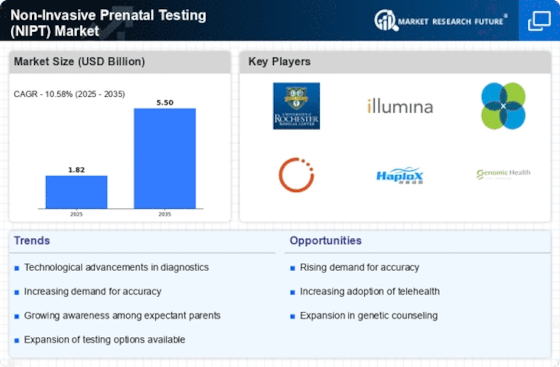
As per Market Research Future analysis, the Non-Invasive Prenatal Testing (NIPT) Market Size was estimated at 1.82 USD Billion in 2024. The NIPT industry is projected to grow from USD 2.013 Billion in 2025 to USD 5.502 Billion by 2035, exhibiting a compound annual growth rate (CAGR) of 10.5% during the forecast period 2025 - 2035

Key Market Trends & Highlights

The Non-Invasive Prenatal Testing (NIPT) market is experiencing robust growth driven by technological advancements and increasing awareness.

  • Technological advancements in NIPT are enhancing accuracy and efficiency, particularly in North America, the largest market. Growing awareness and acceptance of NIPT among expectant parents are contributing to its rising adoption in the Asia-Pacific region, the fastest-growing market. Cell-Free Fetal DNA Testing remains the largest segment, while Biochemical Markers Testing is emerging as the fastest-growing segment. The rising incidence of genetic disorders and increased focus on maternal health are key drivers propelling market growth.

Market Size & Forecast

2024 Market Size 1.82 (USD Billion)
2035 Market Size 5.502 (USD Billion)
CAGR (2025 - 2035) 10.58%
Largest Regional Market Share in 2024 North America

Major Players

Roche (CH), Illumina (US), Natera (US), Fulgent Genetics (US), HaploX (US), Genomic Health (US), LabCorp (US), <a href="https://www.questdiagnostics.com/healthcare-professionals/about-our-tests/womens-health/pregnancy-and-fertility/pregnant-patients/noninvasive-prenatal-screening">Quest Diagnostics</a> (US), PerkinElmer (US)

Market Trends

The Non-Invasive Prenatal Testing (NIPT) Market is currently experiencing notable growth, driven by advancements in genetic testing technologies and increasing awareness among expectant parents. The Non-Invasive Prenatal Testing (NIPT) Market offers a safer alternative to traditional invasive procedures, such as amniocentesis, by utilizing maternal blood samples to assess fetal genetic conditions. As healthcare providers and patients alike recognize the benefits of early detection, the demand for NIPT continues to rise. Furthermore, the integration of artificial intelligence and machine learning into testing processes appears to enhance accuracy and efficiency, potentially transforming prenatal care.

In addition to technological advancements, the Non-Invasive Prenatal Testing (NIPT) Market is influenced by changing societal attitudes towards prenatal screening. As more individuals seek personalized healthcare solutions, the appeal of non-invasive methods grows. This shift is likely to encourage further investment in research and development, fostering innovation within the sector. Moreover, regulatory bodies are increasingly supportive of NIPT, which may facilitate broader access and adoption across various regions. Overall, the landscape of the Non-Invasive Prenatal Testing (NIPT) Market seems poised for continued evolution, reflecting both scientific progress and changing consumer preferences.

Technological Advancements

Recent innovations in genetic testing technologies are significantly enhancing the capabilities of the Non-Invasive Prenatal Testing (NIPT) Market. The introduction of more sophisticated algorithms and improved sequencing methods is likely to increase the accuracy and reliability of test results, thereby attracting more healthcare providers and patients.

Growing Awareness and Acceptance

There is a noticeable increase in awareness regarding the benefits of non-invasive prenatal testing among expectant parents. This growing acceptance is likely to drive demand, as individuals seek safer alternatives to traditional invasive procedures, thereby expanding the Non-Invasive Prenatal Testing (NIPT) Market's reach.

Regulatory Support

Regulatory bodies are becoming increasingly supportive of non-invasive prenatal testing, which may lead to enhanced accessibility and adoption. This trend suggests that as guidelines evolve, the Non-Invasive Prenatal Testing (NIPT) Market could experience accelerated growth and wider implementation.

Non Invasive Prenatal Testing Market Market Drivers

Increased Focus on Maternal Health

The heightened emphasis on maternal health and wellness is a crucial driver for the Non-Invasive Prenatal Testing (NIPT) Market. As healthcare systems worldwide prioritize maternal care, there is a growing recognition of the importance of early prenatal screening. This focus is reflected in various initiatives aimed at improving maternal health outcomes, which often include the promotion of NIPT as a standard practice. Data suggests that countries with robust maternal health programs are witnessing a rise in NIPT adoption rates, as healthcare providers advocate for its benefits. The increasing investment in maternal health initiatives is likely to further bolster the NIPT market, as more women gain access to these essential testing services.

Rising Incidence of Genetic Disorders

The increasing prevalence of genetic disorders among newborns is a pivotal driver for the Non-Invasive Prenatal Testing (NIPT) Market. As more parents seek to understand potential genetic risks, the demand for NIPT has surged. Reports indicate that conditions such as Down syndrome and other chromosomal abnormalities are becoming more recognized, prompting expectant parents to opt for early screening. This trend is further supported by advancements in genetic research, which have made it easier to identify at-risk pregnancies. Consequently, healthcare providers are increasingly recommending NIPT as a reliable option for early detection, thereby expanding its market reach. The rising incidence of genetic disorders is likely to continue influencing the NIPT market, as awareness grows and testing becomes more accessible.

Regulatory Endorsements and Guidelines

Regulatory support and endorsements play a vital role in shaping the Non-Invasive Prenatal Testing (NIPT) Market. As health authorities recognize the benefits of NIPT, they are establishing guidelines that promote its use in clinical practice. These endorsements not only enhance the credibility of NIPT but also encourage healthcare providers to adopt these testing methods. In many regions, regulatory bodies are actively working to ensure that NIPT is included in standard prenatal care protocols, which is likely to increase its accessibility. The establishment of clear guidelines and recommendations is expected to drive market growth, as more healthcare professionals become aware of the advantages of NIPT and its role in improving prenatal care.

Changing Demographics and Delayed Parenthood

Shifts in demographics, particularly the trend of delayed parenthood, are influencing the Non-Invasive Prenatal Testing (NIPT) Market. As more individuals choose to start families later in life, the associated risks of chromosomal abnormalities increase. This demographic shift has led to a greater demand for prenatal testing options that can provide early insights into potential genetic issues. Consequently, healthcare providers are increasingly recommending NIPT as a proactive measure for older expectant mothers. The market data indicates that women over the age of 35 are among the fastest-growing segments opting for NIPT, thereby driving market expansion. This trend is expected to continue, as societal norms evolve and the age of first-time parents rises.

Technological Innovations in Testing Methods

Technological advancements in testing methodologies are significantly propelling the Non-Invasive Prenatal Testing (NIPT) Market. Innovations such as next-generation sequencing (NGS) have enhanced the accuracy and efficiency of prenatal tests, allowing for the detection of fetal DNA in maternal blood with remarkable precision. These advancements not only improve the reliability of results but also reduce the time required for testing, making it more appealing to expectant parents. Furthermore, the integration of artificial intelligence in data analysis is expected to streamline processes and enhance predictive capabilities. As technology continues to evolve, it is anticipated that the NIPT market will experience substantial growth, driven by the demand for more sophisticated and user-friendly testing options.


Market Segment Insights

By Test Type: Cell-Free Fetal DNA Testing (Largest) vs. Biochemical Markers Testing (Fastest-Growing)

The Non-Invasive Prenatal Testing (NIPT) market has prominently positioned Cell-Free Fetal DNA Testing as the largest segment, commanding a significant share due to its advanced accuracy and higher adoption rates among healthcare providers. Conversely, Biochemical Markers Testing, while smaller in scale, is rapidly gaining traction as more expectant parents seek comprehensive methods of prenatal assessment. Ultrasound Screening, although traditional, remains a vital component but is overshadowed by the innovations brought by the other two testing methods.

Cell-Free Fetal DNA Testing: Dominant vs. Biochemical Markers Testing: Emerging

Cell-Free Fetal DNA Testing is widely recognized as the dominant method in the Non-Invasive Prenatal Testing (NIPT) Market, renowned for its exceptional sensitivity and specificity in detecting fetal genetic abnormalities. The method's extensive validation and positive clinical outcomes have led to its widespread integration into prenatal care protocols, making it the preferred choice for many healthcare professionals. On the other hand, Biochemical Markers Testing is emerging as a significant player, particularly due to its cost-effectiveness and ability to provide additional insights when used alongside other testing methods. This segment is evolving rapidly, driven by advancements in technology and growing consumer awareness, positioning it as a noteworthy alternative in prenatal screening.

By Application: Trisomy Detection (Largest) vs. Single Gene Disorders (Fastest-Growing)

The Non-Invasive Prenatal Testing (NIPT) market showcases a distinct segmentation by application. Trisomy detection remains the dominant application, comprising a majority share of the market due to its widespread acceptance and effectiveness in early detection of chromosomal abnormalities. In contrast, the segment of single gene disorders is gaining momentum, representing a growing focus within prenatal testing solutions as parents increasingly seek comprehensive options for genetic screening. The trend towards early and accurate prenatal diagnostics is propelling growth in the NIPT sector. While trisomy detection continues to lead, advancements in technology and increased awareness among healthcare providers and expectant parents are driving rapid expansion in the single gene disorders segment. The ability to screen for disorders like cystic fibrosis and sickle cell anemia is capturing attention, further supporting the growth of NIPT applications.

Trisomy Detection (Dominant) vs. Single Gene Disorders (Emerging)

Trisomy detection is currently the cornerstone of the Non-Invasive Prenatal Testing (NIPT) Market, recognized for its reliability in identifying conditions such as Down syndrome, making it a trusted choice among expectant parents and healthcare providers. Its established presence in clinics and hospitals contributes to a significant share of NIPT applications, despite emerging practices. Conversely, single gene disorders represent an evolving segment that appeals to a more informed demographic, keen on comprehensive genetic insights. With the advent of sophisticated testing methodologies, this segment is rapidly expanding. The emphasis on preventive healthcare and personalized medicine in prenatal care is driving the adoption of single gene disorder screenings, indicating a dynamic shift towards integrating more nuanced genetics into prenatal assessments.

By Technology: Next-Generation Sequencing (Largest) vs. Massively Parallel Sequencing (Fastest-Growing)

The Non-Invasive Prenatal Testing (NIPT) market is predominantly led by <a href="https://www.marketresearchfuture.com/reports/next-generation-sequencing-market-6354">Next-Generation Sequencing</a> (NGS), which captures a significant portion of the total market share due to its high accuracy and efficiency. Following NGS, Massively Parallel Sequencing (MPS) is emerging rapidly, gaining traction among healthcare providers thanks to its ability to analyze multiple DNA sequences simultaneously. Microarray Analysis, while still relevant, has a comparatively smaller share in this competitive landscape.

Technology: NGS (Dominant) vs. MPS (Emerging)

Next-Generation Sequencing (NGS) stands as the dominant technology in the Non-Invasive Prenatal Testing (NIPT) Market, touted for its ability to deliver high-throughput sequencing and unmatched accuracy in detecting chromosomal abnormalities. As prenatal testing becomes increasingly precise, healthcare providers and expectant parents are gravitating toward NGS for its reliability. On the other hand, Massively Parallel Sequencing (MPS) represents the emerging technology with a rapidly growing adoption rate, largely attributed to advancements in its capabilities and cost-effectiveness. MPS facilitates the simultaneous examination of numerous genetic markers, which enhances the efficiency of testing and appeals to an expanding demographic within the prenatal care sector.

By End User: Hospitals (Largest) vs. Diagnostic Laboratories (Fastest-Growing)

In the Non-Invasive Prenatal Testing (NIPT) Market, the largest share is held by hospitals, which play a crucial role in providing comprehensive maternal care services. These institutions have integrated NIPT into their prenatal care protocols, leading to widespread adoption. Diagnostic laboratories, while currently smaller in terms of market share, are rapidly growing due to an increase in demand for specialized testing services. Their ability to offer advanced testing options and support has positioned them as key players in the NIPT landscape.

End User: Hospitals (Dominant) vs. Diagnostic Laboratories (Emerging)

Hospitals dominate the Non-Invasive Prenatal Testing (NIPT) Market as they provide a one-stop solution for expectant mothers, offering a range of prenatal services under one roof. They utilize NIPT to enhance maternal-fetal medicine by ensuring early risk assessment of genetic disorders. Conversely, diagnostic laboratories are emerging as essential players, leveraging advanced technology to provide accurate and timely testing. These laboratories often facilitate genetic counseling, enhancing their value proposition. Their flexibility in adapting to new technologies and fulfilling personalized testing requirements is driving their rapid growth, positioning them as a significant alternative to traditional hospital settings.

Get more detailed insights about Non-Invasive Prenatal Testing (NIPT) Market Research Report - Forecast till 2035

Regional Insights

The Regional analysis of the Non-Invasive Prenatal Testing (NIPT) Market highlights significant growth across various geographical segments, with North America held the majority, valued at 0.785 USD Billion in 2024 and reaching 2.4 USD Billion by 2035, primarily due to advanced healthcare infrastructure and high adoption rates.

Europe follows closely, with a valuation of 0.585 USD Billion in 2024, projected to grow to 1.7 USD Billion by 2035, driven by increasing awareness and accessibility to prenatal screening.

The APAC region, valued at 0.325 USD Billion in 2024 and expected to reach 1.0 USD Billion in 2035, is experiencing rapid growth owing to rising disposable incomes and growing healthcare access in countries like China and India.

Meanwhile, South America and MEA represent smaller shares but show potential; South America is projected to grow from 0.045 USD Billion in 2024 to 0.15 USD Billion by 2035, attributed to improving healthcare facilities.

MEA, valued at 0.065 USD Billion in 2024, is estimated to reach 0.25 USD Billion by 2035, benefiting from increasing investment in healthcare innovations.

These insights from the Non-Invasive Prenatal Testing (NIPT) Market data underline the varied growth dynamics, demonstrating how advancements in technology and accessibility are reshaping prenatal care globally and underlining opportunities for future market growth.

Key Players and Competitive Insights

The Non-Invasive Prenatal Testing (NIPT) Market has rapidly evolved over recent years, primarily driven by advancements in genetic testing technologies and an increasing awareness regarding prenatal health.
With the surge in demand for safe and reliable prenatal tests that identify genetic anomalies without risk to both mother and fetus, many NIPT testing companies are innovating and competing to establish themselves as leaders in this lucrative sector.
The competitive landscape is characterized by a mix of established NIPT test companies and emerging startups, each striving to enhance their offerings while navigating regulatory challenges and evolving market trends.
As the NIPT market expands, entrenched NIPT testing companies are bolstered by significant RD investments, robust distribution networks, and strategic partnerships, which provide them with a competitive edge in capturing extensive market share.
Natera is a prominent player in the Non-Invasive Prenatal Testing (NIPT) Market, known for its innovative approach and comprehensive offerings.
Its flagship product, the Panorama test, stands out due to its high accuracy and ability to detect a wide range of chromosomal conditions early in pregnancy.
Natera has leveraged its strong genetic expertise and technological advancements to establish a foothold in various markets around the world.
The NIPT test company's strengths lie in its focus on customer education, professional collaboration with healthcare providers, and a dedication to delivering precise testing solutions that prioritize patient safety.
Through strategic partnerships and an expansive market presence, Natera continues to solidify its position as a key competitor, driving adoption of its testing services among expectant families and healthcare professionals alike.
Sequenom has established itself as a significant entity in the Non-Invasive Prenatal Testing (NIPT) Market, primarily known for its pioneering efforts in developing non-invasive genetic diagnostic solutions.
The company offers the Matsy test, which is designed to assess fetal health and provide insights into potential genetic disorders without posing risks to the pregnancy.
Sequenom's strengths lie in its commitment to innovative scientific research, strong intellectual property portfolio, and adaptability to shifting non invasive prenatal testing market dynamics.
The company has actively pursued growth through mergers and acquisitions, which have enhanced its capabilities and broadened its service offerings in the NIPT arena.
With a solid presence in international markets, Sequenom continues to strengthen its competitive position by focusing on advancements in technology, expanding its product line, and maintaining strategic collaborations with healthcare entities to foster wider acceptance and implementation of its testing solutions.

Key Companies in the Non Invasive Prenatal Testing Market include

Industry Developments

Recent news developments in the Non-Invasive Prenatal Testing (NIPT) Market indicate a notable growth in demand and technological advances.

NIPT testing companies such as Natera and Illumina are leading the way with innovative testing solutions that provide enhanced accuracy in detecting genetic disorders.

In September 2023, Quest Diagnostics, one of the leading non invasive prenatal testing companies, announced an expansion in its NIPT offerings, enhancing accessibility for patients globally.

Additionally, leading NIPT brands Roche has partnered with the Fetal Medicine Foundation to increase awareness of genetic testing, reflecting a rise in collaborative efforts within the industry.

In terms of mergers and acquisitions, Sequenom, now part of LabCorp, confirmed its acquisition in July 2022, which has strengthened LabCorp’s position in the NIPT market.

Eurofins Scientific has also sought opportunities to expand its portfolio, enhancing its capabilities in prenatal testing services.

The market has witnessed significant valuation growth, propelled by the increasing prevalence of chromosomal disorders and rising consumer awareness.

This has led to more healthcare providers adopting NIPT as a standard prenatal test, reinforcing its pivotal role in prenatal care globally.

The impact of these trends continues to shape the future landscape of the NIPT market.

Future Outlook

Non Invasive Prenatal Testing Market Future Outlook

The Non-Invasive Prenatal Testing (NIPT) Market is projected to grow at a 10.58% CAGR from 2024 to 2035, driven by technological advancements, increasing awareness, and rising demand for early diagnosis.<br>By 2035, the Non-Invasive Prenatal Testing (NIPT) Market is expected to be robust, reflecting substantial growth and innovation.

New opportunities lie in:

  • <p>Expansion of telehealth services for remote NIPT consultations. Development of personalized NIPT kits for specific genetic conditions. Partnerships with healthcare providers for integrated prenatal care solutions.</p>

By 2035, the NIPT market is expected to be robust, reflecting substantial growth and innovation.

Market Segmentation

Non Invasive Prenatal Testing Market End User Outlook

  • Hospitals
  • Diagnostic Laboratories
  • Research Institutions

Non Invasive Prenatal Testing Market Test Type Outlook

  • Cell-Free Fetal DNA Testing
  • Biochemical Markers Testing
  • Ultrasound Screening

Non Invasive Prenatal Testing Market Technology Outlook

  • Next-Generation Sequencing
  • Microarray Analysis
  • Massively Parallel Sequencing

Non Invasive Prenatal Testing Market Application Outlook

  • Trisomy Detection
  • Single Gene Disorders
  • Sex Chromosome Abnormalities

Report Scope

MARKET SIZE 2024 1.82(USD Billion)
MARKET SIZE 2025 2.013(USD Billion)
MARKET SIZE 2035 5.502(USD Billion)
COMPOUND ANNUAL GROWTH RATE (CAGR) 10.58% (2025 - 2035)
REPORT COVERAGE Revenue Forecast, Competitive Landscape, Growth Factors, and Trends
BASE YEAR 2024
Market Forecast Period 2025 - 2035
Historical Data 2019 - 2024
Market Forecast Units USD Billion
Key Companies Profiled Roche (CH), Illumina (US), Natera (US), Fulgent Genetics (US), HaploX (US), Genomic Health (US), LabCorp (US), Quest Diagnostics (US), PerkinElmer (US)
Segments Covered Test Type, Applications, Technology, End Users, Regional
Key Market Opportunities Advancements in genomic technologies enhance accuracy and accessibility in the Non-Invasive Prenatal Testing (NIPT) Market.
Key Market Dynamics Technological advancements and regulatory changes drive growth and competition in the Non-Invasive Prenatal Testing market.
Countries Covered North America, Europe, APAC, South America, MEA

FAQs

What is the projected market valuation of the Non-Invasive Prenatal Testing (NIPT) Market by 2035?

<p>The projected market valuation for the Non-Invasive Prenatal Testing (NIPT) Market is 5.502 USD Billion by 2035.</p>

What was the market valuation of the NIPT Market in 2024?

<p>The overall market valuation of the Non-Invasive Prenatal Testing (NIPT) Market was 1.82 USD Billion in 2024.</p>

What is the expected CAGR for the NIPT Market during the forecast period 2025 - 2035?

<p>The expected CAGR for the Non-Invasive Prenatal Testing (NIPT) Market during the forecast period 2025 - 2035 is 10.58%.</p>

Which test type segment is projected to have the highest valuation by 2035?

<p>The Cell-Free Fetal DNA Testing segment is projected to reach 2.75 USD Billion by 2035.</p>

What are the key applications driving the NIPT Market growth?

<p>Key applications include Trisomy Detection, Single Gene Disorders, and Sex Chromosome Abnormalities, with Trisomy Detection expected to reach 2.19 USD Billion by 2035.</p>

Which technology segment is anticipated to dominate the NIPT Market by 2035?

<p>Next-Generation Sequencing is anticipated to dominate, with a projected valuation of 2.7 USD Billion by 2035.</p>

Who are the leading players in the Non-Invasive Prenatal Testing (NIPT) Market?

<p>Key players in the NIPT Market include Roche, Illumina, Natera, and LabCorp, among others.</p>

What end-user segment is expected to show significant growth in the NIPT Market?

<p>The Hospitals segment is expected to show significant growth, projected to reach 2.19 USD Billion by 2035.</p>

How does the market for Biochemical Markers Testing compare to other test types by 2035?

<p>Biochemical Markers Testing is projected to reach 1.65 USD Billion by 2035, indicating robust growth compared to other test types.</p>

What is the significance of the NIPT Market's growth for healthcare providers?

<p>The growth of the NIPT Market suggests increased opportunities for healthcare providers to offer advanced prenatal testing options, enhancing patient care.</p>

  1. SECTION I: EXECUTIVE SUMMARY AND KEY HIGHLIGHTS
    1. | 1.1 EXECUTIVE SUMMARY
    2. | | 1.1.1 Market Overview
    3. | | 1.1.2 Key Findings
    4. | | 1.1.3 Market Segmentation
    5. | | 1.1.4 Competitive Landscape
    6. | | 1.1.5 Challenges and Opportunities
    7. | | 1.1.6 Future Outlook
  2. SECTION II: SCOPING, METHODOLOGY AND MARKET STRUCTURE
    1. | 2.1 MARKET INTRODUCTION
    2. | | 2.1.1 Definition
    3. | | 2.1.2 Scope of the study
    4. | | | 2.1.2.1 Research Objective
    5. | | | 2.1.2.2 Assumption
    6. | | | 2.1.2.3 Limitations
    7. | 2.2 RESEARCH METHODOLOGY
    8. | | 2.2.1 Overview
    9. | | 2.2.2 Data Mining
    10. | | 2.2.3 Secondary Research
    11. | | 2.2.4 Primary Research
    12. | | | 2.2.4.1 Primary Interviews and Information Gathering Process
    13. | | | 2.2.4.2 Breakdown of Primary Respondents
    14. | | 2.2.5 Forecasting Model
    15. | | 2.2.6 Market Size Estimation
    16. | | | 2.2.6.1 Bottom-Up Approach
    17. | | | 2.2.6.2 Top-Down Approach
    18. | | 2.2.7 Data Triangulation
    19. | | 2.2.8 Validation
  3. SECTION III: QUALITATIVE ANALYSIS
    1. | 3.1 MARKET DYNAMICS
    2. | | 3.1.1 Overview
    3. | | 3.1.2 Drivers
    4. | | 3.1.3 Restraints
    5. | | 3.1.4 Opportunities
    6. | 3.2 MARKET FACTOR ANALYSIS
    7. | | 3.2.1 Value chain Analysis
    8. | | 3.2.2 Porter's Five Forces Analysis
    9. | | | 3.2.2.1 Bargaining Power of Suppliers
    10. | | | 3.2.2.2 Bargaining Power of Buyers
    11. | | | 3.2.2.3 Threat of New Entrants
    12. | | | 3.2.2.4 Threat of Substitutes
    13. | | | 3.2.2.5 Intensity of Rivalry
    14. | | 3.2.3 COVID-19 Impact Analysis
    15. | | | 3.2.3.1 Market Impact Analysis
    16. | | | 3.2.3.2 Regional Impact
    17. | | | 3.2.3.3 Opportunity and Threat Analysis
  4. SECTION IV: QUANTITATIVE ANALYSIS
    1. | 4.1 Healthcare, BY Test Type (USD Billion)
    2. | | 4.1.1 Cell-Free Fetal DNA Testing
    3. | | 4.1.2 Biochemical Markers Testing
    4. | | 4.1.3 Ultrasound Screening
    5. | 4.2 Healthcare, BY Application (USD Billion)
    6. | | 4.2.1 Trisomy Detection
    7. | | 4.2.2 Single Gene Disorders
    8. | | 4.2.3 Sex Chromosome Abnormalities
    9. | 4.3 Healthcare, BY Technology (USD Billion)
    10. | | 4.3.1 Next-Generation Sequencing
    11. | | 4.3.2 Microarray Analysis
    12. | | 4.3.3 Massively Parallel Sequencing
    13. | 4.4 Healthcare, BY End User (USD Billion)
    14. | | 4.4.1 Hospitals
    15. | | 4.4.2 Diagnostic Laboratories
    16. | | 4.4.3 Research Institutions
    17. | 4.5 Healthcare, BY Region (USD Billion)
    18. | | 4.5.1 North America
    19. | | | 4.5.1.1 US
    20. | | | 4.5.1.2 Canada
    21. | | 4.5.2 Europe
    22. | | | 4.5.2.1 Germany
    23. | | | 4.5.2.2 UK
    24. | | | 4.5.2.3 France
    25. | | | 4.5.2.4 Russia
    26. | | | 4.5.2.5 Italy
    27. | | | 4.5.2.6 Spain
    28. | | | 4.5.2.7 Rest of Europe
    29. | | 4.5.3 APAC
    30. | | | 4.5.3.1 China
    31. | | | 4.5.3.2 India
    32. | | | 4.5.3.3 Japan
    33. | | | 4.5.3.4 South Korea
    34. | | | 4.5.3.5 Malaysia
    35. | | | 4.5.3.6 Thailand
    36. | | | 4.5.3.7 Indonesia
    37. | | | 4.5.3.8 Rest of APAC
    38. | | 4.5.4 South America
    39. | | | 4.5.4.1 Brazil
    40. | | | 4.5.4.2 Mexico
    41. | | | 4.5.4.3 Argentina
    42. | | | 4.5.4.4 Rest of South America
    43. | | 4.5.5 MEA
    44. | | | 4.5.5.1 GCC Countries
    45. | | | 4.5.5.2 South Africa
    46. | | | 4.5.5.3 Rest of MEA
  5. SECTION V: COMPETITIVE ANALYSIS
    1. | 5.1 Competitive Landscape
    2. | | 5.1.1 Overview
    3. | | 5.1.2 Competitive Analysis
    4. | | 5.1.3 Market share Analysis
    5. | | 5.1.4 Major Growth Strategy in the Healthcare
    6. | | 5.1.5 Competitive Benchmarking
    7. | | 5.1.6 Leading Players in Terms of Number of Developments in the Healthcare
    8. | | 5.1.7 Key developments and growth strategies
    9. | | | 5.1.7.1 New Product Launch/Service Deployment
    10. | | | 5.1.7.2 Merger & Acquisitions
    11. | | | 5.1.7.3 Joint Ventures
    12. | | 5.1.8 Major Players Financial Matrix
    13. | | | 5.1.8.1 Sales and Operating Income
    14. | | | 5.1.8.2 Major Players R&D Expenditure. 2023
    15. | 5.2 Company Profiles
    16. | | 5.2.1 Roche (CH)
    17. | | | 5.2.1.1 Financial Overview
    18. | | | 5.2.1.2 Products Offered
    19. | | | 5.2.1.3 Key Developments
    20. | | | 5.2.1.4 SWOT Analysis
    21. | | | 5.2.1.5 Key Strategies
    22. | | 5.2.2 Illumina (US)
    23. | | | 5.2.2.1 Financial Overview
    24. | | | 5.2.2.2 Products Offered
    25. | | | 5.2.2.3 Key Developments
    26. | | | 5.2.2.4 SWOT Analysis
    27. | | | 5.2.2.5 Key Strategies
    28. | | 5.2.3 Natera (US)
    29. | | | 5.2.3.1 Financial Overview
    30. | | | 5.2.3.2 Products Offered
    31. | | | 5.2.3.3 Key Developments
    32. | | | 5.2.3.4 SWOT Analysis
    33. | | | 5.2.3.5 Key Strategies
    34. | | 5.2.4 Fulgent Genetics (US)
    35. | | | 5.2.4.1 Financial Overview
    36. | | | 5.2.4.2 Products Offered
    37. | | | 5.2.4.3 Key Developments
    38. | | | 5.2.4.4 SWOT Analysis
    39. | | | 5.2.4.5 Key Strategies
    40. | | 5.2.5 HaploX (US)
    41. | | | 5.2.5.1 Financial Overview
    42. | | | 5.2.5.2 Products Offered
    43. | | | 5.2.5.3 Key Developments
    44. | | | 5.2.5.4 SWOT Analysis
    45. | | | 5.2.5.5 Key Strategies
    46. | | 5.2.6 Genomic Health (US)
    47. | | | 5.2.6.1 Financial Overview
    48. | | | 5.2.6.2 Products Offered
    49. | | | 5.2.6.3 Key Developments
    50. | | | 5.2.6.4 SWOT Analysis
    51. | | | 5.2.6.5 Key Strategies
    52. | | 5.2.7 LabCorp (US)
    53. | | | 5.2.7.1 Financial Overview
    54. | | | 5.2.7.2 Products Offered
    55. | | | 5.2.7.3 Key Developments
    56. | | | 5.2.7.4 SWOT Analysis
    57. | | | 5.2.7.5 Key Strategies
    58. | | 5.2.8 Quest Diagnostics (US)
    59. | | | 5.2.8.1 Financial Overview
    60. | | | 5.2.8.2 Products Offered
    61. | | | 5.2.8.3 Key Developments
    62. | | | 5.2.8.4 SWOT Analysis
    63. | | | 5.2.8.5 Key Strategies
    64. | | 5.2.9 PerkinElmer (US)
    65. | | | 5.2.9.1 Financial Overview
    66. | | | 5.2.9.2 Products Offered
    67. | | | 5.2.9.3 Key Developments
    68. | | | 5.2.9.4 SWOT Analysis
    69. | | | 5.2.9.5 Key Strategies
    70. | 5.3 Appendix
    71. | | 5.3.1 References
    72. | | 5.3.2 Related Reports
  6. LIST OF FIGURES
    1. | 6.1 MARKET SYNOPSIS
    2. | 6.2 NORTH AMERICA MARKET ANALYSIS
    3. | 6.3 US MARKET ANALYSIS BY TEST TYPE
    4. | 6.4 US MARKET ANALYSIS BY APPLICATION
    5. | 6.5 US MARKET ANALYSIS BY TECHNOLOGY
    6. | 6.6 US MARKET ANALYSIS BY END USER
    7. | 6.7 CANADA MARKET ANALYSIS BY TEST TYPE
    8. | 6.8 CANADA MARKET ANALYSIS BY APPLICATION
    9. | 6.9 CANADA MARKET ANALYSIS BY TECHNOLOGY
    10. | 6.10 CANADA MARKET ANALYSIS BY END USER
    11. | 6.11 EUROPE MARKET ANALYSIS
    12. | 6.12 GERMANY MARKET ANALYSIS BY TEST TYPE
    13. | 6.13 GERMANY MARKET ANALYSIS BY APPLICATION
    14. | 6.14 GERMANY MARKET ANALYSIS BY TECHNOLOGY
    15. | 6.15 GERMANY MARKET ANALYSIS BY END USER
    16. | 6.16 UK MARKET ANALYSIS BY TEST TYPE
    17. | 6.17 UK MARKET ANALYSIS BY APPLICATION
    18. | 6.18 UK MARKET ANALYSIS BY TECHNOLOGY
    19. | 6.19 UK MARKET ANALYSIS BY END USER
    20. | 6.20 FRANCE MARKET ANALYSIS BY TEST TYPE
    21. | 6.21 FRANCE MARKET ANALYSIS BY APPLICATION
    22. | 6.22 FRANCE MARKET ANALYSIS BY TECHNOLOGY
    23. | 6.23 FRANCE MARKET ANALYSIS BY END USER
    24. | 6.24 RUSSIA MARKET ANALYSIS BY TEST TYPE
    25. | 6.25 RUSSIA MARKET ANALYSIS BY APPLICATION
    26. | 6.26 RUSSIA MARKET ANALYSIS BY TECHNOLOGY
    27. | 6.27 RUSSIA MARKET ANALYSIS BY END USER
    28. | 6.28 ITALY MARKET ANALYSIS BY TEST TYPE
    29. | 6.29 ITALY MARKET ANALYSIS BY APPLICATION
    30. | 6.30 ITALY MARKET ANALYSIS BY TECHNOLOGY
    31. | 6.31 ITALY MARKET ANALYSIS BY END USER
    32. | 6.32 SPAIN MARKET ANALYSIS BY TEST TYPE
    33. | 6.33 SPAIN MARKET ANALYSIS BY APPLICATION
    34. | 6.34 SPAIN MARKET ANALYSIS BY TECHNOLOGY
    35. | 6.35 SPAIN MARKET ANALYSIS BY END USER
    36. | 6.36 REST OF EUROPE MARKET ANALYSIS BY TEST TYPE
    37. | 6.37 REST OF EUROPE MARKET ANALYSIS BY APPLICATION
    38. | 6.38 REST OF EUROPE MARKET ANALYSIS BY TECHNOLOGY
    39. | 6.39 REST OF EUROPE MARKET ANALYSIS BY END USER
    40. | 6.40 APAC MARKET ANALYSIS
    41. | 6.41 CHINA MARKET ANALYSIS BY TEST TYPE
    42. | 6.42 CHINA MARKET ANALYSIS BY APPLICATION
    43. | 6.43 CHINA MARKET ANALYSIS BY TECHNOLOGY
    44. | 6.44 CHINA MARKET ANALYSIS BY END USER
    45. | 6.45 INDIA MARKET ANALYSIS BY TEST TYPE
    46. | 6.46 INDIA MARKET ANALYSIS BY APPLICATION
    47. | 6.47 INDIA MARKET ANALYSIS BY TECHNOLOGY
    48. | 6.48 INDIA MARKET ANALYSIS BY END USER
    49. | 6.49 JAPAN MARKET ANALYSIS BY TEST TYPE
    50. | 6.50 JAPAN MARKET ANALYSIS BY APPLICATION
    51. | 6.51 JAPAN MARKET ANALYSIS BY TECHNOLOGY
    52. | 6.52 JAPAN MARKET ANALYSIS BY END USER
    53. | 6.53 SOUTH KOREA MARKET ANALYSIS BY TEST TYPE
    54. | 6.54 SOUTH KOREA MARKET ANALYSIS BY APPLICATION
    55. | 6.55 SOUTH KOREA MARKET ANALYSIS BY TECHNOLOGY
    56. | 6.56 SOUTH KOREA MARKET ANALYSIS BY END USER
    57. | 6.57 MALAYSIA MARKET ANALYSIS BY TEST TYPE
    58. | 6.58 MALAYSIA MARKET ANALYSIS BY APPLICATION
    59. | 6.59 MALAYSIA MARKET ANALYSIS BY TECHNOLOGY
    60. | 6.60 MALAYSIA MARKET ANALYSIS BY END USER
    61. | 6.61 THAILAND MARKET ANALYSIS BY TEST TYPE
    62. | 6.62 THAILAND MARKET ANALYSIS BY APPLICATION
    63. | 6.63 THAILAND MARKET ANALYSIS BY TECHNOLOGY
    64. | 6.64 THAILAND MARKET ANALYSIS BY END USER
    65. | 6.65 INDONESIA MARKET ANALYSIS BY TEST TYPE
    66. | 6.66 INDONESIA MARKET ANALYSIS BY APPLICATION
    67. | 6.67 INDONESIA MARKET ANALYSIS BY TECHNOLOGY
    68. | 6.68 INDONESIA MARKET ANALYSIS BY END USER
    69. | 6.69 REST OF APAC MARKET ANALYSIS BY TEST TYPE
    70. | 6.70 REST OF APAC MARKET ANALYSIS BY APPLICATION
    71. | 6.71 REST OF APAC MARKET ANALYSIS BY TECHNOLOGY
    72. | 6.72 REST OF APAC MARKET ANALYSIS BY END USER
    73. | 6.73 SOUTH AMERICA MARKET ANALYSIS
    74. | 6.74 BRAZIL MARKET ANALYSIS BY TEST TYPE
    75. | 6.75 BRAZIL MARKET ANALYSIS BY APPLICATION
    76. | 6.76 BRAZIL MARKET ANALYSIS BY TECHNOLOGY
    77. | 6.77 BRAZIL MARKET ANALYSIS BY END USER
    78. | 6.78 MEXICO MARKET ANALYSIS BY TEST TYPE
    79. | 6.79 MEXICO MARKET ANALYSIS BY APPLICATION
    80. | 6.80 MEXICO MARKET ANALYSIS BY TECHNOLOGY
    81. | 6.81 MEXICO MARKET ANALYSIS BY END USER
    82. | 6.82 ARGENTINA MARKET ANALYSIS BY TEST TYPE
    83. | 6.83 ARGENTINA MARKET ANALYSIS BY APPLICATION
    84. | 6.84 ARGENTINA MARKET ANALYSIS BY TECHNOLOGY
    85. | 6.85 ARGENTINA MARKET ANALYSIS BY END USER
    86. | 6.86 REST OF SOUTH AMERICA MARKET ANALYSIS BY TEST TYPE
    87. | 6.87 REST OF SOUTH AMERICA MARKET ANALYSIS BY APPLICATION
    88. | 6.88 REST OF SOUTH AMERICA MARKET ANALYSIS BY TECHNOLOGY
    89. | 6.89 REST OF SOUTH AMERICA MARKET ANALYSIS BY END USER
    90. | 6.90 MEA MARKET ANALYSIS
    91. | 6.91 GCC COUNTRIES MARKET ANALYSIS BY TEST TYPE
    92. | 6.92 GCC COUNTRIES MARKET ANALYSIS BY APPLICATION
    93. | 6.93 GCC COUNTRIES MARKET ANALYSIS BY TECHNOLOGY
    94. | 6.94 GCC COUNTRIES MARKET ANALYSIS BY END USER
    95. | 6.95 SOUTH AFRICA MARKET ANALYSIS BY TEST TYPE
    96. | 6.96 SOUTH AFRICA MARKET ANALYSIS BY APPLICATION
    97. | 6.97 SOUTH AFRICA MARKET ANALYSIS BY TECHNOLOGY
    98. | 6.98 SOUTH AFRICA MARKET ANALYSIS BY END USER
    99. | 6.99 REST OF MEA MARKET ANALYSIS BY TEST TYPE
    100. | 6.100 REST OF MEA MARKET ANALYSIS BY APPLICATION
    101. | 6.101 REST OF MEA MARKET ANALYSIS BY TECHNOLOGY
    102. | 6.102 REST OF MEA MARKET ANALYSIS BY END USER
    103. | 6.103 KEY BUYING CRITERIA OF HEALTHCARE
    104. | 6.104 RESEARCH PROCESS OF MRFR
    105. | 6.105 DRO ANALYSIS OF HEALTHCARE
    106. | 6.106 DRIVERS IMPACT ANALYSIS: HEALTHCARE
    107. | 6.107 RESTRAINTS IMPACT ANALYSIS: HEALTHCARE
    108. | 6.108 SUPPLY / VALUE CHAIN: HEALTHCARE
    109. | 6.109 HEALTHCARE, BY TEST TYPE, 2024 (% SHARE)
    110. | 6.110 HEALTHCARE, BY TEST TYPE, 2024 TO 2035 (USD Billion)
    111. | 6.111 HEALTHCARE, BY APPLICATION, 2024 (% SHARE)
    112. | 6.112 HEALTHCARE, BY APPLICATION, 2024 TO 2035 (USD Billion)
    113. | 6.113 HEALTHCARE, BY TECHNOLOGY, 2024 (% SHARE)
    114. | 6.114 HEALTHCARE, BY TECHNOLOGY, 2024 TO 2035 (USD Billion)
    115. | 6.115 HEALTHCARE, BY END USER, 2024 (% SHARE)
    116. | 6.116 HEALTHCARE, BY END USER, 2024 TO 2035 (USD Billion)
    117. | 6.117 BENCHMARKING OF MAJOR COMPETITORS
  7. LIST OF TABLES
    1. | 7.1 LIST OF ASSUMPTIONS
    2. | | 7.1.1
    3. | 7.2 North America MARKET SIZE ESTIMATES; FORECAST
    4. | | 7.2.1 BY TEST TYPE, 2025-2035 (USD Billion)
    5. | | 7.2.2 BY APPLICATION, 2025-2035 (USD Billion)
    6. | | 7.2.3 BY TECHNOLOGY, 2025-2035 (USD Billion)
    7. | | 7.2.4 BY END USER, 2025-2035 (USD Billion)
    8. | 7.3 US MARKET SIZE ESTIMATES; FORECAST
    9. | | 7.3.1 BY TEST TYPE, 2025-2035 (USD Billion)
    10. | | 7.3.2 BY APPLICATION, 2025-2035 (USD Billion)
    11. | | 7.3.3 BY TECHNOLOGY, 2025-2035 (USD Billion)
    12. | | 7.3.4 BY END USER, 2025-2035 (USD Billion)
    13. | 7.4 Canada MARKET SIZE ESTIMATES; FORECAST
    14. | | 7.4.1 BY TEST TYPE, 2025-2035 (USD Billion)
    15. | | 7.4.2 BY APPLICATION, 2025-2035 (USD Billion)
    16. | | 7.4.3 BY TECHNOLOGY, 2025-2035 (USD Billion)
    17. | | 7.4.4 BY END USER, 2025-2035 (USD Billion)
    18. | 7.5 Europe MARKET SIZE ESTIMATES; FORECAST
    19. | | 7.5.1 BY TEST TYPE, 2025-2035 (USD Billion)
    20. | | 7.5.2 BY APPLICATION, 2025-2035 (USD Billion)
    21. | | 7.5.3 BY TECHNOLOGY, 2025-2035 (USD Billion)
    22. | | 7.5.4 BY END USER, 2025-2035 (USD Billion)
    23. | 7.6 Germany MARKET SIZE ESTIMATES; FORECAST
    24. | | 7.6.1 BY TEST TYPE, 2025-2035 (USD Billion)
    25. | | 7.6.2 BY APPLICATION, 2025-2035 (USD Billion)
    26. | | 7.6.3 BY TECHNOLOGY, 2025-2035 (USD Billion)
    27. | | 7.6.4 BY END USER, 2025-2035 (USD Billion)
    28. | 7.7 UK MARKET SIZE ESTIMATES; FORECAST
    29. | | 7.7.1 BY TEST TYPE, 2025-2035 (USD Billion)
    30. | | 7.7.2 BY APPLICATION, 2025-2035 (USD Billion)
    31. | | 7.7.3 BY TECHNOLOGY, 2025-2035 (USD Billion)
    32. | | 7.7.4 BY END USER, 2025-2035 (USD Billion)
    33. | 7.8 France MARKET SIZE ESTIMATES; FORECAST
    34. | | 7.8.1 BY TEST TYPE, 2025-2035 (USD Billion)
    35. | | 7.8.2 BY APPLICATION, 2025-2035 (USD Billion)
    36. | | 7.8.3 BY TECHNOLOGY, 2025-2035 (USD Billion)
    37. | | 7.8.4 BY END USER, 2025-2035 (USD Billion)
    38. | 7.9 Russia MARKET SIZE ESTIMATES; FORECAST
    39. | | 7.9.1 BY TEST TYPE, 2025-2035 (USD Billion)
    40. | | 7.9.2 BY APPLICATION, 2025-2035 (USD Billion)
    41. | | 7.9.3 BY TECHNOLOGY, 2025-2035 (USD Billion)
    42. | | 7.9.4 BY END USER, 2025-2035 (USD Billion)
    43. | 7.10 Italy MARKET SIZE ESTIMATES; FORECAST
    44. | | 7.10.1 BY TEST TYPE, 2025-2035 (USD Billion)
    45. | | 7.10.2 BY APPLICATION, 2025-2035 (USD Billion)
    46. | | 7.10.3 BY TECHNOLOGY, 2025-2035 (USD Billion)
    47. | | 7.10.4 BY END USER, 2025-2035 (USD Billion)
    48. | 7.11 Spain MARKET SIZE ESTIMATES; FORECAST
    49. | | 7.11.1 BY TEST TYPE, 2025-2035 (USD Billion)
    50. | | 7.11.2 BY APPLICATION, 2025-2035 (USD Billion)
    51. | | 7.11.3 BY TECHNOLOGY, 2025-2035 (USD Billion)
    52. | | 7.11.4 BY END USER, 2025-2035 (USD Billion)
    53. | 7.12 Rest of Europe MARKET SIZE ESTIMATES; FORECAST
    54. | | 7.12.1 BY TEST TYPE, 2025-2035 (USD Billion)
    55. | | 7.12.2 BY APPLICATION, 2025-2035 (USD Billion)
    56. | | 7.12.3 BY TECHNOLOGY, 2025-2035 (USD Billion)
    57. | | 7.12.4 BY END USER, 2025-2035 (USD Billion)
    58. | 7.13 APAC MARKET SIZE ESTIMATES; FORECAST
    59. | | 7.13.1 BY TEST TYPE, 2025-2035 (USD Billion)
    60. | | 7.13.2 BY APPLICATION, 2025-2035 (USD Billion)
    61. | | 7.13.3 BY TECHNOLOGY, 2025-2035 (USD Billion)
    62. | | 7.13.4 BY END USER, 2025-2035 (USD Billion)
    63. | 7.14 China MARKET SIZE ESTIMATES; FORECAST
    64. | | 7.14.1 BY TEST TYPE, 2025-2035 (USD Billion)
    65. | | 7.14.2 BY APPLICATION, 2025-2035 (USD Billion)
    66. | | 7.14.3 BY TECHNOLOGY, 2025-2035 (USD Billion)
    67. | | 7.14.4 BY END USER, 2025-2035 (USD Billion)
    68. | 7.15 India MARKET SIZE ESTIMATES; FORECAST
    69. | | 7.15.1 BY TEST TYPE, 2025-2035 (USD Billion)
    70. | | 7.15.2 BY APPLICATION, 2025-2035 (USD Billion)
    71. | | 7.15.3 BY TECHNOLOGY, 2025-2035 (USD Billion)
    72. | | 7.15.4 BY END USER, 2025-2035 (USD Billion)
    73. | 7.16 Japan MARKET SIZE ESTIMATES; FORECAST
    74. | | 7.16.1 BY TEST TYPE, 2025-2035 (USD Billion)
    75. | | 7.16.2 BY APPLICATION, 2025-2035 (USD Billion)
    76. | | 7.16.3 BY TECHNOLOGY, 2025-2035 (USD Billion)
    77. | | 7.16.4 BY END USER, 2025-2035 (USD Billion)
    78. | 7.17 South Korea MARKET SIZE ESTIMATES; FORECAST
    79. | | 7.17.1 BY TEST TYPE, 2025-2035 (USD Billion)
    80. | | 7.17.2 BY APPLICATION, 2025-2035 (USD Billion)
    81. | | 7.17.3 BY TECHNOLOGY, 2025-2035 (USD Billion)
    82. | | 7.17.4 BY END USER, 2025-2035 (USD Billion)
    83. | 7.18 Malaysia MARKET SIZE ESTIMATES; FORECAST
    84. | | 7.18.1 BY TEST TYPE, 2025-2035 (USD Billion)
    85. | | 7.18.2 BY APPLICATION, 2025-2035 (USD Billion)
    86. | | 7.18.3 BY TECHNOLOGY, 2025-2035 (USD Billion)
    87. | | 7.18.4 BY END USER, 2025-2035 (USD Billion)
    88. | 7.19 Thailand MARKET SIZE ESTIMATES; FORECAST
    89. | | 7.19.1 BY TEST TYPE, 2025-2035 (USD Billion)
    90. | | 7.19.2 BY APPLICATION, 2025-2035 (USD Billion)
    91. | | 7.19.3 BY TECHNOLOGY, 2025-2035 (USD Billion)
    92. | | 7.19.4 BY END USER, 2025-2035 (USD Billion)
    93. | 7.20 Indonesia MARKET SIZE ESTIMATES; FORECAST
    94. | | 7.20.1 BY TEST TYPE, 2025-2035 (USD Billion)
    95. | | 7.20.2 BY APPLICATION, 2025-2035 (USD Billion)
    96. | | 7.20.3 BY TECHNOLOGY, 2025-2035 (USD Billion)
    97. | | 7.20.4 BY END USER, 2025-2035 (USD Billion)
    98. | 7.21 Rest of APAC MARKET SIZE ESTIMATES; FORECAST
    99. | | 7.21.1 BY TEST TYPE, 2025-2035 (USD Billion)
    100. | | 7.21.2 BY APPLICATION, 2025-2035 (USD Billion)
    101. | | 7.21.3 BY TECHNOLOGY, 2025-2035 (USD Billion)
    102. | | 7.21.4 BY END USER, 2025-2035 (USD Billion)
    103. | 7.22 South America MARKET SIZE ESTIMATES; FORECAST
    104. | | 7.22.1 BY TEST TYPE, 2025-2035 (USD Billion)
    105. | | 7.22.2 BY APPLICATION, 2025-2035 (USD Billion)
    106. | | 7.22.3 BY TECHNOLOGY, 2025-2035 (USD Billion)
    107. | | 7.22.4 BY END USER, 2025-2035 (USD Billion)
    108. | 7.23 Brazil MARKET SIZE ESTIMATES; FORECAST
    109. | | 7.23.1 BY TEST TYPE, 2025-2035 (USD Billion)
    110. | | 7.23.2 BY APPLICATION, 2025-2035 (USD Billion)
    111. | | 7.23.3 BY TECHNOLOGY, 2025-2035 (USD Billion)
    112. | | 7.23.4 BY END USER, 2025-2035 (USD Billion)
    113. | 7.24 Mexico MARKET SIZE ESTIMATES; FORECAST
    114. | | 7.24.1 BY TEST TYPE, 2025-2035 (USD Billion)
    115. | | 7.24.2 BY APPLICATION, 2025-2035 (USD Billion)
    116. | | 7.24.3 BY TECHNOLOGY, 2025-2035 (USD Billion)
    117. | | 7.24.4 BY END USER, 2025-2035 (USD Billion)
    118. | 7.25 Argentina MARKET SIZE ESTIMATES; FORECAST
    119. | | 7.25.1 BY TEST TYPE, 2025-2035 (USD Billion)
    120. | | 7.25.2 BY APPLICATION, 2025-2035 (USD Billion)
    121. | | 7.25.3 BY TECHNOLOGY, 2025-2035 (USD Billion)
    122. | | 7.25.4 BY END USER, 2025-2035 (USD Billion)
    123. | 7.26 Rest of South America MARKET SIZE ESTIMATES; FORECAST
    124. | | 7.26.1 BY TEST TYPE, 2025-2035 (USD Billion)
    125. | | 7.26.2 BY APPLICATION, 2025-2035 (USD Billion)
    126. | | 7.26.3 BY TECHNOLOGY, 2025-2035 (USD Billion)
    127. | | 7.26.4 BY END USER, 2025-2035 (USD Billion)
    128. | 7.27 MEA MARKET SIZE ESTIMATES; FORECAST
    129. | | 7.27.1 BY TEST TYPE, 2025-2035 (USD Billion)
    130. | | 7.27.2 BY APPLICATION, 2025-2035 (USD Billion)
    131. | | 7.27.3 BY TECHNOLOGY, 2025-2035 (USD Billion)
    132. | | 7.27.4 BY END USER, 2025-2035 (USD Billion)
    133. | 7.28 GCC Countries MARKET SIZE ESTIMATES; FORECAST
    134. | | 7.28.1 BY TEST TYPE, 2025-2035 (USD Billion)
    135. | | 7.28.2 BY APPLICATION, 2025-2035 (USD Billion)
    136. | | 7.28.3 BY TECHNOLOGY, 2025-2035 (USD Billion)
    137. | | 7.28.4 BY END USER, 2025-2035 (USD Billion)
    138. | 7.29 South Africa MARKET SIZE ESTIMATES; FORECAST
    139. | | 7.29.1 BY TEST TYPE, 2025-2035 (USD Billion)
    140. | | 7.29.2 BY APPLICATION, 2025-2035 (USD Billion)
    141. | | 7.29.3 BY TECHNOLOGY, 2025-2035 (USD Billion)
    142. | | 7.29.4 BY END USER, 2025-2035 (USD Billion)
    143. | 7.30 Rest of MEA MARKET SIZE ESTIMATES; FORECAST
    144. | | 7.30.1 BY TEST TYPE, 2025-2035 (USD Billion)
    145. | | 7.30.2 BY APPLICATION, 2025-2035 (USD Billion)
    146. | | 7.30.3 BY TECHNOLOGY, 2025-2035 (USD Billion)
    147. | | 7.30.4 BY END USER, 2025-2035 (USD Billion)
    148. | 7.31 PRODUCT LAUNCH/PRODUCT DEVELOPMENT/APPROVAL
    149. | | 7.31.1
    150. | 7.32 ACQUISITION/PARTNERSHIP
    151. | | 7.32.1

Healthcare Market Segmentation

Healthcare By Test Type (USD Billion, 2025-2035)

  • Cell-Free Fetal DNA Testing
  • Biochemical Markers Testing
  • Ultrasound Screening

Healthcare By Application (USD Billion, 2025-2035)

  • Trisomy Detection
  • Single Gene Disorders
  • Sex Chromosome Abnormalities

Healthcare By Technology (USD Billion, 2025-2035)

  • Next-Generation Sequencing
  • Microarray Analysis
  • Massively Parallel Sequencing

Healthcare By End User (USD Billion, 2025-2035)

  • Hospitals
  • Diagnostic Laboratories
  • Research Institutions
Infographic

Free Sample Request

Kindly complete the form below to receive a free sample of this Report

Get Free Sample

Customer Strories

Compare Licence

×
Features License Type
Single User Multiuser License Enterprise User
Price $4,950 $5,950 $7,250
Maximum User Access Limit 1 User Upto 10 Users Unrestricted Access Throughout the Organization
Free Customization
Direct Access to Analyst
Deliverable Format
Platform Access
Discount on Next Purchase 10% 15% 15%
Printable Versions