
Request Free Sample ×

Kindly complete the form below to receive a free sample of this Report

* Please use a valid business email

Leading companies partner with us for data-driven Insights

clients tt-cursor
Hero Background
English
Chinese
French
Japanese
Korean
German
Spanish

Non Destructive Inspection Equipment Market Trends

ID: MRFR/SEM/9549-CR
110 Pages
Ankit Gupta
November 2022

Non-Destructive Inspection Equipment Market Size, Share and Research Report By Industry Vertical (Railways & Transportation, Aerospace & Defense, Oil & Gas, Power & Energy, Healthcare, Others) And By Region (North America, Europe, Asia-Pacific, And Rest Of The World) –Industry Forecast Till 2035

Share:
Download PDF ×

We do not share your information with anyone. However, we may send you emails based on your report interest from time to time. You may contact us at any time to opt-out.

Non Destructive Inspection Equipment Market Infographic
Purchase Options

Market Trends

Key Emerging Trends in the Non Destructive Inspection Equipment Market

Phased Array Ultrasonic Testing, commonly known as PAUT, stands out as a recent and advanced technique in the field of Non-Destructive Testing (NDT). This method utilizes a specialized set of ultrasonic testing probes, each consisting of multiple small elements that are individually pulsed with precisely calculated timings, creating the phased aspect of the methodology. The term 'array' refers to the arrangement of these multiple elements that collectively form a PAUT technology system.

The PAUT testing method finds its utility in a diverse range of applications within the NDT industry. Some notable applications include probing weld joints, inspecting pipes, assessing storage tanks, measuring thickness, conducting corrosion inspections, validating PAUT methods through demonstration blocks, examining rolling stock wheels and axels, calibrating standard blocks for both PAUT and TOFD (Time-of-Flight Diffraction), and inspecting pressure vessels, among others. The versatility of PAUT extends across various industry verticals, making it a valuable tool for ensuring the integrity and safety of critical components.

One of the significant advantages of PAUT lies in its efficiency and reliability compared to other testing technologies, notably radiographic inspection. Unlike traditional methods, PAUT does not rely on the use of radiation, making it a safer and more environmentally friendly option. This makes it particularly suitable for industries where safety and environmental considerations are paramount.

The core principle behind PAUT involves the phased array probes emitting ultrasonic waves into the material being tested. These waves then travel through the material and are reflected back to the probe, where they are detected and analyzed. The key innovation lies in the ability to control the timing and angles of these ultrasonic waves by manipulating the individual elements within the probe.

One of the primary applications of PAUT is in the inspection of weld joints. Welded structures are prevalent in various industries, and ensuring the quality and integrity of these welds is crucial for structural stability and safety. PAUT allows inspectors to scan welds with precision, detecting potential flaws such as cracks or discontinuities. Its ability to provide detailed imaging and accurate measurements makes PAUT a preferred choice for weld inspections.

In the realm of thickness measurements, PAUT offers a superior alternative to traditional methods. It allows for quick and accurate assessment of material thickness, essential in industries where maintaining specific thickness levels is critical for structural integrity. The non-invasive nature of PAUT makes it particularly advantageous, as it eliminates the need for physical contact with the material.

PAUT is also widely employed in the inspection of storage tanks and pressure vessels. These components, often used in industries such as petrochemicals, require regular assessments to identify potential weaknesses or corrosion. PAUT's ability to provide detailed and real-time imaging aids in the early detection of issues, allowing for timely maintenance and preventing catastrophic failures.

The effectiveness of PAUT is further demonstrated in its application to corrosion inspection. Corrosion is a common concern in various industries, and PAUT enables inspectors to assess the extent and severity of corrosion in a non-destructive manner. This proactive approach to corrosion monitoring helps in implementing preventive measures and maintaining the longevity of structures and equipment.

Moreover, PAUT has proven valuable in the calibration of testing methods such as TOFD. Calibration blocks designed for PAUT and TOFD help ensure the accuracy and reliability of these techniques, contributing to the overall precision of inspections.

Phased Array Ultrasonic Testing has emerged as a transformative technology in the field of Non-Destructive Testing. Its ability to provide precise imaging, versatility in applications, and non-invasive nature make it a preferred choice across diverse industries. As technology continues to advance, PAUT is likely to play an increasingly crucial role in ensuring the safety, integrity, and efficiency of critical components in various sectors.


Author
Author Profile
Ankit Gupta
Team Lead - Research

Ankit Gupta is a seasoned market intelligence and strategic research professional with over six plus years of experience in the ICT and Semiconductor industries. With academic roots in Telecom, Marketing, and Electronics, he blends technical insight with business strategy. Ankit has led 200+ projects, including work for Fortune 500 clients like Microsoft and Rio Tinto, covering market sizing, tech forecasting, and go-to-market strategies. Known for bridging engineering and enterprise decision-making, his insights support growth, innovation, and investment planning across diverse technology markets.

Leave a Comment

FAQs

What is the current valuation of the Non-Destructive Inspection Equipment Market?

<p>The market valuation was 3.19 USD Billion in 2024.</p>

What is the projected market size for the Non-Destructive Inspection Equipment Market by 2035?

<p>The projected valuation for 2035 is 6.126 USD Billion.</p>

What is the expected CAGR for the Non-Destructive Inspection Equipment Market during the forecast period 2025 - 2035?

<p>The expected CAGR during this period is 6.11%.</p>

Which industry verticals are driving growth in the Non-Destructive Inspection Equipment Market?

<p>Key industry verticals include Aerospace & Defense, Oil & Gas, and Railways & Transportation.</p>

What was the market size for the Aerospace & Defense segment in 2024?

<p>The market size for the Aerospace & Defense segment was 0.8 USD Billion in 2024.</p>

How much is the Oil & Gas segment projected to grow by 2035?

The Oil &amp; Gas segment is projected to grow from 0.7 USD Billion in 2024 to 1.2 USD Billion by 2035.

Who are the leading players in the Non-Destructive Inspection Equipment Market?

Key players include General Electric, Siemens, Olympus Corporation, and Mistras Group.

What was the market size for the Healthcare segment in 2024?

The Healthcare segment was valued at 0.4 USD Billion in 2024.

What is the projected growth for the Railways & Transportation segment by 2035?

The Railways &amp; Transportation segment is expected to grow from 0.5 USD Billion in 2024 to 1.0 USD Billion by 2035.

How does the Non-Destructive Inspection Equipment Market compare across different segments?

The market shows varied growth, with Aerospace &amp; Defense and Oil &amp; Gas segments indicating higher valuations compared to others.

Market Summary

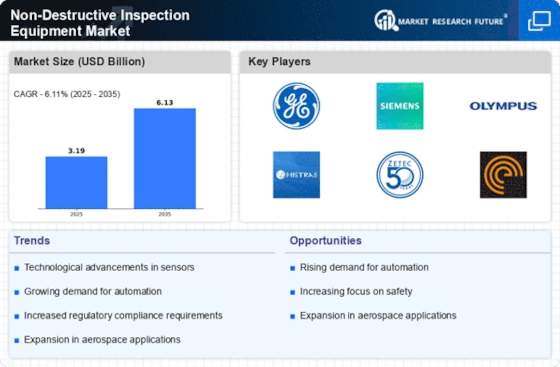
As per Market Research Future analysis, the Non-Destructive Inspection Equipment Market was estimated at 3.19 USD Billion in 2024. The Non-Destructive Inspection Equipment industry is projected to grow from 3.385 USD Billion in 2025 to 6.126 USD Billion by 2035, exhibiting a compound annual growth rate (CAGR) of 6.11% during the forecast period 2025 - 2035

Key Market Trends & Highlights

The Non-Destructive Inspection Equipment Market is poised for substantial growth driven by technological advancements and increasing regulatory compliance.

  • Technological advancements are reshaping the Non-Destructive Inspection Equipment Market, enhancing efficiency and accuracy. North America remains the largest market, while Asia-Pacific is emerging as the fastest-growing region in this sector. The Oil and Gas segment continues to dominate the market, whereas Aerospace and Defense is witnessing rapid growth. Key market drivers include rising investment in infrastructure development and a heightened focus on quality assurance and safety.

Market Size & Forecast

2024 Market Size 3.19 (USD Billion)
2035 Market Size 6.126 (USD Billion)
CAGR (2025 - 2035) 6.11%
Largest Regional Market Share in 2024 North America

Major Players

General Electric (US), Siemens (DE), Olympus Corporation (JP), Mistras Group (US), Zetec (US), Eddyfi Technologies (CA), Sonatest (GB), Intertek Group (GB), Baker Hughes (US)

Market Trends

The Non-Destructive Inspection Equipment Market is currently experiencing a notable evolution, driven by advancements in technology and increasing demand for quality assurance across various industries. This market encompasses a range of tools and techniques that allow for the evaluation of materials and structures without causing any damage. Industries such as aerospace, automotive, and manufacturing are particularly reliant on these technologies to ensure safety and compliance with regulatory standards. As the focus on sustainability and efficiency intensifies, the adoption of non-destructive testing methods is likely to expand, reflecting a broader trend towards minimizing waste and enhancing operational effectiveness. Moreover, the integration of automation and artificial intelligence into non-destructive inspection processes appears to be reshaping the landscape of this market. These innovations not only improve accuracy and speed but also reduce human error, which is crucial in high-stakes environments. The growing emphasis on predictive maintenance and real-time monitoring further indicates a shift towards more proactive approaches in asset management. As industries continue to evolve, the Non-Destructive Inspection Equipment Market is poised for significant growth, driven by the need for reliable inspection solutions that align with modern operational demands.

Technological Advancements

The Non-Destructive Inspection Equipment Market is witnessing rapid technological advancements, particularly in imaging and sensing technologies. Innovations such as digital radiography and ultrasonic testing are enhancing the precision and efficiency of inspections. These developments not only improve the quality of inspections but also reduce the time required for evaluations, making them more appealing to industries that prioritize speed and accuracy.

Increased Regulatory Compliance

There is a growing emphasis on regulatory compliance across various sectors, which is influencing the Non-Destructive Inspection Equipment Market. Industries are increasingly required to adhere to stringent safety and quality standards, prompting a rise in the adoption of non-destructive testing methods. This trend underscores the importance of maintaining high-quality assurance practices to mitigate risks and ensure operational integrity.

Sustainability Focus

The Non-Destructive Inspection Equipment Market is also reflecting a broader trend towards sustainability. As organizations strive to minimize their environmental impact, non-destructive testing methods are being favored for their ability to reduce waste and enhance resource efficiency. This shift towards sustainable practices is likely to drive further innovation and adoption of non-destructive inspection technologies.

Non Destructive Inspection Equipment Market Market Drivers

Increased Regulatory Compliance

Regulatory compliance is a critical driver for the Non-Destructive Inspection Equipment Market, as various sectors are mandated to adhere to stringent safety and quality standards. Industries such as aerospace, automotive, and oil and gas are particularly affected by these regulations, which necessitate regular inspections to ensure product integrity and safety. The market is projected to grow as companies invest in non-destructive testing equipment to meet compliance requirements. For example, the aerospace sector is expected to see a compound annual growth rate of 5.2% in non-destructive testing equipment usage, reflecting the increasing emphasis on safety and regulatory adherence.

Focus on Quality Assurance and Safety

The emphasis on quality assurance and safety across various industries is a significant driver for the Non-Destructive Inspection Equipment Market. Companies are increasingly recognizing the importance of maintaining high standards to avoid costly recalls and ensure customer satisfaction. This focus is particularly evident in sectors such as manufacturing, construction, and energy, where the implications of defects can be severe. As a result, organizations are investing in non-destructive inspection technologies to enhance their quality control processes. The market is expected to benefit from this trend, with a projected increase in the adoption of non-destructive testing methods to ensure product reliability and safety.

Growing Demand from Emerging Economies

Emerging economies are witnessing rapid industrialization, which is propelling the Non-Destructive Inspection Equipment Market forward. As manufacturing and construction activities expand, the need for reliable inspection methods becomes paramount. Countries in Asia and South America are investing heavily in infrastructure and manufacturing, leading to a heightened demand for non-destructive testing solutions. This trend is expected to continue, with the market in these regions projected to grow at a rate of 6.5% annually. The increasing focus on quality assurance and safety in these developing markets is likely to further bolster the demand for non-destructive inspection technologies.

Rising Investment in Infrastructure Development

Investment in infrastructure development is a key driver for the Non-Destructive Inspection Equipment Market. Governments and private entities are allocating substantial resources to enhance transportation, energy, and utility infrastructures. This investment necessitates rigorous inspection processes to ensure structural integrity and safety. As infrastructure projects become more complex, the demand for advanced non-destructive testing solutions is likely to increase. The market is anticipated to grow as stakeholders prioritize safety and compliance in their projects. For instance, the construction sector is projected to see a 4.8% increase in the use of non-destructive inspection technologies, reflecting the growing importance of these methods in infrastructure development.

Technological Advancements in Non-Destructive Inspection Equipment

The Non-Destructive Inspection Equipment Market is experiencing a surge in technological advancements, which are enhancing the capabilities and efficiency of inspection processes. Innovations such as automated systems, artificial intelligence, and advanced imaging techniques are becoming increasingly prevalent. These technologies not only improve the accuracy of inspections but also reduce the time required for assessments. For instance, the integration of AI algorithms in ultrasonic testing has shown to increase defect detection rates by up to 30%. As industries seek to optimize their operations, the demand for sophisticated non-destructive inspection solutions is likely to rise, driving growth in the market.

Market Segment Insights

By Industry Vertical: Oil & Gas (Largest) vs. Aerospace & Defense (Fastest-Growing)

The Non-Destructive Inspection Equipment Market displays a diverse segmentation across various industry verticals. Leading the pack is the <a href="https://www.marketresearchfuture.com/reports/oil-gas-scada-market-7925">Oil &amp; Gas</a> sector, which commands a substantial share of the market due to its critical need for safety and maintenance inspections. Following closely are Aerospace &amp; Defense and Healthcare, which also represent significant segments due to their stringent regulatory requirements and demand for high-quality inspection methods. Additionally, Railways &amp; Transportation, Power &amp; Energy, and Others create a competitive landscape, but their market shares remain smaller compared to the giants.

Oil &amp; Gas (Dominant) vs. Aerospace &amp; Defense (Emerging)

The Oil &amp; Gas sector stands out as the dominant force in the Non-Destructive Inspection Equipment Market, driven by the necessity for consistent and reliable inspections to prevent safety hazards and environmental issues. This industry utilizes various NDI techniques to monitor and assess the integrity of pipelines, drilling rigs, and storage tanks. In contrast, Aerospace &amp; Defense has emerged as a rapidly growing segment, increasingly adopting advanced inspection technologies to meet stringent safety regulations and ensure the performance of critical components. This sector is characterized by a focus on innovation and high precision, resulting in a significant uptick in demand for NDI solutions.

Get more detailed insights about Non-Destructive Inspection Equipment Market Research Report—Global Forecast till 2035

Regional Insights

By Region, the study provides market insights into North America, Europe, Asia-Pacific, and the Rest of the World. The North American non-destructive inspection equipment market accounted for USD 1.28 billion in 2022 and will likely exhibit a significant CAGR growth in the study period. The region dominates due to increased demand for advanced material testing from the United States, Canada, and Mexico. In the United States, established industry players such as Acuren Inspection Inc, Fischer Technology Inc, and Magnaflux Corporation drive the market. 

These end users are primarily from the transportation, manufacturing, aviation, oil & gas, maritime, and power generation industries. According to the Federal Aviation Administration (FAA), over 200,000 airplanes in the United States undergo yearly periodic safety inspections using non-destructive testing equipment. In addition, the U.S. government is increasing its investments in oil & natural gas to support the establishment of the biotech supercluster.

Also, the major countries studied in the market report are the U.S., German, Canada, the UK, France, Italy, Japan, China, Spain, Australia, India, South Korea, and Brazil.

Figure 2: Non-Destructive Inspection Equipment Market SHARE BY REGION 2022 (%)

The European non-destructive inspection equipment market accounts for the second-largest global market share. In European industries, stringent rules and standards about quality, safety, and performance criteria drive the adoption of non-destructive inspection technology to comply with these regulations. 

In addition, technological advancements such as improved imaging techniques, robots, and artificial intelligence (AI) applications are improving the capabilities and accuracy of non-destructive inspection equipment, boosting their use in multiple sectors across Europe. Further, the German non-destructive inspection equipment market held the largest market share, and the UK non-destructive inspection equipment market was the fastest growing market in the European region.

The Asia-Pacific Non-Destructive Inspection Equipment Market is expected to grow at the fastest CAGR from 2023 to 2032. Rapid urbanization and industrialization in India and China are boosting demand for nondestructive inspection equipment in the manufacturing, automotive, aerospace, and infrastructure construction industries. 

Increased expenditures in infrastructure development projects in the region, such as railways, bridges, and power plants, are increasing the demand for nondestructive inspection technology to maintain the efficacy and safety of these essential facilities. Moreover, China’s non-destructive inspection equipment market held the largest market share, and the Indian non-destructive inspection equipment market was the fastest-growing market in the Asia-Pacific region.

Key Players and Competitive Insights

Leading market players in the Non-Destructive Inspection Equipment Market are actively investing in R&D activities to expand their products and services portfolios and drive market growth. These market leaders also participate in proactive measures such as new product releases, mergers & acquisitions, increased investments, contractual agreements, and collaborations with other organizations to grow their global footprint and achieve a competitive advantage. Key market developments in the global non-destructive inspection equipment industry include technical breakthroughs, increased demand from numerous end-use industries, and an increasing focus on safety requirements and quality control.Major players in the non-destructive inspection equipment market, such as Baker Hughes, GE Inspection Technologies, Olympus Corporation, YXLON International GmbH, Sonatest Ltd, and Zetec Inc, are investing extensively in research and development operations to enhance global market demand. Key companies in the non-destructive inspection equipment industry also focus on customization and application-specific solutions to meet the unique requirements of various sectors, including aerospace, automotive, oil & gas, manufacturing, and construction, all of which are major end-users of non-destructive inspection equipment. These businesses leverage local product manufacturing to reduce operational costs, increase consumer value, and gain an edge in the non-destructive inspection equipment industry.Baker Hughes Company is a leading energy and industrial solutions provider. The company's product range comprises drilling equipment, compressors, subsea production systems, electricity generators, pipe systems, energy recovery & storage systems, control systems, regulators, valves, pumps, and process control technologies. It also provides sensor-based process measurement, non-destructive testing & inspection, plant controls, and pipeline integrity solutions. It caters to independent oil & gas enterprises and national or state-owned oil companies. It has research and manufacturing centers in India, Singapore, Australia, Malaysia, Dubai, Italy, Norway, Saudi Arabia, Germany, Oklahoma, Louisiana, and Missouri, among other places. Baker Hughes is based in Houston, Texas, in the United States. Baker Hughes announced the introduction of Veo+ Edge, a next-generation ultrasonic phased array testing system for non-destructive inspection, in September 2021. This cutting-edge inspection equipment allows for faster, more precise, and more efficient inspections of essential assets such as pipelines, vessels, and tanks. Veo+ Edge has increased imaging capabilities and data analysis features, allowing operators to discover faults and abnormalities more precisely, save inspection time, and optimize asset integrity management techniques.Olympus Corporation is a Japanese firm that manufactures optical and digital precision equipment and instruments. The company designs, manufactures, and sells healthcare, medical, imaging, information, and other industrial equipment. It also provides services for biological materials and system development. The corporation operates across the Americas, Europe, and Asia-Pacific through its subsidiaries and facilities. Olympus Corporation introduced the 72DL PLUS ultrasonic thickness gauge in March 2022. It provides high-speed, precise thickness measurements in a portable, user-friendly device. The gauge can measure the thickness of very thin layers for complex applications across various industries to its rapid scanning, advanced algorithms, and lowest-ever minimum thickness capability from Olympus.

Key Companies in the Non Destructive Inspection Equipment Market include

Industry Developments

October 2023: Olympus Corporation announced a flagship phased array flaw detector known as OmniScan X3 64, developed with an emphasis on the energy, oil and gas, and automotive industries. Olympus is said to have added new functionalities and software that are capable of providing advanced 3D visualizations as well as enhanced micro-crack and defect detection features for more effective pipelines and structures. Additionally, Olympus rolled out new AI-driven algorithms that can be used to seamlessly rearrange and analyze inspection data.

The company noted an expected increase in the device’s demand, particularly within markets in areas with high commitments to modernizing their infrastructure.

August 2023: GE Aerospace also introduced their next-generation Mentor UT, emphasizing defect identification capabilities and its relevance to modern aircraft’s lightweight composite material inspection. The Mentor UT is said to cut down inspection times whilst improving defect detection through a cloud interface. Olympus began working with major aerospace manufacturers making it possible for it to increase the device’s appeal to those within the supply chain. It is trials showed that 25% of the identified defects increasing the equipment’s usefulness compared to its predecessor.

October 2022: Ectane 3, a potent non-destructive testing (NDT) equipment for surface and tubing inspections, was introduced by Eddyfi. The next-generation Ectane 3 includes remote-field array (RFA) technology for improved carbon steel heat exchanger examinations.

February 2022: Olympus Corporation has introduced the OmniScan X3 64 defect detector, which has increased power and performance. The pulse capacity of this 64-channel instrument allows it to drive phased array (PA) probes with more elements, enhancing data acquisition speed for total focusing method (TFM) imaging. Users can use its expanded features to diversify and expand their application portfolio.

Future Outlook

Non Destructive Inspection Equipment Market Future Outlook

The Non-Destructive Inspection Equipment Market is projected to grow at a 6.11% CAGR from 2025 to 2035, driven by technological advancements, increasing safety regulations, and rising demand across various industries.

New opportunities lie in:

  • Integration of AI-driven analytics for predictive maintenance solutions.</p><p>Development of portable NDI systems for remote inspections.</p><p>Expansion into emerging markets with tailored inspection solutions.

By 2035, the market is expected to achieve robust growth, solidifying its position as a critical industry.

Market Segmentation

Non Destructive Inspection Equipment Market Industry Vertical Outlook

  • Railways & Transportation
  • Aerospace & Defense
  • Oil & Gas
  • Power & Energy
  • Healthcare
  • Others

Report Scope

MARKET SIZE 2024 3.19(USD Billion)
MARKET SIZE 2025 3.385(USD Billion)
MARKET SIZE 2035 6.126(USD Billion)
COMPOUND ANNUAL GROWTH RATE (CAGR) 6.11% (2025 - 2035)
REPORT COVERAGE Revenue Forecast, Competitive Landscape, Growth Factors, and Trends
BASE YEAR 2024
Market Forecast Period 2025 - 2035
Historical Data 2019 - 2024
Market Forecast Units USD Billion
Key Companies Profiled General Electric (US), Siemens (DE), Olympus Corporation (JP), Mistras Group (US), Zetec (US), Eddyfi Technologies (CA), Sonatest (GB), Intertek Group (GB), Baker Hughes (US)
Segments Covered Industry Vertical, Region
Key Market Opportunities Integration of artificial intelligence enhances efficiency in the Non-Destructive Inspection Equipment Market.
Key Market Dynamics Technological advancements and regulatory changes drive innovation and competition in the Non-Destructive Inspection Equipment Market.
Countries Covered North America, Europe, APAC, South America, MEA

FAQs

What is the current valuation of the Non-Destructive Inspection Equipment Market?

<p>The market valuation was 3.19 USD Billion in 2024.</p>

What is the projected market size for the Non-Destructive Inspection Equipment Market by 2035?

<p>The projected valuation for 2035 is 6.126 USD Billion.</p>

What is the expected CAGR for the Non-Destructive Inspection Equipment Market during the forecast period 2025 - 2035?

<p>The expected CAGR during this period is 6.11%.</p>

Which industry verticals are driving growth in the Non-Destructive Inspection Equipment Market?

<p>Key industry verticals include Aerospace & Defense, Oil & Gas, and Railways & Transportation.</p>

What was the market size for the Aerospace & Defense segment in 2024?

<p>The market size for the Aerospace & Defense segment was 0.8 USD Billion in 2024.</p>

How much is the Oil & Gas segment projected to grow by 2035?

The Oil &amp; Gas segment is projected to grow from 0.7 USD Billion in 2024 to 1.2 USD Billion by 2035.

Who are the leading players in the Non-Destructive Inspection Equipment Market?

Key players include General Electric, Siemens, Olympus Corporation, and Mistras Group.

What was the market size for the Healthcare segment in 2024?

The Healthcare segment was valued at 0.4 USD Billion in 2024.

What is the projected growth for the Railways & Transportation segment by 2035?

The Railways &amp; Transportation segment is expected to grow from 0.5 USD Billion in 2024 to 1.0 USD Billion by 2035.

How does the Non-Destructive Inspection Equipment Market compare across different segments?

The market shows varied growth, with Aerospace &amp; Defense and Oil &amp; Gas segments indicating higher valuations compared to others.

  1. SECTION I: EXECUTIVE SUMMARY AND KEY HIGHLIGHTS
    1. | 1.1 EXECUTIVE SUMMARY
    2. | | 1.1.1 Market Overview
    3. | | 1.1.2 Key Findings
    4. | | 1.1.3 Market Segmentation
    5. | | 1.1.4 Competitive Landscape
    6. | | 1.1.5 Challenges and Opportunities
    7. | | 1.1.6 Future Outlook
  2. SECTION II: SCOPING, METHODOLOGY AND MARKET STRUCTURE
    1. | 2.1 MARKET INTRODUCTION
    2. | | 2.1.1 Definition
    3. | | 2.1.2 Scope of the study
    4. | | | 2.1.2.1 Research Objective
    5. | | | 2.1.2.2 Assumption
    6. | | | 2.1.2.3 Limitations
    7. | 2.2 RESEARCH METHODOLOGY
    8. | | 2.2.1 Overview
    9. | | 2.2.2 Data Mining
    10. | | 2.2.3 Secondary Research
    11. | | 2.2.4 Primary Research
    12. | | | 2.2.4.1 Primary Interviews and Information Gathering Process
    13. | | | 2.2.4.2 Breakdown of Primary Respondents
    14. | | 2.2.5 Forecasting Model
    15. | | 2.2.6 Market Size Estimation
    16. | | | 2.2.6.1 Bottom-Up Approach
    17. | | | 2.2.6.2 Top-Down Approach
    18. | | 2.2.7 Data Triangulation
    19. | | 2.2.8 Validation
  3. SECTION III: QUALITATIVE ANALYSIS
    1. | 3.1 MARKET DYNAMICS
    2. | | 3.1.1 Overview
    3. | | 3.1.2 Drivers
    4. | | 3.1.3 Restraints
    5. | | 3.1.4 Opportunities
    6. | 3.2 MARKET FACTOR ANALYSIS
    7. | | 3.2.1 Value chain Analysis
    8. | | 3.2.2 Porter's Five Forces Analysis
    9. | | | 3.2.2.1 Bargaining Power of Suppliers
    10. | | | 3.2.2.2 Bargaining Power of Buyers
    11. | | | 3.2.2.3 Threat of New Entrants
    12. | | | 3.2.2.4 Threat of Substitutes
    13. | | | 3.2.2.5 Intensity of Rivalry
    14. | | 3.2.3 COVID-19 Impact Analysis
    15. | | | 3.2.3.1 Market Impact Analysis
    16. | | | 3.2.3.2 Regional Impact
    17. | | | 3.2.3.3 Opportunity and Threat Analysis
  4. SECTION IV: QUANTITATIVE ANALYSIS
    1. | 4.1 Semiconductor & Electronics, BY Industry Vertical (USD Billion)
    2. | | 4.1.1 Railways & Transportation
    3. | | 4.1.2 Aerospace & Defense
    4. | | 4.1.3 Oil & Gas
    5. | | 4.1.4 Power & Energy
    6. | | 4.1.5 Healthcare
    7. | | 4.1.6 Others
    8. | 4.2 Semiconductor & Electronics, BY Region (USD Billion)
    9. | | 4.2.1 North America
    10. | | | 4.2.1.1 US
    11. | | | 4.2.1.2 Canada
    12. | | 4.2.2 Europe
    13. | | | 4.2.2.1 Germany
    14. | | | 4.2.2.2 UK
    15. | | | 4.2.2.3 France
    16. | | | 4.2.2.4 Russia
    17. | | | 4.2.2.5 Italy
    18. | | | 4.2.2.6 Spain
    19. | | | 4.2.2.7 Rest of Europe
    20. | | 4.2.3 APAC
    21. | | | 4.2.3.1 China
    22. | | | 4.2.3.2 India
    23. | | | 4.2.3.3 Japan
    24. | | | 4.2.3.4 South Korea
    25. | | | 4.2.3.5 Malaysia
    26. | | | 4.2.3.6 Thailand
    27. | | | 4.2.3.7 Indonesia
    28. | | | 4.2.3.8 Rest of APAC
    29. | | 4.2.4 South America
    30. | | | 4.2.4.1 Brazil
    31. | | | 4.2.4.2 Mexico
    32. | | | 4.2.4.3 Argentina
    33. | | | 4.2.4.4 Rest of South America
    34. | | 4.2.5 MEA
    35. | | | 4.2.5.1 GCC Countries
    36. | | | 4.2.5.2 South Africa
    37. | | | 4.2.5.3 Rest of MEA
  5. SECTION V: COMPETITIVE ANALYSIS
    1. | 5.1 Competitive Landscape
    2. | | 5.1.1 Overview
    3. | | 5.1.2 Competitive Analysis
    4. | | 5.1.3 Market share Analysis
    5. | | 5.1.4 Major Growth Strategy in the Semiconductor & Electronics
    6. | | 5.1.5 Competitive Benchmarking
    7. | | 5.1.6 Leading Players in Terms of Number of Developments in the Semiconductor & Electronics
    8. | | 5.1.7 Key developments and growth strategies
    9. | | | 5.1.7.1 New Product Launch/Service Deployment
    10. | | | 5.1.7.2 Merger & Acquisitions
    11. | | | 5.1.7.3 Joint Ventures
    12. | | 5.1.8 Major Players Financial Matrix
    13. | | | 5.1.8.1 Sales and Operating Income
    14. | | | 5.1.8.2 Major Players R&D Expenditure. 2023
    15. | 5.2 Company Profiles
    16. | | 5.2.1 General Electric (US)
    17. | | | 5.2.1.1 Financial Overview
    18. | | | 5.2.1.2 Products Offered
    19. | | | 5.2.1.3 Key Developments
    20. | | | 5.2.1.4 SWOT Analysis
    21. | | | 5.2.1.5 Key Strategies
    22. | | 5.2.2 Siemens (DE)
    23. | | | 5.2.2.1 Financial Overview
    24. | | | 5.2.2.2 Products Offered
    25. | | | 5.2.2.3 Key Developments
    26. | | | 5.2.2.4 SWOT Analysis
    27. | | | 5.2.2.5 Key Strategies
    28. | | 5.2.3 Olympus Corporation (JP)
    29. | | | 5.2.3.1 Financial Overview
    30. | | | 5.2.3.2 Products Offered
    31. | | | 5.2.3.3 Key Developments
    32. | | | 5.2.3.4 SWOT Analysis
    33. | | | 5.2.3.5 Key Strategies
    34. | | 5.2.4 Mistras Group (US)
    35. | | | 5.2.4.1 Financial Overview
    36. | | | 5.2.4.2 Products Offered
    37. | | | 5.2.4.3 Key Developments
    38. | | | 5.2.4.4 SWOT Analysis
    39. | | | 5.2.4.5 Key Strategies
    40. | | 5.2.5 Zetec (US)
    41. | | | 5.2.5.1 Financial Overview
    42. | | | 5.2.5.2 Products Offered
    43. | | | 5.2.5.3 Key Developments
    44. | | | 5.2.5.4 SWOT Analysis
    45. | | | 5.2.5.5 Key Strategies
    46. | | 5.2.6 Eddyfi Technologies (CA)
    47. | | | 5.2.6.1 Financial Overview
    48. | | | 5.2.6.2 Products Offered
    49. | | | 5.2.6.3 Key Developments
    50. | | | 5.2.6.4 SWOT Analysis
    51. | | | 5.2.6.5 Key Strategies
    52. | | 5.2.7 Sonatest (GB)
    53. | | | 5.2.7.1 Financial Overview
    54. | | | 5.2.7.2 Products Offered
    55. | | | 5.2.7.3 Key Developments
    56. | | | 5.2.7.4 SWOT Analysis
    57. | | | 5.2.7.5 Key Strategies
    58. | | 5.2.8 Intertek Group (GB)
    59. | | | 5.2.8.1 Financial Overview
    60. | | | 5.2.8.2 Products Offered
    61. | | | 5.2.8.3 Key Developments
    62. | | | 5.2.8.4 SWOT Analysis
    63. | | | 5.2.8.5 Key Strategies
    64. | | 5.2.9 Baker Hughes (US)
    65. | | | 5.2.9.1 Financial Overview
    66. | | | 5.2.9.2 Products Offered
    67. | | | 5.2.9.3 Key Developments
    68. | | | 5.2.9.4 SWOT Analysis
    69. | | | 5.2.9.5 Key Strategies
    70. | 5.3 Appendix
    71. | | 5.3.1 References
    72. | | 5.3.2 Related Reports
  6. LIST OF FIGURES
    1. | 6.1 MARKET SYNOPSIS
    2. | 6.2 NORTH AMERICA MARKET ANALYSIS
    3. | 6.3 US MARKET ANALYSIS BY INDUSTRY VERTICAL
    4. | 6.4 CANADA MARKET ANALYSIS BY INDUSTRY VERTICAL
    5. | 6.5 EUROPE MARKET ANALYSIS
    6. | 6.6 GERMANY MARKET ANALYSIS BY INDUSTRY VERTICAL
    7. | 6.7 UK MARKET ANALYSIS BY INDUSTRY VERTICAL
    8. | 6.8 FRANCE MARKET ANALYSIS BY INDUSTRY VERTICAL
    9. | 6.9 RUSSIA MARKET ANALYSIS BY INDUSTRY VERTICAL
    10. | 6.10 ITALY MARKET ANALYSIS BY INDUSTRY VERTICAL
    11. | 6.11 SPAIN MARKET ANALYSIS BY INDUSTRY VERTICAL
    12. | 6.12 REST OF EUROPE MARKET ANALYSIS BY INDUSTRY VERTICAL
    13. | 6.13 APAC MARKET ANALYSIS
    14. | 6.14 CHINA MARKET ANALYSIS BY INDUSTRY VERTICAL
    15. | 6.15 INDIA MARKET ANALYSIS BY INDUSTRY VERTICAL
    16. | 6.16 JAPAN MARKET ANALYSIS BY INDUSTRY VERTICAL
    17. | 6.17 SOUTH KOREA MARKET ANALYSIS BY INDUSTRY VERTICAL
    18. | 6.18 MALAYSIA MARKET ANALYSIS BY INDUSTRY VERTICAL
    19. | 6.19 THAILAND MARKET ANALYSIS BY INDUSTRY VERTICAL
    20. | 6.20 INDONESIA MARKET ANALYSIS BY INDUSTRY VERTICAL
    21. | 6.21 REST OF APAC MARKET ANALYSIS BY INDUSTRY VERTICAL
    22. | 6.22 SOUTH AMERICA MARKET ANALYSIS
    23. | 6.23 BRAZIL MARKET ANALYSIS BY INDUSTRY VERTICAL
    24. | 6.24 MEXICO MARKET ANALYSIS BY INDUSTRY VERTICAL
    25. | 6.25 ARGENTINA MARKET ANALYSIS BY INDUSTRY VERTICAL
    26. | 6.26 REST OF SOUTH AMERICA MARKET ANALYSIS BY INDUSTRY VERTICAL
    27. | 6.27 MEA MARKET ANALYSIS
    28. | 6.28 GCC COUNTRIES MARKET ANALYSIS BY INDUSTRY VERTICAL
    29. | 6.29 SOUTH AFRICA MARKET ANALYSIS BY INDUSTRY VERTICAL
    30. | 6.30 REST OF MEA MARKET ANALYSIS BY INDUSTRY VERTICAL
    31. | 6.31 KEY BUYING CRITERIA OF SEMICONDUCTOR & ELECTRONICS
    32. | 6.32 RESEARCH PROCESS OF MRFR
    33. | 6.33 DRO ANALYSIS OF SEMICONDUCTOR & ELECTRONICS
    34. | 6.34 DRIVERS IMPACT ANALYSIS: SEMICONDUCTOR & ELECTRONICS
    35. | 6.35 RESTRAINTS IMPACT ANALYSIS: SEMICONDUCTOR & ELECTRONICS
    36. | 6.36 SUPPLY / VALUE CHAIN: SEMICONDUCTOR & ELECTRONICS
    37. | 6.37 SEMICONDUCTOR & ELECTRONICS, BY INDUSTRY VERTICAL, 2024 (% SHARE)
    38. | 6.38 SEMICONDUCTOR & ELECTRONICS, BY INDUSTRY VERTICAL, 2024 TO 2035 (USD Billion)
    39. | 6.39 BENCHMARKING OF MAJOR COMPETITORS
  7. LIST OF TABLES
    1. | 7.1 LIST OF ASSUMPTIONS
    2. | | 7.1.1
    3. | 7.2 North America MARKET SIZE ESTIMATES; FORECAST
    4. | | 7.2.1 BY INDUSTRY VERTICAL, 2025-2035 (USD Billion)
    5. | 7.3 US MARKET SIZE ESTIMATES; FORECAST
    6. | | 7.3.1 BY INDUSTRY VERTICAL, 2025-2035 (USD Billion)
    7. | 7.4 Canada MARKET SIZE ESTIMATES; FORECAST
    8. | | 7.4.1 BY INDUSTRY VERTICAL, 2025-2035 (USD Billion)
    9. | 7.5 Europe MARKET SIZE ESTIMATES; FORECAST
    10. | | 7.5.1 BY INDUSTRY VERTICAL, 2025-2035 (USD Billion)
    11. | 7.6 Germany MARKET SIZE ESTIMATES; FORECAST
    12. | | 7.6.1 BY INDUSTRY VERTICAL, 2025-2035 (USD Billion)
    13. | 7.7 UK MARKET SIZE ESTIMATES; FORECAST
    14. | | 7.7.1 BY INDUSTRY VERTICAL, 2025-2035 (USD Billion)
    15. | 7.8 France MARKET SIZE ESTIMATES; FORECAST
    16. | | 7.8.1 BY INDUSTRY VERTICAL, 2025-2035 (USD Billion)
    17. | 7.9 Russia MARKET SIZE ESTIMATES; FORECAST
    18. | | 7.9.1 BY INDUSTRY VERTICAL, 2025-2035 (USD Billion)
    19. | 7.10 Italy MARKET SIZE ESTIMATES; FORECAST
    20. | | 7.10.1 BY INDUSTRY VERTICAL, 2025-2035 (USD Billion)
    21. | 7.11 Spain MARKET SIZE ESTIMATES; FORECAST
    22. | | 7.11.1 BY INDUSTRY VERTICAL, 2025-2035 (USD Billion)
    23. | 7.12 Rest of Europe MARKET SIZE ESTIMATES; FORECAST
    24. | | 7.12.1 BY INDUSTRY VERTICAL, 2025-2035 (USD Billion)
    25. | 7.13 APAC MARKET SIZE ESTIMATES; FORECAST
    26. | | 7.13.1 BY INDUSTRY VERTICAL, 2025-2035 (USD Billion)
    27. | 7.14 China MARKET SIZE ESTIMATES; FORECAST
    28. | | 7.14.1 BY INDUSTRY VERTICAL, 2025-2035 (USD Billion)
    29. | 7.15 India MARKET SIZE ESTIMATES; FORECAST
    30. | | 7.15.1 BY INDUSTRY VERTICAL, 2025-2035 (USD Billion)
    31. | 7.16 Japan MARKET SIZE ESTIMATES; FORECAST
    32. | | 7.16.1 BY INDUSTRY VERTICAL, 2025-2035 (USD Billion)
    33. | 7.17 South Korea MARKET SIZE ESTIMATES; FORECAST
    34. | | 7.17.1 BY INDUSTRY VERTICAL, 2025-2035 (USD Billion)
    35. | 7.18 Malaysia MARKET SIZE ESTIMATES; FORECAST
    36. | | 7.18.1 BY INDUSTRY VERTICAL, 2025-2035 (USD Billion)
    37. | 7.19 Thailand MARKET SIZE ESTIMATES; FORECAST
    38. | | 7.19.1 BY INDUSTRY VERTICAL, 2025-2035 (USD Billion)
    39. | 7.20 Indonesia MARKET SIZE ESTIMATES; FORECAST
    40. | | 7.20.1 BY INDUSTRY VERTICAL, 2025-2035 (USD Billion)
    41. | 7.21 Rest of APAC MARKET SIZE ESTIMATES; FORECAST
    42. | | 7.21.1 BY INDUSTRY VERTICAL, 2025-2035 (USD Billion)
    43. | 7.22 South America MARKET SIZE ESTIMATES; FORECAST
    44. | | 7.22.1 BY INDUSTRY VERTICAL, 2025-2035 (USD Billion)
    45. | 7.23 Brazil MARKET SIZE ESTIMATES; FORECAST
    46. | | 7.23.1 BY INDUSTRY VERTICAL, 2025-2035 (USD Billion)
    47. | 7.24 Mexico MARKET SIZE ESTIMATES; FORECAST
    48. | | 7.24.1 BY INDUSTRY VERTICAL, 2025-2035 (USD Billion)
    49. | 7.25 Argentina MARKET SIZE ESTIMATES; FORECAST
    50. | | 7.25.1 BY INDUSTRY VERTICAL, 2025-2035 (USD Billion)
    51. | 7.26 Rest of South America MARKET SIZE ESTIMATES; FORECAST
    52. | | 7.26.1 BY INDUSTRY VERTICAL, 2025-2035 (USD Billion)
    53. | 7.27 MEA MARKET SIZE ESTIMATES; FORECAST
    54. | | 7.27.1 BY INDUSTRY VERTICAL, 2025-2035 (USD Billion)
    55. | 7.28 GCC Countries MARKET SIZE ESTIMATES; FORECAST
    56. | | 7.28.1 BY INDUSTRY VERTICAL, 2025-2035 (USD Billion)
    57. | 7.29 South Africa MARKET SIZE ESTIMATES; FORECAST
    58. | | 7.29.1 BY INDUSTRY VERTICAL, 2025-2035 (USD Billion)
    59. | 7.30 Rest of MEA MARKET SIZE ESTIMATES; FORECAST
    60. | | 7.30.1 BY INDUSTRY VERTICAL, 2025-2035 (USD Billion)
    61. | 7.31 PRODUCT LAUNCH/PRODUCT DEVELOPMENT/APPROVAL
    62. | | 7.31.1
    63. | 7.32 ACQUISITION/PARTNERSHIP
    64. | | 7.32.1

Semiconductor & Electronics Market Segmentation

Semiconductor & Electronics By Industry Vertical (USD Billion, 2025-2035)

  • Railways & Transportation
  • Aerospace & Defense
  • Oil & Gas
  • Power & Energy
  • Healthcare
  • Others
Infographic

Free Sample Request

Kindly complete the form below to receive a free sample of this Report

Get Free Sample

Customer Strories

Compare Licence

×
Features License Type
Single User Multiuser License Enterprise User
Price $4,950 $5,950 $7,250
Maximum User Access Limit 1 User Upto 10 Users Unrestricted Access Throughout the Organization
Free Customization
Direct Access to Analyst
Deliverable Format
Platform Access
Discount on Next Purchase 10% 15% 15%
Printable Versions
%>