×
Request Free Sample ×

Kindly complete the form below to receive a free sample of this Report

* Please use a valid business email

Leading companies partner with us for data-driven Insights

clients tt-cursor
Hero Background
English
Chinese
French
Japanese
Korean
German
Spanish

Next-Generation Memory Market Analysis

ID: MRFR/SEM/1815-HCR
200 Pages
Ankit Gupta
October 2025

Next Generation Memory Market Size, Share and Research Report: By Technology (Non-Volatile Memory, Volatile Memory, Magnetoresistive Random Access Memory, Phase Change Memory, Resistive Random Access Memory), By Application (Consumer Electronics, Automotive, Telecommunications, Data Centers, Industrial), By End Use (Personal Use, Enterprise Use, Government), By Form Factor (Chip-on-Board, Ball Grid Array, Dual In-line Package, Thin Small Outline Package), and By Regional (North America, Europe, South America, Asia Pacific, Middle East and Af... read more

Share:
Download PDF ×

We do not share your information with anyone. However, we may send you emails based on your report interest from time to time. You may contact us at any time to opt-out.

Next-Generation Memory Market Infographic
×
Next-Generation Memory Market Infographic Full View
Purchase Options

Market Analysis

In-depth Analysis of Next-Generation Memory Market Industry Landscape

The dynamics of the Next-Generation Memory Market are shaped by a myriad of factors, influencing its growth, trends, and overall trajectory. One fundamental driver of market dynamics is the relentless pursuit of higher performance. As computing demands become more sophisticated and applications more complex, there is a continuous need for memory solutions that can keep pace. Such drivers as increasing data access speed and lower latency prop up market growth. In addition, these trends improve general operations and accommodate emerging technologies, for example, artificial intelligence, machine learning, and high performance computing.

Furthermore, as data-driven applications change over time, these technologies that led to the market dynamics in the first place. The explosion of data analytics with big data, IoT, and 5G creates for once digital data a new dimension. It is this flood of data creation and usage that sets off a chain reaction of demand for memory solutions that can efficiently handle vast database sets and process them quickly. The Next-Generation Memory Industry occupies a major place among manufacturers for it is addressing these issues staying on point with solutions where data access and storage become smooth, consequentially affecting market's movement.

Energy efficiency, as the other factor driving the development of Next Generation Memory Market, plays a major role there. Now that technology has become part of everyday life, measures for energy consumption and environmental sustainability are receiving more attention. 3rd generation memory technologies are the giving advantage of energy efficiency and thus are fast taking place not only by manufacturers but also by the end users. With the consumer preference for greener products inclined towards energy saving and ecological memory solutions, the market dynamics are altering in line with the wider global push for sustainable technology.

Also, the most vital factor in the market condition is the competition that is dominant in the process. The market is defined by a huge competition that includes semiconductor manufacturers, high-tech corporations and entrepreneurs as leaders, who are trying to stay ahead of all competitors. Local, national and global research and development initiatives, strategic businesses partnerships and mergers and acquisitions determine the structure of this market. The firms want to take advantage of the really latest technology while staying one step ahead of its competitor to secure the market share; thus lead them to innovations and advancements in the similar sector.

In addition to dynamics of the marketplace, the economics of the system regarding the adoption of the advanced memory technologies are a major consideration. However, the fact that they provide more product capabilities than ever while the initial startup, and production costs may become the most challenging barriers for these technologies to be disseminated on a large scale. The evolution of market dynamics may be seen as the market matures and economics of scale take place. The impact of cost dynamics will enable next-generation memory solutions and affect the market for these products holistically.

In addition, the regulation and standard guidelines contribute to the market conditions. Compliance with industry standards and regulations is essential for market acceptance and interoperability. Changes in standards or the introduction of new regulations can have a profound impact on the market, influencing product development and adoption strategies for industry players.

Author
Ankit Gupta
Senior Research Analyst

Ankit Gupta is an analyst in market research industry in ICT and SEMI industry. With post-graduation in "Telecom and Marketing Management" and graduation in "Electronics and Telecommunication" vertical he is well versed with recent development in ICT industry as a whole. Having worked on more than 150+ reports including consultation for fortune 500 companies such as Microsoft and Rio Tinto in identifying solutions with respect to business problems his opinions are inclined towards mixture of technical and managerial aspects.

Leave a Comment

FAQs

What was the market size of the Next Generation Memory Market in 2024?

The Next Generation Memory Market was valued at 16.08 USD billion in 2024.

What is the projected market size for the Next Generation Memory Market by 2035?

By 2035, the market is projected to reach a value of 55.0 USD billion.

What is the expected CAGR for the Next Generation Memory Market from 2025 to 2035?

The market is anticipated to grow at a CAGR of 31.00% from 2025 to 2035.

Which region dominated the Next Generation Memory Market in 2024?

North America dominated the market with a valuation of 5.01 USD billion in 2024.

How much will the Asia Pacific region contribute to the Next Generation Memory Market by 2035?

The Asia Pacific region is anticipated to contribute 18.25 USD billion to the market by 2035.

What was the market size for Non-Volatile Memory in 2024?

The Non-Volatile Memory segment was valued at 6.4 USD billion in 2024.

Who are the key players in the Next Generation Memory Market?

Major players include SK Hynix, Kioxia, Samsung Electronics, and Micron Technology among others.

What will be the market size for Volatile Memory by 2035?

The Volatile Memory segment is projected to reach 15.8 USD billion by 2035.

What challenges may impact the Next Generation Memory Market?

Potential challenges include technological advancements and fluctuating demand in related sectors.

What growth opportunities exist in the Next Generation Memory Market?

Opportunities lie in rising applications in AI, IoT, and data centers that require advanced memory solutions.

Market Summary

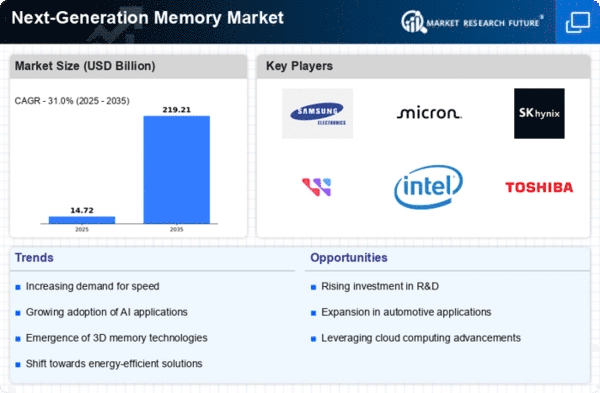
As per MRFR analysis, the Next-Generation Memory Market Size was estimated at 11.24 USD Billion in 2024. The Next-Generation Memory industry is projected to grow from 14.73 USD Billion in 2025 to 219.21 USD Billion by 2035, exhibiting a compound annual growth rate (CAGR) of 31.0 during the forecast period 2025 - 2035.

Key Market Trends & Highlights

The Next-Generation Memory Market is poised for substantial growth driven by technological advancements and increasing demand across various sectors.

  • North America remains the largest market for next-generation memory, driven by robust technological infrastructure. The Asia-Pacific region is emerging as the fastest-growing market, fueled by rapid industrialization and digital transformation. The data storage segment continues to dominate the market, while the artificial intelligence segment is experiencing the fastest growth. Rising data storage needs and advancements in memory technology are key drivers propelling market expansion.

Market Size & Forecast

2024 Market Size 11.24 (USD Billion)
2035 Market Size 219.21 (USD Billion)
CAGR (2025 - 2035) 31.0%
Largest Regional Market Share in 2024 North America

Major Players

Samsung Electronics (KR), Micron Technology (US), SK Hynix (KR), Western Digital (US), Intel Corporation (US), Toshiba Corporation (JP), NVIDIA Corporation (US), STMicroelectronics (FR), Infineon Technologies (DE)

Market Trends

The Next-Generation Memory Market is currently experiencing a transformative phase, driven by the increasing demand for high-performance computing and advanced data storage solutions. This market encompasses a variety of innovative memory technologies, including but not limited to, MRAM, ReRAM, and PCM, which are poised to replace traditional memory solutions. As industries such as artificial intelligence, machine learning, and big data analytics continue to expand, the need for faster, more efficient memory solutions becomes paramount. Companies are investing heavily in research and development to enhance memory performance, reduce latency, and improve energy efficiency, which are critical factors for modern applications. Moreover, the competitive landscape of the Next-Generation Memory Market is evolving, with numerous players striving to establish their foothold. Collaborations and partnerships among technology firms are becoming increasingly common, as they seek to leverage each other's strengths and accelerate innovation. The market appears to be on the brink of significant advancements, with emerging technologies likely to redefine the capabilities of memory solutions. As the demand for data-intensive applications grows, the Next-Generation Memory Market is expected to play a crucial role in shaping the future of computing and data management, potentially leading to unprecedented levels of performance and efficiency.

Emergence of New Technologies

The Next-Generation Memory Market is witnessing the rise of novel memory technologies that promise enhanced performance and efficiency. Innovations such as MRAM, ReRAM, and PCM are gaining traction, offering alternatives to conventional memory solutions. These technologies are designed to address the limitations of existing memory types, potentially leading to faster data access and improved energy consumption.

Increased Investment in R&D

Investment in research and development within the Next-Generation Memory Market is intensifying as companies strive to innovate and stay competitive. This trend indicates a commitment to advancing memory technologies, with firms focusing on improving speed, capacity, and reliability. Such investments are likely to yield breakthroughs that could redefine memory applications across various sectors.

Growing Demand from Emerging Applications

The demand for next-generation memory solutions is being fueled by the proliferation of emerging applications, particularly in artificial intelligence and big data analytics. These sectors require high-speed, reliable memory to process vast amounts of data efficiently. As these applications continue to evolve, the Next-Generation Memory Market is expected to expand, catering to the specific needs of these advanced technologies.

Next-Generation Memory Market Market Drivers

Market Growth Projections

The Global Next Generation Memory Market Industry is poised for substantial growth, with projections indicating a market size of 16.1 USD Billion in 2024 and an anticipated increase to 55 USD Billion by 2035. This growth trajectory suggests a compound annual growth rate of 11.83% from 2025 to 2035, reflecting the increasing reliance on advanced memory technologies across various sectors. The market's expansion is driven by factors such as the rising demand for high-performance computing, advancements in memory technology, and the growing adoption of IoT devices. These dynamics collectively underscore the transformative potential of the Global Next Generation Memory Market Industry.

Growing Adoption of IoT Devices

The proliferation of Internet of Things (IoT) devices is significantly impacting the Global Next Generation Memory Market Industry. As more devices become interconnected, the need for efficient memory solutions that can handle vast amounts of data in real-time is becoming increasingly apparent. IoT applications require memory that is not only fast but also energy-efficient, which drives the demand for next-generation memory technologies. This trend is expected to contribute to a compound annual growth rate of 11.83% from 2025 to 2035, highlighting the importance of innovative memory solutions in supporting the expanding IoT ecosystem and its associated data requirements.

Increased Focus on Data Security

Data security concerns are driving the Global Next Generation Memory Market Industry towards advanced memory solutions. With the rise in cyber threats and data breaches, organizations are prioritizing secure data storage options. Next-generation memory technologies, such as non-volatile memory, offer enhanced security features that protect sensitive information. This focus on data integrity and security is likely to propel market growth, as businesses seek to safeguard their data assets. As the industry evolves, the integration of security features into memory solutions will become increasingly critical, shaping the future landscape of the Global Next Generation Memory Market Industry.

Advancements in Memory Technology

Innovations in memory technology are a key driver of the Global Next Generation Memory Market Industry. Emerging technologies such as 3D NAND, MRAM, and ReRAM are revolutionizing data storage and retrieval processes. These advancements not only improve performance but also reduce power consumption, which is critical for mobile and embedded applications. As manufacturers invest in research and development, the market is likely to experience substantial growth, with projections indicating a market size of 55 USD Billion by 2035. This evolution in memory technology is essential for accommodating the increasing data demands of modern applications, thereby propelling the Global Next Generation Memory Market Industry forward.

Emerging Applications in Automotive Sector

The automotive sector is emerging as a significant driver for the Global Next Generation Memory Market Industry. With the rise of electric vehicles and autonomous driving technologies, there is a growing need for advanced memory solutions that can support complex computations and real-time data processing. Next-generation memory technologies are essential for applications such as advanced driver-assistance systems (ADAS) and vehicle-to-everything (V2X) communication. As the automotive industry continues to innovate, the demand for high-performance memory solutions is expected to rise, contributing to the overall growth of the market.

Rising Demand for High-Performance Computing

The Global Next Generation Memory Market Industry is witnessing a surge in demand for high-performance computing applications. As industries increasingly rely on data-intensive tasks, the need for faster and more efficient memory solutions becomes paramount. This trend is particularly evident in sectors such as artificial intelligence, machine learning, and big data analytics, where traditional memory technologies struggle to keep pace. The market is projected to reach 16.1 USD Billion in 2024, driven by innovations in memory technologies that enhance speed and efficiency. Consequently, the Global Next Generation Memory Market Industry is evolving to meet these demands, fostering advancements that could redefine computing capabilities.

Market Segment Insights

By Application: Data Storage (Largest) vs. Artificial Intelligence (Fastest-Growing)

The Next-Generation Memory Market showcases a diverse range of applications with varying market shares. Data Storage stands as the largest segment, owing to the increasing demand for efficient and scalable storage solutions in both personal and enterprise settings. Following this, sectors like Artificial Intelligence and Consumer Electronics gain prominence, as they utilize advanced memory technology for enhanced performance and user experiences. The reliance on memory solutions in Telecommunications and Automotive sectors highlights their critical roles, although they represent smaller shares in comparison to Data Storage and Artificial Intelligence.

Application: Data Storage (Dominant) vs. Artificial Intelligence (Emerging)

In the Next-Generation Memory Market, Data Storage remains the dominant force, primarily driven by the need for high-capacity storage and swift data retrieval. With the surge in data generation from various sources, traditional memory solutions are evolving to meet modern demands. In contrast, Artificial Intelligence is emerging rapidly, leveraging memory technology for real-time data processing and decision-making. This segment benefits from advancements in machine learning and deep learning, which require robust memory systems for effective performance. The competition between these two segments highlights a shift towards smarter applications, with technology adapting to support high-speed, high-efficiency operations.

By End Use: Cloud Computing (Largest) vs. Gaming (Fastest-Growing)

The Next-Generation Memory Market exhibits varied market share distribution across key end-use segments such as Cloud Computing, Mobile Devices, Gaming, Enterprise Solutions, and the Internet of Things. Among these, Cloud Computing dominates the sector, benefiting from the exponential growth of data generation and storage needs. Other segments like Gaming and Mobile Devices are also significant, indicating a healthy diversification within the market.

Cloud Computing: Leading (Dominant) vs. Gaming: Innovative (Emerging)

Cloud Computing holds a dominant position in the Next-Generation Memory Market due to the rising demand for scalable and efficient memory solutions to support extensive data operations and high-performance cloud services. In contrast, the Gaming segment is rapidly emerging, fueled by advancements in graphics and virtual reality technologies. The demand for faster and more efficient memory solutions in gaming devices is driving innovative developments, as consumers seek enhanced gaming experiences. This dynamic growth trend in gaming signifies a shift towards high-performance memory solutions, allowing it to be recognized as one of the fastest-growing areas within the market.

By Technology Type: 3D NAND (Largest) vs. MRAM (Fastest-Growing)

The Next-Generation Memory Market showcases a dynamic landscape dominated by 3D NAND technology, which accounts for a significant share due to its high density and efficiency. This technology's ability to store vast amounts of data in a compact form has solidified its position as a market leader, effectively catering to the increasing demand for data storage, especially in consumer electronics and enterprise applications. In contrast, MRAM is emerging as the fastest-growing segment, driven by its low power consumption and non-volatility. Its potential applications in automotive and industrial sectors are expanding, with the increasing need for reliable storage solutions. The shift towards IoT and AI technologies is further propelling the adoption of MRAM, indicating a promising future for this segment.

Technology: 3D NAND (Dominant) vs. MRAM (Emerging)

3D NAND stands out as the dominant technology in the Next-Generation Memory Market, renowned for its high storage capacity and enhanced performance. Its layered architecture allows for greater density, significantly outperforming traditional planar NAND technologies. This positions 3D NAND as the preferred choice for SSDs and mobile devices, where speed and efficiency are paramount. Conversely, MRAM is categorized as an emerging technology, gaining traction for its unique attributes such as unlimited endurance and high-speed access. As industries increasingly seek innovative data storage solutions, MRAM's potential for diverse applications, particularly in low-power environments, establishes it as a competitive alternative to 3D NAND in the evolving memory landscape.

By Memory Type: Volatile Memory (Largest) vs. Non-Volatile Memory (Fastest-Growing)

In the upcoming years, the Next-Generation Memory Market is expected to witness a significant distribution in market share among various memory types. Volatile Memory currently holds the largest share, driven by its high-speed performance and low latency, making it a preferred choice for applications requiring rapid data processing. Meanwhile, Non-Volatile Memory, which retains data even when power is off, is seeing a growing share, attracting interest for uses in consumer electronics, data centers, and automotive applications. The growth trends in this segment suggest a robust expansion for Non-Volatile Memory, with increasing demand in sectors like IoT and AI that require efficient and reliable data storage solutions. Hybrid Memory is also gaining traction as it combines the best features of both volatile and non-volatile types, offering enhanced speed and durability. Overall, advancements in memory technology and rising data generation are key drivers for market growth across these segments.

Memory Type: Volatile (Dominant) vs. Hybrid (Emerging)

Volatile Memory, including technologies such as DRAM, remains the dominant player in the Next-Generation Memory Market due to its unparalleled speed and performance. It is extensively used in high-performance computing applications and gaming, where fast data access is critical. On the other hand, Hybrid Memory, which integrates both volatile and non-volatile characteristics, is an emerging contender in the market. This memory type offers a balanced solution that brings together speed and data retention, making it increasingly attractive for modern computing demands. The shift toward Hybrid Memory is indicative of evolving market needs towards versatility and efficiency, setting the stage for potential growth and innovation in the sector.

By Form Factor: Dual In-Line Memory Module (Largest) vs. Chip-on-Board (Fastest-Growing)

Within the Next-Generation Memory Market, the market share distribution reveals Dual In-Line Memory Modules (DIMMs) as the dominant force, currently holding the largest share due to their wide adoption in computing applications. Chip-on-Board (COB), while smaller in market share compared to DIMMs, is gaining traction rapidly as technological solutions evolve to favor their compact and efficient designs for mobile and embedded applications.

Chip-on-Board (Dominant) vs. Small Outline Dual In-Line Package (Emerging)

Chip-on-Board (COB) technology is recognized for its compact form factor and ability to enhance the performance of memory modules in space-constrained devices. As a dominant player, COB offers significant benefits including reduced manufacturing costs, improved thermal management, and higher assembly efficiency, making it well-suited for consumer electronics. On the other hand, Small Outline Dual In-Line Packages (SO-DIMMs) are emerging as a competitive solution, particularly in laptop and compact desktop applications. SO-DIMMs provide a balance of size and performance, appealing to a growing demand for portable computing solutions.

Get more detailed insights about Next-Generation Memory Market Research Report- Global Forecast 2035

Regional Insights

North America : Innovation and Leadership Hub

North America continues to lead the Next-Generation Memory Market, holding a significant market share of 5.62 in 2024. The region's growth is driven by robust demand from technology sectors, including AI, cloud computing, and data centers. Regulatory support for innovation and investment in R&D further catalyzes market expansion, positioning North America as a key player in the global landscape. The competitive landscape is characterized by major players such as Micron Technology, Intel Corporation, and NVIDIA Corporation, which are at the forefront of technological advancements. The U.S. remains a powerhouse, with substantial investments in memory technologies. This concentration of expertise and resources fosters a dynamic environment for innovation, ensuring North America's continued dominance in the market.

Europe : Emerging Market with Potential

Europe's Next-Generation Memory Market is poised for growth, with a market size of 2.81. The region benefits from increasing demand for advanced memory solutions in automotive, industrial, and consumer electronics sectors. Regulatory frameworks promoting digital transformation and sustainability initiatives are key drivers of this growth, enhancing the region's competitive edge in the global market. Leading countries such as Germany, France, and the UK are home to significant players like STMicroelectronics and Infineon Technologies. The competitive landscape is evolving, with a focus on innovation and collaboration among industry stakeholders. As Europe invests in research and development, it aims to strengthen its position in The Next-Generation Memory, fostering a vibrant ecosystem for next-generation technologies.

Asia-Pacific : Rapid Growth and Adoption

Asia-Pacific is emerging as a significant player in the Next-Generation Memory Market, with a market size of 2.81. The region's growth is fueled by increasing demand for memory solutions in consumer electronics, mobile devices, and cloud computing. Government initiatives supporting technological advancements and investments in semiconductor manufacturing are pivotal in driving market expansion across countries like China, Japan, and South Korea. Key players such as Samsung Electronics and SK Hynix dominate the competitive landscape, leveraging their technological expertise to innovate and capture market share. The presence of a robust supply chain and manufacturing capabilities further enhances the region's competitiveness. As Asia-Pacific continues to invest in next-generation memory technologies, it solidifies its position as a The Next-Generation Memory.

Middle East and Africa : Emerging Market with Challenges

The Middle East and Africa (MEA) region presents a nascent but growing market for Next-Generation Memory, with a market size of 0.99. The growth is driven by increasing digitalization and demand for advanced memory solutions in sectors such as telecommunications and automotive. However, challenges such as limited infrastructure and investment in technology remain significant hurdles to overcome for sustained growth. Countries like South Africa and the UAE are beginning to invest in memory technologies, with a focus on enhancing local capabilities. The competitive landscape is still developing, with opportunities for international players to enter the market. As MEA continues to embrace digital transformation, the potential for growth in the next-generation memory sector is promising, albeit gradual.

Key Players and Competitive Insights

The Next-Generation Memory Market is currently characterized by intense competition and rapid technological advancements, driven by the increasing demand for high-performance computing and data storage solutions. Major players such as Samsung Electronics (KR), Micron Technology (US), and SK Hynix (KR) are at the forefront, focusing on innovation and strategic partnerships to enhance their market positions. Samsung, for instance, emphasizes its leadership in DRAM and NAND flash memory technologies, while Micron is investing heavily in R&D to develop advanced memory solutions tailored for AI and machine learning applications. Collectively, these strategies contribute to a dynamic competitive environment, where technological prowess and strategic collaborations are paramount.
Key business tactics within the market include localizing manufacturing and optimizing supply chains to enhance efficiency and reduce costs. The competitive structure appears moderately fragmented, with several key players exerting substantial influence. This fragmentation allows for niche players to emerge, yet the dominance of established companies like Intel Corporation (US) and Western Digital (US) ensures that competition remains robust. The collective actions of these companies shape market dynamics, as they strive to meet the evolving needs of consumers and industries alike.
In November 2025, Intel Corporation (US) announced a significant investment in a new semiconductor fabrication facility in Arizona, aimed at increasing its production capacity for next-generation memory chips. This strategic move is likely to bolster Intel's position in the market, enabling it to meet the surging demand for high-performance memory solutions, particularly in data centers and cloud computing environments. The facility is expected to create thousands of jobs and enhance local economic growth, while also positioning Intel as a key player in the U.S. semiconductor landscape.
In October 2025, Micron Technology (US) unveiled its latest line of 3D NAND flash memory, which reportedly offers improved performance and energy efficiency. This innovation is crucial as it aligns with the growing trend towards sustainability and energy-efficient technologies. By enhancing the capabilities of its memory products, Micron is not only addressing current market demands but also setting the stage for future advancements in data storage solutions, potentially solidifying its competitive edge.
In September 2025, SK Hynix (KR) entered into a strategic partnership with a leading AI technology firm to develop memory solutions optimized for artificial intelligence applications. This collaboration is indicative of the increasing convergence between memory technology and AI, suggesting that companies are recognizing the need to innovate in tandem with emerging technologies. Such partnerships may enhance SK Hynix's product offerings and market reach, allowing it to capitalize on the growing AI sector.
As of December 2025, the competitive landscape is increasingly defined by trends such as digitalization, sustainability, and the integration of AI technologies. Strategic alliances are becoming more prevalent, as companies seek to leverage complementary strengths to drive innovation. The shift from price-based competition to a focus on technological advancement and supply chain reliability is evident, suggesting that future differentiation will hinge on the ability to innovate and adapt to changing market conditions. Companies that prioritize these aspects are likely to emerge as leaders in the Next-Generation Memory Market.

Key Companies in the Next-Generation Memory Market include

Industry Developments

With commercial production of HBM4 scheduled for late 2025, SK Hynix showcased a 16-layer HBM3E prototype at CES 2025 and sampled a 12-layer HBM4 stack at COMPUTEX in May 2025. Additionally, they unveiled a next-generation CXL memory module that has 50% more capacity than DDR5 and 36 GB/s of bandwidth.

Targeting data center efficiency, SK Hynix unveiled their sixth-generation 10nm DRAM chips in June 2024, which had a power saving of nearly 9%.

In the meanwhile, Micron has achieved a number of innovations: The company's new HBM4 36 GB 12 high samples were supplied in Q1 2025, increasing AI data center design victories. In March 2025, Micron sold unprecedented amounts of data-center DRAM and exceeded $1 billion in HBM sales.

It announced a record $200 billion U.S. investment in June 2025 to produce DRAM and HBM onshore, including fabs in Virginia, New York, and Idaho. Their Q3 2025 results showed a 208% increase in EPS and a 37% YoY growth in sales to $9.3 billion, driven by strong HBM demand.

Although the debut of HBM4 is anticipated later in 2025, Samsung Electronics had delays in HBM3E to Nvidia in mid-2025, which allowed Micron and SK Hynix to acquire market share.

The demand for next-generation memory (HBM, CXL, and 3D-DRAM) is rising across the industry; by 2025, it is expected that HBM's total addressable market would reach $35 billion, accounting for half of DRAM's sales by 2030.

Future Outlook

Next-Generation Memory Market Future Outlook

The Next-Generation Memory Market is projected to grow at a 31.0% CAGR from 2024 to 2035, driven by advancements in AI, IoT, and data-intensive applications.

New opportunities lie in:

  • Development of high-capacity 3D NAND solutions for enterprise storage systems.
  • Integration of memory technologies in automotive applications for enhanced performance.
  • Partnerships with cloud service providers to optimize memory solutions for big data analytics.

By 2035, the market is expected to achieve substantial growth, solidifying its position as a leader in memory technology.

Market Segmentation

Next-Generation Memory Market End Use Outlook

  • Cloud Computing
  • Mobile Devices
  • Gaming
  • Enterprise Solutions
  • Internet of Things

Next-Generation Memory Market Application Outlook

  • Data Storage
  • Artificial Intelligence
  • Consumer Electronics
  • Telecommunications
  • Automotive

Next-Generation Memory Market Form Factor Outlook

  • Chip-on-Board
  • Dual In-Line Memory Module
  • Ball Grid Array
  • Small Outline Dual In-Line Package

Next-Generation Memory Market Memory Type Outlook

  • Volatile Memory
  • Non-Volatile Memory
  • Hybrid Memory

Next-Generation Memory Market Technology Type Outlook

  • 3D NAND
  • MRAM
  • ReRAM
  • FRAM
  • PCM

Report Scope

MARKET SIZE 2024 11.24(USD Billion)
MARKET SIZE 2025 14.73(USD Billion)
MARKET SIZE 2035 219.21(USD Billion)
COMPOUND ANNUAL GROWTH RATE (CAGR) 31.0% (2025 - 2035)
REPORT COVERAGE Revenue Forecast, Competitive Landscape, Growth Factors, and Trends
BASE YEAR 2024
Market Forecast Period 2025 - 2035
Historical Data 2019 - 2024
Market Forecast Units USD Billion
Key Companies Profiled Samsung Electronics (KR), Micron Technology (US), SK Hynix (KR), Western Digital (US), Intel Corporation (US), Toshiba Corporation (JP), NVIDIA Corporation (US), STMicroelectronics (FR), Infineon Technologies (DE)
Segments Covered Application, End Use, Technology Type, Memory Type, Form Factor
Key Market Opportunities Advancements in neuromorphic computing drive demand for innovative solutions in the Next-Generation Memory Market.
Key Market Dynamics Technological advancements drive competition in the Next-Generation Memory Market, influencing supply chain dynamics and consumer preferences.
Countries Covered North America, Europe, APAC, South America, MEA

FAQs

What was the market size of the Next Generation Memory Market in 2024?

The Next Generation Memory Market was valued at 16.08 USD billion in 2024.

What is the projected market size for the Next Generation Memory Market by 2035?

By 2035, the market is projected to reach a value of 55.0 USD billion.

What is the expected CAGR for the Next Generation Memory Market from 2025 to 2035?

The market is anticipated to grow at a CAGR of 31.00% from 2025 to 2035.

Which region dominated the Next Generation Memory Market in 2024?

North America dominated the market with a valuation of 5.01 USD billion in 2024.

How much will the Asia Pacific region contribute to the Next Generation Memory Market by 2035?

The Asia Pacific region is anticipated to contribute 18.25 USD billion to the market by 2035.

What was the market size for Non-Volatile Memory in 2024?

The Non-Volatile Memory segment was valued at 6.4 USD billion in 2024.

Who are the key players in the Next Generation Memory Market?

Major players include SK Hynix, Kioxia, Samsung Electronics, and Micron Technology among others.

What will be the market size for Volatile Memory by 2035?

The Volatile Memory segment is projected to reach 15.8 USD billion by 2035.

What challenges may impact the Next Generation Memory Market?

Potential challenges include technological advancements and fluctuating demand in related sectors.

What growth opportunities exist in the Next Generation Memory Market?

Opportunities lie in rising applications in AI, IoT, and data centers that require advanced memory solutions.

  1. SECTION I: EXECUTIVE SUMMARY AND KEY HIGHLIGHTS
    1. | 1.1 EXECUTIVE SUMMARY
  2. SECTION II: SCOPING, METHODOLOGY AND MARKET STRUCTURE
    1. | 2.1 MARKET INTRODUCTION
    2. | 2.2 RESEARCH METHODOLOGY
  3. SECTION III: QUALITATIVE ANALYSIS
    1. | 3.1 MARKET DYNAMICS
    2. | 3.2 MARKET FACTOR ANALYSIS
  4. SECTION IV: QUANTITATIVE ANALYSIS
    1. | 4.1 Semiconductor & Electronics, BY Application (USD Billion)
    2. | 4.2 Semiconductor & Electronics, BY End Use (USD Billion)
    3. | 4.3 Semiconductor & Electronics, BY Technology Type (USD Billion)
    4. | 4.4 Semiconductor & Electronics, BY Memory Type (USD Billion)
    5. | 4.5 Semiconductor & Electronics, BY Form Factor (USD Billion)
    6. | 4.6 Semiconductor & Electronics, BY Region (USD Billion)
  5. SECTION V: COMPETITIVE ANALYSIS
    1. | 5.1 Competitive Landscape
    2. | 5.2 Company Profiles
    3. | 5.3 Appendix

Next-Generation Memory Market Segmentation

Market Segmentation Overview

  • Detailed segmentation data will be available in the full report
  • Comprehensive analysis by multiple parameters
  • Regional and country-level breakdowns
  • Market size forecasts by segment
Infographic

Free Sample Request

Kindly complete the form below to receive a free sample of this Report

Get Free Sample

Customer Strories

Compare Licence

×
Features License Type
Single User Multiuser License Enterprise User
Price $4,950 $5,950 $7,250
Maximum User Access Limit 1 User Upto 10 Users Unrestricted Access Throughout the Organization
Free Customization
Direct Access to Analyst
Deliverable Format
Platform Access
Discount on Next Purchase 10% 15% 15%
Printable Versions