Request Free Sample ×

Kindly complete the form below to receive a free sample of this Report

* Please use a valid business email

Leading companies partner with us for data-driven Insights

clients tt-cursor
Hero Background
English
Chinese
French
Japanese
Korean
German
Spanish

Next Generation Data Storage Technologies Market Trends

ID: MRFR/SEM/1268-HCR
110 Pages
Shubham Munde
December 2024

Next Generation Data Storage Technologies Market Size, Share and Research Report By Types (Flash Arrays, SDS and Holographic), By Solution (Enterprise and Big Data), By Memory (Atomic Scale, Phase Change and Racetrack), And By Region (North America, Europe, Asia-Pacific, And Rest Of The World) – Industry Forecast Till 2035

Share:
Download PDF ×

We do not share your information with anyone. However, we may send you emails based on your report interest from time to time. You may contact us at any time to opt-out.

Next Generation Data Storage Technologies Market Infographic
Purchase Options

Market Trends

Key Emerging Trends in the Next Generation Data Storage Technologies Market

The Next Generation Data Storage Technologies market is witnessing a multitude of trends that are reshaping the industry landscape. One prominent trend is the increasing adoption of cloud-based storage solutions. Organizations are recognizing the flexibility and scalability offered by cloud storage, allowing them to efficiently manage and access their data without the need for extensive on-premises infrastructure. This trend is driven by the growing volume of data generated, coupled with the need for cost-effective and easily scalable storage solutions.

Another notable trend is the rise of software-defined storage (SDS). SDS decouples storage hardware from the software, providing a more flexible and agile storage infrastructure. This trend is gaining traction as organizations seek solutions that can adapt to dynamic workloads and diverse storage requirements. SDS allows for greater customization and scalability, enabling organizations to tailor their storage environments to specific needs.

The integration of artificial intelligence (AI) and machine learning (ML) into data storage solutions is another significant trend. These technologies enhance data management by automating processes such as data categorization, analysis, and optimization. AI and ML-driven storage solutions contribute to improved efficiency, faster data retrieval, and more intelligent data handling, aligning with the broader trend of leveraging advanced technologies for enhanced data processing.

Hybrid cloud storage is emerging as a prevalent trend, addressing the need for a balance between on-premises and cloud-based storage. Organizations are adopting hybrid cloud models to combine the advantages of both environments, allowing them to keep sensitive data on-premises while utilizing the cloud for scalability and accessibility. This trend reflects the recognition that a one-size-fits-all approach to data storage may not be optimal for all use cases.

The increased focus on edge computing is influencing the Next Generation Data Storage Technologies market. As the deployment of IoT devices grows, there is a need for decentralized data storage solutions to reduce latency and enhance real-time processing capabilities. Edge storage solutions enable data to be stored closer to the point of origin, improving response times and supporting applications that require low latency, such as autonomous vehicles and smart cities.

Security remains a paramount concern, leading to a trend of enhanced encryption and data protection features in storage technologies. With the rising frequency and sophistication of cyber threats, organizations are prioritizing robust security measures to safeguard their sensitive data. Storage solutions that offer end-to-end encryption, secure access controls, and advanced threat detection capabilities are becoming increasingly popular in the market.

The advent of new storage architectures is reshaping the market, with technologies like Storage Class Memory (SCM) gaining prominence. SCM combines the speed of traditional memory with the persistence of storage, providing a faster and more reliable storage solution. This trend reflects the industry's pursuit of storage technologies that can keep pace with the increasing demand for real-time data processing.

Environmental sustainability is a growing trend in the Next Generation Data Storage Technologies market. Companies are increasingly adopting green storage solutions, focusing on energy-efficient hardware, and implementing recycling programs for end-of-life storage devices. This trend aligns with the broader global push towards sustainability and corporate responsibility, as organizations seek to minimize their environmental footprint.

Author
Author Profile
Shubham Munde
Team Lead - Research

Shubham brings over 7 years of expertise in Market Intelligence and Strategic Consulting, with a strong focus on the Automotive, Aerospace, and Defense sectors. Backed by a solid foundation in semiconductors, electronics, and software, he has successfully delivered high-impact syndicated and custom research on a global scale. His core strengths include market sizing, forecasting, competitive intelligence, consumer insights, and supply chain mapping. Widely recognized for developing scalable growth strategies, Shubham empowers clients to navigate complex markets and achieve a lasting competitive edge. Trusted by start-ups and Fortune 500 companies alike, he consistently converts challenges into strategic opportunities that drive sustainable growth.

Leave a Comment

FAQs

What is the projected market valuation for the Next Generation Data Storage Technologies Market in 2035?

<p>The projected market valuation for the Next Generation Data Storage Technologies Market in 2035 is 178.79 USD Billion.</p>

What was the overall market valuation for the Next Generation Data Storage Technologies Market in 2024?

<p>The overall market valuation for the Next Generation Data Storage Technologies Market in 2024 was 92.33 USD Billion.</p>

What is the expected CAGR for the Next Generation Data Storage Technologies Market from 2025 to 2035?

<p>The expected CAGR for the Next Generation Data Storage Technologies Market during the forecast period 2025 - 2035 is 6.19%.</p>

Which companies are considered key players in the Next Generation Data Storage Technologies Market?

<p>Key players in the market include Western Digital, Seagate Technology, Samsung Electronics, Intel Corporation, and others.</p>

What are the projected valuations for Flash Arrays in the Next Generation Data Storage Technologies Market?

<p>The projected valuations for Flash Arrays are expected to range from 30.0 to 60.0 USD Billion.</p>

How does the Big Data solution segment perform in terms of market valuation?

<p>The Big Data solution segment is projected to have a valuation ranging from 37.33 to 72.79 USD Billion.</p>

What are the expected valuations for Atomic Scale memory technology in the market?

The expected valuations for Atomic Scale memory technology are projected to range from 20.0 to 40.0 USD Billion.

What is the projected market performance for the Holographic data storage segment?

The projected market performance for the Holographic data storage segment is expected to range from 22.33 to 38.79 USD Billion.

What is the anticipated growth for the Racetrack memory technology segment?

The anticipated growth for the Racetrack memory technology segment is projected to range from 42.33 to 78.79 USD Billion.

How does the Enterprise solution segment compare to other segments in terms of market valuation?

The Enterprise solution segment is projected to have a valuation ranging from 55.0 to 106.0 USD Billion, indicating strong market performance.

Market Summary

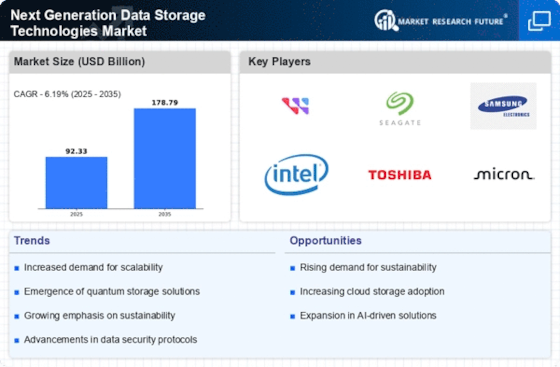
As per Market Research Future analysis, the Next Generation Data Storage Technologies Market Size was estimated at 92.33 USD Billion in 2024. The Next Generation Data Storage Technologies industry is projected to grow from 98.05 USD Billion in 2025 to 178.79 USD Billion by 2035, exhibiting a compound annual growth rate (CAGR) of 6.19% during the forecast period 2025 - 2035

Key Market Trends & Highlights

The Next Generation Data Storage Technologies Market is experiencing transformative growth driven by technological advancements and evolving consumer needs.

  • The market is witnessing increased adoption of cloud storage solutions, particularly in North America, which remains the largest market. Emergence of storage-class memory is reshaping data storage paradigms, with Asia-Pacific identified as the fastest-growing region. Integration of AI and machine learning is enhancing data management capabilities across various sectors, especially in enterprise applications. Rising data volume and complexity, along with demand for enhanced data security, are key drivers propelling the growth of flash arrays and hybrid storage solutions.

Market Size & Forecast

2024 Market Size 92.33 (USD Billion)
2035 Market Size 178.79 (USD Billion)
CAGR (2025 - 2035) 6.19%
Largest Regional Market Share in 2024 Asia Pacific

Major Players

Western Digital (US), Seagate Technology (US), Samsung Electronics (KR), Intel Corporation (US), Toshiba Corporation (JP), Micron Technology (US), IBM Corporation (US), Hewlett Packard Enterprise (US), NetApp (US)

Market Trends

The Next Generation Data Storage Technologies Market is currently experiencing a transformative phase, driven by the increasing demand for efficient, scalable, and high-performance storage solutions. Organizations across various sectors are recognizing the necessity for advanced data management systems that can accommodate the exponential growth of data. This market encompasses a range of innovative technologies, including solid-state drives, cloud storage solutions, and emerging storage-class memory options. As businesses strive to enhance their operational efficiency, the adoption of these technologies appears to be accelerating, suggesting a shift towards more agile and responsive data storage infrastructures. Moreover, the competitive landscape of the Next Generation Data Storage Technologies Market is evolving, with numerous players investing in research and development to introduce cutting-edge solutions. The integration of artificial intelligence and machine learning into storage systems is becoming increasingly prevalent, potentially enabling smarter data management and predictive analytics. This trend indicates a broader movement towards automation and optimization in data storage practices, which may redefine how organizations approach their data strategies in the near future. As the market continues to mature, it is likely that new entrants will emerge, further diversifying the technological offerings available to consumers and enterprises alike.

Increased Adoption of Cloud Storage Solutions

The trend towards cloud storage solutions is gaining momentum as organizations seek flexible and scalable options for data management. This shift allows businesses to reduce infrastructure costs while enhancing accessibility and collaboration. Cloud storage providers are continuously innovating, offering advanced features that cater to diverse user needs.

Emergence of Storage-Class Memory

Storage-class memory is becoming a focal point in the Next Generation Data Storage Technologies Market, bridging the gap between traditional storage and memory. This technology offers high-speed data access and persistence, which could significantly improve application performance and data processing capabilities.

Integration of AI and Machine Learning

The incorporation of artificial intelligence and machine learning into data storage solutions is transforming how data is managed and analyzed. These technologies enable predictive analytics and automated data organization, potentially leading to more efficient storage practices and enhanced decision-making processes.

Next Generation Data Storage Technologies Market Market Drivers

Demand for Enhanced Data Security

In an era where data breaches and cyber threats are increasingly prevalent, the demand for enhanced data security is a significant driver of the Next Generation Data Storage Technologies Market. Organizations are compelled to adopt storage solutions that not only provide high capacity but also robust security features. The market is responding to this need by developing technologies that incorporate advanced encryption, access controls, and data integrity measures. As per industry reports, The Next Generation Data Storage Technologies Market is expected to grow at a compound annual growth rate of over 10% through 2025. This trend indicates a strong correlation between the need for secure data storage and the growth of the Next Generation Data Storage Technologies Market, as businesses prioritize safeguarding sensitive information against potential threats.

Rising Data Volume and Complexity

The exponential growth of data generated across various sectors is a primary driver for the Next Generation Data Storage Technologies Market. As organizations increasingly rely on data analytics for decision-making, the volume and complexity of data continue to escalate. According to recent estimates, the total amount of data created globally is projected to reach 175 zettabytes by 2025. This surge necessitates advanced storage solutions that can efficiently manage, store, and retrieve vast amounts of information. Traditional storage methods are often inadequate, leading to a pressing demand for innovative technologies that can handle this data deluge. Consequently, the Next Generation Data Storage Technologies Market is witnessing a shift towards solutions that offer scalability, speed, and reliability, ensuring that businesses can harness the full potential of their data.

Shift Towards Hybrid Storage Solutions

The transition towards hybrid storage solutions is reshaping the landscape of the Next Generation Data Storage Technologies Market. Organizations are increasingly adopting a combination of on-premises and cloud storage to optimize performance and cost-efficiency. This hybrid approach allows businesses to leverage the benefits of both storage types, ensuring flexibility and scalability. Market analysis suggests that the hybrid cloud storage market is expected to witness substantial growth, with projections indicating a value exceeding 100 billion dollars by 2026. This shift is driven by the need for organizations to balance data accessibility with security and compliance requirements. As a result, the Next Generation Data Storage Technologies Market is evolving to offer integrated solutions that cater to the diverse needs of enterprises, facilitating seamless data management across various environments.

Regulatory Compliance and Data Governance

Regulatory compliance and data governance are increasingly influencing the Next Generation Data Storage Technologies Market. As data protection regulations become more stringent, organizations are required to implement storage solutions that ensure compliance with laws such as GDPR and CCPA. This regulatory landscape compels businesses to adopt technologies that facilitate data management, retention, and deletion in accordance with legal requirements. The market is witnessing a surge in demand for storage solutions that offer built-in compliance features, enabling organizations to mitigate risks associated with non-compliance. Analysts predict that the compliance-driven storage market will experience significant growth, as businesses prioritize investments in technologies that support their governance frameworks. Consequently, the Next Generation Data Storage Technologies Market is adapting to meet these evolving regulatory demands, ensuring that organizations can navigate the complexities of data governance effectively.

Technological Advancements in Storage Media

Technological advancements in storage media are propelling the Next Generation Data Storage Technologies Market forward. Innovations such as 3D NAND technology, NVMe interfaces, and DNA data storage are revolutionizing how data is stored and accessed. These advancements not only enhance storage capacity but also significantly improve data transfer speeds and energy efficiency. For instance, NVMe technology can deliver speeds up to six times faster than traditional SATA SSDs, making it a preferred choice for high-performance applications. The ongoing research and development in storage technologies indicate a robust pipeline of innovations that will continue to drive the market. As organizations seek to optimize their data storage capabilities, the Next Generation Data Storage Technologies Market is likely to benefit from these cutting-edge developments, which promise to redefine data storage paradigms.

Market Segment Insights

By Type: Flash Arrays (Largest) vs. Holographic (Fastest-Growing)

<p>The Next Generation Data Storage Technologies Market showcases a diverse landscape, with Flash Arrays dominating the segment due to their established performance and efficiency. SDS, while significant, is often perceived as an emerging technology, with a smaller market share. Holographic storage, though currently niche, is rapidly gaining traction as innovations address scalability and cost issues, making it a notable player in the market dynamics.</p>

<p>Storage Technology: Flash Arrays (Dominant) vs. Holographic (Emerging)</p>

<p>Flash Arrays are characterized by their rapid data access speeds and reliability, making them the preferred choice for enterprises seeking optimal performance and data integrity. Their established market position stems from their effectiveness in handling high-capacity workloads. On the other hand, Holographic storage technology, still in the emerging stage, offers promising advantages such as high data density and longevity. As research advances and commercial applications expand, it presents an exciting frontier in the realm of data storage, catering to future demands for larger and faster data solutions.</p>

By Solution: Enterprise (Largest) vs. Big Data (Fastest-Growing)

<p>In the Next Generation Data Storage Technologies Market, the Enterprise segment stands out as the dominant player, driven by the need for robust storage solutions in large organizations. It holds a significant share due to its ability to provide efficient data management, security, and scalability. In contrast, the Big Data segment, while smaller in overall share, is experiencing rapid growth as organizations increasingly rely on massive data analytics to inform decision-making processes. The demand for storage capabilities that can handle vast amounts of data is propelling this segment forward. The growth trends in the Enterprise segment are being fueled by the ongoing digital transformation and the increasing adoption of cloud storage solutions for better data accessibility and collaboration. Meanwhile, the Big Data segment is benefitting from the surge in data generation and the need for advanced analytics. Organizations are investing in technologies that enhance data processing speeds and improve data storage efficiency, catering to the explosive growth of data-centric applications.</p>

<p>Enterprise Storage (Dominant) vs. Big Data Storage (Emerging)</p>

<p>The Enterprise Storage segment is characterized by its comprehensive solutions tailored for large organizations that demand high-performance storage systems capable of handling extensive data workloads. It focuses on reliability, security, and scalability, making it the backbone of many IT infrastructures. Vendors in this space are continuously innovating to offer integrated solutions that combine traditional storage with cloud capabilities. Conversely, the Big Data Storage segment is emerging as a vital area of growth, driven by the need to store and process huge volumes of data. This segment emphasizes flexibility and speed, with solutions that can quickly adapt to varying data types and formats, enabling organizations to harness insights from their data effectively.</p>

By Memory: Atomic Scale (Largest) vs. Phase Change (Fastest-Growing)

<p>In the Next Generation Data Storage Technologies Market, the memory segment has seen diverse growth patterns among its various technologies. Atomic Scale memory stands out as the largest segment, easily capturing substantial market interest due to its potential for ultra-high-density storage. Meanwhile, Phase Change memory, known for its rapid read/write speeds and advanced thermal management, is recognized as the fastest-growing segment, gaining traction especially among mobile and portable device manufacturers.</p>

<p>Atomic Scale (Dominant) vs. Racetrack (Emerging)</p>

<p>Atomic Scale memory technology is currently the dominant force in the memory segment of the Next Generation Data Storage Technologies Market. This technology utilizes atomic-level manipulation to achieve unprecedented storage capacities, thus offering significant advantages for data-heavy applications. In contrast, Racetrack memory represents an emerging technology that promises to enhance data transfer speeds and energy efficiency. While still under development, Racetrack memory leverages magnetic domain walls to move data along nanowires, presenting a compelling alternative for future data storage solutions.</p>

Get more detailed insights about Next Generation Data Storage Technologies Market Forecast 2035

Regional Insights

North America : Innovation and Leadership Hub

North America is the largest market for next generation data storage technologies, holding approximately 45% of the global market share. The region's growth is driven by rapid technological advancements, increasing data generation, and a strong focus on cloud computing and big data analytics. Regulatory support for data privacy and security further catalyzes market expansion, with initiatives promoting innovation in storage solutions. The United States leads the market, with key players like Western Digital, Seagate Technology, and Intel Corporation driving competition. The presence of major tech companies and a robust infrastructure for research and development contribute to a dynamic competitive landscape. Canada also plays a significant role, focusing on sustainable storage solutions and data management technologies, enhancing the region's overall market position.

Europe : Emerging Market with Regulations

Europe is witnessing significant growth in the next generation data storage technologies market, accounting for about 30% of the global share. The region's demand is driven by stringent data protection regulations, such as GDPR, which compel organizations to adopt advanced storage solutions. Additionally, the increasing need for efficient data management and storage optimization is propelling market growth, with a focus on sustainability and energy efficiency. Leading countries in this region include Germany, the UK, and France, where companies like IBM and Hewlett Packard Enterprise are prominent. The competitive landscape is characterized by a mix of established players and innovative startups, fostering a vibrant ecosystem. The European market is also seeing increased collaboration between tech firms and regulatory bodies to ensure compliance and drive technological advancements.

Asia-Pacific : Rapid Growth and Adoption

Asia-Pacific is rapidly emerging as a powerhouse in the next generation data storage technologies market, holding approximately 20% of the global market share. The region's growth is fueled by the increasing adoption of cloud services, big data analytics, and IoT applications. Countries like China and India are witnessing a surge in data generation, leading to a heightened demand for advanced storage solutions. Government initiatives promoting digital transformation further support market expansion. China is the largest market in the region, with significant contributions from companies like Samsung Electronics and Toshiba Corporation. India is also gaining traction, with a growing number of startups focusing on innovative storage technologies. The competitive landscape is marked by a blend of local and international players, driving innovation and enhancing the region's market dynamics.

Middle East and Africa : Untapped Potential and Growth

The Middle East and Africa region is gradually emerging in the next generation data storage technologies market, currently holding about 5% of the global share. The growth is driven by increasing digitalization, the rise of e-commerce, and government initiatives aimed at enhancing IT infrastructure. The demand for efficient data storage solutions is expected to rise as businesses seek to optimize their operations and comply with data regulations. Countries like South Africa and the UAE are leading the market, with investments in data centers and cloud services. The competitive landscape is evolving, with both local and international players entering the market. Key players are focusing on partnerships and collaborations to enhance their offerings and capture the growing demand for advanced storage technologies.

Key Players and Competitive Insights

Leading market players are investing heavily in research and development in order to expand their product lines, which will help the next generation data storage technologies market, grow even more. Market participants are also undertaking a variety of strategic activities to expand their global footprint, with important market developments including new product launches, contractual agreements, mergers and acquisitions, higher investments, and collaboration with other organizations. To expand and survive in a more competitive and rising market climate, next generation data storage technologies industry must offer cost-effective items.Manufacturing locally to minimize operational costs is one of the key business tactics used by manufacturers in the global next generation data storage technologies industry to benefit clients and increase the market sector. In recent years, the next generation data storage technologies industry has offered some of the most significant advantages to market.Major players in the next generation data storage technologies market attempting to increase market demand by investing in research and development operations include Dell Inc. (U.S.), IBM Corporation (U.S), VMware Inc. (U.S.), Hewlett-Packard Development Company (U.S.), Sandisk Corporation (U.S.), Micron Technology Inc. (U.S.), Nutanix (U.S.), NetApp (U.S.), Toshiba Corporation (Japan) and Quantum Corporation (U.S.).For more than 25 years, SanDisk has been increasing the possibilities for data storage, assuring consumers and organizations that their data will always be dependable and accessible, even in the most difficult circumstances. Its products are trusted by customers worldwide and are utilised in cutting-edge data centers, innovative smartphones, tablets, and laptops. As a vertically integrated storage solution provider, we can produce cutting-edge, high-quality products more swiftly than our competitors. SanDisk storage solutions, from mobile devices to hyper-scale data centers, enable the amazing.Nutanix Inc offers an enterprise cloud platform. It provides databases, big data analytics, virtual desktop infrastructure, and unified business applications. The company offers a variety of solutions, including databases, virtualization and cloud, business-critical apps, cloud-native, hybrid cloud, and consolidated storage services, among others. It benefits the industries of transportation, consumer goods, finance, healthcare, manufacturing, media, education, energy, retail, public sector, technology, and telecommunications.

Key Companies in the Next Generation Data Storage Technologies Market include

Industry Developments

  • Q2 2024: ABB’s NiZn Batteries for Data Center Power Supplies In 2024, ABB introduced nickel-zinc batteries (NiZn) into its MegaFlex uninterruptible power supply (UPS) lineup for data centers, offering higher power density, improved safety, and reduced environmental impact compared to traditional lithium-ion solutions.

Future Outlook

Next Generation Data Storage Technologies Market Future Outlook

The Next Generation Data Storage Technologies Market is projected to grow at a 6.19% CAGR from 2025 to 2035, driven by increasing data volumes, cloud adoption, and technological advancements.

New opportunities lie in:

  • Development of AI-driven data management solutions</p><p>Expansion of hybrid cloud storage services</p><p>Investment in sustainable storage technologies

By 2035, the market is expected to be robust, driven by innovation and strategic investments.

Market Segmentation

Next Generation Data Storage Technologies Market Type Outlook

  • Flash Arrays
  • SDS
  • Holographic

Next Generation Data Storage Technologies Market Memory Outlook

  • Atomic Scale
  • Phase Change
  • Racetrack

Next Generation Data Storage Technologies Market Solution Outlook

  • Enterprise
  • Big Data

Report Scope

MARKET SIZE 2024 92.33(USD Billion)
MARKET SIZE 2025 98.05(USD Billion)
MARKET SIZE 2035 178.79(USD Billion)
COMPOUND ANNUAL GROWTH RATE (CAGR) 6.19% (2025 - 2035)
REPORT COVERAGE Revenue Forecast, Competitive Landscape, Growth Factors, and Trends
BASE YEAR 2024
Market Forecast Period 2025 - 2035
Historical Data 2019 - 2024
Market Forecast Units USD Billion
Key Companies Profiled Western Digital (US), Seagate Technology (US), Samsung Electronics (KR), Intel Corporation (US), Toshiba Corporation (JP), Micron Technology (US), IBM Corporation (US), Hewlett Packard Enterprise (US), NetApp (US)
Segments Covered Types, Solution, Memory, Region
Key Market Opportunities Integration of artificial intelligence in data storage solutions enhances efficiency and scalability in the Next Generation Data Storage Technologies Market.
Key Market Dynamics Technological advancements drive competition in the Next Generation Data Storage Technologies Market, reshaping consumer preferences and supply chains.
Countries Covered North America, Europe, APAC, South America, MEA

FAQs

What is the projected market valuation for the Next Generation Data Storage Technologies Market in 2035?

<p>The projected market valuation for the Next Generation Data Storage Technologies Market in 2035 is 178.79 USD Billion.</p>

What was the overall market valuation for the Next Generation Data Storage Technologies Market in 2024?

<p>The overall market valuation for the Next Generation Data Storage Technologies Market in 2024 was 92.33 USD Billion.</p>

What is the expected CAGR for the Next Generation Data Storage Technologies Market from 2025 to 2035?

<p>The expected CAGR for the Next Generation Data Storage Technologies Market during the forecast period 2025 - 2035 is 6.19%.</p>

Which companies are considered key players in the Next Generation Data Storage Technologies Market?

<p>Key players in the market include Western Digital, Seagate Technology, Samsung Electronics, Intel Corporation, and others.</p>

What are the projected valuations for Flash Arrays in the Next Generation Data Storage Technologies Market?

<p>The projected valuations for Flash Arrays are expected to range from 30.0 to 60.0 USD Billion.</p>

How does the Big Data solution segment perform in terms of market valuation?

<p>The Big Data solution segment is projected to have a valuation ranging from 37.33 to 72.79 USD Billion.</p>

What are the expected valuations for Atomic Scale memory technology in the market?

The expected valuations for Atomic Scale memory technology are projected to range from 20.0 to 40.0 USD Billion.

What is the projected market performance for the Holographic data storage segment?

The projected market performance for the Holographic data storage segment is expected to range from 22.33 to 38.79 USD Billion.

What is the anticipated growth for the Racetrack memory technology segment?

The anticipated growth for the Racetrack memory technology segment is projected to range from 42.33 to 78.79 USD Billion.

How does the Enterprise solution segment compare to other segments in terms of market valuation?

The Enterprise solution segment is projected to have a valuation ranging from 55.0 to 106.0 USD Billion, indicating strong market performance.

  1. SECTION I: EXECUTIVE SUMMARY AND KEY HIGHLIGHTS
    1. | 1.1 EXECUTIVE SUMMARY
    2. | | 1.1.1 Market Overview
    3. | | 1.1.2 Key Findings
    4. | | 1.1.3 Market Segmentation
    5. | | 1.1.4 Competitive Landscape
    6. | | 1.1.5 Challenges and Opportunities
    7. | | 1.1.6 Future Outlook
  2. SECTION II: SCOPING, METHODOLOGY AND MARKET STRUCTURE
    1. | 2.1 MARKET INTRODUCTION
    2. | | 2.1.1 Definition
    3. | | 2.1.2 Scope of the study
    4. | | | 2.1.2.1 Research Objective
    5. | | | 2.1.2.2 Assumption
    6. | | | 2.1.2.3 Limitations
    7. | 2.2 RESEARCH METHODOLOGY
    8. | | 2.2.1 Overview
    9. | | 2.2.2 Data Mining
    10. | | 2.2.3 Secondary Research
    11. | | 2.2.4 Primary Research
    12. | | | 2.2.4.1 Primary Interviews and Information Gathering Process
    13. | | | 2.2.4.2 Breakdown of Primary Respondents
    14. | | 2.2.5 Forecasting Model
    15. | | 2.2.6 Market Size Estimation
    16. | | | 2.2.6.1 Bottom-Up Approach
    17. | | | 2.2.6.2 Top-Down Approach
    18. | | 2.2.7 Data Triangulation
    19. | | 2.2.8 Validation
  3. SECTION III: QUALITATIVE ANALYSIS
    1. | 3.1 MARKET DYNAMICS
    2. | | 3.1.1 Overview
    3. | | 3.1.2 Drivers
    4. | | 3.1.3 Restraints
    5. | | 3.1.4 Opportunities
    6. | 3.2 MARKET FACTOR ANALYSIS
    7. | | 3.2.1 Value chain Analysis
    8. | | 3.2.2 Porter's Five Forces Analysis
    9. | | | 3.2.2.1 Bargaining Power of Suppliers
    10. | | | 3.2.2.2 Bargaining Power of Buyers
    11. | | | 3.2.2.3 Threat of New Entrants
    12. | | | 3.2.2.4 Threat of Substitutes
    13. | | | 3.2.2.5 Intensity of Rivalry
    14. | | 3.2.3 COVID-19 Impact Analysis
    15. | | | 3.2.3.1 Market Impact Analysis
    16. | | | 3.2.3.2 Regional Impact
    17. | | | 3.2.3.3 Opportunity and Threat Analysis
  4. SECTION IV: QUANTITATIVE ANALYSIS
    1. | 4.1 Semiconductor & Electronics, BY Type (USD Billion)
    2. | | 4.1.1 Flash Arrays
    3. | | 4.1.2 SDS
    4. | | 4.1.3 Holographic
    5. | 4.2 Semiconductor & Electronics, BY Solution (USD Billion)
    6. | | 4.2.1 Enterprise
    7. | | 4.2.2 Big Data
    8. | 4.3 Semiconductor & Electronics, BY Memory (USD Billion)
    9. | | 4.3.1 Atomic Scale
    10. | | 4.3.2 Phase Change
    11. | | 4.3.3 Racetrack
    12. | 4.4 Semiconductor & Electronics, BY Region (USD Billion)
    13. | | 4.4.1 North America
    14. | | | 4.4.1.1 US
    15. | | | 4.4.1.2 Canada
    16. | | 4.4.2 Europe
    17. | | | 4.4.2.1 Germany
    18. | | | 4.4.2.2 UK
    19. | | | 4.4.2.3 France
    20. | | | 4.4.2.4 Russia
    21. | | | 4.4.2.5 Italy
    22. | | | 4.4.2.6 Spain
    23. | | | 4.4.2.7 Rest of Europe
    24. | | 4.4.3 APAC
    25. | | | 4.4.3.1 China
    26. | | | 4.4.3.2 India
    27. | | | 4.4.3.3 Japan
    28. | | | 4.4.3.4 South Korea
    29. | | | 4.4.3.5 Malaysia
    30. | | | 4.4.3.6 Thailand
    31. | | | 4.4.3.7 Indonesia
    32. | | | 4.4.3.8 Rest of APAC
    33. | | 4.4.4 South America
    34. | | | 4.4.4.1 Brazil
    35. | | | 4.4.4.2 Mexico
    36. | | | 4.4.4.3 Argentina
    37. | | | 4.4.4.4 Rest of South America
    38. | | 4.4.5 MEA
    39. | | | 4.4.5.1 GCC Countries
    40. | | | 4.4.5.2 South Africa
    41. | | | 4.4.5.3 Rest of MEA
  5. SECTION V: COMPETITIVE ANALYSIS
    1. | 5.1 Competitive Landscape
    2. | | 5.1.1 Overview
    3. | | 5.1.2 Competitive Analysis
    4. | | 5.1.3 Market share Analysis
    5. | | 5.1.4 Major Growth Strategy in the Semiconductor & Electronics
    6. | | 5.1.5 Competitive Benchmarking
    7. | | 5.1.6 Leading Players in Terms of Number of Developments in the Semiconductor & Electronics
    8. | | 5.1.7 Key developments and growth strategies
    9. | | | 5.1.7.1 New Product Launch/Service Deployment
    10. | | | 5.1.7.2 Merger & Acquisitions
    11. | | | 5.1.7.3 Joint Ventures
    12. | | 5.1.8 Major Players Financial Matrix
    13. | | | 5.1.8.1 Sales and Operating Income
    14. | | | 5.1.8.2 Major Players R&D Expenditure. 2023
    15. | 5.2 Company Profiles
    16. | | 5.2.1 Western Digital (US)
    17. | | | 5.2.1.1 Financial Overview
    18. | | | 5.2.1.2 Products Offered
    19. | | | 5.2.1.3 Key Developments
    20. | | | 5.2.1.4 SWOT Analysis
    21. | | | 5.2.1.5 Key Strategies
    22. | | 5.2.2 Seagate Technology (US)
    23. | | | 5.2.2.1 Financial Overview
    24. | | | 5.2.2.2 Products Offered
    25. | | | 5.2.2.3 Key Developments
    26. | | | 5.2.2.4 SWOT Analysis
    27. | | | 5.2.2.5 Key Strategies
    28. | | 5.2.3 Samsung Electronics (KR)
    29. | | | 5.2.3.1 Financial Overview
    30. | | | 5.2.3.2 Products Offered
    31. | | | 5.2.3.3 Key Developments
    32. | | | 5.2.3.4 SWOT Analysis
    33. | | | 5.2.3.5 Key Strategies
    34. | | 5.2.4 Intel Corporation (US)
    35. | | | 5.2.4.1 Financial Overview
    36. | | | 5.2.4.2 Products Offered
    37. | | | 5.2.4.3 Key Developments
    38. | | | 5.2.4.4 SWOT Analysis
    39. | | | 5.2.4.5 Key Strategies
    40. | | 5.2.5 Toshiba Corporation (JP)
    41. | | | 5.2.5.1 Financial Overview
    42. | | | 5.2.5.2 Products Offered
    43. | | | 5.2.5.3 Key Developments
    44. | | | 5.2.5.4 SWOT Analysis
    45. | | | 5.2.5.5 Key Strategies
    46. | | 5.2.6 Micron Technology (US)
    47. | | | 5.2.6.1 Financial Overview
    48. | | | 5.2.6.2 Products Offered
    49. | | | 5.2.6.3 Key Developments
    50. | | | 5.2.6.4 SWOT Analysis
    51. | | | 5.2.6.5 Key Strategies
    52. | | 5.2.7 IBM Corporation (US)
    53. | | | 5.2.7.1 Financial Overview
    54. | | | 5.2.7.2 Products Offered
    55. | | | 5.2.7.3 Key Developments
    56. | | | 5.2.7.4 SWOT Analysis
    57. | | | 5.2.7.5 Key Strategies
    58. | | 5.2.8 Hewlett Packard Enterprise (US)
    59. | | | 5.2.8.1 Financial Overview
    60. | | | 5.2.8.2 Products Offered
    61. | | | 5.2.8.3 Key Developments
    62. | | | 5.2.8.4 SWOT Analysis
    63. | | | 5.2.8.5 Key Strategies
    64. | | 5.2.9 NetApp (US)
    65. | | | 5.2.9.1 Financial Overview
    66. | | | 5.2.9.2 Products Offered
    67. | | | 5.2.9.3 Key Developments
    68. | | | 5.2.9.4 SWOT Analysis
    69. | | | 5.2.9.5 Key Strategies
    70. | 5.3 Appendix
    71. | | 5.3.1 References
    72. | | 5.3.2 Related Reports
  6. LIST OF FIGURES
    1. | 6.1 MARKET SYNOPSIS
    2. | 6.2 NORTH AMERICA MARKET ANALYSIS
    3. | 6.3 US MARKET ANALYSIS BY TYPE
    4. | 6.4 US MARKET ANALYSIS BY SOLUTION
    5. | 6.5 US MARKET ANALYSIS BY MEMORY
    6. | 6.6 CANADA MARKET ANALYSIS BY TYPE
    7. | 6.7 CANADA MARKET ANALYSIS BY SOLUTION
    8. | 6.8 CANADA MARKET ANALYSIS BY MEMORY
    9. | 6.9 EUROPE MARKET ANALYSIS
    10. | 6.10 GERMANY MARKET ANALYSIS BY TYPE
    11. | 6.11 GERMANY MARKET ANALYSIS BY SOLUTION
    12. | 6.12 GERMANY MARKET ANALYSIS BY MEMORY
    13. | 6.13 UK MARKET ANALYSIS BY TYPE
    14. | 6.14 UK MARKET ANALYSIS BY SOLUTION
    15. | 6.15 UK MARKET ANALYSIS BY MEMORY
    16. | 6.16 FRANCE MARKET ANALYSIS BY TYPE
    17. | 6.17 FRANCE MARKET ANALYSIS BY SOLUTION
    18. | 6.18 FRANCE MARKET ANALYSIS BY MEMORY
    19. | 6.19 RUSSIA MARKET ANALYSIS BY TYPE
    20. | 6.20 RUSSIA MARKET ANALYSIS BY SOLUTION
    21. | 6.21 RUSSIA MARKET ANALYSIS BY MEMORY
    22. | 6.22 ITALY MARKET ANALYSIS BY TYPE
    23. | 6.23 ITALY MARKET ANALYSIS BY SOLUTION
    24. | 6.24 ITALY MARKET ANALYSIS BY MEMORY
    25. | 6.25 SPAIN MARKET ANALYSIS BY TYPE
    26. | 6.26 SPAIN MARKET ANALYSIS BY SOLUTION
    27. | 6.27 SPAIN MARKET ANALYSIS BY MEMORY
    28. | 6.28 REST OF EUROPE MARKET ANALYSIS BY TYPE
    29. | 6.29 REST OF EUROPE MARKET ANALYSIS BY SOLUTION
    30. | 6.30 REST OF EUROPE MARKET ANALYSIS BY MEMORY
    31. | 6.31 APAC MARKET ANALYSIS
    32. | 6.32 CHINA MARKET ANALYSIS BY TYPE
    33. | 6.33 CHINA MARKET ANALYSIS BY SOLUTION
    34. | 6.34 CHINA MARKET ANALYSIS BY MEMORY
    35. | 6.35 INDIA MARKET ANALYSIS BY TYPE
    36. | 6.36 INDIA MARKET ANALYSIS BY SOLUTION
    37. | 6.37 INDIA MARKET ANALYSIS BY MEMORY
    38. | 6.38 JAPAN MARKET ANALYSIS BY TYPE
    39. | 6.39 JAPAN MARKET ANALYSIS BY SOLUTION
    40. | 6.40 JAPAN MARKET ANALYSIS BY MEMORY
    41. | 6.41 SOUTH KOREA MARKET ANALYSIS BY TYPE
    42. | 6.42 SOUTH KOREA MARKET ANALYSIS BY SOLUTION
    43. | 6.43 SOUTH KOREA MARKET ANALYSIS BY MEMORY
    44. | 6.44 MALAYSIA MARKET ANALYSIS BY TYPE
    45. | 6.45 MALAYSIA MARKET ANALYSIS BY SOLUTION
    46. | 6.46 MALAYSIA MARKET ANALYSIS BY MEMORY
    47. | 6.47 THAILAND MARKET ANALYSIS BY TYPE
    48. | 6.48 THAILAND MARKET ANALYSIS BY SOLUTION
    49. | 6.49 THAILAND MARKET ANALYSIS BY MEMORY
    50. | 6.50 INDONESIA MARKET ANALYSIS BY TYPE
    51. | 6.51 INDONESIA MARKET ANALYSIS BY SOLUTION
    52. | 6.52 INDONESIA MARKET ANALYSIS BY MEMORY
    53. | 6.53 REST OF APAC MARKET ANALYSIS BY TYPE
    54. | 6.54 REST OF APAC MARKET ANALYSIS BY SOLUTION
    55. | 6.55 REST OF APAC MARKET ANALYSIS BY MEMORY
    56. | 6.56 SOUTH AMERICA MARKET ANALYSIS
    57. | 6.57 BRAZIL MARKET ANALYSIS BY TYPE
    58. | 6.58 BRAZIL MARKET ANALYSIS BY SOLUTION
    59. | 6.59 BRAZIL MARKET ANALYSIS BY MEMORY
    60. | 6.60 MEXICO MARKET ANALYSIS BY TYPE
    61. | 6.61 MEXICO MARKET ANALYSIS BY SOLUTION
    62. | 6.62 MEXICO MARKET ANALYSIS BY MEMORY
    63. | 6.63 ARGENTINA MARKET ANALYSIS BY TYPE
    64. | 6.64 ARGENTINA MARKET ANALYSIS BY SOLUTION
    65. | 6.65 ARGENTINA MARKET ANALYSIS BY MEMORY
    66. | 6.66 REST OF SOUTH AMERICA MARKET ANALYSIS BY TYPE
    67. | 6.67 REST OF SOUTH AMERICA MARKET ANALYSIS BY SOLUTION
    68. | 6.68 REST OF SOUTH AMERICA MARKET ANALYSIS BY MEMORY
    69. | 6.69 MEA MARKET ANALYSIS
    70. | 6.70 GCC COUNTRIES MARKET ANALYSIS BY TYPE
    71. | 6.71 GCC COUNTRIES MARKET ANALYSIS BY SOLUTION
    72. | 6.72 GCC COUNTRIES MARKET ANALYSIS BY MEMORY
    73. | 6.73 SOUTH AFRICA MARKET ANALYSIS BY TYPE
    74. | 6.74 SOUTH AFRICA MARKET ANALYSIS BY SOLUTION
    75. | 6.75 SOUTH AFRICA MARKET ANALYSIS BY MEMORY
    76. | 6.76 REST OF MEA MARKET ANALYSIS BY TYPE
    77. | 6.77 REST OF MEA MARKET ANALYSIS BY SOLUTION
    78. | 6.78 REST OF MEA MARKET ANALYSIS BY MEMORY
    79. | 6.79 KEY BUYING CRITERIA OF SEMICONDUCTOR & ELECTRONICS
    80. | 6.80 RESEARCH PROCESS OF MRFR
    81. | 6.81 DRO ANALYSIS OF SEMICONDUCTOR & ELECTRONICS
    82. | 6.82 DRIVERS IMPACT ANALYSIS: SEMICONDUCTOR & ELECTRONICS
    83. | 6.83 RESTRAINTS IMPACT ANALYSIS: SEMICONDUCTOR & ELECTRONICS
    84. | 6.84 SUPPLY / VALUE CHAIN: SEMICONDUCTOR & ELECTRONICS
    85. | 6.85 SEMICONDUCTOR & ELECTRONICS, BY TYPE, 2024 (% SHARE)
    86. | 6.86 SEMICONDUCTOR & ELECTRONICS, BY TYPE, 2024 TO 2035 (USD Billion)
    87. | 6.87 SEMICONDUCTOR & ELECTRONICS, BY SOLUTION, 2024 (% SHARE)
    88. | 6.88 SEMICONDUCTOR & ELECTRONICS, BY SOLUTION, 2024 TO 2035 (USD Billion)
    89. | 6.89 SEMICONDUCTOR & ELECTRONICS, BY MEMORY, 2024 (% SHARE)
    90. | 6.90 SEMICONDUCTOR & ELECTRONICS, BY MEMORY, 2024 TO 2035 (USD Billion)
    91. | 6.91 BENCHMARKING OF MAJOR COMPETITORS
  7. LIST OF TABLES
    1. | 7.1 LIST OF ASSUMPTIONS
    2. | | 7.1.1
    3. | 7.2 North America MARKET SIZE ESTIMATES; FORECAST
    4. | | 7.2.1 BY TYPE, 2025-2035 (USD Billion)
    5. | | 7.2.2 BY SOLUTION, 2025-2035 (USD Billion)
    6. | | 7.2.3 BY MEMORY, 2025-2035 (USD Billion)
    7. | 7.3 US MARKET SIZE ESTIMATES; FORECAST
    8. | | 7.3.1 BY TYPE, 2025-2035 (USD Billion)
    9. | | 7.3.2 BY SOLUTION, 2025-2035 (USD Billion)
    10. | | 7.3.3 BY MEMORY, 2025-2035 (USD Billion)
    11. | 7.4 Canada MARKET SIZE ESTIMATES; FORECAST
    12. | | 7.4.1 BY TYPE, 2025-2035 (USD Billion)
    13. | | 7.4.2 BY SOLUTION, 2025-2035 (USD Billion)
    14. | | 7.4.3 BY MEMORY, 2025-2035 (USD Billion)
    15. | 7.5 Europe MARKET SIZE ESTIMATES; FORECAST
    16. | | 7.5.1 BY TYPE, 2025-2035 (USD Billion)
    17. | | 7.5.2 BY SOLUTION, 2025-2035 (USD Billion)
    18. | | 7.5.3 BY MEMORY, 2025-2035 (USD Billion)
    19. | 7.6 Germany MARKET SIZE ESTIMATES; FORECAST
    20. | | 7.6.1 BY TYPE, 2025-2035 (USD Billion)
    21. | | 7.6.2 BY SOLUTION, 2025-2035 (USD Billion)
    22. | | 7.6.3 BY MEMORY, 2025-2035 (USD Billion)
    23. | 7.7 UK MARKET SIZE ESTIMATES; FORECAST
    24. | | 7.7.1 BY TYPE, 2025-2035 (USD Billion)
    25. | | 7.7.2 BY SOLUTION, 2025-2035 (USD Billion)
    26. | | 7.7.3 BY MEMORY, 2025-2035 (USD Billion)
    27. | 7.8 France MARKET SIZE ESTIMATES; FORECAST
    28. | | 7.8.1 BY TYPE, 2025-2035 (USD Billion)
    29. | | 7.8.2 BY SOLUTION, 2025-2035 (USD Billion)
    30. | | 7.8.3 BY MEMORY, 2025-2035 (USD Billion)
    31. | 7.9 Russia MARKET SIZE ESTIMATES; FORECAST
    32. | | 7.9.1 BY TYPE, 2025-2035 (USD Billion)
    33. | | 7.9.2 BY SOLUTION, 2025-2035 (USD Billion)
    34. | | 7.9.3 BY MEMORY, 2025-2035 (USD Billion)
    35. | 7.10 Italy MARKET SIZE ESTIMATES; FORECAST
    36. | | 7.10.1 BY TYPE, 2025-2035 (USD Billion)
    37. | | 7.10.2 BY SOLUTION, 2025-2035 (USD Billion)
    38. | | 7.10.3 BY MEMORY, 2025-2035 (USD Billion)
    39. | 7.11 Spain MARKET SIZE ESTIMATES; FORECAST
    40. | | 7.11.1 BY TYPE, 2025-2035 (USD Billion)
    41. | | 7.11.2 BY SOLUTION, 2025-2035 (USD Billion)
    42. | | 7.11.3 BY MEMORY, 2025-2035 (USD Billion)
    43. | 7.12 Rest of Europe MARKET SIZE ESTIMATES; FORECAST
    44. | | 7.12.1 BY TYPE, 2025-2035 (USD Billion)
    45. | | 7.12.2 BY SOLUTION, 2025-2035 (USD Billion)
    46. | | 7.12.3 BY MEMORY, 2025-2035 (USD Billion)
    47. | 7.13 APAC MARKET SIZE ESTIMATES; FORECAST
    48. | | 7.13.1 BY TYPE, 2025-2035 (USD Billion)
    49. | | 7.13.2 BY SOLUTION, 2025-2035 (USD Billion)
    50. | | 7.13.3 BY MEMORY, 2025-2035 (USD Billion)
    51. | 7.14 China MARKET SIZE ESTIMATES; FORECAST
    52. | | 7.14.1 BY TYPE, 2025-2035 (USD Billion)
    53. | | 7.14.2 BY SOLUTION, 2025-2035 (USD Billion)
    54. | | 7.14.3 BY MEMORY, 2025-2035 (USD Billion)
    55. | 7.15 India MARKET SIZE ESTIMATES; FORECAST
    56. | | 7.15.1 BY TYPE, 2025-2035 (USD Billion)
    57. | | 7.15.2 BY SOLUTION, 2025-2035 (USD Billion)
    58. | | 7.15.3 BY MEMORY, 2025-2035 (USD Billion)
    59. | 7.16 Japan MARKET SIZE ESTIMATES; FORECAST
    60. | | 7.16.1 BY TYPE, 2025-2035 (USD Billion)
    61. | | 7.16.2 BY SOLUTION, 2025-2035 (USD Billion)
    62. | | 7.16.3 BY MEMORY, 2025-2035 (USD Billion)
    63. | 7.17 South Korea MARKET SIZE ESTIMATES; FORECAST
    64. | | 7.17.1 BY TYPE, 2025-2035 (USD Billion)
    65. | | 7.17.2 BY SOLUTION, 2025-2035 (USD Billion)
    66. | | 7.17.3 BY MEMORY, 2025-2035 (USD Billion)
    67. | 7.18 Malaysia MARKET SIZE ESTIMATES; FORECAST
    68. | | 7.18.1 BY TYPE, 2025-2035 (USD Billion)
    69. | | 7.18.2 BY SOLUTION, 2025-2035 (USD Billion)
    70. | | 7.18.3 BY MEMORY, 2025-2035 (USD Billion)
    71. | 7.19 Thailand MARKET SIZE ESTIMATES; FORECAST
    72. | | 7.19.1 BY TYPE, 2025-2035 (USD Billion)
    73. | | 7.19.2 BY SOLUTION, 2025-2035 (USD Billion)
    74. | | 7.19.3 BY MEMORY, 2025-2035 (USD Billion)
    75. | 7.20 Indonesia MARKET SIZE ESTIMATES; FORECAST
    76. | | 7.20.1 BY TYPE, 2025-2035 (USD Billion)
    77. | | 7.20.2 BY SOLUTION, 2025-2035 (USD Billion)
    78. | | 7.20.3 BY MEMORY, 2025-2035 (USD Billion)
    79. | 7.21 Rest of APAC MARKET SIZE ESTIMATES; FORECAST
    80. | | 7.21.1 BY TYPE, 2025-2035 (USD Billion)
    81. | | 7.21.2 BY SOLUTION, 2025-2035 (USD Billion)
    82. | | 7.21.3 BY MEMORY, 2025-2035 (USD Billion)
    83. | 7.22 South America MARKET SIZE ESTIMATES; FORECAST
    84. | | 7.22.1 BY TYPE, 2025-2035 (USD Billion)
    85. | | 7.22.2 BY SOLUTION, 2025-2035 (USD Billion)
    86. | | 7.22.3 BY MEMORY, 2025-2035 (USD Billion)
    87. | 7.23 Brazil MARKET SIZE ESTIMATES; FORECAST
    88. | | 7.23.1 BY TYPE, 2025-2035 (USD Billion)
    89. | | 7.23.2 BY SOLUTION, 2025-2035 (USD Billion)
    90. | | 7.23.3 BY MEMORY, 2025-2035 (USD Billion)
    91. | 7.24 Mexico MARKET SIZE ESTIMATES; FORECAST
    92. | | 7.24.1 BY TYPE, 2025-2035 (USD Billion)
    93. | | 7.24.2 BY SOLUTION, 2025-2035 (USD Billion)
    94. | | 7.24.3 BY MEMORY, 2025-2035 (USD Billion)
    95. | 7.25 Argentina MARKET SIZE ESTIMATES; FORECAST
    96. | | 7.25.1 BY TYPE, 2025-2035 (USD Billion)
    97. | | 7.25.2 BY SOLUTION, 2025-2035 (USD Billion)
    98. | | 7.25.3 BY MEMORY, 2025-2035 (USD Billion)
    99. | 7.26 Rest of South America MARKET SIZE ESTIMATES; FORECAST
    100. | | 7.26.1 BY TYPE, 2025-2035 (USD Billion)
    101. | | 7.26.2 BY SOLUTION, 2025-2035 (USD Billion)
    102. | | 7.26.3 BY MEMORY, 2025-2035 (USD Billion)
    103. | 7.27 MEA MARKET SIZE ESTIMATES; FORECAST
    104. | | 7.27.1 BY TYPE, 2025-2035 (USD Billion)
    105. | | 7.27.2 BY SOLUTION, 2025-2035 (USD Billion)
    106. | | 7.27.3 BY MEMORY, 2025-2035 (USD Billion)
    107. | 7.28 GCC Countries MARKET SIZE ESTIMATES; FORECAST
    108. | | 7.28.1 BY TYPE, 2025-2035 (USD Billion)
    109. | | 7.28.2 BY SOLUTION, 2025-2035 (USD Billion)
    110. | | 7.28.3 BY MEMORY, 2025-2035 (USD Billion)
    111. | 7.29 South Africa MARKET SIZE ESTIMATES; FORECAST
    112. | | 7.29.1 BY TYPE, 2025-2035 (USD Billion)
    113. | | 7.29.2 BY SOLUTION, 2025-2035 (USD Billion)
    114. | | 7.29.3 BY MEMORY, 2025-2035 (USD Billion)
    115. | 7.30 Rest of MEA MARKET SIZE ESTIMATES; FORECAST
    116. | | 7.30.1 BY TYPE, 2025-2035 (USD Billion)
    117. | | 7.30.2 BY SOLUTION, 2025-2035 (USD Billion)
    118. | | 7.30.3 BY MEMORY, 2025-2035 (USD Billion)
    119. | 7.31 PRODUCT LAUNCH/PRODUCT DEVELOPMENT/APPROVAL
    120. | | 7.31.1
    121. | 7.32 ACQUISITION/PARTNERSHIP
    122. | | 7.32.1

Semiconductor & Electronics Market Segmentation

Semiconductor & Electronics By Type (USD Billion, 2025-2035)

  • Flash Arrays
  • SDS
  • Holographic

Semiconductor & Electronics By Solution (USD Billion, 2025-2035)

  • Enterprise
  • Big Data

Semiconductor & Electronics By Memory (USD Billion, 2025-2035)

  • Atomic Scale
  • Phase Change
  • Racetrack
Infographic

Free Sample Request

Kindly complete the form below to receive a free sample of this Report

Get Free Sample

Customer Strories

Compare Licence

×
Features License Type
Single User Multiuser License Enterprise User
Price $4,950 $5,950 $7,250
Maximum User Access Limit 1 User Upto 10 Users Unrestricted Access Throughout the Organization
Free Customization
Direct Access to Analyst
Deliverable Format
Platform Access
Discount on Next Purchase 10% 15% 15%
Printable Versions