Network Automation Market

ID: MRFR/ICT/4396-CR
200 Pages
Ankit Gupta
Last Updated: June 22, 2026
Network Automation Market Size, Share and Research Report By Network Infrastructure (Physical, Virtual, Hybrid), By Component (Solutions, Services), By Deployment Mode (Cloud, On-Premise), By Organization Size (Large Enterprises, Small and Medium Enterprises), By End-User Industry (IT and Telecom, Banking and Financial Services, Manufacturing, Healthcare, Others) and By Regional (North America, Europe, South America, Asia Pacific, Middle East and Africa) - Industry Forecast to 2035
Download PDF ×

We do not share your information with anyone. However, we may send you emails based on your report interest from time to time. You may contact us at any time to opt-out.

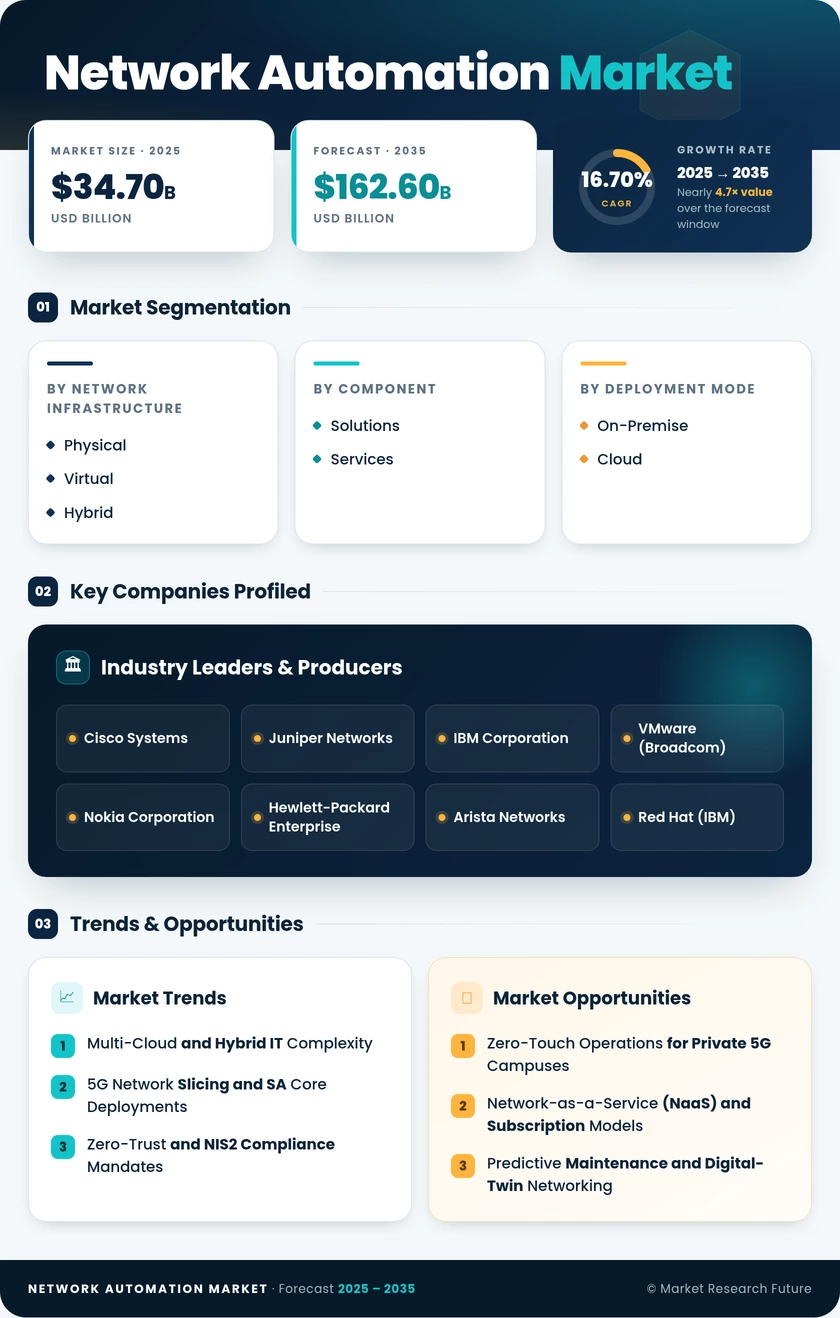
Network Automation Market

Market Size

Forecast Period2026-2035
CAGR (2026-2035)16.70%
2025 Market SizeUSD 34.70 Billion
2035 Market SizeUSD 162.60 Billion

Key Players

Cisco Systems
Juniper Networks
IBM Corporation
VMware
Nokia Corporation
Hewlett-Packard Enterprise
Opportunities
  • Zero-Touch Operations for Private 5G Campuses
  • Network-as-a-Service (NaaS) and Subscription Models
  • Predictive Maintenance and Digital-Twin Networking
  1. 1 Market Overview |
    1. 1.1 Study Assumptions & Market Definition |
    2. 1.2 Scope of the Study |
    3. 1.3 Research Methodology
  2. 2 Market Summary & Key Takeaways
  3. 3 Market Dynamics |
    1. 3.1 Market Drivers Analysis | |
      1. 3.1.1 Multi-Cloud and Hybrid IT Complexity | |
      2. 3.1.2 5G Network Slicing and SA Core Deployments | |
      3. 3.1.3 Zero-Trust and NIS2 Compliance Mandates | |
      4. 3.1.4 AI/ML-Embedded Network Analytics | |
      5. 3.1.5 Edge Computing Proliferation | |
      6. 3.1.6 IoT Device Explosion and Campus Networking | |
      7. 3.1.7 Telecom CapEx Modernization in Emerging Markets |
    2. 3.2 Market Restraints Analysis | |
      1. 3.2.1 Legacy System Integration Complexity | |
      2. 3.2.2 Skilled Talent Scarcity for Automation Platforms | |
      3. 3.2.3 Data Sovereignty and Cross-Border Data Flow Restrictions | |
      4. 3.2.4 High Upfront Deployment Costs for SMEs | |
      5. 3.2.5 Vendor Lock-In Concerns with Proprietary Platforms |
    3. 3.3 Market Opportunity Analysis | |
      1. 3.3.1 Zero-Touch Operations for Private 5G Campuses | |
      2. 3.3.2 Network-as-a-Service (NaaS) and Subscription Models | |
      3. 3.3.3 Predictive Maintenance and Digital-Twin Networking | |
      4. 3.3.4 Emerging-Market Telecom Modernization | |
      5. 3.3.5 Monetizing Network Telemetry Data |
    4. 3.4 Industry Value Chain Analysis |
    5. 3.5 Porter's Five Forces Analysis
  4. 4 Global Network Automation Market Size & Forecast (2021–2035) |
    1. 4.1 Historical Market Size (2021–2025) |
    2. 4.2 Current & Forecast Market Size (2026–2035) |
    3. 4.3 Market Size by Revenue (USD Billion) |
    4. 4.4 Year-over-Year Growth Analysis
  5. 5 Segmentation Analysis |
    1. 5.1 By Network Infrastructure | |
      1. 5.1.1 Physical | |
      2. 5.1.2 Virtual | |
      3. 5.1.3 Hybrid |
    2. 5.2 By Component | |
      1. 5.2.1 Solutions | |
      2. 5.2.2 Services |
    3. 5.3 By Deployment Mode | |
      1. 5.3.1 Cloud | |
      2. 5.3.2 On-Premise |
    4. 5.4 By Organization Size | |
      1. 5.4.1 Large Enterprises | |
      2. 5.4.2 Small and Medium Enterprises |
    5. 5.5 By End-User Industry | |
      1. 5.5.1 IT and Telecom | |
      2. 5.5.2 Banking and Financial Services | |
      3. 5.5.3 Manufacturing | |
      4. 5.5.4 Healthcare | |
      5. 5.5.5 Others
  6. 6 Regional Analysis |
    1. 6.1 North America | |
      1. 6.1.1 United States | |
      2. 6.1.2 Canada | |
      3. 6.1.3 Mexico |
    2. 6.2 Europe | |
      1. 6.2.1 Germany | |
      2. 6.2.2 United Kingdom | |
      3. 6.2.3 France | |
      4. 6.2.4 Italy | |
      5. 6.2.5 Spain | |
      6. 6.2.6 Nordic Countries | |
      7. 6.2.7 Russia | |
      8. 6.2.8 Rest of Europe |
    3. 6.3 Asia-Pacific | |
      1. 6.3.1 China | |
      2. 6.3.2 India | |
      3. 6.3.3 Japan | |
      4. 6.3.4 South Korea | |
      5. 6.3.5 ASEAN | |
      6. 6.3.6 Rest of Asia-Pacific |
    4. 6.4 South America | |
      1. 6.4.1 Brazil | |
      2. 6.4.2 Argentina | |
      3. 6.4.3 Rest of South America |
    5. 6.5 Middle East & Africa | |
      1. 6.5.1 Saudi Arabia | |
      2. 6.5.2 UAE | |
      3. 6.5.3 South Africa | |
      4. 6.5.4 Egypt | |
      5. 6.5.5 Rest of MEA
  7. 7 Competitive Landscape |
    1. 7.1 Market Share Analysis (2025) |
    2. 7.2 Competitive Benchmarking Matrix |
    3. 7.3 Company Profiles | |
      1. 7.3.1 Cisco Systems | |
      2. 7.3.2 Juniper Networks | |
      3. 7.3.3 IBM Corporation | |
      4. 7.3.4 VMware (Broadcom) | |
      5. 7.3.5 Nokia Corporation | |
      6. 7.3.6 Hewlett-Packard Enterprise | |
      7. 7.3.7 Arista Networks | |
      8. 7.3.8 Red Hat (IBM) | |
      9. 7.3.9 NetBrain Technologies | |
      10. 7.3.10 BMC Software
  8. 8 Future Outlook & Strategic Recommendations (2026–2035) |
    1. 8.1 Autonomous Closed-Loop Operations |
    2. 8.2 Platform Economics and NaaS Expansion |
    3. 8.3 6G Preparedness and Programmable Infrastructure |
    4. 8.4 Sustainability and Energy-Aware Networking
  9. 9 Recent Developments & News
  10. 10 Frequently Asked Questions (FAQs)
  11. 11 Report Scope & Methodology |
    1. 11.1 Study Period & Base Year |
    2. 11.2 Data Sources & Citations |
    3. 11.3 Abbreviations
  12. 12 LIST OF TABLES |
  13. TABLE 1 Global Network Automation Market Size & Forecast, by Revenue (USD Billion), 2021–2035 |
  14. TABLE 2 Global Network Automation Market — Year-over-Year Growth Analysis, 2021–2035 |
  15. TABLE 3 Global Network Automation Market — Driver Impact Analysis |
  16. TABLE 4 Global Network Automation Market — Restraint Impact Analysis |
  17. TABLE 5 Global Network Automation Market Size, by Network Infrastructure, 2021–2035 (USD Billion) |
  18. TABLE 6 Global Network Automation Market Size, by Component, 2021–2035 (USD Billion) |
  19. TABLE 7 Global Network Automation Market Size, by Deployment Mode, 2021–2035 (USD Billion) |
  20. TABLE 8 Global Network Automation Market Size, by Organization Size, 2021–2035 (USD Billion) |
  21. TABLE 9 Global Network Automation Market Size, by End-User Industry, 2021–2035 (USD Billion) |
  22. TABLE 10 Global Network Automation Market Size, by Region, 2021–2035 (USD Billion) |
  23. TABLE 11 North America Network Automation Market Size, by Country, 2021–2035 (USD Billion) |
  24. TABLE 12 Europe Network Automation Market Size, by Country, 2021–2035 (USD Billion) |
  25. TABLE 13 Asia-Pacific Network Automation Market Size, by Country, 2021–2035 (USD Billion) |
  26. TABLE 14 South America Network Automation Market Size, by Country, 2021–2035 (USD Billion) |
  27. TABLE 15 Middle East & Africa Network Automation Market Size, by Country, 2021–2035 (USD Billion) |
  28. TABLE 16 Competitive Benchmarking Matrix — Global Network Automation Market, 2025 |
  29. TABLE 17 Company Profiles — Key Players, Global Network Automation Market |
  30. TABLE 18 Recent Developments & Strategic Announcements, 2023–2025 |
  31. TABLE 19 Report Scope and Methodology Summary |
  32. TABLE 20 Detailed Sources and Citations
  33. 13 LIST OF FIGURES |
  34. FIGURE 1 Global Network Automation Market Dynamics — Drivers, Restraints, and Opportunities |
  35. FIGURE 2 Network Automation Industry Value Chain Analysis |
  36. FIGURE 3 Porter's Five Forces Analysis — Global Network Automation Market |
  37. FIGURE 4 Global Network Automation Market Size Trend (USD Billion), 2021–2035 |
  38. FIGURE 5 Network Automation Market Share, by Network Infrastructure (%), 2025 |
  39. FIGURE 6 Network Automation Market Share, by Component (%), 2025 |
  40. FIGURE 7 Network Automation Market Share, by Deployment Mode (%), 2025 |
  41. FIGURE 8 Network Automation Market Share, by Organization Size (%), 2025 |
  42. FIGURE 9 Network Automation Market Share, by End-User Industry (%), 2025 |
  43. FIGURE 10 Network Automation Market Share, by Region (%), 2025 |
  44. FIGURE 11 North America Network Automation Market Size, by Country (USD Billion), 2025 |
  45. FIGURE 12 Europe Network Automation Market Size, by Country (USD Billion), 2025 |
  46. FIGURE 13 Asia-Pacific Network Automation Market Size, by Country (USD Billion), 2025 |
  47. FIGURE 14 South America Network Automation Market Size, by Country (USD Billion), 2025 |
  48. FIGURE 15 Middle East & Africa Network Automation Market Size, by Country (USD Billion), 2025 |
  49. FIGURE 16 Competitive Landscape — Market Share Distribution (%), 2025

Segmentation Quick Reference

DimensionSub-SegmentsDominant SegmentFastest Growing Segment
Network InfrastructurePhysical, Virtual, HybridHybrid (49.50% share, 2025)Virtual (20.50% CAGR)
ComponentSolutions, ServicesSolutions (57.50% share, 2025)Services (17.80% CAGR)
Deployment ModeCloud, On-PremiseOn-Premise (60.20% share, 2025)Cloud (22.30% CAGR)
Organization SizeLarge Enterprises, Small and Medium EnterprisesLarge Enterprises (72.50% share, 2025)SMEs (20.60% CAGR)
End-User IndustryIT and Telecom, Banking and Financial Services, Manufacturing, Healthcare, OthersIT and Telecom (31.80% share, 2025)Healthcare (19.90% CAGR)
GeographyNorth America, Europe, Asia-Pacific, South America, Middle East & AfricaNorth America (41.50% share, 2025)Asia-Pacific (19.70% CAGR)


Market Segmentation Overview

By Network Infrastructure

Sub-SegmentKey Trend
PhysicalLegacy campus refresh cycles are driving hardware-level automation adoption
VirtualCloud-native and container-orchestrated networks are accelerating virtual network growth
HybridMulti-cloud orchestration requires unified policy management across mixed environments


Hybrid network infrastructure remains the default enterprise deployment model as organizations balance predictable on-premises performance with the scalability of software-defined overlays. Virtual architectures are gaining ground rapidly as Kubernetes-native networking and service meshes become standard in cloud-first organizations.

By Component

Sub-SegmentKey Trend
SolutionsPlatform consolidation toward unified automation suites with AI-embedded analytics
ServicesRising demand for managed automation services and implementation consulting


Solutions continue to command the majority of spending as enterprises seek integrated platforms that combine provisioning, assurance, and analytics. The services segment is growing faster as automation complexity demands specialized professional and managed service engagements.

By Deployment Mode

Sub-SegmentKey Trend
CloudSaaS-delivered automation platforms are removing infrastructure overhead for faster time to value
On-PremiseData-sovereignty mandates and latency-sensitive workloads sustaining on-premises demand


On-premise installations retain the largest share due to regulatory requirements in banking, defense, and healthcare verticals. Cloud deployment is the fastest-growing mode as SaaS platforms reduce the total cost of ownership and simplify multi-site automation rollouts.

By Organization Size

Sub-SegmentKey Trend
Large EnterprisesComplex multi-site, multi-vendor environments driving full-stack automation investment
Small and Medium EnterprisesNaaS subscription models are lowering adoption barriers for resource-constrained organizations


Large enterprises account for the majority of the market given their sprawling device estates and multi-vendor complexity. SMEs represent the faster-growing segment as NaaS and OpEx-based consumption models make enterprise-grade automation accessible without heavy capital investment.

By End-User Industry

Sub-SegmentKey Trend
IT and Telecom5G rollout and hyperscaler infrastructure are driving the largest share of automation spend
Banking and Financial ServicesZero-trust mandates and transaction-latency optimization are fueling adoption
ManufacturingIndustry 4.0 campus networks require real-time, deterministic network automation
HealthcareTelehealth expansion and connected medical-device security are creating new demand
OthersGovernment, energy, retail, and education verticals are contributing incremental growth


IT and telecom operators remain the largest buyers of network automation platforms due to the sheer scale and complexity of their infrastructure. Healthcare is emerging as the fastest-growing vertical, driven by the proliferation of connected medical devices and stringent compliance frameworks requiring automated security enforcement.