Request Free Sample ×

Kindly complete the form below to receive a free sample of this Report

* Please use a valid business email

Leading companies partner with us for data-driven Insights

clients tt-cursor
Hero Background
English
Chinese
French
Japanese
Korean
German
Spanish

Neoprene Foam Market Analysis

ID: MRFR/CnM/11173-HCR
128 Pages
Anshula Mandaokar
March 2026

Neoprene Foam Market Research Report Information By Type (Open Cell Foam, and Closed Cell Foam), By End Use (Consumer Durables, Automotive, Chemicals, Construction, Pharmaceuticals, Food & Beverage, Transportation & Logistics, and Others), And By Region (North America, Europe, Asia-Pacific, And Rest Of The World) –Market Forecast Till 2035

Share:
Download PDF ×

We do not share your information with anyone. However, we may send you emails based on your report interest from time to time. You may contact us at any time to opt-out.

Neoprene Foam Market Infographic
Purchase Options

Market Analysis

In-depth Analysis of Neoprene Foam Market Industry Landscape

The Neoprene Foam Market is experiencing dynamic shifts due to various supply chain issues affecting demand levels and, therefore, governing general trends. Neo preform is synthetic rubber known for its versatility, durability, and resistance against some ambient conditions. It has found wide application across industries such as the automotive industry, construction electronics sector, and sports equipment, among others. One key driver of the Neoprene Foam Market is growing demand from automobile manufacturers. Automakers like it because it provides insulation, soundproofing, and vibration-damping features for cars. As automotive companies continue to innovate toward comfort and safety, Neoprene Foam, as a preferred material for manufacturing car seats, gaskets, and insulation parts, is on the rise. It is expected that this trend will continue as consumers increasingly look for vehicles with increased comfort and reduced noise levels. The construction industry also plays a major role in shaping the market dynamics of Neoprene Foam. Its weather resistance to UV rays and chemicals makes it suitable for use in building sealants, insulations, and gaskets. As global construction activities keep on rising, especially in developing markets, the Neoprene Foam Market can expect constant growth. The electronics industry is another essential player influencing the market dynamics of Neoprene Foam. As electronic devices are becoming smaller and more advanced, there is an increasing need for reliable and efficient sealing solutions. A preferred choice of materials for electronic gaskets and seals has been neoprene foam due to its excellent sealing properties coupled with its resistance to moisture and chemicals. The introduction of new technologies is shifting the electronics market; thus, demand for Neo preform would be expected to remain positive going forward. Additionally, the games and leisure sectors add to the market dynamics by using Neoprene Foam to make sporting equipment like wet suits, knee pads, and protective gear. The material has a unique blend of flexibility, buoyancy, and durability that allows it to be applied in various sports activities. However, the movements that are shaping these markets have not been without hitches. Instability in raw material prices, especially those relating to synthetic rubber production, affects the overall Neoprene Foam cost structure. Equally, market participants face environmental concerns while disposing of synthetic materials due to regulations on such wastes. As such, manufacturers have turned to eco-friendly substitutes and recycling methods as a way of remedying this.

Author
Author Profile
Anshula Mandaokar
Team Lead - Research

Anshula Mandaokar holds an academic degree in Chemical Engineering and has been contributing to the field for more than 5 years. She has expertise in Market Research and Business Consulting and serves as a Team Lead for a reputed Market Research firm under the Chemicals and Materials domain spectrum. She has worked on multiple projects, generating explicit results in a quick turnaround time. Her understanding of data interpretation justifies her role as a leader.

Leave a Comment

FAQs

What is the projected market valuation of The Global Neoprene Foam by 2035?

<p>The projected market valuation for The Global Neoprene Foam is 1.036 USD Billion by 2035.</p>

What was the market valuation of The Global Neoprene Foam in 2024?

<p>The overall market valuation of The Global Neoprene Foam was 0.7892 USD Billion in 2024.</p>

What is the expected CAGR for The Global Neoprene Foam during the forecast period 2025 - 2035?

<p>The expected CAGR for The Global Neoprene Foam during the forecast period 2025 - 2035 is 2.5%.</p>

Which companies are considered key players in The Global Neoprene Foam?

<p>Key players in The Global Neoprene Foam include DOW, BASF, Huntsman Corporation, Trelleborg AB, and Continental AG.</p>

What are the two main types of neoprene foam segments in the market?

<p>The two main types of neoprene foam segments in the market are Open Cell Foam and Closed Cell Foam.</p>

How did the valuation of the Open Cell Foam segment compare to the Closed Cell Foam segment in 2024?

<p>In 2024, both the Open Cell Foam and Closed Cell Foam segments had a valuation of 0.3946 USD Billion.</p>

What is the projected valuation for the Automotive segment by 2035?

The projected valuation for the Automotive segment is expected to reach 0.2655 USD Billion by 2035.

Which end-use segment had the highest valuation in 2024?

In 2024, the Automotive end-use segment had the highest valuation at 0.1972 USD Billion.

What is the expected growth trend for the Consumer Durables segment from 2024 to 2035?

The Consumer Durables segment is expected to grow from 0.1572 USD Billion in 2024 to 0.2105 USD Billion by 2035.

How does the projected growth of The Global Neoprene Foam reflect on its applications?

The projected growth of The Global Neoprene Foam indicates increasing applications across various sectors, including Automotive and Construction.

Market Summary

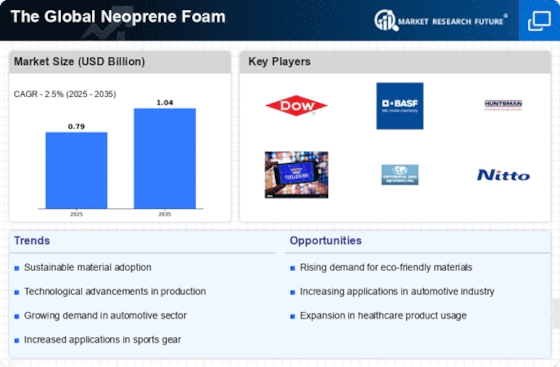
As per Market Research Future analysis, The Global Neoprene Foam Market Size was estimated at 0.7892 USD Billion in 2024. The neoprene foam industry is projected to grow from USD 0.809 Billion in 2025 to USD 1.036 Billion by 2035, exhibiting a compound annual growth rate (CAGR) of 2.5% during the forecast period 2025 - 2035

Key Market Trends & Highlights

The Global Neoprene Foam Market is poised for growth driven by sustainability and innovation.

  • North America remains the largest market for neoprene foam, reflecting robust demand across various applications.
  • Asia-Pacific is emerging as the fastest-growing region, fueled by increasing industrial activities and consumer demand.
  • Closed cell foam dominates the market, while open cell foam is witnessing rapid growth due to its versatility.
  • Rising demand in the automotive sector and increasing awareness of environmental sustainability are key drivers propelling market expansion.

Market Size & Forecast

2024 Market Size 0.7892 (USD Billion)
2035 Market Size 1.036 (USD Billion)
CAGR (2025 - 2035) 2.5%
Largest Regional Market Share in 2024 North America

Major Players

DOW (US), BASF (DE), Huntsman Corporation (US), Trelleborg AB (SE), Continental AG (DE), Nitto Denko Corporation (JP), Kraton Corporation (US), Mitsui Chemicals (JP), Zotefoams PLC (GB)

Market Trends

The Global Neoprene Foam Market is currently experiencing a dynamic phase characterized by evolving consumer preferences and technological advancements. This sector, known for its versatility, finds applications across various industries, including automotive, sports, and healthcare. The increasing demand for lightweight and durable materials is driving innovation in neoprene foam production. Manufacturers are focusing on enhancing product performance while ensuring sustainability, which appears to be a growing concern among consumers. As environmental regulations tighten, companies are likely to invest in eco-friendly alternatives and production methods, potentially reshaping the competitive landscape. In addition, the market is witnessing a shift towards customization, as clients seek tailored solutions to meet specific requirements. This trend suggests that businesses are adapting to the unique needs of their customers, thereby fostering stronger relationships and enhancing brand loyalty. Furthermore, the rise of e-commerce platforms is facilitating easier access to neoprene foam products, which may lead to increased market penetration. Overall, The Global Neoprene Foam Market seems poised for growth, driven by innovation, sustainability, and a customer-centric approach.

Sustainability Initiatives

The emphasis on sustainable practices is becoming increasingly prominent within The Global Neoprene Foam Market. Companies are exploring eco-friendly materials and production techniques to reduce their environmental footprint. This trend indicates a shift towards responsible sourcing and manufacturing, which may resonate well with environmentally conscious consumers.

Customization and Personalization

A notable trend in The Global Neoprene Foam Market is the growing demand for customized products. Clients are seeking solutions tailored to their specific needs, prompting manufacturers to offer personalized options. This shift suggests that businesses are prioritizing customer satisfaction and adaptability in their offerings.

Technological Advancements

Technological innovation is playing a crucial role in shaping The Global Neoprene Foam Market. Advances in production processes and material science are enabling the development of high-performance neoprene foams. This trend indicates that manufacturers are likely to invest in research and development to enhance product quality and functionality.

Neoprene Foam Market Market Drivers

Expansion in Consumer Goods Sector

The consumer goods sector is increasingly adopting neoprene foam for various applications, including packaging, insulation, and protective cases. The material's versatility and resilience make it an attractive choice for manufacturers aiming to enhance product quality and consumer satisfaction. The Global Neoprene Foam Industry is likely to see a significant uptick in demand as brands prioritize sustainable and durable materials in their offerings. Recent data indicates that the consumer goods segment is expected to grow at a rate of approximately 4% annually, driven by rising consumer expectations for quality and performance. This trend highlights the material's adaptability across diverse product categories, from electronics to household items.

Rising Demand in Automotive Sector

The automotive sector is experiencing a notable increase in the demand for neoprene foam, primarily due to its excellent insulation properties and durability. Neoprene foam is utilized in various automotive applications, including seals, gaskets, and soundproofing materials. As the automotive industry continues to evolve, with a focus on electric vehicles and enhanced comfort features, The Global Neoprene Foam Industry is likely to benefit significantly. Reports indicate that the automotive segment accounts for a substantial share of the neoprene foam market, with projections suggesting a growth rate of approximately 5% annually. This trend underscores the material's importance in meeting the stringent requirements for noise reduction and thermal insulation in modern vehicles.

Growth in Sports and Fitness Equipment

The sports and fitness equipment sector is witnessing a surge in the utilization of neoprene foam, attributed to its lightweight and flexible characteristics. Neoprene foam is commonly used in products such as yoga mats, weights, and protective gear, enhancing user experience through comfort and safety. The Global Neoprene Foam Industry is poised for growth as health consciousness rises globally, leading to increased participation in fitness activities. Market analysis suggests that the demand for neoprene foam in this sector could grow by over 6% in the coming years, driven by innovations in product design and the introduction of new fitness trends. This growth reflects a broader shift towards materials that offer both performance and durability in sports applications.

Technological Innovations in Manufacturing

Technological advancements in the manufacturing processes of neoprene foam are contributing to the growth of the market. Innovations such as improved production techniques and enhanced formulations are enabling manufacturers to produce higher quality foam with better performance characteristics. The Global Neoprene Foam Industry is benefiting from these advancements, as they allow for greater customization and efficiency in production. Reports suggest that the introduction of automated manufacturing processes could reduce production costs by up to 15%, thereby increasing competitiveness in the market. This technological evolution not only enhances product quality but also supports sustainability initiatives by minimizing waste and energy consumption during production.

Increasing Awareness of Environmental Sustainability

There is a growing awareness regarding environmental sustainability, which is influencing the neoprene foam market. Manufacturers are increasingly focusing on eco-friendly practices and materials, leading to the development of sustainable neoprene foam alternatives. The Global Neoprene Foam Industry is likely to experience a shift as consumers and businesses alike prioritize environmentally responsible products. Market trends indicate that the demand for sustainable neoprene foam could rise by approximately 7% in the next few years, driven by regulatory pressures and consumer preferences for greener options. This shift not only aligns with global sustainability goals but also presents opportunities for innovation in product development and marketing strategies.

Market Segment Insights

By Type: Closed Cell Foam (Largest) vs. Open Cell Foam (Fastest-Growing)

In The Global Neoprene Foam Market, the distribution of market share between Open Cell Foam and <a href="https://www.marketresearchfuture.com/reports/closed-cell-foam-market-13980" target="_blank" title="closed cell foam">Closed Cell Foam</a> reflects distinct preferences and applications. Closed Cell Foam dominates the market, leveraging its excellent <a href="https://www.marketresearchfuture.com/reports/insulation-market-1654" target="_blank" title="insulation">insulation</a> properties and buoyancy, making it ideal for applications in marine, automotive, and construction sectors. Open Cell Foam, although smaller in market share, is gaining traction as it offers superior comfort and flexibility, particularly in the healthcare and sports industries.

Neoprene Foam Market: Closed Cell (Dominant) vs. Open Cell (Emerging)

Closed Cell Foam is characterized by its dense structure, which prevents water and air from passing through, thus providing excellent thermal insulation and buoyancy. This type of foam is extensively used in applications such as wetsuits, padding, and insulation, underlining its dominant market presence. On the other hand, Open Cell Foam, known for its porous nature, offers advantages in sound absorption and comfort, making it increasingly popular in furniture and bedding industries. The emerging trend towards lightweight and flexible materials is driving the growth of Open Cell Foam, establishing it as a potential competitor in the neoprene foam market.

By End Use: Consumer Durables (Largest) vs. Automotive (Fastest-Growing)

In The Global Neoprene Foam Market, the end-use segments show a diverse distribution of market share, with Consumer Durables leading significantly due to its extensive applications in various products including electronics and household goods. Automotive, while currently smaller in share, is rapidly gaining ground as manufacturers increasingly leverage neoprene foam for its lightweight, durable properties and excellent insulation capabilities. Other notable segments include Chemicals, Construction, Pharmaceuticals, Food & Beverage, and Transportation & Logistics, each contributing to a robust overall market landscape.

Consumer Durables: Dominant vs. Automotive: Emerging

The Consumer Durables segment plays a pivotal role in the neoprene foam market, characterized by high demand for insulation, cushioning, and shock absorption in products like appliances, electronics, and furniture. Its established position is reinforced by consumer preference for durable materials that ensure product longevity. Conversely, the Automotive segment is emerging as a significant player, driven by trends in vehicle lightweighting and enhanced thermal insulation. Neoprene's versatility in automotive applications enables manufacturers to produce fuel-efficient and comfortable vehicles, marking this segment as a key area for growth and innovation in the coming years.

Get more detailed insights about Neoprene Foam Market Research Report—Global Forecast till 2035

Regional Insights

North America : Innovation and Demand Surge

North America is the largest market for neoprene foam, holding approximately 40% of the global share. The region's growth is driven by increasing demand in automotive, aerospace, and consumer goods sectors, alongside stringent regulations promoting eco-friendly materials. The U.S. and Canada are the primary contributors, with a focus on sustainable production practices and technological advancements in foam manufacturing. The competitive landscape is characterized by major players such as DOW, Huntsman Corporation, and Kraton Corporation, which are investing in R&D to enhance product performance. The presence of established manufacturing facilities and a robust supply chain further bolster market growth. Additionally, the region benefits from favorable trade policies that support the import and export of neoprene products.

Europe : Sustainability and Innovation Focus

Europe is the second-largest market for neoprene foam, accounting for around 30% of the global market share. The region's growth is fueled by increasing environmental regulations and a shift towards sustainable materials in various industries, including automotive and construction. Countries like Germany and France are leading the charge, with initiatives aimed at reducing carbon footprints and promoting circular economy practices. The competitive landscape features key players such as BASF and Continental AG, which are actively developing innovative products to meet regulatory standards. The European market is also witnessing collaborations between manufacturers and research institutions to enhance product quality and sustainability. This focus on innovation is expected to drive further growth in the coming years.

Asia-Pacific : Rapid Growth and Expansion

Asia-Pacific is witnessing rapid growth in the neoprene foam market, holding approximately 25% of the global share. The region's expansion is driven by increasing industrialization, urbanization, and rising disposable incomes, particularly in countries like China and India. The demand for neoprene foam in automotive, electronics, and sports equipment is on the rise, supported by favorable government policies promoting manufacturing and exports. Leading countries in this region include China, Japan, and India, with a competitive landscape featuring companies like Mitsui Chemicals and Nitto Denko Corporation. The presence of a large consumer base and growing investments in infrastructure development are further propelling market growth. Additionally, the region is becoming a hub for innovation, with companies focusing on developing high-performance neoprene products.

Middle East and Africa : Resource-Rich and Emerging Market

The Middle East and Africa region is emerging as a significant player in the neoprene foam market, holding about 5% of the global share. The growth is driven by increasing demand in construction, automotive, and oil & gas sectors, alongside government initiatives aimed at diversifying economies. Countries like South Africa and the UAE are leading the market, with investments in infrastructure and industrial projects boosting demand for neoprene products. The competitive landscape is characterized by a mix of local and international players, with companies exploring opportunities in manufacturing and distribution. The region's strategic location also facilitates trade, making it an attractive market for neoprene foam. As the region continues to develop, the demand for high-quality materials is expected to rise, presenting new opportunities for growth.

Key Players and Competitive Insights

Leading market players are making significant R&D investments to broaden their product portfolios, which are excellent news for the Neoprene Foam industry, grow even more. Additionally, market players are engaging in a range of calculated initiatives to increase their worldwide presence, with important market developments involving the introduction of new products, contracts, M&A transactions, increased investment, and cooperation with other enterprises. to grow and endure in an increasingly cutthroat and dynamic market, Neoprene Foam industry must provide reasonably priced goods.

One of the main business strategies employed by manufacturers is to manufacture locally in order to reduce operating expenses in the global Neoprene Foam industry to help customers and expand the market segment. In recent years, the Neoprene Foam industry has provided some of the biggest benefits to medicine. Major players in the Neoprene Foam Market, including Alanto Ltd., DuPont, Denka Company Limited, Lanxess, Shanxi-Nairit Synthetic Rubber Co. Ltd, FOAMTECH Ltd., Rubberlite, Inc., Clark Foam Products, Sedo Chemicals Neoprene GmbH, and others, are engaging in research and development activities in an effort to boost market demand.

DuPont de Nemours, Inc., also known as DuPont, was founded in 1802 by Éleuthère Irénée du Pont de Nemours, a French-American chemist and manufacturer. The corporation began as a significant supplier of gunpowder to the refrigerant industry and played a significant role in Delaware's development. It also created paints and pigments with synthetic ingredients, such as ChromaFlair.

In November DuPont declared its intention to pay $5.2 billion to acquire Rogers Corporation.

Lanxess AG is a Cologne, Germany-based specialty chemicals firm that was created by the spin-off of portions of Bayer AG's polymers business and chemicals division. The company was established in 1863, the same year as Bayer AG was established. The Bayer Group chose to spin off a significant portion of its chemical operations and about a third of its polymer business into an independent company in November 2003 as part of a significant reorganization.

In July After paying US$1.3 billion, Lanxess successfully acquired the microbiological control section of International Flavors & Fragrances.

Key Companies in the Neoprene Foam Market include

Industry Developments

April 2022: Adidas has announced the release of the Adidas Yeezy QNTM "Mono Carbon," a lifestyle sneaker with gray mesh upper and striped accents all over the midfoot that is reminiscent of a basketball. The sneakers include a 3M luminous panel on the heel and an extended navy neoprene ankle collar for support.

April 2022: Platypod, the company behind the well-liked and portable tripod substitutes, has announced the release of the Platypod eXtreme, a flagship model with more capabilities and increased adaptability for photographers who want to travel light.

February 2020: Lanxess procured Itibanyl Produtos Especiais Ltda. (IPEL), a Brazilian biocide company.

Future Outlook

Neoprene Foam Market Future Outlook

The Global Neoprene Foam Market is projected to grow at a 2.5% CAGR from 2025 to 2035, driven by increasing demand in automotive, healthcare, and consumer goods sectors.

New opportunities lie in:

  • Expansion into eco-friendly neoprene alternatives
  • Development of specialized neoprene for medical applications
  • Investment in automated manufacturing processes for efficiency

By 2035, the market is expected to solidify its position, driven by innovation and sustainability.

Market Segmentation

Neoprene Foam Market Type Outlook

  • Open Cell Foam
  • Closed Cell Foam

Neoprene Foam Market End Use Outlook

  • Consumer Durables
  • Automotive
  • Chemicals
  • Construction
  • Pharmaceuticals
  • Food & Beverage
  • Transportation & Logistics
  • Others

Report Scope

MARKET SIZE 2024 0.7892(USD Billion)
MARKET SIZE 2025 0.809(USD Billion)
MARKET SIZE 2035 1.036(USD Billion)
COMPOUND ANNUAL GROWTH RATE (CAGR) 2.5% (2025 - 2035)
REPORT COVERAGE Revenue Forecast, Competitive Landscape, Growth Factors, and Trends
BASE YEAR 2024
Market Forecast Period 2025 - 2035
Historical Data 2019 - 2024
Market Forecast Units USD Billion
Key Companies Profiled DOW (US), BASF (DE), Huntsman Corporation (US), Trelleborg AB (SE), Continental AG (DE), Nitto Denko Corporation (JP), Kraton Corporation (US), Mitsui Chemicals (JP), Zotefoams PLC (GB)
Segments Covered Type, End Use, Region
Key Market Opportunities Growing demand for eco-friendly materials drives innovation in The Global Neoprene Foam.
Key Market Dynamics Rising demand for eco-friendly materials drives innovation and competition in the neoprene foam market.
Countries Covered North America, Europe, APAC, South America, MEA

FAQs

What is the projected market valuation of The Global Neoprene Foam by 2035?

<p>The projected market valuation for The Global Neoprene Foam is 1.036 USD Billion by 2035.</p>

What was the market valuation of The Global Neoprene Foam in 2024?

<p>The overall market valuation of The Global Neoprene Foam was 0.7892 USD Billion in 2024.</p>

What is the expected CAGR for The Global Neoprene Foam during the forecast period 2025 - 2035?

<p>The expected CAGR for The Global Neoprene Foam during the forecast period 2025 - 2035 is 2.5%.</p>

Which companies are considered key players in The Global Neoprene Foam?

<p>Key players in The Global Neoprene Foam include DOW, BASF, Huntsman Corporation, Trelleborg AB, and Continental AG.</p>

What are the two main types of neoprene foam segments in the market?

<p>The two main types of neoprene foam segments in the market are Open Cell Foam and Closed Cell Foam.</p>

How did the valuation of the Open Cell Foam segment compare to the Closed Cell Foam segment in 2024?

<p>In 2024, both the Open Cell Foam and Closed Cell Foam segments had a valuation of 0.3946 USD Billion.</p>

What is the projected valuation for the Automotive segment by 2035?

The projected valuation for the Automotive segment is expected to reach 0.2655 USD Billion by 2035.

Which end-use segment had the highest valuation in 2024?

In 2024, the Automotive end-use segment had the highest valuation at 0.1972 USD Billion.

What is the expected growth trend for the Consumer Durables segment from 2024 to 2035?

The Consumer Durables segment is expected to grow from 0.1572 USD Billion in 2024 to 0.2105 USD Billion by 2035.

How does the projected growth of The Global Neoprene Foam reflect on its applications?

The projected growth of The Global Neoprene Foam indicates increasing applications across various sectors, including Automotive and Construction.

  1. SECTION I: EXECUTIVE SUMMARY AND KEY HIGHLIGHTS
    1. | 1.1 EXECUTIVE SUMMARY
    2. | | 1.1.1 Market Overview
    3. | | 1.1.2 Key Findings
    4. | | 1.1.3 Market Segmentation
    5. | | 1.1.4 Competitive Landscape
    6. | | 1.1.5 Challenges and Opportunities
    7. | | 1.1.6 Future Outlook
  2. SECTION II: SCOPING, METHODOLOGY AND MARKET STRUCTURE
    1. | 2.1 MARKET INTRODUCTION
    2. | | 2.1.1 Definition
    3. | | 2.1.2 Scope of the study
    4. | | | 2.1.2.1 Research Objective
    5. | | | 2.1.2.2 Assumption
    6. | | | 2.1.2.3 Limitations
    7. | 2.2 RESEARCH METHODOLOGY
    8. | | 2.2.1 Overview
    9. | | 2.2.2 Data Mining
    10. | | 2.2.3 Secondary Research
    11. | | 2.2.4 Primary Research
    12. | | | 2.2.4.1 Primary Interviews and Information Gathering Process
    13. | | | 2.2.4.2 Breakdown of Primary Respondents
    14. | | 2.2.5 Forecasting Model
    15. | | 2.2.6 Market Size Estimation
    16. | | | 2.2.6.1 Bottom-Up Approach
    17. | | | 2.2.6.2 Top-Down Approach
    18. | | 2.2.7 Data Triangulation
    19. | | 2.2.8 Validation
  3. SECTION III: QUALITATIVE ANALYSIS
    1. | 3.1 MARKET DYNAMICS
    2. | | 3.1.1 Overview
    3. | | 3.1.2 Drivers
    4. | | 3.1.3 Restraints
    5. | | 3.1.4 Opportunities
    6. | 3.2 MARKET FACTOR ANALYSIS
    7. | | 3.2.1 Value chain Analysis
    8. | | 3.2.2 Porter's Five Forces Analysis
    9. | | | 3.2.2.1 Bargaining Power of Suppliers
    10. | | | 3.2.2.2 Bargaining Power of Buyers
    11. | | | 3.2.2.3 Threat of New Entrants
    12. | | | 3.2.2.4 Threat of Substitutes
    13. | | | 3.2.2.5 Intensity of Rivalry
    14. | | 3.2.3 COVID-19 Impact Analysis
    15. | | | 3.2.3.1 Market Impact Analysis
    16. | | | 3.2.3.2 Regional Impact
    17. | | | 3.2.3.3 Opportunity and Threat Analysis
  4. SECTION IV: QUANTITATIVE ANALYSIS
    1. | 4.1 Chemicals and Materials, BY Type (USD Billion)
    2. | | 4.1.1 Open Cell Foam
    3. | | 4.1.2 Closed Cell Foam
    4. | 4.2 Chemicals and Materials, BY End Use (USD Billion)
    5. | | 4.2.1 Consumer Durables
    6. | | 4.2.2 Automotive
    7. | | 4.2.3 Chemicals
    8. | | 4.2.4 Construction
    9. | | 4.2.5 Pharmaceuticals
    10. | | 4.2.6 Food & Beverage
    11. | | 4.2.7 Transportation & Logistics
    12. | | 4.2.8 Others
    13. | 4.3 Chemicals and Materials, BY Region (USD Billion)
    14. | | 4.3.1 North America
    15. | | | 4.3.1.1 US
    16. | | | 4.3.1.2 Canada
    17. | | 4.3.2 Europe
    18. | | | 4.3.2.1 Germany
    19. | | | 4.3.2.2 UK
    20. | | | 4.3.2.3 France
    21. | | | 4.3.2.4 Russia
    22. | | | 4.3.2.5 Italy
    23. | | | 4.3.2.6 Spain
    24. | | | 4.3.2.7 Rest of Europe
    25. | | 4.3.3 APAC
    26. | | | 4.3.3.1 China
    27. | | | 4.3.3.2 India
    28. | | | 4.3.3.3 Japan
    29. | | | 4.3.3.4 South Korea
    30. | | | 4.3.3.5 Malaysia
    31. | | | 4.3.3.6 Thailand
    32. | | | 4.3.3.7 Indonesia
    33. | | | 4.3.3.8 Rest of APAC
    34. | | 4.3.4 South America
    35. | | | 4.3.4.1 Brazil
    36. | | | 4.3.4.2 Mexico
    37. | | | 4.3.4.3 Argentina
    38. | | | 4.3.4.4 Rest of South America
    39. | | 4.3.5 MEA
    40. | | | 4.3.5.1 GCC Countries
    41. | | | 4.3.5.2 South Africa
    42. | | | 4.3.5.3 Rest of MEA
  5. SECTION V: COMPETITIVE ANALYSIS
    1. | 5.1 Competitive Landscape
    2. | | 5.1.1 Overview
    3. | | 5.1.2 Competitive Analysis
    4. | | 5.1.3 Market share Analysis
    5. | | 5.1.4 Major Growth Strategy in the Chemicals and Materials
    6. | | 5.1.5 Competitive Benchmarking
    7. | | 5.1.6 Leading Players in Terms of Number of Developments in the Chemicals and Materials
    8. | | 5.1.7 Key developments and growth strategies
    9. | | | 5.1.7.1 New Product Launch/Service Deployment
    10. | | | 5.1.7.2 Merger & Acquisitions
    11. | | | 5.1.7.3 Joint Ventures
    12. | | 5.1.8 Major Players Financial Matrix
    13. | | | 5.1.8.1 Sales and Operating Income
    14. | | | 5.1.8.2 Major Players R&D Expenditure. 2023
    15. | 5.2 Company Profiles
    16. | | 5.2.1 DOW (US)
    17. | | | 5.2.1.1 Financial Overview
    18. | | | 5.2.1.2 Products Offered
    19. | | | 5.2.1.3 Key Developments
    20. | | | 5.2.1.4 SWOT Analysis
    21. | | | 5.2.1.5 Key Strategies
    22. | | 5.2.2 BASF (DE)
    23. | | | 5.2.2.1 Financial Overview
    24. | | | 5.2.2.2 Products Offered
    25. | | | 5.2.2.3 Key Developments
    26. | | | 5.2.2.4 SWOT Analysis
    27. | | | 5.2.2.5 Key Strategies
    28. | | 5.2.3 Huntsman Corporation (US)
    29. | | | 5.2.3.1 Financial Overview
    30. | | | 5.2.3.2 Products Offered
    31. | | | 5.2.3.3 Key Developments
    32. | | | 5.2.3.4 SWOT Analysis
    33. | | | 5.2.3.5 Key Strategies
    34. | | 5.2.4 Trelleborg AB (SE)
    35. | | | 5.2.4.1 Financial Overview
    36. | | | 5.2.4.2 Products Offered
    37. | | | 5.2.4.3 Key Developments
    38. | | | 5.2.4.4 SWOT Analysis
    39. | | | 5.2.4.5 Key Strategies
    40. | | 5.2.5 Continental AG (DE)
    41. | | | 5.2.5.1 Financial Overview
    42. | | | 5.2.5.2 Products Offered
    43. | | | 5.2.5.3 Key Developments
    44. | | | 5.2.5.4 SWOT Analysis
    45. | | | 5.2.5.5 Key Strategies
    46. | | 5.2.6 Nitto Denko Corporation (JP)
    47. | | | 5.2.6.1 Financial Overview
    48. | | | 5.2.6.2 Products Offered
    49. | | | 5.2.6.3 Key Developments
    50. | | | 5.2.6.4 SWOT Analysis
    51. | | | 5.2.6.5 Key Strategies
    52. | | 5.2.7 Kraton Corporation (US)
    53. | | | 5.2.7.1 Financial Overview
    54. | | | 5.2.7.2 Products Offered
    55. | | | 5.2.7.3 Key Developments
    56. | | | 5.2.7.4 SWOT Analysis
    57. | | | 5.2.7.5 Key Strategies
    58. | | 5.2.8 Mitsui Chemicals (JP)
    59. | | | 5.2.8.1 Financial Overview
    60. | | | 5.2.8.2 Products Offered
    61. | | | 5.2.8.3 Key Developments
    62. | | | 5.2.8.4 SWOT Analysis
    63. | | | 5.2.8.5 Key Strategies
    64. | | 5.2.9 Zotefoams PLC (GB)
    65. | | | 5.2.9.1 Financial Overview
    66. | | | 5.2.9.2 Products Offered
    67. | | | 5.2.9.3 Key Developments
    68. | | | 5.2.9.4 SWOT Analysis
    69. | | | 5.2.9.5 Key Strategies
    70. | 5.3 Appendix
    71. | | 5.3.1 References
    72. | | 5.3.2 Related Reports
  6. LIST OF FIGURES
    1. | 6.1 MARKET SYNOPSIS
    2. | 6.2 NORTH AMERICA MARKET ANALYSIS
    3. | 6.3 US MARKET ANALYSIS BY TYPE
    4. | 6.4 US MARKET ANALYSIS BY END USE
    5. | 6.5 CANADA MARKET ANALYSIS BY TYPE
    6. | 6.6 CANADA MARKET ANALYSIS BY END USE
    7. | 6.7 EUROPE MARKET ANALYSIS
    8. | 6.8 GERMANY MARKET ANALYSIS BY TYPE
    9. | 6.9 GERMANY MARKET ANALYSIS BY END USE
    10. | 6.10 UK MARKET ANALYSIS BY TYPE
    11. | 6.11 UK MARKET ANALYSIS BY END USE
    12. | 6.12 FRANCE MARKET ANALYSIS BY TYPE
    13. | 6.13 FRANCE MARKET ANALYSIS BY END USE
    14. | 6.14 RUSSIA MARKET ANALYSIS BY TYPE
    15. | 6.15 RUSSIA MARKET ANALYSIS BY END USE
    16. | 6.16 ITALY MARKET ANALYSIS BY TYPE
    17. | 6.17 ITALY MARKET ANALYSIS BY END USE
    18. | 6.18 SPAIN MARKET ANALYSIS BY TYPE
    19. | 6.19 SPAIN MARKET ANALYSIS BY END USE
    20. | 6.20 REST OF EUROPE MARKET ANALYSIS BY TYPE
    21. | 6.21 REST OF EUROPE MARKET ANALYSIS BY END USE
    22. | 6.22 APAC MARKET ANALYSIS
    23. | 6.23 CHINA MARKET ANALYSIS BY TYPE
    24. | 6.24 CHINA MARKET ANALYSIS BY END USE
    25. | 6.25 INDIA MARKET ANALYSIS BY TYPE
    26. | 6.26 INDIA MARKET ANALYSIS BY END USE
    27. | 6.27 JAPAN MARKET ANALYSIS BY TYPE
    28. | 6.28 JAPAN MARKET ANALYSIS BY END USE
    29. | 6.29 SOUTH KOREA MARKET ANALYSIS BY TYPE
    30. | 6.30 SOUTH KOREA MARKET ANALYSIS BY END USE
    31. | 6.31 MALAYSIA MARKET ANALYSIS BY TYPE
    32. | 6.32 MALAYSIA MARKET ANALYSIS BY END USE
    33. | 6.33 THAILAND MARKET ANALYSIS BY TYPE
    34. | 6.34 THAILAND MARKET ANALYSIS BY END USE
    35. | 6.35 INDONESIA MARKET ANALYSIS BY TYPE
    36. | 6.36 INDONESIA MARKET ANALYSIS BY END USE
    37. | 6.37 REST OF APAC MARKET ANALYSIS BY TYPE
    38. | 6.38 REST OF APAC MARKET ANALYSIS BY END USE
    39. | 6.39 SOUTH AMERICA MARKET ANALYSIS
    40. | 6.40 BRAZIL MARKET ANALYSIS BY TYPE
    41. | 6.41 BRAZIL MARKET ANALYSIS BY END USE
    42. | 6.42 MEXICO MARKET ANALYSIS BY TYPE
    43. | 6.43 MEXICO MARKET ANALYSIS BY END USE
    44. | 6.44 ARGENTINA MARKET ANALYSIS BY TYPE
    45. | 6.45 ARGENTINA MARKET ANALYSIS BY END USE
    46. | 6.46 REST OF SOUTH AMERICA MARKET ANALYSIS BY TYPE
    47. | 6.47 REST OF SOUTH AMERICA MARKET ANALYSIS BY END USE
    48. | 6.48 MEA MARKET ANALYSIS
    49. | 6.49 GCC COUNTRIES MARKET ANALYSIS BY TYPE
    50. | 6.50 GCC COUNTRIES MARKET ANALYSIS BY END USE
    51. | 6.51 SOUTH AFRICA MARKET ANALYSIS BY TYPE
    52. | 6.52 SOUTH AFRICA MARKET ANALYSIS BY END USE
    53. | 6.53 REST OF MEA MARKET ANALYSIS BY TYPE
    54. | 6.54 REST OF MEA MARKET ANALYSIS BY END USE
    55. | 6.55 KEY BUYING CRITERIA OF CHEMICALS AND MATERIALS
    56. | 6.56 RESEARCH PROCESS OF MRFR
    57. | 6.57 DRO ANALYSIS OF CHEMICALS AND MATERIALS
    58. | 6.58 DRIVERS IMPACT ANALYSIS: CHEMICALS AND MATERIALS
    59. | 6.59 RESTRAINTS IMPACT ANALYSIS: CHEMICALS AND MATERIALS
    60. | 6.60 SUPPLY / VALUE CHAIN: CHEMICALS AND MATERIALS
    61. | 6.61 CHEMICALS AND MATERIALS, BY TYPE, 2024 (% SHARE)
    62. | 6.62 CHEMICALS AND MATERIALS, BY TYPE, 2024 TO 2035 (USD Billion)
    63. | 6.63 CHEMICALS AND MATERIALS, BY END USE, 2024 (% SHARE)
    64. | 6.64 CHEMICALS AND MATERIALS, BY END USE, 2024 TO 2035 (USD Billion)
    65. | 6.65 BENCHMARKING OF MAJOR COMPETITORS
  7. LIST OF TABLES
    1. | 7.1 LIST OF ASSUMPTIONS
    2. | | 7.1.1
    3. | 7.2 North America MARKET SIZE ESTIMATES; FORECAST
    4. | | 7.2.1 BY TYPE, 2025-2035 (USD Billion)
    5. | | 7.2.2 BY END USE, 2025-2035 (USD Billion)
    6. | 7.3 US MARKET SIZE ESTIMATES; FORECAST
    7. | | 7.3.1 BY TYPE, 2025-2035 (USD Billion)
    8. | | 7.3.2 BY END USE, 2025-2035 (USD Billion)
    9. | 7.4 Canada MARKET SIZE ESTIMATES; FORECAST
    10. | | 7.4.1 BY TYPE, 2025-2035 (USD Billion)
    11. | | 7.4.2 BY END USE, 2025-2035 (USD Billion)
    12. | 7.5 Europe MARKET SIZE ESTIMATES; FORECAST
    13. | | 7.5.1 BY TYPE, 2025-2035 (USD Billion)
    14. | | 7.5.2 BY END USE, 2025-2035 (USD Billion)
    15. | 7.6 Germany MARKET SIZE ESTIMATES; FORECAST
    16. | | 7.6.1 BY TYPE, 2025-2035 (USD Billion)
    17. | | 7.6.2 BY END USE, 2025-2035 (USD Billion)
    18. | 7.7 UK MARKET SIZE ESTIMATES; FORECAST
    19. | | 7.7.1 BY TYPE, 2025-2035 (USD Billion)
    20. | | 7.7.2 BY END USE, 2025-2035 (USD Billion)
    21. | 7.8 France MARKET SIZE ESTIMATES; FORECAST
    22. | | 7.8.1 BY TYPE, 2025-2035 (USD Billion)
    23. | | 7.8.2 BY END USE, 2025-2035 (USD Billion)
    24. | 7.9 Russia MARKET SIZE ESTIMATES; FORECAST
    25. | | 7.9.1 BY TYPE, 2025-2035 (USD Billion)
    26. | | 7.9.2 BY END USE, 2025-2035 (USD Billion)
    27. | 7.10 Italy MARKET SIZE ESTIMATES; FORECAST
    28. | | 7.10.1 BY TYPE, 2025-2035 (USD Billion)
    29. | | 7.10.2 BY END USE, 2025-2035 (USD Billion)
    30. | 7.11 Spain MARKET SIZE ESTIMATES; FORECAST
    31. | | 7.11.1 BY TYPE, 2025-2035 (USD Billion)
    32. | | 7.11.2 BY END USE, 2025-2035 (USD Billion)
    33. | 7.12 Rest of Europe MARKET SIZE ESTIMATES; FORECAST
    34. | | 7.12.1 BY TYPE, 2025-2035 (USD Billion)
    35. | | 7.12.2 BY END USE, 2025-2035 (USD Billion)
    36. | 7.13 APAC MARKET SIZE ESTIMATES; FORECAST
    37. | | 7.13.1 BY TYPE, 2025-2035 (USD Billion)
    38. | | 7.13.2 BY END USE, 2025-2035 (USD Billion)
    39. | 7.14 China MARKET SIZE ESTIMATES; FORECAST
    40. | | 7.14.1 BY TYPE, 2025-2035 (USD Billion)
    41. | | 7.14.2 BY END USE, 2025-2035 (USD Billion)
    42. | 7.15 India MARKET SIZE ESTIMATES; FORECAST
    43. | | 7.15.1 BY TYPE, 2025-2035 (USD Billion)
    44. | | 7.15.2 BY END USE, 2025-2035 (USD Billion)
    45. | 7.16 Japan MARKET SIZE ESTIMATES; FORECAST
    46. | | 7.16.1 BY TYPE, 2025-2035 (USD Billion)
    47. | | 7.16.2 BY END USE, 2025-2035 (USD Billion)
    48. | 7.17 South Korea MARKET SIZE ESTIMATES; FORECAST
    49. | | 7.17.1 BY TYPE, 2025-2035 (USD Billion)
    50. | | 7.17.2 BY END USE, 2025-2035 (USD Billion)
    51. | 7.18 Malaysia MARKET SIZE ESTIMATES; FORECAST
    52. | | 7.18.1 BY TYPE, 2025-2035 (USD Billion)
    53. | | 7.18.2 BY END USE, 2025-2035 (USD Billion)
    54. | 7.19 Thailand MARKET SIZE ESTIMATES; FORECAST
    55. | | 7.19.1 BY TYPE, 2025-2035 (USD Billion)
    56. | | 7.19.2 BY END USE, 2025-2035 (USD Billion)
    57. | 7.20 Indonesia MARKET SIZE ESTIMATES; FORECAST
    58. | | 7.20.1 BY TYPE, 2025-2035 (USD Billion)
    59. | | 7.20.2 BY END USE, 2025-2035 (USD Billion)
    60. | 7.21 Rest of APAC MARKET SIZE ESTIMATES; FORECAST
    61. | | 7.21.1 BY TYPE, 2025-2035 (USD Billion)
    62. | | 7.21.2 BY END USE, 2025-2035 (USD Billion)
    63. | 7.22 South America MARKET SIZE ESTIMATES; FORECAST
    64. | | 7.22.1 BY TYPE, 2025-2035 (USD Billion)
    65. | | 7.22.2 BY END USE, 2025-2035 (USD Billion)
    66. | 7.23 Brazil MARKET SIZE ESTIMATES; FORECAST
    67. | | 7.23.1 BY TYPE, 2025-2035 (USD Billion)
    68. | | 7.23.2 BY END USE, 2025-2035 (USD Billion)
    69. | 7.24 Mexico MARKET SIZE ESTIMATES; FORECAST
    70. | | 7.24.1 BY TYPE, 2025-2035 (USD Billion)
    71. | | 7.24.2 BY END USE, 2025-2035 (USD Billion)
    72. | 7.25 Argentina MARKET SIZE ESTIMATES; FORECAST
    73. | | 7.25.1 BY TYPE, 2025-2035 (USD Billion)
    74. | | 7.25.2 BY END USE, 2025-2035 (USD Billion)
    75. | 7.26 Rest of South America MARKET SIZE ESTIMATES; FORECAST
    76. | | 7.26.1 BY TYPE, 2025-2035 (USD Billion)
    77. | | 7.26.2 BY END USE, 2025-2035 (USD Billion)
    78. | 7.27 MEA MARKET SIZE ESTIMATES; FORECAST
    79. | | 7.27.1 BY TYPE, 2025-2035 (USD Billion)
    80. | | 7.27.2 BY END USE, 2025-2035 (USD Billion)
    81. | 7.28 GCC Countries MARKET SIZE ESTIMATES; FORECAST
    82. | | 7.28.1 BY TYPE, 2025-2035 (USD Billion)
    83. | | 7.28.2 BY END USE, 2025-2035 (USD Billion)
    84. | 7.29 South Africa MARKET SIZE ESTIMATES; FORECAST
    85. | | 7.29.1 BY TYPE, 2025-2035 (USD Billion)
    86. | | 7.29.2 BY END USE, 2025-2035 (USD Billion)
    87. | 7.30 Rest of MEA MARKET SIZE ESTIMATES; FORECAST
    88. | | 7.30.1 BY TYPE, 2025-2035 (USD Billion)
    89. | | 7.30.2 BY END USE, 2025-2035 (USD Billion)
    90. | 7.31 PRODUCT LAUNCH/PRODUCT DEVELOPMENT/APPROVAL
    91. | | 7.31.1
    92. | 7.32 ACQUISITION/PARTNERSHIP
    93. | | 7.32.1

Chemicals and Materials Market Segmentation

Chemicals and Materials By Type (USD Billion, 2025-2035)

  • Open Cell Foam
  • Closed Cell Foam

Chemicals and Materials By End Use (USD Billion, 2025-2035)

  • Consumer Durables
  • Automotive
  • Chemicals
  • Construction
  • Pharmaceuticals
  • Food & Beverage
  • Transportation & Logistics
  • Others
Infographic

Free Sample Request

Kindly complete the form below to receive a free sample of this Report

Get Free Sample

Customer Strories

Compare Licence

×
Features License Type
Single User Multiuser License Enterprise User
Price $4,950 $5,950 $7,250
Maximum User Access Limit 1 User Upto 10 Users Unrestricted Access Throughout the Organization
Free Customization
Direct Access to Analyst
Deliverable Format
Platform Access
Discount on Next Purchase 10% 15% 15%
Printable Versions