Request Free Sample ×

Kindly complete the form below to receive a free sample of this Report

* Please use a valid business email

Leading companies partner with us for data-driven Insights

clients tt-cursor
Hero Background
English
Chinese
French
Japanese
Korean
German
Spanish

Neem Extracts Market Analysis

ID: MRFR/FnB/0561-CR
128 Pages
Sakshi Gupta
October 2023

Neem Extract Market Size, Share, Industry Trend & Analysis Research Report Information by Type (Leaf Extracts, Fruit and seed Extracts, and Bark Extracts), Application (Pharmaceuticals and nutraceuticals, Personal Care, Agriculture and farming, Food and beverages, and Others), And By Region (North America, Europe, Asia-Pacific, and Rest of the World) - Forecast Till 2035

Share:
Download PDF ×

We do not share your information with anyone. However, we may send you emails based on your report interest from time to time. You may contact us at any time to opt-out.

Neem Extracts Market Infographic
Purchase Options

Market Analysis

In-depth Analysis of Neem Extracts Market Industry Landscape

Rising Demand for Neem Extracts Driven by Growing Adoption of Organic Farming A pivotal factor propelling the growth of the neem extract market is the increasing adoption of organic farming. This surge can be attributed to the profound advantages associated with organic farming, particularly in reducing potential hazards to both humans and animals by minimizing residues in agricultural products. Furthermore, organic farming is acknowledged for its contribution to diminishing the overall cost of agricultural production while concurrently enhancing soil health. Neem extracts play a crucial role in organic farming due to their inherent properties, such as being spermicidal and bactericidal. The global shift towards organic farming is substantiated by numerous countries that have embraced this agricultural approach, contributing significantly to the overall share of organic farming on a global scale. According to data from the Government of Tamil Nadu, Australia led the way in organic farming with an extensive land coverage of 35.7 million hectares (mha) in 2019, followed by Argentina (3.7 mha) and Spain (2.4 mha). Notably, India demonstrated a remarkable increase in organic farming, claiming the top position with an expansion of 0.36 mha, followed by Kazakhstan with an increase of 0.1 mha in the year 2019. The share chart below illustrates the leading contributors to organic farming in various regions, underscoring the substantial demand for neem extract on a global scale. [Insert Share Chart] The escalating demand for neem extract is intricately linked to the higher prevalence of organic farming practices worldwide. The discernible increase in organic production and the expansion of organic farmland across the globe serve as key drivers for the burgeoning neem extract market. The benefits of organic farming, including reduced environmental impact, improved soil fertility, and the absence of harmful synthetic chemicals, align with the growing consumer preference for sustainable and eco-friendly agricultural practices. Neem extracts, with their versatile properties, align seamlessly with the principles of organic farming, contributing to the global movement towards healthier and more sustainable agricultural methods. In conclusion, the symbiotic relationship between organic farming and the demand for neem extract is evident in the ongoing global shift towards environmentally conscious and sustainable agricultural practices. As countries continue to prioritize organic farming initiatives, the neem extract market is poised for sustained growth, providing a natural and effective solution for agricultural challenges while promoting ecological well-being.

Author
Author Profile
Sakshi Gupta
Team Lead - Research

Currently a Team Lead in consumer goods, FMCG, and F&B, she translates rigorous research into decisive strategy. She develops GTM roadmaps, pricing architectures, and competitive benchmarks for companies across Europe, the US, and APAC. She synthesize insights, align cross-functional teams, and drive execution from brief to measurable outcomes. She leads end-to-end engagements with crisp analysis, compelling storytelling, and a strong command of Power BI, Tableau, SQL, and advanced research platforms.

Leave a Comment

FAQs

What is the current valuation of the Neem Extract Market as of 2024?

<p>The Neem Extract Market was valued at 2.31 USD Billion in 2024.</p>

What is the projected market size for the Neem Extract Market by 2035?

<p>The market is projected to reach 10.84 USD Billion by 2035.</p>

What is the expected CAGR for the Neem Extract Market during the forecast period 2025 - 2035?

<p>The expected CAGR for the Neem Extract Market during 2025 - 2035 is 15.09%.</p>

Which segments are included in the Neem Extract Market?

<p>The market segments include Leaf Extracts, Fruit & Seed Extracts, and Bark Extracts.</p>

What are the projected valuations for Leaf Extracts by 2035?

<p>Leaf Extracts are projected to grow from 0.69 USD Billion in 2024 to 3.25 USD Billion by 2035.</p>

How do Fruit & Seed Extracts perform in the market?

<p>Fruit & Seed Extracts are expected to increase from 1.15 USD Billion in 2024 to 5.4 USD Billion by 2035.</p>

What is the market outlook for Bark Extracts by 2035?

Bark Extracts are anticipated to rise from 0.47 USD Billion in 2024 to 2.19 USD Billion by 2035.

Which applications are driving the Neem Extract Market?

Key applications include Pharmaceuticals &amp; Nutraceuticals, Personal Care, Agriculture &amp; Farming, and Food &amp; Beverages.

What is the projected growth for the Pharmaceuticals & Nutraceuticals segment by 2035?

This segment is expected to grow from 0.8 USD Billion in 2024 to 3.8 USD Billion by 2035.

Who are the key players in the Neem Extract Market?

Key players include Nimbark Organics, Neem Tree Farms, Agro Extracts, and Himalaya Wellness.

Market Summary

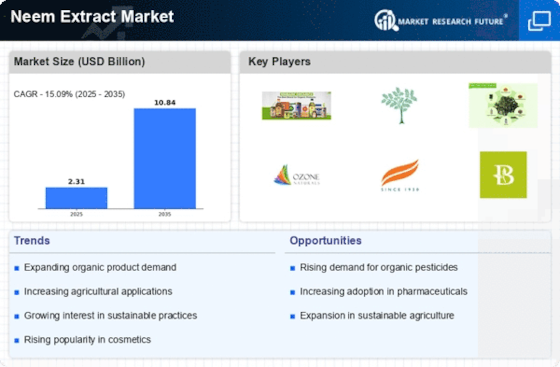
As per Market Research Future analysis, the Neem Extract Market Size was estimated at 2.31 USD Billion in 2024. The Neem Extract industry is projected to grow from 2.659 USD Billion in 2025 to 10.84 USD Billion by 2035, exhibiting a compound annual growth rate (CAGR) of 15.09% during the forecast period 2025 - 2035

Key Market Trends & Highlights

The Neem Extract Market is experiencing robust growth driven by increasing demand for organic products and innovative extraction techniques.

  • The North American region remains the largest market for neem extract, reflecting a strong consumer preference for natural ingredients. Asia-Pacific is identified as the fastest-growing region, with a notable rise in demand for herbal products and sustainable agriculture practices. Leaf extracts dominate the market, while bark extracts are emerging as the fastest-growing segment due to their unique properties. Key market drivers include increasing awareness of health benefits and the expansion of the cosmetic industry, which fuels demand for neem-based products.

Market Size & Forecast

2024 Market Size 2.31 (USD Billion)
2035 Market Size 10.84 (USD Billion)
CAGR (2025 - 2035) 15.09%
Largest Regional Market Share in 2024 Asia Pacific

Major Players

Nimbark Organics (IN), Neem Tree Farms (US), Agro Extracts (IN), Ozone Naturals (IN), Himalaya Wellness (IN), Banyan Botanicals (US), Kopari Beauty (US), Natures Way (US)

Market Trends

The Neem Extract Market is currently experiencing a notable transformation, driven by increasing awareness of natural and organic products. Consumers are gravitating towards sustainable alternatives, which has led to a surge in demand for neem extracts across various sectors, including agriculture, cosmetics, and pharmaceuticals. This shift appears to be influenced by a growing understanding of the benefits associated with neem, such as its antibacterial, antifungal, and anti-inflammatory properties. As a result, manufacturers are exploring innovative extraction methods to enhance the efficacy and purity of neem products, thereby catering to the evolving preferences of health-conscious consumers. Moreover, the Neem Extract Market seems poised for further expansion as regulatory frameworks increasingly support the use of botanical extracts in various applications. The rise of eco-friendly practices among businesses is likely to bolster the market, as companies seek to align with consumer values centered around sustainability. Additionally, the potential for neem extracts to serve as effective pest control agents in agriculture may attract attention from farmers looking for organic solutions. Overall, the market landscape appears dynamic, with numerous opportunities for growth and development in the coming years.

Rising Demand for Organic Products

The Neem Extract Market is witnessing a surge in interest for organic and natural products. Consumers are increasingly prioritizing health and wellness, leading to a preference for neem extracts in personal care and dietary supplements.

Innovative Extraction Techniques

Advancements in extraction technologies are enhancing the quality and potency of neem extracts. Manufacturers are investing in research to develop more efficient methods, which may improve product offerings and attract a broader customer base.

Sustainability in Agriculture

The Neem Extract Market is likely to benefit from the growing trend of sustainable agricultural practices. Neem extracts are recognized for their potential as natural pesticides, appealing to environmentally conscious farmers seeking organic solutions.

Neem Extracts Market Market Drivers

Expansion of the Cosmetic Industry

The Neem Extract Market is significantly influenced by the expansion of the cosmetic sector, where neem extracts are utilized for their beneficial properties. The increasing incorporation of neem in skincare and haircare products is driven by its natural ability to combat skin issues and promote healthy hair. As The Neem Extract continues to grow, with an estimated value reaching over 800 billion dollars by 2025, the demand for neem extracts is likely to rise correspondingly. This expansion indicates a promising opportunity for the Neem Extract Market to establish a strong foothold in the beauty and personal care segments.

Growth of the Herbal Medicine Sector

The Neem Extract Market is experiencing growth due to the increasing popularity of herbal medicine. As consumers turn to traditional remedies for health issues, neem extracts are gaining recognition for their therapeutic properties. The herbal medicine market is projected to reach over 300 billion dollars by 2025, indicating a substantial opportunity for neem extracts to be integrated into various health products. This trend reflects a broader shift towards holistic health approaches, positioning the Neem Extract Market favorably within the expanding herbal sector.

Increasing Awareness of Health Benefits

The Neem Extract Market is experiencing a surge in consumer awareness regarding the health benefits associated with neem extracts. These extracts are recognized for their antibacterial, antifungal, and anti-inflammatory properties, which are increasingly sought after in both personal care and dietary supplements. As consumers become more health-conscious, the demand for natural and organic products rises, leading to a notable increase in the market size. Reports indicate that the market for neem extracts is projected to grow at a compound annual growth rate of approximately 10% over the next five years. This trend suggests that the Neem Extract Market is well-positioned to capitalize on the growing preference for natural remedies.

Regulatory Support for Natural Ingredients

The Neem Extract Market benefits from favorable regulatory frameworks that promote the use of natural ingredients in various applications. Governments and regulatory bodies are increasingly endorsing the use of plant-based extracts in food, cosmetics, and pharmaceuticals, which enhances consumer trust and market acceptance. This regulatory support is crucial as it encourages manufacturers to innovate and incorporate neem extracts into their products. As a result, the Neem Extract Market is likely to witness a boost in product development and market penetration, aligning with the growing trend towards sustainability and natural solutions.

Rising Interest in Sustainable Agriculture

The Neem Extract Market is closely linked to the rising interest in sustainable agricultural practices. Neem trees are known for their pest-repellent properties, making them a valuable asset in organic farming. As farmers seek to reduce chemical pesticide usage, the demand for neem-based solutions is expected to increase. This shift towards sustainable agriculture not only supports environmental health but also enhances the Neem Extract Market by providing a natural alternative to synthetic chemicals. The potential for neem extracts to play a pivotal role in sustainable farming practices suggests a promising future for the industry.

Market Segment Insights

By Type: Leaf Extracts (Largest) vs. Bark Extracts (Fastest-Growing)

In the Neem Extract Market, Leaf Extracts are the dominant player, capturing the largest market share due to their versatile applications in pharmaceuticals, cosmetics, and agriculture. These extracts are favored for their potent antibacterial and antifungal properties, making them indispensable in various health and wellness products. In contrast, Bark Extracts, while currently smaller in share, are experiencing rapid adoption, which positions them as a significant growth opportunity in the coming years. The growth trends indicate a rising preference for natural and organic solutions in personal care and wellness industries. This shift is driving the demand for both Leaf and Bark Extracts, with Bark Extracts being recognized for their unique properties that cater to niche markets. Consumer awareness and an increasing inclination towards Ayurvedic products are expected to boost the growth of Bark Extracts significantly, supporting their emerging status in the market.

Leaf Extracts (Dominant) vs. Bark Extracts (Emerging)

Leaf Extracts hold a dominant position in the Neem Extract Market, renowned for their extensive medicinal properties including anti-inflammatory and antimicrobial benefits. Their versatility allows for use in various formulations, from skincare to agricultural applications. In contrast, Bark Extracts are emerging as a noteworthy segment, providing distinct benefits such as higher concentration of certain active compounds that appeal to specific consumer demands. As consumers seek more sustainable and effective natural solutions, Bark Extracts are beginning to carve a niche, driven by their use in herbal remedies and organic formulations. Strategic marketing and increased awareness are likely to elevate Bark Extracts in the market, making them a segment to watch closely.

By Application: Pharmaceuticals & Nutraceuticals (Largest) vs. Personal Care (Fastest-Growing)

In the Neem Extract Market, the application segment showcases a diverse range of uses, with Pharmaceuticals &amp; Nutraceuticals accounting for the largest share. This application leverages the anti-inflammatory and antibacterial properties of neem extracts, making it a preferred choice for various health products. Following closely, Personal Care is emerging as a significant player, fueled by the growing demand for natural and organic ingredients in cosmetic formulations, indicating a notable shift in consumer preferences towards cleaner products. The growth trends in this segment are driven by an increasing awareness of the benefits of neem extracts, particularly in promoting wellness and sustainability. Agriculture &amp; Farming also plays a crucial role, as neem oil is extensively utilized in pest control and as a natural fertilizer. Meanwhile, the Food &amp; Beverages sector is gradually exploring neem’s potential health benefits, signaling a diversification in application utilization. The overall trend points towards an upward trajectory as industries embrace the multifunctional properties of neem extracts.

Pharmaceuticals &amp; Nutraceuticals (Dominant) vs. Personal Care (Emerging)

Pharmaceuticals &amp; Nutraceuticals represents the dominant application of neem extracts, known for its extensive therapeutic benefits, including immune support and skin health enhancement. This segment thrives on the increasing demand for natural remedies and preventative health solutions. On the other hand, Personal Care is rapidly emerging, reflecting a shift in consumer preferences towards products that incorporate sustainable and natural ingredients. This trend is buoyed by a rising awareness around the side effects of synthetic components in cosmetics. The Personal Care segment capitalizes on neem’s nourishing properties, finding its way into skincare and haircare products. As consumers become more environmentally conscious, both segments are likely to witness increased innovation and market expansion.

Get more detailed insights about Neem Extracts Market Research Report - Global Forecast till 2035

Regional Insights

North America : Growing Demand for Natural Products

The Neem Extract Market in North America is driven by increasing consumer awareness regarding natural and organic products. The region is witnessing a surge in demand for neem extracts, particularly in the cosmetics and personal care sectors. North America holds approximately 35% of the global market share, making it the largest market for neem extracts. Regulatory support for organic products further fuels this growth, as consumers seek eco-friendly alternatives. The United States is the leading country in this region, with a robust presence of key players such as Neem Tree Farms and Banyan Botanicals. The competitive landscape is characterized by a mix of established companies and emerging startups focusing on sustainable practices. The market is also supported by favorable regulations that promote the use of natural ingredients in consumer products, enhancing the overall growth potential.

Europe : Regulatory Support for Natural Ingredients

Europe is rapidly becoming a significant player in the Neem Extract Market, driven by increasing consumer demand for organic and natural products. The region is projected to hold around 30% of the global market share, making it the second-largest market. Regulatory frameworks, such as the EU Cosmetics Regulation, encourage the use of natural ingredients, which is a key driver for market growth in this region. Leading countries in Europe include Germany, France, and the UK, where the demand for neem extracts is particularly high in the cosmetics and health sectors. The competitive landscape features both local and international players, with companies like Ozone Naturals and Himalaya Wellness making notable contributions. The presence of stringent regulations ensures that products meet high safety and quality standards, further enhancing consumer trust in neem-based products.

Asia-Pacific : Emerging Powerhouse for Neem Extracts

The Asia-Pacific region is witnessing a remarkable growth trajectory in the Neem Extract Market, driven by rising awareness of the health benefits associated with neem. This region is expected to capture approximately 25% of the global market share, making it a significant player. The demand is particularly strong in countries like India and China, where traditional medicine practices are being integrated with modern applications, supported by favorable government policies promoting herbal products. India stands out as the largest producer of neem extracts, with key players like Nimbark Organics and Agro Extracts leading the market. The competitive landscape is characterized by a mix of traditional and modern companies, focusing on both domestic and international markets. The increasing popularity of neem in personal care and agricultural applications is further driving market growth, supported by local regulations that encourage sustainable practices.

Middle East and Africa : Resource-Rich Frontier for Neem

The Middle East and Africa region presents a unique opportunity for the Neem Extract Market, characterized by an increasing interest in natural and organic products. This region currently holds about 10% of the global market share, with significant growth potential as consumer preferences shift towards sustainable options. The demand for neem extracts is being driven by the cosmetics and agricultural sectors, supported by local initiatives promoting organic farming practices. Countries like South Africa and the UAE are emerging as key players in this market, with a growing number of companies exploring neem's benefits. The competitive landscape is still developing, with both local and international firms entering the market. The presence of regulatory bodies advocating for natural products is expected to further enhance market growth, making this region a promising frontier for neem extract applications.

Key Players and Competitive Insights

The Neem Extract Market is currently characterized by a dynamic competitive landscape, driven by increasing consumer awareness regarding natural and organic products. This market is witnessing a surge in demand for neem extracts, primarily due to their applications in pharmaceuticals, cosmetics, and agriculture. Key players such as Nimbark Organics (IN), Neem Tree Farms (US), and Agro Extracts (IN) are strategically positioning themselves through innovation and regional expansion. Nimbark Organics (IN) focuses on sustainable sourcing and product diversification, while Neem Tree Farms (US) emphasizes organic certification and direct-to-consumer sales channels. Agro Extracts (IN) is enhancing its operational capabilities through technological advancements in extraction processes, collectively shaping a competitive environment that prioritizes quality and sustainability.

In terms of business tactics, companies are increasingly localizing manufacturing to reduce costs and enhance supply chain efficiency. The Neem Extract Market appears moderately fragmented, with several players vying for market share. The collective influence of these key players is significant, as they not only drive innovation but also set quality standards that smaller companies must adhere to in order to compete effectively.

In August 2025, Nimbark Organics (IN) announced a partnership with a leading organic certification body to enhance its product offerings. This strategic move is likely to bolster consumer trust and expand its market reach, particularly among health-conscious consumers seeking certified organic products. The partnership underscores the importance of quality assurance in the competitive landscape, as consumers increasingly prefer products with verified organic credentials.

In September 2025, Neem Tree Farms (US) launched a new line of neem-based skincare products, leveraging its established brand reputation in the organic market. This product launch is significant as it not only diversifies their portfolio but also aligns with the growing trend of natural skincare solutions. By tapping into this burgeoning segment, Neem Tree Farms (US) positions itself to capture a larger share of the market, appealing to consumers who prioritize natural ingredients in their beauty routines.

In July 2025, Agro Extracts (IN) invested in advanced extraction technology to improve the efficiency and yield of neem oil production. This investment is crucial as it enhances their competitive edge by reducing production costs and increasing output quality. The adoption of cutting-edge technology reflects a broader trend within the industry towards innovation and efficiency, which is essential for maintaining competitiveness in a rapidly evolving market.

As of October 2025, the competitive trends in the Neem Extract Market are increasingly defined by digitalization, sustainability, and the integration of artificial intelligence in production processes. Strategic alliances are becoming more prevalent, as companies recognize the value of collaboration in enhancing product offerings and market reach. Looking ahead, competitive differentiation is likely to evolve from traditional price-based competition to a focus on innovation, technological advancements, and supply chain reliability, as companies strive to meet the growing demand for high-quality, sustainable products.

Key Companies in the Neem Extracts Market include

Industry Developments

Future Outlook

Neem Extracts Market Future Outlook

The Neem Extract Market is projected to grow at a 15.09% CAGR from 2025 to 2035, driven by increasing demand for organic products and sustainable agriculture practices.

New opportunities lie in:

  • <p>Expansion into bio-pesticide formulations for agricultural applications. Development of neem-based personal care products targeting eco-conscious consumers. Partnerships with organic certification bodies to enhance market credibility.</p>

By 2035, the Neem Extract Market is expected to solidify its position as a leader in sustainable product offerings.

Market Segmentation

Neem Extracts Market Type Outlook

  • Leaf Extracts
  • Fruit & Seed Extracts
  • Bark Extracts

Neem Extracts Market Application Outlook

  • Pharmaceuticals & Nutraceuticals
  • Personal Care
  • Agriculture & Farming
  • Food & Beverages
  • Others

Report Scope

MARKET SIZE 2024 2.31(USD Billion)
MARKET SIZE 2025 2.659(USD Billion)
MARKET SIZE 2035 10.84(USD Billion)
COMPOUND ANNUAL GROWTH RATE (CAGR) 15.09% (2025 - 2035)
REPORT COVERAGE Revenue Forecast, Competitive Landscape, Growth Factors, and Trends
BASE YEAR 2024
Market Forecast Period 2025 - 2035
Historical Data 2019 - 2024
Market Forecast Units USD Billion
Key Companies Profiled Nimbark Organics (IN), Neem Tree Farms (US), Agro Extracts (IN), Ozone Naturals (IN), Himalaya Wellness (IN), Banyan Botanicals (US), Kopari Beauty (US), Natures Way (US)
Segments Covered Type, Region
Key Market Opportunities Growing demand for organic pesticides and natural health products drives opportunities in the Neem Extract Market.
Key Market Dynamics Rising demand for organic products drives innovation and competition in the Neem Extract Market.
Countries Covered North America, Europe, APAC, South America, MEA

FAQs

What is the current valuation of the Neem Extract Market as of 2024?

<p>The Neem Extract Market was valued at 2.31 USD Billion in 2024.</p>

What is the projected market size for the Neem Extract Market by 2035?

<p>The market is projected to reach 10.84 USD Billion by 2035.</p>

What is the expected CAGR for the Neem Extract Market during the forecast period 2025 - 2035?

<p>The expected CAGR for the Neem Extract Market during 2025 - 2035 is 15.09%.</p>

Which segments are included in the Neem Extract Market?

<p>The market segments include Leaf Extracts, Fruit & Seed Extracts, and Bark Extracts.</p>

What are the projected valuations for Leaf Extracts by 2035?

<p>Leaf Extracts are projected to grow from 0.69 USD Billion in 2024 to 3.25 USD Billion by 2035.</p>

How do Fruit & Seed Extracts perform in the market?

<p>Fruit & Seed Extracts are expected to increase from 1.15 USD Billion in 2024 to 5.4 USD Billion by 2035.</p>

What is the market outlook for Bark Extracts by 2035?

Bark Extracts are anticipated to rise from 0.47 USD Billion in 2024 to 2.19 USD Billion by 2035.

Which applications are driving the Neem Extract Market?

Key applications include Pharmaceuticals &amp; Nutraceuticals, Personal Care, Agriculture &amp; Farming, and Food &amp; Beverages.

What is the projected growth for the Pharmaceuticals & Nutraceuticals segment by 2035?

This segment is expected to grow from 0.8 USD Billion in 2024 to 3.8 USD Billion by 2035.

Who are the key players in the Neem Extract Market?

Key players include Nimbark Organics, Neem Tree Farms, Agro Extracts, and Himalaya Wellness.

  1. SECTION I: EXECUTIVE SUMMARY AND KEY HIGHLIGHTS
    1. | 1.1 EXECUTIVE SUMMARY
    2. | | 1.1.1 Market Overview
    3. | | 1.1.2 Key Findings
    4. | | 1.1.3 Market Segmentation
    5. | | 1.1.4 Competitive Landscape
    6. | | 1.1.5 Challenges and Opportunities
    7. | | 1.1.6 Future Outlook
  2. SECTION II: SCOPING, METHODOLOGY AND MARKET STRUCTURE
    1. | 2.1 MARKET INTRODUCTION
    2. | | 2.1.1 Definition
    3. | | 2.1.2 Scope of the study
    4. | | | 2.1.2.1 Research Objective
    5. | | | 2.1.2.2 Assumption
    6. | | | 2.1.2.3 Limitations
    7. | 2.2 RESEARCH METHODOLOGY
    8. | | 2.2.1 Overview
    9. | | 2.2.2 Data Mining
    10. | | 2.2.3 Secondary Research
    11. | | 2.2.4 Primary Research
    12. | | | 2.2.4.1 Primary Interviews and Information Gathering Process
    13. | | | 2.2.4.2 Breakdown of Primary Respondents
    14. | | 2.2.5 Forecasting Model
    15. | | 2.2.6 Market Size Estimation
    16. | | | 2.2.6.1 Bottom-Up Approach
    17. | | | 2.2.6.2 Top-Down Approach
    18. | | 2.2.7 Data Triangulation
    19. | | 2.2.8 Validation
  3. SECTION III: QUALITATIVE ANALYSIS
    1. | 3.1 MARKET DYNAMICS
    2. | | 3.1.1 Overview
    3. | | 3.1.2 Drivers
    4. | | 3.1.3 Restraints
    5. | | 3.1.4 Opportunities
    6. | 3.2 MARKET FACTOR ANALYSIS
    7. | | 3.2.1 Value chain Analysis
    8. | | 3.2.2 Porter's Five Forces Analysis
    9. | | | 3.2.2.1 Bargaining Power of Suppliers
    10. | | | 3.2.2.2 Bargaining Power of Buyers
    11. | | | 3.2.2.3 Threat of New Entrants
    12. | | | 3.2.2.4 Threat of Substitutes
    13. | | | 3.2.2.5 Intensity of Rivalry
    14. | | 3.2.3 COVID-19 Impact Analysis
    15. | | | 3.2.3.1 Market Impact Analysis
    16. | | | 3.2.3.2 Regional Impact
    17. | | | 3.2.3.3 Opportunity and Threat Analysis
  4. SECTION IV: QUANTITATIVE ANALYSIS
    1. | 4.1 Food, Beverages & Nutrition, BY Type (USD Billion)
    2. | | 4.1.1 Leaf Extracts
    3. | | 4.1.2 Fruit & Seed Extracts
    4. | | 4.1.3 Bark Extracts
    5. | 4.2 Food, Beverages & Nutrition, BY Application (USD Billion)
    6. | | 4.2.1 Pharmaceuticals & Nutraceuticals
    7. | | 4.2.2 Personal Care
    8. | | 4.2.3 Agriculture & Farming
    9. | | 4.2.4 Food & Beverages
    10. | | 4.2.5 Others
    11. | 4.3 Food, Beverages & Nutrition, BY Region (USD Billion)
    12. | | 4.3.1 North America
    13. | | | 4.3.1.1 US
    14. | | | 4.3.1.2 Canada
    15. | | 4.3.2 Europe
    16. | | | 4.3.2.1 Germany
    17. | | | 4.3.2.2 UK
    18. | | | 4.3.2.3 France
    19. | | | 4.3.2.4 Russia
    20. | | | 4.3.2.5 Italy
    21. | | | 4.3.2.6 Spain
    22. | | | 4.3.2.7 Rest of Europe
    23. | | 4.3.3 APAC
    24. | | | 4.3.3.1 China
    25. | | | 4.3.3.2 India
    26. | | | 4.3.3.3 Japan
    27. | | | 4.3.3.4 South Korea
    28. | | | 4.3.3.5 Malaysia
    29. | | | 4.3.3.6 Thailand
    30. | | | 4.3.3.7 Indonesia
    31. | | | 4.3.3.8 Rest of APAC
    32. | | 4.3.4 South America
    33. | | | 4.3.4.1 Brazil
    34. | | | 4.3.4.2 Mexico
    35. | | | 4.3.4.3 Argentina
    36. | | | 4.3.4.4 Rest of South America
    37. | | 4.3.5 MEA
    38. | | | 4.3.5.1 GCC Countries
    39. | | | 4.3.5.2 South Africa
    40. | | | 4.3.5.3 Rest of MEA
  5. SECTION V: COMPETITIVE ANALYSIS
    1. | 5.1 Competitive Landscape
    2. | | 5.1.1 Overview
    3. | | 5.1.2 Competitive Analysis
    4. | | 5.1.3 Market share Analysis
    5. | | 5.1.4 Major Growth Strategy in the Food, Beverages & Nutrition
    6. | | 5.1.5 Competitive Benchmarking
    7. | | 5.1.6 Leading Players in Terms of Number of Developments in the Food, Beverages & Nutrition
    8. | | 5.1.7 Key developments and growth strategies
    9. | | | 5.1.7.1 New Product Launch/Service Deployment
    10. | | | 5.1.7.2 Merger & Acquisitions
    11. | | | 5.1.7.3 Joint Ventures
    12. | | 5.1.8 Major Players Financial Matrix
    13. | | | 5.1.8.1 Sales and Operating Income
    14. | | | 5.1.8.2 Major Players R&D Expenditure. 2023
    15. | 5.2 Company Profiles
    16. | | 5.2.1 Nimbark Organics (IN)
    17. | | | 5.2.1.1 Financial Overview
    18. | | | 5.2.1.2 Products Offered
    19. | | | 5.2.1.3 Key Developments
    20. | | | 5.2.1.4 SWOT Analysis
    21. | | | 5.2.1.5 Key Strategies
    22. | | 5.2.2 Neem Tree Farms (US)
    23. | | | 5.2.2.1 Financial Overview
    24. | | | 5.2.2.2 Products Offered
    25. | | | 5.2.2.3 Key Developments
    26. | | | 5.2.2.4 SWOT Analysis
    27. | | | 5.2.2.5 Key Strategies
    28. | | 5.2.3 Agro Extracts (IN)
    29. | | | 5.2.3.1 Financial Overview
    30. | | | 5.2.3.2 Products Offered
    31. | | | 5.2.3.3 Key Developments
    32. | | | 5.2.3.4 SWOT Analysis
    33. | | | 5.2.3.5 Key Strategies
    34. | | 5.2.4 Ozone Naturals (IN)
    35. | | | 5.2.4.1 Financial Overview
    36. | | | 5.2.4.2 Products Offered
    37. | | | 5.2.4.3 Key Developments
    38. | | | 5.2.4.4 SWOT Analysis
    39. | | | 5.2.4.5 Key Strategies
    40. | | 5.2.5 Himalaya Wellness (IN)
    41. | | | 5.2.5.1 Financial Overview
    42. | | | 5.2.5.2 Products Offered
    43. | | | 5.2.5.3 Key Developments
    44. | | | 5.2.5.4 SWOT Analysis
    45. | | | 5.2.5.5 Key Strategies
    46. | | 5.2.6 Banyan Botanicals (US)
    47. | | | 5.2.6.1 Financial Overview
    48. | | | 5.2.6.2 Products Offered
    49. | | | 5.2.6.3 Key Developments
    50. | | | 5.2.6.4 SWOT Analysis
    51. | | | 5.2.6.5 Key Strategies
    52. | | 5.2.7 Kopari Beauty (US)
    53. | | | 5.2.7.1 Financial Overview
    54. | | | 5.2.7.2 Products Offered
    55. | | | 5.2.7.3 Key Developments
    56. | | | 5.2.7.4 SWOT Analysis
    57. | | | 5.2.7.5 Key Strategies
    58. | | 5.2.8 Natures Way (US)
    59. | | | 5.2.8.1 Financial Overview
    60. | | | 5.2.8.2 Products Offered
    61. | | | 5.2.8.3 Key Developments
    62. | | | 5.2.8.4 SWOT Analysis
    63. | | | 5.2.8.5 Key Strategies
    64. | 5.3 Appendix
    65. | | 5.3.1 References
    66. | | 5.3.2 Related Reports
  6. LIST OF FIGURES
    1. | 6.1 MARKET SYNOPSIS
    2. | 6.2 NORTH AMERICA MARKET ANALYSIS
    3. | 6.3 US MARKET ANALYSIS BY TYPE
    4. | 6.4 US MARKET ANALYSIS BY APPLICATION
    5. | 6.5 CANADA MARKET ANALYSIS BY TYPE
    6. | 6.6 CANADA MARKET ANALYSIS BY APPLICATION
    7. | 6.7 EUROPE MARKET ANALYSIS
    8. | 6.8 GERMANY MARKET ANALYSIS BY TYPE
    9. | 6.9 GERMANY MARKET ANALYSIS BY APPLICATION
    10. | 6.10 UK MARKET ANALYSIS BY TYPE
    11. | 6.11 UK MARKET ANALYSIS BY APPLICATION
    12. | 6.12 FRANCE MARKET ANALYSIS BY TYPE
    13. | 6.13 FRANCE MARKET ANALYSIS BY APPLICATION
    14. | 6.14 RUSSIA MARKET ANALYSIS BY TYPE
    15. | 6.15 RUSSIA MARKET ANALYSIS BY APPLICATION
    16. | 6.16 ITALY MARKET ANALYSIS BY TYPE
    17. | 6.17 ITALY MARKET ANALYSIS BY APPLICATION
    18. | 6.18 SPAIN MARKET ANALYSIS BY TYPE
    19. | 6.19 SPAIN MARKET ANALYSIS BY APPLICATION
    20. | 6.20 REST OF EUROPE MARKET ANALYSIS BY TYPE
    21. | 6.21 REST OF EUROPE MARKET ANALYSIS BY APPLICATION
    22. | 6.22 APAC MARKET ANALYSIS
    23. | 6.23 CHINA MARKET ANALYSIS BY TYPE
    24. | 6.24 CHINA MARKET ANALYSIS BY APPLICATION
    25. | 6.25 INDIA MARKET ANALYSIS BY TYPE
    26. | 6.26 INDIA MARKET ANALYSIS BY APPLICATION
    27. | 6.27 JAPAN MARKET ANALYSIS BY TYPE
    28. | 6.28 JAPAN MARKET ANALYSIS BY APPLICATION
    29. | 6.29 SOUTH KOREA MARKET ANALYSIS BY TYPE
    30. | 6.30 SOUTH KOREA MARKET ANALYSIS BY APPLICATION
    31. | 6.31 MALAYSIA MARKET ANALYSIS BY TYPE
    32. | 6.32 MALAYSIA MARKET ANALYSIS BY APPLICATION
    33. | 6.33 THAILAND MARKET ANALYSIS BY TYPE
    34. | 6.34 THAILAND MARKET ANALYSIS BY APPLICATION
    35. | 6.35 INDONESIA MARKET ANALYSIS BY TYPE
    36. | 6.36 INDONESIA MARKET ANALYSIS BY APPLICATION
    37. | 6.37 REST OF APAC MARKET ANALYSIS BY TYPE
    38. | 6.38 REST OF APAC MARKET ANALYSIS BY APPLICATION
    39. | 6.39 SOUTH AMERICA MARKET ANALYSIS
    40. | 6.40 BRAZIL MARKET ANALYSIS BY TYPE
    41. | 6.41 BRAZIL MARKET ANALYSIS BY APPLICATION
    42. | 6.42 MEXICO MARKET ANALYSIS BY TYPE
    43. | 6.43 MEXICO MARKET ANALYSIS BY APPLICATION
    44. | 6.44 ARGENTINA MARKET ANALYSIS BY TYPE
    45. | 6.45 ARGENTINA MARKET ANALYSIS BY APPLICATION
    46. | 6.46 REST OF SOUTH AMERICA MARKET ANALYSIS BY TYPE
    47. | 6.47 REST OF SOUTH AMERICA MARKET ANALYSIS BY APPLICATION
    48. | 6.48 MEA MARKET ANALYSIS
    49. | 6.49 GCC COUNTRIES MARKET ANALYSIS BY TYPE
    50. | 6.50 GCC COUNTRIES MARKET ANALYSIS BY APPLICATION
    51. | 6.51 SOUTH AFRICA MARKET ANALYSIS BY TYPE
    52. | 6.52 SOUTH AFRICA MARKET ANALYSIS BY APPLICATION
    53. | 6.53 REST OF MEA MARKET ANALYSIS BY TYPE
    54. | 6.54 REST OF MEA MARKET ANALYSIS BY APPLICATION
    55. | 6.55 KEY BUYING CRITERIA OF FOOD, BEVERAGES & NUTRITION
    56. | 6.56 RESEARCH PROCESS OF MRFR
    57. | 6.57 DRO ANALYSIS OF FOOD, BEVERAGES & NUTRITION
    58. | 6.58 DRIVERS IMPACT ANALYSIS: FOOD, BEVERAGES & NUTRITION
    59. | 6.59 RESTRAINTS IMPACT ANALYSIS: FOOD, BEVERAGES & NUTRITION
    60. | 6.60 SUPPLY / VALUE CHAIN: FOOD, BEVERAGES & NUTRITION
    61. | 6.61 FOOD, BEVERAGES & NUTRITION, BY TYPE, 2024 (% SHARE)
    62. | 6.62 FOOD, BEVERAGES & NUTRITION, BY TYPE, 2024 TO 2035 (USD Billion)
    63. | 6.63 FOOD, BEVERAGES & NUTRITION, BY APPLICATION, 2024 (% SHARE)
    64. | 6.64 FOOD, BEVERAGES & NUTRITION, BY APPLICATION, 2024 TO 2035 (USD Billion)
    65. | 6.65 BENCHMARKING OF MAJOR COMPETITORS
  7. LIST OF TABLES
    1. | 7.1 LIST OF ASSUMPTIONS
    2. | | 7.1.1
    3. | 7.2 North America MARKET SIZE ESTIMATES; FORECAST
    4. | | 7.2.1 BY TYPE, 2025-2035 (USD Billion)
    5. | | 7.2.2 BY APPLICATION, 2025-2035 (USD Billion)
    6. | 7.3 US MARKET SIZE ESTIMATES; FORECAST
    7. | | 7.3.1 BY TYPE, 2025-2035 (USD Billion)
    8. | | 7.3.2 BY APPLICATION, 2025-2035 (USD Billion)
    9. | 7.4 Canada MARKET SIZE ESTIMATES; FORECAST
    10. | | 7.4.1 BY TYPE, 2025-2035 (USD Billion)
    11. | | 7.4.2 BY APPLICATION, 2025-2035 (USD Billion)
    12. | 7.5 Europe MARKET SIZE ESTIMATES; FORECAST
    13. | | 7.5.1 BY TYPE, 2025-2035 (USD Billion)
    14. | | 7.5.2 BY APPLICATION, 2025-2035 (USD Billion)
    15. | 7.6 Germany MARKET SIZE ESTIMATES; FORECAST
    16. | | 7.6.1 BY TYPE, 2025-2035 (USD Billion)
    17. | | 7.6.2 BY APPLICATION, 2025-2035 (USD Billion)
    18. | 7.7 UK MARKET SIZE ESTIMATES; FORECAST
    19. | | 7.7.1 BY TYPE, 2025-2035 (USD Billion)
    20. | | 7.7.2 BY APPLICATION, 2025-2035 (USD Billion)
    21. | 7.8 France MARKET SIZE ESTIMATES; FORECAST
    22. | | 7.8.1 BY TYPE, 2025-2035 (USD Billion)
    23. | | 7.8.2 BY APPLICATION, 2025-2035 (USD Billion)
    24. | 7.9 Russia MARKET SIZE ESTIMATES; FORECAST
    25. | | 7.9.1 BY TYPE, 2025-2035 (USD Billion)
    26. | | 7.9.2 BY APPLICATION, 2025-2035 (USD Billion)
    27. | 7.10 Italy MARKET SIZE ESTIMATES; FORECAST
    28. | | 7.10.1 BY TYPE, 2025-2035 (USD Billion)
    29. | | 7.10.2 BY APPLICATION, 2025-2035 (USD Billion)
    30. | 7.11 Spain MARKET SIZE ESTIMATES; FORECAST
    31. | | 7.11.1 BY TYPE, 2025-2035 (USD Billion)
    32. | | 7.11.2 BY APPLICATION, 2025-2035 (USD Billion)
    33. | 7.12 Rest of Europe MARKET SIZE ESTIMATES; FORECAST
    34. | | 7.12.1 BY TYPE, 2025-2035 (USD Billion)
    35. | | 7.12.2 BY APPLICATION, 2025-2035 (USD Billion)
    36. | 7.13 APAC MARKET SIZE ESTIMATES; FORECAST
    37. | | 7.13.1 BY TYPE, 2025-2035 (USD Billion)
    38. | | 7.13.2 BY APPLICATION, 2025-2035 (USD Billion)
    39. | 7.14 China MARKET SIZE ESTIMATES; FORECAST
    40. | | 7.14.1 BY TYPE, 2025-2035 (USD Billion)
    41. | | 7.14.2 BY APPLICATION, 2025-2035 (USD Billion)
    42. | 7.15 India MARKET SIZE ESTIMATES; FORECAST
    43. | | 7.15.1 BY TYPE, 2025-2035 (USD Billion)
    44. | | 7.15.2 BY APPLICATION, 2025-2035 (USD Billion)
    45. | 7.16 Japan MARKET SIZE ESTIMATES; FORECAST
    46. | | 7.16.1 BY TYPE, 2025-2035 (USD Billion)
    47. | | 7.16.2 BY APPLICATION, 2025-2035 (USD Billion)
    48. | 7.17 South Korea MARKET SIZE ESTIMATES; FORECAST
    49. | | 7.17.1 BY TYPE, 2025-2035 (USD Billion)
    50. | | 7.17.2 BY APPLICATION, 2025-2035 (USD Billion)
    51. | 7.18 Malaysia MARKET SIZE ESTIMATES; FORECAST
    52. | | 7.18.1 BY TYPE, 2025-2035 (USD Billion)
    53. | | 7.18.2 BY APPLICATION, 2025-2035 (USD Billion)
    54. | 7.19 Thailand MARKET SIZE ESTIMATES; FORECAST
    55. | | 7.19.1 BY TYPE, 2025-2035 (USD Billion)
    56. | | 7.19.2 BY APPLICATION, 2025-2035 (USD Billion)
    57. | 7.20 Indonesia MARKET SIZE ESTIMATES; FORECAST
    58. | | 7.20.1 BY TYPE, 2025-2035 (USD Billion)
    59. | | 7.20.2 BY APPLICATION, 2025-2035 (USD Billion)
    60. | 7.21 Rest of APAC MARKET SIZE ESTIMATES; FORECAST
    61. | | 7.21.1 BY TYPE, 2025-2035 (USD Billion)
    62. | | 7.21.2 BY APPLICATION, 2025-2035 (USD Billion)
    63. | 7.22 South America MARKET SIZE ESTIMATES; FORECAST
    64. | | 7.22.1 BY TYPE, 2025-2035 (USD Billion)
    65. | | 7.22.2 BY APPLICATION, 2025-2035 (USD Billion)
    66. | 7.23 Brazil MARKET SIZE ESTIMATES; FORECAST
    67. | | 7.23.1 BY TYPE, 2025-2035 (USD Billion)
    68. | | 7.23.2 BY APPLICATION, 2025-2035 (USD Billion)
    69. | 7.24 Mexico MARKET SIZE ESTIMATES; FORECAST
    70. | | 7.24.1 BY TYPE, 2025-2035 (USD Billion)
    71. | | 7.24.2 BY APPLICATION, 2025-2035 (USD Billion)
    72. | 7.25 Argentina MARKET SIZE ESTIMATES; FORECAST
    73. | | 7.25.1 BY TYPE, 2025-2035 (USD Billion)
    74. | | 7.25.2 BY APPLICATION, 2025-2035 (USD Billion)
    75. | 7.26 Rest of South America MARKET SIZE ESTIMATES; FORECAST
    76. | | 7.26.1 BY TYPE, 2025-2035 (USD Billion)
    77. | | 7.26.2 BY APPLICATION, 2025-2035 (USD Billion)
    78. | 7.27 MEA MARKET SIZE ESTIMATES; FORECAST
    79. | | 7.27.1 BY TYPE, 2025-2035 (USD Billion)
    80. | | 7.27.2 BY APPLICATION, 2025-2035 (USD Billion)
    81. | 7.28 GCC Countries MARKET SIZE ESTIMATES; FORECAST
    82. | | 7.28.1 BY TYPE, 2025-2035 (USD Billion)
    83. | | 7.28.2 BY APPLICATION, 2025-2035 (USD Billion)
    84. | 7.29 South Africa MARKET SIZE ESTIMATES; FORECAST
    85. | | 7.29.1 BY TYPE, 2025-2035 (USD Billion)
    86. | | 7.29.2 BY APPLICATION, 2025-2035 (USD Billion)
    87. | 7.30 Rest of MEA MARKET SIZE ESTIMATES; FORECAST
    88. | | 7.30.1 BY TYPE, 2025-2035 (USD Billion)
    89. | | 7.30.2 BY APPLICATION, 2025-2035 (USD Billion)
    90. | 7.31 PRODUCT LAUNCH/PRODUCT DEVELOPMENT/APPROVAL
    91. | | 7.31.1
    92. | 7.32 ACQUISITION/PARTNERSHIP
    93. | | 7.32.1

Food, Beverages & Nutrition Market Segmentation

Food, Beverages & Nutrition By Type (USD Billion, 2025-2035)

  • Leaf Extracts
  • Fruit & Seed Extracts
  • Bark Extracts

Food, Beverages & Nutrition By Application (USD Billion, 2025-2035)

  • Pharmaceuticals & Nutraceuticals
  • Personal Care
  • Agriculture & Farming
  • Food & Beverages
  • Others
Infographic

Free Sample Request

Kindly complete the form below to receive a free sample of this Report

Get Free Sample

Customer Strories

Compare Licence

×
Features License Type
Single User Multiuser License Enterprise User
Price $4,950 $5,950 $7,250
Maximum User Access Limit 1 User Upto 10 Users Unrestricted Access Throughout the Organization
Free Customization
Direct Access to Analyst
Deliverable Format
Platform Access
Discount on Next Purchase 10% 15% 15%
Printable Versions