Request Free Sample ×

Kindly complete the form below to receive a free sample of this Report

* Please use a valid business email

Leading companies partner with us for data-driven Insights

clients tt-cursor
Hero Background
English
Chinese
French
Japanese
Korean
German
Spanish

Nasal Drug Delivery Market Trends

ID: MRFR/HC/2003-HCR
200 Pages
Satyendra Maurya
April 2026

Nasal Drug Delivery Market Research Report: Size, Share, Trend Analysis By Device Type (Nasal Sprays, Nasal Drops, Nasal Inhalers, Powder Nasal Delivery Devices), By Formulation Type (Liquid Formulations, Semi-solid Formulations, Solid Formulations), By Indication (Allergy, Migraine, Nasal Congestion, Other),By Distribution Channel (Hospital Pharmacies, Retail Pharmacies, and Online Pharmacies), By End-user (Hospitals, Clinics, Homecare), and By Regional (North America, Europe, South America, Asia Pacific, Middle East and Africa) - Growth Outlook & Industry Forecast 2026 To 2035

Share:
Download PDF ×

We do not share your information with anyone. However, we may send you emails based on your report interest from time to time. You may contact us at any time to opt-out.

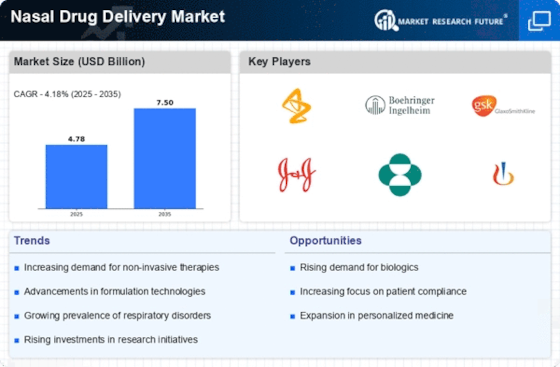
Nasal Drug Delivery Market Infographic
Purchase Options

Market Trends

Key Emerging Trends in the Nasal Drug Delivery Market

The Nasal Drug Delivery market has seen remarkable patterns as of late, reflecting a change in perspective in drug organization techniques. This painless methodology offers benefits like fast drug absorption, further developed bioavailability, and patient comfort. Drug organizations are progressively putting resources into nasal drug delivery advances because of the potential for upgraded helpful results. This interest is driven by the capacity of nasal delivery to sidestep the gastrointestinal parcel and liver digestion, bringing about higher drug concentrations in the circulation system. The pervasiveness of chronic diseases, including respiratory issues like asthma and chronic obstructive pulmonary disease (COPD), has powered the demand for compelling nasal drug delivery frameworks. This pattern is supposed to endure as the worldwide burden of chronic diseases keeps on rising. There is a developing emphasis on creating nasal drug delivery arrangements custom-made to the novel necessities of pediatric and geriatric patients. Nasal organization gives a practical option in contrast to these populations, offering a safe course that is often more passable than customary strategies. The market has seen a deluge in demand for nasal drug delivery frameworks for the management of sensitivities and rhinitis. Nasal sprays containing allergy medicines and corticosteroids are acquiring importance as viable answers for alleviating nasal side effects related with these conditions. The reusing and reformulation of existing drugs for nasal delivery are getting momentum. This approach considers the expansion of patent life and the presentation of further developed adaptations of deep-rooted prescriptions through nasal organization. The nasal drug delivery market is turning out to be progressively globalized, with organizations expanding their span to undiscovered markets. The emphasis on arising economies, where healthcare foundation is advancing, presents amazing open doors for market growth. Progresses in genomics and personalized medicine have affected the advancement of custom fitted nasal drug delivery arrangements. Individualized treatment plans in view of genetic elements are driving the customization of nasal drug definitions for ideal supportive results.

Author
Author Profile
Satyendra Maurya
Research Analyst

An accomplished research analyst with high proficiency in market forecasting, data visualization, competitive benchmarking, and others. He holds a pronounced track record in research and consulting projects for sectors such as life sciences, medical devices, and healthcare IT. His capabilities in qualitative and quantitative analysis have resulted in positive client outcomes. Working on niche market trends, opportunities, sales, and forecasted value is part of his skill set.

Leave a Comment

FAQs

What is the current valuation of the Nasal Drug Delivery Market?

<p>The Nasal Drug Delivery Market was valued at 4.78 USD Billion in 2024.</p>

What is the projected market size for the Nasal Drug Delivery Market by 2035?

<p>The market is projected to reach 7.5 USD Billion by 2035.</p>

What is the expected CAGR for the Nasal Drug Delivery Market during the forecast period 2025 - 2035?

<p>The expected CAGR for the market during 2025 - 2035 is 4.18%.</p>

Which device type segment is anticipated to show the highest growth in the Nasal Drug Delivery Market?

<p>Nasal Sprays are expected to grow from 1.5 USD Billion in 2024 to 2.4 USD Billion by 2035.</p>

How do the liquid formulations compare to solid formulations in terms of market valuation?

<p>Liquid Formulations were valued at 1.5 USD Billion in 2024 and are projected to reach 2.4 USD Billion by 2035, while Solid Formulations are expected to grow from 2.08 USD Billion to 3.17 USD Billion.</p>

What indications are driving growth in the Nasal Drug Delivery Market?

<p>Nasal Congestion is projected to grow from 1.5 USD Billion in 2024 to 2.4 USD Billion by 2035, indicating strong demand.</p>

Which end-user segment is expected to experience the most significant growth?

<p>The Hospitals segment is anticipated to grow from 1.91 USD Billion in 2024 to 3.0 USD Billion by 2035.</p>

Who are the key players in the Nasal Drug Delivery Market?

<p>Key players include AstraZeneca, Boehringer Ingelheim, GlaxoSmithKline, Johnson & Johnson, Merck & Co., Novartis, Pfizer, Sanofi, and Teva Pharmaceutical Industries.</p>

What is the market performance of nasal drops compared to nasal inhalers?

<p>Nasal Drops are projected to grow from 1.2 USD Billion in 2024 to 1.8 USD Billion by 2035, while Nasal Inhalers are expected to increase from 1.0 USD Billion to 1.5 USD Billion.</p>

What trends are influencing the formulation types in the Nasal Drug Delivery Market?

<p>Semi-solid Formulations are expected to grow from 1.2 USD Billion in 2024 to 1.9 USD Billion by 2035, reflecting evolving consumer preferences.</p>

Market Summary

As per Market Research Future analysis, the Nasal Drug Delivery Market Size was estimated at 87.3 USD Billion in 2025. The Nasal Drug Delivery industry is projected to grow from 93.7 USD Billion in 2026 to 177.8 USD Billion by 2035, exhibiting a compound annual growth rate (CAGR) of 7.37% during the forecast period 2026 - 2035

Key Market Trends & Highlights

The Nasal Drug Delivery Market is poised for substantial growth driven by technological advancements and increasing patient preferences.

  • Technological advancements are enhancing the efficacy and safety of nasal drug delivery systems. North America remains the largest market, while Asia-Pacific is emerging as the fastest-growing region. Nasal sprays dominate the market, whereas nasal inhalers are witnessing the fastest growth in adoption. The rising prevalence of respiratory disorders and growing demand for non-invasive drug delivery systems are key drivers of market expansion.

Market Size & Forecast

2025 Market Size 87.3 (USD Billion)
2035 Market Size 177.8 (USD Billion)
CAGR (2026 - 2035) 7.37%
Largest Regional Market Share in 2024 North America

Major Players

AstraZeneca (GB), Boehringer Ingelheim (DE), GlaxoSmithKline (GB), Johnson &amp; Johnson (US), Merck &amp; Co. (US), Novartis (CH), Pfizer (US), Sanofi (FR), Teva Pharmaceutical Industries (IL)

Market Trends

The nasal drug delivery market trends indicate a notable transformation, driven by advancements in technology and an increasing preference for non-invasive administration methods. The expanding nasal drug delivery technology market is gaining traction due to its ability to provide rapid onset of action, enhanced bioavailability, and improved patient compliance. As healthcare professionals and patients alike recognize the benefits of nasal delivery systems, the demand within the nasal drug delivery systems market for innovative formulations and devices is likely to rise.

Furthermore, the growing prevalence of chronic diseases and the need for effective therapeutic solutions across diverse nasal drug delivery market therapeutic applications may further propel market growth. In addition, the nasal drug delivery system market appears to be influenced by ongoing research and development efforts aimed at expanding the range of drugs that can be effectively delivered through this route. Companies are exploring novel drug formulations and delivery technologies, strengthening the nasal drug delivery mode market landscape.

Technological Advancements

Recent innovations in drug formulation and delivery devices are reshaping the nasal drug delivery devices market. Enhanced technologies, such as microemulsions and nanoparticles, are being explored to improve drug absorption and stability. These advancements are positively impacting the nasal drug delivery device market and may lead to more effective treatments while broadening the range of conditions addressed through nasal administration.

Increased Patient Preference

There is a growing inclination among patients towards non-invasive drug delivery methods. The convenience and ease of use associated with nasal delivery systems are likely to drive adoption across the nasal drug delivery market analysis landscape. This trend suggests that patients are seeking alternatives to traditional routes, enhancing treatment adherence and overall market penetration.

Regulatory Developments

The regulatory landscape surrounding nasal drug products is evolving, influencing the overall nasal drug delivery market structure. Clearer guidelines for safety and efficacy may encourage more companies to invest in nasal formulations, potentially leading to a wider array of products within the nasal drug delivery systems market.

Nasal Drug Delivery Market Market Drivers

Rising Prevalence of Respiratory Disorders

The increasing incidence of respiratory disorders, such as asthma and chronic obstructive pulmonary disease, is a primary driver for the Nasal Drug Delivery Market. According to recent estimates, respiratory diseases affect millions of individuals worldwide, leading to a growing demand for effective treatment options. Nasal drug delivery systems offer rapid absorption and targeted action, making them particularly appealing for patients suffering from these conditions. The market for nasal drug delivery is projected to expand as healthcare providers seek innovative solutions to manage these prevalent disorders. Furthermore, the convenience and ease of use associated with nasal delivery systems are likely to enhance patient compliance, thereby driving market growth. As the population ages and the prevalence of respiratory ailments rises, the Nasal Drug Delivery Market is expected to witness significant advancements and increased investment.

Technological Innovations in Drug Formulation

Technological advancements in drug formulation are significantly influencing the Nasal Drug Delivery Market. Innovations such as nanotechnology and microemulsion techniques are enhancing the efficacy and bioavailability of nasal drugs. These technologies allow for the development of formulations that can improve drug absorption through the nasal mucosa, leading to faster onset of action. The market is witnessing a surge in research and development activities aimed at creating novel nasal drug delivery systems that can cater to a variety of therapeutic areas. For instance, the introduction of smart nasal devices that can monitor dosage and provide feedback to patients is likely to enhance user experience and adherence. As these technologies continue to evolve, they are expected to play a crucial role in shaping the future of the Nasal Drug Delivery Market, potentially leading to new product launches and increased market competition.

Increased Investment in Research and Development

Investment in research and development is a critical driver for the Nasal Drug Delivery Market. Pharmaceutical companies are increasingly allocating resources to develop innovative nasal drug delivery systems that can address unmet medical needs. This trend is evident in the growing number of clinical trials focused on nasal formulations for various therapeutic areas, including pain management and neurological disorders. The potential for nasal delivery systems to bypass the blood-brain barrier is particularly appealing for neurological applications, which could lead to groundbreaking treatments. Furthermore, government initiatives aimed at promoting research in drug delivery technologies are likely to bolster market growth. As R&D efforts intensify, the Nasal Drug Delivery Market is expected to benefit from a pipeline of new products and enhanced therapeutic options for patients.

Regulatory Support for Nasal Drug Delivery Products

Regulatory support for nasal drug delivery products is emerging as a significant driver for the Nasal Drug Delivery Market. Regulatory agencies are increasingly recognizing the advantages of nasal delivery systems, leading to streamlined approval processes for new formulations. This supportive regulatory environment encourages pharmaceutical companies to invest in the development of nasal drug delivery products. Recent guidelines have been established to facilitate the evaluation of nasal formulations, which may expedite their entry into the market. As a result, the number of approved nasal drug products is likely to increase, providing patients with more treatment options. The positive regulatory landscape is expected to foster innovation and competition within the Nasal Drug Delivery Market, ultimately benefiting patients and healthcare providers.

Growing Demand for Non-Invasive Drug Delivery Systems

The demand for non-invasive drug delivery systems is on the rise, significantly impacting the Nasal Drug Delivery Market. Patients increasingly prefer methods that do not require injections or invasive procedures, which has led to a shift towards nasal delivery systems. These systems are not only user-friendly but also provide rapid onset of action, making them suitable for acute conditions. Market data indicates that the nasal drug delivery segment is expected to grow at a compound annual growth rate of over 10% in the coming years. This trend is further supported by the increasing awareness of the benefits of non-invasive therapies among healthcare professionals and patients alike. As the healthcare landscape evolves, the Nasal Drug Delivery Market is likely to expand, driven by the need for effective and patient-friendly treatment options.


Market Segment Insights

By Device Type: Nasal Sprays (Largest) vs. Nasal Inhalers (Fastest-Growing)

The Nasal Drug Delivery Market is primarily segmented into Nasal Sprays, Nasal Drops, Nasal Inhalers, and Powder Nasal Delivery Devices. Among these, Nasal Sprays hold the largest nasal drug delivery market share due to their established acceptance and ease of use. Meanwhile, innovation within the broader nasal drug delivery devices market continues to accelerate segment evolution. In contrast, Nasal Drops and Powder Nasal Delivery Devices occupy smaller market niches, while Nasal Inhalers are gaining traction due to the increasing demand for innovative drug delivery methods. Recent trends indicate that Nasal Inhalers are the fastest-growing segment in the Nasal Drug Delivery Market. This growth is fueled by continuous advancements in technology and increasing research and development efforts aimed at improving device efficacy and patient compliance. The rising prevalence of respiratory diseases further propels the demand for effective nasal drug delivery systems, positioning Nasal Inhalers as a key player in the evolution of this market.

Nasal Sprays (Dominant) vs. Nasal Inhalers (Emerging)

Nasal Sprays have established themselves as the dominant force in the Nasal Drug Delivery Market, largely due to their user-friendly design and effectiveness in delivering medication directly to the nasal mucosa. These devices are widely used for treating conditions such as allergic rhinitis and migraine, providing rapid symptom relief. On the other hand, Nasal Inhalers are emerging as a notable segment due to their ability to deliver medications in a more controlled manner, minimizing systemic side effects. The technological advancements in metered-dose inhalers and dry powder inhalers also contribute to their appeal, especially among patients requiring ongoing treatment for chronic respiratory conditions. The synergy of convenience and efficiency is driving both segments, with each catering to distinct patient needs.

By Formulation Type: Liquid Formulations (Largest) vs. Semi-solid Formulations (Fastest-Growing)

In the Nasal Drug Delivery Market, the distribution of market share among formulation types reveals that liquid formulations dominate the competitive landscape, capturing the majority of the market. This stronghold is attributed to their widespread acceptance and effectiveness in delivering active pharmaceutical ingredients swiftly. Semi-solid formulations are gaining attention due to prolonged therapeutic effects, contributing to advancements across nasal drug delivery market therapeutic applications.

Liquid Formulations (Dominant) vs. Semi-solid Formulations (Emerging)

Liquid formulations have established themselves as the dominant force in the Nasal Drug Delivery Market due to their versatility and ease of administration. They are particularly favored for delivering medications quickly and effectively, making them a primary choice for treating a variety of conditions. On the other hand, semi-solid formulations are an emerging category that is drawing increased attention from researchers and manufacturers. Their ability to provide prolonged release and targeted action enhances patient compliance, positioning them as an innovative solution in the market.

By Indication: Allergy (Largest) vs. Nasal Congestion (Fastest-Growing)

In the Nasal Drug Delivery Market, the indication segments are primarily categorized into Allergy, Migraine, Nasal Congestion, and Other. Among these, Allergy represents the largest share, driven by the increasing prevalence of allergic rhinitis globally, which significantly boosts demand for effective nasal formulations. Nasal Congestion segments. Rising consumer awareness and product innovation are strengthening the nasal drug delivery market trends across therapeutic categories. The growth trends within the Nasal Drug Delivery Market reflect a robust increase in awareness regarding nasal delivery as an effective method for drug administration. This is particularly notable in the Nasal Congestion segment, which is the fastest-growing due to evolving consumer preferences and advancements in formulation technologies. The rise of self-administration products supports this growth, making nasal solutions more accessible and appealing to consumers seeking convenience and efficiency in treatment options.

Allergy (Dominant) vs. Nasal Congestion (Emerging)

The Allergy segment stands as the dominant player in the Nasal Drug Delivery Market, capitalizing on the widespread prevalence of allergies and the need for rapid relief solutions. Allergy medications often encompass a variety of formulations, from antihistamines to corticosteroids, catering to different patient needs. On the other hand, the Nasal Congestion segment is emerging rapidly, driven by increasing consumer demand for effective and fast relief options. This segment benefits from innovations in delivery systems that enhance drug absorption and user experience. As more patients gravitate towards nasal formulations for common ailments like sinusitis and colds, the Nasal Congestion segment is likely to grow in market share and relevance, making it a key focus area for pharmaceutical developments.

By End-user: Hospitals (Largest) vs. Homecare (Fastest-Growing)

In the Nasal Drug Delivery Market, Hospitals remain the largest contributors to overall nasal drug delivery market share, while homecare is witnessing rapid expansion due to the rise in self-administration and portable nasal drug delivery devices market solutions. Clinics follow this segment, offering a more accessible point for patients seeking nasal drug therapies. Meanwhile, the Homecare segment has seen rapid growth, driven by the increasing trends of self-administration and preference for more convenient treatment options among patients.

Hospitals (Dominant) vs. Homecare (Emerging)

Hospitals remain the dominant end-user segment in the Nasal Drug Delivery Market, providing advanced medical facilities and specialized staff capable of managing complex drug administrations. This environment fosters trust among patients and ensures the proper use of nasal delivery systems. In contrast, the Homecare segment is emerging as a significant player driven by a growing patient preference for self-administration of medications. Advances in user-friendly nasal <a href="https://www.marketresearchfuture.com/reports/neonatal-prenatal-devices-market-42562">devices </a>and increasing chronic diseases managed at home contribute to this trend, allowing patients to receive effective treatments without frequent hospital visits.

Get more detailed insights about Nasal Drug Delivery Market Research Report - Forecast till 2035

Regional Insights

The Nasal Drug Delivery Market was poised for notable growth across its regional segments. North America held the majority, recorded at 2.12 USD Billion in 2024, reflecting a significant demand for advanced delivery methods, eventually increasing to 3.28 USD Billion in 2035. Europe followed with valuations of 1.45 USD Billion in 2024 and a projected 2.24 USD Billion by 2035, driven by increasing investments in healthcare innovations. South America, with a smaller market size of 0.38 USD Billion in 2024, is expected to reach 0.57 USD Billion in 2035, demonstrating emerging influences in drug delivery technologies.

In the Asia Pacific region, valued at 0.7 USD Billion in 2024 and anticipated to grow to 1.06 USD Billion by 2035, the rise in chronic diseases and a growing population bolster the market. The Middle East and Africa are projected to experience modest growth from 0.13 USD Billion in 2024 to 0.25 USD Billion in 2035, as urbanization and healthcare accessibility improve. Each regional segment showcased unique growth drivers, challenges, and opportunities, contributing to the overall Nasal Drug Delivery Market revenue.

Source: Primary Research, Secondary Research, MRFR Database and Analyst Review

Key Players and Competitive Insights

The competitive landscape of the Nasal Drug Delivery Market is characterized by a dynamic interplay of innovative technologies, regulatory advancements, and evolving consumer preferences. This market segment has gained significant momentum driven by the increased adoption of nasal delivery methods for their rapid onset of action and ease of administration. Companies are increasingly focusing on developing nasal drug delivery systems to enhance patient compliance and therapeutic outcomes. This competitive arena consists of both established pharmaceutical giants and emerging players, each striving to establish their dominance through strategic alliances, product launches, and diversified portfolios. The growing prevalence of respiratory diseases and the demand for effective delivery mechanisms continue to shape the competitive strategies within this market, prompting firms to invest extensively in research and development to gain a first-mover advantage and stay ahead of the curve. Merck & Co. holds a prominent position in the Nasal Drug Delivery Market with its robust portfolio of nasal spray products designed for various therapeutic indications. The company leverages its extensive research capabilities and strong pipeline to develop innovative nasal delivery solutions that meet the needs of patients and healthcare providers alike. One of the key strengths of Merck & Co. lies in its commitment to rigorous clinical trials and regulatory compliance, which bolster the credibility and efficacy of its nasal drug delivery systems. Through strong partnerships and collaborations, Merck & Co. is able to enhance its market presence and capitalize on distribution networks that facilitate the broader reach of its products across the global landscape. This strategic focus not only reinforces their position in the market but also ensures that they remain responsive to the evolving demands of patients and healthcare providers. Novartis has established itself as a key player in the Nasal Drug Delivery Market through its innovative approach and commitment to bringing effective therapeutic solutions to patients. The company has developed a range of nasal delivery products targeting various conditions, showcasing its capability in combining scientific research with advanced delivery technologies. Novartis's strength lies in its extensive experience in drug development, and its well-structured global infrastructure enhances market penetration and accessibility of its nasal products. The company's strategic mergers and acquisitions have further bolstered its capabilities in the nasal drug delivery space, enabling it to enhance its product offerings and expand its reach. By continually investing in research and technology, Novartis is well-positioned to meet the challenges of the market while providing effective solutions that cater to patients’ needs across the global region.

Key Companies in the Nasal Drug Delivery Market include

Industry Developments

Recent product launches and collaborations are reshaping the nasal drug delivery systems market. Innovations in powder devices and nose-to-brain delivery platforms are enhancing the competitive positioning of companies operating within the nasal drug delivery mode market.

Although there were no safety or effectiveness issues, Milestone Pharmaceuticals reported in March 2025 that the U.S. FDA had denied approval for Cardamyst, their nasal spray designed to treat paroxysmal supraventricular tachycardia, citing updated impurity guidelines and asking for a facility inspection. Using standard capsules and filling equipment, Hovione announced on its official website in November 2023 that it had expanded its nasal drug delivery capabilities by collaborating with Industrial Design Consultancy to create two novel powder delivery devices, one single-use and one multidose, intended for local, systemic, and nose-to-brain administration.

Using its BrainDos technology, MetP Pharma AG unveiled a semaglutide nasal formulation in May 2024 with the goal of provide an intranasal alternative for controlling obesity by administering GLP-1 receptor agonists through the olfactory pathway.

A significant step forward in needle-free vaccination techniques was made in July 2024 when the National Institutes of Health launched a Phase I clinical study for MPV/S‑2P, a nasal COVID-19 vaccine that uses a murine pneumonia vector to deliver a stabilized SARS‑CoV‑2 spike protein. The Ultra Soft Nasal Pump Spray, a breath-powered device designed for accurate nose-to-brain distribution and aimed at CNS medication therapy with enhanced comfort and absorption efficiency, was finally introduced by Aero Pump and Resyca in October 2024.

Future Outlook

Nasal Drug Delivery Market Future Outlook

The Nasal Drug Delivery Market is projected to grow at a 7.37% CAGR from 2026 to 2035, driven by technological advancements, increasing chronic disease prevalence, and rising demand for non-invasive delivery methods.

New opportunities lie in:

  • <p>Development of smart nasal delivery devices for personalized medication Expansion into emerging markets with tailored product offerings Partnerships with telehealth platforms for integrated treatment solutions</p>

By 2035, the Nasal Drug Delivery Market is expected to achieve substantial growth and innovation.

Market Segmentation

Nasal Drug Delivery Market End-user Outlook

  • Hospitals
  • Clinics
  • Homecare

Nasal Drug Delivery Market Indication Outlook

  • Allergy
  • Migraine
  • Nasal Congestion
  • Other

Nasal Drug Delivery Market Device Type Outlook

  • Nasal Sprays
  • Nasal Drops
  • Nasal Inhalers
  • Powder Nasal Delivery Devices

Nasal Drug Delivery Market Formulation Type Outlook

  • Liquid Formulations
  • Semi-solid Formulations
  • Solid Formulations

Nasal Drug Delivery Market Distribution Channel Outlook

  • Hospital Pharmacies
  • Retail Pharmacies
  • and Online Pharmacies

Report Scope

MARKET SIZE 2025 87.3 (USD Billion)
MARKET SIZE 2026 93.7 (USD Billion)
MARKET SIZE 2035 177.8 (USD Billion)
COMPOUND ANNUAL GROWTH RATE (CAGR) 7.37% (2026 - 2035)
REPORT COVERAGE Revenue Forecast, Competitive Landscape, Growth Factors, and Trends
BASE YEAR 2024
Market Forecast Period 2026 - 2035
Historical Data 2019 - 2024
Market Forecast Units USD Billion
Key Companies Profiled AstraZeneca (GB), Boehringer Ingelheim (DE), GlaxoSmithKline (GB), Johnson & Johnson (US), Merck & Co. (US), Novartis (CH), Pfizer (US), Sanofi (FR), Teva Pharmaceutical Industries (IL)
Segments Covered Device Type, Formulation Type, Indication, End-user, Regional
Key Market Opportunities Advancements in formulation technologies enhance patient compliance in the Nasal Drug Delivery Market.
Key Market Dynamics Technological advancements in formulation and delivery systems are reshaping the Nasal Drug Delivery Market landscape.
Countries Covered North America, Europe, APAC, South America, MEA

FAQs

What is the current valuation of the Nasal Drug Delivery Market?

<p>The Nasal Drug Delivery Market was valued at 4.78 USD Billion in 2024.</p>

What is the projected market size for the Nasal Drug Delivery Market by 2035?

<p>The market is projected to reach 7.5 USD Billion by 2035.</p>

What is the expected CAGR for the Nasal Drug Delivery Market during the forecast period 2025 - 2035?

<p>The expected CAGR for the market during 2025 - 2035 is 4.18%.</p>

Which device type segment is anticipated to show the highest growth in the Nasal Drug Delivery Market?

<p>Nasal Sprays are expected to grow from 1.5 USD Billion in 2024 to 2.4 USD Billion by 2035.</p>

How do the liquid formulations compare to solid formulations in terms of market valuation?

<p>Liquid Formulations were valued at 1.5 USD Billion in 2024 and are projected to reach 2.4 USD Billion by 2035, while Solid Formulations are expected to grow from 2.08 USD Billion to 3.17 USD Billion.</p>

What indications are driving growth in the Nasal Drug Delivery Market?

<p>Nasal Congestion is projected to grow from 1.5 USD Billion in 2024 to 2.4 USD Billion by 2035, indicating strong demand.</p>

Which end-user segment is expected to experience the most significant growth?

<p>The Hospitals segment is anticipated to grow from 1.91 USD Billion in 2024 to 3.0 USD Billion by 2035.</p>

Who are the key players in the Nasal Drug Delivery Market?

<p>Key players include AstraZeneca, Boehringer Ingelheim, GlaxoSmithKline, Johnson & Johnson, Merck & Co., Novartis, Pfizer, Sanofi, and Teva Pharmaceutical Industries.</p>

What is the market performance of nasal drops compared to nasal inhalers?

<p>Nasal Drops are projected to grow from 1.2 USD Billion in 2024 to 1.8 USD Billion by 2035, while Nasal Inhalers are expected to increase from 1.0 USD Billion to 1.5 USD Billion.</p>

What trends are influencing the formulation types in the Nasal Drug Delivery Market?

<p>Semi-solid Formulations are expected to grow from 1.2 USD Billion in 2024 to 1.9 USD Billion by 2035, reflecting evolving consumer preferences.</p>

  1. SECTION I: EXECUTIVE SUMMARY AND KEY HIGHLIGHTS
    1. | 1.1 EXECUTIVE SUMMARY
    2. | | 1.1.1 Market Overview
    3. | | 1.1.2 Key Findings
    4. | | 1.1.3 Market Segmentation
    5. | | 1.1.4 Competitive Landscape
    6. | | 1.1.5 Challenges and Opportunities
    7. | | 1.1.6 Future Outlook
  2. SECTION II: SCOPING, METHODOLOGY AND MARKET STRUCTURE
    1. | 2.1 MARKET INTRODUCTION
    2. | | 2.1.1 Definition
    3. | | 2.1.2 Scope of the study
    4. | | | 2.1.2.1 Research Objective
    5. | | | 2.1.2.2 Assumption
    6. | | | 2.1.2.3 Limitations
    7. | 2.2 RESEARCH METHODOLOGY
    8. | | 2.2.1 Overview
    9. | | 2.2.2 Data Mining
    10. | | 2.2.3 Secondary Research
    11. | | 2.2.4 Primary Research
    12. | | | 2.2.4.1 Primary Interviews and Information Gathering Process
    13. | | | 2.2.4.2 Breakdown of Primary Respondents
    14. | | 2.2.5 Forecasting Model
    15. | | 2.2.6 Market Size Estimation
    16. | | | 2.2.6.1 Bottom-Up Approach
    17. | | | 2.2.6.2 Top-Down Approach
    18. | | 2.2.7 Data Triangulation
    19. | | 2.2.8 Validation
  3. SECTION III: QUALITATIVE ANALYSIS
    1. | 3.1 MARKET DYNAMICS
    2. | | 3.1.1 Overview
    3. | | 3.1.2 Drivers
    4. | | 3.1.3 Restraints
    5. | | 3.1.4 Opportunities
    6. | 3.2 MARKET FACTOR ANALYSIS
    7. | | 3.2.1 Value chain Analysis
    8. | | 3.2.2 Porter's Five Forces Analysis
    9. | | | 3.2.2.1 Bargaining Power of Suppliers
    10. | | | 3.2.2.2 Bargaining Power of Buyers
    11. | | | 3.2.2.3 Threat of New Entrants
    12. | | | 3.2.2.4 Threat of Substitutes
    13. | | | 3.2.2.5 Intensity of Rivalry
    14. | | 3.2.3 COVID-19 Impact Analysis
    15. | | | 3.2.3.1 Market Impact Analysis
    16. | | | 3.2.3.2 Regional Impact
    17. | | | 3.2.3.3 Opportunity and Threat Analysis
  4. SECTION IV: QUANTITATIVE ANALYSIS
    1. | 4.1 Healthcare, BY Device Type (USD Billion)
    2. | | 4.1.1 Nasal Sprays
    3. | | 4.1.2 Nasal Drops
    4. | | 4.1.3 Nasal Inhalers
    5. | | 4.1.4 Powder Nasal Delivery Devices
    6. | 4.2 Healthcare, BY Formulation Type (USD Billion)
    7. | | 4.2.1 Liquid Formulations
    8. | | 4.2.2 Semi-solid Formulations
    9. | | 4.2.3 Solid Formulations
    10. | 4.3 Healthcare, BY Indication (USD Billion)
    11. | | 4.3.1 Allergy
    12. | | 4.3.2 Migraine
    13. | | 4.3.3 Nasal Congestion
    14. | | 4.3.4 Other
    15. | 4.4 Healthcare, BY End-user (USD Billion)
    16. | | 4.4.1 Hospitals
    17. | | 4.4.2 Clinics
    18. | | 4.4.3 Homecare
    19. | 4.5 Healthcare, BY Region (USD Billion)
    20. | | 4.5.1 North America
    21. | | | 4.5.1.1 US
    22. | | | 4.5.1.2 Canada
    23. | | 4.5.2 Europe
    24. | | | 4.5.2.1 Germany
    25. | | | 4.5.2.2 UK
    26. | | | 4.5.2.3 France
    27. | | | 4.5.2.4 Russia
    28. | | | 4.5.2.5 Italy
    29. | | | 4.5.2.6 Spain
    30. | | | 4.5.2.7 Rest of Europe
    31. | | 4.5.3 APAC
    32. | | | 4.5.3.1 China
    33. | | | 4.5.3.2 India
    34. | | | 4.5.3.3 Japan
    35. | | | 4.5.3.4 South Korea
    36. | | | 4.5.3.5 Malaysia
    37. | | | 4.5.3.6 Thailand
    38. | | | 4.5.3.7 Indonesia
    39. | | | 4.5.3.8 Rest of APAC
    40. | | 4.5.4 South America
    41. | | | 4.5.4.1 Brazil
    42. | | | 4.5.4.2 Mexico
    43. | | | 4.5.4.3 Argentina
    44. | | | 4.5.4.4 Rest of South America
    45. | | 4.5.5 MEA
    46. | | | 4.5.5.1 GCC Countries
    47. | | | 4.5.5.2 South Africa
    48. | | | 4.5.5.3 Rest of MEA
  5. SECTION V: COMPETITIVE ANALYSIS
    1. | 5.1 Competitive Landscape
    2. | | 5.1.1 Overview
    3. | | 5.1.2 Competitive Analysis
    4. | | 5.1.3 Market share Analysis
    5. | | 5.1.4 Major Growth Strategy in the Healthcare
    6. | | 5.1.5 Competitive Benchmarking
    7. | | 5.1.6 Leading Players in Terms of Number of Developments in the Healthcare
    8. | | 5.1.7 Key developments and growth strategies
    9. | | | 5.1.7.1 New Product Launch/Service Deployment
    10. | | | 5.1.7.2 Merger & Acquisitions
    11. | | | 5.1.7.3 Joint Ventures
    12. | | 5.1.8 Major Players Financial Matrix
    13. | | | 5.1.8.1 Sales and Operating Income
    14. | | | 5.1.8.2 Major Players R&D Expenditure. 2023
    15. | 5.2 Company Profiles
    16. | | 5.2.1 AstraZeneca (GB)
    17. | | | 5.2.1.1 Financial Overview
    18. | | | 5.2.1.2 Products Offered
    19. | | | 5.2.1.3 Key Developments
    20. | | | 5.2.1.4 SWOT Analysis
    21. | | | 5.2.1.5 Key Strategies
    22. | | 5.2.2 Boehringer Ingelheim (DE)
    23. | | | 5.2.2.1 Financial Overview
    24. | | | 5.2.2.2 Products Offered
    25. | | | 5.2.2.3 Key Developments
    26. | | | 5.2.2.4 SWOT Analysis
    27. | | | 5.2.2.5 Key Strategies
    28. | | 5.2.3 GlaxoSmithKline (GB)
    29. | | | 5.2.3.1 Financial Overview
    30. | | | 5.2.3.2 Products Offered
    31. | | | 5.2.3.3 Key Developments
    32. | | | 5.2.3.4 SWOT Analysis
    33. | | | 5.2.3.5 Key Strategies
    34. | | 5.2.4 Johnson & Johnson (US)
    35. | | | 5.2.4.1 Financial Overview
    36. | | | 5.2.4.2 Products Offered
    37. | | | 5.2.4.3 Key Developments
    38. | | | 5.2.4.4 SWOT Analysis
    39. | | | 5.2.4.5 Key Strategies
    40. | | 5.2.5 Merck & Co. (US)
    41. | | | 5.2.5.1 Financial Overview
    42. | | | 5.2.5.2 Products Offered
    43. | | | 5.2.5.3 Key Developments
    44. | | | 5.2.5.4 SWOT Analysis
    45. | | | 5.2.5.5 Key Strategies
    46. | | 5.2.6 Novartis (CH)
    47. | | | 5.2.6.1 Financial Overview
    48. | | | 5.2.6.2 Products Offered
    49. | | | 5.2.6.3 Key Developments
    50. | | | 5.2.6.4 SWOT Analysis
    51. | | | 5.2.6.5 Key Strategies
    52. | | 5.2.7 Pfizer (US)
    53. | | | 5.2.7.1 Financial Overview
    54. | | | 5.2.7.2 Products Offered
    55. | | | 5.2.7.3 Key Developments
    56. | | | 5.2.7.4 SWOT Analysis
    57. | | | 5.2.7.5 Key Strategies
    58. | | 5.2.8 Sanofi (FR)
    59. | | | 5.2.8.1 Financial Overview
    60. | | | 5.2.8.2 Products Offered
    61. | | | 5.2.8.3 Key Developments
    62. | | | 5.2.8.4 SWOT Analysis
    63. | | | 5.2.8.5 Key Strategies
    64. | | 5.2.9 Teva Pharmaceutical Industries (IL)
    65. | | | 5.2.9.1 Financial Overview
    66. | | | 5.2.9.2 Products Offered
    67. | | | 5.2.9.3 Key Developments
    68. | | | 5.2.9.4 SWOT Analysis
    69. | | | 5.2.9.5 Key Strategies
    70. | 5.3 Appendix
    71. | | 5.3.1 References
    72. | | 5.3.2 Related Reports
  6. LIST OF FIGURES
    1. | 6.1 MARKET SYNOPSIS
    2. | 6.2 NORTH AMERICA MARKET ANALYSIS
    3. | 6.3 US MARKET ANALYSIS BY DEVICE TYPE
    4. | 6.4 US MARKET ANALYSIS BY FORMULATION TYPE
    5. | 6.5 US MARKET ANALYSIS BY INDICATION
    6. | 6.6 US MARKET ANALYSIS BY END-USER
    7. | 6.7 CANADA MARKET ANALYSIS BY DEVICE TYPE
    8. | 6.8 CANADA MARKET ANALYSIS BY FORMULATION TYPE
    9. | 6.9 CANADA MARKET ANALYSIS BY INDICATION
    10. | 6.10 CANADA MARKET ANALYSIS BY END-USER
    11. | 6.11 EUROPE MARKET ANALYSIS
    12. | 6.12 GERMANY MARKET ANALYSIS BY DEVICE TYPE
    13. | 6.13 GERMANY MARKET ANALYSIS BY FORMULATION TYPE
    14. | 6.14 GERMANY MARKET ANALYSIS BY INDICATION
    15. | 6.15 GERMANY MARKET ANALYSIS BY END-USER
    16. | 6.16 UK MARKET ANALYSIS BY DEVICE TYPE
    17. | 6.17 UK MARKET ANALYSIS BY FORMULATION TYPE
    18. | 6.18 UK MARKET ANALYSIS BY INDICATION
    19. | 6.19 UK MARKET ANALYSIS BY END-USER
    20. | 6.20 FRANCE MARKET ANALYSIS BY DEVICE TYPE
    21. | 6.21 FRANCE MARKET ANALYSIS BY FORMULATION TYPE
    22. | 6.22 FRANCE MARKET ANALYSIS BY INDICATION
    23. | 6.23 FRANCE MARKET ANALYSIS BY END-USER
    24. | 6.24 RUSSIA MARKET ANALYSIS BY DEVICE TYPE
    25. | 6.25 RUSSIA MARKET ANALYSIS BY FORMULATION TYPE
    26. | 6.26 RUSSIA MARKET ANALYSIS BY INDICATION
    27. | 6.27 RUSSIA MARKET ANALYSIS BY END-USER
    28. | 6.28 ITALY MARKET ANALYSIS BY DEVICE TYPE
    29. | 6.29 ITALY MARKET ANALYSIS BY FORMULATION TYPE
    30. | 6.30 ITALY MARKET ANALYSIS BY INDICATION
    31. | 6.31 ITALY MARKET ANALYSIS BY END-USER
    32. | 6.32 SPAIN MARKET ANALYSIS BY DEVICE TYPE
    33. | 6.33 SPAIN MARKET ANALYSIS BY FORMULATION TYPE
    34. | 6.34 SPAIN MARKET ANALYSIS BY INDICATION
    35. | 6.35 SPAIN MARKET ANALYSIS BY END-USER
    36. | 6.36 REST OF EUROPE MARKET ANALYSIS BY DEVICE TYPE
    37. | 6.37 REST OF EUROPE MARKET ANALYSIS BY FORMULATION TYPE
    38. | 6.38 REST OF EUROPE MARKET ANALYSIS BY INDICATION
    39. | 6.39 REST OF EUROPE MARKET ANALYSIS BY END-USER
    40. | 6.40 APAC MARKET ANALYSIS
    41. | 6.41 CHINA MARKET ANALYSIS BY DEVICE TYPE
    42. | 6.42 CHINA MARKET ANALYSIS BY FORMULATION TYPE
    43. | 6.43 CHINA MARKET ANALYSIS BY INDICATION
    44. | 6.44 CHINA MARKET ANALYSIS BY END-USER
    45. | 6.45 INDIA MARKET ANALYSIS BY DEVICE TYPE
    46. | 6.46 INDIA MARKET ANALYSIS BY FORMULATION TYPE
    47. | 6.47 INDIA MARKET ANALYSIS BY INDICATION
    48. | 6.48 INDIA MARKET ANALYSIS BY END-USER
    49. | 6.49 JAPAN MARKET ANALYSIS BY DEVICE TYPE
    50. | 6.50 JAPAN MARKET ANALYSIS BY FORMULATION TYPE
    51. | 6.51 JAPAN MARKET ANALYSIS BY INDICATION
    52. | 6.52 JAPAN MARKET ANALYSIS BY END-USER
    53. | 6.53 SOUTH KOREA MARKET ANALYSIS BY DEVICE TYPE
    54. | 6.54 SOUTH KOREA MARKET ANALYSIS BY FORMULATION TYPE
    55. | 6.55 SOUTH KOREA MARKET ANALYSIS BY INDICATION
    56. | 6.56 SOUTH KOREA MARKET ANALYSIS BY END-USER
    57. | 6.57 MALAYSIA MARKET ANALYSIS BY DEVICE TYPE
    58. | 6.58 MALAYSIA MARKET ANALYSIS BY FORMULATION TYPE
    59. | 6.59 MALAYSIA MARKET ANALYSIS BY INDICATION
    60. | 6.60 MALAYSIA MARKET ANALYSIS BY END-USER
    61. | 6.61 THAILAND MARKET ANALYSIS BY DEVICE TYPE
    62. | 6.62 THAILAND MARKET ANALYSIS BY FORMULATION TYPE
    63. | 6.63 THAILAND MARKET ANALYSIS BY INDICATION
    64. | 6.64 THAILAND MARKET ANALYSIS BY END-USER
    65. | 6.65 INDONESIA MARKET ANALYSIS BY DEVICE TYPE
    66. | 6.66 INDONESIA MARKET ANALYSIS BY FORMULATION TYPE
    67. | 6.67 INDONESIA MARKET ANALYSIS BY INDICATION
    68. | 6.68 INDONESIA MARKET ANALYSIS BY END-USER
    69. | 6.69 REST OF APAC MARKET ANALYSIS BY DEVICE TYPE
    70. | 6.70 REST OF APAC MARKET ANALYSIS BY FORMULATION TYPE
    71. | 6.71 REST OF APAC MARKET ANALYSIS BY INDICATION
    72. | 6.72 REST OF APAC MARKET ANALYSIS BY END-USER
    73. | 6.73 SOUTH AMERICA MARKET ANALYSIS
    74. | 6.74 BRAZIL MARKET ANALYSIS BY DEVICE TYPE
    75. | 6.75 BRAZIL MARKET ANALYSIS BY FORMULATION TYPE
    76. | 6.76 BRAZIL MARKET ANALYSIS BY INDICATION
    77. | 6.77 BRAZIL MARKET ANALYSIS BY END-USER
    78. | 6.78 MEXICO MARKET ANALYSIS BY DEVICE TYPE
    79. | 6.79 MEXICO MARKET ANALYSIS BY FORMULATION TYPE
    80. | 6.80 MEXICO MARKET ANALYSIS BY INDICATION
    81. | 6.81 MEXICO MARKET ANALYSIS BY END-USER
    82. | 6.82 ARGENTINA MARKET ANALYSIS BY DEVICE TYPE
    83. | 6.83 ARGENTINA MARKET ANALYSIS BY FORMULATION TYPE
    84. | 6.84 ARGENTINA MARKET ANALYSIS BY INDICATION
    85. | 6.85 ARGENTINA MARKET ANALYSIS BY END-USER
    86. | 6.86 REST OF SOUTH AMERICA MARKET ANALYSIS BY DEVICE TYPE
    87. | 6.87 REST OF SOUTH AMERICA MARKET ANALYSIS BY FORMULATION TYPE
    88. | 6.88 REST OF SOUTH AMERICA MARKET ANALYSIS BY INDICATION
    89. | 6.89 REST OF SOUTH AMERICA MARKET ANALYSIS BY END-USER
    90. | 6.90 MEA MARKET ANALYSIS
    91. | 6.91 GCC COUNTRIES MARKET ANALYSIS BY DEVICE TYPE
    92. | 6.92 GCC COUNTRIES MARKET ANALYSIS BY FORMULATION TYPE
    93. | 6.93 GCC COUNTRIES MARKET ANALYSIS BY INDICATION
    94. | 6.94 GCC COUNTRIES MARKET ANALYSIS BY END-USER
    95. | 6.95 SOUTH AFRICA MARKET ANALYSIS BY DEVICE TYPE
    96. | 6.96 SOUTH AFRICA MARKET ANALYSIS BY FORMULATION TYPE
    97. | 6.97 SOUTH AFRICA MARKET ANALYSIS BY INDICATION
    98. | 6.98 SOUTH AFRICA MARKET ANALYSIS BY END-USER
    99. | 6.99 REST OF MEA MARKET ANALYSIS BY DEVICE TYPE
    100. | 6.100 REST OF MEA MARKET ANALYSIS BY FORMULATION TYPE
    101. | 6.101 REST OF MEA MARKET ANALYSIS BY INDICATION
    102. | 6.102 REST OF MEA MARKET ANALYSIS BY END-USER
    103. | 6.103 KEY BUYING CRITERIA OF HEALTHCARE
    104. | 6.104 RESEARCH PROCESS OF MRFR
    105. | 6.105 DRO ANALYSIS OF HEALTHCARE
    106. | 6.106 DRIVERS IMPACT ANALYSIS: HEALTHCARE
    107. | 6.107 RESTRAINTS IMPACT ANALYSIS: HEALTHCARE
    108. | 6.108 SUPPLY / VALUE CHAIN: HEALTHCARE
    109. | 6.109 HEALTHCARE, BY DEVICE TYPE, 2024 (% SHARE)
    110. | 6.110 HEALTHCARE, BY DEVICE TYPE, 2024 TO 2035 (USD Billion)
    111. | 6.111 HEALTHCARE, BY FORMULATION TYPE, 2024 (% SHARE)
    112. | 6.112 HEALTHCARE, BY FORMULATION TYPE, 2024 TO 2035 (USD Billion)
    113. | 6.113 HEALTHCARE, BY INDICATION, 2024 (% SHARE)
    114. | 6.114 HEALTHCARE, BY INDICATION, 2024 TO 2035 (USD Billion)
    115. | 6.115 HEALTHCARE, BY END-USER, 2024 (% SHARE)
    116. | 6.116 HEALTHCARE, BY END-USER, 2024 TO 2035 (USD Billion)
    117. | 6.117 BENCHMARKING OF MAJOR COMPETITORS
  7. LIST OF TABLES
    1. | 7.1 LIST OF ASSUMPTIONS
    2. | | 7.1.1
    3. | 7.2 North America MARKET SIZE ESTIMATES; FORECAST
    4. | | 7.2.1 BY DEVICE TYPE, 2025-2035 (USD Billion)
    5. | | 7.2.2 BY FORMULATION TYPE, 2025-2035 (USD Billion)
    6. | | 7.2.3 BY INDICATION, 2025-2035 (USD Billion)
    7. | | 7.2.4 BY END-USER, 2025-2035 (USD Billion)
    8. | 7.3 US MARKET SIZE ESTIMATES; FORECAST
    9. | | 7.3.1 BY DEVICE TYPE, 2025-2035 (USD Billion)
    10. | | 7.3.2 BY FORMULATION TYPE, 2025-2035 (USD Billion)
    11. | | 7.3.3 BY INDICATION, 2025-2035 (USD Billion)
    12. | | 7.3.4 BY END-USER, 2025-2035 (USD Billion)
    13. | 7.4 Canada MARKET SIZE ESTIMATES; FORECAST
    14. | | 7.4.1 BY DEVICE TYPE, 2025-2035 (USD Billion)
    15. | | 7.4.2 BY FORMULATION TYPE, 2025-2035 (USD Billion)
    16. | | 7.4.3 BY INDICATION, 2025-2035 (USD Billion)
    17. | | 7.4.4 BY END-USER, 2025-2035 (USD Billion)
    18. | 7.5 Europe MARKET SIZE ESTIMATES; FORECAST
    19. | | 7.5.1 BY DEVICE TYPE, 2025-2035 (USD Billion)
    20. | | 7.5.2 BY FORMULATION TYPE, 2025-2035 (USD Billion)
    21. | | 7.5.3 BY INDICATION, 2025-2035 (USD Billion)
    22. | | 7.5.4 BY END-USER, 2025-2035 (USD Billion)
    23. | 7.6 Germany MARKET SIZE ESTIMATES; FORECAST
    24. | | 7.6.1 BY DEVICE TYPE, 2025-2035 (USD Billion)
    25. | | 7.6.2 BY FORMULATION TYPE, 2025-2035 (USD Billion)
    26. | | 7.6.3 BY INDICATION, 2025-2035 (USD Billion)
    27. | | 7.6.4 BY END-USER, 2025-2035 (USD Billion)
    28. | 7.7 UK MARKET SIZE ESTIMATES; FORECAST
    29. | | 7.7.1 BY DEVICE TYPE, 2025-2035 (USD Billion)
    30. | | 7.7.2 BY FORMULATION TYPE, 2025-2035 (USD Billion)
    31. | | 7.7.3 BY INDICATION, 2025-2035 (USD Billion)
    32. | | 7.7.4 BY END-USER, 2025-2035 (USD Billion)
    33. | 7.8 France MARKET SIZE ESTIMATES; FORECAST
    34. | | 7.8.1 BY DEVICE TYPE, 2025-2035 (USD Billion)
    35. | | 7.8.2 BY FORMULATION TYPE, 2025-2035 (USD Billion)
    36. | | 7.8.3 BY INDICATION, 2025-2035 (USD Billion)
    37. | | 7.8.4 BY END-USER, 2025-2035 (USD Billion)
    38. | 7.9 Russia MARKET SIZE ESTIMATES; FORECAST
    39. | | 7.9.1 BY DEVICE TYPE, 2025-2035 (USD Billion)
    40. | | 7.9.2 BY FORMULATION TYPE, 2025-2035 (USD Billion)
    41. | | 7.9.3 BY INDICATION, 2025-2035 (USD Billion)
    42. | | 7.9.4 BY END-USER, 2025-2035 (USD Billion)
    43. | 7.10 Italy MARKET SIZE ESTIMATES; FORECAST
    44. | | 7.10.1 BY DEVICE TYPE, 2025-2035 (USD Billion)
    45. | | 7.10.2 BY FORMULATION TYPE, 2025-2035 (USD Billion)
    46. | | 7.10.3 BY INDICATION, 2025-2035 (USD Billion)
    47. | | 7.10.4 BY END-USER, 2025-2035 (USD Billion)
    48. | 7.11 Spain MARKET SIZE ESTIMATES; FORECAST
    49. | | 7.11.1 BY DEVICE TYPE, 2025-2035 (USD Billion)
    50. | | 7.11.2 BY FORMULATION TYPE, 2025-2035 (USD Billion)
    51. | | 7.11.3 BY INDICATION, 2025-2035 (USD Billion)
    52. | | 7.11.4 BY END-USER, 2025-2035 (USD Billion)
    53. | 7.12 Rest of Europe MARKET SIZE ESTIMATES; FORECAST
    54. | | 7.12.1 BY DEVICE TYPE, 2025-2035 (USD Billion)
    55. | | 7.12.2 BY FORMULATION TYPE, 2025-2035 (USD Billion)
    56. | | 7.12.3 BY INDICATION, 2025-2035 (USD Billion)
    57. | | 7.12.4 BY END-USER, 2025-2035 (USD Billion)
    58. | 7.13 APAC MARKET SIZE ESTIMATES; FORECAST
    59. | | 7.13.1 BY DEVICE TYPE, 2025-2035 (USD Billion)
    60. | | 7.13.2 BY FORMULATION TYPE, 2025-2035 (USD Billion)
    61. | | 7.13.3 BY INDICATION, 2025-2035 (USD Billion)
    62. | | 7.13.4 BY END-USER, 2025-2035 (USD Billion)
    63. | 7.14 China MARKET SIZE ESTIMATES; FORECAST
    64. | | 7.14.1 BY DEVICE TYPE, 2025-2035 (USD Billion)
    65. | | 7.14.2 BY FORMULATION TYPE, 2025-2035 (USD Billion)
    66. | | 7.14.3 BY INDICATION, 2025-2035 (USD Billion)
    67. | | 7.14.4 BY END-USER, 2025-2035 (USD Billion)
    68. | 7.15 India MARKET SIZE ESTIMATES; FORECAST
    69. | | 7.15.1 BY DEVICE TYPE, 2025-2035 (USD Billion)
    70. | | 7.15.2 BY FORMULATION TYPE, 2025-2035 (USD Billion)
    71. | | 7.15.3 BY INDICATION, 2025-2035 (USD Billion)
    72. | | 7.15.4 BY END-USER, 2025-2035 (USD Billion)
    73. | 7.16 Japan MARKET SIZE ESTIMATES; FORECAST
    74. | | 7.16.1 BY DEVICE TYPE, 2025-2035 (USD Billion)
    75. | | 7.16.2 BY FORMULATION TYPE, 2025-2035 (USD Billion)
    76. | | 7.16.3 BY INDICATION, 2025-2035 (USD Billion)
    77. | | 7.16.4 BY END-USER, 2025-2035 (USD Billion)
    78. | 7.17 South Korea MARKET SIZE ESTIMATES; FORECAST
    79. | | 7.17.1 BY DEVICE TYPE, 2025-2035 (USD Billion)
    80. | | 7.17.2 BY FORMULATION TYPE, 2025-2035 (USD Billion)
    81. | | 7.17.3 BY INDICATION, 2025-2035 (USD Billion)
    82. | | 7.17.4 BY END-USER, 2025-2035 (USD Billion)
    83. | 7.18 Malaysia MARKET SIZE ESTIMATES; FORECAST
    84. | | 7.18.1 BY DEVICE TYPE, 2025-2035 (USD Billion)
    85. | | 7.18.2 BY FORMULATION TYPE, 2025-2035 (USD Billion)
    86. | | 7.18.3 BY INDICATION, 2025-2035 (USD Billion)
    87. | | 7.18.4 BY END-USER, 2025-2035 (USD Billion)
    88. | 7.19 Thailand MARKET SIZE ESTIMATES; FORECAST
    89. | | 7.19.1 BY DEVICE TYPE, 2025-2035 (USD Billion)
    90. | | 7.19.2 BY FORMULATION TYPE, 2025-2035 (USD Billion)
    91. | | 7.19.3 BY INDICATION, 2025-2035 (USD Billion)
    92. | | 7.19.4 BY END-USER, 2025-2035 (USD Billion)
    93. | 7.20 Indonesia MARKET SIZE ESTIMATES; FORECAST
    94. | | 7.20.1 BY DEVICE TYPE, 2025-2035 (USD Billion)
    95. | | 7.20.2 BY FORMULATION TYPE, 2025-2035 (USD Billion)
    96. | | 7.20.3 BY INDICATION, 2025-2035 (USD Billion)
    97. | | 7.20.4 BY END-USER, 2025-2035 (USD Billion)
    98. | 7.21 Rest of APAC MARKET SIZE ESTIMATES; FORECAST
    99. | | 7.21.1 BY DEVICE TYPE, 2025-2035 (USD Billion)
    100. | | 7.21.2 BY FORMULATION TYPE, 2025-2035 (USD Billion)
    101. | | 7.21.3 BY INDICATION, 2025-2035 (USD Billion)
    102. | | 7.21.4 BY END-USER, 2025-2035 (USD Billion)
    103. | 7.22 South America MARKET SIZE ESTIMATES; FORECAST
    104. | | 7.22.1 BY DEVICE TYPE, 2025-2035 (USD Billion)
    105. | | 7.22.2 BY FORMULATION TYPE, 2025-2035 (USD Billion)
    106. | | 7.22.3 BY INDICATION, 2025-2035 (USD Billion)
    107. | | 7.22.4 BY END-USER, 2025-2035 (USD Billion)
    108. | 7.23 Brazil MARKET SIZE ESTIMATES; FORECAST
    109. | | 7.23.1 BY DEVICE TYPE, 2025-2035 (USD Billion)
    110. | | 7.23.2 BY FORMULATION TYPE, 2025-2035 (USD Billion)
    111. | | 7.23.3 BY INDICATION, 2025-2035 (USD Billion)
    112. | | 7.23.4 BY END-USER, 2025-2035 (USD Billion)
    113. | 7.24 Mexico MARKET SIZE ESTIMATES; FORECAST
    114. | | 7.24.1 BY DEVICE TYPE, 2025-2035 (USD Billion)
    115. | | 7.24.2 BY FORMULATION TYPE, 2025-2035 (USD Billion)
    116. | | 7.24.3 BY INDICATION, 2025-2035 (USD Billion)
    117. | | 7.24.4 BY END-USER, 2025-2035 (USD Billion)
    118. | 7.25 Argentina MARKET SIZE ESTIMATES; FORECAST
    119. | | 7.25.1 BY DEVICE TYPE, 2025-2035 (USD Billion)
    120. | | 7.25.2 BY FORMULATION TYPE, 2025-2035 (USD Billion)
    121. | | 7.25.3 BY INDICATION, 2025-2035 (USD Billion)
    122. | | 7.25.4 BY END-USER, 2025-2035 (USD Billion)
    123. | 7.26 Rest of South America MARKET SIZE ESTIMATES; FORECAST
    124. | | 7.26.1 BY DEVICE TYPE, 2025-2035 (USD Billion)
    125. | | 7.26.2 BY FORMULATION TYPE, 2025-2035 (USD Billion)
    126. | | 7.26.3 BY INDICATION, 2025-2035 (USD Billion)
    127. | | 7.26.4 BY END-USER, 2025-2035 (USD Billion)
    128. | 7.27 MEA MARKET SIZE ESTIMATES; FORECAST
    129. | | 7.27.1 BY DEVICE TYPE, 2025-2035 (USD Billion)
    130. | | 7.27.2 BY FORMULATION TYPE, 2025-2035 (USD Billion)
    131. | | 7.27.3 BY INDICATION, 2025-2035 (USD Billion)
    132. | | 7.27.4 BY END-USER, 2025-2035 (USD Billion)
    133. | 7.28 GCC Countries MARKET SIZE ESTIMATES; FORECAST
    134. | | 7.28.1 BY DEVICE TYPE, 2025-2035 (USD Billion)
    135. | | 7.28.2 BY FORMULATION TYPE, 2025-2035 (USD Billion)
    136. | | 7.28.3 BY INDICATION, 2025-2035 (USD Billion)
    137. | | 7.28.4 BY END-USER, 2025-2035 (USD Billion)
    138. | 7.29 South Africa MARKET SIZE ESTIMATES; FORECAST
    139. | | 7.29.1 BY DEVICE TYPE, 2025-2035 (USD Billion)
    140. | | 7.29.2 BY FORMULATION TYPE, 2025-2035 (USD Billion)
    141. | | 7.29.3 BY INDICATION, 2025-2035 (USD Billion)
    142. | | 7.29.4 BY END-USER, 2025-2035 (USD Billion)
    143. | 7.30 Rest of MEA MARKET SIZE ESTIMATES; FORECAST
    144. | | 7.30.1 BY DEVICE TYPE, 2025-2035 (USD Billion)
    145. | | 7.30.2 BY FORMULATION TYPE, 2025-2035 (USD Billion)
    146. | | 7.30.3 BY INDICATION, 2025-2035 (USD Billion)
    147. | | 7.30.4 BY END-USER, 2025-2035 (USD Billion)
    148. | 7.31 PRODUCT LAUNCH/PRODUCT DEVELOPMENT/APPROVAL
    149. | | 7.31.1
    150. | 7.32 ACQUISITION/PARTNERSHIP
    151. | | 7.32.1

Healthcare Market Segmentation

Healthcare By Device Type (USD Billion, 2025-2035)

  • Nasal Sprays
  • Nasal Drops
  • Nasal Inhalers
  • Powder Nasal Delivery Devices

Healthcare By Formulation Type (USD Billion, 2025-2035)

  • Liquid Formulations
  • Semi-solid Formulations
  • Solid Formulations

Healthcare By Indication (USD Billion, 2025-2035)

  • Allergy
  • Migraine
  • Nasal Congestion
  • Other

Healthcare By End-user (USD Billion, 2025-2035)

  • Hospitals
  • Clinics
  • Homecare
Infographic

Free Sample Request

Kindly complete the form below to receive a free sample of this Report

Get Free Sample

Customer Strories

Compare Licence

×
Features License Type
Single User Multiuser License Enterprise User
Price $4,950 $5,950 $7,250
Maximum User Access Limit 1 User Upto 10 Users Unrestricted Access Throughout the Organization
Free Customization
Direct Access to Analyst
Deliverable Format
Platform Access
Discount on Next Purchase 10% 15% 15%
Printable Versions
%>