Request Free Sample ×

Kindly complete the form below to receive a free sample of this Report

* Please use a valid business email

Leading companies partner with us for data-driven Insights

clients tt-cursor
Hero Background
English
Chinese
French
Japanese
Korean
German
Spanish

Nachos Market Share

ID: MRFR/FnB/1148-HCR
110 Pages
Tejas Chaudhary
April 2026

Nachos Market Size, Share, Industry Trend & Analysis Research Report Information By Type (Fried, Baked, and Others), By Distribution Channel (Store-Based and Non-Store-Based), By Application (Restaurant and Household), And By Region (North America, Europe, Asia-Pacific, And Rest Of The World) – Forecast Till 2035

Share:
Download PDF ×

We do not share your information with anyone. However, we may send you emails based on your report interest from time to time. You may contact us at any time to opt-out.

Nachos Market Infographic
Purchase Options

Market Share

Nachos Market Share Analysis

Key companies in the nachos market have used a variety of market share positioning techniques to establish their presence. Product innovation and diversification are popular strategies. Companies are always trying novel nachos with different tortilla chips, cheeses, and toppings. They provide a variety of nachos to attract a diversified customer base with different taste preferences and gain a competitive edge.

Market share in the nachos sector depends on brand positioning. Brands that emphasize nacho quality, flavor, and authenticity are successful. Strong and identifiable brand identities build customer loyalty and attract new consumers looking for a reliable and fun snacking experience. Brand personality may affect nacho purchases, demonstrating branding's power.This trend is likely to boost the market's growth, with a CAGR of 6.40% from 2023 to 2032. Nacho demand is rising because to saturation in the conventional chips or lay sector. Modern consumers are interested in trying new foods from throughout the world, driving demand for novel snacks like nachos.

Consumer choice for healthy snacks drives Nachos Market growth. Nachos are a good compromise between snacking and eating healthy. To accommodate demand for healthier, tastier snacks, producers are boosting output. Spontaneous processing and production technology and strong retail performance boost industry expansion.

Another key growth driver for the Nachos Market is on-the-go consumption, which fits hectic work schedules. Nachos with pump-able cheese sauce and rapid preparation meet the growing need for immediate snacking. This is especially important when people look for easy, tasty meals to fit into their busy schedules. When these things come together, the Nachos Market thrives and is sought after in the snack market. Nachos market share is growing through smart partnerships and collaborations. Companies are partnering with influencers, prominent restaurants, and other food and beverage companies. Collaboration boosts marketing reach, brand visibility, and customer experience. This strategy follows the consumer desire for distinctive and socially impacted dining experiences.

Nacho brands also use geographic expansion to gain market share. Companies are investigating ways to penetrate new markets and meet varied customer demands as nachos become a worldwide favorite. Adapting nachos to local preferences while preserving their essence helps firms reach new audiences and grow their market share.

Price placement is vital to nachos market share. Companies strategically price their products competitively to appeal to a wide range of customers while preserving quality. Offer good, inexpensive nachos to attract price-sensitive customers and increase market share. Value-added packages and promotions engage customers and encourage repeat purchases.

Author
Author Profile
Tejas Chaudhary
Research Analyst Level II

I have a degree in Engineering (Civil), with masters in Business Administration (Marketing). With more than 4 years of experience in market research and consulting, I am involved in end-to-end process of market research, proposals, project kickoffs and delivery. I have research knowledge and expertise in consumer goods/packaging domain. Also I have worked for various other domains like construction & equipment. Effectively managed and delivered more than 60 report studies for regional as well as global clientele.

Leave a Comment

FAQs

What was the overall valuation of the Nachos Market in 2024?

<p>The overall market valuation of the Nachos Market was 1.698 USD Billion in 2024.</p>

What is the projected market valuation for the Nachos Market in 2035?

<p>The Nachos Market is projected to reach a valuation of 3.086 USD Billion by 2035.</p>

What is the expected CAGR for the Nachos Market during the forecast period 2025 - 2035?

<p>The expected CAGR for the Nachos Market during the forecast period 2025 - 2035 is 5.58%.</p>

Which companies are considered key players in the Nachos Market?

<p>Key players in the Nachos Market include Frito-Lay, Tostitos, Pringles, Doritos, Late July Snacks, Garden of Eatin', Santitas, and Xochitl.</p>

What were the valuations for the Fried and Baked nachos segments in 2024?

<p>In 2024, the Fried nachos segment was valued at 0.679 USD Billion, while the Baked segment was valued at 0.509 USD Billion.</p>

How do the distribution channels for nachos break down in terms of market valuation?

<p>In 2024, the Store-Based distribution channel was valued at 1.018 USD Billion, whereas the Non-Store-Based channel was valued at 0.68 USD Billion.</p>

What applications dominate the Nachos Market in terms of valuation?

In 2024, both the Restaurant and Household applications were valued equally at 0.849 USD Billion.

What is the projected growth for the Fried nachos segment by 2035?

The Fried nachos segment is projected to grow to 1.215 USD Billion by 2035.

What is the expected valuation for the Baked nachos segment in 2035?

The Baked nachos segment is expected to reach a valuation of 0.925 USD Billion by 2035.

How does the valuation of the Non-Store-Based distribution channel compare to the Store-Based channel in 2035?

By 2035, the Non-Store-Based distribution channel is projected to reach 1.338 USD Billion, compared to 1.748 USD Billion for the Store-Based channel.

Market Summary

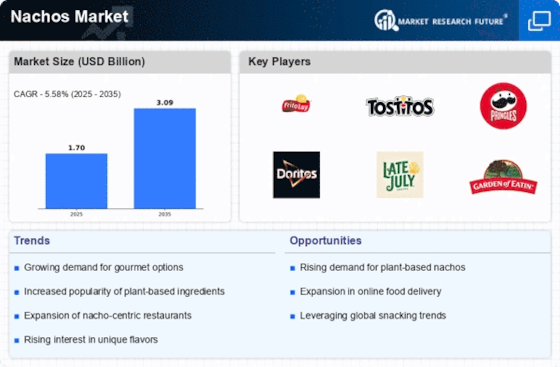
As per Market Research Future analysis, the Nachos Market Size was estimated at 1.698 USD Billion in 2024. The Nachos industry is projected to grow from USD 1.793 Billion in 2025 to USD 3.086 Billion by 2035, exhibiting a compound annual growth rate (CAGR) of 5.58% during the forecast period 2025 - 2035

Key Market Trends & Highlights

The nachos market is experiencing dynamic growth driven by evolving consumer preferences and innovative offerings.

  • Gourmet nacho offerings are gaining traction, particularly in North America, as consumers seek unique dining experiences.
  • Health-conscious alternatives, such as baked nachos, are emerging rapidly, appealing to a growing segment of health-aware consumers.
  • Convenience and delivery services are becoming increasingly important, especially in the fast-growing Asia-Pacific region.
  • The rising snack culture and social media influence are major drivers propelling the popularity of fried nachos in store-based retail channels.

Market Size & Forecast

2024 Market Size 1.698 (USD Billion)
2035 Market Size 3.086 (USD Billion)
CAGR (2025 - 2035) 5.58%
Largest Regional Market Share in 2024 North America

Major Players

Frito-Lay (US), Tostitos (US), Pringles (US), Doritos (US), Late July Snacks (US), Garden of Eatin' (US), Santitas (US), Xochitl (US)

Market Trends

The Nachos Market is currently experiencing a dynamic evolution, driven by changing consumer preferences and innovative product offerings. As individuals increasingly seek convenient and flavorful snack options, nachos have emerged as a popular choice across various demographics. This trend is further fueled by the rise of gourmet nacho varieties, which incorporate diverse toppings and unique flavor profiles, appealing to adventurous eaters. Additionally, the growing popularity of plant-based diets has led to the introduction of nacho products that cater to vegan and vegetarian consumers, thereby expanding the market's reach. Moreover, the Nachos Market is witnessing a surge in demand for healthier alternatives, as consumers become more health-conscious. This shift has prompted manufacturers to explore options such as baked nachos and organic ingredients, which align with the wellness trend. Furthermore, the increasing prevalence of food delivery services has made it easier for consumers to enjoy nachos at home, contributing to their rising popularity. Overall, the Nachos Market appears poised for continued growth, driven by innovation and a focus on meeting diverse consumer needs.

Gourmet Nacho Offerings

The emergence of gourmet nacho varieties is reshaping the Nachos Market. These upscale options feature an array of unique toppings and flavor combinations, appealing to consumers seeking novel culinary experiences. This trend reflects a broader movement towards premium snack foods.

Health-Conscious Alternatives

As health awareness rises, the demand for healthier nacho options is increasing. Manufacturers are responding by creating baked versions and utilizing organic ingredients, catering to consumers who prioritize nutrition without sacrificing taste.

Convenience and Delivery Services

The growth of food delivery services is significantly impacting the Nachos Market. Consumers now have easier access to their favorite nacho dishes from the comfort of their homes, driving sales and encouraging experimentation with different flavors and styles.

Nachos Market Market Drivers

Rising Snack Culture

The increasing inclination towards snacking, particularly among younger demographics, appears to be a pivotal driver for the Nachos Market. As consumers seek convenient and flavorful snack options, nachos have emerged as a popular choice. According to recent data, snack consumption has surged, with a notable percentage of individuals preferring snacks over traditional meals. This trend is likely to bolster the nachos segment, as they are often perceived as a versatile snack that can be enjoyed in various settings, from casual gatherings to sporting events. The Nachos Market is thus positioned to benefit from this cultural shift, as brands innovate to cater to evolving consumer preferences.

Social Media Influence

The impact of social media on consumer behavior is a significant driver for the Nachos Market. Platforms such as Instagram and TikTok have transformed the way food is marketed and consumed, with visually appealing nacho dishes often going viral. This trend encourages restaurants and brands to create aesthetically pleasing nacho presentations, which can lead to increased consumer interest and sales. Data suggests that food items showcased on social media platforms experience a notable uptick in demand, as consumers are influenced by online trends. Consequently, the Nachos Market is likely to see continued growth as brands leverage social media to engage with their audience and promote their offerings.

Innovative Flavor Profiles

The Nachos Market is witnessing a surge in demand for innovative flavor profiles that cater to diverse palates. As consumers become more adventurous in their culinary choices, nacho offerings are expanding beyond traditional cheese and jalapeno toppings. The introduction of gourmet flavors, such as truffle-infused cheese or spicy sriracha, is attracting a broader audience. Market data indicates that specialty nacho products are gaining traction, with a significant increase in sales reported in recent years. This trend suggests that brands that embrace creativity in flavor development may capture a larger share of the market, appealing to both traditional nacho lovers and new consumers seeking unique taste experiences.

Expansion of Retail Channels

The expansion of retail channels is a crucial driver for the Nachos Market. With the rise of e-commerce and the increasing presence of nacho products in supermarkets and convenience stores, consumers have greater access to a variety of nacho offerings. Recent market data indicates that retail sales of snack foods, including nachos, have experienced a steady increase, reflecting changing shopping habits. This trend suggests that as more consumers turn to retail outlets for their snack needs, the nachos segment is poised for growth. Brands that effectively utilize both online and offline channels may enhance their visibility and reach within the competitive landscape of the Nachos Market.

Growing Popularity of Food Trucks

The proliferation of food trucks has emerged as a noteworthy driver for the Nachos Market. These mobile eateries often feature nachos as a staple item on their menus, capitalizing on the trend of casual dining experiences. The convenience and accessibility of food trucks have made them a favored choice for consumers seeking quick and delicious meals. Recent statistics indicate that food truck sales have increased significantly, contributing to the overall growth of the food service sector. As food trucks continue to gain popularity, the nachos segment is likely to benefit, as vendors innovate with toppings and presentation to attract customers.

Market Segment Insights

By Type: Fried (Largest) vs. Baked (Fastest-Growing)

<p>In the Nachos Market, the type segment showcases distinct offerings with Fried nachos holding the largest market share. Fried nachos appeal to consumers looking for traditional, indulgent snacks, contributing significantly to the segment's overall popularity. In contrast, Baked nachos are gaining traction, appealing to health-conscious consumers seeking lighter alternatives. This shift in preference reflects evolving consumer habits and influences market dynamics.</p>

<p>Fried (Dominant) vs. Baked (Emerging)</p>

<p>Fried nachos dominate the Nachos Market due to their classic, rich flavor and texture that resonate well with consumers. Often enjoyed for their crunchiness and savory appeal, these nachos are widely available and remain a staple in snack foods. On the other hand, Baked nachos are emerging as a healthier option, attracting consumers who are more health-oriented. They are often marketed as lower-calorie alternatives without sacrificing taste, appealing particularly to younger demographics and fitness enthusiasts. This dynamic indicates a growing trend towards healthier snacking options that still deliver on flavor.</p>

By Distribution Channel: Store-Based (Largest) vs. Non-Store-Based (Fastest-Growing)

<p>In the Nachos Market, the distribution channel landscape is primarily dominated by store-based formats. These channels capture a significant portion, reflecting consumers' preference for in-store shopping experiences where they can see and choose their products. Traditional retailers, supermarkets, and convenience stores contribute to this dominance, allowing consumers to browse a variety of nacho products. In contrast, non-store-based channels, which include online platforms and delivery services, are emerging but still represent a smaller share of sales in comparison to their store-based counterparts.</p>

<p>Distribution Channels: Store-Based (Dominant) vs. Non-Store-Based (Emerging)</p>

<p>Store-based distribution remains a critical component of the Nachos Market, capitalizing on physical retail's long-standing appeal. Consumers often prefer the tactile experience of purchasing snacks in person, leading to high foot traffic in stores and impulse purchases. The dominant stores foster a sense of brand loyalty by presenting a wide array of nacho offerings. Meanwhile, non-store-based channels are gaining traction, particularly among younger consumers who favor the convenience of online shopping. Innovations in e-commerce and delivery services have positioned non-store-based channels as an emerging force in the market, driven by changing consumer behaviors and increased digital penetration.</p>

By Application: Restaurant (Largest) vs. Household (Fastest-Growing)

<p>In the Nachos Market, the application segment is primarily divided between the restaurant and household sectors. The restaurant application dominates the market, driven by increased consumer engagement in dining out and the growing trend of nachos as a popular shareable appetizer. Households, on the other hand, are gaining traction as more consumers seek convenient snack options at home, leading to a dynamic shift in market applications.</p>

<p>Application: Restaurant (Dominant) vs. Household (Emerging)</p>

<p>The restaurant application in the Nachos Market is known for its ability to cater to larger consumer groups, creating experiences around social dining. This segment benefits from the trend of casual dining settings where nachos are served as a versatile menu item, appealing to all age groups. Meanwhile, the household application is rapidly evolving due to the increasing demand for ready-to-eat snack options among consumers. This emerging segment is characterized by innovative nacho products available at grocery stores, coupled with a surge in home-based gatherings and movie nights, making nachos a favored household snack.</p>

Nachos Market Application Insights

The Nachos Market segmentation, based on application, includes restaurants and households. The household segment dominated the market; nachos can be pretty tasty after being heated. The variety of flavors in the product might improve the flavor. The fact that this flavor is most frequently found in restaurants is a key factor in the segment's growth.

Source: Secondary Research, Primary Research, M.R.F.R. Database and Analyst Review

Get more detailed insights about Nachos Market Research Report - Forecast to 2035

Regional Insights

North America : Snack Food Powerhouse

North America is the largest market for nachos, accounting for approximately 60% of global consumption. The region's growth is driven by increasing snacking trends, the popularity of convenience foods, and a strong culture of social gatherings. Regulatory support for food safety and quality standards further enhances market stability. The U.S. is the leading country, followed by Canada, which contributes significantly to the overall market share. The competitive landscape is dominated by major players such as Frito-Lay, Tostitos, and Doritos, which have established strong brand loyalty. The presence of diverse product offerings, including organic and gluten-free options, caters to evolving consumer preferences. The market is characterized by continuous innovation, with companies investing in new flavors and packaging to attract a broader audience. Overall, North America remains a vibrant hub for nacho products.

Europe : Emerging Snack Market

Europe is witnessing a growing demand for nachos, with a market share of around 25%. The rise in snacking culture, particularly among younger demographics, is a key driver of this growth. Countries like the UK and Germany are leading the market, supported by favorable regulations on food imports and safety standards. The increasing popularity of Mexican cuisine and the trend towards casual dining are also contributing to the expansion of the nachos market in this region. The competitive landscape features both local and international brands, with key players like Doritos and Pringles leading the charge. The presence of artisanal and gourmet nacho products is on the rise, appealing to health-conscious consumers. Retail channels, including supermarkets and online platforms, are expanding their offerings, making nachos more accessible. This dynamic environment is fostering innovation and variety in product lines, enhancing consumer choice.

Asia-Pacific : Emerging Powerhouse

Asia-Pacific is emerging as a significant player in the nachos market, holding approximately 10% of the global share. The region's growth is fueled by urbanization, changing lifestyles, and a growing affinity for Western food trends. Countries like Japan and Australia are at the forefront, with increasing disposable incomes and a rising number of food service establishments. Regulatory frameworks supporting food safety and quality are also enhancing market growth. The competitive landscape is characterized by a mix of local and international brands, with companies like Pringles and Doritos gaining traction. The introduction of unique flavors tailored to local tastes is becoming a trend, attracting a diverse consumer base. Retail expansion, particularly in e-commerce, is making nachos more accessible to consumers. As the market continues to evolve, innovation in product offerings will play a crucial role in capturing consumer interest.

Middle East and Africa : Untapped Snack Potential

The Middle East and Africa region is gradually emerging in the nachos market, currently holding about 5% of the global share. The growth is driven by increasing urbanization, a young population, and a rising trend towards snacking. Countries like South Africa and the UAE are leading the market, supported by favorable trade regulations and a growing food service sector. The region's diverse culinary landscape is also paving the way for innovative nacho products. The competitive landscape is still developing, with both local and international brands vying for market share. Key players are beginning to introduce nachos with unique flavors and ingredients that cater to local tastes. Retail channels are expanding, with supermarkets and convenience stores increasing their snack offerings. As consumer awareness of nachos grows, the market is expected to see significant growth in the coming years.

Key Players and Competitive Insights

The Nachos Market exhibits a dynamic competitive landscape characterized by a blend of established brands and emerging players. Key growth drivers include the increasing consumer preference for convenient snack options, the rise of plant-based alternatives, and the ongoing trend towards healthier snacking. Major companies such as Frito-Lay (US), Doritos (US), and Late July Snacks (US) are strategically positioned to leverage these trends. Frito-Lay (US) focuses on innovation in flavor profiles and healthier ingredients, while Doritos (US) emphasizes bold marketing campaigns to attract younger demographics. Late July Snacks (US) is carving a niche in the organic segment, appealing to health-conscious consumers. Collectively, these strategies foster a competitive environment that is both vibrant and multifaceted.In terms of business tactics, companies are increasingly localizing manufacturing to reduce supply chain disruptions and enhance responsiveness to regional tastes. The Nachos Market appears moderately fragmented, with a mix of large corporations and smaller, niche players. This structure allows for diverse product offerings, yet the influence of key players remains substantial, as they set trends and standards that smaller companies often follow.

In September Frito-Lay (US) announced the launch of a new line of organic nacho chips, aimed at capturing the growing health-conscious segment of the market. This strategic move not only aligns with consumer demand for healthier snacks but also positions Frito-Lay (US) as a leader in innovation within the nacho category. The introduction of organic options could potentially enhance brand loyalty and attract a new customer base.

In August Doritos (US) unveiled a partnership with a popular streaming service to create a limited-edition flavor inspired by a hit series. This collaboration exemplifies Doritos' (US) commitment to engaging with younger audiences through innovative marketing strategies. By intertwining their product with popular culture, Doritos (US) likely enhances brand visibility and relevance in a competitive market.

In July Late July Snacks (US) expanded its distribution channels by partnering with major grocery chains to increase accessibility to its organic nacho products. This strategic action not only broadens their market reach but also reinforces their commitment to providing healthier snack options. Such partnerships may enhance brand recognition and drive sales growth in a competitive landscape.

As of October the competitive trends in the Nachos Market are increasingly defined by digitalization, sustainability, and the integration of artificial intelligence in marketing strategies. Companies are forming strategic alliances to enhance their market presence and operational efficiency. The shift from price-based competition to a focus on innovation, technology, and supply chain reliability is evident. Moving forward, competitive differentiation will likely hinge on the ability to adapt to consumer preferences and leverage technological advancements.

Key Companies in the Nachos Market include

Industry Developments

February 2022: PepsiCo is an American multinational food, snack, and beverage company headquartered in Purchas Village, Harrison, New York. PepsiCo's businesses cover all aspects of the food and beverage industry. It oversees the production, distribution, and marketing of products. PepsiCo is ramping up its healthy snacks in Europe. The company saw sales of snack foods with Nutri scores of B or higher increase tenfold. The company is expanding its range of snacks to include healthier options like popular produce and a new line of popcorn.

In January 2022: PepsiCo's Frito-Lay North America division announced Lay's Mille-Feuille Potato Chips, which the company says are "various, one-of-a-kind potato chips with deliciously crunchy layers." The chips come in two flavors: a trio with a rich and cheesy blend of cheddar, parmesan, and gouda; and sour cream and onions. The chips will be available in mid-January at a retail price of $4.09 for 4 pieces. A 75-ounce bag costs $1.99 for a 1.75-ounce bag or $1 for a 2 to 0.5-ounce bag.

Future Outlook

Nachos Market Future Outlook

The Nachos Market is projected to grow at a 5.58% CAGR from 2025 to 2035, driven by increasing consumer demand for convenient snack options and innovative flavor profiles.

New opportunities lie in:

  • Expansion of nacho product lines with gourmet flavors
  • Development of plant-based nacho cheese alternatives
  • Implementation of automated nacho vending solutions in high-traffic areas

By 2035, the Nachos Market is expected to achieve robust growth, reflecting evolving consumer preferences and innovative product offerings.

Market Segmentation

Nachos Market Type Outlook

  • Fried
  • Baked
  • Others

Nachos Market Application Outlook

  • Restaurant
  • Household

Nachos Market Distribution Channel Outlook

  • Store-Based
  • Non-Store-Based

Report Scope

MARKET SIZE 2024 1.698(USD Billion)
MARKET SIZE 2025 1.793(USD Billion)
MARKET SIZE 2035 3.086(USD Billion)
COMPOUND ANNUAL GROWTH RATE (CAGR) 5.58% (2025 - 2035)
REPORT COVERAGE Revenue Forecast, Competitive Landscape, Growth Factors, and Trends
BASE YEAR 2024
Market Forecast Period 2025 - 2035
Historical Data 2019 - 2024
Market Forecast Units USD Billion
Key Companies Profiled Frito-Lay (US), Tostitos (US), Pringles (US), Doritos (US), Late July Snacks (US), Garden of Eatin' (US), Santitas (US), Xochitl (US)
Segments Covered Type, Distribution Channel, Application, Region
Key Market Opportunities Growing demand for plant-based nacho options aligns with health-conscious consumer trends.
Key Market Dynamics Rising consumer preference for plant-based nacho options drives innovation and competition in the nachos market.
Countries Covered North America, Europe, APAC, South America, MEA

FAQs

What was the overall valuation of the Nachos Market in 2024?

<p>The overall market valuation of the Nachos Market was 1.698 USD Billion in 2024.</p>

What is the projected market valuation for the Nachos Market in 2035?

<p>The Nachos Market is projected to reach a valuation of 3.086 USD Billion by 2035.</p>

What is the expected CAGR for the Nachos Market during the forecast period 2025 - 2035?

<p>The expected CAGR for the Nachos Market during the forecast period 2025 - 2035 is 5.58%.</p>

Which companies are considered key players in the Nachos Market?

<p>Key players in the Nachos Market include Frito-Lay, Tostitos, Pringles, Doritos, Late July Snacks, Garden of Eatin', Santitas, and Xochitl.</p>

What were the valuations for the Fried and Baked nachos segments in 2024?

<p>In 2024, the Fried nachos segment was valued at 0.679 USD Billion, while the Baked segment was valued at 0.509 USD Billion.</p>

How do the distribution channels for nachos break down in terms of market valuation?

<p>In 2024, the Store-Based distribution channel was valued at 1.018 USD Billion, whereas the Non-Store-Based channel was valued at 0.68 USD Billion.</p>

What applications dominate the Nachos Market in terms of valuation?

In 2024, both the Restaurant and Household applications were valued equally at 0.849 USD Billion.

What is the projected growth for the Fried nachos segment by 2035?

The Fried nachos segment is projected to grow to 1.215 USD Billion by 2035.

What is the expected valuation for the Baked nachos segment in 2035?

The Baked nachos segment is expected to reach a valuation of 0.925 USD Billion by 2035.

How does the valuation of the Non-Store-Based distribution channel compare to the Store-Based channel in 2035?

By 2035, the Non-Store-Based distribution channel is projected to reach 1.338 USD Billion, compared to 1.748 USD Billion for the Store-Based channel.

  1. SECTION I: EXECUTIVE SUMMARY AND KEY HIGHLIGHTS
    1. | 1.1 EXECUTIVE SUMMARY
    2. | | 1.1.1 Market Overview
    3. | | 1.1.2 Key Findings
    4. | | 1.1.3 Market Segmentation
    5. | | 1.1.4 Competitive Landscape
    6. | | 1.1.5 Challenges and Opportunities
    7. | | 1.1.6 Future Outlook
  2. SECTION II: SCOPING, METHODOLOGY AND MARKET STRUCTURE
    1. | 2.1 MARKET INTRODUCTION
    2. | | 2.1.1 Definition
    3. | | 2.1.2 Scope of the study
    4. | | | 2.1.2.1 Research Objective
    5. | | | 2.1.2.2 Assumption
    6. | | | 2.1.2.3 Limitations
    7. | 2.2 RESEARCH METHODOLOGY
    8. | | 2.2.1 Overview
    9. | | 2.2.2 Data Mining
    10. | | 2.2.3 Secondary Research
    11. | | 2.2.4 Primary Research
    12. | | | 2.2.4.1 Primary Interviews and Information Gathering Process
    13. | | | 2.2.4.2 Breakdown of Primary Respondents
    14. | | 2.2.5 Forecasting Model
    15. | | 2.2.6 Market Size Estimation
    16. | | | 2.2.6.1 Bottom-Up Approach
    17. | | | 2.2.6.2 Top-Down Approach
    18. | | 2.2.7 Data Triangulation
    19. | | 2.2.8 Validation
  3. SECTION III: QUALITATIVE ANALYSIS
    1. | 3.1 MARKET DYNAMICS
    2. | | 3.1.1 Overview
    3. | | 3.1.2 Drivers
    4. | | 3.1.3 Restraints
    5. | | 3.1.4 Opportunities
    6. | 3.2 MARKET FACTOR ANALYSIS
    7. | | 3.2.1 Value chain Analysis
    8. | | 3.2.2 Porter's Five Forces Analysis
    9. | | | 3.2.2.1 Bargaining Power of Suppliers
    10. | | | 3.2.2.2 Bargaining Power of Buyers
    11. | | | 3.2.2.3 Threat of New Entrants
    12. | | | 3.2.2.4 Threat of Substitutes
    13. | | | 3.2.2.5 Intensity of Rivalry
    14. | | 3.2.3 COVID-19 Impact Analysis
    15. | | | 3.2.3.1 Market Impact Analysis
    16. | | | 3.2.3.2 Regional Impact
    17. | | | 3.2.3.3 Opportunity and Threat Analysis
  4. SECTION IV: QUANTITATIVE ANALYSIS
    1. | 4.1 Food, Beverages & Nutrition, BY Type (USD Billion)
    2. | | 4.1.1 Fried
    3. | | 4.1.2 Baked
    4. | | 4.1.3 Others
    5. | 4.2 Food, Beverages & Nutrition, BY Distribution Channel (USD Billion)
    6. | | 4.2.1 Store-Based
    7. | | 4.2.2 Non-Store-Based
    8. | 4.3 Food, Beverages & Nutrition, BY Application (USD Billion)
    9. | | 4.3.1 Restaurant
    10. | | 4.3.2 Household
    11. | 4.4 Food, Beverages & Nutrition, BY Region (USD Billion)
    12. | | 4.4.1 North America
    13. | | | 4.4.1.1 US
    14. | | | 4.4.1.2 Canada
    15. | | 4.4.2 Europe
    16. | | | 4.4.2.1 Germany
    17. | | | 4.4.2.2 UK
    18. | | | 4.4.2.3 France
    19. | | | 4.4.2.4 Russia
    20. | | | 4.4.2.5 Italy
    21. | | | 4.4.2.6 Spain
    22. | | | 4.4.2.7 Rest of Europe
    23. | | 4.4.3 APAC
    24. | | | 4.4.3.1 China
    25. | | | 4.4.3.2 India
    26. | | | 4.4.3.3 Japan
    27. | | | 4.4.3.4 South Korea
    28. | | | 4.4.3.5 Malaysia
    29. | | | 4.4.3.6 Thailand
    30. | | | 4.4.3.7 Indonesia
    31. | | | 4.4.3.8 Rest of APAC
    32. | | 4.4.4 South America
    33. | | | 4.4.4.1 Brazil
    34. | | | 4.4.4.2 Mexico
    35. | | | 4.4.4.3 Argentina
    36. | | | 4.4.4.4 Rest of South America
    37. | | 4.4.5 MEA
    38. | | | 4.4.5.1 GCC Countries
    39. | | | 4.4.5.2 South Africa
    40. | | | 4.4.5.3 Rest of MEA
  5. SECTION V: COMPETITIVE ANALYSIS
    1. | 5.1 Competitive Landscape
    2. | | 5.1.1 Overview
    3. | | 5.1.2 Competitive Analysis
    4. | | 5.1.3 Market share Analysis
    5. | | 5.1.4 Major Growth Strategy in the Food, Beverages & Nutrition
    6. | | 5.1.5 Competitive Benchmarking
    7. | | 5.1.6 Leading Players in Terms of Number of Developments in the Food, Beverages & Nutrition
    8. | | 5.1.7 Key developments and growth strategies
    9. | | | 5.1.7.1 New Product Launch/Service Deployment
    10. | | | 5.1.7.2 Merger & Acquisitions
    11. | | | 5.1.7.3 Joint Ventures
    12. | | 5.1.8 Major Players Financial Matrix
    13. | | | 5.1.8.1 Sales and Operating Income
    14. | | | 5.1.8.2 Major Players R&D Expenditure. 2023
    15. | 5.2 Company Profiles
    16. | | 5.2.1 Frito-Lay (US)
    17. | | | 5.2.1.1 Financial Overview
    18. | | | 5.2.1.2 Products Offered
    19. | | | 5.2.1.3 Key Developments
    20. | | | 5.2.1.4 SWOT Analysis
    21. | | | 5.2.1.5 Key Strategies
    22. | | 5.2.2 Tostitos (US)
    23. | | | 5.2.2.1 Financial Overview
    24. | | | 5.2.2.2 Products Offered
    25. | | | 5.2.2.3 Key Developments
    26. | | | 5.2.2.4 SWOT Analysis
    27. | | | 5.2.2.5 Key Strategies
    28. | | 5.2.3 Pringles (US)
    29. | | | 5.2.3.1 Financial Overview
    30. | | | 5.2.3.2 Products Offered
    31. | | | 5.2.3.3 Key Developments
    32. | | | 5.2.3.4 SWOT Analysis
    33. | | | 5.2.3.5 Key Strategies
    34. | | 5.2.4 Doritos (US)
    35. | | | 5.2.4.1 Financial Overview
    36. | | | 5.2.4.2 Products Offered
    37. | | | 5.2.4.3 Key Developments
    38. | | | 5.2.4.4 SWOT Analysis
    39. | | | 5.2.4.5 Key Strategies
    40. | | 5.2.5 Late July Snacks (US)
    41. | | | 5.2.5.1 Financial Overview
    42. | | | 5.2.5.2 Products Offered
    43. | | | 5.2.5.3 Key Developments
    44. | | | 5.2.5.4 SWOT Analysis
    45. | | | 5.2.5.5 Key Strategies
    46. | | 5.2.6 Garden of Eatin' (US)
    47. | | | 5.2.6.1 Financial Overview
    48. | | | 5.2.6.2 Products Offered
    49. | | | 5.2.6.3 Key Developments
    50. | | | 5.2.6.4 SWOT Analysis
    51. | | | 5.2.6.5 Key Strategies
    52. | | 5.2.7 Santitas (US)
    53. | | | 5.2.7.1 Financial Overview
    54. | | | 5.2.7.2 Products Offered
    55. | | | 5.2.7.3 Key Developments
    56. | | | 5.2.7.4 SWOT Analysis
    57. | | | 5.2.7.5 Key Strategies
    58. | | 5.2.8 Xochitl (US)
    59. | | | 5.2.8.1 Financial Overview
    60. | | | 5.2.8.2 Products Offered
    61. | | | 5.2.8.3 Key Developments
    62. | | | 5.2.8.4 SWOT Analysis
    63. | | | 5.2.8.5 Key Strategies
    64. | 5.3 Appendix
    65. | | 5.3.1 References
    66. | | 5.3.2 Related Reports
  6. LIST OF FIGURES
    1. | 6.1 MARKET SYNOPSIS
    2. | 6.2 NORTH AMERICA MARKET ANALYSIS
    3. | 6.3 US MARKET ANALYSIS BY TYPE
    4. | 6.4 US MARKET ANALYSIS BY DISTRIBUTION CHANNEL
    5. | 6.5 US MARKET ANALYSIS BY APPLICATION
    6. | 6.6 CANADA MARKET ANALYSIS BY TYPE
    7. | 6.7 CANADA MARKET ANALYSIS BY DISTRIBUTION CHANNEL
    8. | 6.8 CANADA MARKET ANALYSIS BY APPLICATION
    9. | 6.9 EUROPE MARKET ANALYSIS
    10. | 6.10 GERMANY MARKET ANALYSIS BY TYPE
    11. | 6.11 GERMANY MARKET ANALYSIS BY DISTRIBUTION CHANNEL
    12. | 6.12 GERMANY MARKET ANALYSIS BY APPLICATION
    13. | 6.13 UK MARKET ANALYSIS BY TYPE
    14. | 6.14 UK MARKET ANALYSIS BY DISTRIBUTION CHANNEL
    15. | 6.15 UK MARKET ANALYSIS BY APPLICATION
    16. | 6.16 FRANCE MARKET ANALYSIS BY TYPE
    17. | 6.17 FRANCE MARKET ANALYSIS BY DISTRIBUTION CHANNEL
    18. | 6.18 FRANCE MARKET ANALYSIS BY APPLICATION
    19. | 6.19 RUSSIA MARKET ANALYSIS BY TYPE
    20. | 6.20 RUSSIA MARKET ANALYSIS BY DISTRIBUTION CHANNEL
    21. | 6.21 RUSSIA MARKET ANALYSIS BY APPLICATION
    22. | 6.22 ITALY MARKET ANALYSIS BY TYPE
    23. | 6.23 ITALY MARKET ANALYSIS BY DISTRIBUTION CHANNEL
    24. | 6.24 ITALY MARKET ANALYSIS BY APPLICATION
    25. | 6.25 SPAIN MARKET ANALYSIS BY TYPE
    26. | 6.26 SPAIN MARKET ANALYSIS BY DISTRIBUTION CHANNEL
    27. | 6.27 SPAIN MARKET ANALYSIS BY APPLICATION
    28. | 6.28 REST OF EUROPE MARKET ANALYSIS BY TYPE
    29. | 6.29 REST OF EUROPE MARKET ANALYSIS BY DISTRIBUTION CHANNEL
    30. | 6.30 REST OF EUROPE MARKET ANALYSIS BY APPLICATION
    31. | 6.31 APAC MARKET ANALYSIS
    32. | 6.32 CHINA MARKET ANALYSIS BY TYPE
    33. | 6.33 CHINA MARKET ANALYSIS BY DISTRIBUTION CHANNEL
    34. | 6.34 CHINA MARKET ANALYSIS BY APPLICATION
    35. | 6.35 INDIA MARKET ANALYSIS BY TYPE
    36. | 6.36 INDIA MARKET ANALYSIS BY DISTRIBUTION CHANNEL
    37. | 6.37 INDIA MARKET ANALYSIS BY APPLICATION
    38. | 6.38 JAPAN MARKET ANALYSIS BY TYPE
    39. | 6.39 JAPAN MARKET ANALYSIS BY DISTRIBUTION CHANNEL
    40. | 6.40 JAPAN MARKET ANALYSIS BY APPLICATION
    41. | 6.41 SOUTH KOREA MARKET ANALYSIS BY TYPE
    42. | 6.42 SOUTH KOREA MARKET ANALYSIS BY DISTRIBUTION CHANNEL
    43. | 6.43 SOUTH KOREA MARKET ANALYSIS BY APPLICATION
    44. | 6.44 MALAYSIA MARKET ANALYSIS BY TYPE
    45. | 6.45 MALAYSIA MARKET ANALYSIS BY DISTRIBUTION CHANNEL
    46. | 6.46 MALAYSIA MARKET ANALYSIS BY APPLICATION
    47. | 6.47 THAILAND MARKET ANALYSIS BY TYPE
    48. | 6.48 THAILAND MARKET ANALYSIS BY DISTRIBUTION CHANNEL
    49. | 6.49 THAILAND MARKET ANALYSIS BY APPLICATION
    50. | 6.50 INDONESIA MARKET ANALYSIS BY TYPE
    51. | 6.51 INDONESIA MARKET ANALYSIS BY DISTRIBUTION CHANNEL
    52. | 6.52 INDONESIA MARKET ANALYSIS BY APPLICATION
    53. | 6.53 REST OF APAC MARKET ANALYSIS BY TYPE
    54. | 6.54 REST OF APAC MARKET ANALYSIS BY DISTRIBUTION CHANNEL
    55. | 6.55 REST OF APAC MARKET ANALYSIS BY APPLICATION
    56. | 6.56 SOUTH AMERICA MARKET ANALYSIS
    57. | 6.57 BRAZIL MARKET ANALYSIS BY TYPE
    58. | 6.58 BRAZIL MARKET ANALYSIS BY DISTRIBUTION CHANNEL
    59. | 6.59 BRAZIL MARKET ANALYSIS BY APPLICATION
    60. | 6.60 MEXICO MARKET ANALYSIS BY TYPE
    61. | 6.61 MEXICO MARKET ANALYSIS BY DISTRIBUTION CHANNEL
    62. | 6.62 MEXICO MARKET ANALYSIS BY APPLICATION
    63. | 6.63 ARGENTINA MARKET ANALYSIS BY TYPE
    64. | 6.64 ARGENTINA MARKET ANALYSIS BY DISTRIBUTION CHANNEL
    65. | 6.65 ARGENTINA MARKET ANALYSIS BY APPLICATION
    66. | 6.66 REST OF SOUTH AMERICA MARKET ANALYSIS BY TYPE
    67. | 6.67 REST OF SOUTH AMERICA MARKET ANALYSIS BY DISTRIBUTION CHANNEL
    68. | 6.68 REST OF SOUTH AMERICA MARKET ANALYSIS BY APPLICATION
    69. | 6.69 MEA MARKET ANALYSIS
    70. | 6.70 GCC COUNTRIES MARKET ANALYSIS BY TYPE
    71. | 6.71 GCC COUNTRIES MARKET ANALYSIS BY DISTRIBUTION CHANNEL
    72. | 6.72 GCC COUNTRIES MARKET ANALYSIS BY APPLICATION
    73. | 6.73 SOUTH AFRICA MARKET ANALYSIS BY TYPE
    74. | 6.74 SOUTH AFRICA MARKET ANALYSIS BY DISTRIBUTION CHANNEL
    75. | 6.75 SOUTH AFRICA MARKET ANALYSIS BY APPLICATION
    76. | 6.76 REST OF MEA MARKET ANALYSIS BY TYPE
    77. | 6.77 REST OF MEA MARKET ANALYSIS BY DISTRIBUTION CHANNEL
    78. | 6.78 REST OF MEA MARKET ANALYSIS BY APPLICATION
    79. | 6.79 KEY BUYING CRITERIA OF FOOD, BEVERAGES & NUTRITION
    80. | 6.80 RESEARCH PROCESS OF MRFR
    81. | 6.81 DRO ANALYSIS OF FOOD, BEVERAGES & NUTRITION
    82. | 6.82 DRIVERS IMPACT ANALYSIS: FOOD, BEVERAGES & NUTRITION
    83. | 6.83 RESTRAINTS IMPACT ANALYSIS: FOOD, BEVERAGES & NUTRITION
    84. | 6.84 SUPPLY / VALUE CHAIN: FOOD, BEVERAGES & NUTRITION
    85. | 6.85 FOOD, BEVERAGES & NUTRITION, BY TYPE, 2024 (% SHARE)
    86. | 6.86 FOOD, BEVERAGES & NUTRITION, BY TYPE, 2024 TO 2035 (USD Billion)
    87. | 6.87 FOOD, BEVERAGES & NUTRITION, BY DISTRIBUTION CHANNEL, 2024 (% SHARE)
    88. | 6.88 FOOD, BEVERAGES & NUTRITION, BY DISTRIBUTION CHANNEL, 2024 TO 2035 (USD Billion)
    89. | 6.89 FOOD, BEVERAGES & NUTRITION, BY APPLICATION, 2024 (% SHARE)
    90. | 6.90 FOOD, BEVERAGES & NUTRITION, BY APPLICATION, 2024 TO 2035 (USD Billion)
    91. | 6.91 BENCHMARKING OF MAJOR COMPETITORS
  7. LIST OF TABLES
    1. | 7.1 LIST OF ASSUMPTIONS
    2. | | 7.1.1
    3. | 7.2 North America MARKET SIZE ESTIMATES; FORECAST
    4. | | 7.2.1 BY TYPE, 2025-2035 (USD Billion)
    5. | | 7.2.2 BY DISTRIBUTION CHANNEL, 2025-2035 (USD Billion)
    6. | | 7.2.3 BY APPLICATION, 2025-2035 (USD Billion)
    7. | 7.3 US MARKET SIZE ESTIMATES; FORECAST
    8. | | 7.3.1 BY TYPE, 2025-2035 (USD Billion)
    9. | | 7.3.2 BY DISTRIBUTION CHANNEL, 2025-2035 (USD Billion)
    10. | | 7.3.3 BY APPLICATION, 2025-2035 (USD Billion)
    11. | 7.4 Canada MARKET SIZE ESTIMATES; FORECAST
    12. | | 7.4.1 BY TYPE, 2025-2035 (USD Billion)
    13. | | 7.4.2 BY DISTRIBUTION CHANNEL, 2025-2035 (USD Billion)
    14. | | 7.4.3 BY APPLICATION, 2025-2035 (USD Billion)
    15. | 7.5 Europe MARKET SIZE ESTIMATES; FORECAST
    16. | | 7.5.1 BY TYPE, 2025-2035 (USD Billion)
    17. | | 7.5.2 BY DISTRIBUTION CHANNEL, 2025-2035 (USD Billion)
    18. | | 7.5.3 BY APPLICATION, 2025-2035 (USD Billion)
    19. | 7.6 Germany MARKET SIZE ESTIMATES; FORECAST
    20. | | 7.6.1 BY TYPE, 2025-2035 (USD Billion)
    21. | | 7.6.2 BY DISTRIBUTION CHANNEL, 2025-2035 (USD Billion)
    22. | | 7.6.3 BY APPLICATION, 2025-2035 (USD Billion)
    23. | 7.7 UK MARKET SIZE ESTIMATES; FORECAST
    24. | | 7.7.1 BY TYPE, 2025-2035 (USD Billion)
    25. | | 7.7.2 BY DISTRIBUTION CHANNEL, 2025-2035 (USD Billion)
    26. | | 7.7.3 BY APPLICATION, 2025-2035 (USD Billion)
    27. | 7.8 France MARKET SIZE ESTIMATES; FORECAST
    28. | | 7.8.1 BY TYPE, 2025-2035 (USD Billion)
    29. | | 7.8.2 BY DISTRIBUTION CHANNEL, 2025-2035 (USD Billion)
    30. | | 7.8.3 BY APPLICATION, 2025-2035 (USD Billion)
    31. | 7.9 Russia MARKET SIZE ESTIMATES; FORECAST
    32. | | 7.9.1 BY TYPE, 2025-2035 (USD Billion)
    33. | | 7.9.2 BY DISTRIBUTION CHANNEL, 2025-2035 (USD Billion)
    34. | | 7.9.3 BY APPLICATION, 2025-2035 (USD Billion)
    35. | 7.10 Italy MARKET SIZE ESTIMATES; FORECAST
    36. | | 7.10.1 BY TYPE, 2025-2035 (USD Billion)
    37. | | 7.10.2 BY DISTRIBUTION CHANNEL, 2025-2035 (USD Billion)
    38. | | 7.10.3 BY APPLICATION, 2025-2035 (USD Billion)
    39. | 7.11 Spain MARKET SIZE ESTIMATES; FORECAST
    40. | | 7.11.1 BY TYPE, 2025-2035 (USD Billion)
    41. | | 7.11.2 BY DISTRIBUTION CHANNEL, 2025-2035 (USD Billion)
    42. | | 7.11.3 BY APPLICATION, 2025-2035 (USD Billion)
    43. | 7.12 Rest of Europe MARKET SIZE ESTIMATES; FORECAST
    44. | | 7.12.1 BY TYPE, 2025-2035 (USD Billion)
    45. | | 7.12.2 BY DISTRIBUTION CHANNEL, 2025-2035 (USD Billion)
    46. | | 7.12.3 BY APPLICATION, 2025-2035 (USD Billion)
    47. | 7.13 APAC MARKET SIZE ESTIMATES; FORECAST
    48. | | 7.13.1 BY TYPE, 2025-2035 (USD Billion)
    49. | | 7.13.2 BY DISTRIBUTION CHANNEL, 2025-2035 (USD Billion)
    50. | | 7.13.3 BY APPLICATION, 2025-2035 (USD Billion)
    51. | 7.14 China MARKET SIZE ESTIMATES; FORECAST
    52. | | 7.14.1 BY TYPE, 2025-2035 (USD Billion)
    53. | | 7.14.2 BY DISTRIBUTION CHANNEL, 2025-2035 (USD Billion)
    54. | | 7.14.3 BY APPLICATION, 2025-2035 (USD Billion)
    55. | 7.15 India MARKET SIZE ESTIMATES; FORECAST
    56. | | 7.15.1 BY TYPE, 2025-2035 (USD Billion)
    57. | | 7.15.2 BY DISTRIBUTION CHANNEL, 2025-2035 (USD Billion)
    58. | | 7.15.3 BY APPLICATION, 2025-2035 (USD Billion)
    59. | 7.16 Japan MARKET SIZE ESTIMATES; FORECAST
    60. | | 7.16.1 BY TYPE, 2025-2035 (USD Billion)
    61. | | 7.16.2 BY DISTRIBUTION CHANNEL, 2025-2035 (USD Billion)
    62. | | 7.16.3 BY APPLICATION, 2025-2035 (USD Billion)
    63. | 7.17 South Korea MARKET SIZE ESTIMATES; FORECAST
    64. | | 7.17.1 BY TYPE, 2025-2035 (USD Billion)
    65. | | 7.17.2 BY DISTRIBUTION CHANNEL, 2025-2035 (USD Billion)
    66. | | 7.17.3 BY APPLICATION, 2025-2035 (USD Billion)
    67. | 7.18 Malaysia MARKET SIZE ESTIMATES; FORECAST
    68. | | 7.18.1 BY TYPE, 2025-2035 (USD Billion)
    69. | | 7.18.2 BY DISTRIBUTION CHANNEL, 2025-2035 (USD Billion)
    70. | | 7.18.3 BY APPLICATION, 2025-2035 (USD Billion)
    71. | 7.19 Thailand MARKET SIZE ESTIMATES; FORECAST
    72. | | 7.19.1 BY TYPE, 2025-2035 (USD Billion)
    73. | | 7.19.2 BY DISTRIBUTION CHANNEL, 2025-2035 (USD Billion)
    74. | | 7.19.3 BY APPLICATION, 2025-2035 (USD Billion)
    75. | 7.20 Indonesia MARKET SIZE ESTIMATES; FORECAST
    76. | | 7.20.1 BY TYPE, 2025-2035 (USD Billion)
    77. | | 7.20.2 BY DISTRIBUTION CHANNEL, 2025-2035 (USD Billion)
    78. | | 7.20.3 BY APPLICATION, 2025-2035 (USD Billion)
    79. | 7.21 Rest of APAC MARKET SIZE ESTIMATES; FORECAST
    80. | | 7.21.1 BY TYPE, 2025-2035 (USD Billion)
    81. | | 7.21.2 BY DISTRIBUTION CHANNEL, 2025-2035 (USD Billion)
    82. | | 7.21.3 BY APPLICATION, 2025-2035 (USD Billion)
    83. | 7.22 South America MARKET SIZE ESTIMATES; FORECAST
    84. | | 7.22.1 BY TYPE, 2025-2035 (USD Billion)
    85. | | 7.22.2 BY DISTRIBUTION CHANNEL, 2025-2035 (USD Billion)
    86. | | 7.22.3 BY APPLICATION, 2025-2035 (USD Billion)
    87. | 7.23 Brazil MARKET SIZE ESTIMATES; FORECAST
    88. | | 7.23.1 BY TYPE, 2025-2035 (USD Billion)
    89. | | 7.23.2 BY DISTRIBUTION CHANNEL, 2025-2035 (USD Billion)
    90. | | 7.23.3 BY APPLICATION, 2025-2035 (USD Billion)
    91. | 7.24 Mexico MARKET SIZE ESTIMATES; FORECAST
    92. | | 7.24.1 BY TYPE, 2025-2035 (USD Billion)
    93. | | 7.24.2 BY DISTRIBUTION CHANNEL, 2025-2035 (USD Billion)
    94. | | 7.24.3 BY APPLICATION, 2025-2035 (USD Billion)
    95. | 7.25 Argentina MARKET SIZE ESTIMATES; FORECAST
    96. | | 7.25.1 BY TYPE, 2025-2035 (USD Billion)
    97. | | 7.25.2 BY DISTRIBUTION CHANNEL, 2025-2035 (USD Billion)
    98. | | 7.25.3 BY APPLICATION, 2025-2035 (USD Billion)
    99. | 7.26 Rest of South America MARKET SIZE ESTIMATES; FORECAST
    100. | | 7.26.1 BY TYPE, 2025-2035 (USD Billion)
    101. | | 7.26.2 BY DISTRIBUTION CHANNEL, 2025-2035 (USD Billion)
    102. | | 7.26.3 BY APPLICATION, 2025-2035 (USD Billion)
    103. | 7.27 MEA MARKET SIZE ESTIMATES; FORECAST
    104. | | 7.27.1 BY TYPE, 2025-2035 (USD Billion)
    105. | | 7.27.2 BY DISTRIBUTION CHANNEL, 2025-2035 (USD Billion)
    106. | | 7.27.3 BY APPLICATION, 2025-2035 (USD Billion)
    107. | 7.28 GCC Countries MARKET SIZE ESTIMATES; FORECAST
    108. | | 7.28.1 BY TYPE, 2025-2035 (USD Billion)
    109. | | 7.28.2 BY DISTRIBUTION CHANNEL, 2025-2035 (USD Billion)
    110. | | 7.28.3 BY APPLICATION, 2025-2035 (USD Billion)
    111. | 7.29 South Africa MARKET SIZE ESTIMATES; FORECAST
    112. | | 7.29.1 BY TYPE, 2025-2035 (USD Billion)
    113. | | 7.29.2 BY DISTRIBUTION CHANNEL, 2025-2035 (USD Billion)
    114. | | 7.29.3 BY APPLICATION, 2025-2035 (USD Billion)
    115. | 7.30 Rest of MEA MARKET SIZE ESTIMATES; FORECAST
    116. | | 7.30.1 BY TYPE, 2025-2035 (USD Billion)
    117. | | 7.30.2 BY DISTRIBUTION CHANNEL, 2025-2035 (USD Billion)
    118. | | 7.30.3 BY APPLICATION, 2025-2035 (USD Billion)
    119. | 7.31 PRODUCT LAUNCH/PRODUCT DEVELOPMENT/APPROVAL
    120. | | 7.31.1
    121. | 7.32 ACQUISITION/PARTNERSHIP
    122. | | 7.32.1

Food, Beverages & Nutrition Market Segmentation

Food, Beverages & Nutrition By Type (USD Billion, 2025-2035)

  • Fried
  • Baked
  • Others

Food, Beverages & Nutrition By Distribution Channel (USD Billion, 2025-2035)

  • Store-Based
  • Non-Store-Based

Food, Beverages & Nutrition By Application (USD Billion, 2025-2035)

  • Restaurant
  • Household
Infographic

Free Sample Request

Kindly complete the form below to receive a free sample of this Report

Get Free Sample

Customer Strories

Compare Licence

×
Features License Type
Single User Multiuser License Enterprise User
Price $4,950 $5,950 $7,250
Maximum User Access Limit 1 User Upto 10 Users Unrestricted Access Throughout the Organization
Free Customization
Direct Access to Analyst
Deliverable Format
Platform Access
Discount on Next Purchase 10% 15% 15%
Printable Versions
%>