×
Request Free Sample ×

Kindly complete the form below to receive a free sample of this Report

* Please use a valid business email

Leading companies partner with us for data-driven Insights

clients tt-cursor
Hero Background
English
Chinese
French
Japanese
Korean
German
Spanish

Multifactor Authentication Market Trends

ID: MRFR/ICT/1008-CR
200 Pages
Aarti Dhapte
July 2025

Multi-Factor Authentication Market Size, Share and Research Report: By Authentication Method (One-Time Passwords, Biometrics, Smart Cards, Token-Based), By Deployment Type (On-Premises, Cloud-Based, Hybrid), By End-user (Banking and Financial Services, Government, Healthcare, Retail, IT and Telecom), By Component (Hardware, Software, Services), and By Regional (North America, Europe, South America, Asia Pacific, Middle East and Africa) - Industry Forecast to 2035

Share:
Download PDF ×

We do not share your information with anyone. However, we may send you emails based on your report interest from time to time. You may contact us at any time to opt-out.

Multifactor Authentication Market Infographic
Purchase Options

Market Trends

Key Emerging Trends in the Multifactor Authentication Market

The multi-factor authentication (MFA) market is encountering critical development and advancement as associations across different enterprises try to improve security, safeguard delicate information, and battle the rising danger of cyberattacks. MFA agreements provide an extra level of security as clients are required to present various types of authentication, such as passwords, biometrics tokens or in case mobile phones before accessing systems, applications or digital assets. This market segment due to the increasing awareness regarding network security threats, regulatory compliance needs and ensuring remote & cloud-based conditions because of escalating nature of a digital threat landscape together with growth in digitization is seeing unprecedented demand.

The adoption of biometric authentication and behavioral identity verification technologies is an observable market trend in the MFA market. On the other hand, biometric MFA systems such as fingerprint recognition facial recognition and iris scanning provide a higher level of security while offering user convenience since they rely on unique biological properties in order to authenticate users. This trend is fueling the evolution of biometric MFA solutions that offer continuous and seamless user experiences while securing identity assurance and authentication across millions of applications, devices, and touches.

Additionally, the combination of MFA with variable and risk-based authentication is changing how market drivers work. Flexible MFA techniques use contemporary data, user behavior analysis and risk assessment to adapt authentication requirements more freely based on the perceived threat level of a particular access attempt. This phenomenon is leading to the development of mobile MFA solutions that can reach a balance between security and user experience through applying proper authentication level based on location of access request, client behavior, and risk factors.

Another important trend in the MFA market is cloud-focused and mobile-based MFA solutions. As the popularity of cloud services, mobile work, and mobile apps increases allows MFA implementations to provide secure access to cloud databases, cell phones and online applications. This trend is pushing the development of cloud-based and mobile MFA solutions that deliver continuous integration, flexibility, and simple authentication protocols to lock down access to cloud services, mobile apps, as well as remote offices.

In addition, the trend toward MFA-as-a -Management and identity access management (IAM) fusion is shaping market dynamics. Organizations want MFA arrangements that are effectively integrable with their current IAM stages, index services and cloud identity providers to help user authentication access control and character management. This pattern is driving the improvement of MFA-as-a-Administration contributions that give consistent incorporation, unified administration, and strategy implementation to help the personality and access the board needs of associations across different IT conditions and applications.

Author
Aarti Dhapte
AVP - Research

A consulting professional focused on helping businesses navigate complex markets through structured research and strategic insights. I partner with clients to solve high-impact business problems across market entry strategy, competitive intelligence, and opportunity assessment. Over the course of my experience, I have led and contributed to 100+ market research and consulting engagements, delivering insights across multiple industries and geographies, and supporting strategic decisions linked to $500M+ market opportunities. My core expertise lies in building robust market sizing, forecasting, and commercial models (top-down and bottom-up), alongside deep-dive competitive and industry analysis. I have played a key role in shaping go-to-market strategies, investment cases, and growth roadmaps, enabling clients to make confident, data-backed decisions in dynamic markets.

Leave a Comment

FAQs

What is the projected market valuation of the Multi-Factor Authentication Market by 2035?

<p>The Multi-Factor Authentication Market is projected to reach a valuation of 35.01 USD Billion by 2035.</p>

What was the market valuation of the Multi-Factor Authentication Market in 2024?

<p>In 2024, the market valuation of the Multi-Factor Authentication Market was 11.0 USD Billion.</p>

What is the expected CAGR for the Multi-Factor Authentication Market during the forecast period 2025 - 2035?

<p>The expected CAGR for the Multi-Factor Authentication Market during the forecast period 2025 - 2035 is 11.1%.</p>

Which authentication method segment is projected to have the highest valuation by 2035?

<p>The One-Time Passwords segment is projected to reach a valuation of 10.0 USD Billion by 2035.</p>

What is the anticipated growth of the Cloud-Based deployment type by 2035?

<p>The Cloud-Based deployment type is anticipated to grow to 17.5 USD Billion by 2035.</p>

Which end-user segment is expected to see significant growth in the Multi-Factor Authentication Market?

<p>The Banking and Financial Services segment is expected to grow to 10.0 USD Billion by 2035.</p>

What is the projected valuation for the Software component in the Multi-Factor Authentication Market by 2035?

<p>The Software component is projected to reach a valuation of 17.5 USD Billion by 2035.</p>

Who are the key players in the Multi-Factor Authentication Market?

<p>Key players in the Multi-Factor Authentication Market include Microsoft, Google, IBM, Duo Security, Okta, RSA Security, Ping Identity, Auth0, and Yubico.</p>

What is the expected valuation for the Token-Based authentication method by 2035?

<p>The Token-Based authentication method is expected to reach a valuation of 10.0 USD Billion by 2035.</p>

How does the projected growth of the Multi-Factor Authentication Market compare to its 2024 valuation?

<p>The Multi-Factor Authentication Market is expected to grow from 11.0 USD Billion in 2024 to 35.01 USD Billion by 2035.</p>

Market Summary

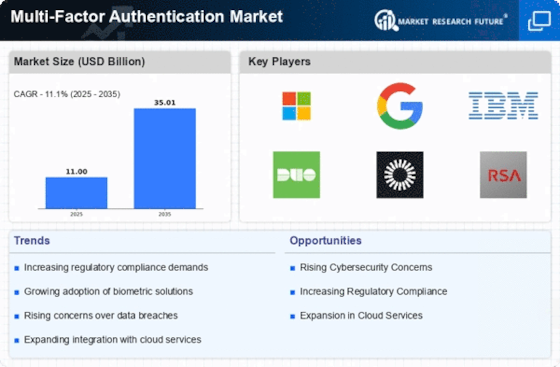
As per Market Research Future analysis, the Multi-Factor Authentication Market Size was estimated at 11.0 USD Billion in 2024. The Multi-Factor Authentication industry is projected to grow from 12.22 USD Billion in 2025 to 35.01 USD Billion by 2035, exhibiting a compound annual growth rate (CAGR) of 11.1% during the forecast period 2025 - 2035

Key Market Trends & Highlights

The Multi-Factor Authentication Market is experiencing robust growth driven by technological advancements and increasing cybersecurity awareness.

  • North America remains the largest market for multi-factor authentication solutions, reflecting a strong emphasis on cybersecurity. The Asia-Pacific region is emerging as the fastest-growing market, propelled by rising digitalization and security concerns. One-Time Passwords dominate the market, while Biometrics is rapidly gaining traction as a preferred authentication method. Increasing cyber threats and regulatory compliance requirements are key drivers fueling the demand for user-friendly security solutions.

Market Size & Forecast

2024 Market Size 11.0 (USD Billion)
2035 Market Size 35.01 (USD Billion)
CAGR (2025 - 2035) 11.1%
Largest Regional Market Share in 2024 North America

Major Players

Microsoft (US), Google (US), IBM (US), Duo Security (US), Okta (US), RSA Security (US), Ping Identity (US), Auth0 (US), Yubico (SE)

Market Trends

The Multi-Factor Authentication Market is currently experiencing a notable transformation, driven by the increasing demand for enhanced security measures across various sectors. The adoption of multi factor authentication has become a fundamental requirement for businesses aiming to meet stringent regulatory compliance standards across various sectors. As cyber threats evolve, the adoption of multi-factor authentication solutions appears to be a proactive approach to safeguarding sensitive information. This shift is particularly evident in industries such as finance, healthcare, and government, where data protection is paramount. Furthermore, the integration of advanced technologies, such as biometrics and artificial intelligence, is likely to redefine the landscape of authentication methods, making them more user-friendly and efficient.

In addition, regulatory frameworks are becoming more stringent, compelling businesses to implement robust security protocols. This regulatory pressure, combined with a growing awareness of the importance of cybersecurity, suggests that the Multi-Factor Authentication Market will continue to expand. Organizations are increasingly investing in comprehensive security strategies that incorporate multi-factor authentication as a fundamental component. As the market evolves, it may also witness innovations that enhance user experience while maintaining high security standards, indicating a promising future for multi-factor authentication solutions.

Rising Cybersecurity Awareness

There is a growing recognition among organizations regarding the necessity of robust cybersecurity measures. This heightened awareness is driving the adoption of multi-factor authentication solutions as a means to protect sensitive data from unauthorized access.

Integration of Advanced Technologies

Advanced multi-factor authentication platforms now incorporate adaptive risk-based policies, allowing for dynamic verification triggered by unusual login locations or device behaviors. Modern multifactor authentication solutions offer seamless integration with existing identity management systems, ensuring strong security without compromising user convenience. These innovations are enhancing the efficiency and user-friendliness of authentication processes, making them more appealing to businesses.

Regulatory Compliance Pressure

Increasingly stringent regulatory requirements are compelling organizations to adopt multi-factor authentication as part of their security protocols. Compliance with these regulations is becoming essential for businesses to avoid penalties and protect their reputations.

Multifactor Authentication Market Market Drivers

Increasing Cyber Threats

The rise in cyber threats has become a pivotal driver for the Multi-Factor Authentication Market. Organizations are increasingly recognizing the necessity of robust security measures to protect sensitive data from unauthorized access. In recent years, the frequency of data breaches has surged, prompting businesses to adopt multi-factor authentication as a critical component of their cybersecurity strategy. According to industry reports, the number of reported data breaches has escalated, with millions of records compromised annually. This alarming trend underscores the urgency for organizations to implement multi-factor authentication solutions, which can significantly reduce the risk of unauthorized access. As cyber threats evolve, the Multi-Factor Authentication Market is likely to experience sustained growth, driven by the imperative to safeguard digital assets.

Adoption of Remote Work Practices

The shift towards remote work practices has emerged as a crucial driver for the Multi-Factor Authentication Market. As organizations increasingly adopt flexible work arrangements, the need for secure access to corporate resources has become paramount. Multi-factor authentication provides an additional layer of security, ensuring that only authorized personnel can access sensitive information from remote locations. This trend has been accelerated by the growing reliance on cloud-based services, which necessitate robust authentication measures to protect against unauthorized access. The Multi-Factor Authentication Market is poised for growth as businesses recognize the importance of securing remote access, with many organizations implementing multi-factor authentication solutions to safeguard their digital environments.

Regulatory Compliance Requirements

Regulatory compliance is a significant driver for the Multi-Factor Authentication Market, as organizations face increasing pressure to adhere to stringent security standards. Various regulations, such as the General Data Protection Regulation (GDPR) and the Health Insurance Portability and Accountability Act (HIPAA), mandate the implementation of robust security measures to protect sensitive information. Non-compliance can result in severe penalties, prompting organizations to invest in multi-factor authentication solutions to meet these requirements. The demand for compliance-driven security measures is expected to propel the growth of the Multi-Factor Authentication Market, as businesses seek to avoid legal repercussions and enhance their security posture. As regulatory frameworks continue to evolve, the emphasis on multi-factor authentication will likely intensify, further driving market expansion.

Growing Demand for User-Friendly Security Solutions

The growing demand for user-friendly security solutions is a notable driver for the Multi-Factor Authentication Market. Organizations are increasingly aware that security measures must not only be effective but also convenient for users. Multi-factor authentication solutions that offer seamless integration and minimal disruption to user workflows are gaining traction. This trend is particularly relevant in environments where user experience is paramount, such as in financial services and e-commerce. As businesses strive to balance security with usability, the Multi-Factor Authentication Market is likely to see a rise in solutions that prioritize user-friendly features. This focus on enhancing the user experience could lead to broader adoption of multi-factor authentication across various sectors.

Technological Advancements in Authentication Solutions

Technological advancements in authentication solutions are driving innovation within the Multi-Factor Authentication Market. The integration of biometrics, artificial intelligence, and machine learning into authentication processes enhances security and user experience. These technologies enable organizations to implement more sophisticated multi-factor authentication methods, such as facial recognition and behavioral analytics, which can adapt to emerging threats. As businesses seek to leverage these advancements, the demand for cutting-edge multi-factor authentication solutions is expected to rise. The Multi-Factor Authentication Market is likely to benefit from this trend, as organizations prioritize the adoption of advanced technologies to bolster their security frameworks and protect against evolving cyber threats.

Market Segment Insights

By Authentication Method: One-Time Passwords (Largest) vs. Biometrics (Fastest-Growing)

In the Multi-Factor Authentication Market, One-Time Passwords (OTPs) currently hold the largest share, favored for their simplicity and effectiveness in providing secure access. OTPs are widely adopted across various industries, especially in banking and finance, due to their capacity to enhance security while ensuring user accessibility. In contrast, the Biometrics segment, which includes fingerprint and <a href="facial%20recognition%20-%20https://www.marketresearchfuture.com/reports/facial-recognition-market-1250">facial recognition </a>technologies, is emerging rapidly, gaining traction as organizations look for cutting-edge solutions that provide robust security while improving user experience. The growth of these segments is driven by increasing cyber threats and the demand for stronger, user-friendly authentication solutions. As OTPs continue to dominate, the surge in biometric technology adoption is propelled by advancements in sensor capabilities and the growing acceptance of biometrics in everyday consumer devices. Businesses are increasingly seeing the value in integrating these technologies to meet regulatory standards and protect sensitive data.

Authentication Method: One-Time Passwords (Dominant) vs. Biometrics (Emerging)

One-Time Passwords (OTPs) serve as the dominant force in the Multi-Factor Authentication Market due to their straightforward implementation and widespread acceptance among users. Leveraging short-lived codes, OTPs significantly reduce the chances of unauthorized access. On the other hand, Biometrics is an emerging trend that offers a new layer of security, enabling authentication through unique physical traits such as fingerprints or iris patterns. This method enhances user convenience, as it often eliminates the need for passwords altogether. As organizations prioritize security, the integration of biometrics into existing systems, along with advancements in technology, positions it as a pivotal player likely to reshape the future of user authentication.

By Deployment Type: Cloud-Based (Largest) vs. On-Premises (Fastest-Growing)

In the Multi-Factor Authentication Market, the distribution of deployment types reveals a significant preference for cloud-based solutions. This segment has captured the largest share, driven by the increasing demand for flexibility and scalability in <a href="https://www.marketresearchfuture.com/reports/us-security-solutions-market-17996">security solutions</a>. As organizations prioritize remote access and digital services, the cloud-based deployment type continues to be a pivotal component of their authentication strategies. In contrast, on-premises deployment is experiencing rapid growth, appealing to businesses that prioritize control over their security infrastructure and need to comply with stringent data regulations.

Cloud-Based: Dominant vs. On-Premises: Emerging

Cloud-based multi-factor authentication solutions dominate the market due to their user-friendly nature and the ability to integrate with various applications seamlessly. They offer businesses the flexibility to adapt to changing needs without heavy investments in infrastructure. On the other hand, on-premises solutions are gaining traction among organizations wanting to retain control over their security systems. This segment caters to industries such as healthcare and finance, where data sovereignty and regulatory compliance are critical. The rise of cyber threats has further fueled the demand for robust on-premises systems, marking it as an emerging choice for organizations prioritizing data security.

By End-user: Banking and Financial Services (Largest) vs. Government (Fastest-Growing)

In the Multi-Factor Authentication (MFA) market, the distribution of market share among end-user segments reveals that Banking and Financial Services hold the largest share. This segment's extensive reliance on secure transactions and sensitive customer data drives its demand for robust authentication solutions. Conversely, the Government sector, while smaller in share, is witnessing a rapid increase in adoption rates as governmental bodies elevate their security measures to protect sensitive citizen data and enhance service delivery efficiency.

Banking and Financial Services: Dominant vs. Government: Emerging

The Banking and Financial Services sector, as a dominant player, is characterized by its rigorous security requirements and high regulatory standards. Financial institutions prioritize multi-factor authentication to combat fraud and ensure customer trust, thus solidifying their position in the MFA market. On the other hand, the Government sector is emerging as a significant player due to its increasing focus on cybersecurity initiatives and <a href="digital%20transformation%20-%20https://www.marketresearchfuture.com/reports/digital-transformation-market-8685">digital transformation</a>. Government agencies are implementing MFA solutions to safeguard critical infrastructure and data, spurred by rising cyber threats and the need for compliant secure access among personnel.

By Component: Software (Largest) vs. Hardware (Fastest-Growing)

The Multi-Factor Authentication (MFA) market is predominantly driven by software components, which hold the largest market share due to their wide applicability across various industries, including finance, healthcare, and e-commerce. Software solutions offer flexibility, scalability, and ease of integration with existing systems, making them the preferred choice for organizations aiming to enhance their security protocols. In contrast, while hardware components, such as authentication tokens and biometric scanners, represent a smaller share, they are witnessing rapid adoption as enterprises increasingly focus on robust, physical authentication methods to combat sophisticated cyber threats. Growth in the MFA components sector is heavily influenced by the escalating incidences of cyberattacks and data breaches across industries. Organizations are prioritizing investments in security solutions, particularly those that integrate both hardware and software functionalities. The rapid emergence of IoT devices and the shift towards remote work are further propelling the demand for hardware solutions, as companies seek to ensure secure access to these endpoints. As a result, the MFA market is evolving, with software maintaining dominance while hardware adoption rapidly increases to address emerging security challenges.

Software (Dominant) vs. Hardware (Emerging)

In the Multi-Factor Authentication market, the software segment stands out as the dominant force, recognized for its versatility and widespread integration capabilities. Software solutions are designed to provide a seamless user experience while ensuring maximum security through various authentication methods, such as OTPs (one-time passwords) and mobile-based verifications. This adaptability allows organizations to implement MFA with minimal disruption to existing workflows. Conversely, the hardware segment is emerging as a crucial player, characterized by physical devices like <a href="smart%20cards%20-%20https://www.marketresearchfuture.com/reports/smart-cards-market-6499">smart cards </a>and biometrics, which offer an added layer of security. As businesses become more alert to potential vulnerabilities, the demand for hardware solutions is expected to rise, benefiting from advancements in technology that enhance user trust and authentication accuracy.

Get more detailed insights about Multi-Factor Authentication Market Research Report - Global Forecast to 2035

Regional Insights

In this context, the regional segmentation revealed significant disparities in market valuation. North America led with a prominent valuation of 4.5 USD Billion in 2024 and is expected to grow to 14.0 USD Billion by 2035, highlighting its major role in technological innovation and cybersecurity advancements.Europe followed closely with a market value of 3.0 USD Billion in 2024, expected to reach 10.0 USD Billion by 2035, driven by stringent compliance mandates in data protection.

In contrast, Asia Pacific's 2.5 USD Billion valuation in 2024, projected to grow to 7.0 USD Billion by 2035, reflected a growing awareness and adoption of multi-factor authentication solutions.

South America, valued at 1.0 USD Billion in 2024, and expected to rise to 3.5 USD Billion by 2035, indicated modest growth driven by improving digital infrastructure. Lastly, the Middle East and Africa remained the least dominant, with a valuation of 0.5 USD Billion in both 2024 and 2035, showcasing both challenges and opportunities for market penetration in these regions.Overall, these Regional insights illustrated a dynamic landscape of the Multi-Factor Authentication Market, reflecting diverse growth potentials and varying adoption rates influenced by local market conditions and regulatory environments.

Key Players and Competitive Insights

The Multi-Factor Authentication Market has been experiencing significant growth due to increasing concerns around cybersecurity and the need for enhanced security measures in digital transactions and user access.As cyber threats become more sophisticated, businesses and organizations are actively seeking multi-factor authentication solutions that offer added layers of security to protect sensitive information and systems. The competitive landscape of this market features a variety of key players that contribute to a dynamic environment, where innovation, technological advancements, and strategic partnerships play crucial roles in shaping the future of multi-factor authentication.Companies are competing not only on the basis of product effectiveness but also on factors such as scalability, ease of integration, and user experience, making it essential for businesses to remain agile and responsive to customer needs. Symantec stands out in the Multi-Factor Authentication Market with its strong reputation for providing comprehensive cybersecurity solutions. The company has established a significant presence globally, leveraging its extensive expertise in data protection and threat intelligence.Symantec's strengths lie in its ability to offer robust identity verification solutions that cater to a variety of industries, including financial services, healthcare, and government. Their deep understanding of security challenges enables them to design MFA solutions that effectively mitigate risks. Additionally, Symantec's commitment to continuous improvement and innovation has solidified its position as a trusted provider in the multi-factor authentication space, further enhancing customer loyalty and market share.Auth0 has carved a niche for itself in the Multi-Factor Authentication Market with its focus on identity management and user authentication. The company offers a range of key products and services designed to provide seamless security solutions for developers and enterprises alike, enabling them to implement MFA with ease. Auth0 is recognized for its agility and adaptability to the evolving security landscape, allowing organizations to integrate its authentication capabilities into their applications quickly. With a strong global market presence, Auth0 has built a reputation for its developer-friendly platform, which simplifies the authentication process while maintaining high-security standards.Their strengths include an impressive array of partnership opportunities and acquisitions that have enhanced their product offerings and geographical reach, positioning Auth0 as a compelling player in the multi-factor authentication ecosystem.

Key Companies in the Multifactor Authentication Market include

Industry Developments

Auth0 introduced safe authentication for AI agents with token vaulting, fine-grained authorization, and async workflows with the release of Auth for GenAI  in April 2025. Token Vault APIs and Actions-based configurable MFA support for mobile flows were made available by Auth0 in October 2024.With early availability for business clients, Okta introduced Cross App Access in June 2025, expanding OAuth to secure AI agent access and app-to-app interactions.

Okta received its ninth consecutive Gartner Leader ranking in Access Management in October 2024.
With support for FIDO2 and app-based authenticators, Microsoft implemented obligatory MFA and passwordless authentication for Azure CLI, PowerShell, and mobile apps in June 2025.Ping Identity published PingID v2.2.0 in May 2024, which included SSH integration, passwordless Windows login, and mobile-optimized authentication alerts. IBM improved Verify Access in March 2025 by adding continuous risk scoring and mobile biometrics for adaptive MFA in business settings.

Future Outlook

Multifactor Authentication Market Future Outlook

The Multi-Factor Authentication Market is projected to grow at 11.1% CAGR from 2025 to 2035, driven by increasing cybersecurity threats and regulatory compliance requirements.

New opportunities lie in:

  • <p>Integration of biometric authentication solutions in mobile applications. Development of AI-driven <a href="adaptive%20authentication%20-%20https://www.marketresearchfuture.com/reports/adaptive-authentication-market-34685">adaptive authentication </a>systems. Expansion of MFA solutions for IoT devices in smart homes.</p>

By 2035, the market for multi factor authentication is expected to be robust, reflecting substantial growth and innovation.

Market Segmentation

Multifactor Authentication Market End-user Outlook

  • Banking and Financial Services
  • Government
  • Healthcare
  • Retail
  • IT and Telecom

Multifactor Authentication Market Component Outlook

  • Hardware
  • Software
  • Services

Multifactor Authentication Market Deployment Type Outlook

  • On-Premises
  • Cloud-Based
  • Hybrid

Multifactor Authentication Market Authentication Method Outlook

  • One-Time Passwords
  • Biometrics
  • Smart Cards
  • Token-Based

Report Scope

MARKET SIZE 2024 11.0(USD Billion)
MARKET SIZE 2025 12.22(USD Billion)
MARKET SIZE 2035 35.01(USD Billion)
COMPOUND ANNUAL GROWTH RATE (CAGR) 11.1% (2025 - 2035)
REPORT COVERAGE Revenue Forecast, Competitive Landscape, Growth Factors, and Trends
BASE YEAR 2024
Market Forecast Period 2025 - 2035
Historical Data 2019 - 2024
Market Forecast Units USD Billion
Key Companies Profiled Microsoft (US), Google (US), IBM (US), Duo Security (US), Okta (US), RSA Security (US), Ping Identity (US), Auth0 (US), Yubico (SE)
Segments Covered Authentication Method, Deployment Type, End-user, Component, Regional
Key Market Opportunities Integration of biometric technologies enhances security and drives growth in the Multi-Factor Authentication Market.
Key Market Dynamics Rising cybersecurity threats drive demand for Multi-Factor Authentication solutions, enhancing user verification and data protection.
Countries Covered North America, Europe, APAC, South America, MEA

FAQs

What is the projected market valuation of the Multi-Factor Authentication Market by 2035?

<p>The Multi-Factor Authentication Market is projected to reach a valuation of 35.01 USD Billion by 2035.</p>

What was the market valuation of the Multi-Factor Authentication Market in 2024?

<p>In 2024, the market valuation of the Multi-Factor Authentication Market was 11.0 USD Billion.</p>

What is the expected CAGR for the Multi-Factor Authentication Market during the forecast period 2025 - 2035?

<p>The expected CAGR for the Multi-Factor Authentication Market during the forecast period 2025 - 2035 is 11.1%.</p>

Which authentication method segment is projected to have the highest valuation by 2035?

<p>The One-Time Passwords segment is projected to reach a valuation of 10.0 USD Billion by 2035.</p>

What is the anticipated growth of the Cloud-Based deployment type by 2035?

<p>The Cloud-Based deployment type is anticipated to grow to 17.5 USD Billion by 2035.</p>

Which end-user segment is expected to see significant growth in the Multi-Factor Authentication Market?

<p>The Banking and Financial Services segment is expected to grow to 10.0 USD Billion by 2035.</p>

What is the projected valuation for the Software component in the Multi-Factor Authentication Market by 2035?

<p>The Software component is projected to reach a valuation of 17.5 USD Billion by 2035.</p>

Who are the key players in the Multi-Factor Authentication Market?

<p>Key players in the Multi-Factor Authentication Market include Microsoft, Google, IBM, Duo Security, Okta, RSA Security, Ping Identity, Auth0, and Yubico.</p>

What is the expected valuation for the Token-Based authentication method by 2035?

<p>The Token-Based authentication method is expected to reach a valuation of 10.0 USD Billion by 2035.</p>

How does the projected growth of the Multi-Factor Authentication Market compare to its 2024 valuation?

<p>The Multi-Factor Authentication Market is expected to grow from 11.0 USD Billion in 2024 to 35.01 USD Billion by 2035.</p>

  1. SECTION I: EXECUTIVE SUMMARY AND KEY HIGHLIGHTS
    1. | 1.1 EXECUTIVE SUMMARY
    2. | | 1.1.1 Market Overview
    3. | | 1.1.2 Key Findings
    4. | | 1.1.3 Market Segmentation
    5. | | 1.1.4 Competitive Landscape
    6. | | 1.1.5 Challenges and Opportunities
    7. | | 1.1.6 Future Outlook
  2. SECTION II: SCOPING, METHODOLOGY AND MARKET STRUCTURE
    1. | 2.1 MARKET INTRODUCTION
    2. | | 2.1.1 Definition
    3. | | 2.1.2 Scope of the study
    4. | | | 2.1.2.1 Research Objective
    5. | | | 2.1.2.2 Assumption
    6. | | | 2.1.2.3 Limitations
    7. | 2.2 RESEARCH METHODOLOGY
    8. | | 2.2.1 Overview
    9. | | 2.2.2 Data Mining
    10. | | 2.2.3 Secondary Research
    11. | | 2.2.4 Primary Research
    12. | | | 2.2.4.1 Primary Interviews and Information Gathering Process
    13. | | | 2.2.4.2 Breakdown of Primary Respondents
    14. | | 2.2.5 Forecasting Model
    15. | | 2.2.6 Market Size Estimation
    16. | | | 2.2.6.1 Bottom-Up Approach
    17. | | | 2.2.6.2 Top-Down Approach
    18. | | 2.2.7 Data Triangulation
    19. | | 2.2.8 Validation
  3. SECTION III: QUALITATIVE ANALYSIS
    1. | 3.1 MARKET DYNAMICS
    2. | | 3.1.1 Overview
    3. | | 3.1.2 Drivers
    4. | | 3.1.3 Restraints
    5. | | 3.1.4 Opportunities
    6. | 3.2 MARKET FACTOR ANALYSIS
    7. | | 3.2.1 Value chain Analysis
    8. | | 3.2.2 Porter's Five Forces Analysis
    9. | | | 3.2.2.1 Bargaining Power of Suppliers
    10. | | | 3.2.2.2 Bargaining Power of Buyers
    11. | | | 3.2.2.3 Threat of New Entrants
    12. | | | 3.2.2.4 Threat of Substitutes
    13. | | | 3.2.2.5 Intensity of Rivalry
    14. | | 3.2.3 COVID-19 Impact Analysis
    15. | | | 3.2.3.1 Market Impact Analysis
    16. | | | 3.2.3.2 Regional Impact
    17. | | | 3.2.3.3 Opportunity and Threat Analysis
  4. SECTION IV: QUANTITATIVE ANALYSIS
    1. | 4.1 Information and Communications Technology, BY Authentication Method (USD Billion)
    2. | | 4.1.1 One-Time Passwords
    3. | | 4.1.2 Biometrics
    4. | | 4.1.3 Smart Cards
    5. | | 4.1.4 Token-Based
    6. | 4.2 Information and Communications Technology, BY Deployment Type (USD Billion)
    7. | | 4.2.1 On-Premises
    8. | | 4.2.2 Cloud-Based
    9. | | 4.2.3 Hybrid
    10. | 4.3 Information and Communications Technology, BY End-user (USD Billion)
    11. | | 4.3.1 Banking and Financial Services
    12. | | 4.3.2 Government
    13. | | 4.3.3 Healthcare
    14. | | 4.3.4 Retail
    15. | | 4.3.5 IT and Telecom
    16. | 4.4 Information and Communications Technology, BY Component (USD Billion)
    17. | | 4.4.1 Hardware
    18. | | 4.4.2 Software
    19. | | 4.4.3 Services
    20. | 4.5 Information and Communications Technology, BY Region (USD Billion)
    21. | | 4.5.1 North America
    22. | | | 4.5.1.1 US
    23. | | | 4.5.1.2 Canada
    24. | | 4.5.2 Europe
    25. | | | 4.5.2.1 Germany
    26. | | | 4.5.2.2 UK
    27. | | | 4.5.2.3 France
    28. | | | 4.5.2.4 Russia
    29. | | | 4.5.2.5 Italy
    30. | | | 4.5.2.6 Spain
    31. | | | 4.5.2.7 Rest of Europe
    32. | | 4.5.3 APAC
    33. | | | 4.5.3.1 China
    34. | | | 4.5.3.2 India
    35. | | | 4.5.3.3 Japan
    36. | | | 4.5.3.4 South Korea
    37. | | | 4.5.3.5 Malaysia
    38. | | | 4.5.3.6 Thailand
    39. | | | 4.5.3.7 Indonesia
    40. | | | 4.5.3.8 Rest of APAC
    41. | | 4.5.4 South America
    42. | | | 4.5.4.1 Brazil
    43. | | | 4.5.4.2 Mexico
    44. | | | 4.5.4.3 Argentina
    45. | | | 4.5.4.4 Rest of South America
    46. | | 4.5.5 MEA
    47. | | | 4.5.5.1 GCC Countries
    48. | | | 4.5.5.2 South Africa
    49. | | | 4.5.5.3 Rest of MEA
  5. SECTION V: COMPETITIVE ANALYSIS
    1. | 5.1 Competitive Landscape
    2. | | 5.1.1 Overview
    3. | | 5.1.2 Competitive Analysis
    4. | | 5.1.3 Market share Analysis
    5. | | 5.1.4 Major Growth Strategy in the Information and Communications Technology
    6. | | 5.1.5 Competitive Benchmarking
    7. | | 5.1.6 Leading Players in Terms of Number of Developments in the Information and Communications Technology
    8. | | 5.1.7 Key developments and growth strategies
    9. | | | 5.1.7.1 New Product Launch/Service Deployment
    10. | | | 5.1.7.2 Merger & Acquisitions
    11. | | | 5.1.7.3 Joint Ventures
    12. | | 5.1.8 Major Players Financial Matrix
    13. | | | 5.1.8.1 Sales and Operating Income
    14. | | | 5.1.8.2 Major Players R&D Expenditure. 2023
    15. | 5.2 Company Profiles
    16. | | 5.2.1 Microsoft (US)
    17. | | | 5.2.1.1 Financial Overview
    18. | | | 5.2.1.2 Products Offered
    19. | | | 5.2.1.3 Key Developments
    20. | | | 5.2.1.4 SWOT Analysis
    21. | | | 5.2.1.5 Key Strategies
    22. | | 5.2.2 Google (US)
    23. | | | 5.2.2.1 Financial Overview
    24. | | | 5.2.2.2 Products Offered
    25. | | | 5.2.2.3 Key Developments
    26. | | | 5.2.2.4 SWOT Analysis
    27. | | | 5.2.2.5 Key Strategies
    28. | | 5.2.3 IBM (US)
    29. | | | 5.2.3.1 Financial Overview
    30. | | | 5.2.3.2 Products Offered
    31. | | | 5.2.3.3 Key Developments
    32. | | | 5.2.3.4 SWOT Analysis
    33. | | | 5.2.3.5 Key Strategies
    34. | | 5.2.4 Duo Security (US)
    35. | | | 5.2.4.1 Financial Overview
    36. | | | 5.2.4.2 Products Offered
    37. | | | 5.2.4.3 Key Developments
    38. | | | 5.2.4.4 SWOT Analysis
    39. | | | 5.2.4.5 Key Strategies
    40. | | 5.2.5 Okta (US)
    41. | | | 5.2.5.1 Financial Overview
    42. | | | 5.2.5.2 Products Offered
    43. | | | 5.2.5.3 Key Developments
    44. | | | 5.2.5.4 SWOT Analysis
    45. | | | 5.2.5.5 Key Strategies
    46. | | 5.2.6 RSA Security (US)
    47. | | | 5.2.6.1 Financial Overview
    48. | | | 5.2.6.2 Products Offered
    49. | | | 5.2.6.3 Key Developments
    50. | | | 5.2.6.4 SWOT Analysis
    51. | | | 5.2.6.5 Key Strategies
    52. | | 5.2.7 Ping Identity (US)
    53. | | | 5.2.7.1 Financial Overview
    54. | | | 5.2.7.2 Products Offered
    55. | | | 5.2.7.3 Key Developments
    56. | | | 5.2.7.4 SWOT Analysis
    57. | | | 5.2.7.5 Key Strategies
    58. | | 5.2.8 Auth0 (US)
    59. | | | 5.2.8.1 Financial Overview
    60. | | | 5.2.8.2 Products Offered
    61. | | | 5.2.8.3 Key Developments
    62. | | | 5.2.8.4 SWOT Analysis
    63. | | | 5.2.8.5 Key Strategies
    64. | | 5.2.9 Yubico (SE)
    65. | | | 5.2.9.1 Financial Overview
    66. | | | 5.2.9.2 Products Offered
    67. | | | 5.2.9.3 Key Developments
    68. | | | 5.2.9.4 SWOT Analysis
    69. | | | 5.2.9.5 Key Strategies
    70. | 5.3 Appendix
    71. | | 5.3.1 References
    72. | | 5.3.2 Related Reports
  6. LIST OF FIGURES
    1. | 6.1 MARKET SYNOPSIS
    2. | 6.2 NORTH AMERICA MARKET ANALYSIS
    3. | 6.3 US MARKET ANALYSIS BY AUTHENTICATION METHOD
    4. | 6.4 US MARKET ANALYSIS BY DEPLOYMENT TYPE
    5. | 6.5 US MARKET ANALYSIS BY END-USER
    6. | 6.6 US MARKET ANALYSIS BY COMPONENT
    7. | 6.7 CANADA MARKET ANALYSIS BY AUTHENTICATION METHOD
    8. | 6.8 CANADA MARKET ANALYSIS BY DEPLOYMENT TYPE
    9. | 6.9 CANADA MARKET ANALYSIS BY END-USER
    10. | 6.10 CANADA MARKET ANALYSIS BY COMPONENT
    11. | 6.11 EUROPE MARKET ANALYSIS
    12. | 6.12 GERMANY MARKET ANALYSIS BY AUTHENTICATION METHOD
    13. | 6.13 GERMANY MARKET ANALYSIS BY DEPLOYMENT TYPE
    14. | 6.14 GERMANY MARKET ANALYSIS BY END-USER
    15. | 6.15 GERMANY MARKET ANALYSIS BY COMPONENT
    16. | 6.16 UK MARKET ANALYSIS BY AUTHENTICATION METHOD
    17. | 6.17 UK MARKET ANALYSIS BY DEPLOYMENT TYPE
    18. | 6.18 UK MARKET ANALYSIS BY END-USER
    19. | 6.19 UK MARKET ANALYSIS BY COMPONENT
    20. | 6.20 FRANCE MARKET ANALYSIS BY AUTHENTICATION METHOD
    21. | 6.21 FRANCE MARKET ANALYSIS BY DEPLOYMENT TYPE
    22. | 6.22 FRANCE MARKET ANALYSIS BY END-USER
    23. | 6.23 FRANCE MARKET ANALYSIS BY COMPONENT
    24. | 6.24 RUSSIA MARKET ANALYSIS BY AUTHENTICATION METHOD
    25. | 6.25 RUSSIA MARKET ANALYSIS BY DEPLOYMENT TYPE
    26. | 6.26 RUSSIA MARKET ANALYSIS BY END-USER
    27. | 6.27 RUSSIA MARKET ANALYSIS BY COMPONENT
    28. | 6.28 ITALY MARKET ANALYSIS BY AUTHENTICATION METHOD
    29. | 6.29 ITALY MARKET ANALYSIS BY DEPLOYMENT TYPE
    30. | 6.30 ITALY MARKET ANALYSIS BY END-USER
    31. | 6.31 ITALY MARKET ANALYSIS BY COMPONENT
    32. | 6.32 SPAIN MARKET ANALYSIS BY AUTHENTICATION METHOD
    33. | 6.33 SPAIN MARKET ANALYSIS BY DEPLOYMENT TYPE
    34. | 6.34 SPAIN MARKET ANALYSIS BY END-USER
    35. | 6.35 SPAIN MARKET ANALYSIS BY COMPONENT
    36. | 6.36 REST OF EUROPE MARKET ANALYSIS BY AUTHENTICATION METHOD
    37. | 6.37 REST OF EUROPE MARKET ANALYSIS BY DEPLOYMENT TYPE
    38. | 6.38 REST OF EUROPE MARKET ANALYSIS BY END-USER
    39. | 6.39 REST OF EUROPE MARKET ANALYSIS BY COMPONENT
    40. | 6.40 APAC MARKET ANALYSIS
    41. | 6.41 CHINA MARKET ANALYSIS BY AUTHENTICATION METHOD
    42. | 6.42 CHINA MARKET ANALYSIS BY DEPLOYMENT TYPE
    43. | 6.43 CHINA MARKET ANALYSIS BY END-USER
    44. | 6.44 CHINA MARKET ANALYSIS BY COMPONENT
    45. | 6.45 INDIA MARKET ANALYSIS BY AUTHENTICATION METHOD
    46. | 6.46 INDIA MARKET ANALYSIS BY DEPLOYMENT TYPE
    47. | 6.47 INDIA MARKET ANALYSIS BY END-USER
    48. | 6.48 INDIA MARKET ANALYSIS BY COMPONENT
    49. | 6.49 JAPAN MARKET ANALYSIS BY AUTHENTICATION METHOD
    50. | 6.50 JAPAN MARKET ANALYSIS BY DEPLOYMENT TYPE
    51. | 6.51 JAPAN MARKET ANALYSIS BY END-USER
    52. | 6.52 JAPAN MARKET ANALYSIS BY COMPONENT
    53. | 6.53 SOUTH KOREA MARKET ANALYSIS BY AUTHENTICATION METHOD
    54. | 6.54 SOUTH KOREA MARKET ANALYSIS BY DEPLOYMENT TYPE
    55. | 6.55 SOUTH KOREA MARKET ANALYSIS BY END-USER
    56. | 6.56 SOUTH KOREA MARKET ANALYSIS BY COMPONENT
    57. | 6.57 MALAYSIA MARKET ANALYSIS BY AUTHENTICATION METHOD
    58. | 6.58 MALAYSIA MARKET ANALYSIS BY DEPLOYMENT TYPE
    59. | 6.59 MALAYSIA MARKET ANALYSIS BY END-USER
    60. | 6.60 MALAYSIA MARKET ANALYSIS BY COMPONENT
    61. | 6.61 THAILAND MARKET ANALYSIS BY AUTHENTICATION METHOD
    62. | 6.62 THAILAND MARKET ANALYSIS BY DEPLOYMENT TYPE
    63. | 6.63 THAILAND MARKET ANALYSIS BY END-USER
    64. | 6.64 THAILAND MARKET ANALYSIS BY COMPONENT
    65. | 6.65 INDONESIA MARKET ANALYSIS BY AUTHENTICATION METHOD
    66. | 6.66 INDONESIA MARKET ANALYSIS BY DEPLOYMENT TYPE
    67. | 6.67 INDONESIA MARKET ANALYSIS BY END-USER
    68. | 6.68 INDONESIA MARKET ANALYSIS BY COMPONENT
    69. | 6.69 REST OF APAC MARKET ANALYSIS BY AUTHENTICATION METHOD
    70. | 6.70 REST OF APAC MARKET ANALYSIS BY DEPLOYMENT TYPE
    71. | 6.71 REST OF APAC MARKET ANALYSIS BY END-USER
    72. | 6.72 REST OF APAC MARKET ANALYSIS BY COMPONENT
    73. | 6.73 SOUTH AMERICA MARKET ANALYSIS
    74. | 6.74 BRAZIL MARKET ANALYSIS BY AUTHENTICATION METHOD
    75. | 6.75 BRAZIL MARKET ANALYSIS BY DEPLOYMENT TYPE
    76. | 6.76 BRAZIL MARKET ANALYSIS BY END-USER
    77. | 6.77 BRAZIL MARKET ANALYSIS BY COMPONENT
    78. | 6.78 MEXICO MARKET ANALYSIS BY AUTHENTICATION METHOD
    79. | 6.79 MEXICO MARKET ANALYSIS BY DEPLOYMENT TYPE
    80. | 6.80 MEXICO MARKET ANALYSIS BY END-USER
    81. | 6.81 MEXICO MARKET ANALYSIS BY COMPONENT
    82. | 6.82 ARGENTINA MARKET ANALYSIS BY AUTHENTICATION METHOD
    83. | 6.83 ARGENTINA MARKET ANALYSIS BY DEPLOYMENT TYPE
    84. | 6.84 ARGENTINA MARKET ANALYSIS BY END-USER
    85. | 6.85 ARGENTINA MARKET ANALYSIS BY COMPONENT
    86. | 6.86 REST OF SOUTH AMERICA MARKET ANALYSIS BY AUTHENTICATION METHOD
    87. | 6.87 REST OF SOUTH AMERICA MARKET ANALYSIS BY DEPLOYMENT TYPE
    88. | 6.88 REST OF SOUTH AMERICA MARKET ANALYSIS BY END-USER
    89. | 6.89 REST OF SOUTH AMERICA MARKET ANALYSIS BY COMPONENT
    90. | 6.90 MEA MARKET ANALYSIS
    91. | 6.91 GCC COUNTRIES MARKET ANALYSIS BY AUTHENTICATION METHOD
    92. | 6.92 GCC COUNTRIES MARKET ANALYSIS BY DEPLOYMENT TYPE
    93. | 6.93 GCC COUNTRIES MARKET ANALYSIS BY END-USER
    94. | 6.94 GCC COUNTRIES MARKET ANALYSIS BY COMPONENT
    95. | 6.95 SOUTH AFRICA MARKET ANALYSIS BY AUTHENTICATION METHOD
    96. | 6.96 SOUTH AFRICA MARKET ANALYSIS BY DEPLOYMENT TYPE
    97. | 6.97 SOUTH AFRICA MARKET ANALYSIS BY END-USER
    98. | 6.98 SOUTH AFRICA MARKET ANALYSIS BY COMPONENT
    99. | 6.99 REST OF MEA MARKET ANALYSIS BY AUTHENTICATION METHOD
    100. | 6.100 REST OF MEA MARKET ANALYSIS BY DEPLOYMENT TYPE
    101. | 6.101 REST OF MEA MARKET ANALYSIS BY END-USER
    102. | 6.102 REST OF MEA MARKET ANALYSIS BY COMPONENT
    103. | 6.103 KEY BUYING CRITERIA OF INFORMATION AND COMMUNICATIONS TECHNOLOGY
    104. | 6.104 RESEARCH PROCESS OF MRFR
    105. | 6.105 DRO ANALYSIS OF INFORMATION AND COMMUNICATIONS TECHNOLOGY
    106. | 6.106 DRIVERS IMPACT ANALYSIS: INFORMATION AND COMMUNICATIONS TECHNOLOGY
    107. | 6.107 RESTRAINTS IMPACT ANALYSIS: INFORMATION AND COMMUNICATIONS TECHNOLOGY
    108. | 6.108 SUPPLY / VALUE CHAIN: INFORMATION AND COMMUNICATIONS TECHNOLOGY
    109. | 6.109 INFORMATION AND COMMUNICATIONS TECHNOLOGY, BY AUTHENTICATION METHOD, 2024 (% SHARE)
    110. | 6.110 INFORMATION AND COMMUNICATIONS TECHNOLOGY, BY AUTHENTICATION METHOD, 2024 TO 2035 (USD Billion)
    111. | 6.111 INFORMATION AND COMMUNICATIONS TECHNOLOGY, BY DEPLOYMENT TYPE, 2024 (% SHARE)
    112. | 6.112 INFORMATION AND COMMUNICATIONS TECHNOLOGY, BY DEPLOYMENT TYPE, 2024 TO 2035 (USD Billion)
    113. | 6.113 INFORMATION AND COMMUNICATIONS TECHNOLOGY, BY END-USER, 2024 (% SHARE)
    114. | 6.114 INFORMATION AND COMMUNICATIONS TECHNOLOGY, BY END-USER, 2024 TO 2035 (USD Billion)
    115. | 6.115 INFORMATION AND COMMUNICATIONS TECHNOLOGY, BY COMPONENT, 2024 (% SHARE)
    116. | 6.116 INFORMATION AND COMMUNICATIONS TECHNOLOGY, BY COMPONENT, 2024 TO 2035 (USD Billion)
    117. | 6.117 BENCHMARKING OF MAJOR COMPETITORS
  7. LIST OF TABLES
    1. | 7.1 LIST OF ASSUMPTIONS
    2. | | 7.1.1
    3. | 7.2 North America MARKET SIZE ESTIMATES; FORECAST
    4. | | 7.2.1 BY AUTHENTICATION METHOD, 2025-2035 (USD Billion)
    5. | | 7.2.2 BY DEPLOYMENT TYPE, 2025-2035 (USD Billion)
    6. | | 7.2.3 BY END-USER, 2025-2035 (USD Billion)
    7. | | 7.2.4 BY COMPONENT, 2025-2035 (USD Billion)
    8. | 7.3 US MARKET SIZE ESTIMATES; FORECAST
    9. | | 7.3.1 BY AUTHENTICATION METHOD, 2025-2035 (USD Billion)
    10. | | 7.3.2 BY DEPLOYMENT TYPE, 2025-2035 (USD Billion)
    11. | | 7.3.3 BY END-USER, 2025-2035 (USD Billion)
    12. | | 7.3.4 BY COMPONENT, 2025-2035 (USD Billion)
    13. | 7.4 Canada MARKET SIZE ESTIMATES; FORECAST
    14. | | 7.4.1 BY AUTHENTICATION METHOD, 2025-2035 (USD Billion)
    15. | | 7.4.2 BY DEPLOYMENT TYPE, 2025-2035 (USD Billion)
    16. | | 7.4.3 BY END-USER, 2025-2035 (USD Billion)
    17. | | 7.4.4 BY COMPONENT, 2025-2035 (USD Billion)
    18. | 7.5 Europe MARKET SIZE ESTIMATES; FORECAST
    19. | | 7.5.1 BY AUTHENTICATION METHOD, 2025-2035 (USD Billion)
    20. | | 7.5.2 BY DEPLOYMENT TYPE, 2025-2035 (USD Billion)
    21. | | 7.5.3 BY END-USER, 2025-2035 (USD Billion)
    22. | | 7.5.4 BY COMPONENT, 2025-2035 (USD Billion)
    23. | 7.6 Germany MARKET SIZE ESTIMATES; FORECAST
    24. | | 7.6.1 BY AUTHENTICATION METHOD, 2025-2035 (USD Billion)
    25. | | 7.6.2 BY DEPLOYMENT TYPE, 2025-2035 (USD Billion)
    26. | | 7.6.3 BY END-USER, 2025-2035 (USD Billion)
    27. | | 7.6.4 BY COMPONENT, 2025-2035 (USD Billion)
    28. | 7.7 UK MARKET SIZE ESTIMATES; FORECAST
    29. | | 7.7.1 BY AUTHENTICATION METHOD, 2025-2035 (USD Billion)
    30. | | 7.7.2 BY DEPLOYMENT TYPE, 2025-2035 (USD Billion)
    31. | | 7.7.3 BY END-USER, 2025-2035 (USD Billion)
    32. | | 7.7.4 BY COMPONENT, 2025-2035 (USD Billion)
    33. | 7.8 France MARKET SIZE ESTIMATES; FORECAST
    34. | | 7.8.1 BY AUTHENTICATION METHOD, 2025-2035 (USD Billion)
    35. | | 7.8.2 BY DEPLOYMENT TYPE, 2025-2035 (USD Billion)
    36. | | 7.8.3 BY END-USER, 2025-2035 (USD Billion)
    37. | | 7.8.4 BY COMPONENT, 2025-2035 (USD Billion)
    38. | 7.9 Russia MARKET SIZE ESTIMATES; FORECAST
    39. | | 7.9.1 BY AUTHENTICATION METHOD, 2025-2035 (USD Billion)
    40. | | 7.9.2 BY DEPLOYMENT TYPE, 2025-2035 (USD Billion)
    41. | | 7.9.3 BY END-USER, 2025-2035 (USD Billion)
    42. | | 7.9.4 BY COMPONENT, 2025-2035 (USD Billion)
    43. | 7.10 Italy MARKET SIZE ESTIMATES; FORECAST
    44. | | 7.10.1 BY AUTHENTICATION METHOD, 2025-2035 (USD Billion)
    45. | | 7.10.2 BY DEPLOYMENT TYPE, 2025-2035 (USD Billion)
    46. | | 7.10.3 BY END-USER, 2025-2035 (USD Billion)
    47. | | 7.10.4 BY COMPONENT, 2025-2035 (USD Billion)
    48. | 7.11 Spain MARKET SIZE ESTIMATES; FORECAST
    49. | | 7.11.1 BY AUTHENTICATION METHOD, 2025-2035 (USD Billion)
    50. | | 7.11.2 BY DEPLOYMENT TYPE, 2025-2035 (USD Billion)
    51. | | 7.11.3 BY END-USER, 2025-2035 (USD Billion)
    52. | | 7.11.4 BY COMPONENT, 2025-2035 (USD Billion)
    53. | 7.12 Rest of Europe MARKET SIZE ESTIMATES; FORECAST
    54. | | 7.12.1 BY AUTHENTICATION METHOD, 2025-2035 (USD Billion)
    55. | | 7.12.2 BY DEPLOYMENT TYPE, 2025-2035 (USD Billion)
    56. | | 7.12.3 BY END-USER, 2025-2035 (USD Billion)
    57. | | 7.12.4 BY COMPONENT, 2025-2035 (USD Billion)
    58. | 7.13 APAC MARKET SIZE ESTIMATES; FORECAST
    59. | | 7.13.1 BY AUTHENTICATION METHOD, 2025-2035 (USD Billion)
    60. | | 7.13.2 BY DEPLOYMENT TYPE, 2025-2035 (USD Billion)
    61. | | 7.13.3 BY END-USER, 2025-2035 (USD Billion)
    62. | | 7.13.4 BY COMPONENT, 2025-2035 (USD Billion)
    63. | 7.14 China MARKET SIZE ESTIMATES; FORECAST
    64. | | 7.14.1 BY AUTHENTICATION METHOD, 2025-2035 (USD Billion)
    65. | | 7.14.2 BY DEPLOYMENT TYPE, 2025-2035 (USD Billion)
    66. | | 7.14.3 BY END-USER, 2025-2035 (USD Billion)
    67. | | 7.14.4 BY COMPONENT, 2025-2035 (USD Billion)
    68. | 7.15 India MARKET SIZE ESTIMATES; FORECAST
    69. | | 7.15.1 BY AUTHENTICATION METHOD, 2025-2035 (USD Billion)
    70. | | 7.15.2 BY DEPLOYMENT TYPE, 2025-2035 (USD Billion)
    71. | | 7.15.3 BY END-USER, 2025-2035 (USD Billion)
    72. | | 7.15.4 BY COMPONENT, 2025-2035 (USD Billion)
    73. | 7.16 Japan MARKET SIZE ESTIMATES; FORECAST
    74. | | 7.16.1 BY AUTHENTICATION METHOD, 2025-2035 (USD Billion)
    75. | | 7.16.2 BY DEPLOYMENT TYPE, 2025-2035 (USD Billion)
    76. | | 7.16.3 BY END-USER, 2025-2035 (USD Billion)
    77. | | 7.16.4 BY COMPONENT, 2025-2035 (USD Billion)
    78. | 7.17 South Korea MARKET SIZE ESTIMATES; FORECAST
    79. | | 7.17.1 BY AUTHENTICATION METHOD, 2025-2035 (USD Billion)
    80. | | 7.17.2 BY DEPLOYMENT TYPE, 2025-2035 (USD Billion)
    81. | | 7.17.3 BY END-USER, 2025-2035 (USD Billion)
    82. | | 7.17.4 BY COMPONENT, 2025-2035 (USD Billion)
    83. | 7.18 Malaysia MARKET SIZE ESTIMATES; FORECAST
    84. | | 7.18.1 BY AUTHENTICATION METHOD, 2025-2035 (USD Billion)
    85. | | 7.18.2 BY DEPLOYMENT TYPE, 2025-2035 (USD Billion)
    86. | | 7.18.3 BY END-USER, 2025-2035 (USD Billion)
    87. | | 7.18.4 BY COMPONENT, 2025-2035 (USD Billion)
    88. | 7.19 Thailand MARKET SIZE ESTIMATES; FORECAST
    89. | | 7.19.1 BY AUTHENTICATION METHOD, 2025-2035 (USD Billion)
    90. | | 7.19.2 BY DEPLOYMENT TYPE, 2025-2035 (USD Billion)
    91. | | 7.19.3 BY END-USER, 2025-2035 (USD Billion)
    92. | | 7.19.4 BY COMPONENT, 2025-2035 (USD Billion)
    93. | 7.20 Indonesia MARKET SIZE ESTIMATES; FORECAST
    94. | | 7.20.1 BY AUTHENTICATION METHOD, 2025-2035 (USD Billion)
    95. | | 7.20.2 BY DEPLOYMENT TYPE, 2025-2035 (USD Billion)
    96. | | 7.20.3 BY END-USER, 2025-2035 (USD Billion)
    97. | | 7.20.4 BY COMPONENT, 2025-2035 (USD Billion)
    98. | 7.21 Rest of APAC MARKET SIZE ESTIMATES; FORECAST
    99. | | 7.21.1 BY AUTHENTICATION METHOD, 2025-2035 (USD Billion)
    100. | | 7.21.2 BY DEPLOYMENT TYPE, 2025-2035 (USD Billion)
    101. | | 7.21.3 BY END-USER, 2025-2035 (USD Billion)
    102. | | 7.21.4 BY COMPONENT, 2025-2035 (USD Billion)
    103. | 7.22 South America MARKET SIZE ESTIMATES; FORECAST
    104. | | 7.22.1 BY AUTHENTICATION METHOD, 2025-2035 (USD Billion)
    105. | | 7.22.2 BY DEPLOYMENT TYPE, 2025-2035 (USD Billion)
    106. | | 7.22.3 BY END-USER, 2025-2035 (USD Billion)
    107. | | 7.22.4 BY COMPONENT, 2025-2035 (USD Billion)
    108. | 7.23 Brazil MARKET SIZE ESTIMATES; FORECAST
    109. | | 7.23.1 BY AUTHENTICATION METHOD, 2025-2035 (USD Billion)
    110. | | 7.23.2 BY DEPLOYMENT TYPE, 2025-2035 (USD Billion)
    111. | | 7.23.3 BY END-USER, 2025-2035 (USD Billion)
    112. | | 7.23.4 BY COMPONENT, 2025-2035 (USD Billion)
    113. | 7.24 Mexico MARKET SIZE ESTIMATES; FORECAST
    114. | | 7.24.1 BY AUTHENTICATION METHOD, 2025-2035 (USD Billion)
    115. | | 7.24.2 BY DEPLOYMENT TYPE, 2025-2035 (USD Billion)
    116. | | 7.24.3 BY END-USER, 2025-2035 (USD Billion)
    117. | | 7.24.4 BY COMPONENT, 2025-2035 (USD Billion)
    118. | 7.25 Argentina MARKET SIZE ESTIMATES; FORECAST
    119. | | 7.25.1 BY AUTHENTICATION METHOD, 2025-2035 (USD Billion)
    120. | | 7.25.2 BY DEPLOYMENT TYPE, 2025-2035 (USD Billion)
    121. | | 7.25.3 BY END-USER, 2025-2035 (USD Billion)
    122. | | 7.25.4 BY COMPONENT, 2025-2035 (USD Billion)
    123. | 7.26 Rest of South America MARKET SIZE ESTIMATES; FORECAST
    124. | | 7.26.1 BY AUTHENTICATION METHOD, 2025-2035 (USD Billion)
    125. | | 7.26.2 BY DEPLOYMENT TYPE, 2025-2035 (USD Billion)
    126. | | 7.26.3 BY END-USER, 2025-2035 (USD Billion)
    127. | | 7.26.4 BY COMPONENT, 2025-2035 (USD Billion)
    128. | 7.27 MEA MARKET SIZE ESTIMATES; FORECAST
    129. | | 7.27.1 BY AUTHENTICATION METHOD, 2025-2035 (USD Billion)
    130. | | 7.27.2 BY DEPLOYMENT TYPE, 2025-2035 (USD Billion)
    131. | | 7.27.3 BY END-USER, 2025-2035 (USD Billion)
    132. | | 7.27.4 BY COMPONENT, 2025-2035 (USD Billion)
    133. | 7.28 GCC Countries MARKET SIZE ESTIMATES; FORECAST
    134. | | 7.28.1 BY AUTHENTICATION METHOD, 2025-2035 (USD Billion)
    135. | | 7.28.2 BY DEPLOYMENT TYPE, 2025-2035 (USD Billion)
    136. | | 7.28.3 BY END-USER, 2025-2035 (USD Billion)
    137. | | 7.28.4 BY COMPONENT, 2025-2035 (USD Billion)
    138. | 7.29 South Africa MARKET SIZE ESTIMATES; FORECAST
    139. | | 7.29.1 BY AUTHENTICATION METHOD, 2025-2035 (USD Billion)
    140. | | 7.29.2 BY DEPLOYMENT TYPE, 2025-2035 (USD Billion)
    141. | | 7.29.3 BY END-USER, 2025-2035 (USD Billion)
    142. | | 7.29.4 BY COMPONENT, 2025-2035 (USD Billion)
    143. | 7.30 Rest of MEA MARKET SIZE ESTIMATES; FORECAST
    144. | | 7.30.1 BY AUTHENTICATION METHOD, 2025-2035 (USD Billion)
    145. | | 7.30.2 BY DEPLOYMENT TYPE, 2025-2035 (USD Billion)
    146. | | 7.30.3 BY END-USER, 2025-2035 (USD Billion)
    147. | | 7.30.4 BY COMPONENT, 2025-2035 (USD Billion)
    148. | 7.31 PRODUCT LAUNCH/PRODUCT DEVELOPMENT/APPROVAL
    149. | | 7.31.1
    150. | 7.32 ACQUISITION/PARTNERSHIP
    151. | | 7.32.1

Information and Communications Technology Market Segmentation

Information and Communications Technology By Authentication Method (USD Billion, 2025-2035)

  • One-Time Passwords
  • Biometrics
  • Smart Cards
  • Token-Based

Information and Communications Technology By Deployment Type (USD Billion, 2025-2035)

  • On-Premises
  • Cloud-Based
  • Hybrid

Information and Communications Technology By End-user (USD Billion, 2025-2035)

  • Banking and Financial Services
  • Government
  • Healthcare
  • Retail
  • IT and Telecom

Information and Communications Technology By Component (USD Billion, 2025-2035)

  • Hardware
  • Software
  • Services
Infographic

Free Sample Request

Kindly complete the form below to receive a free sample of this Report

Get Free Sample

Customer Strories

Compare Licence

×
Features License Type
Single User Multiuser License Enterprise User
Price $4,950 $5,950 $7,250
Maximum User Access Limit 1 User Upto 10 Users Unrestricted Access Throughout the Organization
Free Customization
Direct Access to Analyst
Deliverable Format
Platform Access
Discount on Next Purchase 10% 15% 15%
Printable Versions