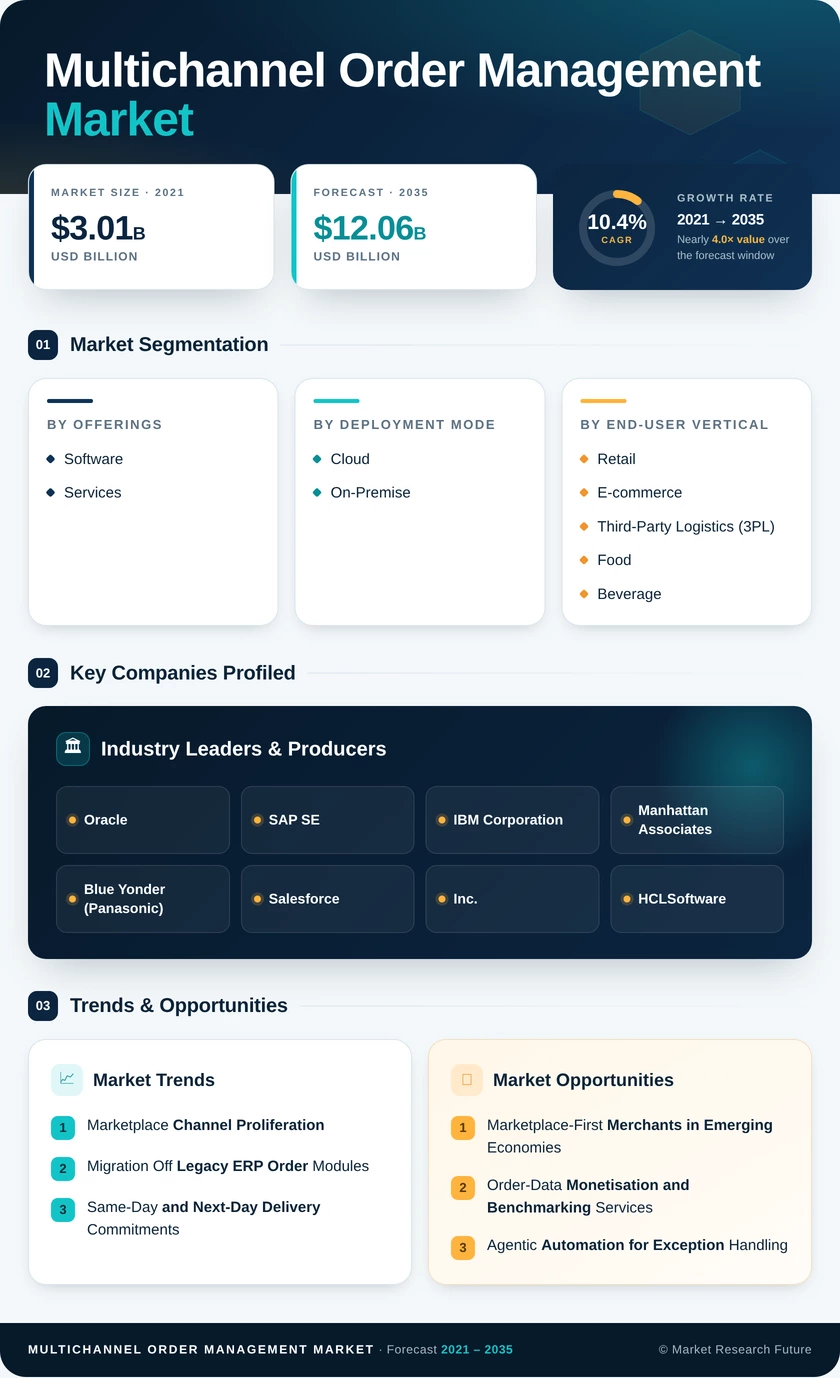
Segmentation Quick Reference
| Dimension | Sub-Segments | Dominant Segment | Fastest Growing Segment |
| By Offerings | Software; Services | Software — 66.9% revenue share (2025) | Services — 13.9% CAGR (2026–2035) |
| By Deployment Mode | Cloud; On-Premise | Cloud — 63.6% revenue share (2025) | Cloud — 63.6% revenue share (2025) |
| By End-user Vertical | Retail and E-commerce; Third-Party Logistics (3PL); Food and Beverage; Healthcare; Other End-user Verticals | Retail and E-commerce — 43.1% revenue share (2025) | Third-Party Logistics (3PL) — 13.4% CAGR (2026–2035) |
| By Organisation Size | Large Enterprises; Small and Medium Enterprises | Large Enterprises — 55.5% revenue share (2025) | Small and Medium Enterprises — 14.0% CAGR (2026–2035) |
| By Sales-Channel Complexity | Pure-play Digital; Click-and-mortar; Marketplace Sellers | Click-and-mortar — 46.9% revenue share (2025) | Marketplace Sellers — 13.1% CAGR (2026–2035) |
| By Region | North America; Europe; Asia-Pacific; South America; Middle East & Africa | North America — 38.2% revenue share | Asia-Pacific — 13.1% CAGR (2026–2035) |
Market Segmentation Overview
By Offerings
| Sub-Segment | Key Trend |
| Software | Consolidation of promising, allocation, and returns logic into a single configurable engine. |
| Services | Shift from fixed-scope delivery toward continuous managed optimisation and model tuning. |
Software leads this dimension at 66.9% of 2025 revenue because orchestration rules are the asset that survives channel churn, and buyers capitalise on them accordingly. Services grow faster at 13.9% CAGR for a specific architectural reason: composable deployments add integration points with every new channel, and few retailers retain the in-house engineering depth to maintain them. Managed contracts now cover upgrade sequencing and allocation-model retraining, work that did not exist under monolithic suites.
By Deployment Mode
| Sub-Segment | Key Trend |
| Cloud | Elastic provisioning sized for peak trading bursts rather than annual average load |
| On-Premise | Persistence in sovereign-hosting and tightly ERP-coupled distribution environments |
Cloud holds 63.6% of 2025 revenue and is also the faster-expanding mode, because peak-week order volumes can exceed baseline several times over and owned hardware sized for that peak sits idle for eleven months. On-Premise retains USD 1.63 billion, concentrated where pharmaceutical serialisation or national data rules prohibit external processing. Hybrid configurations increasingly split the difference, replicating availability data to cloud services while transaction posting remains local.
By End-user Vertical
| Sub-Segment | Key Trend |
| Retail and E-commerce | Store-fulfilment expansion to meet sub-24-hour delivery promises |
| Third-Party Logistics (3PL) | Multi-tenant rule sets, automated client billing, and shared visibility portals |
| Food and Beverage | Lot-level traceability tied to recall readiness and cold-chain sequencing |
| Healthcare | Serialisation and chain-of-custody documentation embedded in order flow |
| Other End-user Verticals | Spare-parts and industrial distribution routing across dealer networks |
Retail and E-commerce dominates at 43.1% share because no other vertical carries the same channel spread combined with consumer-grade delivery expectations. Third-Party Logistics (3PL) grows fastest at 13.4% CAGR as brands convert fixed warehouse cost into variable cost, which obliges providers to support distinct SLAs, label formats, and billing rules per client inside one instance. Food and Beverage adoption is compliance-driven rather than service-driven, with recall traceability the deciding requirement.
By Organisation Size
| Sub-Segment | Key Trend |
| Large Enterprises | Multi-entity, multi-country rollouts sequenced against ERP modernisation programmes. |
| Small and Medium Enterprises | Template configuration and connector libraries replacing custom development |
Large Enterprises account for 55.5% of 2025 revenue through contract value rather than logo count, since global deployments spanning dozens of legal entities and tax jurisdictions carry seven-figure annual commitments. Small and Medium Enterprises expand fastest at 14.0% CAGR, driven by subscription tiers that eliminate capital approval and by pre-built connectors to widely used storefronts and regional marketplaces. Vendor product investment has followed, prioritising self-service dashboards over administrator-dependent configuration consoles.
By Sales-Channel Complexity
| Sub-Segment | Key Trend |
| Pure-play Digital | Carrier-cost optimisation and distribution-centre allocation efficiency |
| Click-and-mortar | Continuous reconciliation of store shelf positions with digital availability |
| Marketplace Sellers | Sub-second listing refresh across multiple portals to prevent oversell |
Click-and-mortar operators lead at 46.9% of 2025 revenue because synchronising store and warehouse positions is the hardest orchestration problem and carries the most visible financial penalty when it fails. Marketplace Sellers grow fastest at 13.1% CAGR as portal ecosystems widen and social-commerce checkout generates unpredictable order bursts that batch synchronisation cannot absorb. Pure-play Digital merchants, at USD 1.30 Billion, optimise primarily on carrier cost rather than node complexity.


 Noah Malgeri
Co-Founder

 Peter Groot koerkamp
Account and Business Manager

 Younghwan Choi
Senior Retail Manager

 Mark Irwin
Management Consultant

 Akif Moroglu
Strategy & Business Development Director

 Guilherme Gomes Martins
Product Management Director

 Joseph Aguayo
Sales Operations & Pricing Manager

 La Terria Dodd
Program Support Specialist

 Rob Kooiker
Group Product Manager HVAC & Fire Protection GMA