Request Free Sample ×

Kindly complete the form below to receive a free sample of this Report

* Please use a valid business email

Leading companies partner with us for data-driven Insights

clients tt-cursor
Hero Background
English
Chinese
French
Japanese
Korean
German
Spanish

MRSA Drugs Market Share

ID: MRFR/Pharma/1570-CR
128 Pages
Satyendra Maurya
May 2024

Methicillin-resistant Staphylococcus Aureus Drugs Market Research Report Information By Drug Class (Lipopeptides, Oxazolidinones, Cephalosporin, Tetracycline, Folate Antagonist, and Other Drug Classes), By Route of Administration (Oral Administration and Parenteral Administration), By Distribution Channel (Retail Pharmacies, Hospital Pharmacies, and Online Pharmacies), And By Region (North America, Europe, Asia-Pacific, And Rest Of The World) –Market Forecast Till 2035

Share:
Download PDF ×

We do not share your information with anyone. However, we may send you emails based on your report interest from time to time. You may contact us at any time to opt-out.

MRSA Drugs Market Infographic
Purchase Options

Market Share

MRSA Drugs Market Share Analysis

The rapid growth of the global Methicillin-resistant Staphylococcus aureus (MRSA) drugs manufacturing market is anticipated, buoyed by the substantial support and incentives extended by governments towards MRSA prevention. Notably, the establishment of a task force by President Barack Obama aimed at formulating a comprehensive national strategy to combat antibiotic-resistant bacteria stands out as a significant stride. These governmental initiatives serve as a valuable impetus for the MRSA drugs market, enhancing its growth prospects.

Governments worldwide are recognizing the severity of antibiotic-resistant strains like MRSA and are actively engaging in initiatives to curb their impact. The concerted efforts to address MRSA prevention at a national level underscore a commitment to public health and safety. President Obama's task force, dedicated to developing a strategic approach against antibiotic-resistant bacteria, is emblematic of the global recognition of the urgency to tackle this public health challenge.

The support from governments translates into a favorable environment for the MRSA drugs manufacturing market. The financial backing and strategic planning facilitated by these initiatives contribute to the research, development, and production of drugs specifically designed to combat MRSA infections. As a result, the market benefits from a conducive landscape that fosters innovation and the implementation of effective solutions to counter the antibiotic-resistant strains.

One of the key drivers propelling the growth of the global MRSA drugs market is the escalating demand for MRSA drugs. This heightened demand is closely linked to an increased awareness of MRSA, particularly in developed economies. As awareness campaigns gain traction, individuals become more informed about the risks associated with MRSA infections and the importance of seeking appropriate treatment.

Developed economies, characterized by robust healthcare systems and widespread access to information, are witnessing a surge in awareness initiatives. These campaigns not only educate the public about MRSA but also emphasize the significance of early detection and appropriate medication. Consequently, a growing number of individuals in these economies are seeking MRSA drugs, contributing to the overall expansion of the market.

The nexus between awareness and demand is pivotal for the MRSA drugs market. As people become more cognizant of the risks posed by antibiotic-resistant strains, the demand for effective drugs to combat MRSA infections rises. This heightened demand serves as a driving force for pharmaceutical companies, prompting them to invest in research and development to meet the growing needs of the market.

In conclusion, the global MRSA drugs manufacturing market is poised for swift growth, driven by the support and initiatives of governments worldwide. The establishment of task forces and national strategies underscores a collective commitment to addressing the challenges posed by antibiotic-resistant bacteria. Additionally, the growing awareness of MRSA, especially in developed economies, significantly contributes to the rising demand for MRSA drugs, creating a conducive environment for market expansion.


Author
Author Profile
Satyendra Maurya
Research Analyst

An accomplished research analyst with high proficiency in market forecasting, data visualization, competitive benchmarking, and others. He holds a pronounced track record in research and consulting projects for sectors such as life sciences, medical devices, and healthcare IT. His capabilities in qualitative and quantitative analysis have resulted in positive client outcomes. Working on niche market trends, opportunities, sales, and forecasted value is part of his skill set.

Leave a Comment

FAQs

What is the current valuation of the Methicillin-resistant Staphylococcus Aureus Drugs Market?

<p>The market valuation was 3.45 USD Billion in 2024.</p>

What is the projected market size for the Methicillin-resistant Staphylococcus Aureus Drugs Market by 2035?

<p>The projected valuation for 2035 is 5.369 USD Billion.</p>

What is the expected CAGR for the Methicillin-resistant Staphylococcus Aureus Drugs Market during the forecast period?

<p>The expected CAGR from 2025 to 2035 is 4.1%.</p>

Which drug classes are included in the Methicillin-resistant Staphylococcus Aureus Drugs Market?

<p>Key drug classes include Lipopeptides, Oxazolidinones, Cephalosporin, Tetracycline, Folate Antagonist, and Other Drug Classes.</p>

How do the revenues of different drug classes compare in the market?

<p>In 2024, Cephalosporin generated 1.2 to 1.8 USD Billion, while Lipopeptides accounted for 0.5 to 0.75 USD Billion.</p>

What are the primary routes of administration for these drugs?

<p>The main routes of administration are Oral Administration, valued at 1.5 to 2.3 USD Billion, and Parenteral Administration, valued at 1.95 to 3.069 USD Billion.</p>

What distribution channels are utilized in the Methicillin-resistant Staphylococcus Aureus Drugs Market?

Distribution channels include Hospital Pharmacies, Retail Pharmacies, and Online Pharmacies.

What is the revenue range for Hospital Pharmacies in this market?

Hospital Pharmacies generated revenues between 1.5 to 2.3 USD Billion in 2024.

Which companies are leading the Methicillin-resistant Staphylococcus Aureus Drugs Market?

Key players include Pfizer, Merck &amp; Co, Johnson &amp; Johnson, Novartis, and Bristol-Myers Squibb.

What trends are anticipated in the Methicillin-resistant Staphylococcus Aureus Drugs Market by 2035?

The market is likely to experience growth driven by advancements in drug development and increasing resistance to antibiotics.

Market Summary

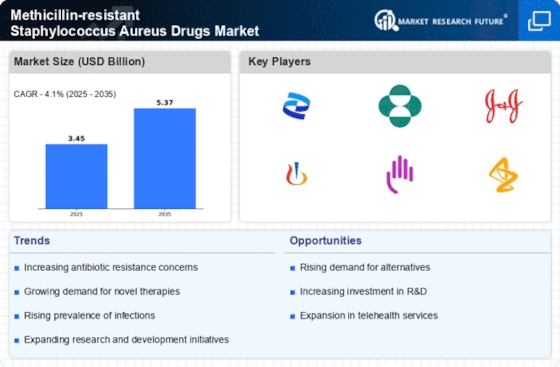
As per Market Research Future analysis, the Methicillin-resistant Staphylococcus Aureus Drugs Market Size was estimated at 3.45 USD Billion in 2024. The Methicillin-resistant Staphylococcus Aureus Drugs industry is projected to grow from 3.592 USD Billion in 2025 to 5.369 USD Billion by 2035, exhibiting a compound annual growth rate (CAGR) of 4.1% during the forecast period 2025 - 2035

Key Market Trends & Highlights

The Methicillin-resistant Staphylococcus Aureus Drugs Market is experiencing a dynamic shift towards innovative treatment options and heightened awareness.

  • The rising incidence of MRSA infections is driving demand for effective therapeutic solutions. There is a notable focus on novel therapeutics, particularly in the development of lipopeptides, which currently dominate the market. North America remains the largest market, while the Asia-Pacific region is emerging as the fastest-growing area for MRSA drug development. Increased healthcare expenditure and rising awareness of MRSA infections are key drivers propelling market growth.

Market Size & Forecast

2024 Market Size 3.45 (USD Billion)
2035 Market Size 5.369 (USD Billion)
CAGR (2025 - 2035) 4.1%
Largest Regional Market Share in 2024 North America

Major Players

Pfizer (US), Merck &amp; Co (US), <a href="https://www.jnj.com/innovativemedicine/emea/our-innovation/focus-areas/communicable-diseases/bacterial-infections">Johnson &amp; Johnson</a> (US), Novartis (CH), Bristol-Myers Squibb (US), AstraZeneca (GB), Gilead Sciences (US), Sanofi (FR), AbbVie (US)

Market Trends

The Methicillin-resistant Staphylococcus Aureus Drugs Market is currently experiencing notable shifts driven by various factors. The increasing prevalence of MRSA infections has led to heightened demand for effective treatment options. Healthcare providers are actively seeking innovative therapies to combat resistant strains, which has prompted pharmaceutical companies to invest in research and development. Furthermore, the growing awareness of antibiotic resistance among the public and healthcare professionals is influencing prescribing practices, thereby impacting market dynamics. As a result, the landscape of available drugs is evolving, with a focus on novel mechanisms of action and combination therapies that may enhance efficacy against resistant bacteria. In addition, regulatory bodies are playing a crucial role in shaping the Methicillin-resistant Staphylococcus Aureus Drugs Market. Stricter guidelines and approval processes for new antibiotics are emerging, which could affect the speed at which new treatments reach the market. This regulatory environment may encourage pharmaceutical companies to prioritize the development of drugs that address unmet medical needs. Overall, the Methicillin-resistant Staphylococcus Aureus Drugs Market appears poised for transformation as stakeholders adapt to the challenges posed by antibiotic resistance and strive to deliver effective solutions for patients in need.

Rising Incidence of MRSA Infections

The increasing occurrence of Methicillin-resistant Staphylococcus Aureus infections is driving demand for effective treatment options. This trend highlights the urgent need for innovative therapies that can address the challenges posed by resistant strains.

Focus on Novel Therapeutics

Pharmaceutical companies are increasingly investing in the development of novel therapeutics aimed at combating MRSA. This trend reflects a shift towards exploring new mechanisms of action and combination therapies to enhance treatment efficacy.

Regulatory Influence on Drug Development

The evolving regulatory landscape is impacting the Methicillin-resistant Staphylococcus Aureus Drugs Market. Stricter guidelines for antibiotic approval are shaping the development pipeline, encouraging companies to prioritize drugs that meet critical medical needs.

MRSA Drugs Market Market Drivers

Increased Healthcare Expenditure

The rise in healthcare expenditure across various regions is a crucial driver for the Methicillin-resistant Staphylococcus Aureus Drugs Market. As healthcare budgets expand, there is a greater allocation of resources towards infectious disease management, including MRSA. Governments and private sectors are investing in advanced healthcare infrastructure, which includes the procurement of effective MRSA treatments. Reports suggest that healthcare spending is expected to grow at a compound annual growth rate of 5.4% from 2021 to 2028. This increase in funding is likely to enhance the availability of MRSA drugs, thereby fostering growth in the Methicillin-resistant Staphylococcus Aureus Drugs Market.

Advancements in Antibiotic Research

The ongoing advancements in antibiotic research are significantly influencing the Methicillin-resistant Staphylococcus Aureus Drugs Market. Researchers are increasingly focusing on developing novel antibiotics and alternative therapies to combat MRSA, which has shown resistance to many conventional treatments. The market is witnessing a shift towards the exploration of new drug classes, including bacteriophage therapy and antimicrobial peptides. Recent studies indicate that The Methicillin-resistant Staphylococcus Aureus Drugs is projected to reach USD 60 billion by 2025, with a substantial portion dedicated to MRSA-targeted therapies. This trend underscores the urgency for innovative solutions, thereby driving investments and research initiatives within the Methicillin-resistant Staphylococcus Aureus Drugs Market.

Rising Awareness of MRSA Infections

The increasing awareness surrounding Methicillin-resistant Staphylococcus Aureus (MRSA) infections is a pivotal driver for the Methicillin-resistant Staphylococcus Aureus Drugs Market. Educational campaigns by health organizations and government bodies have heightened public consciousness about the risks associated with MRSA. This awareness has led to a surge in demand for effective treatment options, thereby propelling market growth. In recent years, the prevalence of MRSA infections has been reported to affect millions, with estimates suggesting that approximately 80,000 invasive MRSA infections occur annually in the United States alone. Consequently, healthcare providers are more inclined to invest in innovative drugs that target MRSA, further stimulating the Methicillin-resistant Staphylococcus Aureus Drugs Market.

Regulatory Support for Drug Development

Regulatory support for drug development is a significant driver for the Methicillin-resistant Staphylococcus Aureus Drugs Market. Regulatory agencies are increasingly recognizing the need for expedited approval processes for new MRSA treatments, given the urgent public health threat posed by resistant infections. Initiatives such as the FDA's Qualified Infectious Disease Product designation aim to encourage the development of new antibiotics. This regulatory framework not only accelerates the approval timeline but also provides financial incentives for pharmaceutical companies. As a result, the Methicillin-resistant Staphylococcus Aureus Drugs Market is likely to benefit from a more favorable environment for innovation and drug availability.

Emergence of Multidrug-Resistant Strains

The emergence of multidrug-resistant strains of MRSA is a pressing concern that is driving the Methicillin-resistant Staphylococcus Aureus Drugs Market. As MRSA continues to evolve, traditional antibiotics are becoming less effective, necessitating the development of new therapeutic options. The World Health Organization has classified MRSA as a high-priority pathogen, emphasizing the need for urgent action in drug development. This situation has prompted pharmaceutical companies to invest heavily in research and development of novel drugs that can effectively target these resistant strains. The urgency to address this challenge is likely to propel the Methicillin-resistant Staphylococcus Aureus Drugs Market forward.

Market Segment Insights

By Drug Class: Lipopeptides (Largest) vs. Oxazolidinones (Fastest-Growing)

In the Methicillin-resistant Staphylococcus Aureus (MRSA) Drugs Market, the distribution of market share among various drug classes showcases a competitive landscape. Lipopeptides continue to hold the largest share, largely due to their efficacy in targeting MRSA infections. Meanwhile, oxazolidinones are rapidly gaining traction as healthcare providers increasingly favor them for their unique mechanism of action and favorable safety profile. Other categories, such as cephalosporins, tetracyclines, folate antagonists, and various other drug classes, contribute to the market but currently hold smaller shares compared to these two dominant segments. The growth trends in the MRSA Drugs Market reflect an increasing demand for effective treatments, driven by the rise of antibiotic resistance. This scenario is propelling the development and adoption of newer classes, with oxazolidinones characterized as the fastest-growing segment. Their rapid acceptance is spurred by clinical guidelines endorsing their use and increased awareness among clinicians about the implications of MRSA infections, creating a heightened focus on effective treatment options that can address this significant public health concern.

Lipopeptides (Dominant) vs. Oxazolidinones (Emerging)

Lipopeptides have established themselves as a dominant force in the MRSA Drugs Market, primarily evidenced by their proven effectiveness against a broad spectrum of MRSA strains. Their unique action mechanism disrupts bacterial cell membranes, which is critical in treating resistant infections. Clinicians appreciate their reliability particularly in severe cases of MRSA, ensuring their continued relevance. On the other hand, oxazolidinones are characterized as an emerging segment, distinguished by their novel approach as protein synthesis inhibitors. The increasing trend towards antibiotic stewardship is fostering interest in these agents, known for a lower propensity to contribute to resistance. Their growing presence highlights a shift towards therapies that offer both effectiveness and usability, aligning with current treatment paradigms that emphasize mitigating resistance issues.

By Route of Administration: Oral Administration (Largest) vs. Parenteral Administration (Fastest-Growing)

In the Methicillin-resistant Staphylococcus Aureus (MRSA) Drugs Market, the Route of Administration segment is characterized by two primary methods: Oral Administration and Parenteral Administration. Oral Administration holds the largest share, appealing to patients for its convenience and ease of use. Meanwhile, Parenteral Administration is emerging rapidly due to its ability to deliver drugs more directly into the system, ensuring higher bioavailability and faster therapeutic effects. This shift reflects the growing preference for treatments that provide quick results in combating MRSA infections. As healthcare systems increasingly adopt advanced therapies for MRSA treatment, the growth trends indicate a rising inclination towards Parenteral Administration among healthcare professionals and patients alike. Factors contributing to this trend include the demand for fast-acting formulations and the developing landscape of injectable antibiotics that target MRSA specifically. Furthermore, innovations in drug delivery systems are enhancing the efficacy of parenteral medications, which strengthens their position in the market, making this segment a focal point for investment and development in the near future.

Oral Administration (Dominant) vs. Parenteral Administration (Emerging)

Oral Administration is widely recognized as the dominant route for delivering MRSA drugs, primarily due to its user-friendly nature, often leading to better patient compliance. This method allows self-administration, reducing the need for hospital visits. Conversely, Parenteral Administration is perceived as an emerging alternative, gaining traction for its ability to offer rapid therapeutic intervention. It is especially favored in acute care settings where immediate antibiotic action is essential. The cultivation of novel injectable drugs specifically targeting MRSA has catalyzed interest in parenteral options, and as healthcare providers seek efficient treatment paradigms, the dynamics between these two routes continue to evolve, potentially reshaping the treatment landscape for MRSA.

By Distribution Channel: Hospital Pharmacies (Largest) vs. Online Pharmacies (Fastest-Growing)

In the Methicillin-resistant Staphylococcus Aureus (MRSA) drugs market, the distribution channels have distinct shares. Hospital pharmacies are currently the largest segment, capturing a significant portion of the market due to their crucial role in patient care and access to specialized drugs. Conversely, online pharmacies are gaining traction as consumer preferences shift towards convenience and accessibility, particularly in the aftermath of the pandemic. Retail pharmacies also play a vital role, but their growth rate lags behind online channels as more patients opt for online prescriptions and home delivery services. The growth trends in the distribution channel are influenced by several factors. Hospital pharmacies remain dominant due to their established relationships with healthcare providers, securring faster access to MRSA treatments. Online pharmacies are emerging as the fastest-growing segment, benefiting from increased digital adoption and the desire for ease of purchasing medication. Retail pharmacies must innovate to keep pace with these trends, focusing on personalized customer experiences and integrated health services to retain consumer interest and loyalty.

Hospital Pharmacies (Dominant) vs. Online Pharmacies (Emerging)

Hospital pharmacies serve as the backbone for administering MRSA drugs, offering personalized care and medications tailored to patient needs within a clinical setting. Their dominance is attributed to established healthcare networks and regulatory compliance, ensuring that patients receive the latest treatment systematically. In contrast, online pharmacies represent an emerging channel that caters to the growing demand for convenience in medication access. They leverage technology to provide quick ordering and delivery services, appealing especially to a younger, tech-savvy demographic. The competition between these two segments highlights a shift in consumer behavior, with patient-centric care from hospital pharmacies versus the user-friendly, accessible model posed by online platforms. As a result, both channels are poised to influence market dynamics significantly.

Get more detailed insights about Methicillin-resistant Staphylococcus Aureus Drugs Market Research Report — Global Forecast till 2035

Regional Insights

By region, the study provides the market insights into North America, Europe, Asia-Pacific and Rest of the World. The North American Methicillin-resistant Staphylococcus Aureus Drugs market area will dominate this market. North America is predicted to remain dominant in the forecast period due to the strategic presence of important antibiotic manufacturing businesses in the U.S. This is because major players are investing more in the R&D of innovative medication molecules against MRSA infection.

Further, the major countries studied in the market report are the US, Canada, German, France, the UK, Italy, Spain, China, Japan, India, Australia, and South Korea.

Europe Methicillin-resistant Staphylococcus Aureus Drugs market accounts for the second-largest market share because of research grants to encourage the development of anti-MRSA medications from European governments and private companies. In addition, the UK government is working hard to stop surgical site infections (SSIs) from happening there. Thus, market expansion in Europe is being driven by the government's enhanced efforts and preventive measures for the reduction of

. Further, the German Methicillin-resistant Staphylococcus Aureus Drugs market held the largest market share, and the UK Methicillin-resistant Staphylococcus Aureus Drugs market was the fastest growing market in the European region.

The Asia-Pacific Methicillin-resistant Staphylococcus Aureus Drugs Market is expected to grow at the fastest CAGR from 2024 to 2032. The increasing rate of MRSA infections and the improved healthcare system in the area are the main drivers of the market expansion. Furthermore, the public health agencies' and the government's increased assistance in treating MRSA infections in individuals is anticipated to drive target market expansion. Moreover, China’s Methicillin-resistant Staphylococcus Aureus Drugs market held the largest market share, and the Indian Methicillin-resistant Staphylococcus Aureus Drugs market was the fastest growing market in the Asia-Pacific region.


Key Players and Competitive Insights

Leading market players are investing heavily in research and development in order to expand their product lines, which will help the Methicillin-resistant Staphylococcus Aureus Drugs market, grow even more. Market participants are also undertaking a variety of strategic activities to expand their global footprint, with important market developments including new product launches, contractual agreements, mergers and acquisitions, higher investments, and collaboration with other organizations. To expand and survive in a more competitive and rising market climate, Methicillin-resistant Staphylococcus Aureus Drugs industry must offer cost-effective items.
Manufacturing locally to minimize operational costs is one of the key business tactics used by manufacturers in the global Methicillin-resistant Staphylococcus Aureus Drugs industry to benefit clients and increase the market sector. In recent years, the Methicillin-resistant Staphylococcus Aureus Drugs industry has offered some of the most significant advantages to medicine.
Major players in the Methicillin-resistant Staphylococcus Aureus Drugs market are attempting to increase market demand by investing in research and development operations includes Teva Pharmaceutical Industries ltd, Cumberland Pharmaceuticals Inc, AbbVie Inc., Merck & Co Inc, Pfizer Inc, Theravance Biopharma, Basilea Pharmaceutica, AmpliPhi Biosciences Corporation, Debiopharm International S.A., Nabriva Therapeutics Plc, Melinta Therapeutics Inc, Innovation Pharmaceuticals Inc., and Paratek Pharmaceuticals, Inc.
The biopharmaceutical business Melinta Therapeutics, LLC (Melinta) is dedicated to the discovery of innovative anti-infectives for the treatment of diverse bacterial illnesses. Antibiotics are part of its marketed portfolio and are used to treat severe bacterial infections, such as complicated urinary tract infections (cUTI) and acute bacterial skin and skin structure infections (ABSSSI), as well as to prevent and treat other serious infections caused by susceptible bacteria. A startup in the commercial stage, Melinta Therapeutics (Melinta) creates innovative remedies for acute and
. The lipoglycopeptide antibiotic KIMYRSA (oritavancin), which totally resolves acute bacterial skin and skin structure infections (ABSSSI) with a single, one-hour infusion of 1,200 mg, was recently introduced for commercial use, according to the firm.
Specializing in the acquisition, development, and marketing of branded prescription medications, Cumberland Pharmaceuticals Inc. (Cumberland) is a pharmaceutical firm. Gastroenterology, cancer supportive care, and acute care in hospitals are its main target markets. With the help of its US hospital and gastrointestinal sales teams, Cumberland Pharma advertises approved medications. Additionally, the business is building a global network of partners to sell its goods in other nations. Nashville, Tennessee, in the United States, is home to Cumberland Pharma's headquarters.

Key Companies in the MRSA Drugs Market include

Industry Developments

May 2023: 

The company Roche Information Solutions India Pvt Ltd, which creates cutting-edge solutions to support labs and physicians, has announced that it will be exhibiting cutting-edge digital diagnostics and laboratory solutions under the theme "Innovation Past, Present, and Future" at WorldLab-EuroMedLab 2023, which will take place in Rome, Italy, from May 21–25. Attendees get the chance to see firsthand the most recent technical innovations from Roche in point of care, molecular, lab automation, and serum workspace.

July 2021: 

KIMYRSA (oritavancin), a lipoglycopeptide antibiotic developed by Melinta Therapeutics, provides a comprehensive course of treatment for acute bacterial skin and skin structure infections (ABSSSI) brought on by susceptible isolates of specific Gram-positive microorganisms, such as methicillin-resistant Staphylococcus aureus (MRSA).

Future Outlook

MRSA Drugs Market Future Outlook

The Methicillin-resistant Staphylococcus Aureus Drugs Market is projected to grow at a 4.1% CAGR from 2025 to 2035, driven by rising infection rates, innovative drug development, and increased healthcare spending.

New opportunities lie in:

  • Expansion of telehealth services for MRSA treatment management.
  • Development of combination therapies to enhance treatment efficacy.
  • Investment in rapid diagnostic technologies for timely MRSA detection.

By 2035, the market is expected to achieve robust growth, reflecting evolving treatment paradigms and increased demand.

Market Segmentation

MRSA Drugs Market Drug Class Outlook

  • Lipopeptides
  • Oxazolidinones
  • Cephalosporin
  • Tetracycline
  • Folate Antagonist
  • Other Drug Classes

MRSA Drugs Market Distribution Channel Outlook

  • Hospital Pharmacies
  • Retail Pharmacies
  • Online Pharmacies

MRSA Drugs Market Route of Administration Outlook

  • Oral Administration
  • Parenteral Administration

Report Scope

MARKET SIZE 2024 3.45(USD Billion)
MARKET SIZE 2025 3.592(USD Billion)
MARKET SIZE 2035 5.369(USD Billion)
COMPOUND ANNUAL GROWTH RATE (CAGR) 4.1% (2025 - 2035)
REPORT COVERAGE Revenue Forecast, Competitive Landscape, Growth Factors, and Trends
BASE YEAR 2024
Market Forecast Period 2025 - 2035
Historical Data 2019 - 2024
Market Forecast Units USD Billion
Key Companies Profiled Pfizer (US), Merck & Co (US), Johnson & Johnson (US), Novartis (CH), Bristol-Myers Squibb (US), AstraZeneca (GB), Gilead Sciences (US), Sanofi (FR), AbbVie (US)
Segments Covered Drug Class, Route of Administration, Distribution Channel, Region
Key Market Opportunities Advancements in targeted therapies and diagnostics enhance treatment options in the Methicillin-resistant Staphylococcus Aureus Drugs Market.
Key Market Dynamics Rising antibiotic resistance drives demand for innovative Methicillin-resistant Staphylococcus Aureus drug therapies and treatment options.
Countries Covered North America, Europe, APAC, South America, MEA

FAQs

What is the current valuation of the Methicillin-resistant Staphylococcus Aureus Drugs Market?

<p>The market valuation was 3.45 USD Billion in 2024.</p>

What is the projected market size for the Methicillin-resistant Staphylococcus Aureus Drugs Market by 2035?

<p>The projected valuation for 2035 is 5.369 USD Billion.</p>

What is the expected CAGR for the Methicillin-resistant Staphylococcus Aureus Drugs Market during the forecast period?

<p>The expected CAGR from 2025 to 2035 is 4.1%.</p>

Which drug classes are included in the Methicillin-resistant Staphylococcus Aureus Drugs Market?

<p>Key drug classes include Lipopeptides, Oxazolidinones, Cephalosporin, Tetracycline, Folate Antagonist, and Other Drug Classes.</p>

How do the revenues of different drug classes compare in the market?

<p>In 2024, Cephalosporin generated 1.2 to 1.8 USD Billion, while Lipopeptides accounted for 0.5 to 0.75 USD Billion.</p>

What are the primary routes of administration for these drugs?

<p>The main routes of administration are Oral Administration, valued at 1.5 to 2.3 USD Billion, and Parenteral Administration, valued at 1.95 to 3.069 USD Billion.</p>

What distribution channels are utilized in the Methicillin-resistant Staphylococcus Aureus Drugs Market?

Distribution channels include Hospital Pharmacies, Retail Pharmacies, and Online Pharmacies.

What is the revenue range for Hospital Pharmacies in this market?

Hospital Pharmacies generated revenues between 1.5 to 2.3 USD Billion in 2024.

Which companies are leading the Methicillin-resistant Staphylococcus Aureus Drugs Market?

Key players include Pfizer, Merck &amp; Co, Johnson &amp; Johnson, Novartis, and Bristol-Myers Squibb.

What trends are anticipated in the Methicillin-resistant Staphylococcus Aureus Drugs Market by 2035?

The market is likely to experience growth driven by advancements in drug development and increasing resistance to antibiotics.

  1. SECTION I: EXECUTIVE SUMMARY AND KEY HIGHLIGHTS
    1. | 1.1 EXECUTIVE SUMMARY
    2. | | 1.1.1 Market Overview
    3. | | 1.1.2 Key Findings
    4. | | 1.1.3 Market Segmentation
    5. | | 1.1.4 Competitive Landscape
    6. | | 1.1.5 Challenges and Opportunities
    7. | | 1.1.6 Future Outlook
  2. SECTION II: SCOPING, METHODOLOGY AND MARKET STRUCTURE
    1. | 2.1 MARKET INTRODUCTION
    2. | | 2.1.1 Definition
    3. | | 2.1.2 Scope of the study
    4. | | | 2.1.2.1 Research Objective
    5. | | | 2.1.2.2 Assumption
    6. | | | 2.1.2.3 Limitations
    7. | 2.2 RESEARCH METHODOLOGY
    8. | | 2.2.1 Overview
    9. | | 2.2.2 Data Mining
    10. | | 2.2.3 Secondary Research
    11. | | 2.2.4 Primary Research
    12. | | | 2.2.4.1 Primary Interviews and Information Gathering Process
    13. | | | 2.2.4.2 Breakdown of Primary Respondents
    14. | | 2.2.5 Forecasting Model
    15. | | 2.2.6 Market Size Estimation
    16. | | | 2.2.6.1 Bottom-Up Approach
    17. | | | 2.2.6.2 Top-Down Approach
    18. | | 2.2.7 Data Triangulation
    19. | | 2.2.8 Validation
  3. SECTION III: QUALITATIVE ANALYSIS
    1. | 3.1 MARKET DYNAMICS
    2. | | 3.1.1 Overview
    3. | | 3.1.2 Drivers
    4. | | 3.1.3 Restraints
    5. | | 3.1.4 Opportunities
    6. | 3.2 MARKET FACTOR ANALYSIS
    7. | | 3.2.1 Value chain Analysis
    8. | | 3.2.2 Porter's Five Forces Analysis
    9. | | | 3.2.2.1 Bargaining Power of Suppliers
    10. | | | 3.2.2.2 Bargaining Power of Buyers
    11. | | | 3.2.2.3 Threat of New Entrants
    12. | | | 3.2.2.4 Threat of Substitutes
    13. | | | 3.2.2.5 Intensity of Rivalry
    14. | | 3.2.3 COVID-19 Impact Analysis
    15. | | | 3.2.3.1 Market Impact Analysis
    16. | | | 3.2.3.2 Regional Impact
    17. | | | 3.2.3.3 Opportunity and Threat Analysis
  4. SECTION IV: QUANTITATIVE ANALYSIS
    1. | 4.1 Healthcare, BY Drug Class (USD Billion)
    2. | | 4.1.1 Lipopeptides
    3. | | 4.1.2 Oxazolidinones
    4. | | 4.1.3 Cephalosporin
    5. | | 4.1.4 Tetracycline
    6. | | 4.1.5 Folate Antagonist
    7. | | 4.1.6 Other Drug Classes
    8. | 4.2 Healthcare, BY Route of Administration (USD Billion)
    9. | | 4.2.1 Oral Administration
    10. | | 4.2.2 Parenteral Administration
    11. | 4.3 Healthcare, BY Distribution Channel (USD Billion)
    12. | | 4.3.1 Hospital Pharmacies
    13. | | 4.3.2 Retail Pharmacies
    14. | | 4.3.3 Online Pharmacies
    15. | 4.4 Healthcare, BY Region (USD Billion)
    16. | | 4.4.1 North America
    17. | | | 4.4.1.1 US
    18. | | | 4.4.1.2 Canada
    19. | | 4.4.2 Europe
    20. | | | 4.4.2.1 Germany
    21. | | | 4.4.2.2 UK
    22. | | | 4.4.2.3 France
    23. | | | 4.4.2.4 Russia
    24. | | | 4.4.2.5 Italy
    25. | | | 4.4.2.6 Spain
    26. | | | 4.4.2.7 Rest of Europe
    27. | | 4.4.3 APAC
    28. | | | 4.4.3.1 China
    29. | | | 4.4.3.2 India
    30. | | | 4.4.3.3 Japan
    31. | | | 4.4.3.4 South Korea
    32. | | | 4.4.3.5 Malaysia
    33. | | | 4.4.3.6 Thailand
    34. | | | 4.4.3.7 Indonesia
    35. | | | 4.4.3.8 Rest of APAC
    36. | | 4.4.4 South America
    37. | | | 4.4.4.1 Brazil
    38. | | | 4.4.4.2 Mexico
    39. | | | 4.4.4.3 Argentina
    40. | | | 4.4.4.4 Rest of South America
    41. | | 4.4.5 MEA
    42. | | | 4.4.5.1 GCC Countries
    43. | | | 4.4.5.2 South Africa
    44. | | | 4.4.5.3 Rest of MEA
  5. SECTION V: COMPETITIVE ANALYSIS
    1. | 5.1 Competitive Landscape
    2. | | 5.1.1 Overview
    3. | | 5.1.2 Competitive Analysis
    4. | | 5.1.3 Market share Analysis
    5. | | 5.1.4 Major Growth Strategy in the Healthcare
    6. | | 5.1.5 Competitive Benchmarking
    7. | | 5.1.6 Leading Players in Terms of Number of Developments in the Healthcare
    8. | | 5.1.7 Key developments and growth strategies
    9. | | | 5.1.7.1 New Product Launch/Service Deployment
    10. | | | 5.1.7.2 Merger & Acquisitions
    11. | | | 5.1.7.3 Joint Ventures
    12. | | 5.1.8 Major Players Financial Matrix
    13. | | | 5.1.8.1 Sales and Operating Income
    14. | | | 5.1.8.2 Major Players R&D Expenditure. 2023
    15. | 5.2 Company Profiles
    16. | | 5.2.1 Pfizer (US)
    17. | | | 5.2.1.1 Financial Overview
    18. | | | 5.2.1.2 Products Offered
    19. | | | 5.2.1.3 Key Developments
    20. | | | 5.2.1.4 SWOT Analysis
    21. | | | 5.2.1.5 Key Strategies
    22. | | 5.2.2 Merck & Co (US)
    23. | | | 5.2.2.1 Financial Overview
    24. | | | 5.2.2.2 Products Offered
    25. | | | 5.2.2.3 Key Developments
    26. | | | 5.2.2.4 SWOT Analysis
    27. | | | 5.2.2.5 Key Strategies
    28. | | 5.2.3 Johnson & Johnson (US)
    29. | | | 5.2.3.1 Financial Overview
    30. | | | 5.2.3.2 Products Offered
    31. | | | 5.2.3.3 Key Developments
    32. | | | 5.2.3.4 SWOT Analysis
    33. | | | 5.2.3.5 Key Strategies
    34. | | 5.2.4 Novartis (CH)
    35. | | | 5.2.4.1 Financial Overview
    36. | | | 5.2.4.2 Products Offered
    37. | | | 5.2.4.3 Key Developments
    38. | | | 5.2.4.4 SWOT Analysis
    39. | | | 5.2.4.5 Key Strategies
    40. | | 5.2.5 Bristol-Myers Squibb (US)
    41. | | | 5.2.5.1 Financial Overview
    42. | | | 5.2.5.2 Products Offered
    43. | | | 5.2.5.3 Key Developments
    44. | | | 5.2.5.4 SWOT Analysis
    45. | | | 5.2.5.5 Key Strategies
    46. | | 5.2.6 AstraZeneca (GB)
    47. | | | 5.2.6.1 Financial Overview
    48. | | | 5.2.6.2 Products Offered
    49. | | | 5.2.6.3 Key Developments
    50. | | | 5.2.6.4 SWOT Analysis
    51. | | | 5.2.6.5 Key Strategies
    52. | | 5.2.7 Gilead Sciences (US)
    53. | | | 5.2.7.1 Financial Overview
    54. | | | 5.2.7.2 Products Offered
    55. | | | 5.2.7.3 Key Developments
    56. | | | 5.2.7.4 SWOT Analysis
    57. | | | 5.2.7.5 Key Strategies
    58. | | 5.2.8 Sanofi (FR)
    59. | | | 5.2.8.1 Financial Overview
    60. | | | 5.2.8.2 Products Offered
    61. | | | 5.2.8.3 Key Developments
    62. | | | 5.2.8.4 SWOT Analysis
    63. | | | 5.2.8.5 Key Strategies
    64. | | 5.2.9 AbbVie (US)
    65. | | | 5.2.9.1 Financial Overview
    66. | | | 5.2.9.2 Products Offered
    67. | | | 5.2.9.3 Key Developments
    68. | | | 5.2.9.4 SWOT Analysis
    69. | | | 5.2.9.5 Key Strategies
    70. | 5.3 Appendix
    71. | | 5.3.1 References
    72. | | 5.3.2 Related Reports
  6. LIST OF FIGURES
    1. | 6.1 MARKET SYNOPSIS
    2. | 6.2 NORTH AMERICA MARKET ANALYSIS
    3. | 6.3 US MARKET ANALYSIS BY DRUG CLASS
    4. | 6.4 US MARKET ANALYSIS BY ROUTE OF ADMINISTRATION
    5. | 6.5 US MARKET ANALYSIS BY DISTRIBUTION CHANNEL
    6. | 6.6 CANADA MARKET ANALYSIS BY DRUG CLASS
    7. | 6.7 CANADA MARKET ANALYSIS BY ROUTE OF ADMINISTRATION
    8. | 6.8 CANADA MARKET ANALYSIS BY DISTRIBUTION CHANNEL
    9. | 6.9 EUROPE MARKET ANALYSIS
    10. | 6.10 GERMANY MARKET ANALYSIS BY DRUG CLASS
    11. | 6.11 GERMANY MARKET ANALYSIS BY ROUTE OF ADMINISTRATION
    12. | 6.12 GERMANY MARKET ANALYSIS BY DISTRIBUTION CHANNEL
    13. | 6.13 UK MARKET ANALYSIS BY DRUG CLASS
    14. | 6.14 UK MARKET ANALYSIS BY ROUTE OF ADMINISTRATION
    15. | 6.15 UK MARKET ANALYSIS BY DISTRIBUTION CHANNEL
    16. | 6.16 FRANCE MARKET ANALYSIS BY DRUG CLASS
    17. | 6.17 FRANCE MARKET ANALYSIS BY ROUTE OF ADMINISTRATION
    18. | 6.18 FRANCE MARKET ANALYSIS BY DISTRIBUTION CHANNEL
    19. | 6.19 RUSSIA MARKET ANALYSIS BY DRUG CLASS
    20. | 6.20 RUSSIA MARKET ANALYSIS BY ROUTE OF ADMINISTRATION
    21. | 6.21 RUSSIA MARKET ANALYSIS BY DISTRIBUTION CHANNEL
    22. | 6.22 ITALY MARKET ANALYSIS BY DRUG CLASS
    23. | 6.23 ITALY MARKET ANALYSIS BY ROUTE OF ADMINISTRATION
    24. | 6.24 ITALY MARKET ANALYSIS BY DISTRIBUTION CHANNEL
    25. | 6.25 SPAIN MARKET ANALYSIS BY DRUG CLASS
    26. | 6.26 SPAIN MARKET ANALYSIS BY ROUTE OF ADMINISTRATION
    27. | 6.27 SPAIN MARKET ANALYSIS BY DISTRIBUTION CHANNEL
    28. | 6.28 REST OF EUROPE MARKET ANALYSIS BY DRUG CLASS
    29. | 6.29 REST OF EUROPE MARKET ANALYSIS BY ROUTE OF ADMINISTRATION
    30. | 6.30 REST OF EUROPE MARKET ANALYSIS BY DISTRIBUTION CHANNEL
    31. | 6.31 APAC MARKET ANALYSIS
    32. | 6.32 CHINA MARKET ANALYSIS BY DRUG CLASS
    33. | 6.33 CHINA MARKET ANALYSIS BY ROUTE OF ADMINISTRATION
    34. | 6.34 CHINA MARKET ANALYSIS BY DISTRIBUTION CHANNEL
    35. | 6.35 INDIA MARKET ANALYSIS BY DRUG CLASS
    36. | 6.36 INDIA MARKET ANALYSIS BY ROUTE OF ADMINISTRATION
    37. | 6.37 INDIA MARKET ANALYSIS BY DISTRIBUTION CHANNEL
    38. | 6.38 JAPAN MARKET ANALYSIS BY DRUG CLASS
    39. | 6.39 JAPAN MARKET ANALYSIS BY ROUTE OF ADMINISTRATION
    40. | 6.40 JAPAN MARKET ANALYSIS BY DISTRIBUTION CHANNEL
    41. | 6.41 SOUTH KOREA MARKET ANALYSIS BY DRUG CLASS
    42. | 6.42 SOUTH KOREA MARKET ANALYSIS BY ROUTE OF ADMINISTRATION
    43. | 6.43 SOUTH KOREA MARKET ANALYSIS BY DISTRIBUTION CHANNEL
    44. | 6.44 MALAYSIA MARKET ANALYSIS BY DRUG CLASS
    45. | 6.45 MALAYSIA MARKET ANALYSIS BY ROUTE OF ADMINISTRATION
    46. | 6.46 MALAYSIA MARKET ANALYSIS BY DISTRIBUTION CHANNEL
    47. | 6.47 THAILAND MARKET ANALYSIS BY DRUG CLASS
    48. | 6.48 THAILAND MARKET ANALYSIS BY ROUTE OF ADMINISTRATION
    49. | 6.49 THAILAND MARKET ANALYSIS BY DISTRIBUTION CHANNEL
    50. | 6.50 INDONESIA MARKET ANALYSIS BY DRUG CLASS
    51. | 6.51 INDONESIA MARKET ANALYSIS BY ROUTE OF ADMINISTRATION
    52. | 6.52 INDONESIA MARKET ANALYSIS BY DISTRIBUTION CHANNEL
    53. | 6.53 REST OF APAC MARKET ANALYSIS BY DRUG CLASS
    54. | 6.54 REST OF APAC MARKET ANALYSIS BY ROUTE OF ADMINISTRATION
    55. | 6.55 REST OF APAC MARKET ANALYSIS BY DISTRIBUTION CHANNEL
    56. | 6.56 SOUTH AMERICA MARKET ANALYSIS
    57. | 6.57 BRAZIL MARKET ANALYSIS BY DRUG CLASS
    58. | 6.58 BRAZIL MARKET ANALYSIS BY ROUTE OF ADMINISTRATION
    59. | 6.59 BRAZIL MARKET ANALYSIS BY DISTRIBUTION CHANNEL
    60. | 6.60 MEXICO MARKET ANALYSIS BY DRUG CLASS
    61. | 6.61 MEXICO MARKET ANALYSIS BY ROUTE OF ADMINISTRATION
    62. | 6.62 MEXICO MARKET ANALYSIS BY DISTRIBUTION CHANNEL
    63. | 6.63 ARGENTINA MARKET ANALYSIS BY DRUG CLASS
    64. | 6.64 ARGENTINA MARKET ANALYSIS BY ROUTE OF ADMINISTRATION
    65. | 6.65 ARGENTINA MARKET ANALYSIS BY DISTRIBUTION CHANNEL
    66. | 6.66 REST OF SOUTH AMERICA MARKET ANALYSIS BY DRUG CLASS
    67. | 6.67 REST OF SOUTH AMERICA MARKET ANALYSIS BY ROUTE OF ADMINISTRATION
    68. | 6.68 REST OF SOUTH AMERICA MARKET ANALYSIS BY DISTRIBUTION CHANNEL
    69. | 6.69 MEA MARKET ANALYSIS
    70. | 6.70 GCC COUNTRIES MARKET ANALYSIS BY DRUG CLASS
    71. | 6.71 GCC COUNTRIES MARKET ANALYSIS BY ROUTE OF ADMINISTRATION
    72. | 6.72 GCC COUNTRIES MARKET ANALYSIS BY DISTRIBUTION CHANNEL
    73. | 6.73 SOUTH AFRICA MARKET ANALYSIS BY DRUG CLASS
    74. | 6.74 SOUTH AFRICA MARKET ANALYSIS BY ROUTE OF ADMINISTRATION
    75. | 6.75 SOUTH AFRICA MARKET ANALYSIS BY DISTRIBUTION CHANNEL
    76. | 6.76 REST OF MEA MARKET ANALYSIS BY DRUG CLASS
    77. | 6.77 REST OF MEA MARKET ANALYSIS BY ROUTE OF ADMINISTRATION
    78. | 6.78 REST OF MEA MARKET ANALYSIS BY DISTRIBUTION CHANNEL
    79. | 6.79 KEY BUYING CRITERIA OF HEALTHCARE
    80. | 6.80 RESEARCH PROCESS OF MRFR
    81. | 6.81 DRO ANALYSIS OF HEALTHCARE
    82. | 6.82 DRIVERS IMPACT ANALYSIS: HEALTHCARE
    83. | 6.83 RESTRAINTS IMPACT ANALYSIS: HEALTHCARE
    84. | 6.84 SUPPLY / VALUE CHAIN: HEALTHCARE
    85. | 6.85 HEALTHCARE, BY DRUG CLASS, 2024 (% SHARE)
    86. | 6.86 HEALTHCARE, BY DRUG CLASS, 2024 TO 2035 (USD Billion)
    87. | 6.87 HEALTHCARE, BY ROUTE OF ADMINISTRATION, 2024 (% SHARE)
    88. | 6.88 HEALTHCARE, BY ROUTE OF ADMINISTRATION, 2024 TO 2035 (USD Billion)
    89. | 6.89 HEALTHCARE, BY DISTRIBUTION CHANNEL, 2024 (% SHARE)
    90. | 6.90 HEALTHCARE, BY DISTRIBUTION CHANNEL, 2024 TO 2035 (USD Billion)
    91. | 6.91 BENCHMARKING OF MAJOR COMPETITORS
  7. LIST OF TABLES
    1. | 7.1 LIST OF ASSUMPTIONS
    2. | | 7.1.1
    3. | 7.2 North America MARKET SIZE ESTIMATES; FORECAST
    4. | | 7.2.1 BY DRUG CLASS, 2025-2035 (USD Billion)
    5. | | 7.2.2 BY ROUTE OF ADMINISTRATION, 2025-2035 (USD Billion)
    6. | | 7.2.3 BY DISTRIBUTION CHANNEL, 2025-2035 (USD Billion)
    7. | 7.3 US MARKET SIZE ESTIMATES; FORECAST
    8. | | 7.3.1 BY DRUG CLASS, 2025-2035 (USD Billion)
    9. | | 7.3.2 BY ROUTE OF ADMINISTRATION, 2025-2035 (USD Billion)
    10. | | 7.3.3 BY DISTRIBUTION CHANNEL, 2025-2035 (USD Billion)
    11. | 7.4 Canada MARKET SIZE ESTIMATES; FORECAST
    12. | | 7.4.1 BY DRUG CLASS, 2025-2035 (USD Billion)
    13. | | 7.4.2 BY ROUTE OF ADMINISTRATION, 2025-2035 (USD Billion)
    14. | | 7.4.3 BY DISTRIBUTION CHANNEL, 2025-2035 (USD Billion)
    15. | 7.5 Europe MARKET SIZE ESTIMATES; FORECAST
    16. | | 7.5.1 BY DRUG CLASS, 2025-2035 (USD Billion)
    17. | | 7.5.2 BY ROUTE OF ADMINISTRATION, 2025-2035 (USD Billion)
    18. | | 7.5.3 BY DISTRIBUTION CHANNEL, 2025-2035 (USD Billion)
    19. | 7.6 Germany MARKET SIZE ESTIMATES; FORECAST
    20. | | 7.6.1 BY DRUG CLASS, 2025-2035 (USD Billion)
    21. | | 7.6.2 BY ROUTE OF ADMINISTRATION, 2025-2035 (USD Billion)
    22. | | 7.6.3 BY DISTRIBUTION CHANNEL, 2025-2035 (USD Billion)
    23. | 7.7 UK MARKET SIZE ESTIMATES; FORECAST
    24. | | 7.7.1 BY DRUG CLASS, 2025-2035 (USD Billion)
    25. | | 7.7.2 BY ROUTE OF ADMINISTRATION, 2025-2035 (USD Billion)
    26. | | 7.7.3 BY DISTRIBUTION CHANNEL, 2025-2035 (USD Billion)
    27. | 7.8 France MARKET SIZE ESTIMATES; FORECAST
    28. | | 7.8.1 BY DRUG CLASS, 2025-2035 (USD Billion)
    29. | | 7.8.2 BY ROUTE OF ADMINISTRATION, 2025-2035 (USD Billion)
    30. | | 7.8.3 BY DISTRIBUTION CHANNEL, 2025-2035 (USD Billion)
    31. | 7.9 Russia MARKET SIZE ESTIMATES; FORECAST
    32. | | 7.9.1 BY DRUG CLASS, 2025-2035 (USD Billion)
    33. | | 7.9.2 BY ROUTE OF ADMINISTRATION, 2025-2035 (USD Billion)
    34. | | 7.9.3 BY DISTRIBUTION CHANNEL, 2025-2035 (USD Billion)
    35. | 7.10 Italy MARKET SIZE ESTIMATES; FORECAST
    36. | | 7.10.1 BY DRUG CLASS, 2025-2035 (USD Billion)
    37. | | 7.10.2 BY ROUTE OF ADMINISTRATION, 2025-2035 (USD Billion)
    38. | | 7.10.3 BY DISTRIBUTION CHANNEL, 2025-2035 (USD Billion)
    39. | 7.11 Spain MARKET SIZE ESTIMATES; FORECAST
    40. | | 7.11.1 BY DRUG CLASS, 2025-2035 (USD Billion)
    41. | | 7.11.2 BY ROUTE OF ADMINISTRATION, 2025-2035 (USD Billion)
    42. | | 7.11.3 BY DISTRIBUTION CHANNEL, 2025-2035 (USD Billion)
    43. | 7.12 Rest of Europe MARKET SIZE ESTIMATES; FORECAST
    44. | | 7.12.1 BY DRUG CLASS, 2025-2035 (USD Billion)
    45. | | 7.12.2 BY ROUTE OF ADMINISTRATION, 2025-2035 (USD Billion)
    46. | | 7.12.3 BY DISTRIBUTION CHANNEL, 2025-2035 (USD Billion)
    47. | 7.13 APAC MARKET SIZE ESTIMATES; FORECAST
    48. | | 7.13.1 BY DRUG CLASS, 2025-2035 (USD Billion)
    49. | | 7.13.2 BY ROUTE OF ADMINISTRATION, 2025-2035 (USD Billion)
    50. | | 7.13.3 BY DISTRIBUTION CHANNEL, 2025-2035 (USD Billion)
    51. | 7.14 China MARKET SIZE ESTIMATES; FORECAST
    52. | | 7.14.1 BY DRUG CLASS, 2025-2035 (USD Billion)
    53. | | 7.14.2 BY ROUTE OF ADMINISTRATION, 2025-2035 (USD Billion)
    54. | | 7.14.3 BY DISTRIBUTION CHANNEL, 2025-2035 (USD Billion)
    55. | 7.15 India MARKET SIZE ESTIMATES; FORECAST
    56. | | 7.15.1 BY DRUG CLASS, 2025-2035 (USD Billion)
    57. | | 7.15.2 BY ROUTE OF ADMINISTRATION, 2025-2035 (USD Billion)
    58. | | 7.15.3 BY DISTRIBUTION CHANNEL, 2025-2035 (USD Billion)
    59. | 7.16 Japan MARKET SIZE ESTIMATES; FORECAST
    60. | | 7.16.1 BY DRUG CLASS, 2025-2035 (USD Billion)
    61. | | 7.16.2 BY ROUTE OF ADMINISTRATION, 2025-2035 (USD Billion)
    62. | | 7.16.3 BY DISTRIBUTION CHANNEL, 2025-2035 (USD Billion)
    63. | 7.17 South Korea MARKET SIZE ESTIMATES; FORECAST
    64. | | 7.17.1 BY DRUG CLASS, 2025-2035 (USD Billion)
    65. | | 7.17.2 BY ROUTE OF ADMINISTRATION, 2025-2035 (USD Billion)
    66. | | 7.17.3 BY DISTRIBUTION CHANNEL, 2025-2035 (USD Billion)
    67. | 7.18 Malaysia MARKET SIZE ESTIMATES; FORECAST
    68. | | 7.18.1 BY DRUG CLASS, 2025-2035 (USD Billion)
    69. | | 7.18.2 BY ROUTE OF ADMINISTRATION, 2025-2035 (USD Billion)
    70. | | 7.18.3 BY DISTRIBUTION CHANNEL, 2025-2035 (USD Billion)
    71. | 7.19 Thailand MARKET SIZE ESTIMATES; FORECAST
    72. | | 7.19.1 BY DRUG CLASS, 2025-2035 (USD Billion)
    73. | | 7.19.2 BY ROUTE OF ADMINISTRATION, 2025-2035 (USD Billion)
    74. | | 7.19.3 BY DISTRIBUTION CHANNEL, 2025-2035 (USD Billion)
    75. | 7.20 Indonesia MARKET SIZE ESTIMATES; FORECAST
    76. | | 7.20.1 BY DRUG CLASS, 2025-2035 (USD Billion)
    77. | | 7.20.2 BY ROUTE OF ADMINISTRATION, 2025-2035 (USD Billion)
    78. | | 7.20.3 BY DISTRIBUTION CHANNEL, 2025-2035 (USD Billion)
    79. | 7.21 Rest of APAC MARKET SIZE ESTIMATES; FORECAST
    80. | | 7.21.1 BY DRUG CLASS, 2025-2035 (USD Billion)
    81. | | 7.21.2 BY ROUTE OF ADMINISTRATION, 2025-2035 (USD Billion)
    82. | | 7.21.3 BY DISTRIBUTION CHANNEL, 2025-2035 (USD Billion)
    83. | 7.22 South America MARKET SIZE ESTIMATES; FORECAST
    84. | | 7.22.1 BY DRUG CLASS, 2025-2035 (USD Billion)
    85. | | 7.22.2 BY ROUTE OF ADMINISTRATION, 2025-2035 (USD Billion)
    86. | | 7.22.3 BY DISTRIBUTION CHANNEL, 2025-2035 (USD Billion)
    87. | 7.23 Brazil MARKET SIZE ESTIMATES; FORECAST
    88. | | 7.23.1 BY DRUG CLASS, 2025-2035 (USD Billion)
    89. | | 7.23.2 BY ROUTE OF ADMINISTRATION, 2025-2035 (USD Billion)
    90. | | 7.23.3 BY DISTRIBUTION CHANNEL, 2025-2035 (USD Billion)
    91. | 7.24 Mexico MARKET SIZE ESTIMATES; FORECAST
    92. | | 7.24.1 BY DRUG CLASS, 2025-2035 (USD Billion)
    93. | | 7.24.2 BY ROUTE OF ADMINISTRATION, 2025-2035 (USD Billion)
    94. | | 7.24.3 BY DISTRIBUTION CHANNEL, 2025-2035 (USD Billion)
    95. | 7.25 Argentina MARKET SIZE ESTIMATES; FORECAST
    96. | | 7.25.1 BY DRUG CLASS, 2025-2035 (USD Billion)
    97. | | 7.25.2 BY ROUTE OF ADMINISTRATION, 2025-2035 (USD Billion)
    98. | | 7.25.3 BY DISTRIBUTION CHANNEL, 2025-2035 (USD Billion)
    99. | 7.26 Rest of South America MARKET SIZE ESTIMATES; FORECAST
    100. | | 7.26.1 BY DRUG CLASS, 2025-2035 (USD Billion)
    101. | | 7.26.2 BY ROUTE OF ADMINISTRATION, 2025-2035 (USD Billion)
    102. | | 7.26.3 BY DISTRIBUTION CHANNEL, 2025-2035 (USD Billion)
    103. | 7.27 MEA MARKET SIZE ESTIMATES; FORECAST
    104. | | 7.27.1 BY DRUG CLASS, 2025-2035 (USD Billion)
    105. | | 7.27.2 BY ROUTE OF ADMINISTRATION, 2025-2035 (USD Billion)
    106. | | 7.27.3 BY DISTRIBUTION CHANNEL, 2025-2035 (USD Billion)
    107. | 7.28 GCC Countries MARKET SIZE ESTIMATES; FORECAST
    108. | | 7.28.1 BY DRUG CLASS, 2025-2035 (USD Billion)
    109. | | 7.28.2 BY ROUTE OF ADMINISTRATION, 2025-2035 (USD Billion)
    110. | | 7.28.3 BY DISTRIBUTION CHANNEL, 2025-2035 (USD Billion)
    111. | 7.29 South Africa MARKET SIZE ESTIMATES; FORECAST
    112. | | 7.29.1 BY DRUG CLASS, 2025-2035 (USD Billion)
    113. | | 7.29.2 BY ROUTE OF ADMINISTRATION, 2025-2035 (USD Billion)
    114. | | 7.29.3 BY DISTRIBUTION CHANNEL, 2025-2035 (USD Billion)
    115. | 7.30 Rest of MEA MARKET SIZE ESTIMATES; FORECAST
    116. | | 7.30.1 BY DRUG CLASS, 2025-2035 (USD Billion)
    117. | | 7.30.2 BY ROUTE OF ADMINISTRATION, 2025-2035 (USD Billion)
    118. | | 7.30.3 BY DISTRIBUTION CHANNEL, 2025-2035 (USD Billion)
    119. | 7.31 PRODUCT LAUNCH/PRODUCT DEVELOPMENT/APPROVAL
    120. | | 7.31.1
    121. | 7.32 ACQUISITION/PARTNERSHIP
    122. | | 7.32.1

Healthcare Market Segmentation

Healthcare By Drug Class (USD Billion, 2025-2035)

  • Lipopeptides
  • Oxazolidinones
  • Cephalosporin
  • Tetracycline
  • Folate Antagonist
  • Other Drug Classes

Healthcare By Route of Administration (USD Billion, 2025-2035)

  • Oral Administration
  • Parenteral Administration

Healthcare By Distribution Channel (USD Billion, 2025-2035)

  • Hospital Pharmacies
  • Retail Pharmacies
  • Online Pharmacies
Infographic

Free Sample Request

Kindly complete the form below to receive a free sample of this Report

Get Free Sample

Customer Strories

Compare Licence

×
Features License Type
Single User Multiuser License Enterprise User
Price $4,950 $5,950 $7,250
Maximum User Access Limit 1 User Upto 10 Users Unrestricted Access Throughout the Organization
Free Customization
Direct Access to Analyst
Deliverable Format
Platform Access
Discount on Next Purchase 10% 15% 15%
Printable Versions