
Request Free Sample ×

Kindly complete the form below to receive a free sample of this Report

* Please use a valid business email

Leading companies partner with us for data-driven Insights

clients tt-cursor
Hero Background
English
Chinese
French
Japanese
Korean
German
Spanish

Motor Control Centers Market Size

ID: MRFR/EnP/2770-HCR
111 Pages
Priya Nagrale
March 2026

Motor Control Centers Market Research Report by Type (Conventional MCC and Intelligent MCC), by Voltage (Low voltage and Medium voltage), by Component (Busbars, Circuit Breakers & Fuses, Overload Relays, Variable Speed Drives, Soft Starters and Others), by End User (Industrial(Oil & Gas, Metal & Mining, Utilities, Chemical and Petrochemicals, Cement and Manufacturing Food & Beverage, others), Commercial), By Standard Segment (NEMA, IEC, Others) and by Region - Growth & Industry Forecast to 2035

Share:
Download PDF ×

We do not share your information with anyone. However, we may send you emails based on your report interest from time to time. You may contact us at any time to opt-out.

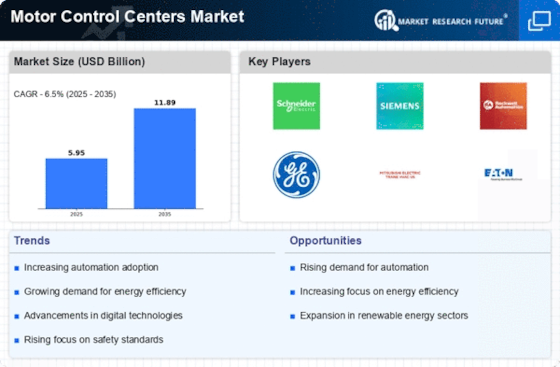
Motor Control Centers Market Infographic
Purchase Options

Motor Control Centers Size

Motor Control Centers Market Growth Projections and Opportunities

Expanded interest for reliable and productive frameworks is the aftereffect of worldwide industrialization, foundation improvement, and the interest for cutting edge engine control arrangements in businesses like oil and gas, which all drive the motor control centers (MCC) market.

Industry-altering innovative improvements are reshaping the market for engine control focuses; computerization and insightful advancements are helping efficiency and constancy. It is feasible for the IIoT to carry out prescient upkeep and remote checking.

The market for motor control centers focuses is impelled by government drives and guidelines that energize energy preservation and natural security. Endowments and government motivations further drive the development of the eco-accommodating innovation market.

The monetary climate applies a critical effect on the MCC market. Expanded modern action is emphatically connected with both financial development and soundness. Businesses put resources into growing and modernizing their framework during times of financial extension and success, bringing about an expansion in the interest in motor control centers. Going against the norm, monetary withdrawals might prompt reduced capital consumptions by areas, accordingly, applying an unfriendly effect available.

Roundabout outcomes of worldwide market patterns, for example, the developing reception of sustainable power sources, can be seen in the market. Speculations are moved by the change towards unadulterated and economical energy sources, like breeze and sun-based power. These areas require motor control centers to administer their mind-boggling tasks really. Thus, the MCC market encounters a flood as an outcome of the expanded interest starting from the environmentally friendly power industry.

The cutthroat elements, central members, key coordinated efforts, and consolidations that characterize the market focuses affect client inclinations and market patterns.

Finally, the exhaustive consumption on engine control focuses, enveloping both establishment and upkeep costs, affects market elements. Especially in cost delicate business sectors, end-clients keep on considering cost-viability a vital marker. Makers endeavor to figure out some kind of harmony among moderateness and quality to take care of a different scope of clients.

The direction of the motor control centers still up in the air by a huge number of interconnected factors. The scene of MCCs is impacted by an assortment of market factors, including mechanical headways, unofficial laws, monetary circumstances, and worldwide patterns. Thus, the MCC business is dynamic and versatile to the changing necessities of different areas.
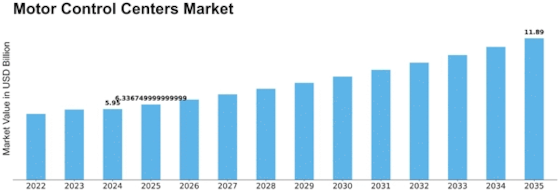

Motor Control Centers Market Size Graph
Author
Priya Nagrale
Senior Research Analyst

With an experience of over five years in market research industry (Chemicals & Materials domain), I gather and analyze market data from diverse sources to produce results, which are then presented back to a client. Also, provide recommendations based on the findings. As a Senior Research Analyst, I perform quality checks (QC) for market estimations, QC for reports, and handle queries and work extensively on client customizations. Also, handle the responsibilities of client proposals, report planning, report finalization, and execution

Leave a Comment

FAQs

What is the projected market valuation of the Motor Control Centers Market by 2035?

<p>The Motor Control Centers Market is projected to reach a valuation of 11.89 USD Billion by 2035.</p>

What was the market valuation of the Motor Control Centers Market in 2024?

<p>In 2024, the Motor Control Centers Market had a valuation of 5.95 USD Billion.</p>

What is the expected CAGR for the Motor Control Centers Market during the forecast period 2025 - 2035?

<p>The expected CAGR for the Motor Control Centers Market during the forecast period 2025 - 2035 is 6.5%.</p>

Which companies are considered key players in the Motor Control Centers Market?

<p>Key players in the Motor Control Centers Market include Schneider Electric, Siemens, Rockwell Automation, General Electric, Mitsubishi Electric, Eaton, ABB, Honeywell, and Emerson Electric.</p>

What are the different types of Motor Control Centers and their market values?

The market values for Motor Control Centers by type are 3.57 USD Billion for Conventional and 2.38 USD Billion for Intelligent.

How does the market for Motor Control Centers segment by voltage?

The Motor Control Centers Market segments by voltage with values of 2.38 USD Billion for Low, 2.38 USD Billion for Medium, and 1.19 USD Billion for High.

What components are included in the Motor Control Centers Market and their respective valuations?

Components in the Motor Control Centers Market include Busbars at 1.19 USD Billion, Overload Relays at 0.89 USD Billion, and Variable Speed Drives at 1.79 USD Billion.

Which end-user industries are driving the Motor Control Centers Market?

End-user industries driving the Motor Control Centers Market include Energy &amp; Utilities at 1.19 USD Billion and Cement and Manufacturing at 1.19 USD Billion.

What standards are relevant to the Motor Control Centers Market?

The relevant standards for the Motor Control Centers Market include NEMA at 2.38 USD Billion and IEC at 2.37 USD Billion.

What is the potential growth outlook for the Motor Control Centers Market?

The Motor Control Centers Market appears poised for growth, with a projected increase from 5.95 USD Billion in 2024 to 11.89 USD Billion by 2035.

Market Summary

As per Market Research Future analysis, the Motor Control Centers Market Size was estimated at 5.95 USD Billion in 2024. The Motor Control Centers industry is projected to grow from 6.337 USD Billion in 2025 to 11.89 USD Billion by 2035, exhibiting a compound annual growth rate (CAGR) of 6% during the forecast period 2025 - 2035

Key Market Trends & Highlights

The Motor Control Centers Market is poised for substantial growth driven by technological advancements and increasing demand for energy efficiency.

  • The integration of smart technologies is transforming the Motor Control Centers Market, enhancing operational efficiency. North America remains the largest market, while Asia-Pacific is emerging as the fastest-growing region in this sector. Conventional Motor Control Centers Market dominate the market, yet Intelligent systems are rapidly gaining traction as the fastest-growing segment. Rising demand for automation and an increased focus on energy management are key drivers propelling market expansion.

Market Size & Forecast

2024 Market Size 5.95 (USD Billion)
2035 Market Size 11.89 (USD Billion)
CAGR (2025 - 2035) 6.5%
Largest Regional Market Share in 2024 Asia Pacific

Major Players

Schneider Electric (FR), <a href="https://www.siemens.com/us/en/products/energy/low-voltage/low-voltage-motor-control-centers.html">Siemens </a>(DE), Rockwell Automation (US), General Electric (US), Mitsubishi Electric (JP), <a href="https://www.eaton.com/us/en-us/products/low-voltage-power-distribution-control-systems/motor-control-centers.html">Eaton </a>(US), ABB (CH), Honeywell (US), Emerson Electric (US)

Market Trends

The Motor Control Centers Market is currently experiencing a transformative phase, driven by advancements in automation and the increasing demand for energy efficiency across various industries. As organizations strive to optimize their operations, the integration of smart technologies into motor control centers is becoming more prevalent. This shift not only enhances operational efficiency but also contributes to significant cost savings. Furthermore, the growing emphasis on sustainability is prompting manufacturers to develop eco-friendly solutions, which may reshape the competitive landscape of the motor control centers market.

In addition, the expansion of renewable energy sources is likely to influence the Motor Control Centers Market positively. As wind and solar power installations proliferate, the need for reliable and efficient motor control systems becomes paramount. This trend suggests a potential increase in investments in research and development, aimed at creating innovative products that cater to the evolving needs of the energy sector. Overall, the Motor Control Centers Market appears poised for growth, with various factors converging to create a dynamic environment for stakeholders.

Integration of Smart Technologies

The motor control centers market trends is witnessing a notable trend towards the incorporation of smart technologies. This integration facilitates enhanced monitoring and control capabilities, allowing for real-time data analysis and improved decision-making processes. As industries increasingly adopt automation, the demand for intelligent motor control solutions particularly within the low voltage motor control centers market is expected to rise.

Focus on Energy Efficiency

A growing emphasis on energy efficiency is shaping the Motor Control Centers Market. Organizations are actively seeking solutions that minimize energy consumption while maximizing performance. This trend is likely to drive innovation, as manufacturers develop products that align with sustainability goals and regulatory requirements.

Expansion of Renewable Energy Sources

The rise of renewable energy sources is significantly impacting the Motor Control Centers Market. As the adoption of wind and solar energy continues to grow, the need for reliable motor control systems becomes critical. This trend may lead to increased investments in advanced technologies particularly within the MV switchgears motor control centers market, that support the integration of renewable energy into existing infrastructures.

Motor Control Centers Market Market Drivers

Rising Demand for Automation

The increasing demand for automation across various industries appears to be a primary driver for the Motor Control Centers Market. As manufacturers seek to enhance productivity and reduce operational costs, the integration of motor control centers becomes essential. According to industry reports, the automation sector is projected to grow at a compound annual growth rate of approximately 9% over the next five years. This growth is likely to spur investments in motor control technologies, as companies aim to streamline processes and improve efficiency. Furthermore, the adoption of advanced control systems in manufacturing plants necessitates the deployment of sophisticated motor control centers, thereby driving market expansion.

Emphasis on Safety and Compliance

The increasing emphasis on safety and regulatory compliance within industrial environments appears to be a significant driver for the Motor Control Centers Market. Organizations are increasingly prioritizing the implementation of safety standards to protect workers and equipment. Motor control centers play a crucial role in ensuring safe operations by providing essential control and monitoring capabilities. Regulatory bodies are enforcing stricter guidelines, which necessitate the adoption of advanced motor control technologies. As a result, companies are investing in modern motor control centers to meet compliance requirements, thereby driving market growth. The focus on safety is expected to remain a key factor influencing purchasing decisions in the industry.

Growing Infrastructure Development

Infrastructure development initiatives across multiple sectors, including construction, transportation, and energy, are likely to significantly influence the Motor Control Centers Market. Governments and private entities are investing heavily in infrastructure projects, which require reliable and efficient motor control systems. For instance, the construction of smart cities and the modernization of existing facilities necessitate the installation of advanced motor control centers to manage electrical systems effectively. Recent data indicates that infrastructure spending is expected to reach trillions of dollars in the coming years, creating a substantial demand for motor control solutions. This trend suggests a robust growth trajectory for the market as infrastructure projects proliferate.

Increased Focus on Energy Management

The heightened focus on energy management and sustainability initiatives is emerging as a crucial driver for the Motor Control Centers Market. Organizations are increasingly seeking ways to optimize energy consumption and reduce carbon footprints. Motor control centers are integral to energy management strategies, as they facilitate the efficient operation of electrical systems. Recent studies indicate that energy-efficient motor control solutions can lead to energy savings of up to 30%. As businesses strive to meet sustainability goals and comply with environmental regulations, the demand for energy-efficient motor control centers is likely to surge, thereby enhancing market prospects.

Technological Advancements in Control Systems

Technological advancements in control systems are likely to propel the Motor Control Centers Market forward. Innovations such as digitalization, IoT integration, and enhanced communication protocols are transforming how motor control centers operate. These advancements enable real-time monitoring and control, leading to improved efficiency and reduced downtime. The market for smart motor control centers is projected to grow significantly, with estimates suggesting a potential increase of over 15% in the next few years. As industries adopt these cutting-edge technologies, the demand for sophisticated motor control solutions is expected to rise, further driving market dynamics.

Market Segment Insights

By Type: Conventional (Largest) vs. Intelligent (Fastest-Growing)

In the Motor Control Centers Market, the Conventional type holds the largest share, benefiting from its long-established presence and reliability. This segment is favored in traditional industries where lasting performance and proven technology are crucial. Many manufacturers still prefer Conventional motor control systems for their straightforward operation and maintenance, allowing them to dominate the market landscape despite competition from newer technologies. Conversely, the Intelligent type is emerging rapidly as the fastest-growing segment in the market. This growth is fueled by increasing demand for automation, real-time data monitoring, and enhanced energy efficiency in various sectors. As industries adopt smart technologies, Intelligent motor control centers are becoming increasingly preferred for their ability to optimize performance and maintenance schedules, reflecting a significant shift in market dynamics.

Conventional (Dominant) vs. Intelligent (Emerging)

The Conventional motor control centers are characterized by their robustness and straightforward design, providing reliable performance across various applications. They are generally easier to install and maintain, making them a go-to choice for industries that require time-tested solutions. Their dominance stems from their widespread adoption in traditional manufacturing and infrastructure sectors. In contrast, Intelligent motor control centers are poised to transform the market with their advanced functionalities, including integrated communication systems and user-friendly interfaces. They cater to modern demands for efficiency, reducing downtime and operational costs. This emerging technology attracts investments and interest as it aligns with industry 4.0 trends, positioning it as a critical component in the drive towards smarter, automated processes.

By Voltage: Low Voltage (Largest) vs. High Voltage (Fastest-Growing)

In the Motor Control Centers Market, the voltage segment is categorized into Low, Medium, and <a href="https://www.marketresearchfuture.com/reports/high-voltage-substation-market-28459">High voltage</a>, with Low Voltage dominating the market due to its widespread applicability across various industries, including commercial and residential. The demand for Low Voltage solutions stems from their cost-effectiveness and the robustness required for efficient operations. On the other hand, High Voltage systems are witnessing significant growth, primarily driven by the increasing adoption of renewable energy sources and the need for efficient power distribution in larger industrial applications.

Voltage: Low (Dominant) vs. High (Emerging)

Low voltage motor control centers (MCC) are crucial due to their ability to control and distribute electrical power effectively in various applications, making them a preferred choice for many industries. They are characterized by their flexibility, reliability, and efficiency, often designed to operate at voltages below 1000V. In contrast, High voltage motor control centers are at the forefront of the emerging market, catering to large-scale industrial plants and renewable energy sectors. They offer enhanced control capabilities and are essential for the management of high power loads, ensuring optimal performance and safety in electrical systems.

By Component: Busbars (Largest) vs. Variable Speed Drives (Fastest-Growing)

In the Motor Control Centers Market, the component segment shows a diverse distribution of market share among its values. Busbars hold a significant portion of the market, primarily due to their efficient design and ability to handle high currents. This established component is widely utilized in various industrial applications, cementing its position as the largest segment. In contrast, Variable Speed Drives have been gaining traction, driven by the demand for energy efficiency and automation in motor control systems. Their adaptive capabilities allow for improved control over motor operations, making them increasingly popular amongst users. The growth trends within the component segment are largely influenced by the rising need for energy-efficient solutions across industries. The shift towards automation and smart technology has led to a surge in demand for advanced components such as Variable Speed Drives, which are regarded as the fastest-growing segment. Additionally, environmental regulations promoting energy conservation play a pivotal role in driving the adoption of efficient components. As industries move towards greener practices, the demand for both Busbars and Variable Speed Drives is anticipated to grow, albeit at different rates, highlighting a dynamic and competitive market landscape.

Busbars (Dominant) vs. Soft Starters (Emerging)

<a href="https://www.marketresearchfuture.com/reports/busbars-market-26789">Busbars</a> have established themselves as a dominant force in the Motor Control Centers Market due to their robust performance and ability to accommodate diverse electrical loads. Their design allows for minimal energy loss and high durability, making them essential in high-demand industrial settings. Conversely, Soft Starters represent an emerging technology within the sector. They provide a smooth start-up and controlled acceleration of motors, reducing mechanical stress and extending the lifespan of equipment. While Busbars maintain their superiority in terms of market share and reliability, the growing adoption of Soft Starters signifies a shift towards more sophisticated motor control solutions that prioritize efficiency and operational safety.

By End-User Industry: Oil & Gas (Largest) vs. Energy & Utilities (Fastest-Growing)

The Motor Control Centers (MCC) Market exhibits a diverse range of applications across various end-user industries. Among these, the Oil &amp; Gas segment holds the largest market share, driven by its critical role in facilitating efficient operations in exploration, refining, and distribution. Meanwhile, the Energy &amp; Utilities sector is rapidly gaining traction, reflecting an increasing emphasis on sustainable power solutions, which propels its growth within the MCC landscape. Growth in the Motor Control Centers Market is significantly influenced by the rising need for automation and advanced control systems across various industries. The Oil &amp; Gas sector benefits from technological advancements and the demand for reliability in harsh environments. Conversely, the Energy &amp; Utilities segment is transformed by shifting governmental policies and a greater focus on renewable energy sources, marking it as the fastest-growing area in this market.

Oil &amp; Gas (Dominant) vs. Energy &amp; Utilities (Emerging)

The Oil &amp; Gas industry is a dominant segment within the Motor Control Centers Market, largely due to its extensive infrastructure and the necessity for high reliability in operations such as drilling, transportation, and processing of hydrocarbons. This sector mandates robust motor control solutions that can effectively manage high voltages and heavy machinery, contributing to its leading market position. On the other hand, the Energy &amp; Utilities segment, categorized as emerging, is experiencing rapid growth due to increasing investments in renewable energy projects and modernization of utility grids. As utilities aim for efficiency and sustainability, motor control centers equipped with advanced automation technologies are becoming crucial in managing energy distribution, paving the way for innovative solutions that meet contemporary demands.

By Standard Segment: NEMA (Largest) vs. IEC (Fastest-Growing)

In the Motor Control Centers Market, the distribution of market share among the standard segments shows NEMA as the dominant player, holding a significant portion of the market. The NEMA standard is widely adopted in North America, making it a highly preferred choice among industries that require robust and reliable motor control solutions. Meanwhile, the IEC standard is witnessing rapid adoption in regions outside of North America, positioning it as a notable contender in the market, particularly in Europe and Asia.

NEMA (Dominant) vs. IEC (Emerging)

The NEMA segment is characterized by its strong foothold in the North American market, providing a wide array of motor control solutions that cater to various industrial applications. Its well-established standards ensure not only compatibility but also reliability in performance across different sectors. Conversely, the IEC segment, though emerging, is gaining traction as industries globalize and seek solutions compliant with international standards. While still growing, IEC is expected to capture a larger market share by addressing the needs of diverse markets outside the U.S., offering versatile options that align with global safety and efficiency standards.

Get more detailed insights about Motor Control Centers Market Research Report - Global Forecast till 2035

Regional Insights

North America : Innovation and Demand Surge

North America is the largest market for Motor Control Centers Market, holding approximately 40% of the global market share. The region's growth is driven by increasing industrial automation, stringent safety regulations, and the need for energy-efficient solutions. The demand for advanced motor control technologies is further fueled by the expansion of renewable energy projects and smart grid initiatives, which are supported by government incentives and funding programs. The United States and Canada are the leading countries in this region, with significant contributions from key players like Rockwell Automation, General Electric, and Schneider Electric. The competitive landscape is characterized by continuous innovation and strategic partnerships among these companies, enhancing their market presence. The focus on digital transformation and IoT integration in manufacturing processes is expected to further boost market growth in the coming years.

Europe : Regulatory Framework and Growth

Europe is the second-largest market for Motor Control Centers Market, accounting for around 30% of the global market share. The region's growth is propelled by stringent environmental regulations, the push for energy efficiency, and the increasing adoption of automation in various industries. The European Union's commitment to reducing carbon emissions and promoting sustainable practices has led to significant investments in advanced motor control technologies, creating a favorable regulatory environment for market expansion. Germany, France, and the United Kingdom are the leading countries in this market, with major players like Siemens and ABB driving innovation. The competitive landscape is marked by a focus on R&D and the development of smart motor control solutions. The presence of established manufacturers and a growing number of startups in the region contribute to a dynamic market environment, fostering collaboration and technological advancements.

Asia-Pacific : Emerging Market Potential

Asia-Pacific is witnessing rapid growth in the Motor Control Centers Market, holding approximately 25% of the global market share. The region's expansion is driven by increasing industrialization, urbanization, and the rising demand for energy-efficient solutions. Countries like China and India are investing heavily in infrastructure development and smart manufacturing, which are key catalysts for market growth. Additionally, government initiatives aimed at promoting renewable energy sources are further enhancing the demand for advanced motor control technologies. China is the largest market in this region, followed by India and Japan. The competitive landscape features key players such as Mitsubishi Electric and Eaton, who are focusing on innovation and localization strategies to cater to the diverse needs of the market. The presence of a robust manufacturing base and a growing emphasis on automation in various sectors are expected to drive further growth in the coming years.

Middle East and Africa : Resource-Rich and Growing Demand

The Middle East and Africa region is emerging as a significant market for Motor Control Centers Market, accounting for about 5% of the global market share. The growth in this region is primarily driven by increasing investments in infrastructure, oil and gas, and renewable energy projects. Governments are focusing on diversifying their economies and enhancing industrial capabilities, which is creating a favorable environment for motor control technologies. The demand for energy-efficient solutions is also rising, supported by regulatory frameworks aimed at sustainability. Countries like the United Arab Emirates and South Africa are leading the market, with key players such as Honeywell and Emerson Electric establishing a strong presence. The competitive landscape is characterized by collaborations and partnerships aimed at leveraging technological advancements. As the region continues to develop its industrial base, the demand for advanced motor control solutions is expected to grow significantly.

Key Players and Competitive Insights

The Motor Control Centers Market is currently characterized by a dynamic competitive landscape, driven by technological advancements and increasing demand for automation across various industries. Key players such as Schneider Electric (France), Siemens (Germany), and Rockwell Automation (US) are strategically positioning themselves through innovation and digital transformation initiatives. Schneider Electric (France) emphasizes sustainability and energy efficiency, while Siemens (Germany) focuses on integrating advanced digital solutions into their offerings. Rockwell Automation (US) is enhancing its portfolio through strategic partnerships, thereby shaping a competitive environment that prioritizes technological integration and operational efficiency.

In terms of business tactics, companies are increasingly localizing manufacturing to reduce lead times and optimize supply chains. The Motor Control Centers Market appears moderately fragmented, with several key players exerting influence over specific regions. This fragmentation allows for niche players to thrive, while larger corporations leverage their scale to implement comprehensive strategies that enhance their market presence.

In August 2025, Siemens (Germany) announced the launch of a new line of smart motor control centers designed to enhance energy efficiency and reduce operational costs for industrial applications. This strategic move underscores Siemens' commitment to innovation and positions the company favorably in a market that increasingly values sustainability. The introduction of these smart solutions is likely to attract a broader customer base seeking to modernize their operations.

In September 2025, Rockwell Automation (US) expanded its partnership with a leading software provider to integrate AI-driven analytics into its motor control systems. This collaboration aims to enhance predictive maintenance capabilities, thereby reducing downtime for clients. The strategic importance of this partnership lies in its potential to differentiate Rockwell's offerings in a competitive market, as clients increasingly seek solutions that leverage data for operational improvements.

In July 2025, Schneider Electric (France) entered into a joint venture with a regional player in Asia to enhance its market penetration and localize its product offerings. This strategic alliance is indicative of Schneider's approach to adapt to regional market demands while expanding its footprint in emerging markets. Such collaborations may provide Schneider with a competitive edge, allowing for tailored solutions that resonate with local customers.

As of October 2025, the Motor Control Centers Market is witnessing trends that emphasize digitalization, sustainability, and the integration of artificial intelligence. Strategic alliances are becoming increasingly pivotal, as companies seek to combine their strengths to innovate and meet evolving customer needs. The competitive differentiation is likely to shift from traditional price-based competition to a focus on technological innovation, reliability in supply chains, and the ability to deliver sustainable solutions. This evolution suggests that companies that prioritize these aspects will be better positioned to thrive in the future.

Key Companies in the Motor Control Centers Market include

Industry Developments

  • A new technology named Intelligent Phase control has recently entered the market to reduce the workload in production and simplify the system design. It also stabilizes the motor rotation and reduces power consumption.
  • Smart Motor Control Centers Market have the capability of integrating with advanced technologies like PLC, DCS which allow them to operate across multiple communication protocols.
  • On february 2021, ABB had launched its new motor control centre product named ReliaGear™ LV MCC. The low voltage motor control center is built for simplicity and durability. This low-voltage MCC was created to meet customer needs across a wide range of applications with a focus on smart MCC solutions. 

Future Outlook

Motor Control Centers Market Future Outlook

The Motor Control Centers Market is projected to grow at a 6.5% CAGR from 2025 to 2035, driven by industrial automation, energy efficiency, and technological advancements.

New opportunities lie in:

  • <p>Integration of IoT for predictive maintenance solutions. Development of modular motor control systems for scalability. Expansion into renewable energy sectors with tailored control solutions.</p>

By 2035, the Motor Control Centers Market is expected to achieve robust growth, reflecting evolving industrial needs.

Market Segmentation

Motor Control Centers Market Type Outlook

  • Conventional
  • Intelligent

Motor Control Centers Market Voltage Outlook

  • Low
  • Medium
  • High

Motor Control Centers Market Component Outlook

  • Busbars
  • Overload Relays
  • Variable Speed Drives
  • Soft Starters
  • Others

Motor Control Centers Market Standard Segment Outlook

  • NEMA
  • IEC
  • Others

Motor Control Centers Market End-User Industry Outlook

  • Oil & Gas
  • Chemical & Petrochemicals
  • Energy & Utilities
  • Mining & Metals
  • Cement and Manufacturing
  • Food & Beverage
  • Others

Report Scope

MARKET SIZE 2024 5.95(USD Billion)
MARKET SIZE 2025 6.337(USD Billion)
MARKET SIZE 2035 11.89(USD Billion)
COMPOUND ANNUAL GROWTH RATE (CAGR) 6.5% (2025 - 2035)
REPORT COVERAGE Revenue Forecast, Competitive Landscape, Growth Factors, and Trends
BASE YEAR 2024
Market Forecast Period 2025 - 2035
Historical Data 2019 - 2024
Market Forecast Units USD Billion
Key Companies Profiled Schneider Electric (FR), Siemens (DE), Rockwell Automation (US), General Electric (US), Mitsubishi Electric (JP), Eaton (US), ABB (CH), Honeywell (US), Emerson Electric (US)
Segments Covered Type, Voltage, Component, End User, Standard Segment, Region - Global Forecast To 2035
Key Market Opportunities Integration of advanced automation technologies enhances efficiency in the Motor Control Centers Market.
Key Market Dynamics Rising demand for energy efficiency drives innovation and competition in the Motor Control Centers market.
Countries Covered North America, Europe, APAC, South America, MEA

FAQs

What is the projected market valuation of the Motor Control Centers Market by 2035?

<p>The Motor Control Centers Market is projected to reach a valuation of 11.89 USD Billion by 2035.</p>

What was the market valuation of the Motor Control Centers Market in 2024?

<p>In 2024, the Motor Control Centers Market had a valuation of 5.95 USD Billion.</p>

What is the expected CAGR for the Motor Control Centers Market during the forecast period 2025 - 2035?

<p>The expected CAGR for the Motor Control Centers Market during the forecast period 2025 - 2035 is 6.5%.</p>

Which companies are considered key players in the Motor Control Centers Market?

<p>Key players in the Motor Control Centers Market include Schneider Electric, Siemens, Rockwell Automation, General Electric, Mitsubishi Electric, Eaton, ABB, Honeywell, and Emerson Electric.</p>

What are the different types of Motor Control Centers and their market values?

The market values for Motor Control Centers by type are 3.57 USD Billion for Conventional and 2.38 USD Billion for Intelligent.

How does the market for Motor Control Centers segment by voltage?

The Motor Control Centers Market segments by voltage with values of 2.38 USD Billion for Low, 2.38 USD Billion for Medium, and 1.19 USD Billion for High.

What components are included in the Motor Control Centers Market and their respective valuations?

Components in the Motor Control Centers Market include Busbars at 1.19 USD Billion, Overload Relays at 0.89 USD Billion, and Variable Speed Drives at 1.79 USD Billion.

Which end-user industries are driving the Motor Control Centers Market?

End-user industries driving the Motor Control Centers Market include Energy &amp; Utilities at 1.19 USD Billion and Cement and Manufacturing at 1.19 USD Billion.

What standards are relevant to the Motor Control Centers Market?

The relevant standards for the Motor Control Centers Market include NEMA at 2.38 USD Billion and IEC at 2.37 USD Billion.

What is the potential growth outlook for the Motor Control Centers Market?

The Motor Control Centers Market appears poised for growth, with a projected increase from 5.95 USD Billion in 2024 to 11.89 USD Billion by 2035.

  1. SECTION I: EXECUTIVE SUMMARY AND KEY HIGHLIGHTS
    1. | 1.1 EXECUTIVE SUMMARY
    2. | | 1.1.1 Market Overview
    3. | | 1.1.2 Key Findings
    4. | | 1.1.3 Market Segmentation
    5. | | 1.1.4 Competitive Landscape
    6. | | 1.1.5 Challenges and Opportunities
    7. | | 1.1.6 Future Outlook
  2. SECTION II: SCOPING, METHODOLOGY AND MARKET STRUCTURE
    1. | 2.1 MARKET INTRODUCTION
    2. | | 2.1.1 Definition
    3. | | 2.1.2 Scope of the study
    4. | | | 2.1.2.1 Research Objective
    5. | | | 2.1.2.2 Assumption
    6. | | | 2.1.2.3 Limitations
    7. | 2.2 RESEARCH METHODOLOGY
    8. | | 2.2.1 Overview
    9. | | 2.2.2 Data Mining
    10. | | 2.2.3 Secondary Research
    11. | | 2.2.4 Primary Research
    12. | | | 2.2.4.1 Primary Interviews and Information Gathering Process
    13. | | | 2.2.4.2 Breakdown of Primary Respondents
    14. | | 2.2.5 Forecasting Model
    15. | | 2.2.6 Market Size Estimation
    16. | | | 2.2.6.1 Bottom-Up Approach
    17. | | | 2.2.6.2 Top-Down Approach
    18. | | 2.2.7 Data Triangulation
    19. | | 2.2.8 Validation
  3. SECTION III: QUALITATIVE ANALYSIS
    1. | 3.1 MARKET DYNAMICS
    2. | | 3.1.1 Overview
    3. | | 3.1.2 Drivers
    4. | | 3.1.3 Restraints
    5. | | 3.1.4 Opportunities
    6. | 3.2 MARKET FACTOR ANALYSIS
    7. | | 3.2.1 Value chain Analysis
    8. | | 3.2.2 Porter's Five Forces Analysis
    9. | | | 3.2.2.1 Bargaining Power of Suppliers
    10. | | | 3.2.2.2 Bargaining Power of Buyers
    11. | | | 3.2.2.3 Threat of New Entrants
    12. | | | 3.2.2.4 Threat of Substitutes
    13. | | | 3.2.2.5 Intensity of Rivalry
    14. | | 3.2.3 COVID-19 Impact Analysis
    15. | | | 3.2.3.1 Market Impact Analysis
    16. | | | 3.2.3.2 Regional Impact
    17. | | | 3.2.3.3 Opportunity and Threat Analysis
  4. SECTION IV: QUANTITATIVE ANALYSIS
    1. | 4.1 Energy & Power, BY Type (USD Billion)
    2. | | 4.1.1 Conventional
    3. | | 4.1.2 Intelligent
    4. | 4.2 Energy & Power, BY Voltage (USD Billion)
    5. | | 4.2.1 Low
    6. | | 4.2.2 Medium
    7. | | 4.2.3 High
    8. | 4.3 Energy & Power, BY Component (USD Billion)
    9. | | 4.3.1 Busbars
    10. | | 4.3.2 Overload Relays
    11. | | 4.3.3 Variable Speed Drives
    12. | | 4.3.4 Soft Starters
    13. | | 4.3.5 Others
    14. | 4.4 Energy & Power, BY End-User Industry (USD Billion)
    15. | | 4.4.1 Oil & Gas
    16. | | 4.4.2 Chemical & Petrochemicals
    17. | | 4.4.3 Energy & Utilities
    18. | | 4.4.4 Mining & Metals
    19. | | 4.4.5 Cement and Manufacturing
    20. | | 4.4.6 Food & Beverage
    21. | | 4.4.7 Others
    22. | 4.5 Energy & Power, BY Standard Segment (USD Billion)
    23. | | 4.5.1 NEMA
    24. | | 4.5.2 IEC
    25. | | 4.5.3 Others
    26. | 4.6 Energy & Power, BY Region (USD Billion)
    27. | | 4.6.1 North America
    28. | | | 4.6.1.1 US
    29. | | | 4.6.1.2 Canada
    30. | | 4.6.2 Europe
    31. | | | 4.6.2.1 Germany
    32. | | | 4.6.2.2 UK
    33. | | | 4.6.2.3 France
    34. | | | 4.6.2.4 Russia
    35. | | | 4.6.2.5 Italy
    36. | | | 4.6.2.6 Spain
    37. | | | 4.6.2.7 Rest of Europe
    38. | | 4.6.3 APAC
    39. | | | 4.6.3.1 China
    40. | | | 4.6.3.2 India
    41. | | | 4.6.3.3 Japan
    42. | | | 4.6.3.4 South Korea
    43. | | | 4.6.3.5 Malaysia
    44. | | | 4.6.3.6 Thailand
    45. | | | 4.6.3.7 Indonesia
    46. | | | 4.6.3.8 Rest of APAC
    47. | | 4.6.4 South America
    48. | | | 4.6.4.1 Brazil
    49. | | | 4.6.4.2 Mexico
    50. | | | 4.6.4.3 Argentina
    51. | | | 4.6.4.4 Rest of South America
    52. | | 4.6.5 MEA
    53. | | | 4.6.5.1 GCC Countries
    54. | | | 4.6.5.2 South Africa
    55. | | | 4.6.5.3 Rest of MEA
  5. SECTION V: COMPETITIVE ANALYSIS
    1. | 5.1 Competitive Landscape
    2. | | 5.1.1 Overview
    3. | | 5.1.2 Competitive Analysis
    4. | | 5.1.3 Market share Analysis
    5. | | 5.1.4 Major Growth Strategy in the Energy & Power
    6. | | 5.1.5 Competitive Benchmarking
    7. | | 5.1.6 Leading Players in Terms of Number of Developments in the Energy & Power
    8. | | 5.1.7 Key developments and growth strategies
    9. | | | 5.1.7.1 New Product Launch/Service Deployment
    10. | | | 5.1.7.2 Merger & Acquisitions
    11. | | | 5.1.7.3 Joint Ventures
    12. | | 5.1.8 Major Players Financial Matrix
    13. | | | 5.1.8.1 Sales and Operating Income
    14. | | | 5.1.8.2 Major Players R&D Expenditure. 2023
    15. | 5.2 Company Profiles
    16. | | 5.2.1 Schneider Electric (FR)
    17. | | | 5.2.1.1 Financial Overview
    18. | | | 5.2.1.2 Products Offered
    19. | | | 5.2.1.3 Key Developments
    20. | | | 5.2.1.4 SWOT Analysis
    21. | | | 5.2.1.5 Key Strategies
    22. | | 5.2.2 Siemens (DE)
    23. | | | 5.2.2.1 Financial Overview
    24. | | | 5.2.2.2 Products Offered
    25. | | | 5.2.2.3 Key Developments
    26. | | | 5.2.2.4 SWOT Analysis
    27. | | | 5.2.2.5 Key Strategies
    28. | | 5.2.3 Rockwell Automation (US)
    29. | | | 5.2.3.1 Financial Overview
    30. | | | 5.2.3.2 Products Offered
    31. | | | 5.2.3.3 Key Developments
    32. | | | 5.2.3.4 SWOT Analysis
    33. | | | 5.2.3.5 Key Strategies
    34. | | 5.2.4 General Electric (US)
    35. | | | 5.2.4.1 Financial Overview
    36. | | | 5.2.4.2 Products Offered
    37. | | | 5.2.4.3 Key Developments
    38. | | | 5.2.4.4 SWOT Analysis
    39. | | | 5.2.4.5 Key Strategies
    40. | | 5.2.5 Mitsubishi Electric (JP)
    41. | | | 5.2.5.1 Financial Overview
    42. | | | 5.2.5.2 Products Offered
    43. | | | 5.2.5.3 Key Developments
    44. | | | 5.2.5.4 SWOT Analysis
    45. | | | 5.2.5.5 Key Strategies
    46. | | 5.2.6 Eaton (US)
    47. | | | 5.2.6.1 Financial Overview
    48. | | | 5.2.6.2 Products Offered
    49. | | | 5.2.6.3 Key Developments
    50. | | | 5.2.6.4 SWOT Analysis
    51. | | | 5.2.6.5 Key Strategies
    52. | | 5.2.7 ABB (CH)
    53. | | | 5.2.7.1 Financial Overview
    54. | | | 5.2.7.2 Products Offered
    55. | | | 5.2.7.3 Key Developments
    56. | | | 5.2.7.4 SWOT Analysis
    57. | | | 5.2.7.5 Key Strategies
    58. | | 5.2.8 Honeywell (US)
    59. | | | 5.2.8.1 Financial Overview
    60. | | | 5.2.8.2 Products Offered
    61. | | | 5.2.8.3 Key Developments
    62. | | | 5.2.8.4 SWOT Analysis
    63. | | | 5.2.8.5 Key Strategies
    64. | | 5.2.9 Emerson Electric (US)
    65. | | | 5.2.9.1 Financial Overview
    66. | | | 5.2.9.2 Products Offered
    67. | | | 5.2.9.3 Key Developments
    68. | | | 5.2.9.4 SWOT Analysis
    69. | | | 5.2.9.5 Key Strategies
    70. | 5.3 Appendix
    71. | | 5.3.1 References
    72. | | 5.3.2 Related Reports
  6. LIST OF FIGURES
    1. | 6.1 MARKET SYNOPSIS
    2. | 6.2 NORTH AMERICA MARKET ANALYSIS
    3. | 6.3 US MARKET ANALYSIS BY TYPE
    4. | 6.4 US MARKET ANALYSIS BY VOLTAGE
    5. | 6.5 US MARKET ANALYSIS BY COMPONENT
    6. | 6.6 US MARKET ANALYSIS BY END-USER INDUSTRY
    7. | 6.7 US MARKET ANALYSIS BY STANDARD SEGMENT
    8. | 6.8 CANADA MARKET ANALYSIS BY TYPE
    9. | 6.9 CANADA MARKET ANALYSIS BY VOLTAGE
    10. | 6.10 CANADA MARKET ANALYSIS BY COMPONENT
    11. | 6.11 CANADA MARKET ANALYSIS BY END-USER INDUSTRY
    12. | 6.12 CANADA MARKET ANALYSIS BY STANDARD SEGMENT
    13. | 6.13 EUROPE MARKET ANALYSIS
    14. | 6.14 GERMANY MARKET ANALYSIS BY TYPE
    15. | 6.15 GERMANY MARKET ANALYSIS BY VOLTAGE
    16. | 6.16 GERMANY MARKET ANALYSIS BY COMPONENT
    17. | 6.17 GERMANY MARKET ANALYSIS BY END-USER INDUSTRY
    18. | 6.18 GERMANY MARKET ANALYSIS BY STANDARD SEGMENT
    19. | 6.19 UK MARKET ANALYSIS BY TYPE
    20. | 6.20 UK MARKET ANALYSIS BY VOLTAGE
    21. | 6.21 UK MARKET ANALYSIS BY COMPONENT
    22. | 6.22 UK MARKET ANALYSIS BY END-USER INDUSTRY
    23. | 6.23 UK MARKET ANALYSIS BY STANDARD SEGMENT
    24. | 6.24 FRANCE MARKET ANALYSIS BY TYPE
    25. | 6.25 FRANCE MARKET ANALYSIS BY VOLTAGE
    26. | 6.26 FRANCE MARKET ANALYSIS BY COMPONENT
    27. | 6.27 FRANCE MARKET ANALYSIS BY END-USER INDUSTRY
    28. | 6.28 FRANCE MARKET ANALYSIS BY STANDARD SEGMENT
    29. | 6.29 RUSSIA MARKET ANALYSIS BY TYPE
    30. | 6.30 RUSSIA MARKET ANALYSIS BY VOLTAGE
    31. | 6.31 RUSSIA MARKET ANALYSIS BY COMPONENT
    32. | 6.32 RUSSIA MARKET ANALYSIS BY END-USER INDUSTRY
    33. | 6.33 RUSSIA MARKET ANALYSIS BY STANDARD SEGMENT
    34. | 6.34 ITALY MARKET ANALYSIS BY TYPE
    35. | 6.35 ITALY MARKET ANALYSIS BY VOLTAGE
    36. | 6.36 ITALY MARKET ANALYSIS BY COMPONENT
    37. | 6.37 ITALY MARKET ANALYSIS BY END-USER INDUSTRY
    38. | 6.38 ITALY MARKET ANALYSIS BY STANDARD SEGMENT
    39. | 6.39 SPAIN MARKET ANALYSIS BY TYPE
    40. | 6.40 SPAIN MARKET ANALYSIS BY VOLTAGE
    41. | 6.41 SPAIN MARKET ANALYSIS BY COMPONENT
    42. | 6.42 SPAIN MARKET ANALYSIS BY END-USER INDUSTRY
    43. | 6.43 SPAIN MARKET ANALYSIS BY STANDARD SEGMENT
    44. | 6.44 REST OF EUROPE MARKET ANALYSIS BY TYPE
    45. | 6.45 REST OF EUROPE MARKET ANALYSIS BY VOLTAGE
    46. | 6.46 REST OF EUROPE MARKET ANALYSIS BY COMPONENT
    47. | 6.47 REST OF EUROPE MARKET ANALYSIS BY END-USER INDUSTRY
    48. | 6.48 REST OF EUROPE MARKET ANALYSIS BY STANDARD SEGMENT
    49. | 6.49 APAC MARKET ANALYSIS
    50. | 6.50 CHINA MARKET ANALYSIS BY TYPE
    51. | 6.51 CHINA MARKET ANALYSIS BY VOLTAGE
    52. | 6.52 CHINA MARKET ANALYSIS BY COMPONENT
    53. | 6.53 CHINA MARKET ANALYSIS BY END-USER INDUSTRY
    54. | 6.54 CHINA MARKET ANALYSIS BY STANDARD SEGMENT
    55. | 6.55 INDIA MARKET ANALYSIS BY TYPE
    56. | 6.56 INDIA MARKET ANALYSIS BY VOLTAGE
    57. | 6.57 INDIA MARKET ANALYSIS BY COMPONENT
    58. | 6.58 INDIA MARKET ANALYSIS BY END-USER INDUSTRY
    59. | 6.59 INDIA MARKET ANALYSIS BY STANDARD SEGMENT
    60. | 6.60 JAPAN MARKET ANALYSIS BY TYPE
    61. | 6.61 JAPAN MARKET ANALYSIS BY VOLTAGE
    62. | 6.62 JAPAN MARKET ANALYSIS BY COMPONENT
    63. | 6.63 JAPAN MARKET ANALYSIS BY END-USER INDUSTRY
    64. | 6.64 JAPAN MARKET ANALYSIS BY STANDARD SEGMENT
    65. | 6.65 SOUTH KOREA MARKET ANALYSIS BY TYPE
    66. | 6.66 SOUTH KOREA MARKET ANALYSIS BY VOLTAGE
    67. | 6.67 SOUTH KOREA MARKET ANALYSIS BY COMPONENT
    68. | 6.68 SOUTH KOREA MARKET ANALYSIS BY END-USER INDUSTRY
    69. | 6.69 SOUTH KOREA MARKET ANALYSIS BY STANDARD SEGMENT
    70. | 6.70 MALAYSIA MARKET ANALYSIS BY TYPE
    71. | 6.71 MALAYSIA MARKET ANALYSIS BY VOLTAGE
    72. | 6.72 MALAYSIA MARKET ANALYSIS BY COMPONENT
    73. | 6.73 MALAYSIA MARKET ANALYSIS BY END-USER INDUSTRY
    74. | 6.74 MALAYSIA MARKET ANALYSIS BY STANDARD SEGMENT
    75. | 6.75 THAILAND MARKET ANALYSIS BY TYPE
    76. | 6.76 THAILAND MARKET ANALYSIS BY VOLTAGE
    77. | 6.77 THAILAND MARKET ANALYSIS BY COMPONENT
    78. | 6.78 THAILAND MARKET ANALYSIS BY END-USER INDUSTRY
    79. | 6.79 THAILAND MARKET ANALYSIS BY STANDARD SEGMENT
    80. | 6.80 INDONESIA MARKET ANALYSIS BY TYPE
    81. | 6.81 INDONESIA MARKET ANALYSIS BY VOLTAGE
    82. | 6.82 INDONESIA MARKET ANALYSIS BY COMPONENT
    83. | 6.83 INDONESIA MARKET ANALYSIS BY END-USER INDUSTRY
    84. | 6.84 INDONESIA MARKET ANALYSIS BY STANDARD SEGMENT
    85. | 6.85 REST OF APAC MARKET ANALYSIS BY TYPE
    86. | 6.86 REST OF APAC MARKET ANALYSIS BY VOLTAGE
    87. | 6.87 REST OF APAC MARKET ANALYSIS BY COMPONENT
    88. | 6.88 REST OF APAC MARKET ANALYSIS BY END-USER INDUSTRY
    89. | 6.89 REST OF APAC MARKET ANALYSIS BY STANDARD SEGMENT
    90. | 6.90 SOUTH AMERICA MARKET ANALYSIS
    91. | 6.91 BRAZIL MARKET ANALYSIS BY TYPE
    92. | 6.92 BRAZIL MARKET ANALYSIS BY VOLTAGE
    93. | 6.93 BRAZIL MARKET ANALYSIS BY COMPONENT
    94. | 6.94 BRAZIL MARKET ANALYSIS BY END-USER INDUSTRY
    95. | 6.95 BRAZIL MARKET ANALYSIS BY STANDARD SEGMENT
    96. | 6.96 MEXICO MARKET ANALYSIS BY TYPE
    97. | 6.97 MEXICO MARKET ANALYSIS BY VOLTAGE
    98. | 6.98 MEXICO MARKET ANALYSIS BY COMPONENT
    99. | 6.99 MEXICO MARKET ANALYSIS BY END-USER INDUSTRY
    100. | 6.100 MEXICO MARKET ANALYSIS BY STANDARD SEGMENT
    101. | 6.101 ARGENTINA MARKET ANALYSIS BY TYPE
    102. | 6.102 ARGENTINA MARKET ANALYSIS BY VOLTAGE
    103. | 6.103 ARGENTINA MARKET ANALYSIS BY COMPONENT
    104. | 6.104 ARGENTINA MARKET ANALYSIS BY END-USER INDUSTRY
    105. | 6.105 ARGENTINA MARKET ANALYSIS BY STANDARD SEGMENT
    106. | 6.106 REST OF SOUTH AMERICA MARKET ANALYSIS BY TYPE
    107. | 6.107 REST OF SOUTH AMERICA MARKET ANALYSIS BY VOLTAGE
    108. | 6.108 REST OF SOUTH AMERICA MARKET ANALYSIS BY COMPONENT
    109. | 6.109 REST OF SOUTH AMERICA MARKET ANALYSIS BY END-USER INDUSTRY
    110. | 6.110 REST OF SOUTH AMERICA MARKET ANALYSIS BY STANDARD SEGMENT
    111. | 6.111 MEA MARKET ANALYSIS
    112. | 6.112 GCC COUNTRIES MARKET ANALYSIS BY TYPE
    113. | 6.113 GCC COUNTRIES MARKET ANALYSIS BY VOLTAGE
    114. | 6.114 GCC COUNTRIES MARKET ANALYSIS BY COMPONENT
    115. | 6.115 GCC COUNTRIES MARKET ANALYSIS BY END-USER INDUSTRY
    116. | 6.116 GCC COUNTRIES MARKET ANALYSIS BY STANDARD SEGMENT
    117. | 6.117 SOUTH AFRICA MARKET ANALYSIS BY TYPE
    118. | 6.118 SOUTH AFRICA MARKET ANALYSIS BY VOLTAGE
    119. | 6.119 SOUTH AFRICA MARKET ANALYSIS BY COMPONENT
    120. | 6.120 SOUTH AFRICA MARKET ANALYSIS BY END-USER INDUSTRY
    121. | 6.121 SOUTH AFRICA MARKET ANALYSIS BY STANDARD SEGMENT
    122. | 6.122 REST OF MEA MARKET ANALYSIS BY TYPE
    123. | 6.123 REST OF MEA MARKET ANALYSIS BY VOLTAGE
    124. | 6.124 REST OF MEA MARKET ANALYSIS BY COMPONENT
    125. | 6.125 REST OF MEA MARKET ANALYSIS BY END-USER INDUSTRY
    126. | 6.126 REST OF MEA MARKET ANALYSIS BY STANDARD SEGMENT
    127. | 6.127 KEY BUYING CRITERIA OF ENERGY & POWER
    128. | 6.128 RESEARCH PROCESS OF MRFR
    129. | 6.129 DRO ANALYSIS OF ENERGY & POWER
    130. | 6.130 DRIVERS IMPACT ANALYSIS: ENERGY & POWER
    131. | 6.131 RESTRAINTS IMPACT ANALYSIS: ENERGY & POWER
    132. | 6.132 SUPPLY / VALUE CHAIN: ENERGY & POWER
    133. | 6.133 ENERGY & POWER, BY TYPE, 2024 (% SHARE)
    134. | 6.134 ENERGY & POWER, BY TYPE, 2024 TO 2035 (USD Billion)
    135. | 6.135 ENERGY & POWER, BY VOLTAGE, 2024 (% SHARE)
    136. | 6.136 ENERGY & POWER, BY VOLTAGE, 2024 TO 2035 (USD Billion)
    137. | 6.137 ENERGY & POWER, BY COMPONENT, 2024 (% SHARE)
    138. | 6.138 ENERGY & POWER, BY COMPONENT, 2024 TO 2035 (USD Billion)
    139. | 6.139 ENERGY & POWER, BY END-USER INDUSTRY, 2024 (% SHARE)
    140. | 6.140 ENERGY & POWER, BY END-USER INDUSTRY, 2024 TO 2035 (USD Billion)
    141. | 6.141 ENERGY & POWER, BY STANDARD SEGMENT, 2024 (% SHARE)
    142. | 6.142 ENERGY & POWER, BY STANDARD SEGMENT, 2024 TO 2035 (USD Billion)
    143. | 6.143 BENCHMARKING OF MAJOR COMPETITORS
  7. LIST OF TABLES
    1. | 7.1 LIST OF ASSUMPTIONS
    2. | | 7.1.1
    3. | 7.2 North America MARKET SIZE ESTIMATES; FORECAST
    4. | | 7.2.1 BY TYPE, 2025-2035 (USD Billion)
    5. | | 7.2.2 BY VOLTAGE, 2025-2035 (USD Billion)
    6. | | 7.2.3 BY COMPONENT, 2025-2035 (USD Billion)
    7. | | 7.2.4 BY END-USER INDUSTRY, 2025-2035 (USD Billion)
    8. | | 7.2.5 BY STANDARD SEGMENT, 2025-2035 (USD Billion)
    9. | 7.3 US MARKET SIZE ESTIMATES; FORECAST
    10. | | 7.3.1 BY TYPE, 2025-2035 (USD Billion)
    11. | | 7.3.2 BY VOLTAGE, 2025-2035 (USD Billion)
    12. | | 7.3.3 BY COMPONENT, 2025-2035 (USD Billion)
    13. | | 7.3.4 BY END-USER INDUSTRY, 2025-2035 (USD Billion)
    14. | | 7.3.5 BY STANDARD SEGMENT, 2025-2035 (USD Billion)
    15. | 7.4 Canada MARKET SIZE ESTIMATES; FORECAST
    16. | | 7.4.1 BY TYPE, 2025-2035 (USD Billion)
    17. | | 7.4.2 BY VOLTAGE, 2025-2035 (USD Billion)
    18. | | 7.4.3 BY COMPONENT, 2025-2035 (USD Billion)
    19. | | 7.4.4 BY END-USER INDUSTRY, 2025-2035 (USD Billion)
    20. | | 7.4.5 BY STANDARD SEGMENT, 2025-2035 (USD Billion)
    21. | 7.5 Europe MARKET SIZE ESTIMATES; FORECAST
    22. | | 7.5.1 BY TYPE, 2025-2035 (USD Billion)
    23. | | 7.5.2 BY VOLTAGE, 2025-2035 (USD Billion)
    24. | | 7.5.3 BY COMPONENT, 2025-2035 (USD Billion)
    25. | | 7.5.4 BY END-USER INDUSTRY, 2025-2035 (USD Billion)
    26. | | 7.5.5 BY STANDARD SEGMENT, 2025-2035 (USD Billion)
    27. | 7.6 Germany MARKET SIZE ESTIMATES; FORECAST
    28. | | 7.6.1 BY TYPE, 2025-2035 (USD Billion)
    29. | | 7.6.2 BY VOLTAGE, 2025-2035 (USD Billion)
    30. | | 7.6.3 BY COMPONENT, 2025-2035 (USD Billion)
    31. | | 7.6.4 BY END-USER INDUSTRY, 2025-2035 (USD Billion)
    32. | | 7.6.5 BY STANDARD SEGMENT, 2025-2035 (USD Billion)
    33. | 7.7 UK MARKET SIZE ESTIMATES; FORECAST
    34. | | 7.7.1 BY TYPE, 2025-2035 (USD Billion)
    35. | | 7.7.2 BY VOLTAGE, 2025-2035 (USD Billion)
    36. | | 7.7.3 BY COMPONENT, 2025-2035 (USD Billion)
    37. | | 7.7.4 BY END-USER INDUSTRY, 2025-2035 (USD Billion)
    38. | | 7.7.5 BY STANDARD SEGMENT, 2025-2035 (USD Billion)
    39. | 7.8 France MARKET SIZE ESTIMATES; FORECAST
    40. | | 7.8.1 BY TYPE, 2025-2035 (USD Billion)
    41. | | 7.8.2 BY VOLTAGE, 2025-2035 (USD Billion)
    42. | | 7.8.3 BY COMPONENT, 2025-2035 (USD Billion)
    43. | | 7.8.4 BY END-USER INDUSTRY, 2025-2035 (USD Billion)
    44. | | 7.8.5 BY STANDARD SEGMENT, 2025-2035 (USD Billion)
    45. | 7.9 Russia MARKET SIZE ESTIMATES; FORECAST
    46. | | 7.9.1 BY TYPE, 2025-2035 (USD Billion)
    47. | | 7.9.2 BY VOLTAGE, 2025-2035 (USD Billion)
    48. | | 7.9.3 BY COMPONENT, 2025-2035 (USD Billion)
    49. | | 7.9.4 BY END-USER INDUSTRY, 2025-2035 (USD Billion)
    50. | | 7.9.5 BY STANDARD SEGMENT, 2025-2035 (USD Billion)
    51. | 7.10 Italy MARKET SIZE ESTIMATES; FORECAST
    52. | | 7.10.1 BY TYPE, 2025-2035 (USD Billion)
    53. | | 7.10.2 BY VOLTAGE, 2025-2035 (USD Billion)
    54. | | 7.10.3 BY COMPONENT, 2025-2035 (USD Billion)
    55. | | 7.10.4 BY END-USER INDUSTRY, 2025-2035 (USD Billion)
    56. | | 7.10.5 BY STANDARD SEGMENT, 2025-2035 (USD Billion)
    57. | 7.11 Spain MARKET SIZE ESTIMATES; FORECAST
    58. | | 7.11.1 BY TYPE, 2025-2035 (USD Billion)
    59. | | 7.11.2 BY VOLTAGE, 2025-2035 (USD Billion)
    60. | | 7.11.3 BY COMPONENT, 2025-2035 (USD Billion)
    61. | | 7.11.4 BY END-USER INDUSTRY, 2025-2035 (USD Billion)
    62. | | 7.11.5 BY STANDARD SEGMENT, 2025-2035 (USD Billion)
    63. | 7.12 Rest of Europe MARKET SIZE ESTIMATES; FORECAST
    64. | | 7.12.1 BY TYPE, 2025-2035 (USD Billion)
    65. | | 7.12.2 BY VOLTAGE, 2025-2035 (USD Billion)
    66. | | 7.12.3 BY COMPONENT, 2025-2035 (USD Billion)
    67. | | 7.12.4 BY END-USER INDUSTRY, 2025-2035 (USD Billion)
    68. | | 7.12.5 BY STANDARD SEGMENT, 2025-2035 (USD Billion)
    69. | 7.13 APAC MARKET SIZE ESTIMATES; FORECAST
    70. | | 7.13.1 BY TYPE, 2025-2035 (USD Billion)
    71. | | 7.13.2 BY VOLTAGE, 2025-2035 (USD Billion)
    72. | | 7.13.3 BY COMPONENT, 2025-2035 (USD Billion)
    73. | | 7.13.4 BY END-USER INDUSTRY, 2025-2035 (USD Billion)
    74. | | 7.13.5 BY STANDARD SEGMENT, 2025-2035 (USD Billion)
    75. | 7.14 China MARKET SIZE ESTIMATES; FORECAST
    76. | | 7.14.1 BY TYPE, 2025-2035 (USD Billion)
    77. | | 7.14.2 BY VOLTAGE, 2025-2035 (USD Billion)
    78. | | 7.14.3 BY COMPONENT, 2025-2035 (USD Billion)
    79. | | 7.14.4 BY END-USER INDUSTRY, 2025-2035 (USD Billion)
    80. | | 7.14.5 BY STANDARD SEGMENT, 2025-2035 (USD Billion)
    81. | 7.15 India MARKET SIZE ESTIMATES; FORECAST
    82. | | 7.15.1 BY TYPE, 2025-2035 (USD Billion)
    83. | | 7.15.2 BY VOLTAGE, 2025-2035 (USD Billion)
    84. | | 7.15.3 BY COMPONENT, 2025-2035 (USD Billion)
    85. | | 7.15.4 BY END-USER INDUSTRY, 2025-2035 (USD Billion)
    86. | | 7.15.5 BY STANDARD SEGMENT, 2025-2035 (USD Billion)
    87. | 7.16 Japan MARKET SIZE ESTIMATES; FORECAST
    88. | | 7.16.1 BY TYPE, 2025-2035 (USD Billion)
    89. | | 7.16.2 BY VOLTAGE, 2025-2035 (USD Billion)
    90. | | 7.16.3 BY COMPONENT, 2025-2035 (USD Billion)
    91. | | 7.16.4 BY END-USER INDUSTRY, 2025-2035 (USD Billion)
    92. | | 7.16.5 BY STANDARD SEGMENT, 2025-2035 (USD Billion)
    93. | 7.17 South Korea MARKET SIZE ESTIMATES; FORECAST
    94. | | 7.17.1 BY TYPE, 2025-2035 (USD Billion)
    95. | | 7.17.2 BY VOLTAGE, 2025-2035 (USD Billion)
    96. | | 7.17.3 BY COMPONENT, 2025-2035 (USD Billion)
    97. | | 7.17.4 BY END-USER INDUSTRY, 2025-2035 (USD Billion)
    98. | | 7.17.5 BY STANDARD SEGMENT, 2025-2035 (USD Billion)
    99. | 7.18 Malaysia MARKET SIZE ESTIMATES; FORECAST
    100. | | 7.18.1 BY TYPE, 2025-2035 (USD Billion)
    101. | | 7.18.2 BY VOLTAGE, 2025-2035 (USD Billion)
    102. | | 7.18.3 BY COMPONENT, 2025-2035 (USD Billion)
    103. | | 7.18.4 BY END-USER INDUSTRY, 2025-2035 (USD Billion)
    104. | | 7.18.5 BY STANDARD SEGMENT, 2025-2035 (USD Billion)
    105. | 7.19 Thailand MARKET SIZE ESTIMATES; FORECAST
    106. | | 7.19.1 BY TYPE, 2025-2035 (USD Billion)
    107. | | 7.19.2 BY VOLTAGE, 2025-2035 (USD Billion)
    108. | | 7.19.3 BY COMPONENT, 2025-2035 (USD Billion)
    109. | | 7.19.4 BY END-USER INDUSTRY, 2025-2035 (USD Billion)
    110. | | 7.19.5 BY STANDARD SEGMENT, 2025-2035 (USD Billion)
    111. | 7.20 Indonesia MARKET SIZE ESTIMATES; FORECAST
    112. | | 7.20.1 BY TYPE, 2025-2035 (USD Billion)
    113. | | 7.20.2 BY VOLTAGE, 2025-2035 (USD Billion)
    114. | | 7.20.3 BY COMPONENT, 2025-2035 (USD Billion)
    115. | | 7.20.4 BY END-USER INDUSTRY, 2025-2035 (USD Billion)
    116. | | 7.20.5 BY STANDARD SEGMENT, 2025-2035 (USD Billion)
    117. | 7.21 Rest of APAC MARKET SIZE ESTIMATES; FORECAST
    118. | | 7.21.1 BY TYPE, 2025-2035 (USD Billion)
    119. | | 7.21.2 BY VOLTAGE, 2025-2035 (USD Billion)
    120. | | 7.21.3 BY COMPONENT, 2025-2035 (USD Billion)
    121. | | 7.21.4 BY END-USER INDUSTRY, 2025-2035 (USD Billion)
    122. | | 7.21.5 BY STANDARD SEGMENT, 2025-2035 (USD Billion)
    123. | 7.22 South America MARKET SIZE ESTIMATES; FORECAST
    124. | | 7.22.1 BY TYPE, 2025-2035 (USD Billion)
    125. | | 7.22.2 BY VOLTAGE, 2025-2035 (USD Billion)
    126. | | 7.22.3 BY COMPONENT, 2025-2035 (USD Billion)
    127. | | 7.22.4 BY END-USER INDUSTRY, 2025-2035 (USD Billion)
    128. | | 7.22.5 BY STANDARD SEGMENT, 2025-2035 (USD Billion)
    129. | 7.23 Brazil MARKET SIZE ESTIMATES; FORECAST
    130. | | 7.23.1 BY TYPE, 2025-2035 (USD Billion)
    131. | | 7.23.2 BY VOLTAGE, 2025-2035 (USD Billion)
    132. | | 7.23.3 BY COMPONENT, 2025-2035 (USD Billion)
    133. | | 7.23.4 BY END-USER INDUSTRY, 2025-2035 (USD Billion)
    134. | | 7.23.5 BY STANDARD SEGMENT, 2025-2035 (USD Billion)
    135. | 7.24 Mexico MARKET SIZE ESTIMATES; FORECAST
    136. | | 7.24.1 BY TYPE, 2025-2035 (USD Billion)
    137. | | 7.24.2 BY VOLTAGE, 2025-2035 (USD Billion)
    138. | | 7.24.3 BY COMPONENT, 2025-2035 (USD Billion)
    139. | | 7.24.4 BY END-USER INDUSTRY, 2025-2035 (USD Billion)
    140. | | 7.24.5 BY STANDARD SEGMENT, 2025-2035 (USD Billion)
    141. | 7.25 Argentina MARKET SIZE ESTIMATES; FORECAST
    142. | | 7.25.1 BY TYPE, 2025-2035 (USD Billion)
    143. | | 7.25.2 BY VOLTAGE, 2025-2035 (USD Billion)
    144. | | 7.25.3 BY COMPONENT, 2025-2035 (USD Billion)
    145. | | 7.25.4 BY END-USER INDUSTRY, 2025-2035 (USD Billion)
    146. | | 7.25.5 BY STANDARD SEGMENT, 2025-2035 (USD Billion)
    147. | 7.26 Rest of South America MARKET SIZE ESTIMATES; FORECAST
    148. | | 7.26.1 BY TYPE, 2025-2035 (USD Billion)
    149. | | 7.26.2 BY VOLTAGE, 2025-2035 (USD Billion)
    150. | | 7.26.3 BY COMPONENT, 2025-2035 (USD Billion)
    151. | | 7.26.4 BY END-USER INDUSTRY, 2025-2035 (USD Billion)
    152. | | 7.26.5 BY STANDARD SEGMENT, 2025-2035 (USD Billion)
    153. | 7.27 MEA MARKET SIZE ESTIMATES; FORECAST
    154. | | 7.27.1 BY TYPE, 2025-2035 (USD Billion)
    155. | | 7.27.2 BY VOLTAGE, 2025-2035 (USD Billion)
    156. | | 7.27.3 BY COMPONENT, 2025-2035 (USD Billion)
    157. | | 7.27.4 BY END-USER INDUSTRY, 2025-2035 (USD Billion)
    158. | | 7.27.5 BY STANDARD SEGMENT, 2025-2035 (USD Billion)
    159. | 7.28 GCC Countries MARKET SIZE ESTIMATES; FORECAST
    160. | | 7.28.1 BY TYPE, 2025-2035 (USD Billion)
    161. | | 7.28.2 BY VOLTAGE, 2025-2035 (USD Billion)
    162. | | 7.28.3 BY COMPONENT, 2025-2035 (USD Billion)
    163. | | 7.28.4 BY END-USER INDUSTRY, 2025-2035 (USD Billion)
    164. | | 7.28.5 BY STANDARD SEGMENT, 2025-2035 (USD Billion)
    165. | 7.29 South Africa MARKET SIZE ESTIMATES; FORECAST
    166. | | 7.29.1 BY TYPE, 2025-2035 (USD Billion)
    167. | | 7.29.2 BY VOLTAGE, 2025-2035 (USD Billion)
    168. | | 7.29.3 BY COMPONENT, 2025-2035 (USD Billion)
    169. | | 7.29.4 BY END-USER INDUSTRY, 2025-2035 (USD Billion)
    170. | | 7.29.5 BY STANDARD SEGMENT, 2025-2035 (USD Billion)
    171. | 7.30 Rest of MEA MARKET SIZE ESTIMATES; FORECAST
    172. | | 7.30.1 BY TYPE, 2025-2035 (USD Billion)
    173. | | 7.30.2 BY VOLTAGE, 2025-2035 (USD Billion)
    174. | | 7.30.3 BY COMPONENT, 2025-2035 (USD Billion)
    175. | | 7.30.4 BY END-USER INDUSTRY, 2025-2035 (USD Billion)
    176. | | 7.30.5 BY STANDARD SEGMENT, 2025-2035 (USD Billion)
    177. | 7.31 PRODUCT LAUNCH/PRODUCT DEVELOPMENT/APPROVAL
    178. | | 7.31.1
    179. | 7.32 ACQUISITION/PARTNERSHIP
    180. | | 7.32.1

Energy & Power Market Segmentation

Energy & Power By Type (USD Billion, 2025-2035)

  • Conventional
  • Intelligent

Energy & Power By Voltage (USD Billion, 2025-2035)

  • Low
  • Medium
  • High

Energy & Power By Component (USD Billion, 2025-2035)

  • Busbars
  • Overload Relays
  • Variable Speed Drives
  • Soft Starters
  • Others

Energy & Power By End-User Industry (USD Billion, 2025-2035)

  • Oil & Gas
  • Chemical & Petrochemicals
  • Energy & Utilities
  • Mining & Metals
  • Cement and Manufacturing
  • Food & Beverage
  • Others

Energy & Power By Standard Segment (USD Billion, 2025-2035)

  • NEMA
  • IEC
  • Others
Infographic

Free Sample Request

Kindly complete the form below to receive a free sample of this Report

Get Free Sample

Customer Strories

Compare Licence

×
Features License Type
Single User Multiuser License Enterprise User
Price $4,950 $5,950 $7,250
Maximum User Access Limit 1 User Upto 10 Users Unrestricted Access Throughout the Organization
Free Customization
Direct Access to Analyst
Deliverable Format
Platform Access
Discount on Next Purchase 10% 15% 15%
Printable Versions