Request Free Sample ×

Kindly complete the form below to receive a free sample of this Report

* Please use a valid business email

Leading companies partner with us for data-driven Insights

clients tt-cursor
Hero Background
English
Chinese
French
Japanese
Korean
German
Spanish

Mosquito Repellents Market Share

ID: MRFR/CG/5902-HCR
128 Pages
Pradeep Nandi
April 2026

Mosquito Repellents Market Size, Share, Industry Trend & Analysis Research Report: By Product Type (Sprays, Creams, Lotions, Granules), By Active Ingredients (DEET, Picaridin, IR3535, Oil of Lemon Eucalyptus), By Formulation (Chemical, Natural, Biopesticides), By End Use (Household, Commercial, Agricultural) andBy Regional (North America, Europe, South America, Asia Pacific, Middle East and Africa)- Forecast to 2035

Share:
Download PDF ×

We do not share your information with anyone. However, we may send you emails based on your report interest from time to time. You may contact us at any time to opt-out.

Mosquito Repellents Market Infographic
Purchase Options

Market Share

Mosquito Repellents Market Share Analysis

In the hard part of the Mosquito Spray Market, businesses use many customer strategies to meet need for good mosquito defense across world. A main plan is to make and create new products. Businesses put money into making mosquito-pusher stuff that has smart parts like DEET, picaridin or natural things such as citronella and eucalyptus oil. These are known to work good at keeping away the bugs. Brands give different types of items like sprays and lotions that suit all choices. This makes them a total answer for people wanting to avoid mosquito-diseases and discomfort caused by insect bites. The way companies price their mosquito repellents is very important for getting a big share in the market. Businesses often use different prices for their goods. This helps customers with various spending limits to afford them. High-end mosquito sprays that last longer or have extra things like natural ingredients are sold for more money to show better quality and protection. At the same time, cheaper choices are made for people who don't want to spend much money. These options give everyone access without taking away important features that keep mosquitoes away. Trust and safety are very important in the Mosquito Repellents Market. People prefer brands that have a good name for being safe and effective, especially since it's so important to guard against illnesses spread by mosquitoes. Firms spend money on becoming trusted by clearly talking about their product's safety, following rules and having skin doctor or lab tests. Making mosquito repellents seem gentle and safe helps people trust the brand. This makes it a good choice for families or others who want to protect themselves well from bites of these bugs. In the Mosquito Repellents Market, including everyone has now become very important. Seeing that people have different likes and needs, businesses are making their products more welcoming by including a wider variety. By giving mosquito repellents that work for different ages, skin types and choices, companies can serve more people. This considerate way connects with people wanting items that handle their special needs and suit what they like.


Author
Author Profile
Pradeep Nandi
Senior Research Analyst

I have a bachelor's degree in mechanical engineering and an MBA. I have more than two years of expertise in the retail, food, and beverage, chemical, and material industries, and hence have developed a sound cross-domain expertise. A firm believer in lifelong learning and sharing of knowledge. Having a proclivity for hatching ideas and trying to absorb as much information as possible in a short amount of time. Introducing corporates to the data and insight, which enables them to move from probability to possibility, has been my key areas of interest. 

Leave a Comment

FAQs

What is the current valuation of the Mosquito Repellents Market?

<p>The Mosquito Repellents Market was valued at 4.79 USD Billion in 2024.</p>

What is the projected market size for the Mosquito Repellents Market by 2035?

<p>The market is projected to reach 7.989 USD Billion by 2035.</p>

What is the expected CAGR for the Mosquito Repellents Market during the forecast period?

<p>The expected CAGR for the Mosquito Repellents Market from 2025 to 2035 is 4.76%.</p>

Which companies are considered key players in the Mosquito Repellents Market?

<p>Key players include SC Johnson, Reckitt Benckiser, Bayer, and Spectrum Brands, among others.</p>

What are the main product types in the Mosquito Repellents Market?

<p>The main product types include sprays, creams, lotions, and granules.</p>

How did the valuation of sprays in the Mosquito Repellents Market change from 2024 to 2035?

<p>Sprays were valued at 1.5 USD Billion in 2024 and are projected to reach 2.5 USD Billion by 2035.</p>

What active ingredients are commonly used in mosquito repellents?

<p>Common active ingredients include DEET, Picaridin, IR3535, and Oil of Lemon Eucalyptus.</p>

What is the projected valuation for natural formulations in the Mosquito Repellents Market by 2035?

<p>Natural formulations are expected to grow from 1.5 USD Billion in 2024 to 2.5 USD Billion by 2035.</p>

What end-use segments are present in the Mosquito Repellents Market?

<p>The end-use segments include household, commercial, and agricultural applications.</p>

How is the market for biopesticides expected to evolve by 2035?

<p>The biopesticides segment is projected to increase from 0.79 USD Billion in 2024 to 1.49 USD Billion by 2035.</p>

Market Summary

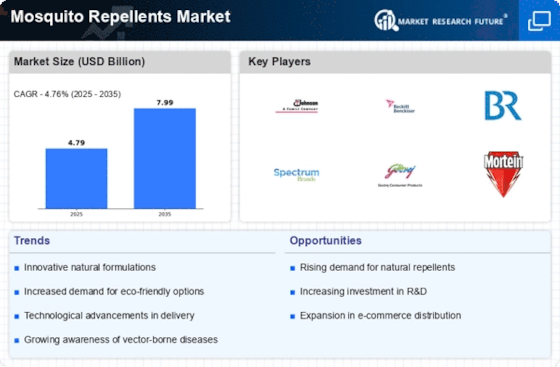
As per Market Research Future analysis, the Mosquito Repellents Market Size was estimated at 4.79 USD Billion in 2024. The Mosquito Repellents industry is projected to grow from 5.018 USD Billion in 2025 to 7.989 USD Billion by 2035, exhibiting a compound annual growth rate (CAGR) of 4.7% during the forecast period 2025 - 2035

Key Market Trends & Highlights

The Mosquito Repellents Market is experiencing a dynamic shift towards natural and sustainable solutions.

  • The market is witnessing a notable shift towards natural ingredients, driven by consumer preferences for eco-friendly products. E-commerce channels are expanding rapidly, facilitating greater accessibility and convenience for consumers in North America. Increased focus on sustainability is shaping product development, particularly in the Asia-Pacific region, where environmental concerns are paramount. Rising incidence of mosquito-borne diseases and increased consumer awareness are key drivers propelling growth in the sprays and DEET segments.

Market Size & Forecast

2024 Market Size 4.79 (USD Billion)
2035 Market Size 7.989 (USD Billion)
CAGR (2025 - 2035) 4.76%
Largest Regional Market Share in 2024 Asia Pacific

Major Players

<a href="https://www.scjp.com/en-us/products/active-insect-repellent-i">SC Johnson</a> (US), <a href="https://www.reckitt.com/powerbrands/hygiene/mortein/">Reckitt Benckiser</a> (GB), Bayer (DE), Spectrum Brands (US), Godrej Consumer Products (IN), Mortein (AU), Cutter (US), Thermacell (US), Pest Control (US)

Market Trends

The Mosquito Repellents Market is currently experiencing a dynamic evolution, driven by a confluence of factors including heightened awareness of mosquito-borne diseases and a growing preference for natural ingredients. Consumers are increasingly seeking products that not only provide effective protection but also align with their health and environmental values. This shift is prompting manufacturers to innovate, leading to the development of new formulations that incorporate botanical extracts and essential oils. As a result, the market landscape is becoming more diverse, with a range of options available to cater to varying consumer preferences. Moreover, the rise of e-commerce platforms is reshaping the distribution channels within the Mosquito Repellents Market. Online shopping offers convenience and accessibility, allowing consumers to explore a wider array of products than traditional retail settings. This trend is particularly appealing to younger demographics who prioritize digital engagement. Consequently, brands are increasingly investing in online marketing strategies to enhance visibility and reach. Overall, the Mosquito Repellents Market appears poised for continued growth, driven by innovation, changing consumer behaviors, and the ongoing need for effective mosquito control solutions.

Shift Towards Natural Ingredients

There is a noticeable trend in the Mosquito Repellents Market towards the use of natural ingredients. Consumers are becoming more health-conscious and environmentally aware, leading to a preference for products that utilize botanical extracts and essential oils. This shift is prompting manufacturers to reformulate existing products and develop new ones that align with these consumer values.

Growth of E-commerce Channels

The expansion of e-commerce is significantly impacting the Mosquito Repellents Market. Online platforms provide consumers with greater access to a variety of products, enhancing convenience and choice. This trend is particularly appealing to younger consumers who favor digital shopping experiences, prompting brands to adapt their marketing strategies to focus on online engagement.

Increased Focus on Sustainability

Sustainability is becoming a critical consideration in the Mosquito Repellents Market. As environmental concerns rise, consumers are seeking products that are not only effective but also eco-friendly. This trend is encouraging manufacturers to adopt sustainable practices in sourcing, production, and packaging, thereby appealing to a more environmentally conscious consumer base.

Mosquito Repellents Market Market Drivers

Regulatory Support and Initiatives

Regulatory support and initiatives aimed at controlling mosquito populations and preventing disease transmission are influencing the Mosquito Repellents Market. Governments and health organizations are implementing policies that encourage the use of repellents as part of integrated pest management strategies. These initiatives often include public health campaigns that promote the use of mosquito repellents, particularly in high-risk areas. Such regulatory frameworks not only enhance consumer confidence in the safety and efficacy of these products but also stimulate market growth. As authorities continue to prioritize public health, the demand for mosquito repellents is expected to rise, creating opportunities for manufacturers to innovate and expand their product offerings.

Expansion of Outdoor Activities and Travel

The growing trend of outdoor activities and travel is contributing to the expansion of the Mosquito Repellents Market. As more individuals engage in camping, hiking, and international travel, the need for effective mosquito protection becomes paramount. This trend is particularly pronounced during warmer months when outdoor activities peak. Additionally, travel to regions where mosquito-borne diseases are prevalent necessitates the use of repellents, further driving market demand. Retailers are responding to this trend by offering a wider range of products tailored for outdoor enthusiasts, including portable and easy-to-apply formulations. The intersection of leisure activities and health awareness is likely to sustain the growth of the mosquito repellent market in the coming years.

Increased Consumer Awareness and Education

Consumer awareness regarding the dangers posed by mosquitoes and the effectiveness of repellents is on the rise, which is driving the Mosquito Repellents Market. Educational campaigns by health organizations and governments are informing the public about the risks associated with mosquito bites and the importance of using repellents. This heightened awareness is leading to increased sales of mosquito repellent products, as consumers are more inclined to invest in preventive measures. Furthermore, the availability of information through various media channels is empowering consumers to make informed choices about the products they purchase. As awareness continues to grow, it is anticipated that the demand for mosquito repellents will further escalate, contributing to the overall expansion of the market.

Rising Incidence of Mosquito-Borne Diseases

The increasing prevalence of mosquito-borne diseases such as dengue fever, Zika virus, and malaria appears to be a primary driver for the Mosquito Repellents Market. According to health organizations, millions of cases are reported annually, leading to heightened public awareness and demand for effective repellents. This trend is particularly evident in regions where these diseases are endemic, prompting governments and health agencies to promote preventive measures. Consequently, the market for mosquito repellents is likely to expand as consumers seek reliable products to protect themselves and their families from these health threats. The urgency to combat these diseases may also lead to innovations in repellent formulations, further stimulating market growth.

Technological Advancements in Repellent Formulations

Technological innovations in the formulation of mosquito repellents are significantly influencing the Mosquito Repellents Market. Recent advancements have led to the development of long-lasting and more effective repellents, which may include novel active ingredients and delivery systems. For instance, products that utilize microencapsulation technology can provide extended protection, appealing to consumers seeking convenience and efficacy. The market is witnessing a shift towards formulations that are not only effective but also safe for human use and the environment. This focus on innovation is expected to attract a broader consumer base, thereby enhancing market growth. As manufacturers invest in research and development, the competitive landscape of the industry is likely to evolve, offering consumers a wider array of choices.

Market Segment Insights

By Type: Sprays (Largest) vs. Creams (Fastest-Growing)

<p>The Mosquito Repellents Market displays a varied distribution among its product types, with sprays currently leading the segment, commanding a significant share of the market. Creams, though trailing behind, are gaining momentum, with increasing consumer preference for options that provide longer-lasting protection against mosquitoes. Lotions and granules, while present, hold smaller portions of the market as they cater to specific consumer needs. This diversification allows consumers to choose products based on convenience and application preferences. Market growth trends show that sprays have established themselves as the go-to option for immediate mosquito protection, however, the rise of creams reflects a shift towards products that offer both effective protection and skin-friendly formulations. Factors driving this growth include a growing awareness of mosquito-borne diseases and a preference for personal care products that blend effectiveness with safety. Emerging interests in natural and organic ingredients have also propelled the demand for creams that promise to repel mosquitoes while being gentler on the skin.</p>

<p>Sprays: Dominant vs. Creams: Emerging</p>

<p>Sprays have long maintained their dominance in the Mosquito Repellents Market, thanks to their convenience and immediate effectiveness. They come in various formulations, including aerosol and pump sprays, which appeal to consumers for quick application and versatility in usage, whether outdoors or indoors. Conversely, creams are emerging as a popular alternative, particularly among consumers seeking a dual benefit of skin treatment along with mosquito repellent properties. They appeal to segments concerned with skin health, especially in regions where prolonged exposure to mosquito bites is prevalent. Creams are typically formulated with natural repellents and moisturizing agents, positioning them well in the market as a safe option for families seeking effective solutions without harsh chemicals.</p>

By Active Ingredients: DEET (Largest) vs. Picaridin (Fastest-Growing)

<p>In the Mosquito Repellents Market, DEET continues to hold the largest market share among active ingredients, attributed to its long-standing efficacy and widespread recognition among consumers. Picaridin, however, is rapidly gaining traction, appealing particularly to consumers looking for DEET alternatives that provide a similar level of protection without some of the drawbacks, like the potential for skin irritation found in DEET-based products.</p>

<p>DEET (Dominant) vs. Picaridin (Emerging)</p>

<p>DEET has been the dominant active ingredient in mosquito repellents for several decades, known for its effectiveness in warding off mosquitoes, ticks, and other biting insects. Its widespread use across various formulations makes it a familiar choice among consumers. In contrast, Picaridin is emerging as a strong competitor, praised for its odorless formula and skin-friendly characteristics. As consumers lean towards more natural and less aggressive repellents, Picaridin's market share is growing, carving out a niche that threatens to challenge DEET's long-standing predominance.</p>

By Formulation: Chemical (Largest) vs. Natural (Fastest-Growing)

<p>The 'Formulation' segment of the Mosquito Repellents Market is characterized by three main categories: Chemical, Natural, and Biopesticides. Chemical repellents hold the largest market share due to their widespread effectiveness and consumer acceptance. Meanwhile, Natural repellents are gaining traction, particularly among health-conscious consumers seeking safer alternatives, while Biopesticides represent a niche yet growing part of the market. This distribution highlights a market thirst for both proven efficacy and natural solutions.</p>

<p>Chemical: Largest vs. Natural: Emerging</p>

<p>Chemical mosquito repellents dominate the market primarily due to their high effectiveness and longevity in repelling mosquitoes. They are often favored in regions with heavy mosquito populations, where the need for strong protection is paramount. In contrast, Natural repellents are emerging as a popular choice, appealing particularly to eco-conscious consumers and those concerned with the potential health risks associated with synthetic chemicals. The rising awareness of environmental sustainability and the push for organic products are significant drivers for the growth of the Natural segment. This evolving preference indicates a shift towards formulations that provide safety without compromising effectiveness.</p>

By End Use: Household (Largest) vs. Agricultural (Fastest-Growing)

<p>The mosquito repellents market's end use segment is predominantly driven by the household category, which accounts for the largest share due to constant consumer demand for personal protection from mosquito-borne diseases. This segment benefits from rising awareness of health issues linked to mosquito bites, leading to household purchases of repellent products in various forms such as sprays, lotions, and candles. Additionally, the commercial use of mosquito repellents in hospitality and outdoor events plays a crucial role, albeit on a smaller scale, compared to households.</p>

<p>Household (Dominant) vs. Agricultural (Emerging)</p>

<p>The household segment represents the dominant force in the mosquito repellents market, characterized by a diverse range of products tailored for family safety and comfort during outdoor activities. These products are often marketed with essential features such as long-lasting protection and multi-purpose use. Conversely, the agricultural segment is emerging rapidly as farmers and agricultural businesses increasingly adopt mosquito repellents to protect crops and livestock from mosquito-related diseases. This segment is motivated by the need to maintain agricultural productivity and safeguard animal health, leading to innovative formulations of repellents that are effective and environmentally sustainable.</p>

Mosquito Repellents Market End Use Insights

Mosquito Repellents Market End Use Insights

The Global Mosquito Repellents Market is experiencing significant growth, with its overall valuation expected to reach 4.79 USD Billion by 2024 and further increasing to 8.0 USD Billion by 2035. Within the market, various end use applications are critical contributors to this growth, notably within the Household, Commercial, and Agricultural sectors. The Household segment plays a crucial role, as consumers increasingly seek effective solutions to create pest-free environments at home.

The Commercial segment is prevalent in sectors such as hospitality and tourism, where maintaining comfort is essential for customer satisfaction and retention.In the Agricultural sector, the use of mosquito repellents helps to safeguard crops and livestock from vector-borne diseases, making it significant for <a href="https://www.marketresearchfuture.com/reports/global-food-safety-testing-market-683">food safety</a> and production. This diverse segmentation reflects the varied applications of mosquito repellents across the globe, catering to different needs and emerging trends. The market growth will be supported by rising awareness about vector-borne diseases and increasing urbanization, which heightens the demand for effective repellents across all end use categories.

Get more detailed insights about Mosquito Repellents Market Research Report – Forecast till 2035

Regional Insights

North America : Market Leader in Innovation

North America is the largest market for mosquito repellents, holding approximately 35% of the global market share. The region's growth is driven by increasing awareness of mosquito-borne diseases and a rising demand for effective repellents. Regulatory support, such as the Environmental Protection Agency's guidelines on pesticide use, further catalyzes market expansion. The trend towards natural and organic products is also gaining traction, influencing consumer preferences. The United States and Canada are the leading countries in this region, with major players like SC Johnson, Reckitt Benckiser, and Thermacell dominating the market. The competitive landscape is characterized by innovation in product formulations and marketing strategies. Companies are increasingly focusing on eco-friendly solutions to meet consumer demand, ensuring a robust market presence and driving sales growth in the mosquito repellent sector.

Europe : Regulatory Framework Drives Growth

Europe is witnessing significant growth in the mosquito repellents market, accounting for approximately 25% of the global share. The region's growth is propelled by stringent regulations on chemical repellents and a shift towards natural alternatives. The European Chemicals Agency's regulations on biocides are pivotal in shaping product development and consumer safety standards. Increased public awareness of health risks associated with mosquito bites is also driving demand for effective repellents. Leading countries in this region include Germany, France, and the UK, where companies like Bayer and Reckitt Benckiser are prominent. The competitive landscape is marked by a mix of established brands and emerging players focusing on innovative formulations. The presence of key players ensures a diverse product range, catering to varying consumer preferences and enhancing market dynamics.

Asia-Pacific : Rapid Growth in Demand

Asia-Pacific is rapidly emerging as a significant market for mosquito repellents, holding around 20% of the global market share. The region's growth is driven by increasing urbanization, rising disposable incomes, and a growing awareness of mosquito-borne diseases. Countries like India and China are witnessing a surge in demand for effective repellents, supported by government initiatives aimed at controlling mosquito populations and preventing disease outbreaks. India and China are the leading countries in this region, with key players such as Godrej Consumer Products and Spectrum Brands making substantial inroads. The competitive landscape is characterized by a mix of local and international brands, focusing on affordability and accessibility. The presence of diverse product offerings, including sprays, coils, and natural repellents, caters to the varying needs of consumers across the region.

Middle East and Africa : Untapped Market Potential

The Middle East and Africa region is gradually emerging in the mosquito repellents market, currently holding about 15% of the global share. The growth is driven by increasing awareness of health risks associated with mosquito bites and a rise in tourism, which heightens the demand for effective repellents. Government initiatives aimed at controlling mosquito populations and preventing diseases like malaria are also contributing to market growth. Leading countries in this region include South Africa and Nigeria, where companies like Mortein and local brands are gaining traction. The competitive landscape is evolving, with a mix of established brands and new entrants focusing on affordability and effectiveness. The presence of key players is crucial in addressing the unique challenges of the region, ensuring a diverse range of products to meet consumer needs.

Key Players and Competitive Insights

The Global Mosquito Repellents Market has experienced significant growth driven by increasing consumer awareness concerning health risks posed by mosquito-borne diseases, rising incidences of diseases such as malaria and dengue, and an increasing preference for outdoor activities. This market encompasses a range of products, including repellents in spray, lotion, and electronic forms, catering to diverse consumer needs. The competitive landscape is characterized by a mix of established companies and emerging brands, each vying for market share through innovative product offerings and effective marketing strategies.
The rising demand is prompting companies to introduce advanced formulations featuring natural ingredients, catering to the growing consumer trend towards environmentally friendly and safe repellent options, which is reshaping the competitive dynamics of this market. Thermacell stands out in the Global Mosquito Repellents Market due to its innovative approach to mosquito control. The company has forged a strong market presence with its unique outdoor mosquito repellent solutions that utilize a variety of technologies, including portable and patio repellent devices.
One of the significant strengths of Thermacell is its focus on providing user-friendly, portable products that offer effective protection against mosquitoes without the need for sprays or lotions. This convenience appeals to outdoor enthusiasts and households, contributing to the brand's popularity. Furthermore, Thermacell has garnered consumer trust through extensive research and positive efficacy claims, positioning itself as a leading player in this competitive market segment and solidifying its brand loyalty among consumers. Newell Brands has established itself as a significant player in the Global Mosquito Repellents Market through a diverse product portfolio that includes both traditional and innovative repellent solutions.
The company offers several well-known brands that are synonymous with quality and effectiveness, thus benefiting from a strong market presence in households globally. One of the key strengths of Newell Brands is its continuous commitment to research and development, leading to the introduction of advanced formulations and eco-friendly alternatives tailored to customer preferences. Additionally, the company has engaged in strategic mergers and acquisitions, bolstering its capabilities to expand its product range and market reach.
This proactive approach ensures that Newell Brands remains competitive while catering to the evolving demands of the global consumer base in the mosquito repellent industry, allowing it to maintain a strong foothold in the market.

Key Companies in the Mosquito Repellents Market include

Industry Developments

The Global Mosquito Repellents Market has been very active lately because more people are aware of mosquito-borne diseases and are spending more time outside after the pandemic. Thermacell released new outdoor repellent devices in September 2023 to make the experience better for users and provide better protection. Around the same time, Amway started selling plant-based repellents in some Asian markets, which showed that they were interested in eco-friendly products. Reckitt Benckiser said that Mortein sales went up in June 2023, which is when demand is highest in the summer.

Ecolab, on the other hand, added more mosquito control services for businesses in 2023, especially in the hospitality and healthcare sectors. In August 2023, Godrej Consumer Products looked into ways to grow its insecticide business strategically, which showed that it was still focused on brands like Goodknight. Japan's Kincho launched resin-infused mosquito solutions in November 2022, which were in line with trends toward sustainability. The market keeps growing steadily, and online shopping and direct-to-consumer channels are important for making things easier to get around the world and increasing sales.


Future Outlook

Mosquito Repellents Market Future Outlook

The Mosquito Repellents Market is projected to grow at a 4.76% CAGR from 2025 to 2035, driven by increasing health awareness and demand for eco-friendly products.

New opportunities lie in:

  • Development of smart mosquito repellent devices with IoT integration.
  • Expansion into emerging markets with tailored product lines.
  • Partnerships with outdoor recreation brands for co-branded products.

By 2035, the market is expected to achieve robust growth, reflecting evolving consumer preferences and innovative solutions.

Market Segmentation

Mosquito Repellents Market Type Outlook

  • Sprays
  • Creams
  • Lotions
  • Granules

Mosquito Repellents Market End Use Outlook

  • Household
  • Commercial
  • Agricultural

Mosquito Repellents Market Formulation Outlook

  • Chemical
  • Natural
  • Biopesticides

Mosquito Repellents Market Active Ingredients Outlook

  • DEET
  • Picaridin
  • IR3535
  • Oil of Lemon Eucalyptus

Report Scope

MARKET SIZE 2024 4.79(USD Billion)
MARKET SIZE 2025 5.018(USD Billion)
MARKET SIZE 2035 7.989(USD Billion)
COMPOUND ANNUAL GROWTH RATE (CAGR) 4.76% (2025 - 2035)
REPORT COVERAGE Revenue Forecast, Competitive Landscape, Growth Factors, and Trends
BASE YEAR 2024
Market Forecast Period 2025 - 2035
Historical Data 2019 - 2024
Market Forecast Units USD Billion
Key Companies Profiled SC Johnson (US), Reckitt Benckiser (GB), Bayer (DE), Spectrum Brands (US), Godrej Consumer Products (IN), Mortein (AU), Cutter (US), Thermacell (US), Pest Control (US)
Segments Covered Product Type, Active Ingredients, Formulation, End Use, Regional
Key Market Opportunities Integration of natural ingredients and innovative delivery systems in the Mosquito Repellents Market.
Key Market Dynamics Rising consumer preference for natural ingredients drives innovation in mosquito repellent formulations and product offerings.
Countries Covered North America, Europe, APAC, South America, MEA

FAQs

What is the current valuation of the Mosquito Repellents Market?

<p>The Mosquito Repellents Market was valued at 4.79 USD Billion in 2024.</p>

What is the projected market size for the Mosquito Repellents Market by 2035?

<p>The market is projected to reach 7.989 USD Billion by 2035.</p>

What is the expected CAGR for the Mosquito Repellents Market during the forecast period?

<p>The expected CAGR for the Mosquito Repellents Market from 2025 to 2035 is 4.76%.</p>

Which companies are considered key players in the Mosquito Repellents Market?

<p>Key players include SC Johnson, Reckitt Benckiser, Bayer, and Spectrum Brands, among others.</p>

What are the main product types in the Mosquito Repellents Market?

<p>The main product types include sprays, creams, lotions, and granules.</p>

How did the valuation of sprays in the Mosquito Repellents Market change from 2024 to 2035?

<p>Sprays were valued at 1.5 USD Billion in 2024 and are projected to reach 2.5 USD Billion by 2035.</p>

What active ingredients are commonly used in mosquito repellents?

<p>Common active ingredients include DEET, Picaridin, IR3535, and Oil of Lemon Eucalyptus.</p>

What is the projected valuation for natural formulations in the Mosquito Repellents Market by 2035?

<p>Natural formulations are expected to grow from 1.5 USD Billion in 2024 to 2.5 USD Billion by 2035.</p>

What end-use segments are present in the Mosquito Repellents Market?

<p>The end-use segments include household, commercial, and agricultural applications.</p>

How is the market for biopesticides expected to evolve by 2035?

<p>The biopesticides segment is projected to increase from 0.79 USD Billion in 2024 to 1.49 USD Billion by 2035.</p>

  1. SECTION I: EXECUTIVE SUMMARY AND KEY HIGHLIGHTS
    1. | 1.1 EXECUTIVE SUMMARY
    2. | | 1.1.1 Market Overview
    3. | | 1.1.2 Key Findings
    4. | | 1.1.3 Market Segmentation
    5. | | 1.1.4 Competitive Landscape
    6. | | 1.1.5 Challenges and Opportunities
    7. | | 1.1.6 Future Outlook
  2. SECTION II: SCOPING, METHODOLOGY AND MARKET STRUCTURE
    1. | 2.1 MARKET INTRODUCTION
    2. | | 2.1.1 Definition
    3. | | 2.1.2 Scope of the study
    4. | | | 2.1.2.1 Research Objective
    5. | | | 2.1.2.2 Assumption
    6. | | | 2.1.2.3 Limitations
    7. | 2.2 RESEARCH METHODOLOGY
    8. | | 2.2.1 Overview
    9. | | 2.2.2 Data Mining
    10. | | 2.2.3 Secondary Research
    11. | | 2.2.4 Primary Research
    12. | | | 2.2.4.1 Primary Interviews and Information Gathering Process
    13. | | | 2.2.4.2 Breakdown of Primary Respondents
    14. | | 2.2.5 Forecasting Model
    15. | | 2.2.6 Market Size Estimation
    16. | | | 2.2.6.1 Bottom-Up Approach
    17. | | | 2.2.6.2 Top-Down Approach
    18. | | 2.2.7 Data Triangulation
    19. | | 2.2.8 Validation
  3. SECTION III: QUALITATIVE ANALYSIS
    1. | 3.1 MARKET DYNAMICS
    2. | | 3.1.1 Overview
    3. | | 3.1.2 Drivers
    4. | | 3.1.3 Restraints
    5. | | 3.1.4 Opportunities
    6. | 3.2 MARKET FACTOR ANALYSIS
    7. | | 3.2.1 Value chain Analysis
    8. | | 3.2.2 Porter's Five Forces Analysis
    9. | | | 3.2.2.1 Bargaining Power of Suppliers
    10. | | | 3.2.2.2 Bargaining Power of Buyers
    11. | | | 3.2.2.3 Threat of New Entrants
    12. | | | 3.2.2.4 Threat of Substitutes
    13. | | | 3.2.2.5 Intensity of Rivalry
    14. | | 3.2.3 COVID-19 Impact Analysis
    15. | | | 3.2.3.1 Market Impact Analysis
    16. | | | 3.2.3.2 Regional Impact
    17. | | | 3.2.3.3 Opportunity and Threat Analysis
  4. SECTION IV: QUANTITATIVE ANALYSIS
    1. | 4.1 Consumer and Retail, BY Type (USD Billion)
    2. | | 4.1.1 Sprays
    3. | | 4.1.2 Creams
    4. | | 4.1.3 Lotions
    5. | | 4.1.4 Granules
    6. | 4.2 Consumer and Retail, BY Active Ingredients (USD Billion)
    7. | | 4.2.1 DEET
    8. | | 4.2.2 Picaridin
    9. | | 4.2.3 IR3535
    10. | | 4.2.4 Oil of Lemon Eucalyptus
    11. | 4.3 Consumer and Retail, BY Formulation (USD Billion)
    12. | | 4.3.1 Chemical
    13. | | 4.3.2 Natural
    14. | | 4.3.3 Biopesticides
    15. | 4.4 Consumer and Retail, BY End Use (USD Billion)
    16. | | 4.4.1 Household
    17. | | 4.4.2 Commercial
    18. | | 4.4.3 Agricultural
    19. | 4.5 Consumer and Retail, BY Region (USD Billion)
    20. | | 4.5.1 North America
    21. | | | 4.5.1.1 US
    22. | | | 4.5.1.2 Canada
    23. | | 4.5.2 Europe
    24. | | | 4.5.2.1 Germany
    25. | | | 4.5.2.2 UK
    26. | | | 4.5.2.3 France
    27. | | | 4.5.2.4 Russia
    28. | | | 4.5.2.5 Italy
    29. | | | 4.5.2.6 Spain
    30. | | | 4.5.2.7 Rest of Europe
    31. | | 4.5.3 APAC
    32. | | | 4.5.3.1 China
    33. | | | 4.5.3.2 India
    34. | | | 4.5.3.3 Japan
    35. | | | 4.5.3.4 South Korea
    36. | | | 4.5.3.5 Malaysia
    37. | | | 4.5.3.6 Thailand
    38. | | | 4.5.3.7 Indonesia
    39. | | | 4.5.3.8 Rest of APAC
    40. | | 4.5.4 South America
    41. | | | 4.5.4.1 Brazil
    42. | | | 4.5.4.2 Mexico
    43. | | | 4.5.4.3 Argentina
    44. | | | 4.5.4.4 Rest of South America
    45. | | 4.5.5 MEA
    46. | | | 4.5.5.1 GCC Countries
    47. | | | 4.5.5.2 South Africa
    48. | | | 4.5.5.3 Rest of MEA
  5. SECTION V: COMPETITIVE ANALYSIS
    1. | 5.1 Competitive Landscape
    2. | | 5.1.1 Overview
    3. | | 5.1.2 Competitive Analysis
    4. | | 5.1.3 Market share Analysis
    5. | | 5.1.4 Major Growth Strategy in the Consumer and Retail
    6. | | 5.1.5 Competitive Benchmarking
    7. | | 5.1.6 Leading Players in Terms of Number of Developments in the Consumer and Retail
    8. | | 5.1.7 Key developments and growth strategies
    9. | | | 5.1.7.1 New Product Launch/Service Deployment
    10. | | | 5.1.7.2 Merger & Acquisitions
    11. | | | 5.1.7.3 Joint Ventures
    12. | | 5.1.8 Major Players Financial Matrix
    13. | | | 5.1.8.1 Sales and Operating Income
    14. | | | 5.1.8.2 Major Players R&D Expenditure. 2023
    15. | 5.2 Company Profiles
    16. | | 5.2.1 SC Johnson (US)
    17. | | | 5.2.1.1 Financial Overview
    18. | | | 5.2.1.2 Products Offered
    19. | | | 5.2.1.3 Key Developments
    20. | | | 5.2.1.4 SWOT Analysis
    21. | | | 5.2.1.5 Key Strategies
    22. | | 5.2.2 Reckitt Benckiser (GB)
    23. | | | 5.2.2.1 Financial Overview
    24. | | | 5.2.2.2 Products Offered
    25. | | | 5.2.2.3 Key Developments
    26. | | | 5.2.2.4 SWOT Analysis
    27. | | | 5.2.2.5 Key Strategies
    28. | | 5.2.3 Bayer (DE)
    29. | | | 5.2.3.1 Financial Overview
    30. | | | 5.2.3.2 Products Offered
    31. | | | 5.2.3.3 Key Developments
    32. | | | 5.2.3.4 SWOT Analysis
    33. | | | 5.2.3.5 Key Strategies
    34. | | 5.2.4 Spectrum Brands (US)
    35. | | | 5.2.4.1 Financial Overview
    36. | | | 5.2.4.2 Products Offered
    37. | | | 5.2.4.3 Key Developments
    38. | | | 5.2.4.4 SWOT Analysis
    39. | | | 5.2.4.5 Key Strategies
    40. | | 5.2.5 Godrej Consumer Products (IN)
    41. | | | 5.2.5.1 Financial Overview
    42. | | | 5.2.5.2 Products Offered
    43. | | | 5.2.5.3 Key Developments
    44. | | | 5.2.5.4 SWOT Analysis
    45. | | | 5.2.5.5 Key Strategies
    46. | | 5.2.6 Mortein (AU)
    47. | | | 5.2.6.1 Financial Overview
    48. | | | 5.2.6.2 Products Offered
    49. | | | 5.2.6.3 Key Developments
    50. | | | 5.2.6.4 SWOT Analysis
    51. | | | 5.2.6.5 Key Strategies
    52. | | 5.2.7 Cutter (US)
    53. | | | 5.2.7.1 Financial Overview
    54. | | | 5.2.7.2 Products Offered
    55. | | | 5.2.7.3 Key Developments
    56. | | | 5.2.7.4 SWOT Analysis
    57. | | | 5.2.7.5 Key Strategies
    58. | | 5.2.8 Thermacell (US)
    59. | | | 5.2.8.1 Financial Overview
    60. | | | 5.2.8.2 Products Offered
    61. | | | 5.2.8.3 Key Developments
    62. | | | 5.2.8.4 SWOT Analysis
    63. | | | 5.2.8.5 Key Strategies
    64. | | 5.2.9 Pest Control (US)
    65. | | | 5.2.9.1 Financial Overview
    66. | | | 5.2.9.2 Products Offered
    67. | | | 5.2.9.3 Key Developments
    68. | | | 5.2.9.4 SWOT Analysis
    69. | | | 5.2.9.5 Key Strategies
    70. | 5.3 Appendix
    71. | | 5.3.1 References
    72. | | 5.3.2 Related Reports
  6. LIST OF FIGURES
    1. | 6.1 MARKET SYNOPSIS
    2. | 6.2 NORTH AMERICA MARKET ANALYSIS
    3. | 6.3 US MARKET ANALYSIS BY TYPE
    4. | 6.4 US MARKET ANALYSIS BY ACTIVE INGREDIENTS
    5. | 6.5 US MARKET ANALYSIS BY FORMULATION
    6. | 6.6 US MARKET ANALYSIS BY END USE
    7. | 6.7 CANADA MARKET ANALYSIS BY TYPE
    8. | 6.8 CANADA MARKET ANALYSIS BY ACTIVE INGREDIENTS
    9. | 6.9 CANADA MARKET ANALYSIS BY FORMULATION
    10. | 6.10 CANADA MARKET ANALYSIS BY END USE
    11. | 6.11 EUROPE MARKET ANALYSIS
    12. | 6.12 GERMANY MARKET ANALYSIS BY TYPE
    13. | 6.13 GERMANY MARKET ANALYSIS BY ACTIVE INGREDIENTS
    14. | 6.14 GERMANY MARKET ANALYSIS BY FORMULATION
    15. | 6.15 GERMANY MARKET ANALYSIS BY END USE
    16. | 6.16 UK MARKET ANALYSIS BY TYPE
    17. | 6.17 UK MARKET ANALYSIS BY ACTIVE INGREDIENTS
    18. | 6.18 UK MARKET ANALYSIS BY FORMULATION
    19. | 6.19 UK MARKET ANALYSIS BY END USE
    20. | 6.20 FRANCE MARKET ANALYSIS BY TYPE
    21. | 6.21 FRANCE MARKET ANALYSIS BY ACTIVE INGREDIENTS
    22. | 6.22 FRANCE MARKET ANALYSIS BY FORMULATION
    23. | 6.23 FRANCE MARKET ANALYSIS BY END USE
    24. | 6.24 RUSSIA MARKET ANALYSIS BY TYPE
    25. | 6.25 RUSSIA MARKET ANALYSIS BY ACTIVE INGREDIENTS
    26. | 6.26 RUSSIA MARKET ANALYSIS BY FORMULATION
    27. | 6.27 RUSSIA MARKET ANALYSIS BY END USE
    28. | 6.28 ITALY MARKET ANALYSIS BY TYPE
    29. | 6.29 ITALY MARKET ANALYSIS BY ACTIVE INGREDIENTS
    30. | 6.30 ITALY MARKET ANALYSIS BY FORMULATION
    31. | 6.31 ITALY MARKET ANALYSIS BY END USE
    32. | 6.32 SPAIN MARKET ANALYSIS BY TYPE
    33. | 6.33 SPAIN MARKET ANALYSIS BY ACTIVE INGREDIENTS
    34. | 6.34 SPAIN MARKET ANALYSIS BY FORMULATION
    35. | 6.35 SPAIN MARKET ANALYSIS BY END USE
    36. | 6.36 REST OF EUROPE MARKET ANALYSIS BY TYPE
    37. | 6.37 REST OF EUROPE MARKET ANALYSIS BY ACTIVE INGREDIENTS
    38. | 6.38 REST OF EUROPE MARKET ANALYSIS BY FORMULATION
    39. | 6.39 REST OF EUROPE MARKET ANALYSIS BY END USE
    40. | 6.40 APAC MARKET ANALYSIS
    41. | 6.41 CHINA MARKET ANALYSIS BY TYPE
    42. | 6.42 CHINA MARKET ANALYSIS BY ACTIVE INGREDIENTS
    43. | 6.43 CHINA MARKET ANALYSIS BY FORMULATION
    44. | 6.44 CHINA MARKET ANALYSIS BY END USE
    45. | 6.45 INDIA MARKET ANALYSIS BY TYPE
    46. | 6.46 INDIA MARKET ANALYSIS BY ACTIVE INGREDIENTS
    47. | 6.47 INDIA MARKET ANALYSIS BY FORMULATION
    48. | 6.48 INDIA MARKET ANALYSIS BY END USE
    49. | 6.49 JAPAN MARKET ANALYSIS BY TYPE
    50. | 6.50 JAPAN MARKET ANALYSIS BY ACTIVE INGREDIENTS
    51. | 6.51 JAPAN MARKET ANALYSIS BY FORMULATION
    52. | 6.52 JAPAN MARKET ANALYSIS BY END USE
    53. | 6.53 SOUTH KOREA MARKET ANALYSIS BY TYPE
    54. | 6.54 SOUTH KOREA MARKET ANALYSIS BY ACTIVE INGREDIENTS
    55. | 6.55 SOUTH KOREA MARKET ANALYSIS BY FORMULATION
    56. | 6.56 SOUTH KOREA MARKET ANALYSIS BY END USE
    57. | 6.57 MALAYSIA MARKET ANALYSIS BY TYPE
    58. | 6.58 MALAYSIA MARKET ANALYSIS BY ACTIVE INGREDIENTS
    59. | 6.59 MALAYSIA MARKET ANALYSIS BY FORMULATION
    60. | 6.60 MALAYSIA MARKET ANALYSIS BY END USE
    61. | 6.61 THAILAND MARKET ANALYSIS BY TYPE
    62. | 6.62 THAILAND MARKET ANALYSIS BY ACTIVE INGREDIENTS
    63. | 6.63 THAILAND MARKET ANALYSIS BY FORMULATION
    64. | 6.64 THAILAND MARKET ANALYSIS BY END USE
    65. | 6.65 INDONESIA MARKET ANALYSIS BY TYPE
    66. | 6.66 INDONESIA MARKET ANALYSIS BY ACTIVE INGREDIENTS
    67. | 6.67 INDONESIA MARKET ANALYSIS BY FORMULATION
    68. | 6.68 INDONESIA MARKET ANALYSIS BY END USE
    69. | 6.69 REST OF APAC MARKET ANALYSIS BY TYPE
    70. | 6.70 REST OF APAC MARKET ANALYSIS BY ACTIVE INGREDIENTS
    71. | 6.71 REST OF APAC MARKET ANALYSIS BY FORMULATION
    72. | 6.72 REST OF APAC MARKET ANALYSIS BY END USE
    73. | 6.73 SOUTH AMERICA MARKET ANALYSIS
    74. | 6.74 BRAZIL MARKET ANALYSIS BY TYPE
    75. | 6.75 BRAZIL MARKET ANALYSIS BY ACTIVE INGREDIENTS
    76. | 6.76 BRAZIL MARKET ANALYSIS BY FORMULATION
    77. | 6.77 BRAZIL MARKET ANALYSIS BY END USE
    78. | 6.78 MEXICO MARKET ANALYSIS BY TYPE
    79. | 6.79 MEXICO MARKET ANALYSIS BY ACTIVE INGREDIENTS
    80. | 6.80 MEXICO MARKET ANALYSIS BY FORMULATION
    81. | 6.81 MEXICO MARKET ANALYSIS BY END USE
    82. | 6.82 ARGENTINA MARKET ANALYSIS BY TYPE
    83. | 6.83 ARGENTINA MARKET ANALYSIS BY ACTIVE INGREDIENTS
    84. | 6.84 ARGENTINA MARKET ANALYSIS BY FORMULATION
    85. | 6.85 ARGENTINA MARKET ANALYSIS BY END USE
    86. | 6.86 REST OF SOUTH AMERICA MARKET ANALYSIS BY TYPE
    87. | 6.87 REST OF SOUTH AMERICA MARKET ANALYSIS BY ACTIVE INGREDIENTS
    88. | 6.88 REST OF SOUTH AMERICA MARKET ANALYSIS BY FORMULATION
    89. | 6.89 REST OF SOUTH AMERICA MARKET ANALYSIS BY END USE
    90. | 6.90 MEA MARKET ANALYSIS
    91. | 6.91 GCC COUNTRIES MARKET ANALYSIS BY TYPE
    92. | 6.92 GCC COUNTRIES MARKET ANALYSIS BY ACTIVE INGREDIENTS
    93. | 6.93 GCC COUNTRIES MARKET ANALYSIS BY FORMULATION
    94. | 6.94 GCC COUNTRIES MARKET ANALYSIS BY END USE
    95. | 6.95 SOUTH AFRICA MARKET ANALYSIS BY TYPE
    96. | 6.96 SOUTH AFRICA MARKET ANALYSIS BY ACTIVE INGREDIENTS
    97. | 6.97 SOUTH AFRICA MARKET ANALYSIS BY FORMULATION
    98. | 6.98 SOUTH AFRICA MARKET ANALYSIS BY END USE
    99. | 6.99 REST OF MEA MARKET ANALYSIS BY TYPE
    100. | 6.100 REST OF MEA MARKET ANALYSIS BY ACTIVE INGREDIENTS
    101. | 6.101 REST OF MEA MARKET ANALYSIS BY FORMULATION
    102. | 6.102 REST OF MEA MARKET ANALYSIS BY END USE
    103. | 6.103 KEY BUYING CRITERIA OF CONSUMER AND RETAIL
    104. | 6.104 RESEARCH PROCESS OF MRFR
    105. | 6.105 DRO ANALYSIS OF CONSUMER AND RETAIL
    106. | 6.106 DRIVERS IMPACT ANALYSIS: CONSUMER AND RETAIL
    107. | 6.107 RESTRAINTS IMPACT ANALYSIS: CONSUMER AND RETAIL
    108. | 6.108 SUPPLY / VALUE CHAIN: CONSUMER AND RETAIL
    109. | 6.109 CONSUMER AND RETAIL, BY TYPE, 2024 (% SHARE)
    110. | 6.110 CONSUMER AND RETAIL, BY TYPE, 2024 TO 2035 (USD Billion)
    111. | 6.111 CONSUMER AND RETAIL, BY ACTIVE INGREDIENTS, 2024 (% SHARE)
    112. | 6.112 CONSUMER AND RETAIL, BY ACTIVE INGREDIENTS, 2024 TO 2035 (USD Billion)
    113. | 6.113 CONSUMER AND RETAIL, BY FORMULATION, 2024 (% SHARE)
    114. | 6.114 CONSUMER AND RETAIL, BY FORMULATION, 2024 TO 2035 (USD Billion)
    115. | 6.115 CONSUMER AND RETAIL, BY END USE, 2024 (% SHARE)
    116. | 6.116 CONSUMER AND RETAIL, BY END USE, 2024 TO 2035 (USD Billion)
    117. | 6.117 BENCHMARKING OF MAJOR COMPETITORS
  7. LIST OF TABLES
    1. | 7.1 LIST OF ASSUMPTIONS
    2. | | 7.1.1
    3. | 7.2 North America MARKET SIZE ESTIMATES; FORECAST
    4. | | 7.2.1 BY TYPE, 2025-2035 (USD Billion)
    5. | | 7.2.2 BY ACTIVE INGREDIENTS, 2025-2035 (USD Billion)
    6. | | 7.2.3 BY FORMULATION, 2025-2035 (USD Billion)
    7. | | 7.2.4 BY END USE, 2025-2035 (USD Billion)
    8. | 7.3 US MARKET SIZE ESTIMATES; FORECAST
    9. | | 7.3.1 BY TYPE, 2025-2035 (USD Billion)
    10. | | 7.3.2 BY ACTIVE INGREDIENTS, 2025-2035 (USD Billion)
    11. | | 7.3.3 BY FORMULATION, 2025-2035 (USD Billion)
    12. | | 7.3.4 BY END USE, 2025-2035 (USD Billion)
    13. | 7.4 Canada MARKET SIZE ESTIMATES; FORECAST
    14. | | 7.4.1 BY TYPE, 2025-2035 (USD Billion)
    15. | | 7.4.2 BY ACTIVE INGREDIENTS, 2025-2035 (USD Billion)
    16. | | 7.4.3 BY FORMULATION, 2025-2035 (USD Billion)
    17. | | 7.4.4 BY END USE, 2025-2035 (USD Billion)
    18. | 7.5 Europe MARKET SIZE ESTIMATES; FORECAST
    19. | | 7.5.1 BY TYPE, 2025-2035 (USD Billion)
    20. | | 7.5.2 BY ACTIVE INGREDIENTS, 2025-2035 (USD Billion)
    21. | | 7.5.3 BY FORMULATION, 2025-2035 (USD Billion)
    22. | | 7.5.4 BY END USE, 2025-2035 (USD Billion)
    23. | 7.6 Germany MARKET SIZE ESTIMATES; FORECAST
    24. | | 7.6.1 BY TYPE, 2025-2035 (USD Billion)
    25. | | 7.6.2 BY ACTIVE INGREDIENTS, 2025-2035 (USD Billion)
    26. | | 7.6.3 BY FORMULATION, 2025-2035 (USD Billion)
    27. | | 7.6.4 BY END USE, 2025-2035 (USD Billion)
    28. | 7.7 UK MARKET SIZE ESTIMATES; FORECAST
    29. | | 7.7.1 BY TYPE, 2025-2035 (USD Billion)
    30. | | 7.7.2 BY ACTIVE INGREDIENTS, 2025-2035 (USD Billion)
    31. | | 7.7.3 BY FORMULATION, 2025-2035 (USD Billion)
    32. | | 7.7.4 BY END USE, 2025-2035 (USD Billion)
    33. | 7.8 France MARKET SIZE ESTIMATES; FORECAST
    34. | | 7.8.1 BY TYPE, 2025-2035 (USD Billion)
    35. | | 7.8.2 BY ACTIVE INGREDIENTS, 2025-2035 (USD Billion)
    36. | | 7.8.3 BY FORMULATION, 2025-2035 (USD Billion)
    37. | | 7.8.4 BY END USE, 2025-2035 (USD Billion)
    38. | 7.9 Russia MARKET SIZE ESTIMATES; FORECAST
    39. | | 7.9.1 BY TYPE, 2025-2035 (USD Billion)
    40. | | 7.9.2 BY ACTIVE INGREDIENTS, 2025-2035 (USD Billion)
    41. | | 7.9.3 BY FORMULATION, 2025-2035 (USD Billion)
    42. | | 7.9.4 BY END USE, 2025-2035 (USD Billion)
    43. | 7.10 Italy MARKET SIZE ESTIMATES; FORECAST
    44. | | 7.10.1 BY TYPE, 2025-2035 (USD Billion)
    45. | | 7.10.2 BY ACTIVE INGREDIENTS, 2025-2035 (USD Billion)
    46. | | 7.10.3 BY FORMULATION, 2025-2035 (USD Billion)
    47. | | 7.10.4 BY END USE, 2025-2035 (USD Billion)
    48. | 7.11 Spain MARKET SIZE ESTIMATES; FORECAST
    49. | | 7.11.1 BY TYPE, 2025-2035 (USD Billion)
    50. | | 7.11.2 BY ACTIVE INGREDIENTS, 2025-2035 (USD Billion)
    51. | | 7.11.3 BY FORMULATION, 2025-2035 (USD Billion)
    52. | | 7.11.4 BY END USE, 2025-2035 (USD Billion)
    53. | 7.12 Rest of Europe MARKET SIZE ESTIMATES; FORECAST
    54. | | 7.12.1 BY TYPE, 2025-2035 (USD Billion)
    55. | | 7.12.2 BY ACTIVE INGREDIENTS, 2025-2035 (USD Billion)
    56. | | 7.12.3 BY FORMULATION, 2025-2035 (USD Billion)
    57. | | 7.12.4 BY END USE, 2025-2035 (USD Billion)
    58. | 7.13 APAC MARKET SIZE ESTIMATES; FORECAST
    59. | | 7.13.1 BY TYPE, 2025-2035 (USD Billion)
    60. | | 7.13.2 BY ACTIVE INGREDIENTS, 2025-2035 (USD Billion)
    61. | | 7.13.3 BY FORMULATION, 2025-2035 (USD Billion)
    62. | | 7.13.4 BY END USE, 2025-2035 (USD Billion)
    63. | 7.14 China MARKET SIZE ESTIMATES; FORECAST
    64. | | 7.14.1 BY TYPE, 2025-2035 (USD Billion)
    65. | | 7.14.2 BY ACTIVE INGREDIENTS, 2025-2035 (USD Billion)
    66. | | 7.14.3 BY FORMULATION, 2025-2035 (USD Billion)
    67. | | 7.14.4 BY END USE, 2025-2035 (USD Billion)
    68. | 7.15 India MARKET SIZE ESTIMATES; FORECAST
    69. | | 7.15.1 BY TYPE, 2025-2035 (USD Billion)
    70. | | 7.15.2 BY ACTIVE INGREDIENTS, 2025-2035 (USD Billion)
    71. | | 7.15.3 BY FORMULATION, 2025-2035 (USD Billion)
    72. | | 7.15.4 BY END USE, 2025-2035 (USD Billion)
    73. | 7.16 Japan MARKET SIZE ESTIMATES; FORECAST
    74. | | 7.16.1 BY TYPE, 2025-2035 (USD Billion)
    75. | | 7.16.2 BY ACTIVE INGREDIENTS, 2025-2035 (USD Billion)
    76. | | 7.16.3 BY FORMULATION, 2025-2035 (USD Billion)
    77. | | 7.16.4 BY END USE, 2025-2035 (USD Billion)
    78. | 7.17 South Korea MARKET SIZE ESTIMATES; FORECAST
    79. | | 7.17.1 BY TYPE, 2025-2035 (USD Billion)
    80. | | 7.17.2 BY ACTIVE INGREDIENTS, 2025-2035 (USD Billion)
    81. | | 7.17.3 BY FORMULATION, 2025-2035 (USD Billion)
    82. | | 7.17.4 BY END USE, 2025-2035 (USD Billion)
    83. | 7.18 Malaysia MARKET SIZE ESTIMATES; FORECAST
    84. | | 7.18.1 BY TYPE, 2025-2035 (USD Billion)
    85. | | 7.18.2 BY ACTIVE INGREDIENTS, 2025-2035 (USD Billion)
    86. | | 7.18.3 BY FORMULATION, 2025-2035 (USD Billion)
    87. | | 7.18.4 BY END USE, 2025-2035 (USD Billion)
    88. | 7.19 Thailand MARKET SIZE ESTIMATES; FORECAST
    89. | | 7.19.1 BY TYPE, 2025-2035 (USD Billion)
    90. | | 7.19.2 BY ACTIVE INGREDIENTS, 2025-2035 (USD Billion)
    91. | | 7.19.3 BY FORMULATION, 2025-2035 (USD Billion)
    92. | | 7.19.4 BY END USE, 2025-2035 (USD Billion)
    93. | 7.20 Indonesia MARKET SIZE ESTIMATES; FORECAST
    94. | | 7.20.1 BY TYPE, 2025-2035 (USD Billion)
    95. | | 7.20.2 BY ACTIVE INGREDIENTS, 2025-2035 (USD Billion)
    96. | | 7.20.3 BY FORMULATION, 2025-2035 (USD Billion)
    97. | | 7.20.4 BY END USE, 2025-2035 (USD Billion)
    98. | 7.21 Rest of APAC MARKET SIZE ESTIMATES; FORECAST
    99. | | 7.21.1 BY TYPE, 2025-2035 (USD Billion)
    100. | | 7.21.2 BY ACTIVE INGREDIENTS, 2025-2035 (USD Billion)
    101. | | 7.21.3 BY FORMULATION, 2025-2035 (USD Billion)
    102. | | 7.21.4 BY END USE, 2025-2035 (USD Billion)
    103. | 7.22 South America MARKET SIZE ESTIMATES; FORECAST
    104. | | 7.22.1 BY TYPE, 2025-2035 (USD Billion)
    105. | | 7.22.2 BY ACTIVE INGREDIENTS, 2025-2035 (USD Billion)
    106. | | 7.22.3 BY FORMULATION, 2025-2035 (USD Billion)
    107. | | 7.22.4 BY END USE, 2025-2035 (USD Billion)
    108. | 7.23 Brazil MARKET SIZE ESTIMATES; FORECAST
    109. | | 7.23.1 BY TYPE, 2025-2035 (USD Billion)
    110. | | 7.23.2 BY ACTIVE INGREDIENTS, 2025-2035 (USD Billion)
    111. | | 7.23.3 BY FORMULATION, 2025-2035 (USD Billion)
    112. | | 7.23.4 BY END USE, 2025-2035 (USD Billion)
    113. | 7.24 Mexico MARKET SIZE ESTIMATES; FORECAST
    114. | | 7.24.1 BY TYPE, 2025-2035 (USD Billion)
    115. | | 7.24.2 BY ACTIVE INGREDIENTS, 2025-2035 (USD Billion)
    116. | | 7.24.3 BY FORMULATION, 2025-2035 (USD Billion)
    117. | | 7.24.4 BY END USE, 2025-2035 (USD Billion)
    118. | 7.25 Argentina MARKET SIZE ESTIMATES; FORECAST
    119. | | 7.25.1 BY TYPE, 2025-2035 (USD Billion)
    120. | | 7.25.2 BY ACTIVE INGREDIENTS, 2025-2035 (USD Billion)
    121. | | 7.25.3 BY FORMULATION, 2025-2035 (USD Billion)
    122. | | 7.25.4 BY END USE, 2025-2035 (USD Billion)
    123. | 7.26 Rest of South America MARKET SIZE ESTIMATES; FORECAST
    124. | | 7.26.1 BY TYPE, 2025-2035 (USD Billion)
    125. | | 7.26.2 BY ACTIVE INGREDIENTS, 2025-2035 (USD Billion)
    126. | | 7.26.3 BY FORMULATION, 2025-2035 (USD Billion)
    127. | | 7.26.4 BY END USE, 2025-2035 (USD Billion)
    128. | 7.27 MEA MARKET SIZE ESTIMATES; FORECAST
    129. | | 7.27.1 BY TYPE, 2025-2035 (USD Billion)
    130. | | 7.27.2 BY ACTIVE INGREDIENTS, 2025-2035 (USD Billion)
    131. | | 7.27.3 BY FORMULATION, 2025-2035 (USD Billion)
    132. | | 7.27.4 BY END USE, 2025-2035 (USD Billion)
    133. | 7.28 GCC Countries MARKET SIZE ESTIMATES; FORECAST
    134. | | 7.28.1 BY TYPE, 2025-2035 (USD Billion)
    135. | | 7.28.2 BY ACTIVE INGREDIENTS, 2025-2035 (USD Billion)
    136. | | 7.28.3 BY FORMULATION, 2025-2035 (USD Billion)
    137. | | 7.28.4 BY END USE, 2025-2035 (USD Billion)
    138. | 7.29 South Africa MARKET SIZE ESTIMATES; FORECAST
    139. | | 7.29.1 BY TYPE, 2025-2035 (USD Billion)
    140. | | 7.29.2 BY ACTIVE INGREDIENTS, 2025-2035 (USD Billion)
    141. | | 7.29.3 BY FORMULATION, 2025-2035 (USD Billion)
    142. | | 7.29.4 BY END USE, 2025-2035 (USD Billion)
    143. | 7.30 Rest of MEA MARKET SIZE ESTIMATES; FORECAST
    144. | | 7.30.1 BY TYPE, 2025-2035 (USD Billion)
    145. | | 7.30.2 BY ACTIVE INGREDIENTS, 2025-2035 (USD Billion)
    146. | | 7.30.3 BY FORMULATION, 2025-2035 (USD Billion)
    147. | | 7.30.4 BY END USE, 2025-2035 (USD Billion)
    148. | 7.31 PRODUCT LAUNCH/PRODUCT DEVELOPMENT/APPROVAL
    149. | | 7.31.1
    150. | 7.32 ACQUISITION/PARTNERSHIP
    151. | | 7.32.1

Consumer and Retail Market Segmentation

Consumer and Retail By Type (USD Billion, 2025-2035)

  • Sprays
  • Creams
  • Lotions
  • Granules

Consumer and Retail By Active Ingredients (USD Billion, 2025-2035)

  • DEET
  • Picaridin
  • IR3535
  • Oil of Lemon Eucalyptus

Consumer and Retail By Formulation (USD Billion, 2025-2035)

  • Chemical
  • Natural
  • Biopesticides

Consumer and Retail By End Use (USD Billion, 2025-2035)

  • Household
  • Commercial
  • Agricultural
Infographic

Free Sample Request

Kindly complete the form below to receive a free sample of this Report

Get Free Sample

Customer Strories

Compare Licence

×
Features License Type
Single User Multiuser License Enterprise User
Price $4,950 $5,950 $7,250
Maximum User Access Limit 1 User Upto 10 Users Unrestricted Access Throughout the Organization
Free Customization
Direct Access to Analyst
Deliverable Format
Platform Access
Discount on Next Purchase 10% 15% 15%
Printable Versions
%>