Molecular Sieves Market

ID: MRFR/CnM/6965-CR
215 Pages
Chitranshi Jaiswal
Last Updated: June 16, 2026
Molecular Sieves Market Research Report Information by Type (4A, 3A, 5A, 13X, Zeolite Y, and Others), by Shape (Beads, Pellets, and Powder), by Product (Zeolites, Activated Carbon, Clay, and Others), by End-use (Oil & Gas, Automotive, Packaging, Coatings, Wastewater Treatment, Detergents, and Others), And By Region (North America, Europe, Asia-Pacific, And Rest Of The World) –Market Forecast Till 2035
Download PDF ×

We do not share your information with anyone. However, we may send you emails based on your report interest from time to time. You may contact us at any time to opt-out.

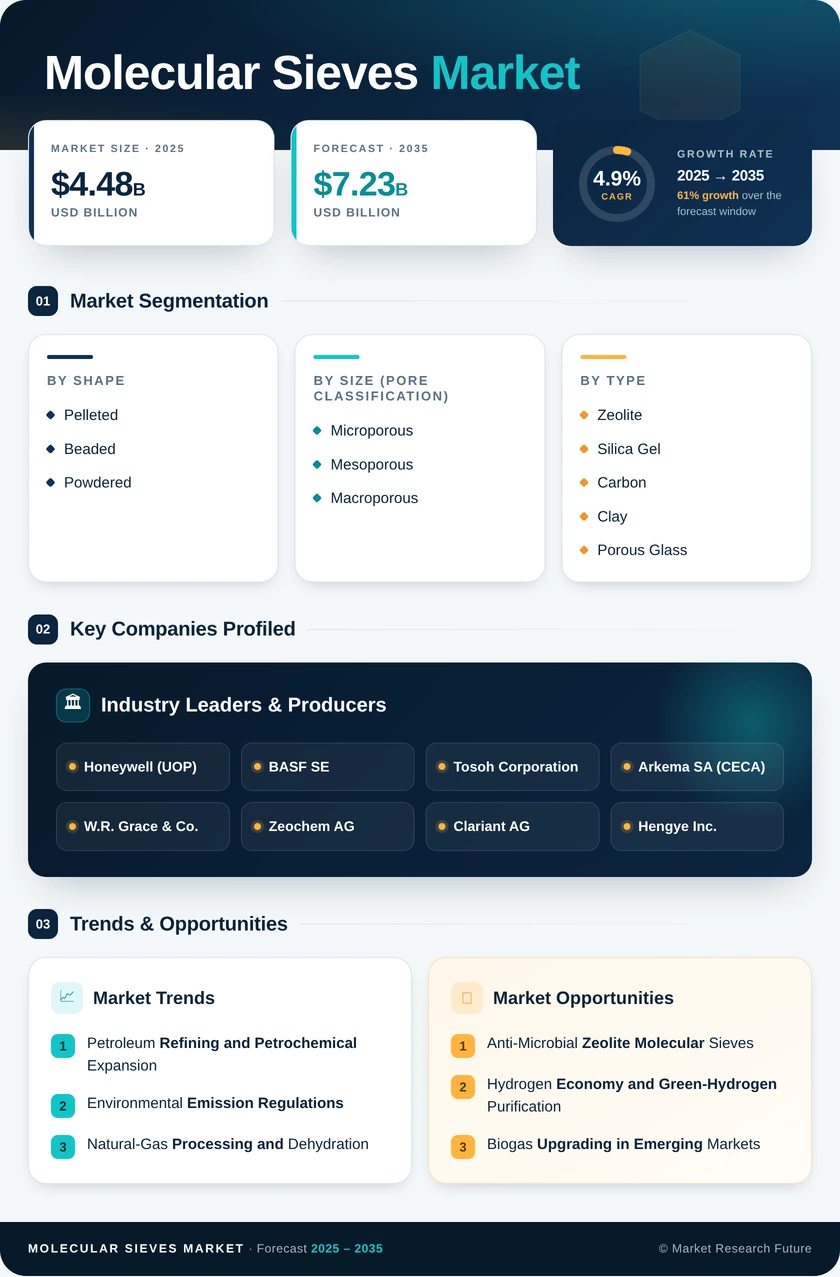
Molecular Sieves Market

Market Size

Forecast Period2026-2035
CAGR (2026-2035)4.9%
2025 Market SizeUSD 4.48 Billion
2035 Market SizeUSD 7.23 Billion

Key Players

Honeywell
BASF SE
Tosoh Corporation
Arkema SA
W.R. Grace & Co.
Zeochem AG
Opportunities
  • Anti-Microbial Zeolite Molecular Sieves
  • Hydrogen Economy and Green-Hydrogen Purification
  • Biogas Upgrading in Emerging Markets
  1. 1 Market Overview |
    1. 1.1 Study Assumptions & Market Definition |
    2. 1.2 Scope of the Study |
    3. 1.3 Research Methodology
  2. 2 Market Summary & Key Takeaways
  3. 3 Market Dynamics |
    1. 3.1 Market Drivers Analysis | |
      1. 3.1.1 Petroleum Refining and Petrochemical Expansion | |
      2. 3.1.2 Environmental Emission Regulations | |
      3. 3.1.3 Natural-Gas Processing and Dehydration | |
      4. 3.1.4 Wastewater and Water Treatment Mandates | |
      5. 3.1.5 Hydrogen Purification Requirements | |
      6. 3.1.6 Pharmaceutical Solvent Recovery Growth | |
      7. 3.1.7 Biogas Upgrading for Renewable Natural Gas |
    2. 3.2 Market Restraints Analysis | |
      1. 3.2.1 Membrane Technology Substitution | |
      2. 3.2.2 Raw-Material Price Volatility | |
      3. 3.2.3 Energy-Intensive Regeneration Costs | |
      4. 3.2.4 Competition from Enzyme-Based Catalysts | |
      5. 3.2.5 Slow Regulatory Adoption in Emerging Markets |
    3. 3.3 Market Opportunity Analysis | |
      1. 3.3.1 Anti-Microbial Zeolite Molecular Sieves | |
      2. 3.3.2 Hydrogen Economy and Green-Hydrogen Purification | |
      3. 3.3.3 Biogas Upgrading in Emerging Markets | |
      4. 3.3.4 Data-Driven Adsorbent Lifecycle Management | |
      5. 3.3.5 Pharmaceutical Solvent Recovery |
    4. 3.4 Industry Value Chain Analysis |
    5. 3.5 Porter's Five Forces Analysis
  4. 4 Global Molecular Sieves Market Size & Forecast (2021–2035) |
    1. 4.1 Historical Market Size (2021–2025) |
    2. 4.2 Current & Forecast Market Size (2026–2035) |
    3. 4.3 Market Size by Revenue (USD Billion) |
    4. 4.4 Year-over-Year Growth Analysis
  5. 5 Segmentation Analysis |
    1. 5.1 By Shape | |
      1. 5.1.1 Pelleted | |
      2. 5.1.2 Beaded | |
      3. 5.1.3 Powdered |
    2. 5.2 By Size (Pore Classification) | |
      1. 5.2.1 Microporous | |
      2. 5.2.2 Mesoporous | |
      3. 5.2.3 Macroporous |
    3. 5.3 By Product Type | |
      1. 5.3.1 Carbon | |
      2. 5.3.2 Clay | |
      3. 5.3.3 Porous Glass | |
      4. 5.3.4 Silica Gel | |
      5. 5.3.5 Zeolite |
    4. 5.4 By End-User Industry | |
      1. 5.4.1 Automotive | |
      2. 5.4.2 Cosmetics and Detergent | |
      3. 5.4.3 Oil and Gas | |
      4. 5.4.4 Pharmaceutical | |
      5. 5.4.5 Waste and Water Treatment | |
      6. 5.4.6 Others
  6. 6 Regional Analysis |
    1. 6.1 North America | |
      1. 6.1.1 United States | |
      2. 6.1.2 Canada | |
      3. 6.1.3 Mexico |
    2. 6.2 Europe | |
      1. 6.2.1 Germany | |
      2. 6.2.2 United Kingdom | |
      3. 6.2.3 France | |
      4. 6.2.4 Italy | |
      5. 6.2.5 Spain | |
      6. 6.2.6 Nordic Countries | |
      7. 6.2.7 Russia | |
      8. 6.2.8 Rest of Europe |
    3. 6.3 Asia-Pacific | |
      1. 6.3.1 China | |
      2. 6.3.2 India | |
      3. 6.3.3 Japan | |
      4. 6.3.4 South Korea | |
      5. 6.3.5 ASEAN | |
      6. 6.3.6 Rest of Asia-Pacific |
    4. 6.4 South America | |
      1. 6.4.1 Brazil | |
      2. 6.4.2 Argentina | |
      3. 6.4.3 Rest of South America |
    5. 6.5 Middle East & Africa | |
      1. 6.5.1 Saudi Arabia | |
      2. 6.5.2 UAE | |
      3. 6.5.3 South Africa | |
      4. 6.5.4 Egypt | |
      5. 6.5.5 Rest of MEA
  7. 7 Competitive Landscape |
    1. 7.1 Market Share Analysis (2025) |
    2. 7.2 Competitive Benchmarking Matrix |
    3. 7.3 Company Profiles | |
      1. 7.3.1 Honeywell International Inc. (UOP) | |
      2. 7.3.2 BASF SE | |
      3. 7.3.3 Tosoh Corporation | |
      4. 7.3.4 Arkema SA (CECA) | |
      5. 7.3.5 W.R. Grace & Co. | |
      6. 7.3.6 Zeochem AG | |
      7. 7.3.7 Clariant AG | |
      8. 7.3.8 Hengye Inc. | |
      9. 7.3.9 KNT Group | |
      10. 7.3.10 Luoyang Jianlong Micro-Nano New Materials Co.
  8. 8 Future Outlook & Strategic Recommendations (2026–2035) |
    1. 8.1 Hydrogen Economy Integration |
    2. 8.2 Digital Operations and Predictive Maintenance |
    3. 8.3 Sustainability and Circular-Economy Mandates |
    4. 8.4 Emerging-Market Industrialization
  9. 9 Recent Developments & News
  10. 10 Frequently Asked Questions (FAQs)
  11. 11 Report Scope & Methodology |
    1. 11.1 Study Period & Base Year |
    2. 11.2 Data Sources & Citations |
    3. 11.3 Abbreviations
  12. 12 LIST OF TABLES |
  13. TABLE 1 Global Molecular Sieves Market Size & Forecast, by Revenue (USD Billion), 2021–2035 |
  14. TABLE 2 Global Molecular Sieves Market — Year-over-Year Growth Analysis, 2021–2035 |
  15. TABLE 3 Driver Impact Analysis — Global Molecular Sieves Market |
  16. TABLE 4 Restraint Impact Analysis — Global Molecular Sieves Market |
  17. TABLE 5 Regional Market Summary — Global Molecular Sieves Market, 2025 |
  18. TABLE 6 North America Molecular Sieves Market Size, by Country, 2021–2035 (USD Billion) |
  19. TABLE 7 Europe Molecular Sieves Market Size, by Country, 2021–2035 (USD Billion) |
  20. TABLE 8 Asia-Pacific Molecular Sieves Market Size, by Country, 2021–2035 (USD Billion) |
  21. TABLE 9 South America Molecular Sieves Market Size, by Country, 2021–2035 (USD Billion) |
  22. TABLE 10 Middle East & Africa Molecular Sieves Market Size, by Country, 2021–2035 (USD Billion) |
  23. TABLE 11 Global Molecular Sieves Market Size, by Shape, 2021–2035 (USD Billion) |
  24. TABLE 12 Global Molecular Sieves Market Size, by Size (Pore Classification), 2021–2035 (USD Billion) |
  25. TABLE 13 Global Molecular Sieves Market Size, by Product Type, 2021–2035 (USD Billion) |
  26. TABLE 14 Global Molecular Sieves Market Size, by End-User Industry, 2021–2035 (USD Billion) |
  27. TABLE 15 Competitive Benchmarking Matrix — Global Molecular Sieves Market, 2025 |
  28. TABLE 16 Company Profiles — Key Players, Global Molecular Sieves Market |
  29. TABLE 17 Recent Developments & Strategic Announcements, 2024–2025 |
  30. TABLE 18 Report Scope & Methodology Summary |
  31. TABLE 19 Detailed Sources and Citations |
  32. TABLE 20 North America Molecular Sieves Market Size, by Shape, 2021–2035 (USD Billion) |
  33. TABLE 21 North America Molecular Sieves Market Size, by Size, 2021–2035 (USD Billion) |
  34. TABLE 22 North America Molecular Sieves Market Size, by Product Type, 2021–2035 (USD Billion) |
  35. TABLE 23 North America Molecular Sieves Market Size, by End-User Industry, 2021–2035 (USD Billion) |
  36. TABLE 24 Europe Molecular Sieves Market Size, by Shape, 2021–2035 (USD Billion) |
  37. TABLE 25 Europe Molecular Sieves Market Size, by Size, 2021–2035 (USD Billion) |
  38. TABLE 26 Europe Molecular Sieves Market Size, by Product Type, 2021–2035 (USD Billion) |
  39. TABLE 27 Europe Molecular Sieves Market Size, by End-User Industry, 2021–2035 (USD Billion) |
  40. TABLE 28 Asia-Pacific Molecular Sieves Market Size, by Shape, 2021–2035 (USD Billion) |
  41. TABLE 29 Asia-Pacific Molecular Sieves Market Size, by Size, 2021–2035 (USD Billion) |
  42. TABLE 30 Asia-Pacific Molecular Sieves Market Size, by Product Type, 2021–2035 (USD Billion) |
  43. TABLE 31 Asia-Pacific Molecular Sieves Market Size, by End-User Industry, 2021–2035 (USD Billion) |
  44. TABLE 32 South America Molecular Sieves Market Size, by Shape, 2021–2035 (USD Billion) |
  45. TABLE 33 South America Molecular Sieves Market Size, by Size, 2021–2035 (USD Billion) |
  46. TABLE 34 South America Molecular Sieves Market Size, by Product Type, 2021–2035 (USD Billion) |
  47. TABLE 35 South America Molecular Sieves Market Size, by End-User Industry, 2021–2035 (USD Billion) |
  48. TABLE 36 Middle East & Africa Molecular Sieves Market Size, by Shape, 2021–2035 (USD Billion) |
  49. TABLE 37 Middle East & Africa Molecular Sieves Market Size, by Size, 2021–2035 (USD Billion) |
  50. TABLE 38 Middle East & Africa Molecular Sieves Market Size, by Product Type, 2021–2035 (USD Billion) |
  51. TABLE 39 Middle East & Africa Molecular Sieves Market Size, by End-User Industry, 2021–2035 (USD Billion)
  52. 13 LIST OF FIGURES |
  53. FIGURE 1 Global Molecular Sieves Market — Market Dynamics Overview |
  54. FIGURE 2 Value Chain Analysis — Molecular Sieves Industry |
  55. FIGURE 3 Porter's Five Forces Analysis — Global Molecular Sieves Market |
  56. FIGURE 4 Global Molecular Sieves Market Size Trend (USD Billion), 2021–2035 |
  57. FIGURE 5 Global Molecular Sieves Market Share, by Shape, 2025 |
  58. FIGURE 6 Global Molecular Sieves Market Share, by Size (Pore Classification), 2025 |
  59. FIGURE 7 Global Molecular Sieves Market Share, by Product Type, 2025 |
  60. FIGURE 8 Global Molecular Sieves Market Share, by End-User Industry, 2025 |
  61. FIGURE 9 Global Molecular Sieves Market Share, by Region, 2025 |
  62. FIGURE 10 North America Molecular Sieves Market Size Trend (USD Billion), 2021–2035 |
  63. FIGURE 11 Europe Molecular Sieves Market Size Trend (USD Billion), 2021–2035 |
  64. FIGURE 12 Asia-Pacific Molecular Sieves Market Size Trend (USD Billion), 2021–2035 |
  65. FIGURE 13 South America Molecular Sieves Market Size Trend (USD Billion), 2021–2035 |
  66. FIGURE 14 Middle East & Africa Molecular Sieves Market Size Trend (USD Billion), 2021–2035 |
  67. FIGURE 15 Competitive Landscape — Market Share Snapshot, 2025

Segmentation Quick Reference

DimensionSub-SegmentsDominant SegmentFastest Growing Segment
By ShapePelleted, Beaded, PowderedPelleted (~44% share)Beaded (CAGR ~5.3%)
By SizeMicroporous, Mesoporous, MacroporousMicroporous (~62% share)Mesoporous (CAGR ~5.6%)
By Product TypeCarbon, Clay, Porous Glass, Silica Gel, ZeoliteZeolite (~52% share)Carbon (CAGR ~6.1%)
By End-User IndustryAutomotive, Cosmetics & Detergent, Oil & Gas, Pharmaceutical, Waste & Water Treatment, OthersOil & Gas (USD 1.48B)Waste & Water Treatment (CAGR ~5.8%)
By RegionNorth America, Europe, Asia-Pacific, South America, Middle East & AfricaAsia-Pacific (~46% share)Asia-Pacific (CAGR ~5.4%)


Market Segmentation Overview

By Shape

Sub-SegmentKey Trend
PelletedSteady demand from legacy fixed-bed adsorption systems in refining and gas processing
BeadedAccelerating adoption in rapid-cycle PSA/TSA units requiring low-attrition geometry
PowderedStable consumption in detergent builders and polymer-additive formulations


Pelleted molecular sieves remain the standard form factor for large-scale gas dehydration and solvent-drying columns. Beaded variants are gaining share as operators upgrade to high-frequency pressure-swing systems where spherical shape reduces dust generation and improves bed longevity.

By Size (Pore Classification)

Sub-SegmentKey Trend
MicroporousCore platform for standard 3A, 4A, 5A, 13X industrial applications
MesoporousRising demand in FCC catalyst support and pharmaceutical intermediate processing
MacroporousNiche use in guard beds and pre-filtration ahead of microporous polishing stages


Microporous zeolites underpin the majority of industrial molecular sieve applications thanks to their precisely defined pore openings. Mesoporous materials are the fastest-growing category, reflecting expanding use in specialty catalysis and large-molecule adsorption applications.

By Product Type

Sub-SegmentKey Trend
ZeoliteDominant material platform across refining, gas processing, and environmental applications
Silica GelMature, cost-sensitive segment for ambient humidity control
CarbonFastest-growing type driven by biogas upgrading and nitrogen-generation installations
ClayBudget option for low-criticality industrial filtration duties
Porous GlassSpecialty niche in laboratory chromatography and sensor substrates


Zeolite molecular sieves account for over half of global revenue, reflecting decades of optimization for refinery and petrochemical service. Carbon molecular sieves are experiencing rapid growth as the biogas-to-biomethane value chain scales in Europe and Latin America.

By End-User Industry

Sub-SegmentKey Trend
Oil and GasLargest consumer — dehydration, sweetening, cracking catalyst support
Waste and Water TreatmentFastest-growing — regulatory push for advanced contaminant removal
PharmaceuticalExpanding — solvent recovery and API purification under tighter GMP standards
AutomotiveModerate growth — brake-system desiccation and EV refrigerant drying
Cosmetics and DetergentStable — zeolite builders replacing sodium tripolyphosphate
OthersElectronics, food packaging, HVAC applications


Oil and gas operations anchor global molecular sieve demand through both upstream gas conditioning and downstream product purification. The waste-and-water-treatment sector is the fastest-growing end user as tightening discharge standards drive adoption of zeolite and carbon-based adsorbents for micropollutant and heavy-metal removal.