
Request Free Sample ×

Kindly complete the form below to receive a free sample of this Report

* Please use a valid business email

Leading companies partner with us for data-driven Insights

clients tt-cursor
Hero Background
English
Chinese
French
Japanese
Korean
German
Spanish

Modified Atmospheric Packaging Market Trends

ID: MRFR/PCM/1894-HCR
140 Pages
Tejas Chaudhary
March 2026

Modified Atmospheric Packaging Market Size, Share & Industry Analysis Research Report By Application (Food Packaging, Pharmaceutical Packaging, Electronics Packaging, Cosmetic Packaging), By Material Type (Plastic Films, Paper Paperboards, Foams, Aluminum Foil), By Packaging Type (Flexible Packaging, Rigid Packaging, Semi-Rigid Packaging), By End Use (Food Beverage, Pharmaceuticals, Consumer Goods) and By Regional (North America, Europe, South America, Asia Pacific, Middle East and Africa) - Forecast to 2035

Share:
Download PDF ×

We do not share your information with anyone. However, we may send you emails based on your report interest from time to time. You may contact us at any time to opt-out.

Modified Atmospheric Packaging Market Infographic
Purchase Options

Market Trends

Key Emerging Trends in the Modified Atmospheric Packaging Market

The modified atmospheric packaging (MAP) market has witnessed significant growth and evolving trends in recent years, driven by increasing demand for extended shelf life, food safety, and sustainability in packaged products across various industries. MAP is a packaging technique that involves modifying the composition of the atmosphere inside a package to slow down the deterioration of perishable products, thereby extending their shelf life and maintaining product freshness.

One notable trend in the modified atmospheric packaging market is the growing emphasis on food safety and preservation. With consumers becoming more health-conscious and demanding higher standards of food quality and safety, there is a rising interest in packaging solutions that can prolong the shelf life of perishable foods while maintaining their nutritional value and freshness. MAP addresses this need by modifying the gas composition inside the package to create an optimal environment that inhibits the growth of spoilage microorganisms and slows down the oxidation and deterioration of food products, thus extending their shelf life and preserving their quality.

Moreover, technological advancements have played a crucial role in driving innovation in the modified atmospheric packaging market, leading to the development of advanced packaging materials, equipment, and technologies with enhanced capabilities and efficiency. Advances in gas flushing systems, vacuum packaging machines, and gas composition monitoring devices have enabled manufacturers to achieve precise control over the gas composition inside the package, ensuring optimal conditions for food preservation and extending shelf life. Additionally, the development of barrier materials with improved gas barrier properties has helped enhance the effectiveness of MAP in preserving the freshness and quality of packaged products.

Additionally, the global modified atmospheric packaging market is influenced by regulatory requirements and industry standards governing food safety, packaging materials, and labeling practices. Regulatory bodies such as the Food and Drug Administration (FDA) in the United States and the European Food Safety Authority (EFSA) in Europe establish guidelines and regulations for the use of modified atmospheric packaging in food products. Compliance with these regulations drives the adoption of MAP solutions that meet specific criteria for safety, efficacy, and regulatory approval, ensuring consumer protection and regulatory compliance.

Furthermore, market trends in the global modified atmospheric packaging market are shaped by shifting consumer preferences and buying behavior, particularly in the food and beverage sector. With consumers increasingly seeking convenient, nutritious, and fresh food options, there is a growing demand for MAP solutions that can extend the shelf life of perishable foods while maintaining their sensory attributes and nutritional value. Manufacturers are responding to this trend by offering innovative MAP solutions that cater to consumer preferences for convenience, freshness, and quality in packaged foods.

Author
Author Profile
Tejas Chaudhary
Research Analyst Level II

I have a degree in Engineering (Civil), with masters in Business Administration (Marketing). With more than 4 years of experience in market research and consulting, I am involved in end-to-end process of market research, proposals, project kickoffs and delivery. I have research knowledge and expertise in consumer goods/packaging domain. Also I have worked for various other domains like construction & equipment. Effectively managed and delivered more than 60 report studies for regional as well as global clientele.

Leave a Comment

FAQs

What is the projected market valuation of the Modified Atmospheric Packaging Market by 2035?

<p>The Modified Atmospheric Packaging Market is projected to reach a valuation of 32532.09 USD Billion by 2035.</p>

What was the overall market valuation of the Modified Atmospheric Packaging Market in 2024?

<p>In 2024, the overall market valuation of the Modified Atmospheric Packaging Market was 18980.55 USD Billion.</p>

What is the expected CAGR for the Modified Atmospheric Packaging Market during the forecast period 2025 - 2035?

<p>The expected CAGR for the Modified Atmospheric Packaging Market during the forecast period 2025 - 2035 is 5.02%.</p>

Which companies are considered key players in the Modified Atmospheric Packaging Market?

<p>Key players in the Modified Atmospheric Packaging Market include Sealed Air Corporation, Amcor plc, Berry Global Inc., and Mondi Group plc.</p>

What are the main applications of Modified Atmospheric Packaging?

<p>The main applications of Modified Atmospheric Packaging include food packaging, pharmaceutical packaging, electronics packaging, and cosmetic packaging.</p>

How does the food packaging segment perform in the Modified Atmospheric Packaging Market?

<p>The food packaging segment was valued at 7590.27 USD Billion in 2024 and is projected to reach 12600.0 USD Billion by 2035.</p>

What materials are predominantly used in Modified Atmospheric Packaging?

<p>The predominant materials used in Modified Atmospheric Packaging include plastic, metal, paper, and glass.</p>

What is the projected growth of the vacuum packaging segment in the Modified Atmospheric Packaging Market?

<p>The vacuum packaging segment was valued at 5000.0 USD Billion in 2024 and is expected to grow to 8500.0 USD Billion by 2035.</p>

What are the different product types in the Modified Atmospheric Packaging Market?

<p>Different product types in the Modified Atmospheric Packaging Market include flexible packaging, rigid packaging, and semi-rigid packaging.</p>

How does the industrial end-use segment perform in the Modified Atmospheric Packaging Market?

The industrial end-use segment was valued at 5700.55 USD Billion in 2024 and is projected to reach 10300.09 USD Billion by 2035.

Market Summary

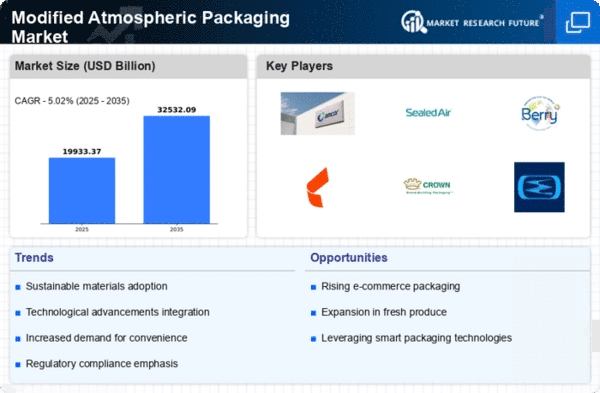
As per MRFR analysis, the Modified Atmospheric Packaging Market Size was estimated at 18980.55 USD Billion in 2024. The Modified Atmospheric Packaging industry is projected to grow from 19933.42 USD Billion in 2025 to 32532.09 USD Billion by 2035, exhibiting a compound annual growth rate (CAGR) of 5.02% during the forecast period 2025 - 2035.

Key Market Trends & Highlights

The Modified Atmospheric Packaging Market is poised for substantial growth driven by technological advancements and evolving consumer preferences.

  • Technological advancements in packaging are enhancing the efficiency and effectiveness of modified atmospheric packaging solutions. Sustainability initiatives are increasingly influencing packaging choices, with a notable shift towards eco-friendly materials. Consumer preference for freshness is driving demand in the food packaging segment, particularly in North America, the largest market. Rising demand for convenience foods and a focus on food safety and quality are key drivers propelling the market forward.

Market Size & Forecast

2024 Market Size 18980.55 (USD Billion)
2035 Market Size 32532.09 (USD Billion)
CAGR (2025 - 2035) 5.02%
Largest Regional Market Share in 2024 North America

Major Players

Amcor (AU), Sealed Air (US), Berry Global (US), Mondi Group (GB), Crown Holdings (US), Smurfit Kappa (IE), Winpak Ltd. (CA), Coveris (GB), Schur Flexibles (AT)

Market Trends

The Modified Atmospheric Packaging Market is currently experiencing a notable transformation, driven by evolving consumer preferences and advancements in packaging technology. This market focuses on extending the shelf life of perishable goods by altering the composition of the atmosphere surrounding the product. As consumers increasingly prioritize freshness and quality, manufacturers are compelled to adopt innovative packaging solutions that not only preserve food but also enhance its visual appeal. The integration of smart packaging technologies further supports this trend, allowing for real-time monitoring of product conditions, which could potentially improve supply chain efficiency. Moreover, sustainability concerns are becoming more pronounced within the Modified Atmospheric Packaging Market. Companies are exploring eco-friendly materials and practices to reduce environmental impact while maintaining product integrity. This shift towards sustainable packaging solutions appears to resonate with environmentally conscious consumers, who are more likely to support brands that demonstrate a commitment to reducing waste. As the market continues to evolve, it is likely that the interplay between technology, consumer demand, and sustainability will shape the future landscape of modified atmospheric packaging, presenting both challenges and opportunities for industry stakeholders.

Technological Advancements in Packaging

The Modified Atmospheric Packaging Market is witnessing a surge in technological innovations that enhance packaging efficiency and product preservation. Developments in materials science and smart packaging technologies are enabling manufacturers to create solutions that not only extend shelf life but also provide real-time monitoring of product conditions. This trend suggests a growing emphasis on quality control and consumer safety.

Sustainability Initiatives

There is a marked shift towards sustainable practices within the Modified Atmospheric Packaging Market. Companies are increasingly adopting eco-friendly materials and processes to minimize environmental impact. This trend indicates a response to consumer demand for greener packaging options, which may influence purchasing decisions and brand loyalty.

Consumer Preference for Freshness

The Modified Atmospheric Packaging Market reflects a growing consumer preference for fresh and high-quality products. As consumers become more discerning about food quality, manufacturers are compelled to innovate packaging solutions that not only preserve freshness but also enhance the overall product experience. This trend highlights the importance of aligning packaging strategies with consumer expectations.

Modified Atmospheric Packaging Market Market Drivers

Rising Demand for Fresh Food

The Global Modified Atmospheric Packaging Market Industry experiences a notable increase in demand for fresh food products. Consumers are increasingly seeking fresh, minimally processed foods, which necessitates packaging solutions that extend shelf life while maintaining quality. Modified atmospheric packaging effectively slows down the deterioration of perishable goods, making it an attractive option for food manufacturers. In 2024, the market is projected to reach 5.83 USD Billion, driven by this consumer preference for freshness. As the trend continues, it is anticipated that the market will grow significantly, with projections indicating a rise to 9.7 USD Billion by 2035.

Regulatory Support for Food Safety

Regulatory frameworks promoting food safety standards are pivotal for the Global Modified Atmospheric Packaging Market Industry. Governments worldwide are implementing stringent regulations to ensure the safety and quality of food products. Modified atmospheric packaging aligns with these regulations by providing effective solutions that help prevent contamination and spoilage. Compliance with food safety standards not only protects consumers but also enhances the reputation of food manufacturers. As regulations become more rigorous, the demand for modified atmospheric packaging solutions is expected to rise, further driving market growth.

Growth of E-commerce in Food Sector

The rise of e-commerce significantly influences the Global Modified Atmospheric Packaging Market Industry. As online grocery shopping becomes more prevalent, the demand for packaging solutions that ensure product integrity during transit increases. Modified atmospheric packaging is particularly suited for this purpose, as it protects food from spoilage and maintains freshness during delivery. The convenience offered by e-commerce platforms drives consumer behavior, leading to a greater reliance on packaging that can withstand longer shipping times. This trend is likely to contribute to the market's expansion, as more consumers opt for online food purchases.

Consumer Awareness of Sustainability

Growing consumer awareness regarding sustainability significantly impacts the Global Modified Atmospheric Packaging Market Industry. As consumers become more environmentally conscious, they increasingly seek packaging solutions that minimize environmental impact. Modified atmospheric packaging can contribute to sustainability by reducing food waste and utilizing recyclable materials. This shift in consumer preferences encourages manufacturers to adopt eco-friendly practices, which may lead to the development of innovative packaging solutions. Consequently, the market is likely to benefit from this trend, as companies strive to meet the evolving demands of environmentally aware consumers.

Technological Advancements in Packaging

Technological innovations play a crucial role in the Global Modified Atmospheric Packaging Market Industry. Advancements in materials and processes enhance the efficiency and effectiveness of modified atmospheric packaging solutions. For instance, the development of barrier films and smart packaging technologies allows for better control of gas composition, thus prolonging the shelf life of products. These innovations not only improve product quality but also reduce food waste, aligning with global sustainability goals. As a result, the market is expected to witness a compound annual growth rate of 4.73% from 2025 to 2035, reflecting the impact of these technological advancements.

Market Segment Insights

By Application: Food Packaging (Largest) vs. Cosmetic Packaging (Fastest-Growing)

<p>The Modified Atmospheric Packaging Market is experiencing a diverse distribution across various application segments. Among these, food packaging holds the largest share, driven by its essential role in preserving food quality and extending shelf life. This segment benefits from the increasing consumer demand for fresh and processed foods packaged using advanced technologies that inhibit oxidation, thereby enhancing product safety and longevity. On the other hand, the pharmaceutical packaging sector is also significant, showcasing a robust market position due to stringent regulatory requirements and the necessity for maintaining drug efficacy. Growth trends in the Modified Atmospheric Packaging Market reveal an exciting trajectory, particularly influenced by evolving consumer preferences and technological advancements. The food packaging segment continues to dominate as consumers seek convenient yet quality-assured products. Conversely, cosmetic packaging is emerging as the fastest-growing segment, fueled by rising awareness about personal care and aesthetics. This growth is further supported by innovation and the adoption of sustainable packaging solutions, addressing both the aesthetic demands of consumers and environmental considerations.</p>

<p>Food Packaging (Dominant) vs. Cosmetic Packaging (Emerging)</p>

<p>Food packaging plays a dominant role in the Modified Atmospheric Packaging Market, capitalizing on its critical function in preserving perishable goods. This segment is characterized by significant innovation in packaging materials and techniques designed to prevent spoilage and maintain flavor integrity. The focus on sustainability is also reshaping the landscape, with companies increasingly pursuing eco-friendly packaging solutions to align with consumer values. On the other hand, cosmetic packaging is rapidly emerging, reflecting a shift towards heightened consumer interest in beauty and self-care products. This segment is driven by creative designs and bespoke packaging options that cater to the unique demands of the beauty market, while the integration of modified atmosphere techniques enhances product freshness and appeal.</p>

By Material Type: Plastic (Largest) vs. Metal (Fastest-Growing)

In the Modified Atmospheric Packaging Market, the distribution of material type segments reveals that plastic holds the largest share due to its versatility and lightweight properties. Its ability to provide excellent barrier protection for a variety of food products continues to make it the preferred choice among manufacturers. Metal and <a href="https://www.marketresearchfuture.com/reports/paper-packaging-market-10741">paper packaging</a> are also notable, with metal rapidly gaining traction owing to its recyclability and durability, thereby appealing to environmentally-conscious consumers.

Packaging: Plastic (Dominant) vs. Metal (Emerging)

Plastic packaging remains dominant in the Modified Atmospheric Packaging Market, characterized by its lightweight nature and excellent sealability, offering an effective barrier against oxygen and moisture. This segment is particularly favored in the food industry, where preserving freshness is crucial. In contrast, metal packaging, while historically seen as bulky, is emerging rapidly due to innovations that enhance its sustainability appeal. Manufacturers are investing in more efficient recycling processes, responding to consumer demand for eco-friendly options, thus fostering growth and making metal a strong contender in this segment.

By End Use: Retail (Largest) vs. Food Service (Fastest-Growing)

<p>The Modified Atmospheric Packaging Market shows diverse market share distribution among its end-use segments. Retail is the largest segment, significantly influencing overall market dynamics due to its widespread application in packing perishable goods, snacks, and ready-to-eat meals. The growing demand for packaged foods and convenience options has led retail to take a commanding lead with a substantial market share. In contrast, the food service segment is emerging as the fastest-growing area, driven by an uptick in dining out and take-out services, particularly post-pandemic. Increasing consumer preference for fresh, minimally processed foods has fueled this growth, with major investments in packaging technology to enhance food safety and shelf life. The convenience and quality associated with modified atmospheric packaging play a crucial role in bolstering this segment's expansion.</p>

<p>Retail: Dominant vs. Food Service: Emerging</p>

<p>The retail segment stands as a dominant force in the Modified Atmospheric Packaging Market, characterized by its extensive use in various food products. With the rise of e-commerce and demand for convenience foods, retail packaging focuses on enhancing shelf life while maintaining product freshness. To cater to consumer preferences, retailers are increasingly adopting innovative packaging solutions that emphasize sustainability and ease of use. On the other hand, the food service segment is considered more emerging, portraying rapid growth potential. Restaurants and cafes are leveraging modified atmospheric packaging for take-out and delivery options, ensuring that food remains attractive and fresh for customers. This shift highlights the importance of packaging in enhancing customer experience, positioning food service as a vibrant player in the market.</p>

By Technology: Vacuum Packaging (Largest) vs. Gas Flushing (Fastest-Growing)

<p>In the Modified Atmospheric Packaging Market, Vacuum Packaging takes the lead with significant market share, showcasing its importance in food preservation and extending shelf life. This method effectively reduces oxygen levels, thereby minimizing spoilage and maintaining product quality, making it a preferred choice among manufacturers. Meanwhile, Gas Flushing is emerging as a powerful contender, appealing to sectors requiring customized gas compositions to enhance food freshness and safety. This tailored approach enables companies to cater to diverse consumer needs, thus gaining traction in the market.</p>

<p>Technology: Vacuum Packaging (Dominant) vs. Gas Flushing (Emerging)</p>

<p>Vacuum Packaging has established itself as the dominant technology in the Modified Atmospheric Packaging Market, primarily due to its ability to significantly prolong shelf life and maintain food quality. This method involves removing air from the package, effectively inhibiting the growth of aerobic bacteria and molds. Its widespread adoption across various food sectors underscores its efficacy. In contrast, Gas Flushing is rapidly becoming an emerging technology, particularly favored for its flexibility in maintaining freshness and safety through customized gas compositions. This innovation meets the increasing demand for specific atmospheric conditions that cater to various food types, giving it a competitive edge as consumer preferences evolve.</p>

By Product Type: Flexible Packaging (Largest) vs. Rigid Packaging (Fastest-Growing)

<p>The Modified Atmospheric Packaging Market is primarily driven by three product types: flexible packaging, rigid packaging, and semi-rigid packaging. Among these, flexible packaging holds the largest market share due to its adaptability, lighter weight, and lower cost. Rigid packaging follows closely behind, while semi-rigid packaging caters to niche markets. The distribution reflects trends in consumer preferences for convenience and sustainability in packaging solutions. Over recent years, the demand for flexible packaging has steadily increased as it provides an effective barrier against environmental factors, thus preserving product quality and extending shelf life. Growth trends in the Modified Atmospheric Packaging Market are influenced by the rise in convenience food consumption and the need for longer shelf life in products. Technological advancements have led to innovations in flexible and rigid packaging that cater to both sustainability and resource efficiency. The increasing focus on reducing food waste is driving investments in modified atmospheric packaging technologies. Additionally, consumer awareness regarding packaging materials is fostering the development of eco-friendly packaging solutions within the market.</p>

<p>Flexible Packaging (Dominant) vs. Rigid Packaging (Emerging)</p>

<p>Flexible packaging has established itself as the dominant force in the Modified Atmospheric Packaging Market, largely due to its versatility in applications ranging from food to pharmaceuticals. Its lightweight nature reduces shipping costs and minimizes environmental impact. The materials used in flexible packaging often have barrier properties that enhance the preservation of perishable items, making it increasingly popular among manufacturers and retailers. On the other hand, rigid packaging is viewed as an emerging segment, gaining traction thanks to its structural integrity and premium appeal, particularly in sectors like beverages and high-end products. As brands seek differentiation and high-quality presentation, rigid packaging is rapidly evolving to meet these consumer needs, creating a competitive landscape within the market.</p>

Get more detailed insights about Modified Atmospheric Packaging Market Research Report - Forecast to 2035

Regional Insights

North America : Market Leader in Packaging

North America is poised to maintain its leadership in the Modified Atmospheric Packaging (MAP) market, with a substantial market size of $7590.27 million. The region's growth is driven by increasing consumer demand for fresh and longer-lasting food products, alongside stringent food safety regulations. The rise in e-commerce and the need for sustainable packaging solutions further catalyze market expansion. Regulatory support for innovative packaging technologies also plays a crucial role in shaping the market landscape. The United States stands as the dominant player, accounting for a significant share of the market. Key companies such as Sealed Air Corporation, Amcor plc, and Berry Global Inc. are at the forefront, driving innovation and competition. The competitive landscape is characterized by strategic partnerships and mergers, aimed at enhancing product offerings and expanding market reach. This dynamic environment positions North America as a critical hub for MAP advancements.

Europe : Emerging Trends in Sustainability

Europe's Modified Atmospheric Packaging market is valued at $5321.83 million, reflecting a growing trend towards sustainability and eco-friendly packaging solutions. The region is witnessing increased regulatory pressure to reduce plastic waste, which is driving innovation in biodegradable and recyclable materials. Consumer preferences are shifting towards sustainable products, further fueling demand for MAP solutions that extend shelf life while minimizing environmental impact. The European market is also supported by robust food safety regulations that encourage the adoption of advanced packaging technologies. Leading countries such as Germany, France, and the UK are at the forefront of this market, with significant contributions from key players like Amcor plc and Mondi Group plc. The competitive landscape is marked by a focus on research and development, with companies investing heavily in sustainable practices. The presence of regulatory bodies advocating for environmental standards enhances the market's growth potential, making Europe a vital region for MAP innovations.

Asia-Pacific : Rapid Growth in Emerging Markets

The Asia-Pacific region, with a market size of $4875.45 million, is experiencing rapid growth in the Modified Atmospheric Packaging sector. This growth is driven by increasing urbanization, rising disposable incomes, and changing consumer lifestyles that demand convenient and fresh food options. Additionally, the region's expanding food and beverage industry is a significant catalyst for MAP adoption. Regulatory frameworks are evolving to support food safety and quality, further enhancing market prospects in this dynamic region. Countries like China, India, and Japan are leading the charge, with a growing number of local and international players entering the market. Companies such as Berry Global Inc. and Crown Holdings Inc. are actively expanding their operations in the region. The competitive landscape is characterized by innovation and strategic collaborations, aimed at meeting the diverse needs of consumers. As the market matures, Asia-Pacific is set to become a key player in the global MAP industry.

Middle East and Africa : Untapped Potential in Packaging

The Middle East and Africa (MEA) region, with a market size of $193.0 million, presents untapped potential in the Modified Atmospheric Packaging market. The growth in this region is primarily driven by increasing demand for packaged food products, influenced by changing consumer habits and urbanization. Additionally, the region's growing food processing industry is expected to boost the adoption of MAP solutions. Regulatory initiatives aimed at improving food safety standards are also contributing to market growth, creating a favorable environment for investment. Countries such as South Africa and the UAE are emerging as key players in the MAP landscape, with local companies and international firms exploring opportunities. The competitive environment is gradually evolving, with an increasing focus on innovation and quality. As the region continues to develop, the MEA market is likely to attract more investments and partnerships, paving the way for significant growth in the coming years.

Key Players and Competitive Insights

The Modified Atmospheric Packaging Market is currently characterized by a dynamic competitive landscape, driven by increasing consumer demand for longer shelf life and enhanced food safety. Key players such as Amcor (AU), Sealed Air (US), and Berry Global (US) are strategically positioned to leverage innovation and sustainability in their operations. Amcor (AU) focuses on developing sustainable packaging solutions, which aligns with global trends towards eco-friendliness. Sealed Air (US) emphasizes technological advancements in packaging to enhance product protection and reduce waste, while Berry Global (US) is investing in expanding its product portfolio to cater to diverse market needs. Collectively, these strategies contribute to a competitive environment that prioritizes innovation and sustainability.In terms of business tactics, companies are increasingly localizing manufacturing to reduce lead times and optimize supply chains. The market appears moderately fragmented, with several key players exerting influence over various segments. This fragmentation allows for niche players to thrive, while larger companies consolidate their market positions through strategic partnerships and acquisitions.
In November Amcor (AU) announced a partnership with a leading food manufacturer to develop a new line of biodegradable packaging solutions. This collaboration is significant as it not only enhances Amcor's sustainability credentials but also positions the company as a leader in eco-friendly packaging innovations. The move is likely to attract environmentally conscious consumers and strengthen Amcor's market share.
In October Sealed Air (US) launched a new smart packaging technology that integrates IoT capabilities to monitor product freshness in real-time. This strategic initiative is crucial as it addresses the growing demand for transparency in food supply chains, potentially reducing food waste and enhancing consumer trust. The integration of technology into packaging solutions may redefine industry standards and set Sealed Air apart from competitors.
In September Berry Global (US) expanded its manufacturing capabilities in Europe by acquiring a local packaging firm. This acquisition is indicative of Berry's strategy to enhance its operational footprint and respond to the increasing demand for modified atmospheric packaging in the region. By strengthening its presence, Berry Global is likely to improve its supply chain efficiency and better serve its European clientele.
As of December the competitive trends in the Modified Atmospheric Packaging Market are increasingly influenced by digitalization, sustainability, and AI integration. Strategic alliances are becoming more prevalent, allowing companies to pool resources and expertise to innovate more effectively. The shift from price-based competition to a focus on innovation, technology, and supply chain reliability is evident, suggesting that future competitive differentiation will hinge on these factors. Companies that can adeptly navigate these trends are likely to secure a competitive edge in the evolving market landscape.

Key Companies in the Modified Atmospheric Packaging Market include

Industry Developments

  • Q2 2024: Amcor to Acquire Moda Systems, Expanding Packaging Automation Capabilities Amcor announced the acquisition of Moda Systems, a New Zealand-based company specializing in automated protein packaging systems, to strengthen its position in the modified atmosphere packaging sector and expand its automation solutions for food packaging.
  • Q2 2024: SEE Launches New CRYOVAC Brand Modified Atmosphere Packaging Solution for Fresh Protein Sealed Air (SEE) introduced a new CRYOVAC brand modified atmosphere packaging solution designed to extend the shelf life of fresh protein products, targeting food processors and retailers seeking improved food safety and sustainability.
  • Q1 2024: Amcor Opens New Innovation Center in Ghent, Belgium Amcor inaugurated a new innovation center in Ghent, Belgium, focused on developing advanced packaging technologies, including modified atmosphere packaging, to support food safety and sustainability initiatives in Europe.
  • Q2 2024: Sealed Air Appoints New Chief Technology Officer to Drive Packaging Innovation Sealed Air appointed Dr. Emile Chammas as Chief Technology Officer, tasking him with leading the company's innovation strategy in areas such as modified atmosphere packaging and smart packaging solutions.
  • Q2 2024: Amcor and Tyson Foods Announce Strategic Partnership for Sustainable Modified Atmosphere Packaging Amcor and Tyson Foods entered a strategic partnership to develop and implement sustainable modified atmosphere packaging solutions for Tyson’s fresh protein products, aiming to reduce food waste and improve shelf life.
  • Q1 2024: Tetra Pak Launches New Modified Atmosphere Packaging Line for Dairy Products Tetra Pak launched a new packaging line featuring modified atmosphere technology specifically designed for dairy products, enabling longer shelf life and improved product safety for global dairy producers.
  • Q2 2024: Mondi Invests €50 Million in New Modified Atmosphere Packaging Facility in Germany Mondi announced a €50 million investment in a new facility in Germany dedicated to producing modified atmosphere packaging for the European food industry, with operations expected to begin in late 2025.
  • Q1 2024: Sealed Air Completes Acquisition of Automated Packaging Systems to Expand MAP Offerings Sealed Air completed the acquisition of Automated Packaging Systems, enhancing its portfolio of modified atmosphere packaging equipment and solutions for the food processing sector.
  • Q2 2024: Berry Global and Nestlé Partner to Develop Recyclable Modified Atmosphere Packaging for Coffee Berry Global and Nestlé announced a partnership to co-develop recyclable modified atmosphere packaging for Nestlé’s coffee products, aiming to improve sustainability and product freshness.
  • Q1 2024: Amcor Launches Next-Generation Recyclable Modified Atmosphere Packaging Film Amcor introduced a new recyclable modified atmosphere packaging film designed for fresh produce and protein, offering improved barrier properties and sustainability benefits.
  • Q2 2024: Sealed Air Signs Multi-Year Supply Agreement with JBS for Modified Atmosphere Packaging Sealed Air signed a multi-year supply agreement with JBS, one of the world’s largest food companies, to provide modified atmosphere packaging solutions for its global meat processing operations.
  • Q1 2024: Coveris Opens New Modified Atmosphere Packaging Production Line in Poland Coveris opened a new production line in Poland dedicated to manufacturing modified atmosphere packaging for the European fresh food market, increasing its capacity to meet growing demand.

Future Outlook

Modified Atmospheric Packaging Market Future Outlook

The Modified Atmospheric Packaging Market is projected to grow at 5.02% CAGR from 2025 to 2035, driven by increasing demand for food preservation and sustainability initiatives.

New opportunities lie in:

  • <p>Development of biodegradable packaging materials for eco-conscious consumers. Integration of smart technology for real-time monitoring of packaging conditions. Expansion into emerging markets with tailored packaging solutions for local products.</p>

By 2035, the market is expected to achieve robust growth, reflecting evolving consumer preferences and technological advancements.

Market Segmentation

Modified Atmospheric Packaging Market End Use Outlook

  • Retail
  • Food Service
  • Healthcare
  • Industrial

Modified Atmospheric Packaging Market Shelf Life Outlook

  • Short Term
  • Medium Term
  • Long Term

Modified Atmospheric Packaging Market Technology Outlook

  • Vacuum Packaging
  • Gas Flushing
  • Modified Atmosphere Packaging
  • Active Packaging

Modified Atmospheric Packaging Market Application Outlook

  • Food Packaging
  • Pharmaceutical Packaging
  • Electronics Packaging
  • Cosmetic Packaging

Modified Atmospheric Packaging Market Material Type Outlook

  • Plastic
  • Metal
  • Paper
  • Glass

Report Scope

MARKET SIZE 2024 18980.55(USD Billion)
MARKET SIZE 2025 19933.42(USD Billion)
MARKET SIZE 2035 32532.09(USD Billion)
COMPOUND ANNUAL GROWTH RATE (CAGR) 5.02% (2025 - 2035)
REPORT COVERAGE Revenue Forecast, Competitive Landscape, Growth Factors, and Trends
BASE YEAR 2024
Market Forecast Period 2025 - 2035
Historical Data 2019 - 2024
Market Forecast Units USD Billion
Key Companies Profiled Amcor (AU), Sealed Air (US), Berry Global (US), Mondi Group (GB), Crown Holdings (US), Smurfit Kappa (IE), Winpak Ltd. (CA), Coveris (GB), Schur Flexibles (AT)
Segments Covered Application, Material Type, End Use, Technology, Shelf Life
Key Market Opportunities Integration of sustainable materials in Modified Atmospheric Packaging Market enhances environmental compliance and consumer appeal.
Key Market Dynamics Rising demand for sustainable packaging solutions drives innovation in Modified Atmospheric Packaging technologies and materials.
Countries Covered North America, Europe, APAC, South America, MEA

FAQs

What is the projected market valuation of the Modified Atmospheric Packaging Market by 2035?

<p>The Modified Atmospheric Packaging Market is projected to reach a valuation of 32532.09 USD Billion by 2035.</p>

What was the overall market valuation of the Modified Atmospheric Packaging Market in 2024?

<p>In 2024, the overall market valuation of the Modified Atmospheric Packaging Market was 18980.55 USD Billion.</p>

What is the expected CAGR for the Modified Atmospheric Packaging Market during the forecast period 2025 - 2035?

<p>The expected CAGR for the Modified Atmospheric Packaging Market during the forecast period 2025 - 2035 is 5.02%.</p>

Which companies are considered key players in the Modified Atmospheric Packaging Market?

<p>Key players in the Modified Atmospheric Packaging Market include Sealed Air Corporation, Amcor plc, Berry Global Inc., and Mondi Group plc.</p>

What are the main applications of Modified Atmospheric Packaging?

<p>The main applications of Modified Atmospheric Packaging include food packaging, pharmaceutical packaging, electronics packaging, and cosmetic packaging.</p>

How does the food packaging segment perform in the Modified Atmospheric Packaging Market?

<p>The food packaging segment was valued at 7590.27 USD Billion in 2024 and is projected to reach 12600.0 USD Billion by 2035.</p>

What materials are predominantly used in Modified Atmospheric Packaging?

<p>The predominant materials used in Modified Atmospheric Packaging include plastic, metal, paper, and glass.</p>

What is the projected growth of the vacuum packaging segment in the Modified Atmospheric Packaging Market?

<p>The vacuum packaging segment was valued at 5000.0 USD Billion in 2024 and is expected to grow to 8500.0 USD Billion by 2035.</p>

What are the different product types in the Modified Atmospheric Packaging Market?

<p>Different product types in the Modified Atmospheric Packaging Market include flexible packaging, rigid packaging, and semi-rigid packaging.</p>

How does the industrial end-use segment perform in the Modified Atmospheric Packaging Market?

The industrial end-use segment was valued at 5700.55 USD Billion in 2024 and is projected to reach 10300.09 USD Billion by 2035.

  1. SECTION I: EXECUTIVE SUMMARY AND KEY HIGHLIGHTS
    1. | 1.1 EXECUTIVE SUMMARY
    2. | | 1.1.1 Market Overview
    3. | | 1.1.2 Key Findings
    4. | | 1.1.3 Market Segmentation
    5. | | 1.1.4 Competitive Landscape
    6. | | 1.1.5 Challenges and Opportunities
    7. | | 1.1.6 Future Outlook
  2. SECTION II: SCOPING, METHODOLOGY AND MARKET STRUCTURE
    1. | 2.1 MARKET INTRODUCTION
    2. | | 2.1.1 Definition
    3. | | 2.1.2 Scope of the study
    4. | | | 2.1.2.1 Research Objective
    5. | | | 2.1.2.2 Assumption
    6. | | | 2.1.2.3 Limitations
    7. | 2.2 RESEARCH METHODOLOGY
    8. | | 2.2.1 Overview
    9. | | 2.2.2 Data Mining
    10. | | 2.2.3 Secondary Research
    11. | | 2.2.4 Primary Research
    12. | | | 2.2.4.1 Primary Interviews and Information Gathering Process
    13. | | | 2.2.4.2 Breakdown of Primary Respondents
    14. | | 2.2.5 Forecasting Model
    15. | | 2.2.6 Market Size Estimation
    16. | | | 2.2.6.1 Bottom-Up Approach
    17. | | | 2.2.6.2 Top-Down Approach
    18. | | 2.2.7 Data Triangulation
    19. | | 2.2.8 Validation
  3. SECTION III: QUALITATIVE ANALYSIS
    1. | 3.1 MARKET DYNAMICS
    2. | | 3.1.1 Overview
    3. | | 3.1.2 Drivers
    4. | | 3.1.3 Restraints
    5. | | 3.1.4 Opportunities
    6. | 3.2 MARKET FACTOR ANALYSIS
    7. | | 3.2.1 Value chain Analysis
    8. | | 3.2.2 Porter's Five Forces Analysis
    9. | | | 3.2.2.1 Bargaining Power of Suppliers
    10. | | | 3.2.2.2 Bargaining Power of Buyers
    11. | | | 3.2.2.3 Threat of New Entrants
    12. | | | 3.2.2.4 Threat of Substitutes
    13. | | | 3.2.2.5 Intensity of Rivalry
    14. | | 3.2.3 COVID-19 Impact Analysis
    15. | | | 3.2.3.1 Market Impact Analysis
    16. | | | 3.2.3.2 Regional Impact
    17. | | | 3.2.3.3 Opportunity and Threat Analysis
  4. SECTION IV: QUANTITATIVE ANALYSIS
    1. | 4.1 Packaging & Transport, BY Application (USD Billion)
    2. | | 4.1.1 Food Packaging
    3. | | 4.1.2 Pharmaceutical Packaging
    4. | | 4.1.3 Electronics Packaging
    5. | | 4.1.4 Cosmetic Packaging
    6. | 4.2 Packaging & Transport, BY Material Type (USD Billion)
    7. | | 4.2.1 Plastic
    8. | | 4.2.2 Metal
    9. | | 4.2.3 Paper
    10. | | 4.2.4 Glass
    11. | 4.3 Packaging & Transport, BY End Use (USD Billion)
    12. | | 4.3.1 Retail
    13. | | 4.3.2 Food Service
    14. | | 4.3.3 Household
    15. | | 4.3.4 Industrial
    16. | 4.4 Packaging & Transport, BY Technology (USD Billion)
    17. | | 4.4.1 Vacuum Packaging
    18. | | 4.4.2 Gas Flushing
    19. | | 4.4.3 Modified Atmosphere Packaging
    20. | | 4.4.4 Active Packaging
    21. | 4.5 Packaging & Transport, BY Product Type (USD Billion)
    22. | | 4.5.1 Flexible Packaging
    23. | | 4.5.2 Rigid Packaging
    24. | | 4.5.3 Semi-Rigid Packaging
    25. | 4.6 Packaging & Transport, BY Region (USD Billion)
    26. | | 4.6.1 North America
    27. | | | 4.6.1.1 US
    28. | | | 4.6.1.2 Canada
    29. | | 4.6.2 Europe
    30. | | | 4.6.2.1 Germany
    31. | | | 4.6.2.2 UK
    32. | | | 4.6.2.3 France
    33. | | | 4.6.2.4 Russia
    34. | | | 4.6.2.5 Italy
    35. | | | 4.6.2.6 Spain
    36. | | | 4.6.2.7 Rest of Europe
    37. | | 4.6.3 APAC
    38. | | | 4.6.3.1 China
    39. | | | 4.6.3.2 India
    40. | | | 4.6.3.3 Japan
    41. | | | 4.6.3.4 South Korea
    42. | | | 4.6.3.5 Malaysia
    43. | | | 4.6.3.6 Thailand
    44. | | | 4.6.3.7 Indonesia
    45. | | | 4.6.3.8 Rest of APAC
    46. | | 4.6.4 South America
    47. | | | 4.6.4.1 Brazil
    48. | | | 4.6.4.2 Mexico
    49. | | | 4.6.4.3 Argentina
    50. | | | 4.6.4.4 Rest of South America
    51. | | 4.6.5 MEA
    52. | | | 4.6.5.1 GCC Countries
    53. | | | 4.6.5.2 South Africa
    54. | | | 4.6.5.3 Rest of MEA
  5. SECTION V: COMPETITIVE ANALYSIS
    1. | 5.1 Competitive Landscape
    2. | | 5.1.1 Overview
    3. | | 5.1.2 Competitive Analysis
    4. | | 5.1.3 Market share Analysis
    5. | | 5.1.4 Major Growth Strategy in the Packaging & Transport
    6. | | 5.1.5 Competitive Benchmarking
    7. | | 5.1.6 Leading Players in Terms of Number of Developments in the Packaging & Transport
    8. | | 5.1.7 Key developments and growth strategies
    9. | | | 5.1.7.1 New Product Launch/Service Deployment
    10. | | | 5.1.7.2 Merger & Acquisitions
    11. | | | 5.1.7.3 Joint Ventures
    12. | | 5.1.8 Major Players Financial Matrix
    13. | | | 5.1.8.1 Sales and Operating Income
    14. | | | 5.1.8.2 Major Players R&D Expenditure. 2023
    15. | 5.2 Company Profiles
    16. | | 5.2.1 Sealed Air Corporation (US)
    17. | | | 5.2.1.1 Financial Overview
    18. | | | 5.2.1.2 Products Offered
    19. | | | 5.2.1.3 Key Developments
    20. | | | 5.2.1.4 SWOT Analysis
    21. | | | 5.2.1.5 Key Strategies
    22. | | 5.2.2 Amcor plc (GB)
    23. | | | 5.2.2.1 Financial Overview
    24. | | | 5.2.2.2 Products Offered
    25. | | | 5.2.2.3 Key Developments
    26. | | | 5.2.2.4 SWOT Analysis
    27. | | | 5.2.2.5 Key Strategies
    28. | | 5.2.3 Berry Global Inc. (US)
    29. | | | 5.2.3.1 Financial Overview
    30. | | | 5.2.3.2 Products Offered
    31. | | | 5.2.3.3 Key Developments
    32. | | | 5.2.3.4 SWOT Analysis
    33. | | | 5.2.3.5 Key Strategies
    34. | | 5.2.4 Mondi Group plc (GB)
    35. | | | 5.2.4.1 Financial Overview
    36. | | | 5.2.4.2 Products Offered
    37. | | | 5.2.4.3 Key Developments
    38. | | | 5.2.4.4 SWOT Analysis
    39. | | | 5.2.4.5 Key Strategies
    40. | | 5.2.5 Crown Holdings Inc. (US)
    41. | | | 5.2.5.1 Financial Overview
    42. | | | 5.2.5.2 Products Offered
    43. | | | 5.2.5.3 Key Developments
    44. | | | 5.2.5.4 SWOT Analysis
    45. | | | 5.2.5.5 Key Strategies
    46. | | 5.2.6 Smurfit Kappa Group plc (IE)
    47. | | | 5.2.6.1 Financial Overview
    48. | | | 5.2.6.2 Products Offered
    49. | | | 5.2.6.3 Key Developments
    50. | | | 5.2.6.4 SWOT Analysis
    51. | | | 5.2.6.5 Key Strategies
    52. | | 5.2.7 Winpak Ltd. (CA)
    53. | | | 5.2.7.1 Financial Overview
    54. | | | 5.2.7.2 Products Offered
    55. | | | 5.2.7.3 Key Developments
    56. | | | 5.2.7.4 SWOT Analysis
    57. | | | 5.2.7.5 Key Strategies
    58. | | 5.2.8 Coveris Holdings S.A. (LU)
    59. | | | 5.2.8.1 Financial Overview
    60. | | | 5.2.8.2 Products Offered
    61. | | | 5.2.8.3 Key Developments
    62. | | | 5.2.8.4 SWOT Analysis
    63. | | | 5.2.8.5 Key Strategies
    64. | | 5.2.9 Schur Flexibles Group (AT)
    65. | | | 5.2.9.1 Financial Overview
    66. | | | 5.2.9.2 Products Offered
    67. | | | 5.2.9.3 Key Developments
    68. | | | 5.2.9.4 SWOT Analysis
    69. | | | 5.2.9.5 Key Strategies
    70. | 5.3 Appendix
    71. | | 5.3.1 References
    72. | | 5.3.2 Related Reports
  6. LIST OF FIGURES
    1. | 6.1 MARKET SYNOPSIS
    2. | 6.2 NORTH AMERICA MARKET ANALYSIS
    3. | 6.3 US MARKET ANALYSIS BY APPLICATION
    4. | 6.4 US MARKET ANALYSIS BY MATERIAL TYPE
    5. | 6.5 US MARKET ANALYSIS BY END USE
    6. | 6.6 US MARKET ANALYSIS BY TECHNOLOGY
    7. | 6.7 US MARKET ANALYSIS BY PRODUCT TYPE
    8. | 6.8 CANADA MARKET ANALYSIS BY APPLICATION
    9. | 6.9 CANADA MARKET ANALYSIS BY MATERIAL TYPE
    10. | 6.10 CANADA MARKET ANALYSIS BY END USE
    11. | 6.11 CANADA MARKET ANALYSIS BY TECHNOLOGY
    12. | 6.12 CANADA MARKET ANALYSIS BY PRODUCT TYPE
    13. | 6.13 EUROPE MARKET ANALYSIS
    14. | 6.14 GERMANY MARKET ANALYSIS BY APPLICATION
    15. | 6.15 GERMANY MARKET ANALYSIS BY MATERIAL TYPE
    16. | 6.16 GERMANY MARKET ANALYSIS BY END USE
    17. | 6.17 GERMANY MARKET ANALYSIS BY TECHNOLOGY
    18. | 6.18 GERMANY MARKET ANALYSIS BY PRODUCT TYPE
    19. | 6.19 UK MARKET ANALYSIS BY APPLICATION
    20. | 6.20 UK MARKET ANALYSIS BY MATERIAL TYPE
    21. | 6.21 UK MARKET ANALYSIS BY END USE
    22. | 6.22 UK MARKET ANALYSIS BY TECHNOLOGY
    23. | 6.23 UK MARKET ANALYSIS BY PRODUCT TYPE
    24. | 6.24 FRANCE MARKET ANALYSIS BY APPLICATION
    25. | 6.25 FRANCE MARKET ANALYSIS BY MATERIAL TYPE
    26. | 6.26 FRANCE MARKET ANALYSIS BY END USE
    27. | 6.27 FRANCE MARKET ANALYSIS BY TECHNOLOGY
    28. | 6.28 FRANCE MARKET ANALYSIS BY PRODUCT TYPE
    29. | 6.29 RUSSIA MARKET ANALYSIS BY APPLICATION
    30. | 6.30 RUSSIA MARKET ANALYSIS BY MATERIAL TYPE
    31. | 6.31 RUSSIA MARKET ANALYSIS BY END USE
    32. | 6.32 RUSSIA MARKET ANALYSIS BY TECHNOLOGY
    33. | 6.33 RUSSIA MARKET ANALYSIS BY PRODUCT TYPE
    34. | 6.34 ITALY MARKET ANALYSIS BY APPLICATION
    35. | 6.35 ITALY MARKET ANALYSIS BY MATERIAL TYPE
    36. | 6.36 ITALY MARKET ANALYSIS BY END USE
    37. | 6.37 ITALY MARKET ANALYSIS BY TECHNOLOGY
    38. | 6.38 ITALY MARKET ANALYSIS BY PRODUCT TYPE
    39. | 6.39 SPAIN MARKET ANALYSIS BY APPLICATION
    40. | 6.40 SPAIN MARKET ANALYSIS BY MATERIAL TYPE
    41. | 6.41 SPAIN MARKET ANALYSIS BY END USE
    42. | 6.42 SPAIN MARKET ANALYSIS BY TECHNOLOGY
    43. | 6.43 SPAIN MARKET ANALYSIS BY PRODUCT TYPE
    44. | 6.44 REST OF EUROPE MARKET ANALYSIS BY APPLICATION
    45. | 6.45 REST OF EUROPE MARKET ANALYSIS BY MATERIAL TYPE
    46. | 6.46 REST OF EUROPE MARKET ANALYSIS BY END USE
    47. | 6.47 REST OF EUROPE MARKET ANALYSIS BY TECHNOLOGY
    48. | 6.48 REST OF EUROPE MARKET ANALYSIS BY PRODUCT TYPE
    49. | 6.49 APAC MARKET ANALYSIS
    50. | 6.50 CHINA MARKET ANALYSIS BY APPLICATION
    51. | 6.51 CHINA MARKET ANALYSIS BY MATERIAL TYPE
    52. | 6.52 CHINA MARKET ANALYSIS BY END USE
    53. | 6.53 CHINA MARKET ANALYSIS BY TECHNOLOGY
    54. | 6.54 CHINA MARKET ANALYSIS BY PRODUCT TYPE
    55. | 6.55 INDIA MARKET ANALYSIS BY APPLICATION
    56. | 6.56 INDIA MARKET ANALYSIS BY MATERIAL TYPE
    57. | 6.57 INDIA MARKET ANALYSIS BY END USE
    58. | 6.58 INDIA MARKET ANALYSIS BY TECHNOLOGY
    59. | 6.59 INDIA MARKET ANALYSIS BY PRODUCT TYPE
    60. | 6.60 JAPAN MARKET ANALYSIS BY APPLICATION
    61. | 6.61 JAPAN MARKET ANALYSIS BY MATERIAL TYPE
    62. | 6.62 JAPAN MARKET ANALYSIS BY END USE
    63. | 6.63 JAPAN MARKET ANALYSIS BY TECHNOLOGY
    64. | 6.64 JAPAN MARKET ANALYSIS BY PRODUCT TYPE
    65. | 6.65 SOUTH KOREA MARKET ANALYSIS BY APPLICATION
    66. | 6.66 SOUTH KOREA MARKET ANALYSIS BY MATERIAL TYPE
    67. | 6.67 SOUTH KOREA MARKET ANALYSIS BY END USE
    68. | 6.68 SOUTH KOREA MARKET ANALYSIS BY TECHNOLOGY
    69. | 6.69 SOUTH KOREA MARKET ANALYSIS BY PRODUCT TYPE
    70. | 6.70 MALAYSIA MARKET ANALYSIS BY APPLICATION
    71. | 6.71 MALAYSIA MARKET ANALYSIS BY MATERIAL TYPE
    72. | 6.72 MALAYSIA MARKET ANALYSIS BY END USE
    73. | 6.73 MALAYSIA MARKET ANALYSIS BY TECHNOLOGY
    74. | 6.74 MALAYSIA MARKET ANALYSIS BY PRODUCT TYPE
    75. | 6.75 THAILAND MARKET ANALYSIS BY APPLICATION
    76. | 6.76 THAILAND MARKET ANALYSIS BY MATERIAL TYPE
    77. | 6.77 THAILAND MARKET ANALYSIS BY END USE
    78. | 6.78 THAILAND MARKET ANALYSIS BY TECHNOLOGY
    79. | 6.79 THAILAND MARKET ANALYSIS BY PRODUCT TYPE
    80. | 6.80 INDONESIA MARKET ANALYSIS BY APPLICATION
    81. | 6.81 INDONESIA MARKET ANALYSIS BY MATERIAL TYPE
    82. | 6.82 INDONESIA MARKET ANALYSIS BY END USE
    83. | 6.83 INDONESIA MARKET ANALYSIS BY TECHNOLOGY
    84. | 6.84 INDONESIA MARKET ANALYSIS BY PRODUCT TYPE
    85. | 6.85 REST OF APAC MARKET ANALYSIS BY APPLICATION
    86. | 6.86 REST OF APAC MARKET ANALYSIS BY MATERIAL TYPE
    87. | 6.87 REST OF APAC MARKET ANALYSIS BY END USE
    88. | 6.88 REST OF APAC MARKET ANALYSIS BY TECHNOLOGY
    89. | 6.89 REST OF APAC MARKET ANALYSIS BY PRODUCT TYPE
    90. | 6.90 SOUTH AMERICA MARKET ANALYSIS
    91. | 6.91 BRAZIL MARKET ANALYSIS BY APPLICATION
    92. | 6.92 BRAZIL MARKET ANALYSIS BY MATERIAL TYPE
    93. | 6.93 BRAZIL MARKET ANALYSIS BY END USE
    94. | 6.94 BRAZIL MARKET ANALYSIS BY TECHNOLOGY
    95. | 6.95 BRAZIL MARKET ANALYSIS BY PRODUCT TYPE
    96. | 6.96 MEXICO MARKET ANALYSIS BY APPLICATION
    97. | 6.97 MEXICO MARKET ANALYSIS BY MATERIAL TYPE
    98. | 6.98 MEXICO MARKET ANALYSIS BY END USE
    99. | 6.99 MEXICO MARKET ANALYSIS BY TECHNOLOGY
    100. | 6.100 MEXICO MARKET ANALYSIS BY PRODUCT TYPE
    101. | 6.101 ARGENTINA MARKET ANALYSIS BY APPLICATION
    102. | 6.102 ARGENTINA MARKET ANALYSIS BY MATERIAL TYPE
    103. | 6.103 ARGENTINA MARKET ANALYSIS BY END USE
    104. | 6.104 ARGENTINA MARKET ANALYSIS BY TECHNOLOGY
    105. | 6.105 ARGENTINA MARKET ANALYSIS BY PRODUCT TYPE
    106. | 6.106 REST OF SOUTH AMERICA MARKET ANALYSIS BY APPLICATION
    107. | 6.107 REST OF SOUTH AMERICA MARKET ANALYSIS BY MATERIAL TYPE
    108. | 6.108 REST OF SOUTH AMERICA MARKET ANALYSIS BY END USE
    109. | 6.109 REST OF SOUTH AMERICA MARKET ANALYSIS BY TECHNOLOGY
    110. | 6.110 REST OF SOUTH AMERICA MARKET ANALYSIS BY PRODUCT TYPE
    111. | 6.111 MEA MARKET ANALYSIS
    112. | 6.112 GCC COUNTRIES MARKET ANALYSIS BY APPLICATION
    113. | 6.113 GCC COUNTRIES MARKET ANALYSIS BY MATERIAL TYPE
    114. | 6.114 GCC COUNTRIES MARKET ANALYSIS BY END USE
    115. | 6.115 GCC COUNTRIES MARKET ANALYSIS BY TECHNOLOGY
    116. | 6.116 GCC COUNTRIES MARKET ANALYSIS BY PRODUCT TYPE
    117. | 6.117 SOUTH AFRICA MARKET ANALYSIS BY APPLICATION
    118. | 6.118 SOUTH AFRICA MARKET ANALYSIS BY MATERIAL TYPE
    119. | 6.119 SOUTH AFRICA MARKET ANALYSIS BY END USE
    120. | 6.120 SOUTH AFRICA MARKET ANALYSIS BY TECHNOLOGY
    121. | 6.121 SOUTH AFRICA MARKET ANALYSIS BY PRODUCT TYPE
    122. | 6.122 REST OF MEA MARKET ANALYSIS BY APPLICATION
    123. | 6.123 REST OF MEA MARKET ANALYSIS BY MATERIAL TYPE
    124. | 6.124 REST OF MEA MARKET ANALYSIS BY END USE
    125. | 6.125 REST OF MEA MARKET ANALYSIS BY TECHNOLOGY
    126. | 6.126 REST OF MEA MARKET ANALYSIS BY PRODUCT TYPE
    127. | 6.127 KEY BUYING CRITERIA OF PACKAGING & TRANSPORT
    128. | 6.128 RESEARCH PROCESS OF MRFR
    129. | 6.129 DRO ANALYSIS OF PACKAGING & TRANSPORT
    130. | 6.130 DRIVERS IMPACT ANALYSIS: PACKAGING & TRANSPORT
    131. | 6.131 RESTRAINTS IMPACT ANALYSIS: PACKAGING & TRANSPORT
    132. | 6.132 SUPPLY / VALUE CHAIN: PACKAGING & TRANSPORT
    133. | 6.133 PACKAGING & TRANSPORT, BY APPLICATION, 2024 (% SHARE)
    134. | 6.134 PACKAGING & TRANSPORT, BY APPLICATION, 2024 TO 2035 (USD Billion)
    135. | 6.135 PACKAGING & TRANSPORT, BY MATERIAL TYPE, 2024 (% SHARE)
    136. | 6.136 PACKAGING & TRANSPORT, BY MATERIAL TYPE, 2024 TO 2035 (USD Billion)
    137. | 6.137 PACKAGING & TRANSPORT, BY END USE, 2024 (% SHARE)
    138. | 6.138 PACKAGING & TRANSPORT, BY END USE, 2024 TO 2035 (USD Billion)
    139. | 6.139 PACKAGING & TRANSPORT, BY TECHNOLOGY, 2024 (% SHARE)
    140. | 6.140 PACKAGING & TRANSPORT, BY TECHNOLOGY, 2024 TO 2035 (USD Billion)
    141. | 6.141 PACKAGING & TRANSPORT, BY PRODUCT TYPE, 2024 (% SHARE)
    142. | 6.142 PACKAGING & TRANSPORT, BY PRODUCT TYPE, 2024 TO 2035 (USD Billion)
    143. | 6.143 BENCHMARKING OF MAJOR COMPETITORS
  7. LIST OF TABLES
    1. | 7.1 LIST OF ASSUMPTIONS
    2. | | 7.1.1
    3. | 7.2 North America MARKET SIZE ESTIMATES; FORECAST
    4. | | 7.2.1 BY APPLICATION, 2025-2035 (USD Billion)
    5. | | 7.2.2 BY MATERIAL TYPE, 2025-2035 (USD Billion)
    6. | | 7.2.3 BY END USE, 2025-2035 (USD Billion)
    7. | | 7.2.4 BY TECHNOLOGY, 2025-2035 (USD Billion)
    8. | | 7.2.5 BY PRODUCT TYPE, 2025-2035 (USD Billion)
    9. | 7.3 US MARKET SIZE ESTIMATES; FORECAST
    10. | | 7.3.1 BY APPLICATION, 2025-2035 (USD Billion)
    11. | | 7.3.2 BY MATERIAL TYPE, 2025-2035 (USD Billion)
    12. | | 7.3.3 BY END USE, 2025-2035 (USD Billion)
    13. | | 7.3.4 BY TECHNOLOGY, 2025-2035 (USD Billion)
    14. | | 7.3.5 BY PRODUCT TYPE, 2025-2035 (USD Billion)
    15. | 7.4 Canada MARKET SIZE ESTIMATES; FORECAST
    16. | | 7.4.1 BY APPLICATION, 2025-2035 (USD Billion)
    17. | | 7.4.2 BY MATERIAL TYPE, 2025-2035 (USD Billion)
    18. | | 7.4.3 BY END USE, 2025-2035 (USD Billion)
    19. | | 7.4.4 BY TECHNOLOGY, 2025-2035 (USD Billion)
    20. | | 7.4.5 BY PRODUCT TYPE, 2025-2035 (USD Billion)
    21. | 7.5 Europe MARKET SIZE ESTIMATES; FORECAST
    22. | | 7.5.1 BY APPLICATION, 2025-2035 (USD Billion)
    23. | | 7.5.2 BY MATERIAL TYPE, 2025-2035 (USD Billion)
    24. | | 7.5.3 BY END USE, 2025-2035 (USD Billion)
    25. | | 7.5.4 BY TECHNOLOGY, 2025-2035 (USD Billion)
    26. | | 7.5.5 BY PRODUCT TYPE, 2025-2035 (USD Billion)
    27. | 7.6 Germany MARKET SIZE ESTIMATES; FORECAST
    28. | | 7.6.1 BY APPLICATION, 2025-2035 (USD Billion)
    29. | | 7.6.2 BY MATERIAL TYPE, 2025-2035 (USD Billion)
    30. | | 7.6.3 BY END USE, 2025-2035 (USD Billion)
    31. | | 7.6.4 BY TECHNOLOGY, 2025-2035 (USD Billion)
    32. | | 7.6.5 BY PRODUCT TYPE, 2025-2035 (USD Billion)
    33. | 7.7 UK MARKET SIZE ESTIMATES; FORECAST
    34. | | 7.7.1 BY APPLICATION, 2025-2035 (USD Billion)
    35. | | 7.7.2 BY MATERIAL TYPE, 2025-2035 (USD Billion)
    36. | | 7.7.3 BY END USE, 2025-2035 (USD Billion)
    37. | | 7.7.4 BY TECHNOLOGY, 2025-2035 (USD Billion)
    38. | | 7.7.5 BY PRODUCT TYPE, 2025-2035 (USD Billion)
    39. | 7.8 France MARKET SIZE ESTIMATES; FORECAST
    40. | | 7.8.1 BY APPLICATION, 2025-2035 (USD Billion)
    41. | | 7.8.2 BY MATERIAL TYPE, 2025-2035 (USD Billion)
    42. | | 7.8.3 BY END USE, 2025-2035 (USD Billion)
    43. | | 7.8.4 BY TECHNOLOGY, 2025-2035 (USD Billion)
    44. | | 7.8.5 BY PRODUCT TYPE, 2025-2035 (USD Billion)
    45. | 7.9 Russia MARKET SIZE ESTIMATES; FORECAST
    46. | | 7.9.1 BY APPLICATION, 2025-2035 (USD Billion)
    47. | | 7.9.2 BY MATERIAL TYPE, 2025-2035 (USD Billion)
    48. | | 7.9.3 BY END USE, 2025-2035 (USD Billion)
    49. | | 7.9.4 BY TECHNOLOGY, 2025-2035 (USD Billion)
    50. | | 7.9.5 BY PRODUCT TYPE, 2025-2035 (USD Billion)
    51. | 7.10 Italy MARKET SIZE ESTIMATES; FORECAST
    52. | | 7.10.1 BY APPLICATION, 2025-2035 (USD Billion)
    53. | | 7.10.2 BY MATERIAL TYPE, 2025-2035 (USD Billion)
    54. | | 7.10.3 BY END USE, 2025-2035 (USD Billion)
    55. | | 7.10.4 BY TECHNOLOGY, 2025-2035 (USD Billion)
    56. | | 7.10.5 BY PRODUCT TYPE, 2025-2035 (USD Billion)
    57. | 7.11 Spain MARKET SIZE ESTIMATES; FORECAST
    58. | | 7.11.1 BY APPLICATION, 2025-2035 (USD Billion)
    59. | | 7.11.2 BY MATERIAL TYPE, 2025-2035 (USD Billion)
    60. | | 7.11.3 BY END USE, 2025-2035 (USD Billion)
    61. | | 7.11.4 BY TECHNOLOGY, 2025-2035 (USD Billion)
    62. | | 7.11.5 BY PRODUCT TYPE, 2025-2035 (USD Billion)
    63. | 7.12 Rest of Europe MARKET SIZE ESTIMATES; FORECAST
    64. | | 7.12.1 BY APPLICATION, 2025-2035 (USD Billion)
    65. | | 7.12.2 BY MATERIAL TYPE, 2025-2035 (USD Billion)
    66. | | 7.12.3 BY END USE, 2025-2035 (USD Billion)
    67. | | 7.12.4 BY TECHNOLOGY, 2025-2035 (USD Billion)
    68. | | 7.12.5 BY PRODUCT TYPE, 2025-2035 (USD Billion)
    69. | 7.13 APAC MARKET SIZE ESTIMATES; FORECAST
    70. | | 7.13.1 BY APPLICATION, 2025-2035 (USD Billion)
    71. | | 7.13.2 BY MATERIAL TYPE, 2025-2035 (USD Billion)
    72. | | 7.13.3 BY END USE, 2025-2035 (USD Billion)
    73. | | 7.13.4 BY TECHNOLOGY, 2025-2035 (USD Billion)
    74. | | 7.13.5 BY PRODUCT TYPE, 2025-2035 (USD Billion)
    75. | 7.14 China MARKET SIZE ESTIMATES; FORECAST
    76. | | 7.14.1 BY APPLICATION, 2025-2035 (USD Billion)
    77. | | 7.14.2 BY MATERIAL TYPE, 2025-2035 (USD Billion)
    78. | | 7.14.3 BY END USE, 2025-2035 (USD Billion)
    79. | | 7.14.4 BY TECHNOLOGY, 2025-2035 (USD Billion)
    80. | | 7.14.5 BY PRODUCT TYPE, 2025-2035 (USD Billion)
    81. | 7.15 India MARKET SIZE ESTIMATES; FORECAST
    82. | | 7.15.1 BY APPLICATION, 2025-2035 (USD Billion)
    83. | | 7.15.2 BY MATERIAL TYPE, 2025-2035 (USD Billion)
    84. | | 7.15.3 BY END USE, 2025-2035 (USD Billion)
    85. | | 7.15.4 BY TECHNOLOGY, 2025-2035 (USD Billion)
    86. | | 7.15.5 BY PRODUCT TYPE, 2025-2035 (USD Billion)
    87. | 7.16 Japan MARKET SIZE ESTIMATES; FORECAST
    88. | | 7.16.1 BY APPLICATION, 2025-2035 (USD Billion)
    89. | | 7.16.2 BY MATERIAL TYPE, 2025-2035 (USD Billion)
    90. | | 7.16.3 BY END USE, 2025-2035 (USD Billion)
    91. | | 7.16.4 BY TECHNOLOGY, 2025-2035 (USD Billion)
    92. | | 7.16.5 BY PRODUCT TYPE, 2025-2035 (USD Billion)
    93. | 7.17 South Korea MARKET SIZE ESTIMATES; FORECAST
    94. | | 7.17.1 BY APPLICATION, 2025-2035 (USD Billion)
    95. | | 7.17.2 BY MATERIAL TYPE, 2025-2035 (USD Billion)
    96. | | 7.17.3 BY END USE, 2025-2035 (USD Billion)
    97. | | 7.17.4 BY TECHNOLOGY, 2025-2035 (USD Billion)
    98. | | 7.17.5 BY PRODUCT TYPE, 2025-2035 (USD Billion)
    99. | 7.18 Malaysia MARKET SIZE ESTIMATES; FORECAST
    100. | | 7.18.1 BY APPLICATION, 2025-2035 (USD Billion)
    101. | | 7.18.2 BY MATERIAL TYPE, 2025-2035 (USD Billion)
    102. | | 7.18.3 BY END USE, 2025-2035 (USD Billion)
    103. | | 7.18.4 BY TECHNOLOGY, 2025-2035 (USD Billion)
    104. | | 7.18.5 BY PRODUCT TYPE, 2025-2035 (USD Billion)
    105. | 7.19 Thailand MARKET SIZE ESTIMATES; FORECAST
    106. | | 7.19.1 BY APPLICATION, 2025-2035 (USD Billion)
    107. | | 7.19.2 BY MATERIAL TYPE, 2025-2035 (USD Billion)
    108. | | 7.19.3 BY END USE, 2025-2035 (USD Billion)
    109. | | 7.19.4 BY TECHNOLOGY, 2025-2035 (USD Billion)
    110. | | 7.19.5 BY PRODUCT TYPE, 2025-2035 (USD Billion)
    111. | 7.20 Indonesia MARKET SIZE ESTIMATES; FORECAST
    112. | | 7.20.1 BY APPLICATION, 2025-2035 (USD Billion)
    113. | | 7.20.2 BY MATERIAL TYPE, 2025-2035 (USD Billion)
    114. | | 7.20.3 BY END USE, 2025-2035 (USD Billion)
    115. | | 7.20.4 BY TECHNOLOGY, 2025-2035 (USD Billion)
    116. | | 7.20.5 BY PRODUCT TYPE, 2025-2035 (USD Billion)
    117. | 7.21 Rest of APAC MARKET SIZE ESTIMATES; FORECAST
    118. | | 7.21.1 BY APPLICATION, 2025-2035 (USD Billion)
    119. | | 7.21.2 BY MATERIAL TYPE, 2025-2035 (USD Billion)
    120. | | 7.21.3 BY END USE, 2025-2035 (USD Billion)
    121. | | 7.21.4 BY TECHNOLOGY, 2025-2035 (USD Billion)
    122. | | 7.21.5 BY PRODUCT TYPE, 2025-2035 (USD Billion)
    123. | 7.22 South America MARKET SIZE ESTIMATES; FORECAST
    124. | | 7.22.1 BY APPLICATION, 2025-2035 (USD Billion)
    125. | | 7.22.2 BY MATERIAL TYPE, 2025-2035 (USD Billion)
    126. | | 7.22.3 BY END USE, 2025-2035 (USD Billion)
    127. | | 7.22.4 BY TECHNOLOGY, 2025-2035 (USD Billion)
    128. | | 7.22.5 BY PRODUCT TYPE, 2025-2035 (USD Billion)
    129. | 7.23 Brazil MARKET SIZE ESTIMATES; FORECAST
    130. | | 7.23.1 BY APPLICATION, 2025-2035 (USD Billion)
    131. | | 7.23.2 BY MATERIAL TYPE, 2025-2035 (USD Billion)
    132. | | 7.23.3 BY END USE, 2025-2035 (USD Billion)
    133. | | 7.23.4 BY TECHNOLOGY, 2025-2035 (USD Billion)
    134. | | 7.23.5 BY PRODUCT TYPE, 2025-2035 (USD Billion)
    135. | 7.24 Mexico MARKET SIZE ESTIMATES; FORECAST
    136. | | 7.24.1 BY APPLICATION, 2025-2035 (USD Billion)
    137. | | 7.24.2 BY MATERIAL TYPE, 2025-2035 (USD Billion)
    138. | | 7.24.3 BY END USE, 2025-2035 (USD Billion)
    139. | | 7.24.4 BY TECHNOLOGY, 2025-2035 (USD Billion)
    140. | | 7.24.5 BY PRODUCT TYPE, 2025-2035 (USD Billion)
    141. | 7.25 Argentina MARKET SIZE ESTIMATES; FORECAST
    142. | | 7.25.1 BY APPLICATION, 2025-2035 (USD Billion)
    143. | | 7.25.2 BY MATERIAL TYPE, 2025-2035 (USD Billion)
    144. | | 7.25.3 BY END USE, 2025-2035 (USD Billion)
    145. | | 7.25.4 BY TECHNOLOGY, 2025-2035 (USD Billion)
    146. | | 7.25.5 BY PRODUCT TYPE, 2025-2035 (USD Billion)
    147. | 7.26 Rest of South America MARKET SIZE ESTIMATES; FORECAST
    148. | | 7.26.1 BY APPLICATION, 2025-2035 (USD Billion)
    149. | | 7.26.2 BY MATERIAL TYPE, 2025-2035 (USD Billion)
    150. | | 7.26.3 BY END USE, 2025-2035 (USD Billion)
    151. | | 7.26.4 BY TECHNOLOGY, 2025-2035 (USD Billion)
    152. | | 7.26.5 BY PRODUCT TYPE, 2025-2035 (USD Billion)
    153. | 7.27 MEA MARKET SIZE ESTIMATES; FORECAST
    154. | | 7.27.1 BY APPLICATION, 2025-2035 (USD Billion)
    155. | | 7.27.2 BY MATERIAL TYPE, 2025-2035 (USD Billion)
    156. | | 7.27.3 BY END USE, 2025-2035 (USD Billion)
    157. | | 7.27.4 BY TECHNOLOGY, 2025-2035 (USD Billion)
    158. | | 7.27.5 BY PRODUCT TYPE, 2025-2035 (USD Billion)
    159. | 7.28 GCC Countries MARKET SIZE ESTIMATES; FORECAST
    160. | | 7.28.1 BY APPLICATION, 2025-2035 (USD Billion)
    161. | | 7.28.2 BY MATERIAL TYPE, 2025-2035 (USD Billion)
    162. | | 7.28.3 BY END USE, 2025-2035 (USD Billion)
    163. | | 7.28.4 BY TECHNOLOGY, 2025-2035 (USD Billion)
    164. | | 7.28.5 BY PRODUCT TYPE, 2025-2035 (USD Billion)
    165. | 7.29 South Africa MARKET SIZE ESTIMATES; FORECAST
    166. | | 7.29.1 BY APPLICATION, 2025-2035 (USD Billion)
    167. | | 7.29.2 BY MATERIAL TYPE, 2025-2035 (USD Billion)
    168. | | 7.29.3 BY END USE, 2025-2035 (USD Billion)
    169. | | 7.29.4 BY TECHNOLOGY, 2025-2035 (USD Billion)
    170. | | 7.29.5 BY PRODUCT TYPE, 2025-2035 (USD Billion)
    171. | 7.30 Rest of MEA MARKET SIZE ESTIMATES; FORECAST
    172. | | 7.30.1 BY APPLICATION, 2025-2035 (USD Billion)
    173. | | 7.30.2 BY MATERIAL TYPE, 2025-2035 (USD Billion)
    174. | | 7.30.3 BY END USE, 2025-2035 (USD Billion)
    175. | | 7.30.4 BY TECHNOLOGY, 2025-2035 (USD Billion)
    176. | | 7.30.5 BY PRODUCT TYPE, 2025-2035 (USD Billion)
    177. | 7.31 PRODUCT LAUNCH/PRODUCT DEVELOPMENT/APPROVAL
    178. | | 7.31.1
    179. | 7.32 ACQUISITION/PARTNERSHIP
    180. | | 7.32.1

Packaging & Transport Market Segmentation

Packaging & Transport By Application (USD Billion, 2025-2035)

  • Food Packaging
  • Pharmaceutical Packaging
  • Electronics Packaging
  • Cosmetic Packaging

Packaging & Transport By Material Type (USD Billion, 2025-2035)

  • Plastic
  • Metal
  • Paper
  • Glass

Packaging & Transport By End Use (USD Billion, 2025-2035)

  • Retail
  • Food Service
  • Household
  • Industrial

Packaging & Transport By Technology (USD Billion, 2025-2035)

  • Vacuum Packaging
  • Gas Flushing
  • Modified Atmosphere Packaging
  • Active Packaging

Packaging & Transport By Product Type (USD Billion, 2025-2035)

  • Flexible Packaging
  • Rigid Packaging
  • Semi-Rigid Packaging
Infographic

Free Sample Request

Kindly complete the form below to receive a free sample of this Report

Get Free Sample

Customer Strories

Compare Licence

×
Features License Type
Single User Multiuser License Enterprise User
Price $4,950 $5,950 $7,250
Maximum User Access Limit 1 User Upto 10 Users Unrestricted Access Throughout the Organization
Free Customization
Direct Access to Analyst
Deliverable Format
Platform Access
Discount on Next Purchase 10% 15% 15%
Printable Versions