Request Free Sample ×

Kindly complete the form below to receive a free sample of this Report

* Please use a valid business email

Leading companies partner with us for data-driven Insights

clients tt-cursor
Hero Background
English
Chinese
French
Japanese
Korean
German
Spanish

Mobility Technology Market Size

ID: MRFR/AT/14683-HCR
128 Pages
Shubham Munde
Last Updated: April 06, 2026

Mobility Technology Market Research Report Information By Type (Bluetooth, Wearable Technology, Mobile Augmented Reality, and Wireless Gigabit), By Application (Electronic Products, Car, Medical Equipment, and Other), By Region (North America, Europe, Asia-Pacific, And Rest Of The World) –Market Forecast Till 2035

Share:
Download PDF ×

We do not share your information with anyone. However, we may send you emails based on your report interest from time to time. You may contact us at any time to opt-out.

Mobility Technology Market Infographic
Purchase Options

Mobility Technology Size

Mobility Technology Market Growth Projections and Opportunities

The market dynamics of the mobility technology sector have been undergoing a transformative journey, driven by a confluence of technological advancements, changing consumer preferences, and regulatory initiatives. As we delve into the intricate fabric of this market, a prominent feature is the rapid evolution of smart mobility solutions. The demand for these technologies, which encompass a spectrum from electric vehicles to intelligent transportation systems, has surged in recent years, reflecting a global shift towards sustainable and efficient transportation options.

One of the key drivers propelling the mobility technology market is the growing awareness and concern for environmental sustainability. Governments worldwide are increasingly emphasizing the need to reduce carbon emissions and combat climate change. This has led to a surge in investments and incentives for the development and adoption of electric vehicles (EVs) and other clean transportation solutions. Consequently, traditional automakers are pivoting their strategies towards electric and hybrid vehicles, and a slew of new players are entering the market with innovative electric mobility solutions.

Furthermore, the advent of autonomous vehicles has added a new dimension to the market dynamics. The race to achieve fully autonomous driving capabilities has intensified, with major players in the automotive and technology sectors investing heavily in research and development. The promise of increased safety, reduced traffic congestion, and enhanced mobility services has fueled consumer and industry enthusiasm. As a result, partnerships and collaborations between automotive manufacturers, tech companies, and mobility service providers have become commonplace, reshaping the competitive landscape.

The consumer mindset is also playing a pivotal role in shaping the mobility technology market. Urbanization trends and the rise of the sharing economy have given rise to a preference for on-demand and shared mobility services. Ride-hailing platforms, bike-sharing programs, and other shared mobility solutions are gaining popularity, particularly among younger demographics. This shift in consumer behavior is prompting traditional transportation models to adapt and integrate technology-driven solutions to stay relevant in a changing market.

Amidst these transformative forces, regulatory frameworks are exerting a significant influence on the mobility technology market. Governments worldwide are formulating policies to encourage the adoption of electric vehicles, promote sustainable transportation infrastructure, and address safety concerns related to autonomous vehicles. The regulatory landscape is evolving rapidly, and companies operating in the mobility technology sector must navigate these complexities to ensure compliance and foster innovation.

In terms of market competition, the mobility technology sector is witnessing a convergence of industries. Traditional automotive manufacturers are competing with technology giants, start-ups, and new entrants from various sectors. The battle for market share extends beyond the manufacturing of vehicles to the development of software, connectivity solutions, and mobility-as-a-service platforms. The emergence of ecosystem-driven approaches, where companies offer integrated solutions encompassing hardware, software, and services, is becoming increasingly prevalent.

In conclusion, the market dynamics of the mobility technology sector are characterized by a dynamic interplay of technological innovation, shifting consumer preferences, regulatory influences, and intense competition. The trajectory of this market reflects a future where sustainable, connected, and autonomous mobility solutions will play a central role in shaping the way people and goods move. As the industry continues to evolve, stakeholders must remain agile, adaptive, and collaborative to navigate the complexities and capitalize on the myriad opportunities that this transformative era presents.

Mobility Technology Market Size Graph
Author
Author Profile
Shubham Munde
Team Lead - Research

Shubham brings over 7 years of expertise in Market Intelligence and Strategic Consulting, with a strong focus on the Automotive, Aerospace, and Defense sectors. Backed by a solid foundation in semiconductors, electronics, and software, he has successfully delivered high-impact syndicated and custom research on a global scale. His core strengths include market sizing, forecasting, competitive intelligence, consumer insights, and supply chain mapping. Widely recognized for developing scalable growth strategies, Shubham empowers clients to navigate complex markets and achieve a lasting competitive edge. Trusted by start-ups and Fortune 500 companies alike, he consistently converts challenges into strategic opportunities that drive sustainable growth.

Leave a Comment

FAQs

What is the current valuation of the Mobility Technology Market in 2025?

<p>The Mobility Technology Market is valued at approximately 9.218 USD Billion in 2024.</p>

What is the projected market valuation for the Mobility Technology Market by 2035?

<p>The market is projected to reach a valuation of 215.89 USD Billion by 2035.</p>

What is the expected CAGR for the Mobility Technology Market during the forecast period 2025 - 2035?

<p>The expected CAGR for the Mobility Technology Market during 2025 - 2035 is 33.2%.</p>

Which companies are considered key players in the Mobility Technology Market?

<p>Key players include Tesla, Waymo, Uber, Daimler, BMW, Ford, Toyota, Volkswagen, and Nissan.</p>

What are the main segments of the Mobility Technology Market?

<p>The main segments include Type and Application, with various technologies and products categorized under each.</p>

How does the Bluetooth segment perform in the Mobility Technology Market?

<p>The Bluetooth segment is valued at 1.5 USD Billion in 2024 and is projected to grow to 35.0 USD Billion by 2035.</p>

What is the valuation of the Wearable Technology segment in the Mobility Technology Market?

The Wearable Technology segment is valued at 2.0 USD Billion in 2024 and is expected to reach 50.0 USD Billion by 2035.

What is the projected growth for Mobile Augmented Reality in the Mobility Technology Market?

Mobile Augmented Reality is valued at 2.5 USD Billion in 2024 and is anticipated to grow to 60.0 USD Billion by 2035.

What is the expected performance of the Wireless Gigabit segment?

The Wireless Gigabit segment is valued at 3.218 USD Billion in 2024 and is projected to increase to 70.0 USD Billion by 2035.

How do the applications of electronic products and cars compare in the Mobility Technology Market?

In 2024, electronic products are valued at 2.5 USD Billion, while cars are valued at 3.0 USD Billion, indicating a strong demand for automotive applications.

Market Summary

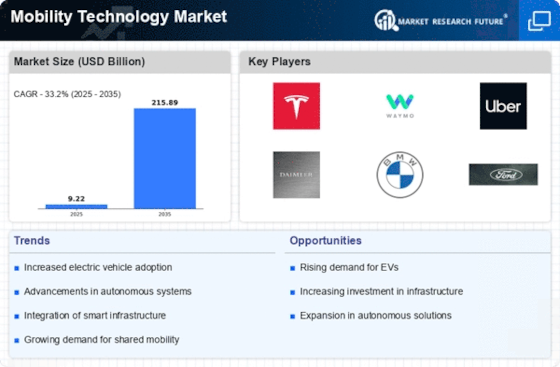
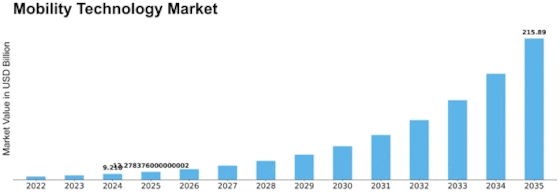
As per Market Research Future analysis, the Mobility Technology Market Size was estimated at 9.218 USD Billion in 2024. The Mobility Technology industry is projected to grow from 12.28 USD Billion in 2025 to 215.89 USD Billion by 2035, exhibiting a compound annual growth rate (CAGR) of 33.2% during the forecast period 2025 - 2035

Key Market Trends & Highlights

The Mobility Technology Market is experiencing robust growth driven by innovation and sustainability initiatives.

  • The rise of electric vehicles is reshaping consumer preferences and market dynamics in North America. Advancements in autonomous driving technologies are gaining traction, particularly in the Asia-Pacific region. Integration of smart infrastructure is becoming essential for enhancing urban mobility solutions. Increased demand for sustainable transportation and government initiatives are key drivers propelling market expansion.

Market Size & Forecast

2024 Market Size 9.218 (USD Billion)
2035 Market Size 215.89 (USD Billion)
CAGR (2025 - 2035) 33.2%
Largest Regional Market Share in 2024 North America

Major Players

Tesla (US), <a href="https://waymo.com/waymo-driver/">Waymo</a> (US), Uber (US), Daimler (DE), BMW (DE), Ford (US), <a href="https://global.toyota/en/mobility/index.html">Toyota</a> (JP), Volkswagen (DE), Nissan (JP)

Market Trends

The Mobility Technology Market is currently experiencing a transformative phase, driven by advancements in connectivity, automation, and sustainability. As urbanization accelerates, the demand for innovative transportation solutions within the mobility technology market continues to intensifies. This market encompasses a wide array of technologies, including electric vehicles, autonomous driving systems, and smart infrastructure and increasingly, mobile payment technologies market solutions that enable seamless transactions across mobility platforms . Stakeholders are increasingly focusing on enhancing user experience while addressing environmental concerns. The integration of artificial intelligence and data analytics into mobility solutions appears to be reshaping how individuals and goods are transported, fostering efficiency and safety. 

Moreover, the mobile payment technology market, is likely to witness a surge in collaborative efforts among public and private sectors. Partnerships between technology firms and traditional automotive manufacturers may lead to the development of integrated mobility services. This trend suggests a shift towards a more holistic approach to transportation, where various modes of transport are interconnected. As cities evolve, the emphasis on reducing congestion and emissions could further propel innovations in this sector, indicating a promising future for mobility technologies.

Rise of Electric Vehicles

The transition towards electric vehicles is gaining momentum, as consumers and governments alike prioritize sustainability. This trend reflects a broader commitment to reducing carbon footprints and enhancing energy efficiency in transportation.

Advancements in Autonomous Driving

The development of autonomous driving technologies is progressing rapidly, with numerous companies investing in research and testing. This trend indicates a potential shift in how mobility is perceived, emphasizing safety and convenience.

Integration of Smart Infrastructure

The incorporation of smart infrastructure into urban planning is becoming increasingly prevalent. This trend suggests that cities are adapting to new mobility solutions, enhancing connectivity and improving overall transportation efficiency.

Mobility Technology Market Market Drivers

Government Initiatives and Regulations

Government initiatives play a pivotal role in shaping the Mobility Technology Market. Various countries are implementing stringent regulations aimed at reducing carbon emissions and promoting electric vehicle adoption. For instance, several nations have set ambitious targets to phase out internal combustion engines by 2035. These regulatory frameworks not only encourage manufacturers to innovate but also stimulate consumer interest in cleaner technologies. The Mobility Technology Market is expected to thrive under these supportive policies, as they create a conducive environment for the growth of electric and hybrid vehicles.

Rising Urbanization and Population Density

The Mobility Technology Market is being driven by the rapid urbanization and increasing population density in metropolitan areas. As cities expand, the demand for efficient and innovative transportation solutions becomes more pressing. Urban congestion is prompting the exploration of alternative mobility options, such as shared mobility services and micro-mobility solutions. By 2025, it is projected that urban areas will house over 60% of the global population, necessitating advancements in mobility technologies. The Mobility Technology Market is thus likely to adapt to these demographic shifts by offering solutions that alleviate urban transportation challenges.

Technological Advancements in Connectivity

The Mobility Technology Market is significantly influenced by advancements in connectivity technologies. The proliferation of 5G networks is enhancing vehicle-to-everything (V2X) communication, which is crucial for the development of smart transportation systems. This connectivity allows for real-time data exchange between vehicles, infrastructure, and users, improving safety and efficiency. As of 2025, it is estimated that over 50% of new vehicles will be equipped with V2X capabilities, underscoring the importance of connectivity in shaping the future of mobility. The Mobility Technology Market is thus likely to see increased investment in connected vehicle technologies.

Increased Demand for Sustainable Transportation

The Mobility Technology Market is experiencing a notable shift towards sustainable transportation solutions. As environmental concerns intensify, consumers and governments alike are advocating for greener alternatives. This trend is reflected in the rising sales of electric vehicles, which accounted for approximately 10% of total vehicle sales in 2025. Additionally, investments in renewable energy sources for charging infrastructure are surging, indicating a robust commitment to sustainability. The Mobility Technology Market is thus poised to benefit from this growing demand, as manufacturers innovate to meet eco-friendly standards and consumer preferences.

Integration of Artificial Intelligence in Mobility Solutions

The integration of artificial intelligence (AI) into mobility solutions is transforming the Mobility Technology Market. AI technologies are enhancing various aspects of transportation, from autonomous driving systems to predictive maintenance for vehicles. By 2025, it is anticipated that AI-driven applications will account for a substantial portion of the market, improving operational efficiency and user experience. The ability to analyze vast amounts of data in real-time allows for smarter decision-making in traffic management and route optimization. Consequently, the Mobility Technology Market is expected to witness significant growth as AI continues to revolutionize transportation.

Market Segment Insights

By Type: Bluetooth (Largest) vs. Wearable Technology (Fastest-Growing)

The Mobility Technology Market is witnessing a diverse distribution among its segment types. Bluetooth technology continues to dominate the market, holding the largest share due to its widespread adoption in wireless communication devices, automotive applications, and smart home technologies. Conversely, wearable technology is carving out a significant position, rapidly gaining traction as consumers seek health monitoring and fitness solutions. As both segments evolve, their interdependence enhances the overall market landscape, creating opportunities for innovation and growth. Market growth trends indicate that while Bluetooth remains the cornerstone of connectivity, wearable technology is quickly emerging as a key player, driven by technological advancements in health tracking, augmented reality, and user engagement. The push towards a more connected lifestyle fuels this growth, as consumers increasingly embrace devices that offer seamless integration with their daily routines. Moreover, the rise of mobile augmented reality and wireless gigabit technologies complements these segments, enhancing user experience and paving the way for future innovations.

Bluetooth (Dominant) vs. Wearable Technology (Emerging)

In the Mobility Technology Market, Bluetooth technology is established as the dominant force due to its reliability and widespread application across various devices, ranging from smartphones to automotive systems. Its seamless communication capabilities facilitate data exchange, making it integral to the IoT ecosystem. In contrast, wearable technology is an emerging segment characterized by smart devices designed for health, fitness, and personal convenience. With increasing consumer awareness and demand for health-centric applications, this segment is witnessing rapid growth. Wearables are integrating advanced features such as biometric monitoring and augmented reality interfaces, positioning them for significant market expansion. As both segments evolve, their synergy creates new opportunities for innovation and consumer engagement in the mobility landscape.

By Application: Car (Largest) vs. Medical Equipment (Fastest-Growing)

In the Mobility Technology Market, the application segment is primarily dominated by the automotive sector, particularly cars, which holds the largest share due to the increasing integration of advanced technologies such as electric vehicles and autonomous driving features. The utilization of mobility technologies in cars enhances the driving experience and contributes to the growing demand within this segment. Meanwhile, the medical equipment sector is emerging as the fastest-growing segment, reflecting a heightened focus on developing mobility solutions for healthcare applications, thereby leveraging technological advancements to improve patient care and operational efficiency.

Car (Dominant) vs. Medical Equipment (Emerging)

The car application segment remains dominant in the Mobility Technology Market, driven by innovations such as IoT integration, <a href="https://www.marketresearchfuture.com/reports/advanced-driver-assistance-systems-market-4434">advanced driver-assistance systems</a> (ADAS), and electrification trends, appealing to both manufacturers and consumers. Car manufacturers are increasingly adopting mobility technologies to enhance safety, improve connectivity, and cater to the evolving consumer preferences for smart vehicles. In contrast, the medical equipment segment is characterized by rapid innovations aimed at ensuring seamless mobility solutions within healthcare. This emerging segment is witnessing investments that ramp up the development of assistive technologies, portable diagnostics, and telehealth solutions, thus meeting the rising demand for mobility-enhancing medical devices.

Get more detailed insights about Mobility Technology Market Research Report — Global Forecast till 2035

Regional Insights

North America : Innovation and Leadership Hub

North America is the largest market for mobility technology, holding approximately 45% of the global share. The region benefits from strong demand driven by technological advancements, urbanization, and supportive government regulations. Initiatives like the U.S. Department of Transportation's Smart City Challenge are catalyzing growth, while investments in electric and autonomous vehicles are on the rise. The competitive landscape is led by key players such as Tesla, Waymo, and Uber, which are pioneering innovations in electric and autonomous vehicles. The U.S. is the primary market, followed by Canada, which is also investing heavily in smart mobility solutions. The presence of major automotive manufacturers like Ford and General Motors further strengthens the region's position in the global market.

Europe : Sustainable Mobility Initiatives

Europe is the second-largest market for mobility technology, accounting for around 30% of the global share. The region is characterized by stringent regulations aimed at reducing carbon emissions and promoting sustainable transport solutions. The European Union's Green Deal and various national initiatives are driving demand for electric vehicles and smart mobility solutions, fostering innovation across the sector. Leading countries include Germany, France, and the UK, with major automotive players like Daimler, BMW, and Volkswagen leading the charge. The competitive landscape is robust, with a focus on electric and autonomous vehicles. The presence of innovative startups alongside established manufacturers is enhancing the region's mobility technology ecosystem.

Asia-Pacific : Emerging Market Potential

Asia-Pacific is witnessing rapid growth in the mobility technology market, holding approximately 20% of the global share. The region's growth is driven by increasing urbanization, rising disposable incomes, and government initiatives promoting electric vehicles. Countries like China and Japan are at the forefront, with significant investments in smart transportation infrastructure and technology. China is the largest market in the region, with companies like Toyota and Nissan leading the charge in electric mobility. The competitive landscape is evolving, with numerous startups emerging alongside established players. The focus on innovation and technology adoption is expected to propel the region's market further, making it a key player in the global mobility technology landscape.

Middle East and Africa : Resource-Rich Opportunities

The Middle East and Africa region is gradually emerging in the mobility technology market, holding about 5% of the global share. The growth is primarily driven by increasing investments in infrastructure and a growing interest in smart mobility solutions. Countries like the UAE and South Africa are leading the way, with government initiatives aimed at enhancing transportation systems and promoting electric vehicles. The competitive landscape is still developing, with a mix of local and international players entering the market. The presence of key automotive manufacturers is increasing, and partnerships between governments and private sectors are fostering innovation. As urbanization continues, the demand for efficient mobility solutions is expected to rise significantly in this region.

Key Players and Competitive Insights

Leading market players are investing heavily in research and development in order to expand their product lines, which will help the mobility technology market, grow even more. Market participants are also undertaking a variety of strategic activities to expand their global footprint, with important market developments including new product launches, contractual agreements, mergers and acquisitions, higher investments, and collaboration with other organizations. To expand and survive in a more competitive and rising market climate, mobility technology industry must offer cost-effective items.Manufacturing locally to minimize operational costs is one of the key business tactics used by manufacturers in the global mobility technology industry to benefit clients and increase the market sector. In recent years, the mobility technology industry has offered some of the most significant advantages to medicine. Major players in the mobility technology market are attempting to increase market demand by investing in research and development operations includes Qualcomm, Sierra Wireless, Samsung Electronics, Apple, Nuance Communication, Stmicroelectronics, Motorola Solutions, Texas Instruments, Atmel, Autotalks, Intel, Harris, Daifuku, and Dematic.Texas Instruments Inc. (TI) is a semiconductor manufacturer, designer, and distributor. The company's analog and embedded processor divisions sell standard semiconductor devices tailored to specific applications. Power and signal chain solutions are part of the company's analog chip range. Via its embedded processing category, it provides a large selection of microcontrollers, applications processors, and digital signal processors (DSPs). In addition, TI provides custom semiconductors, CAN transceivers, flip flops, calculators, data convertors, voltage translation devices, RF and microwave, sensors, switches, and wireless connection.Offering cellular wireless and Internet of Things (IoT) solutions to the machine-to-machine (M2M) and connected device markets is Sierra Wireless Inc. (Sierra Wireless). In addition to wireless gateways and routers for commercial and industrial use, the company provides original equipment manufacturers (OEM) with a portfolio of embedded broadband solutions, embedded wireless modules, and IoT connection services. The company facilitates end-to-end apps and offers cloud services for device management. Sierra Wireless provides its goods and services to the following industries: mobile computing, public safety, enterprise networking, cleantech, field services, healthcare, manufacturing, energy, security, residential, manufacturing, transportation, sales and payment.

Key Companies in the Mobility Technology Market include

Industry Developments

Future Outlook

Mobility Technology Market Future Outlook

The Mobility Technology Market is poised for robust growth at 33.2% CAGR from 2025 to 2035, driven by advancements in autonomous vehicles, electric mobility, and smart infrastructure.

New opportunities lie in:

  • <p>Development of integrated mobility-as-a-service platforms Expansion of electric vehicle charging networks Investment in AI-driven traffic management systems</p>

By 2035, the Mobility Technology Market is expected to be a cornerstone of global transportation innovation.

Market Segmentation

Mobility Technology Market Type Outlook

  • Bluetooth
  • Wearable Technology
  • Mobile Augmented Reality
  • Wireless Gigabit

Mobility Technology Market Application Outlook

  • Electronic Products
  • Car
  • Medical Equipment
  • Other

Report Scope

MARKET SIZE 2024 9.218(USD Billion)
MARKET SIZE 2025 12.28(USD Billion)
MARKET SIZE 2035 215.89(USD Billion)
COMPOUND ANNUAL GROWTH RATE (CAGR) 33.2% (2025 - 2035)
REPORT COVERAGE Revenue Forecast, Competitive Landscape, Growth Factors, and Trends
BASE YEAR 2024
Market Forecast Period 2025 - 2035
Historical Data 2019 - 2024
Market Forecast Units USD Billion
Key Companies Profiled Tesla (US), Waymo (US), Uber (US), Daimler (DE), BMW (DE), Ford (US), Toyota (JP), Volkswagen (DE), Nissan (JP)
Segments Covered Type, Application, Region
Key Market Opportunities Integration of autonomous vehicles with smart city infrastructure presents a transformative opportunity in the Mobility Technology Market.
Key Market Dynamics Rising demand for electric vehicles drives innovation and competition in the Mobility Technology Market.
Countries Covered North America, Europe, APAC, South America, MEA

FAQs

What is the current valuation of the Mobility Technology Market in 2025?

<p>The Mobility Technology Market is valued at approximately 9.218 USD Billion in 2024.</p>

What is the projected market valuation for the Mobility Technology Market by 2035?

<p>The market is projected to reach a valuation of 215.89 USD Billion by 2035.</p>

What is the expected CAGR for the Mobility Technology Market during the forecast period 2025 - 2035?

<p>The expected CAGR for the Mobility Technology Market during 2025 - 2035 is 33.2%.</p>

Which companies are considered key players in the Mobility Technology Market?

<p>Key players include Tesla, Waymo, Uber, Daimler, BMW, Ford, Toyota, Volkswagen, and Nissan.</p>

What are the main segments of the Mobility Technology Market?

<p>The main segments include Type and Application, with various technologies and products categorized under each.</p>

How does the Bluetooth segment perform in the Mobility Technology Market?

<p>The Bluetooth segment is valued at 1.5 USD Billion in 2024 and is projected to grow to 35.0 USD Billion by 2035.</p>

What is the valuation of the Wearable Technology segment in the Mobility Technology Market?

The Wearable Technology segment is valued at 2.0 USD Billion in 2024 and is expected to reach 50.0 USD Billion by 2035.

What is the projected growth for Mobile Augmented Reality in the Mobility Technology Market?

Mobile Augmented Reality is valued at 2.5 USD Billion in 2024 and is anticipated to grow to 60.0 USD Billion by 2035.

What is the expected performance of the Wireless Gigabit segment?

The Wireless Gigabit segment is valued at 3.218 USD Billion in 2024 and is projected to increase to 70.0 USD Billion by 2035.

How do the applications of electronic products and cars compare in the Mobility Technology Market?

In 2024, electronic products are valued at 2.5 USD Billion, while cars are valued at 3.0 USD Billion, indicating a strong demand for automotive applications.

  1. SECTION I: EXECUTIVE SUMMARY AND KEY HIGHLIGHTS
    1. | 1.1 EXECUTIVE SUMMARY
    2. | | 1.1.1 Market Overview
    3. | | 1.1.2 Key Findings
    4. | | 1.1.3 Market Segmentation
    5. | | 1.1.4 Competitive Landscape
    6. | | 1.1.5 Challenges and Opportunities
    7. | | 1.1.6 Future Outlook
  2. SECTION II: SCOPING, METHODOLOGY AND MARKET STRUCTURE
    1. | 2.1 MARKET INTRODUCTION
    2. | | 2.1.1 Definition
    3. | | 2.1.2 Scope of the study
    4. | | | 2.1.2.1 Research Objective
    5. | | | 2.1.2.2 Assumption
    6. | | | 2.1.2.3 Limitations
    7. | 2.2 RESEARCH METHODOLOGY
    8. | | 2.2.1 Overview
    9. | | 2.2.2 Data Mining
    10. | | 2.2.3 Secondary Research
    11. | | 2.2.4 Primary Research
    12. | | | 2.2.4.1 Primary Interviews and Information Gathering Process
    13. | | | 2.2.4.2 Breakdown of Primary Respondents
    14. | | 2.2.5 Forecasting Model
    15. | | 2.2.6 Market Size Estimation
    16. | | | 2.2.6.1 Bottom-Up Approach
    17. | | | 2.2.6.2 Top-Down Approach
    18. | | 2.2.7 Data Triangulation
    19. | | 2.2.8 Validation
  3. SECTION III: QUALITATIVE ANALYSIS
    1. | 3.1 MARKET DYNAMICS
    2. | | 3.1.1 Overview
    3. | | 3.1.2 Drivers
    4. | | 3.1.3 Restraints
    5. | | 3.1.4 Opportunities
    6. | 3.2 MARKET FACTOR ANALYSIS
    7. | | 3.2.1 Value chain Analysis
    8. | | 3.2.2 Porter's Five Forces Analysis
    9. | | | 3.2.2.1 Bargaining Power of Suppliers
    10. | | | 3.2.2.2 Bargaining Power of Buyers
    11. | | | 3.2.2.3 Threat of New Entrants
    12. | | | 3.2.2.4 Threat of Substitutes
    13. | | | 3.2.2.5 Intensity of Rivalry
    14. | | 3.2.3 COVID-19 Impact Analysis
    15. | | | 3.2.3.1 Market Impact Analysis
    16. | | | 3.2.3.2 Regional Impact
    17. | | | 3.2.3.3 Opportunity and Threat Analysis
  4. SECTION IV: QUANTITATIVE ANALYSIS
    1. | 4.1 Automobile, BY Type (USD Billion)
    2. | | 4.1.1 Bluetooth
    3. | | 4.1.2 Wearable Technology
    4. | | 4.1.3 Mobile Augmented Reality
    5. | | 4.1.4 Wireless Gigabit
    6. | 4.2 Automobile, BY Application (USD Billion)
    7. | | 4.2.1 Electronic Products
    8. | | 4.2.2 Car
    9. | | 4.2.3 Medical Equipment
    10. | | 4.2.4 Other
    11. | 4.3 Automobile, BY Region (USD Billion)
    12. | | 4.3.1 North America
    13. | | | 4.3.1.1 US
    14. | | | 4.3.1.2 Canada
    15. | | 4.3.2 Europe
    16. | | | 4.3.2.1 Germany
    17. | | | 4.3.2.2 UK
    18. | | | 4.3.2.3 France
    19. | | | 4.3.2.4 Russia
    20. | | | 4.3.2.5 Italy
    21. | | | 4.3.2.6 Spain
    22. | | | 4.3.2.7 Rest of Europe
    23. | | 4.3.3 APAC
    24. | | | 4.3.3.1 China
    25. | | | 4.3.3.2 India
    26. | | | 4.3.3.3 Japan
    27. | | | 4.3.3.4 South Korea
    28. | | | 4.3.3.5 Malaysia
    29. | | | 4.3.3.6 Thailand
    30. | | | 4.3.3.7 Indonesia
    31. | | | 4.3.3.8 Rest of APAC
    32. | | 4.3.4 South America
    33. | | | 4.3.4.1 Brazil
    34. | | | 4.3.4.2 Mexico
    35. | | | 4.3.4.3 Argentina
    36. | | | 4.3.4.4 Rest of South America
    37. | | 4.3.5 MEA
    38. | | | 4.3.5.1 GCC Countries
    39. | | | 4.3.5.2 South Africa
    40. | | | 4.3.5.3 Rest of MEA
  5. SECTION V: COMPETITIVE ANALYSIS
    1. | 5.1 Competitive Landscape
    2. | | 5.1.1 Overview
    3. | | 5.1.2 Competitive Analysis
    4. | | 5.1.3 Market share Analysis
    5. | | 5.1.4 Major Growth Strategy in the Automobile
    6. | | 5.1.5 Competitive Benchmarking
    7. | | 5.1.6 Leading Players in Terms of Number of Developments in the Automobile
    8. | | 5.1.7 Key developments and growth strategies
    9. | | | 5.1.7.1 New Product Launch/Service Deployment
    10. | | | 5.1.7.2 Merger & Acquisitions
    11. | | | 5.1.7.3 Joint Ventures
    12. | | 5.1.8 Major Players Financial Matrix
    13. | | | 5.1.8.1 Sales and Operating Income
    14. | | | 5.1.8.2 Major Players R&D Expenditure. 2023
    15. | 5.2 Company Profiles
    16. | | 5.2.1 Tesla (US)
    17. | | | 5.2.1.1 Financial Overview
    18. | | | 5.2.1.2 Products Offered
    19. | | | 5.2.1.3 Key Developments
    20. | | | 5.2.1.4 SWOT Analysis
    21. | | | 5.2.1.5 Key Strategies
    22. | | 5.2.2 Waymo (US)
    23. | | | 5.2.2.1 Financial Overview
    24. | | | 5.2.2.2 Products Offered
    25. | | | 5.2.2.3 Key Developments
    26. | | | 5.2.2.4 SWOT Analysis
    27. | | | 5.2.2.5 Key Strategies
    28. | | 5.2.3 Uber (US)
    29. | | | 5.2.3.1 Financial Overview
    30. | | | 5.2.3.2 Products Offered
    31. | | | 5.2.3.3 Key Developments
    32. | | | 5.2.3.4 SWOT Analysis
    33. | | | 5.2.3.5 Key Strategies
    34. | | 5.2.4 Daimler (DE)
    35. | | | 5.2.4.1 Financial Overview
    36. | | | 5.2.4.2 Products Offered
    37. | | | 5.2.4.3 Key Developments
    38. | | | 5.2.4.4 SWOT Analysis
    39. | | | 5.2.4.5 Key Strategies
    40. | | 5.2.5 BMW (DE)
    41. | | | 5.2.5.1 Financial Overview
    42. | | | 5.2.5.2 Products Offered
    43. | | | 5.2.5.3 Key Developments
    44. | | | 5.2.5.4 SWOT Analysis
    45. | | | 5.2.5.5 Key Strategies
    46. | | 5.2.6 Ford (US)
    47. | | | 5.2.6.1 Financial Overview
    48. | | | 5.2.6.2 Products Offered
    49. | | | 5.2.6.3 Key Developments
    50. | | | 5.2.6.4 SWOT Analysis
    51. | | | 5.2.6.5 Key Strategies
    52. | | 5.2.7 Toyota (JP)
    53. | | | 5.2.7.1 Financial Overview
    54. | | | 5.2.7.2 Products Offered
    55. | | | 5.2.7.3 Key Developments
    56. | | | 5.2.7.4 SWOT Analysis
    57. | | | 5.2.7.5 Key Strategies
    58. | | 5.2.8 Volkswagen (DE)
    59. | | | 5.2.8.1 Financial Overview
    60. | | | 5.2.8.2 Products Offered
    61. | | | 5.2.8.3 Key Developments
    62. | | | 5.2.8.4 SWOT Analysis
    63. | | | 5.2.8.5 Key Strategies
    64. | | 5.2.9 Nissan (JP)
    65. | | | 5.2.9.1 Financial Overview
    66. | | | 5.2.9.2 Products Offered
    67. | | | 5.2.9.3 Key Developments
    68. | | | 5.2.9.4 SWOT Analysis
    69. | | | 5.2.9.5 Key Strategies
    70. | 5.3 Appendix
    71. | | 5.3.1 References
    72. | | 5.3.2 Related Reports
  6. LIST OF FIGURES
    1. | 6.1 MARKET SYNOPSIS
    2. | 6.2 NORTH AMERICA MARKET ANALYSIS
    3. | 6.3 US MARKET ANALYSIS BY TYPE
    4. | 6.4 US MARKET ANALYSIS BY APPLICATION
    5. | 6.5 CANADA MARKET ANALYSIS BY TYPE
    6. | 6.6 CANADA MARKET ANALYSIS BY APPLICATION
    7. | 6.7 EUROPE MARKET ANALYSIS
    8. | 6.8 GERMANY MARKET ANALYSIS BY TYPE
    9. | 6.9 GERMANY MARKET ANALYSIS BY APPLICATION
    10. | 6.10 UK MARKET ANALYSIS BY TYPE
    11. | 6.11 UK MARKET ANALYSIS BY APPLICATION
    12. | 6.12 FRANCE MARKET ANALYSIS BY TYPE
    13. | 6.13 FRANCE MARKET ANALYSIS BY APPLICATION
    14. | 6.14 RUSSIA MARKET ANALYSIS BY TYPE
    15. | 6.15 RUSSIA MARKET ANALYSIS BY APPLICATION
    16. | 6.16 ITALY MARKET ANALYSIS BY TYPE
    17. | 6.17 ITALY MARKET ANALYSIS BY APPLICATION
    18. | 6.18 SPAIN MARKET ANALYSIS BY TYPE
    19. | 6.19 SPAIN MARKET ANALYSIS BY APPLICATION
    20. | 6.20 REST OF EUROPE MARKET ANALYSIS BY TYPE
    21. | 6.21 REST OF EUROPE MARKET ANALYSIS BY APPLICATION
    22. | 6.22 APAC MARKET ANALYSIS
    23. | 6.23 CHINA MARKET ANALYSIS BY TYPE
    24. | 6.24 CHINA MARKET ANALYSIS BY APPLICATION
    25. | 6.25 INDIA MARKET ANALYSIS BY TYPE
    26. | 6.26 INDIA MARKET ANALYSIS BY APPLICATION
    27. | 6.27 JAPAN MARKET ANALYSIS BY TYPE
    28. | 6.28 JAPAN MARKET ANALYSIS BY APPLICATION
    29. | 6.29 SOUTH KOREA MARKET ANALYSIS BY TYPE
    30. | 6.30 SOUTH KOREA MARKET ANALYSIS BY APPLICATION
    31. | 6.31 MALAYSIA MARKET ANALYSIS BY TYPE
    32. | 6.32 MALAYSIA MARKET ANALYSIS BY APPLICATION
    33. | 6.33 THAILAND MARKET ANALYSIS BY TYPE
    34. | 6.34 THAILAND MARKET ANALYSIS BY APPLICATION
    35. | 6.35 INDONESIA MARKET ANALYSIS BY TYPE
    36. | 6.36 INDONESIA MARKET ANALYSIS BY APPLICATION
    37. | 6.37 REST OF APAC MARKET ANALYSIS BY TYPE
    38. | 6.38 REST OF APAC MARKET ANALYSIS BY APPLICATION
    39. | 6.39 SOUTH AMERICA MARKET ANALYSIS
    40. | 6.40 BRAZIL MARKET ANALYSIS BY TYPE
    41. | 6.41 BRAZIL MARKET ANALYSIS BY APPLICATION
    42. | 6.42 MEXICO MARKET ANALYSIS BY TYPE
    43. | 6.43 MEXICO MARKET ANALYSIS BY APPLICATION
    44. | 6.44 ARGENTINA MARKET ANALYSIS BY TYPE
    45. | 6.45 ARGENTINA MARKET ANALYSIS BY APPLICATION
    46. | 6.46 REST OF SOUTH AMERICA MARKET ANALYSIS BY TYPE
    47. | 6.47 REST OF SOUTH AMERICA MARKET ANALYSIS BY APPLICATION
    48. | 6.48 MEA MARKET ANALYSIS
    49. | 6.49 GCC COUNTRIES MARKET ANALYSIS BY TYPE
    50. | 6.50 GCC COUNTRIES MARKET ANALYSIS BY APPLICATION
    51. | 6.51 SOUTH AFRICA MARKET ANALYSIS BY TYPE
    52. | 6.52 SOUTH AFRICA MARKET ANALYSIS BY APPLICATION
    53. | 6.53 REST OF MEA MARKET ANALYSIS BY TYPE
    54. | 6.54 REST OF MEA MARKET ANALYSIS BY APPLICATION
    55. | 6.55 KEY BUYING CRITERIA OF AUTOMOBILE
    56. | 6.56 RESEARCH PROCESS OF MRFR
    57. | 6.57 DRO ANALYSIS OF AUTOMOBILE
    58. | 6.58 DRIVERS IMPACT ANALYSIS: AUTOMOBILE
    59. | 6.59 RESTRAINTS IMPACT ANALYSIS: AUTOMOBILE
    60. | 6.60 SUPPLY / VALUE CHAIN: AUTOMOBILE
    61. | 6.61 AUTOMOBILE, BY TYPE, 2024 (% SHARE)
    62. | 6.62 AUTOMOBILE, BY TYPE, 2024 TO 2035 (USD Billion)
    63. | 6.63 AUTOMOBILE, BY APPLICATION, 2024 (% SHARE)
    64. | 6.64 AUTOMOBILE, BY APPLICATION, 2024 TO 2035 (USD Billion)
    65. | 6.65 BENCHMARKING OF MAJOR COMPETITORS
  7. LIST OF TABLES
    1. | 7.1 LIST OF ASSUMPTIONS
    2. | | 7.1.1
    3. | 7.2 North America MARKET SIZE ESTIMATES; FORECAST
    4. | | 7.2.1 BY TYPE, 2025-2035 (USD Billion)
    5. | | 7.2.2 BY APPLICATION, 2025-2035 (USD Billion)
    6. | 7.3 US MARKET SIZE ESTIMATES; FORECAST
    7. | | 7.3.1 BY TYPE, 2025-2035 (USD Billion)
    8. | | 7.3.2 BY APPLICATION, 2025-2035 (USD Billion)
    9. | 7.4 Canada MARKET SIZE ESTIMATES; FORECAST
    10. | | 7.4.1 BY TYPE, 2025-2035 (USD Billion)
    11. | | 7.4.2 BY APPLICATION, 2025-2035 (USD Billion)
    12. | 7.5 Europe MARKET SIZE ESTIMATES; FORECAST
    13. | | 7.5.1 BY TYPE, 2025-2035 (USD Billion)
    14. | | 7.5.2 BY APPLICATION, 2025-2035 (USD Billion)
    15. | 7.6 Germany MARKET SIZE ESTIMATES; FORECAST
    16. | | 7.6.1 BY TYPE, 2025-2035 (USD Billion)
    17. | | 7.6.2 BY APPLICATION, 2025-2035 (USD Billion)
    18. | 7.7 UK MARKET SIZE ESTIMATES; FORECAST
    19. | | 7.7.1 BY TYPE, 2025-2035 (USD Billion)
    20. | | 7.7.2 BY APPLICATION, 2025-2035 (USD Billion)
    21. | 7.8 France MARKET SIZE ESTIMATES; FORECAST
    22. | | 7.8.1 BY TYPE, 2025-2035 (USD Billion)
    23. | | 7.8.2 BY APPLICATION, 2025-2035 (USD Billion)
    24. | 7.9 Russia MARKET SIZE ESTIMATES; FORECAST
    25. | | 7.9.1 BY TYPE, 2025-2035 (USD Billion)
    26. | | 7.9.2 BY APPLICATION, 2025-2035 (USD Billion)
    27. | 7.10 Italy MARKET SIZE ESTIMATES; FORECAST
    28. | | 7.10.1 BY TYPE, 2025-2035 (USD Billion)
    29. | | 7.10.2 BY APPLICATION, 2025-2035 (USD Billion)
    30. | 7.11 Spain MARKET SIZE ESTIMATES; FORECAST
    31. | | 7.11.1 BY TYPE, 2025-2035 (USD Billion)
    32. | | 7.11.2 BY APPLICATION, 2025-2035 (USD Billion)
    33. | 7.12 Rest of Europe MARKET SIZE ESTIMATES; FORECAST
    34. | | 7.12.1 BY TYPE, 2025-2035 (USD Billion)
    35. | | 7.12.2 BY APPLICATION, 2025-2035 (USD Billion)
    36. | 7.13 APAC MARKET SIZE ESTIMATES; FORECAST
    37. | | 7.13.1 BY TYPE, 2025-2035 (USD Billion)
    38. | | 7.13.2 BY APPLICATION, 2025-2035 (USD Billion)
    39. | 7.14 China MARKET SIZE ESTIMATES; FORECAST
    40. | | 7.14.1 BY TYPE, 2025-2035 (USD Billion)
    41. | | 7.14.2 BY APPLICATION, 2025-2035 (USD Billion)
    42. | 7.15 India MARKET SIZE ESTIMATES; FORECAST
    43. | | 7.15.1 BY TYPE, 2025-2035 (USD Billion)
    44. | | 7.15.2 BY APPLICATION, 2025-2035 (USD Billion)
    45. | 7.16 Japan MARKET SIZE ESTIMATES; FORECAST
    46. | | 7.16.1 BY TYPE, 2025-2035 (USD Billion)
    47. | | 7.16.2 BY APPLICATION, 2025-2035 (USD Billion)
    48. | 7.17 South Korea MARKET SIZE ESTIMATES; FORECAST
    49. | | 7.17.1 BY TYPE, 2025-2035 (USD Billion)
    50. | | 7.17.2 BY APPLICATION, 2025-2035 (USD Billion)
    51. | 7.18 Malaysia MARKET SIZE ESTIMATES; FORECAST
    52. | | 7.18.1 BY TYPE, 2025-2035 (USD Billion)
    53. | | 7.18.2 BY APPLICATION, 2025-2035 (USD Billion)
    54. | 7.19 Thailand MARKET SIZE ESTIMATES; FORECAST
    55. | | 7.19.1 BY TYPE, 2025-2035 (USD Billion)
    56. | | 7.19.2 BY APPLICATION, 2025-2035 (USD Billion)
    57. | 7.20 Indonesia MARKET SIZE ESTIMATES; FORECAST
    58. | | 7.20.1 BY TYPE, 2025-2035 (USD Billion)
    59. | | 7.20.2 BY APPLICATION, 2025-2035 (USD Billion)
    60. | 7.21 Rest of APAC MARKET SIZE ESTIMATES; FORECAST
    61. | | 7.21.1 BY TYPE, 2025-2035 (USD Billion)
    62. | | 7.21.2 BY APPLICATION, 2025-2035 (USD Billion)
    63. | 7.22 South America MARKET SIZE ESTIMATES; FORECAST
    64. | | 7.22.1 BY TYPE, 2025-2035 (USD Billion)
    65. | | 7.22.2 BY APPLICATION, 2025-2035 (USD Billion)
    66. | 7.23 Brazil MARKET SIZE ESTIMATES; FORECAST
    67. | | 7.23.1 BY TYPE, 2025-2035 (USD Billion)
    68. | | 7.23.2 BY APPLICATION, 2025-2035 (USD Billion)
    69. | 7.24 Mexico MARKET SIZE ESTIMATES; FORECAST
    70. | | 7.24.1 BY TYPE, 2025-2035 (USD Billion)
    71. | | 7.24.2 BY APPLICATION, 2025-2035 (USD Billion)
    72. | 7.25 Argentina MARKET SIZE ESTIMATES; FORECAST
    73. | | 7.25.1 BY TYPE, 2025-2035 (USD Billion)
    74. | | 7.25.2 BY APPLICATION, 2025-2035 (USD Billion)
    75. | 7.26 Rest of South America MARKET SIZE ESTIMATES; FORECAST
    76. | | 7.26.1 BY TYPE, 2025-2035 (USD Billion)
    77. | | 7.26.2 BY APPLICATION, 2025-2035 (USD Billion)
    78. | 7.27 MEA MARKET SIZE ESTIMATES; FORECAST
    79. | | 7.27.1 BY TYPE, 2025-2035 (USD Billion)
    80. | | 7.27.2 BY APPLICATION, 2025-2035 (USD Billion)
    81. | 7.28 GCC Countries MARKET SIZE ESTIMATES; FORECAST
    82. | | 7.28.1 BY TYPE, 2025-2035 (USD Billion)
    83. | | 7.28.2 BY APPLICATION, 2025-2035 (USD Billion)
    84. | 7.29 South Africa MARKET SIZE ESTIMATES; FORECAST
    85. | | 7.29.1 BY TYPE, 2025-2035 (USD Billion)
    86. | | 7.29.2 BY APPLICATION, 2025-2035 (USD Billion)
    87. | 7.30 Rest of MEA MARKET SIZE ESTIMATES; FORECAST
    88. | | 7.30.1 BY TYPE, 2025-2035 (USD Billion)
    89. | | 7.30.2 BY APPLICATION, 2025-2035 (USD Billion)
    90. | 7.31 PRODUCT LAUNCH/PRODUCT DEVELOPMENT/APPROVAL
    91. | | 7.31.1
    92. | 7.32 ACQUISITION/PARTNERSHIP
    93. | | 7.32.1

Automobile Market Segmentation

Automobile By Type (USD Billion, 2025-2035)

  • Bluetooth
  • Wearable Technology
  • Mobile Augmented Reality
  • Wireless Gigabit

Automobile By Application (USD Billion, 2025-2035)

  • Electronic Products
  • Car
  • Medical Equipment
  • Other
Infographic

Free Sample Request

Kindly complete the form below to receive a free sample of this Report

Get Free Sample

Customer Strories

Compare Licence

×
Features License Type
Single User Multiuser License Enterprise User
Price $4,950 $5,950 $7,250
Maximum User Access Limit 1 User Upto 10 Users Unrestricted Access Throughout the Organization
Free Customization
Direct Access to Analyst
Deliverable Format
Platform Access
Discount on Next Purchase 10% 15% 15%
Printable Versions