Request Free Sample ×

Kindly complete the form below to receive a free sample of this Report

* Please use a valid business email

Leading companies partner with us for data-driven Insights

clients tt-cursor
Hero Background
English
Chinese
French
Japanese
Korean
German
Spanish

Mobile Phone Loudspeaker Market Trends

ID: MRFR/SEM/6762-CR
108 Pages
Ankit Gupta
Last Updated: January 13, 2026

Mobile Phone Loudspeaker Market Size, Share and Research Report By Type (Mono and Stereo), By Type (Electric Speakers, Piezoelectric Speakers, Electromagnetic Speakers, and Plasma Speakers), By Sound Output (Less Than 80 DB, 80-90 DB, and More Than 90 DB) And By Region (North America, Europe, Asia-Pacific, And Rest Of The World) –Industry Forecast Till 2035

Share:
Download PDF ×

We do not share your information with anyone. However, we may send you emails based on your report interest from time to time. You may contact us at any time to opt-out.

Mobile Phone Loudspeaker Market Infographic
Purchase Options

Market Trends

Key Emerging Trends in the Mobile Phone Loudspeaker Market

The global consumer landscape is witnessing a notable shift as individuals increasingly opt for higher-priced smartphones, even in traditionally price-sensitive markets like India. This trend underscores a growing willingness among consumers to invest in premium smartphones, a phenomenon observed globally. Key players in the premium smartphone segment, such as Apple Inc. and Samsung Electronics, are strategically expanding their market presence, extending their reach into developing regions. This expansion is propelled by a surging demand for premium smartphones in these countries.

Research findings from Counterpoint Research reveal a substantial increase in the average selling price (ASP) range in 2017, marking a 19% rise, equivalent to USD 144, compared to the previous year. This trend is not exclusive to India but is mirrored in countries like China and the US as well. According to analysis by MRFR, several factors contribute to the consumer preference for premium phones. A pivotal factor is the rise in per capita income globally. Data from the World Bank database indicates an increase in annual GDP per capita, rising from 1.39% in 2016 to 1.99% in 2017. This surge in income has enhanced consumers' purchasing power, encouraging them to allocate more resources to premium smartphone purchases.

Moreover, the relatively stable inflation rate worldwide, especially in developing regions like South East Asia and South America, has contributed to a positive spending trend. Another significant influence is the availability of convenient payment options for consumers. Major retail chains are offering diverse financing choices, including low-interest Equated Monthly Installments (EMIs) and payment through various lending platforms like Zest Money. These financial solutions facilitate consumer access to premium phones, driving an upward trajectory in their adoption.

The increasing prevalence of premium smartphones has triggered a corresponding surge in demand for advanced loudspeaker components by Original Equipment Manufacturers (OEMs). This heightened demand is a key driver propelling the overall market. In essence, the evolving consumer preferences, driven by economic factors and facilitated by flexible payment options, are reshaping the smartphone landscape. As premium smartphones continue to gain traction globally, their impact reverberates through the entire supply chain, influencing market dynamics and presenting new opportunities for manufacturers of advanced components.


Author
Author Profile
Ankit Gupta
Team Lead - Research

Ankit Gupta is a seasoned market intelligence and strategic research professional with over six plus years of experience in the ICT and Semiconductor industries. With academic roots in Telecom, Marketing, and Electronics, he blends technical insight with business strategy. Ankit has led 200+ projects, including work for Fortune 500 clients like Microsoft and Rio Tinto, covering market sizing, tech forecasting, and go-to-market strategies. Known for bridging engineering and enterprise decision-making, his insights support growth, innovation, and investment planning across diverse technology markets.

Leave a Comment

FAQs

What is the current valuation of the Mobile Phone Loudspeaker Market as of 2024?

<p>The Mobile Phone Loudspeaker Market was valued at 1.35 USD Billion in 2024.</p>

What is the projected market valuation for the Mobile Phone Loudspeaker Market in 2035?

<p>The market is projected to reach 2.446 USD Billion by 2035.</p>

What is the expected CAGR for the Mobile Phone Loudspeaker Market during the forecast period 2025 - 2035?

<p>The expected CAGR for the Mobile Phone Loudspeaker Market during 2025 - 2035 is 5.55%.</p>

Which companies are considered key players in the Mobile Phone Loudspeaker Market?

<p>Key players include Apple Inc, Samsung Electronics, Sony Corporation, LG Electronics, Huawei Technologies, Xiaomi Corporation, Oppo Electronics, Vivo Communication Technology, and Lenovo Group.</p>

What are the main product segments in the Mobile Phone Loudspeaker Market?

<p>The main product segments are Mono and Stereo loudspeakers, with valuations of 0.54 to 0.99 USD Billion for Mono and 0.81 to 1.45 USD Billion for Stereo.</p>

How do different types of speakers perform in the Mobile Phone Loudspeaker Market?

<p>Electric Speakers range from 0.54 to 0.99 USD Billion, while Piezoelectric Speakers range from 0.27 to 0.49 USD Billion.</p>

What sound output categories are present in the Mobile Phone Loudspeaker Market?

<p>Sound output categories include Less Than 80 DB, 80-90 DB, and More Than 90 DB, with valuations of 0.405 to 0.738 USD Billion, 0.675 to 1.215 USD Billion, and 0.265 to 0.493 USD Billion, respectively.</p>

How does the Mobile Phone Loudspeaker Market compare to other electronic markets?

While specific comparisons are not provided, the Mobile Phone Loudspeaker Market's growth trajectory suggests a robust performance relative to other electronic segments.

What trends are influencing the growth of the Mobile Phone Loudspeaker Market?

Trends such as advancements in audio technology and increasing consumer demand for high-quality sound are likely influencing market growth.

What is the significance of the projected growth from 2024 to 2035 in the Mobile Phone Loudspeaker Market?

The projected growth from 1.35 USD Billion in 2024 to 2.446 USD Billion in 2035 indicates a strong upward trend in consumer interest and technological advancements.

Market Summary

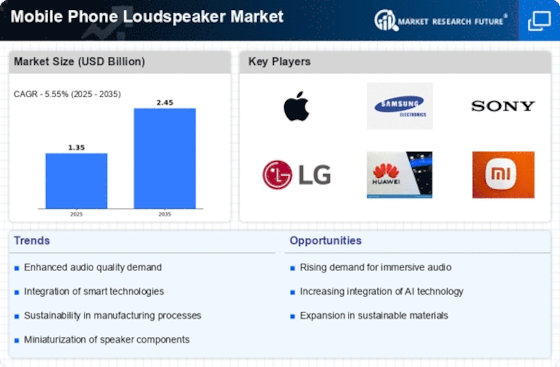
As per Market Research Future analysis, the Mobile Phone Loudspeaker Market Size was estimated at 1.35 USD Billion in 2024. The Mobile Phone Loudspeaker industry is projected to grow from USD 1.425 Billion in 2025 to USD 2.446 Billion by 2035, exhibiting a compound annual growth rate (CAGR) of 5.55% during the forecast period 2025 - 2035

Key Market Trends & Highlights

The Mobile Phone Loudspeaker Market is experiencing dynamic growth driven by technological advancements and changing consumer preferences.

  • North America remains the largest market for mobile phone loudspeakers, driven by high consumer spending on audio technology. Asia-Pacific is the fastest-growing region, reflecting a surge in smartphone adoption and demand for enhanced audio experiences. The stereo segment continues to dominate the market, while mono loudspeakers are witnessing rapid growth due to their compact design. Rising demand for enhanced audio quality and increased adoption of streaming services are key drivers propelling market expansion.

Market Size & Forecast

2024 Market Size 1.35 (USD Billion)
2035 Market Size 2.446 (USD Billion)
CAGR (2025 - 2035) 5.55%
Largest Regional Market Share in 2024 North America

Major Players

Apple Inc (US), Samsung Electronics (KR), Sony Corporation (JP), LG Electronics (KR), Huawei Technologies (CN), Xiaomi Corporation (CN), Oppo Electronics (CN), Vivo Communication Technology (CN), Lenovo Group (CN)

Market Trends

The Mobile Phone Loudspeaker Market is currently experiencing a dynamic evolution, driven by advancements in technology and changing consumer preferences. As mobile devices become increasingly integral to daily life, the demand for high-quality audio output has surged. Manufacturers are focusing on enhancing sound clarity, volume, and overall performance to meet the expectations of discerning users. This trend is further fueled by the rise of multimedia consumption on smartphones, including music streaming, gaming, and video playback, which necessitates superior audio capabilities. Additionally, the integration of smart features, such as voice assistants and noise cancellation, is becoming commonplace, indicating a shift towards more sophisticated loudspeaker systems. Moreover, sustainability is emerging as a pivotal consideration within the Mobile Phone Loudspeaker Market. Companies are exploring eco-friendly materials and production processes to appeal to environmentally conscious consumers. This shift not only addresses consumer demand for sustainable products but also aligns with global efforts to reduce electronic waste. As the market continues to evolve, it appears that innovation and sustainability will play crucial roles in shaping the future landscape of mobile phone loudspeakers, potentially leading to new opportunities and challenges for manufacturers and consumers alike.

Technological Advancements

The Mobile Phone Loudspeaker Market is witnessing rapid technological innovations, with manufacturers integrating advanced audio technologies. Features such as enhanced bass response, spatial audio, and adaptive sound tuning are becoming prevalent, allowing for a more immersive listening experience. This trend reflects a broader consumer expectation for high-fidelity sound in compact devices.

Sustainability Initiatives

Sustainability is increasingly influencing the Mobile Phone Loudspeaker Market, as companies prioritize eco-friendly materials and production methods. This shift not only caters to the growing demand for environmentally responsible products but also aligns with global sustainability goals, potentially reshaping consumer purchasing behaviors.

Integration of Smart Features

The integration of smart features into mobile phone loudspeakers is becoming more common, with functionalities such as voice recognition and noise cancellation gaining traction. This trend indicates a move towards more interactive and user-friendly audio experiences, enhancing the overall functionality of mobile devices.

Mobile Phone Loudspeaker Market Market Drivers

Emergence of 5G Technology

The Mobile Phone Loudspeaker Market is poised for transformation with the emergence of 5G technology. The rollout of 5G networks is expected to enhance mobile connectivity, enabling faster data transfer and improved streaming capabilities. This technological advancement is likely to drive the demand for high-performance loudspeakers that can handle increased audio data without compromising quality. As users engage in more data-intensive activities, such as high-definition video streaming and online gaming, the need for superior audio output becomes paramount. Market analysts predict that the integration of 5G technology will lead to a surge in mobile device sales, further propelling the Mobile Phone Loudspeaker Market. Manufacturers are thus incentivized to innovate and develop loudspeakers that can fully leverage the benefits of 5G, ensuring a competitive edge in the market.

Consumer Preference for Compact Devices

The Mobile Phone Loudspeaker Market is witnessing a shift in consumer preferences towards compact and lightweight devices. As mobile phones become increasingly slim and portable, manufacturers are challenged to design loudspeakers that deliver powerful sound without adding bulk. This trend is evident in the rising popularity of ultra-slim smartphones, which often prioritize aesthetics and portability. Recent market data indicates that nearly 60% of consumers consider the size and weight of a device as critical factors in their purchasing decisions. Consequently, manufacturers are investing in innovative materials and engineering techniques to create smaller yet more efficient loudspeakers. This focus on compact design not only meets consumer demands but also enhances the overall user experience, thereby driving growth in the Mobile Phone Loudspeaker Market.

Increased Adoption of Streaming Services

The Mobile Phone Loudspeaker Market is significantly influenced by the growing adoption of streaming services. As more consumers turn to platforms like Spotify, Apple Music, and YouTube for their audio and video needs, the demand for high-quality loudspeakers in mobile devices has surged. Recent statistics suggest that the number of streaming subscribers has reached over 500 million, indicating a robust market for audio playback. This trend compels manufacturers to enhance the loudspeaker capabilities of their devices to provide an optimal listening experience. Consequently, the integration of advanced audio technologies, such as Dolby Atmos and spatial audio, is becoming increasingly common in mobile phones. This evolution not only caters to the needs of consumers but also positions the Mobile Phone Loudspeaker Market for sustained growth as it adapts to the changing landscape of media consumption.

Rising Demand for Enhanced Audio Quality

The Mobile Phone Loudspeaker Market is experiencing a notable increase in demand for superior audio quality. Consumers are increasingly seeking devices that deliver immersive sound experiences, which has led manufacturers to invest in advanced loudspeaker technologies. According to recent data, the market for mobile phone loudspeakers is projected to grow at a compound annual growth rate of approximately 8% over the next five years. This growth is driven by the rising popularity of multimedia content consumption, including music and video streaming, which necessitates high-fidelity audio output. As a result, manufacturers are focusing on improving sound clarity, bass response, and overall audio performance to meet consumer expectations. This trend indicates a shift towards prioritizing audio quality in mobile devices, thereby shaping the future of the Mobile Phone Loudspeaker Market.

Growing Interest in Gaming and Multimedia Applications

The Mobile Phone Loudspeaker Market is significantly impacted by the growing interest in gaming and multimedia applications. As mobile gaming continues to gain traction, users are increasingly seeking devices equipped with high-quality loudspeakers that can deliver an immersive audio experience. Recent surveys indicate that over 70% of mobile gamers prioritize sound quality when selecting a device, highlighting the importance of audio in enhancing gameplay. This trend has prompted manufacturers to incorporate advanced audio technologies, such as surround sound and enhanced bass, into their loudspeakers. Furthermore, the rise of mobile content creation, including vlogging and streaming, has further fueled the demand for superior audio output. As a result, the Mobile Phone Loudspeaker Market is likely to see continued growth as it adapts to the evolving needs of gamers and content creators.

Market Segment Insights

By Product: Stereo (Largest) vs. Mono (Fastest-Growing)

<p>In the Mobile Phone Loudspeaker Market, the Stereo segment is currently the largest, commanding a significant share due to the increasing consumer demand for enhanced audio experiences. Stereo loudspeakers provide a richer sound quality, making them the preferred choice among users for activities such as gaming and multimedia consumption. On the other hand, the Mono segment, while smaller in market share, is witnessing rapid growth as a result of the rising popularity of budget-friendly smartphones that predominantly utilize mono speakers to reduce costs while still meeting basic audio requirements.</p>

<p>Product: Stereo (Dominant) vs. Mono (Emerging)</p>

<p>The Stereo loudspeaker segment stands out as the dominant force in the Mobile Phone Loudspeaker Market, offering superior sound quality that enhances user experience significantly. This dual-channel system allows for spatial sound reproduction, making it ideal for multimedia applications such as streaming music and watching videos. In contrast, the Mono loudspeaker segment, emerging rapidly, appeals primarily to budget-conscious consumers and entry-level smartphones. Mono loudspeakers, while limited in audio depth compared to their stereo counterparts, remain popular in low-cost devices due to their simplicity and cost-efficiency, thus capturing a distinct segment of the market.</p>

By Type: Electric Speakers (Largest) vs. Piezoelectric Speakers (Fastest-Growing)

<p>The Mobile Phone Loudspeaker Market is experiencing a diverse distribution in its 'By Type' segment. Electric speakers currently hold the largest market share, primarily due to their superior sound quality and widespread adoption in high-end devices. In contrast, piezoelectric speakers are swiftly gaining traction, leveraging their compact size and energy efficiency to appeal to manufacturers focusing on slim and lightweight mobile designs.</p>

<p>Electric Speakers (Dominant) vs. Piezoelectric Speakers (Emerging)</p>

<p>Electric speakers dominate the Mobile Phone Loudspeaker Market, favored for their remarkable sound reproduction capabilities and ability to produce rich bass tones. They are commonly integrated into premium smartphones, where audio quality is a significant selling point. Meanwhile, piezoelectric speakers, emerging rapidly in the industry, offer a lightweight alternative and consume less power, making them appealing for newer smartphone models that emphasize design and battery life. As mobile manufacturers seek to innovate and enhance user experiences, both segment values are critical—electric speakers for their quality and piezoelectric speakers for their practicality.</p>

By Sound Output: 80-90 DB (Largest) vs. More Than 90 DB (Fastest-Growing)

<p>In the Mobile Phone Loudspeaker Market, the sound output segment is divided into three key values: Less Than 80 DB, 80-90 DB, and More Than 90 DB. Among these, the 80-90 DB segment holds the largest market share, primarily driven by consumer preferences for balanced audio output that is suitable for a wide range of activities, from casual listening to video playback. Meanwhile, the Less Than 80 DB category is gradually declining as consumers increasingly seek louder and more impactful sound experiences in their devices. Conversely, the More Than 90 DB segment is recognized as the fastest-growing value, fueled by the rising demand for loudspeakers that can deliver clear and powerful audio in various environments. This growth is particularly notable among younger, tech-savvy consumers who prioritize sound quality and volume in their mobile devices. As manufacturers innovate to meet these demands, the loudspeaker capabilities are expected to evolve, further enhancing user experience in mobile communications and entertainment activities.</p>

<p>80-90 DB (Dominant) vs. More Than 90 DB (Emerging)</p>

<p>The 80-90 DB segment in the Mobile Phone Loudspeaker Market is currently the dominant force, as it satisfies the need for high-quality audio without overwhelming noise levels. This sound output range is particularly favored by users who engage in a mix of listening scenarios, including music, podcasts, and phone calls, where clarity and volume must be balanced. Brands focusing on this segment often emphasize durability and sound fidelity to cater to a diverse audience. On the other hand, the More Than 90 DB category emerges as an attractive market segment, particularly among younger audiences and those in entertainment industries who require superior sound. The appeal of powerful audio devices encourages manufacturers to explore cutting-edge technologies and designs, setting the stage for competitive innovation as this segment continues to grow.</p>

Get more detailed insights about Mobile Phone Loudspeaker Market Research Report - Global Forecast till 2035

Regional Insights

North America : Innovation and Demand Surge

The North American mobile phone loudspeaker market is driven by technological advancements and increasing consumer demand for high-quality audio experiences. The region holds approximately 35% of the global market share, making it the largest market. Regulatory support for innovation and sustainability initiatives further catalyzes growth, with a focus on eco-friendly materials and energy-efficient designs. Leading countries in this region include the United States and Canada, with major players like Apple Inc. and Samsung Electronics dominating the landscape. The competitive environment is characterized by continuous innovation and product differentiation, as companies strive to enhance audio quality and integrate advanced features into their devices. The presence of established brands ensures a robust market, fostering healthy competition and consumer choice.

Europe : Regulatory Support and Innovation

Europe is witnessing a significant transformation in the mobile phone loudspeaker market, driven by stringent regulations and a growing emphasis on sustainability. The region accounts for approximately 30% of the global market share, making it the second-largest market. Regulatory frameworks promoting eco-friendly practices and energy efficiency are key growth catalysts, encouraging manufacturers to innovate and comply with environmental standards. Countries like Germany, France, and the UK are at the forefront of this market, with key players such as Sony Corporation and LG Electronics leading the charge. The competitive landscape is marked by a blend of established brands and emerging players, all striving to meet consumer demands for superior audio quality and innovative features. The presence of diverse manufacturers fosters a dynamic market environment, enhancing consumer choices and driving technological advancements.

Asia-Pacific : Emerging Powerhouse in Technology

The Asia-Pacific region is rapidly emerging as a powerhouse in the mobile phone loudspeaker market, driven by rising disposable incomes and a growing middle class. This region holds approximately 25% of the global market share, with countries like China and India leading the charge. The demand for high-quality audio experiences is escalating, fueled by the proliferation of smartphones and advancements in audio technology. China is home to several key players, including Huawei Technologies and Xiaomi Corporation, which significantly influence the competitive landscape. The market is characterized by intense competition, with numerous local and international brands vying for market share. The presence of a robust manufacturing base and a focus on innovation further enhance the region's position in the global market, making it a critical area for growth and development.

Middle East and Africa : Untapped Potential and Growth

The Middle East and Africa region is witnessing a gradual but promising growth in the mobile phone loudspeaker market, driven by increasing smartphone penetration and a young, tech-savvy population. This region currently holds about 10% of the global market share, indicating significant untapped potential. The demand for affordable yet high-quality audio solutions is on the rise, supported by improving economic conditions and infrastructure development. Countries like South Africa and the UAE are leading the market, with a mix of local and international brands competing for consumer attention. The competitive landscape is evolving, with companies like Oppo Electronics and Vivo Communication Technology making strides in the market. As the region continues to develop, the focus on enhancing audio quality and integrating advanced features into mobile devices will be crucial for capturing a larger market share.

Key Players and Competitive Insights

Leading market players are investing heavily in research and development to expand their product lines, which will help the mobile phone loudspeaker market grow even more. Market participants are also undertaking various strategic activities to expand their global footprint, with significant market developments including new product launches, contractual agreements, mergers and acquisitions, higher investments, and collaboration with other organizations. To expand and survive in a more competitive and rising market climate, the mobile phone loudspeaker industry must offer cost-effective items.Manufacturing locally to minimize operational costs is a critical business tactic manufacturers use in the global mobile phone loudspeaker industry to benefit clients and increase the market sector. Major players in the mobile phone loudspeaker market, including Gettop Acoustic Co., Ltd. (China), BeStar Electronics Co., Ltd (China), BSE Co., Ltd (South Korea), Fortune Grand Technology Inc. (Taiwan), CUI Inc. (US), Dain, Inc. (China), and others, are attempting to increase market demand by investing in research and development operations.Samsung Electronics Co Ltd, a subsidiary of Samsung Group, manufactures consumer electronics, information technology and mobile communications, and device solutions. The company's product portfolio includes televisions (TV), refrigerators, washing machines, air conditioners, medical devices, printers, monitors, computers, network systems, and digital cameras. It also manufactures LCD and LED panels, mobile phones and smartphones, tablets, and accessories. Samsung provides solutions to retail, hospitality, healthcare institutions, finance, education, transportation, and government sectors.

In June Samsung launched the Q and S series of wireless soundbars with Dolby Atmos support in India.The Q series is expressed to have the world’s first built-in wireless Samsung TV-to-Soundbar Dolby Atmos connection. In contrast, the S series is the world’s slimmest soundbar series.Sony Group Corp manufactures electronic equipment, semiconductors, medical-related equipment, instruments, and devices. The company's products include televisions, mobile phones, cameras, music systems, game consoles and software, batteries, and other electronic components. Sony produces, acquires, and distributes recorded music, motion pictures, and television programming; and operates television and digital networks. The company markets products through sales subsidiaries, distributors, and direct sales through the Internet. It sells products under Sony, PlayStation, Walkman, Blu-ray, Cyber-shot, Bravia, Exmor, Experia, and Airpeak brands. The company operates in Asia-Pacific, Europe, the Middle East, Africa, and the Americas.

In February Sony Corporation declared the newest addition to its premium mobile ES car subwoofer and amplifier line-up. This will deliver higher power output and clarity.

Key Companies in the Mobile Phone Loudspeaker Market include

Industry Developments

June 2022: Bose introduced its most outstanding Bluetooth speaker as part of its Soundlink sequence in India. The speaker's robust strategy comes with the firm's proprietary Bose PositionIQ technology, which automatically notices the speaker's orientation to deliver improved audio playback.

October 2020: apple launched a new smart speaker called the Apple HomePod mini. HomePod Mini is organized to work with Apple Music, podcasts, and radio stations and delivers an immersive sound quality.

October 2021: Bose Corporation launched a Bluetooth speaker in the USA called Soundlink Flex. It features a portable and rugged design and comes with Bose PositionIQ technology that automatically detects the speaker's orientation to optimize sound delivery.

Future Outlook

Mobile Phone Loudspeaker Market Future Outlook

The Mobile Phone Loudspeaker Market is projected to grow at a 5.55% CAGR from 2025 to 2035, driven by technological advancements and increasing consumer demand for high-quality audio.

New opportunities lie in:

  • Development of integrated smart loudspeakers for enhanced user experience.</p><p>Expansion into emerging markets with tailored audio solutions.</p><p>Partnerships with smartphone manufacturers for exclusive loudspeaker technologies.

By 2035, the market is expected to achieve robust growth, solidifying its position in the global audio industry.

Market Segmentation

Mobile Phone Loudspeaker Market Type Outlook

  • Electric Speakers
  • Piezoelectric Speakers
  • Electromagnetic Speakers
  • Plasma Speakers

Mobile Phone Loudspeaker Market Product Outlook

  • Mono
  • Stereo

Mobile Phone Loudspeaker Market Sound Output Outlook

  • Less Than 80 DB
  • 80-90 DB
  • More Than 90 DB

Report Scope

MARKET SIZE 2024 1.35(USD Billion)
MARKET SIZE 2025 1.425(USD Billion)
MARKET SIZE 2035 2.446(USD Billion)
COMPOUND ANNUAL GROWTH RATE (CAGR) 5.55% (2025 - 2035)
REPORT COVERAGE Revenue Forecast, Competitive Landscape, Growth Factors, and Trends
BASE YEAR 2024
Market Forecast Period 2025 - 2035
Historical Data 2019 - 2024
Market Forecast Units USD Billion
Key Companies Profiled Apple Inc (US), Samsung Electronics (KR), Sony Corporation (JP), LG Electronics (KR), Huawei Technologies (CN), Xiaomi Corporation (CN), Oppo Electronics (CN), Vivo Communication Technology (CN), Lenovo Group (CN)
Segments Covered Type, Type, Sound Output, Region
Key Market Opportunities Integration of advanced audio technologies enhances user experience in the Mobile Phone Loudspeaker Market.
Key Market Dynamics Technological advancements in sound quality and miniaturization drive competition in the mobile phone loudspeaker market.
Countries Covered North America, Europe, APAC, South America, MEA

FAQs

What is the current valuation of the Mobile Phone Loudspeaker Market as of 2024?

<p>The Mobile Phone Loudspeaker Market was valued at 1.35 USD Billion in 2024.</p>

What is the projected market valuation for the Mobile Phone Loudspeaker Market in 2035?

<p>The market is projected to reach 2.446 USD Billion by 2035.</p>

What is the expected CAGR for the Mobile Phone Loudspeaker Market during the forecast period 2025 - 2035?

<p>The expected CAGR for the Mobile Phone Loudspeaker Market during 2025 - 2035 is 5.55%.</p>

Which companies are considered key players in the Mobile Phone Loudspeaker Market?

<p>Key players include Apple Inc, Samsung Electronics, Sony Corporation, LG Electronics, Huawei Technologies, Xiaomi Corporation, Oppo Electronics, Vivo Communication Technology, and Lenovo Group.</p>

What are the main product segments in the Mobile Phone Loudspeaker Market?

<p>The main product segments are Mono and Stereo loudspeakers, with valuations of 0.54 to 0.99 USD Billion for Mono and 0.81 to 1.45 USD Billion for Stereo.</p>

How do different types of speakers perform in the Mobile Phone Loudspeaker Market?

<p>Electric Speakers range from 0.54 to 0.99 USD Billion, while Piezoelectric Speakers range from 0.27 to 0.49 USD Billion.</p>

What sound output categories are present in the Mobile Phone Loudspeaker Market?

<p>Sound output categories include Less Than 80 DB, 80-90 DB, and More Than 90 DB, with valuations of 0.405 to 0.738 USD Billion, 0.675 to 1.215 USD Billion, and 0.265 to 0.493 USD Billion, respectively.</p>

How does the Mobile Phone Loudspeaker Market compare to other electronic markets?

While specific comparisons are not provided, the Mobile Phone Loudspeaker Market's growth trajectory suggests a robust performance relative to other electronic segments.

What trends are influencing the growth of the Mobile Phone Loudspeaker Market?

Trends such as advancements in audio technology and increasing consumer demand for high-quality sound are likely influencing market growth.

What is the significance of the projected growth from 2024 to 2035 in the Mobile Phone Loudspeaker Market?

The projected growth from 1.35 USD Billion in 2024 to 2.446 USD Billion in 2035 indicates a strong upward trend in consumer interest and technological advancements.

  1. SECTION I: EXECUTIVE SUMMARY AND KEY HIGHLIGHTS
    1. | 1.1 EXECUTIVE SUMMARY
    2. | | 1.1.1 Market Overview
    3. | | 1.1.2 Key Findings
    4. | | 1.1.3 Market Segmentation
    5. | | 1.1.4 Competitive Landscape
    6. | | 1.1.5 Challenges and Opportunities
    7. | | 1.1.6 Future Outlook
  2. SECTION II: SCOPING, METHODOLOGY AND MARKET STRUCTURE
    1. | 2.1 MARKET INTRODUCTION
    2. | | 2.1.1 Definition
    3. | | 2.1.2 Scope of the study
    4. | | | 2.1.2.1 Research Objective
    5. | | | 2.1.2.2 Assumption
    6. | | | 2.1.2.3 Limitations
    7. | 2.2 RESEARCH METHODOLOGY
    8. | | 2.2.1 Overview
    9. | | 2.2.2 Data Mining
    10. | | 2.2.3 Secondary Research
    11. | | 2.2.4 Primary Research
    12. | | | 2.2.4.1 Primary Interviews and Information Gathering Process
    13. | | | 2.2.4.2 Breakdown of Primary Respondents
    14. | | 2.2.5 Forecasting Model
    15. | | 2.2.6 Market Size Estimation
    16. | | | 2.2.6.1 Bottom-Up Approach
    17. | | | 2.2.6.2 Top-Down Approach
    18. | | 2.2.7 Data Triangulation
    19. | | 2.2.8 Validation
  3. SECTION III: QUALITATIVE ANALYSIS
    1. | 3.1 MARKET DYNAMICS
    2. | | 3.1.1 Overview
    3. | | 3.1.2 Drivers
    4. | | 3.1.3 Restraints
    5. | | 3.1.4 Opportunities
    6. | 3.2 MARKET FACTOR ANALYSIS
    7. | | 3.2.1 Value chain Analysis
    8. | | 3.2.2 Porter's Five Forces Analysis
    9. | | | 3.2.2.1 Bargaining Power of Suppliers
    10. | | | 3.2.2.2 Bargaining Power of Buyers
    11. | | | 3.2.2.3 Threat of New Entrants
    12. | | | 3.2.2.4 Threat of Substitutes
    13. | | | 3.2.2.5 Intensity of Rivalry
    14. | | 3.2.3 COVID-19 Impact Analysis
    15. | | | 3.2.3.1 Market Impact Analysis
    16. | | | 3.2.3.2 Regional Impact
    17. | | | 3.2.3.3 Opportunity and Threat Analysis
  4. SECTION IV: QUANTITATIVE ANALYSIS
    1. | 4.1 Semiconductor & Electronics, BY Product (USD Billion)
    2. | | 4.1.1 Mono
    3. | | 4.1.2 Stereo
    4. | 4.2 Semiconductor & Electronics, BY Type (USD Billion)
    5. | | 4.2.1 Electric Speakers
    6. | | 4.2.2 Piezoelectric Speakers
    7. | | 4.2.3 Electromagnetic Speakers
    8. | | 4.2.4 Plasma Speakers
    9. | 4.3 Semiconductor & Electronics, BY Sound Output (USD Billion)
    10. | | 4.3.1 Less Than 80 DB
    11. | | 4.3.2 80-90 DB
    12. | | 4.3.3 More Than 90 DB
    13. | 4.4 Semiconductor & Electronics, BY Region (USD Billion)
    14. | | 4.4.1 North America
    15. | | | 4.4.1.1 US
    16. | | | 4.4.1.2 Canada
    17. | | 4.4.2 Europe
    18. | | | 4.4.2.1 Germany
    19. | | | 4.4.2.2 UK
    20. | | | 4.4.2.3 France
    21. | | | 4.4.2.4 Russia
    22. | | | 4.4.2.5 Italy
    23. | | | 4.4.2.6 Spain
    24. | | | 4.4.2.7 Rest of Europe
    25. | | 4.4.3 APAC
    26. | | | 4.4.3.1 China
    27. | | | 4.4.3.2 India
    28. | | | 4.4.3.3 Japan
    29. | | | 4.4.3.4 South Korea
    30. | | | 4.4.3.5 Malaysia
    31. | | | 4.4.3.6 Thailand
    32. | | | 4.4.3.7 Indonesia
    33. | | | 4.4.3.8 Rest of APAC
    34. | | 4.4.4 South America
    35. | | | 4.4.4.1 Brazil
    36. | | | 4.4.4.2 Mexico
    37. | | | 4.4.4.3 Argentina
    38. | | | 4.4.4.4 Rest of South America
    39. | | 4.4.5 MEA
    40. | | | 4.4.5.1 GCC Countries
    41. | | | 4.4.5.2 South Africa
    42. | | | 4.4.5.3 Rest of MEA
  5. SECTION V: COMPETITIVE ANALYSIS
    1. | 5.1 Competitive Landscape
    2. | | 5.1.1 Overview
    3. | | 5.1.2 Competitive Analysis
    4. | | 5.1.3 Market share Analysis
    5. | | 5.1.4 Major Growth Strategy in the Semiconductor & Electronics
    6. | | 5.1.5 Competitive Benchmarking
    7. | | 5.1.6 Leading Players in Terms of Number of Developments in the Semiconductor & Electronics
    8. | | 5.1.7 Key developments and growth strategies
    9. | | | 5.1.7.1 New Product Launch/Service Deployment
    10. | | | 5.1.7.2 Merger & Acquisitions
    11. | | | 5.1.7.3 Joint Ventures
    12. | | 5.1.8 Major Players Financial Matrix
    13. | | | 5.1.8.1 Sales and Operating Income
    14. | | | 5.1.8.2 Major Players R&D Expenditure. 2023
    15. | 5.2 Company Profiles
    16. | | 5.2.1 Apple Inc (US)
    17. | | | 5.2.1.1 Financial Overview
    18. | | | 5.2.1.2 Products Offered
    19. | | | 5.2.1.3 Key Developments
    20. | | | 5.2.1.4 SWOT Analysis
    21. | | | 5.2.1.5 Key Strategies
    22. | | 5.2.2 Samsung Electronics (KR)
    23. | | | 5.2.2.1 Financial Overview
    24. | | | 5.2.2.2 Products Offered
    25. | | | 5.2.2.3 Key Developments
    26. | | | 5.2.2.4 SWOT Analysis
    27. | | | 5.2.2.5 Key Strategies
    28. | | 5.2.3 Sony Corporation (JP)
    29. | | | 5.2.3.1 Financial Overview
    30. | | | 5.2.3.2 Products Offered
    31. | | | 5.2.3.3 Key Developments
    32. | | | 5.2.3.4 SWOT Analysis
    33. | | | 5.2.3.5 Key Strategies
    34. | | 5.2.4 LG Electronics (KR)
    35. | | | 5.2.4.1 Financial Overview
    36. | | | 5.2.4.2 Products Offered
    37. | | | 5.2.4.3 Key Developments
    38. | | | 5.2.4.4 SWOT Analysis
    39. | | | 5.2.4.5 Key Strategies
    40. | | 5.2.5 Huawei Technologies (CN)
    41. | | | 5.2.5.1 Financial Overview
    42. | | | 5.2.5.2 Products Offered
    43. | | | 5.2.5.3 Key Developments
    44. | | | 5.2.5.4 SWOT Analysis
    45. | | | 5.2.5.5 Key Strategies
    46. | | 5.2.6 Xiaomi Corporation (CN)
    47. | | | 5.2.6.1 Financial Overview
    48. | | | 5.2.6.2 Products Offered
    49. | | | 5.2.6.3 Key Developments
    50. | | | 5.2.6.4 SWOT Analysis
    51. | | | 5.2.6.5 Key Strategies
    52. | | 5.2.7 Oppo Electronics (CN)
    53. | | | 5.2.7.1 Financial Overview
    54. | | | 5.2.7.2 Products Offered
    55. | | | 5.2.7.3 Key Developments
    56. | | | 5.2.7.4 SWOT Analysis
    57. | | | 5.2.7.5 Key Strategies
    58. | | 5.2.8 Vivo Communication Technology (CN)
    59. | | | 5.2.8.1 Financial Overview
    60. | | | 5.2.8.2 Products Offered
    61. | | | 5.2.8.3 Key Developments
    62. | | | 5.2.8.4 SWOT Analysis
    63. | | | 5.2.8.5 Key Strategies
    64. | | 5.2.9 Lenovo Group (CN)
    65. | | | 5.2.9.1 Financial Overview
    66. | | | 5.2.9.2 Products Offered
    67. | | | 5.2.9.3 Key Developments
    68. | | | 5.2.9.4 SWOT Analysis
    69. | | | 5.2.9.5 Key Strategies
    70. | 5.3 Appendix
    71. | | 5.3.1 References
    72. | | 5.3.2 Related Reports
  6. LIST OF FIGURES
    1. | 6.1 MARKET SYNOPSIS
    2. | 6.2 NORTH AMERICA MARKET ANALYSIS
    3. | 6.3 US MARKET ANALYSIS BY PRODUCT
    4. | 6.4 US MARKET ANALYSIS BY TYPE
    5. | 6.5 US MARKET ANALYSIS BY SOUND OUTPUT
    6. | 6.6 CANADA MARKET ANALYSIS BY PRODUCT
    7. | 6.7 CANADA MARKET ANALYSIS BY TYPE
    8. | 6.8 CANADA MARKET ANALYSIS BY SOUND OUTPUT
    9. | 6.9 EUROPE MARKET ANALYSIS
    10. | 6.10 GERMANY MARKET ANALYSIS BY PRODUCT
    11. | 6.11 GERMANY MARKET ANALYSIS BY TYPE
    12. | 6.12 GERMANY MARKET ANALYSIS BY SOUND OUTPUT
    13. | 6.13 UK MARKET ANALYSIS BY PRODUCT
    14. | 6.14 UK MARKET ANALYSIS BY TYPE
    15. | 6.15 UK MARKET ANALYSIS BY SOUND OUTPUT
    16. | 6.16 FRANCE MARKET ANALYSIS BY PRODUCT
    17. | 6.17 FRANCE MARKET ANALYSIS BY TYPE
    18. | 6.18 FRANCE MARKET ANALYSIS BY SOUND OUTPUT
    19. | 6.19 RUSSIA MARKET ANALYSIS BY PRODUCT
    20. | 6.20 RUSSIA MARKET ANALYSIS BY TYPE
    21. | 6.21 RUSSIA MARKET ANALYSIS BY SOUND OUTPUT
    22. | 6.22 ITALY MARKET ANALYSIS BY PRODUCT
    23. | 6.23 ITALY MARKET ANALYSIS BY TYPE
    24. | 6.24 ITALY MARKET ANALYSIS BY SOUND OUTPUT
    25. | 6.25 SPAIN MARKET ANALYSIS BY PRODUCT
    26. | 6.26 SPAIN MARKET ANALYSIS BY TYPE
    27. | 6.27 SPAIN MARKET ANALYSIS BY SOUND OUTPUT
    28. | 6.28 REST OF EUROPE MARKET ANALYSIS BY PRODUCT
    29. | 6.29 REST OF EUROPE MARKET ANALYSIS BY TYPE
    30. | 6.30 REST OF EUROPE MARKET ANALYSIS BY SOUND OUTPUT
    31. | 6.31 APAC MARKET ANALYSIS
    32. | 6.32 CHINA MARKET ANALYSIS BY PRODUCT
    33. | 6.33 CHINA MARKET ANALYSIS BY TYPE
    34. | 6.34 CHINA MARKET ANALYSIS BY SOUND OUTPUT
    35. | 6.35 INDIA MARKET ANALYSIS BY PRODUCT
    36. | 6.36 INDIA MARKET ANALYSIS BY TYPE
    37. | 6.37 INDIA MARKET ANALYSIS BY SOUND OUTPUT
    38. | 6.38 JAPAN MARKET ANALYSIS BY PRODUCT
    39. | 6.39 JAPAN MARKET ANALYSIS BY TYPE
    40. | 6.40 JAPAN MARKET ANALYSIS BY SOUND OUTPUT
    41. | 6.41 SOUTH KOREA MARKET ANALYSIS BY PRODUCT
    42. | 6.42 SOUTH KOREA MARKET ANALYSIS BY TYPE
    43. | 6.43 SOUTH KOREA MARKET ANALYSIS BY SOUND OUTPUT
    44. | 6.44 MALAYSIA MARKET ANALYSIS BY PRODUCT
    45. | 6.45 MALAYSIA MARKET ANALYSIS BY TYPE
    46. | 6.46 MALAYSIA MARKET ANALYSIS BY SOUND OUTPUT
    47. | 6.47 THAILAND MARKET ANALYSIS BY PRODUCT
    48. | 6.48 THAILAND MARKET ANALYSIS BY TYPE
    49. | 6.49 THAILAND MARKET ANALYSIS BY SOUND OUTPUT
    50. | 6.50 INDONESIA MARKET ANALYSIS BY PRODUCT
    51. | 6.51 INDONESIA MARKET ANALYSIS BY TYPE
    52. | 6.52 INDONESIA MARKET ANALYSIS BY SOUND OUTPUT
    53. | 6.53 REST OF APAC MARKET ANALYSIS BY PRODUCT
    54. | 6.54 REST OF APAC MARKET ANALYSIS BY TYPE
    55. | 6.55 REST OF APAC MARKET ANALYSIS BY SOUND OUTPUT
    56. | 6.56 SOUTH AMERICA MARKET ANALYSIS
    57. | 6.57 BRAZIL MARKET ANALYSIS BY PRODUCT
    58. | 6.58 BRAZIL MARKET ANALYSIS BY TYPE
    59. | 6.59 BRAZIL MARKET ANALYSIS BY SOUND OUTPUT
    60. | 6.60 MEXICO MARKET ANALYSIS BY PRODUCT
    61. | 6.61 MEXICO MARKET ANALYSIS BY TYPE
    62. | 6.62 MEXICO MARKET ANALYSIS BY SOUND OUTPUT
    63. | 6.63 ARGENTINA MARKET ANALYSIS BY PRODUCT
    64. | 6.64 ARGENTINA MARKET ANALYSIS BY TYPE
    65. | 6.65 ARGENTINA MARKET ANALYSIS BY SOUND OUTPUT
    66. | 6.66 REST OF SOUTH AMERICA MARKET ANALYSIS BY PRODUCT
    67. | 6.67 REST OF SOUTH AMERICA MARKET ANALYSIS BY TYPE
    68. | 6.68 REST OF SOUTH AMERICA MARKET ANALYSIS BY SOUND OUTPUT
    69. | 6.69 MEA MARKET ANALYSIS
    70. | 6.70 GCC COUNTRIES MARKET ANALYSIS BY PRODUCT
    71. | 6.71 GCC COUNTRIES MARKET ANALYSIS BY TYPE
    72. | 6.72 GCC COUNTRIES MARKET ANALYSIS BY SOUND OUTPUT
    73. | 6.73 SOUTH AFRICA MARKET ANALYSIS BY PRODUCT
    74. | 6.74 SOUTH AFRICA MARKET ANALYSIS BY TYPE
    75. | 6.75 SOUTH AFRICA MARKET ANALYSIS BY SOUND OUTPUT
    76. | 6.76 REST OF MEA MARKET ANALYSIS BY PRODUCT
    77. | 6.77 REST OF MEA MARKET ANALYSIS BY TYPE
    78. | 6.78 REST OF MEA MARKET ANALYSIS BY SOUND OUTPUT
    79. | 6.79 KEY BUYING CRITERIA OF SEMICONDUCTOR & ELECTRONICS
    80. | 6.80 RESEARCH PROCESS OF MRFR
    81. | 6.81 DRO ANALYSIS OF SEMICONDUCTOR & ELECTRONICS
    82. | 6.82 DRIVERS IMPACT ANALYSIS: SEMICONDUCTOR & ELECTRONICS
    83. | 6.83 RESTRAINTS IMPACT ANALYSIS: SEMICONDUCTOR & ELECTRONICS
    84. | 6.84 SUPPLY / VALUE CHAIN: SEMICONDUCTOR & ELECTRONICS
    85. | 6.85 SEMICONDUCTOR & ELECTRONICS, BY PRODUCT, 2024 (% SHARE)
    86. | 6.86 SEMICONDUCTOR & ELECTRONICS, BY PRODUCT, 2024 TO 2035 (USD Billion)
    87. | 6.87 SEMICONDUCTOR & ELECTRONICS, BY TYPE, 2024 (% SHARE)
    88. | 6.88 SEMICONDUCTOR & ELECTRONICS, BY TYPE, 2024 TO 2035 (USD Billion)
    89. | 6.89 SEMICONDUCTOR & ELECTRONICS, BY SOUND OUTPUT, 2024 (% SHARE)
    90. | 6.90 SEMICONDUCTOR & ELECTRONICS, BY SOUND OUTPUT, 2024 TO 2035 (USD Billion)
    91. | 6.91 BENCHMARKING OF MAJOR COMPETITORS
  7. LIST OF TABLES
    1. | 7.1 LIST OF ASSUMPTIONS
    2. | | 7.1.1
    3. | 7.2 North America MARKET SIZE ESTIMATES; FORECAST
    4. | | 7.2.1 BY PRODUCT, 2025-2035 (USD Billion)
    5. | | 7.2.2 BY TYPE, 2025-2035 (USD Billion)
    6. | | 7.2.3 BY SOUND OUTPUT, 2025-2035 (USD Billion)
    7. | 7.3 US MARKET SIZE ESTIMATES; FORECAST
    8. | | 7.3.1 BY PRODUCT, 2025-2035 (USD Billion)
    9. | | 7.3.2 BY TYPE, 2025-2035 (USD Billion)
    10. | | 7.3.3 BY SOUND OUTPUT, 2025-2035 (USD Billion)
    11. | 7.4 Canada MARKET SIZE ESTIMATES; FORECAST
    12. | | 7.4.1 BY PRODUCT, 2025-2035 (USD Billion)
    13. | | 7.4.2 BY TYPE, 2025-2035 (USD Billion)
    14. | | 7.4.3 BY SOUND OUTPUT, 2025-2035 (USD Billion)
    15. | 7.5 Europe MARKET SIZE ESTIMATES; FORECAST
    16. | | 7.5.1 BY PRODUCT, 2025-2035 (USD Billion)
    17. | | 7.5.2 BY TYPE, 2025-2035 (USD Billion)
    18. | | 7.5.3 BY SOUND OUTPUT, 2025-2035 (USD Billion)
    19. | 7.6 Germany MARKET SIZE ESTIMATES; FORECAST
    20. | | 7.6.1 BY PRODUCT, 2025-2035 (USD Billion)
    21. | | 7.6.2 BY TYPE, 2025-2035 (USD Billion)
    22. | | 7.6.3 BY SOUND OUTPUT, 2025-2035 (USD Billion)
    23. | 7.7 UK MARKET SIZE ESTIMATES; FORECAST
    24. | | 7.7.1 BY PRODUCT, 2025-2035 (USD Billion)
    25. | | 7.7.2 BY TYPE, 2025-2035 (USD Billion)
    26. | | 7.7.3 BY SOUND OUTPUT, 2025-2035 (USD Billion)
    27. | 7.8 France MARKET SIZE ESTIMATES; FORECAST
    28. | | 7.8.1 BY PRODUCT, 2025-2035 (USD Billion)
    29. | | 7.8.2 BY TYPE, 2025-2035 (USD Billion)
    30. | | 7.8.3 BY SOUND OUTPUT, 2025-2035 (USD Billion)
    31. | 7.9 Russia MARKET SIZE ESTIMATES; FORECAST
    32. | | 7.9.1 BY PRODUCT, 2025-2035 (USD Billion)
    33. | | 7.9.2 BY TYPE, 2025-2035 (USD Billion)
    34. | | 7.9.3 BY SOUND OUTPUT, 2025-2035 (USD Billion)
    35. | 7.10 Italy MARKET SIZE ESTIMATES; FORECAST
    36. | | 7.10.1 BY PRODUCT, 2025-2035 (USD Billion)
    37. | | 7.10.2 BY TYPE, 2025-2035 (USD Billion)
    38. | | 7.10.3 BY SOUND OUTPUT, 2025-2035 (USD Billion)
    39. | 7.11 Spain MARKET SIZE ESTIMATES; FORECAST
    40. | | 7.11.1 BY PRODUCT, 2025-2035 (USD Billion)
    41. | | 7.11.2 BY TYPE, 2025-2035 (USD Billion)
    42. | | 7.11.3 BY SOUND OUTPUT, 2025-2035 (USD Billion)
    43. | 7.12 Rest of Europe MARKET SIZE ESTIMATES; FORECAST
    44. | | 7.12.1 BY PRODUCT, 2025-2035 (USD Billion)
    45. | | 7.12.2 BY TYPE, 2025-2035 (USD Billion)
    46. | | 7.12.3 BY SOUND OUTPUT, 2025-2035 (USD Billion)
    47. | 7.13 APAC MARKET SIZE ESTIMATES; FORECAST
    48. | | 7.13.1 BY PRODUCT, 2025-2035 (USD Billion)
    49. | | 7.13.2 BY TYPE, 2025-2035 (USD Billion)
    50. | | 7.13.3 BY SOUND OUTPUT, 2025-2035 (USD Billion)
    51. | 7.14 China MARKET SIZE ESTIMATES; FORECAST
    52. | | 7.14.1 BY PRODUCT, 2025-2035 (USD Billion)
    53. | | 7.14.2 BY TYPE, 2025-2035 (USD Billion)
    54. | | 7.14.3 BY SOUND OUTPUT, 2025-2035 (USD Billion)
    55. | 7.15 India MARKET SIZE ESTIMATES; FORECAST
    56. | | 7.15.1 BY PRODUCT, 2025-2035 (USD Billion)
    57. | | 7.15.2 BY TYPE, 2025-2035 (USD Billion)
    58. | | 7.15.3 BY SOUND OUTPUT, 2025-2035 (USD Billion)
    59. | 7.16 Japan MARKET SIZE ESTIMATES; FORECAST
    60. | | 7.16.1 BY PRODUCT, 2025-2035 (USD Billion)
    61. | | 7.16.2 BY TYPE, 2025-2035 (USD Billion)
    62. | | 7.16.3 BY SOUND OUTPUT, 2025-2035 (USD Billion)
    63. | 7.17 South Korea MARKET SIZE ESTIMATES; FORECAST
    64. | | 7.17.1 BY PRODUCT, 2025-2035 (USD Billion)
    65. | | 7.17.2 BY TYPE, 2025-2035 (USD Billion)
    66. | | 7.17.3 BY SOUND OUTPUT, 2025-2035 (USD Billion)
    67. | 7.18 Malaysia MARKET SIZE ESTIMATES; FORECAST
    68. | | 7.18.1 BY PRODUCT, 2025-2035 (USD Billion)
    69. | | 7.18.2 BY TYPE, 2025-2035 (USD Billion)
    70. | | 7.18.3 BY SOUND OUTPUT, 2025-2035 (USD Billion)
    71. | 7.19 Thailand MARKET SIZE ESTIMATES; FORECAST
    72. | | 7.19.1 BY PRODUCT, 2025-2035 (USD Billion)
    73. | | 7.19.2 BY TYPE, 2025-2035 (USD Billion)
    74. | | 7.19.3 BY SOUND OUTPUT, 2025-2035 (USD Billion)
    75. | 7.20 Indonesia MARKET SIZE ESTIMATES; FORECAST
    76. | | 7.20.1 BY PRODUCT, 2025-2035 (USD Billion)
    77. | | 7.20.2 BY TYPE, 2025-2035 (USD Billion)
    78. | | 7.20.3 BY SOUND OUTPUT, 2025-2035 (USD Billion)
    79. | 7.21 Rest of APAC MARKET SIZE ESTIMATES; FORECAST
    80. | | 7.21.1 BY PRODUCT, 2025-2035 (USD Billion)
    81. | | 7.21.2 BY TYPE, 2025-2035 (USD Billion)
    82. | | 7.21.3 BY SOUND OUTPUT, 2025-2035 (USD Billion)
    83. | 7.22 South America MARKET SIZE ESTIMATES; FORECAST
    84. | | 7.22.1 BY PRODUCT, 2025-2035 (USD Billion)
    85. | | 7.22.2 BY TYPE, 2025-2035 (USD Billion)
    86. | | 7.22.3 BY SOUND OUTPUT, 2025-2035 (USD Billion)
    87. | 7.23 Brazil MARKET SIZE ESTIMATES; FORECAST
    88. | | 7.23.1 BY PRODUCT, 2025-2035 (USD Billion)
    89. | | 7.23.2 BY TYPE, 2025-2035 (USD Billion)
    90. | | 7.23.3 BY SOUND OUTPUT, 2025-2035 (USD Billion)
    91. | 7.24 Mexico MARKET SIZE ESTIMATES; FORECAST
    92. | | 7.24.1 BY PRODUCT, 2025-2035 (USD Billion)
    93. | | 7.24.2 BY TYPE, 2025-2035 (USD Billion)
    94. | | 7.24.3 BY SOUND OUTPUT, 2025-2035 (USD Billion)
    95. | 7.25 Argentina MARKET SIZE ESTIMATES; FORECAST
    96. | | 7.25.1 BY PRODUCT, 2025-2035 (USD Billion)
    97. | | 7.25.2 BY TYPE, 2025-2035 (USD Billion)
    98. | | 7.25.3 BY SOUND OUTPUT, 2025-2035 (USD Billion)
    99. | 7.26 Rest of South America MARKET SIZE ESTIMATES; FORECAST
    100. | | 7.26.1 BY PRODUCT, 2025-2035 (USD Billion)
    101. | | 7.26.2 BY TYPE, 2025-2035 (USD Billion)
    102. | | 7.26.3 BY SOUND OUTPUT, 2025-2035 (USD Billion)
    103. | 7.27 MEA MARKET SIZE ESTIMATES; FORECAST
    104. | | 7.27.1 BY PRODUCT, 2025-2035 (USD Billion)
    105. | | 7.27.2 BY TYPE, 2025-2035 (USD Billion)
    106. | | 7.27.3 BY SOUND OUTPUT, 2025-2035 (USD Billion)
    107. | 7.28 GCC Countries MARKET SIZE ESTIMATES; FORECAST
    108. | | 7.28.1 BY PRODUCT, 2025-2035 (USD Billion)
    109. | | 7.28.2 BY TYPE, 2025-2035 (USD Billion)
    110. | | 7.28.3 BY SOUND OUTPUT, 2025-2035 (USD Billion)
    111. | 7.29 South Africa MARKET SIZE ESTIMATES; FORECAST
    112. | | 7.29.1 BY PRODUCT, 2025-2035 (USD Billion)
    113. | | 7.29.2 BY TYPE, 2025-2035 (USD Billion)
    114. | | 7.29.3 BY SOUND OUTPUT, 2025-2035 (USD Billion)
    115. | 7.30 Rest of MEA MARKET SIZE ESTIMATES; FORECAST
    116. | | 7.30.1 BY PRODUCT, 2025-2035 (USD Billion)
    117. | | 7.30.2 BY TYPE, 2025-2035 (USD Billion)
    118. | | 7.30.3 BY SOUND OUTPUT, 2025-2035 (USD Billion)
    119. | 7.31 PRODUCT LAUNCH/PRODUCT DEVELOPMENT/APPROVAL
    120. | | 7.31.1
    121. | 7.32 ACQUISITION/PARTNERSHIP
    122. | | 7.32.1

Semiconductor & Electronics Market Segmentation

Semiconductor & Electronics By Product (USD Billion, 2025-2035)

  • Mono
  • Stereo

Semiconductor & Electronics By Type (USD Billion, 2025-2035)

  • Electric Speakers
  • Piezoelectric Speakers
  • Electromagnetic Speakers
  • Plasma Speakers

Semiconductor & Electronics By Sound Output (USD Billion, 2025-2035)

  • Less Than 80 DB
  • 80-90 DB
  • More Than 90 DB
Infographic

Free Sample Request

Kindly complete the form below to receive a free sample of this Report

Get Free Sample

Customer Strories

Compare Licence

×
Features License Type
Single User Multiuser License Enterprise User
Price $4,950 $5,950 $7,250
Maximum User Access Limit 1 User Upto 10 Users Unrestricted Access Throughout the Organization
Free Customization
Direct Access to Analyst
Deliverable Format
Platform Access
Discount on Next Purchase 10% 15% 15%
Printable Versions