
Request Free Sample ×

Kindly complete the form below to receive a free sample of this Report

* Please use a valid business email

Leading companies partner with us for data-driven Insights

clients tt-cursor
Hero Background
English
Chinese
French
Japanese
Korean
German
Spanish

Mobile Mapping Market Trends

ID: MRFR/ICT/4292-CR
186 Pages
Aarti Dhapte
November 2020

Mobile Mapping Market Size, Share and Research Report: By Component (Hardware, Software and Services), Solution (Location-Based, Indoor Mapping, Asset Management and 3D Mapping), Application (Land Surveys and Aerial Surveys), End-User (Real Estate & Construction, IT & Telecom and Others) And By Region (North America, Europe, Asia-Pacific, And Rest Of The World) –Market Forecast Till 2035.

Share:
Download PDF ×

We do not share your information with anyone. However, we may send you emails based on your report interest from time to time. You may contact us at any time to opt-out.

Mobile Mapping Market Infographic
Purchase Options

Market Trends

Key Emerging Trends in the Mobile Mapping Market

The mobile mapping market is witnessing significant changes propelled by various factors reshaping its landscape. With the widespread adoption of smartphones, GPS technology, and advanced mapping applications, mobile mapping has emerged as a powerful tool for capturing, analyzing, and visualizing geospatial data in real-time. As organizations across industries recognize the value of location-based insights for decision-making, the demand for mobile mapping solutions continues to grow.

One of the primary drivers behind the evolving market dynamics is the proliferation of location-based services (LBS) and navigation applications. Consumers increasingly rely on mobile mapping applications for turn-by-turn navigation, location-based recommendations, and real-time traffic updates. Moreover, businesses are leveraging LBS to deliver personalized experiences, optimize logistics operations, and target customers based on their geographic location. This surge in demand for location-based services is driving innovation in the mobile mapping market, with vendors introducing new features, such as augmented reality (AR) navigation and indoor mapping, to enhance the user experience.

Furthermore, advancements in mobile technology, such as improved GPS accuracy, augmented reality capabilities, and 5G connectivity, are fueling the growth of the mobile mapping market. High-resolution cameras, LiDAR sensors, and inertial measurement units (IMUs) embedded in smartphones enable users to capture detailed 3D maps and point clouds on-the-go. These advancements empower businesses and consumers to create immersive experiences, conduct virtual site inspections, and visualize spatial data with unprecedented accuracy and realism. Additionally, the rollout of 5G networks promises faster data speeds and lower latency, unlocking new possibilities for real-time mapping and location-based applications.

Moreover, the rise of autonomous vehicles and smart cities is driving demand for mobile mapping solutions with enhanced precision and reliability. Self-driving cars, drones, and other autonomous vehicles rely on high-definition maps and real-time sensor data to navigate safely and efficiently. Mobile mapping platforms equipped with advanced sensors and AI-powered algorithms enable organizations to collect, process, and update mapping data at scale, supporting the development and deployment of autonomous systems. Likewise, smart city initiatives require accurate geospatial data to optimize urban planning, manage infrastructure assets, and deliver public services effectively. Mobile mapping solutions play a crucial role in creating digital twins of cities, enabling urban planners, policymakers, and citizens to visualize and analyze spatial data for informed decision-making.

Additionally, the COVID-19 pandemic has accelerated the adoption of mobile mapping solutions for remote work, asset management, and emergency response. With social distancing measures in place and travel restrictions in effect, organizations are turning to mobile mapping technology to remotely survey job sites, conduct virtual inspections, and monitor infrastructure assets. Mobile mapping applications equipped with collaboration features, such as real-time sharing and annotation tools, enable teams to collaborate effectively from anywhere, ensuring business continuity and operational resilience in challenging times.

Furthermore, the integration of mobile mapping technology with other emerging technologies, such as IoT (Internet of Things) and AI (Artificial Intelligence), is driving innovation and expanding the market opportunities. IoT sensors embedded in vehicles, smartphones, and wearable devices generate vast amounts of spatial data that can be leveraged for mapping and location-based analytics. AI-powered algorithms analyze this data to extract valuable insights, such as traffic patterns, consumer behavior, and environmental conditions, enabling organizations to make data-driven decisions and deliver personalized experiences.


 

Author
Author Profile
Aarti Dhapte
AVP - Research

A consulting professional focused on helping businesses navigate complex markets through structured research and strategic insights. I partner with clients to solve high-impact business problems across market entry strategy, competitive intelligence, and opportunity assessment. Over the course of my experience, I have led and contributed to 100+ market research and consulting engagements, delivering insights across multiple industries and geographies, and supporting strategic decisions linked to $500M+ market opportunities. My core expertise lies in building robust market sizing, forecasting, and commercial models (top-down and bottom-up), alongside deep-dive competitive and industry analysis. I have played a key role in shaping go-to-market strategies, investment cases, and growth roadmaps, enabling clients to make confident, data-backed decisions in dynamic markets.

Leave a Comment

FAQs

What is the current valuation of the Mobile Mapping Market as of 2024?

<p>The Mobile Mapping Market was valued at 31.76 USD Billion in 2024.</p>

What is the projected market size for the Mobile Mapping Market by 2035?

<p>The Mobile Mapping Market is projected to reach 97.09 USD Billion by 2035.</p>

What is the expected CAGR for the Mobile Mapping Market during the forecast period 2025 - 2035?

<p>The expected CAGR for the Mobile Mapping Market during the forecast period 2025 - 2035 is 10.69%.</p>

Which companies are considered key players in the Mobile Mapping Market?

<p>Key players in the Mobile Mapping Market include Google, Apple, HERE Technologies, Esri, Trimble, Autodesk, Fugro, RIEGL, and Leica Geosystems.</p>

What are the main components of the Mobile Mapping Market and their valuations?

<p>The main components include Hardware valued at 30.0 USD Billion, Software at 36.0 USD Billion, and Services at 31.09 USD Billion.</p>

What solutions are driving growth in the Mobile Mapping Market?

<p>Key solutions include Location-Based services valued at 25.0 USD Billion, Indoor Mapping at 20.0 USD Billion, Asset Management at 30.0 USD Billion, and 3D Mapping at 22.09 USD Billion.</p>

What applications are contributing to the Mobile Mapping Market's expansion?

The applications include Land Surveys valued at 37.0 USD Billion and Aerial Surveys at 60.09 USD Billion.

Which end-user segments are most prominent in the Mobile Mapping Market?

Prominent end-user segments include Real Estate &amp; Construction at 30.0 USD Billion, IT &amp; Telecom at 35.0 USD Billion, and Others at 32.09 USD Billion.

How does the Mobile Mapping Market's growth compare across different segments?

The Mobile Mapping Market shows varied growth, with Hardware and Software segments projected to grow significantly, reflecting the increasing demand for advanced mapping technologies.

What trends are influencing the Mobile Mapping Market in 2025?

In 2025, trends such as the integration of AI in mapping solutions and the rise of smart city initiatives appear to be influencing the Mobile Mapping Market.

Market Summary

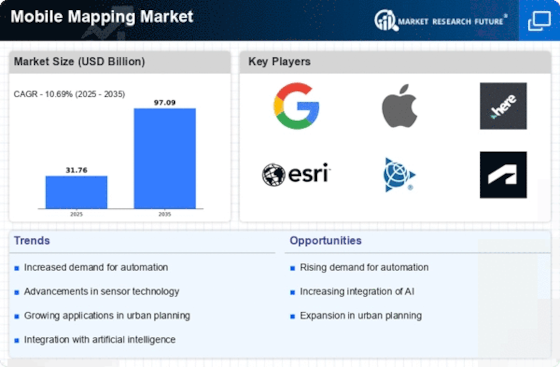
As per Market Research Future analysis, the Mobile Mapping Market Size was estimated at 31.76 USD Billion in 2024. The Mobile Mapping industry is projected to grow from USD 35.16 Billion in 2025 to USD 97.09 Billion by 2035, exhibiting a compound annual growth rate (CAGR) of 10.69% during the forecast period 2025 - 2035

Key Market Trends & Highlights

The Mobile Mapping Market is poised for substantial growth driven by technological advancements and increasing demand for real-time data.

  • North America remains the largest market for mobile mapping solutions, reflecting a robust demand across various sectors. The Asia-Pacific region is emerging as the fastest-growing market, fueled by rapid urbanization and smart city initiatives. In the hardware segment, mobile mapping technologies dominate, while the software segment is experiencing the fastest growth due to evolving applications. Key market drivers include technological advancements in mobile mapping and the rising demand for geographic information systems (GIS).

Market Size & Forecast

2024 Market Size 31.76 (USD Billion)
2035 Market Size 97.09 (USD Billion)
CAGR (2025 - 2035) 10.69%
Largest Regional Market Share in 2024 North America

Major Players

Google (US), Apple (US), HERE Technologies (NL), Esri (US), Trimble (US), Autodesk (US), Fugro (NL), RIEGL (AT), Leica Geosystems (CH)

Market Trends

The Mobile Mapping Market is currently experiencing a transformative phase, driven by advancements in technology and increasing demand for accurate geospatial data. The integration of high-resolution imaging, LiDAR, and GPS technologies has enhanced the capabilities of mobile mapping systems, allowing for more precise data collection and analysis. This evolution is not merely a trend but appears to be a fundamental shift in how geographic information is gathered and utilized across various sectors, including urban planning, transportation, and environmental monitoring. As organizations recognize the value of real-time data, the Mobile Mapping Market is likely to expand, fostering innovation and competition among key players.

Mobile mapping enables the rapid collection of geospatial data using vehicle-mounted sensors, transforming how location intelligence is generated across industries. The concept of mapping mobile platforms has gained attention as organizations seek flexible, real-time geospatial data collection methods. Mobile mapping applications are widely used in land surveying, infrastructure planning, urban development, and environmental monitoring. A mobile mapping system integrates GPS, LiDAR, cameras, and inertial sensors to capture accurate geospatial data in real time.

 Moreover, the growing emphasis on smart city initiatives and infrastructure development is propelling the adoption of mobile mapping solutions. Stakeholders are increasingly leveraging these technologies to improve decision-making processes and optimize resource allocation. The potential for mobile mapping to facilitate enhanced situational awareness and operational efficiency suggests that its relevance will continue to rise. As the market evolves, it may also witness the emergence of new applications and use cases, further solidifying its position as a critical component in the geospatial landscape. A mobile mapping survey allows rapid and cost-effective data collection for road networks, utilities, and urban infrastructure projects.

Growth in the automotive digital mapping market, particularly for autonomous and connected vehicles, is supporting demand for advanced mobile mapping solutions. Emerging mapping trends, including AI-driven data processing and real-time geospatial analytics, are reshaping the Mobile Mapping Market. Mobile mapping services are increasingly adopted by governments and enterprises to outsource large-scale geospatial data collection and analysis. Continuous innovation in mobile mapping technology, including LiDAR, AI, and cloud-based analytics, is improving data accuracy and operational efficiency.

Technological Advancements

The Mobile Mapping Market is witnessing rapid technological advancements that enhance data collection and processing capabilities. Innovations in sensor technology, such as LiDAR and high-resolution cameras, are enabling more accurate and detailed mapping solutions. These advancements are likely to improve the efficiency of various applications, from urban planning to disaster management.

Increased Demand for Real-Time Data

There is a growing demand for real-time data across multiple industries, which is influencing the Mobile Mapping Market. Organizations are increasingly seeking immediate access to geospatial information to support decision-making processes. This trend suggests that mobile mapping solutions will play a crucial role in providing timely insights for various applications.

Expansion of Smart City Initiatives

The rise of smart city initiatives is significantly impacting the Mobile Mapping Market. As cities strive to enhance infrastructure and improve quality of life, mobile mapping technologies are being integrated into urban planning and management. This trend indicates a shift towards more data-driven approaches in city development, potentially increasing the adoption of mobile mapping solutions.

Mobile Mapping Market Market Drivers

Expansion of Smart City Initiatives

The Mobile Mapping Market is significantly influenced by the expansion of smart city initiatives, which aim to enhance urban living through technology. As cities evolve into smart environments, the need for accurate mapping and spatial data becomes paramount. Mobile mapping solutions play a crucial role in the development and maintenance of smart infrastructure, including transportation systems, utilities, and public services. Recent statistics indicate that investments in smart city projects are expected to reach trillions of dollars in the coming years, creating substantial opportunities for mobile mapping providers. This trend underscores the importance of integrating mobile mapping technologies into urban planning and development strategies.

Increased Demand for Real-Time Data

The Mobile Mapping Market is witnessing a surge in demand for real-time data, driven by the need for timely and accurate information across various applications. Industries such as logistics, construction, and emergency response are increasingly adopting mobile mapping solutions to enhance operational efficiency and decision-making processes. The ability to capture and analyze data in real-time allows organizations to respond swiftly to changing conditions, thereby improving service delivery and resource management. Market data suggests that the demand for real-time mapping solutions is expected to rise significantly, with a projected increase in adoption rates among businesses seeking to leverage data for competitive advantage.

Technological Advancements in Mobile Mapping

The Mobile Mapping Market is experiencing rapid technological advancements that enhance data collection and processing capabilities. Innovations in LiDAR, photogrammetry, and GPS technologies are driving the development of more accurate and efficient mapping solutions. For instance, the integration of artificial intelligence and machine learning algorithms into mobile mapping systems allows for real-time data analysis and improved decision-making. According to recent data, the market for mobile mapping systems is projected to grow at a compound annual growth rate of over 15% through 2026. This growth is indicative of the increasing reliance on advanced technologies to meet the demands of various sectors, including transportation, urban planning, and environmental monitoring.

Growing Adoption in Transportation and Logistics

The Mobile Mapping Market is experiencing growing adoption within the transportation and logistics sectors, where accurate mapping is essential for operational efficiency. Companies are increasingly utilizing mobile mapping technologies to optimize routes, monitor fleet performance, and enhance supply chain management. The integration of mobile mapping solutions allows for better visibility and tracking of assets, which is crucial in a highly competitive market. Data indicates that the transportation sector is one of the largest consumers of mobile mapping services, with a projected market share of over 30% by 2026. This trend highlights the critical role of mobile mapping in driving innovation and efficiency in logistics operations.

Rising Demand for Geographic Information Systems (GIS)

The Mobile Mapping Market is witnessing a rising demand for Geographic Information Systems (GIS), which are integral to various applications, including urban planning, environmental management, and disaster response. The synergy between mobile mapping technologies and GIS enhances the ability to visualize and analyze spatial data effectively. As organizations increasingly recognize the value of geospatial data, the demand for mobile mapping solutions that integrate seamlessly with GIS platforms is expected to grow. Market analysis suggests that the GIS market is projected to expand significantly, with mobile mapping playing a pivotal role in providing accurate and timely data for informed decision-making across multiple sectors.

Market Segment Insights

By Component: Hardware (Largest) vs. Software (Fastest-Growing)

In the Mobile Mapping Market, the component segment is primarily dominated by Hardware, which holds the largest share in this sector. Hardware includes essential elements such as GPS devices, sensors, and cameras that are critical for effective mapping solutions. This segment's extensive presence is attributed to the increasing demand for accurate and reliable mapping technologies in various industries. Meanwhile, Software has emerged as the fastest-growing component, reflecting the burgeoning need for advanced applications that can leverage the data captured by hardware. As mobile mapping technology evolves, software solutions are gaining significance for their ability to enhance user experience and integrate with existing infrastructures.

Hardware (Dominant) vs. Software (Emerging)

The hardware segment in the Mobile Mapping Market is characterized by established technologies such as GPS and LiDAR systems that provide the backbone for mapping activities. These devices are essential for delivering high-precision data, making them indispensable in sectors like construction, transportation, and urban planning. In contrast, the software segment is emerging as a vital driver of innovation, focusing on applications that improve data usability and analytics. Software solutions are increasingly being tailored to specific industries, offering capabilities like real-time data processing and interactive mapping interfaces. Together, these segments illustrate the synergistic relationship between hardware and software, where advancements in one drive progress in the other.

By Solution: Location-Based (Largest) vs. Indoor Mapping (Fastest-Growing)

In the Mobile Mapping Market, the Location-Based solutions are the largest segment, commanding a significant share due to their extensive applications in logistics and navigation. Indoor Mapping is emerging as the fastest-growing segment, driven by the increasing demand for accurate indoor navigation services in complexes like shopping malls and airports. The presence of advanced technologies like geo-tagging and GPS integration further enhances the relevance of these solutions in various sectors.

Location-Based (Dominant) vs. Indoor Mapping (Emerging)

Location-Based services have established dominance in the Mobile Mapping Market owing to their broad applicability across multiple industries including transportation, real estate, and emergency services. These services leverage GPS and other technologies to offer real-time location data, making them essential for many businesses. On the other hand, Indoor Mapping is recognized as an emerging segment focused on providing mapping solutions within enclosed spaces, which is increasingly crucial with the expansion of smart buildings. Enhanced customer experiences and improved operational efficiency are driving innovative applications in this area, positioning Indoor Mapping for rapid growth in the coming years.

By Application: Land Surveys (Largest) vs. Aerial Surveys (Fastest-Growing)

In the Mobile Mapping Market, the application of Land Surveys is the largest segment, capturing a significant share of the overall market. This has been largely driven by the increasing demand for precise data collection in construction and civil engineering projects. Aerial Surveys are rapidly gaining traction, thanks to advancements in drone technology which allow for efficient and cost-effective data acquisition from above, redefining traditional surveying methods.

Surveys: Land (Dominant) vs. Aerial (Emerging)

Land Surveys dominate the Mobile Mapping Market due to their established methodologies and wide applicability in various engineering and environmental projects. Utilizing technologies like GPS and terrestrial laser scanning, Land Surveys provide accurate terrain mapping and topographical data, which are essential for infrastructure development. On the other hand, Aerial Surveys are emerging as a crucial tool in this market due to the proliferation of UAV (drone) technology, which enables rapid data capture over large areas. This shift not only reduces time and labor costs but also enhances the scope of survey exploration, making aerial methods increasingly preferred in various sectors.

By End User: Real Estate & Construction (Largest) vs. IT & Telecom (Fastest-Growing)

The Mobile Mapping Market shares its focus among several end users, with Real Estate and Construction leading due to heightened demand for precision in surveying and infrastructure development. This segment capitalizes on mobile mapping technologies to enhance project planning and execution, thereby establishing its significant market presence. Meanwhile, the IT and Telecom sectors are also crucial end users, leveraging mobile mapping solutions for network planning, asset management, and service enhancement, contributing to a robust market composition.

Real Estate &amp; Construction: Dominant vs. IT &amp; Telecom: Emerging

The Real Estate and Construction sector stands as the dominant end user in the Mobile Mapping Market, driven by a continual need for high-accuracy data in land surveying, urban planning, and construction management. Companies in this sector are increasingly utilizing mobile mapping systems equipped with high-definition cameras and LiDAR to streamline workflows and improve project outcomes. On the other hand, the IT and Telecom segment represents an emerging market force, utilizing mobile mapping to enhance network deployments, optimize infrastructure, and provide geographic insights for improving service delivery. As this segment grows, it shows significant potential for innovative applications and market expansion in the future.

Get more detailed insights about Mobile Mapping Market Research Report - Global Forecast till 2035

Regional Insights

North America : Technological Innovation Leader

North America is the largest market for mobile mapping, holding approximately 45% of the global share. The region's growth is driven by advancements in technology, increasing demand for accurate mapping solutions, and supportive regulatory frameworks. The U.S. government has been investing in infrastructure projects that require precise mapping, further fueling market expansion. Additionally, the rise of autonomous vehicles and smart city initiatives are significant catalysts for growth. The United States is the leading country in this sector, with major players like Google, Apple, and Esri headquartered here. The competitive landscape is characterized by rapid innovation and collaboration among tech giants and startups. Canada also plays a vital role, contributing to the market with its focus on geographic information systems (GIS) and mobile mapping technologies. The presence of key players ensures a dynamic and competitive environment.

Europe : Emerging Market with Regulations

Europe is the second-largest market for mobile mapping, accounting for approximately 30% of the global share. The region's growth is propelled by stringent regulations aimed at improving urban planning and environmental monitoring. Countries like Germany and the Netherlands are leading the charge, with government initiatives promoting the use of mobile mapping for infrastructure development and smart city projects. The European Union's focus on digital transformation is also a significant driver of demand. Germany, the UK, and the Netherlands are at the forefront of mobile mapping technologies, with a strong presence of companies like HERE Technologies and Fugro. The competitive landscape is marked by collaborations between public and private sectors, enhancing the development of innovative solutions. The region's emphasis on sustainability and efficiency in urban planning further solidifies its position in the mobile mapping market.

Asia-Pacific : Rapid Growth and Adoption

Asia-Pacific is witnessing rapid growth in the mobile mapping market, holding approximately 20% of the global share. The region's expansion is driven by increasing urbanization, government investments in smart city initiatives, and the rising demand for accurate geographic data. Countries like China and Japan are leading the market, with significant advancements in technology and infrastructure development. Regulatory support for digital mapping solutions is also a key factor in this growth. China is the largest market in the region, with a strong focus on integrating mobile mapping into various sectors, including transportation and urban planning. Japan follows closely, emphasizing precision and innovation in mapping technologies. The competitive landscape features both established players and emerging startups, fostering a dynamic environment for growth and innovation in mobile mapping solutions.

Middle East and Africa : Untapped Potential and Growth

The Middle East and Africa region is gradually emerging in the mobile mapping market, currently holding about 5% of the global share. The growth is primarily driven by increasing investments in infrastructure and urban development projects. Countries like the UAE and South Africa are leading the way, with government initiatives aimed at enhancing geographic data collection and usage. The region's potential is further supported by the growing demand for smart city solutions and improved transportation systems. The UAE is at the forefront, leveraging mobile mapping technologies for urban planning and development. South Africa is also making strides, focusing on integrating mobile mapping into various sectors, including mining and agriculture. The competitive landscape is characterized by a mix of local and international players, creating opportunities for collaboration and innovation in the mobile mapping space.

Key Players and Competitive Insights

The Mobile Mapping Market is currently characterized by a dynamic competitive landscape, driven by technological advancements and increasing demand for geospatial data across various sectors. Key players such as Google (US), HERE Technologies (NL), and Trimble (US) are at the forefront, each adopting distinct strategies to enhance their market positioning. Google (US) continues to leverage its extensive data ecosystem, focusing on integrating AI and machine learning into its mapping solutions, thereby improving user experience and operational efficiency. HERE Technologies (NL), on the other hand, emphasizes partnerships with automotive manufacturers to enhance its mapping capabilities for autonomous vehicles, indicating a strategic pivot towards the burgeoning automotive sector. Trimble (US) appears to be concentrating on expanding its software solutions for construction and agriculture, which suggests a diversification strategy aimed at tapping into niche markets within the mobile mapping domain.The business tactics employed by these companies reflect a moderately fragmented market structure, where localized manufacturing and supply chain optimization are becoming increasingly vital. Companies are actively seeking to enhance their operational efficiencies while also addressing regional market needs. This competitive structure allows for a variety of players to coexist, each contributing to the overall growth of the mobile mapping ecosystem. The collective influence of these key players is shaping a landscape where innovation and strategic partnerships are paramount.
In August HERE Technologies (NL) announced a collaboration with a leading automotive manufacturer to integrate its mapping solutions into next-generation vehicles. This partnership is strategically significant as it positions HERE at the forefront of the autonomous driving revolution, potentially increasing its market share in the automotive sector. The integration of real-time mapping data into vehicles could enhance safety and navigation, thereby solidifying HERE's reputation as a leader in mobile mapping technology.
In September Trimble (US) launched a new suite of software tools designed specifically for the construction industry, aimed at improving project management and site efficiency. This move underscores Trimble's commitment to innovation and its focus on providing tailored solutions that meet the specific needs of its clients. By enhancing its software offerings, Trimble is likely to strengthen its competitive edge and attract a broader customer base within the construction sector.
In October Google (US) unveiled an upgraded version of its mapping platform, incorporating advanced AI features that enhance real-time data processing and user interaction. This development is indicative of Google's ongoing investment in technology and innovation, which may further entrench its position as a market leader. The emphasis on AI integration not only improves user experience but also aligns with broader trends in digital transformation across industries.
As of October the Mobile Mapping Market is witnessing trends that emphasize digitalization, sustainability, and the integration of artificial intelligence. Strategic alliances are increasingly shaping the competitive landscape, as companies recognize the value of collaboration in driving innovation. Looking ahead, it appears that competitive differentiation will evolve from traditional price-based competition to a focus on technological advancements, innovative solutions, and reliable supply chains. This shift may redefine how companies position themselves in the market, ultimately fostering a more resilient and adaptive mobile mapping ecosystem.

Key Companies in the Mobile Mapping Market include

Industry Developments

  • Q2 2024: Hexagon launches Leica Pegasus TRK100 mobile mapping solution Hexagon AB announced the launch of the Leica Pegasus TRK100, a new mobile mapping system designed for capturing geospatial data with enhanced efficiency and accuracy. The product is aimed at professionals in surveying, construction, and asset management.
  • Q1 2024: Trimble Introduces New Mobile Mapping Market System for Transportation Infrastructure Trimble unveiled a new mobile mapping system specifically designed for transportation infrastructure projects, offering improved data collection capabilities for road and rail asset management.
  • Q2 2024: Topcon Launches Next-Generation Mobile Mapping Market Platform Topcon Corporation announced the release of its next-generation mobile mapping platform, featuring advanced LiDAR and imaging technologies for enhanced geospatial data acquisition.
  • Q2 2024: Cyclomedia Expands Mobile Mapping Market Operations with New Facility in North America Cyclomedia Technology B.V. opened a new facility in North America to support its expanding mobile mapping operations and meet growing demand for high-resolution geospatial data services.
  • Q1 2024: Javad GNSS Announces Strategic Partnership with Geosystems for Mobile Mapping Market Solutions Javad GNSS Inc. entered into a strategic partnership with Geosystems to jointly develop and market advanced mobile mapping solutions targeting infrastructure and urban planning sectors.
  • Q2 2024: OpTech LLC Secures Major Contract for Mobile Mapping Market of State Highways OpTech LLC was awarded a significant contract to provide mobile mapping services for state highway infrastructure, focusing on asset inventory and condition assessment.
  • Q1 2024: Mitsubishi Corporation Invests in Mobile Mapping Market Startup for Smart City Applications Mitsubishi Corporation announced an investment in a mobile mapping startup to accelerate the development of smart city solutions leveraging advanced geospatial technologies.
  • Q2 2024: EveryScape Inc. Launches AI-Powered Mobile Mapping Market Platform EveryScape Inc. introduced a new AI-powered mobile mapping platform designed to automate geospatial data processing and improve mapping accuracy for urban environments.
  • Q1 2025: Hexagon AB Acquires Geospatial Startup to Enhance Mobile Mapping Market Capabilities Hexagon AB completed the acquisition of a geospatial technology startup to strengthen its mobile mapping product portfolio and accelerate innovation in 3D mapping solutions.
  • Q2 2025: Trimble Wins Contract for Mobile Mapping Market of National Rail Network Trimble Inc. secured a contract to provide mobile mapping services for a national rail network, supporting infrastructure monitoring and digital asset management.
  • Q1 2025: Topcon Corporation Appoints New Head of Mobile Mapping Market Division Topcon Corporation announced the appointment of a new executive to lead its mobile mapping division, aiming to drive growth and innovation in geospatial technologies.
  • Q2 2025: Cyclomedia Technology B.V. Partners with Municipalities for Urban Mobile Mapping Market Projects Cyclomedia Technology B.V. entered into partnerships with several municipalities to deliver urban mobile mapping projects focused on infrastructure planning and asset management.

Future Outlook

Mobile Mapping Market Future Outlook

The Mobile Mapping Market is poised for growth at a 10.69% CAGR from 2025 to 2035, driven by advancements in technology, increased demand for geospatial data, and urbanization.

New opportunities lie in:

  • <p>Integration of AI-driven analytics for enhanced data interpretation. Development of subscription-based mapping services for continuous revenue. Expansion into emerging markets with tailored mobile mapping solutions.</p>

By 2035, the Mobile Mapping Market is expected to achieve substantial growth, driven by innovation and strategic market positioning.

Market Segmentation

Mobile Mapping Market End User Outlook

  • Real Estate & Construction
  • IT & Telecom
  • Others

Mobile Mapping Market Solution Outlook

  • Location-Based
  • Indoor Mapping
  • Asset Management
  • 3D Mapping

Mobile Mapping Market Component Outlook

  • Hardware
  • Software
  • Services

Mobile Mapping Market Application Outlook

  • Land Surveys
  • Aerial Surveys

Report Scope

MARKET SIZE 2024 31.76(USD Billion)
MARKET SIZE 2025 35.16(USD Billion)
MARKET SIZE 2035 97.09(USD Billion)
COMPOUND ANNUAL GROWTH RATE (CAGR) 10.69% (2025 - 2035)
REPORT COVERAGE Revenue Forecast, Competitive Landscape, Growth Factors, and Trends
BASE YEAR 2024
Market Forecast Period 2025 - 2035
Historical Data 2019 - 2024
Market Forecast Units USD Billion
Key Companies Profiled Google (US), Apple (US), HERE Technologies (NL), Esri (US), Trimble (US), Autodesk (US), Fugro (NL), RIEGL (AT), Leica Geosystems (CH)
Segments Covered Component, Region
Key Market Opportunities Integration of artificial intelligence and machine learning enhances data accuracy in the Mobile Mapping Market.
Key Market Dynamics Technological advancements and regulatory changes drive innovation and competition in the Mobile Mapping Market.
Countries Covered North America, Europe, APAC, South America, MEA

FAQs

What is the current valuation of the Mobile Mapping Market as of 2024?

<p>The Mobile Mapping Market was valued at 31.76 USD Billion in 2024.</p>

What is the projected market size for the Mobile Mapping Market by 2035?

<p>The Mobile Mapping Market is projected to reach 97.09 USD Billion by 2035.</p>

What is the expected CAGR for the Mobile Mapping Market during the forecast period 2025 - 2035?

<p>The expected CAGR for the Mobile Mapping Market during the forecast period 2025 - 2035 is 10.69%.</p>

Which companies are considered key players in the Mobile Mapping Market?

<p>Key players in the Mobile Mapping Market include Google, Apple, HERE Technologies, Esri, Trimble, Autodesk, Fugro, RIEGL, and Leica Geosystems.</p>

What are the main components of the Mobile Mapping Market and their valuations?

<p>The main components include Hardware valued at 30.0 USD Billion, Software at 36.0 USD Billion, and Services at 31.09 USD Billion.</p>

What solutions are driving growth in the Mobile Mapping Market?

<p>Key solutions include Location-Based services valued at 25.0 USD Billion, Indoor Mapping at 20.0 USD Billion, Asset Management at 30.0 USD Billion, and 3D Mapping at 22.09 USD Billion.</p>

What applications are contributing to the Mobile Mapping Market's expansion?

The applications include Land Surveys valued at 37.0 USD Billion and Aerial Surveys at 60.09 USD Billion.

Which end-user segments are most prominent in the Mobile Mapping Market?

Prominent end-user segments include Real Estate &amp; Construction at 30.0 USD Billion, IT &amp; Telecom at 35.0 USD Billion, and Others at 32.09 USD Billion.

How does the Mobile Mapping Market's growth compare across different segments?

The Mobile Mapping Market shows varied growth, with Hardware and Software segments projected to grow significantly, reflecting the increasing demand for advanced mapping technologies.

What trends are influencing the Mobile Mapping Market in 2025?

In 2025, trends such as the integration of AI in mapping solutions and the rise of smart city initiatives appear to be influencing the Mobile Mapping Market.

  1. SECTION I: EXECUTIVE SUMMARY AND KEY HIGHLIGHTS
    1. | 1.1 EXECUTIVE SUMMARY
    2. | | 1.1.1 Market Overview
    3. | | 1.1.2 Key Findings
    4. | | 1.1.3 Market Segmentation
    5. | | 1.1.4 Competitive Landscape
    6. | | 1.1.5 Challenges and Opportunities
    7. | | 1.1.6 Future Outlook
  2. SECTION II: SCOPING, METHODOLOGY AND MARKET STRUCTURE
    1. | 2.1 MARKET INTRODUCTION
    2. | | 2.1.1 Definition
    3. | | 2.1.2 Scope of the study
    4. | | | 2.1.2.1 Research Objective
    5. | | | 2.1.2.2 Assumption
    6. | | | 2.1.2.3 Limitations
    7. | 2.2 RESEARCH METHODOLOGY
    8. | | 2.2.1 Overview
    9. | | 2.2.2 Data Mining
    10. | | 2.2.3 Secondary Research
    11. | | 2.2.4 Primary Research
    12. | | | 2.2.4.1 Primary Interviews and Information Gathering Process
    13. | | | 2.2.4.2 Breakdown of Primary Respondents
    14. | | 2.2.5 Forecasting Model
    15. | | 2.2.6 Market Size Estimation
    16. | | | 2.2.6.1 Bottom-Up Approach
    17. | | | 2.2.6.2 Top-Down Approach
    18. | | 2.2.7 Data Triangulation
    19. | | 2.2.8 Validation
  3. SECTION III: QUALITATIVE ANALYSIS
    1. | 3.1 MARKET DYNAMICS
    2. | | 3.1.1 Overview
    3. | | 3.1.2 Drivers
    4. | | 3.1.3 Restraints
    5. | | 3.1.4 Opportunities
    6. | 3.2 MARKET FACTOR ANALYSIS
    7. | | 3.2.1 Value chain Analysis
    8. | | 3.2.2 Porter's Five Forces Analysis
    9. | | | 3.2.2.1 Bargaining Power of Suppliers
    10. | | | 3.2.2.2 Bargaining Power of Buyers
    11. | | | 3.2.2.3 Threat of New Entrants
    12. | | | 3.2.2.4 Threat of Substitutes
    13. | | | 3.2.2.5 Intensity of Rivalry
    14. | | 3.2.3 COVID-19 Impact Analysis
    15. | | | 3.2.3.1 Market Impact Analysis
    16. | | | 3.2.3.2 Regional Impact
    17. | | | 3.2.3.3 Opportunity and Threat Analysis
  4. SECTION IV: QUANTITATIVE ANALYSIS
    1. | 4.1 Information and Communications Technology, BY Component (USD Billion)
    2. | | 4.1.1 Hardware
    3. | | 4.1.2 Software
    4. | | 4.1.3 Services
    5. | 4.2 Information and Communications Technology, BY Solution (USD Billion)
    6. | | 4.2.1 Location-Based
    7. | | 4.2.2 Indoor Mapping
    8. | | 4.2.3 Asset Management
    9. | | 4.2.4 3D Mapping
    10. | 4.3 Information and Communications Technology, BY Application (USD Billion)
    11. | | 4.3.1 Land Surveys
    12. | | 4.3.2 Aerial Surveys
    13. | 4.4 Information and Communications Technology, BY End User (USD Billion)
    14. | | 4.4.1 Real Estate & Construction
    15. | | 4.4.2 IT & Telecom
    16. | | 4.4.3 Others
    17. | 4.5 Information and Communications Technology, BY Region (USD Billion)
    18. | | 4.5.1 North America
    19. | | | 4.5.1.1 US
    20. | | | 4.5.1.2 Canada
    21. | | 4.5.2 Europe
    22. | | | 4.5.2.1 Germany
    23. | | | 4.5.2.2 UK
    24. | | | 4.5.2.3 France
    25. | | | 4.5.2.4 Russia
    26. | | | 4.5.2.5 Italy
    27. | | | 4.5.2.6 Spain
    28. | | | 4.5.2.7 Rest of Europe
    29. | | 4.5.3 APAC
    30. | | | 4.5.3.1 China
    31. | | | 4.5.3.2 India
    32. | | | 4.5.3.3 Japan
    33. | | | 4.5.3.4 South Korea
    34. | | | 4.5.3.5 Malaysia
    35. | | | 4.5.3.6 Thailand
    36. | | | 4.5.3.7 Indonesia
    37. | | | 4.5.3.8 Rest of APAC
    38. | | 4.5.4 South America
    39. | | | 4.5.4.1 Brazil
    40. | | | 4.5.4.2 Mexico
    41. | | | 4.5.4.3 Argentina
    42. | | | 4.5.4.4 Rest of South America
    43. | | 4.5.5 MEA
    44. | | | 4.5.5.1 GCC Countries
    45. | | | 4.5.5.2 South Africa
    46. | | | 4.5.5.3 Rest of MEA
  5. SECTION V: COMPETITIVE ANALYSIS
    1. | 5.1 Competitive Landscape
    2. | | 5.1.1 Overview
    3. | | 5.1.2 Competitive Analysis
    4. | | 5.1.3 Market share Analysis
    5. | | 5.1.4 Major Growth Strategy in the Information and Communications Technology
    6. | | 5.1.5 Competitive Benchmarking
    7. | | 5.1.6 Leading Players in Terms of Number of Developments in the Information and Communications Technology
    8. | | 5.1.7 Key developments and growth strategies
    9. | | | 5.1.7.1 New Product Launch/Service Deployment
    10. | | | 5.1.7.2 Merger & Acquisitions
    11. | | | 5.1.7.3 Joint Ventures
    12. | | 5.1.8 Major Players Financial Matrix
    13. | | | 5.1.8.1 Sales and Operating Income
    14. | | | 5.1.8.2 Major Players R&D Expenditure. 2023
    15. | 5.2 Company Profiles
    16. | | 5.2.1 Google (US)
    17. | | | 5.2.1.1 Financial Overview
    18. | | | 5.2.1.2 Products Offered
    19. | | | 5.2.1.3 Key Developments
    20. | | | 5.2.1.4 SWOT Analysis
    21. | | | 5.2.1.5 Key Strategies
    22. | | 5.2.2 Apple (US)
    23. | | | 5.2.2.1 Financial Overview
    24. | | | 5.2.2.2 Products Offered
    25. | | | 5.2.2.3 Key Developments
    26. | | | 5.2.2.4 SWOT Analysis
    27. | | | 5.2.2.5 Key Strategies
    28. | | 5.2.3 HERE Technologies (NL)
    29. | | | 5.2.3.1 Financial Overview
    30. | | | 5.2.3.2 Products Offered
    31. | | | 5.2.3.3 Key Developments
    32. | | | 5.2.3.4 SWOT Analysis
    33. | | | 5.2.3.5 Key Strategies
    34. | | 5.2.4 Esri (US)
    35. | | | 5.2.4.1 Financial Overview
    36. | | | 5.2.4.2 Products Offered
    37. | | | 5.2.4.3 Key Developments
    38. | | | 5.2.4.4 SWOT Analysis
    39. | | | 5.2.4.5 Key Strategies
    40. | | 5.2.5 Trimble (US)
    41. | | | 5.2.5.1 Financial Overview
    42. | | | 5.2.5.2 Products Offered
    43. | | | 5.2.5.3 Key Developments
    44. | | | 5.2.5.4 SWOT Analysis
    45. | | | 5.2.5.5 Key Strategies
    46. | | 5.2.6 Autodesk (US)
    47. | | | 5.2.6.1 Financial Overview
    48. | | | 5.2.6.2 Products Offered
    49. | | | 5.2.6.3 Key Developments
    50. | | | 5.2.6.4 SWOT Analysis
    51. | | | 5.2.6.5 Key Strategies
    52. | | 5.2.7 Fugro (NL)
    53. | | | 5.2.7.1 Financial Overview
    54. | | | 5.2.7.2 Products Offered
    55. | | | 5.2.7.3 Key Developments
    56. | | | 5.2.7.4 SWOT Analysis
    57. | | | 5.2.7.5 Key Strategies
    58. | | 5.2.8 RIEGL (AT)
    59. | | | 5.2.8.1 Financial Overview
    60. | | | 5.2.8.2 Products Offered
    61. | | | 5.2.8.3 Key Developments
    62. | | | 5.2.8.4 SWOT Analysis
    63. | | | 5.2.8.5 Key Strategies
    64. | | 5.2.9 Leica Geosystems (CH)
    65. | | | 5.2.9.1 Financial Overview
    66. | | | 5.2.9.2 Products Offered
    67. | | | 5.2.9.3 Key Developments
    68. | | | 5.2.9.4 SWOT Analysis
    69. | | | 5.2.9.5 Key Strategies
    70. | 5.3 Appendix
    71. | | 5.3.1 References
    72. | | 5.3.2 Related Reports
  6. LIST OF FIGURES
    1. | 6.1 MARKET SYNOPSIS
    2. | 6.2 NORTH AMERICA MARKET ANALYSIS
    3. | 6.3 US MARKET ANALYSIS BY COMPONENT
    4. | 6.4 US MARKET ANALYSIS BY SOLUTION
    5. | 6.5 US MARKET ANALYSIS BY APPLICATION
    6. | 6.6 US MARKET ANALYSIS BY END USER
    7. | 6.7 CANADA MARKET ANALYSIS BY COMPONENT
    8. | 6.8 CANADA MARKET ANALYSIS BY SOLUTION
    9. | 6.9 CANADA MARKET ANALYSIS BY APPLICATION
    10. | 6.10 CANADA MARKET ANALYSIS BY END USER
    11. | 6.11 EUROPE MARKET ANALYSIS
    12. | 6.12 GERMANY MARKET ANALYSIS BY COMPONENT
    13. | 6.13 GERMANY MARKET ANALYSIS BY SOLUTION
    14. | 6.14 GERMANY MARKET ANALYSIS BY APPLICATION
    15. | 6.15 GERMANY MARKET ANALYSIS BY END USER
    16. | 6.16 UK MARKET ANALYSIS BY COMPONENT
    17. | 6.17 UK MARKET ANALYSIS BY SOLUTION
    18. | 6.18 UK MARKET ANALYSIS BY APPLICATION
    19. | 6.19 UK MARKET ANALYSIS BY END USER
    20. | 6.20 FRANCE MARKET ANALYSIS BY COMPONENT
    21. | 6.21 FRANCE MARKET ANALYSIS BY SOLUTION
    22. | 6.22 FRANCE MARKET ANALYSIS BY APPLICATION
    23. | 6.23 FRANCE MARKET ANALYSIS BY END USER
    24. | 6.24 RUSSIA MARKET ANALYSIS BY COMPONENT
    25. | 6.25 RUSSIA MARKET ANALYSIS BY SOLUTION
    26. | 6.26 RUSSIA MARKET ANALYSIS BY APPLICATION
    27. | 6.27 RUSSIA MARKET ANALYSIS BY END USER
    28. | 6.28 ITALY MARKET ANALYSIS BY COMPONENT
    29. | 6.29 ITALY MARKET ANALYSIS BY SOLUTION
    30. | 6.30 ITALY MARKET ANALYSIS BY APPLICATION
    31. | 6.31 ITALY MARKET ANALYSIS BY END USER
    32. | 6.32 SPAIN MARKET ANALYSIS BY COMPONENT
    33. | 6.33 SPAIN MARKET ANALYSIS BY SOLUTION
    34. | 6.34 SPAIN MARKET ANALYSIS BY APPLICATION
    35. | 6.35 SPAIN MARKET ANALYSIS BY END USER
    36. | 6.36 REST OF EUROPE MARKET ANALYSIS BY COMPONENT
    37. | 6.37 REST OF EUROPE MARKET ANALYSIS BY SOLUTION
    38. | 6.38 REST OF EUROPE MARKET ANALYSIS BY APPLICATION
    39. | 6.39 REST OF EUROPE MARKET ANALYSIS BY END USER
    40. | 6.40 APAC MARKET ANALYSIS
    41. | 6.41 CHINA MARKET ANALYSIS BY COMPONENT
    42. | 6.42 CHINA MARKET ANALYSIS BY SOLUTION
    43. | 6.43 CHINA MARKET ANALYSIS BY APPLICATION
    44. | 6.44 CHINA MARKET ANALYSIS BY END USER
    45. | 6.45 INDIA MARKET ANALYSIS BY COMPONENT
    46. | 6.46 INDIA MARKET ANALYSIS BY SOLUTION
    47. | 6.47 INDIA MARKET ANALYSIS BY APPLICATION
    48. | 6.48 INDIA MARKET ANALYSIS BY END USER
    49. | 6.49 JAPAN MARKET ANALYSIS BY COMPONENT
    50. | 6.50 JAPAN MARKET ANALYSIS BY SOLUTION
    51. | 6.51 JAPAN MARKET ANALYSIS BY APPLICATION
    52. | 6.52 JAPAN MARKET ANALYSIS BY END USER
    53. | 6.53 SOUTH KOREA MARKET ANALYSIS BY COMPONENT
    54. | 6.54 SOUTH KOREA MARKET ANALYSIS BY SOLUTION
    55. | 6.55 SOUTH KOREA MARKET ANALYSIS BY APPLICATION
    56. | 6.56 SOUTH KOREA MARKET ANALYSIS BY END USER
    57. | 6.57 MALAYSIA MARKET ANALYSIS BY COMPONENT
    58. | 6.58 MALAYSIA MARKET ANALYSIS BY SOLUTION
    59. | 6.59 MALAYSIA MARKET ANALYSIS BY APPLICATION
    60. | 6.60 MALAYSIA MARKET ANALYSIS BY END USER
    61. | 6.61 THAILAND MARKET ANALYSIS BY COMPONENT
    62. | 6.62 THAILAND MARKET ANALYSIS BY SOLUTION
    63. | 6.63 THAILAND MARKET ANALYSIS BY APPLICATION
    64. | 6.64 THAILAND MARKET ANALYSIS BY END USER
    65. | 6.65 INDONESIA MARKET ANALYSIS BY COMPONENT
    66. | 6.66 INDONESIA MARKET ANALYSIS BY SOLUTION
    67. | 6.67 INDONESIA MARKET ANALYSIS BY APPLICATION
    68. | 6.68 INDONESIA MARKET ANALYSIS BY END USER
    69. | 6.69 REST OF APAC MARKET ANALYSIS BY COMPONENT
    70. | 6.70 REST OF APAC MARKET ANALYSIS BY SOLUTION
    71. | 6.71 REST OF APAC MARKET ANALYSIS BY APPLICATION
    72. | 6.72 REST OF APAC MARKET ANALYSIS BY END USER
    73. | 6.73 SOUTH AMERICA MARKET ANALYSIS
    74. | 6.74 BRAZIL MARKET ANALYSIS BY COMPONENT
    75. | 6.75 BRAZIL MARKET ANALYSIS BY SOLUTION
    76. | 6.76 BRAZIL MARKET ANALYSIS BY APPLICATION
    77. | 6.77 BRAZIL MARKET ANALYSIS BY END USER
    78. | 6.78 MEXICO MARKET ANALYSIS BY COMPONENT
    79. | 6.79 MEXICO MARKET ANALYSIS BY SOLUTION
    80. | 6.80 MEXICO MARKET ANALYSIS BY APPLICATION
    81. | 6.81 MEXICO MARKET ANALYSIS BY END USER
    82. | 6.82 ARGENTINA MARKET ANALYSIS BY COMPONENT
    83. | 6.83 ARGENTINA MARKET ANALYSIS BY SOLUTION
    84. | 6.84 ARGENTINA MARKET ANALYSIS BY APPLICATION
    85. | 6.85 ARGENTINA MARKET ANALYSIS BY END USER
    86. | 6.86 REST OF SOUTH AMERICA MARKET ANALYSIS BY COMPONENT
    87. | 6.87 REST OF SOUTH AMERICA MARKET ANALYSIS BY SOLUTION
    88. | 6.88 REST OF SOUTH AMERICA MARKET ANALYSIS BY APPLICATION
    89. | 6.89 REST OF SOUTH AMERICA MARKET ANALYSIS BY END USER
    90. | 6.90 MEA MARKET ANALYSIS
    91. | 6.91 GCC COUNTRIES MARKET ANALYSIS BY COMPONENT
    92. | 6.92 GCC COUNTRIES MARKET ANALYSIS BY SOLUTION
    93. | 6.93 GCC COUNTRIES MARKET ANALYSIS BY APPLICATION
    94. | 6.94 GCC COUNTRIES MARKET ANALYSIS BY END USER
    95. | 6.95 SOUTH AFRICA MARKET ANALYSIS BY COMPONENT
    96. | 6.96 SOUTH AFRICA MARKET ANALYSIS BY SOLUTION
    97. | 6.97 SOUTH AFRICA MARKET ANALYSIS BY APPLICATION
    98. | 6.98 SOUTH AFRICA MARKET ANALYSIS BY END USER
    99. | 6.99 REST OF MEA MARKET ANALYSIS BY COMPONENT
    100. | 6.100 REST OF MEA MARKET ANALYSIS BY SOLUTION
    101. | 6.101 REST OF MEA MARKET ANALYSIS BY APPLICATION
    102. | 6.102 REST OF MEA MARKET ANALYSIS BY END USER
    103. | 6.103 KEY BUYING CRITERIA OF INFORMATION AND COMMUNICATIONS TECHNOLOGY
    104. | 6.104 RESEARCH PROCESS OF MRFR
    105. | 6.105 DRO ANALYSIS OF INFORMATION AND COMMUNICATIONS TECHNOLOGY
    106. | 6.106 DRIVERS IMPACT ANALYSIS: INFORMATION AND COMMUNICATIONS TECHNOLOGY
    107. | 6.107 RESTRAINTS IMPACT ANALYSIS: INFORMATION AND COMMUNICATIONS TECHNOLOGY
    108. | 6.108 SUPPLY / VALUE CHAIN: INFORMATION AND COMMUNICATIONS TECHNOLOGY
    109. | 6.109 INFORMATION AND COMMUNICATIONS TECHNOLOGY, BY COMPONENT, 2024 (% SHARE)
    110. | 6.110 INFORMATION AND COMMUNICATIONS TECHNOLOGY, BY COMPONENT, 2024 TO 2035 (USD Billion)
    111. | 6.111 INFORMATION AND COMMUNICATIONS TECHNOLOGY, BY SOLUTION, 2024 (% SHARE)
    112. | 6.112 INFORMATION AND COMMUNICATIONS TECHNOLOGY, BY SOLUTION, 2024 TO 2035 (USD Billion)
    113. | 6.113 INFORMATION AND COMMUNICATIONS TECHNOLOGY, BY APPLICATION, 2024 (% SHARE)
    114. | 6.114 INFORMATION AND COMMUNICATIONS TECHNOLOGY, BY APPLICATION, 2024 TO 2035 (USD Billion)
    115. | 6.115 INFORMATION AND COMMUNICATIONS TECHNOLOGY, BY END USER, 2024 (% SHARE)
    116. | 6.116 INFORMATION AND COMMUNICATIONS TECHNOLOGY, BY END USER, 2024 TO 2035 (USD Billion)
    117. | 6.117 BENCHMARKING OF MAJOR COMPETITORS
  7. LIST OF TABLES
    1. | 7.1 LIST OF ASSUMPTIONS
    2. | | 7.1.1
    3. | 7.2 North America MARKET SIZE ESTIMATES; FORECAST
    4. | | 7.2.1 BY COMPONENT, 2025-2035 (USD Billion)
    5. | | 7.2.2 BY SOLUTION, 2025-2035 (USD Billion)
    6. | | 7.2.3 BY APPLICATION, 2025-2035 (USD Billion)
    7. | | 7.2.4 BY END USER, 2025-2035 (USD Billion)
    8. | 7.3 US MARKET SIZE ESTIMATES; FORECAST
    9. | | 7.3.1 BY COMPONENT, 2025-2035 (USD Billion)
    10. | | 7.3.2 BY SOLUTION, 2025-2035 (USD Billion)
    11. | | 7.3.3 BY APPLICATION, 2025-2035 (USD Billion)
    12. | | 7.3.4 BY END USER, 2025-2035 (USD Billion)
    13. | 7.4 Canada MARKET SIZE ESTIMATES; FORECAST
    14. | | 7.4.1 BY COMPONENT, 2025-2035 (USD Billion)
    15. | | 7.4.2 BY SOLUTION, 2025-2035 (USD Billion)
    16. | | 7.4.3 BY APPLICATION, 2025-2035 (USD Billion)
    17. | | 7.4.4 BY END USER, 2025-2035 (USD Billion)
    18. | 7.5 Europe MARKET SIZE ESTIMATES; FORECAST
    19. | | 7.5.1 BY COMPONENT, 2025-2035 (USD Billion)
    20. | | 7.5.2 BY SOLUTION, 2025-2035 (USD Billion)
    21. | | 7.5.3 BY APPLICATION, 2025-2035 (USD Billion)
    22. | | 7.5.4 BY END USER, 2025-2035 (USD Billion)
    23. | 7.6 Germany MARKET SIZE ESTIMATES; FORECAST
    24. | | 7.6.1 BY COMPONENT, 2025-2035 (USD Billion)
    25. | | 7.6.2 BY SOLUTION, 2025-2035 (USD Billion)
    26. | | 7.6.3 BY APPLICATION, 2025-2035 (USD Billion)
    27. | | 7.6.4 BY END USER, 2025-2035 (USD Billion)
    28. | 7.7 UK MARKET SIZE ESTIMATES; FORECAST
    29. | | 7.7.1 BY COMPONENT, 2025-2035 (USD Billion)
    30. | | 7.7.2 BY SOLUTION, 2025-2035 (USD Billion)
    31. | | 7.7.3 BY APPLICATION, 2025-2035 (USD Billion)
    32. | | 7.7.4 BY END USER, 2025-2035 (USD Billion)
    33. | 7.8 France MARKET SIZE ESTIMATES; FORECAST
    34. | | 7.8.1 BY COMPONENT, 2025-2035 (USD Billion)
    35. | | 7.8.2 BY SOLUTION, 2025-2035 (USD Billion)
    36. | | 7.8.3 BY APPLICATION, 2025-2035 (USD Billion)
    37. | | 7.8.4 BY END USER, 2025-2035 (USD Billion)
    38. | 7.9 Russia MARKET SIZE ESTIMATES; FORECAST
    39. | | 7.9.1 BY COMPONENT, 2025-2035 (USD Billion)
    40. | | 7.9.2 BY SOLUTION, 2025-2035 (USD Billion)
    41. | | 7.9.3 BY APPLICATION, 2025-2035 (USD Billion)
    42. | | 7.9.4 BY END USER, 2025-2035 (USD Billion)
    43. | 7.10 Italy MARKET SIZE ESTIMATES; FORECAST
    44. | | 7.10.1 BY COMPONENT, 2025-2035 (USD Billion)
    45. | | 7.10.2 BY SOLUTION, 2025-2035 (USD Billion)
    46. | | 7.10.3 BY APPLICATION, 2025-2035 (USD Billion)
    47. | | 7.10.4 BY END USER, 2025-2035 (USD Billion)
    48. | 7.11 Spain MARKET SIZE ESTIMATES; FORECAST
    49. | | 7.11.1 BY COMPONENT, 2025-2035 (USD Billion)
    50. | | 7.11.2 BY SOLUTION, 2025-2035 (USD Billion)
    51. | | 7.11.3 BY APPLICATION, 2025-2035 (USD Billion)
    52. | | 7.11.4 BY END USER, 2025-2035 (USD Billion)
    53. | 7.12 Rest of Europe MARKET SIZE ESTIMATES; FORECAST
    54. | | 7.12.1 BY COMPONENT, 2025-2035 (USD Billion)
    55. | | 7.12.2 BY SOLUTION, 2025-2035 (USD Billion)
    56. | | 7.12.3 BY APPLICATION, 2025-2035 (USD Billion)
    57. | | 7.12.4 BY END USER, 2025-2035 (USD Billion)
    58. | 7.13 APAC MARKET SIZE ESTIMATES; FORECAST
    59. | | 7.13.1 BY COMPONENT, 2025-2035 (USD Billion)
    60. | | 7.13.2 BY SOLUTION, 2025-2035 (USD Billion)
    61. | | 7.13.3 BY APPLICATION, 2025-2035 (USD Billion)
    62. | | 7.13.4 BY END USER, 2025-2035 (USD Billion)
    63. | 7.14 China MARKET SIZE ESTIMATES; FORECAST
    64. | | 7.14.1 BY COMPONENT, 2025-2035 (USD Billion)
    65. | | 7.14.2 BY SOLUTION, 2025-2035 (USD Billion)
    66. | | 7.14.3 BY APPLICATION, 2025-2035 (USD Billion)
    67. | | 7.14.4 BY END USER, 2025-2035 (USD Billion)
    68. | 7.15 India MARKET SIZE ESTIMATES; FORECAST
    69. | | 7.15.1 BY COMPONENT, 2025-2035 (USD Billion)
    70. | | 7.15.2 BY SOLUTION, 2025-2035 (USD Billion)
    71. | | 7.15.3 BY APPLICATION, 2025-2035 (USD Billion)
    72. | | 7.15.4 BY END USER, 2025-2035 (USD Billion)
    73. | 7.16 Japan MARKET SIZE ESTIMATES; FORECAST
    74. | | 7.16.1 BY COMPONENT, 2025-2035 (USD Billion)
    75. | | 7.16.2 BY SOLUTION, 2025-2035 (USD Billion)
    76. | | 7.16.3 BY APPLICATION, 2025-2035 (USD Billion)
    77. | | 7.16.4 BY END USER, 2025-2035 (USD Billion)
    78. | 7.17 South Korea MARKET SIZE ESTIMATES; FORECAST
    79. | | 7.17.1 BY COMPONENT, 2025-2035 (USD Billion)
    80. | | 7.17.2 BY SOLUTION, 2025-2035 (USD Billion)
    81. | | 7.17.3 BY APPLICATION, 2025-2035 (USD Billion)
    82. | | 7.17.4 BY END USER, 2025-2035 (USD Billion)
    83. | 7.18 Malaysia MARKET SIZE ESTIMATES; FORECAST
    84. | | 7.18.1 BY COMPONENT, 2025-2035 (USD Billion)
    85. | | 7.18.2 BY SOLUTION, 2025-2035 (USD Billion)
    86. | | 7.18.3 BY APPLICATION, 2025-2035 (USD Billion)
    87. | | 7.18.4 BY END USER, 2025-2035 (USD Billion)
    88. | 7.19 Thailand MARKET SIZE ESTIMATES; FORECAST
    89. | | 7.19.1 BY COMPONENT, 2025-2035 (USD Billion)
    90. | | 7.19.2 BY SOLUTION, 2025-2035 (USD Billion)
    91. | | 7.19.3 BY APPLICATION, 2025-2035 (USD Billion)
    92. | | 7.19.4 BY END USER, 2025-2035 (USD Billion)
    93. | 7.20 Indonesia MARKET SIZE ESTIMATES; FORECAST
    94. | | 7.20.1 BY COMPONENT, 2025-2035 (USD Billion)
    95. | | 7.20.2 BY SOLUTION, 2025-2035 (USD Billion)
    96. | | 7.20.3 BY APPLICATION, 2025-2035 (USD Billion)
    97. | | 7.20.4 BY END USER, 2025-2035 (USD Billion)
    98. | 7.21 Rest of APAC MARKET SIZE ESTIMATES; FORECAST
    99. | | 7.21.1 BY COMPONENT, 2025-2035 (USD Billion)
    100. | | 7.21.2 BY SOLUTION, 2025-2035 (USD Billion)
    101. | | 7.21.3 BY APPLICATION, 2025-2035 (USD Billion)
    102. | | 7.21.4 BY END USER, 2025-2035 (USD Billion)
    103. | 7.22 South America MARKET SIZE ESTIMATES; FORECAST
    104. | | 7.22.1 BY COMPONENT, 2025-2035 (USD Billion)
    105. | | 7.22.2 BY SOLUTION, 2025-2035 (USD Billion)
    106. | | 7.22.3 BY APPLICATION, 2025-2035 (USD Billion)
    107. | | 7.22.4 BY END USER, 2025-2035 (USD Billion)
    108. | 7.23 Brazil MARKET SIZE ESTIMATES; FORECAST
    109. | | 7.23.1 BY COMPONENT, 2025-2035 (USD Billion)
    110. | | 7.23.2 BY SOLUTION, 2025-2035 (USD Billion)
    111. | | 7.23.3 BY APPLICATION, 2025-2035 (USD Billion)
    112. | | 7.23.4 BY END USER, 2025-2035 (USD Billion)
    113. | 7.24 Mexico MARKET SIZE ESTIMATES; FORECAST
    114. | | 7.24.1 BY COMPONENT, 2025-2035 (USD Billion)
    115. | | 7.24.2 BY SOLUTION, 2025-2035 (USD Billion)
    116. | | 7.24.3 BY APPLICATION, 2025-2035 (USD Billion)
    117. | | 7.24.4 BY END USER, 2025-2035 (USD Billion)
    118. | 7.25 Argentina MARKET SIZE ESTIMATES; FORECAST
    119. | | 7.25.1 BY COMPONENT, 2025-2035 (USD Billion)
    120. | | 7.25.2 BY SOLUTION, 2025-2035 (USD Billion)
    121. | | 7.25.3 BY APPLICATION, 2025-2035 (USD Billion)
    122. | | 7.25.4 BY END USER, 2025-2035 (USD Billion)
    123. | 7.26 Rest of South America MARKET SIZE ESTIMATES; FORECAST
    124. | | 7.26.1 BY COMPONENT, 2025-2035 (USD Billion)
    125. | | 7.26.2 BY SOLUTION, 2025-2035 (USD Billion)
    126. | | 7.26.3 BY APPLICATION, 2025-2035 (USD Billion)
    127. | | 7.26.4 BY END USER, 2025-2035 (USD Billion)
    128. | 7.27 MEA MARKET SIZE ESTIMATES; FORECAST
    129. | | 7.27.1 BY COMPONENT, 2025-2035 (USD Billion)
    130. | | 7.27.2 BY SOLUTION, 2025-2035 (USD Billion)
    131. | | 7.27.3 BY APPLICATION, 2025-2035 (USD Billion)
    132. | | 7.27.4 BY END USER, 2025-2035 (USD Billion)
    133. | 7.28 GCC Countries MARKET SIZE ESTIMATES; FORECAST
    134. | | 7.28.1 BY COMPONENT, 2025-2035 (USD Billion)
    135. | | 7.28.2 BY SOLUTION, 2025-2035 (USD Billion)
    136. | | 7.28.3 BY APPLICATION, 2025-2035 (USD Billion)
    137. | | 7.28.4 BY END USER, 2025-2035 (USD Billion)
    138. | 7.29 South Africa MARKET SIZE ESTIMATES; FORECAST
    139. | | 7.29.1 BY COMPONENT, 2025-2035 (USD Billion)
    140. | | 7.29.2 BY SOLUTION, 2025-2035 (USD Billion)
    141. | | 7.29.3 BY APPLICATION, 2025-2035 (USD Billion)
    142. | | 7.29.4 BY END USER, 2025-2035 (USD Billion)
    143. | 7.30 Rest of MEA MARKET SIZE ESTIMATES; FORECAST
    144. | | 7.30.1 BY COMPONENT, 2025-2035 (USD Billion)
    145. | | 7.30.2 BY SOLUTION, 2025-2035 (USD Billion)
    146. | | 7.30.3 BY APPLICATION, 2025-2035 (USD Billion)
    147. | | 7.30.4 BY END USER, 2025-2035 (USD Billion)
    148. | 7.31 PRODUCT LAUNCH/PRODUCT DEVELOPMENT/APPROVAL
    149. | | 7.31.1
    150. | 7.32 ACQUISITION/PARTNERSHIP
    151. | | 7.32.1

Information and Communications Technology Market Segmentation

Information and Communications Technology By Component (USD Billion, 2025-2035)

  • Hardware
  • Software
  • Services

Information and Communications Technology By Solution (USD Billion, 2025-2035)

  • Location-Based
  • Indoor Mapping
  • Asset Management
  • 3D Mapping

Information and Communications Technology By Application (USD Billion, 2025-2035)

  • Land Surveys
  • Aerial Surveys

Information and Communications Technology By End User (USD Billion, 2025-2035)

  • Real Estate & Construction
  • IT & Telecom
  • Others
Infographic

Free Sample Request

Kindly complete the form below to receive a free sample of this Report

Get Free Sample

Customer Strories

Compare Licence

×
Features License Type
Single User Multiuser License Enterprise User
Price $4,950 $5,950 $7,250
Maximum User Access Limit 1 User Upto 10 Users Unrestricted Access Throughout the Organization
Free Customization
Direct Access to Analyst
Deliverable Format
Platform Access
Discount on Next Purchase 10% 15% 15%
Printable Versions