×
Request Free Sample ×

Kindly complete the form below to receive a free sample of this Report

* Please use a valid business email

Leading companies partner with us for data-driven Insights

clients tt-cursor
Hero Background
English
Chinese
French
Japanese
Korean
German
Spanish

Minimally Invasive Surgery Devices Market Size

ID: MRFR/HC/6403-HCR
200 Pages
Rahul Gotadki
October 2025

Minimally Invasive Surgery Devices Market Research Report By Application (General Surgery, Cardiothoracic Surgery, Gynecological Surgery, Urological Surgery, Orthopedic Surgery), By Product Type (Endoscopes, Robotic Surgery Systems, Laparoscopic Surgical Instruments, Visualization Systems, Access Devices), By End-use (Hospitals, Ambulatory Surgical Centers, Specialty Clinics), By Technology (Video-Assisted Thoracoscopic Surgery, Transcatheter Aortic Valve Replacement, Natural Orifice Transluminal Endoscopic Surgery), and By Regional (North America, Europe, South America, Asia Pacific, Middle East and Africa) - Growth & Industry Forecast 2025 To 2035

Share:
Download PDF ×

We do not share your information with anyone. However, we may send you emails based on your report interest from time to time. You may contact us at any time to opt-out.

Minimally Invasive Surgery Devices Market Infographic
Purchase Options

Minimally Invasive Surgery Devices Size

Minimally Invasive Surgery Devices Market Growth Projections and Opportunities

Many variables affect the Tire Changing Machines Market's development and dynamics. Automotive sector health is a major factor. Tire changing machine demand is strongly connected to the automobile industry. As vehicle production and sales rise, service centers and garages require more tire changing equipment.

Consumer tastes shape the tire changing machine industry. Advanced and automated tire changing equipment are in demand as customers seek more convenient and efficient car maintenance. Increasing popularity of electric cars and specialist tires also affect customer demands and the tire changing equipment industry.

Economic variables like inflation and buying power affect the tire changing machine industry. Automotive repair shops and garages buy new equipment based on economic stability and customer spending. Businesses may postpone or cut equipment purchases during recessions, hurting the market.

Tire changing equipment are evolving with technology. Smart technology like sensors and digital interfaces are improving tire change efficiency and accuracy. New tire changing equipment can handle a broad variety of tire sizes, including those used in trucks and buses, extending the market.

Tire changing machines are also affected by government rules and safety requirements. Automotive service providers must follow safety rules. Manufacturers of tire changing machines must meet or exceed these criteria, and regulatory changes might affect their design and features.

Competition in the tire changing machines industry also affects its dynamics. Manufacturers, from global giants to small suppliers, generate competition. Pricing, product quality, and after-sales service are crucial for organizations seeking market share and competitiveness.

Global commerce and geopolitics affect the tire changing machines business. International trade dynamics impact raw material and component availability and price, affecting market enterprises' production costs. Geopolitical conflicts may disrupt supply networks, impacting the market.

Increased vehicle automation affects the tire changing machines market. Tire changing devices with enhanced automation are in demand as vehicle repair facilities and garages automate to save time and money. This tendency will certainly continue as technology advances and corporations streamline operations.

Environmental factors influence the tire changing machine industry. Energy-efficient and eco-friendly technology is in demand due to the automobile industry's sustainability and environmental responsibilities. Environmentally concerned customers and companies will choose tire changing equipment with eco-friendly features.

In conclusion, economic circumstances, technical advances, regulatory requirements, and customer preferences affect the tire changing machines industry. Businesses in this sector must adjust their strategy and services to these elements to be competitive in a continually changing automobile service business.
Minimally Invasive Surgery Devices Market Size Graph
Author
Rahul Gotadki
Assistant Manager

He holds an experience of about 7+ years in Market Research and Business Consulting, working under the spectrum of Life Sciences and Healthcare domains. Rahul conceptualizes and implements a scalable business strategy and provides strategic leadership to the clients. His expertise lies in market estimation, competitive intelligence, pipeline analysis, customer assessment, etc. In addition to the above, his other responsibility includes strategic tracking of high growth markets & advising clients on the potential areas of focus they could direct their business initiatives

Leave a Comment

FAQs

What is the projected growth of the Minimally-Invasive Surgery Devices market?

The Minimally-Invasive Surgery Devices market is the expected increase in total market value of 40.43 USD billion over a defined forecast period 2025–2035. It is driven by factors such as demand trends, technological advances, regulatory changes, and geographic expansion.

What is the size of the Minimally-Invasive Surgery Devices market?

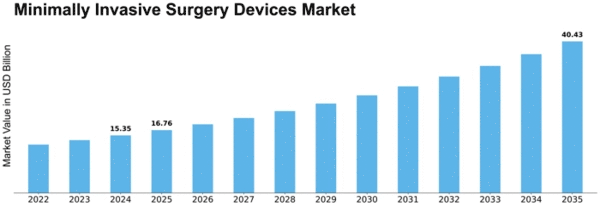
Minimally-Invasive Surgery Devices market size was valued at approximately 15.35 billion USD in 2024. This figure will reach 40.43 billion USD covering all regions (America, Europe, Asia, MEA and ROW), focusing its segments / services / distribution channels till 2035.

What is the CAGR of the Minimally-Invasive Surgery Devices market?

Minimally-Invasive Surgery Devices market is expected to grow at a CAGR of 9.2% between 2025 and 2035.

How much will the Minimally-Invasive Surgery Devices market be worth by 2035?

Minimally-Invasive Surgery Devices market is expected to be worth of 40.43 billion USD, reflecting growth driven by usage, technology and global demands by the end of 2035.

How will the Minimally-Invasive Surgery Devices market perform over the next 10 years?

Over the next 10 years the Minimally-Invasive Surgery Devices market is expected to shift from usd billion 15.35 to 40.43 billion USD, led by adoption of advanced tech, demographic trends, regulatory approvals, with potential headwinds from 2025 to 2035.

What was the market size for the Minimally Invasive Surgery Devices Market in 2024?

The Minimally Invasive Surgery Devices Market was valued at 35.59 USD billion in 2024.

Which application segment will dominate the market in 2024, and what will its projected value be in 2035?

The General Surgery segment dominated the market, valued at 10.5 USD billion in 2024 and projected to reach 16.25 USD billion by 2035.

What are the projected values for the Cardiothoracic Surgery application in the market for 2024 and 2035?

The Cardiothoracic Surgery application was valued at 7.2 USD billion in 2024 and is projected to grow to 11.2 USD billion by 2035.

Which region is expected to have the highest market value in 2024 and what will it be by 2035?

North America held the highest market value of 12.5 USD billion in 2024, expected to increase to 20.0 USD billion by 2035.

What was the market value for the Asia Pacific region in 2024?

The Asia Pacific region held a market value of 8.0 USD billion in 2024.

Market Summary

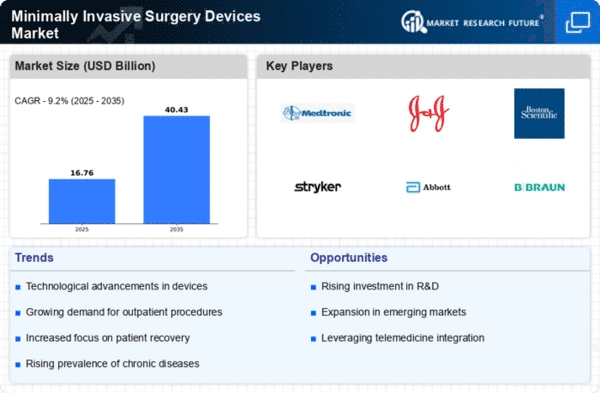
As per MRFR analysis, the Minimally Invasive Surgery Devices Market was estimated at 15.35 USD Billion in 2024. The Minimally Invasive Surgery Devices industry is projected to grow from 16.77 USD Billion in 2025 to 40.43 USD Billion by 2035, exhibiting a compound annual growth rate (CAGR) of 9.2 during the forecast period 2025 - 2035.

Key Market Trends & Highlights

The Minimally Invasive Surgery Devices Market is poised for substantial growth driven by technological advancements and increasing patient demand.

  • Technological advancements are revolutionizing the Minimally Invasive Surgery Devices Market, enhancing precision and efficiency.
  • North America remains the largest market, while the Asia-Pacific region is emerging as the fastest-growing area for these devices.
  • Cardiothoracic surgery continues to dominate the market, whereas urological surgery is witnessing the fastest growth in demand.
  • The rising demand for outpatient procedures and an aging population are key drivers propelling market expansion.

Market Size & Forecast

2024 Market Size 15.35 (USD Billion)
2035 Market Size 40.43 (USD Billion)
CAGR (2025 - 2035) 9.2%
Largest Regional Market Share in 2024 North America

Major Players

Medtronic (US), Johnson & Johnson (US), Boston Scientific (US), Stryker (US), Abbott Laboratories (US), B. Braun Melsungen AG (DE), Olympus Corporation (JP), Smith & Nephew (GB), Intuitive Surgical (US)

Market Trends

The Minimally Invasive Surgery Devices Market is currently experiencing a notable transformation, driven by advancements in technology and an increasing preference for less invasive procedures among patients. This market encompasses a wide array of devices designed to facilitate surgical interventions with minimal disruption to the body, thereby promoting quicker recovery times and reduced hospital stays. As healthcare providers continue to prioritize patient outcomes, the demand for innovative surgical solutions is likely to rise, fostering a competitive landscape where manufacturers strive to enhance their offerings. Furthermore, the integration of robotics and imaging technologies into surgical practices appears to be reshaping traditional methodologies, suggesting a shift towards more precise and efficient surgical techniques. In addition to technological advancements, the Minimally Invasive Surgery Devices Market is influenced by evolving regulatory frameworks and growing awareness regarding the benefits of minimally invasive procedures. Healthcare professionals are increasingly recognizing the advantages of these techniques, which may lead to broader adoption across various surgical specialties. As the market evolves, it seems poised for sustained growth, with potential opportunities emerging in developing regions where access to advanced surgical technologies is expanding. Overall, the Minimally Invasive Surgery Devices Market reflects a dynamic interplay of innovation, regulatory changes, and shifting patient preferences, indicating a promising future for the sector.

Technological Advancements

The Minimally Invasive Surgery Devices Market is witnessing rapid technological innovations, particularly in robotics and imaging systems. These advancements enhance precision and efficiency during surgical procedures, potentially leading to improved patient outcomes.

Regulatory Developments

Evolving regulatory frameworks are shaping the Minimally Invasive Surgery Devices Market. Stricter guidelines and approvals may influence the introduction of new devices, ensuring safety and efficacy while fostering innovation.

Increased Patient Awareness

Growing awareness among patients regarding the benefits of minimally invasive procedures is driving demand in the Minimally Invasive Surgery Devices Market. As individuals seek less traumatic surgical options, healthcare providers are adapting to meet these expectations.

Minimally Invasive Surgery Devices Market Market Drivers

Technological Advancements

The Global Minimally Invasive Surgery Devices Market Industry is experiencing rapid growth due to continuous technological advancements. Innovations such as robotic-assisted surgery, advanced imaging techniques, and enhanced surgical instruments are transforming surgical procedures. For instance, the integration of artificial intelligence in surgical devices is improving precision and outcomes. As a result, the market is projected to reach 35.6 USD Billion in 2024, reflecting a growing demand for sophisticated surgical solutions. These advancements not only enhance patient safety but also reduce recovery times, making minimally invasive procedures more appealing to healthcare providers and patients alike.

Market Segment Insights

By Application: Cardiothoracic Surgery (Largest) vs. Urological Surgery (Fastest-Growing)

In the Minimally Invasive Surgery Devices Market, Cardiothoracic Surgery holds the largest share among the various applications due to its established adoption of advanced surgical devices that facilitate heart and lung procedures with minimal invasiveness. This segment benefits from a growing number of cardiac conditions and an increasing elderly population, making it a critical area for device manufacturers. On the other hand, Urological Surgery has emerged as the fastest-growing segment as technological advancements enhance surgical precision and patient outcomes. The rising incidence of urological diseases, along with a growing preference for minimally invasive techniques, drives the demand for innovative devices in this field.

Cardiothoracic Surgery: Dominant vs. Urological Surgery: Emerging

Cardiothoracic Surgery represents a dominant force in the Minimally Invasive Surgery Devices Market, characterized by a broad range of applications from coronary artery bypass to valve repair procedures. Its strong market position is attributed to the high effectiveness and shorter recovery times associated with minimally invasive techniques. Conversely, Urological Surgery, while still emerging, is witnessing rapid growth due to technological innovations such as robotic-assisted surgeries and improved imaging techniques. These advancements enable surgeons to perform complex procedures with enhanced accuracy and reduced patient trauma. As awareness of minimally invasive options increases, Urological Surgery is set to further expand its footprint in the surgery devices market, potentially challenging the established leaders over time.

By Device Type: Endoscopes (Largest) vs. Surgical Robots (Fastest-Growing)

In the Minimally Invasive Surgery Devices Market, endoscopes hold the largest share due to their widespread use and versatility in procedures. These devices enable surgeons to perform complex operations with minimal incisions, enhancing recovery time and improving patient outcomes. Other segments like laparoscopic instruments and access devices also contribute significantly, but they remain behind endoscopes in market share. Surgical robots, while smaller in share, are rapidly gaining traction as more healthcare facilities adopt this advanced technology for intricate surgeries. Growth trends in the minimally invasive surgery devices market are being driven by technological advancements and an increasing preference for less invasive procedures among patients. The market for surgical robots is anticipated to expand rapidly, influenced by the growing demand for precision and automation in surgical procedures. As healthcare costs rise, the efficiency and effectiveness offered by minimally invasive devices are propelling their adoption in surgical settings, indicating robust future growth for this segment.

Endoscopes (Dominant) vs. Surgical Robots (Emerging)

Endoscopes have established themselves as the dominant technology in the Minimally Invasive Surgery Devices Market due to their capability to facilitate a broad range of diagnostic and therapeutic procedures. Their design allows for direct visualization of internal organs, making them indispensable in surgeries such as gastrointestinal and pulmonary interventions. On the other hand, surgical robots are emerging rapidly, characterized by enhanced surgical precision and reduced recovery time for patients. These advanced systems offer surgeons unparalleled control and flexibility, thereby driving their adoption in complex surgical scenarios. With an increasing number of training programs and technological advancements, surgical robots are set to revolutionize the landscape of minimally invasive surgeries.

By End User: Hospitals (Largest) vs. Ambulatory Surgical Centers (Fastest-Growing)

In the Minimally Invasive Surgery Devices Market, hospitals represent the largest end-user segment, leveraging advanced surgical technologies and comprehensive patient care. Their extensive infrastructure and ability to invest in cutting-edge devices contribute significantly to their market share. Following hospitals, ambulatory surgical centers (ASCs) are gaining traction, attributed to their cost-effectiveness and efficiency in performing same-day procedures. As healthcare shifts toward outpatient care, ASCs are rapidly capturing a larger portion of the market.

Hospitals (Dominant) vs. Ambulatory Surgical Centers (Emerging)

Hospitals are the dominant end users in the minimally invasive surgery devices market, characterized by their high patient throughput and extensive surgical departments. They have the resources to integrate a wide array of advanced surgical devices, thereby enhancing patient outcomes. Conversely, ambulatory surgical centers represent an emerging segment, focusing on outpatient procedures that allow patients to recover at home. ASCs feature lower overhead costs and shorter waiting times, making them increasingly popular among patients and insurers. This focus on patient-centered care positions ASCs as a vital player in the minimally invasive surgery landscape, poised for significant growth.

Get more detailed insights about Minimally-Invasive Surgery Devices Market Research Report - Forecast till 2035

Regional Insights

North America : Market Leader in Innovation

North America is poised to maintain its leadership in the Minimally Invasive Surgery Devices Market, holding a significant market share of 7.5 in 2024. The region's growth is driven by increasing demand for advanced surgical techniques, rising healthcare expenditures, and favorable reimbursement policies. Regulatory support from agencies like the FDA further catalyzes innovation and adoption of new technologies, enhancing patient outcomes and operational efficiencies. The competitive landscape in North America is robust, featuring key players such as Medtronic, Johnson & Johnson, and Intuitive Surgical. These companies are at the forefront of technological advancements, focusing on product development and strategic partnerships to expand their market presence. The U.S. remains the largest market, supported by a well-established healthcare infrastructure and a high prevalence of chronic diseases, driving the need for minimally invasive procedures.

Europe : Emerging Market with Growth Potential

Europe's Minimally Invasive Surgery Devices Market is projected to grow significantly, with a market size of 4.5 in 2024. The region benefits from a growing aging population, increasing prevalence of lifestyle-related diseases, and advancements in surgical technologies. Regulatory frameworks, such as the EU Medical Device Regulation, are enhancing safety and efficacy standards, thereby boosting market confidence and adoption rates across member states. Leading countries in Europe include Germany, France, and the UK, where major players like B. Braun Melsungen AG and Olympus Corporation are actively innovating. The competitive landscape is characterized by a mix of established firms and emerging startups, focusing on developing cutting-edge solutions. The European market is increasingly collaborative, with partnerships aimed at enhancing product offerings and expanding market reach, reflecting a dynamic and evolving industry landscape.

Asia-Pacific : Rapidly Growing Market Segment

The Asia-Pacific region is witnessing rapid growth in the Minimally Invasive Surgery Devices Market, with a market size of 2.8 in 2024. Key growth drivers include rising healthcare awareness, increasing disposable incomes, and a growing number of surgical procedures. Governments are investing in healthcare infrastructure and promoting advanced surgical techniques, which are expected to further enhance market growth. Regulatory bodies are also streamlining approval processes to facilitate quicker market entry for innovative devices. Countries like Japan, China, and India are leading the charge in adopting minimally invasive techniques. The competitive landscape features both global giants and local manufacturers, with companies like Olympus Corporation and Stryker playing pivotal roles. The region's market is characterized by a diverse range of products and technologies, catering to various surgical specialties, thus driving competition and innovation in the sector.

Middle East and Africa : Emerging Market with Challenges

The Middle East and Africa region is gradually emerging in the Minimally Invasive Surgery Devices Market, with a market size of 0.55 in 2024. Growth is driven by increasing healthcare investments, a rising prevalence of chronic diseases, and a growing demand for advanced surgical solutions. However, challenges such as limited healthcare infrastructure and regulatory hurdles may impede faster growth. Governments are focusing on improving healthcare access and quality, which is expected to positively impact market dynamics. Leading countries in this region include South Africa and the UAE, where there is a growing presence of key players like Abbott Laboratories and Boston Scientific. The competitive landscape is evolving, with both international and local companies striving to capture market share. As healthcare systems improve, the demand for minimally invasive procedures is expected to rise, fostering innovation and investment in the sector.

Key Players and Competitive Insights

The Minimally Invasive Surgery Devices Market is characterized by a dynamic competitive landscape, driven by technological advancements, increasing patient preference for less invasive procedures, and a growing emphasis on cost-effective healthcare solutions. Key players such as Medtronic (US), Johnson & Johnson (US), and Intuitive Surgical (US) are at the forefront, each adopting distinct strategies to enhance their market positioning. Medtronic (US) focuses on innovation through the development of advanced robotic-assisted surgical systems, while Johnson & Johnson (US) emphasizes strategic partnerships to expand its product portfolio. Intuitive Surgical (US) continues to lead in robotic surgery, leveraging its established da Vinci system to capture a larger market share, thereby shaping a competitive environment that prioritizes technological superiority and operational efficiency.The business tactics employed by these companies include localizing manufacturing to reduce costs and optimize supply chains, which is particularly crucial in a moderately fragmented market. This competitive structure allows for a diverse range of products and services, with key players collectively influencing market trends through their strategic initiatives. The emphasis on supply chain optimization and localized production is likely to enhance responsiveness to market demands, thereby fostering a more resilient operational framework.

In November Medtronic (US) announced the launch of its latest robotic-assisted surgical platform, which integrates AI capabilities to enhance surgical precision. This strategic move is significant as it not only reinforces Medtronic's commitment to innovation but also positions the company to better compete against emerging players in the market. The integration of AI is expected to streamline surgical workflows, potentially leading to improved patient outcomes and reduced recovery times.

In October Johnson & Johnson (US) entered into a partnership with a leading telehealth provider to enhance remote surgical consultations. This collaboration is indicative of the company's strategy to leverage digital health technologies, thereby expanding its reach and improving patient access to minimally invasive procedures. Such initiatives may enhance the overall patient experience and drive adoption rates for their surgical devices.

In September Intuitive Surgical (US) expanded its global footprint by establishing a new manufacturing facility in Europe. This strategic expansion is likely to facilitate quicker distribution of its products across the region, thereby enhancing its competitive edge. The facility is expected to support increased production capacity, which aligns with the growing demand for robotic-assisted surgeries in Europe.

As of December the Minimally Invasive Surgery Devices Market is witnessing trends such as digitalization, sustainability, and the integration of AI technologies. Strategic alliances are increasingly shaping the competitive landscape, allowing companies to pool resources and expertise. The shift from price-based competition to a focus on innovation, technology, and supply chain reliability is becoming more pronounced. As the market evolves, differentiation will likely hinge on the ability to deliver cutting-edge solutions that enhance surgical outcomes and patient satisfaction.

Key Companies in the Minimally Invasive Surgery Devices Market include

Industry Developments

In order to facilitate difficult thoracic and urologic operations, Intuitive Surgical announced in February 2025 that it will introduce a next-generation da Vinci robotic system with improved tactile feedback and AI-assisted navigation.

Following prior FDA certification, CMR Surgical extended its Versius robotic platform across Latin America and Southeast Asia in March 2025 in response to the rising need for small, reasonably priced minimally invasive procedures. The FDA approved Johnson & Johnson's Ethicon division's powered laparoscopic stapler with integrated real-time tissue sensing in October 2024.

The device is intended to improve accuracy and lower intraoperative mistakes. The first 5 mm wristed, articulating laparoscopic tool line, the ArtiSential 5, was introduced by LivsMed in October 2024. Its finer instrumentation gives surgeons more maneuverability. The FDA approved Virtual Incision Corporation's MIRA mini-RAS system in February 2024.

It is a small robotic device for adult colectomy that integrates easily into current operating rooms. Furthermore, Momentis Surgical, founded in Israel, received FDA 510(k) approval in March 2025 for their Anovo single-port robotic device, which is intended to treat ventral hernias.

A significant step toward automation in gastrointestinal procedures was finally taken in February 2025 when state-of-the-art academic teams presented a semi-automated, contactless robot-assisted laser tissue soldering device for in-vivo colon incision closure in pigs.

Future Outlook

Minimally Invasive Surgery Devices Market Future Outlook

The Minimally Invasive Surgery Devices Market is projected to grow at a 9.2% CAGR from 2025 to 2035, driven by technological advancements, increasing patient demand, and cost-effectiveness.

New opportunities lie in:

  • Expansion of robotic-assisted surgical systems in outpatient settings.
  • Development of advanced imaging technologies for enhanced surgical precision.
  • Integration of AI-driven analytics for personalized surgical planning.

By 2035, the market is expected to be robust, reflecting substantial growth and innovation.

Market Segmentation

Minimally Invasive Surgery Devices Market End User Outlook

  • Hospitals
  • Ambulatory Surgical Centers
  • Specialty Clinics
  • Research Institutions

Minimally Invasive Surgery Devices Market Application Outlook

  • Cardiothoracic Surgery
  • Gastrointestinal Surgery
  • Urological Surgery
  • Orthopedic Surgery
  • Gynecological Surgery

Minimally Invasive Surgery Devices Market Device Type Outlook

  • Endoscopes
  • Surgical Robots
  • Laparoscopic Instruments
  • Access Devices
  • Visualization Systems

Report Scope

MARKET SIZE 202415.35(USD Billion)
MARKET SIZE 202516.77(USD Billion)
MARKET SIZE 203540.43(USD Billion)
COMPOUND ANNUAL GROWTH RATE (CAGR)9.2% (2025 - 2035)
REPORT COVERAGERevenue Forecast, Competitive Landscape, Growth Factors, and Trends
BASE YEAR2024
Market Forecast Period2025 - 2035
Historical Data2019 - 2024
Market Forecast UnitsUSD Billion
Key Companies ProfiledMedtronic (US), Johnson & Johnson (US), Boston Scientific (US), Stryker (US), Abbott Laboratories (US), B. Braun Melsungen AG (DE), Olympus Corporation (JP), Smith & Nephew (GB), Intuitive Surgical (US)
Segments CoveredApplication, Device Type, End User
Key Market OpportunitiesIntegration of advanced robotics and artificial intelligence enhances precision in the Minimally Invasive Surgery Devices Market.
Key Market DynamicsTechnological advancements and regulatory changes drive growth in the Minimally Invasive Surgery Devices Market.
Countries CoveredNorth America, Europe, APAC, South America, MEA

FAQs

What is the projected growth of the Minimally-Invasive Surgery Devices market?

The Minimally-Invasive Surgery Devices market is the expected increase in total market value of 40.43 USD billion over a defined forecast period 2025–2035. It is driven by factors such as demand trends, technological advances, regulatory changes, and geographic expansion.

What is the size of the Minimally-Invasive Surgery Devices market?

Minimally-Invasive Surgery Devices market size was valued at approximately 15.35 billion USD in 2024. This figure will reach 40.43 billion USD covering all regions (America, Europe, Asia, MEA and ROW), focusing its segments / services / distribution channels till 2035.

What is the CAGR of the Minimally-Invasive Surgery Devices market?

Minimally-Invasive Surgery Devices market is expected to grow at a CAGR of 9.2% between 2025 and 2035.

How much will the Minimally-Invasive Surgery Devices market be worth by 2035?

Minimally-Invasive Surgery Devices market is expected to be worth of 40.43 billion USD, reflecting growth driven by usage, technology and global demands by the end of 2035.

How will the Minimally-Invasive Surgery Devices market perform over the next 10 years?

Over the next 10 years the Minimally-Invasive Surgery Devices market is expected to shift from usd billion 15.35 to 40.43 billion USD, led by adoption of advanced tech, demographic trends, regulatory approvals, with potential headwinds from 2025 to 2035.

What was the market size for the Minimally Invasive Surgery Devices Market in 2024?

The Minimally Invasive Surgery Devices Market was valued at 35.59 USD billion in 2024.

Which application segment will dominate the market in 2024, and what will its projected value be in 2035?

The General Surgery segment dominated the market, valued at 10.5 USD billion in 2024 and projected to reach 16.25 USD billion by 2035.

What are the projected values for the Cardiothoracic Surgery application in the market for 2024 and 2035?

The Cardiothoracic Surgery application was valued at 7.2 USD billion in 2024 and is projected to grow to 11.2 USD billion by 2035.

Which region is expected to have the highest market value in 2024 and what will it be by 2035?

North America held the highest market value of 12.5 USD billion in 2024, expected to increase to 20.0 USD billion by 2035.

What was the market value for the Asia Pacific region in 2024?

The Asia Pacific region held a market value of 8.0 USD billion in 2024.

  1. SECTION I: EXECUTIVE SUMMARY AND KEY HIGHLIGHTS
    1. EXECUTIVE SUMMARY
      1. Market Overview
      2. Key Findings
      3. Market Segmentation
      4. Competitive Landscape
      5. Challenges and Opportunities
      6. Future Outlook
  2. SECTION II: SCOPING, METHODOLOGY AND MARKET STRUCTURE
    1. MARKET INTRODUCTION
      1. Definition
      2. Scope of the study
    2. RESEARCH METHODOLOGY
      1. Overview
      2. Data Mining
      3. Secondary Research
      4. Primary Research
      5. Forecasting Model
      6. Market Size Estimation
      7. Data Triangulation
      8. Validation
  3. SECTION III: QUALITATIVE ANALYSIS
    1. MARKET DYNAMICS
      1. Overview
      2. Drivers
      3. Restraints
      4. Opportunities
    2. MARKET FACTOR ANALYSIS
      1. Value chain Analysis
      2. Porter's Five Forces Analysis
      3. COVID-19 Impact Analysis
  4. SECTION IV: QUANTITATIVE ANALYSIS
    1. Healthcare, BY Application (USD Billion)
      1. Cardiothoracic Surgery
      2. Gastrointestinal Surgery
      3. Urological Surgery
      4. Orthopedic Surgery
      5. Gynecological Surgery
    2. Healthcare, BY Device Type (USD Billion)
      1. Endoscopes
      2. Surgical Robots
      3. Laparoscopic Instruments
      4. Access Devices
      5. Visualization Systems
    3. Healthcare, BY End User (USD Billion)
      1. Hospitals
      2. Ambulatory Surgical Centers
      3. Specialty Clinics
      4. Research Institutions
    4. Healthcare, BY Region (USD Billion)
      1. North America
      2. Europe
      3. APAC
      4. South America
      5. MEA
  5. SECTION V: COMPETITIVE ANALYSIS
    1. Competitive Landscape
      1. Overview
      2. Competitive Analysis
      3. Market share Analysis
      4. Major Growth Strategy in the Healthcare
      5. Competitive Benchmarking
      6. Leading Players in Terms of Number of Developments in the Healthcare
      7. Key developments and growth strategies
      8. Major Players Financial Matrix
    2. Company Profiles
      1. Medtronic (US)
      2. Johnson & Johnson (US)
      3. Boston Scientific (US)
      4. Stryker (US)
      5. Abbott Laboratories (US)
      6. B. Braun Melsungen AG (DE)
      7. Olympus Corporation (JP)
      8. Smith & Nephew (GB)
      9. Intuitive Surgical (US)
    3. Appendix
      1. References
      2. Related Reports

Healthcare Market Segmentation

Healthcare By Application (USD Billion, 2025-2035)

  • Cardiothoracic Surgery
  • Gastrointestinal Surgery
  • Urological Surgery
  • Orthopedic Surgery
  • Gynecological Surgery

Healthcare By Device Type (USD Billion, 2025-2035)

  • Endoscopes
  • Surgical Robots
  • Laparoscopic Instruments
  • Access Devices
  • Visualization Systems

Healthcare By End User (USD Billion, 2025-2035)

  • Hospitals
  • Ambulatory Surgical Centers
  • Specialty Clinics
  • Research Institutions
Infographic

Free Sample Request

Kindly complete the form below to receive a free sample of this Report

Get Free Sample

Customer Strories

Compare Licence

×
Features License Type
Single User Multiuser License Enterprise User
Price $4,950 $5,950 $7,250
Maximum User Access Limit 1 User Upto 10 Users Unrestricted Access Throughout the Organization
Free Customization
Direct Access to Analyst
Deliverable Format
Platform Access
Discount on Next Purchase 10% 15% 15%
Printable Versions