×
  • Cat-intel
  • MedIntelliX
  • Resources
  • About Us
  • Hero Background
    English
    Chinese
    French
    Japanese
    Korean
    German
    Spanish

    Military Body Armor Market Share

    ID: MRFR/A&D/4974-HCR
    100 Pages
    Sejal Akre
    October 2025

    Military Body Armor Market Research Report Information By Level (Level I, Level IIA, Level II, Level IIIA, Level III, Level IV), By Application (Law Enforcement Protection, Civilians) By Material (Steel, UHMWPE, Aramid, Composite Ceramic, Others) And By Region (North America, Europe, Asia-Pacific, And Rest Of The World) –Market Forecast Till 2035.

    Share:
    Download PDF ×

    We do not share your information with anyone. However, we may send you emails based on your report interest from time to time. You may contact us at any time to opt-out.

    Military Body Armor Market Infographic
    Purchase Options

    Market Share

    Military Body Armor Market Share Analysis

    In the highly specialized realm of the Military Body Armor Market, companies strategically employ a range of market share positioning strategies to gain a competitive edge and secure a substantial share of the industry. One prevalent strategy is differentiation, where companies focus on developing advanced and specialized body armor technologies to distinguish themselves from competitors. This may involve innovations in lightweight materials, increased flexibility, and enhanced protection capabilities, catering to military and law enforcement agencies seeking cutting-edge solutions for personnel protection. By emphasizing these unique features, companies aim to attract clients looking for state-of-the-art military body armor, positioning themselves as leaders in the evolving field of personal protection for defense and security forces.

    Cost leadership is another crucial strategy within the Military Body Armor Market, as companies strive to become the primary providers of cost-effective solutions. Achieving cost leadership involves optimizing manufacturing processes, sourcing materials strategically, and offering competitively priced body armor without compromising on performance or durability. This strategy appeals to defense organizations and security forces facing budget constraints, which require efficient protection solutions for personnel in the field. By providing cost-effective options, companies can broaden their customer base and secure contracts in a market where affordability is a significant consideration.

    Market segmentation plays a fundamental role in market share positioning within the Military Body Armor Market. Companies analyze the diverse needs of various user segments, including infantry, special forces, and law enforcement, tailoring their body armor offerings to specific requirements. This segmentation could involve developing specialized armor for different threat levels, incorporating modular components for mission-specific adaptability, or creating solutions tailored to specific operational environments. By understanding and addressing the distinct needs of different end-users, companies can effectively target their marketing efforts, creating a stronger foothold in specific niches within the broader market.

    Strategic partnerships and collaborations are key components of market share positioning within the Military Body Armor Market. Companies often form alliances with defense contractors, research institutions, or government agencies to enhance the development and performance of their body armor solutions. These collaborations may involve joint research and development initiatives, testing and certification partnerships, or integration with other military technologies. Such partnerships not only strengthen a company's market position but also contribute to advancements and innovation in the field of military body armor, ensuring the highest standards of protection for military and law enforcement personnel.

    Geographical expansion is a notable strategy for market share positioning, where companies strategically enter new markets to tap into emerging opportunities. This could involve establishing partnerships with local defense contractors, participating in international defense exhibitions, or adapting products to meet specific regional regulations and operational requirements. By expanding their geographic reach, companies aim to increase their market share and adapt their military body armor solutions to the unique challenges and threats in different parts of the world.

    Author
    Sejal Akre
    Senior Research Analyst

    She has over 5 years of rich experience, in market research and consulting providing valuable market insights to client. Hands on expertise in management consulting, and extensive knowledge in domain including ICT, Automotive & Transportation and Aerospace & Defense. She is skilled in Go-to market strategy, industry analysis, market sizing, in depth company profiling, competitive intelligence & benchmarking and value chain amongst others.

    Leave a Comment

    FAQs

    How much is the military body armor market?

    The military body armor market was valued at USD 1.6 Billion in 2022.

    What is the growth rate of the military body armor market?

    The market is projected to grow at a CAGR of 5.40% during the forecast period, 2023-2030.

    Which Region held the largest market share in the military body armor market?

    North America had the largest share of the market.

    Who are the key players in the military body armor market?

    The key players in the market are Elmon (Greece), Honeywell (US), BAE Systems (UK), Coorstek Inc. (US), Du Pont (US), Point Blank Enterprises Inc (US), MKU Limited (India), M (US Safariland, LLC (US), Survitec Group Limited (UK)

    Which product type led the military body armor market?

    The soft military body armor category dominated the market in 2022.

    Which Material had the largest market share in the military body armor market?

    The composite ceramic base had the largest share of the market.

    Market Summary

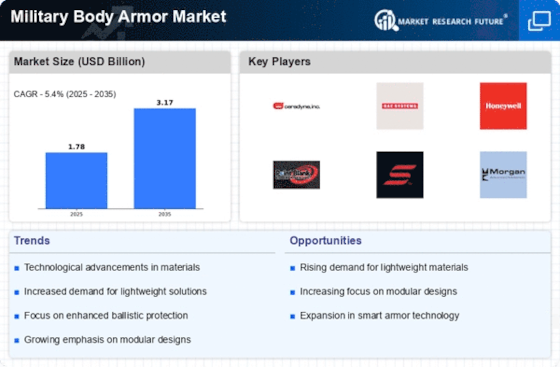
    As per MRFR analysis, the Military Body Armor Market Size was estimated at 1.777 USD Billion in 2024. The Military Body Armor industry is projected to grow from 1.873 USD Billion in 2025 to 3.17 USD Billion by 2035, exhibiting a compound annual growth rate (CAGR) of 5.4 during the forecast period 2025 - 2035.

    Key Market Trends & Highlights

    The Military Body Armor Market is experiencing robust growth driven by technological advancements and increasing defense expenditures.

    • North America remains the largest market for military body armor, driven by substantial defense budgets and ongoing military engagements.
    • The Asia-Pacific region is emerging as the fastest-growing market, fueled by rising geopolitical tensions and defense collaborations.
    • Level III body armor continues to dominate the market, while Level IV armor is witnessing rapid growth due to evolving threats.
    • Key market drivers include increasing defense budgets and a heightened focus on soldier well-being, which are propelling innovations in body armor technology.

    Market Size & Forecast

    2024 Market Size 1.777 (USD Billion)
    2035 Market Size 3.17 (USD Billion)
    CAGR (2025 - 2035) 5.4%
    Largest Regional Market Share in 2024 North America

    Major Players

    <p>Ceradyne (US), BAE Systems (GB), Honeywell (US), Point Blank Enterprises (US), Safariland (US), Morgan Advanced Materials (GB), General Dynamics (US), Rheinmetall (DE), Northrop Grumman (US)</p>

    Market Trends

    The Military Body Armor Market is currently experiencing a dynamic evolution, driven by advancements in materials technology and increasing demand for enhanced protection among military personnel. As threats become more sophisticated, the need for lightweight yet durable armor solutions appears paramount. Manufacturers are focusing on integrating innovative materials such as advanced composites and nanofibers, which may provide superior ballistic resistance while minimizing weight. This shift not only enhances soldier mobility but also contributes to overall operational effectiveness in diverse environments. Moreover, the Military Body Armor Market is witnessing a growing emphasis on customization and modular designs. This trend suggests that military forces are increasingly seeking tailored solutions that can adapt to specific mission requirements. The incorporation of modular components allows for flexibility in armor configurations, enabling personnel to modify their protective gear based on the nature of the threat. As a result, the market is likely to see a rise in collaborative efforts between manufacturers and military organizations to develop bespoke armor systems that meet evolving operational demands.

    Advancements in Materials Technology

    The Military Body Armor Market is seeing a notable shift towards the use of advanced materials, such as composites and nanofibers. These innovations are likely to enhance ballistic protection while reducing weight, thereby improving soldier mobility and comfort.

    Customization and Modular Designs

    There is a growing trend towards customization in the Military Body Armor Market, with an emphasis on modular designs. This approach allows military personnel to adapt their armor to specific mission requirements, enhancing operational effectiveness.

    Integration of Smart Technologies

    The incorporation of smart technologies into body armor is emerging as a significant trend. Features such as integrated communication systems and health monitoring sensors may provide soldiers with real-time data, potentially improving situational awareness and safety.

    Military Body Armor Market Market Drivers

    Increasing Defense Budgets

    The Military Body Armor Market is experiencing a notable surge due to the increasing defense budgets across various nations. Governments are prioritizing the enhancement of military capabilities, which includes investing in advanced protective gear for personnel. For instance, defense budgets in several countries have seen a rise of approximately 5 to 10 percent annually, reflecting a commitment to improving soldier safety. This trend is likely to drive demand for innovative body armor solutions that offer superior protection and comfort. As military operations become more complex, the need for effective body armor becomes paramount, thereby propelling the market forward. The emphasis on equipping armed forces with state-of-the-art protective gear is expected to sustain growth in the Military Body Armor Market for the foreseeable future.

    Increased Focus on Soldier Well-being

    The Military Body Armor Market is increasingly influenced by the growing emphasis on soldier well-being and performance. Military organizations are recognizing that the physical and psychological health of personnel is paramount to operational effectiveness. As a result, there is a concerted effort to develop body armor that not only provides protection but also enhances comfort and reduces fatigue. This trend is reflected in the design of modular and customizable body armor systems that cater to individual soldier needs. The market is expected to witness a steady growth rate of around 5 percent as military forces prioritize the holistic well-being of their personnel. This focus on soldier-centric designs is likely to drive innovation and investment in the Military Body Armor Market.

    Technological Innovations in Body Armor

    Technological innovations play a crucial role in shaping the Military Body Armor Market. The development of lightweight, high-strength materials such as aramid fibers and polyethylene composites has revolutionized body armor design. These advancements not only enhance protection levels but also improve mobility and comfort for soldiers. The integration of smart technologies, such as sensors and communication systems, is also gaining traction, allowing for real-time data collection and situational awareness. As a result, the market is projected to grow at a rate of approximately 7 percent annually, driven by the demand for cutting-edge solutions that meet the evolving needs of modern warfare. The continuous pursuit of innovation is likely to remain a key driver in the Military Body Armor Market.

    Rising Threats and Geopolitical Tensions

    The Military Body Armor Market is significantly influenced by the rising threats and geopolitical tensions observed in various regions. As conflicts and security challenges escalate, military forces are compelled to enhance their protective measures. The ongoing tensions in regions such as Eastern Europe and the Middle East have led to increased procurement of body armor to ensure the safety of personnel in hostile environments. This heightened focus on personal protection is likely to result in a compound annual growth rate (CAGR) of around 6 percent in the Military Body Armor Market over the next few years. The urgency to address these threats drives innovation and investment in advanced body armor technologies, further solidifying the market's expansion.

    Emerging Markets and Defense Collaborations

    The Military Body Armor Market is poised for growth due to the emergence of new markets and defense collaborations. Countries with developing military capabilities are increasingly investing in body armor solutions to modernize their armed forces. Collaborations between established defense contractors and emerging economies are facilitating the transfer of technology and expertise, thereby enhancing local production capabilities. This trend is expected to contribute to a market growth rate of approximately 6 percent as these nations seek to bolster their defense readiness. The strategic partnerships and joint ventures are likely to result in the development of tailored body armor solutions that meet specific regional needs, further expanding the Military Body Armor Market.

    Market Segment Insights

    By Level: Level III (Largest) vs. Level IV (Fastest-Growing)

    <p>In the Military Body Armor Market, the segmentation predominantly features Level III as the largest segment, catering to military units requiring robust protection against various ballistic threats. Meanwhile, Level IV armor, designed to withstand armor-piercing rounds, is experiencing rapid growth as defense forces increasingly prioritize enhanced safety features for personnel in combat zones. As threats evolve, the demand distribution across these levels illustrates a shifting emphasis on both coverage and weight, favoring advanced materials and innovative designs. The growth trends in this segment are driven by rising geopolitical tensions and the need for enhanced personal protection for military personnel. Technological advancements in ballistic materials are further spurring innovation, leading to improved comfort and mobility. The modest increase in armored vehicle deployment is also contributing to the demand for higher protection levels, particularly in combat situations. Thus, while Level III remains dominant in use, the accelerated adoption of Level IV gear signifies a pivotal shift in benchmark standards for military body armor design and functionality.</p>

    <p>Level III (Dominant) vs. Level IV (Emerging)</p>

    <p>Level III body armor is characterized by its capability to protect against higher caliber firearms, making it a staple choice for military personnel. Its composite design balances weight and protection effectively, offering a practical solution for various combat scenarios. With its established presence, Level III armor continues to thrive in military procurement, demonstrating reliability and performance. In contrast, Level IV armor represents an emerging choice that is gaining traction for its unparalleled strength against armor-piercing ammunition. Leveraging advanced materials and engineering, Level IV suits are becoming increasingly essential as modern warfare evolves. The investment in Level IV reflects a strategic shift in military standards, where the emphasis on soldier survivability urges armed forces to adopt and integrate these high-grade protective solutions.</p>

    By Material: Steel (Largest) vs. UHMWPE (Fastest-Growing)

    <p>The Military Body Armor Market showcases a diverse range of materials that are integral to the development of protective gear. Steel remains the largest segment, favored for its durability and protective capabilities, while UHMWPE, known for its lightweight properties, is emerging as the fastest-growing option. This shift in preference signifies a trend toward more versatile and user-friendly armor solutions to meet modern military requirements. As defense forces globally focus on enhancing soldier mobility and protection, demand for advanced materials is on the rise. UHMWPE’s advantages in weight and flexibility cater to this need, driving innovation and investment in this segment. Additionally, aramid and composite ceramic materials are gaining traction, supporting this evolution in military gear, with their unique properties offering distinct benefits for varying combat scenarios.</p>

    <p>Materials: Steel (Dominant) vs. UHMWPE (Emerging)</p>

    <p>Steel armor is a longstanding choice in military applications, known for its robustness and protective qualities against a wide range of ballistic threats. Its weight, however, poses challenges for ease of mobility, prompting a shift toward lighter materials. UHMWPE, on the other hand, is revolutionizing the sector with its superior strength-to-weight ratio and resistance to impact, making it an attractive alternative for contemporary military needs. While steel is often preferred for heavy-duty protection, UHMWPE addresses the increasing demand for lightweight, flexible solutions that do not compromise safety. This dynamic between steel and emerging materials like UHMWPE illustrates the ongoing advancement in military body armor technology, favoring adaptive strategies that align with modern warfare's demands.</p>

    By Product Type: Soft Armor (Largest) vs. Hard Armor (Fastest-Growing)

    <p>In the Military Body Armor Market, the distribution of market share between Soft Armor and Hard Armor is notably distinct. Soft Armor currently holds the largest market share, primarily due to its lightweight nature and flexibility, making it a preferred choice for various military operations. It has been widely adopted for personnel protection, particularly in scenarios where mobility is crucial, solidifying its position in the market. On the other hand, Hard Armor, while having a smaller market share, is gaining traction rapidly due to its advanced protective capabilities against high-velocity projectiles and blast impacts.</p>

    <p>Soft Armor (Dominant) vs. Hard Armor (Emerging)</p>

    <p>Soft Armor is characterized by its lightweight materials, often made from aramid fibers and polyethylene, providing excellent flexibility and comfort for military personnel. This segment dominates the market due to its widespread application in personal protection gear, enabling troops to maintain mobility without compromising on safety. Conversely, Hard Armor is emerging as a critical component in modern warfare, incorporating ceramic and composite materials that offer superior ballistic resistance. Its rapid growth is fueled by increasing demand for enhanced protection levels, particularly in high-risk combat environments, making it a vital investment for military forces seeking to adapt to evolving threats.</p>

    By Product Style: Covert (Largest) vs. Overt (Fastest-Growing)

    <p>In the Military Body Armor Market, the 'Covert' style currently commands the largest market share due to its emphasis on discreet protection suitable for special operations and undercover missions. Covert body armor is designed to blend in with civilian clothing, making it a preferred choice for military personnel engaged in non-combat scenarios. In contrast, the 'Overt' style has been gaining traction, particularly among conventional forces as it offers visible protection and enhanced identification in active environments, leading to increased acceptance and market growth.</p>

    <p>Product Style: Covert (Dominant) vs. Overt (Emerging)</p>

    <p>The Covert segment of military body armor is characterized by its low-profile design which allows for unobtrusive wear under civilian clothing. This style is essential for personnel who require stealth and tactical advantages in covert operations. The Overt segment, on the other hand, includes body armor that is visibly worn over clothing, signaling readiness and protection. While Covert styles currently dominate due to their versatility, the Overt segment is emerging quickly as military units seek improved visibility in combat zones, making it a vital area for future growth and innovation. As threats evolve, both segments continue to adapt to meet the unique needs of military personnel.</p>

    Get more detailed insights about Military Body Armor Market Research Report – Forecast to 2035

    Regional Insights

    • Military Body Armor Regional Insights

    By Region, the study provides market insights into North America, Europe, Asia-Pacific, and the Rest of the World. North America, this rising adoption of ballistic protection suits in various industries will boost the market growth in this Region.

    Further, the major countries studied in the market report are The U.S., Canada, German, France, the UK, Italy, Spain, China, Japan, India, Australia, South Korea, and Brazil.

    Figure2:  MILITARY BODY ARMOR MARKET SHARE BY REGION 2022 (%)

    MILITARY BODY ARMOR MARKET SHARE BY REGION 2022

    Source Secondary Research, Primary Research, Market Research Future Database, and Analyst Review

    Europe's Military Body Armor market accounts for the second-largest market share dueto the increased spending attributed to military upgradation in terms of personal safety and weapons upgrades. Further, the German Military Body Armor market held the largest market share, and the UK Military Body Armor market was the fastest-growing market in the European Region.

    The Asia-Pacific Military Body Armor Market is expected to grow at the fastest CAGR from 2023 to 2030. This is due to increased military spending in the Region. Moreover, China’s Military Body Armor market held the largest market share, and the Indian Military Body Armor market was the fastest-growing market in the Asia-Pacific region.

    Key Players and Competitive Insights

    Leading market players are investing heavily in research and development to expand their product lines, which will help the Military Body Armor market grow even more. Market participants are also undertaking various strategic activities to expand their footprint, with important market developments including new product launches, contractual agreements, mergers and acquisitions, higher investments, and collaboration with other organizations. The military body armor industry must offer cost-effective items to expand and survive in a more competitive and rising market climate.

    Manufacturing locally to minimize operational costs is one of the key business tactics manufacturers use in the Military Body Armor industry to benefit clients and increase the market sector. In recent years, the Military Body Armor industry has offered some of the most significant advantages to the military. Major players in the Military Body Armor market, including Elmon (Greece), Honeywell (US), BAE Systems (UK), Coorstek Inc. (US), Du Pont (US), Point Blank Enterprises Inc (US), and others, are attempting to increase market demand by investing in research and development operations.

    DuPont de Nemours, Inc., commonly shortened to DuPont, is an American multinational chemical company first formed in 1802 by a French American chemist and industrialist. The company played a major role in the development of Delaware and first arose as a major supplier of gunpowder. DuPont’s expertise spans high-performance fibers and foams, aramid papers, non-woven structures, water purification technologies, and protective garments. DuPont de Nemours Inc. recently acquired Core Matrix Technology, a Tex Tech Industries Inc. subsidiary specializing in bullet fragmentation and ballistic performance solutions for the military. Additionally, they also help reduce back trauma disorders.

    This acquisition aligns with expanding the firm's presence towards an expanded portfolio.

    MKU manufactures optronics devices like night vision binoculars and monocular as personal and platform armor solutions. MKU has centers of research & development in India and Germany that develop ballistic protection technologies for the company. Additionally, it has its own In house Ballistic testing laboratory in Germany, which can conduct ballistic testing up to STANG Level IV, including various other prevalent testing standards, ly. It recently launched a new technology called the 6th generation ballistic protection technology called "GEN-6," offering a substantial reduction in the weight and thickness of personal body armor by 40% and 30%, respectively.

    The Government of India has recently contracted the company to manufacture and supply 1.59 lakh ballistic helmets to the Indian Army. India advertised fresh "Veer" helmets for the Indian Army's soldiers.  Defense drafted these helmets and Homeland Security Company MKU, which are consonant with the modular accessory connector system employed for multi-accessory installation.

    Key Companies in the Military Body Armor Market market include

    Industry Developments

    • Q2 2024: BAE Systems secures $221 million U.S. Army contract for next-generation body armor BAE Systems was awarded a $221 million contract by the U.S. Army to deliver advanced body armor systems designed to improve soldier protection and mobility. The contract includes the supply of modular scalable vests and ballistic plates for active-duty personnel.
    • Q2 2024: Point Blank Enterprises announces new manufacturing facility in Tennessee Point Blank Enterprises, a leading U.S. body armor manufacturer, announced the opening of a new production facility in Tennessee to expand its capacity for military and law enforcement body armor products.
    • Q3 2024: Safariland wins $50 million contract to supply body armor to Canadian Armed Forces Safariland was awarded a $50 million contract to provide advanced body armor systems to the Canadian Armed Forces, supporting the country's ongoing military modernization efforts.
    • Q3 2024: Armor Express launches new Gen IV military body armor platform Armor Express introduced its Generation IV body armor platform, featuring lighter materials and enhanced ballistic protection, targeting military and federal agency contracts.
    • Q4 2024: Honeywell International unveils Spectra Shield XT, a next-generation ballistic material Honeywell International launched Spectra Shield XT, a new ballistic material designed for military body armor, offering improved protection and reduced weight for soldiers in the field.
    • Q4 2024: U.S. Army awards Gentex Corporation $35 million contract for advanced helmet and body armor systems Gentex Corporation received a $35 million contract from the U.S. Army to supply integrated helmet and body armor systems for enhanced soldier survivability.
    • Q1 2025: Avon Protection acquires Team Wendy to expand military body armor portfolio Avon Protection completed the acquisition of Team Wendy, a U.S.-based helmet and body armor manufacturer, strengthening its position in the global military protection market.
    • Q1 2025: Indian Ministry of Defence approves $120 million procurement of indigenous body armor The Indian Ministry of Defence approved a $120 million procurement of domestically produced body armor for the Indian Army, supporting local manufacturing and modernization.
    • Q2 2025: U.S. Marine Corps selects new lightweight body armor system from KDH Defense Systems The U.S. Marine Corps selected KDH Defense Systems to supply a new lightweight body armor system, aiming to reduce soldier fatigue and improve operational effectiveness.
    • Q2 2025: BAE Systems opens advanced research center for next-gen military armor in Texas BAE Systems inaugurated a new research and development center in Texas focused on next-generation military body armor technologies, including advanced materials and smart integration.
    • Q3 2025: Australian Defence Force awards $40 million contract to XTEK for ballistic armor XTEK, an Australian defense company, secured a $40 million contract to supply ballistic body armor to the Australian Defence Force, supporting troop protection initiatives.
    • Q3 2025: Elbit Systems launches new modular body armor system for NATO forces Elbit Systems introduced a modular body armor system designed for NATO military forces, featuring customizable protection levels and integration with digital soldier systems.

    Future Outlook

    Military Body Armor Market Future Outlook

    <p>The Military Body Armor Market is projected to grow at a 5.4% CAGR from 2024 to 2035, driven by technological advancements, increasing defense budgets, and rising global security concerns.</p>

    New opportunities lie in:

    • <p>Development of lightweight, multi-threat body armor solutions</p>
    • <p>Integration of smart technology for real-time data analysis</p>
    • <p>Expansion into emerging markets with tailored product offerings</p>

    <p>By 2035, the market is expected to be robust, driven by innovation and strategic investments.</p>

    Market Segmentation

    Military Body Armor Market Level Outlook

    • Level I
    • Level IIA
    • Level II
    • Level IIIA
    • Level III
    • Level IV

    Military Body Armor Market Material Outlook

    • Steel
    • UHMWPE
    • Aramid
    • Composite Ceramic
    • Others

    Military Body Armor Market Product Type Outlook

    • Soft Armor
    • Hard Armor

    Military Body Armor Market Product Style Outlook

    • Covert
    • Overt

    Report Scope

    MARKET SIZE 20241.777(USD Billion)
    MARKET SIZE 20251.873(USD Billion)
    MARKET SIZE 20353.17(USD Billion)
    COMPOUND ANNUAL GROWTH RATE (CAGR)5.4% (2024 - 2035)
    REPORT COVERAGERevenue Forecast, Competitive Landscape, Growth Factors, and Trends
    BASE YEAR2024
    Market Forecast Period2025 - 2035
    Historical Data2019 - 2024
    Market Forecast UnitsUSD Billion
    Key Companies ProfiledMarket analysis in progress
    Segments CoveredMarket segmentation analysis in progress
    Key Market OpportunitiesIntegration of advanced materials and smart technologies enhances protection in the Military Body Armor Market.
    Key Market DynamicsTechnological advancements drive innovation in military body armor, enhancing protection and performance for armed forces.
    Countries CoveredNorth America, Europe, APAC, South America, MEA

    FAQs

    How much is the military body armor market?

    The military body armor market was valued at USD 1.6 Billion in 2022.

    What is the growth rate of the military body armor market?

    The market is projected to grow at a CAGR of 5.40% during the forecast period, 2023-2030.

    Which Region held the largest market share in the military body armor market?

    North America had the largest share of the market.

    Who are the key players in the military body armor market?

    The key players in the market are Elmon (Greece), Honeywell (US), BAE Systems (UK), Coorstek Inc. (US), Du Pont (US), Point Blank Enterprises Inc (US), MKU Limited (India), M (US Safariland, LLC (US), Survitec Group Limited (UK)

    Which product type led the military body armor market?

    The soft military body armor category dominated the market in 2022.

    Which Material had the largest market share in the military body armor market?

    The composite ceramic base had the largest share of the market.

    1. SECTION I: EXECUTIVE SUMMARY AND KEY HIGHLIGHTS
      1. | 1.1 EXECUTIVE SUMMARY
      2. | | 1.1.1 Market Overview
      3. | | 1.1.2 Key Findings
      4. | | 1.1.3 Market Segmentation
      5. | | 1.1.4 Competitive Landscape
      6. | | 1.1.5 Challenges and Opportunities
      7. | | 1.1.6 Future Outlook
    2. SECTION II: SCOPING, METHODOLOGY AND MARKET STRUCTURE
      1. | 2.1 MARKET INTRODUCTION
      2. | | 2.1.1 Definition
      3. | | 2.1.2 Scope of the study
      4. | | | 2.1.2.1 Research Objective
      5. | | | 2.1.2.2 Assumption
      6. | | | 2.1.2.3 Limitations
      7. | 2.2 RESEARCH METHODOLOGY
      8. | | 2.2.1 Overview
      9. | | 2.2.2 Data Mining
      10. | | 2.2.3 Secondary Research
      11. | | 2.2.4 Primary Research
      12. | | | 2.2.4.1 Primary Interviews and Information Gathering Process
      13. | | | 2.2.4.2 Breakdown of Primary Respondents
      14. | | 2.2.5 Forecasting Model
      15. | | 2.2.6 Market Size Estimation
      16. | | | 2.2.6.1 Bottom-Up Approach
      17. | | | 2.2.6.2 Top-Down Approach
      18. | | 2.2.7 Data Triangulation
      19. | | 2.2.8 Validation
    3. SECTION III: QUALITATIVE ANALYSIS
      1. | 3.1 MARKET DYNAMICS
      2. | | 3.1.1 Overview
      3. | | 3.1.2 Drivers
      4. | | 3.1.3 Restraints
      5. | | 3.1.4 Opportunities
      6. | 3.2 MARKET FACTOR ANALYSIS
      7. | | 3.2.1 Value chain Analysis
      8. | | 3.2.2 Porter's Five Forces Analysis
      9. | | | 3.2.2.1 Bargaining Power of Suppliers
      10. | | | 3.2.2.2 Bargaining Power of Buyers
      11. | | | 3.2.2.3 Threat of New Entrants
      12. | | | 3.2.2.4 Threat of Substitutes
      13. | | | 3.2.2.5 Intensity of Rivalry
      14. | | 3.2.3 COVID-19 Impact Analysis
      15. | | | 3.2.3.1 Market Impact Analysis
      16. | | | 3.2.3.2 Regional Impact
      17. | | | 3.2.3.3 Opportunity and Threat Analysis
    4. SECTION IV: QUANTITATIVE ANALYSIS
      1. | 4.1 Aerospace & Defense, BY Level (USD Billion)
      2. | | 4.1.1 Level I
      3. | | 4.1.2 Level IIA
      4. | | 4.1.3 Level II
      5. | | 4.1.4 Level IIIA
      6. | | 4.1.5 Level III
      7. | | 4.1.6 Level IV
      8. | 4.2 Aerospace & Defense, BY Material (USD Billion)
      9. | | 4.2.1 Steel
      10. | | 4.2.2 UHMWPE
      11. | | 4.2.3 Aramid
      12. | | 4.2.4 Composite Ceramic
      13. | | 4.2.5 Others
      14. | 4.3 Aerospace & Defense, BY Product Type (USD Billion)
      15. | | 4.3.1 Soft Armor
      16. | | 4.3.2 Hard Armor
      17. | 4.4 Aerospace & Defense, BY Product Style (USD Billion)
      18. | | 4.4.1 Covert
      19. | | 4.4.2 Overt
      20. | 4.5 Aerospace & Defense, BY Region (USD Billion)
      21. | | 4.5.1 North America
      22. | | | 4.5.1.1 US
      23. | | | 4.5.1.2 Canada
      24. | | 4.5.2 Europe
      25. | | | 4.5.2.1 Germany
      26. | | | 4.5.2.2 UK
      27. | | | 4.5.2.3 France
      28. | | | 4.5.2.4 Russia
      29. | | | 4.5.2.5 Italy
      30. | | | 4.5.2.6 Spain
      31. | | | 4.5.2.7 Rest of Europe
      32. | | 4.5.3 APAC
      33. | | | 4.5.3.1 China
      34. | | | 4.5.3.2 India
      35. | | | 4.5.3.3 Japan
      36. | | | 4.5.3.4 South Korea
      37. | | | 4.5.3.5 Malaysia
      38. | | | 4.5.3.6 Thailand
      39. | | | 4.5.3.7 Indonesia
      40. | | | 4.5.3.8 Rest of APAC
      41. | | 4.5.4 South America
      42. | | | 4.5.4.1 Brazil
      43. | | | 4.5.4.2 Mexico
      44. | | | 4.5.4.3 Argentina
      45. | | | 4.5.4.4 Rest of South America
      46. | | 4.5.5 MEA
      47. | | | 4.5.5.1 GCC Countries
      48. | | | 4.5.5.2 South Africa
      49. | | | 4.5.5.3 Rest of MEA
    5. SECTION V: COMPETITIVE ANALYSIS
      1. | 5.1 Competitive Landscape
      2. | | 5.1.1 Overview
      3. | | 5.1.2 Competitive Analysis
      4. | | 5.1.3 Market share Analysis
      5. | | 5.1.4 Major Growth Strategy in the Aerospace & Defense
      6. | | 5.1.5 Competitive Benchmarking
      7. | | 5.1.6 Leading Players in Terms of Number of Developments in the Aerospace & Defense
      8. | | 5.1.7 Key developments and growth strategies
      9. | | | 5.1.7.1 New Product Launch/Service Deployment
      10. | | | 5.1.7.2 Merger & Acquisitions
      11. | | | 5.1.7.3 Joint Ventures
      12. | | 5.1.8 Major Players Financial Matrix
      13. | | | 5.1.8.1 Sales and Operating Income
      14. | | | 5.1.8.2 Major Players R&D Expenditure. 2023
      15. | 5.2 Company Profiles
      16. | | 5.2.1 Ceradyne (US)
      17. | | | 5.2.1.1 Financial Overview
      18. | | | 5.2.1.2 Products Offered
      19. | | | 5.2.1.3 Key Developments
      20. | | | 5.2.1.4 SWOT Analysis
      21. | | | 5.2.1.5 Key Strategies
      22. | | 5.2.2 BAE Systems (GB)
      23. | | | 5.2.2.1 Financial Overview
      24. | | | 5.2.2.2 Products Offered
      25. | | | 5.2.2.3 Key Developments
      26. | | | 5.2.2.4 SWOT Analysis
      27. | | | 5.2.2.5 Key Strategies
      28. | | 5.2.3 Honeywell (US)
      29. | | | 5.2.3.1 Financial Overview
      30. | | | 5.2.3.2 Products Offered
      31. | | | 5.2.3.3 Key Developments
      32. | | | 5.2.3.4 SWOT Analysis
      33. | | | 5.2.3.5 Key Strategies
      34. | | 5.2.4 Point Blank Enterprises (US)
      35. | | | 5.2.4.1 Financial Overview
      36. | | | 5.2.4.2 Products Offered
      37. | | | 5.2.4.3 Key Developments
      38. | | | 5.2.4.4 SWOT Analysis
      39. | | | 5.2.4.5 Key Strategies
      40. | | 5.2.5 Safariland (US)
      41. | | | 5.2.5.1 Financial Overview
      42. | | | 5.2.5.2 Products Offered
      43. | | | 5.2.5.3 Key Developments
      44. | | | 5.2.5.4 SWOT Analysis
      45. | | | 5.2.5.5 Key Strategies
      46. | | 5.2.6 Morgan Advanced Materials (GB)
      47. | | | 5.2.6.1 Financial Overview
      48. | | | 5.2.6.2 Products Offered
      49. | | | 5.2.6.3 Key Developments
      50. | | | 5.2.6.4 SWOT Analysis
      51. | | | 5.2.6.5 Key Strategies
      52. | | 5.2.7 General Dynamics (US)
      53. | | | 5.2.7.1 Financial Overview
      54. | | | 5.2.7.2 Products Offered
      55. | | | 5.2.7.3 Key Developments
      56. | | | 5.2.7.4 SWOT Analysis
      57. | | | 5.2.7.5 Key Strategies
      58. | | 5.2.8 Rheinmetall (DE)
      59. | | | 5.2.8.1 Financial Overview
      60. | | | 5.2.8.2 Products Offered
      61. | | | 5.2.8.3 Key Developments
      62. | | | 5.2.8.4 SWOT Analysis
      63. | | | 5.2.8.5 Key Strategies
      64. | | 5.2.9 Northrop Grumman (US)
      65. | | | 5.2.9.1 Financial Overview
      66. | | | 5.2.9.2 Products Offered
      67. | | | 5.2.9.3 Key Developments
      68. | | | 5.2.9.4 SWOT Analysis
      69. | | | 5.2.9.5 Key Strategies
      70. | 5.3 Appendix
      71. | | 5.3.1 References
      72. | | 5.3.2 Related Reports
    6. LIST OF FIGURES
      1. | 6.1 MARKET SYNOPSIS
      2. | 6.2 NORTH AMERICA MARKET ANALYSIS
      3. | 6.3 US MARKET ANALYSIS BY LEVEL
      4. | 6.4 US MARKET ANALYSIS BY MATERIAL
      5. | 6.5 US MARKET ANALYSIS BY PRODUCT TYPE
      6. | 6.6 US MARKET ANALYSIS BY PRODUCT STYLE
      7. | 6.7 CANADA MARKET ANALYSIS BY LEVEL
      8. | 6.8 CANADA MARKET ANALYSIS BY MATERIAL
      9. | 6.9 CANADA MARKET ANALYSIS BY PRODUCT TYPE
      10. | 6.10 CANADA MARKET ANALYSIS BY PRODUCT STYLE
      11. | 6.11 EUROPE MARKET ANALYSIS
      12. | 6.12 GERMANY MARKET ANALYSIS BY LEVEL
      13. | 6.13 GERMANY MARKET ANALYSIS BY MATERIAL
      14. | 6.14 GERMANY MARKET ANALYSIS BY PRODUCT TYPE
      15. | 6.15 GERMANY MARKET ANALYSIS BY PRODUCT STYLE
      16. | 6.16 UK MARKET ANALYSIS BY LEVEL
      17. | 6.17 UK MARKET ANALYSIS BY MATERIAL
      18. | 6.18 UK MARKET ANALYSIS BY PRODUCT TYPE
      19. | 6.19 UK MARKET ANALYSIS BY PRODUCT STYLE
      20. | 6.20 FRANCE MARKET ANALYSIS BY LEVEL
      21. | 6.21 FRANCE MARKET ANALYSIS BY MATERIAL
      22. | 6.22 FRANCE MARKET ANALYSIS BY PRODUCT TYPE
      23. | 6.23 FRANCE MARKET ANALYSIS BY PRODUCT STYLE
      24. | 6.24 RUSSIA MARKET ANALYSIS BY LEVEL
      25. | 6.25 RUSSIA MARKET ANALYSIS BY MATERIAL
      26. | 6.26 RUSSIA MARKET ANALYSIS BY PRODUCT TYPE
      27. | 6.27 RUSSIA MARKET ANALYSIS BY PRODUCT STYLE
      28. | 6.28 ITALY MARKET ANALYSIS BY LEVEL
      29. | 6.29 ITALY MARKET ANALYSIS BY MATERIAL
      30. | 6.30 ITALY MARKET ANALYSIS BY PRODUCT TYPE
      31. | 6.31 ITALY MARKET ANALYSIS BY PRODUCT STYLE
      32. | 6.32 SPAIN MARKET ANALYSIS BY LEVEL
      33. | 6.33 SPAIN MARKET ANALYSIS BY MATERIAL
      34. | 6.34 SPAIN MARKET ANALYSIS BY PRODUCT TYPE
      35. | 6.35 SPAIN MARKET ANALYSIS BY PRODUCT STYLE
      36. | 6.36 REST OF EUROPE MARKET ANALYSIS BY LEVEL
      37. | 6.37 REST OF EUROPE MARKET ANALYSIS BY MATERIAL
      38. | 6.38 REST OF EUROPE MARKET ANALYSIS BY PRODUCT TYPE
      39. | 6.39 REST OF EUROPE MARKET ANALYSIS BY PRODUCT STYLE
      40. | 6.40 APAC MARKET ANALYSIS
      41. | 6.41 CHINA MARKET ANALYSIS BY LEVEL
      42. | 6.42 CHINA MARKET ANALYSIS BY MATERIAL
      43. | 6.43 CHINA MARKET ANALYSIS BY PRODUCT TYPE
      44. | 6.44 CHINA MARKET ANALYSIS BY PRODUCT STYLE
      45. | 6.45 INDIA MARKET ANALYSIS BY LEVEL
      46. | 6.46 INDIA MARKET ANALYSIS BY MATERIAL
      47. | 6.47 INDIA MARKET ANALYSIS BY PRODUCT TYPE
      48. | 6.48 INDIA MARKET ANALYSIS BY PRODUCT STYLE
      49. | 6.49 JAPAN MARKET ANALYSIS BY LEVEL
      50. | 6.50 JAPAN MARKET ANALYSIS BY MATERIAL
      51. | 6.51 JAPAN MARKET ANALYSIS BY PRODUCT TYPE
      52. | 6.52 JAPAN MARKET ANALYSIS BY PRODUCT STYLE
      53. | 6.53 SOUTH KOREA MARKET ANALYSIS BY LEVEL
      54. | 6.54 SOUTH KOREA MARKET ANALYSIS BY MATERIAL
      55. | 6.55 SOUTH KOREA MARKET ANALYSIS BY PRODUCT TYPE
      56. | 6.56 SOUTH KOREA MARKET ANALYSIS BY PRODUCT STYLE
      57. | 6.57 MALAYSIA MARKET ANALYSIS BY LEVEL
      58. | 6.58 MALAYSIA MARKET ANALYSIS BY MATERIAL
      59. | 6.59 MALAYSIA MARKET ANALYSIS BY PRODUCT TYPE
      60. | 6.60 MALAYSIA MARKET ANALYSIS BY PRODUCT STYLE
      61. | 6.61 THAILAND MARKET ANALYSIS BY LEVEL
      62. | 6.62 THAILAND MARKET ANALYSIS BY MATERIAL
      63. | 6.63 THAILAND MARKET ANALYSIS BY PRODUCT TYPE
      64. | 6.64 THAILAND MARKET ANALYSIS BY PRODUCT STYLE
      65. | 6.65 INDONESIA MARKET ANALYSIS BY LEVEL
      66. | 6.66 INDONESIA MARKET ANALYSIS BY MATERIAL
      67. | 6.67 INDONESIA MARKET ANALYSIS BY PRODUCT TYPE
      68. | 6.68 INDONESIA MARKET ANALYSIS BY PRODUCT STYLE
      69. | 6.69 REST OF APAC MARKET ANALYSIS BY LEVEL
      70. | 6.70 REST OF APAC MARKET ANALYSIS BY MATERIAL
      71. | 6.71 REST OF APAC MARKET ANALYSIS BY PRODUCT TYPE
      72. | 6.72 REST OF APAC MARKET ANALYSIS BY PRODUCT STYLE
      73. | 6.73 SOUTH AMERICA MARKET ANALYSIS
      74. | 6.74 BRAZIL MARKET ANALYSIS BY LEVEL
      75. | 6.75 BRAZIL MARKET ANALYSIS BY MATERIAL
      76. | 6.76 BRAZIL MARKET ANALYSIS BY PRODUCT TYPE
      77. | 6.77 BRAZIL MARKET ANALYSIS BY PRODUCT STYLE
      78. | 6.78 MEXICO MARKET ANALYSIS BY LEVEL
      79. | 6.79 MEXICO MARKET ANALYSIS BY MATERIAL
      80. | 6.80 MEXICO MARKET ANALYSIS BY PRODUCT TYPE
      81. | 6.81 MEXICO MARKET ANALYSIS BY PRODUCT STYLE
      82. | 6.82 ARGENTINA MARKET ANALYSIS BY LEVEL
      83. | 6.83 ARGENTINA MARKET ANALYSIS BY MATERIAL
      84. | 6.84 ARGENTINA MARKET ANALYSIS BY PRODUCT TYPE
      85. | 6.85 ARGENTINA MARKET ANALYSIS BY PRODUCT STYLE
      86. | 6.86 REST OF SOUTH AMERICA MARKET ANALYSIS BY LEVEL
      87. | 6.87 REST OF SOUTH AMERICA MARKET ANALYSIS BY MATERIAL
      88. | 6.88 REST OF SOUTH AMERICA MARKET ANALYSIS BY PRODUCT TYPE
      89. | 6.89 REST OF SOUTH AMERICA MARKET ANALYSIS BY PRODUCT STYLE
      90. | 6.90 MEA MARKET ANALYSIS
      91. | 6.91 GCC COUNTRIES MARKET ANALYSIS BY LEVEL
      92. | 6.92 GCC COUNTRIES MARKET ANALYSIS BY MATERIAL
      93. | 6.93 GCC COUNTRIES MARKET ANALYSIS BY PRODUCT TYPE
      94. | 6.94 GCC COUNTRIES MARKET ANALYSIS BY PRODUCT STYLE
      95. | 6.95 SOUTH AFRICA MARKET ANALYSIS BY LEVEL
      96. | 6.96 SOUTH AFRICA MARKET ANALYSIS BY MATERIAL
      97. | 6.97 SOUTH AFRICA MARKET ANALYSIS BY PRODUCT TYPE
      98. | 6.98 SOUTH AFRICA MARKET ANALYSIS BY PRODUCT STYLE
      99. | 6.99 REST OF MEA MARKET ANALYSIS BY LEVEL
      100. | 6.100 REST OF MEA MARKET ANALYSIS BY MATERIAL
      101. | 6.101 REST OF MEA MARKET ANALYSIS BY PRODUCT TYPE
      102. | 6.102 REST OF MEA MARKET ANALYSIS BY PRODUCT STYLE
      103. | 6.103 KEY BUYING CRITERIA OF AEROSPACE & DEFENSE
      104. | 6.104 RESEARCH PROCESS OF MRFR
      105. | 6.105 DRO ANALYSIS OF AEROSPACE & DEFENSE
      106. | 6.106 DRIVERS IMPACT ANALYSIS: AEROSPACE & DEFENSE
      107. | 6.107 RESTRAINTS IMPACT ANALYSIS: AEROSPACE & DEFENSE
      108. | 6.108 SUPPLY / VALUE CHAIN: AEROSPACE & DEFENSE
      109. | 6.109 AEROSPACE & DEFENSE, BY LEVEL, 2024 (% SHARE)
      110. | 6.110 AEROSPACE & DEFENSE, BY LEVEL, 2024 TO 2035 (USD Billion)
      111. | 6.111 AEROSPACE & DEFENSE, BY MATERIAL, 2024 (% SHARE)
      112. | 6.112 AEROSPACE & DEFENSE, BY MATERIAL, 2024 TO 2035 (USD Billion)
      113. | 6.113 AEROSPACE & DEFENSE, BY PRODUCT TYPE, 2024 (% SHARE)
      114. | 6.114 AEROSPACE & DEFENSE, BY PRODUCT TYPE, 2024 TO 2035 (USD Billion)
      115. | 6.115 AEROSPACE & DEFENSE, BY PRODUCT STYLE, 2024 (% SHARE)
      116. | 6.116 AEROSPACE & DEFENSE, BY PRODUCT STYLE, 2024 TO 2035 (USD Billion)
      117. | 6.117 BENCHMARKING OF MAJOR COMPETITORS
    7. LIST OF TABLES
      1. | 7.1 LIST OF ASSUMPTIONS
      2. | | 7.1.1
      3. | 7.2 North America MARKET SIZE ESTIMATES; FORECAST
      4. | | 7.2.1 BY LEVEL, 2025-2035 (USD Billion)
      5. | | 7.2.2 BY MATERIAL, 2025-2035 (USD Billion)
      6. | | 7.2.3 BY PRODUCT TYPE, 2025-2035 (USD Billion)
      7. | | 7.2.4 BY PRODUCT STYLE, 2025-2035 (USD Billion)
      8. | 7.3 US MARKET SIZE ESTIMATES; FORECAST
      9. | | 7.3.1 BY LEVEL, 2025-2035 (USD Billion)
      10. | | 7.3.2 BY MATERIAL, 2025-2035 (USD Billion)
      11. | | 7.3.3 BY PRODUCT TYPE, 2025-2035 (USD Billion)
      12. | | 7.3.4 BY PRODUCT STYLE, 2025-2035 (USD Billion)
      13. | 7.4 Canada MARKET SIZE ESTIMATES; FORECAST
      14. | | 7.4.1 BY LEVEL, 2025-2035 (USD Billion)
      15. | | 7.4.2 BY MATERIAL, 2025-2035 (USD Billion)
      16. | | 7.4.3 BY PRODUCT TYPE, 2025-2035 (USD Billion)
      17. | | 7.4.4 BY PRODUCT STYLE, 2025-2035 (USD Billion)
      18. | 7.5 Europe MARKET SIZE ESTIMATES; FORECAST
      19. | | 7.5.1 BY LEVEL, 2025-2035 (USD Billion)
      20. | | 7.5.2 BY MATERIAL, 2025-2035 (USD Billion)
      21. | | 7.5.3 BY PRODUCT TYPE, 2025-2035 (USD Billion)
      22. | | 7.5.4 BY PRODUCT STYLE, 2025-2035 (USD Billion)
      23. | 7.6 Germany MARKET SIZE ESTIMATES; FORECAST
      24. | | 7.6.1 BY LEVEL, 2025-2035 (USD Billion)
      25. | | 7.6.2 BY MATERIAL, 2025-2035 (USD Billion)
      26. | | 7.6.3 BY PRODUCT TYPE, 2025-2035 (USD Billion)
      27. | | 7.6.4 BY PRODUCT STYLE, 2025-2035 (USD Billion)
      28. | 7.7 UK MARKET SIZE ESTIMATES; FORECAST
      29. | | 7.7.1 BY LEVEL, 2025-2035 (USD Billion)
      30. | | 7.7.2 BY MATERIAL, 2025-2035 (USD Billion)
      31. | | 7.7.3 BY PRODUCT TYPE, 2025-2035 (USD Billion)
      32. | | 7.7.4 BY PRODUCT STYLE, 2025-2035 (USD Billion)
      33. | 7.8 France MARKET SIZE ESTIMATES; FORECAST
      34. | | 7.8.1 BY LEVEL, 2025-2035 (USD Billion)
      35. | | 7.8.2 BY MATERIAL, 2025-2035 (USD Billion)
      36. | | 7.8.3 BY PRODUCT TYPE, 2025-2035 (USD Billion)
      37. | | 7.8.4 BY PRODUCT STYLE, 2025-2035 (USD Billion)
      38. | 7.9 Russia MARKET SIZE ESTIMATES; FORECAST
      39. | | 7.9.1 BY LEVEL, 2025-2035 (USD Billion)
      40. | | 7.9.2 BY MATERIAL, 2025-2035 (USD Billion)
      41. | | 7.9.3 BY PRODUCT TYPE, 2025-2035 (USD Billion)
      42. | | 7.9.4 BY PRODUCT STYLE, 2025-2035 (USD Billion)
      43. | 7.10 Italy MARKET SIZE ESTIMATES; FORECAST
      44. | | 7.10.1 BY LEVEL, 2025-2035 (USD Billion)
      45. | | 7.10.2 BY MATERIAL, 2025-2035 (USD Billion)
      46. | | 7.10.3 BY PRODUCT TYPE, 2025-2035 (USD Billion)
      47. | | 7.10.4 BY PRODUCT STYLE, 2025-2035 (USD Billion)
      48. | 7.11 Spain MARKET SIZE ESTIMATES; FORECAST
      49. | | 7.11.1 BY LEVEL, 2025-2035 (USD Billion)
      50. | | 7.11.2 BY MATERIAL, 2025-2035 (USD Billion)
      51. | | 7.11.3 BY PRODUCT TYPE, 2025-2035 (USD Billion)
      52. | | 7.11.4 BY PRODUCT STYLE, 2025-2035 (USD Billion)
      53. | 7.12 Rest of Europe MARKET SIZE ESTIMATES; FORECAST
      54. | | 7.12.1 BY LEVEL, 2025-2035 (USD Billion)
      55. | | 7.12.2 BY MATERIAL, 2025-2035 (USD Billion)
      56. | | 7.12.3 BY PRODUCT TYPE, 2025-2035 (USD Billion)
      57. | | 7.12.4 BY PRODUCT STYLE, 2025-2035 (USD Billion)
      58. | 7.13 APAC MARKET SIZE ESTIMATES; FORECAST
      59. | | 7.13.1 BY LEVEL, 2025-2035 (USD Billion)
      60. | | 7.13.2 BY MATERIAL, 2025-2035 (USD Billion)
      61. | | 7.13.3 BY PRODUCT TYPE, 2025-2035 (USD Billion)
      62. | | 7.13.4 BY PRODUCT STYLE, 2025-2035 (USD Billion)
      63. | 7.14 China MARKET SIZE ESTIMATES; FORECAST
      64. | | 7.14.1 BY LEVEL, 2025-2035 (USD Billion)
      65. | | 7.14.2 BY MATERIAL, 2025-2035 (USD Billion)
      66. | | 7.14.3 BY PRODUCT TYPE, 2025-2035 (USD Billion)
      67. | | 7.14.4 BY PRODUCT STYLE, 2025-2035 (USD Billion)
      68. | 7.15 India MARKET SIZE ESTIMATES; FORECAST
      69. | | 7.15.1 BY LEVEL, 2025-2035 (USD Billion)
      70. | | 7.15.2 BY MATERIAL, 2025-2035 (USD Billion)
      71. | | 7.15.3 BY PRODUCT TYPE, 2025-2035 (USD Billion)
      72. | | 7.15.4 BY PRODUCT STYLE, 2025-2035 (USD Billion)
      73. | 7.16 Japan MARKET SIZE ESTIMATES; FORECAST
      74. | | 7.16.1 BY LEVEL, 2025-2035 (USD Billion)
      75. | | 7.16.2 BY MATERIAL, 2025-2035 (USD Billion)
      76. | | 7.16.3 BY PRODUCT TYPE, 2025-2035 (USD Billion)
      77. | | 7.16.4 BY PRODUCT STYLE, 2025-2035 (USD Billion)
      78. | 7.17 South Korea MARKET SIZE ESTIMATES; FORECAST
      79. | | 7.17.1 BY LEVEL, 2025-2035 (USD Billion)
      80. | | 7.17.2 BY MATERIAL, 2025-2035 (USD Billion)
      81. | | 7.17.3 BY PRODUCT TYPE, 2025-2035 (USD Billion)
      82. | | 7.17.4 BY PRODUCT STYLE, 2025-2035 (USD Billion)
      83. | 7.18 Malaysia MARKET SIZE ESTIMATES; FORECAST
      84. | | 7.18.1 BY LEVEL, 2025-2035 (USD Billion)
      85. | | 7.18.2 BY MATERIAL, 2025-2035 (USD Billion)
      86. | | 7.18.3 BY PRODUCT TYPE, 2025-2035 (USD Billion)
      87. | | 7.18.4 BY PRODUCT STYLE, 2025-2035 (USD Billion)
      88. | 7.19 Thailand MARKET SIZE ESTIMATES; FORECAST
      89. | | 7.19.1 BY LEVEL, 2025-2035 (USD Billion)
      90. | | 7.19.2 BY MATERIAL, 2025-2035 (USD Billion)
      91. | | 7.19.3 BY PRODUCT TYPE, 2025-2035 (USD Billion)
      92. | | 7.19.4 BY PRODUCT STYLE, 2025-2035 (USD Billion)
      93. | 7.20 Indonesia MARKET SIZE ESTIMATES; FORECAST
      94. | | 7.20.1 BY LEVEL, 2025-2035 (USD Billion)
      95. | | 7.20.2 BY MATERIAL, 2025-2035 (USD Billion)
      96. | | 7.20.3 BY PRODUCT TYPE, 2025-2035 (USD Billion)
      97. | | 7.20.4 BY PRODUCT STYLE, 2025-2035 (USD Billion)
      98. | 7.21 Rest of APAC MARKET SIZE ESTIMATES; FORECAST
      99. | | 7.21.1 BY LEVEL, 2025-2035 (USD Billion)
      100. | | 7.21.2 BY MATERIAL, 2025-2035 (USD Billion)
      101. | | 7.21.3 BY PRODUCT TYPE, 2025-2035 (USD Billion)
      102. | | 7.21.4 BY PRODUCT STYLE, 2025-2035 (USD Billion)
      103. | 7.22 South America MARKET SIZE ESTIMATES; FORECAST
      104. | | 7.22.1 BY LEVEL, 2025-2035 (USD Billion)
      105. | | 7.22.2 BY MATERIAL, 2025-2035 (USD Billion)
      106. | | 7.22.3 BY PRODUCT TYPE, 2025-2035 (USD Billion)
      107. | | 7.22.4 BY PRODUCT STYLE, 2025-2035 (USD Billion)
      108. | 7.23 Brazil MARKET SIZE ESTIMATES; FORECAST
      109. | | 7.23.1 BY LEVEL, 2025-2035 (USD Billion)
      110. | | 7.23.2 BY MATERIAL, 2025-2035 (USD Billion)
      111. | | 7.23.3 BY PRODUCT TYPE, 2025-2035 (USD Billion)
      112. | | 7.23.4 BY PRODUCT STYLE, 2025-2035 (USD Billion)
      113. | 7.24 Mexico MARKET SIZE ESTIMATES; FORECAST
      114. | | 7.24.1 BY LEVEL, 2025-2035 (USD Billion)
      115. | | 7.24.2 BY MATERIAL, 2025-2035 (USD Billion)
      116. | | 7.24.3 BY PRODUCT TYPE, 2025-2035 (USD Billion)
      117. | | 7.24.4 BY PRODUCT STYLE, 2025-2035 (USD Billion)
      118. | 7.25 Argentina MARKET SIZE ESTIMATES; FORECAST
      119. | | 7.25.1 BY LEVEL, 2025-2035 (USD Billion)
      120. | | 7.25.2 BY MATERIAL, 2025-2035 (USD Billion)
      121. | | 7.25.3 BY PRODUCT TYPE, 2025-2035 (USD Billion)
      122. | | 7.25.4 BY PRODUCT STYLE, 2025-2035 (USD Billion)
      123. | 7.26 Rest of South America MARKET SIZE ESTIMATES; FORECAST
      124. | | 7.26.1 BY LEVEL, 2025-2035 (USD Billion)
      125. | | 7.26.2 BY MATERIAL, 2025-2035 (USD Billion)
      126. | | 7.26.3 BY PRODUCT TYPE, 2025-2035 (USD Billion)
      127. | | 7.26.4 BY PRODUCT STYLE, 2025-2035 (USD Billion)
      128. | 7.27 MEA MARKET SIZE ESTIMATES; FORECAST
      129. | | 7.27.1 BY LEVEL, 2025-2035 (USD Billion)
      130. | | 7.27.2 BY MATERIAL, 2025-2035 (USD Billion)
      131. | | 7.27.3 BY PRODUCT TYPE, 2025-2035 (USD Billion)
      132. | | 7.27.4 BY PRODUCT STYLE, 2025-2035 (USD Billion)
      133. | 7.28 GCC Countries MARKET SIZE ESTIMATES; FORECAST
      134. | | 7.28.1 BY LEVEL, 2025-2035 (USD Billion)
      135. | | 7.28.2 BY MATERIAL, 2025-2035 (USD Billion)
      136. | | 7.28.3 BY PRODUCT TYPE, 2025-2035 (USD Billion)
      137. | | 7.28.4 BY PRODUCT STYLE, 2025-2035 (USD Billion)
      138. | 7.29 South Africa MARKET SIZE ESTIMATES; FORECAST
      139. | | 7.29.1 BY LEVEL, 2025-2035 (USD Billion)
      140. | | 7.29.2 BY MATERIAL, 2025-2035 (USD Billion)
      141. | | 7.29.3 BY PRODUCT TYPE, 2025-2035 (USD Billion)
      142. | | 7.29.4 BY PRODUCT STYLE, 2025-2035 (USD Billion)
      143. | 7.30 Rest of MEA MARKET SIZE ESTIMATES; FORECAST
      144. | | 7.30.1 BY LEVEL, 2025-2035 (USD Billion)
      145. | | 7.30.2 BY MATERIAL, 2025-2035 (USD Billion)
      146. | | 7.30.3 BY PRODUCT TYPE, 2025-2035 (USD Billion)
      147. | | 7.30.4 BY PRODUCT STYLE, 2025-2035 (USD Billion)
      148. | 7.31 PRODUCT LAUNCH/PRODUCT DEVELOPMENT/APPROVAL
      149. | | 7.31.1
      150. | 7.32 ACQUISITION/PARTNERSHIP
      151. | | 7.32.1

    Market Segmentation Tab

    Military Body Armor Level Outlook (USD Billion, 2019-2030)

    • Level I
    • Level II A
    • Level II
    • Level III A
    • Level III
    • Level IV

    Military Body Armor By Application Outlook (USD Billion, 2019-2030)

    • Law Enforcement Protection
    • Civilians

    Military Body Armor By Material Outlook (USD Billion, 2019-2030)

    • Steel
    • UHMWPE
    • Aramid
    • Composite Ceramic
    • Others

    Military Body Armor By Product Type Outlook (USD Billion, 2019-2030)

    • Soft Armor
    • Hard Armor

    Military Body Armor By Product Style Outlook (USD Billion, 2019-2030)

    • Covert
    • Overt

    Military Body Armor Regional Outlook (USD Billion, 2019-2030)

    • North America Outlook(USD Billion, 2019-2030)

      • North America Military Body Armor By Level

        • Level I
        • Level II A
        • Level II
        • Level III A
        • Level III
        • Level IV
      • North America Military Body Armor By Application

        • Law Enforcement Protection
        • Civilians
      • North America Military Body Armor By Material

    • Steel
    • UHMWPE
    • Aramid
    • Composite Ceramic
    • Others
    • North America Military Body Armor By Product Type

    • Soft Armor
    • Hard Armor
    • North America Military Body Armor By product Style

    • Covert
    • Overt
      • US Outlook (USD Billion, 2019-2030)

      • US Military Body Armor By Level

        • Level I
        • Level II A
        • Level II
        • Level III A
        • Level III
        • Level IV
      • US Military Body Armor By Application

        • Law Enforcement Protection
        • Civilians
      • US Military Body Armor By Material

    • Steel
    • UHMWPE
    • Aramid
    • Composite Ceramic
    • Others
    • US Military Body Armor Product Type

    • Soft Armor
    • Hard Armor
    • US Military Body Armor By product Style

    • Covert
    • Overt
      • CANADA Outlook (USD Billion, 2019-2030)

      • CANADA Military Body Armor By Level

        • Level I
        • Level II A
        • Level II
        • Level III A
        • Level III
        • Level IV
      • CANADA Military Body Armor By Application

        • Law Enforcement Protection
        • Civilians
      • CANADA Military Body Armor By Material

    • Steel
    • UHMWPE
    • Aramid
    • Composite Ceramic
    • Others
    • CANADA Military Body Armor Product Type

    • Soft Armor
    • Hard Armor
    • CANADA Military Body Armor By product Style

    • Covert
    • Overt
    • Europe Outlook (USD Billion, 2019-2030)

      • Europe Military Body Armor By Level

        • Level I
        • Level II A
        • Level II
        • Level III A
        • Level III
        • Level IV
      • Europe Military Body Armor By Application

        • Law Enforcement Protection
        • Civilians
      • Europe Military Body Armor By Material

    • Steel
    • UHMWPE
    • Aramid
    • Composite Ceramic
    • Others
    • Europe Military Body Armor By Product Type

    • Soft Armor
    • Hard Armor
    • Europe Military Body Armor By product Style

    • Covert
    • Overt
      • Germany Outlook (USD Billion, 2019-2030)

      • Germany Military Body Armor By Level

        • Level I
        • Level II A
        • Level II
        • Level III A
        • Level III
        • Level IV
      • Germany Military Body Armor By Application

        • Law Enforcement Protection
        • Civilians
      • Germany Military Body Armor By Material

    • Steel
    • UHMWPE
    • Aramid
    • Composite Ceramic
    • Others
    • Germany Military Body Armor Product Type

    • Soft Armor
    • Hard Armor
    • Germany Military Body Armor By product Style

    • Covert
    • Overt
      • France Outlook (USD Billion, 2019-2030)

      • France Military Body Armor By Level

        • Level I
        • Level II A
        • Level II
        • Level III A
        • Level III
        • Level IV
      • France Military Body Armor By Application

        • Law Enforcement Protection
        • Civilians
      • France Military Body Armor By Material

    • Steel
    • UHMWPE
    • Aramid
    • Composite Ceramic
    • Others
    • France Military Body Armor By Product Type

    • Soft Armor
    • Hard Armor
    • France Military Body Armor By product Style

    • Covert
    • Overt
      • UK Outlook (USD Billion, 2019-2030)

      • UK Military Body Armor By Level

        • Level I
        • Level II A
        • Level II
        • Level III A
        • Level III
        • Level IV
      • UK Military Body Armor By Application

        • Law Enforcement Protection
        • Civilians
      • UK Military Body Armor By Material

    • Steel
    • UHMWPE
    • Aramid
    • Composite Ceramic
    • Others
    • UK Military Body Armor By Product Type

    • Soft Armor
    • Hard Armor
    • UK Military Body Armor By product Style

    • Covert
    • Overt
      • ITALY Outlook (USD Billion, 2019-2030)

      • ITALY Military Body Armor By Level

        • Level I
        • Level II A
        • Level II
        • Level III A
        • Level III
        • Level IV
      • ITALY Military Body Armor By Application

        • Law Enforcement Protection
        • Civilians
      • ITALY Military Body Armor By Material

    • Steel
    • UHMWPE
    • Aramid
    • Composite Ceramic
    • Others
    • ITALY Military Body Armor By Product Type

    • Soft Armor
    • Hard Armor
    • ITALY Military Body Armor By product Style

    • Covert
    • Overt
      • SPAIN Outlook (USD Billion, 2019-2030)

      • Spain Military Body Armor By Level

        • Level I
        • Level II A
        • Level II
        • Level III A
        • Level III
        • Level IV
      • Spain Military Body Armor By Application

        • Law Enforcement Protection
        • Civilians
      • Spain Military Body Armor By Material

    • Steel
    • UHMWPE
    • Aramid
    • Composite Ceramic
    • Others
    • Spain Military Body Armor By Product Type

    • Soft Armor
    • Hard Armor
    • Spain Military Body Armor By product Style

    • Covert
    • Overt
      • Rest Of Europe Outlook (USD Billion, 2019-2030)

      • Rest Of Military Body Armor By Level

        • Level I
        • Level II A
        • Level II
        • Level III A
        • Level III
        • Level IV
      • REST OF Military Body Armor By Application

        • Law Enforcement Protection
        • Civilians
      • Rest Of Military Body Armor By Material

    • Steel
    • UHMWPE
    • Aramid
    • Composite Ceramic
    • Others
    • Rest Of Military Body Armor By Product Type

    • Soft Armor
    • Hard Armor
    • Rest Of Military Body Armor By product Style

    • Covert
    • Overt
    • Asia-Pacific Outlook (USD Billion, 2019-2030)

      • Asia-Pacific Military Body Armor By Level

        • Level I
        • Level II A
        • Level II
        • Level III A
        • Level III
        • Level IV
      • Asia-Pacific Military Body Armor By Application

        • Law Enforcement Protection
        • Civilians
      • Asia-Pacific Military Body Armor By Material

    • Steel
    • UHMWPE
    • Aramid
    • Composite Ceramic
    • Others
    • Asia-Pacific Military Body Armor By Product Type

    • Soft Armor
    • Hard Armor
    • Asia-Pacific Military Body Armor By product Style

    • Covert
    • Overt
      • China Outlook (USD Billion, 2019-2030)

      • China Military Body Armor By Level

        • Level I
        • Level II A
        • Level II
        • Level III A
        • Level III
        • Level IV
      • China Military Body Armor By Application

        • Law Enforcement Protection
        • Civilians
      • China Military Body Armor By Material

    • Steel
    • UHMWPE
    • Aramid
    • Composite Ceramic
    • Others
    • China Military Body Armor By Product Type

    • Soft Armor
    • Hard Armor
    • China Military Body Armor By product Style

    • Covert
    • Overt
      • Japan Outlook (USD Billion, 2019-2030)

      • Japan Military Body Armor By Level

        • Level I
        • Level II A
        • Level II
        • Level III A
        • Level III
        • Level IV
      • Japan Military Body Armor By Application

        • Law Enforcement Protection
        • Civilians
      • Japan Military Body Armor By Material

    • Steel
    • UHMWPE
    • Aramid
    • Composite Ceramic
    • Others
    • Japan Military Body Armor By Product Type

    • Soft Armor
    • Hard Armor
    • Japan Military Body Armor By product Style

    • Covert
    • Overt
      • India Outlook (USD Billion, 2019-2030)

      • India Military Body Armor By Level

        • Level I
        • Level II A
        • Level II
        • Level III A
        • Level III
        • Level IV
      • India Military Body Armor By Application

        • Law Enforcement Protection
        • Civilians
      • India Military Body Armor By Material

    • Steel
    • UHMWPE
    • Aramid
    • Composite Ceramic
    • Others
    • India Military Body Armor By Product Type

    • Soft Armor
    • Hard Armor
    • India Military Body Armor By product Style

    • Covert
    • Overt
      • Australia Outlook (USD Billion, 2019-2030)

      • Australia Military Body Armor By Level

        • Level I
        • Level II A
        • Level II
        • Level III A
        • Level III
        • Level IV
      • Australia Military Body Armor By Application

        • Law Enforcement Protection
        • Civilians
      • Australia Military Body Armor By Material

    • Steel
    • UHMWPE
    • Aramid
    • Composite Ceramic
    • Others
    • Australia Military Body Armor By Product Type

    • Soft Armor
    • Hard Armor
    • Australia Military Body Armor By product Style

    • Covert
    • Overt
      • Rest of Asia-Pacific Outlook (USD Billion, 2019-2030)

      • Rest of Asia-Pacific Military Body Armor By Level

        • Level I
        • Level II A
        • Level II
        • Level III A
        • Level III
        • Level IV
      • Rest of Asia-Pacific Military Body Armor By Application

        • Law Enforcement Protection
        • Civilians
      • Rest of Asia-Pacific Military Body Armor By Material

    • Steel
    • UHMWPE
    • Aramid
    • Composite Ceramic
    • Others
    • Rest of Asia-Pacific Military Body Armor By Product Type

    • Soft Armor
    • Hard Armor
    • Rest of Asia-Pacific Military Body Armor By product Style

    • Covert
    • Overt
    • Rest of the World Outlook (USD Billion, 2019-2030)

      • Rest of the World Military Body Armor By Level

        • Level I
        • Level II A
        • Level II
        • Level III A
        • Level III
        • Level IV
      • Rest of the World Military Body Armor By Application

        • Law Enforcement Protection
        • Civilians
      • Rest of the World Military Body Armor By Material

    • Steel
    • UHMWPE
    • Aramid
    • Composite Ceramic
    • Others
    • Rest of the World Military Body Armor By Product Type

    • Soft Armor
    • Hard Armor
    • Rest of the World Military Body Armor By product Style

    • Covert
    • Overt
      • Middle East Outlook (USD Billion, 2019-2030)

      • Middle East Military Body Armor By Level

        • Level I
        • Level II A
        • Level II
        • Level III A
        • Level III
        • Level IV
      • Middle East Military Body Armor By Application

        • Law Enforcement Protection
        • Civilians
      • Middle East Military Body Armor By Material

    • Steel
    • UHMWPE
    • Aramid
    • Composite Ceramic
    • Others
    • Middle East Military Body Armor By Product Type

    • Soft Armor
    • Hard Armor
    • Middle East Military Body Armor By product Style

    • Covert
    • Overt
      • Africa Outlook (USD Billion, 2019-2030)

      • Africa Military Body Armor By Level

        • Level I
        • Level II A
        • Level II
        • Level III A
        • Level III
        • Level IV
      • Africa Military Body Armor By Application

        • Law Enforcement Protection
        • Civilians
      • Africa Military Body Armor By Material

    • Steel
    • UHMWPE
    • Aramid
    • Composite Ceramic
    • Others
    • Africa Military Body Armor By Product Type

    • Soft Armor
    • Hard Armor
    • Africa Military Body Armor By product Style

    • Covert
    • Overt
      • Latin America Outlook (USD Billion, 2019-2030)

      • Latin America Military Body Armor By Level

        • Level I
        • Level II A
        • Level II
        • Level III A
        • Level III
        • Level IV
      • Latin America Military Body Armor By Application

        • Law Enforcement Protection
        • Civilians
      • Latin America Military Body Armor By Material

    • Steel
    • UHMWPE
    • Aramid
    • Composite Ceramic
    • Others
    • Latin America Military Body Armor By Product Type

    • Soft Armor
    • Hard Armor
    • Latin America Military Body Armor By product Style

    • Covert
    • Overt

    Infographic

    Free Sample Request

    Kindly complete the form below to receive a free sample of this Report

    Get Free Sample

    Customer Strories

    “I am very pleased with how market segments have been defined in a relevant way for my purposes (such as "Portable Freezers & refrigerators" and "last-mile"). In general the report is well structured. Thanks very much for your efforts.”

    Victoria Milne

    Founder
    Case Study
    Chemicals and Materials

    Compare Licence

    ×
    Features License Type
    Single User Multiuser License Enterprise User
    Price $4,950 $5,950 $7,250
    Maximum User Access Limit 1 User Upto 10 Users Unrestricted Access Throughout the Organization
    Free Customization
    Direct Access to Analyst
    Deliverable Format
    Platform Access
    Discount on Next Purchase 10% 15% 15%
    Printable Versions