×
Request Free Sample ×

Kindly complete the form below to receive a free sample of this Report

* Please use a valid business email

Leading companies partner with us for data-driven Insights

clients tt-cursor
Hero Background
English
Chinese
French
Japanese
Korean
German
Spanish

Middle East & Africa Electric Scooter Market Analysis

ID: MRFR/AT/11148-HCR
128 Pages
Swapnil Palwe
October 2025

Middle East & Africa Electric Scooter Market Research Report Information By Type (2 Wheel and 3 Wheel), By Design (Foldable and Unfoldable), By Foot Platform (Less Than 3.5 Feet, 3.5 Feet, 5 Feet, and Others), By Material (Industrial-Grade Aluminum Alloy, Carbon Fiber, Plastic, and Composite), By Age (5 - 8 Years, 8 - 12 Years, and Less Than 5 Years) –and Middle East & Africa Market Forecast Till 2035

Share:
Download PDF ×

We do not share your information with anyone. However, we may send you emails based on your report interest from time to time. You may contact us at any time to opt-out.

middle-east-and-africa Electric Scooter Market Infographic
×
middle-east-and-africa Electric Scooter Market Infographic Full View
Purchase Options

Market Analysis

In-depth Analysis of middle-east-and-africa Electric Scooter Market Industry Landscape

The Middle East & Africa (MEA) electric scooter market is experiencing a surge in demand driven by various market dynamics. One significant factor contributing to this growth is the increasing urbanization across the region. As cities expand and populations grow, there's a greater need for efficient and sustainable modes of transportation. Electric scooters offer a convenient solution for short-distance travel within congested urban areas, where traditional modes of transport may be less practical or environmentally friendly.

Another key driver of market dynamics in the MEA electric scooter market is the growing awareness of environmental sustainability. With concerns over air pollution and climate change on the rise, consumers are increasingly seeking eco-friendly alternatives to conventional gasoline-powered vehicles. Electric scooters, with their zero-emission operation, appeal to environmentally conscious individuals looking to reduce their carbon footprint.

Government initiatives and policies also play a significant role in shaping the market dynamics of electric scooters in the MEA region. Many governments are implementing regulations and incentives to promote the adoption of electric vehicles, including scooters. These measures may include subsidies, tax incentives, and infrastructure development such as charging stations, all of which serve to encourage consumers to choose electric scooters over conventional vehicles.

Additionally, technological advancements are driving innovation in the electric scooter market, further fueling its growth in the MEA region. Manufacturers are continually improving battery technology, extending the range and performance of electric scooters while reducing charging times. Furthermore, the integration of smart features such as GPS navigation, app connectivity, and anti-theft systems enhances the appeal of electric scooters to tech-savvy consumers.

The competitive landscape of the MEA electric scooter market is also evolving rapidly. Both established players and new entrants are vying for market share, leading to increased innovation and product diversification. This competition benefits consumers by offering a wider range of options in terms of price, features, and design.

However, the market dynamics of the MEA electric scooter market are not without challenges. One significant obstacle is the lack of adequate infrastructure to support widespread adoption. This includes a shortage of charging stations and dedicated lanes for electric scooters, which can limit their practicality and convenience, particularly in densely populated urban areas.

Furthermore, concerns over safety and regulation pose challenges to the growth of the electric scooter market in the MEA region. Issues such as reckless riding, accidents, and conflicts with pedestrians have prompted authorities to impose restrictions and regulations on electric scooter usage in some areas. Addressing these concerns will be crucial for sustaining the long-term growth of the market.

In conclusion, the Middle East & Africa electric scooter market is experiencing robust growth driven by various market dynamics, including urbanization, environmental sustainability, government initiatives, technological advancements, and competitive forces. While the market presents significant opportunities for manufacturers and consumers alike, challenges such as infrastructure limitations and safety concerns must be addressed to unlock the full potential of electric scooters in the region.

Author
Swapnil Palwe
Team Lead - Research

With a technical background as Bachelor's in Mechanical Engineering, with MBA in Operations Management , Swapnil has 6+ years of experience in market research, consulting and analytics with the tasks of data mining, analysis, and project execution. He is the POC for our clients, for their consulting projects running under the Automotive/A&D domain. Swapnil has worked on major projects in verticals such as Aerospace & Defense, Automotive and many other domain projects. He has worked on projects for fortune 500 companies' syndicate and consulting projects along with several government projects.

Leave a Comment

FAQs

What is the current valuation of the MEA E Scooters Market?

<p>As of 2024, the MEA E Scooters Market was valued at 1.44 USD Billion.</p>

What is the projected market size for the MEA E Scooters Market by 2035?

<p>The market is expected to reach a valuation of 2.83 USD Billion by 2035.</p>

What is the expected CAGR for the MEA E Scooters Market during the forecast period?

<p>The expected CAGR for the MEA E Scooters Market from 2025 to 2035 is 6.34%.</p>

Which application segments are driving the MEA E Scooters Market?

<p>The key application segments include Personal Mobility, Shared Mobility, Delivery Services, and Recreational Use, with valuations ranging from 0.24 to 0.95 USD Billion.</p>

What types of batteries are predominantly used in the MEA E Scooters Market?

<p>The market primarily utilizes Lithium-ion Batteries, Lead-acid Batteries, and Nickel Metal Hydride Batteries, with valuations from 0.24 to 1.6 USD Billion.</p>

What vehicle types are most popular in the MEA E Scooters Market?

Kick Scooters, Standing Scooters, Foldable Scooters, and Three-Wheeled Scooters are the main vehicle types, with valuations between 0.24 and 0.95 USD Billion.

How is the charging infrastructure evolving in the MEA E Scooters Market?

Charging infrastructure is expanding, with Home Charging Stations, Public Charging Stations, and Fast Charging Solutions valued between 0.34 and 1.2 USD Billion.

What regulatory frameworks are influencing the MEA E Scooters Market?

The market is shaped by Safety Standards, Environmental Regulations, and Licensing Requirements, with valuations ranging from 0.4 to 1.08 USD Billion.

Who are the key players in the MEA E Scooters Market?

Key players include Xiaomi, Segway-Ninebot, Yamaha, Gogoro, Kawasaki, Razor, Super Soco, E-Twow, and Inokim.

What trends are expected to shape the MEA E Scooters Market in the coming years?

Trends likely to shape the market include advancements in battery technology, increased demand for shared mobility solutions, and evolving regulatory standards.

Market Summary

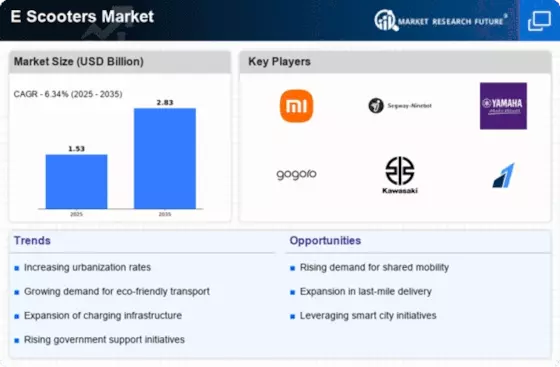
As per analysis, the MEA E Scooters Market is projected to grow from USD 1.54 Billion in 2025 to USD 2.83 Billion by 2035, exhibiting a compound annual growth rate (CAGR) of 6.34% during the forecast period (2025 - 2035).

Key Market Trends & Highlights

The MEA E Scooters Market is poised for substantial growth driven by urban mobility solutions and sustainability initiatives.

  • The GCC region emerges as the largest market for E scooters, reflecting a robust demand for personal mobility solutions.
  • South Africa is recognized as the fastest-growing region, indicating a rising trend in shared mobility options.
  • The personal mobility segment remains the largest, while the shared mobility segment is rapidly gaining traction in urban areas.
  • Urbanization and environmental awareness are key drivers propelling the market forward, alongside supportive government policies.

Market Size & Forecast

2024 Market Size 1.44 (USD Billion)
2035 Market Size 2.83 (USD Billion)
CAGR (2025 - 2035) 6.34%

Major Players

<p>Xiaomi (CN), Segway-Ninebot (CN), Yamaha (JP), Gogoro (TW), Kawasaki (JP), Razor (US), Super Soco (CN), E-Twow (RO), Inokim (IL)</p>

Market Trends

The MEA E Scooters Market is currently experiencing a notable transformation, driven by a confluence of urbanization, environmental awareness, and technological advancements. As cities across the Middle East and Africa grapple with increasing congestion and pollution, electric scooters emerge as a viable alternative for short-distance travel. This shift is further supported by government initiatives aimed at promoting sustainable transportation solutions. The integration of smart technologies into e-scooters enhances user experience, making them more appealing to a broader demographic. Furthermore, the rise of shared mobility services is reshaping urban transport dynamics, encouraging more individuals to consider e-scooters as a practical option for their daily commutes. In addition to the growing acceptance of e-scooters, the MEA region is witnessing a surge in infrastructure development tailored to support this mode of transport. Cities are increasingly investing in dedicated lanes and charging stations, which could potentially facilitate the widespread adoption of electric scooters. Moreover, the collaboration between private companies and local governments appears to be fostering an environment conducive to innovation and growth within the sector. As the MEA E Scooters Market continues to evolve, it is likely to play a pivotal role in shaping the future of urban mobility in the region, offering a sustainable and efficient alternative to traditional transportation methods.

Urban Mobility Solutions

The MEA E Scooters Market is increasingly recognized as a key player in addressing urban mobility challenges. As cities expand, the demand for efficient transportation options rises. E-scooters provide a flexible solution for short trips, reducing reliance on cars and alleviating traffic congestion. This trend is particularly evident in metropolitan areas where public transport systems may be insufficient to meet the needs of growing populations.

Sustainability Initiatives

Environmental concerns are driving the MEA E Scooters Market towards more sustainable practices. Governments in the region are implementing policies that encourage the use of electric vehicles, including e-scooters. This focus on sustainability not only aims to reduce carbon emissions but also promotes cleaner air quality in urban centers. The alignment of e-scooter adoption with national sustainability goals suggests a promising future for this market.

Technological Integration

The integration of advanced technologies into e-scooters is transforming the MEA E Scooters Market. Features such as GPS tracking, mobile app connectivity, and smart locking mechanisms enhance user convenience and safety. This technological evolution is likely to attract a wider audience, including tech-savvy individuals who prioritize innovation in their transportation choices.

middle-east-and-africa Electric Scooter Market Market Drivers

Technological Advancements

Technological innovation plays a crucial role in shaping the MEA E Scooters Market. The integration of advanced features such as smart connectivity, GPS tracking, and enhanced battery technology is transforming the e-scooter landscape. In 2025, the introduction of IoT-enabled e-scooters has allowed users to monitor their rides in real-time, improving safety and user experience. Furthermore, advancements in battery technology have led to longer ranges and shorter charging times, making e-scooters more appealing to consumers. As technology continues to evolve, it is expected that the MEA E Scooters Market will witness increased competition among manufacturers, driving further innovation and attracting a broader customer base.

Investment in Infrastructure

The development of infrastructure tailored for e-scooters is a critical driver for the MEA E Scooters Market. As cities recognize the need for sustainable transport solutions, investments in dedicated lanes, parking facilities, and charging stations are becoming more prevalent. In 2025, several MEA cities announced plans to expand their infrastructure to accommodate the growing number of e-scooters on the roads. This investment not only enhances the safety and convenience of e-scooter usage but also encourages more individuals to adopt this mode of transport. As infrastructure continues to improve, the MEA E Scooters Market is likely to experience robust growth, driven by increased accessibility and user-friendly environments.

Urbanization and Population Growth

The rapid urbanization in the Middle East and Africa (MEA) is a pivotal driver for the MEA E Scooters Market. As cities expand and populations increase, the demand for efficient and convenient transportation solutions rises. Urban areas are experiencing a surge in traffic congestion, prompting consumers to seek alternatives to traditional vehicles. In 2025, urban areas in MEA accounted for over 60 percent of the total population, indicating a substantial market potential for e-scooters. This trend is likely to continue, as urban centers strive to accommodate growing populations while minimizing environmental impact. Consequently, the MEA E Scooters Market is positioned to benefit from this demographic shift, as e-scooters offer a practical solution for short-distance travel, thereby enhancing urban mobility.

Government Policies and Regulations

Government initiatives across the MEA region are increasingly favoring the adoption of electric scooters, significantly influencing the MEA E Scooters Market. Various countries are implementing policies aimed at reducing carbon emissions and promoting sustainable transportation. For instance, in 2025, several MEA nations introduced subsidies for electric vehicles, including e-scooters, to encourage their use. Additionally, regulatory frameworks are being established to ensure safety and operational standards for e-scooter usage in urban areas. These supportive measures not only enhance consumer confidence but also stimulate market growth by making e-scooters more accessible and affordable. As governments continue to prioritize green transportation solutions, the MEA E Scooters Market is likely to experience accelerated expansion.

Environmental Awareness and Sustainability

Growing environmental consciousness among consumers is a significant driver for the MEA E Scooters Market. As awareness of climate change and pollution rises, individuals are increasingly seeking eco-friendly transportation options. E-scooters, being electric and often powered by renewable energy sources, present a sustainable alternative to traditional gasoline-powered vehicles. In 2025, surveys indicated that over 70 percent of consumers in major MEA cities expressed a preference for sustainable transport solutions. This shift in consumer behavior is likely to propel the demand for e-scooters, as they align with the values of environmentally conscious individuals. Consequently, the MEA E Scooters Market stands to gain from this trend, as more consumers opt for greener modes of transportation.

Market Segment Insights

By Application: Personal Mobility (Largest) vs. Shared Mobility (Fastest-Growing)

<p>In the MEA E Scooters Market, the application segment showcases a noteworthy split among its key values, with Personal Mobility leading the market share due to rising urban congestion and a shift towards sustainable transport solutions. Shared Mobility is quickly gaining traction, particularly in metropolitan areas, as consumers increasingly prefer convenience and cost-effectiveness in urban transit. Delivery Services and Recreational Use follow, appealing to niche segments and lifestyle preferences. The growth forecast for the Application segment indicates strong momentum, driven by government initiatives promoting eco-friendly transport and demographic shifts towards urban living. Personal Mobility continues to thrive as individuals seek efficient personal transport alternatives, while Shared Mobility is fueled by the adoption of mobility-as-a-service (MaaS) models. The expanding e-commerce landscape also enhances the Delivery Services segment, reflecting changing consumer behavior during the pandemic. Recreational Use remains stable, appealing to leisure-driven consumers eager for eco-friendly alternatives.</p>

<p>Personal Mobility (Dominant) vs. Delivery Services (Emerging)</p>

<p>Within the MEA E Scooters Market, Personal Mobility stands as the dominant application due to its widespread adoption for daily commuting needs. This segment attracts consumers seeking an environmentally friendly transport solution that easily navigates through traffic and contributes to a reduction in carbon emissions. The convenience of e scooters for short to medium-distance journeys caters to urban dwellers' fast-paced lifestyles. On the other hand, Delivery Services is emerging as a significant market player driven by the rapid expansion of e-commerce. Companies are investing in e scooters to enhance last-mile delivery efficiency, offering speed and flexibility that traditional delivery methods cannot match. This segment leverages an increasing demand for quick delivery services, reinforcing its potential for growth in the coming years.</p>

By Battery Type: Lithium-ion Battery (Largest) vs. Lead-acid Battery (Fastest-Growing)

<p>In the MEA E Scooters Market, lithium-ion batteries dominate the battery type segment, leveraging their superior energy density, lighter weight, and longer lifespan compared to other options. It's widely adopted by e-scooter manufacturers due to their ability to provide efficient and reliable power, thereby constituting a significant portion of the market share. On the other hand, lead-acid batteries, although traditionally used, are continuously being replaced by more advanced technologies; however, they still remain a prominent choice for budget-conscious consumers. The growth trends in the battery segment are driven by advancements in technology and increasing adoption of electric scooters across the Middle East and Africa. Lithium-ion batteries are fueled by rising demand for sustainable and efficient energy solutions, while lead-acid batteries are experiencing a revival due to their affordability, making them suitable for entry-level e-scooter models. Moreover, regulatory incentives for electric mobility are bolstering both segments’ growth.</p>

<p>Lithium-ion Battery (Dominant) vs. Lead-acid Battery (Emerging)</p>

<p>Lithium-ion batteries are recognized as the dominant force in the MEA E Scooters Market, celebrated for their energy efficiency, reduced weight, and reusability. Despite higher costs, their longevity and performance capabilities have led manufacturers to favor them, ensuring a robust and dependable power supply for e-scooters. Conversely, lead-acid batteries are emerging as a cost-effective alternative, appealing to entry-level e-scooter buyers. While they are heavier and less efficient than lithium-ion counterparts, their lower price point makes them attractive for certain market segments, thus sustaining their relevance in the evolving landscape of the e-scooter industry.</p>

By Vehicle Type: Kick Scooters (Largest) vs. Foldable Scooters (Fastest-Growing)

<p>In the MEA E Scooters Market, Kick Scooters hold the largest share, appealing to a broad range of consumers due to their simplicity and effectiveness for short commutes. Standing Scooters also represent a significant portion of the market, particularly among younger urban riders. Meanwhile, Foldable Scooters are gaining attention for their convenience and portability, making them a favored choice for individuals who need to combine multiple modes of transportation.</p>

<p>Kick Scooters (Dominant) vs. Foldable Scooters (Emerging)</p>

<p>Kick Scooters dominate the MEA E Scooters Market due to their established presence and widespread acceptance among users for daily commuting. They are typically designed for stability and ease of use, attracting both youths and adults. In contrast, Foldable Scooters are emerging rapidly, appealing to tech-savvy consumers who prioritize storage and transport convenience. The growth of Foldable Scooters can be attributed to urbanization trends and the increasing demand for energy-efficient travel options in crowded cities.</p>

By Charging Infrastructure: Home Charging Stations (Largest) vs. Fast Charging Solutions (Fastest-Growing)

<p>In the MEA E Scooters Market, the distribution of charging infrastructure reveals that Home Charging Stations hold a commanding presence, catering to consumer preferences for convenient, at-home charging solutions. This segment benefits from the growing number of e-scooter owners looking for accessible and cost-effective charging options. In contrast, Public Charging Stations and Fast Charging Solutions are emerging to meet the demands of urban users and those requiring rapid charging capabilities, but they currently represent a smaller market share overall.</p>

<p>Home Charging Stations (Dominant) vs. Fast Charging Solutions (Emerging)</p>

<p>Home Charging Stations are characterized by their convenience, with users able to charge their e-scooters overnight in the comfort of their homes, thus promoting frequent use. This segment is particularly favored in residential areas and contributes significantly to the overall adoption of e-scooters in the MEA region. Meanwhile, Fast Charging Solutions, while currently an emerging trend, are gaining traction among users who prioritize quick turnaround times for charging. This need is driven by the fast-paced lifestyle in urban areas, where immediate access to power can significantly enhance the user experience.</p>

By Regulatory Framework: Safety Standards (Largest) vs. Environmental Regulations (Fastest-Growing)

<p>In the MEA E Scooters Market, the regulatory framework plays a critical role in shaping market dynamics. Safety standards account for the largest share of regulatory initiatives, ensuring that e-scooters meet essential safety protocols and guidelines. In contrast, environmental regulations are gaining momentum as governments increasingly focus on sustainability and reducing carbon footprints, making it the fastest-growing aspect of regulation in this segment. These regulations not only shape consumer confidence but also influence the design and manufacturing processes of e-scooters. The growth trends in this segment are driven by heightened awareness of safety among consumers and regulatory bodies alike, leading to stricter enforcement of safety standards. Moreover, the rise in urbanization and the push towards greener transportation options are compelling market players to adapt to new environmental regulations. Governments in the MEA region are actively promoting policies to facilitate e-scooter usage, creating a balanced regulatory environment that fosters growth while ensuring safety and sustainability are prioritized.</p>

<p>Safety Standards: Compliance (Dominant) vs. Licensing Requirements (Emerging)</p>

<p>In the context of the MEA E Scooters Market, compliance with safety standards is the dominant segment value, characterized by stringent requirements set forth by authorities to ensure that e-scooters are safe for public use. These requirements not only cover the structural integrity and operational safety of the scooters but also mandate user safety gear. On the other hand, licensing requirements represent an emerging trend that is gaining traction among regulators. While still in the development phase in many regions, these requirements focus on ensuring that e-scooter users have the necessary knowledge and skills to operate vehicles safely, thus enhancing public safety and decreasing accidents. As more regions adopt licensing frameworks, the licensing requirements are likely to see accelerated growth, encouraging responsible e-scooter usage.</p>

Get more detailed insights about Middle East & Africa Electric Scooter Market Research Report—Forecast till 2035

Regional Insights

GCC : Rapid Growth and Urban Mobility

The GCC region holds a commanding market share of 72% in the MEA e-scooter market as of January 2026, driven by urbanization and a growing emphasis on sustainable transport. Key growth drivers include government initiatives promoting electric mobility, favorable regulatory frameworks, and increasing consumer awareness of eco-friendly transportation. Cities like Dubai and Riyadh are investing heavily in infrastructure to support e-scooter usage, including dedicated lanes and charging stations, enhancing accessibility and convenience for users. In the GCC, major markets include the UAE and Saudi Arabia, where the competitive landscape features prominent players like Xiaomi and Segway-Ninebot. The business environment is characterized by a mix of local startups and established international brands, fostering innovation and competition. The demand for e-scooters is particularly strong among urban commuters and tourists, with applications in last-mile connectivity and leisure activities.

South Africa : Urban Mobility and Sustainability Focus

South Africa captures a 48% share of the MEA e-scooter market, reflecting a growing trend towards urban mobility solutions. Key growth drivers include rising fuel prices, urban congestion, and a shift towards sustainable transport options. Government initiatives, such as the National Land Transport Act, are encouraging the adoption of e-scooters, while cities like Johannesburg and Cape Town are enhancing infrastructure to support this mode of transport. Key markets in South Africa include Gauteng and the Western Cape, where competition is intensifying among local and international players like Razor and Super Soco. The local market dynamics are influenced by a burgeoning middle class seeking affordable transport solutions. E-scooters are increasingly being used for short commutes and deliveries, reflecting a shift in consumer behavior towards more sustainable and efficient transport options.

Rest of MEA : Diverse Opportunities and Challenges

The Rest of MEA holds a 24% market share in the e-scooter sector, with significant potential for growth driven by urbanization and increasing environmental awareness. Key growth drivers include government policies aimed at reducing carbon emissions and the rising popularity of shared mobility services. Countries like Kenya and Egypt are beginning to invest in e-scooter infrastructure, although challenges remain in terms of regulatory frameworks and market acceptance. Key markets in this sub-region include Nairobi and Cairo, where local startups are emerging alongside established brands like Inokim and E-Twow. The competitive landscape is diverse, with a mix of international players and local innovators. The business environment is evolving, with increasing interest from investors in the e-scooter sector, particularly in urban areas where traffic congestion is a pressing issue. E-scooters are being adopted for both personal use and shared mobility services, indicating a shift in consumer preferences.

Key Players and Competitive Insights

The E Scooters Market is currently characterized by a dynamic competitive landscape, driven by increasing urbanization, environmental concerns, and a growing demand for sustainable transportation solutions. Key players such as Xiaomi (CN), Segway-Ninebot (CN), and Yamaha (JP) are actively shaping the market through innovative product offerings and strategic partnerships. Xiaomi (CN) focuses on integrating smart technology into its scooters, enhancing user experience and connectivity, while Segway-Ninebot (CN) emphasizes its extensive distribution network and product diversification. Yamaha (JP) is leveraging its expertise in electric mobility to expand its product line, indicating a strong commitment to innovation and market responsiveness. Collectively, these strategies contribute to a competitive environment that is increasingly centered around technological advancement and consumer-centric solutions.

In terms of business tactics, companies are localizing manufacturing to reduce costs and improve supply chain efficiency. This approach appears to be particularly relevant in the context of fluctuating global supply chains. The market structure is moderately fragmented, with several players vying for market share, yet the influence of major companies remains substantial. The collective actions of these key players are likely to shape market dynamics, as they compete not only on price but also on technological innovation and customer engagement.

In December 2025, Xiaomi (CN) announced the launch of its latest e-scooter model, which features advanced AI capabilities for enhanced safety and navigation. This strategic move underscores Xiaomi's commitment to innovation and positions the company to capture a larger share of the tech-savvy consumer segment. The integration of AI technology is expected to differentiate Xiaomi's offerings in a crowded market, potentially leading to increased sales and brand loyalty.

In November 2025, Segway-Ninebot (CN) entered into a partnership with a leading ride-sharing platform to provide e-scooter rentals in urban areas. This collaboration is indicative of a broader trend towards shared mobility solutions, which may enhance Segway-Ninebot's market presence and accessibility. By aligning with a ride-sharing service, the company is likely to tap into a new customer base, thereby expanding its operational footprint and driving revenue growth.

In October 2025, Yamaha (JP) unveiled a new line of e-scooters designed specifically for urban commuting, featuring lightweight materials and energy-efficient technology. This launch reflects Yamaha's strategic focus on addressing the needs of urban commuters, who prioritize efficiency and sustainability. The introduction of these models may position Yamaha favorably against competitors, as urban consumers increasingly seek eco-friendly transportation options.

As of January 2026, current competitive trends in the E Scooters Market are heavily influenced by digitalization, sustainability, and the integration of AI technologies. Strategic alliances, such as partnerships between manufacturers and ride-sharing platforms, are reshaping the landscape, fostering innovation and expanding market reach. Looking ahead, competitive differentiation is expected to evolve, with a notable shift from price-based competition to a focus on technological innovation, supply chain reliability, and enhanced customer experiences. This transition may redefine market dynamics, compelling companies to invest in R&D and strategic collaborations to maintain a competitive edge.

Key Companies in the middle-east-and-africa Electric Scooter Market include

Industry Developments

Future Outlook

middle-east-and-africa Electric Scooter Market Future Outlook

The MEA E Scooters Market is projected to grow at a 6.34% CAGR from 2024 to 2035, driven by urbanization, sustainability initiatives, and technological advancements.

New opportunities lie in:

  • Expansion of subscription-based models for urban commuters.
  • Development of integrated charging infrastructure in urban areas.
  • Partnerships with local governments for smart city initiatives.

By 2035, the MEA E Scooters Market is expected to be robust, driven by innovative business models and strategic partnerships.

Market Segmentation

middle-east-and-africa Electric Scooter Market Application Outlook

  • Personal Mobility
  • Shared Mobility
  • Delivery Services
  • Recreational Use

middle-east-and-africa Electric Scooter Market Battery Type Outlook

  • Lithium-ion Battery
  • Lead-acid Battery
  • Nickel Metal Hydride Battery

middle-east-and-africa Electric Scooter Market Vehicle Type Outlook

  • Kick Scooters
  • Standing Scooters
  • Foldable Scooters
  • Three-Wheeled Scooters

middle-east-and-africa Electric Scooter Market Regulatory Framework Outlook

  • Safety Standards
  • Environmental Regulations
  • Licensing Requirements

middle-east-and-africa Electric Scooter Market Charging Infrastructure Outlook

  • Home Charging Stations
  • Public Charging Stations
  • Fast Charging Solutions

Report Scope

MARKET SIZE 20241.44(USD Billion)
MARKET SIZE 20251.54(USD Billion)
MARKET SIZE 20352.83(USD Billion)
COMPOUND ANNUAL GROWTH RATE (CAGR)6.34% (2024 - 2035)
REPORT COVERAGERevenue Forecast, Competitive Landscape, Growth Factors, and Trends
BASE YEAR2024
Market Forecast Period2025 - 2035
Historical Data2019 - 2024
Market Forecast UnitsUSD Billion
Key Companies ProfiledXiaomi (CN), Segway-Ninebot (CN), Yamaha (JP), Gogoro (TW), Kawasaki (JP), Razor (US), Super Soco (CN), E-Twow (RO), Inokim (IL)
Segments CoveredApplication, Battery Type, Vehicle Type, Charging Infrastructure, Regulatory Framework
Key Market OpportunitiesGrowing demand for sustainable urban mobility solutions drives innovation in the MEA E Scooters Market.
Key Market DynamicsRising consumer demand for eco-friendly transportation drives innovation and competition in the MEA E Scooters Market.
Countries CoveredGCC Countries, South Africa, Rest of MEA

FAQs

What is the current valuation of the MEA E Scooters Market?

<p>As of 2024, the MEA E Scooters Market was valued at 1.44 USD Billion.</p>

What is the projected market size for the MEA E Scooters Market by 2035?

<p>The market is expected to reach a valuation of 2.83 USD Billion by 2035.</p>

What is the expected CAGR for the MEA E Scooters Market during the forecast period?

<p>The expected CAGR for the MEA E Scooters Market from 2025 to 2035 is 6.34%.</p>

Which application segments are driving the MEA E Scooters Market?

<p>The key application segments include Personal Mobility, Shared Mobility, Delivery Services, and Recreational Use, with valuations ranging from 0.24 to 0.95 USD Billion.</p>

What types of batteries are predominantly used in the MEA E Scooters Market?

<p>The market primarily utilizes Lithium-ion Batteries, Lead-acid Batteries, and Nickel Metal Hydride Batteries, with valuations from 0.24 to 1.6 USD Billion.</p>

What vehicle types are most popular in the MEA E Scooters Market?

Kick Scooters, Standing Scooters, Foldable Scooters, and Three-Wheeled Scooters are the main vehicle types, with valuations between 0.24 and 0.95 USD Billion.

How is the charging infrastructure evolving in the MEA E Scooters Market?

Charging infrastructure is expanding, with Home Charging Stations, Public Charging Stations, and Fast Charging Solutions valued between 0.34 and 1.2 USD Billion.

What regulatory frameworks are influencing the MEA E Scooters Market?

The market is shaped by Safety Standards, Environmental Regulations, and Licensing Requirements, with valuations ranging from 0.4 to 1.08 USD Billion.

Who are the key players in the MEA E Scooters Market?

Key players include Xiaomi, Segway-Ninebot, Yamaha, Gogoro, Kawasaki, Razor, Super Soco, E-Twow, and Inokim.

What trends are expected to shape the MEA E Scooters Market in the coming years?

Trends likely to shape the market include advancements in battery technology, increased demand for shared mobility solutions, and evolving regulatory standards.

  1. SECTION I: EXECUTIVE SUMMARY AND KEY HIGHLIGHTS
    1. | 1.1 EXECUTIVE SUMMARY
  2. SECTION II: SCOPING, METHODOLOGY AND MARKET STRUCTURE
    1. | 2.1 MARKET INTRODUCTION
    2. | 2.2 RESEARCH METHODOLOGY
  3. SECTION III: QUALITATIVE ANALYSIS
    1. | 3.1 MARKET DYNAMICS
    2. | 3.2 MARKET FACTOR ANALYSIS
  4. SECTION IV: QUANTITATIVE ANALYSIS
    1. | 4.1 Automobile, BY Application (USD Billion)
    2. | 4.2 Automobile, BY Battery Type (USD Billion)
    3. | 4.3 Automobile, BY Vehicle Type (USD Billion)
    4. | 4.4 Automobile, BY Charging Infrastructure (USD Billion)
    5. | 4.5 Automobile, BY Regulatory Framework (USD Billion)
  5. SECTION V: COMPETITIVE ANALYSIS
    1. | 5.1 Competitive Landscape
    2. | 5.2 Company Profiles
    3. | 5.3 Appendix

Middle East & Africa Electric Scooter Market Segmentation

Market Segmentation Overview

  • Detailed segmentation data will be available in the full report
  • Comprehensive analysis by multiple parameters
  • Regional and country-level breakdowns
  • Market size forecasts by segment
Infographic

Free Sample Request

Kindly complete the form below to receive a free sample of this Report

Get Free Sample

Customer Strories

Compare Licence

×
Features License Type
Single User Multiuser License Enterprise User
Price $4,950 $5,950 $7,250
Maximum User Access Limit 1 User Upto 10 Users Unrestricted Access Throughout the Organization
Free Customization
Direct Access to Analyst
Deliverable Format
Platform Access
Discount on Next Purchase 10% 15% 15%
Printable Versions