
Request Free Sample ×

Kindly complete the form below to receive a free sample of this Report

* Please use a valid business email

Leading companies partner with us for data-driven Insights

clients tt-cursor
Hero Background
English
Chinese
French
Japanese
Korean
German
Spanish

Mid Wave Infrared MWIR Sensors Market Analysis

ID: MRFR/SEM/9935-CR
188 Pages
Ankit Gupta
March 2023

Mid-Wave Infrared (MWIR) Sensors Market Size, Share and Research Report By Type (Cooled Mid-Wave Infrared (MWIR) Sensors and High Operating Temperature (HOT) Mid-Wave Infrared (MWIR) Sensors), Application (Aerospace & Defense and Commercial), and By Region (North America, Europe, Asia-Pacific, Middle East & Africa, and South America) - Industry Forecast Till 2035

Share:
Download PDF ×

We do not share your information with anyone. However, we may send you emails based on your report interest from time to time. You may contact us at any time to opt-out.

Mid Wave Infrared MWIR Sensors Market Infographic
Purchase Options

Market Analysis

In-depth Analysis of Mid Wave Infrared MWIR Sensors Market Industry Landscape

Everything with a temperature above absolute zero gives off infrared radiation. This radiation increases with the object's temperature, and we can use infrared sensors on unmanned vehicles like drones, specifically UAVs (unmanned aerial vehicles), to detect these temperature changes and create images. To capture both thermal and visual data during a flight, we attach infrared (IR) cameras to the same autonomous vehicle. These cameras are usually paired with a multi-axis gimbal, which helps maintain stability during image capture, reducing the impact of vibrations, sudden movements, and impacts. Some drone manufacturers offer complete thermal imaging systems, including the UAV, stabilizing gimbal, and imaging payload.

Unmanned infrared imaging systems have various applications, such as searching for and monitoring humans for security, search and rescue operations, and law enforcement. They are also used for wildlife conservation, helping monitor animals. Additionally, IR imaging systems are handy for detecting gas leaks and insulation problems and keeping track of thermal energy flow in homes or industrial buildings. Drones equipped with an infrared imaging camera can efficiently inspect large arrays of solar panels for any defects.

As technology in this fascinating field progresses, drone pilots are discovering new ways to utilize thermal imaging sensors. Drones with thermal cameras are now commonly employed to enhance the performance of solar plants, keep tabs on and inspect livestock, identify thermal runaway switches on electrical supply lines, check mine infrastructure, maintain agricultural systems, and contribute to search and rescue efforts. With the ongoing advancement of drone technology and the exploration of new applications in various industries, the use cases for drones with thermal cameras are only expected to grow.

In simple terms, when things are not too cold, they give off a type of light that we can't see, called infrared radiation. Drones, which are unmanned flying vehicles, use special sensors to detect this invisible light. By putting cameras on these drones that can capture both normal and this invisible light, we can get a better understanding of what's happening in different situations. For example, drones with these special cameras can be used to find people for security reasons, help in rescue missions, or even keep an eye on animals for their protection. The cameras on these drones can also help in practical tasks like finding problems with gas pipes or checking if a house is using energy efficiently.

As technology improves, the people who fly these drones are finding more and more ways to use them. Drones with special cameras are now commonly used to make sure solar power plants work well, check on animals like cows and sheep, look for issues with electrical lines, inspect mines, help with farming, and even assist in finding missing people. As technology keeps getting better and more industries find useful ways for these flying cameras, we can expect to see drones with special cameras doing even more important tasks in the future.


Author
Author Profile
Ankit Gupta
Team Lead - Research

Ankit Gupta is a seasoned market intelligence and strategic research professional with over six plus years of experience in the ICT and Semiconductor industries. With academic roots in Telecom, Marketing, and Electronics, he blends technical insight with business strategy. Ankit has led 200+ projects, including work for Fortune 500 clients like Microsoft and Rio Tinto, covering market sizing, tech forecasting, and go-to-market strategies. Known for bridging engineering and enterprise decision-making, his insights support growth, innovation, and investment planning across diverse technology markets.

Leave a Comment

FAQs

What is the projected market valuation for the Global Mid-Wave Infrared (MWIR) Sensors Market in 2035?

<p>The projected market valuation for the Global Mid-Wave Infrared (MWIR) Sensors Market in 2035 is 7.741 USD Billion.</p>

What was the market valuation of the Global Mid-Wave Infrared (MWIR) Sensors Market in 2024?

<p>The market valuation of the Global Mid-Wave Infrared (MWIR) Sensors Market in 2024 was 2.881 USD Billion.</p>

What is the expected CAGR for the Global Mid-Wave Infrared (MWIR) Sensors Market during the forecast period 2025 - 2035?

<p>The expected CAGR for the Global Mid-Wave Infrared (MWIR) Sensors Market during the forecast period 2025 - 2035 is 9.4%.</p>

Which companies are considered key players in the Global Mid-Wave Infrared (MWIR) Sensors Market?

<p>Key players in the Global Mid-Wave Infrared (MWIR) Sensors Market include FLIR Systems, Raytheon Technologies, Thales Group, and Leonardo S.p.A.</p>

What are the two main types of Mid-Wave Infrared (MWIR) Sensors and their market values?

The two main types of Mid-Wave Infrared (MWIR) Sensors are Cooled MWIR Sensors and High Operating Temperature (HOT) MWIR Sensors, each valued at 3.8705 USD Billion in 2035.

What applications are driving the demand for Mid-Wave Infrared (MWIR) Sensors?

The primary applications driving demand for Mid-Wave Infrared (MWIR) Sensors are Aerospace &amp; Defense and Commercial sectors, with projected values of 3.8835 USD Billion and 3.8575 USD Billion respectively in 2035.

How did the market for Cooled Mid-Wave Infrared (MWIR) Sensors perform in 2024?

In 2024, the market for Cooled Mid-Wave Infrared (MWIR) Sensors was valued at 1.4405 USD Billion.

What is the anticipated growth trend for the Aerospace & Defense application segment of MWIR Sensors?

The Aerospace &amp; Defense application segment of MWIR Sensors is anticipated to grow to 3.8835 USD Billion by 2035.

What factors contribute to the growth of the Global Mid-Wave Infrared (MWIR) Sensors Market?

Factors contributing to the growth of the Global Mid-Wave Infrared (MWIR) Sensors Market include advancements in sensor technology and increasing demand in defense applications.

What was the market value for the Commercial application of Mid-Wave Infrared (MWIR) Sensors in 2024?

The market value for the Commercial application of Mid-Wave Infrared (MWIR) Sensors in 2024 was 1.4405 USD Billion.

Market Summary

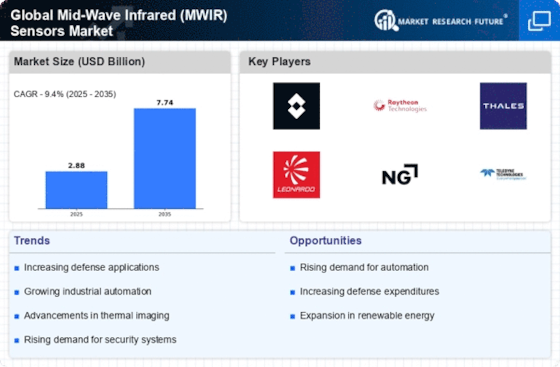
As per Market Research Future analysis, the Global Mid-Wave Infrared (MWIR) Sensors Market was estimated at 2.881 USD Billion in 2024. The MWIR sensors industry is projected to grow from 3.152 USD Billion in 2025 to 7.741 USD Billion by 2035, exhibiting a compound annual growth rate (CAGR) of 9.4% during the forecast period 2025 - 2035

Key Market Trends & Highlights

The Global Mid-Wave Infrared (MWIR) Sensors Market is poised for substantial growth driven by technological advancements and increasing applications across various sectors.

  • North America remains the largest market for MWIR sensors, primarily due to its robust defense and aerospace sectors.
  • The Asia-Pacific region is emerging as the fastest-growing market, fueled by rising industrialization and technological adoption.
  • Cooled MWIR sensors dominate the market, while High Operating Temperature MWIR sensors are witnessing rapid growth in demand.
  • Key market drivers include the rising adoption of MWIR sensors in industrial applications and the enhanced security and surveillance needs across various sectors.

Market Size & Forecast

2024 Market Size 2.881 (USD Billion)
2035 Market Size 7.741 (USD Billion)
CAGR (2025 - 2035) 9.4%
Largest Regional Market Share in 2024 North America

Major Players

FLIR Systems (US), Raytheon Technologies (US), Thales Group (FR), Leonardo S.p.A. (IT), Northrop Grumman (US), Teledyne Technologies (US), L3Harris Technologies (US), Sierra Nevada Corporation (US), Bae Systems (GB)

Market Trends

The Global Mid-Wave Infrared (MWIR) Sensors Market is currently experiencing a notable evolution, driven by advancements in technology and increasing applications across various sectors. These sensors, which operate within the mid-infrared spectrum, are becoming increasingly vital in fields such as defense, industrial monitoring, and environmental sensing. The growing demand for high-resolution imaging and precise temperature measurements is propelling the market forward. Furthermore, the integration of MWIR sensors into unmanned aerial vehicles and other advanced systems is enhancing their utility, suggesting a promising trajectory for future growth. In addition to technological advancements, the Global Mid-Wave Infrared (MWIR) Sensors Market is influenced by the rising emphasis on safety and security measures across industries. As organizations seek to improve their operational efficiency and ensure compliance with regulatory standards, the adoption of MWIR sensors is likely to increase. This trend is further supported by the ongoing development of innovative sensor designs that offer improved performance and reliability. Overall, the market appears poised for expansion, with various factors contributing to its dynamic landscape.

Technological Advancements

Recent innovations in sensor technology are enhancing the capabilities of MWIR sensors, leading to improved performance and efficiency. These advancements may include better resolution, sensitivity, and integration with other systems, which could broaden their applications.

Growing Demand in Defense Sector

The defense sector is increasingly adopting MWIR sensors for surveillance and reconnaissance purposes. This trend indicates a shift towards more sophisticated monitoring systems, which may drive further investment and development in this area.

Environmental Monitoring Applications

There is a rising interest in utilizing MWIR sensors for environmental monitoring, particularly in detecting pollutants and assessing climate change impacts. This trend suggests a potential expansion of the market into new sectors focused on sustainability.

Mid Wave Infrared MWIR Sensors Market Market Drivers

Growth in Automotive Sector

The automotive industry's shift towards advanced driver-assistance systems (ADAS) is contributing to the growth of the Mid-Wave Infrared (MWIR) Sensors Market. As vehicles increasingly incorporate thermal imaging for pedestrian detection, collision avoidance, and night vision, the demand for MWIR sensors is expected to rise. The automotive sector is projected to witness a compound annual growth rate of around 10% in the coming years, with MWIR sensors playing a crucial role in enhancing vehicle safety and performance. This trend indicates a promising future for MWIR technology within the automotive landscape.

Enhanced Security and Surveillance Needs

The escalating demand for advanced security and surveillance systems is likely to propel the Mid-Wave Infrared (MWIR) Sensors Market. With the rise in security threats and the need for effective monitoring solutions, MWIR sensors are being integrated into various security applications, including perimeter security and critical infrastructure protection. The market for security and surveillance is projected to grow significantly, with MWIR sensors providing superior imaging capabilities in low-light conditions. This trend suggests that the adoption of MWIR technology could become a standard in security systems, further driving market expansion.

Growing Demand for Non-Destructive Testing

The rising need for non-destructive testing (NDT) methods across various industries is emerging as a significant driver for the Mid-Wave Infrared (MWIR) Sensors Market. MWIR sensors are increasingly utilized in NDT applications for detecting material defects, thermal anomalies, and structural integrity assessments. Industries such as aerospace, automotive, and construction are adopting these technologies to ensure safety and compliance with regulatory standards. The NDT market is anticipated to expand, with MWIR sensors playing a pivotal role in enhancing inspection processes and reducing operational risks.

Rising Adoption in Industrial Applications

The increasing utilization of Mid-Wave Infrared (MWIR) sensors in various industrial applications appears to be a key driver for the MWIR Sensors Market. Industries such as manufacturing, oil and gas, and chemical processing are increasingly employing these sensors for temperature measurement, gas detection, and process monitoring. The ability of MWIR sensors to operate effectively in harsh environments enhances their appeal, potentially leading to a market growth rate of approximately 8% annually. This trend indicates a growing recognition of the benefits offered by MWIR technology in improving operational efficiency and safety standards.

Increasing Focus on Research and Development

The emphasis on research and development in the field of infrared technology is fostering innovation within the Mid-Wave Infrared (MWIR) Sensors Market. Various research institutions and companies are investing in the development of next-generation MWIR sensors that offer improved sensitivity, resolution, and miniaturization. This focus on R&D is likely to lead to the introduction of advanced products that cater to diverse applications, including medical imaging and environmental monitoring. The potential for breakthroughs in sensor technology may significantly influence market dynamics and drive growth.

Market Segment Insights

By Type: Cooled Mid-Wave Infrared (MWIR) Sensors (Largest) vs. High Operating Temperature (HOT) Mid-Wave Infrared (MWIR) Sensors (Fastest-Growing)

<p>In the Global Mid-Wave Infrared (MWIR) Sensors Market, cooled MWIR sensors currently hold the largest share, favored for their superior sensitivity and ability to detect faint thermal signals. This segment dominates applications in military and aerospace sectors, where precise imaging is crucial. Conversely, high operating temperature (HOT) MWIR sensors are rapidly gaining traction due to their cost-effectiveness and reduced need for complex cooling systems, making them appealing for commercial applications.</p>

<p>Cooled MWIR Sensors (Dominant) vs. HOT MWIR Sensors (Emerging)</p>

<p>Cooled mid-wave infrared (MWIR) sensors are known for their high sensitivity and performance, making them indispensable in critical areas like defense and surveillance. These sensors use cryogenic cooling technology to enhance thermal detection, thereby ensuring reliable functioning under challenging conditions. On the other hand, high operating temperature (HOT) MWIR sensors are emerging as a cost-efficient alternative; they operate effectively at higher temperatures, thus eliminating the need for external cooling. As industries seek versatile and economical solutions, HOT MWIR sensors are carving a niche in industrial and automotive applications, presenting strong growth potential.</p>

By Application: Aerospace & Defense (Largest) vs. Commercial (Fastest-Growing)

<p>The Global Mid-Wave Infrared (MWIR) Sensors Market exhibits a diverse distribution of market share between its primary application segments: Aerospace & Defense and Commercial. Aerospace & Defense holds the largest share, attributed to its critical use in surveillance, targeting, and reconnaissance systems. Meanwhile, the Commercial segment is rapidly gaining traction, driven by increasing demand from industries such as automotive and manufacturing for enhanced thermal imaging capabilities. This diversified application ensures a robust growth trajectory within the market.</p>

<p>Application: Aerospace & Defense (Dominant) vs. Commercial (Emerging)</p>

<p>Aerospace & Defense stands out as a dominant application segment for MWIR sensors, primarily due to the necessity for advanced thermal imaging in defense operations and aerospace applications. This sector relies heavily on high-performance sensors for missions involving night vision and surveillance, thus establishing strong growth foundations. In contrast, the Commercial segment is emerging as a notable player, propelled by rising investments in security and automation. Demand for intelligent monitoring solutions across sectors like transportation and energy efficiency enhances its growth potential, indicating a shift in application needs that could reshape market dynamics in the future.</p>

Get more detailed insights about Mid-Wave Infrared (MWIR) Sensors Market Research Report—Global Forecast till 2035

Regional Insights

North America : Technological Innovation Leader

North America is the largest market for Mid-Wave Infrared (MWIR) sensors, accounting for approximately 45% of the global market share. The region's growth is driven by increasing defense spending, advancements in sensor technology, and rising demand for surveillance and reconnaissance applications. Regulatory support from government agencies further catalyzes market expansion, ensuring compliance with safety and operational standards. The United States leads the North American market, with key players such as FLIR Systems, Raytheon Technologies, and Northrop Grumman dominating the landscape. The competitive environment is characterized by continuous innovation and strategic partnerships, enhancing product offerings. The presence of advanced research facilities and a skilled workforce further solidifies North America's position as a hub for MWIR sensor development.

Europe : Emerging Defense Technology Hub

Europe is witnessing significant growth in the Mid-Wave Infrared (MWIR) sensors market, holding approximately 30% of the global share. The demand is primarily driven by increasing defense budgets and the need for advanced surveillance systems. Regulatory frameworks, such as the European Defense Fund, are fostering innovation and collaboration among member states, enhancing the market's growth potential. Leading countries in this region include France, Germany, and the United Kingdom, with key players like Thales Group and Leonardo S.p.A. actively contributing to market advancements. The competitive landscape is marked by a focus on R&D and strategic alliances, ensuring that European manufacturers remain at the forefront of MWIR technology. The region's commitment to enhancing defense capabilities further supports market expansion.

Asia-Pacific : Rapidly Growing Market Potential

Asia-Pacific is rapidly emerging as a significant player in the Mid-Wave Infrared (MWIR) sensors market, accounting for about 20% of the global share. The growth is fueled by increasing military expenditures, urbanization, and the rising need for advanced surveillance systems. Countries in the region are investing heavily in defense modernization, which is expected to drive demand for MWIR sensors in the coming years. Key countries such as China, India, and Japan are leading the charge, with a growing number of local manufacturers entering the market. The competitive landscape is evolving, with both established players and new entrants focusing on innovation and cost-effective solutions. The presence of major global companies further enhances the region's market dynamics, making it a focal point for MWIR sensor development.

Middle East and Africa : Strategic Defense Investments

The Middle East and Africa region is witnessing a gradual increase in the Mid-Wave Infrared (MWIR) sensors market, holding approximately 5% of the global share. The growth is primarily driven by heightened security concerns and increased defense spending by various nations. Governments are prioritizing investments in advanced surveillance technologies to address regional security challenges, which is expected to boost market demand. Countries like the United Arab Emirates and South Africa are at the forefront of this market, with a growing emphasis on modernizing their defense capabilities. The competitive landscape is characterized by collaborations between local and international firms, enhancing the availability of advanced MWIR sensor technologies. As regional tensions persist, the demand for effective surveillance solutions is likely to continue rising.

Key Players and Competitive Insights

The Mid-Wave Infrared (MWIR) Sensors Market has witnessed significant growth over the forecast period due to an increase in demand for low-cost mid-IR sensors for consumer products and rapidly growing space exploration activities.Prior to now, low-cost optical sensing technology was primarily restricted to near-infrared (IR) and visible wavelengths; however, there is a growing demand for mid-IR wavelengths (2.5–25 m) equipped with low-cost optical sensing technology for applications such as thermal imaging spectroscopy, air quality monitoring, and consumer goods The use of mid-IR sensors in consumer products is one of these applications that is anticipated to offer profitable growth prospects to the main players. The composition of edible oils can be analyzed, and sugar and salt content in food can be monitored, among other uses for mid-IR sensors.Consumer goods around the world has experienced significant growth which is driving the demand for MWIR sensors market.Furthermore, there are several domestic, regional, and global players operating in the Mid-Wave Infrared (MWIR) Sensors Market who continuously strive to gain a significant share of the overall market. During the study, MRFR has analyzed some of the major players in the Mid-Wave Infrared (MWIR) Sensors Market who have contributed to the market growth. These include SemiConductor Devices, Teledyne FLIR LLC, Lynred, Leonardo S.p.A., GSTIR, Silent Sentinel, Ascendent Technology Group, Excelitas Technologies Corp., Opto Engineering, New Infrared Technologies (NIT), L3Harris Technologies, Inc., Sierra-Olympia Tech., InfraTec GmbH, Xenics NV, and Tech Imaging Services.December 2022 Photonis, a global pioneer in highly distinctive technology for the defence and industrial markets, announced the signing of a formal agreement to acquire Xenics. With the addition of Xenics to Photonis, the merged firm will be able to supply distinctive high-end imaging goods to their Business-to-Business customers by mastering component production, having a vast geographical reach, and having superior technological capabilities.

Key Companies in the Mid Wave Infrared MWIR Sensors Market include

Industry Developments

August 2022 Teledyne FLIR released Neutrino LC CZ 15-300, the latest Neutrino IS series model of mid-wavelength infrared (MWIR) camera modules with integrated continuous zoom (CZ) lenses. Designed for integrated solutions requiring crisp, long range, SD or HD MWIR imaging, the ITAR-free Neutrino IS series offers size, weight, power, and cost (SWaP+C) benefits to original equipment manufacturers (OEM) and system integrators for airborne, unmanned, C-UAS, security, ISR, and targeting applications.

September 2021 Lynred launched Galatea MW, one of the compact and low power consumptioninfrared (IR) detectors on the market. Its SWaP (Size, Weight, and Power) design enhances the autonomy and performance of battery powered devices. This enhances company’s product portfolio in MWIR segment.

July 2022 Silent Sentinel announced the addition of new full High-Definition (HD) cooled Mid-Wave Infrared (MWIR) thermal lenses to its product portfolio. Silent Sentinel has expanded its standard-definition product line to include HD-cooled MWIR thermal lenses with 1280 x 1024 resolution and 10m pixel pitch as standard, significantly improving the range performance of its camera platform offering.

Future Outlook

Mid Wave Infrared MWIR Sensors Market Future Outlook

The Global Mid-Wave Infrared (MWIR) Sensors Market is projected to grow at a 9.4% CAGR from 2025 to 2035, driven by advancements in defense applications, industrial automation, and environmental monitoring.

New opportunities lie in:

  • Development of advanced thermal imaging systems for security applications.
  • Integration of MWIR sensors in autonomous vehicles for enhanced navigation.
  • Expansion into emerging markets with tailored sensor solutions for local industries.

By 2035, the MWIR sensors market is expected to achieve substantial growth, solidifying its position as a key technology sector.

Market Segmentation

Mid Wave Infrared MWIR Sensors Market Type Outlook

  • Cooled Mid-Wave Infrared (MWIR) Sensors
  • High Operating Temperature (HOT) Mid-Wave Infrared (MWIR) Sensors

Mid Wave Infrared MWIR Sensors Market Application Outlook

  • Aerospace & Defense
  • Commercial

Report Scope

MARKET SIZE 2024 2.881(USD Billion)
MARKET SIZE 2025 3.152(USD Billion)
MARKET SIZE 2035 7.741(USD Billion)
COMPOUND ANNUAL GROWTH RATE (CAGR) 9.4% (2025 - 2035)
REPORT COVERAGE Revenue Forecast, Competitive Landscape, Growth Factors, and Trends
BASE YEAR 2024
Market Forecast Period 2025 - 2035
Historical Data 2019 - 2024
Market Forecast Units USD Billion
Key Companies Profiled FLIR Systems (US), Raytheon Technologies (US), Thales Group (FR), Leonardo S.p.A. (IT), Northrop Grumman (US), Teledyne Technologies (US), L3Harris Technologies (US), Sierra Nevada Corporation (US), Bae Systems (GB)
Segments Covered Type, Region
Key Market Opportunities Growing demand for advanced surveillance and monitoring applications drives innovation in the Global Mid-Wave Infrared (MWIR) Sensors Market.
Key Market Dynamics Rising demand for advanced surveillance systems drives innovation in Mid-Wave Infrared Sensors technology and applications.
Countries Covered North America, Europe, APAC, South America, MEA

FAQs

What is the projected market valuation for the Global Mid-Wave Infrared (MWIR) Sensors Market in 2035?

<p>The projected market valuation for the Global Mid-Wave Infrared (MWIR) Sensors Market in 2035 is 7.741 USD Billion.</p>

What was the market valuation of the Global Mid-Wave Infrared (MWIR) Sensors Market in 2024?

<p>The market valuation of the Global Mid-Wave Infrared (MWIR) Sensors Market in 2024 was 2.881 USD Billion.</p>

What is the expected CAGR for the Global Mid-Wave Infrared (MWIR) Sensors Market during the forecast period 2025 - 2035?

<p>The expected CAGR for the Global Mid-Wave Infrared (MWIR) Sensors Market during the forecast period 2025 - 2035 is 9.4%.</p>

Which companies are considered key players in the Global Mid-Wave Infrared (MWIR) Sensors Market?

<p>Key players in the Global Mid-Wave Infrared (MWIR) Sensors Market include FLIR Systems, Raytheon Technologies, Thales Group, and Leonardo S.p.A.</p>

What are the two main types of Mid-Wave Infrared (MWIR) Sensors and their market values?

The two main types of Mid-Wave Infrared (MWIR) Sensors are Cooled MWIR Sensors and High Operating Temperature (HOT) MWIR Sensors, each valued at 3.8705 USD Billion in 2035.

What applications are driving the demand for Mid-Wave Infrared (MWIR) Sensors?

The primary applications driving demand for Mid-Wave Infrared (MWIR) Sensors are Aerospace &amp; Defense and Commercial sectors, with projected values of 3.8835 USD Billion and 3.8575 USD Billion respectively in 2035.

How did the market for Cooled Mid-Wave Infrared (MWIR) Sensors perform in 2024?

In 2024, the market for Cooled Mid-Wave Infrared (MWIR) Sensors was valued at 1.4405 USD Billion.

What is the anticipated growth trend for the Aerospace & Defense application segment of MWIR Sensors?

The Aerospace &amp; Defense application segment of MWIR Sensors is anticipated to grow to 3.8835 USD Billion by 2035.

What factors contribute to the growth of the Global Mid-Wave Infrared (MWIR) Sensors Market?

Factors contributing to the growth of the Global Mid-Wave Infrared (MWIR) Sensors Market include advancements in sensor technology and increasing demand in defense applications.

What was the market value for the Commercial application of Mid-Wave Infrared (MWIR) Sensors in 2024?

The market value for the Commercial application of Mid-Wave Infrared (MWIR) Sensors in 2024 was 1.4405 USD Billion.

  1. SECTION I: EXECUTIVE SUMMARY AND KEY HIGHLIGHTS
    1. | 1.1 EXECUTIVE SUMMARY
    2. | | 1.1.1 Market Overview
    3. | | 1.1.2 Key Findings
    4. | | 1.1.3 Market Segmentation
    5. | | 1.1.4 Competitive Landscape
    6. | | 1.1.5 Challenges and Opportunities
    7. | | 1.1.6 Future Outlook
  2. SECTION II: SCOPING, METHODOLOGY AND MARKET STRUCTURE
    1. | 2.1 MARKET INTRODUCTION
    2. | | 2.1.1 Definition
    3. | | 2.1.2 Scope of the study
    4. | | | 2.1.2.1 Research Objective
    5. | | | 2.1.2.2 Assumption
    6. | | | 2.1.2.3 Limitations
    7. | 2.2 RESEARCH METHODOLOGY
    8. | | 2.2.1 Overview
    9. | | 2.2.2 Data Mining
    10. | | 2.2.3 Secondary Research
    11. | | 2.2.4 Primary Research
    12. | | | 2.2.4.1 Primary Interviews and Information Gathering Process
    13. | | | 2.2.4.2 Breakdown of Primary Respondents
    14. | | 2.2.5 Forecasting Model
    15. | | 2.2.6 Market Size Estimation
    16. | | | 2.2.6.1 Bottom-Up Approach
    17. | | | 2.2.6.2 Top-Down Approach
    18. | | 2.2.7 Data Triangulation
    19. | | 2.2.8 Validation
  3. SECTION III: QUALITATIVE ANALYSIS
    1. | 3.1 MARKET DYNAMICS
    2. | | 3.1.1 Overview
    3. | | 3.1.2 Drivers
    4. | | 3.1.3 Restraints
    5. | | 3.1.4 Opportunities
    6. | 3.2 MARKET FACTOR ANALYSIS
    7. | | 3.2.1 Value chain Analysis
    8. | | 3.2.2 Porter's Five Forces Analysis
    9. | | | 3.2.2.1 Bargaining Power of Suppliers
    10. | | | 3.2.2.2 Bargaining Power of Buyers
    11. | | | 3.2.2.3 Threat of New Entrants
    12. | | | 3.2.2.4 Threat of Substitutes
    13. | | | 3.2.2.5 Intensity of Rivalry
    14. | | 3.2.3 COVID-19 Impact Analysis
    15. | | | 3.2.3.1 Market Impact Analysis
    16. | | | 3.2.3.2 Regional Impact
    17. | | | 3.2.3.3 Opportunity and Threat Analysis
  4. SECTION IV: QUANTITATIVE ANALYSIS
    1. | 4.1 Semiconductor & Electronics, BY Type (USD Billion)
    2. | | 4.1.1 Cooled Mid-Wave Infrared (MWIR) Sensors
    3. | | 4.1.2 High Operating Temperature (HOT) Mid-Wave Infrared (MWIR) Sensors
    4. | 4.2 Semiconductor & Electronics, BY Application (USD Billion)
    5. | | 4.2.1 Aerospace & Defense
    6. | | 4.2.2 Commercial
    7. | 4.3 Semiconductor & Electronics, BY Region (USD Billion)
    8. | | 4.3.1 North America
    9. | | | 4.3.1.1 US
    10. | | | 4.3.1.2 Canada
    11. | | 4.3.2 Europe
    12. | | | 4.3.2.1 Germany
    13. | | | 4.3.2.2 UK
    14. | | | 4.3.2.3 France
    15. | | | 4.3.2.4 Russia
    16. | | | 4.3.2.5 Italy
    17. | | | 4.3.2.6 Spain
    18. | | | 4.3.2.7 Rest of Europe
    19. | | 4.3.3 APAC
    20. | | | 4.3.3.1 China
    21. | | | 4.3.3.2 India
    22. | | | 4.3.3.3 Japan
    23. | | | 4.3.3.4 South Korea
    24. | | | 4.3.3.5 Malaysia
    25. | | | 4.3.3.6 Thailand
    26. | | | 4.3.3.7 Indonesia
    27. | | | 4.3.3.8 Rest of APAC
    28. | | 4.3.4 South America
    29. | | | 4.3.4.1 Brazil
    30. | | | 4.3.4.2 Mexico
    31. | | | 4.3.4.3 Argentina
    32. | | | 4.3.4.4 Rest of South America
    33. | | 4.3.5 MEA
    34. | | | 4.3.5.1 GCC Countries
    35. | | | 4.3.5.2 South Africa
    36. | | | 4.3.5.3 Rest of MEA
  5. SECTION V: COMPETITIVE ANALYSIS
    1. | 5.1 Competitive Landscape
    2. | | 5.1.1 Overview
    3. | | 5.1.2 Competitive Analysis
    4. | | 5.1.3 Market share Analysis
    5. | | 5.1.4 Major Growth Strategy in the Semiconductor & Electronics
    6. | | 5.1.5 Competitive Benchmarking
    7. | | 5.1.6 Leading Players in Terms of Number of Developments in the Semiconductor & Electronics
    8. | | 5.1.7 Key developments and growth strategies
    9. | | | 5.1.7.1 New Product Launch/Service Deployment
    10. | | | 5.1.7.2 Merger & Acquisitions
    11. | | | 5.1.7.3 Joint Ventures
    12. | | 5.1.8 Major Players Financial Matrix
    13. | | | 5.1.8.1 Sales and Operating Income
    14. | | | 5.1.8.2 Major Players R&D Expenditure. 2023
    15. | 5.2 Company Profiles
    16. | | 5.2.1 FLIR Systems (US)
    17. | | | 5.2.1.1 Financial Overview
    18. | | | 5.2.1.2 Products Offered
    19. | | | 5.2.1.3 Key Developments
    20. | | | 5.2.1.4 SWOT Analysis
    21. | | | 5.2.1.5 Key Strategies
    22. | | 5.2.2 Raytheon Technologies (US)
    23. | | | 5.2.2.1 Financial Overview
    24. | | | 5.2.2.2 Products Offered
    25. | | | 5.2.2.3 Key Developments
    26. | | | 5.2.2.4 SWOT Analysis
    27. | | | 5.2.2.5 Key Strategies
    28. | | 5.2.3 Thales Group (FR)
    29. | | | 5.2.3.1 Financial Overview
    30. | | | 5.2.3.2 Products Offered
    31. | | | 5.2.3.3 Key Developments
    32. | | | 5.2.3.4 SWOT Analysis
    33. | | | 5.2.3.5 Key Strategies
    34. | | 5.2.4 Leonardo S.p.A. (IT)
    35. | | | 5.2.4.1 Financial Overview
    36. | | | 5.2.4.2 Products Offered
    37. | | | 5.2.4.3 Key Developments
    38. | | | 5.2.4.4 SWOT Analysis
    39. | | | 5.2.4.5 Key Strategies
    40. | | 5.2.5 Northrop Grumman (US)
    41. | | | 5.2.5.1 Financial Overview
    42. | | | 5.2.5.2 Products Offered
    43. | | | 5.2.5.3 Key Developments
    44. | | | 5.2.5.4 SWOT Analysis
    45. | | | 5.2.5.5 Key Strategies
    46. | | 5.2.6 Teledyne Technologies (US)
    47. | | | 5.2.6.1 Financial Overview
    48. | | | 5.2.6.2 Products Offered
    49. | | | 5.2.6.3 Key Developments
    50. | | | 5.2.6.4 SWOT Analysis
    51. | | | 5.2.6.5 Key Strategies
    52. | | 5.2.7 L3Harris Technologies (US)
    53. | | | 5.2.7.1 Financial Overview
    54. | | | 5.2.7.2 Products Offered
    55. | | | 5.2.7.3 Key Developments
    56. | | | 5.2.7.4 SWOT Analysis
    57. | | | 5.2.7.5 Key Strategies
    58. | | 5.2.8 Sierra Nevada Corporation (US)
    59. | | | 5.2.8.1 Financial Overview
    60. | | | 5.2.8.2 Products Offered
    61. | | | 5.2.8.3 Key Developments
    62. | | | 5.2.8.4 SWOT Analysis
    63. | | | 5.2.8.5 Key Strategies
    64. | | 5.2.9 Bae Systems (GB)
    65. | | | 5.2.9.1 Financial Overview
    66. | | | 5.2.9.2 Products Offered
    67. | | | 5.2.9.3 Key Developments
    68. | | | 5.2.9.4 SWOT Analysis
    69. | | | 5.2.9.5 Key Strategies
    70. | 5.3 Appendix
    71. | | 5.3.1 References
    72. | | 5.3.2 Related Reports
  6. LIST OF FIGURES
    1. | 6.1 MARKET SYNOPSIS
    2. | 6.2 NORTH AMERICA MARKET ANALYSIS
    3. | 6.3 US MARKET ANALYSIS BY TYPE
    4. | 6.4 US MARKET ANALYSIS BY APPLICATION
    5. | 6.5 CANADA MARKET ANALYSIS BY TYPE
    6. | 6.6 CANADA MARKET ANALYSIS BY APPLICATION
    7. | 6.7 EUROPE MARKET ANALYSIS
    8. | 6.8 GERMANY MARKET ANALYSIS BY TYPE
    9. | 6.9 GERMANY MARKET ANALYSIS BY APPLICATION
    10. | 6.10 UK MARKET ANALYSIS BY TYPE
    11. | 6.11 UK MARKET ANALYSIS BY APPLICATION
    12. | 6.12 FRANCE MARKET ANALYSIS BY TYPE
    13. | 6.13 FRANCE MARKET ANALYSIS BY APPLICATION
    14. | 6.14 RUSSIA MARKET ANALYSIS BY TYPE
    15. | 6.15 RUSSIA MARKET ANALYSIS BY APPLICATION
    16. | 6.16 ITALY MARKET ANALYSIS BY TYPE
    17. | 6.17 ITALY MARKET ANALYSIS BY APPLICATION
    18. | 6.18 SPAIN MARKET ANALYSIS BY TYPE
    19. | 6.19 SPAIN MARKET ANALYSIS BY APPLICATION
    20. | 6.20 REST OF EUROPE MARKET ANALYSIS BY TYPE
    21. | 6.21 REST OF EUROPE MARKET ANALYSIS BY APPLICATION
    22. | 6.22 APAC MARKET ANALYSIS
    23. | 6.23 CHINA MARKET ANALYSIS BY TYPE
    24. | 6.24 CHINA MARKET ANALYSIS BY APPLICATION
    25. | 6.25 INDIA MARKET ANALYSIS BY TYPE
    26. | 6.26 INDIA MARKET ANALYSIS BY APPLICATION
    27. | 6.27 JAPAN MARKET ANALYSIS BY TYPE
    28. | 6.28 JAPAN MARKET ANALYSIS BY APPLICATION
    29. | 6.29 SOUTH KOREA MARKET ANALYSIS BY TYPE
    30. | 6.30 SOUTH KOREA MARKET ANALYSIS BY APPLICATION
    31. | 6.31 MALAYSIA MARKET ANALYSIS BY TYPE
    32. | 6.32 MALAYSIA MARKET ANALYSIS BY APPLICATION
    33. | 6.33 THAILAND MARKET ANALYSIS BY TYPE
    34. | 6.34 THAILAND MARKET ANALYSIS BY APPLICATION
    35. | 6.35 INDONESIA MARKET ANALYSIS BY TYPE
    36. | 6.36 INDONESIA MARKET ANALYSIS BY APPLICATION
    37. | 6.37 REST OF APAC MARKET ANALYSIS BY TYPE
    38. | 6.38 REST OF APAC MARKET ANALYSIS BY APPLICATION
    39. | 6.39 SOUTH AMERICA MARKET ANALYSIS
    40. | 6.40 BRAZIL MARKET ANALYSIS BY TYPE
    41. | 6.41 BRAZIL MARKET ANALYSIS BY APPLICATION
    42. | 6.42 MEXICO MARKET ANALYSIS BY TYPE
    43. | 6.43 MEXICO MARKET ANALYSIS BY APPLICATION
    44. | 6.44 ARGENTINA MARKET ANALYSIS BY TYPE
    45. | 6.45 ARGENTINA MARKET ANALYSIS BY APPLICATION
    46. | 6.46 REST OF SOUTH AMERICA MARKET ANALYSIS BY TYPE
    47. | 6.47 REST OF SOUTH AMERICA MARKET ANALYSIS BY APPLICATION
    48. | 6.48 MEA MARKET ANALYSIS
    49. | 6.49 GCC COUNTRIES MARKET ANALYSIS BY TYPE
    50. | 6.50 GCC COUNTRIES MARKET ANALYSIS BY APPLICATION
    51. | 6.51 SOUTH AFRICA MARKET ANALYSIS BY TYPE
    52. | 6.52 SOUTH AFRICA MARKET ANALYSIS BY APPLICATION
    53. | 6.53 REST OF MEA MARKET ANALYSIS BY TYPE
    54. | 6.54 REST OF MEA MARKET ANALYSIS BY APPLICATION
    55. | 6.55 KEY BUYING CRITERIA OF SEMICONDUCTOR & ELECTRONICS
    56. | 6.56 RESEARCH PROCESS OF MRFR
    57. | 6.57 DRO ANALYSIS OF SEMICONDUCTOR & ELECTRONICS
    58. | 6.58 DRIVERS IMPACT ANALYSIS: SEMICONDUCTOR & ELECTRONICS
    59. | 6.59 RESTRAINTS IMPACT ANALYSIS: SEMICONDUCTOR & ELECTRONICS
    60. | 6.60 SUPPLY / VALUE CHAIN: SEMICONDUCTOR & ELECTRONICS
    61. | 6.61 SEMICONDUCTOR & ELECTRONICS, BY TYPE, 2024 (% SHARE)
    62. | 6.62 SEMICONDUCTOR & ELECTRONICS, BY TYPE, 2024 TO 2035 (USD Billion)
    63. | 6.63 SEMICONDUCTOR & ELECTRONICS, BY APPLICATION, 2024 (% SHARE)
    64. | 6.64 SEMICONDUCTOR & ELECTRONICS, BY APPLICATION, 2024 TO 2035 (USD Billion)
    65. | 6.65 BENCHMARKING OF MAJOR COMPETITORS
  7. LIST OF TABLES
    1. | 7.1 LIST OF ASSUMPTIONS
    2. | | 7.1.1
    3. | 7.2 North America MARKET SIZE ESTIMATES; FORECAST
    4. | | 7.2.1 BY TYPE, 2025-2035 (USD Billion)
    5. | | 7.2.2 BY APPLICATION, 2025-2035 (USD Billion)
    6. | 7.3 US MARKET SIZE ESTIMATES; FORECAST
    7. | | 7.3.1 BY TYPE, 2025-2035 (USD Billion)
    8. | | 7.3.2 BY APPLICATION, 2025-2035 (USD Billion)
    9. | 7.4 Canada MARKET SIZE ESTIMATES; FORECAST
    10. | | 7.4.1 BY TYPE, 2025-2035 (USD Billion)
    11. | | 7.4.2 BY APPLICATION, 2025-2035 (USD Billion)
    12. | 7.5 Europe MARKET SIZE ESTIMATES; FORECAST
    13. | | 7.5.1 BY TYPE, 2025-2035 (USD Billion)
    14. | | 7.5.2 BY APPLICATION, 2025-2035 (USD Billion)
    15. | 7.6 Germany MARKET SIZE ESTIMATES; FORECAST
    16. | | 7.6.1 BY TYPE, 2025-2035 (USD Billion)
    17. | | 7.6.2 BY APPLICATION, 2025-2035 (USD Billion)
    18. | 7.7 UK MARKET SIZE ESTIMATES; FORECAST
    19. | | 7.7.1 BY TYPE, 2025-2035 (USD Billion)
    20. | | 7.7.2 BY APPLICATION, 2025-2035 (USD Billion)
    21. | 7.8 France MARKET SIZE ESTIMATES; FORECAST
    22. | | 7.8.1 BY TYPE, 2025-2035 (USD Billion)
    23. | | 7.8.2 BY APPLICATION, 2025-2035 (USD Billion)
    24. | 7.9 Russia MARKET SIZE ESTIMATES; FORECAST
    25. | | 7.9.1 BY TYPE, 2025-2035 (USD Billion)
    26. | | 7.9.2 BY APPLICATION, 2025-2035 (USD Billion)
    27. | 7.10 Italy MARKET SIZE ESTIMATES; FORECAST
    28. | | 7.10.1 BY TYPE, 2025-2035 (USD Billion)
    29. | | 7.10.2 BY APPLICATION, 2025-2035 (USD Billion)
    30. | 7.11 Spain MARKET SIZE ESTIMATES; FORECAST
    31. | | 7.11.1 BY TYPE, 2025-2035 (USD Billion)
    32. | | 7.11.2 BY APPLICATION, 2025-2035 (USD Billion)
    33. | 7.12 Rest of Europe MARKET SIZE ESTIMATES; FORECAST
    34. | | 7.12.1 BY TYPE, 2025-2035 (USD Billion)
    35. | | 7.12.2 BY APPLICATION, 2025-2035 (USD Billion)
    36. | 7.13 APAC MARKET SIZE ESTIMATES; FORECAST
    37. | | 7.13.1 BY TYPE, 2025-2035 (USD Billion)
    38. | | 7.13.2 BY APPLICATION, 2025-2035 (USD Billion)
    39. | 7.14 China MARKET SIZE ESTIMATES; FORECAST
    40. | | 7.14.1 BY TYPE, 2025-2035 (USD Billion)
    41. | | 7.14.2 BY APPLICATION, 2025-2035 (USD Billion)
    42. | 7.15 India MARKET SIZE ESTIMATES; FORECAST
    43. | | 7.15.1 BY TYPE, 2025-2035 (USD Billion)
    44. | | 7.15.2 BY APPLICATION, 2025-2035 (USD Billion)
    45. | 7.16 Japan MARKET SIZE ESTIMATES; FORECAST
    46. | | 7.16.1 BY TYPE, 2025-2035 (USD Billion)
    47. | | 7.16.2 BY APPLICATION, 2025-2035 (USD Billion)
    48. | 7.17 South Korea MARKET SIZE ESTIMATES; FORECAST
    49. | | 7.17.1 BY TYPE, 2025-2035 (USD Billion)
    50. | | 7.17.2 BY APPLICATION, 2025-2035 (USD Billion)
    51. | 7.18 Malaysia MARKET SIZE ESTIMATES; FORECAST
    52. | | 7.18.1 BY TYPE, 2025-2035 (USD Billion)
    53. | | 7.18.2 BY APPLICATION, 2025-2035 (USD Billion)
    54. | 7.19 Thailand MARKET SIZE ESTIMATES; FORECAST
    55. | | 7.19.1 BY TYPE, 2025-2035 (USD Billion)
    56. | | 7.19.2 BY APPLICATION, 2025-2035 (USD Billion)
    57. | 7.20 Indonesia MARKET SIZE ESTIMATES; FORECAST
    58. | | 7.20.1 BY TYPE, 2025-2035 (USD Billion)
    59. | | 7.20.2 BY APPLICATION, 2025-2035 (USD Billion)
    60. | 7.21 Rest of APAC MARKET SIZE ESTIMATES; FORECAST
    61. | | 7.21.1 BY TYPE, 2025-2035 (USD Billion)
    62. | | 7.21.2 BY APPLICATION, 2025-2035 (USD Billion)
    63. | 7.22 South America MARKET SIZE ESTIMATES; FORECAST
    64. | | 7.22.1 BY TYPE, 2025-2035 (USD Billion)
    65. | | 7.22.2 BY APPLICATION, 2025-2035 (USD Billion)
    66. | 7.23 Brazil MARKET SIZE ESTIMATES; FORECAST
    67. | | 7.23.1 BY TYPE, 2025-2035 (USD Billion)
    68. | | 7.23.2 BY APPLICATION, 2025-2035 (USD Billion)
    69. | 7.24 Mexico MARKET SIZE ESTIMATES; FORECAST
    70. | | 7.24.1 BY TYPE, 2025-2035 (USD Billion)
    71. | | 7.24.2 BY APPLICATION, 2025-2035 (USD Billion)
    72. | 7.25 Argentina MARKET SIZE ESTIMATES; FORECAST
    73. | | 7.25.1 BY TYPE, 2025-2035 (USD Billion)
    74. | | 7.25.2 BY APPLICATION, 2025-2035 (USD Billion)
    75. | 7.26 Rest of South America MARKET SIZE ESTIMATES; FORECAST
    76. | | 7.26.1 BY TYPE, 2025-2035 (USD Billion)
    77. | | 7.26.2 BY APPLICATION, 2025-2035 (USD Billion)
    78. | 7.27 MEA MARKET SIZE ESTIMATES; FORECAST
    79. | | 7.27.1 BY TYPE, 2025-2035 (USD Billion)
    80. | | 7.27.2 BY APPLICATION, 2025-2035 (USD Billion)
    81. | 7.28 GCC Countries MARKET SIZE ESTIMATES; FORECAST
    82. | | 7.28.1 BY TYPE, 2025-2035 (USD Billion)
    83. | | 7.28.2 BY APPLICATION, 2025-2035 (USD Billion)
    84. | 7.29 South Africa MARKET SIZE ESTIMATES; FORECAST
    85. | | 7.29.1 BY TYPE, 2025-2035 (USD Billion)
    86. | | 7.29.2 BY APPLICATION, 2025-2035 (USD Billion)
    87. | 7.30 Rest of MEA MARKET SIZE ESTIMATES; FORECAST
    88. | | 7.30.1 BY TYPE, 2025-2035 (USD Billion)
    89. | | 7.30.2 BY APPLICATION, 2025-2035 (USD Billion)
    90. | 7.31 PRODUCT LAUNCH/PRODUCT DEVELOPMENT/APPROVAL
    91. | | 7.31.1
    92. | 7.32 ACQUISITION/PARTNERSHIP
    93. | | 7.32.1

Semiconductor & Electronics Market Segmentation

Semiconductor & Electronics By Type (USD Billion, 2025-2035)

  • Cooled Mid-Wave Infrared (MWIR) Sensors
  • High Operating Temperature (HOT) Mid-Wave Infrared (MWIR) Sensors

Semiconductor & Electronics By Application (USD Billion, 2025-2035)

  • Aerospace & Defense
  • Commercial
Infographic

Free Sample Request

Kindly complete the form below to receive a free sample of this Report

Get Free Sample

Customer Strories

Compare Licence

×
Features License Type
Single User Multiuser License Enterprise User
Price $4,950 $5,950 $7,250
Maximum User Access Limit 1 User Upto 10 Users Unrestricted Access Throughout the Organization
Free Customization
Direct Access to Analyst
Deliverable Format
Platform Access
Discount on Next Purchase 10% 15% 15%
Printable Versions
%>