×
Hero Background
English
Chinese
French
Japanese
Korean
German
Spanish

Microwavable Foods Market Size

ID: MRFR/FnB/10085-HCR
128 Pages
Garvit Vyas
October 2025

Microwavable Foods Market Research Report Information By Product (Shelf Stable Microwavable Food, Chilled Food, and Frozen Food), by Packaging Technology (Patterned Susceptors Technology, New Tray-lidding Methods, New Cook Bag Technique), by Distribution Channel (Hypermarkets/Supermarkets, Convenience Stores, Online Sales Channel, Others), And By Region (North America, Europe, Asia-Pacific, And Rest Of The World) –Market Forecast Till 2035

Share:
Download PDF ×

We do not share your information with anyone. However, we may send you emails based on your report interest from time to time. You may contact us at any time to opt-out.

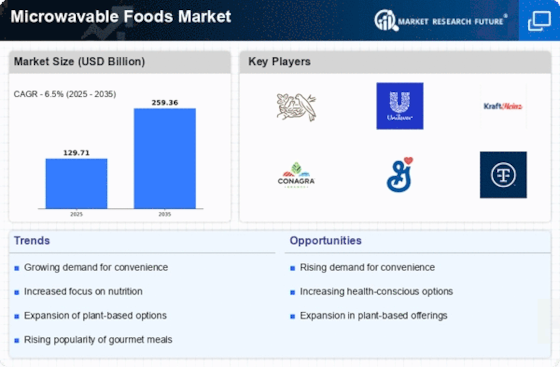
Microwavable Foods Market Infographic
Purchase Options

Microwavable Foods Size

Microwavable Foods Market Growth Projections and Opportunities

The Microwavable Foods Market is influenced by various market factors that shape its dynamics and growth trajectory. One crucial factor is the increasing pace of modern lifestyles, where consumers seek convenient and time-saving meal solutions. The hectic schedules of individuals and families have led to a rising demand for quick and easy-to-prepare meals, making microwavable foods a convenient choice. This trend is particularly evident in urban areas where time constraints often limit the preparation of elaborate meals.

Another significant market factor is the growing awareness of health and wellness among consumers. With an increasing focus on maintaining a balanced lifestyle, there is a rising demand for microwavable food options that align with health-conscious choices. Market players have responded by introducing healthier alternatives, such as organic, low-sodium, and preservative-free microwavable meals, catering to the evolving preferences of health-conscious consumers.

The global shift towards urbanization is also impacting the microwavable foods market. As more people migrate to urban areas in search of better economic opportunities, the demand for convenient and ready-to-eat meals has surged. Urbanization is often accompanied by smaller living spaces and busier lifestyles, further fueling the need for quick and hassle-free meal options that microwavable foods offer.

Moreover, the influence of technology on the market cannot be ignored. Advancements in food processing and packaging technologies have played a pivotal role in enhancing the quality, taste, and shelf life of microwavable foods. Innovative packaging solutions, including microwave-safe materials and technologies that retain the freshness of the food, have contributed to the market's growth. Additionally, the development of microwaveable packaging that allows for even cooking and heating has improved the overall consumer experience.

Economic factors also contribute to the market dynamics of microwavable foods. The affordability and cost-effectiveness of these products make them an attractive option for a wide range of consumers, including students, working professionals, and families on a budget. The competitive pricing of microwavable meals compared to dining out or ordering takeout further enhances their market appeal, especially during economic uncertainties.

Furthermore, the influence of cultural shifts and changing dietary preferences impacts the market for microwavable foods. As globalization continues to connect diverse cultures, consumers are exposed to a variety of cuisines, leading to a demand for convenient options that reflect this cultural diversity. Manufacturers are responding by introducing a range of international flavors and cuisines in microwavable formats, catering to the multicultural palate of consumers.

Environmental sustainability is emerging as a critical factor influencing the microwavable foods market. As consumers become more environmentally conscious, there is a growing demand for sustainable and eco-friendly packaging options. Market players are responding by exploring and adopting packaging solutions that minimize environmental impact, such as recyclable and biodegradable materials, to align with the values of environmentally conscious consumers.
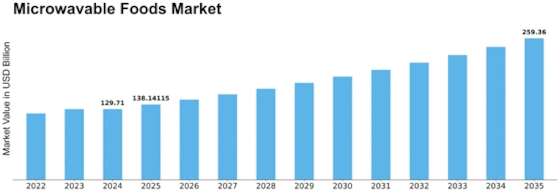
Microwavable Foods Market Size Graph
Author
Garvit Vyas
Analyst

Explore the profile of Garvit Vyas, one of our esteemed authors at Market Research Future, and access their expert research contributions in the field of market research and industry analysis

Leave a Comment

FAQs

What is the current valuation of the Microwavable Foods Market?

The Microwavable Foods Market was valued at 129.71 USD Billion in 2024.

What is the projected market size for the Microwavable Foods Market by 2035?

The market is projected to reach 259.36 USD Billion by 2035.

What is the expected CAGR for the Microwavable Foods Market during the forecast period?

The expected CAGR for the Microwavable Foods Market from 2025 to 2035 is 6.5%.

Which product segment holds the highest valuation in the Microwavable Foods Market?

The Frozen Food segment had a valuation of 59.71 USD Billion in 2024.

What are the key players in the Microwavable Foods Market?

Key players include Nestle, Unilever, Kraft Heinz, Conagra Brands, and General Mills.

How does the Chilled Food segment perform in terms of market valuation?

The Chilled Food segment was valued at 40.0 USD Billion in 2024 and is expected to grow significantly.

Market Summary

As per MRFR analysis, the Microwavable Foods Market was estimated at 129.71 USD Billion in 2024. The microwavable foods industry is projected to grow from 138.14 USD Billion in 2025 to 259.36 USD Billion by 2035, exhibiting a compound annual growth rate (CAGR) of 6.5 during the forecast period 2025 - 2035.

Key Market Trends & Highlights

The Microwavable Foods Market is experiencing a dynamic shift towards health-conscious and innovative offerings.

  • Health-conscious offerings are increasingly prevalent, catering to the growing demand for nutritious meal options.
  • Sustainable packaging solutions are gaining traction, reflecting consumer preferences for environmentally friendly products.
  • Diverse flavor profiles are emerging, appealing to a wide range of culinary tastes across different demographics.
  • Convenience and time efficiency, alongside innovative product development, are major drivers propelling growth in North America and Asia-Pacific, particularly in the frozen food and new cook bag technique segments.

Market Size & Forecast

2024 Market Size 129.71 (USD Billion)
2035 Market Size 259.36 (USD Billion)
CAGR (2025 - 2035) 6.5%
Largest Regional Market Share in 2024 North America

Major Players

<p>Nestle (CH), Unilever (GB), Kraft Heinz (US), Conagra Brands (US), General Mills (US), Tyson Foods (US), Pinnacle Foods (US), McCain Foods (CA), Amy's Kitchen (US)</p>

Market Trends

The Microwavable Foods Market is currently experiencing a notable transformation, driven by evolving consumer preferences and lifestyle changes. As individuals increasingly seek convenience in their meal options, the demand for ready-to-eat and easy-to-prepare food products continues to rise. This shift is further influenced by the growing trend of busy lifestyles, where time constraints often dictate food choices. Consequently, manufacturers are innovating to provide a diverse range of microwavable offerings that cater to various dietary needs and preferences, including vegetarian, gluten-free, and organic options. Additionally, the emphasis on health and wellness is prompting brands to enhance the nutritional profiles of their products, thereby appealing to health-conscious consumers. Moreover, advancements in packaging technology and food preservation methods are contributing to the expansion of the Microwavable Foods Market. These innovations not only extend shelf life but also maintain the quality and taste of the food, which is crucial for consumer satisfaction. The market landscape is further characterized by increased competition, as both established players and new entrants strive to capture market share. This competitive environment fosters creativity and differentiation, leading to a broader array of products that meet the diverse needs of consumers. As the market evolves, it appears poised for continued growth, reflecting the dynamic interplay between consumer demands and industry responses.

Health-Conscious Offerings

There is a growing emphasis on health and wellness within the Microwavable Foods Market. Brands are increasingly focusing on creating products that are not only convenient but also nutritious. This trend reflects a shift towards healthier eating habits, with consumers seeking options that align with their dietary preferences and health goals.

Sustainable Packaging Solutions

Sustainability is becoming a pivotal concern in the Microwavable Foods Market. Companies are exploring eco-friendly packaging alternatives to reduce environmental impact. This trend indicates a broader commitment to sustainability, appealing to environmentally conscious consumers who prioritize responsible consumption.

Diverse Flavor Profiles

The demand for diverse and exotic flavors is rising within the Microwavable Foods Market. Consumers are increasingly adventurous in their culinary choices, seeking products that offer unique taste experiences. This trend encourages manufacturers to innovate and expand their flavor offerings, catering to a wider audience.

Microwavable Foods Market Market Drivers

Rising Urbanization

Urbanization is a significant factor influencing the Microwavable Foods Market. As more individuals migrate to urban areas, the demand for convenient food options increases. Urban dwellers often face time constraints due to long working hours and commuting, leading to a preference for quick meal solutions. The Microwavable Foods Market is well-positioned to cater to this demographic, as its products align with the needs of busy city residents. Data indicates that urban populations are projected to continue growing, which may further drive the demand for microwavable foods. This trend suggests that the industry could experience sustained growth as urbanization continues to shape consumer behavior and preferences.

Innovative Product Development

Innovation plays a crucial role in driving the Microwavable Foods Market. Manufacturers are increasingly focusing on developing new and exciting products that cater to evolving consumer tastes and dietary preferences. This includes the introduction of healthier options, such as low-calorie and organic microwavable meals, which appeal to health-conscious consumers. Additionally, the incorporation of diverse international cuisines into microwavable offerings has expanded the market's appeal. Recent statistics suggest that the introduction of innovative products has led to a notable increase in sales within the industry, as consumers are drawn to unique flavors and convenient meal solutions. The continuous evolution of product offerings is likely to sustain growth in the Microwavable Foods Market.

Convenience and Time Efficiency

The demand for convenience in food preparation is a primary driver of the Microwavable Foods Market. As lifestyles become increasingly fast-paced, consumers seek quick meal solutions that require minimal preparation time. Microwavable foods offer an ideal solution, allowing individuals to prepare meals in mere minutes. According to recent data, the market for ready-to-eat meals, which includes microwavable options, is projected to grow significantly, indicating a shift in consumer preferences towards convenience. This trend is particularly evident among busy professionals and families, who prioritize time-saving options. The Microwavable Foods Market is thus positioned to benefit from this growing demand for convenience, as more consumers opt for products that align with their hectic schedules.

E-commerce Growth and Online Retailing

The rise of e-commerce and online retailing is transforming the landscape of the Microwavable Foods Market. With the increasing popularity of online shopping, consumers are more inclined to purchase microwavable foods through digital platforms. This shift is driven by the convenience of home delivery and the ability to access a wider variety of products. Recent data shows that online grocery sales, including microwavable foods, have surged, indicating a significant change in consumer purchasing behavior. As e-commerce continues to grow, it is likely to provide new opportunities for the Microwavable Foods Market, enabling manufacturers to reach a broader audience and enhance their market presence.

Increased Focus on Health and Nutrition

The growing awareness of health and nutrition among consumers is a pivotal driver of the Microwavable Foods Market. As individuals become more conscious of their dietary choices, there is a rising demand for healthier microwavable options. This includes meals that are lower in sodium, free from artificial preservatives, and rich in nutrients. Manufacturers are responding to this trend by reformulating existing products and introducing new lines that emphasize health benefits. Recent market analysis indicates that the health-oriented segment of the microwavable foods market is expanding, reflecting a shift in consumer priorities. This focus on health and nutrition is likely to continue influencing product development within the Microwavable Foods Market.

Market Segment Insights

By Product: Frozen Food (Largest) vs. Chilled Food (Fastest-Growing)

<p>In the Microwavable Foods Market, the distribution of market share is heavily influenced by product type. Frozen Food holds a significant portion of the market, appealing to consumers seeking convenience and long shelf life, while Chilled Food has rapidly gained traction among health-conscious buyers desiring fresh ingredients in their meals. Shelf Stable Microwavable Food, although growing, occupies a smaller share of the overall market compared to its frozen and chilled counterparts. The growth trends within this segment are shaped by changing consumer preferences, including increased demand for ready-to-eat and convenient meal solutions. The rise of Chilled Food is particularly noteworthy, driven by health trends and a desire for fresher options. Furthermore, innovations in packaging and preserving technologies have enhanced the appeal and shelf life of these products, attracting a broader audience in the microwavable food sector.</p>

<p>Frozen Food (Dominant) vs. Chilled Food (Emerging)</p>

<p>Frozen Food is a dominant player in the Microwavable Foods Market, characterized by its extensive variety of offerings and ability to cater to diverse consumer tastes. This segment thrives due to its convenience, longer shelf life, and the ability to lock in flavors while maintaining nutritional value. On the other hand, Chilled Food is emerging as a strong competitor, particularly among younger, health-conscious consumers who prefer meals that emphasize freshness and natural ingredients. This segment is rapidly expanding because it meets the growing demand for healthier food options without sacrificing convenience. As manufacturers continue to innovate in this space, leveraging fresh and high-quality ingredients, Chilled Food is poised to capture an increasing share of the market.</p>

By Packaging Technology: Patterned Susceptors Technology (Largest) vs. New Cook Bag Technique (Fastest-Growing)

<p>The Microwavable Foods Market has seen a notable distribution of packaging technologies, particularly with Patterned Susceptors Technology leading the charge. This technology captures the largest market share due to its efficient performance in heating food evenly, thereby enhancing quality and consumer satisfaction. Conversely, the New Cook Bag Technique is gaining traction as consumers seek convenience and ease of use, thus carving out a significant share in the rapidly evolving landscape of microwavable food packaging.</p>

<p>Packaging Technology: Patterned Susceptors (Dominant) vs. New Tray-lidding Methods (Emerging)</p>

<p>Patterned Susceptors Technology remains the dominant player in the Microwavable Foods Market, renowned for its ability to distribute microwave energy effectively, ensuring optimal heating of products. This technology turns ordinary microwavable containers into advanced cooking implements, making them preferred by both manufacturers and consumers. In contrast, New Tray-lidding Methods are emerging as a cost-effective alternative, offering enhanced sealing and preservation properties for microwavable foods. This method is gaining popularity due to its innovation in reducing food spoilage and improving shelf life, aligning with consumer demands for freshness and convenience.</p>

By Distribution Channel: Hypermarkets/Supermarkets (Largest) vs. Online Sales Channel (Fastest-Growing)

<p>In the Microwavable Foods Market, Hypermarkets and Supermarkets hold a dominant share of the distribution channel segment, reflecting consumer preference for larger retail formats offering a variety of products. This channel appeals to shoppers seeking convenience and a wide selection, leading to significant sales volume. Meanwhile, Convenience Stores and Online Sales Channels, although smaller in share, exhibit varying contributions, with Online Sales Channels particularly gaining traction in recent years as consumer behavior shifts towards digital shopping platforms. The growth trends within the distribution channel segment of microwavable foods showcase a shift towards convenience and instant gratification. Online Sales Channels are driven by the increasing adoption of e-commerce, with consumers valuing the convenience of shopping from home. Convenience Stores also play a critical role, especially catering to on-the-go consumers; however, the growing trend of health-conscious eating and meal preparation directly influences product availability across all channels, differentiating their market dynamics significantly.</p>

<p>Hypermarkets/Supermarkets (Dominant) vs. Online Sales Channel (Emerging)</p>

<p>Hypermarkets and Supermarkets remain the dominant players in the distribution of microwavable foods, offering broad assortments and competitive pricing, which attract a wide range of consumers. Their expansive shelf space accommodates various brands and product types, from ready-to-eat meals to snacks, catering to diverse consumer needs. In contrast, the Online Sales Channel represents an emerging force, capitalizing on the convenience and accessibility of digital shopping. This channel appeals particularly to younger consumers and busy professionals who prefer the ease of home delivery, providing opportunities for niche brands to reach a broader audience. As both channels evolve, they demonstrate distinct advantages that cater to evolving shopping preferences.</p>

Get more detailed insights about Microwavable Foods Market Research Report — Global Forecast till 2035

Regional Insights

North America : Market Leader in Convenience

North America is the largest market for microwavable foods, holding approximately 45% of the global market share. The region's growth is driven by busy lifestyles, increasing demand for convenience foods, and a growing focus on health-conscious options. Regulatory support for food safety and labeling further catalyzes market expansion, ensuring consumer trust and compliance with health standards. The United States is the primary contributor, with significant market players like Kraft Heinz, Conagra Brands, and General Mills leading the competitive landscape. Canada also plays a vital role, with companies like McCain Foods and Pinnacle Foods enhancing market offerings. The presence of these key players fosters innovation and variety, catering to diverse consumer preferences.

Europe : Emerging Market with Potential

Europe is witnessing a growing demand for microwavable foods, accounting for about 30% of the global market share. Factors such as increasing urbanization, busy lifestyles, and a shift towards convenience foods are driving this growth. Regulatory frameworks in the EU promote food safety and quality, which enhances consumer confidence and encourages market expansion. Leading countries include the United Kingdom, Germany, and France, where major players like Unilever and Nestle are actively innovating to meet consumer demands. The competitive landscape is characterized by a mix of established brands and emerging local companies, ensuring a diverse range of products. The focus on sustainability and health trends is also shaping product offerings in this region.

Asia-Pacific : Rapid Growth and Innovation

Asia-Pacific is rapidly emerging as a significant market for microwavable foods, holding approximately 20% of the global market share. The region's growth is fueled by increasing disposable incomes, urbanization, and a rising trend towards convenience foods. Regulatory initiatives aimed at improving food safety and quality standards are also contributing to market growth, ensuring consumer protection and trust. Countries like China, Japan, and India are leading the charge, with a mix of local and international players such as Nestle and Unilever. The competitive landscape is vibrant, with companies focusing on product innovation and catering to local tastes. The growing popularity of online grocery shopping is further enhancing market accessibility and consumer reach in this region.

Middle East and Africa : Untapped Market Opportunities

The Middle East and Africa represent an emerging market for microwavable foods, currently holding about 5% of the global market share. The region's growth is driven by changing consumer lifestyles, urbanization, and an increasing preference for convenience foods. Regulatory bodies are beginning to implement food safety standards, which will likely enhance market growth and consumer confidence in the coming years. Leading countries include South Africa and the UAE, where local and international brands are beginning to establish a foothold. The competitive landscape is still developing, with opportunities for growth as consumer demand for convenient meal options rises. Key players are exploring innovative products tailored to local tastes, which could significantly impact market dynamics in the future.

Key Players and Competitive Insights

Leading market players are Collaborations with other industry players, including manufacturers, and technology firms, enabling companies to leverage complementary strengths. Market participants are also adopting a variety of strategic activities to expand their global presence, with crucial market developments such as product launches, contractual agreements, research and development collaboration, mergers and acquisitions, increasing investments, and partnerships with other market players. To expand and survive in a more competitive and rising market climate, the Microwavable Foods industry must offer innovative solutions.

Manufacturing locally to reduce operational costs is one of the common tactics used by manufacturers in the global Microwavable Foods industry to increase their market share. In recent years, the Microwavable Foods industry has offered some of the most significant advantages to Consumers.

Major players in the Microwavable Foods Market, including Ajinomoto Windsor, Inc., Campbell Soup Company., ConAgra Foods, Inc., General Mills Inc., Kellogg Company, McCain Foods, Nestle SA, Pinnacle Food Inc., The Kraft Heinz Company and Unilever Plc., and others, are attempting to increase market demand by investing in product development to increase their product line and cater to diverse consumer needs.

Ajinomoto Windsor, Inc. is a leading food and seasoning company with a global presence, specializing in the production of a diverse range of frozen and convenient food products. Established as Windsor Foods in 1946, the company became a subsidiary of Ajinomoto Co., Inc. in 2014. Ajinomoto Windsor is known for its commitment to creating high-quality, flavorful, and convenient food solutions that cater to the evolving tastes and lifestyles of consumers. The company's product portfolio includes a wide array of frozen appetizers, ethnic specialties, snacks, and ready-to-eat meals.

With a focus on innovation, culinary expertise, and a dedication to meeting the demands of modern consumers, Ajinomoto Windsor has become a trusted name in the food industry, contributing to the convenience and enjoyment of meals for households around the world.

Campbell Soup Company, founded in 1869, is an iconic American food company recognized for its extensive portfolio of soup, sauce, and beverage brands. Headquartered in Camden, New Jersey, Campbell Soup has evolved into a global powerhouse, offering a diverse range of products under well-known labels such as Campbell's, Pepperidge Farm, and Prego. The company's rich heritage is marked by a commitment to quality, innovation, and meeting consumer preferences. Campbell Soup continues to adapt to changing market dynamics by introducing new flavors, packaging innovations, and responding to health and wellness trends.

With a presence in multiple countries, Campbell Soup remains a significant player in the food industry, providing consumers with a variety of convenient and comforting food options for various occasions.

Key Companies in the Microwavable Foods Market market include

Industry Developments

April 2022: Starkist introduced a delicious microwavable tuna option complete with vegetables and grains, designed to be enjoyed either heated or at room temperature for a convenient lunch, dinner, or healthy snack.

April 2022: Rich Products Corporation unveiled a new line of microwavable single-serve snacks named Time Outs. This frozen selection encompasses appetizers, snacks, and meals featuring plant-based meat and ingredients, providing a quick and convenient option for those seeking flavorful and satisfying on-the-go options.

Future Outlook

Microwavable Foods Market Future Outlook

<p>The Microwavable Foods Market is projected to grow at a 6.5% CAGR from 2024 to 2035, driven by convenience, innovation, and health-conscious consumer trends.</p>

New opportunities lie in:

  • <p>Expansion of plant-based microwavable meal options</p>
  • <p>Development of smart microwavable packaging</p>
  • <p>Partnerships with meal kit delivery services for exclusive offerings</p>

<p>By 2035, the market is expected to be robust, reflecting evolving consumer preferences and innovative product developments.</p>

Market Segmentation

Microwavable Foods Market Product Outlook

  • Shelf Stable Microwavable Food
  • Chilled Food
  • Frozen Food

Microwavable Foods Market Distribution Channel Outlook

  • Hypermarkets/Supermarkets
  • Convenience Stores
  • Online Sales Channel
  • Others

Microwavable Foods Market Packaging Technology Outlook

  • Patterned Susceptors Technology
  • New Tray-lidding Methods
  • New Cook Bag Technique

Report Scope

MARKET SIZE 2024129.71(USD Billion)
MARKET SIZE 2025138.14(USD Billion)
MARKET SIZE 2035259.36(USD Billion)
COMPOUND ANNUAL GROWTH RATE (CAGR)6.5% (2024 - 2035)
REPORT COVERAGERevenue Forecast, Competitive Landscape, Growth Factors, and Trends
BASE YEAR2024
Market Forecast Period2025 - 2035
Historical Data2019 - 2024
Market Forecast UnitsUSD Billion
Key Companies ProfiledMarket analysis in progress
Segments CoveredMarket segmentation analysis in progress
Key Market OpportunitiesGrowing demand for plant-based options in the Microwavable Foods Market presents significant innovation opportunities.
Key Market DynamicsRising consumer demand for convenience drives innovation and competition in the microwavable foods sector.
Countries CoveredNorth America, Europe, APAC, South America, MEA

FAQs

What is the current valuation of the Microwavable Foods Market?

The Microwavable Foods Market was valued at 129.71 USD Billion in 2024.

What is the projected market size for the Microwavable Foods Market by 2035?

The market is projected to reach 259.36 USD Billion by 2035.

What is the expected CAGR for the Microwavable Foods Market during the forecast period?

The expected CAGR for the Microwavable Foods Market from 2025 to 2035 is 6.5%.

Which product segment holds the highest valuation in the Microwavable Foods Market?

The Frozen Food segment had a valuation of 59.71 USD Billion in 2024.

What are the key players in the Microwavable Foods Market?

Key players include Nestle, Unilever, Kraft Heinz, Conagra Brands, and General Mills.

How does the Chilled Food segment perform in terms of market valuation?

The Chilled Food segment was valued at 40.0 USD Billion in 2024 and is expected to grow significantly.

  1. SECTION I: EXECUTIVE SUMMARY AND KEY HIGHLIGHTS
    1. EXECUTIVE SUMMARY
      1. Market Overview
      2. Key Findings
      3. Market Segmentation
      4. Competitive Landscape
      5. Challenges and Opportunities
      6. Future Outlook
  2. SECTION II: SCOPING, METHODOLOGY AND MARKET STRUCTURE
    1. MARKET INTRODUCTION
      1. Definition
      2. Scope of the study
    2. RESEARCH METHODOLOGY
      1. Overview
      2. Data Mining
      3. Secondary Research
      4. Primary Research
      5. Forecasting Model
      6. Market Size Estimation
      7. Data Triangulation
      8. Validation
  3. SECTION III: QUALITATIVE ANALYSIS
    1. MARKET DYNAMICS
      1. Overview
      2. Drivers
      3. Restraints
      4. Opportunities
    2. MARKET FACTOR ANALYSIS
      1. Value chain Analysis
      2. Porter's Five Forces Analysis
      3. COVID-19 Impact Analysis
  4. SECTION IV: QUANTITATIVE ANALYSIS
    1. Food, Beverages & Nutrition, BY Product (USD Billion)
      1. Shelf Stable Microwavable Food
      2. Chilled Food
      3. Frozen Food
    2. Food, Beverages & Nutrition, BY Packaging Technology (USD Billion)
      1. Patterned Susceptors Technology
      2. New Tray-lidding Methods
      3. New Cook Bag Technique
    3. Food, Beverages & Nutrition, BY Distribution Channel (USD Billion)
      1. Hypermarkets/Supermarkets
      2. Convenience Stores
      3. Online Sales Channel
      4. Others
    4. Food, Beverages & Nutrition, BY Region (USD Billion)
      1. North America
      2. Europe
      3. APAC
      4. South America
      5. MEA
  5. SECTION V: COMPETITIVE ANALYSIS
    1. Competitive Landscape
      1. Overview
      2. Competitive Analysis
      3. Market share Analysis
      4. Major Growth Strategy in the Food, Beverages & Nutrition
      5. Competitive Benchmarking
      6. Leading Players in Terms of Number of Developments in the Food, Beverages & Nutrition
      7. Key developments and growth strategies
      8. Major Players Financial Matrix
    2. Company Profiles
      1. Nestle (CH)
      2. Unilever (GB)
      3. Kraft Heinz (US)
      4. Conagra Brands (US)
      5. General Mills (US)
      6. Tyson Foods (US)
      7. Pinnacle Foods (US)
      8. McCain Foods (CA)
      9. Amy's Kitchen (US)
    3. Appendix
      1. References
      2. Related Reports
  6. LIST OF FIGURES
    1. MARKET SYNOPSIS
    2. NORTH AMERICA MARKET ANALYSIS
    3. US MARKET ANALYSIS BY PRODUCT
    4. US MARKET ANALYSIS BY PACKAGING TECHNOLOGY
    5. US MARKET ANALYSIS BY DISTRIBUTION CHANNEL
    6. CANADA MARKET ANALYSIS BY PRODUCT
    7. CANADA MARKET ANALYSIS BY PACKAGING TECHNOLOGY
    8. CANADA MARKET ANALYSIS BY DISTRIBUTION CHANNEL
    9. EUROPE MARKET ANALYSIS
    10. GERMANY MARKET ANALYSIS BY PRODUCT
    11. GERMANY MARKET ANALYSIS BY PACKAGING TECHNOLOGY
    12. GERMANY MARKET ANALYSIS BY DISTRIBUTION CHANNEL
    13. UK MARKET ANALYSIS BY PRODUCT
    14. UK MARKET ANALYSIS BY PACKAGING TECHNOLOGY
    15. UK MARKET ANALYSIS BY DISTRIBUTION CHANNEL
    16. FRANCE MARKET ANALYSIS BY PRODUCT
    17. FRANCE MARKET ANALYSIS BY PACKAGING TECHNOLOGY
    18. FRANCE MARKET ANALYSIS BY DISTRIBUTION CHANNEL
    19. RUSSIA MARKET ANALYSIS BY PRODUCT
    20. RUSSIA MARKET ANALYSIS BY PACKAGING TECHNOLOGY
    21. RUSSIA MARKET ANALYSIS BY DISTRIBUTION CHANNEL
    22. ITALY MARKET ANALYSIS BY PRODUCT
    23. ITALY MARKET ANALYSIS BY PACKAGING TECHNOLOGY
    24. ITALY MARKET ANALYSIS BY DISTRIBUTION CHANNEL
    25. SPAIN MARKET ANALYSIS BY PRODUCT
    26. SPAIN MARKET ANALYSIS BY PACKAGING TECHNOLOGY
    27. SPAIN MARKET ANALYSIS BY DISTRIBUTION CHANNEL
    28. REST OF EUROPE MARKET ANALYSIS BY PRODUCT
    29. REST OF EUROPE MARKET ANALYSIS BY PACKAGING TECHNOLOGY
    30. REST OF EUROPE MARKET ANALYSIS BY DISTRIBUTION CHANNEL
    31. APAC MARKET ANALYSIS
    32. CHINA MARKET ANALYSIS BY PRODUCT
    33. CHINA MARKET ANALYSIS BY PACKAGING TECHNOLOGY
    34. CHINA MARKET ANALYSIS BY DISTRIBUTION CHANNEL
    35. INDIA MARKET ANALYSIS BY PRODUCT
    36. INDIA MARKET ANALYSIS BY PACKAGING TECHNOLOGY
    37. INDIA MARKET ANALYSIS BY DISTRIBUTION CHANNEL
    38. JAPAN MARKET ANALYSIS BY PRODUCT
    39. JAPAN MARKET ANALYSIS BY PACKAGING TECHNOLOGY
    40. JAPAN MARKET ANALYSIS BY DISTRIBUTION CHANNEL
    41. SOUTH KOREA MARKET ANALYSIS BY PRODUCT
    42. SOUTH KOREA MARKET ANALYSIS BY PACKAGING TECHNOLOGY
    43. SOUTH KOREA MARKET ANALYSIS BY DISTRIBUTION CHANNEL
    44. MALAYSIA MARKET ANALYSIS BY PRODUCT
    45. MALAYSIA MARKET ANALYSIS BY PACKAGING TECHNOLOGY
    46. MALAYSIA MARKET ANALYSIS BY DISTRIBUTION CHANNEL
    47. THAILAND MARKET ANALYSIS BY PRODUCT
    48. THAILAND MARKET ANALYSIS BY PACKAGING TECHNOLOGY
    49. THAILAND MARKET ANALYSIS BY DISTRIBUTION CHANNEL
    50. INDONESIA MARKET ANALYSIS BY PRODUCT
    51. INDONESIA MARKET ANALYSIS BY PACKAGING TECHNOLOGY
    52. INDONESIA MARKET ANALYSIS BY DISTRIBUTION CHANNEL
    53. REST OF APAC MARKET ANALYSIS BY PRODUCT
    54. REST OF APAC MARKET ANALYSIS BY PACKAGING TECHNOLOGY
    55. REST OF APAC MARKET ANALYSIS BY DISTRIBUTION CHANNEL
    56. SOUTH AMERICA MARKET ANALYSIS
    57. BRAZIL MARKET ANALYSIS BY PRODUCT
    58. BRAZIL MARKET ANALYSIS BY PACKAGING TECHNOLOGY
    59. BRAZIL MARKET ANALYSIS BY DISTRIBUTION CHANNEL
    60. MEXICO MARKET ANALYSIS BY PRODUCT
    61. MEXICO MARKET ANALYSIS BY PACKAGING TECHNOLOGY
    62. MEXICO MARKET ANALYSIS BY DISTRIBUTION CHANNEL
    63. ARGENTINA MARKET ANALYSIS BY PRODUCT
    64. ARGENTINA MARKET ANALYSIS BY PACKAGING TECHNOLOGY
    65. ARGENTINA MARKET ANALYSIS BY DISTRIBUTION CHANNEL
    66. REST OF SOUTH AMERICA MARKET ANALYSIS BY PRODUCT
    67. REST OF SOUTH AMERICA MARKET ANALYSIS BY PACKAGING TECHNOLOGY
    68. REST OF SOUTH AMERICA MARKET ANALYSIS BY DISTRIBUTION CHANNEL
    69. MEA MARKET ANALYSIS
    70. GCC COUNTRIES MARKET ANALYSIS BY PRODUCT
    71. GCC COUNTRIES MARKET ANALYSIS BY PACKAGING TECHNOLOGY
    72. GCC COUNTRIES MARKET ANALYSIS BY DISTRIBUTION CHANNEL
    73. SOUTH AFRICA MARKET ANALYSIS BY PRODUCT
    74. SOUTH AFRICA MARKET ANALYSIS BY PACKAGING TECHNOLOGY
    75. SOUTH AFRICA MARKET ANALYSIS BY DISTRIBUTION CHANNEL
    76. REST OF MEA MARKET ANALYSIS BY PRODUCT
    77. REST OF MEA MARKET ANALYSIS BY PACKAGING TECHNOLOGY
    78. REST OF MEA MARKET ANALYSIS BY DISTRIBUTION CHANNEL
    79. KEY BUYING CRITERIA OF FOOD, BEVERAGES & NUTRITION
    80. RESEARCH PROCESS OF MRFR
    81. DRO ANALYSIS OF FOOD, BEVERAGES & NUTRITION
    82. DRIVERS IMPACT ANALYSIS: FOOD, BEVERAGES & NUTRITION
    83. RESTRAINTS IMPACT ANALYSIS: FOOD, BEVERAGES & NUTRITION
    84. SUPPLY / VALUE CHAIN: FOOD, BEVERAGES & NUTRITION
    85. FOOD, BEVERAGES & NUTRITION, BY PRODUCT, 2024 (% SHARE)
    86. FOOD, BEVERAGES & NUTRITION, BY PRODUCT, 2024 TO 2035 (USD Billion)
    87. FOOD, BEVERAGES & NUTRITION, BY PACKAGING TECHNOLOGY, 2024 (% SHARE)
    88. FOOD, BEVERAGES & NUTRITION, BY PACKAGING TECHNOLOGY, 2024 TO 2035 (USD Billion)
    89. FOOD, BEVERAGES & NUTRITION, BY DISTRIBUTION CHANNEL, 2024 (% SHARE)
    90. FOOD, BEVERAGES & NUTRITION, BY DISTRIBUTION CHANNEL, 2024 TO 2035 (USD Billion)
    91. BENCHMARKING OF MAJOR COMPETITORS
  7. LIST OF TABLES
    1. LIST OF ASSUMPTIONS
    2. North America MARKET SIZE ESTIMATES; FORECAST
      1. BY PRODUCT, 2025-2035 (USD Billion)
      2. BY PACKAGING TECHNOLOGY, 2025-2035 (USD Billion)
      3. BY DISTRIBUTION CHANNEL, 2025-2035 (USD Billion)
    3. US MARKET SIZE ESTIMATES; FORECAST
      1. BY PRODUCT, 2025-2035 (USD Billion)
      2. BY PACKAGING TECHNOLOGY, 2025-2035 (USD Billion)
      3. BY DISTRIBUTION CHANNEL, 2025-2035 (USD Billion)
    4. Canada MARKET SIZE ESTIMATES; FORECAST
      1. BY PRODUCT, 2025-2035 (USD Billion)
      2. BY PACKAGING TECHNOLOGY, 2025-2035 (USD Billion)
      3. BY DISTRIBUTION CHANNEL, 2025-2035 (USD Billion)
    5. Europe MARKET SIZE ESTIMATES; FORECAST
      1. BY PRODUCT, 2025-2035 (USD Billion)
      2. BY PACKAGING TECHNOLOGY, 2025-2035 (USD Billion)
      3. BY DISTRIBUTION CHANNEL, 2025-2035 (USD Billion)
    6. Germany MARKET SIZE ESTIMATES; FORECAST
      1. BY PRODUCT, 2025-2035 (USD Billion)
      2. BY PACKAGING TECHNOLOGY, 2025-2035 (USD Billion)
      3. BY DISTRIBUTION CHANNEL, 2025-2035 (USD Billion)
    7. UK MARKET SIZE ESTIMATES; FORECAST
      1. BY PRODUCT, 2025-2035 (USD Billion)
      2. BY PACKAGING TECHNOLOGY, 2025-2035 (USD Billion)
      3. BY DISTRIBUTION CHANNEL, 2025-2035 (USD Billion)
    8. France MARKET SIZE ESTIMATES; FORECAST
      1. BY PRODUCT, 2025-2035 (USD Billion)
      2. BY PACKAGING TECHNOLOGY, 2025-2035 (USD Billion)
      3. BY DISTRIBUTION CHANNEL, 2025-2035 (USD Billion)
    9. Russia MARKET SIZE ESTIMATES; FORECAST
      1. BY PRODUCT, 2025-2035 (USD Billion)
      2. BY PACKAGING TECHNOLOGY, 2025-2035 (USD Billion)
      3. BY DISTRIBUTION CHANNEL, 2025-2035 (USD Billion)
    10. Italy MARKET SIZE ESTIMATES; FORECAST
      1. BY PRODUCT, 2025-2035 (USD Billion)
      2. BY PACKAGING TECHNOLOGY, 2025-2035 (USD Billion)
      3. BY DISTRIBUTION CHANNEL, 2025-2035 (USD Billion)
    11. Spain MARKET SIZE ESTIMATES; FORECAST
      1. BY PRODUCT, 2025-2035 (USD Billion)
      2. BY PACKAGING TECHNOLOGY, 2025-2035 (USD Billion)
      3. BY DISTRIBUTION CHANNEL, 2025-2035 (USD Billion)
    12. Rest of Europe MARKET SIZE ESTIMATES; FORECAST
      1. BY PRODUCT, 2025-2035 (USD Billion)
      2. BY PACKAGING TECHNOLOGY, 2025-2035 (USD Billion)
      3. BY DISTRIBUTION CHANNEL, 2025-2035 (USD Billion)
    13. APAC MARKET SIZE ESTIMATES; FORECAST
      1. BY PRODUCT, 2025-2035 (USD Billion)
      2. BY PACKAGING TECHNOLOGY, 2025-2035 (USD Billion)
      3. BY DISTRIBUTION CHANNEL, 2025-2035 (USD Billion)
    14. China MARKET SIZE ESTIMATES; FORECAST
      1. BY PRODUCT, 2025-2035 (USD Billion)
      2. BY PACKAGING TECHNOLOGY, 2025-2035 (USD Billion)
      3. BY DISTRIBUTION CHANNEL, 2025-2035 (USD Billion)
    15. India MARKET SIZE ESTIMATES; FORECAST
      1. BY PRODUCT, 2025-2035 (USD Billion)
      2. BY PACKAGING TECHNOLOGY, 2025-2035 (USD Billion)
      3. BY DISTRIBUTION CHANNEL, 2025-2035 (USD Billion)
    16. Japan MARKET SIZE ESTIMATES; FORECAST
      1. BY PRODUCT, 2025-2035 (USD Billion)
      2. BY PACKAGING TECHNOLOGY, 2025-2035 (USD Billion)
      3. BY DISTRIBUTION CHANNEL, 2025-2035 (USD Billion)
    17. South Korea MARKET SIZE ESTIMATES; FORECAST
      1. BY PRODUCT, 2025-2035 (USD Billion)
      2. BY PACKAGING TECHNOLOGY, 2025-2035 (USD Billion)
      3. BY DISTRIBUTION CHANNEL, 2025-2035 (USD Billion)
    18. Malaysia MARKET SIZE ESTIMATES; FORECAST
      1. BY PRODUCT, 2025-2035 (USD Billion)
      2. BY PACKAGING TECHNOLOGY, 2025-2035 (USD Billion)
      3. BY DISTRIBUTION CHANNEL, 2025-2035 (USD Billion)
    19. Thailand MARKET SIZE ESTIMATES; FORECAST
      1. BY PRODUCT, 2025-2035 (USD Billion)
      2. BY PACKAGING TECHNOLOGY, 2025-2035 (USD Billion)
      3. BY DISTRIBUTION CHANNEL, 2025-2035 (USD Billion)
    20. Indonesia MARKET SIZE ESTIMATES; FORECAST
      1. BY PRODUCT, 2025-2035 (USD Billion)
      2. BY PACKAGING TECHNOLOGY, 2025-2035 (USD Billion)
      3. BY DISTRIBUTION CHANNEL, 2025-2035 (USD Billion)
    21. Rest of APAC MARKET SIZE ESTIMATES; FORECAST
      1. BY PRODUCT, 2025-2035 (USD Billion)
      2. BY PACKAGING TECHNOLOGY, 2025-2035 (USD Billion)
      3. BY DISTRIBUTION CHANNEL, 2025-2035 (USD Billion)
    22. South America MARKET SIZE ESTIMATES; FORECAST
      1. BY PRODUCT, 2025-2035 (USD Billion)
      2. BY PACKAGING TECHNOLOGY, 2025-2035 (USD Billion)
      3. BY DISTRIBUTION CHANNEL, 2025-2035 (USD Billion)
    23. Brazil MARKET SIZE ESTIMATES; FORECAST
      1. BY PRODUCT, 2025-2035 (USD Billion)
      2. BY PACKAGING TECHNOLOGY, 2025-2035 (USD Billion)
      3. BY DISTRIBUTION CHANNEL, 2025-2035 (USD Billion)
    24. Mexico MARKET SIZE ESTIMATES; FORECAST
      1. BY PRODUCT, 2025-2035 (USD Billion)
      2. BY PACKAGING TECHNOLOGY, 2025-2035 (USD Billion)
      3. BY DISTRIBUTION CHANNEL, 2025-2035 (USD Billion)
    25. Argentina MARKET SIZE ESTIMATES; FORECAST
      1. BY PRODUCT, 2025-2035 (USD Billion)
      2. BY PACKAGING TECHNOLOGY, 2025-2035 (USD Billion)
      3. BY DISTRIBUTION CHANNEL, 2025-2035 (USD Billion)
    26. Rest of South America MARKET SIZE ESTIMATES; FORECAST
      1. BY PRODUCT, 2025-2035 (USD Billion)
      2. BY PACKAGING TECHNOLOGY, 2025-2035 (USD Billion)
      3. BY DISTRIBUTION CHANNEL, 2025-2035 (USD Billion)
    27. MEA MARKET SIZE ESTIMATES; FORECAST
      1. BY PRODUCT, 2025-2035 (USD Billion)
      2. BY PACKAGING TECHNOLOGY, 2025-2035 (USD Billion)
      3. BY DISTRIBUTION CHANNEL, 2025-2035 (USD Billion)
    28. GCC Countries MARKET SIZE ESTIMATES; FORECAST
      1. BY PRODUCT, 2025-2035 (USD Billion)
      2. BY PACKAGING TECHNOLOGY, 2025-2035 (USD Billion)
      3. BY DISTRIBUTION CHANNEL, 2025-2035 (USD Billion)
    29. South Africa MARKET SIZE ESTIMATES; FORECAST
      1. BY PRODUCT, 2025-2035 (USD Billion)
      2. BY PACKAGING TECHNOLOGY, 2025-2035 (USD Billion)
      3. BY DISTRIBUTION CHANNEL, 2025-2035 (USD Billion)
    30. Rest of MEA MARKET SIZE ESTIMATES; FORECAST
      1. BY PRODUCT, 2025-2035 (USD Billion)
      2. BY PACKAGING TECHNOLOGY, 2025-2035 (USD Billion)
      3. BY DISTRIBUTION CHANNEL, 2025-2035 (USD Billion)
    31. PRODUCT LAUNCH/PRODUCT DEVELOPMENT/APPROVAL
    32. ACQUISITION/PARTNERSHIP

Microwavable Foods Market Segmentation

Microwavable Foods Product Outlook (USD Billion, 2018-2032)

  • Shelf Stable Microwavable Food
  • Chilled Food
  • Frozen Food

Microwavable Foods Packaging Technology Outlook (USD Billion, 2018-2032)

  • Patterned Susceptors Technology
  • New Tray-lidding Methods
  • New Cook Bag Technique

Microwavable Foods Distribution Channel Outlook (USD Billion, 2018-2032)

  • Hypermarkets/Supermarkets
  • Convenience Stores
  • Online Sales Channel
  • Others

Microwavable Foods Regional Outlook (USD Billion, 2018-2032)

  • North America Outlook (USD Billion, 2018-2032)
    • North America Microwavable Foods by Product
      • Shelf Stable Microwavable Food
      • Chilled Food
      • Frozen Food
    • North America Microwavable Foods by Packaging Technology
      • Patterned Susceptors Technology
      • New Tray-lidding Methods
      • New Cook Bag Technique
    • North America Microwavable Foods by Distribution Channel
      • Hypermarkets/Supermarkets
      • Convenience Stores
      • Online Sales Channel
      • Others
    • US Outlook (USD Billion, 2018-2032)
    • US Microwavable Foods by Product
      • Shelf Stable Microwavable Food
      • Chilled Food
      • Frozen Food
    • US Microwavable Foods by Packaging Technology
      • Patterned Susceptors Technology
      • New Tray-lidding Methods
      • New Cook Bag Technique
    • US Microwavable Foods by Distribution Channel
      • Hypermarkets/Supermarkets
      • Convenience Stores
      • Online Sales Channel
      • Others
    • Canada Outlook (USD Billion, 2018-2032)
    • Canada Microwavable Foods by Product
      • Shelf Stable Microwavable Food
      • Chilled Food
      • Frozen Food
    • Canada Microwavable Foods by Packaging Technology
      • Patterned Susceptors Technology
      • New Tray-lidding Methods
      • New Cook Bag Technique
    • Canada Microwavable Foods by Distribution Channel
      • Hypermarkets/Supermarkets
      • Convenience Stores
      • Online Sales Channel
      • Others
    • Europe Outlook (USD Billion, 2018-2032)
      • Europe Microwavable Foods by Product
        • Shelf Stable Microwavable Food
        • Chilled Food
        • Frozen Food
      • Europe Microwavable Foods by Packaging Technology
        • Patterned Susceptors Technology
        • New Tray-lidding Methods
        • New Cook Bag Technique
      • Europe Microwavable Foods by Distribution Channel
        • Hypermarkets/Supermarkets
        • Convenience Stores
        • Online Sales Channel
        • Others
      • Germany Outlook (USD Billion, 2018-2032)
      • Germany Microwavable Foods by Product
        • Shelf Stable Microwavable Food
        • Chilled Food
        • Frozen Food
      • Germany Microwavable Foods by Packaging Technology
        • Patterned Susceptors Technology
        • New Tray-lidding Methods
        • New Cook Bag Technique
      • Germany Microwavable Foods by Distribution Channel
        • Hypermarkets/Supermarkets
        • Convenience Stores
        • Online Sales Channel
        • Others
      • France Outlook (USD Billion, 2018-2032)
      • France Microwavable Foods by Product
        • Shelf Stable Microwavable Food
        • Chilled Food
        • Frozen Food
      • France Microwavable Foods by Packaging Technology
        • Patterned Susceptors Technology
        • New Tray-lidding Methods
        • New Cook Bag Technique
      • France Microwavable Foods by Distribution Channel
        • Hypermarkets/Supermarkets
        • Convenience Stores
        • Online Sales Channel
        • Others
      • UK Outlook (USD Billion, 2018-2032)
      • UK Microwavable Foods by Product
        • Shelf Stable Microwavable Food
        • Chilled Food
        • Frozen Food
      • UK Microwavable Foods by Packaging Technology
        • Patterned Susceptors Technology
        • New Tray-lidding Methods
        • New Cook Bag Technique
      • UK Microwavable Foods by Distribution Channel
        • Hypermarkets/Supermarkets
        • Convenience Stores
        • Online Sales Channel
        • Others
      • Italy Outlook (USD Billion, 2018-2032)
      • Italy Microwavable Foods by Product
        • Shelf Stable Microwavable Food
        • Chilled Food
        • Frozen Food
      • Italy Microwavable Foods by Packaging Technology
        • Patterned Susceptors Technology
        • New Tray-lidding Methods
        • New Cook Bag Technique
      • Italy Microwavable Foods by Distribution Channel
        • Hypermarkets/Supermarkets
        • Convenience Stores
        • Online Sales Channel
        • Others
      • Spain Outlook (USD Billion, 2018-2032)
      • Spain Microwavable Foods by Product
        • Shelf Stable Microwavable Food
        • Chilled Food
        • Frozen Food
      • Spain Microwavable Foods by Packaging Technology
        • Patterned Susceptors Technology
        • New Tray-lidding Methods
        • New Cook Bag Technique
      • Spain Microwavable Foods by Distribution Channel
        • Hypermarkets/Supermarkets
        • Convenience Stores
        • Online Sales Channel
        • Others
      • Rest Of Europe Outlook (USD Billion, 2018-2032)
      • Rest of Europe Microwavable Foods by Product
        • Shelf Stable Microwavable Food
        • Chilled Food
        • Frozen Food
      • Rest of Europe Microwavable Foods by Packaging Technology
        • Patterned Susceptors Technology
        • New Tray-lidding Methods
        • New Cook Bag Technique
      • Rest of Europe Microwavable Foods by Distribution Channel
        • Hypermarkets/Supermarkets
        • Convenience Stores
        • Online Sales Channel
        • Others
      • Asia-Pacific Outlook (USD Billion, 2018-2032)
        • Asia-Pacific Microwavable Foods by Product
          • Shelf Stable Microwavable Food
          • Chilled Food
          • Frozen Food
        • Asia-Pacific Microwavable Foods by Packaging Technology
          • Patterned Susceptors Technology
          • New Tray-lidding Methods
          • New Cook Bag Technique
        • Asia-Pacific Microwavable Foods by Distribution Channel
          • Hypermarkets/Supermarkets
          • Convenience Stores
          • Online Sales Channel
          • Others
        • China Outlook (USD Billion, 2018-2032)
        • China Microwavable Foods by Product
          • Shelf Stable Microwavable Food
          • Chilled Food
          • Frozen Food
        • China Microwavable Foods by Packaging Technology
          • Patterned Susceptors Technology
          • New Tray-lidding Methods
          • New Cook Bag Technique
        • China Microwavable Foods by Distribution Channel
          • Hypermarkets/Supermarkets
          • Convenience Stores
          • Online Sales Channel
          • Others
        • Japan Outlook (USD Billion, 2018-2032)
        • Japan Microwavable Foods by Product
          • Shelf Stable Microwavable Food
          • Chilled Food
          • Frozen Food
        • Japan Microwavable Foods by Packaging Technology
          • Patterned Susceptors Technology
          • New Tray-lidding Methods
          • New Cook Bag Technique
        • Japan Microwavable Foods by Distribution Channel
          • Hypermarkets/Supermarkets
          • Convenience Stores
          • Online Sales Channel
          • Others
        • India Outlook (USD Billion, 2018-2032)
        • India Microwavable Foods by Product
          • Shelf Stable Microwavable Food
          • Chilled Food
          • Frozen Food
        • India Microwavable Foods by Packaging Technology
          • Patterned Susceptors Technology
          • New Tray-lidding Methods
          • New Cook Bag Technique
        • India Microwavable Foods by Distribution Channel
          • Hypermarkets/Supermarkets
          • Convenience Stores
          • Online Sales Channel
          • Others
        • Australia Outlook (USD Billion, 2018-2032)
        • Australia Microwavable Foods by Product
          • Shelf Stable Microwavable Food
          • Chilled Food
          • Frozen Food
        • Australia Microwavable Foods by Packaging Technology
          • Patterned Susceptors Technology
          • New Tray-lidding Methods
          • New Cook Bag Technique
        • Australia Microwavable Foods by Distribution Channel
          • Hypermarkets/Supermarkets
          • Convenience Stores
          • Online Sales Channel
          • Others
        • Rest of Asia-Pacific Outlook (USD Billion, 2018-2032)
        • Rest of Asia-Pacific Microwavable Foods by Product
          • Shelf Stable Microwavable Food
          • Chilled Food
          • Frozen Food
        • Rest of Asia-Pacific Microwavable Foods by Packaging Technology
          • Patterned Susceptors Technology
          • New Tray-lidding Methods
          • New Cook Bag Technique
        • Rest of Asia-Pacific Microwavable Foods by Distribution Channel
          • Hypermarkets/Supermarkets
          • Convenience Stores
          • Online Sales Channel
          • Others
        • Rest of the World Outlook (USD Billion, 2018-2032)
          • Rest of the World Microwavable Foods by Product
            • Shelf Stable Microwavable Food
            • Chilled Food
            • Frozen Food
          • Rest of the World Microwavable Foods by Packaging Technology
            • Patterned Susceptors Technology
            • New Tray-lidding Methods
            • New Cook Bag Technique
          • Rest of the World Microwavable Foods by Distribution Channel
            • Hypermarkets/Supermarkets
            • Convenience Stores
            • Online Sales Channel
            • Others
          • Middle East Outlook (USD Billion, 2018-2032)
          • Middle East Microwavable Foods by Product
            • Shelf Stable Microwavable Food
            • Chilled Food
            • Frozen Food
          • Middle East Microwavable Foods by Packaging Technology
            • Patterned Susceptors Technology
            • New Tray-lidding Methods
            • New Cook Bag Technique
          • Middle East Microwavable Foods by Distribution Channel
            • Hypermarkets/Supermarkets
            • Convenience Stores
            • Online Sales Channel
            • Others
          • Africa Outlook (USD Billion, 2018-2032)
          • Africa Microwavable Foods by Product
            • Shelf Stable Microwavable Food
            • Chilled Food
            • Frozen Food
          • Africa Microwavable Foods by Packaging Technology
            • Patterned Susceptors Technology
            • New Tray-lidding Methods
            • New Cook Bag Technique
          • Africa Microwavable Foods by Distribution Channel
            • Hypermarkets/Supermarkets
            • Convenience Stores
            • Online Sales Channel
            • Others
          • Latin America Outlook (USD Billion, 2018-2032)
          • Latin America Microwavable Foods by Product
            • Shelf Stable Microwavable Food
            • Chilled Food
            • Frozen Food
          • Latin America Microwavable Foods by Packaging Technology
            • Patterned Susceptors Technology
            • New Tray-lidding Methods
            • New Cook Bag Technique
          • Latin America Microwavable Foods by Distribution Channel
            • Hypermarkets/Supermarkets
            • Convenience Stores
            • Online Sales Channel
            • Others
Infographic

Free Sample Request

Kindly complete the form below to receive a free sample of this Report

Get Free Sample

Customer Strories

Compare Licence

×
Features License Type
Single User Multiuser License Enterprise User
Price $4,950 $5,950 $7,250
Maximum User Access Limit 1 User Upto 10 Users Unrestricted Access Throughout the Organization
Free Customization
Direct Access to Analyst
Deliverable Format
Platform Access
Discount on Next Purchase 10% 15% 15%
Printable Versions