Request Free Sample ×

Kindly complete the form below to receive a free sample of this Report

* Please use a valid business email

Leading companies partner with us for data-driven Insights

clients tt-cursor
Hero Background

Microgrid Controller Market

ID: MRFR/SEM/6114-HCR
200 Pages
Ankit Gupta
April 2026

Microgrid Controller Market Size, Share and Research Report By Connectivity (Grid and Off-Grid/Islanded), By Offering (Hardware, Software, and Service), By Vertical (Government, Oil & Gas, Energy & Power, Industrial, Military & Defense, and Commercial), And By Region (North America, Europe, Asia-Pacific, And Rest Of The World) – Industry Forecast Till 2035

Share:
Download PDF ×

We do not share your information with anyone. However, we may send you emails based on your report interest from time to time. You may contact us at any time to opt-out.

Microgrid Controller Market Infographic
Purchase Options

Microgrid Controller Market Summary

As per Market Research Future analysis, the Microgrid Controller Market Size was estimated at 5.216 USD Billion in 2024. The Microgrid Controller industry is projected to grow from 5.923 USD Billion in 2025 to 21.13 USD Billion by 2035, exhibiting a compound annual growth rate (CAGR) of 13.56% during the forecast period 2025 - 2035

Key Market Trends & Highlights

The Microgrid Controller Market is poised for substantial growth driven by technological advancements and increasing demand for energy resilience.

  • The integration of renewable energy sources is becoming a pivotal trend in the Microgrid Controller Market, particularly in North America.
  • Advancements in control technologies are enhancing the efficiency and reliability of microgrid systems, especially in the Asia-Pacific region.
  • The grid segment remains the largest market, while the off-grid/island segment is experiencing the fastest growth due to rising energy demands.
  • Key market drivers include the integration of energy storage systems and government incentives for clean energy initiatives, which are fueling market expansion.

Market Size & Forecast

2024 Market Size 5.216 (USD Billion)
2035 Market Size 21.13 (USD Billion)
CAGR (2025 - 2035) 13.56%

Major Players

Schneider Electric (FR), Siemens (DE), General Electric (US), Honeywell (US), ABB (CH), Eaton (US), Rockwell Automation (US), S&C Electric Company (US), Microgrid Energy (US)

Our Impact
Enabled $4.3B Revenue Impact for Fortune 500 and Leading Multinationals
Partnering with 2000+ Global Organizations Each Year
30K+ Citations by Top-Tier Firms in the Industry

Microgrid Controller Market Trends

The Microgrid Controller Market is currently experiencing a transformative phase, driven by the increasing demand for decentralized energy systems. This shift is largely influenced by the growing emphasis on renewable energy sources and the need for enhanced energy security. As communities and industries seek to optimize energy consumption and reduce reliance on traditional power grids, microgrid controllers are emerging as pivotal components in managing localized energy generation and distribution. These microgrid controls facilitate the integration of various energy sources, including solar, wind, and battery storage, thereby promoting sustainability and resilience in energy supply.

Moreover, advancements in technology are propelling the microgrid controller market forward. Innovations in software and hardware are enabling more sophisticated microgrid control systems, which enhance the efficiency and reliability of microgrids. The increasing adoption of smart grid technologies further complements this trend, as it allows for real-time monitoring and management of energy resources using intelligent microgrid controls. As regulatory frameworks evolve to support decentralized energy solutions, the market is poised for substantial growth. 

Integration of Renewable Energy Sources

The Microgrid Controller Market is witnessing a notable trend towards the integration of renewable energy sources. As the global focus shifts towards sustainability, microgrid controllers are increasingly designed to accommodate various renewable technologies, such as solar and wind. This integration not only enhances energy efficiency but also contributes to reducing greenhouse gas emissions through advanced microgrid control systems.

Advancements in Control Technologies

Technological advancements are significantly shaping the microgrid controller market. Innovations in control technologies, including artificial intelligence and machine learning, are enabling more efficient energy management. These developments allow for improved predictive analytics and real-time decision-making, strengthening the functionality of microgrid controls and overall system performance.

Regulatory Support for Decentralized Energy Solutions

There is a growing trend of regulatory support for decentralized energy solutions within the Microgrid Controller Market. Governments and regulatory bodies are increasingly recognizing the importance of microgrid controllers in achieving energy resilience and sustainability. This support is likely to foster investment and innovation among controller manufacturers, further driving market growth.

Microgrid Controller Market Drivers

Growing Interest in Smart Cities

The growing interest in smart cities is emerging as a significant driver for the Microgrid Controller Market. As urban areas increasingly adopt smart technologies to enhance sustainability and efficiency, microgrids are becoming integral to these initiatives. Smart cities aim to optimize energy consumption, reduce carbon footprints, and improve the quality of life for residents. Market projections indicate that investments in smart city infrastructure, including microgrid systems, are expected to surge in the coming years. This trend necessitates advanced microgrid controllers capable of integrating various energy sources and managing demand effectively. The convergence of smart city concepts with microgrid technologies suggests a promising future for the microgrid controller market, as cities seek innovative solutions to meet their energy needs.

Rising Demand for Energy Resilience

The increasing demand for energy resilience is a crucial factor driving the Microgrid Controller Market. As communities and businesses face challenges related to energy reliability, the need for microgrids that can operate independently or in conjunction with the main grid becomes more pronounced. This trend is particularly evident in regions prone to natural disasters or those experiencing frequent power outages. Market data indicates that the microgrid sector is expected to witness substantial growth, with investments in microgrid projects projected to reach billions of dollars in the next few years. This demand for resilience necessitates advanced microgrid controllers that can manage diverse energy sources and ensure seamless operation during disruptions. Consequently, the focus on energy resilience is likely to propel the development and adoption of sophisticated microgrid control technologies.

Integration of Energy Storage Systems

The integration of energy storage systems is a pivotal driver for the Microgrid Controller Market. As the demand for reliable and efficient energy solutions increases, energy storage technologies, such as batteries, are becoming essential components of microgrids. These systems enable the storage of excess energy generated from renewable sources, allowing for better load management and energy distribution. According to recent data, the energy storage market is projected to grow significantly, with estimates suggesting a compound annual growth rate of over 20% in the coming years. This growth directly influences the microgrid controller market, as advanced controllers are required to optimize the performance of these storage systems, ensuring that energy is available when needed. Thus, the synergy between energy storage and microgrid controllers is likely to enhance the overall efficiency and reliability of energy systems.

Government Incentives for Clean Energy Initiatives

Government incentives for clean energy initiatives are playing a vital role in shaping the Microgrid Controller Market. Many governments are implementing policies and financial incentives to promote the adoption of renewable energy sources and decentralized energy solutions. These initiatives often include tax credits, grants, and subsidies aimed at encouraging investments in microgrid technologies. Recent reports indicate that countries with robust clean energy policies are witnessing accelerated growth in microgrid projects, with funding levels reaching unprecedented heights. This supportive regulatory environment not only fosters innovation in microgrid controller technologies but also enhances market attractiveness for investors. As a result, the alignment of government policies with clean energy goals is likely to stimulate further advancements in the microgrid controller market.

Technological Advancements in Communication Systems

Technological advancements in communication systems are significantly influencing the Microgrid Controller Market. Enhanced communication technologies, such as the Internet of Things (IoT) and advanced data analytics, are enabling more efficient monitoring and control of microgrid operations. These innovations facilitate real-time data exchange between various components of the microgrid, allowing for improved decision-making and operational efficiency. Market analysis suggests that the integration of IoT in energy management systems could lead to a reduction in operational costs by up to 30%. As microgrid controllers become more sophisticated, they will likely incorporate these advanced communication technologies to optimize energy distribution and consumption. This trend indicates a shift towards more intelligent microgrid systems, which could further drive the growth of the microgrid controller market.

Market Segment Insights

By Connectivity: Grid (Largest) vs. Off-Grid/Islanded (Fastest-Growing)

In the Microgrid Controller Market, the connectivity segment is divided into two main categories: Grid and Off-Grid/Islanded. The Grid segment holds the largest market share, being the preferred choice for many utilities due to its reliability and inherent cost advantages of leveraging existing infrastructure. In contrast, the Off-Grid or Islanded segment is emerging rapidly, appealing to locations that lack access to conventional power sources, thus showcasing remarkable growth potential in recent years.

Connectivity: Grid (Dominant) vs. Off-Grid/Islanded (Emerging)

The Grid connectivity segment is characterized by its integration with national and regional power networks, allowing for enhanced reliability and efficiency. It supports a broad array of applications, including urban infrastructure and industrial plants, contributing to its dominant market position. Conversely, the Off-Grid/Islanded segment serves a niche yet rapidly expanding market, particularly in remote areas where traditional grid connections are not feasible. This segment leverages renewable energy sources and innovative controller technologies, making it attractive for new deployments. As sustainability becomes a priority, the Off-Grid/Islanded segment is positioned well for significant growth, driven by both technological advancements and increasing demand for energy independence.

By Offering: Hardware (Largest) vs. Software (Fastest-Growing)

In the Microgrid Controller Market, the offering segment is primarily dominated by hardware, encompassing physical components such as sensors, controllers, and communication devices. This segment holds a substantial market share compared to software and services, reflecting the essential nature of tangible equipment in microgrid systems. Hardware is the backbone that supports operational functionalities, infrastructural reliability, and real-time monitoring. Conversely, the software segment, which includes control algorithms and monitoring applications, is experiencing rapid growth due to the increasing demand for advanced analytics and automated systems in energy management. The growth trends of the Microgrid Controller Market are most pronounced in the software sector, projected to sustain its position as the fastest-growing offering. The demand for integrated solutions that provide both hardware and intelligent software capabilities positions software at the forefront of technological advances. Driving factors include the escalating need for energy efficiency, renewable energy integration, and overall grid resilience. As industries shift towards smarter energy systems, the software segment is anticipated to spearhead innovations, sustained by strategic investments in research and development.

Hardware (Dominant) vs. Service (Emerging)

In the microgrid controller landscape, hardware serves as the dominant offering, providing essential components critical for the functionality of microgrid systems. These components, such as controllers and energy management systems, are indispensable, ensuring optimal performance and reliability in energy distribution. Hardware solutions typically involve significant capital investment, which fortifies their market leadership position due to the high entry barrier for new competitors. Conversely, the service segment is emerging as a vital component of the market, focusing on system integration, maintenance, and operational support. This segment's growth can be attributed to the expanding need for expert assistance in optimizing microgrid operations and enhancing system efficiency. As organizations pursue sustainable energy solutions, the services associated with microgrid controllers will likely grow in significance, fostering a comprehensive ecosystem around hardware.

By Vertical: Energy & Power (Largest) vs. Oil & Gas (Fastest-Growing)

In the Microgrid Controller Market, the 'By Vertical' segmentation reveals a diverse distribution of market share among various sectors. The Energy & Power sector emerges as the largest segment, signifying a robust demand for efficient and reliable microgrid systems capable of integrating renewable energy sources. In contrast, the Oil & Gas sector, though smaller, is recognized for its rapid growth as companies seek to leverage microgrid technologies for enhanced resilience and operational efficiency in remote locations. Analyzing growth trends within these segments, the Energy & Power sector is driven by increasing investments in renewable energy infrastructure and the need for reliable energy solutions. Meanwhile, the Oil & Gas sector experiences growth due to the industry's push towards digital transformation and sustainability, seeking innovative technologies to reduce emissions and improve energy management in challenging environments.

Energy & Power: Largest vs. Oil & Gas: Fastest-Growing

The Energy & Power sector is characterized by its demand for advanced microgrid solutions that enhance energy distribution and reliability, particularly with the integration of renewable sources like solar and wind. This segment focuses on grid stability, energy storage solutions, and ultimately, sustainability goals, positioning it as a leader in the microgrid controller market. Conversely, the Oil & Gas sector is rapidly evolving, with companies investing in microgrid technologies to ensure consistent energy supply in remote operations while minimizing their carbon footprint. This emerging interest reflects a broader trend of industries seeking technological innovations to adapt to environmental regulations and enhance operational efficiency under challenging conditions.

Get more detailed insights about Microgrid Controller Market

Regional Insights

North America : Innovation and Investment Hub

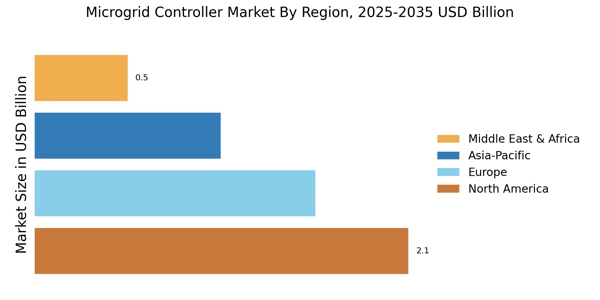
North America is the largest market for microgrid controllers, holding approximately 40% of the global market share. The region hosts several leading controller manufacturers such as General Electric, Schneider Electric, and Honeywell. The region's growth is driven by increasing investments in renewable energy, government incentives, and a strong focus on energy resilience. Regulatory frameworks, such as the Federal Energy Regulatory Commission's initiatives, further catalyze market expansion, promoting decentralized energy solutions and smart grid technologies.

The United States is the dominant player in this region, with significant contributions from Canada. Key players like General Electric, Schneider Electric, and Honeywell are actively involved in developing advanced microgrid solutions. The competitive landscape is characterized by innovation and strategic partnerships, enhancing the region's position as a leader in microgrid technology.

Europe : Sustainable Energy Transition Leader

Europe is the second-largest market for microgrid control systems, accounting for approximately 30% of the global market share. Companies like Siemens and ABB are among the prominent micro grid companies driving adoption. The region's growth is fueled by stringent environmental regulations, a commitment to reducing carbon emissions, and increasing investments in renewable energy sources. The European Union's Green Deal and various national policies are pivotal in driving the adoption of microgrid technologies, promoting energy efficiency and sustainability.

Leading countries in this region include Germany, the UK, and France, where significant investments in smart grid infrastructure are being made. Major players like Siemens and ABB are at the forefront, collaborating with local governments and organizations to enhance energy management systems. The competitive landscape is marked by innovation and a strong focus on integrating renewable energy sources into microgrid solutions.

Asia-Pacific : Emerging Market with High Potential

Asia-Pacific is witnessing rapid growth in the microgrid controller market, holding approximately 20% of the global market share. India and China are investing heavily in microgrid controllers for rural electrification and renewable integration. The region's expansion is driven by increasing energy demand, urbanization, and government initiatives aimed at enhancing energy security. 

India is emerging as a key player in this market, with significant projects aimed at rural electrification and renewable energy deployment. The competitive landscape includes local and international players, with companies like Rockwell Automation and S&C Electric Company actively participating. The region's focus on sustainable energy solutions positions it as a promising market for microgrid controllers in the coming years.

Middle East and Africa : Resource-Rich Market Opportunities

The Middle East and Africa region is gradually emerging in the microgrid controller market, holding about 10% of the global market share. The growth is driven by the need for energy diversification, particularly in resource-rich countries. Governments are increasingly recognizing the importance of microgrids for enhancing energy security and sustainability, leading to supportive policies and investments in renewable energy projects. Countries like South Africa and the UAE are leading the charge, with initiatives aimed at integrating renewable energy into their grids. The competitive landscape is evolving, with both local and international players, including Microgrid Energy, seeking to capitalize on the growing demand for microgrid solutions. The region's unique energy challenges present significant opportunities for innovation and investment in microgrid technologies.

Microgrid Controller Market Regional Image

Key Players and Competitive Insights

Leading market players are investing heavily in research and development to expand their product lines, which will help the microgrid controller market grow even more. Market participants are also undertaking various strategic activities to expand their global footprint, with important market developments including new product launches, contractual agreements, mergers and acquisitions, higher investments, and collaboration with other organizations. To expand and survive in a more competitive and rising market climate, Microgrid Controller industry must offer cost-effective items.Manufacturing locally to minimize operational costs is one of the key business tactics manufacturer use in the global Microgrid Controller industry to benefit clients and increase the market sector. In recent years, the Microgrid Controller industry has offered some of the most significant technological development.Major players in the Microgrid Controller Market, including Schneider Electric (France), Lockheed Martin Corporation (US), S&C Electric Company (US), Emerson Electric Co. (US), Eaton Corporation (Ireland), Honeywell International Inc. (US), Siemens (Germany), Schweitzer Engineering Laboratories (US), GE Power (US), ABB (Switzerland), Power Analytics (US), HOMER Energy LLC (US), Pareto Energy (US), Advanced MicroGrid Solutions Inc. (US), Qinous GmbH (Germany) and others are attempting to increase market demand by investing in research and development operations.ABB Group Ltd. is a worldwide company headquartered in Zürich, Switzerland, founded by Swedes and Swiss. Allmänna Svenska Elektriska Aktiebolaget (ASEA) of Sweden and Brown, Boveri & Cie of Switzerland combined in 1988 to form ASEA Brown Boveri, commonly referred to as "ABB". ABB is at the forefront of electrification and automation technology, which pave the way for a greener, more efficient future. The company's products integrate engineering expertise with computer programs to improve the making, moving, powering, and using of objects.ABB has over 105,000 dedicated workers building on the company's 130 years of experience to drive innovations that speed up the industrial transformation.
In June Modular facilities were designed by ABB and the Swiss firm Axpo in Italy to produce green hydrogen at the lowest possible cost while adhering to stringent environmental regulations.Although the company operates globally, Honeywell International Inc.'s headquarters are in Charlotte, North Carolina. Honeywell Performance Materials & Technologies' (PMT) daily objective is to create future-forward solutions that alter how the world operates as a global technological leader. Honeywell PMT's scientists, chemists, and engineers work tirelessly to advance technology and usher in the future.
In June Honeywell worked with a commercial brand of Duke Energy (the American electric power and natural gas holding company) called Duke Energy Sustainable Solutions (DESS). The companies' goal in working together was to create and distribute nationwide solutions for energy resilience.

Key Companies in the Microgrid Controller Market include

Industry Developments

March 2022: SEL has expanded the utility of its SEL-751 Feeder Protection Relay by introducing two new cards that may be upgraded in the field.

April 2022: Schneider Electric has released the EcoStruxure Energy Hub, an Internet of Things software as a service platform for controlling digitized power and energy systems.

Future Outlook

Microgrid Controller Market Future Outlook

The Microgrid Controller Market is poised for growth at 13.56% CAGR from 2025 to 2035, driven by increasing demand for renewable energy integration and energy efficiency.

New opportunities lie in:

  • Development of advanced AI-driven microgrid management software. Expansion into emerging markets with tailored microgrid solutions. Partnerships with utility companies for integrated energy services.

By 2035, the market is expected to achieve substantial growth, reflecting its critical role in energy management.

Market Segmentation

Microgrid Controller Market Offering Outlook

  • Hardware
  • Software
  • Service

Microgrid Controller Market Vertical Outlook

  • Government
  • Oil & Gas
  • Energy & Power
  • Industrial
  • Military and Defense
  • Commercial

Microgrid Controller Market Connectivity Outlook

  • Grid
  • Off-Grid/Islanded

Report Scope

MARKET SIZE 2024 5.216(USD Billion)
MARKET SIZE 2025 5.923(USD Billion)
MARKET SIZE 2035 21.13(USD Billion)
COMPOUND ANNUAL GROWTH RATE (CAGR) 13.56% (2025 - 2035)
REPORT COVERAGE Revenue Forecast, Competitive Landscape, Growth Factors, and Trends
BASE YEAR 2024
Market Forecast Period 2025 - 2035
Historical Data 2019 - 2024
Market Forecast Units USD Billion
Key Companies Profiled Schneider Electric (FR), Siemens (DE), General Electric (US), Honeywell (US), ABB (CH), Eaton (US), Rockwell Automation (US), S&C Electric Company (US), Microgrid Energy (US)
Segments Covered Connectivity, Offering, Vertical, Region
Key Market Opportunities Integration of renewable energy sources enhances growth potential in the Microgrid Controller Market.
Key Market Dynamics Rising demand for renewable energy integration drives innovation in microgrid controller technologies and regulatory frameworks.
Countries Covered North America, Europe, APAC, South America, MEA

Market Highlights

Author
Author
Author Profile
Ankit Gupta LinkedIn
Team Lead - Research
Ankit Gupta is a seasoned market intelligence and strategic research professional with over six plus years of experience in the ICT and Semiconductor industries. With academic roots in Telecom, Marketing, and Electronics, he blends technical insight with business strategy. Ankit has led 200+ projects, including work for Fortune 500 clients like Microsoft and Rio Tinto, covering market sizing, tech forecasting, and go-to-market strategies. Known for bridging engineering and enterprise decision-making, his insights support growth, innovation, and investment planning across diverse technology markets.
Co-Author
Co-Author Profile
Shubham Munde LinkedIn
Team Lead - Research
Shubham brings over 7 years of expertise in Market Intelligence and Strategic Consulting, with a strong focus on the Automotive, Aerospace, and Defense sectors. Backed by a solid foundation in semiconductors, electronics, and software, he has successfully delivered high-impact syndicated and custom research on a global scale. His core strengths include market sizing, forecasting, competitive intelligence, consumer insights, and supply chain mapping. Widely recognized for developing scalable growth strategies, Shubham empowers clients to navigate complex markets and achieve a lasting competitive edge. Trusted by start-ups and Fortune 500 companies alike, he consistently converts challenges into strategic opportunities that drive sustainable growth.
Leave a Comment

FAQs

What is the projected market valuation of the Microgrid Controller Market by 2035?

The Microgrid Controller Market is projected to reach a valuation of 21.13 USD Billion by 2035.

What was the market valuation of the Microgrid Controller Market in 2024?

In 2024, the Microgrid Controller Market was valued at 5.216 USD Billion.

What is the expected CAGR for the Microgrid Controller Market during the forecast period 2025 - 2035?

The expected CAGR for the Microgrid Controller Market during the forecast period 2025 - 2035 is 13.56%.

Which companies are considered key players in the Microgrid Controller Market?

Key players in the Microgrid Controller Market include Schneider Electric, Siemens, General Electric, Honeywell, ABB, Eaton, Rockwell Automation, S&C Electric Company, and Microgrid Energy.

What are the main segments of the Microgrid Controller Market?

The main segments of the Microgrid Controller Market include Connectivity, Offering, and Vertical.

How much is the Connectivity segment projected to grow by 2035?

The Connectivity segment is projected to grow from 5.216 USD Billion in 2024 to approximately 10.852 USD Billion by 2035.

What is the projected growth for the Hardware segment in the Offering category?

The Hardware segment in the Offering category is expected to grow from 1.5 USD Billion in 2024 to around 6.5 USD Billion by 2035.

Which vertical is expected to have the highest growth in the Microgrid Controller Market?

The Energy & Power vertical is expected to grow significantly, from 1.2 USD Billion in 2024 to 5.0 USD Billion by 2035.

What is the projected valuation for the Off-Grid/Islanded segment by 2035?

The Off-Grid/Islanded segment is projected to reach approximately 10.278 USD Billion by 2035.

How does the Microgrid Controller Market's growth compare across different verticals?

The Microgrid Controller Market shows varied growth across verticals, with the Energy & Power sector leading, followed by Commercial and Industrial sectors.

Research Approach

Research Methodology on Microgrid Controller Market

Introduction

The global microgrid controller market is expected to reach an all-time high revenue and is said to grow at a steady CAGR during the forecast period 2023-2030. A microgrid controller is a specialized device designed to regulate and monitor the performance of an electric grid. It works by collecting real-time data from various components of the power grid, such as the energy source, the grid load, equipment, and other items. The data is then analyzed and used to generate optimized control signals. The microgrid controller also provides fault protection, grid stability, and remote access features. The primary purpose of the controller is to optimize production and consumption in the microgrid in order to maximize efficiency and overall value.

Research Objectives

The main objectives of this research are:

  • To identify the market potential and growth opportunities of the global microgrid controller market.
  • To analyze the key trends, drivers and challenges that impact the global microgrid controller market.
  • To examine the competitive landscape of the global microgrid controller market, and identify the major market players and their strategies.
  • To estimate the market size of the global microgrid controller market and its segments, in terms of value and volume, for the forecast period of 2023-2030.
  • To analyze and identify the macro and microeconomic factors that are influencing the growth of the global microgrid controller market.

Research Methodology

This research report is based on a quantitative, qualitative, and analytical analysis of the global microgrid controller market.

A. Primary Research

Primary research includes interviews and surveys with experts from the industry. The primary research will help to determine the preference of the market regarding various products, services and technologies.

B. Secondary Research

Secondary sources for this study include research papers and reports found online, industry reports, company websites, and other relevant sources.

C. Market Modelling

Market modelling helps to provide an in-depth understanding of the market dynamics through hypotheses and informed estimations. Various market models like custom market models, Porter's five forces analysis, and others were used.

D. Market Forecasting

Market forecasting was done using various methodologies like time-series analysis, econometric analysis, and demand-side and supply-side forecasting. The forecast data was then validated using the actual data.

E. Data Analysis

Data analysis was done using various methods like descriptive analysis, correlation analysis, and multivariate analysis. The data analysis techniques helped to determine the key findings and insights for the global microgrid controller market.

Conclusion

This research presents a comprehensive analysis of the global microgrid controller market. It provides an in-depth understanding of the current trends, drivers and challenges that impact the growth of the market. The research also covers the competitive landscape of the market and identifies the key players and their strategies. The research is based on a quantitative, qualitative, and analytical approach and is backed by a detailed market model and market forecast from 2023 to 2030.

Download Free Sample

Kindly complete the form below to receive a free sample of this Report

Compare Licence

×
Features License Type
Single User Multiuser License Enterprise User
Price $4,950 $5,950 $7,250
Maximum User Access Limit 1 User Upto 10 Users Unrestricted Access Throughout the Organization
Free Customization
Direct Access to Analyst
Deliverable Format
Platform Access
Discount on Next Purchase 10% 15% 15%
Printable Versions