Microgrid as a Service Market

ID: MRFR/ICT/1342-HCR
110 Pages
Ankit Gupta
Last Updated: June 10, 2026
Microgrid as a Service Market Size, Share and Research Report: By Grid Type (Grid connected, Islanded), By Service Type (Software as a Service, Monitoring & Control Service, Operation & Maintenance Service) And By Region (North America, Europe, Asia-Pacific, And Rest Of The World) –Market Forecast Till 2035.
Download PDF ×

We do not share your information with anyone. However, we may send you emails based on your report interest from time to time. You may contact us at any time to opt-out.

  1. 1 Market Overview |
    1. 1.1 Study Assumptions & Market Definition |
    2. 1.2 Scope of the Study |
    3. 1.3 Research Methodology
  2. 2 Market Summary & Key Takeaways
  3. 3 Market Dynamics |
    1. 3.1 Market Drivers Analysis | |
      1. 3.1.1 Grid Resilience Mandates and Federal Funding | |
      2. 3.1.2 Declining Battery Storage Costs | |
      3. 3.1.3 Corporate Decarbonization and ESG Targets | |
      4. 3.1.4 Data Center Power Demand Surge | |
      5. 3.1.5 Electrification of Transportation Fleets | |
      6. 3.1.6 Remote and Island Community Electrification |
    2. 3.2 Market Restraints Analysis | |
      1. 3.2.1 High Upfront Integration Complexity | |
      2. 3.2.2 Regulatory Fragmentation Across Jurisdictions | |
      3. 3.2.3 Cybersecurity Vulnerabilities in Connected Microgrids | |
      4. 3.2.4 Limited Skilled Workforce for Microgrid O&M | |
      5. 3.2.5 Utility Pushback on Distributed Generation Interconnection |
    3. 3.3 Market Opportunity Analysis | |
      1. 3.3.1 Island and Remote Community Electrification | |
      2. 3.3.2 Data Monetization and Grid Services Revenue | |
      3. 3.3.3 Vehicle-to-Grid (V2G) Integration | |
      4. 3.3.4 Defense and Military Base Resilience | |
      5. 3.3.5 Emerging Market Industrial Zones |
    4. 3.4 Industry Value Chain Analysis |
    5. 3.5 Porter's Five Forces Analysis
  4. 4 Global Microgrid as a Service Market Size & Forecast (2021–2035) |
    1. 4.1 Historical Market Size (2021–2025) |
    2. 4.2 Current & Forecast Market Size (2026–2035) |
    3. 4.3 Market Size by Revenue (USD Billion) |
    4. 4.4 Year-over-Year Growth Analysis
  5. 5 Segmentation Analysis |
    1. 5.1 By Service Type | |
      1. 5.1.1 Engineering and Design Service | |
      2. 5.1.2 Software as a Service | |
      3. 5.1.3 Monitoring and Control Services | |
      4. 5.1.4 Operation and Maintenance Services |
    2. 5.2 By End-User Vertical | |
      1. 5.2.1 Government | |
      2. 5.2.2 Residential and Commercial | |
      3. 5.2.3 Industrial
  6. 6 Regional Analysis |
    1. 6.1 North America | |
      1. 6.1.1 United States | |
      2. 6.1.2 Canada | |
      3. 6.1.3 Mexico |
    2. 6.2 Europe | |
      1. 6.2.1 Germany | |
      2. 6.2.2 United Kingdom | |
      3. 6.2.3 France | |
      4. 6.2.4 Italy | |
      5. 6.2.5 Spain | |
      6. 6.2.6 Nordic Countries | |
      7. 6.2.7 Russia | |
      8. 6.2.8 Rest of Europe |
    3. 6.3 Asia-Pacific | |
      1. 6.3.1 China | |
      2. 6.3.2 India | |
      3. 6.3.3 Japan | |
      4. 6.3.4 South Korea | |
      5. 6.3.5 ASEAN | |
      6. 6.3.6 Rest of Asia-Pacific |
    4. 6.4 South America | |
      1. 6.4.1 Brazil | |
      2. 6.4.2 Argentina | |
      3. 6.4.3 Rest of South America |
    5. 6.5 Middle East & Africa | |
      1. 6.5.1 Saudi Arabia | |
      2. 6.5.2 UAE | |
      3. 6.5.3 South Africa | |
      4. 6.5.4 Egypt | |
      5. 6.5.5 Rest of MEA
  7. 7 Competitive Landscape |
    1. 7.1 Market Share Analysis (2025) |
    2. 7.2 Competitive Benchmarking Matrix |
    3. 7.3 Company Profiles | |
      1. 7.3.1 Schneider Electric | |
      2. 7.3.2 Eaton Corporation | |
      3. 7.3.3 GE Vernova | |
      4. 7.3.4 Siemens Energy | |
      5. 7.3.5 ABB Ltd | |
      6. 7.3.6 Honeywell International | |
      7. 7.3.7 Caterpillar Inc. | |
      8. 7.3.8 Bloom Energy | |
      9. 7.3.9 Enchanted Rock | |
      10. 7.3.10 Scale Microgrid Solutions
  8. 8 Future Outlook & Strategic Recommendations (2026–2035) |
    1. 8.1 AI-Driven Autonomous Microgrid Operations |
    2. 8.2 Platform Economics and Aggregation |
    3. 8.3 Electrification Supercycle and Load Growth |
    4. 8.4 ESG Reporting and Climate Disclosure Mandates
  9. 9 Recent Developments & News
  10. 10 Frequently Asked Questions (FAQs)
  11. 11 Report Scope & Methodology |
    1. 11.1 Study Period & Base Year |
    2. 11.2 Data Sources & Citations |
    3. 11.3 Abbreviations
  12. 12 LIST OF TABLES |
  13. TABLE 1 Global Microgrid as a Service Market Size & Forecast, by Revenue (USD Billion), 2021–2035 |
  14. TABLE 2 Global Microgrid as a Service Market – Year-over-Year Growth Analysis, 2021–2035 |
  15. TABLE 3 Global Microgrid as a Service Market – Driver Impact Analysis |
  16. TABLE 4 Global Microgrid as a Service Market – Restraint Impact Analysis |
  17. TABLE 5 Global Microgrid as a Service Market Size, by Service Type, 2021–2035 |
  18. TABLE 6 Global Microgrid as a Service Market Size, by End-User Vertical, 2021–2035 |
  19. TABLE 7 Global Microgrid as a Service Market Size, by Region, 2021–2035 (USD Billion) |
  20. TABLE 8 North America Microgrid as a Service Market Size, by Country, 2021–2035 |
  21. TABLE 9 Europe Microgrid as a Service Market Size, by Country, 2021–2035 |
  22. TABLE 10 Asia-Pacific Microgrid as a Service Market Size, by Country, 2021–2035 |
  23. TABLE 11 South America Microgrid as a Service Market Size, by Country, 2021–2035 |
  24. TABLE 12 Middle East & Africa Microgrid as a Service Market Size, by Country, 2021–2035 |
  25. TABLE 13 Competitive Benchmarking Matrix – Global Microgrid as a Service Market, 2025 |
  26. TABLE 14 Company Profiles – Key Players, Global Microgrid as a Service Market |
  27. TABLE 15 Recent Developments & Strategic Announcements, 2023–2025 |
  28. TABLE 16 Report Scope & Methodology Summary |
  29. TABLE 17 Detailed Sources and Citations
  30. 13 LIST OF FIGURES |
  31. FIGURE 1 Microgrid as a Service Market Dynamics – Drivers, Restraints, and Opportunities |
  32. FIGURE 2 Industry Value Chain Analysis – Microgrid as a Service Market |
  33. FIGURE 3 Porter's Five Forces Analysis – Microgrid as a Service Market |
  34. FIGURE 4 Global Microgrid as a Service Market Size Trend (USD Billion), 2021–2035 |
  35. FIGURE 5 Microgrid as a Service Market Share, by Service Type (%), 2025 |
  36. FIGURE 6 Microgrid as a Service Market Share, by End-User Vertical (%), 2025 |
  37. FIGURE 7 Microgrid as a Service Market Share, by Region (%), 2025 |
  38. FIGURE 8 North America Microgrid as a Service Market – Country Share (%), 2025 |
  39. FIGURE 9 Europe Microgrid as a Service Market – Country Share (%), 2025 |
  40. FIGURE 10 Asia-Pacific Microgrid as a Service Market – Country Share (%), 2025 |
  41. FIGURE 11 South America Microgrid as a Service Market – Country Share (%), 2025 |
  42. FIGURE 12 Middle East & Africa Microgrid as a Service Market – Country Share (%), 2025 |
  43. FIGURE 13 Competitive Landscape – Market Share Analysis, 2025

Segmentation Quick Reference

DimensionSub-SegmentsDominant SegmentFastest Growing Segment
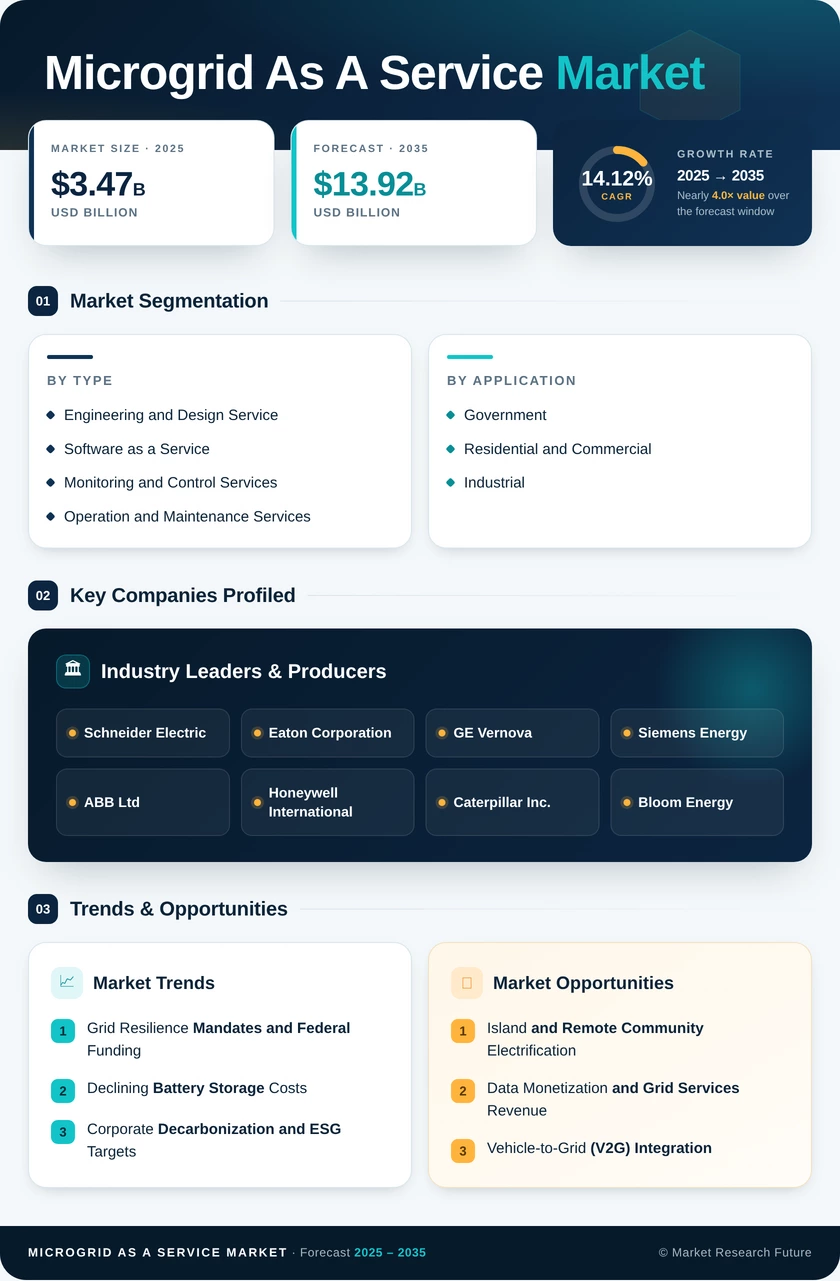
By Service TypeEngineering and Design Service, Software as a Service, Monitoring and Control Services, Operation and Maintenance ServicesSoftware as a ServiceMonitoring and Control Services
By End-User VerticalGovernment, Residential and Commercial, IndustrialIndustrialGovernment
By GeographyNorth America, Europe, Asia-Pacific, South America, Middle East & AfricaAsia-PacificAsia-Pacific


Market Segmentation Overview

By Service Type

Sub-SegmentKey Trend
Engineering and Design ServiceGrowing demand for turnkey greenfield microgrid project development
Software as a ServiceCloud-native energy-as-a-service platforms are driving rapid enterprise onboarding
Monitoring and Control ServicesAI-powered microgrid control systems enabling real-time hybrid asset optimization
Operation and Maintenance ServicesLong-term recurring contracts with guaranteed uptime SLAs


The service type segmentation reflects the full lifecycle of microgrid deployment. Software as a Service has emerged as the leading adoption vector because cloud-based distributed energy management eliminates upfront IT investment, while Monitoring and Control Services are accelerating fastest as operators demand granular visibility into renewable microgrid technology performance.

By End-User Vertical

Sub-SegmentKey Trend
GovernmentFederal resilience mandates and defense-sector procurement are driving large-scale deployments
Residential and CommercialMulti-tenant buildings and campus environments adopting smart grid solutions
IndustrialManufacturing continuity requirements and mining electrification are fueling a dominant share


Industrial end users dominate because power-disruption penalties are steepest in manufacturing and extraction environments. The Government vertical is growing fastest, propelled by defense energy-independence mandates and municipal resilience programs that prioritize microgrid control systems for critical infrastructure.