×
Request Free Sample ×

Kindly complete the form below to receive a free sample of this Report

* Please use a valid business email

Leading companies partner with us for data-driven Insights

clients tt-cursor
Hero Background
English
Chinese
French
Japanese
Korean
German
Spanish

Microbial Lipase Market Analysis

ID: MRFR/FnB/4856-HCR
128 Pages
Snehal Singh
October 2025

Microbial Lipase Market Size, Share, Industry Trend & Analysis Research Report Information by Source (Bacteria, Fungi), Form (Liquid, Powder), Application (Cleaning Agents, Animal Feed, Dairy Products, Bakery Products, Confectionery, Others), and Region (North America, Europe, Asia-Pacific, and Rest of the World) - Forecast till 2035

Share:
Download PDF ×

We do not share your information with anyone. However, we may send you emails based on your report interest from time to time. You may contact us at any time to opt-out.

Microbial Lipase Market Infographic
Purchase Options

Market Analysis

In-depth Analysis of Microbial Lipase Market Industry Landscape

The market dynamics of microbial lipase are undergoing substantial transformations driven by a convergence of factors that underscore the expanding applications in the food and beverage industry, advancements in enzyme technology, and the growing demand for enzyme-based solutions. Microbial lipases, enzymes produced by microorganisms, play a crucial role in the breakdown of fats into fatty acids and glycerol. One key driver of the market is the increasing demand for enzyme solutions in the food and beverage sector, particularly in the dairy, bakery, and confectionery industries. Microbial lipases find applications in cheese production, baking, and the flavor enhancement of various food products, responding to the industry's need for effective and sustainable solutions to improve production processes and product quality.

The food and beverage industry significantly shapes the market dynamics of microbial lipase. With the growing consumer preference for clean-label and natural ingredients, manufacturers are incorporating microbial lipases into various food formulations. In the dairy sector, microbial lipases are used to enhance the flavor and ripening process of cheeses, providing a cost-effective and efficient alternative to traditional methods. In the bakery and confectionery segments, these enzymes contribute to the development of unique textures and flavors, meeting consumer demands for innovative and high-quality products. This trend is not only driven by the desire for improved product characteristics but also by the sustainability aspects of microbial lipases, which offer efficient processing without compromising on quality.

Advancements in enzyme technology contribute significantly to the evolving market dynamics of microbial lipase. Continuous research and development efforts have led to improved microbial strains with enhanced lipase production capabilities, as well as more efficient extraction and purification processes. These technological advancements expand the application possibilities of microbial lipases, influencing market dynamics by providing higher-performing and cost-effective enzyme solutions for the food and beverage industry.

Global trade and international market dynamics impact the microbial lipase market, as the sourcing and availability of raw materials from different regions influence pricing and supply chains. Regulatory considerations, quality standards, and variations in food processing practices contribute to the overall market dynamics, necessitating industry stakeholders to navigate and adapt to changing global conditions.

The pharmaceutical and biotechnology sectors also significantly contribute to the market dynamics of microbial lipases. Enzymes play a crucial role in various pharmaceutical and biotechnological processes, including the production of pharmaceutical compounds, biofuels, and biodegradable plastics. The market dynamics in these sectors reflect an increased utilization of microbial lipases for their specificity and efficiency in catalyzing lipid-based reactions, demonstrating the versatility of these enzymes beyond the food and beverage industry.

Challenges within the market dynamics of microbial lipases include the need for customization to suit specific food applications, addressing regulatory considerations, and ensuring stability in varying processing conditions. Industry participants are responding to these challenges through ongoing research and development initiatives, collaboration with regulatory bodies, and the development of enzyme formulations tailored to specific food processing requirements.


Author
Snehal Singh
Assistant Manager - Research

High acumen in analyzing complex macro & micro markets with more than 6 years of work experience in the field of market research. By implementing her analytical skills in forecasting and estimation into market research reports, she has expertise in Packaging, Construction, and Equipment domains. She handles a team size of 20-25 resources and ensures smooth running of the projects, associated marketing activities, and client servicing.

Leave a Comment

Market Summary

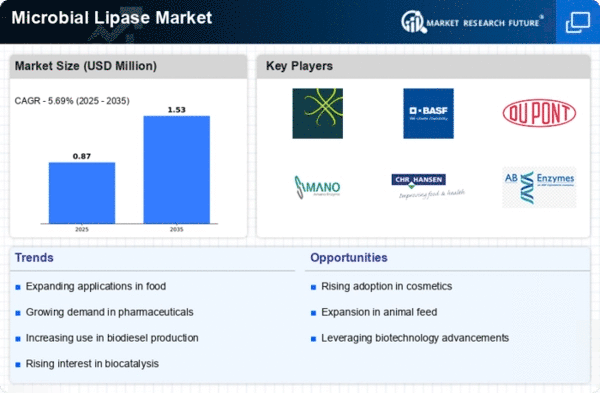
As per MRFR analysis, the Microbial Lipase Market Size was estimated at 0.826 USD Million in 2024. The Microbial Lipase industry is projected to grow from 0.883 in 2025 to 1.53 by 2035, exhibiting a compound annual growth rate (CAGR) of 5.69 during the forecast period 2025 - 2035.

Key Market Trends & Highlights

The Microbial Lipase Market is poised for substantial growth driven by diverse applications and technological advancements.

  • The food industry continues to exhibit a growing demand for microbial lipases, solidifying its position as the largest market segment.
  • Asia-Pacific emerges as the fastest-growing region, reflecting increasing investments in biotechnological innovations.
  • In the microbial lipase market, bacteria remain the largest segment, while fungi are rapidly gaining traction due to their unique properties.
  • Key market drivers include the rising demand for enzymatic applications and regulatory support for biocatalysts, particularly in the biofuel sector.

Market Size & Forecast

2024 Market Size 0.826 (USD Million)
2035 Market Size 1.53 (USD Million)
CAGR (2025 - 2035) 5.69%
Largest Regional Market Share in 2024 North America

Major Players

Novozymes (DK), BASF (DE), DuPont (US), Amano Enzyme (JP), Chr. Hansen (DK), AB Enzymes (DE), Roche (CH), Biocatalysts (GB), Enzyme Development Corporation (US)

Market Trends

The Microbial Lipase Market is currently experiencing a notable transformation, driven by the increasing demand for enzymes in various industries, including food, pharmaceuticals, and biofuels. This shift appears to be influenced by the growing awareness of the benefits associated with microbial lipases, such as their efficiency in catalyzing reactions and their ability to function under diverse conditions. As industries seek sustainable and eco-friendly solutions, the adoption of microbial lipases is likely to expand, reflecting a broader trend towards biocatalysis. Furthermore, advancements in biotechnology and genetic engineering are enhancing the production processes of these enzymes, potentially leading to higher yields and lower costs. In addition, the Microbial Lipase Market seems to be benefiting from the rising trend of plant-based diets and the increasing use of lipases in the production of biodiesel. This trend indicates a shift in consumer preferences towards healthier and more sustainable options, which may further propel the market's growth. Moreover, the ongoing research and development efforts aimed at discovering novel microbial strains and optimizing enzyme formulations suggest a promising future for the sector. As the market evolves, it is essential for stakeholders to remain vigilant and adaptable to the changing landscape, ensuring they capitalize on emerging opportunities and address potential challenges.

Growing Demand in Food Industry

The food sector is increasingly utilizing microbial lipases for their ability to enhance flavor and improve texture in various products. This trend reflects a broader consumer preference for natural ingredients and clean label products.

Sustainability in Biofuels

The shift towards renewable energy sources has led to a heightened interest in microbial lipases for biodiesel production. Their efficiency in catalyzing transesterification reactions positions them as a viable option for sustainable fuel alternatives.

Advancements in Biotechnology

Innovations in genetic engineering and fermentation technologies are likely to enhance the production efficiency of microbial lipases. These advancements may lead to cost-effective solutions, making them more accessible across different industries.

Microbial Lipase Market Market Drivers

Increasing Applications in Biofuels

The Global Microbial Lipase Market Industry is increasingly benefiting from the rising applications of microbial lipases in biofuel production. As the world seeks alternative energy sources, microbial lipases facilitate the transesterification process in biodiesel production, converting fats and oils into usable fuel. This trend aligns with global efforts to reduce carbon emissions and promote renewable energy. The growing emphasis on sustainable energy solutions is likely to bolster the market, as industries adopt microbial lipases to enhance biofuel production efficiency, thereby expanding their market share.

Growing Awareness of Health Benefits

The Global Microbial Lipase Market Industry is also experiencing growth due to the increasing awareness of health benefits associated with microbial lipases. These enzymes are recognized for their potential to aid in digestion and improve nutrient absorption, particularly in dietary supplements and functional foods. As consumers become more health-conscious, the demand for products containing microbial lipases is expected to rise. This trend may lead to a broader acceptance of microbial lipases in the health and wellness sector, further driving market expansion.

Expansion in Food and Beverage Sector

The Global Microbial Lipase Market Industry is witnessing substantial growth due to the expansion of the food and beverage sector. Microbial lipases are extensively utilized in food processing, particularly in the production of cheese, dairy products, and baked goods. Their ability to enhance flavor and texture makes them indispensable in this industry. As the global population continues to rise, the demand for processed food is expected to increase, potentially driving the market value to 1122.4 USD Million by 2035. This growth trajectory highlights the importance of microbial lipases in meeting consumer preferences for high-quality food products.

Rising Demand for Biodegradable Products

The Global Microbial Lipase Market Industry experiences a notable surge in demand for biodegradable products, driven by increasing environmental awareness. As consumers and manufacturers alike shift towards sustainable alternatives, microbial lipases play a crucial role in the production of biodegradable plastics and detergents. This trend is expected to contribute significantly to the market, with projections indicating a market value of 590.0 USD Million in 2024. The growing preference for eco-friendly products is likely to propel the adoption of microbial lipases, further enhancing their market presence.

Technological Advancements in Enzyme Production

Technological advancements in enzyme production are significantly influencing the Global Microbial Lipase Market Industry. Innovations in fermentation technology and genetic engineering have led to the development of more efficient microbial strains capable of producing lipases with enhanced activity and stability. These advancements not only improve production yields but also reduce costs, making microbial lipases more accessible to various industries. As a result, the market is poised for growth, with a projected CAGR of 6.02% from 2025 to 2035, indicating a robust future for microbial lipases in diverse applications.

Market Segment Insights

By Application: Food Industry (Largest) vs. Pharmaceuticals (Fastest-Growing)

In the Microbial Lipase Market, the Food Industry represents the largest application segment, driven by the increasing demand for processed food and the incorporation of healthy fats in food products. Other notable segments include Cosmetics, Pharmaceuticals, Biofuels, and Detergents, each contributing to the diversification of applications for microbial lipases. Among these, Pharmaceuticals show a rapidly increasing market presence, as they utilize microbial lipases in drug formulation and synthesis, thus highlighting shifts in consumer preferences and technological advancements. As awareness about health benefits escalates, the demand for microbial lipases in the Food Industry continues to dominate, supported by trends focusing on natural and organic products. The surge in pharmaceuticals, driven by innovations in drug development and the increasing need for biocatalytic processes, marks it as the fastest-growing segment. Similarly, the rising popularity of sustainable fuels in Biofuels and eco-friendly options in Detergents further elevate the need for microbial lipases, unearthing potential growth opportunities in these emerging markets.

Food Industry (Dominant) vs. Biofuels (Emerging)

The Food Industry stands as the dominant application area for microbial lipases, characterized by its extensive utilization in food processing, flavor enhancement, and the production of healthy ingredients. This segment benefits from growing consumer preferences for natural additives and healthier food alternatives, which enhances its position in the market. In contrast, the Biofuels segment is emerging as a significant player, supported by a shift towards renewable energy sources and sustainability in fuel production. The increasing focus on biodiesel production using microbial lipases highlights its potential, driven by global environmental concerns and the push for greener technologies. Together, these segments showcase divergent paths that are reshaping the microbial lipase market.

By Source: Bacteria (Largest) vs. Fungi (Fastest-Growing)

In the Microbial Lipase Market, the source segment is divided into three primary categories: Bacteria, Fungi, and Yeast. Among these, bacteria have emerged as the largest contributor, accounting for a significant share due to their widespread application in various industries such as food, biofuels, and pharmaceuticals. Fungi, on the other hand, is gaining in popularity and is recognized for its fast growth, leveraging its unique properties that can enhance product quality and performance in diverse applications.

Bacteria (Dominant) vs. Fungi (Emerging)

Bacteria have established themselves as the dominant source of microbial lipase in the market, largely due to their efficient production processes and robust performance across various applications. Their versatility allows for optimal enzymatic reactions in food processing, waste management, and bioconversion. Fungi, while currently an emerging source, are rapidly gaining traction in the microbial lipase arena. Their enzymes are noted for higher specificity and lower operational costs, making them increasingly attractive for industries focused on sustainability and bioprocess optimization. This dynamic competitive landscape highlights the potential for fungi to disrupt traditional market roles.

By Form: Liquid (Largest) vs. Powder (Fastest-Growing)

In the Microbial Lipase Market, the segment distribution indicates that liquid forms dominate the landscape, widely utilized in various applications due to their versatility and effectiveness. The liquid form is preferred in food processing, pharmaceuticals, and detergents, leading to a significant market share. Meanwhile, the powder form, although smaller in overall share, exhibits robust growth trends as industries seek more concentrated and versatile enzyme solutions. Its applicability in dry formulations and convenience in storage drive its increasing popularity.

Liquid (Dominant) vs. Powder (Emerging)

The liquid form of microbial lipase remains a dominant player, favored for its easy integration into production processes and wide applicability across multiple sectors such as food, pharmaceuticals, and biofuels. In contrast, the powdered form is emerging as a significant competitor, attracting attention for its stability and convenience in applications where precise enzyme concentrations are crucial. Both forms cater to diverse needs; however, the increasing preferences for powdered enzymes in specialty applications such as animal feed and niche food products indicate a shift towards the powdered format as a viable alternative, leading to its rapid growth in the market.

By Functionality: Thermostable (Largest) vs. Alkaline (Fastest-Growing)

In the Microbial Lipase Market, the functionality segment demonstrates a diverse distribution with thermostable lipases commanding the largest market share. These enzymes are highly sought after for their stability at elevated temperatures, making them preferred in various applications such as food processing and biofuels. On the other hand, alkaline lipases are emerging rapidly, gaining significant traction in industrial applications due to their effectiveness in breaking down fats in alkaline environments. This shift is influenced by their expanding utility in sectors such as detergents and biodiesel production. Market trends indicate that the demand for thermostable lipases will continue to dominate, driven by advancements in food technology and renewable energy sectors. Concurrently, the alkaline lipase segment is anticipated to exhibit the fastest growth trajectory, prompted by increased interest in sustainable products and enzyme applications across diverse industries. The focus on green technologies and cleaner production processes will likely bolster the adoption of these enzymes, reshaping the landscape of the Microbial Lipase Market in the coming years.

Thermostable (Dominant) vs. Alkaline (Emerging)

Thermostable lipases hold a dominant position in the Microbial Lipase Market due to their remarkable thermal stability, allowing them to function optimally at high temperatures. This characteristic enhances their applicability in various processes, particularly in the food and beverage industry, where temperature control is crucial for product quality. Their widespread acceptance and proven efficacy make them a preferred choice for companies seeking reliable enzymatic solutions. In contrast, alkaline lipases are emerging as a revolutionary force, particularly in industrial applications where pH levels vary significantly. Their ability to efficiently catalyze the hydrolysis of fats in alkaline conditions positions them favorably for growth, especially in sectors like laundry detergents and biodiesel production. The increasing demand for biodegradable products and environmentally friendly alternatives to chemical processes is driving the expansion of alkaline lipases, promising a dynamic evolution in this segment.

Get more detailed insights about Microbial Lipase Market Research Report - Forecast till 2035

Regional Insights

North America : Market Leader in Innovation

North America is poised to maintain its leadership in the microbial lipase market, holding a significant market share of 40% in 2024. The region's growth is driven by increasing demand for enzyme-based solutions in food processing, biofuels, and pharmaceuticals. Regulatory support for biotechnological advancements further catalyzes market expansion, as companies seek to innovate and meet consumer demands for sustainable products. The United States stands out as a key player, with major companies like DuPont and Novozymes leading the charge. The competitive landscape is characterized by continuous R&D investments and strategic partnerships among industry leaders. This dynamic environment fosters innovation, ensuring that North America remains at the forefront of microbial lipase production and application.

Europe : Emerging Market with Growth Potential

Europe is witnessing a burgeoning microbial lipase market, accounting for 25% of the global share in 2024. The region's growth is fueled by increasing consumer awareness regarding health and nutrition, driving demand for enzyme applications in food and beverage industries. Additionally, stringent regulations promoting environmentally friendly production methods are encouraging investments in biocatalysts. Leading countries such as Germany, France, and the UK are at the forefront of this market, with key players like BASF and Chr. Hansen actively participating. The competitive landscape is marked by innovation and collaboration among companies, enhancing product offerings and market reach. As Europe continues to prioritize sustainability, the microbial lipase market is expected to thrive, supported by favorable regulatory frameworks.

Asia-Pacific : Rapid Growth in Emerging Economies

The Asia-Pacific region is emerging as a significant player in the microbial lipase market, holding a 15% share in 2024. The growth is primarily driven by rising industrialization and increasing demand for enzymes in food processing and detergents. Countries like China and India are witnessing rapid advancements in biotechnology, supported by government initiatives aimed at enhancing enzyme production capabilities. China leads the market in the region, with numerous local and international companies investing in microbial lipase production. The competitive landscape is evolving, with a focus on innovation and cost-effective solutions. As the region continues to develop its industrial base, the microbial lipase market is expected to expand, driven by both domestic and export demands.

Middle East and Africa : Niche Market with Growth Opportunities

The Middle East and Africa represent a nascent market for microbial lipase, with a mere 1% share in 2024. However, the region is gradually recognizing the potential of biocatalysts in various industries, including food and pharmaceuticals. Increasing investments in biotechnology and a growing awareness of sustainable practices are expected to drive market growth in the coming years. Countries like South Africa and the UAE are beginning to explore the benefits of microbial lipase, with local companies starting to invest in enzyme production. The competitive landscape is still developing, but there is a clear opportunity for growth as more businesses recognize the advantages of enzyme applications. As the region's industrial capabilities expand, the microbial lipase market is likely to gain traction.

Key Players and Competitive Insights

The Microbial Lipase Market is characterized by a dynamic competitive landscape, driven by increasing demand for biocatalysts across various industries, including food, pharmaceuticals, and biofuels. Key players such as Novozymes (Denmark), BASF (Germany), and DuPont (US) are strategically positioned to leverage innovation and sustainability in their operations. Novozymes (Denmark) focuses on enhancing its product portfolio through continuous research and development, while BASF (Germany) emphasizes strategic partnerships to expand its market reach. DuPont (US) is actively pursuing digital transformation initiatives to optimize its manufacturing processes, thereby enhancing operational efficiency. Collectively, these strategies contribute to a competitive environment that is increasingly focused on innovation and sustainability.In terms of business tactics, companies are localizing manufacturing to reduce lead times and optimize supply chains. The market structure appears moderately fragmented, with several key players exerting significant influence. This fragmentation allows for niche players to emerge, yet the collective strength of major companies shapes market dynamics, often leading to collaborative efforts that enhance product offerings and market penetration.

In November Novozymes (Denmark) announced a partnership with a leading food manufacturer to develop a new line of microbial lipases tailored for plant-based products. This strategic move is likely to position Novozymes at the forefront of the growing plant-based food sector, aligning with consumer trends towards healthier and sustainable food options. The collaboration underscores the importance of innovation in meeting evolving market demands.

In October BASF (Germany) launched a new microbial lipase product aimed at the biofuel industry, which is expected to enhance the efficiency of biodiesel production. This initiative reflects BASF's commitment to sustainability and its strategic focus on renewable energy solutions. By diversifying its product offerings, BASF is likely to strengthen its competitive edge in the biofuels market, which is experiencing significant growth.

In September DuPont (US) unveiled a digital platform designed to optimize enzyme production processes, thereby reducing costs and improving product quality. This technological advancement is indicative of DuPont's commitment to integrating digital solutions into its operations, which may enhance its competitive positioning in the microbial lipase market. The emphasis on technology integration suggests a broader trend towards digitalization within the industry.

As of December current competitive trends indicate a strong focus on digitalization, sustainability, and the integration of artificial intelligence in production processes. Strategic alliances are increasingly shaping the landscape, allowing companies to pool resources and expertise to drive innovation. Looking ahead, competitive differentiation is likely to evolve from traditional price-based competition to a focus on technological advancements, innovative product development, and reliable supply chains. This shift may redefine market dynamics, compelling companies to prioritize long-term sustainability and innovation over short-term gains.

Key Companies in the Microbial Lipase Market include

Industry Developments

Future Outlook

Microbial Lipase Market Future Outlook

The Microbial Lipase Market is projected to grow at a 5.69% CAGR from 2025 to 2035, driven by increasing demand in food processing, biofuels, and pharmaceuticals.

New opportunities lie in:

  • Expansion into emerging markets with tailored microbial lipase products.
  • Development of enzyme blends for specific industrial applications.
  • Investment in R&D for innovative microbial lipase formulations.

By 2035, the Microbial Lipase Market is expected to achieve robust growth and diversification.

Market Segmentation

Microbial Lipase Market Form Outlook

  • Liquid
  • Powder
  • Granular

Microbial Lipase Market Source Outlook

  • Bacteria
  • Fungi
  • Yeast

Microbial Lipase Market Application Outlook

  • Food Industry
  • Cosmetics
  • Pharmaceuticals
  • Biofuels
  • Detergents

Microbial Lipase Market Functionality Outlook

  • Thermostable
  • Acidic
  • Alkaline
  • Neutral

Report Scope

MARKET SIZE 20240.826(USD Million)
MARKET SIZE 20250.883(USD Million)
MARKET SIZE 20351.53(USD Million)
COMPOUND ANNUAL GROWTH RATE (CAGR)5.69% (2025 - 2035)
REPORT COVERAGERevenue Forecast, Competitive Landscape, Growth Factors, and Trends
BASE YEAR2024
Market Forecast Period2025 - 2035
Historical Data2019 - 2024
Market Forecast UnitsUSD Million
Key Companies ProfiledNovozymes (DK), BASF (DE), DuPont (US), Amano Enzyme (JP), Chr. Hansen (DK), AB Enzymes (DE), Roche (CH), Biocatalysts (GB), Enzyme Development Corporation (US)
Segments CoveredApplication, Source, Form, Functionality
Key Market OpportunitiesGrowing demand for sustainable biocatalysts in food and biofuel industries drives Microbial Lipase Market expansion.
Key Market DynamicsRising demand for biodegradable products drives innovation and competition in the microbial lipase market.
Countries CoveredNorth America, Europe, APAC, South America, MEA

FAQs

  1. SECTION I: EXECUTIVE SUMMARY AND KEY HIGHLIGHTS
    1. | 1.1 EXECUTIVE SUMMARY
    2. | 1.1.1 Market Overview
    3. | 1.1.2 Key Findings
    4. | 1.1.3 Market Segmentation
    5. | 1.1.4 Competitive Landscape
    6. | 1.1.5 Challenges and Opportunities
    7. | 1.1.6 Future Outlook
  2. SECTION II: SCOPING, METHODOLOGY AND MARKET STRUCTURE
    1. | 2.1 MARKET INTRODUCTION
    2. | 2.1.1 Definition
    3. | 2.1.2 Scope of the study
    4. |-- 2.1.2.1 Research Objective
    5. |-- 2.1.2.2 Assumption
    6. |-- 2.1.2.3 Limitations
    7. | 2.2 RESEARCH METHODOLOGY
    8. | 2.2.1 Overview
    9. | 2.2.2 Data Mining
    10. | 2.2.3 Secondary Research
    11. | 2.2.4 Primary Research
    12. |-- 2.2.4.1 Primary Interviews and Information Gathering Process
    13. |-- 2.2.4.2 Breakdown of Primary Respondents
    14. | 2.2.5 Forecasting Model
    15. | 2.2.6 Market Size Estimation
    16. |-- 2.2.6.1 Bottom-Up Approach
    17. |-- 2.2.6.2 Top-Down Approach
    18. | 2.2.7 Data Triangulation
    19. | 2.2.8 Validation
  3. SECTION III: QUALITATIVE ANALYSIS
    1. | 3.1 MARKET DYNAMICS
    2. | 3.1.1 Overview
    3. | 3.1.2 Drivers
    4. | 3.1.3 Restraints
    5. | 3.1.4 Opportunities
    6. | 3.2 MARKET FACTOR ANALYSIS
    7. | 3.2.1 Value chain Analysis
    8. | 3.2.2 Porter's Five Forces Analysis
    9. |-- 3.2.2.1 Bargaining Power of Suppliers
    10. |-- 3.2.2.2 Bargaining Power of Buyers
    11. |-- 3.2.2.3 Threat of New Entrants
    12. |-- 3.2.2.4 Threat of Substitutes
    13. |-- 3.2.2.5 Intensity of Rivalry
    14. | 3.2.3 COVID-19 Impact Analysis
    15. |-- 3.2.3.1 Market Impact Analysis
    16. |-- 3.2.3.2 Regional Impact
    17. |-- 3.2.3.3 Opportunity and Threat Analysis
  4. SECTION IV: QUANTITATIVE ANALYSIS
    1. | 4.1 Food, Beverages & Nutrition, BY Application (USD Million)
    2. | 4.1.1 Food Industry
    3. | 4.1.2 Cosmetics
    4. | 4.1.3 Pharmaceuticals
    5. | 4.1.4 Biofuels
    6. | 4.1.5 Detergents
    7. | 4.2 Food, Beverages & Nutrition, BY Source (USD Million)
    8. | 4.2.1 Bacteria
    9. | 4.2.2 Fungi
    10. | 4.2.3 Yeast
    11. | 4.3 Food, Beverages & Nutrition, BY Form (USD Million)
    12. | 4.3.1 Liquid
    13. | 4.3.2 Powder
    14. | 4.3.3 Granular
    15. | 4.4 Food, Beverages & Nutrition, BY Functionality (USD Million)
    16. | 4.4.1 Thermostable
    17. | 4.4.2 Acidic
    18. | 4.4.3 Alkaline
    19. | 4.4.4 Neutral
    20. | 4.5 Food, Beverages & Nutrition, BY Region (USD Million)
    21. | 4.5.1 North America
    22. |-- 4.5.1.1 US
    23. |-- 4.5.1.2 Canada
    24. | 4.5.2 Europe
    25. |-- 4.5.2.1 Germany
    26. |-- 4.5.2.2 UK
    27. |-- 4.5.2.3 France
    28. |-- 4.5.2.4 Russia
    29. |-- 4.5.2.5 Italy
    30. |-- 4.5.2.6 Spain
    31. |-- 4.5.2.7 Rest of Europe
    32. | 4.5.3 APAC
    33. |-- 4.5.3.1 China
    34. |-- 4.5.3.2 India
    35. |-- 4.5.3.3 Japan
    36. |-- 4.5.3.4 South Korea
    37. |-- 4.5.3.5 Malaysia
    38. |-- 4.5.3.6 Thailand
    39. |-- 4.5.3.7 Indonesia
    40. |-- 4.5.3.8 Rest of APAC
    41. | 4.5.4 South America
    42. |-- 4.5.4.1 Brazil
    43. |-- 4.5.4.2 Mexico
    44. |-- 4.5.4.3 Argentina
    45. |-- 4.5.4.4 Rest of South America
    46. | 4.5.5 MEA
    47. |-- 4.5.5.1 GCC Countries
    48. |-- 4.5.5.2 South Africa
    49. |-- 4.5.5.3 Rest of MEA
  5. SECTION V: COMPETITIVE ANALYSIS
    1. | 5.1 Competitive Landscape
    2. | 5.1.1 Overview
    3. | 5.1.2 Competitive Analysis
    4. | 5.1.3 Market share Analysis
    5. | 5.1.4 Major Growth Strategy in the Food, Beverages & Nutrition
    6. | 5.1.5 Competitive Benchmarking
    7. | 5.1.6 Leading Players in Terms of Number of Developments in the Food, Beverages & Nutrition
    8. | 5.1.7 Key developments and growth strategies
    9. |-- 5.1.7.1 New Product Launch/Service Deployment
    10. |-- 5.1.7.2 Merger & Acquisitions
    11. |-- 5.1.7.3 Joint Ventures
    12. | 5.1.8 Major Players Financial Matrix
    13. |-- 5.1.8.1 Sales and Operating Income
    14. |-- 5.1.8.2 Major Players R&D Expenditure. 2023
    15. | 5.2 Company Profiles
    16. | 5.2.1 Novozymes (DK)
    17. |-- 5.2.1.1 Financial Overview
    18. |-- 5.2.1.2 Products Offered
    19. |-- 5.2.1.3 Key Developments
    20. |-- 5.2.1.4 SWOT Analysis
    21. |-- 5.2.1.5 Key Strategies
    22. | 5.2.2 BASF (DE)
    23. |-- 5.2.2.1 Financial Overview
    24. |-- 5.2.2.2 Products Offered
    25. |-- 5.2.2.3 Key Developments
    26. |-- 5.2.2.4 SWOT Analysis
    27. |-- 5.2.2.5 Key Strategies
    28. | 5.2.3 DuPont (US)
    29. |-- 5.2.3.1 Financial Overview
    30. |-- 5.2.3.2 Products Offered
    31. |-- 5.2.3.3 Key Developments
    32. |-- 5.2.3.4 SWOT Analysis
    33. |-- 5.2.3.5 Key Strategies
    34. | 5.2.4 Amano Enzyme (JP)
    35. |-- 5.2.4.1 Financial Overview
    36. |-- 5.2.4.2 Products Offered
    37. |-- 5.2.4.3 Key Developments
    38. |-- 5.2.4.4 SWOT Analysis
    39. |-- 5.2.4.5 Key Strategies
    40. | 5.2.5 Chr. Hansen (DK)
    41. |-- 5.2.5.1 Financial Overview
    42. |-- 5.2.5.2 Products Offered
    43. |-- 5.2.5.3 Key Developments
    44. |-- 5.2.5.4 SWOT Analysis
    45. |-- 5.2.5.5 Key Strategies
    46. | 5.2.6 AB Enzymes (DE)
    47. |-- 5.2.6.1 Financial Overview
    48. |-- 5.2.6.2 Products Offered
    49. |-- 5.2.6.3 Key Developments
    50. |-- 5.2.6.4 SWOT Analysis
    51. |-- 5.2.6.5 Key Strategies
    52. | 5.2.7 Roche (CH)
    53. |-- 5.2.7.1 Financial Overview
    54. |-- 5.2.7.2 Products Offered
    55. |-- 5.2.7.3 Key Developments
    56. |-- 5.2.7.4 SWOT Analysis
    57. |-- 5.2.7.5 Key Strategies
    58. | 5.2.8 Biocatalysts (GB)
    59. |-- 5.2.8.1 Financial Overview
    60. |-- 5.2.8.2 Products Offered
    61. |-- 5.2.8.3 Key Developments
    62. |-- 5.2.8.4 SWOT Analysis
    63. |-- 5.2.8.5 Key Strategies
    64. | 5.2.9 Enzyme Development Corporation (US)
    65. |-- 5.2.9.1 Financial Overview
    66. |-- 5.2.9.2 Products Offered
    67. |-- 5.2.9.3 Key Developments
    68. |-- 5.2.9.4 SWOT Analysis
    69. |-- 5.2.9.5 Key Strategies
    70. | 5.3 Appendix
    71. | 5.3.1 References
    72. | 5.3.2 Related Reports

Food, Beverages & Nutrition Market Segmentation

Food, Beverages & Nutrition By Application (USD Million, 2025-2035)

  • Food Industry
  • Cosmetics
  • Pharmaceuticals
  • Biofuels
  • Detergents

Food, Beverages & Nutrition By Source (USD Million, 2025-2035)

  • Bacteria
  • Fungi
  • Yeast

Food, Beverages & Nutrition By Form (USD Million, 2025-2035)

  • Liquid
  • Powder
  • Granular

Food, Beverages & Nutrition By Functionality (USD Million, 2025-2035)

  • Thermostable
  • Acidic
  • Alkaline
  • Neutral
Infographic

Free Sample Request

Kindly complete the form below to receive a free sample of this Report

Get Free Sample

Customer Strories

Compare Licence

×
Features License Type
Single User Multiuser License Enterprise User
Price $4,950 $5,950 $7,250
Maximum User Access Limit 1 User Upto 10 Users Unrestricted Access Throughout the Organization
Free Customization
Direct Access to Analyst
Deliverable Format
Platform Access
Discount on Next Purchase 10% 15% 15%
Printable Versions