Request Free Sample ×

Kindly complete the form below to receive a free sample of this Report

* Please use a valid business email

Leading companies partner with us for data-driven Insights

clients tt-cursor
Hero Background
English
Chinese
French
Japanese
Korean
German
Spanish

mHealth Applications Market Share

ID: MRFR/HCIT/2304-CR
122 Pages
Satyendra Maurya
December 2024

MHealth Applications Market Research Report By Application Type (Fitness and Wellness, Chronic Disease Management, Women's Health, Mental Health, Medication Management), By End User (Consumers, Healthcare Providers, Pharmaceutical Companies, Insurance Companies), By Platform (iOS, Android, Web-based), By Functionality (Monitoring, Diagnosis, Consultation, Treatment) and By Regional (North America, Europe, South America, Asia Pacific, Middle East and Africa) - Growth & Industry Forecast 2025 To 2035

Share:
Download PDF ×

We do not share your information with anyone. However, we may send you emails based on your report interest from time to time. You may contact us at any time to opt-out.

mHealth Applications Market Infographic
Purchase Options

Market Share

mHealth Applications Market Share Analysis

In the ever dynamic and fast evolving mHealth Applications Market, companies use different strategic approaches in order to be leaders in provision of mobile health solutions that increase access to healthcare and enhance patients’ outcomes. For example, one of the main strategies is continuous innovation of mhealth apps.

The mHealth Applications Market is using customization and personalization as fundamental market share positioning strategies. Customizable mHealth apps which can address wide range of users’ needs are designed according to specific health or wellness goals such as fitness tracking, chronic disease management or mental health support. They are flexible enough that they can be adapted by users themselves based on their condition and lifestyle preferences thus helping retain existing customers while attracting new ones who need just the right kind of app tailored to suit their unique requirements.

Moreover, User education and engagement are essential tactics used in market share positioning by a majority of players operating within the mHealth Applications Market. Companies therefore engage in activities that seek to educate potential consumer groups regarding how the applications work hence improving its acceptance among its target market segment. These initiatives may involve training individuals on how these apps work or even informing them about data privacy issues among others. Educating end-users establishes positive experiences with these apps hence increasing brand loyalty shares respectively.

The most important thing for mHealth Applications Market to focus on is data security and privacy in their market share positioning strategies. Health data being sensitive, companies therefore put in place strong security measures in addition to following privacy laws. Encryption, secure data storage and compliance with healthcare privacy standards make mHealth applications be seen as trustworthy and credible. Making the issue of data security and privacy central builds confidence among customers while also positioning the same companies as being responsible for safe and dependable mHealth solutions. This approach towards security contributes to market share growth by giving assurance to users about the safety of their health information.

To diversify geographically across global markets is one strategic approach that applies in this case. By making applications available in regional languages, adapting them to local healthcare systems or cultural preferences, multinationals can reach more people globally through new apps development policies. Some other practices may entail forging partnerships with local health organizations, understanding varied regulatory frameworks within different jurisdictions and redesigning an app that addresses the specific public health challenges faced by diverse populations. From a geographical perspective however, this allows companies penetrate new markets which makes them tap into emerging markets expanding their customer base hence gaining large shares.


Author
Author Profile
Satyendra Maurya
Research Analyst

An accomplished research analyst with high proficiency in market forecasting, data visualization, competitive benchmarking, and others. He holds a pronounced track record in research and consulting projects for sectors such as life sciences, medical devices, and healthcare IT. His capabilities in qualitative and quantitative analysis have resulted in positive client outcomes. Working on niche market trends, opportunities, sales, and forecasted value is part of his skill set.

Leave a Comment

FAQs

What is the current valuation of the mHealth Applications Market in 2025?

<p>The mHealth Applications Market is valued at approximately 59.19 USD Billion in 2024.</p>

What is the projected market size for the mHealth Applications Market by 2035?

<p>The market is expected to reach a valuation of 307.23 USD Billion by 2035.</p>

What is the expected CAGR for the mHealth Applications Market during the forecast period 2025 - 2035?

<p>The expected CAGR for the mHealth Applications Market during the forecast period 2025 - 2035 is 16.15%.</p>

Which application type segment has the highest projected valuation by 2035?

<p>The Chronic Disease Management segment is projected to reach approximately 75.0 USD Billion by 2035.</p>

How do the revenues of the Fitness and Wellness segment compare to the Mental Health segment by 2035?

<p>By 2035, the Fitness and Wellness segment is expected to reach 50.0 USD Billion, while the Mental Health segment is projected at 60.0 USD Billion.</p>

What is the anticipated revenue for the Android platform in the mHealth Applications Market by 2035?

<p>The Android platform is projected to generate approximately 120.0 USD Billion by 2035.</p>

Which end user segment is expected to contribute the most to the mHealth Applications Market by 2035?

<p>The Consumers segment is anticipated to contribute around 100.0 USD Billion by 2035.</p>

What functionality segment is projected to have the highest revenue by 2035?

<p>The Treatment functionality segment is expected to reach approximately 122.23 USD Billion by 2035.</p>

Who are the key players leading the mHealth Applications Market?

<p>Key players in the mHealth Applications Market include Apple Inc., Samsung Electronics, Google LLC, and Fitbit Inc.</p>

What is the projected revenue for the Medication Management segment by 2035?

<p>The Medication Management segment is expected to reach approximately 82.23 USD Billion by 2035.</p>

Market Summary

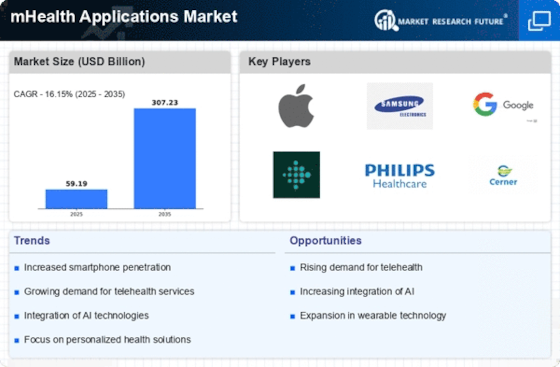
As per Market Research Future analysis, the mHealth Applications Market Size was estimated at 59.19 USD Billion in 2024. The mHealth Applications industry is projected to grow from 68.75 USD Billion in 2025 to 307.23 USD Billion by 2035, exhibiting a compound annual growth rate (CAGR) of 16.15% during the forecast period 2025 - 2035

Key Market Trends & Highlights

The mHealth Applications Market is experiencing robust growth driven by technological advancements and increasing health awareness.

  • The integration with wearable technology is enhancing user engagement and health monitoring capabilities. A growing focus on preventive health is shaping consumer preferences and driving app development. Telehealth services are expanding rapidly, particularly in North America, as patients seek convenient healthcare solutions. Rising demand for chronic disease management and increased smartphone penetration are key drivers propelling market growth.

Market Size & Forecast

2024 Market Size 59.19 (USD Billion)
2035 Market Size 307.23 (USD Billion)
CAGR (2025 - 2035) 16.15%
Largest Regional Market Share in 2024 North America

Major Players

Apple Inc. (US), <a href="https://www.samsung.com/us/support/owners/app/samsung-health">Samsung Electronics</a> (KR), Google LLC (US), Fitbit Inc. (US), Philips Healthcare (NL), Cerner Corporation (US), McKesson Corporation (US), IBM Corporation (US), Omada Health (US)

Market Trends

The mHealth Applications Market is currently experiencing a transformative phase, driven by advancements in technology and an increasing emphasis on health management. The proliferation of smartphones and wearable devices has facilitated the integration of health applications into daily routines, enabling users to monitor their health metrics conveniently. This shift towards digital health solutions appears to be reshaping the landscape of healthcare delivery, as individuals seek more personalized and accessible options for managing their well-being. Furthermore, the growing awareness of preventive healthcare is likely to propel the demand for mHealth applications, as users become more proactive in tracking their health indicators and lifestyle choices. In addition, the mHealth Applications Market seems to be influenced by a rising trend of telehealth services, which offer remote consultations and health monitoring. This trend indicates a potential shift in how healthcare providers interact with patients, as digital platforms become increasingly integral to patient engagement. As the market evolves, it may also witness a surge in partnerships between technology firms and healthcare organizations, aimed at enhancing the functionality and reach of mobile health solutions. Overall, the mHealth Applications Market is poised for continued growth, driven by innovation and a commitment to improving health outcomes through technology-driven solutions.

Integration with Wearable Technology

The mHealth Applications Market is increasingly integrating with wearable devices, allowing users to track their health metrics in real-time. This trend enhances user engagement and provides valuable data for both individuals and healthcare providers.

Focus on Preventive Health

There is a growing emphasis on preventive health within the mHealth Applications Market. Users are becoming more proactive in managing their health, leading to an increased demand for applications that facilitate health monitoring and lifestyle management.

Expansion of Telehealth Services

The mHealth Applications Market is witnessing an expansion of telehealth services, which enable remote consultations and health monitoring. This trend suggests a shift in healthcare delivery, making it more accessible and convenient for patients.

mHealth Applications Market Market Drivers

Growing Focus on Mental Health

The mHealth Applications Market is witnessing a growing emphasis on mental health solutions. As awareness of mental health issues increases, there is a corresponding demand for applications that provide support and resources for mental well-being. Recent studies indicate that nearly one in five adults experience mental illness, highlighting the urgent need for accessible mental health care. mHealth applications offer features such as guided meditation, mood tracking, and virtual therapy sessions, which can be instrumental in addressing these challenges. This focus on mental health is likely to propel the mHealth Applications Market forward, as both consumers and healthcare providers recognize the importance of mental wellness in overall health.

Increased Smartphone Penetration

The mHealth Applications Market is significantly influenced by the widespread adoption of smartphones. With over 80% of the population in developed regions owning a smartphone, the accessibility of mobile health applications has surged. This trend is particularly pronounced among younger demographics, who are more inclined to utilize technology for health management. The convenience of having health information at one's fingertips fosters a culture of proactive health monitoring. Furthermore, the integration of advanced features such as GPS tracking and health sensors in smartphones enhances the functionality of mHealth applications. As smartphone penetration continues to rise, it is anticipated that the mHealth Applications Market will expand, catering to a growing user base that seeks personalized health solutions.

Integration of Artificial Intelligence

The mHealth Applications Market is increasingly incorporating artificial intelligence (AI) to enhance user experience and health outcomes. AI technologies enable applications to provide personalized recommendations, predictive analytics, and advanced data analysis, which can significantly improve the effectiveness of health management. For instance, AI-driven applications can analyze user data to identify patterns and suggest tailored interventions, thereby promoting better health behaviors. The integration of AI is not only appealing to consumers but also to healthcare providers who seek to leverage technology for improved patient care. As AI continues to evolve, its application within the mHealth Applications Market is likely to expand, offering innovative solutions that address complex health challenges.

Rising Demand for Chronic Disease Management

The mHealth Applications Market is experiencing a notable increase in demand for applications that assist in chronic disease management. As the prevalence of chronic conditions such as diabetes, hypertension, and cardiovascular diseases continues to rise, patients are seeking innovative solutions to monitor their health. According to recent data, approximately 60% of adults have at least one chronic condition, which underscores the necessity for effective management tools. mHealth applications provide functionalities such as medication reminders, symptom tracking, and real-time health monitoring, which empower patients to take control of their health. This trend is likely to drive the growth of the mHealth Applications Market, as healthcare providers increasingly recommend these tools to enhance patient engagement and improve health outcomes.

Regulatory Support for Digital Health Solutions

The mHealth Applications Market is benefiting from increasing regulatory support for digital health solutions. Governments and health organizations are recognizing the potential of mHealth applications to improve healthcare delivery and patient outcomes. Initiatives aimed at promoting telehealth and digital health technologies are being implemented, which may include funding for development and incentives for healthcare providers to adopt these solutions. This regulatory environment fosters innovation and encourages the development of new mHealth applications that meet the evolving needs of patients. As regulatory frameworks become more supportive, the mHealth Applications Market is expected to experience accelerated growth, driven by the introduction of new and improved applications.

Market Segment Insights

By Application Type: Fitness and Wellness (Largest) vs. Chronic Disease Management (Fastest-Growing)

Within the mHealth Applications Market, the distribution of market share across various application types reveals a significant lead for Fitness and Wellness applications, which command the largest share. This segment capitalizes on the growing global health consciousness and mobile connectivity, with a user base driven by a desire for healthier lifestyles and improved physical fitness. <a title="Chronic Disease Management" href="https://www.marketresearchfuture.com/reports/chronic-disease-management-market-981" target="_blank" rel="noopener">Chronic Disease Management</a>, while not the largest, is emerging rapidly as an essential area, driven by the increasing prevalence of chronic conditions and innovative technology integrations.

Fitness and Wellness (Dominant) vs. Chronic Disease Management (Emerging)

The Fitness and Wellness application segment stands out within the mHealth landscape as the dominant player. It encompasses a wide array of features including activity tracking, nutrition guidance, and personalized fitness plans which cater to an increasingly health-aware public. In contrast, Chronic Disease Management represents an emerging segment that is garnering significant attention due to advancements in remote monitoring and telehealth. This sector focuses on offering solutions for ongoing health conditions like diabetes and hypertension, aiming to enhance patients' quality of life while reducing healthcare costs. Both segments demonstrate unique characteristics, catering to diverse consumer needs and adapting to evolving healthcare trends.

By End User: Consumers (Largest) vs. Healthcare Providers (Fastest-Growing)

In the mHealth Applications Market, Consumers hold the largest market share, driven by the increasing adoption of smartphones and health-conscious behaviors. This segment includes individual users who leverage mobile health applications for fitness tracking, medication reminders, and wellness monitoring. On the other hand, Healthcare Providers represent the fastest-growing segment as they increasingly incorporate mHealth solutions to enhance patient engagement and care delivery. Healthcare organizations are recognizing the value of these applications in managing chronic diseases and facilitating remote patient monitoring. The growth trends in this segment are largely influenced by technological advancements and a shift towards patient-centered care. The mHealth applications tailored for Healthcare Providers are becoming indispensable for improving operational efficiencies and patient outcomes. Consumer preferences also drive growth, as there is a rising demand for features that promote convenience and personalized health management. As a result, both segments are evolving rapidly, shaping the future of healthcare delivery and patient interaction through mobile applications.

Consumers (Dominant) vs. Healthcare Providers (Emerging)

The Consumers segment dominates the mHealth Applications Market, characterized by a diverse range of applications focused on personal health, fitness, and wellness management. This segment benefits from a high level of engagement, as users seek convenient and accessible ways to monitor their health. The growth is fueled by increasing smartphone penetration and a consumer shift towards proactive health management. Conversely, Healthcare Providers represent an emerging segment, integrating mHealth applications into their practice for improved care coordination and patient communication. This segment is experiencing rapid adoption due to the demand for digital health solutions that enhance service delivery. Both segments complement each other, as consumer-driven applications provide data that can be utilized by healthcare providers to offer tailored care.

By Platform: iOS (Largest) vs. Android (Fastest-Growing)

In the mHealth Applications Market, the platform distribution reveals that iOS has secured the largest share, largely attributed to its strong integration with the Apple ecosystem and a loyal user base. Android, while not as dominant as iOS, is emerging rapidly due to its accessibility and wide adoption among various demographics. The competition between these two platforms significantly shapes the market, as developers often target both to maximize reach and engagement. Growth trends indicate that while iOS holds a significant market share currently, Android is experiencing the fastest growth due to increasing smartphone penetration in emerging markets and rising reliance on digital health solutions. The demand for customizable and affordable applications has fueled Android's rapid ascent. Both platforms are likely to innovate continuously, enhancing user experience and expanding their user base in the health sector.

iOS (Dominant) vs. Web-based (Emerging)

The iOS platform remains dominant in the mHealth Applications Market, praised for its seamless user experience, robust security features, and integration with health-related wearables. The loyal customer base of Apple contributes to iOS&rsquo;s strong market position, as users are generally less price-sensitive and more engaged with premium health applications. Conversely, web-based applications are emerging, offering flexibility and accessibility without the need for specific device requirements. As more users become comfortable interacting with health services online, web-based mHealth applications are capturing attention, particularly in communities where smartphones may not be the primary tool for accessing health information. This growing trend highlights the increasing demand for health solutions that are device-agnostic.

By Functionality: Monitoring (Largest) vs. Diagnosis (Fastest-Growing)

In the mHealth Applications Market, the functionality segment is characterized by diverse offerings including Monitoring, Diagnosis, Consultation, and Treatment. Monitoring holds the largest market share as a vital tool for patients and healthcare providers alike, facilitating real-time tracking of health metrics such as heart rate, blood pressure, and physical activity. Following closely, Diagnosis applications are gaining traction, empowered by advancements in AI and machine learning to swiftly identify health issues, thereby improving health outcomes for users.

Monitoring (Dominant) vs. Diagnosis (Emerging)

Monitoring applications dominate the mHealth landscape, primarily due to their robust functionality in chronic disease management and preventive health care. These apps integrate seamlessly with various wearables, providing continuous data to both patients and healthcare professionals. They enable proactive health management and support personalized care. In contrast, Diagnosis applications are rapidly emerging as influential players in this sector. With increasing consumer demand for efficient and accessible health assessments, these apps leverage advanced algorithms and telemedicine technologies to facilitate accurate health diagnosis and recommendations, making them indispensable tools for early detection and timely intervention.

Get more detailed insights about mHealth Applications Market Research Report - Forecast To 2035

Regional Insights

North America : Innovation and Adoption Leader

North America is the largest market for mHealth applications, holding approximately 45% of the global market share. The region's growth is driven by high smartphone penetration, increasing health awareness, and supportive regulatory frameworks. The demand for remote patient monitoring and chronic disease management applications is surging, fueled by the COVID-19 pandemic and a shift towards telehealth services. The United States is the leading country in this market, with major players like Apple Inc., Google LLC, and Fitbit Inc. dominating the landscape. Canada follows as the second-largest market, benefiting from government initiatives promoting digital health solutions. The competitive environment is characterized by continuous innovation and partnerships among tech companies and healthcare providers, enhancing user engagement and health outcomes.

Europe : Emerging Market with Regulations

Europe is witnessing significant growth in the mHealth applications market, accounting for approximately 30% of the global share. The region's expansion is driven by increasing smartphone usage, a growing aging population, and supportive regulations from the European Union aimed at enhancing digital health. The EU's Digital Health Strategy is a key regulatory catalyst, promoting interoperability and data security in health applications. Leading countries include Germany, the UK, and France, where the presence of key players like Philips Healthcare and Cerner Corporation is notable. The competitive landscape is marked by a mix of established companies and innovative startups, focusing on personalized health solutions and chronic disease management. The region's emphasis on data privacy and security further shapes the market dynamics, ensuring user trust and compliance with regulations.

Asia-Pacific : Rapid Growth and Adoption

Asia-Pacific is rapidly emerging as a significant player in the mHealth applications market, holding around 20% of the global market share. The region's growth is fueled by increasing smartphone penetration, rising healthcare costs, and a growing focus on preventive healthcare. Countries like India and China are witnessing a surge in demand for mobile health solutions, driven by their large populations and increasing health awareness. China is the largest market in the region, with a robust competitive landscape featuring both local and international players. Companies like Samsung Electronics and Omada Health are expanding their presence, focusing on innovative solutions tailored to local needs. The region's diverse healthcare systems and varying regulatory environments present both challenges and opportunities for market players, fostering a dynamic and competitive atmosphere.

Middle East and Africa : Untapped Potential and Growth

The Middle East and Africa region is gradually emerging in the mHealth applications market, currently holding about 5% of the global share. The growth is driven by increasing smartphone adoption, a rising middle class, and government initiatives aimed at improving healthcare access. Countries like South Africa and the UAE are leading the way, with investments in digital health technologies and infrastructure development. The competitive landscape is still developing, with a mix of local startups and international players entering the market. Key players are focusing on mobile health solutions that cater to chronic disease management and maternal health. The region's unique challenges, such as varying healthcare regulations and economic disparities, present both hurdles and opportunities for growth in the mHealth sector.

Key Players and Competitive Insights

The mHealth Applications Market is currently characterized by a dynamic competitive landscape, driven by rapid technological advancements and an increasing demand for personalized healthcare solutions. Key players such as Apple Inc. (US), Google LLC (US), and Philips Healthcare (NL) are at the forefront, leveraging their technological prowess to enhance user engagement and health outcomes. Apple Inc. (US) has positioned itself as a leader in health monitoring through its Apple Watch, which integrates seamlessly with its ecosystem, emphasizing innovation and user experience. Meanwhile, Google LLC (US) focuses on data analytics and artificial intelligence to improve health management, indicating a strategic shift towards data-driven healthcare solutions. Philips Healthcare (NL) is concentrating on telehealth and remote patient monitoring, reflecting a broader trend towards digital transformation in healthcare delivery.
The business tactics employed by these companies include localizing manufacturing and optimizing supply chains to enhance efficiency and responsiveness to market demands. The mHealth Applications Market appears moderately fragmented, with a mix of established players and emerging startups. The collective influence of these key players shapes a competitive environment where innovation and strategic partnerships are paramount for success.
In August 2025, Apple Inc. (US) announced a partnership with a leading health insurance provider to integrate health data from its devices into insurance platforms, enhancing personalized health management for users. This strategic move not only broadens Apple's reach in the healthcare sector but also reinforces its commitment to leveraging technology for improved health outcomes. Similarly, in September 2025, Google LLC (US) launched a new AI-driven health analytics tool aimed at healthcare providers, which is expected to streamline patient data management and improve clinical decision-making. This initiative underscores Google's focus on integrating advanced technology into healthcare, potentially transforming how providers interact with patient data.
In July 2025, Philips Healthcare (NL) expanded its telehealth services by acquiring a startup specializing in remote patient monitoring solutions. This acquisition is likely to enhance Philips' capabilities in delivering comprehensive telehealth solutions, aligning with the growing demand for remote healthcare services. Such strategic actions reflect a broader trend towards consolidation in the mHealth sector, as companies seek to enhance their service offerings and market presence.
As of October 2025, the competitive trends in the mHealth Applications Market are increasingly defined by digitalization, sustainability, and the integration of artificial intelligence. Strategic alliances are becoming more prevalent, as companies recognize the value of collaboration in driving innovation and expanding their market reach. Looking ahead, competitive differentiation is expected to evolve, with a notable shift from price-based competition to a focus on innovation, technological advancements, and supply chain reliability. This transition suggests that companies that prioritize these elements will likely emerge as leaders in the mHealth Applications Market.

Key Companies in the mHealth Applications Market include

Industry Developments

  • Q2 2024: Maven Clinic acquires Naytal to expand virtual women’s health services in the UK Maven Clinic, a leading virtual clinic for women’s and family health, announced the acquisition of UK-based digital health startup Naytal, strengthening its presence in the European mHealth market and expanding its telehealth offerings for women’s health.
  • Q2 2024: Babylon Health files for bankruptcy and sells U.S. assets to eMed Babylon Health, a prominent mHealth app provider, filed for bankruptcy protection in the U.S. and agreed to sell its U.S. business to digital health company eMed, marking a significant restructuring in the mobile health sector.
  • Q2 2024: Apple launches new Health app features for medication tracking and mental health Apple announced new features in its Health app, including medication tracking and mental health assessments, aiming to enhance user engagement and support for chronic disease management through its mHealth platform.
  • Q2 2024: Fitbit launches AI-powered sleep coaching in its mHealth app Fitbit introduced an AI-driven sleep coaching feature in its mobile health app, providing personalized sleep insights and recommendations to users, further integrating AI into consumer mHealth solutions.
  • Q3 2024: Teladoc Health partners with Microsoft to integrate AI into its mHealth platform Teladoc Health announced a strategic partnership with Microsoft to incorporate generative AI tools into its mHealth applications, aiming to improve patient engagement and streamline virtual care delivery.
  • Q3 2024: Doctolib acquires Mediktor to expand AI triage in European mHealth apps French mHealth leader Doctolib acquired Spanish AI triage company Mediktor, enhancing its app’s ability to provide automated symptom checking and digital triage for millions of users across Europe.
  • Q3 2024: MyFitnessPal appoints new CEO to drive global mHealth expansion MyFitnessPal, a leading nutrition and fitness tracking app, named former Google Health executive Sarah Kim as CEO, signaling a renewed focus on international growth and product innovation in the mHealth sector.
  • Q4 2024: Noom raises $150 million in new funding to expand digital health platform Noom, a popular mHealth app focused on weight management and behavioral health, secured $150 million in a late-stage funding round to accelerate product development and expand its global reach.
  • Q4 2024: Omada Health receives FDA clearance for digital diabetes management app Omada Health announced it received FDA clearance for its digital diabetes management application, enabling broader adoption of its mHealth solution by healthcare providers and payers.
  • Q1 2025: Headspace launches new AI-powered mental health support features Headspace, a leading mental wellness app, introduced AI-driven support tools for stress and anxiety management, expanding its suite of digital mental health offerings.
  • Q1 2025: Ada Health partners with UnitedHealthcare to offer AI symptom checker to U.S. members Ada Health, a German mHealth app developer, entered a partnership with UnitedHealthcare to provide its AI-powered symptom assessment tool to millions of U.S. insurance members, marking a major contract win in the mHealth space.
  • Q2 2025: Babylon Health relaunches with new AI-driven mHealth platform after restructuring Following its bankruptcy and asset sale, Babylon Health announced the launch of a new AI-powered mHealth platform focused on preventive care and chronic disease management, signaling its return to the digital health market.

Future Outlook

mHealth Applications Market Future Outlook

The mHealth Applications Market is projected to grow at a 16.15% CAGR from 2025 to 2035, driven by technological advancements, increasing smartphone penetration, and rising health awareness.

New opportunities lie in:

  • Development of AI-driven personalized health coaching apps.
  • Integration of telehealth services with wearable devices.
  • Expansion into emerging markets with localized health solutions.

By 2035, the mHealth Applications Market is expected to be robust, reflecting substantial growth and innovation.

Market Segmentation

mHealth Applications Market End User Outlook

  • Consumers
  • Healthcare Providers
  • Pharmaceutical Companies
  • Insurance Companies

mHealth Applications Market Platform Outlook

  • iOS
  • Android
  • Web-based

mHealth Applications Market Functionality Outlook

  • Monitoring
  • Diagnosis
  • Consultation
  • Treatment

mHealth Applications Market Application Type Outlook

  • Fitness and Wellness
  • Chronic Disease Management
  • Women's Health
  • Mental Health
  • Medication Management

Report Scope

MARKET SIZE 2024 59.19(USD Billion)
MARKET SIZE 2025 68.75(USD Billion)
MARKET SIZE 2035 307.23(USD Billion)
COMPOUND ANNUAL GROWTH RATE (CAGR) 16.15% (2025 - 2035)
REPORT COVERAGE Revenue Forecast, Competitive Landscape, Growth Factors, and Trends
BASE YEAR 2024
Market Forecast Period 2025 - 2035
Historical Data 2019 - 2024
Market Forecast Units USD Billion
Key Companies Profiled Apple Inc. (US), Samsung Electronics (KR), Google LLC (US), Fitbit Inc. (US), Philips Healthcare (NL), Cerner Corporation (US), McKesson Corporation (US), IBM Corporation (US), Omada Health (US)
Segments Covered Application Type, End User, Platform, Functionality, Regional
Key Market Opportunities Integration of artificial intelligence enhances personalized healthcare solutions in the mHealth Applications Market.
Key Market Dynamics Rising consumer demand for personalized health solutions drives innovation and competition in the mHealth applications market.
Countries Covered North America, Europe, APAC, South America, MEA

FAQs

What is the current valuation of the mHealth Applications Market in 2025?

<p>The mHealth Applications Market is valued at approximately 59.19 USD Billion in 2024.</p>

What is the projected market size for the mHealth Applications Market by 2035?

<p>The market is expected to reach a valuation of 307.23 USD Billion by 2035.</p>

What is the expected CAGR for the mHealth Applications Market during the forecast period 2025 - 2035?

<p>The expected CAGR for the mHealth Applications Market during the forecast period 2025 - 2035 is 16.15%.</p>

Which application type segment has the highest projected valuation by 2035?

<p>The Chronic Disease Management segment is projected to reach approximately 75.0 USD Billion by 2035.</p>

How do the revenues of the Fitness and Wellness segment compare to the Mental Health segment by 2035?

<p>By 2035, the Fitness and Wellness segment is expected to reach 50.0 USD Billion, while the Mental Health segment is projected at 60.0 USD Billion.</p>

What is the anticipated revenue for the Android platform in the mHealth Applications Market by 2035?

<p>The Android platform is projected to generate approximately 120.0 USD Billion by 2035.</p>

Which end user segment is expected to contribute the most to the mHealth Applications Market by 2035?

<p>The Consumers segment is anticipated to contribute around 100.0 USD Billion by 2035.</p>

What functionality segment is projected to have the highest revenue by 2035?

<p>The Treatment functionality segment is expected to reach approximately 122.23 USD Billion by 2035.</p>

Who are the key players leading the mHealth Applications Market?

<p>Key players in the mHealth Applications Market include Apple Inc., Samsung Electronics, Google LLC, and Fitbit Inc.</p>

What is the projected revenue for the Medication Management segment by 2035?

<p>The Medication Management segment is expected to reach approximately 82.23 USD Billion by 2035.</p>

  1. SECTION I: EXECUTIVE SUMMARY AND KEY HIGHLIGHTS
    1. | 1.1 EXECUTIVE SUMMARY
    2. | | 1.1.1 Market Overview
    3. | | 1.1.2 Key Findings
    4. | | 1.1.3 Market Segmentation
    5. | | 1.1.4 Competitive Landscape
    6. | | 1.1.5 Challenges and Opportunities
    7. | | 1.1.6 Future Outlook
  2. SECTION II: SCOPING, METHODOLOGY AND MARKET STRUCTURE
    1. | 2.1 MARKET INTRODUCTION
    2. | | 2.1.1 Definition
    3. | | 2.1.2 Scope of the study
    4. | | | 2.1.2.1 Research Objective
    5. | | | 2.1.2.2 Assumption
    6. | | | 2.1.2.3 Limitations
    7. | 2.2 RESEARCH METHODOLOGY
    8. | | 2.2.1 Overview
    9. | | 2.2.2 Data Mining
    10. | | 2.2.3 Secondary Research
    11. | | 2.2.4 Primary Research
    12. | | | 2.2.4.1 Primary Interviews and Information Gathering Process
    13. | | | 2.2.4.2 Breakdown of Primary Respondents
    14. | | 2.2.5 Forecasting Model
    15. | | 2.2.6 Market Size Estimation
    16. | | | 2.2.6.1 Bottom-Up Approach
    17. | | | 2.2.6.2 Top-Down Approach
    18. | | 2.2.7 Data Triangulation
    19. | | 2.2.8 Validation
  3. SECTION III: QUALITATIVE ANALYSIS
    1. | 3.1 MARKET DYNAMICS
    2. | | 3.1.1 Overview
    3. | | 3.1.2 Drivers
    4. | | 3.1.3 Restraints
    5. | | 3.1.4 Opportunities
    6. | 3.2 MARKET FACTOR ANALYSIS
    7. | | 3.2.1 Value chain Analysis
    8. | | 3.2.2 Porter's Five Forces Analysis
    9. | | | 3.2.2.1 Bargaining Power of Suppliers
    10. | | | 3.2.2.2 Bargaining Power of Buyers
    11. | | | 3.2.2.3 Threat of New Entrants
    12. | | | 3.2.2.4 Threat of Substitutes
    13. | | | 3.2.2.5 Intensity of Rivalry
    14. | | 3.2.3 COVID-19 Impact Analysis
    15. | | | 3.2.3.1 Market Impact Analysis
    16. | | | 3.2.3.2 Regional Impact
    17. | | | 3.2.3.3 Opportunity and Threat Analysis
  4. SECTION IV: QUANTITATIVE ANALYSIS
    1. | 4.1 Healthcare, BY Application Type (USD Billion)
    2. | | 4.1.1 Fitness and Wellness
    3. | | 4.1.2 Chronic Disease Management
    4. | | 4.1.3 Women's Health
    5. | | 4.1.4 Mental Health
    6. | | 4.1.5 Medication Management
    7. | 4.2 Healthcare, BY End User (USD Billion)
    8. | | 4.2.1 Consumers
    9. | | 4.2.2 Healthcare Providers
    10. | | 4.2.3 Pharmaceutical Companies
    11. | | 4.2.4 Insurance Companies
    12. | 4.3 Healthcare, BY Platform (USD Billion)
    13. | | 4.3.1 iOS
    14. | | 4.3.2 Android
    15. | | 4.3.3 Web-based
    16. | 4.4 Healthcare, BY Functionality (USD Billion)
    17. | | 4.4.1 Monitoring
    18. | | 4.4.2 Diagnosis
    19. | | 4.4.3 Consultation
    20. | | 4.4.4 Treatment
    21. | 4.5 Healthcare, BY Region (USD Billion)
    22. | | 4.5.1 North America
    23. | | | 4.5.1.1 US
    24. | | | 4.5.1.2 Canada
    25. | | 4.5.2 Europe
    26. | | | 4.5.2.1 Germany
    27. | | | 4.5.2.2 UK
    28. | | | 4.5.2.3 France
    29. | | | 4.5.2.4 Russia
    30. | | | 4.5.2.5 Italy
    31. | | | 4.5.2.6 Spain
    32. | | | 4.5.2.7 Rest of Europe
    33. | | 4.5.3 APAC
    34. | | | 4.5.3.1 China
    35. | | | 4.5.3.2 India
    36. | | | 4.5.3.3 Japan
    37. | | | 4.5.3.4 South Korea
    38. | | | 4.5.3.5 Malaysia
    39. | | | 4.5.3.6 Thailand
    40. | | | 4.5.3.7 Indonesia
    41. | | | 4.5.3.8 Rest of APAC
    42. | | 4.5.4 South America
    43. | | | 4.5.4.1 Brazil
    44. | | | 4.5.4.2 Mexico
    45. | | | 4.5.4.3 Argentina
    46. | | | 4.5.4.4 Rest of South America
    47. | | 4.5.5 MEA
    48. | | | 4.5.5.1 GCC Countries
    49. | | | 4.5.5.2 South Africa
    50. | | | 4.5.5.3 Rest of MEA
  5. SECTION V: COMPETITIVE ANALYSIS
    1. | 5.1 Competitive Landscape
    2. | | 5.1.1 Overview
    3. | | 5.1.2 Competitive Analysis
    4. | | 5.1.3 Market share Analysis
    5. | | 5.1.4 Major Growth Strategy in the Healthcare
    6. | | 5.1.5 Competitive Benchmarking
    7. | | 5.1.6 Leading Players in Terms of Number of Developments in the Healthcare
    8. | | 5.1.7 Key developments and growth strategies
    9. | | | 5.1.7.1 New Product Launch/Service Deployment
    10. | | | 5.1.7.2 Merger & Acquisitions
    11. | | | 5.1.7.3 Joint Ventures
    12. | | 5.1.8 Major Players Financial Matrix
    13. | | | 5.1.8.1 Sales and Operating Income
    14. | | | 5.1.8.2 Major Players R&D Expenditure. 2023
    15. | 5.2 Company Profiles
    16. | | 5.2.1 Apple Inc. (US)
    17. | | | 5.2.1.1 Financial Overview
    18. | | | 5.2.1.2 Products Offered
    19. | | | 5.2.1.3 Key Developments
    20. | | | 5.2.1.4 SWOT Analysis
    21. | | | 5.2.1.5 Key Strategies
    22. | | 5.2.2 Samsung Electronics (KR)
    23. | | | 5.2.2.1 Financial Overview
    24. | | | 5.2.2.2 Products Offered
    25. | | | 5.2.2.3 Key Developments
    26. | | | 5.2.2.4 SWOT Analysis
    27. | | | 5.2.2.5 Key Strategies
    28. | | 5.2.3 Google LLC (US)
    29. | | | 5.2.3.1 Financial Overview
    30. | | | 5.2.3.2 Products Offered
    31. | | | 5.2.3.3 Key Developments
    32. | | | 5.2.3.4 SWOT Analysis
    33. | | | 5.2.3.5 Key Strategies
    34. | | 5.2.4 Fitbit Inc. (US)
    35. | | | 5.2.4.1 Financial Overview
    36. | | | 5.2.4.2 Products Offered
    37. | | | 5.2.4.3 Key Developments
    38. | | | 5.2.4.4 SWOT Analysis
    39. | | | 5.2.4.5 Key Strategies
    40. | | 5.2.5 Philips Healthcare (NL)
    41. | | | 5.2.5.1 Financial Overview
    42. | | | 5.2.5.2 Products Offered
    43. | | | 5.2.5.3 Key Developments
    44. | | | 5.2.5.4 SWOT Analysis
    45. | | | 5.2.5.5 Key Strategies
    46. | | 5.2.6 Cerner Corporation (US)
    47. | | | 5.2.6.1 Financial Overview
    48. | | | 5.2.6.2 Products Offered
    49. | | | 5.2.6.3 Key Developments
    50. | | | 5.2.6.4 SWOT Analysis
    51. | | | 5.2.6.5 Key Strategies
    52. | | 5.2.7 McKesson Corporation (US)
    53. | | | 5.2.7.1 Financial Overview
    54. | | | 5.2.7.2 Products Offered
    55. | | | 5.2.7.3 Key Developments
    56. | | | 5.2.7.4 SWOT Analysis
    57. | | | 5.2.7.5 Key Strategies
    58. | | 5.2.8 IBM Corporation (US)
    59. | | | 5.2.8.1 Financial Overview
    60. | | | 5.2.8.2 Products Offered
    61. | | | 5.2.8.3 Key Developments
    62. | | | 5.2.8.4 SWOT Analysis
    63. | | | 5.2.8.5 Key Strategies
    64. | | 5.2.9 Omada Health (US)
    65. | | | 5.2.9.1 Financial Overview
    66. | | | 5.2.9.2 Products Offered
    67. | | | 5.2.9.3 Key Developments
    68. | | | 5.2.9.4 SWOT Analysis
    69. | | | 5.2.9.5 Key Strategies
    70. | 5.3 Appendix
    71. | | 5.3.1 References
    72. | | 5.3.2 Related Reports
  6. LIST OF FIGURES
    1. | 6.1 MARKET SYNOPSIS
    2. | 6.2 NORTH AMERICA MARKET ANALYSIS
    3. | 6.3 US MARKET ANALYSIS BY APPLICATION TYPE
    4. | 6.4 US MARKET ANALYSIS BY END USER
    5. | 6.5 US MARKET ANALYSIS BY PLATFORM
    6. | 6.6 US MARKET ANALYSIS BY FUNCTIONALITY
    7. | 6.7 CANADA MARKET ANALYSIS BY APPLICATION TYPE
    8. | 6.8 CANADA MARKET ANALYSIS BY END USER
    9. | 6.9 CANADA MARKET ANALYSIS BY PLATFORM
    10. | 6.10 CANADA MARKET ANALYSIS BY FUNCTIONALITY
    11. | 6.11 EUROPE MARKET ANALYSIS
    12. | 6.12 GERMANY MARKET ANALYSIS BY APPLICATION TYPE
    13. | 6.13 GERMANY MARKET ANALYSIS BY END USER
    14. | 6.14 GERMANY MARKET ANALYSIS BY PLATFORM
    15. | 6.15 GERMANY MARKET ANALYSIS BY FUNCTIONALITY
    16. | 6.16 UK MARKET ANALYSIS BY APPLICATION TYPE
    17. | 6.17 UK MARKET ANALYSIS BY END USER
    18. | 6.18 UK MARKET ANALYSIS BY PLATFORM
    19. | 6.19 UK MARKET ANALYSIS BY FUNCTIONALITY
    20. | 6.20 FRANCE MARKET ANALYSIS BY APPLICATION TYPE
    21. | 6.21 FRANCE MARKET ANALYSIS BY END USER
    22. | 6.22 FRANCE MARKET ANALYSIS BY PLATFORM
    23. | 6.23 FRANCE MARKET ANALYSIS BY FUNCTIONALITY
    24. | 6.24 RUSSIA MARKET ANALYSIS BY APPLICATION TYPE
    25. | 6.25 RUSSIA MARKET ANALYSIS BY END USER
    26. | 6.26 RUSSIA MARKET ANALYSIS BY PLATFORM
    27. | 6.27 RUSSIA MARKET ANALYSIS BY FUNCTIONALITY
    28. | 6.28 ITALY MARKET ANALYSIS BY APPLICATION TYPE
    29. | 6.29 ITALY MARKET ANALYSIS BY END USER
    30. | 6.30 ITALY MARKET ANALYSIS BY PLATFORM
    31. | 6.31 ITALY MARKET ANALYSIS BY FUNCTIONALITY
    32. | 6.32 SPAIN MARKET ANALYSIS BY APPLICATION TYPE
    33. | 6.33 SPAIN MARKET ANALYSIS BY END USER
    34. | 6.34 SPAIN MARKET ANALYSIS BY PLATFORM
    35. | 6.35 SPAIN MARKET ANALYSIS BY FUNCTIONALITY
    36. | 6.36 REST OF EUROPE MARKET ANALYSIS BY APPLICATION TYPE
    37. | 6.37 REST OF EUROPE MARKET ANALYSIS BY END USER
    38. | 6.38 REST OF EUROPE MARKET ANALYSIS BY PLATFORM
    39. | 6.39 REST OF EUROPE MARKET ANALYSIS BY FUNCTIONALITY
    40. | 6.40 APAC MARKET ANALYSIS
    41. | 6.41 CHINA MARKET ANALYSIS BY APPLICATION TYPE
    42. | 6.42 CHINA MARKET ANALYSIS BY END USER
    43. | 6.43 CHINA MARKET ANALYSIS BY PLATFORM
    44. | 6.44 CHINA MARKET ANALYSIS BY FUNCTIONALITY
    45. | 6.45 INDIA MARKET ANALYSIS BY APPLICATION TYPE
    46. | 6.46 INDIA MARKET ANALYSIS BY END USER
    47. | 6.47 INDIA MARKET ANALYSIS BY PLATFORM
    48. | 6.48 INDIA MARKET ANALYSIS BY FUNCTIONALITY
    49. | 6.49 JAPAN MARKET ANALYSIS BY APPLICATION TYPE
    50. | 6.50 JAPAN MARKET ANALYSIS BY END USER
    51. | 6.51 JAPAN MARKET ANALYSIS BY PLATFORM
    52. | 6.52 JAPAN MARKET ANALYSIS BY FUNCTIONALITY
    53. | 6.53 SOUTH KOREA MARKET ANALYSIS BY APPLICATION TYPE
    54. | 6.54 SOUTH KOREA MARKET ANALYSIS BY END USER
    55. | 6.55 SOUTH KOREA MARKET ANALYSIS BY PLATFORM
    56. | 6.56 SOUTH KOREA MARKET ANALYSIS BY FUNCTIONALITY
    57. | 6.57 MALAYSIA MARKET ANALYSIS BY APPLICATION TYPE
    58. | 6.58 MALAYSIA MARKET ANALYSIS BY END USER
    59. | 6.59 MALAYSIA MARKET ANALYSIS BY PLATFORM
    60. | 6.60 MALAYSIA MARKET ANALYSIS BY FUNCTIONALITY
    61. | 6.61 THAILAND MARKET ANALYSIS BY APPLICATION TYPE
    62. | 6.62 THAILAND MARKET ANALYSIS BY END USER
    63. | 6.63 THAILAND MARKET ANALYSIS BY PLATFORM
    64. | 6.64 THAILAND MARKET ANALYSIS BY FUNCTIONALITY
    65. | 6.65 INDONESIA MARKET ANALYSIS BY APPLICATION TYPE
    66. | 6.66 INDONESIA MARKET ANALYSIS BY END USER
    67. | 6.67 INDONESIA MARKET ANALYSIS BY PLATFORM
    68. | 6.68 INDONESIA MARKET ANALYSIS BY FUNCTIONALITY
    69. | 6.69 REST OF APAC MARKET ANALYSIS BY APPLICATION TYPE
    70. | 6.70 REST OF APAC MARKET ANALYSIS BY END USER
    71. | 6.71 REST OF APAC MARKET ANALYSIS BY PLATFORM
    72. | 6.72 REST OF APAC MARKET ANALYSIS BY FUNCTIONALITY
    73. | 6.73 SOUTH AMERICA MARKET ANALYSIS
    74. | 6.74 BRAZIL MARKET ANALYSIS BY APPLICATION TYPE
    75. | 6.75 BRAZIL MARKET ANALYSIS BY END USER
    76. | 6.76 BRAZIL MARKET ANALYSIS BY PLATFORM
    77. | 6.77 BRAZIL MARKET ANALYSIS BY FUNCTIONALITY
    78. | 6.78 MEXICO MARKET ANALYSIS BY APPLICATION TYPE
    79. | 6.79 MEXICO MARKET ANALYSIS BY END USER
    80. | 6.80 MEXICO MARKET ANALYSIS BY PLATFORM
    81. | 6.81 MEXICO MARKET ANALYSIS BY FUNCTIONALITY
    82. | 6.82 ARGENTINA MARKET ANALYSIS BY APPLICATION TYPE
    83. | 6.83 ARGENTINA MARKET ANALYSIS BY END USER
    84. | 6.84 ARGENTINA MARKET ANALYSIS BY PLATFORM
    85. | 6.85 ARGENTINA MARKET ANALYSIS BY FUNCTIONALITY
    86. | 6.86 REST OF SOUTH AMERICA MARKET ANALYSIS BY APPLICATION TYPE
    87. | 6.87 REST OF SOUTH AMERICA MARKET ANALYSIS BY END USER
    88. | 6.88 REST OF SOUTH AMERICA MARKET ANALYSIS BY PLATFORM
    89. | 6.89 REST OF SOUTH AMERICA MARKET ANALYSIS BY FUNCTIONALITY
    90. | 6.90 MEA MARKET ANALYSIS
    91. | 6.91 GCC COUNTRIES MARKET ANALYSIS BY APPLICATION TYPE
    92. | 6.92 GCC COUNTRIES MARKET ANALYSIS BY END USER
    93. | 6.93 GCC COUNTRIES MARKET ANALYSIS BY PLATFORM
    94. | 6.94 GCC COUNTRIES MARKET ANALYSIS BY FUNCTIONALITY
    95. | 6.95 SOUTH AFRICA MARKET ANALYSIS BY APPLICATION TYPE
    96. | 6.96 SOUTH AFRICA MARKET ANALYSIS BY END USER
    97. | 6.97 SOUTH AFRICA MARKET ANALYSIS BY PLATFORM
    98. | 6.98 SOUTH AFRICA MARKET ANALYSIS BY FUNCTIONALITY
    99. | 6.99 REST OF MEA MARKET ANALYSIS BY APPLICATION TYPE
    100. | 6.100 REST OF MEA MARKET ANALYSIS BY END USER
    101. | 6.101 REST OF MEA MARKET ANALYSIS BY PLATFORM
    102. | 6.102 REST OF MEA MARKET ANALYSIS BY FUNCTIONALITY
    103. | 6.103 KEY BUYING CRITERIA OF HEALTHCARE
    104. | 6.104 RESEARCH PROCESS OF MRFR
    105. | 6.105 DRO ANALYSIS OF HEALTHCARE
    106. | 6.106 DRIVERS IMPACT ANALYSIS: HEALTHCARE
    107. | 6.107 RESTRAINTS IMPACT ANALYSIS: HEALTHCARE
    108. | 6.108 SUPPLY / VALUE CHAIN: HEALTHCARE
    109. | 6.109 HEALTHCARE, BY APPLICATION TYPE, 2024 (% SHARE)
    110. | 6.110 HEALTHCARE, BY APPLICATION TYPE, 2024 TO 2035 (USD Billion)
    111. | 6.111 HEALTHCARE, BY END USER, 2024 (% SHARE)
    112. | 6.112 HEALTHCARE, BY END USER, 2024 TO 2035 (USD Billion)
    113. | 6.113 HEALTHCARE, BY PLATFORM, 2024 (% SHARE)
    114. | 6.114 HEALTHCARE, BY PLATFORM, 2024 TO 2035 (USD Billion)
    115. | 6.115 HEALTHCARE, BY FUNCTIONALITY, 2024 (% SHARE)
    116. | 6.116 HEALTHCARE, BY FUNCTIONALITY, 2024 TO 2035 (USD Billion)
    117. | 6.117 BENCHMARKING OF MAJOR COMPETITORS
  7. LIST OF TABLES
    1. | 7.1 LIST OF ASSUMPTIONS
    2. | | 7.1.1
    3. | 7.2 North America MARKET SIZE ESTIMATES; FORECAST
    4. | | 7.2.1 BY APPLICATION TYPE, 2025-2035 (USD Billion)
    5. | | 7.2.2 BY END USER, 2025-2035 (USD Billion)
    6. | | 7.2.3 BY PLATFORM, 2025-2035 (USD Billion)
    7. | | 7.2.4 BY FUNCTIONALITY, 2025-2035 (USD Billion)
    8. | 7.3 US MARKET SIZE ESTIMATES; FORECAST
    9. | | 7.3.1 BY APPLICATION TYPE, 2025-2035 (USD Billion)
    10. | | 7.3.2 BY END USER, 2025-2035 (USD Billion)
    11. | | 7.3.3 BY PLATFORM, 2025-2035 (USD Billion)
    12. | | 7.3.4 BY FUNCTIONALITY, 2025-2035 (USD Billion)
    13. | 7.4 Canada MARKET SIZE ESTIMATES; FORECAST
    14. | | 7.4.1 BY APPLICATION TYPE, 2025-2035 (USD Billion)
    15. | | 7.4.2 BY END USER, 2025-2035 (USD Billion)
    16. | | 7.4.3 BY PLATFORM, 2025-2035 (USD Billion)
    17. | | 7.4.4 BY FUNCTIONALITY, 2025-2035 (USD Billion)
    18. | 7.5 Europe MARKET SIZE ESTIMATES; FORECAST
    19. | | 7.5.1 BY APPLICATION TYPE, 2025-2035 (USD Billion)
    20. | | 7.5.2 BY END USER, 2025-2035 (USD Billion)
    21. | | 7.5.3 BY PLATFORM, 2025-2035 (USD Billion)
    22. | | 7.5.4 BY FUNCTIONALITY, 2025-2035 (USD Billion)
    23. | 7.6 Germany MARKET SIZE ESTIMATES; FORECAST
    24. | | 7.6.1 BY APPLICATION TYPE, 2025-2035 (USD Billion)
    25. | | 7.6.2 BY END USER, 2025-2035 (USD Billion)
    26. | | 7.6.3 BY PLATFORM, 2025-2035 (USD Billion)
    27. | | 7.6.4 BY FUNCTIONALITY, 2025-2035 (USD Billion)
    28. | 7.7 UK MARKET SIZE ESTIMATES; FORECAST
    29. | | 7.7.1 BY APPLICATION TYPE, 2025-2035 (USD Billion)
    30. | | 7.7.2 BY END USER, 2025-2035 (USD Billion)
    31. | | 7.7.3 BY PLATFORM, 2025-2035 (USD Billion)
    32. | | 7.7.4 BY FUNCTIONALITY, 2025-2035 (USD Billion)
    33. | 7.8 France MARKET SIZE ESTIMATES; FORECAST
    34. | | 7.8.1 BY APPLICATION TYPE, 2025-2035 (USD Billion)
    35. | | 7.8.2 BY END USER, 2025-2035 (USD Billion)
    36. | | 7.8.3 BY PLATFORM, 2025-2035 (USD Billion)
    37. | | 7.8.4 BY FUNCTIONALITY, 2025-2035 (USD Billion)
    38. | 7.9 Russia MARKET SIZE ESTIMATES; FORECAST
    39. | | 7.9.1 BY APPLICATION TYPE, 2025-2035 (USD Billion)
    40. | | 7.9.2 BY END USER, 2025-2035 (USD Billion)
    41. | | 7.9.3 BY PLATFORM, 2025-2035 (USD Billion)
    42. | | 7.9.4 BY FUNCTIONALITY, 2025-2035 (USD Billion)
    43. | 7.10 Italy MARKET SIZE ESTIMATES; FORECAST
    44. | | 7.10.1 BY APPLICATION TYPE, 2025-2035 (USD Billion)
    45. | | 7.10.2 BY END USER, 2025-2035 (USD Billion)
    46. | | 7.10.3 BY PLATFORM, 2025-2035 (USD Billion)
    47. | | 7.10.4 BY FUNCTIONALITY, 2025-2035 (USD Billion)
    48. | 7.11 Spain MARKET SIZE ESTIMATES; FORECAST
    49. | | 7.11.1 BY APPLICATION TYPE, 2025-2035 (USD Billion)
    50. | | 7.11.2 BY END USER, 2025-2035 (USD Billion)
    51. | | 7.11.3 BY PLATFORM, 2025-2035 (USD Billion)
    52. | | 7.11.4 BY FUNCTIONALITY, 2025-2035 (USD Billion)
    53. | 7.12 Rest of Europe MARKET SIZE ESTIMATES; FORECAST
    54. | | 7.12.1 BY APPLICATION TYPE, 2025-2035 (USD Billion)
    55. | | 7.12.2 BY END USER, 2025-2035 (USD Billion)
    56. | | 7.12.3 BY PLATFORM, 2025-2035 (USD Billion)
    57. | | 7.12.4 BY FUNCTIONALITY, 2025-2035 (USD Billion)
    58. | 7.13 APAC MARKET SIZE ESTIMATES; FORECAST
    59. | | 7.13.1 BY APPLICATION TYPE, 2025-2035 (USD Billion)
    60. | | 7.13.2 BY END USER, 2025-2035 (USD Billion)
    61. | | 7.13.3 BY PLATFORM, 2025-2035 (USD Billion)
    62. | | 7.13.4 BY FUNCTIONALITY, 2025-2035 (USD Billion)
    63. | 7.14 China MARKET SIZE ESTIMATES; FORECAST
    64. | | 7.14.1 BY APPLICATION TYPE, 2025-2035 (USD Billion)
    65. | | 7.14.2 BY END USER, 2025-2035 (USD Billion)
    66. | | 7.14.3 BY PLATFORM, 2025-2035 (USD Billion)
    67. | | 7.14.4 BY FUNCTIONALITY, 2025-2035 (USD Billion)
    68. | 7.15 India MARKET SIZE ESTIMATES; FORECAST
    69. | | 7.15.1 BY APPLICATION TYPE, 2025-2035 (USD Billion)
    70. | | 7.15.2 BY END USER, 2025-2035 (USD Billion)
    71. | | 7.15.3 BY PLATFORM, 2025-2035 (USD Billion)
    72. | | 7.15.4 BY FUNCTIONALITY, 2025-2035 (USD Billion)
    73. | 7.16 Japan MARKET SIZE ESTIMATES; FORECAST
    74. | | 7.16.1 BY APPLICATION TYPE, 2025-2035 (USD Billion)
    75. | | 7.16.2 BY END USER, 2025-2035 (USD Billion)
    76. | | 7.16.3 BY PLATFORM, 2025-2035 (USD Billion)
    77. | | 7.16.4 BY FUNCTIONALITY, 2025-2035 (USD Billion)
    78. | 7.17 South Korea MARKET SIZE ESTIMATES; FORECAST
    79. | | 7.17.1 BY APPLICATION TYPE, 2025-2035 (USD Billion)
    80. | | 7.17.2 BY END USER, 2025-2035 (USD Billion)
    81. | | 7.17.3 BY PLATFORM, 2025-2035 (USD Billion)
    82. | | 7.17.4 BY FUNCTIONALITY, 2025-2035 (USD Billion)
    83. | 7.18 Malaysia MARKET SIZE ESTIMATES; FORECAST
    84. | | 7.18.1 BY APPLICATION TYPE, 2025-2035 (USD Billion)
    85. | | 7.18.2 BY END USER, 2025-2035 (USD Billion)
    86. | | 7.18.3 BY PLATFORM, 2025-2035 (USD Billion)
    87. | | 7.18.4 BY FUNCTIONALITY, 2025-2035 (USD Billion)
    88. | 7.19 Thailand MARKET SIZE ESTIMATES; FORECAST
    89. | | 7.19.1 BY APPLICATION TYPE, 2025-2035 (USD Billion)
    90. | | 7.19.2 BY END USER, 2025-2035 (USD Billion)
    91. | | 7.19.3 BY PLATFORM, 2025-2035 (USD Billion)
    92. | | 7.19.4 BY FUNCTIONALITY, 2025-2035 (USD Billion)
    93. | 7.20 Indonesia MARKET SIZE ESTIMATES; FORECAST
    94. | | 7.20.1 BY APPLICATION TYPE, 2025-2035 (USD Billion)
    95. | | 7.20.2 BY END USER, 2025-2035 (USD Billion)
    96. | | 7.20.3 BY PLATFORM, 2025-2035 (USD Billion)
    97. | | 7.20.4 BY FUNCTIONALITY, 2025-2035 (USD Billion)
    98. | 7.21 Rest of APAC MARKET SIZE ESTIMATES; FORECAST
    99. | | 7.21.1 BY APPLICATION TYPE, 2025-2035 (USD Billion)
    100. | | 7.21.2 BY END USER, 2025-2035 (USD Billion)
    101. | | 7.21.3 BY PLATFORM, 2025-2035 (USD Billion)
    102. | | 7.21.4 BY FUNCTIONALITY, 2025-2035 (USD Billion)
    103. | 7.22 South America MARKET SIZE ESTIMATES; FORECAST
    104. | | 7.22.1 BY APPLICATION TYPE, 2025-2035 (USD Billion)
    105. | | 7.22.2 BY END USER, 2025-2035 (USD Billion)
    106. | | 7.22.3 BY PLATFORM, 2025-2035 (USD Billion)
    107. | | 7.22.4 BY FUNCTIONALITY, 2025-2035 (USD Billion)
    108. | 7.23 Brazil MARKET SIZE ESTIMATES; FORECAST
    109. | | 7.23.1 BY APPLICATION TYPE, 2025-2035 (USD Billion)
    110. | | 7.23.2 BY END USER, 2025-2035 (USD Billion)
    111. | | 7.23.3 BY PLATFORM, 2025-2035 (USD Billion)
    112. | | 7.23.4 BY FUNCTIONALITY, 2025-2035 (USD Billion)
    113. | 7.24 Mexico MARKET SIZE ESTIMATES; FORECAST
    114. | | 7.24.1 BY APPLICATION TYPE, 2025-2035 (USD Billion)
    115. | | 7.24.2 BY END USER, 2025-2035 (USD Billion)
    116. | | 7.24.3 BY PLATFORM, 2025-2035 (USD Billion)
    117. | | 7.24.4 BY FUNCTIONALITY, 2025-2035 (USD Billion)
    118. | 7.25 Argentina MARKET SIZE ESTIMATES; FORECAST
    119. | | 7.25.1 BY APPLICATION TYPE, 2025-2035 (USD Billion)
    120. | | 7.25.2 BY END USER, 2025-2035 (USD Billion)
    121. | | 7.25.3 BY PLATFORM, 2025-2035 (USD Billion)
    122. | | 7.25.4 BY FUNCTIONALITY, 2025-2035 (USD Billion)
    123. | 7.26 Rest of South America MARKET SIZE ESTIMATES; FORECAST
    124. | | 7.26.1 BY APPLICATION TYPE, 2025-2035 (USD Billion)
    125. | | 7.26.2 BY END USER, 2025-2035 (USD Billion)
    126. | | 7.26.3 BY PLATFORM, 2025-2035 (USD Billion)
    127. | | 7.26.4 BY FUNCTIONALITY, 2025-2035 (USD Billion)
    128. | 7.27 MEA MARKET SIZE ESTIMATES; FORECAST
    129. | | 7.27.1 BY APPLICATION TYPE, 2025-2035 (USD Billion)
    130. | | 7.27.2 BY END USER, 2025-2035 (USD Billion)
    131. | | 7.27.3 BY PLATFORM, 2025-2035 (USD Billion)
    132. | | 7.27.4 BY FUNCTIONALITY, 2025-2035 (USD Billion)
    133. | 7.28 GCC Countries MARKET SIZE ESTIMATES; FORECAST
    134. | | 7.28.1 BY APPLICATION TYPE, 2025-2035 (USD Billion)
    135. | | 7.28.2 BY END USER, 2025-2035 (USD Billion)
    136. | | 7.28.3 BY PLATFORM, 2025-2035 (USD Billion)
    137. | | 7.28.4 BY FUNCTIONALITY, 2025-2035 (USD Billion)
    138. | 7.29 South Africa MARKET SIZE ESTIMATES; FORECAST
    139. | | 7.29.1 BY APPLICATION TYPE, 2025-2035 (USD Billion)
    140. | | 7.29.2 BY END USER, 2025-2035 (USD Billion)
    141. | | 7.29.3 BY PLATFORM, 2025-2035 (USD Billion)
    142. | | 7.29.4 BY FUNCTIONALITY, 2025-2035 (USD Billion)
    143. | 7.30 Rest of MEA MARKET SIZE ESTIMATES; FORECAST
    144. | | 7.30.1 BY APPLICATION TYPE, 2025-2035 (USD Billion)
    145. | | 7.30.2 BY END USER, 2025-2035 (USD Billion)
    146. | | 7.30.3 BY PLATFORM, 2025-2035 (USD Billion)
    147. | | 7.30.4 BY FUNCTIONALITY, 2025-2035 (USD Billion)
    148. | 7.31 PRODUCT LAUNCH/PRODUCT DEVELOPMENT/APPROVAL
    149. | | 7.31.1
    150. | 7.32 ACQUISITION/PARTNERSHIP
    151. | | 7.32.1

Healthcare Market Segmentation

Healthcare By Application Type (USD Billion, 2025-2035)

  • Fitness and Wellness
  • Chronic Disease Management
  • Women's Health
  • Mental Health
  • Medication Management

Healthcare By End User (USD Billion, 2025-2035)

  • Consumers
  • Healthcare Providers
  • Pharmaceutical Companies
  • Insurance Companies

Healthcare By Platform (USD Billion, 2025-2035)

  • iOS
  • Android
  • Web-based

Healthcare By Functionality (USD Billion, 2025-2035)

  • Monitoring
  • Diagnosis
  • Consultation
  • Treatment
Infographic

Free Sample Request

Kindly complete the form below to receive a free sample of this Report

Get Free Sample

Customer Strories

Compare Licence

×
Features License Type
Single User Multiuser License Enterprise User
Price $4,950 $5,950 $7,250
Maximum User Access Limit 1 User Upto 10 Users Unrestricted Access Throughout the Organization
Free Customization
Direct Access to Analyst
Deliverable Format
Platform Access
Discount on Next Purchase 10% 15% 15%
Printable Versions
%>