×
Request Free Sample ×

Kindly complete the form below to receive a free sample of this Report

* Please use a valid business email

Leading companies partner with us for data-driven Insights

clients tt-cursor
Hero Background
English
Chinese
French
Japanese
Korean
German
Spanish

Methane Sulfonic Acid Market Analysis

ID: MRFR/CnM/5978-HCR
111 Pages
Chitranshi Jaiswal
February 2026

Methane Sulfonic Acid Market Research Report Information By Industrial Grade (Industrial, Pharmaceuticals), By Application (Esterification, Electroplating, Pharmaceuticals), And By Region (North America, Europe, Asia-Pacific, And Rest Of The World) –Market Forecast Till 2035

Share:
Download PDF ×

We do not share your information with anyone. However, we may send you emails based on your report interest from time to time. You may contact us at any time to opt-out.

Methane Sulfonic Acid Market Infographic
Purchase Options

Market Analysis

In-depth Analysis of Methane Sulfonic Acid Market Industry Landscape

The Methane Sulfonic Acid (MSA) Market operates within a dynamic landscape influenced by a variety of factors that collectively shape its growth and trends. MSA, a strong organic acid with unique properties, finds applications in various industries such as electronics, pharmaceuticals, and agrochemicals. The market dynamics of MSA are intricately linked to trends in end-user industries, regulatory standards, technological advancements, and global economic conditions.

One of the primary drivers of the MSA market is its use as a catalyst in the production of pharmaceuticals and fine chemicals. MSA serves as an efficient and environmentally friendly alternative to traditional mineral acids in certain chemical processes. The dynamics of the market respond to the increasing demand for sustainable and high-performance acid catalysts, with companies adapting their strategies to provide MSA solutions that meet the evolving needs of the chemical and pharmaceutical industries.

Technological advancements play a pivotal role in shaping the MSA market dynamics. Ongoing research and development efforts focus on optimizing MSA production processes, enhancing its purity, and expanding its application scope. Innovations in manufacturing techniques and catalyst formulations contribute to the production of high-quality MSA. The market dynamics adapt to these technological breakthroughs, with companies striving to offer advanced MSA products that meet the stringent specifications of diverse industries.

Regulatory standards and compliance are critical factors influencing the MSA market dynamics. MSA's eco-friendly and non-corrosive nature positions it favorably in the context of stringent environmental regulations. Compliance with safety and quality standards becomes integral to the competitive positioning of companies within the market. As regulations evolve to address environmental concerns and workplace safety, the market dynamics respond with a growing emphasis on sustainable and non-hazardous acid solutions.

Global economic conditions and industrial activities further contribute to the dynamics of the MSA market. Economic growth leads to increased demand for MSA in various applications, including chemical synthesis and electroplating. Conversely, economic downturns may lead to a temporary reduction in industrial activities, impacting the dynamics of the MSA market. The cyclical nature of the economy adds an element of unpredictability to market trends.

Market dynamics are also influenced by the competitive landscape and regional variations. Companies operating in specific regions may tailor their MSA products to meet local regulatory requirements and industry practices. The geographical distribution of manufacturing facilities, raw material availability, and the concentration of end-user industries impact the competitiveness of MSA suppliers in specific regions. Global players often adapt their strategies to address regional variations and maintain a strong market presence. The level of competition, market consolidation, and strategic alliances within the MSA market contribute to the overall dynamics of the industry.

Environmental considerations are increasingly influencing the MSA market dynamics. As industries strive to reduce their environmental footprint, the demand for green and sustainable chemical solutions like MSA continues to grow. The market dynamics respond to this trend, with companies positioning MSA as an environmentally friendly alternative to conventional acids in various applications. The green credentials of MSA contribute to its market growth, especially in industries where sustainability is a key consideration.
Author
Chitranshi Jaiswal
Team Lead - Research

Chitranshi is a Team Leader in the Chemicals & Materials (CnM) and Energy & Power (EnP) domains, with 6+ years of experience in market research. She leads and mentors teams to deliver cross-domain projects that equip clients with actionable insights and growth strategies. She is skilled in market estimation, forecasting, competitive benchmarking, and both primary & secondary research, enabling her to turn complex data into decision-ready insights. An engineer and MBA professional, she combines technical expertise with strategic acumen to solve dynamic market challenges. Chitranshi has successfully managed projects that support market entry, investment planning, and competitive positioning, while building strong client relationships. Certified in Advanced Excel & Power BI she leverages data-driven approaches to ensure accuracy, clarity, and impactful outcomes.

Leave a Comment

FAQs

What is the projected market valuation of the Methane Sulfonic Acid Market by 2035?

<p>The projected market valuation for the Methane Sulfonic Acid Market is 0.8537 USD Billion by 2035.</p>

What was the market valuation of Methane Sulfonic Acid in 2024?

<p>The overall market valuation of Methane Sulfonic Acid was 0.54 USD Billion in 2024.</p>

What is the expected CAGR for the Methane Sulfonic Acid Market during the forecast period 2025 - 2035?

<p>The expected CAGR for the Methane Sulfonic Acid Market during the forecast period 2025 - 2035 is 4.25%.</p>

Which companies are considered key players in the Methane Sulfonic Acid Market?

<p>Key players in the Methane Sulfonic Acid Market include BASF SE, Huntsman Corporation, Solvay S.A., Eastman Chemical Company, Merck KGaA, Tianjin Zhongxin Chemical Group, Zhejiang Jianye Chemical Co., Ltd., and Shandong Huachang Chemical Co., Ltd.</p>

What are the main segments of the Methane Sulfonic Acid Market?

<p>The main segments of the Methane Sulfonic Acid Market include Industrial Grade and Application.</p>

What was the valuation of the Industrial Grade segment in 2024?

In 2024, the valuation of the Industrial Grade segment was 0.513 USD Billion.

What is the projected valuation for the Pharmaceuticals segment by 2035?

The projected valuation for the Pharmaceuticals segment is expected to reach 0.3 USD Billion by 2035.

How does the Electroplating application segment perform in terms of valuation?

The Electroplating application segment was valued at 0.2 USD Billion in 2024 and is projected to grow to 0.3 USD Billion by 2035.

What is the estimated growth potential for the Esterification application segment?

The Esterification application segment is expected to grow from 0.15 USD Billion in 2024 to 0.25 USD Billion by 2035.

How does the Methane Sulfonic Acid Market's growth compare to other chemical markets?

While specific comparisons to other chemical markets are not provided, the Methane Sulfonic Acid Market's expected CAGR of 4.25% during 2025 - 2035 suggests a steady growth trajectory.

Market Summary

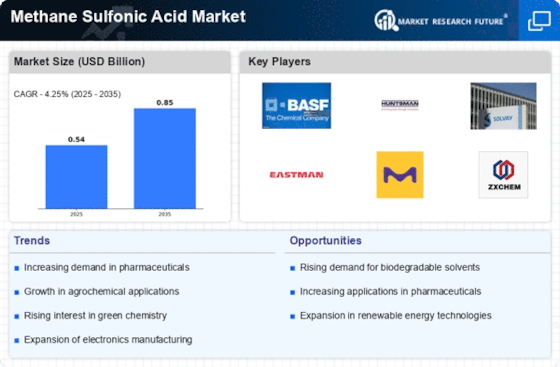
As per Market Research Future analysis, the Methane Sulfonic Acid Market Size was estimated at 0.54 USD Billion in 2024. The Methane Sulfonic Acid industry is projected to grow from USD 0.563 Billion in 2025 to USD 0.8537 Billion by 2035, exhibiting a compound annual growth rate (CAGR) of 4.25% during the forecast period 2025 - 2035

Key Market Trends & Highlights

The Methane Sulfonic Acid Market is currently experiencing robust growth driven by sustainability initiatives and technological advancements.

  • North America remains the largest market for Methane Sulfonic Acid Market, driven by its extensive industrial applications. The Asia-Pacific region is emerging as the fastest-growing market, fueled by increasing demand in various sectors. The Pharmaceuticals segment holds the largest share, while the Industrial segment is witnessing rapid growth due to evolving manufacturing processes. Key market drivers include sustainability initiatives and the growth of the electronics sector, which are significantly influencing demand.

Market Size & Forecast

2024 Market Size 0.54 (USD Billion)
2035 Market Size 0.8537 (USD Billion)
CAGR (2025 - 2035) 4.25%
Largest Regional Market Share in 2024 North America

Major Players

BASF SE (DE), Huntsman Corporation (US), Solvay S.A. (BE), Eastman Chemical Company (US), Merck KGaA (DE), Tianjin Zhongxin Chemical Group (CN), Zhejiang Jianye Chemical Co., Ltd. (CN), Shandong Huachang Chemical Co., Ltd. (CN)

Market Trends

The Methane Sulfonic Acid Market is currently experiencing a notable evolution, driven by various factors that influence its demand and application across multiple industries. This compound, recognized for its unique properties, is increasingly utilized in sectors such as electronics, pharmaceuticals, and agriculture. The growing emphasis on environmentally friendly alternatives has led to a heightened interest in methane sulfonic acid, as it is perceived to be less harmful compared to traditional acids. Furthermore, advancements in production technologies are likely to enhance the efficiency and sustainability of its manufacturing processes, potentially expanding its market reach. In addition to the environmental considerations, the Methane Sulfonic Acid Market is also shaped by the rising demand for high-purity chemicals in the electronics industry. As manufacturers seek to improve product quality and performance, the need for specialized chemicals like methane sulfonic acid becomes more pronounced. This trend suggests a shift towards more refined and application-specific chemical solutions, which may further drive innovation and investment in this sector. Overall, the Methane Sulfonic Acid Market appears poised for growth, with various dynamics at play that could influence its trajectory in the coming years.

Sustainability Focus

The increasing The Methane Sulfonic Acid Market towards greener alternatives. Industries are actively seeking eco-friendly chemicals, and methane sulfonic acid is gaining traction due to its lower environmental impact compared to conventional acids. This trend indicates a potential shift in production practices and consumer preferences.

Technological Advancements

Innovations in production technologies are likely to enhance the efficiency of methane sulfonic acid manufacturing. These advancements may lead to reduced costs and improved quality, making the compound more accessible to various industries. As technology evolves, the market could witness a transformation in how this chemical is produced and utilized.

Electronics Industry Demand

The demand for high-purity chemicals in the electronics sector is significantly influencing the Methane Sulfonic Acid Market. As manufacturers prioritize product quality, the need for specialized chemicals like methane sulfonic acid is expected to rise. This trend suggests a growing intersection between chemical manufacturing and technological advancements in electronics.

Methane Sulfonic Acid Market Market Drivers

Regulatory Compliance

Regulatory compliance is an essential driver influencing the Methane Sulfonic Acid Market. Governments worldwide are implementing stringent regulations regarding chemical usage and environmental protection. Methane sulfonic acid, being a safer alternative to traditional sulfonic acids, is gaining traction among manufacturers seeking to comply with these regulations. Its low toxicity and minimal environmental impact make it an attractive option for industries such as pharmaceuticals and agrochemicals. As companies strive to adhere to evolving regulatory frameworks, the demand for compliant chemicals like methane sulfonic acid is expected to rise. This trend may lead to an increase in market penetration, with projections indicating a potential market growth of 4% annually as industries prioritize regulatory adherence.

Electronics Sector Growth

The rapid growth of the electronics sector is a significant driver for the Methane Sulfonic Acid Market. As electronic devices become more sophisticated, the demand for high-purity chemicals, including methane sulfonic acid, has escalated. This compound is increasingly utilized in the production of semiconductors and circuit boards, where its properties facilitate improved performance and reliability. The electronics industry is projected to expand at a CAGR of around 6% in the coming years, further propelling the demand for methane sulfonic acid. Manufacturers are keen on incorporating this chemical to enhance product quality and meet stringent industry standards. Consequently, the synergy between the electronics sector and the methane sulfonic acid market is likely to foster substantial growth opportunities.

Technological Innovations

Technological innovations play a crucial role in shaping the Methane Sulfonic Acid Market. Advances in production techniques and applications have enhanced the efficiency and effectiveness of methane sulfonic acid in various sectors. For instance, the development of new synthesis methods has improved yield and reduced production costs, making it more accessible to manufacturers. Additionally, innovations in application technologies, such as its use in electroplating and as a catalyst in chemical reactions, have expanded its market reach. The market is expected to witness a notable increase in demand, driven by these technological advancements, which could potentially lead to a market size exceeding USD 200 million by 2027. This growth indicates a robust interest in leveraging methane sulfonic acid for diverse industrial applications.

Sustainability Initiatives

The increasing emphasis on sustainability initiatives is a pivotal driver for the Methane Sulfonic Acid Market. As industries strive to reduce their environmental footprint, the demand for eco-friendly chemicals has surged. Methane sulfonic acid, known for its biodegradable properties, aligns well with these sustainability goals. This compound is utilized in various applications, including metal finishing and cleaning agents, where traditional chemicals are being replaced by greener alternatives. The market for methane sulfonic acid is projected to grow at a compound annual growth rate (CAGR) of approximately 5% over the next few years, reflecting the industry's shift towards sustainable practices. Companies are increasingly adopting methane sulfonic acid to meet regulatory requirements and consumer preferences for environmentally responsible products.

Rising Demand in Agriculture

The rising demand in the agriculture sector is emerging as a key driver for the Methane Sulfonic Acid Market. Methane sulfonic acid is increasingly being recognized for its applications in agrochemicals, particularly as a solvent and catalyst in the formulation of pesticides and fertilizers. As agricultural practices evolve towards more efficient and sustainable methods, the need for effective chemical solutions is paramount. The agriculture sector is anticipated to grow at a rate of approximately 5% annually, which could significantly boost the demand for methane sulfonic acid. This growth is indicative of a broader trend where agricultural stakeholders are seeking innovative chemical solutions to enhance crop yield and sustainability, thereby creating a favorable environment for the methane sulfonic acid market.

Market Segment Insights

By Industrial Grade: Pharmaceuticals (Largest) vs. Industrial (Fastest-Growing)

<p>In the Methane Sulfonic Acid Market, the market share distribution indicates that the Pharmaceuticals segment holds a significant portion of the market. This dominance is attributed to the segment's comprehensive application in various pharmaceutical formulations, enhancing drug solubility and stability. Meanwhile, the Industrial segment, while currently smaller in market share, is experiencing rapid growth due to its increasing usage in various industrial processes, such as metal finishing and electroplating.</p>

<p>Pharmaceuticals (Dominant) vs. Industrial (Emerging)</p>

<p>Pharmaceuticals is a dominant segment in the Methane Sulfonic Acid Market due to its essential role in drug formulations. The compound enhances the efficacy of active pharmaceutical ingredients, making it a preferred choice among manufacturers. Its compatibility with various compounds ensures high performance. On the other hand, the Industrial segment is emerging as a key player as its applications in fields like metal processing continue to expand. The increased emphasis on green chemistry and eco-friendly practices has also led industries to explore Methane Sulfonic Acid due to its non-toxic nature and efficiency in production processes.</p>

By Application: Esterification (Largest) vs. Electroplating (Fastest-Growing)

<p>In the Methane Sulfonic Acid Market, Esterification dominates the application segment, leveraging its extensive use in the production of esters that serve a wide range of industries. This segment commands the largest share, driven by the rising demand for esters in pharmaceuticals and agrochemicals. Meanwhile, Electroplating, although smaller in comparison, is rapidly gaining traction. It serves critical roles in improving corrosion resistance and aesthetic appeal in various metal components, thus accelerating its growth. Growth trends indicate a significant shift towards Electroplating applications, catalyzed by advancements in technology and increasing emphasis on product quality. Factors such as the escalation in automotive and electronics manufacturing are propelling the demand for efficient electroplating processes. Furthermore, the pharmaceutical sector's steady reliance on Methane Sulfonic Acid highlights its vital role in esterification processes, ensuring continued market stability for established players while fostering emerging opportunities in electroplating.</p>

<p>Esterification (Dominant) vs. Electroplating (Emerging)</p>

<p>Esterification stands as the dominant application within the Methane Sulfonic Acid Market due to its critical role in synthesizing esters, which are pivotal in various sectors including cosmetics, food, and pharmaceuticals. This application benefits from established market players, nurturing a reliable demand base that remains consistent over time. Conversely, Electroplating presents itself as an emerging application, fueled by technological innovations and a rising focus on enhancing product durability and appeal. The quickening pace of urbanization and industrialization, particularly in developing regions, is driving this growth. As industries seek optimal solutions for finishing metal surfaces, the demand for Methane Sulfonic Acid in electroplating processes is set to rise, indicating a promising future for market entrants and expansions.</p>

Get more detailed insights about Methane Sulfonic Acid Market Research Report – Global Forecast till 2035

Regional Insights

North America : Innovation and Demand Surge

The North American Methane Sulfonic Acid Market is driven by increasing demand from the electronics and automotive sectors, alongside stringent environmental regulations promoting cleaner production methods. The region holds approximately 40% of the global market share, making it the largest market for this chemical. The U.S. leads in consumption, supported by a robust manufacturing base and technological advancements in chemical processes. Key players such as BASF SE and Huntsman Corporation dominate the landscape, leveraging their extensive distribution networks and R&D capabilities. The competitive environment is characterized by innovation and strategic partnerships, with companies focusing on sustainable practices to meet regulatory standards. The presence of established firms ensures a steady supply chain, further enhancing market stability.

Europe : Regulatory Framework and Growth

Europe is witnessing significant growth in the Methane Sulfonic Acid Market, driven by stringent environmental regulations and a shift towards sustainable chemical processes. The region accounts for approximately 30% of the global market share, making it the second-largest market. Countries like Germany and France are at the forefront, with policies that encourage the use of eco-friendly chemicals in various applications, including pharmaceuticals and electronics. The competitive landscape is marked by key players such as Solvay S.A. and Merck KGaA, who are investing in innovative production techniques to comply with EU regulations. The presence of a well-established chemical industry fosters collaboration among companies, enhancing research and development efforts. This dynamic environment is expected to propel market growth further, aligning with the EU's Green Deal objectives. "The European Union is committed to reducing chemical waste and promoting sustainable practices across industries," European Commission report 2021.

Asia-Pacific : Emerging Markets and Opportunities

The Asia-Pacific region is emerging as a powerhouse in the Methane Sulfonic Acid Market, driven by rapid industrialization and increasing demand from the electronics and automotive sectors. This region holds approximately 25% of the global market share, with China and India leading the charge. The growing focus on sustainable manufacturing practices and government initiatives to promote cleaner technologies are significant growth drivers in this market. China, home to major players like Tianjin Zhongxin Chemical Group and Zhejiang Jianye Chemical Co., Ltd., is witnessing a surge in production capacity. The competitive landscape is evolving, with local manufacturers investing in advanced technologies to enhance efficiency and reduce environmental impact. As the region continues to develop, the demand for Methane Sulfonic Acid Market is expected to rise, supported by favorable government policies and increasing foreign investments.

Middle East and Africa : Resource-Rich and Growing Demand

The Middle East and Africa region is gradually emerging in the Methane Sulfonic Acid Market, driven by increasing industrial activities and a growing focus on sustainable chemical production. This region currently holds about 5% of the global market share, with countries like South Africa and the UAE showing promising growth potential. The demand for Methane Sulfonic Acid Market is expected to rise as industries seek eco-friendly alternatives to traditional chemicals. The competitive landscape is still developing, with local players beginning to establish their presence. Companies are focusing on building partnerships and enhancing production capabilities to meet the rising demand. As the region invests in infrastructure and technology, the Methane Sulfonic Acid Market is poised for growth, supported by government initiatives aimed at promoting industrial diversification and sustainability.

Key Players and Competitive Insights

Leading market players are investing heavily in research and development in order to expand their product lines, which will help the Methane Sulfonic Acid Market, grow even more. Market participants are also undertaking a variety of strategic activities to expand their global footprint, with important market developments including new product launches, contractual agreements, mergers and acquisitions, higher investments, and collaboration with other organizations. To expand and survive in a more competitive and rising market climate, Methane Sulfonic Acid industry must offer cost-effective items.Manufacturing locally to minimize operational costs is one of the key business tactics used by manufacturers in the global Methane Sulfonic Acid industry to benefit clients and increase the market sector. In recent years, the Methane Sulfonic Acid industry has offered some of the most significant advantages to medicine. Major players in the Methane Sulfonic Acid Market, including Langfang Jinshenghui Chemical Co., Ltd (China), Zhongke Fine Chemical Co., Ltd (China), HEBEI YANUO Bioscience Co., Ltd (China), Alfa Aesar (US), and Avantor, Inc. (US).BASF SE is a European multinational corporation and the world's largest chemical producer. The company's headquarters are in Ludwigshafen, Germany. BASF has subsidiaries and joint ventures in over 80 countries and runs six integrated manufacturing sites as well as 390 other manufacturing locations throughout Europe, Asia, Australia, the Americas, and Africa. BASF has customers in over 190 countries and serves a wide range of sectors. Despite its size and global reach, BASF has gotten little public notice since it stopped manufacturing and selling BASF-branded consumer electronics items in the 1990s.

In January BASF announced that it will continue to increase global methane sulfonic acid (MSA) capacities to 50,000 metric tons per year. This implies a multi-million-euro investment in Ludwigshafen for the construction of a new methane sulfonic acid facility. The building work has only barely began. The amounts of new capacity are expected to be available by the end of 2021.Arkema S.A. is a publicly traded multi-national maker of specialized materials based in Colombes, France, near Paris. Adhesives, advanced materials, and coatings are its three specialized materials segments (or divisions). A separate section discusses chemical intermediates. The company was founded in 2004 as part of Total's restructuring of its chemicals division, and it went public on the Paris stock exchange in May 2006. In 2021, turnover was €9.5 billion. Arkema is present in over 55 countries and employs over 20,200 people across 13 research centres and 144 manufacturing plants.In September 2020, Arkema announced the acquisition of a 10% share in Ihsedu Agrochem, India's top MSA producer.

Key Companies in the Methane Sulfonic Acid Market include

Industry Developments

In November 2020, Zhongke Fine Chemical Co. Ltd, a Chinese company, reported the successful development of a novel process for the production of MSA that decreases production costs by 30%.

In July 2021, Chemos GmbH, a German chemical business, said that it has expanded its product line to include MSA, which would be utilized in a variety of applications such as electroplating, medicines, and organic synthesis.

In March 2021, CABB Group GmbH, a Swiss chemical company, said that it had completed a 50% expansion of its MSA manufacturing capacity at its Pratteln plant in Switzerland.

Future Outlook

Methane Sulfonic Acid Market Future Outlook

The Methane Sulfonic Acid Market is projected to grow at a 4.25% CAGR from 2025 to 2035, driven by increasing demand in electronics and pharmaceuticals.

New opportunities lie in:

  • Expansion into emerging markets with tailored product offerings.</p><p>Development of eco-friendly production processes to attract sustainability-focused clients.</p><p>Investment in R&amp;D for innovative applications in battery technology.

By 2035, the Methane Sulfonic Acid Market is expected to achieve robust growth and enhanced market positioning.

Market Segmentation

Methane Sulfonic Acid Market Application Outlook

  • Esterification
  • Electroplating
  • Pharmaceuticals

Methane Sulfonic Acid Market Industrial Grade Outlook

  • Industrial
  • Pharmaceuticals

Report Scope

MARKET SIZE 2024 0.54(USD Billion)
MARKET SIZE 2025 0.563(USD Billion)
MARKET SIZE 2035 0.8537(USD Billion)
COMPOUND ANNUAL GROWTH RATE (CAGR) 4.25% (2025 - 2035)
REPORT COVERAGE Revenue Forecast, Competitive Landscape, Growth Factors, and Trends
BASE YEAR 2024
Market Forecast Period 2025 - 2035
Historical Data 2019 - 2024
Market Forecast Units USD Billion
Key Companies Profiled BASF SE (DE), Huntsman Corporation (US), Solvay S.A. (BE), Eastman Chemical Company (US), Merck KGaA (DE), Tianjin Zhongxin Chemical Group (CN), Zhejiang Jianye Chemical Co., Ltd. (CN), Shandong Huachang Chemical Co., Ltd. (CN)
Segments Covered Industrial Grade, Application, Region
Key Market Opportunities Growing demand for eco-friendly solvents in various industrial applications enhances the Methane Sulfonic Acid Market.
Key Market Dynamics Rising demand for eco-friendly solvents drives innovation and competition in the Methane Sulfonic Acid market.
Countries Covered North America, Europe, APAC, South America, MEA

FAQs

What is the projected market valuation of the Methane Sulfonic Acid Market by 2035?

<p>The projected market valuation for the Methane Sulfonic Acid Market is 0.8537 USD Billion by 2035.</p>

What was the market valuation of Methane Sulfonic Acid in 2024?

<p>The overall market valuation of Methane Sulfonic Acid was 0.54 USD Billion in 2024.</p>

What is the expected CAGR for the Methane Sulfonic Acid Market during the forecast period 2025 - 2035?

<p>The expected CAGR for the Methane Sulfonic Acid Market during the forecast period 2025 - 2035 is 4.25%.</p>

Which companies are considered key players in the Methane Sulfonic Acid Market?

<p>Key players in the Methane Sulfonic Acid Market include BASF SE, Huntsman Corporation, Solvay S.A., Eastman Chemical Company, Merck KGaA, Tianjin Zhongxin Chemical Group, Zhejiang Jianye Chemical Co., Ltd., and Shandong Huachang Chemical Co., Ltd.</p>

What are the main segments of the Methane Sulfonic Acid Market?

<p>The main segments of the Methane Sulfonic Acid Market include Industrial Grade and Application.</p>

What was the valuation of the Industrial Grade segment in 2024?

In 2024, the valuation of the Industrial Grade segment was 0.513 USD Billion.

What is the projected valuation for the Pharmaceuticals segment by 2035?

The projected valuation for the Pharmaceuticals segment is expected to reach 0.3 USD Billion by 2035.

How does the Electroplating application segment perform in terms of valuation?

The Electroplating application segment was valued at 0.2 USD Billion in 2024 and is projected to grow to 0.3 USD Billion by 2035.

What is the estimated growth potential for the Esterification application segment?

The Esterification application segment is expected to grow from 0.15 USD Billion in 2024 to 0.25 USD Billion by 2035.

How does the Methane Sulfonic Acid Market's growth compare to other chemical markets?

While specific comparisons to other chemical markets are not provided, the Methane Sulfonic Acid Market's expected CAGR of 4.25% during 2025 - 2035 suggests a steady growth trajectory.

  1. SECTION I: EXECUTIVE SUMMARY AND KEY HIGHLIGHTS
    1. | 1.1 EXECUTIVE SUMMARY
    2. | | 1.1.1 Market Overview
    3. | | 1.1.2 Key Findings
    4. | | 1.1.3 Market Segmentation
    5. | | 1.1.4 Competitive Landscape
    6. | | 1.1.5 Challenges and Opportunities
    7. | | 1.1.6 Future Outlook
  2. SECTION II: SCOPING, METHODOLOGY AND MARKET STRUCTURE
    1. | 2.1 MARKET INTRODUCTION
    2. | | 2.1.1 Definition
    3. | | 2.1.2 Scope of the study
    4. | | | 2.1.2.1 Research Objective
    5. | | | 2.1.2.2 Assumption
    6. | | | 2.1.2.3 Limitations
    7. | 2.2 RESEARCH METHODOLOGY
    8. | | 2.2.1 Overview
    9. | | 2.2.2 Data Mining
    10. | | 2.2.3 Secondary Research
    11. | | 2.2.4 Primary Research
    12. | | | 2.2.4.1 Primary Interviews and Information Gathering Process
    13. | | | 2.2.4.2 Breakdown of Primary Respondents
    14. | | 2.2.5 Forecasting Model
    15. | | 2.2.6 Market Size Estimation
    16. | | | 2.2.6.1 Bottom-Up Approach
    17. | | | 2.2.6.2 Top-Down Approach
    18. | | 2.2.7 Data Triangulation
    19. | | 2.2.8 Validation
  3. SECTION III: QUALITATIVE ANALYSIS
    1. | 3.1 MARKET DYNAMICS
    2. | | 3.1.1 Overview
    3. | | 3.1.2 Drivers
    4. | | 3.1.3 Restraints
    5. | | 3.1.4 Opportunities
    6. | 3.2 MARKET FACTOR ANALYSIS
    7. | | 3.2.1 Value chain Analysis
    8. | | 3.2.2 Porter's Five Forces Analysis
    9. | | | 3.2.2.1 Bargaining Power of Suppliers
    10. | | | 3.2.2.2 Bargaining Power of Buyers
    11. | | | 3.2.2.3 Threat of New Entrants
    12. | | | 3.2.2.4 Threat of Substitutes
    13. | | | 3.2.2.5 Intensity of Rivalry
    14. | | 3.2.3 COVID-19 Impact Analysis
    15. | | | 3.2.3.1 Market Impact Analysis
    16. | | | 3.2.3.2 Regional Impact
    17. | | | 3.2.3.3 Opportunity and Threat Analysis
  4. SECTION IV: QUANTITATIVE ANALYSIS
    1. | 4.1 Chemicals and Materials, BY Industrial Grade (USD Billion)
    2. | | 4.1.1 Industrial
    3. | | 4.1.2 Pharmaceuticals
    4. | 4.2 Chemicals and Materials, BY Application (USD Billion)
    5. | | 4.2.1 Esterification
    6. | | 4.2.2 Electroplating
    7. | | 4.2.3 Pharmaceuticals
    8. | 4.3 Chemicals and Materials, BY Region (USD Billion)
    9. | | 4.3.1 North America
    10. | | | 4.3.1.1 US
    11. | | | 4.3.1.2 Canada
    12. | | 4.3.2 Europe
    13. | | | 4.3.2.1 Germany
    14. | | | 4.3.2.2 UK
    15. | | | 4.3.2.3 France
    16. | | | 4.3.2.4 Russia
    17. | | | 4.3.2.5 Italy
    18. | | | 4.3.2.6 Spain
    19. | | | 4.3.2.7 Rest of Europe
    20. | | 4.3.3 APAC
    21. | | | 4.3.3.1 China
    22. | | | 4.3.3.2 India
    23. | | | 4.3.3.3 Japan
    24. | | | 4.3.3.4 South Korea
    25. | | | 4.3.3.5 Malaysia
    26. | | | 4.3.3.6 Thailand
    27. | | | 4.3.3.7 Indonesia
    28. | | | 4.3.3.8 Rest of APAC
    29. | | 4.3.4 South America
    30. | | | 4.3.4.1 Brazil
    31. | | | 4.3.4.2 Mexico
    32. | | | 4.3.4.3 Argentina
    33. | | | 4.3.4.4 Rest of South America
    34. | | 4.3.5 MEA
    35. | | | 4.3.5.1 GCC Countries
    36. | | | 4.3.5.2 South Africa
    37. | | | 4.3.5.3 Rest of MEA
  5. SECTION V: COMPETITIVE ANALYSIS
    1. | 5.1 Competitive Landscape
    2. | | 5.1.1 Overview
    3. | | 5.1.2 Competitive Analysis
    4. | | 5.1.3 Market share Analysis
    5. | | 5.1.4 Major Growth Strategy in the Chemicals and Materials
    6. | | 5.1.5 Competitive Benchmarking
    7. | | 5.1.6 Leading Players in Terms of Number of Developments in the Chemicals and Materials
    8. | | 5.1.7 Key developments and growth strategies
    9. | | | 5.1.7.1 New Product Launch/Service Deployment
    10. | | | 5.1.7.2 Merger & Acquisitions
    11. | | | 5.1.7.3 Joint Ventures
    12. | | 5.1.8 Major Players Financial Matrix
    13. | | | 5.1.8.1 Sales and Operating Income
    14. | | | 5.1.8.2 Major Players R&D Expenditure. 2023
    15. | 5.2 Company Profiles
    16. | | 5.2.1 BASF SE (DE)
    17. | | | 5.2.1.1 Financial Overview
    18. | | | 5.2.1.2 Products Offered
    19. | | | 5.2.1.3 Key Developments
    20. | | | 5.2.1.4 SWOT Analysis
    21. | | | 5.2.1.5 Key Strategies
    22. | | 5.2.2 Huntsman Corporation (US)
    23. | | | 5.2.2.1 Financial Overview
    24. | | | 5.2.2.2 Products Offered
    25. | | | 5.2.2.3 Key Developments
    26. | | | 5.2.2.4 SWOT Analysis
    27. | | | 5.2.2.5 Key Strategies
    28. | | 5.2.3 Solvay S.A. (BE)
    29. | | | 5.2.3.1 Financial Overview
    30. | | | 5.2.3.2 Products Offered
    31. | | | 5.2.3.3 Key Developments
    32. | | | 5.2.3.4 SWOT Analysis
    33. | | | 5.2.3.5 Key Strategies
    34. | | 5.2.4 Eastman Chemical Company (US)
    35. | | | 5.2.4.1 Financial Overview
    36. | | | 5.2.4.2 Products Offered
    37. | | | 5.2.4.3 Key Developments
    38. | | | 5.2.4.4 SWOT Analysis
    39. | | | 5.2.4.5 Key Strategies
    40. | | 5.2.5 Merck KGaA (DE)
    41. | | | 5.2.5.1 Financial Overview
    42. | | | 5.2.5.2 Products Offered
    43. | | | 5.2.5.3 Key Developments
    44. | | | 5.2.5.4 SWOT Analysis
    45. | | | 5.2.5.5 Key Strategies
    46. | | 5.2.6 Tianjin Zhongxin Chemical Group (CN)
    47. | | | 5.2.6.1 Financial Overview
    48. | | | 5.2.6.2 Products Offered
    49. | | | 5.2.6.3 Key Developments
    50. | | | 5.2.6.4 SWOT Analysis
    51. | | | 5.2.6.5 Key Strategies
    52. | | 5.2.7 Zhejiang Jianye Chemical Co., Ltd. (CN)
    53. | | | 5.2.7.1 Financial Overview
    54. | | | 5.2.7.2 Products Offered
    55. | | | 5.2.7.3 Key Developments
    56. | | | 5.2.7.4 SWOT Analysis
    57. | | | 5.2.7.5 Key Strategies
    58. | | 5.2.8 Shandong Huachang Chemical Co., Ltd. (CN)
    59. | | | 5.2.8.1 Financial Overview
    60. | | | 5.2.8.2 Products Offered
    61. | | | 5.2.8.3 Key Developments
    62. | | | 5.2.8.4 SWOT Analysis
    63. | | | 5.2.8.5 Key Strategies
    64. | 5.3 Appendix
    65. | | 5.3.1 References
    66. | | 5.3.2 Related Reports
  6. LIST OF FIGURES
    1. | 6.1 MARKET SYNOPSIS
    2. | 6.2 NORTH AMERICA MARKET ANALYSIS
    3. | 6.3 US MARKET ANALYSIS BY INDUSTRIAL GRADE
    4. | 6.4 US MARKET ANALYSIS BY APPLICATION
    5. | 6.5 CANADA MARKET ANALYSIS BY INDUSTRIAL GRADE
    6. | 6.6 CANADA MARKET ANALYSIS BY APPLICATION
    7. | 6.7 EUROPE MARKET ANALYSIS
    8. | 6.8 GERMANY MARKET ANALYSIS BY INDUSTRIAL GRADE
    9. | 6.9 GERMANY MARKET ANALYSIS BY APPLICATION
    10. | 6.10 UK MARKET ANALYSIS BY INDUSTRIAL GRADE
    11. | 6.11 UK MARKET ANALYSIS BY APPLICATION
    12. | 6.12 FRANCE MARKET ANALYSIS BY INDUSTRIAL GRADE
    13. | 6.13 FRANCE MARKET ANALYSIS BY APPLICATION
    14. | 6.14 RUSSIA MARKET ANALYSIS BY INDUSTRIAL GRADE
    15. | 6.15 RUSSIA MARKET ANALYSIS BY APPLICATION
    16. | 6.16 ITALY MARKET ANALYSIS BY INDUSTRIAL GRADE
    17. | 6.17 ITALY MARKET ANALYSIS BY APPLICATION
    18. | 6.18 SPAIN MARKET ANALYSIS BY INDUSTRIAL GRADE
    19. | 6.19 SPAIN MARKET ANALYSIS BY APPLICATION
    20. | 6.20 REST OF EUROPE MARKET ANALYSIS BY INDUSTRIAL GRADE
    21. | 6.21 REST OF EUROPE MARKET ANALYSIS BY APPLICATION
    22. | 6.22 APAC MARKET ANALYSIS
    23. | 6.23 CHINA MARKET ANALYSIS BY INDUSTRIAL GRADE
    24. | 6.24 CHINA MARKET ANALYSIS BY APPLICATION
    25. | 6.25 INDIA MARKET ANALYSIS BY INDUSTRIAL GRADE
    26. | 6.26 INDIA MARKET ANALYSIS BY APPLICATION
    27. | 6.27 JAPAN MARKET ANALYSIS BY INDUSTRIAL GRADE
    28. | 6.28 JAPAN MARKET ANALYSIS BY APPLICATION
    29. | 6.29 SOUTH KOREA MARKET ANALYSIS BY INDUSTRIAL GRADE
    30. | 6.30 SOUTH KOREA MARKET ANALYSIS BY APPLICATION
    31. | 6.31 MALAYSIA MARKET ANALYSIS BY INDUSTRIAL GRADE
    32. | 6.32 MALAYSIA MARKET ANALYSIS BY APPLICATION
    33. | 6.33 THAILAND MARKET ANALYSIS BY INDUSTRIAL GRADE
    34. | 6.34 THAILAND MARKET ANALYSIS BY APPLICATION
    35. | 6.35 INDONESIA MARKET ANALYSIS BY INDUSTRIAL GRADE
    36. | 6.36 INDONESIA MARKET ANALYSIS BY APPLICATION
    37. | 6.37 REST OF APAC MARKET ANALYSIS BY INDUSTRIAL GRADE
    38. | 6.38 REST OF APAC MARKET ANALYSIS BY APPLICATION
    39. | 6.39 SOUTH AMERICA MARKET ANALYSIS
    40. | 6.40 BRAZIL MARKET ANALYSIS BY INDUSTRIAL GRADE
    41. | 6.41 BRAZIL MARKET ANALYSIS BY APPLICATION
    42. | 6.42 MEXICO MARKET ANALYSIS BY INDUSTRIAL GRADE
    43. | 6.43 MEXICO MARKET ANALYSIS BY APPLICATION
    44. | 6.44 ARGENTINA MARKET ANALYSIS BY INDUSTRIAL GRADE
    45. | 6.45 ARGENTINA MARKET ANALYSIS BY APPLICATION
    46. | 6.46 REST OF SOUTH AMERICA MARKET ANALYSIS BY INDUSTRIAL GRADE
    47. | 6.47 REST OF SOUTH AMERICA MARKET ANALYSIS BY APPLICATION
    48. | 6.48 MEA MARKET ANALYSIS
    49. | 6.49 GCC COUNTRIES MARKET ANALYSIS BY INDUSTRIAL GRADE
    50. | 6.50 GCC COUNTRIES MARKET ANALYSIS BY APPLICATION
    51. | 6.51 SOUTH AFRICA MARKET ANALYSIS BY INDUSTRIAL GRADE
    52. | 6.52 SOUTH AFRICA MARKET ANALYSIS BY APPLICATION
    53. | 6.53 REST OF MEA MARKET ANALYSIS BY INDUSTRIAL GRADE
    54. | 6.54 REST OF MEA MARKET ANALYSIS BY APPLICATION
    55. | 6.55 KEY BUYING CRITERIA OF CHEMICALS AND MATERIALS
    56. | 6.56 RESEARCH PROCESS OF MRFR
    57. | 6.57 DRO ANALYSIS OF CHEMICALS AND MATERIALS
    58. | 6.58 DRIVERS IMPACT ANALYSIS: CHEMICALS AND MATERIALS
    59. | 6.59 RESTRAINTS IMPACT ANALYSIS: CHEMICALS AND MATERIALS
    60. | 6.60 SUPPLY / VALUE CHAIN: CHEMICALS AND MATERIALS
    61. | 6.61 CHEMICALS AND MATERIALS, BY INDUSTRIAL GRADE, 2024 (% SHARE)
    62. | 6.62 CHEMICALS AND MATERIALS, BY INDUSTRIAL GRADE, 2024 TO 2035 (USD Billion)
    63. | 6.63 CHEMICALS AND MATERIALS, BY APPLICATION, 2024 (% SHARE)
    64. | 6.64 CHEMICALS AND MATERIALS, BY APPLICATION, 2024 TO 2035 (USD Billion)
    65. | 6.65 BENCHMARKING OF MAJOR COMPETITORS
  7. LIST OF TABLES
    1. | 7.1 LIST OF ASSUMPTIONS
    2. | | 7.1.1
    3. | 7.2 North America MARKET SIZE ESTIMATES; FORECAST
    4. | | 7.2.1 BY INDUSTRIAL GRADE, 2025-2035 (USD Billion)
    5. | | 7.2.2 BY APPLICATION, 2025-2035 (USD Billion)
    6. | 7.3 US MARKET SIZE ESTIMATES; FORECAST
    7. | | 7.3.1 BY INDUSTRIAL GRADE, 2025-2035 (USD Billion)
    8. | | 7.3.2 BY APPLICATION, 2025-2035 (USD Billion)
    9. | 7.4 Canada MARKET SIZE ESTIMATES; FORECAST
    10. | | 7.4.1 BY INDUSTRIAL GRADE, 2025-2035 (USD Billion)
    11. | | 7.4.2 BY APPLICATION, 2025-2035 (USD Billion)
    12. | 7.5 Europe MARKET SIZE ESTIMATES; FORECAST
    13. | | 7.5.1 BY INDUSTRIAL GRADE, 2025-2035 (USD Billion)
    14. | | 7.5.2 BY APPLICATION, 2025-2035 (USD Billion)
    15. | 7.6 Germany MARKET SIZE ESTIMATES; FORECAST
    16. | | 7.6.1 BY INDUSTRIAL GRADE, 2025-2035 (USD Billion)
    17. | | 7.6.2 BY APPLICATION, 2025-2035 (USD Billion)
    18. | 7.7 UK MARKET SIZE ESTIMATES; FORECAST
    19. | | 7.7.1 BY INDUSTRIAL GRADE, 2025-2035 (USD Billion)
    20. | | 7.7.2 BY APPLICATION, 2025-2035 (USD Billion)
    21. | 7.8 France MARKET SIZE ESTIMATES; FORECAST
    22. | | 7.8.1 BY INDUSTRIAL GRADE, 2025-2035 (USD Billion)
    23. | | 7.8.2 BY APPLICATION, 2025-2035 (USD Billion)
    24. | 7.9 Russia MARKET SIZE ESTIMATES; FORECAST
    25. | | 7.9.1 BY INDUSTRIAL GRADE, 2025-2035 (USD Billion)
    26. | | 7.9.2 BY APPLICATION, 2025-2035 (USD Billion)
    27. | 7.10 Italy MARKET SIZE ESTIMATES; FORECAST
    28. | | 7.10.1 BY INDUSTRIAL GRADE, 2025-2035 (USD Billion)
    29. | | 7.10.2 BY APPLICATION, 2025-2035 (USD Billion)
    30. | 7.11 Spain MARKET SIZE ESTIMATES; FORECAST
    31. | | 7.11.1 BY INDUSTRIAL GRADE, 2025-2035 (USD Billion)
    32. | | 7.11.2 BY APPLICATION, 2025-2035 (USD Billion)
    33. | 7.12 Rest of Europe MARKET SIZE ESTIMATES; FORECAST
    34. | | 7.12.1 BY INDUSTRIAL GRADE, 2025-2035 (USD Billion)
    35. | | 7.12.2 BY APPLICATION, 2025-2035 (USD Billion)
    36. | 7.13 APAC MARKET SIZE ESTIMATES; FORECAST
    37. | | 7.13.1 BY INDUSTRIAL GRADE, 2025-2035 (USD Billion)
    38. | | 7.13.2 BY APPLICATION, 2025-2035 (USD Billion)
    39. | 7.14 China MARKET SIZE ESTIMATES; FORECAST
    40. | | 7.14.1 BY INDUSTRIAL GRADE, 2025-2035 (USD Billion)
    41. | | 7.14.2 BY APPLICATION, 2025-2035 (USD Billion)
    42. | 7.15 India MARKET SIZE ESTIMATES; FORECAST
    43. | | 7.15.1 BY INDUSTRIAL GRADE, 2025-2035 (USD Billion)
    44. | | 7.15.2 BY APPLICATION, 2025-2035 (USD Billion)
    45. | 7.16 Japan MARKET SIZE ESTIMATES; FORECAST
    46. | | 7.16.1 BY INDUSTRIAL GRADE, 2025-2035 (USD Billion)
    47. | | 7.16.2 BY APPLICATION, 2025-2035 (USD Billion)
    48. | 7.17 South Korea MARKET SIZE ESTIMATES; FORECAST
    49. | | 7.17.1 BY INDUSTRIAL GRADE, 2025-2035 (USD Billion)
    50. | | 7.17.2 BY APPLICATION, 2025-2035 (USD Billion)
    51. | 7.18 Malaysia MARKET SIZE ESTIMATES; FORECAST
    52. | | 7.18.1 BY INDUSTRIAL GRADE, 2025-2035 (USD Billion)
    53. | | 7.18.2 BY APPLICATION, 2025-2035 (USD Billion)
    54. | 7.19 Thailand MARKET SIZE ESTIMATES; FORECAST
    55. | | 7.19.1 BY INDUSTRIAL GRADE, 2025-2035 (USD Billion)
    56. | | 7.19.2 BY APPLICATION, 2025-2035 (USD Billion)
    57. | 7.20 Indonesia MARKET SIZE ESTIMATES; FORECAST
    58. | | 7.20.1 BY INDUSTRIAL GRADE, 2025-2035 (USD Billion)
    59. | | 7.20.2 BY APPLICATION, 2025-2035 (USD Billion)
    60. | 7.21 Rest of APAC MARKET SIZE ESTIMATES; FORECAST
    61. | | 7.21.1 BY INDUSTRIAL GRADE, 2025-2035 (USD Billion)
    62. | | 7.21.2 BY APPLICATION, 2025-2035 (USD Billion)
    63. | 7.22 South America MARKET SIZE ESTIMATES; FORECAST
    64. | | 7.22.1 BY INDUSTRIAL GRADE, 2025-2035 (USD Billion)
    65. | | 7.22.2 BY APPLICATION, 2025-2035 (USD Billion)
    66. | 7.23 Brazil MARKET SIZE ESTIMATES; FORECAST
    67. | | 7.23.1 BY INDUSTRIAL GRADE, 2025-2035 (USD Billion)
    68. | | 7.23.2 BY APPLICATION, 2025-2035 (USD Billion)
    69. | 7.24 Mexico MARKET SIZE ESTIMATES; FORECAST
    70. | | 7.24.1 BY INDUSTRIAL GRADE, 2025-2035 (USD Billion)
    71. | | 7.24.2 BY APPLICATION, 2025-2035 (USD Billion)
    72. | 7.25 Argentina MARKET SIZE ESTIMATES; FORECAST
    73. | | 7.25.1 BY INDUSTRIAL GRADE, 2025-2035 (USD Billion)
    74. | | 7.25.2 BY APPLICATION, 2025-2035 (USD Billion)
    75. | 7.26 Rest of South America MARKET SIZE ESTIMATES; FORECAST
    76. | | 7.26.1 BY INDUSTRIAL GRADE, 2025-2035 (USD Billion)
    77. | | 7.26.2 BY APPLICATION, 2025-2035 (USD Billion)
    78. | 7.27 MEA MARKET SIZE ESTIMATES; FORECAST
    79. | | 7.27.1 BY INDUSTRIAL GRADE, 2025-2035 (USD Billion)
    80. | | 7.27.2 BY APPLICATION, 2025-2035 (USD Billion)
    81. | 7.28 GCC Countries MARKET SIZE ESTIMATES; FORECAST
    82. | | 7.28.1 BY INDUSTRIAL GRADE, 2025-2035 (USD Billion)
    83. | | 7.28.2 BY APPLICATION, 2025-2035 (USD Billion)
    84. | 7.29 South Africa MARKET SIZE ESTIMATES; FORECAST
    85. | | 7.29.1 BY INDUSTRIAL GRADE, 2025-2035 (USD Billion)
    86. | | 7.29.2 BY APPLICATION, 2025-2035 (USD Billion)
    87. | 7.30 Rest of MEA MARKET SIZE ESTIMATES; FORECAST
    88. | | 7.30.1 BY INDUSTRIAL GRADE, 2025-2035 (USD Billion)
    89. | | 7.30.2 BY APPLICATION, 2025-2035 (USD Billion)
    90. | 7.31 PRODUCT LAUNCH/PRODUCT DEVELOPMENT/APPROVAL
    91. | | 7.31.1
    92. | 7.32 ACQUISITION/PARTNERSHIP
    93. | | 7.32.1

Chemicals and Materials Market Segmentation

Chemicals and Materials By Industrial Grade (USD Billion, 2025-2035)

  • Industrial
  • Pharmaceuticals

Chemicals and Materials By Application (USD Billion, 2025-2035)

  • Esterification
  • Electroplating
  • Pharmaceuticals
Infographic

Free Sample Request

Kindly complete the form below to receive a free sample of this Report

Get Free Sample

Customer Strories

Compare Licence

×
Features License Type
Single User Multiuser License Enterprise User
Price $4,950 $5,950 $7,250
Maximum User Access Limit 1 User Upto 10 Users Unrestricted Access Throughout the Organization
Free Customization
Direct Access to Analyst
Deliverable Format
Platform Access
Discount on Next Purchase 10% 15% 15%
Printable Versions