×
Request Free Sample ×

Kindly complete the form below to receive a free sample of this Report

* Please use a valid business email

Leading companies partner with us for data-driven Insights

clients tt-cursor
Hero Background
English
Chinese
French
Japanese
Korean
German
Spanish

Metabolomics Services Market Share

ID: MRFR/HC/6963-CR
78 Pages
Rahul Gotadki
October 2019

Metabolomics Services Market Research Report Information By Product and Service (Chromatography, Metabolomics Bioinformatics Services and Mass Spectrometry), By Application (Biomedical and Pharmaceutical, Agriculture and Food) - Global Forecast till 2035

Share:
Download PDF ×

We do not share your information with anyone. However, we may send you emails based on your report interest from time to time. You may contact us at any time to opt-out.

Metabolomics Services Market Infographic
Purchase Options

Market Share

Metabolomics Services Market Share Analysis

The Metabolomics Services market, vital to life sciences and healthcare research, analyzes metabolites to understand physiological processes. These organizations must use effective market share positioning strategies to address the increased demand for metabolomics services. Metabolomics Services firms might provide specific services to stand out. Advanced metabolite profiling, focused analysis, or integration with other omics technologies may give academics and pharmaceutical businesses with complete solutions. Staying ahead of technology is vital. To attract customers seeking cutting-edge research, companies should invest in cutting-edge equipment, analytical platforms, and bioinformatics tools to improve metabolomics services. Strategic collaborations with universities and research institutes might be beneficial. Collaborations provide access to different research initiatives, creativity, and reputation, making a corporation a leader in metabolomics research. Strong data interpretation and analysis services are important. Comprehensive metabolomics data insights may help companies stand out and help academics draw relevant conclusions from complicated datasets. Metabolomics services tailored to pharmaceutical, biotechnology, and clinical research sectors help organizations solve particular problems. Understanding industry needs and offering tailored solutions might boost market attractiveness. Metabolomics data is crucial to research and medication development, thus regulatory requirements and data quality are essential. To build customer trust and market share, companies must apply strict quality assurance processes. Market share growth frequently requires geographic expansion. Through partnerships, acquisitions, or regional offices, companies may deliberately grow worldwide to attract a diversified customer. Education and training are key market positioning strategies in metabolomics, a fast-changing science. Companies may provide seminars, webinars, and training events to teach researchers and professionals the newest metabolomics methods. Pricing must be open and flexible. Clear pricing that matches metabolomics project scale and complexity builds customer confidence and long-term partnerships. Strong client ties are essential. To build a good reputation in metabolomics, companies should focus customer service, proactive communication, and client demands. Attending scientific conferences, publishing research papers, and contributing to industry journals develop brands. Such initiatives demonstrate a company's competence, research, and dedication to metabolomics. A solid web presence and focused marketing are crucial. Digital platforms, social media, and content marketing may recruit metabolomics researchers and organizations. Continuous research and development is needed to stay ahead in science. To stay ahead in metabolomics, companies should invest in R&D to develop new methods, technology, and applications.

Author
Rahul Gotadki
Assistant Manager

He holds an experience of about 7+ years in Market Research and Business Consulting, working under the spectrum of Life Sciences and Healthcare domains. Rahul conceptualizes and implements a scalable business strategy and provides strategic leadership to the clients. His expertise lies in market estimation, competitive intelligence, pipeline analysis, customer assessment, etc. In addition to the above, his other responsibility includes strategic tracking of high growth markets & advising clients on the potential areas of focus they could direct their business initiatives

Leave a Comment

FAQs

How much is the global metabolomics services market worth in the future?

The valuation of the global metabolomics services market is estimated to reach USD 7.41 BN. by 2035.

At what CAGR is the global metabolomics services market projected to grow in the forecast period (2025-2035)?

The global metabolomics services market is projected to grow at approximately 12.26% CAGR during the forecast period (2025-2035).

Who are the top players in the global metabolomics services market?

Agilent Technologies, Inc. (US), Waters (US), Bruker (US), Thermo Fisher Scientific (US), TMIC (Canada), Biocrates Life Sciences AG (Austria), Metabolon, INC (US), Creative Proteomics (US), and Human Metabolome Technologies America Inc (Japan), are some of the major players operating in the metabolomics services market.

Which region holds the largest share in the global metabolomics services market?

North America holds the largest share in the global metabolomics services market, followed by Europe and the Asia Pacific, respectively.

What are the major tailwinds pushing the growth of the global metabolomics services market?

High prevalence of diseases such as cancer, neurological disorders, and cardiac diseases across the globe.

Market Summary

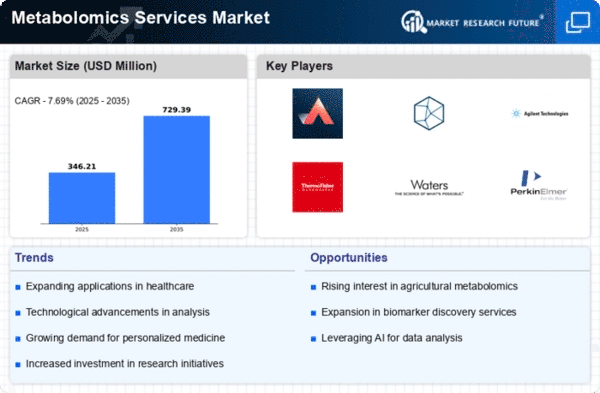
As per MRFR analysis, the Metabolomics Services Market Size was estimated at 321.49 USD Million in 2024. The Metabolomics Services industry is projected to grow from 349.9 in 2025 to 729.39 by 2035, exhibiting a compound annual growth rate (CAGR) of 7.69% during the forecast period 2025 - 2035.

Key Market Trends & Highlights

The Metabolomics Services Market is poised for substantial growth driven by technological advancements and increasing demand for personalized medicine.

  • The integration with other omics technologies is becoming increasingly prevalent, enhancing the scope of metabolomics applications. North America remains the largest market, while the Asia-Pacific region is emerging as the fastest-growing area for metabolomics services. Biomarker discovery continues to dominate the market, whereas drug development is rapidly gaining traction as a key segment. The growing demand for biomarker discovery and rising investment in research and development are significant drivers propelling market expansion.

Market Size & Forecast

2024 Market Size 321.49 (USD Million)
2035 Market Size 729.39 (USD Million)
CAGR (2025 - 2035) 7.69%
Largest Regional Market Share in 2024 North America

Major Players

Metabolon (US), Biocrates Life Sciences (AT), Agilent Technologies (US), <a href="https://www.thermofisher.com/in/en/home/industrial/mass-spectrometry/metabolomics-lipidomics.html">Thermo Fisher Scientific</a> (US), Waters Corporation (US), PerkinElmer (US), Sciex (US), Sierra Analytics (US)

Market Trends

The Metabolomics Services Market is currently experiencing a notable evolution, driven by advancements in analytical technologies and an increasing emphasis on personalized medicine. This market encompasses a range of services that analyze metabolites in biological samples, providing insights into metabolic processes and disease mechanisms. The growing demand for biomarker discovery and the need for comprehensive metabolic profiling in drug development are propelling the market forward. Furthermore, collaborations between academic institutions and industry players are fostering innovation, enhancing the capabilities of metabolomics services. As research continues to expand, the integration of metabolomics with other omics technologies appears to be a promising avenue for future exploration. In addition, the Metabolomics Services Market is witnessing a shift towards automation and high-throughput analysis, which may improve efficiency and reduce costs. The rise of artificial intelligence and machine learning in data analysis is likely to enhance the interpretation of complex metabolic data, leading to more accurate results. Moreover, the increasing prevalence of chronic diseases and the growing focus on preventive healthcare are expected to further drive the demand for metabolomics services. Overall, the market seems poised for substantial growth, with various factors contributing to its dynamic landscape.

Integration with Other Omics Technologies

The Metabolomics Services Market is increasingly integrating with genomics and proteomics, creating a more holistic approach to understanding biological systems. This convergence allows for a comprehensive analysis of cellular functions, enhancing the potential for biomarker discovery and therapeutic development.

Rise of Personalized Medicine

There is a growing trend towards personalized medicine within the Metabolomics Services Market, as healthcare providers seek tailored treatment options based on individual metabolic profiles. This shift is likely to improve patient outcomes and optimize therapeutic strategies.

Advancements in Analytical Technologies

The Metabolomics Services Market is benefiting from continuous advancements in analytical technologies, such as mass spectrometry and nuclear magnetic resonance. These innovations are enhancing the sensitivity and accuracy of metabolite detection, thereby expanding the applications of metabolomics in various fields.

Metabolomics Services Market Market Drivers

Rising Demand for Personalized Medicine

The Global Metabolomics Services Market Industry experiences a notable surge in demand for personalized medicine, driven by advancements in genomics and biotechnology. As healthcare shifts towards individualized treatment plans, metabolomics plays a crucial role in understanding patient-specific metabolic profiles. This trend is evidenced by the projected market value of 2.94 USD Billion in 2024, reflecting a growing recognition of the importance of metabolic analysis in tailoring therapies. The integration of metabolomics into clinical practice not only enhances treatment efficacy but also minimizes adverse effects, thereby fostering a more patient-centered approach in healthcare.

Market Segment Insights

By Application: Biomarker Discovery (Largest) vs. Drug Development (Fastest-Growing)

The Metabolomics Services Market displays a diverse distribution of applications, notably among Biomarker Discovery, Drug Development, Nutritional Metabolomics, Toxicology, and Clinical Diagnostics. Biomarker Discovery holds the largest share, as it plays a critical role in identifying disease-related metabolic changes, which fuels its demand across various sectors including healthcare and research. Following closely, Drug Development is witnessing significant traction due to its essential role in the pharmaceutical industry, pushing for innovative solutions that enhance drug efficacy and patient outcomes.

Biomarker Discovery (Dominant) vs. Nutritional Metabolomics (Emerging)

Biomarker Discovery remains the dominant force in the Metabolomics Services Market due to its fundamental role in enhancing clinical research and diagnosis processes. This segment is characterized by its application in identifying and validating metabolic markers linked to various diseases, making it a pivotal area for research institutions and clinical organizations. On the other hand, Nutritional Metabolomics is emerging rapidly as consumers increasingly prioritize health and wellness. This trend is driven by a growing interest in personalized nutrition and dietary choices, leading to increased investments in research that unravels how metabolites influence health outcomes. As such, Nutritional Metabolomics is carving a niche for itself alongside the more established segments.

By Technology: Mass Spectrometry (Largest) vs. Chromatography (Fastest-Growing)

In the Metabolomics Services Market, the technology segment reveals a competitive landscape characterized by diverse analytical techniques. Mass Spectrometry dominates this segment, owing to its high sensitivity and unparalleled ability to analyze complex mixtures. Chromatography, while currently smaller in market share, is rapidly gaining traction as an essential tool for metabolomic analysis. Other technologies such as Nuclear Magnetic Resonance Spectroscopy and Capillary Electrophoresis also play important roles but are growing at a slower pace compared to Chromatography.

Technology: Mass Spectrometry (Dominant) vs. Chromatography (Emerging)

Mass Spectrometry stands out as the dominant technology in the Metabolomics Services Market due to its capability to provide comprehensive insights into the metabolome with high accuracy. This technique is widely adopted for its rapid analysis times and ability to identify and quantify metabolites effectively. Meanwhile, Chromatography is emerging as a key player, showcasing faster growth rates. Its strength lies in separating complex mixtures, making it highly valuable for specific applications in metabolomics. Together, these technologies cater to the evolving needs of research and clinical laboratories, driving innovation and expanding the overall market.

By End User: Pharmaceutical Companies (Largest) vs. Academic Research Institutions (Fastest-Growing)

The Metabolomics Services Market exhibits a diverse distribution among its end user segments, with Pharmaceutical Companies leading in market share due to their extensive reliance on metabolomics in drug development and personalized medicine. Academic Research Institutions, while capturing a smaller share, are significant contributors to expanding research applications that invigorate the market dynamics.

Pharmaceutical Companies (Dominant) vs. Clinical Laboratories (Emerging)

Pharmaceutical Companies dominate the Metabolomics Services Market, leveraging cutting-edge metabolomic technologies to enhance drug discovery processes and optimize clinical trials. These enterprises benefit from significant investments and a strong focus on personalized medicine, making them key players. In contrast, Clinical Laboratories represent an emerging segment, gradually adopting metabolomics services to enhance diagnostic capabilities. Their growing interest stems from the increasing demand for precision medicine, wherein metabolomic data plays a crucial role in understanding disease mechanisms and developing targeted therapies. The collaboration between clinical laboratories and pharmaceutical companies further propels innovation and research, establishing a synergistic environment for advancing metabolomics applications.

Get more detailed insights about Metabolomics Services Market Research Report - Global Forecast till 2035

Regional Insights

North America : Market Leader in Metabolomics

North America continues to lead the Metabolomics Services Market, holding a significant share of 160.74M in 2025. The region's growth is driven by advanced research facilities, increasing investments in healthcare, and a strong focus on personalized medicine. Regulatory support from agencies like the FDA further catalyzes innovation and adoption of metabolomics technologies, enhancing market demand. The competitive landscape is robust, with key players such as Metabolon, Agilent Technologies, and Thermo Fisher Scientific dominating the market. The U.S. is the primary contributor, benefiting from a well-established infrastructure and a high concentration of research institutions. This environment fosters collaboration and accelerates the development of new metabolomics applications, solidifying North America's position as a market leader.

Europe : Emerging Metabolomics Hub

Europe's Metabolomics Services Market is projected to reach 90.45M by 2025, driven by increasing research initiatives and a growing emphasis on precision medicine. The region benefits from supportive regulatory frameworks and funding from the EU for research and innovation, which are crucial for market expansion. The rising prevalence of chronic diseases further fuels demand for metabolomics services, enhancing their application in clinical settings. Leading countries in this region include Germany, the UK, and France, where significant investments in biotechnology and healthcare are evident. Key players like Biocrates Life Sciences and Agilent Technologies are actively contributing to the market's growth. The competitive landscape is characterized by collaborations between academic institutions and industry, fostering innovation and enhancing service offerings in metabolomics.

Asia-Pacific : Rapidly Growing Market

The Asia-Pacific Metabolomics Services Market is expected to grow significantly, reaching 55.0M by 2025. This growth is driven by increasing investments in healthcare infrastructure, rising awareness of personalized medicine, and a growing number of research initiatives. Countries like China and India are at the forefront, supported by government initiatives aimed at enhancing research capabilities and healthcare services. The competitive landscape is evolving, with both local and international players entering the market. Companies such as Thermo Fisher Scientific and Waters Corporation are expanding their presence in the region. The increasing collaboration between research institutions and industry players is expected to drive innovation and improve service delivery in metabolomics, positioning Asia-Pacific as a key player in the global market.

Middle East and Africa : Emerging Market Potential

The Middle East and Africa (MEA) Metabolomics Services Market is projected to reach 15.3M by 2025, driven by increasing healthcare investments and a growing focus on research and development. The region is witnessing a rise in chronic diseases, prompting a demand for advanced diagnostic tools and personalized medicine solutions. Regulatory bodies are beginning to recognize the importance of metabolomics, which is expected to catalyze market growth. Countries like South Africa and the UAE are leading the way in adopting metabolomics technologies, supported by government initiatives aimed at enhancing healthcare services. The competitive landscape is gradually evolving, with both local and international players exploring opportunities in this emerging market. The presence of key players is expected to increase, fostering innovation and improving service offerings in the region.

Key Players and Competitive Insights

The Metabolomics Services Market is currently characterized by a dynamic competitive landscape, driven by advancements in analytical technologies and an increasing focus on personalized medicine. Key players such as Metabolon (US), Biocrates Life Sciences (AT), and Agilent Technologies (US) are strategically positioning themselves through innovation and partnerships. Metabolon (US) emphasizes its proprietary technology platforms to enhance metabolomic profiling, while Biocrates Life Sciences (AT) focuses on expanding its product offerings in targeted metabolomics. Agilent Technologies (US) is leveraging its extensive portfolio to integrate metabolomics with other omics technologies, thereby enhancing its market presence. Collectively, these strategies contribute to a competitive environment that is increasingly focused on technological integration and service diversification.
In terms of business tactics, companies are localizing manufacturing and optimizing supply chains to enhance operational efficiency. The market structure appears moderately fragmented, with several players vying for market share. However, the influence of key players is substantial, as they drive innovation and set industry standards. This competitive structure fosters an environment where collaboration and strategic partnerships are essential for growth and sustainability.
In November 2025, Metabolon (US) announced a collaboration with a leading pharmaceutical company to develop a novel biomarker discovery platform. This strategic move is likely to enhance Metabolon’s capabilities in drug development, positioning it as a key player in the pharmaceutical sector. The partnership underscores the importance of integrating metabolomics into drug discovery processes, potentially leading to more effective therapeutic solutions.
In October 2025, Biocrates Life Sciences (AT) launched a new suite of targeted metabolomics kits aimed at clinical research applications. This introduction reflects Biocrates' commitment to expanding its market reach and addressing the growing demand for precise metabolic profiling in clinical settings. The launch is expected to strengthen its competitive edge by providing researchers with advanced tools for biomarker identification and validation.
In September 2025, Agilent Technologies (US) unveiled a new software platform designed to streamline data analysis in metabolomics research. This innovation is indicative of Agilent's focus on digital transformation, enhancing user experience and operational efficiency. By simplifying complex data interpretation, Agilent is likely to attract a broader customer base, reinforcing its position in the market.
As of December 2025, current competitive trends in the Metabolomics Services Market are heavily influenced by digitalization, sustainability, and the integration of artificial intelligence (AI). Strategic alliances are increasingly shaping the landscape, enabling companies to pool resources and expertise. The shift from price-based competition to a focus on innovation and technology is evident, as firms prioritize reliability in supply chains and the development of cutting-edge solutions. Looking ahead, competitive differentiation will likely evolve, with an emphasis on technological advancements and collaborative efforts to meet the growing demands of the market.

Key Companies in the Metabolomics Services Market include

Industry Developments

Jan 2021 OWL and BIOSFER, biotech players, have arrived at a strategic partnership to reinforce R&D in developing diagnostic methods and personalized medicine use metabolomics. The agreement permits both groups to identify prospects, produce detailed proposals, and find the most suitable backing to safeguard these projects' victory and make them advantageous for society and the biotechnology industry. OWL and BIOSFER have widespread knowledge of metabolomic technology for application in various areas, such as increasing new biomarkers to create diagnostic products or encourage advanced platforms for studies and clinical tests in the pharmaceutical industry. 

Jan 2021 numares A.G., a leading metabolomics diagnostics company, and Bruker Corporation have decided to cooperate to bring novel diagnostics tests employing NMR to the laboratory market unmet medical requirements. The tests are created on the automated measurement of metabolites via artificial intelligence and a strong magnetic field. The platform is advertised under the numares brand AXINON. This partnership will support the current transition of AXINON  platform from research into routine clinical use and makes it accessible to all patients as a reasonably priced, day-to-day diagnostic standard.

Aug 2020 Metabolon, Inc., the global leader in metabolomics, has entered into a multi-year association with Merck KGaA, Germany, a top science and technology company. Merck KGaA, Germany, runs its biopharmaceuticals business in the U.S. and Canada as EMD Serono. Metabolon will back clinical & translational research developments through therapeutic areas as an exploratory metabolomics associate. Through this partnership, Metabolon will achieve worldwide metabolomics and deliver top biological interpretation and examination of the results to shed light on biomarkers and biochemical pathways detected to progress both the rapidity and yield of Merck KGaA's drug development pipeline.

July 2020 ReviveMed has announced that they are pursuing an assessment analysis with Bristol Myers Squibb. This analysis will use ReviveMed's artificial intelligence (A.I.) platform to understand the mechanisms of resistance and response to immunotherapies in cancer patients. ReviveMed has built one of the most comprehensive databanks about metabolites and their relation with other molecules. Their exclusive A.I. algorithm utilizes this database to classify a large number of metabolites for individual patients quickly and at a low cost. ReviveMed's AI-driven platform interprets this large number of data to discover novel disease mechanisms and molecules for drug discovery purposes.

Future Outlook

Metabolomics Services Market Future Outlook

The Metabolomics Services Market is projected to grow at a 7.69% CAGR from 2025 to 2035, driven by advancements in technology, increasing research funding, and rising demand for personalized medicine.

New opportunities lie in:

  • Development of integrated metabolomics platforms for real-time data analysis.
  • Expansion of metabolomics applications in agricultural biotechnology.
  • Partnerships with pharmaceutical companies for drug discovery and development.

By 2035, the Metabolomics Services Market is expected to be robust, reflecting substantial growth and innovation.

Market Segmentation

Metabolomics Services Market End User Outlook

  • Pharmaceutical Companies
  • Academic Research Institutions
  • Clinical Laboratories
  • Biotechnology Firms
  • Contract Research Organizations

Metabolomics Services Market Technology Outlook

  • Nuclear Magnetic Resonance Spectroscopy
  • Mass Spectrometry
  • Chromatography
  • Capillary Electrophoresis
  • Infrared Spectroscopy

Metabolomics Services Market Application Outlook

  • Biomarker Discovery
  • Drug Development
  • Nutritional Metabolomics
  • Toxicology
  • Clinical Diagnostics

Report Scope

MARKET SIZE 2024 321.49(USD Million)
MARKET SIZE 2025 349.9(USD Million)
MARKET SIZE 2035 729.39(USD Million)
COMPOUND ANNUAL GROWTH RATE (CAGR) 7.69% (2025 - 2035)
REPORT COVERAGE Revenue Forecast, Competitive Landscape, Growth Factors, and Trends
BASE YEAR 2024
Market Forecast Period 2025 - 2035
Historical Data 2019 - 2024
Market Forecast Units USD Million
Key Companies Profiled Metabolon (US), Biocrates Life Sciences (AT), Agilent Technologies (US), Thermo Fisher Scientific (US), Waters Corporation (US), PerkinElmer (US), Sciex (US), Sierra Analytics (US)
Segments Covered Application, Technology, End User
Key Market Opportunities Integration of artificial intelligence in metabolomics analysis enhances precision and accelerates research outcomes.
Key Market Dynamics Rising demand for personalized medicine drives innovation and competition in the metabolomics services sector.
Countries Covered North America, Europe, APAC, South America, MEA

FAQs

How much is the global metabolomics services market worth in the future?

The valuation of the global metabolomics services market is estimated to reach USD 7.41 BN. by 2035.

At what CAGR is the global metabolomics services market projected to grow in the forecast period (2025-2035)?

The global metabolomics services market is projected to grow at approximately 12.26% CAGR during the forecast period (2025-2035).

Who are the top players in the global metabolomics services market?

Agilent Technologies, Inc. (US), Waters (US), Bruker (US), Thermo Fisher Scientific (US), TMIC (Canada), Biocrates Life Sciences AG (Austria), Metabolon, INC (US), Creative Proteomics (US), and Human Metabolome Technologies America Inc (Japan), are some of the major players operating in the metabolomics services market.

Which region holds the largest share in the global metabolomics services market?

North America holds the largest share in the global metabolomics services market, followed by Europe and the Asia Pacific, respectively.

What are the major tailwinds pushing the growth of the global metabolomics services market?

High prevalence of diseases such as cancer, neurological disorders, and cardiac diseases across the globe.

  1. SECTION I: EXECUTIVE SUMMARY AND KEY HIGHLIGHTS
    1. | 1.1 EXECUTIVE SUMMARY
    2. | 1.1.1 Market Overview
    3. | 1.1.2 Key Findings
    4. | 1.1.3 Market Segmentation
    5. | 1.1.4 Competitive Landscape
    6. | 1.1.5 Challenges and Opportunities
    7. | 1.1.6 Future Outlook
  2. SECTION II: SCOPING, METHODOLOGY AND MARKET STRUCTURE
    1. | 2.1 MARKET INTRODUCTION
    2. | 2.1.1 Definition
    3. | 2.1.2 Scope of the study
    4. |-- 2.1.2.1 Research Objective
    5. |-- 2.1.2.2 Assumption
    6. |-- 2.1.2.3 Limitations
    7. | 2.2 RESEARCH METHODOLOGY
    8. | 2.2.1 Overview
    9. | 2.2.2 Data Mining
    10. | 2.2.3 Secondary Research
    11. | 2.2.4 Primary Research
    12. |-- 2.2.4.1 Primary Interviews and Information Gathering Process
    13. |-- 2.2.4.2 Breakdown of Primary Respondents
    14. | 2.2.5 Forecasting Model
    15. | 2.2.6 Market Size Estimation
    16. |-- 2.2.6.1 Bottom-Up Approach
    17. |-- 2.2.6.2 Top-Down Approach
    18. | 2.2.7 Data Triangulation
    19. | 2.2.8 Validation
  3. SECTION III: QUALITATIVE ANALYSIS
    1. | 3.1 MARKET DYNAMICS
    2. | 3.1.1 Overview
    3. | 3.1.2 Drivers
    4. | 3.1.3 Restraints
    5. | 3.1.4 Opportunities
    6. | 3.2 MARKET FACTOR ANALYSIS
    7. | 3.2.1 Value chain Analysis
    8. | 3.2.2 Porter's Five Forces Analysis
    9. |-- 3.2.2.1 Bargaining Power of Suppliers
    10. |-- 3.2.2.2 Bargaining Power of Buyers
    11. |-- 3.2.2.3 Threat of New Entrants
    12. |-- 3.2.2.4 Threat of Substitutes
    13. |-- 3.2.2.5 Intensity of Rivalry
    14. | 3.2.3 COVID-19 Impact Analysis
    15. |-- 3.2.3.1 Market Impact Analysis
    16. |-- 3.2.3.2 Regional Impact
    17. |-- 3.2.3.3 Opportunity and Threat Analysis
  4. SECTION IV: QUANTITATIVE ANALYSIS
    1. | 4.1 Healthcare, BY Application (USD Million)
    2. | 4.1.1 Biomarker Discovery
    3. | 4.1.2 Drug Development
    4. | 4.1.3 Nutritional Metabolomics
    5. | 4.1.4 Toxicology
    6. | 4.1.5 Clinical Diagnostics
    7. | 4.2 Healthcare, BY Technology (USD Million)
    8. | 4.2.1 Nuclear Magnetic Resonance Spectroscopy
    9. | 4.2.2 Mass Spectrometry
    10. | 4.2.3 Chromatography
    11. | 4.2.4 Capillary Electrophoresis
    12. | 4.2.5 Infrared Spectroscopy
    13. | 4.3 Healthcare, BY End User (USD Million)
    14. | 4.3.1 Pharmaceutical Companies
    15. | 4.3.2 Academic Research Institutions
    16. | 4.3.3 Clinical Laboratories
    17. | 4.3.4 Biotechnology Firms
    18. | 4.3.5 Contract Research Organizations
    19. | 4.4 Healthcare, BY Region (USD Million)
    20. | 4.4.1 North America
    21. |-- 4.4.1.1 US
    22. |-- 4.4.1.2 Canada
    23. | 4.4.2 Europe
    24. |-- 4.4.2.1 Germany
    25. |-- 4.4.2.2 UK
    26. |-- 4.4.2.3 France
    27. |-- 4.4.2.4 Russia
    28. |-- 4.4.2.5 Italy
    29. |-- 4.4.2.6 Spain
    30. |-- 4.4.2.7 Rest of Europe
    31. | 4.4.3 APAC
    32. |-- 4.4.3.1 China
    33. |-- 4.4.3.2 India
    34. |-- 4.4.3.3 Japan
    35. |-- 4.4.3.4 South Korea
    36. |-- 4.4.3.5 Malaysia
    37. |-- 4.4.3.6 Thailand
    38. |-- 4.4.3.7 Indonesia
    39. |-- 4.4.3.8 Rest of APAC
    40. | 4.4.4 South America
    41. |-- 4.4.4.1 Brazil
    42. |-- 4.4.4.2 Mexico
    43. |-- 4.4.4.3 Argentina
    44. |-- 4.4.4.4 Rest of South America
    45. | 4.4.5 MEA
    46. |-- 4.4.5.1 GCC Countries
    47. |-- 4.4.5.2 South Africa
    48. |-- 4.4.5.3 Rest of MEA
  5. SECTION V: COMPETITIVE ANALYSIS
    1. | 5.1 Competitive Landscape
    2. | 5.1.1 Overview
    3. | 5.1.2 Competitive Analysis
    4. | 5.1.3 Market share Analysis
    5. | 5.1.4 Major Growth Strategy in the Healthcare
    6. | 5.1.5 Competitive Benchmarking
    7. | 5.1.6 Leading Players in Terms of Number of Developments in the Healthcare
    8. | 5.1.7 Key developments and growth strategies
    9. |-- 5.1.7.1 New Product Launch/Service Deployment
    10. |-- 5.1.7.2 Merger & Acquisitions
    11. |-- 5.1.7.3 Joint Ventures
    12. | 5.1.8 Major Players Financial Matrix
    13. |-- 5.1.8.1 Sales and Operating Income
    14. |-- 5.1.8.2 Major Players R&D Expenditure. 2023
    15. | 5.2 Company Profiles
    16. | 5.2.1 Metabolon (US)
    17. |-- 5.2.1.1 Financial Overview
    18. |-- 5.2.1.2 Products Offered
    19. |-- 5.2.1.3 Key Developments
    20. |-- 5.2.1.4 SWOT Analysis
    21. |-- 5.2.1.5 Key Strategies
    22. | 5.2.2 Biocrates Life Sciences (AT)
    23. |-- 5.2.2.1 Financial Overview
    24. |-- 5.2.2.2 Products Offered
    25. |-- 5.2.2.3 Key Developments
    26. |-- 5.2.2.4 SWOT Analysis
    27. |-- 5.2.2.5 Key Strategies
    28. | 5.2.3 Agilent Technologies (US)
    29. |-- 5.2.3.1 Financial Overview
    30. |-- 5.2.3.2 Products Offered
    31. |-- 5.2.3.3 Key Developments
    32. |-- 5.2.3.4 SWOT Analysis
    33. |-- 5.2.3.5 Key Strategies
    34. | 5.2.4 Thermo Fisher Scientific (US)
    35. |-- 5.2.4.1 Financial Overview
    36. |-- 5.2.4.2 Products Offered
    37. |-- 5.2.4.3 Key Developments
    38. |-- 5.2.4.4 SWOT Analysis
    39. |-- 5.2.4.5 Key Strategies
    40. | 5.2.5 Waters Corporation (US)
    41. |-- 5.2.5.1 Financial Overview
    42. |-- 5.2.5.2 Products Offered
    43. |-- 5.2.5.3 Key Developments
    44. |-- 5.2.5.4 SWOT Analysis
    45. |-- 5.2.5.5 Key Strategies
    46. | 5.2.6 PerkinElmer (US)
    47. |-- 5.2.6.1 Financial Overview
    48. |-- 5.2.6.2 Products Offered
    49. |-- 5.2.6.3 Key Developments
    50. |-- 5.2.6.4 SWOT Analysis
    51. |-- 5.2.6.5 Key Strategies
    52. | 5.2.7 Sciex (US)
    53. |-- 5.2.7.1 Financial Overview
    54. |-- 5.2.7.2 Products Offered
    55. |-- 5.2.7.3 Key Developments
    56. |-- 5.2.7.4 SWOT Analysis
    57. |-- 5.2.7.5 Key Strategies
    58. | 5.2.8 Sierra Analytics (US)
    59. |-- 5.2.8.1 Financial Overview
    60. |-- 5.2.8.2 Products Offered
    61. |-- 5.2.8.3 Key Developments
    62. |-- 5.2.8.4 SWOT Analysis
    63. |-- 5.2.8.5 Key Strategies
    64. | 5.3 Appendix
    65. | 5.3.1 References
    66. | 5.3.2 Related Reports

Healthcare Market Segmentation

Healthcare By Application (USD Million, 2025-2035)

  • Biomarker Discovery
  • Drug Development
  • Nutritional Metabolomics
  • Toxicology
  • Clinical Diagnostics

Healthcare By Technology (USD Million, 2025-2035)

  • Nuclear Magnetic Resonance Spectroscopy
  • Mass Spectrometry
  • Chromatography
  • Capillary Electrophoresis
  • Infrared Spectroscopy

Healthcare By End User (USD Million, 2025-2035)

  • Pharmaceutical Companies
  • Academic Research Institutions
  • Clinical Laboratories
  • Biotechnology Firms
  • Contract Research Organizations
Infographic

Free Sample Request

Kindly complete the form below to receive a free sample of this Report

Get Free Sample

Customer Strories

Compare Licence

×
Features License Type
Single User Multiuser License Enterprise User
Price $4,950 $5,950 $7,250
Maximum User Access Limit 1 User Upto 10 Users Unrestricted Access Throughout the Organization
Free Customization
Direct Access to Analyst
Deliverable Format
Platform Access
Discount on Next Purchase 10% 15% 15%
Printable Versions