Request Free Sample ×

Kindly complete the form below to receive a free sample of this Report

* Please use a valid business email

Leading companies partner with us for data-driven Insights

clients tt-cursor
Hero Background
English
Chinese
French
Japanese
Korean
German
Spanish

Mental Health Market Size

ID: MRFR/LS/10832-HCR
132 Pages
Vikita Thakur
March 2026

Mental Health Market Research Report: Size, Share, Trend Analysis By Disorder (Schizophrenia, Alcohol Use Disorders, Bipolar Disorder, Depression, Anxiety, Post-traumatic Stress Disorder, Substance Abuse Disorders, Eating Disorders, Other), By Services (Emergency Mental Health Services, Outpatient Counselling, Home-based Treatment Services, Inpatient Hospital Treatment Services, Other), By Age Group (Pediatric, Adult, Geriatric) And By Region (North America, Europe, Asia-Pacific, And Rest Of The World), - Competitor Industry Analysis and Trends Forecast Till 2035

Share:
Download PDF ×

We do not share your information with anyone. However, we may send you emails based on your report interest from time to time. You may contact us at any time to opt-out.

Mental Health Market Infographic
Purchase Options

Mental Health Size

Mental Health Market Growth Projections and Opportunities

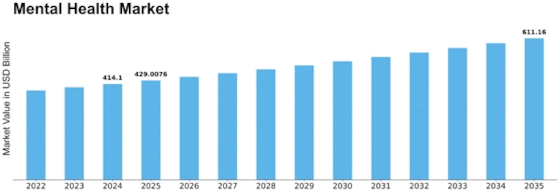
By 2032, the market size of mental health is expected to hit USD 530.5 Billion with a CAGR of 3.6% during the forecast period 2023-2032. The Mental Health Market is experiencing a shift in paradigm due to several factors that point to the recognition of mental health as an essential element of overall well-being. One factor that heavily influences this industry is the high prevalence rate of mental health disorders globally. Technological advancements have become game changers in the mental health market; digital approaches such as mobile applications, virtual therapy platforms, and telepsychiatry services have increased access to mental health care. COVID-19 has significantly propelled digitalized mental healthcare adoption by elevating the importance of mental health in society at large while at the same time increasing instances of difficulties associated with it caused by stressors related to the pandemic. Factors influencing these dynamics in markets include corporate initiatives regarding employees' mental well-being. These organizations are investing in programs and support systems aimed at promoting team member's well-being through the provision of psychological assistance. Additionally, regulatory frameworks and policy changes form crucial elements that shape this industry; governments and healthcare authorities are acknowledging that mental health matters, hence coming up with policies geared towards improving access to these services across their countries or states, for example, insurance coverage for MH or even regulation supporting eMH platforms. The market innovation in mind toward technology partners, either technology companies collaborating with professionals involved in treating people with different psychological issues or professionals from the medical domain being engaged in technological companies like IT ones, plays a critical role in moving forward into better understanding of a developing situation about Digital Health Sector itself. Furthermore, social and cultural shifts towards open conversations about personal wellness also affect market behavior. Efforts on advocacy or public campaigns and destigmatization, among others, contribute to creating supportive conditions necessary for those struggling with mental issues. Similarly, some economic considerations influence how the Mental Health Market looks. Thus, the cost-effectiveness and scalability of mental health solutions have been in focus due to the economic burden generated by untreated mental health conditions such as lost productivity, sickness absence rates, and healthcare costs. Also, people can afford digitalized systems for the care of the mind that work on a large scale (economically sustainable).
Mental Health Market Size Graph
Author
Author Profile
Vikita Thakur
Senior Research Analyst

She holds an experience of about 5+ years in market research and business consulting projects for sectors such as life sciences, medical devices, and healthcare IT. She possesses a robust background in data analysis, market estimation, competitive intelligence, pipeline analysis market trend identification, and consumer behavior insights. Her expertise lies in technical Sales support, client interaction and project management, designing and implementing market research studies, conducting competitive analysis, and synthesizing complex data into actionable recommendations that drive business growth.

Leave a Comment

FAQs

What is the projected market valuation of the Mental Health Market by 2035?

<p>The Mental Health Market is projected to reach a valuation of 611.16 USD Billion by 2035.</p>

What was the market valuation of the Mental Health Market in 2024?

<p>In 2024, the overall market valuation was 414.1 USD Billion.</p>

What is the expected CAGR for the Mental Health Market from 2025 to 2035?

<p>The expected CAGR for the Mental Health Market during the forecast period 2025 - 2035 is 3.6%.</p>

Which service type segment had the highest valuation in 2024?

<p>In 2024, the Medication segment had the highest valuation at 150.0 USD Billion.</p>

What is the projected valuation for the Therapy segment by 2035?

<p>The Therapy segment is projected to reach a valuation of 150.0 USD Billion by 2035.</p>

Which patient type segment is expected to grow the most by 2035?

<p>The Adults patient type segment is expected to grow the most, reaching 321.12 USD Billion by 2035.</p>

What was the valuation of the Anxiety Disorders segment in 2024?

<p>The Anxiety Disorders segment was valued at 120.0 USD Billion in 2024.</p>

Which treatment setting segment is projected to have the highest growth by 2035?

<p>The Online treatment setting segment is projected to grow significantly, reaching 211.16 USD Billion by 2035.</p>

Who are the key players in the Mental Health Market?

<p>Key players in the Mental Health Market include UnitedHealth Group, Anthem, Cigna, and Teladoc Health.</p>

What was the valuation of the Elderly patient type segment in 2024?

<p>The Elderly patient type segment was valued at 100.0 USD Billion in 2024.</p>

Market Summary

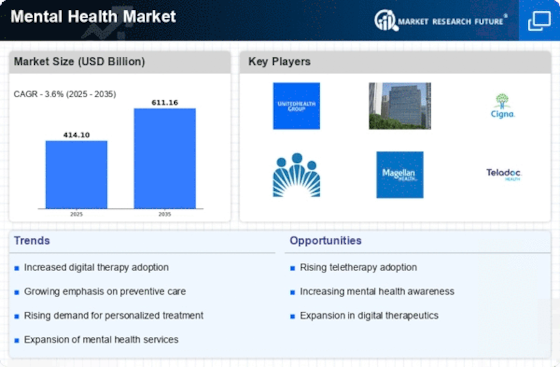
According to MRFR analysis, the Mental Health Market Size was valued at USD 414.1 Billion in 2024. The market is projected to grow from USD 429.01 Billion in 2025 to USD 611.16 Billion by 2035, registering a CAGR of 3.6% during the forecast period (2025–2035). North America led the market with over 39.99% share, generating around USD 165.6 billion in revenue.
 
The Mental Health Market is expanding due to the rising prevalence of depression, anxiety, and other psychological disorders. Key trends include growing adoption of digital mental health platforms, increasing awareness of mental wellness, and rising investments in telepsychiatry, therapy services, and innovative treatment approaches to improve global mental healthcare access.

Key Market Trends & Highlights

The Mental Health Market is experiencing transformative growth driven by technological advancements and increased awareness.

  • Teletherapy continues to rise in popularity, particularly in North America, as individuals seek accessible mental health support. The integration of mental health services into primary care settings is becoming more prevalent, especially in the Asia-Pacific region. Preventive mental health strategies are gaining traction, with a notable focus on children as the fastest-growing segment. Increased awareness of mental health issues and technological advancements in solutions are key drivers propelling market expansion.

Market Size & Forecast

2024 Market Size 414.1 (USD Billion)
2035 Market Size 611.16 (USD Billion)
CAGR (2025 - 2035) 3.6%
Largest Regional Market Share in 2024 North America

Major Players

Companies such as UnitedHealth Group (US), Anthem (US), Cigna (US), <a href="https://healthy.kaiserpermanente.org/health-wellness/mental-health">Kaiser Permanente</a> (US), <a href="https://www.magellanhealthcare.com/about/bh-resources/mymh/">Magellan Health (</a>US), Teladoc Health (US), Mental Health America (US), LivaNova (GB), HCA Healthcare (US), Acadia Healthcare (US) are some of the major participants in the global market.

Market Trends

The Mental Health Market is currently experiencing a transformative phase, characterized by an increasing recognition of mental health issues across various demographics. This heightened awareness is fostering a shift in societal attitudes, leading to greater acceptance and reduced stigma surrounding mental health conditions. As a result, there is a growing demand for mental health services, which encompasses therapy, counseling, and medication management.

Mental health disorders continue to increase worldwide, creating significant healthcare demand. According to the Institute for Health Metrics and Evaluation, mental disorders account for more than 14% of global years lived with disability (YLDs), highlighting the growing need for expanded mental health services and treatment options.

Furthermore, advancements in technology are playing a pivotal role in shaping the landscape of mental health care. Digital platforms and telehealth services are becoming more prevalent, providing individuals with easier access to mental health resources. This trend is particularly beneficial for those in remote areas or those who may feel uncomfortable seeking help in traditional settings. In addition to technological advancements, the Mental Health Market is witnessing an increase in the integration of mental health services within primary care settings. This approach aims to provide holistic care, addressing both physical and mental health needs simultaneously.

Moreover, there is a growing emphasis on preventive measures and early intervention strategies, which are crucial in mitigating the long-term impacts of mental health disorders. As the market evolves, it appears that collaboration among various stakeholders, including healthcare providers, policymakers, and community organizations, will be essential in creating a comprehensive support system for individuals facing mental health challenges.

Rise of Teletherapy

Teletherapy is gaining traction as a viable alternative to traditional in-person therapy. This trend is driven by the convenience and accessibility that digital platforms offer, allowing individuals to connect with mental health professionals from the comfort of their homes. As technology continues to advance, teletherapy is likely to become a standard practice in mental health care.

Digital mental health platforms are gaining strong traction as healthcare systems adopt remote care solutions. Data from the National Institute of Mental Health suggests that millions of adults seek online mental health support each year, reflecting the rising adoption of teletherapy and app-based counseling services.

Integration of Mental Health Market in Primary Care

There is a noticeable shift towards integrating mental health services within primary care settings. This approach facilitates a more comprehensive treatment model, addressing both physical and mental health needs concurrently. Such integration may enhance patient outcomes and streamline access to necessary services.

Governments and healthcare organizations are prioritizing early diagnosis and intervention for mental health conditions. Research from the Organisation for Economic Co‑operation and Development indicates that mental health conditions cost the global economy over USD 1 trillion annually in lost productivity, encouraging policymakers to invest in preventive mental health programs and integrated care models.

Focus on Preventive Mental Health Market Strategies

The Mental Health Market is increasingly prioritizing preventive strategies aimed at early intervention. By emphasizing education and awareness, stakeholders are working to reduce the incidence of mental health disorders. This proactive approach could lead to improved overall mental well-being and a decrease in the long-term burden of mental health issues.

Mental Health Market Market Drivers

Increased Awareness of Mental Health Issues

The rising awareness of mental health issues has become a pivotal driver in the Mental Health Market. Public campaigns and educational initiatives have contributed to a greater understanding of mental health conditions, reducing stigma and encouraging individuals to seek help.
 
According to recent data, approximately 1 in 5 adults experience mental illness each year, highlighting the urgent need for accessible mental health services. This awareness has led to increased demand for various mental health solutions, including therapy, counseling, and medication.
 
As more individuals recognize the importance of mental well-being, the Mental Health Market is likely to expand, with a projected growth rate of around 7% annually over the next several years. This trend suggests a shift towards prioritizing mental health as a critical component of overall health.

Rising Prevalence of Mental Health Disorders

The rising prevalence of mental health disorders is a significant driver influencing the Mental Health Market. Current estimates indicate that nearly 450 million people worldwide suffer from mental health conditions, underscoring the urgent need for effective treatment options. This increasing prevalence is attributed to various factors, including societal pressures, economic challenges, and changing lifestyles.
 
As more individuals seek help for their mental health issues, the demand for diverse treatment modalities, such as psychotherapy, medication, and support groups, is expected to escalate. The Mental Health Market is likely to expand in response to this growing need, with projections indicating a compound annual growth rate of approximately 8% over the next five years. This trend highlights the critical importance of addressing mental health as a public health priority.

Technological Advancements in Mental Health Solutions

Technological advancements are reshaping the Mental Health Market, offering innovative solutions that enhance accessibility and effectiveness. The proliferation of mobile applications, online therapy platforms, and artificial intelligence-driven tools has transformed how individuals engage with mental health services.
 
For instance, the use of teletherapy has surged, with reports indicating that over 60% of mental health professionals now offer remote services. This shift not only broadens access for those in remote areas but also caters to the preferences of younger generations who favor digital interactions. As technology continues to evolve, the Mental Health Market is expected to witness significant growth, with an estimated market value reaching over 200 billion dollars by 2027. This evolution indicates a promising future for mental health care delivery.

Integration of Mental Health Services in Healthcare Systems

The integration of mental health services within broader healthcare systems is a crucial driver for the Mental Health Market. This approach facilitates a more holistic view of patient care, recognizing the interplay between physical and mental health. Recent studies suggest that integrated care models can lead to improved patient outcomes and reduced healthcare costs. As healthcare providers increasingly adopt this model, the demand for mental health professionals and services is likely to rise.
 
The Mental Health Market is responding to this trend by developing collaborative care programs that enhance service delivery. This integration not only improves access to mental health resources but also encourages early intervention, which is essential for effective treatment. The potential for growth in this area is substantial, as healthcare systems worldwide prioritize comprehensive care.

Policy Changes and Increased Funding for Mental Health Services

Policy changes and increased funding for mental health services are emerging as vital drivers in the Mental Health Market. Governments and organizations are recognizing the necessity of investing in mental health care, leading to enhanced funding for programs and services. Recent legislative efforts have aimed to improve access to mental health resources, with some countries allocating significant portions of their healthcare budgets to mental health initiatives.
 
This shift in policy not only supports the development of new services but also encourages research and innovation within the Mental Health Market. As funding increases, the potential for expanding mental health services and improving treatment outcomes becomes more pronounced. This trend suggests a promising future for mental health care, as stakeholders prioritize mental well-being in their agendas.

Market Segment Insights

By Service Type: Therapy (Largest) vs. Counseling (Fastest-Growing)

In the Mental Health Market, the service type segment showcases a complex distribution among its various components. Therapy is acknowledged as the largest segment, capturing significant attention due to its effectiveness in treating a range of mental health issues. Counseling follows closely, representing a growing preference among individuals seeking mental health support, particularly among younger demographics who value accessibility and immediacy in mental health care services.

Therapy: Dominant vs. Counseling: Emerging

Therapy has established itself as a dominant force in the mental health market, encompassing various modalities such as cognitive behavioral therapy and psychodynamic therapy, which are favored for their in-depth and personalized approaches. Meanwhile, counseling is emerging rapidly, particularly in communities seeking brief intervention strategies and support for lesser mental health concerns. This shift indicates a broader acceptance of mental health awareness, with counseling services often viewed as preventive and supportive rather than solely remedial. Both segments are essential, with therapy's comprehensive solutions bridging gaps for severe conditions while counseling meets the needs of those pursuing personal development and coping strategies.

By Patient Type: Adults (Largest) vs. Children (Fastest-Growing)

The Mental Health Market shows a diverse distribution across patient types, with adults representing the largest segment due to their prevalence in various mental health conditions such as anxiety and depression. This demographic is often targeted by healthcare providers and mental health services, which leads to significant market traction. Meanwhile, the children's segment, while smaller, is rapidly gaining attention as awareness of mental health issues in younger populations grows, pushing initiatives and services geared specifically toward this age group.

Adults (Dominant) vs. Children (Emerging)

In the Mental Health Market, adults stand out as the dominant segment, characterized by a substantial representation of those suffering from chronic mental health issues, such as mood disorders and anxiety. Adults typically have greater access to resources and treatment options, leading to robust service utilization in this age group. Conversely, children are emerging as an equally critical segment, driven by increasing recognition of mental health challenges in younger populations. The focus on early intervention and therapeutic services for children is intensifying, as parents and educators seek to address issues like bullying and academic-related stress. This shift is fostering innovative therapeutic interventions, making the children’s segment a dynamic area for future growth.

By Disorder Type: Depression (Largest) vs. Anxiety Disorders (Fastest-Growing)

In the Mental Health Market, Depression stands out as the largest segment, significantly impacting the overall market dynamics. It accounts for a substantial share of the prevalence of mental health issues, leading to comprehensive treatment options and increasing awareness. Conversely, <a href="https://www.marketresearchfuture.com/reports/anxiety-disorders-depression-treatment-market-22424">Anxiety Disorders Depression</a>, while smaller in comparison, are emerging rapidly, driven by heightened stress levels and societal pressures, showcasing a growing concern among individuals of all ages.

Depression: (Dominant) vs. Anxiety Disorders (Emerging)

Depression is the dominant disorder in the Mental Health Market, characterized by persistent sadness and a lack of interest in previously enjoyed activities. Its prevalence influences a range of treatment modalities including therapy and medication. In contrast, Anxiety Disorders are gaining traction as an emerging segment, with individuals increasingly recognizing and seeking help for their anxiety symptoms. The growing acknowledgment of mental health awareness and the availability of innovative therapeutic approaches contribute to the rising acceptance and treatment of these disorders, making them a focal point for mental health initiatives.

By Treatment Setting: Outpatient (Largest) vs. Online (Fastest-Growing)

The treatment setting segment showcases a diverse distribution of services, with inpatient, outpatient, residential, and online options. Outpatient treatment currently holds the largest Mental Health Market share, favored for its flexibility and accessibility, allowing patients to receive care without overnight hospitalization. Conversely, while inpatient care remains vital for severe cases, its share is comparatively smaller, with residential treatment serving as a bridge for those requiring extensive support but preferring a home-like environment. The online treatment setting is gaining momentum as a significant player in this market.

Outpatient (Dominant) vs. Online (Emerging)

The outpatient treatment setting in the Mental Health Market is characterized by its structured yet flexible approach, allowing individuals to attend therapy sessions while maintaining their daily routines. This model is particularly effective for those with mild to moderate mental health issues, offering a range of services from counseling to medication management. In contrast, online treatment is an emerging option catering to the digital-savvy population, providing accessible mental health support via teletherapy or digital platforms. This segment appeals to those seeking anonymity, convenience, and immediate access to care, facilitating a shift in how mental health services are delivered.

Get more detailed insights about Mental Health Market Research Report - Forecast Till 2035

Regional Insights

North America : Leading Market for Mental Health Market

North America leads in the Mental Health Market Size, accounting for over 39.99% of the global revenue in 2024. The region's growth is driven by increasing awareness of mental health issues, rising demand for telehealth services, and supportive regulatory frameworks. The U.S. government has implemented various initiatives to enhance mental health care access, including the Mental Health Market Parity and Addiction Equity Act, which mandates equal coverage for mental health services.

The competitive landscape in North America is robust, with key players such as UnitedHealth Group, Anthem, and Cigna leading the market. The presence of advanced healthcare infrastructure and a high prevalence of mental health disorders further bolster the market. Additionally, the integration of technology in mental health services, such as teletherapy and mobile applications, is gaining traction, enhancing service delivery and patient engagement.

Europe : Emerging Focus on Mental Health Market

Europe Mental Health Market size was valued at USD 124.23 Billion in 2024, making it the second-largest regional market with a 30% share. The region's growth is fueled by increasing recognition of mental health issues, government initiatives, and funding for mental health programs. The European Union has emphasized mental health in its public health agenda, promoting policies that enhance access to mental health services and reduce stigma associated with mental illnesses.

Leading countries in Europe include Germany, the UK, and France, which are investing heavily in mental health infrastructure and services. The competitive landscape features key players like LivaNova and various national health services. The integration of mental health into primary care and the rise of digital mental health solutions are transforming service delivery, making it more accessible and effective for patients across the region.

Asia-Pacific : Rapidly Growing Mental Health Market Sector

Asia-Pacific is emerging as a rapidly growing market for mental health services, holding approximately 20% of the global market share. The region's growth is driven by increasing awareness of mental health issues, urbanization, and rising disposable incomes. Governments are beginning to recognize the importance of mental health, leading to the implementation of policies aimed at improving access to mental health care and reducing stigma associated with mental illnesses.

Countries like Australia, Japan, and India are at the forefront of this growth, with significant investments in mental health infrastructure and services. The competitive landscape includes both local and international players, with a focus on integrating mental health services into primary healthcare. The rise of telehealth and digital mental health solutions is also transforming the landscape, making services more accessible to diverse populations across the region.

Middle East and Africa : Evolving Mental Health Market Landscape

The Middle East and Africa region is gradually evolving in its approach to mental health, currently holding about 15% of the global market share. The growth is driven by increasing awareness of mental health issues, government initiatives, and international support for mental health programs. Countries are beginning to implement policies aimed at improving mental health services, although challenges such as stigma and limited resources remain prevalent.

Leading countries in this region include South Africa, Nigeria, and the UAE, which are making strides in enhancing mental health care access. The competitive landscape is characterized by a mix of local and international organizations working to address mental health needs. The integration of mental health services into community health programs is gaining momentum, supported by various NGOs and government initiatives aimed at improving mental health outcomes.

Key Players and Competitive Insights

The Global Mental Health Market is experiencing significant growth driven by increasing awareness about mental health issues and the rising prevalence of mental disorders across various demographics. This growth attracts numerous players looking to address the escalating demand for effective mental health solutions. The competitive landscape is characterized by an array of service providers ranging from traditional therapy and counseling services to innovative digital solutions and mental wellness applications.
 
As mental health becomes a focal point for healthcare providers, policymakers, and society as a whole, companies are leveraging technology and research to develop unique offerings, differentiating themselves in this rapidly evolving market. This competitive environment also fosters collaboration and partnerships among companies to enhance their service delivery and reach broader audiences globally, thereby shaping the future of mental health care. Myndlift stands out in the Global Mental Health Market primarily through its innovative approach to neuromodulation and mental wellness solutions.
 
The company's strength lies in its ability to integrate technology with mental health therapies, creating user-friendly applications that allow individuals to engage with their mental wellness actively. By offering personalized mental health solutions, Myndlift empowers users to manage anxiety, depression, and other mental health concerns effectively. The company is focused on providing evidence-based therapies and harnessing the power of neurofeedback to enhance mental well-being. By continuously innovating and adapting its offerings, Myndlift positions itself as a key player in the mental health space, catering to the growing demand for accessible and effective mental health resources.
 
Spring Health is another significant entity within the Global Mental Health Market, known for its comprehensive suite of mental health services designed to support varied populations. Focusing on employing data-driven strategies, Spring Health offers tailored treatment options aimed at various mental health conditions such as anxiety, depression, and stress management. Its key products include personalized care plans, access to a wide range of mental health professionals, and tools for enhancing workplace mental health, solidifying its presence in both corporate and individual segments.
 
The company's strength comes from its strong focus on research and development, alongside strategic partnerships and acquisitions aimed at expanding its service offerings and enhancing its market reach. By continually advancing its technological capabilities and staying ahead of industry trends, Spring Health is well-positioned to meet the growing global demand for effective mental health solutions.

Key Companies in the Mental Health Market include

Industry Developments

  • Q2 2025: Teladoc Health Acquires UpLift, Expanding Consumer Access to Mental Health Market Care Services Through Covered Benefits Teladoc Health acquired UpLift, a virtual mental health provider with in-network health plan relationships, in an all-cash transaction for $30 million plus up to $15 million in earnouts. The deal closed April 30, 2025, and UpLift will continue to operate under its existing leadership.
  • Q2 2025: Private Equity Health Care Acquisitions – May 2025 NexPhase Capital announced the acquisition of Behavior Frontiers, a provider of Applied Behavior Analysis (ABA) treatment for autism, from Lorient Capital. Behavior Frontiers operates 21 centers and provides home-based care across 18 states.
  • Q2 2025: Private Equity Health Care Acquisitions – May 2025 Beacon Behavioral Partners, owned by Resolute Capital Partners and Latticework Capital Management, announced the acquisition of five mental health providers in 2025: Synapse Integrative Behavioral Health, Shore Clinical TMS & Wellness Center, NeuroPsych Wellness Center, Cognizant Behavioral Health Service, and The Maples.
  • Q1 2025: Behavioral Health Prime for Consolidation in 2025, But Regulatory Uncertainty Looms Oceans Healthcare announced the acquisition of Haven Behavioral Healthcare in early January 2025, expanding its behavioral health platform.
  • Q1 2025: Behavioral Health Prime for Consolidation in 2025, But Regulatory Uncertainty Looms Iris Telehealth closed a deal to acquire InnovaTel from Quartet at the end of January 2025, strengthening its telepsychiatry services.
  • Q1 2025: Behavioral Health Prime for Consolidation in 2025, But Regulatory Uncertainty Looms Thriveworks acquired AI-powered behavioral health company Synchronous Health at the end of 2024, marking its entry into the M&A arena.
  • Q1 2025: Behavioral Health Prime for Consolidation in 2025, But Regulatory Uncertainty Looms Eleos, DarioHealth, SlingshotAI, and Prosper Health closed funding rounds in January 2025, reflecting increased investment activity in digital mental health.
  • Q4 2024: Q4 2024 Behavioral Health M&A Report The fourth quarter of 2024 saw 25 deals involving mental healthcare providers, with a total of 99 transactions for the year, indicating a resurgence in M&A activity in the sector.

Future Outlook

Mental Health Market Future Outlook

The Mental Health Market size is projected to reach USD 611.16 Billion by 2035, growing at a CAGR of 3.6%, driven by increasing awareness, technological advancements, and rising demand for mental health services.

New opportunities lie in:

  • <p>Development of teletherapy platforms for remote consultations Integration of AI-driven mental health assessment tools Expansion of <a href="https://www.marketresearchfuture.com/reports/corporate-wellness-market-6963">corporate wellness</a> programs focusing on mental health</p>

By 2035, the Mental Health Market is expected to be robust, reflecting substantial growth and innovation.

Market Segmentation

Mental Health Market Patient Type Outlook

  • Children
  • Adolescents
  • Adults
  • Elderly

Mental Health Market Service Type Outlook

  • Therapy
  • Counseling
  • Medication
  • Support Groups

Mental Health Market Disorder Type Outlook

  • Depression
  • Anxiety Disorders
  • Bipolar Disorder
  • Schizophrenia

Mental Health Market Treatment Setting Outlook

  • Inpatient
  • Outpatient
  • Residential
  • Online

Report Scope

MARKET SIZE 2024 414.1(USD Billion)
MARKET SIZE 2025 429.01(USD Billion)
MARKET SIZE 2035 611.16(USD Billion)
COMPOUND ANNUAL GROWTH RATE (CAGR) 3.6% (2025 - 2035)
REPORT COVERAGE Revenue Forecast, Competitive Landscape, Growth Factors, and Trends
BASE YEAR 2024
Market Forecast Period 2025 - 2035
Historical Data 2019 - 2024
Market Forecast Units USD Billion
Key Companies Profiled UnitedHealth Group (US), Anthem (US), Cigna (US), Kaiser Permanente (US), Magellan Health (US), Teladoc Health (US), Mental Health America (US), LivaNova (GB), HCA Healthcare (US), Acadia Healthcare (US)
Segments Covered Disorder, Services, Age Group, Region
Key Market Opportunities Integration of digital therapeutics and telehealth services in the Mental Health Market.
Key Market Dynamics Rising demand for digital mental health solutions drives innovation and competition among service providers and technology firms.
Countries Covered North America, Europe, APAC, South America, MEA

FAQs

What is the projected market valuation of the Mental Health Market by 2035?

<p>The Mental Health Market is projected to reach a valuation of 611.16 USD Billion by 2035.</p>

What was the market valuation of the Mental Health Market in 2024?

<p>In 2024, the overall market valuation was 414.1 USD Billion.</p>

What is the expected CAGR for the Mental Health Market from 2025 to 2035?

<p>The expected CAGR for the Mental Health Market during the forecast period 2025 - 2035 is 3.6%.</p>

Which service type segment had the highest valuation in 2024?

<p>In 2024, the Medication segment had the highest valuation at 150.0 USD Billion.</p>

What is the projected valuation for the Therapy segment by 2035?

<p>The Therapy segment is projected to reach a valuation of 150.0 USD Billion by 2035.</p>

Which patient type segment is expected to grow the most by 2035?

<p>The Adults patient type segment is expected to grow the most, reaching 321.12 USD Billion by 2035.</p>

What was the valuation of the Anxiety Disorders segment in 2024?

<p>The Anxiety Disorders segment was valued at 120.0 USD Billion in 2024.</p>

Which treatment setting segment is projected to have the highest growth by 2035?

<p>The Online treatment setting segment is projected to grow significantly, reaching 211.16 USD Billion by 2035.</p>

Who are the key players in the Mental Health Market?

<p>Key players in the Mental Health Market include UnitedHealth Group, Anthem, Cigna, and Teladoc Health.</p>

What was the valuation of the Elderly patient type segment in 2024?

<p>The Elderly patient type segment was valued at 100.0 USD Billion in 2024.</p>

  1. SECTION I: EXECUTIVE SUMMARY AND KEY HIGHLIGHTS
    1. | 1.1 EXECUTIVE SUMMARY
    2. | | 1.1.1 Market Overview
    3. | | 1.1.2 Key Findings
    4. | | 1.1.3 Market Segmentation
    5. | | 1.1.4 Competitive Landscape
    6. | | 1.1.5 Challenges and Opportunities
    7. | | 1.1.6 Future Outlook
  2. SECTION II: SCOPING, METHODOLOGY AND MARKET STRUCTURE
    1. | 2.1 MARKET INTRODUCTION
    2. | | 2.1.1 Definition
    3. | | 2.1.2 Scope of the study
    4. | | | 2.1.2.1 Research Objective
    5. | | | 2.1.2.2 Assumption
    6. | | | 2.1.2.3 Limitations
    7. | 2.2 RESEARCH METHODOLOGY
    8. | | 2.2.1 Overview
    9. | | 2.2.2 Data Mining
    10. | | 2.2.3 Secondary Research
    11. | | 2.2.4 Primary Research
    12. | | | 2.2.4.1 Primary Interviews and Information Gathering Process
    13. | | | 2.2.4.2 Breakdown of Primary Respondents
    14. | | 2.2.5 Forecasting Model
    15. | | 2.2.6 Market Size Estimation
    16. | | | 2.2.6.1 Bottom-Up Approach
    17. | | | 2.2.6.2 Top-Down Approach
    18. | | 2.2.7 Data Triangulation
    19. | | 2.2.8 Validation
  3. SECTION III: QUALITATIVE ANALYSIS
    1. | 3.1 MARKET DYNAMICS
    2. | | 3.1.1 Overview
    3. | | 3.1.2 Drivers
    4. | | 3.1.3 Restraints
    5. | | 3.1.4 Opportunities
    6. | 3.2 MARKET FACTOR ANALYSIS
    7. | | 3.2.1 Value chain Analysis
    8. | | 3.2.2 Porter's Five Forces Analysis
    9. | | | 3.2.2.1 Bargaining Power of Suppliers
    10. | | | 3.2.2.2 Bargaining Power of Buyers
    11. | | | 3.2.2.3 Threat of New Entrants
    12. | | | 3.2.2.4 Threat of Substitutes
    13. | | | 3.2.2.5 Intensity of Rivalry
    14. | | 3.2.3 COVID-19 Impact Analysis
    15. | | | 3.2.3.1 Market Impact Analysis
    16. | | | 3.2.3.2 Regional Impact
    17. | | | 3.2.3.3 Opportunity and Threat Analysis
  4. SECTION IV: QUANTITATIVE ANALYSIS
    1. | 4.1 Healthcare, BY Service Type (USD Billion)
    2. | | 4.1.1 Therapy
    3. | | 4.1.2 Counseling
    4. | | 4.1.3 Medication
    5. | | 4.1.4 Support Groups
    6. | 4.2 Healthcare, BY Patient Type (USD Billion)
    7. | | 4.2.1 Children
    8. | | 4.2.2 Adolescents
    9. | | 4.2.3 Adults
    10. | | 4.2.4 Elderly
    11. | 4.3 Healthcare, BY Disorder Type (USD Billion)
    12. | | 4.3.1 Depression
    13. | | 4.3.2 Anxiety Disorders
    14. | | 4.3.3 Bipolar Disorder
    15. | | 4.3.4 Schizophrenia
    16. | 4.4 Healthcare, BY Treatment Setting (USD Billion)
    17. | | 4.4.1 Inpatient
    18. | | 4.4.2 Outpatient
    19. | | 4.4.3 Residential
    20. | | 4.4.4 Online
    21. | 4.5 Healthcare, BY Region (USD Billion)
    22. | | 4.5.1 North America
    23. | | | 4.5.1.1 US
    24. | | | 4.5.1.2 Canada
    25. | | 4.5.2 Europe
    26. | | | 4.5.2.1 Germany
    27. | | | 4.5.2.2 UK
    28. | | | 4.5.2.3 France
    29. | | | 4.5.2.4 Russia
    30. | | | 4.5.2.5 Italy
    31. | | | 4.5.2.6 Spain
    32. | | | 4.5.2.7 Rest of Europe
    33. | | 4.5.3 APAC
    34. | | | 4.5.3.1 China
    35. | | | 4.5.3.2 India
    36. | | | 4.5.3.3 Japan
    37. | | | 4.5.3.4 South Korea
    38. | | | 4.5.3.5 Malaysia
    39. | | | 4.5.3.6 Thailand
    40. | | | 4.5.3.7 Indonesia
    41. | | | 4.5.3.8 Rest of APAC
    42. | | 4.5.4 South America
    43. | | | 4.5.4.1 Brazil
    44. | | | 4.5.4.2 Mexico
    45. | | | 4.5.4.3 Argentina
    46. | | | 4.5.4.4 Rest of South America
    47. | | 4.5.5 MEA
    48. | | | 4.5.5.1 GCC Countries
    49. | | | 4.5.5.2 South Africa
    50. | | | 4.5.5.3 Rest of MEA
  5. SECTION V: COMPETITIVE ANALYSIS
    1. | 5.1 Competitive Landscape
    2. | | 5.1.1 Overview
    3. | | 5.1.2 Competitive Analysis
    4. | | 5.1.3 Market share Analysis
    5. | | 5.1.4 Major Growth Strategy in the Healthcare
    6. | | 5.1.5 Competitive Benchmarking
    7. | | 5.1.6 Leading Players in Terms of Number of Developments in the Healthcare
    8. | | 5.1.7 Key developments and growth strategies
    9. | | | 5.1.7.1 New Product Launch/Service Deployment
    10. | | | 5.1.7.2 Merger & Acquisitions
    11. | | | 5.1.7.3 Joint Ventures
    12. | | 5.1.8 Major Players Financial Matrix
    13. | | | 5.1.8.1 Sales and Operating Income
    14. | | | 5.1.8.2 Major Players R&D Expenditure. 2023
    15. | 5.2 Company Profiles
    16. | | 5.2.1 UnitedHealth Group (US)
    17. | | | 5.2.1.1 Financial Overview
    18. | | | 5.2.1.2 Products Offered
    19. | | | 5.2.1.3 Key Developments
    20. | | | 5.2.1.4 SWOT Analysis
    21. | | | 5.2.1.5 Key Strategies
    22. | | 5.2.2 Anthem (US)
    23. | | | 5.2.2.1 Financial Overview
    24. | | | 5.2.2.2 Products Offered
    25. | | | 5.2.2.3 Key Developments
    26. | | | 5.2.2.4 SWOT Analysis
    27. | | | 5.2.2.5 Key Strategies
    28. | | 5.2.3 Cigna (US)
    29. | | | 5.2.3.1 Financial Overview
    30. | | | 5.2.3.2 Products Offered
    31. | | | 5.2.3.3 Key Developments
    32. | | | 5.2.3.4 SWOT Analysis
    33. | | | 5.2.3.5 Key Strategies
    34. | | 5.2.4 Kaiser Permanente (US)
    35. | | | 5.2.4.1 Financial Overview
    36. | | | 5.2.4.2 Products Offered
    37. | | | 5.2.4.3 Key Developments
    38. | | | 5.2.4.4 SWOT Analysis
    39. | | | 5.2.4.5 Key Strategies
    40. | | 5.2.5 Magellan Health (US)
    41. | | | 5.2.5.1 Financial Overview
    42. | | | 5.2.5.2 Products Offered
    43. | | | 5.2.5.3 Key Developments
    44. | | | 5.2.5.4 SWOT Analysis
    45. | | | 5.2.5.5 Key Strategies
    46. | | 5.2.6 Teladoc Health (US)
    47. | | | 5.2.6.1 Financial Overview
    48. | | | 5.2.6.2 Products Offered
    49. | | | 5.2.6.3 Key Developments
    50. | | | 5.2.6.4 SWOT Analysis
    51. | | | 5.2.6.5 Key Strategies
    52. | | 5.2.7 Mental Health America (US)
    53. | | | 5.2.7.1 Financial Overview
    54. | | | 5.2.7.2 Products Offered
    55. | | | 5.2.7.3 Key Developments
    56. | | | 5.2.7.4 SWOT Analysis
    57. | | | 5.2.7.5 Key Strategies
    58. | | 5.2.8 LivaNova (GB)
    59. | | | 5.2.8.1 Financial Overview
    60. | | | 5.2.8.2 Products Offered
    61. | | | 5.2.8.3 Key Developments
    62. | | | 5.2.8.4 SWOT Analysis
    63. | | | 5.2.8.5 Key Strategies
    64. | | 5.2.9 HCA Healthcare (US)
    65. | | | 5.2.9.1 Financial Overview
    66. | | | 5.2.9.2 Products Offered
    67. | | | 5.2.9.3 Key Developments
    68. | | | 5.2.9.4 SWOT Analysis
    69. | | | 5.2.9.5 Key Strategies
    70. | | 5.2.10 Acadia Healthcare (US)
    71. | | | 5.2.10.1 Financial Overview
    72. | | | 5.2.10.2 Products Offered
    73. | | | 5.2.10.3 Key Developments
    74. | | | 5.2.10.4 SWOT Analysis
    75. | | | 5.2.10.5 Key Strategies
    76. | 5.3 Appendix
    77. | | 5.3.1 References
    78. | | 5.3.2 Related Reports
  6. LIST OF FIGURES
    1. | 6.1 MARKET SYNOPSIS
    2. | 6.2 NORTH AMERICA MARKET ANALYSIS
    3. | 6.3 US MARKET ANALYSIS BY SERVICE TYPE
    4. | 6.4 US MARKET ANALYSIS BY PATIENT TYPE
    5. | 6.5 US MARKET ANALYSIS BY DISORDER TYPE
    6. | 6.6 US MARKET ANALYSIS BY TREATMENT SETTING
    7. | 6.7 CANADA MARKET ANALYSIS BY SERVICE TYPE
    8. | 6.8 CANADA MARKET ANALYSIS BY PATIENT TYPE
    9. | 6.9 CANADA MARKET ANALYSIS BY DISORDER TYPE
    10. | 6.10 CANADA MARKET ANALYSIS BY TREATMENT SETTING
    11. | 6.11 EUROPE MARKET ANALYSIS
    12. | 6.12 GERMANY MARKET ANALYSIS BY SERVICE TYPE
    13. | 6.13 GERMANY MARKET ANALYSIS BY PATIENT TYPE
    14. | 6.14 GERMANY MARKET ANALYSIS BY DISORDER TYPE
    15. | 6.15 GERMANY MARKET ANALYSIS BY TREATMENT SETTING
    16. | 6.16 UK MARKET ANALYSIS BY SERVICE TYPE
    17. | 6.17 UK MARKET ANALYSIS BY PATIENT TYPE
    18. | 6.18 UK MARKET ANALYSIS BY DISORDER TYPE
    19. | 6.19 UK MARKET ANALYSIS BY TREATMENT SETTING
    20. | 6.20 FRANCE MARKET ANALYSIS BY SERVICE TYPE
    21. | 6.21 FRANCE MARKET ANALYSIS BY PATIENT TYPE
    22. | 6.22 FRANCE MARKET ANALYSIS BY DISORDER TYPE
    23. | 6.23 FRANCE MARKET ANALYSIS BY TREATMENT SETTING
    24. | 6.24 RUSSIA MARKET ANALYSIS BY SERVICE TYPE
    25. | 6.25 RUSSIA MARKET ANALYSIS BY PATIENT TYPE
    26. | 6.26 RUSSIA MARKET ANALYSIS BY DISORDER TYPE
    27. | 6.27 RUSSIA MARKET ANALYSIS BY TREATMENT SETTING
    28. | 6.28 ITALY MARKET ANALYSIS BY SERVICE TYPE
    29. | 6.29 ITALY MARKET ANALYSIS BY PATIENT TYPE
    30. | 6.30 ITALY MARKET ANALYSIS BY DISORDER TYPE
    31. | 6.31 ITALY MARKET ANALYSIS BY TREATMENT SETTING
    32. | 6.32 SPAIN MARKET ANALYSIS BY SERVICE TYPE
    33. | 6.33 SPAIN MARKET ANALYSIS BY PATIENT TYPE
    34. | 6.34 SPAIN MARKET ANALYSIS BY DISORDER TYPE
    35. | 6.35 SPAIN MARKET ANALYSIS BY TREATMENT SETTING
    36. | 6.36 REST OF EUROPE MARKET ANALYSIS BY SERVICE TYPE
    37. | 6.37 REST OF EUROPE MARKET ANALYSIS BY PATIENT TYPE
    38. | 6.38 REST OF EUROPE MARKET ANALYSIS BY DISORDER TYPE
    39. | 6.39 REST OF EUROPE MARKET ANALYSIS BY TREATMENT SETTING
    40. | 6.40 APAC MARKET ANALYSIS
    41. | 6.41 CHINA MARKET ANALYSIS BY SERVICE TYPE
    42. | 6.42 CHINA MARKET ANALYSIS BY PATIENT TYPE
    43. | 6.43 CHINA MARKET ANALYSIS BY DISORDER TYPE
    44. | 6.44 CHINA MARKET ANALYSIS BY TREATMENT SETTING
    45. | 6.45 INDIA MARKET ANALYSIS BY SERVICE TYPE
    46. | 6.46 INDIA MARKET ANALYSIS BY PATIENT TYPE
    47. | 6.47 INDIA MARKET ANALYSIS BY DISORDER TYPE
    48. | 6.48 INDIA MARKET ANALYSIS BY TREATMENT SETTING
    49. | 6.49 JAPAN MARKET ANALYSIS BY SERVICE TYPE
    50. | 6.50 JAPAN MARKET ANALYSIS BY PATIENT TYPE
    51. | 6.51 JAPAN MARKET ANALYSIS BY DISORDER TYPE
    52. | 6.52 JAPAN MARKET ANALYSIS BY TREATMENT SETTING
    53. | 6.53 SOUTH KOREA MARKET ANALYSIS BY SERVICE TYPE
    54. | 6.54 SOUTH KOREA MARKET ANALYSIS BY PATIENT TYPE
    55. | 6.55 SOUTH KOREA MARKET ANALYSIS BY DISORDER TYPE
    56. | 6.56 SOUTH KOREA MARKET ANALYSIS BY TREATMENT SETTING
    57. | 6.57 MALAYSIA MARKET ANALYSIS BY SERVICE TYPE
    58. | 6.58 MALAYSIA MARKET ANALYSIS BY PATIENT TYPE
    59. | 6.59 MALAYSIA MARKET ANALYSIS BY DISORDER TYPE
    60. | 6.60 MALAYSIA MARKET ANALYSIS BY TREATMENT SETTING
    61. | 6.61 THAILAND MARKET ANALYSIS BY SERVICE TYPE
    62. | 6.62 THAILAND MARKET ANALYSIS BY PATIENT TYPE
    63. | 6.63 THAILAND MARKET ANALYSIS BY DISORDER TYPE
    64. | 6.64 THAILAND MARKET ANALYSIS BY TREATMENT SETTING
    65. | 6.65 INDONESIA MARKET ANALYSIS BY SERVICE TYPE
    66. | 6.66 INDONESIA MARKET ANALYSIS BY PATIENT TYPE
    67. | 6.67 INDONESIA MARKET ANALYSIS BY DISORDER TYPE
    68. | 6.68 INDONESIA MARKET ANALYSIS BY TREATMENT SETTING
    69. | 6.69 REST OF APAC MARKET ANALYSIS BY SERVICE TYPE
    70. | 6.70 REST OF APAC MARKET ANALYSIS BY PATIENT TYPE
    71. | 6.71 REST OF APAC MARKET ANALYSIS BY DISORDER TYPE
    72. | 6.72 REST OF APAC MARKET ANALYSIS BY TREATMENT SETTING
    73. | 6.73 SOUTH AMERICA MARKET ANALYSIS
    74. | 6.74 BRAZIL MARKET ANALYSIS BY SERVICE TYPE
    75. | 6.75 BRAZIL MARKET ANALYSIS BY PATIENT TYPE
    76. | 6.76 BRAZIL MARKET ANALYSIS BY DISORDER TYPE
    77. | 6.77 BRAZIL MARKET ANALYSIS BY TREATMENT SETTING
    78. | 6.78 MEXICO MARKET ANALYSIS BY SERVICE TYPE
    79. | 6.79 MEXICO MARKET ANALYSIS BY PATIENT TYPE
    80. | 6.80 MEXICO MARKET ANALYSIS BY DISORDER TYPE
    81. | 6.81 MEXICO MARKET ANALYSIS BY TREATMENT SETTING
    82. | 6.82 ARGENTINA MARKET ANALYSIS BY SERVICE TYPE
    83. | 6.83 ARGENTINA MARKET ANALYSIS BY PATIENT TYPE
    84. | 6.84 ARGENTINA MARKET ANALYSIS BY DISORDER TYPE
    85. | 6.85 ARGENTINA MARKET ANALYSIS BY TREATMENT SETTING
    86. | 6.86 REST OF SOUTH AMERICA MARKET ANALYSIS BY SERVICE TYPE
    87. | 6.87 REST OF SOUTH AMERICA MARKET ANALYSIS BY PATIENT TYPE
    88. | 6.88 REST OF SOUTH AMERICA MARKET ANALYSIS BY DISORDER TYPE
    89. | 6.89 REST OF SOUTH AMERICA MARKET ANALYSIS BY TREATMENT SETTING
    90. | 6.90 MEA MARKET ANALYSIS
    91. | 6.91 GCC COUNTRIES MARKET ANALYSIS BY SERVICE TYPE
    92. | 6.92 GCC COUNTRIES MARKET ANALYSIS BY PATIENT TYPE
    93. | 6.93 GCC COUNTRIES MARKET ANALYSIS BY DISORDER TYPE
    94. | 6.94 GCC COUNTRIES MARKET ANALYSIS BY TREATMENT SETTING
    95. | 6.95 SOUTH AFRICA MARKET ANALYSIS BY SERVICE TYPE
    96. | 6.96 SOUTH AFRICA MARKET ANALYSIS BY PATIENT TYPE
    97. | 6.97 SOUTH AFRICA MARKET ANALYSIS BY DISORDER TYPE
    98. | 6.98 SOUTH AFRICA MARKET ANALYSIS BY TREATMENT SETTING
    99. | 6.99 REST OF MEA MARKET ANALYSIS BY SERVICE TYPE
    100. | 6.100 REST OF MEA MARKET ANALYSIS BY PATIENT TYPE
    101. | 6.101 REST OF MEA MARKET ANALYSIS BY DISORDER TYPE
    102. | 6.102 REST OF MEA MARKET ANALYSIS BY TREATMENT SETTING
    103. | 6.103 KEY BUYING CRITERIA OF HEALTHCARE
    104. | 6.104 RESEARCH PROCESS OF MRFR
    105. | 6.105 DRO ANALYSIS OF HEALTHCARE
    106. | 6.106 DRIVERS IMPACT ANALYSIS: HEALTHCARE
    107. | 6.107 RESTRAINTS IMPACT ANALYSIS: HEALTHCARE
    108. | 6.108 SUPPLY / VALUE CHAIN: HEALTHCARE
    109. | 6.109 HEALTHCARE, BY SERVICE TYPE, 2024 (% SHARE)
    110. | 6.110 HEALTHCARE, BY SERVICE TYPE, 2024 TO 2035 (USD Billion)
    111. | 6.111 HEALTHCARE, BY PATIENT TYPE, 2024 (% SHARE)
    112. | 6.112 HEALTHCARE, BY PATIENT TYPE, 2024 TO 2035 (USD Billion)
    113. | 6.113 HEALTHCARE, BY DISORDER TYPE, 2024 (% SHARE)
    114. | 6.114 HEALTHCARE, BY DISORDER TYPE, 2024 TO 2035 (USD Billion)
    115. | 6.115 HEALTHCARE, BY TREATMENT SETTING, 2024 (% SHARE)
    116. | 6.116 HEALTHCARE, BY TREATMENT SETTING, 2024 TO 2035 (USD Billion)
    117. | 6.117 BENCHMARKING OF MAJOR COMPETITORS
  7. LIST OF TABLES
    1. | 7.1 LIST OF ASSUMPTIONS
    2. | | 7.1.1
    3. | 7.2 North America MARKET SIZE ESTIMATES; FORECAST
    4. | | 7.2.1 BY SERVICE TYPE, 2025-2035 (USD Billion)
    5. | | 7.2.2 BY PATIENT TYPE, 2025-2035 (USD Billion)
    6. | | 7.2.3 BY DISORDER TYPE, 2025-2035 (USD Billion)
    7. | | 7.2.4 BY TREATMENT SETTING, 2025-2035 (USD Billion)
    8. | 7.3 US MARKET SIZE ESTIMATES; FORECAST
    9. | | 7.3.1 BY SERVICE TYPE, 2025-2035 (USD Billion)
    10. | | 7.3.2 BY PATIENT TYPE, 2025-2035 (USD Billion)
    11. | | 7.3.3 BY DISORDER TYPE, 2025-2035 (USD Billion)
    12. | | 7.3.4 BY TREATMENT SETTING, 2025-2035 (USD Billion)
    13. | 7.4 Canada MARKET SIZE ESTIMATES; FORECAST
    14. | | 7.4.1 BY SERVICE TYPE, 2025-2035 (USD Billion)
    15. | | 7.4.2 BY PATIENT TYPE, 2025-2035 (USD Billion)
    16. | | 7.4.3 BY DISORDER TYPE, 2025-2035 (USD Billion)
    17. | | 7.4.4 BY TREATMENT SETTING, 2025-2035 (USD Billion)
    18. | 7.5 Europe MARKET SIZE ESTIMATES; FORECAST
    19. | | 7.5.1 BY SERVICE TYPE, 2025-2035 (USD Billion)
    20. | | 7.5.2 BY PATIENT TYPE, 2025-2035 (USD Billion)
    21. | | 7.5.3 BY DISORDER TYPE, 2025-2035 (USD Billion)
    22. | | 7.5.4 BY TREATMENT SETTING, 2025-2035 (USD Billion)
    23. | 7.6 Germany MARKET SIZE ESTIMATES; FORECAST
    24. | | 7.6.1 BY SERVICE TYPE, 2025-2035 (USD Billion)
    25. | | 7.6.2 BY PATIENT TYPE, 2025-2035 (USD Billion)
    26. | | 7.6.3 BY DISORDER TYPE, 2025-2035 (USD Billion)
    27. | | 7.6.4 BY TREATMENT SETTING, 2025-2035 (USD Billion)
    28. | 7.7 UK MARKET SIZE ESTIMATES; FORECAST
    29. | | 7.7.1 BY SERVICE TYPE, 2025-2035 (USD Billion)
    30. | | 7.7.2 BY PATIENT TYPE, 2025-2035 (USD Billion)
    31. | | 7.7.3 BY DISORDER TYPE, 2025-2035 (USD Billion)
    32. | | 7.7.4 BY TREATMENT SETTING, 2025-2035 (USD Billion)
    33. | 7.8 France MARKET SIZE ESTIMATES; FORECAST
    34. | | 7.8.1 BY SERVICE TYPE, 2025-2035 (USD Billion)
    35. | | 7.8.2 BY PATIENT TYPE, 2025-2035 (USD Billion)
    36. | | 7.8.3 BY DISORDER TYPE, 2025-2035 (USD Billion)
    37. | | 7.8.4 BY TREATMENT SETTING, 2025-2035 (USD Billion)
    38. | 7.9 Russia MARKET SIZE ESTIMATES; FORECAST
    39. | | 7.9.1 BY SERVICE TYPE, 2025-2035 (USD Billion)
    40. | | 7.9.2 BY PATIENT TYPE, 2025-2035 (USD Billion)
    41. | | 7.9.3 BY DISORDER TYPE, 2025-2035 (USD Billion)
    42. | | 7.9.4 BY TREATMENT SETTING, 2025-2035 (USD Billion)
    43. | 7.10 Italy MARKET SIZE ESTIMATES; FORECAST
    44. | | 7.10.1 BY SERVICE TYPE, 2025-2035 (USD Billion)
    45. | | 7.10.2 BY PATIENT TYPE, 2025-2035 (USD Billion)
    46. | | 7.10.3 BY DISORDER TYPE, 2025-2035 (USD Billion)
    47. | | 7.10.4 BY TREATMENT SETTING, 2025-2035 (USD Billion)
    48. | 7.11 Spain MARKET SIZE ESTIMATES; FORECAST
    49. | | 7.11.1 BY SERVICE TYPE, 2025-2035 (USD Billion)
    50. | | 7.11.2 BY PATIENT TYPE, 2025-2035 (USD Billion)
    51. | | 7.11.3 BY DISORDER TYPE, 2025-2035 (USD Billion)
    52. | | 7.11.4 BY TREATMENT SETTING, 2025-2035 (USD Billion)
    53. | 7.12 Rest of Europe MARKET SIZE ESTIMATES; FORECAST
    54. | | 7.12.1 BY SERVICE TYPE, 2025-2035 (USD Billion)
    55. | | 7.12.2 BY PATIENT TYPE, 2025-2035 (USD Billion)
    56. | | 7.12.3 BY DISORDER TYPE, 2025-2035 (USD Billion)
    57. | | 7.12.4 BY TREATMENT SETTING, 2025-2035 (USD Billion)
    58. | 7.13 APAC MARKET SIZE ESTIMATES; FORECAST
    59. | | 7.13.1 BY SERVICE TYPE, 2025-2035 (USD Billion)
    60. | | 7.13.2 BY PATIENT TYPE, 2025-2035 (USD Billion)
    61. | | 7.13.3 BY DISORDER TYPE, 2025-2035 (USD Billion)
    62. | | 7.13.4 BY TREATMENT SETTING, 2025-2035 (USD Billion)
    63. | 7.14 China MARKET SIZE ESTIMATES; FORECAST
    64. | | 7.14.1 BY SERVICE TYPE, 2025-2035 (USD Billion)
    65. | | 7.14.2 BY PATIENT TYPE, 2025-2035 (USD Billion)
    66. | | 7.14.3 BY DISORDER TYPE, 2025-2035 (USD Billion)
    67. | | 7.14.4 BY TREATMENT SETTING, 2025-2035 (USD Billion)
    68. | 7.15 India MARKET SIZE ESTIMATES; FORECAST
    69. | | 7.15.1 BY SERVICE TYPE, 2025-2035 (USD Billion)
    70. | | 7.15.2 BY PATIENT TYPE, 2025-2035 (USD Billion)
    71. | | 7.15.3 BY DISORDER TYPE, 2025-2035 (USD Billion)
    72. | | 7.15.4 BY TREATMENT SETTING, 2025-2035 (USD Billion)
    73. | 7.16 Japan MARKET SIZE ESTIMATES; FORECAST
    74. | | 7.16.1 BY SERVICE TYPE, 2025-2035 (USD Billion)
    75. | | 7.16.2 BY PATIENT TYPE, 2025-2035 (USD Billion)
    76. | | 7.16.3 BY DISORDER TYPE, 2025-2035 (USD Billion)
    77. | | 7.16.4 BY TREATMENT SETTING, 2025-2035 (USD Billion)
    78. | 7.17 South Korea MARKET SIZE ESTIMATES; FORECAST
    79. | | 7.17.1 BY SERVICE TYPE, 2025-2035 (USD Billion)
    80. | | 7.17.2 BY PATIENT TYPE, 2025-2035 (USD Billion)
    81. | | 7.17.3 BY DISORDER TYPE, 2025-2035 (USD Billion)
    82. | | 7.17.4 BY TREATMENT SETTING, 2025-2035 (USD Billion)
    83. | 7.18 Malaysia MARKET SIZE ESTIMATES; FORECAST
    84. | | 7.18.1 BY SERVICE TYPE, 2025-2035 (USD Billion)
    85. | | 7.18.2 BY PATIENT TYPE, 2025-2035 (USD Billion)
    86. | | 7.18.3 BY DISORDER TYPE, 2025-2035 (USD Billion)
    87. | | 7.18.4 BY TREATMENT SETTING, 2025-2035 (USD Billion)
    88. | 7.19 Thailand MARKET SIZE ESTIMATES; FORECAST
    89. | | 7.19.1 BY SERVICE TYPE, 2025-2035 (USD Billion)
    90. | | 7.19.2 BY PATIENT TYPE, 2025-2035 (USD Billion)
    91. | | 7.19.3 BY DISORDER TYPE, 2025-2035 (USD Billion)
    92. | | 7.19.4 BY TREATMENT SETTING, 2025-2035 (USD Billion)
    93. | 7.20 Indonesia MARKET SIZE ESTIMATES; FORECAST
    94. | | 7.20.1 BY SERVICE TYPE, 2025-2035 (USD Billion)
    95. | | 7.20.2 BY PATIENT TYPE, 2025-2035 (USD Billion)
    96. | | 7.20.3 BY DISORDER TYPE, 2025-2035 (USD Billion)
    97. | | 7.20.4 BY TREATMENT SETTING, 2025-2035 (USD Billion)
    98. | 7.21 Rest of APAC MARKET SIZE ESTIMATES; FORECAST
    99. | | 7.21.1 BY SERVICE TYPE, 2025-2035 (USD Billion)
    100. | | 7.21.2 BY PATIENT TYPE, 2025-2035 (USD Billion)
    101. | | 7.21.3 BY DISORDER TYPE, 2025-2035 (USD Billion)
    102. | | 7.21.4 BY TREATMENT SETTING, 2025-2035 (USD Billion)
    103. | 7.22 South America MARKET SIZE ESTIMATES; FORECAST
    104. | | 7.22.1 BY SERVICE TYPE, 2025-2035 (USD Billion)
    105. | | 7.22.2 BY PATIENT TYPE, 2025-2035 (USD Billion)
    106. | | 7.22.3 BY DISORDER TYPE, 2025-2035 (USD Billion)
    107. | | 7.22.4 BY TREATMENT SETTING, 2025-2035 (USD Billion)
    108. | 7.23 Brazil MARKET SIZE ESTIMATES; FORECAST
    109. | | 7.23.1 BY SERVICE TYPE, 2025-2035 (USD Billion)
    110. | | 7.23.2 BY PATIENT TYPE, 2025-2035 (USD Billion)
    111. | | 7.23.3 BY DISORDER TYPE, 2025-2035 (USD Billion)
    112. | | 7.23.4 BY TREATMENT SETTING, 2025-2035 (USD Billion)
    113. | 7.24 Mexico MARKET SIZE ESTIMATES; FORECAST
    114. | | 7.24.1 BY SERVICE TYPE, 2025-2035 (USD Billion)
    115. | | 7.24.2 BY PATIENT TYPE, 2025-2035 (USD Billion)
    116. | | 7.24.3 BY DISORDER TYPE, 2025-2035 (USD Billion)
    117. | | 7.24.4 BY TREATMENT SETTING, 2025-2035 (USD Billion)
    118. | 7.25 Argentina MARKET SIZE ESTIMATES; FORECAST
    119. | | 7.25.1 BY SERVICE TYPE, 2025-2035 (USD Billion)
    120. | | 7.25.2 BY PATIENT TYPE, 2025-2035 (USD Billion)
    121. | | 7.25.3 BY DISORDER TYPE, 2025-2035 (USD Billion)
    122. | | 7.25.4 BY TREATMENT SETTING, 2025-2035 (USD Billion)
    123. | 7.26 Rest of South America MARKET SIZE ESTIMATES; FORECAST
    124. | | 7.26.1 BY SERVICE TYPE, 2025-2035 (USD Billion)
    125. | | 7.26.2 BY PATIENT TYPE, 2025-2035 (USD Billion)
    126. | | 7.26.3 BY DISORDER TYPE, 2025-2035 (USD Billion)
    127. | | 7.26.4 BY TREATMENT SETTING, 2025-2035 (USD Billion)
    128. | 7.27 MEA MARKET SIZE ESTIMATES; FORECAST
    129. | | 7.27.1 BY SERVICE TYPE, 2025-2035 (USD Billion)
    130. | | 7.27.2 BY PATIENT TYPE, 2025-2035 (USD Billion)
    131. | | 7.27.3 BY DISORDER TYPE, 2025-2035 (USD Billion)
    132. | | 7.27.4 BY TREATMENT SETTING, 2025-2035 (USD Billion)
    133. | 7.28 GCC Countries MARKET SIZE ESTIMATES; FORECAST
    134. | | 7.28.1 BY SERVICE TYPE, 2025-2035 (USD Billion)
    135. | | 7.28.2 BY PATIENT TYPE, 2025-2035 (USD Billion)
    136. | | 7.28.3 BY DISORDER TYPE, 2025-2035 (USD Billion)
    137. | | 7.28.4 BY TREATMENT SETTING, 2025-2035 (USD Billion)
    138. | 7.29 South Africa MARKET SIZE ESTIMATES; FORECAST
    139. | | 7.29.1 BY SERVICE TYPE, 2025-2035 (USD Billion)
    140. | | 7.29.2 BY PATIENT TYPE, 2025-2035 (USD Billion)
    141. | | 7.29.3 BY DISORDER TYPE, 2025-2035 (USD Billion)
    142. | | 7.29.4 BY TREATMENT SETTING, 2025-2035 (USD Billion)
    143. | 7.30 Rest of MEA MARKET SIZE ESTIMATES; FORECAST
    144. | | 7.30.1 BY SERVICE TYPE, 2025-2035 (USD Billion)
    145. | | 7.30.2 BY PATIENT TYPE, 2025-2035 (USD Billion)
    146. | | 7.30.3 BY DISORDER TYPE, 2025-2035 (USD Billion)
    147. | | 7.30.4 BY TREATMENT SETTING, 2025-2035 (USD Billion)
    148. | 7.31 PRODUCT LAUNCH/PRODUCT DEVELOPMENT/APPROVAL
    149. | | 7.31.1
    150. | 7.32 ACQUISITION/PARTNERSHIP
    151. | | 7.32.1

Healthcare Market Segmentation

Healthcare By Service Type (USD Billion, 2025-2035)

  • Therapy
  • Counseling
  • Medication
  • Support Groups

Healthcare By Patient Type (USD Billion, 2025-2035)

  • Children
  • Adolescents
  • Adults
  • Elderly

Healthcare By Disorder Type (USD Billion, 2025-2035)

  • Depression
  • Anxiety Disorders
  • Bipolar Disorder
  • Schizophrenia

Healthcare By Treatment Setting (USD Billion, 2025-2035)

  • Inpatient
  • Outpatient
  • Residential
  • Online
Infographic

Free Sample Request

Kindly complete the form below to receive a free sample of this Report

Get Free Sample

Customer Strories

Compare Licence

×
Features License Type
Single User Multiuser License Enterprise User
Price $4,950 $5,950 $7,250
Maximum User Access Limit 1 User Upto 10 Users Unrestricted Access Throughout the Organization
Free Customization
Direct Access to Analyst
Deliverable Format
Platform Access
Discount on Next Purchase 10% 15% 15%
Printable Versions