Request Free Sample ×

Kindly complete the form below to receive a free sample of this Report

* Please use a valid business email

Leading companies partner with us for data-driven Insights

clients tt-cursor
Hero Background
English
Chinese
French
Japanese
Korean
German
Spanish

Medical Suction Device Market Share

ID: MRFR/MED/0103-CR
128 Pages
Vikita Thakur
March 2023

Medical Suction Devices Market Research Report By Device Type (Portable Suction Devices, Wall-Mounted Suction Devices, Suction Accessories), By Application (Surgical Procedures, Chronic Respiratory Diseases, Emergency Care, Dental Procedures), By End Use (Hospitals, Ambulatory Surgical Centers, Home Care Settings, Dental Clinics), By Technology (Electric Suction Devices, Manual Suction Devices, Battery-Operated Suction Devices) and By Region (North America, Europe, South America, Asia Pacific, Middle East and Africa) - Growth & Industry Forecast 2025 To 2035

Share:
Download PDF ×

We do not share your information with anyone. However, we may send you emails based on your report interest from time to time. You may contact us at any time to opt-out.

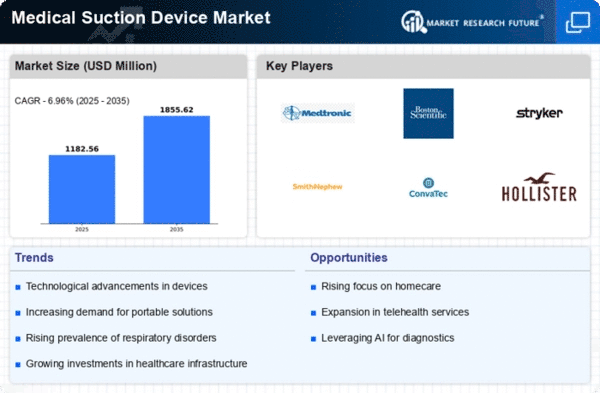
Medical Suction Device Market Infographic
Purchase Options

Market Share

Medical Suction Device Market Share Analysis

In the dynamic landscape of the Medical Suction Devices Market, companies employ various market share positioning strategies to gain a competitive edge. These strategies revolve around understanding customer needs, technological advancements, and market trends. One common approach is differentiation, where companies strive to make their products stand out in terms of features, performance, or quality. By offering unique functionalities such as noise reduction, portability, or advanced filtration systems, companies can carve a niche for themselves and attract a specific segment of customers.

Moreover, pricing strategies play a crucial role in market share positioning. Some companies opt for a penetration pricing strategy, offering their products at lower prices to gain a significant share of the market quickly. This approach can be particularly effective in price-sensitive markets or when targeting cost-conscious customers. Conversely, premium pricing strategies position products as high-quality, premium offerings, appealing to customers who prioritize performance and reliability over price.

Distribution channels also play a vital role in market share positioning. Companies may choose to establish exclusive partnerships with distributors or enter into agreements with healthcare facilities to ensure widespread availability and visibility of their products. By strategically selecting distribution channels, companies can enhance their market reach and accessibility to customers.

Furthermore, branding and marketing efforts are essential components of market share positioning strategies. Effective branding helps companies create a distinct identity and build customer trust and loyalty. Through targeted marketing campaigns, companies can highlight the unique features and benefits of their products, effectively communicating their value proposition to customers. Utilizing digital marketing channels, such as social media platforms and online advertising, allows companies to reach a broader audience and engage with potential customers effectively.

Innovation plays a pivotal role in maintaining market share in the Medical Suction Devices Market. Companies invest heavily in research and development to introduce innovative products that address evolving customer needs and industry trends. Whether it's developing compact and portable suction devices for ambulatory care settings or incorporating advanced technologies for improved performance and efficiency, innovation enables companies to stay ahead of the competition and capture market share.

Moreover, strategic partnerships and collaborations can bolster market share positioning efforts. By forming alliances with other healthcare companies, manufacturers can leverage complementary strengths and resources to expand their market presence. Collaborating with hospitals, medical institutions, and healthcare professionals can provide valuable insights into customer preferences and emerging trends, informing product development and marketing strategies.

Lastly, customer service and after-sales support are critical factors in maintaining market share. Companies that prioritize excellent customer service and offer comprehensive support solutions differentiate themselves from competitors and build long-term relationships with customers. Timely maintenance, technical assistance, and training programs ensure that customers derive maximum value from their investments, fostering loyalty and repeat business.


Author
Author Profile
Vikita Thakur
Senior Research Analyst

She holds an experience of about 5+ years in market research and business consulting projects for sectors such as life sciences, medical devices, and healthcare IT. She possesses a robust background in data analysis, market estimation, competitive intelligence, pipeline analysis market trend identification, and consumer behavior insights. Her expertise lies in technical Sales support, client interaction and project management, designing and implementing market research studies, conducting competitive analysis, and synthesizing complex data into actionable recommendations that drive business growth.

Leave a Comment

FAQs

What is the current market valuation of the Medical Suction Device Market?

As of 2024, the market valuation of themarket was 1105.61 USD Million.

What is the projected market size for the Medical Suction Device Market by 2035?

<p>The market is projected to reach a valuation of 1855.62 USD Million by 2035.</p>

What is the expected CAGR for the Medical Suction Device Market during the forecast period 2025 - 2035?

The expected CAGR for the market during the forecast period 2025 - 2035 is 6.96%.

Which application segment is anticipated to generate the highest revenue in the Medical Suction Device Market?

<p>The Surgical application segment is anticipated to generate revenue between 300.0 and 500.0 USD Million.</p>

What are the key end-use segments in the Medical Suction Device Market?

<p>Key end-use segments include Hospitals, Ambulatory Surgical Centers, and Home Healthcare, with valuations ranging from 150.0 to 650.0 USD Million.</p>

Which product type is expected to dominate the Medical Suction Device Market?

<p>Electric Suction Devices are expected to dominate the market, with a projected valuation between 400.0 and 650.0 USD Million.</p>

What are the leading technologies utilized in the Medical Suction Device Market?

<p>Leading technologies include Vacuum and Electromechanical systems, with market valuations ranging from 300.0 to 650.0 USD Million.</p>

How does the market for Pediatric suction devices compare to Adult devices?

<p>The Pediatric suction device market is projected to generate between 276.84 and 450.0 USD Million, compared to the Adult segment, which is expected to reach 663.36 to 1100.0 USD Million.</p>

Who are the key players in the Medical Suction Device Market?

<p>Key players include Medtronic, Boston Scientific, Smiths Medical, and Stryker, among others.</p>

What is the expected growth trend for the Medical Suction Device Market in the coming years?

<p>The market is likely to experience steady growth, driven by advancements in technology and increasing demand across various applications.</p>

Market Summary

As per MRFR analysis, the Medical Suction Device Market Size was estimated at 1105.61 USD Million in 2024. The Medical Suction Device industry is projected to grow from 1158.91 USD Million in 2025 to 1855.62 USD Million by 2035, exhibiting a compound annual growth rate (CAGR) of 6.96% during the forecast period 2025 - 2035. North America led the market with over 49.75% share, generating around USD 550 billion in revenue.
 
The Medical Suction Devices Market is primarily driven by the increasing number of surgical procedures and rising demand for efficient airway and fluid management systems, supported by advancements in healthcare infrastructure and growing focus on infection control and patient safety globally.
 
According to the World Health Organization (WHO), over 234 million major surgical procedures are performed annually worldwide, significantly increasing demand for suction devices. This growing surgical volume is driving adoption of advanced medical suction technologies to ensure effective fluid management and improved patient outcomes.

Key Market Trends & Highlights

The Medical Suction Device Market is experiencing robust growth driven by technological advancements and increasing demand for home healthcare solutions.

  • Hospitals account for 62% share, reflecting strong demand in advanced clinical settings. North America holds 49.75% share, while Europe accounts for 27.13% share with significant regional market value. Portable devices dominate with 60% share, driven by mobility and increasing home healthcare adoption. Surgical applications lead with 58% share, supported by over 234 million global surgeries annually.

Market Size & Forecast

2024 Market Size 1105.61 (USD Million)
2035 Market Size 1855.62 (USD Million)
CAGR (2025 - 2035) 6.96%
Largest Regional Market Share in 2024 North America

Major Players

Companies such as Medtronic (US), Boston Scientific (US), Stryker (US), Smith &amp; Nephew (GB), ConvaTec (GB), Hollister (US), B. Braun (DE), <a href="https://www.olympus.co.uk/medical/en/Products-and-solutions/Products/Product/KV-6.html">Olympus</a> (JP), Fresenius Kabi (DE) are some of the major participants in the global market.

Market Trends

The Medical Suction Device Market is currently experiencing notable growth, driven by advancements in technology and increasing demand for effective healthcare solutions. The rise in surgical procedures and the need for efficient fluid management in various medical settings contribute to the market's expansion. Additionally, the growing awareness of hygiene and infection control measures further propels the adoption of these devices. As healthcare facilities strive to enhance patient outcomes, the integration of innovative suction devices becomes increasingly essential.

Moreover, the Medical Suction Device Market is witnessing a shift towards portable and user-friendly devices, catering to both hospital and home care environments. This trend reflects a broader movement towards patient-centered care, where convenience and accessibility are prioritized. Manufacturers are focusing on developing devices that are not only efficient but also easy to operate, ensuring that healthcare professionals can deliver timely interventions. The ongoing evolution of this market suggests a promising future, with continuous improvements in design and functionality likely to meet the diverse needs of healthcare providers and patients alike.

Technological Advancements

The Medical Suction Device Market is seeing rapid technological innovations that enhance device performance and usability. New features such as smart sensors and automated controls are being integrated, allowing for more precise suction management. These advancements not only improve patient safety but also streamline workflows in medical settings.

The Institute for Health Metrics and Evaluation (IHME) highlights increasing global surgical and emergency care demand, contributing to healthcare system expansion. Technological innovations such as automated suction systems and smart monitoring are improving procedural efficiency, supporting broader adoption of advanced suction devices in modern healthcare settings.

Rising Demand for Home Healthcare

There is a growing trend towards home healthcare solutions, which is influencing the Medical Suction Device Market. As more patients receive care at home, the need for portable and easy-to-use suction devices increases. This shift reflects a broader change in healthcare delivery, emphasizing convenience and patient autonomy.

The United Nations Population Fund (UNFPA) reports a rapidly aging global population, with individuals aged 65+ expected to double by 2050. This demographic shift is increasing demand for home-based medical care, driving adoption of portable suction devices for respiratory and chronic condition management.

Focus on Infection Control

Infection prevention remains a critical concern in healthcare, driving the Medical Suction Device Market towards products that enhance hygiene. Manufacturers are developing devices with features that minimize contamination risks, such as disposable components and easy-to-clean designs. This focus on infection control aligns with global health initiatives aimed at improving patient safety.

According to the Centers for Disease Control and Prevention (CDC), healthcare-associated infections affect approximately 1 in 31 hospital patients daily in the U.S. This highlights the need for hygienic medical equipment, driving demand for advanced suction devices with disposable components and enhanced infection control features.

Medical Suction Device Market Market Drivers

Rising Demand for Surgical Procedures

The Global Medical Suction Devices Market Industry experiences a notable increase in demand due to the rising number of surgical procedures performed worldwide. As healthcare systems evolve, the need for efficient suction devices becomes paramount in ensuring patient safety and optimal surgical outcomes. For instance, the market is projected to reach 1.11 USD Billion in 2024, driven by advancements in surgical techniques and an increase in minimally invasive surgeries. This trend suggests that healthcare providers are increasingly prioritizing the integration of reliable suction devices to enhance procedural efficacy, thereby contributing to the overall growth of the market.

Market Segment Insights

By Application: Surgical (Largest) vs. Home Care (Fastest-Growing)

The medical suction device market exhibits a diverse application segmentation, with surgical applications holding the largest share of 58%. Surgical devices are integral to various procedures, ensuring effective removal of fluids and maintaining a clear surgical field. Emergency and dental applications also contribute significantly, while home care is emerging as a noteworthy segment. The increasing demand for effective suction in both professional and home settings demonstrates the breadth of market applicability. Growth trends in the medical suction device segment are primarily driven by advancements in technology and an increasing focus on patient safety. The demand for portable and easy-to-use suction devices in home care settings is accelerating, reflecting changing lifestyles and an aging population. Consequently, emergency and transport applications are not far behind, with innovations aimed at enhancing the efficiency of suction during critical moments in healthcare delivery.

Surgical (Dominant) vs. Home Care (Emerging)

The Surgical segment of the medical suction device market remains dominant due to its critical role in various surgical procedures, facilitating the removal of fluids and debris for optimal visibility and safety. Surgical suction devices are designed to handle a higher volume and pressure, ensuring they meet the rigorous demands of operating rooms. Conversely, the Home Care segment is emerging rapidly, propelled by the growing trend of at-home healthcare. These devices are typically smaller, user-friendly, and adaptable for various conditions, thus appealing to patients and caregivers alike. The evolving healthcare landscape emphasizes the need for effective management of health issues in a home setting, presenting significant growth opportunities for home care suction devices.

By End Use: Hospitals (Largest) vs. Home Healthcare (Fastest-Growing)

<section class="text-token-text-primary w-full focus:outline-none [--shadow-height:45px] has-data-writing-block:pointer-events-none has-data-writing-block:-mt-(--shadow-height) has-data-writing-block:pt-(--shadow-height) [&amp;:has([data-writing-block])&gt;*]:pointer-events-auto scroll-mt-[calc(var(--header-height)+min(200px,max(70px,20svh)))]" dir="auto" data-turn-id="request-69c0e758-2a80-8324-af4b-127c94933aa1-0" data-testid="conversation-turn-50" data-scroll-anchor="true" data-turn="assistant">In the Medical Suction Device Market, hospitals remain the largest end-user segment, commanding a significant share of the overall market at 62%. They rely heavily on advanced suction devices for various procedures, including surgeries and emergency care. Following hospitals are clinics, ambulatory surgical centers, home healthcare, and long-term care facilities, with each segment contributing to the diverse applications of medical suction devices across healthcare settings. Despite their smaller shares, these segments are essential for the holistic operation of healthcare services. <br> </section>

Hospitals (Dominant) vs. Home Healthcare (Emerging)

Hospitals, as the dominant segment, leverage state-of-the-art medical suction devices for a vast array of surgical and emergency procedures, emphasizing the necessity of reliability and efficiency in critical contexts. The demand in hospitals is driven by the requirement for high-performance suction systems during complex surgeries and intensive care operations. On the other hand, home healthcare is an emerging segment that is witnessing rapid growth, primarily due to an increasing preference for at-home patient management. This segment focuses on compact and user-friendly suction devices designed for personal use, catering to patients requiring continuous care in the comfort of their homes. The trend toward outpatient care and the advancement of telehealth services are further propelling this segment's growth.

By Product Type: Portable Suction Devices (Largest) vs. Electric Suction Devices (Fastest-Growing)

In the Medical Suction Device Market, Portable Suction Devices hold the largest market share of 60%, driven by their versatility and ease of use in various healthcare settings. Wall-mounted and Electric Suction Devices follow closely, appealing to more permanent installations, while Manual Suction Devices serve niche markets where electric power may be insufficient or impractical. While all types of devices are essential, the clear dominance of portable devices showcases the healthcare industry's need for mobility and adaptability. Looking ahead, Electric Suction Devices are emerging as the fastest-growing segment within this space, propelled by advancements in technology and increasing demand for efficient and reliable suction solutions. Factors driving this growth include greater emphasis on patient-centric care, which necessitates more sophisticated devices, and the integration of smart technology aimed at enhancing operational efficiency. As providers seek innovative solutions, Electric Suction Devices are likely to see significant adoption in both hospitals and home care environments.

Portable Suction Devices (Dominant) vs. Manual Suction Devices (Emerging)

Portable Suction Devices have established their position as the dominant force in the Medical Suction Device Market, offering unmatched flexibility for use in diverse clinical settings, including emergencies, home care, and outpatient facilities. Their compact design allows for easy transportation and operation, making them indispensable for healthcare providers that prioritize immediate and effective patient care. In contrast, Manual Suction Devices have emerged as a viable alternative in areas where electricity is limited or when a lightweight, cost-effective solution is needed. While they lack the advanced features of their electric counterparts, Manual Devices play an important role in resource-constrained environments. This growing recognition of their utility indicates a shift toward a more inclusive approach in medical device provision.

By Technology: Electromechanical (Largest) vs. Battery-Operated (Fastest-Growing)

In the Medical Suction Device Market, the electromechanical segment holds the largest market share of 64%, attributed to its widespread adoption in hospitals and surgical centers due to reliability and efficiency. Vacuum and handheld devices also contribute significantly, but electromechanical systems lead in overall usage. The battery-operated segment, while smaller, is rapidly expanding as portable solutions become favorable in ambulatory and home care settings, driven by the increasing need for accessible medical equipment.

Technology: Electromechanical (Dominant) vs. Battery-Operated (Emerging)

Electromechanical suction devices dominate the Medical Suction Device Market, primarily due to their high performance and consistent reliability in clinical environments. They feature robust designs suited for continuous operation, catering to diverse medical procedures such as surgeries and emergency care. Conversely, battery-operated devices are emerging as vital alternatives, particularly for their portability and ease of use in non-hospital settings. With advancements in battery technology and a growing demand for home healthcare solutions, this segment is experiencing rapid growth, appealing especially to patients requiring at-home suction therapy.

By Patient Type: Adult (Largest) vs. Pediatric (Fastest-Growing)

The Medical Suction Device Market exhibits varied share distribution across patient types, with Adults holding the largest share of 67%. This segment dominates due to the higher prevalence of respiratory issues and surgeries in adults that necessitate the use of suction devices. Meanwhile, the Pediatric segment is gaining traction as awareness of the need for specialized suction solutions for children increases, contributing to its rapid growth in the market.

Adult (Dominant) vs. Pediatric (Emerging)

The Adult segment, being the dominant player in the Medical Suction Device Market, attributes its strong presence to existing healthcare protocols and a significant patient population requiring suction assistance. This segment includes devices that cater to various adult conditions, predominantly respiratory ailments. In contrast, the Pediatric market is emerging as a critical segment, where manufacturers are actively developing smaller, more adaptable devices specifically designed for the delicate needs of infants and young children. The growth in this area is driven by an increase in pediatric surgeries and the rising focus on child health, underscoring the demand for efficient and safe suction devices tailored to younger patients.

Get more detailed insights about Medical Suction Device Market Research Report- Forecast Till 2035

Regional Insights

North America : Market Leader in Innovation

North America leads in Medical Suction Devices Market Size, accounting for over 49.75% of the global revenue in 2024. The region's growth is driven by increasing healthcare expenditures, technological advancements, and a rising prevalence of chronic diseases. Regulatory support from agencies like the FDA further catalyzes innovation and market expansion, ensuring compliance and safety in medical devices. The competitive landscape is robust, with key players such as Medtronic, Boston Scientific, and Stryker leading the charge. The U.S. remains the largest market, supported by a well-established healthcare infrastructure and high demand for advanced medical technologies. The presence of major manufacturers and ongoing R&D investments are expected to sustain growth in this region.

Europe : Emerging Market with Growth Potential

Europe Medical Suction Devices Market size was valued at USD 300 billion in 2024, making it the second-largest regional market with 27.13% share, reflecting a growing demand driven by an aging population and increasing surgical procedures. Regulatory frameworks, such as the Medical Device Regulation (MDR), are enhancing product safety and efficacy, thereby boosting consumer confidence and market growth. The region is also witnessing a shift towards minimally invasive surgeries, further propelling the demand for suction devices. Leading countries like Germany, the UK, and France are at the forefront of this market, with a strong presence of key players such as B. Braun and Fresenius Kabi. The competitive landscape is characterized by innovation and strategic partnerships, enabling companies to enhance their product offerings. The European market is expected to grow steadily as healthcare providers increasingly adopt advanced medical technologies.

Asia-Pacific : Rapidly Growing Healthcare Sector

The Asia-Pacific region, with a market size of 200.0 million, is rapidly emerging as a significant player in the medical suction device market. Factors such as increasing healthcare investments, a growing population, and rising awareness of advanced medical technologies are driving this growth. Additionally, government initiatives aimed at improving healthcare infrastructure are expected to further boost market demand in the coming years. Countries like Japan, China, and India are leading the charge, with a mix of local and international players competing for market share. Companies such as Olympus and ConvaTec are expanding their presence in this region, focusing on innovation and affordability. The competitive landscape is evolving, with a strong emphasis on meeting the unique needs of diverse patient populations across Asia-Pacific.

Middle East and Africa : Untapped Market with Opportunities

The Middle East and Africa (MEA) region, valued at 55.61 million, presents a unique opportunity in the medical suction device market. The growth is driven by increasing healthcare investments, a rising prevalence of chronic diseases, and a growing demand for advanced medical technologies. Regulatory bodies are beginning to establish frameworks that support the safe introduction of medical devices, which is crucial for market expansion. Countries like South Africa and the UAE are leading the market, with a growing number of healthcare facilities and increasing patient populations. The competitive landscape is characterized by a mix of local and international players, with companies like Hollister and Stryker looking to expand their footprint. As healthcare systems evolve, the MEA region is expected to see significant growth in the medical suction device market.

Key Players and Competitive Insights

The Medical Suction Device Market is characterized by a competitive landscape that is increasingly shaped by innovation, strategic partnerships, and regional expansions. Key players such as Medtronic (US), Boston Scientific (US), and Stryker (US) are at the forefront, leveraging their extensive research and development capabilities to enhance product offerings. Medtronic (US) focuses on integrating advanced technologies into its suction devices, aiming to improve patient outcomes and operational efficiency. Meanwhile, Boston Scientific (US) emphasizes strategic acquisitions to bolster its product portfolio, thereby enhancing its market presence. Stryker (US) adopts a dual approach of innovation and geographic expansion, targeting emerging markets to capture new growth opportunities.
 
Collectively, these strategies contribute to a dynamic competitive environment, where companies are not only vying for market share but also striving to set new industry standards.In terms of business tactics, companies are increasingly localizing manufacturing to reduce costs and improve supply chain efficiency. This trend is particularly evident in the context of a moderately fragmented market structure, where the influence of key players is significant but not overwhelming. The collective actions of these companies indicate a shift towards optimizing operations while maintaining a focus on quality and compliance with regulatory standards.
 
In November Medtronic (US) announced the launch of a new line of portable suction devices designed for home healthcare settings. This strategic move is pivotal as it aligns with the growing trend of patient-centered care, allowing for greater flexibility and accessibility in treatment options. The introduction of these devices is expected to enhance Medtronic's competitive edge by catering to the increasing demand for home-based medical solutions.
 
In October Boston Scientific (US) completed the acquisition of a leading suction device manufacturer, which is anticipated to significantly expand its market share and product capabilities. This acquisition not only strengthens Boston Scientific's position in the market but also allows for the integration of innovative technologies that could lead to enhanced product performance. The strategic importance of this move lies in its potential to accelerate growth and improve competitive positioning in a rapidly evolving market.
In September Stryker (US) entered into a strategic partnership with a technology firm to develop AI-driven suction devices. This collaboration aims to leverage artificial intelligence to optimize suction performance and improve patient safety. The significance of this partnership is underscored by the increasing demand for smart medical devices, which are expected to play a crucial role in future healthcare delivery.
 
As of December the Medical Suction Device Market is witnessing trends that emphasize digitalization, sustainability, and the integration of advanced technologies such as AI. Strategic alliances are becoming increasingly important, as companies seek to enhance their capabilities and market reach. The competitive differentiation is likely to evolve from traditional price-based competition to a focus on innovation, technological advancements, and supply chain reliability. This shift indicates a future where companies that prioritize these elements will be better positioned to thrive in an increasingly complex market.

Key Companies in the Medical Suction Device Market include

Industry Developments

Recent developments in the  Medical Suction Devices Market highlight a shift towards innovative technology and strategic collaborations among major companies such as Smiths Medical, Medtronic, and BD. There is an increasing emphasis on the development of electrically powered suction devices that enhance operational efficiency and patient safety. Additionally, Merger and acquisition activity has been notable, particularly with firms like Atrium Medical and Conmed expanding their portfolios, while Vyaire Medical has made strategic moves to strengthen its market position following their recent acquisition of technology innovations that complement their existing suction offerings.

Notably, companies are focusing on increasing market share through  expansions and partnerships, especially in emerging markets, which is expected to enhance growth prospects within the sector. The investment in technological advancements and rising demand for advanced medical care continue to fuel the valuation increases of key players, resulting in a competitive landscape shaped by innovation and strategic realignment. The overall trajectory indicates a robust growth phase for the market, driven by advancements in medical technology and shifts in healthcare delivery models.

Future Outlook

Medical Suction Device Market Future Outlook

The Medical Suction Device Market size is projected to reach USD 1855.62 Billion by 2035, growing at a CAGR of 6.96%, driven by technological advancements, increasing healthcare demands, and rising awareness of hygiene standards.

New opportunities lie in:

  • <p>Development of portable suction devices for home healthcare settings. Integration of IoT technology for real-time monitoring and maintenance. Expansion into emerging markets with tailored product offerings.</p>

By 2035, the Medical Suction Device Market is expected to achieve substantial growth and innovation.

Market Segmentation

Medical Suction Device Market End Use Outlook

  • Hospitals
  • Clinics
  • Ambulatory Surgical Centers
  • Home Healthcare
  • Long-term Care Facilities

Medical Suction Device Market Technology Outlook

  • Electromechanical
  • Vacuum
  • Pneumatic
  • Battery-operated

Medical Suction Device Market Application Outlook

  • Surgical
  • Emergency
  • Home Care
  • Transport
  • Dental

Medical Suction Device Market Product Type Outlook

  • Portable Suction Devices
  • Wall-mounted Suction Devices
  • Electric Suction Devices
  • Manual Suction Devices

Report Scope

MARKET SIZE 2024 1105.61(USD Million)
MARKET SIZE 2025 1158.91(USD Million)
MARKET SIZE 2035 1855.62(USD Million)
COMPOUND ANNUAL GROWTH RATE (CAGR) 6.96% (2025 - 2035)
REPORT COVERAGE Revenue Forecast, Competitive Landscape, Growth Factors, and Trends
BASE YEAR 2024
Market Forecast Period 2025 - 2035
Historical Data 2019 - 2024
Market Forecast Units USD Million
Key Companies Profiled Medtronic (US), Boston Scientific (US), Stryker (US), Smith & Nephew (GB), ConvaTec (GB), Hollister (US), B. Braun (DE), Olympus (JP), Fresenius Kabi (DE)
Segments Covered Application, End Use, Product Type, Technology
Key Market Opportunities Integration of advanced technologies enhances efficiency in the Medical Suction Device Market.
Key Market Dynamics Technological advancements and regulatory changes drive innovation and competition in the market.
Countries Covered North America, Europe, APAC, South America, MEA

FAQs

What is the current market valuation of the Medical Suction Device Market?

As of 2024, the market valuation of themarket was 1105.61 USD Million.

What is the projected market size for the Medical Suction Device Market by 2035?

<p>The market is projected to reach a valuation of 1855.62 USD Million by 2035.</p>

What is the expected CAGR for the Medical Suction Device Market during the forecast period 2025 - 2035?

The expected CAGR for the market during the forecast period 2025 - 2035 is 6.96%.

Which application segment is anticipated to generate the highest revenue in the Medical Suction Device Market?

<p>The Surgical application segment is anticipated to generate revenue between 300.0 and 500.0 USD Million.</p>

What are the key end-use segments in the Medical Suction Device Market?

<p>Key end-use segments include Hospitals, Ambulatory Surgical Centers, and Home Healthcare, with valuations ranging from 150.0 to 650.0 USD Million.</p>

Which product type is expected to dominate the Medical Suction Device Market?

<p>Electric Suction Devices are expected to dominate the market, with a projected valuation between 400.0 and 650.0 USD Million.</p>

What are the leading technologies utilized in the Medical Suction Device Market?

<p>Leading technologies include Vacuum and Electromechanical systems, with market valuations ranging from 300.0 to 650.0 USD Million.</p>

How does the market for Pediatric suction devices compare to Adult devices?

<p>The Pediatric suction device market is projected to generate between 276.84 and 450.0 USD Million, compared to the Adult segment, which is expected to reach 663.36 to 1100.0 USD Million.</p>

Who are the key players in the Medical Suction Device Market?

<p>Key players include Medtronic, Boston Scientific, Smiths Medical, and Stryker, among others.</p>

What is the expected growth trend for the Medical Suction Device Market in the coming years?

<p>The market is likely to experience steady growth, driven by advancements in technology and increasing demand across various applications.</p>

  1. SECTION I: EXECUTIVE SUMMARY AND KEY HIGHLIGHTS |
    1. EXECUTIVE SUMMARY | |
      1. Market Overview | |
      2. Key Findings | |
      3. Market Segmentation | |
      4. Competitive Landscape | |
      5. Challenges and Opportunities | |
      6. Future Outlook 2
  2. SECTION II: SCOPING, METHODOLOGY AND MARKET STRUCTURE |
    1. MARKET INTRODUCTION | |
      1. Definition | |
      2. Scope of the study | | |
    2. RESEARCH METHODOLOGY | |
      1. Overview | |
      2. Data Mining | |
      3. Secondary Research | |
      4. Primary Research | | |
      5. Forecasting Model | |
      6. Market Size Estimation | | |
      7. Data Triangulation | |
      8. Validation 3
  3. SECTION III: QUALITATIVE ANALYSIS |
    1. MARKET DYNAMICS | |
      1. Overview | |
      2. Drivers | |
      3. Restraints | |
      4. Opportunities |
    2. MARKET FACTOR ANALYSIS | |
      1. Value chain Analysis | |
      2. Porter's Five Forces Analysis | | |
      3. COVID-19 Impact Analysis | | |
  4. SECTION IV: QUANTITATIVE ANALYSIS |
    1. Healthcare, BY Application (USD Million) | |
      1. Surgical | |
      2. Emergency | |
      3. Home Care | |
      4. Transport | |
      5. Pediatric |
    2. Healthcare, BY End Use (USD Million) | |
      1. Hospitals | |
      2. Ambulatory Surgical Centers | |
      3. Home Healthcare | |
      4. Emergency Medical Services | |
      5. Dental Clinics |
    3. Healthcare, BY Product Type (USD Million) | |
      1. Portable Suction Devices | |
      2. Wall-Mounted Suction Devices | |
      3. Electric Suction Devices | |
      4. Manual Suction Devices |
    4. Healthcare, BY Technology (USD Million) | |
      1. Electromechanical | |
      2. Vacuum | |
      3. Battery-Operated | |
      4. Handheld |
    5. Healthcare, BY Patient Type (USD Million) | |
      1. Adult | |
      2. Pediatric | |
      3. Neonatal |
    6. Healthcare, BY Region (USD Million) | |
      1. North America | | |
      2. Europe | | |
      3. APAC | | |
      4. South America | | |
      5. MEA | | |
  5. SECTION V: COMPETITIVE ANALYSIS |
    1. Competitive Landscape | |
      1. Overview | |
      2. Competitive Analysis | |
      3. Market share Analysis | |
      4. Major Growth Strategy in the Healthcare | |
      5. Competitive Benchmarking | |
      6. Leading Players in Terms of Number of Developments in the Healthcare | |
      7. Key developments and growth strategies | | |
      8. Major Players Financial Matrix | | |
    2. Company Profiles | |
      1. Medtronic (US) | | |
      2. Boston Scientific (US) | | |
      3. Smiths Medical (US) | | |
      4. ConvaTec (GB) | | |
      5. Stryker (US) | | |
      6. Hollister (US) | | |
      7. Teleflex (US) | | |
      8. B. Braun (DE) | | |
      9. Fresenius Kabi (DE) | | |
      10. MediGus (GB) | | |
    3. Appendix | |
      1. References | |
      2. Related Reports 6 LIST OF FIGURES |
    4. MARKET SYNOPSIS |
    5. NORTH AMERICA MARKET ANALYSIS |
    6. US MARKET ANALYSIS BY APPLICATION |
    7. US MARKET ANALYSIS BY END USE |
    8. US MARKET ANALYSIS BY PRODUCT TYPE |
    9. US MARKET ANALYSIS BY TECHNOLOGY |
    10. US MARKET ANALYSIS BY PATIENT TYPE |
    11. CANADA MARKET ANALYSIS BY APPLICATION |
    12. CANADA MARKET ANALYSIS BY END USE |
    13. CANADA MARKET ANALYSIS BY PRODUCT TYPE |
    14. CANADA MARKET ANALYSIS BY TECHNOLOGY |
    15. CANADA MARKET ANALYSIS BY PATIENT TYPE |
    16. EUROPE MARKET ANALYSIS |
    17. GERMANY MARKET ANALYSIS BY APPLICATION |
    18. GERMANY MARKET ANALYSIS BY END USE |
    19. GERMANY MARKET ANALYSIS BY PRODUCT TYPE |
    20. GERMANY MARKET ANALYSIS BY TECHNOLOGY |
    21. GERMANY MARKET ANALYSIS BY PATIENT TYPE |
    22. UK MARKET ANALYSIS BY APPLICATION |
    23. UK MARKET ANALYSIS BY END USE |
    24. UK MARKET ANALYSIS BY PRODUCT TYPE |
    25. UK MARKET ANALYSIS BY TECHNOLOGY |
    26. UK MARKET ANALYSIS BY PATIENT TYPE |
    27. FRANCE MARKET ANALYSIS BY APPLICATION |
    28. FRANCE MARKET ANALYSIS BY END USE |
    29. FRANCE MARKET ANALYSIS BY PRODUCT TYPE |
    30. FRANCE MARKET ANALYSIS BY TECHNOLOGY |
    31. FRANCE MARKET ANALYSIS BY PATIENT TYPE |
    32. RUSSIA MARKET ANALYSIS BY APPLICATION |
    33. RUSSIA MARKET ANALYSIS BY END USE |
    34. RUSSIA MARKET ANALYSIS BY PRODUCT TYPE |
    35. RUSSIA MARKET ANALYSIS BY TECHNOLOGY |
    36. RUSSIA MARKET ANALYSIS BY PATIENT TYPE |
    37. ITALY MARKET ANALYSIS BY APPLICATION |
    38. ITALY MARKET ANALYSIS BY END USE |
    39. ITALY MARKET ANALYSIS BY PRODUCT TYPE |
    40. ITALY MARKET ANALYSIS BY TECHNOLOGY |
    41. ITALY MARKET ANALYSIS BY PATIENT TYPE |
    42. SPAIN MARKET ANALYSIS BY APPLICATION |
    43. SPAIN MARKET ANALYSIS BY END USE |
    44. SPAIN MARKET ANALYSIS BY PRODUCT TYPE |
    45. SPAIN MARKET ANALYSIS BY TECHNOLOGY |
    46. SPAIN MARKET ANALYSIS BY PATIENT TYPE |
    47. REST OF EUROPE MARKET ANALYSIS BY APPLICATION |
    48. REST OF EUROPE MARKET ANALYSIS BY END USE |
    49. REST OF EUROPE MARKET ANALYSIS BY PRODUCT TYPE |
    50. REST OF EUROPE MARKET ANALYSIS BY TECHNOLOGY |
    51. REST OF EUROPE MARKET ANALYSIS BY PATIENT TYPE |
    52. APAC MARKET ANALYSIS |
    53. CHINA MARKET ANALYSIS BY APPLICATION |
    54. CHINA MARKET ANALYSIS BY END USE |
    55. CHINA MARKET ANALYSIS BY PRODUCT TYPE |
    56. CHINA MARKET ANALYSIS BY TECHNOLOGY |
    57. CHINA MARKET ANALYSIS BY PATIENT TYPE |
    58. INDIA MARKET ANALYSIS BY APPLICATION |
    59. INDIA MARKET ANALYSIS BY END USE |
    60. INDIA MARKET ANALYSIS BY PRODUCT TYPE |
    61. INDIA MARKET ANALYSIS BY TECHNOLOGY |
    62. INDIA MARKET ANALYSIS BY PATIENT TYPE |
    63. JAPAN MARKET ANALYSIS BY APPLICATION |
    64. JAPAN MARKET ANALYSIS BY END USE |
    65. JAPAN MARKET ANALYSIS BY PRODUCT TYPE |
    66. JAPAN MARKET ANALYSIS BY TECHNOLOGY |
    67. JAPAN MARKET ANALYSIS BY PATIENT TYPE |
    68. SOUTH KOREA MARKET ANALYSIS BY APPLICATION |
    69. SOUTH KOREA MARKET ANALYSIS BY END USE |
    70. SOUTH KOREA MARKET ANALYSIS BY PRODUCT TYPE |
    71. SOUTH KOREA MARKET ANALYSIS BY TECHNOLOGY |
    72. SOUTH KOREA MARKET ANALYSIS BY PATIENT TYPE |
    73. MALAYSIA MARKET ANALYSIS BY APPLICATION |
    74. MALAYSIA MARKET ANALYSIS BY END USE |
    75. MALAYSIA MARKET ANALYSIS BY PRODUCT TYPE |
    76. MALAYSIA MARKET ANALYSIS BY TECHNOLOGY |
    77. MALAYSIA MARKET ANALYSIS BY PATIENT TYPE |
    78. THAILAND MARKET ANALYSIS BY APPLICATION |
    79. THAILAND MARKET ANALYSIS BY END USE |
    80. THAILAND MARKET ANALYSIS BY PRODUCT TYPE |
    81. THAILAND MARKET ANALYSIS BY TECHNOLOGY |
    82. THAILAND MARKET ANALYSIS BY PATIENT TYPE |
    83. INDONESIA MARKET ANALYSIS BY APPLICATION |
    84. INDONESIA MARKET ANALYSIS BY END USE |
    85. INDONESIA MARKET ANALYSIS BY PRODUCT TYPE |
    86. INDONESIA MARKET ANALYSIS BY TECHNOLOGY |
    87. INDONESIA MARKET ANALYSIS BY PATIENT TYPE |
    88. REST OF APAC MARKET ANALYSIS BY APPLICATION |
    89. REST OF APAC MARKET ANALYSIS BY END USE |
    90. REST OF APAC MARKET ANALYSIS BY PRODUCT TYPE |
    91. REST OF APAC MARKET ANALYSIS BY TECHNOLOGY |
    92. REST OF APAC MARKET ANALYSIS BY PATIENT TYPE |
    93. SOUTH AMERICA MARKET ANALYSIS |
    94. BRAZIL MARKET ANALYSIS BY APPLICATION |
    95. BRAZIL MARKET ANALYSIS BY END USE |
    96. BRAZIL MARKET ANALYSIS BY PRODUCT TYPE |
    97. BRAZIL MARKET ANALYSIS BY TECHNOLOGY |
    98. BRAZIL MARKET ANALYSIS BY PATIENT TYPE |
    99. MEXICO MARKET ANALYSIS BY APPLICATION |
    100. MEXICO MARKET ANALYSIS BY END USE |
    101. MEXICO MARKET ANALYSIS BY PRODUCT TYPE |
    102. MEXICO MARKET ANALYSIS BY TECHNOLOGY |
    103. MEXICO MARKET ANALYSIS BY PATIENT TYPE |
    104. ARGENTINA MARKET ANALYSIS BY APPLICATION |
    105. ARGENTINA MARKET ANALYSIS BY END USE |
    106. ARGENTINA MARKET ANALYSIS BY PRODUCT TYPE |
    107. ARGENTINA MARKET ANALYSIS BY TECHNOLOGY |
    108. ARGENTINA MARKET ANALYSIS BY PATIENT TYPE |
    109. REST OF SOUTH AMERICA MARKET ANALYSIS BY APPLICATION |
    110. REST OF SOUTH AMERICA MARKET ANALYSIS BY END USE |
    111. REST OF SOUTH AMERICA MARKET ANALYSIS BY PRODUCT TYPE |
    112. REST OF SOUTH AMERICA MARKET ANALYSIS BY TECHNOLOGY |
    113. REST OF SOUTH AMERICA MARKET ANALYSIS BY PATIENT TYPE |
    114. MEA MARKET ANALYSIS |
    115. GCC COUNTRIES MARKET ANALYSIS BY APPLICATION |
    116. GCC COUNTRIES MARKET ANALYSIS BY END USE |
    117. GCC COUNTRIES MARKET ANALYSIS BY PRODUCT TYPE |
    118. GCC COUNTRIES MARKET ANALYSIS BY TECHNOLOGY |
    119. GCC COUNTRIES MARKET ANALYSIS BY PATIENT TYPE |
    120. SOUTH AFRICA MARKET ANALYSIS BY APPLICATION |
    121. SOUTH AFRICA MARKET ANALYSIS BY END USE |
    122. SOUTH AFRICA MARKET ANALYSIS BY PRODUCT TYPE |
    123. SOUTH AFRICA MARKET ANALYSIS BY TECHNOLOGY |
    124. SOUTH AFRICA MARKET ANALYSIS BY PATIENT TYPE |
    125. REST OF MEA MARKET ANALYSIS BY APPLICATION |
    126. REST OF MEA MARKET ANALYSIS BY END USE |
    127. REST OF MEA MARKET ANALYSIS BY PRODUCT TYPE |
    128. REST OF MEA MARKET ANALYSIS BY TECHNOLOGY |
    129. REST OF MEA MARKET ANALYSIS BY PATIENT TYPE |
    130. KEY BUYING CRITERIA OF HEALTHCARE |
    131. RESEARCH PROCESS OF MRFR |
    132. DRO ANALYSIS OF HEALTHCARE |
    133. DRIVERS IMPACT ANALYSIS: HEALTHCARE |
    134. RESTRAINTS IMPACT ANALYSIS: HEALTHCARE |
    135. SUPPLY / VALUE CHAIN: HEALTHCARE |
    136. HEALTHCARE, BY APPLICATION, 2024 (% SHARE) |
    137. HEALTHCARE, BY APPLICATION, 2024 TO 2035 (USD Million) |
    138. HEALTHCARE, BY END USE, 2024 (% SHARE) |
    139. HEALTHCARE, BY END USE, 2024 TO 2035 (USD Million) |
    140. HEALTHCARE, BY PRODUCT TYPE, 2024 (% SHARE) |
    141. HEALTHCARE, BY PRODUCT TYPE, 2024 TO 2035 (USD Million) |
    142. HEALTHCARE, BY TECHNOLOGY, 2024 (% SHARE) |
    143. HEALTHCARE, BY TECHNOLOGY, 2024 TO 2035 (USD Million) |
    144. HEALTHCARE, BY PATIENT TYPE, 2024 (% SHARE) |
    145. HEALTHCARE, BY PATIENT TYPE, 2024 TO 2035 (USD Million) |
    146. BENCHMARKING OF MAJOR COMPETITORS 7 LIST OF TABLES |
    147. LIST OF ASSUMPTIONS | |
      1. |
    148. North America MARKET SIZE ESTIMATES; FORECAST | |
      1. BY APPLICATION, 2025-2035 (USD Million) | |
      2. BY END USE, 2025-2035 (USD Million) | |
      3. BY PRODUCT TYPE, 2025-2035 (USD Million) | |
      4. BY TECHNOLOGY, 2025-2035 (USD Million) | |
      5. BY PATIENT TYPE, 2025-2035 (USD Million) |
    149. US MARKET SIZE ESTIMATES; FORECAST | |
      1. BY APPLICATION, 2025-2035 (USD Million) | |
      2. BY END USE, 2025-2035 (USD Million) | |
      3. BY PRODUCT TYPE, 2025-2035 (USD Million) | |
      4. BY TECHNOLOGY, 2025-2035 (USD Million) | |
      5. BY PATIENT TYPE, 2025-2035 (USD Million) |
    150. Canada MARKET SIZE ESTIMATES; FORECAST | |
      1. BY APPLICATION, 2025-2035 (USD Million) | |
      2. BY END USE, 2025-2035 (USD Million) | |
      3. BY PRODUCT TYPE, 2025-2035 (USD Million) | |
      4. BY TECHNOLOGY, 2025-2035 (USD Million) | |
      5. BY PATIENT TYPE, 2025-2035 (USD Million) |
    151. Europe MARKET SIZE ESTIMATES; FORECAST | |
      1. BY APPLICATION, 2025-2035 (USD Million) | |
      2. BY END USE, 2025-2035 (USD Million) | |
      3. BY PRODUCT TYPE, 2025-2035 (USD Million) | |
      4. BY TECHNOLOGY, 2025-2035 (USD Million) | |
      5. BY PATIENT TYPE, 2025-2035 (USD Million) |
    152. Germany MARKET SIZE ESTIMATES; FORECAST | |
      1. BY APPLICATION, 2025-2035 (USD Million) | |
      2. BY END USE, 2025-2035 (USD Million) | |
      3. BY PRODUCT TYPE, 2025-2035 (USD Million) | |
      4. BY TECHNOLOGY, 2025-2035 (USD Million) | |
      5. BY PATIENT TYPE, 2025-2035 (USD Million) |
    153. UK MARKET SIZE ESTIMATES; FORECAST | |
      1. BY APPLICATION, 2025-2035 (USD Million) | |
      2. BY END USE, 2025-2035 (USD Million) | |
      3. BY PRODUCT TYPE, 2025-2035 (USD Million) | |
      4. BY TECHNOLOGY, 2025-2035 (USD Million) | |
      5. BY PATIENT TYPE, 2025-2035 (USD Million) |
    154. France MARKET SIZE ESTIMATES; FORECAST | |
      1. BY APPLICATION, 2025-2035 (USD Million) | |
      2. BY END USE, 2025-2035 (USD Million) | |
      3. BY PRODUCT TYPE, 2025-2035 (USD Million) | |
      4. BY TECHNOLOGY, 2025-2035 (USD Million) | |
      5. BY PATIENT TYPE, 2025-2035 (USD Million) |
    155. Russia MARKET SIZE ESTIMATES; FORECAST | |
      1. BY APPLICATION, 2025-2035 (USD Million) | |
      2. BY END USE, 2025-2035 (USD Million) | |
      3. BY PRODUCT TYPE, 2025-2035 (USD Million) | |
      4. BY TECHNOLOGY, 2025-2035 (USD Million) | |
      5. BY PATIENT TYPE, 2025-2035 (USD Million) |
    156. Italy MARKET SIZE ESTIMATES; FORECAST | |
      1. BY APPLICATION, 2025-2035 (USD Million) | |
      2. BY END USE, 2025-2035 (USD Million) | |
      3. BY PRODUCT TYPE, 2025-2035 (USD Million) | |
      4. BY TECHNOLOGY, 2025-2035 (USD Million) | |
      5. BY PATIENT TYPE, 2025-2035 (USD Million) |
    157. Spain MARKET SIZE ESTIMATES; FORECAST | |
      1. BY APPLICATION, 2025-2035 (USD Million) | |
      2. BY END USE, 2025-2035 (USD Million) | |
      3. BY PRODUCT TYPE, 2025-2035 (USD Million) | |
      4. BY TECHNOLOGY, 2025-2035 (USD Million) | |
      5. BY PATIENT TYPE, 2025-2035 (USD Million) |
    158. Rest of Europe MARKET SIZE ESTIMATES; FORECAST | |
      1. BY APPLICATION, 2025-2035 (USD Million) | |
      2. BY END USE, 2025-2035 (USD Million) | |
      3. BY PRODUCT TYPE, 2025-2035 (USD Million) | |
      4. BY TECHNOLOGY, 2025-2035 (USD Million) | |
      5. BY PATIENT TYPE, 2025-2035 (USD Million) |
    159. APAC MARKET SIZE ESTIMATES; FORECAST | |
      1. BY APPLICATION, 2025-2035 (USD Million) | |
      2. BY END USE, 2025-2035 (USD Million) | |
      3. BY PRODUCT TYPE, 2025-2035 (USD Million) | |
      4. BY TECHNOLOGY, 2025-2035 (USD Million) | |
      5. BY PATIENT TYPE, 2025-2035 (USD Million) |
    160. China MARKET SIZE ESTIMATES; FORECAST | |
      1. BY APPLICATION, 2025-2035 (USD Million) | |
      2. BY END USE, 2025-2035 (USD Million) | |
      3. BY PRODUCT TYPE, 2025-2035 (USD Million) | |
      4. BY TECHNOLOGY, 2025-2035 (USD Million) | |
      5. BY PATIENT TYPE, 2025-2035 (USD Million) |
    161. India MARKET SIZE ESTIMATES; FORECAST | |
      1. BY APPLICATION, 2025-2035 (USD Million) | |
      2. BY END USE, 2025-2035 (USD Million) | |
      3. BY PRODUCT TYPE, 2025-2035 (USD Million) | |
      4. BY TECHNOLOGY, 2025-2035 (USD Million) | |
      5. BY PATIENT TYPE, 2025-2035 (USD Million) |
    162. Japan MARKET SIZE ESTIMATES; FORECAST | |
      1. BY APPLICATION, 2025-2035 (USD Million) | |
      2. BY END USE, 2025-2035 (USD Million) | |
      3. BY PRODUCT TYPE, 2025-2035 (USD Million) | |
      4. BY TECHNOLOGY, 2025-2035 (USD Million) | |
      5. BY PATIENT TYPE, 2025-2035 (USD Million) |
    163. South Korea MARKET SIZE ESTIMATES; FORECAST | |
      1. BY APPLICATION, 2025-2035 (USD Million) | |
      2. BY END USE, 2025-2035 (USD Million) | |
      3. BY PRODUCT TYPE, 2025-2035 (USD Million) | |
      4. BY TECHNOLOGY, 2025-2035 (USD Million) | |
      5. BY PATIENT TYPE, 2025-2035 (USD Million) |
    164. Malaysia MARKET SIZE ESTIMATES; FORECAST | |
      1. BY APPLICATION, 2025-2035 (USD Million) | |
      2. BY END USE, 2025-2035 (USD Million) | |
      3. BY PRODUCT TYPE, 2025-2035 (USD Million) | |
      4. BY TECHNOLOGY, 2025-2035 (USD Million) | |
      5. BY PATIENT TYPE, 2025-2035 (USD Million) |
    165. Thailand MARKET SIZE ESTIMATES; FORECAST | |
      1. BY APPLICATION, 2025-2035 (USD Million) | |
      2. BY END USE, 2025-2035 (USD Million) | |
      3. BY PRODUCT TYPE, 2025-2035 (USD Million) | |
      4. BY TECHNOLOGY, 2025-2035 (USD Million) | |
      5. BY PATIENT TYPE, 2025-2035 (USD Million) |
    166. Indonesia MARKET SIZE ESTIMATES; FORECAST | |
      1. BY APPLICATION, 2025-2035 (USD Million) | |
      2. BY END USE, 2025-2035 (USD Million) | |
      3. BY PRODUCT TYPE, 2025-2035 (USD Million) | |
      4. BY TECHNOLOGY, 2025-2035 (USD Million) | |
      5. BY PATIENT TYPE, 2025-2035 (USD Million) |
    167. Rest of APAC MARKET SIZE ESTIMATES; FORECAST | |
      1. BY APPLICATION, 2025-2035 (USD Million) | |
      2. BY END USE, 2025-2035 (USD Million) | |
      3. BY PRODUCT TYPE, 2025-2035 (USD Million) | |
      4. BY TECHNOLOGY, 2025-2035 (USD Million) | |
      5. BY PATIENT TYPE, 2025-2035 (USD Million) |
    168. South America MARKET SIZE ESTIMATES; FORECAST | |
      1. BY APPLICATION, 2025-2035 (USD Million) | |
      2. BY END USE, 2025-2035 (USD Million) | |
      3. BY PRODUCT TYPE, 2025-2035 (USD Million) | |
      4. BY TECHNOLOGY, 2025-2035 (USD Million) | |
      5. BY PATIENT TYPE, 2025-2035 (USD Million) |
    169. Brazil MARKET SIZE ESTIMATES; FORECAST | |
      1. BY APPLICATION, 2025-2035 (USD Million) | |
      2. BY END USE, 2025-2035 (USD Million) | |
      3. BY PRODUCT TYPE, 2025-2035 (USD Million) | |
      4. BY TECHNOLOGY, 2025-2035 (USD Million) | |
      5. BY PATIENT TYPE, 2025-2035 (USD Million) |
    170. Mexico MARKET SIZE ESTIMATES; FORECAST | |
      1. BY APPLICATION, 2025-2035 (USD Million) | |
      2. BY END USE, 2025-2035 (USD Million) | |
      3. BY PRODUCT TYPE, 2025-2035 (USD Million) | |
      4. BY TECHNOLOGY, 2025-2035 (USD Million) | |
      5. BY PATIENT TYPE, 2025-2035 (USD Million) |
    171. Argentina MARKET SIZE ESTIMATES; FORECAST | |
      1. BY APPLICATION, 2025-2035 (USD Million) | |
      2. BY END USE, 2025-2035 (USD Million) | |
      3. BY PRODUCT TYPE, 2025-2035 (USD Million) | |
      4. BY TECHNOLOGY, 2025-2035 (USD Million) | |
      5. BY PATIENT TYPE, 2025-2035 (USD Million) |
    172. Rest of South America MARKET SIZE ESTIMATES; FORECAST | |
      1. BY APPLICATION, 2025-2035 (USD Million) | |
      2. BY END USE, 2025-2035 (USD Million) | |
      3. BY PRODUCT TYPE, 2025-2035 (USD Million) | |
      4. BY TECHNOLOGY, 2025-2035 (USD Million) | |
      5. BY PATIENT TYPE, 2025-2035 (USD Million) |
    173. MEA MARKET SIZE ESTIMATES; FORECAST | |
      1. BY APPLICATION, 2025-2035 (USD Million) | |
      2. BY END USE, 2025-2035 (USD Million) | |
      3. BY PRODUCT TYPE, 2025-2035 (USD Million) | |
      4. BY TECHNOLOGY, 2025-2035 (USD Million) | |
      5. BY PATIENT TYPE, 2025-2035 (USD Million) |
    174. GCC Countries MARKET SIZE ESTIMATES; FORECAST | |
      1. BY APPLICATION, 2025-2035 (USD Million) | |
      2. BY END USE, 2025-2035 (USD Million) | |
      3. BY PRODUCT TYPE, 2025-2035 (USD Million) | |
      4. BY TECHNOLOGY, 2025-2035 (USD Million) | |
      5. BY PATIENT TYPE, 2025-2035 (USD Million) |
    175. South Africa MARKET SIZE ESTIMATES; FORECAST | |
      1. BY APPLICATION, 2025-2035 (USD Million) | |
      2. BY END USE, 2025-2035 (USD Million) | |
      3. BY PRODUCT TYPE, 2025-2035 (USD Million) | |
      4. BY TECHNOLOGY, 2025-2035 (USD Million) | |
      5. BY PATIENT TYPE, 2025-2035 (USD Million) |
    176. Rest of MEA MARKET SIZE ESTIMATES; FORECAST | |
      1. BY APPLICATION, 2025-2035 (USD Million) | |
      2. BY END USE, 2025-2035 (USD Million) | |
      3. BY PRODUCT TYPE, 2025-2035 (USD Million) | |
      4. BY TECHNOLOGY, 2025-2035 (USD Million) | |
      5. BY PATIENT TYPE, 2025-2035 (USD Million) |
    177. PRODUCT LAUNCH/PRODUCT DEVELOPMENT/APPROVAL | |
      1. |
    178. ACQUISITION/PARTNERSHIP | |

Healthcare Market Segmentation

Healthcare By Application (USD Million, 2025-2035)

  • Surgical
  • Emergency
  • Home Care
  • Transport
  • Pediatric

Healthcare By End Use (USD Million, 2025-2035)

  • Hospitals
  • Ambulatory Surgical Centers
  • Home Healthcare
  • Emergency Medical Services
  • Dental Clinics

Healthcare By Product Type (USD Million, 2025-2035)

  • Portable Suction Devices
  • Wall-Mounted Suction Devices
  • Electric Suction Devices
  • Manual Suction Devices

Healthcare By Technology (USD Million, 2025-2035)

  • Electromechanical
  • Vacuum
  • Battery-Operated
  • Handheld

Healthcare By Patient Type (USD Million, 2025-2035)

  • Adult
  • Pediatric
  • Neonatal
Infographic

Free Sample Request

Kindly complete the form below to receive a free sample of this Report

Get Free Sample

Customer Strories

Compare Licence

×
Features License Type
Single User Multiuser License Enterprise User
Price $4,950 $5,950 $7,250
Maximum User Access Limit 1 User Upto 10 Users Unrestricted Access Throughout the Organization
Free Customization
Direct Access to Analyst
Deliverable Format
Platform Access
Discount on Next Purchase 10% 15% 15%
Printable Versions