Request Free Sample ×

Kindly complete the form below to receive a free sample of this Report

* Please use a valid business email

Leading companies partner with us for data-driven Insights

clients tt-cursor
Hero Background
English
Chinese
French
Japanese
Korean
German
Spanish

Medical Smart Textile Market Analysis

ID: MRFR/MED/0617-CR
106 Pages
Satyendra Maurya
September 2019

Medical Smart Textile Market Research Report Information by Technology (Wearable Technology, Textile Sensors and others), by Application (Bio-Monitoring, Surgery, Therapy and Wellness and others), by End User (Hospitals and Clinics and others) and by Region (Americas, Europe, Asia-Pacific and the Middle East & Africa) - Forecast till 2035

Share:
Download PDF ×

We do not share your information with anyone. However, we may send you emails based on your report interest from time to time. You may contact us at any time to opt-out.

Medical Smart Textile Market Infographic
Purchase Options

Market Analysis

In-depth Analysis of Medical Smart Textile Market Industry Landscape

The medical smart textile industry is growing rapidly due to the popularity of healthcare wearables. Intelligent textiles containing sensors and electrical components can monitor heart rate, body temperature, and physical activity. Demand for patient monitoring and healthcare management is transforming the sector. Patient-centered care is changing healthcare markets. Medical smart textiles allow people to actively control their health since they monitor continuously without invasive treatments. Textile comfort and usability promote patient compliance and participation. Sensor technology development is crucial to the growth of the medical smart textile industry. Textiles with small, flexible sensors are becoming increasingly popular for real-time data collection and comfort. These advances are speeding the development of intelligent clothes that can monitor several physiological variables. As chronic illness rates grow, the industry is introducing intelligent textiles for continuous monitoring and management. Wearable textiles may provide a lot of data concerning diabetes, cardiovascular disease, and respiratory diseases. This allows rapid intervention and customized therapy. The industry is heavily influenced by remote patient monitoring technologies. Medical smart textiles allow doctors to remotely monitor patients, decreasing hospital visits. This improves healthcare efficiency and patient convenience. The combination of medical smart fabrics with telemedicine is new. Wearable textiles that send real-time health data to medical experts are becoming increasingly popular to encourage telemedicine and remote diagnosis. This integration makes healthcare more accessible, particularly in distant or impoverished places. Besides medical uses, the industry is moving into fitness and wellbeing. Smart textiles with fitness tracking aspects may appeal to those interested in proactive health monitoring and customized training. The market's clientele grows due to this diversity. Textile material innovations are changing the textile industry. In addition to conductive and flexible fabrics, washable and long-lasting electronic components have improved medical smart textile efficiency and lifespan. These technological advances enhance smart clothing' usability and increase their popularity. Regulations affect medical smart textiles. Data privacy and medical electronic equipment legislation are examples. Market participants must meet regulatory requirements to guarantee smart textile safety and dependability in healthcare applications. Compliance with legislation affects market dynamics. Traditional textile producers and technological businesses are changing their markets via collaborations. These collaborations use the experience of both sectors to create intelligent fabrics that can be readily incorporated into everyday routines. When numerous parties collaborate, innovation is promoted, time to market is minimized, and medical smart textiles are more competitive. Market dynamics include efforts to increase smart textile medical device availability and cost-effectiveness. Technology and economies of scale have reduced the cost of producing these textiles, making them more affordable for a wider audience. To increase utilization, the product must be inexpensive.


Author
Author Profile
Satyendra Maurya
Research Analyst

An accomplished research analyst with high proficiency in market forecasting, data visualization, competitive benchmarking, and others. He holds a pronounced track record in research and consulting projects for sectors such as life sciences, medical devices, and healthcare IT. His capabilities in qualitative and quantitative analysis have resulted in positive client outcomes. Working on niche market trends, opportunities, sales, and forecasted value is part of his skill set.

Leave a Comment

FAQs

What is the projected market valuation of The Global Medical Smart Textile by 2035?

<p>The projected market valuation is expected to reach 10.58 USD Billion by 2035.</p>

What was the market valuation of The Global Medical Smart Textile in 2024?

<p>The market valuation was 4.536 USD Billion in 2024.</p>

What is the expected CAGR for The Global Medical Smart Textile during the forecast period 2025 - 2035?

<p>The expected CAGR is 8.0% during the forecast period 2025 - 2035.</p>

Which technology segments are included in The Global Medical Smart Textile?

<p>The technology segments include Wearable Technology, Textile Sensors, and Others, with projected values of 3.5 USD Billion, 4.0 USD Billion, and 3.08 USD Billion respectively by 2035.</p>

What applications are driving growth in The Global Medical Smart Textile?

<p>Key applications include Bio-Monitoring, Surgery, and Therapy and Wellness, with projected values of 3.5 USD Billion, 2.8 USD Billion, and 3.2 USD Billion respectively by 2035.</p>

Who are the key players in The Global Medical Smart Textile?

Key players include Medtronic, Johnson &amp; Johnson, 3M, Siemens Healthineers, BASF, Hexcel Corporation, Hanesbrands Inc., Sioen Industries, and Adidas.

What end-user segments are anticipated to contribute to The Global Medical Smart Textile?

End-user segments include Hospitals and Clinics, projected to reach 6.24 USD Billion by 2035, and Others, expected to reach 4.34 USD Billion.

How does the market for Textile Sensors compare to Wearable Technology in terms of projected growth?

Textile Sensors are projected to reach 4.0 USD Billion, surpassing Wearable Technology, which is expected to reach 3.5 USD Billion by 2035.

What is the significance of the Others segment in The Global Medical Smart Textile?

The Others segment is projected to reach 3.08 USD Billion by 2035, indicating a notable contribution to the overall market growth.

How are advancements in technology influencing The Global Medical Smart Textile?

Advancements in technology are likely to enhance product offerings, driving growth across various segments, particularly in Wearable Technology and Textile Sensors.

Market Summary

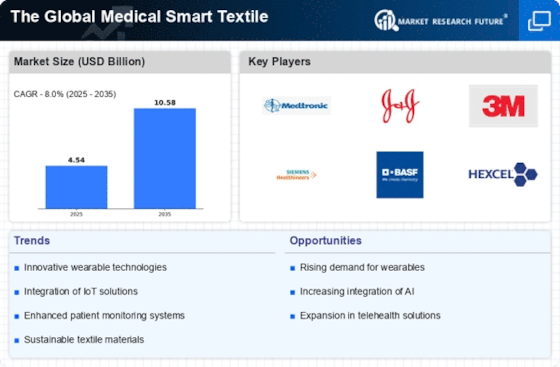
As per Market Research Future analysis, The Global Medical Smart Textile Market was estimated at 4.536 USD Billion in 2024. The market is projected to grow from 4.899 USD Billion in 2025 to 10.58 USD Billion by 2035, exhibiting a compound annual growth rate (CAGR) of 8.0% during the forecast period 2025 - 2035

Key Market Trends & Highlights

The Global Medical Smart Textile Market is poised for substantial growth driven by technological advancements and increasing healthcare demands.

  • The integration of wearable technology is transforming patient monitoring and health management. Personalized healthcare solutions are gaining traction, enhancing patient engagement and outcomes. Sustainability in textile production is becoming a priority, reflecting a shift towards eco-friendly practices. Advancements in sensor technology and rising demand for remote patient monitoring are key drivers propelling market expansion.

Market Size & Forecast

2024 Market Size 4.536 (USD Billion)
2035 Market Size 10.58 (USD Billion)
CAGR (2025 - 2035) 8.0%
Largest Regional Market Share in 2024 North America

Major Players

Medtronic (US), Johnson &amp; Johnson (US), 3M (US), Siemens Healthineers (DE), BASF (DE), Hexcel Corporation (US), Hanesbrands Inc. (US), <a href="https://sioen.com/en">Sioen Industries</a> (BE), Adidas (DE)

Market Trends

The Global Medical Smart Textile Market is currently experiencing a transformative phase, characterized by the integration of advanced technologies into textile materials. These innovations are designed to enhance patient care and monitoring, offering functionalities such as real-time health tracking and improved therapeutic outcomes. The market appears to be driven by a growing demand for personalized healthcare solutions, as well as an increasing emphasis on preventive medicine. As healthcare systems evolve, the role of smart textiles in facilitating remote patient monitoring and enhancing the overall patient experience seems to be gaining traction. Moreover, The Global Medical Smart Textile Market is likely to witness a surge in collaborations between textile manufacturers and healthcare providers. This trend suggests a shift towards more tailored solutions that address specific medical needs. Additionally, the potential for smart textiles to integrate with wearable technology indicates a promising future for this sector. As research and development efforts continue to advance, the market may see the emergence of innovative products that not only improve patient outcomes but also streamline healthcare processes. Overall, the landscape of The Global Medical Smart Textile Market appears to be dynamic, with numerous opportunities for growth and development on the horizon.

Integration of Wearable Technology

The convergence of wearable technology with smart textiles is becoming increasingly prevalent. This trend indicates a movement towards textiles that can seamlessly integrate with devices, allowing for continuous health monitoring and data collection. Such integration may enhance the functionality of medical textiles, making them more appealing to both consumers and healthcare providers.

Focus on Personalized Healthcare Solutions

There is a noticeable shift towards personalized healthcare solutions within The Global Medical Smart Textile Market. This trend suggests that products are being developed to cater to individual patient needs, potentially improving treatment efficacy. Customization in smart textiles may lead to better patient engagement and adherence to medical protocols.

Sustainability in Textile Production

Sustainability is emerging as a critical consideration in the production of medical smart textiles. This trend indicates a growing awareness of environmental impacts, prompting manufacturers to explore eco-friendly materials and processes. The emphasis on sustainability may not only appeal to environmentally conscious consumers but also align with broader healthcare goals of reducing waste and promoting health.

Medical Smart Textile Market Market Drivers

Advancements in Sensor Technology

The integration of advanced sensor technology into textiles is a pivotal driver for the Medical Smart Textile Market. These sensors enable real-time monitoring of vital signs, such as heart rate and temperature, which is crucial for patient care. The market for wearable sensors is projected to reach USD 27 billion by 2026, indicating a robust growth trajectory. This technological evolution not only enhances patient outcomes but also facilitates remote monitoring, thereby reducing the burden on healthcare facilities. As healthcare systems increasingly adopt telemedicine, the demand for smart textiles equipped with sophisticated sensors is likely to surge, further propelling the Medical Smart Textile Market.

Growing Awareness of Health and Wellness

The increasing awareness of health and wellness among consumers is shaping the Medical Smart Textile Market. As individuals become more health-conscious, there is a rising demand for products that promote well-being. Smart textiles that monitor health metrics and provide feedback are gaining traction among consumers. This trend is evident in the growing popularity of fitness trackers and health-monitoring garments. The Global Medical Smart Textile Market is projected to reach USD 4.5 trillion by 2025, indicating a strong consumer shift towards health-oriented products. This heightened awareness is likely to drive the adoption of smart textiles, thereby benefiting the Medical Smart Textile Market.

Rising Demand for Remote Patient Monitoring

The growing emphasis on remote patient monitoring is significantly influencing the Medical Smart Textile Market. With an increasing number of patients requiring continuous health monitoring, smart textiles that can transmit data wirelessly are becoming essential. The market for remote patient monitoring devices is expected to grow at a CAGR of 25% from 2023 to 2030. This trend is driven by the need for efficient healthcare delivery, especially in chronic disease management. Smart textiles that integrate monitoring capabilities can provide healthcare professionals with timely data, thus improving decision-making processes and patient care. Consequently, this demand is likely to bolster the Medical Smart Textile Market.

Increased Investment in Healthcare Technology

Investment in healthcare technology is a crucial driver for the Medical Smart Textile Market. Governments and private entities are channeling substantial funds into innovative healthcare solutions, including smart textiles. For instance, the global healthcare technology investment reached approximately USD 80 billion in 2023, reflecting a growing recognition of the importance of advanced medical solutions. This influx of capital is likely to accelerate research and development in smart textiles, leading to the introduction of novel products that enhance patient care. As a result, the Medical Smart Textile Market is poised for significant growth, driven by these investments.

Regulatory Support for Innovative Healthcare Solutions

Regulatory support for innovative healthcare solutions is a significant driver for the Medical Smart Textile Market. Governments are increasingly recognizing the potential of smart textiles in enhancing patient care and are establishing frameworks to facilitate their development and adoption. For example, regulatory bodies are streamlining approval processes for medical devices, including smart textiles, which can expedite their entry into the market. This supportive environment encourages manufacturers to invest in research and development, leading to the creation of advanced products. As regulatory support continues to grow, it is likely to foster innovation and expansion within the Medical Smart Textile Market.

Market Segment Insights

By Technology: Wearable Technology (Largest) vs. Textile Sensors (Fastest-Growing)

In The Global Medical Smart Textile, Wearable Technology emerges as the largest segment, capturing a significant share of the overall market. This segment encompasses a variety of devices that are integrated into textiles, enabling health monitoring and data collection in real-time. Conversely, Textile Sensors are recognized as the fastest-growing segment, driven by advancements in sensor technology and increasing demand for smart fabrics that can monitor health metrics continuously. As healthcare shifts towards preventative measures, these technologies are gaining traction and expanding their presence in clinical settings. The growth trends within the technology segment reflect broader shifts in consumer behavior and healthcare delivery models. Wearable Technology is increasingly recognized for its ability to provide convenience and immediate access to health data, appealing to both consumers and healthcare providers. Meanwhile, the rapid advancements in Textile Sensors are fueled by innovations in material science and electronics, allowing for more accurate and reliable health data collection. These factors are propelling both segments towards greater adoption and integration in medical applications, making them pivotal components of the evolving healthcare landscape.

Wearable Technology (Dominant) vs. Textile Sensors (Emerging)

Wearable Technology dominates The Global Medical Smart Textile due to its widespread applications in health monitoring and diagnostics. This segment includes devices such as smartwatches and fitness trackers, which are equipped with advanced sensors to track vital signs, movement, and other health-related metrics. Their ease of use and integration with mobile devices make them appealing to a broad audience, from fitness enthusiasts to patients managing chronic conditions. On the other hand, Textile Sensors represent an emerging technology with immense potential. These sensors are woven directly into fabrics, enabling them to collect data continuously without the need for bulky devices. As advancements continue in this area, Textile Sensors are finding innovative applications in both consumer health and clinical monitoring, offering new opportunities for patient care and preventative health management.

By Application: Bio-Monitoring (Largest) vs. Therapy and Wellness (Fastest-Growing)

The Global Medical Smart Textile showcases a diverse application landscape, with Bio-Monitoring emerging as the largest segment. This segment captures a significant share of the market due to its essential role in delivering real-time health data, which has become increasingly vital in managing chronic conditions. Following Bio-Monitoring, segments like Surgery and Therapy and Wellness are gaining traction, which indicates a healthy diversification of applications within the market.

Bio-Monitoring (Dominant) vs. Therapy and Wellness (Emerging)

Bio-Monitoring, as a dominant application in The Global Medical Smart Textile, focuses on leveraging smart textiles to continuously monitor physiological parameters such as heart rate, temperature, and more, ensuring effective patient management. Conversely, the Therapy and Wellness segment represents an emerging market characterized by smart textiles that promote recovery and well-being. Innovations in this area are driven by advances in material technology and an increasing consumer emphasis on preventive healthcare. As such, while Bio-Monitoring remains critical, the Therapy and Wellness segment is quickly gaining attention and relevance as healthcare trends evolve.

By End-User: Hospitals and Clinics (Largest) vs. Others (Fastest-Growing)

In The Global Medical Smart Textile, the distribution of market share among end-user segments prominently features 'Hospitals and Clinics' as the largest sector. This segment enjoys a substantial portion due to the increasing adoption of advanced medical technologies and the rising demand for better patient care solutions. 'Others' represent a smaller yet rapidly growing segment, driven by niche applications in various healthcare settings such as rehabilitation centers, home healthcare, and sports medicine, which are beginning to recognize the benefits of smart textiles.

End-User: Hospitals and Clinics (Dominant) vs. Others (Emerging)

Hospitals and Clinics dominate The Global Medical Smart Textile as they utilize advanced smart textile solutions for patient monitoring, rehabilitation, and personalized treatment. This segment benefits from extensive infrastructure, significant investment in healthcare technology, and an increasing emphasis on quality patient outcomes. Conversely, the 'Others' segment consists of emerging applications that utilize smart textiles in alternative healthcare environments such as outpatient facilities and wellness programs. These applications foster innovation and scalability, driven by rising consumer awareness and demand for wearable healthcare solutions that enhance treatment options and improve patient engagement.

Get more detailed insights about Medical Smart Textile Market Research Report - Forecast till 2035

Regional Insights

North America : Innovation and Market Leadership

North America is the largest market for medical smart textiles, holding approximately 45% of the global share. The region benefits from advanced healthcare infrastructure, significant investments in R&D, and a growing demand for wearable health monitoring devices. Regulatory support from agencies like the FDA further catalyzes innovation, ensuring that new products meet safety and efficacy standards. The increasing prevalence of chronic diseases and the aging population are also driving demand for smart textiles in healthcare applications. The United States leads the North American market, with key players such as Medtronic, Johnson & Johnson, and 3M dominating the landscape. These companies are at the forefront of developing innovative solutions that integrate textiles with technology for enhanced patient care. The competitive environment is characterized by strategic partnerships and collaborations aimed at advancing product offerings. Canada also contributes to the market, focusing on research and development initiatives to enhance healthcare delivery.

Europe : Emerging Regulatory Frameworks

Europe is the second-largest market for medical smart textiles, accounting for approximately 30% of the global market share. The region is witnessing a surge in demand due to increasing healthcare expenditures and a focus on preventive care. Regulatory frameworks, such as the EU Medical Device Regulation, are fostering innovation while ensuring patient safety. The integration of smart textiles in healthcare is being propelled by advancements in technology and a growing emphasis on personalized medicine, which is reshaping treatment paradigms across the continent. Germany, France, and the UK are the leading countries in this market, with significant contributions from companies like Siemens Healthineers and BASF. The competitive landscape is marked by a mix of established players and startups, all striving to innovate and capture market share. Collaborative efforts between academia and industry are also prevalent, enhancing the development of cutting-edge solutions. The European market is poised for growth as it adapts to evolving healthcare needs and technological advancements.

Asia-Pacific : Rapid Growth and Adoption

Asia-Pacific is rapidly emerging as a significant player in the medical smart textile market, holding approximately 20% of the global share. The region's growth is driven by increasing healthcare investments, a rising population, and a growing prevalence of chronic diseases. Countries like China and India are witnessing a surge in demand for innovative healthcare solutions, supported by government initiatives aimed at improving healthcare infrastructure. The region's diverse market dynamics present both opportunities and challenges for stakeholders in the medical textiles sector. China is the largest market in the Asia-Pacific region, followed by India and Japan. The competitive landscape is characterized by a mix of local and international players, with companies like Hanesbrands Inc. and Sioen Industries making significant inroads. The presence of a robust manufacturing base and a focus on R&D are key factors driving innovation in smart textiles. As the region continues to embrace technological advancements, the market is expected to expand further, catering to the evolving needs of healthcare providers and patients alike.

Middle East and Africa : Untapped Potential and Growth

The Middle East and Africa region is gradually emerging in the medical smart textile market, currently holding about 5% of the global share. The growth is primarily driven by increasing healthcare investments and a rising awareness of advanced medical technologies. Governments in countries like the UAE and South Africa are focusing on enhancing healthcare infrastructure, which is expected to boost the adoption of smart textiles in medical applications. The region's unique challenges, including varying levels of healthcare access, present opportunities for innovative solutions tailored to local needs. South Africa and the UAE are leading the market in this region, with a growing number of startups and established companies exploring smart textile applications. The competitive landscape is evolving, with local firms collaborating with international players to enhance product offerings. As healthcare systems in the region continue to develop, the demand for smart textiles is anticipated to grow, driven by the need for improved patient care and monitoring solutions.

Key Players and Competitive Insights

The Global Medical Smart Textile is currently characterized by a dynamic competitive landscape, driven by technological advancements and increasing demand for innovative healthcare solutions. Key players such as Medtronic (US), Johnson & Johnson (US), and Siemens Healthineers (DE) are at the forefront, focusing on strategic initiatives that enhance their market positioning. Medtronic (US) emphasizes innovation in wearable health monitoring devices, while Johnson & Johnson (US) is investing in partnerships to expand its product offerings in smart textiles. Siemens Healthineers (DE) is leveraging digital transformation to integrate smart textiles into its diagnostic equipment, thereby enhancing patient care. Collectively, these strategies contribute to a competitive environment that prioritizes technological innovation and collaborative growth.

In terms of business tactics, companies are increasingly localizing manufacturing to reduce costs and improve supply chain efficiency. The market structure appears moderately fragmented, with several players vying for market share. However, the influence of major companies like 3M (US) and BASF (DE) is notable, as they engage in strategic collaborations and product development initiatives that shape market dynamics. The collective actions of these key players indicate a trend towards consolidation, where partnerships and alliances are becoming essential for maintaining competitive advantage.

In August 2025, Medtronic (US) announced a partnership with a leading technology firm to develop advanced smart textiles for remote patient monitoring. This collaboration is expected to enhance the functionality of wearable devices, allowing for real-time health data collection and analysis. The strategic importance of this partnership lies in its potential to revolutionize patient care by providing healthcare professionals with timely insights into patient health, thereby improving treatment outcomes.

In September 2025, Johnson & Johnson (US) launched a new line of smart bandages that incorporate biosensors to monitor wound healing. This innovative product is designed to provide healthcare providers with critical data on the healing process, which could lead to more effective treatment protocols. The introduction of these smart bandages signifies a shift towards personalized medicine, where treatment is tailored to individual patient needs based on real-time data.

In October 2025, Siemens Healthineers (DE) unveiled a new smart textile technology integrated into its imaging systems, aimed at enhancing patient comfort during diagnostic procedures. This development not only improves the patient experience but also positions Siemens as a leader in the integration of smart textiles within medical devices. The strategic move underscores the importance of patient-centric solutions in the evolving healthcare landscape.

As of October 2025, current competitive trends in The Global Medical Smart Textile are heavily influenced by digitalization, sustainability, and the integration of artificial intelligence. Strategic alliances are increasingly shaping the landscape, as companies recognize the need for collaboration to drive innovation. Looking ahead, competitive differentiation is likely to evolve from traditional price-based competition to a focus on technological advancements, innovative solutions, and reliable supply chains. This shift suggests that companies that prioritize research and development, alongside strategic partnerships, will be better positioned to thrive in this rapidly changing market.

Key Companies in the Medical Smart Textile Market include

Industry Developments

In the month of February 2019, Gentherm signed an agreement of partnership with ThermoAnalytics, Inc., which is a leading thermal software modeling development firm for the advancement of thermal comfort predictions of humans.

In the month of July 2019, Camira Fabric obtained Luna Textiles which is a US-based company that manufactures textiles for healthcare, lounge seating purposes, and hospitality. This merger or acquisition helped to raise the revenue of Camira Fabric.

Future Outlook

Medical Smart Textile Market Future Outlook

The Global Medical Smart Textile Market is projected to grow at an 8.0% CAGR from 2025 to 2035, driven by technological advancements, increasing healthcare demands, and rising awareness of patient monitoring.

New opportunities lie in:

  • Integration of AI-driven analytics for real-time health monitoring
  • Development of customizable smart textiles for personalized patient care
  • Expansion into emerging markets with tailored healthcare solutions

By 2035, the market is expected to be robust, driven by innovation and strategic partnerships.

Market Segmentation

Medical Smart Textile Market End-User Outlook

  • Hospitals and Clinics
  • Others

Medical Smart Textile Market Technology Outlook

  • Wearable Technology
  • Textile Sensors
  • Others

Medical Smart Textile Market Application Outlook

  • Bio-Monitoring
  • Surgery
  • Therapy and Wellness
  • Others

Report Scope

MARKET SIZE 2024 4.536(USD Billion)
MARKET SIZE 2025 4.899(USD Billion)
MARKET SIZE 2035 10.58(USD Billion)
COMPOUND ANNUAL GROWTH RATE (CAGR) 8.0% (2025 - 2035)
REPORT COVERAGE Revenue Forecast, Competitive Landscape, Growth Factors, and Trends
BASE YEAR 2024
Market Forecast Period 2025 - 2035
Historical Data 2019 - 2024
Market Forecast Units USD Billion
Key Companies Profiled Medtronic (US), Johnson & Johnson (US), 3M (US), Siemens Healthineers (DE), BASF (DE), Hexcel Corporation (US), Hanesbrands Inc. (US), Sioen Industries (BE), Adidas (DE)
Segments Covered Technology, Application, End User, Region
Key Market Opportunities Integration of advanced sensors in textiles enhances patient monitoring and personalized healthcare solutions.
Key Market Dynamics Technological advancements drive innovation in medical smart textiles, enhancing patient monitoring and treatment efficacy.
Countries Covered North America, Europe, APAC, South America, MEA

FAQs

What is the projected market valuation of The Global Medical Smart Textile by 2035?

<p>The projected market valuation is expected to reach 10.58 USD Billion by 2035.</p>

What was the market valuation of The Global Medical Smart Textile in 2024?

<p>The market valuation was 4.536 USD Billion in 2024.</p>

What is the expected CAGR for The Global Medical Smart Textile during the forecast period 2025 - 2035?

<p>The expected CAGR is 8.0% during the forecast period 2025 - 2035.</p>

Which technology segments are included in The Global Medical Smart Textile?

<p>The technology segments include Wearable Technology, Textile Sensors, and Others, with projected values of 3.5 USD Billion, 4.0 USD Billion, and 3.08 USD Billion respectively by 2035.</p>

What applications are driving growth in The Global Medical Smart Textile?

<p>Key applications include Bio-Monitoring, Surgery, and Therapy and Wellness, with projected values of 3.5 USD Billion, 2.8 USD Billion, and 3.2 USD Billion respectively by 2035.</p>

Who are the key players in The Global Medical Smart Textile?

Key players include Medtronic, Johnson &amp; Johnson, 3M, Siemens Healthineers, BASF, Hexcel Corporation, Hanesbrands Inc., Sioen Industries, and Adidas.

What end-user segments are anticipated to contribute to The Global Medical Smart Textile?

End-user segments include Hospitals and Clinics, projected to reach 6.24 USD Billion by 2035, and Others, expected to reach 4.34 USD Billion.

How does the market for Textile Sensors compare to Wearable Technology in terms of projected growth?

Textile Sensors are projected to reach 4.0 USD Billion, surpassing Wearable Technology, which is expected to reach 3.5 USD Billion by 2035.

What is the significance of the Others segment in The Global Medical Smart Textile?

The Others segment is projected to reach 3.08 USD Billion by 2035, indicating a notable contribution to the overall market growth.

How are advancements in technology influencing The Global Medical Smart Textile?

Advancements in technology are likely to enhance product offerings, driving growth across various segments, particularly in Wearable Technology and Textile Sensors.

  1. SECTION I: EXECUTIVE SUMMARY AND KEY HIGHLIGHTS
    1. | 1.1 EXECUTIVE SUMMARY
    2. | | 1.1.1 Market Overview
    3. | | 1.1.2 Key Findings
    4. | | 1.1.3 Market Segmentation
    5. | | 1.1.4 Competitive Landscape
    6. | | 1.1.5 Challenges and Opportunities
    7. | | 1.1.6 Future Outlook
  2. SECTION II: SCOPING, METHODOLOGY AND MARKET STRUCTURE
    1. | 2.1 MARKET INTRODUCTION
    2. | | 2.1.1 Definition
    3. | | 2.1.2 Scope of the study
    4. | | | 2.1.2.1 Research Objective
    5. | | | 2.1.2.2 Assumption
    6. | | | 2.1.2.3 Limitations
    7. | 2.2 RESEARCH METHODOLOGY
    8. | | 2.2.1 Overview
    9. | | 2.2.2 Data Mining
    10. | | 2.2.3 Secondary Research
    11. | | 2.2.4 Primary Research
    12. | | | 2.2.4.1 Primary Interviews and Information Gathering Process
    13. | | | 2.2.4.2 Breakdown of Primary Respondents
    14. | | 2.2.5 Forecasting Model
    15. | | 2.2.6 Market Size Estimation
    16. | | | 2.2.6.1 Bottom-Up Approach
    17. | | | 2.2.6.2 Top-Down Approach
    18. | | 2.2.7 Data Triangulation
    19. | | 2.2.8 Validation
  3. SECTION III: QUALITATIVE ANALYSIS
    1. | 3.1 MARKET DYNAMICS
    2. | | 3.1.1 Overview
    3. | | 3.1.2 Drivers
    4. | | 3.1.3 Restraints
    5. | | 3.1.4 Opportunities
    6. | 3.2 MARKET FACTOR ANALYSIS
    7. | | 3.2.1 Value chain Analysis
    8. | | 3.2.2 Porter's Five Forces Analysis
    9. | | | 3.2.2.1 Bargaining Power of Suppliers
    10. | | | 3.2.2.2 Bargaining Power of Buyers
    11. | | | 3.2.2.3 Threat of New Entrants
    12. | | | 3.2.2.4 Threat of Substitutes
    13. | | | 3.2.2.5 Intensity of Rivalry
    14. | | 3.2.3 COVID-19 Impact Analysis
    15. | | | 3.2.3.1 Market Impact Analysis
    16. | | | 3.2.3.2 Regional Impact
    17. | | | 3.2.3.3 Opportunity and Threat Analysis
  4. SECTION IV: QUANTITATIVE ANALYSIS
    1. | 4.1 Healthcare, BY Technology (USD Billion)
    2. | | 4.1.1 Wearable Technology
    3. | | 4.1.2 Textile Sensors
    4. | | 4.1.3 Others
    5. | 4.2 Healthcare, BY Application (USD Billion)
    6. | | 4.2.1 Bio-Monitoring
    7. | | 4.2.2 Surgery
    8. | | 4.2.3 Therapy and Wellness
    9. | | 4.2.4 Others
    10. | 4.3 Healthcare, BY End-User (USD Billion)
    11. | | 4.3.1 Hospitals and Clinics
    12. | | 4.3.2 Others
    13. | 4.4 Healthcare, BY Region (USD Billion)
    14. | | 4.4.1 North America
    15. | | | 4.4.1.1 US
    16. | | | 4.4.1.2 Canada
    17. | | 4.4.2 Europe
    18. | | | 4.4.2.1 Germany
    19. | | | 4.4.2.2 UK
    20. | | | 4.4.2.3 France
    21. | | | 4.4.2.4 Russia
    22. | | | 4.4.2.5 Italy
    23. | | | 4.4.2.6 Spain
    24. | | | 4.4.2.7 Rest of Europe
    25. | | 4.4.3 APAC
    26. | | | 4.4.3.1 China
    27. | | | 4.4.3.2 India
    28. | | | 4.4.3.3 Japan
    29. | | | 4.4.3.4 South Korea
    30. | | | 4.4.3.5 Malaysia
    31. | | | 4.4.3.6 Thailand
    32. | | | 4.4.3.7 Indonesia
    33. | | | 4.4.3.8 Rest of APAC
    34. | | 4.4.4 South America
    35. | | | 4.4.4.1 Brazil
    36. | | | 4.4.4.2 Mexico
    37. | | | 4.4.4.3 Argentina
    38. | | | 4.4.4.4 Rest of South America
    39. | | 4.4.5 MEA
    40. | | | 4.4.5.1 GCC Countries
    41. | | | 4.4.5.2 South Africa
    42. | | | 4.4.5.3 Rest of MEA
  5. SECTION V: COMPETITIVE ANALYSIS
    1. | 5.1 Competitive Landscape
    2. | | 5.1.1 Overview
    3. | | 5.1.2 Competitive Analysis
    4. | | 5.1.3 Market share Analysis
    5. | | 5.1.4 Major Growth Strategy in the Healthcare
    6. | | 5.1.5 Competitive Benchmarking
    7. | | 5.1.6 Leading Players in Terms of Number of Developments in the Healthcare
    8. | | 5.1.7 Key developments and growth strategies
    9. | | | 5.1.7.1 New Product Launch/Service Deployment
    10. | | | 5.1.7.2 Merger & Acquisitions
    11. | | | 5.1.7.3 Joint Ventures
    12. | | 5.1.8 Major Players Financial Matrix
    13. | | | 5.1.8.1 Sales and Operating Income
    14. | | | 5.1.8.2 Major Players R&D Expenditure. 2023
    15. | 5.2 Company Profiles
    16. | | 5.2.1 Medtronic (US)
    17. | | | 5.2.1.1 Financial Overview
    18. | | | 5.2.1.2 Products Offered
    19. | | | 5.2.1.3 Key Developments
    20. | | | 5.2.1.4 SWOT Analysis
    21. | | | 5.2.1.5 Key Strategies
    22. | | 5.2.2 Johnson & Johnson (US)
    23. | | | 5.2.2.1 Financial Overview
    24. | | | 5.2.2.2 Products Offered
    25. | | | 5.2.2.3 Key Developments
    26. | | | 5.2.2.4 SWOT Analysis
    27. | | | 5.2.2.5 Key Strategies
    28. | | 5.2.3 3M (US)
    29. | | | 5.2.3.1 Financial Overview
    30. | | | 5.2.3.2 Products Offered
    31. | | | 5.2.3.3 Key Developments
    32. | | | 5.2.3.4 SWOT Analysis
    33. | | | 5.2.3.5 Key Strategies
    34. | | 5.2.4 Siemens Healthineers (DE)
    35. | | | 5.2.4.1 Financial Overview
    36. | | | 5.2.4.2 Products Offered
    37. | | | 5.2.4.3 Key Developments
    38. | | | 5.2.4.4 SWOT Analysis
    39. | | | 5.2.4.5 Key Strategies
    40. | | 5.2.5 BASF (DE)
    41. | | | 5.2.5.1 Financial Overview
    42. | | | 5.2.5.2 Products Offered
    43. | | | 5.2.5.3 Key Developments
    44. | | | 5.2.5.4 SWOT Analysis
    45. | | | 5.2.5.5 Key Strategies
    46. | | 5.2.6 Hexcel Corporation (US)
    47. | | | 5.2.6.1 Financial Overview
    48. | | | 5.2.6.2 Products Offered
    49. | | | 5.2.6.3 Key Developments
    50. | | | 5.2.6.4 SWOT Analysis
    51. | | | 5.2.6.5 Key Strategies
    52. | | 5.2.7 Hanesbrands Inc. (US)
    53. | | | 5.2.7.1 Financial Overview
    54. | | | 5.2.7.2 Products Offered
    55. | | | 5.2.7.3 Key Developments
    56. | | | 5.2.7.4 SWOT Analysis
    57. | | | 5.2.7.5 Key Strategies
    58. | | 5.2.8 Sioen Industries (BE)
    59. | | | 5.2.8.1 Financial Overview
    60. | | | 5.2.8.2 Products Offered
    61. | | | 5.2.8.3 Key Developments
    62. | | | 5.2.8.4 SWOT Analysis
    63. | | | 5.2.8.5 Key Strategies
    64. | | 5.2.9 Adidas (DE)
    65. | | | 5.2.9.1 Financial Overview
    66. | | | 5.2.9.2 Products Offered
    67. | | | 5.2.9.3 Key Developments
    68. | | | 5.2.9.4 SWOT Analysis
    69. | | | 5.2.9.5 Key Strategies
    70. | 5.3 Appendix
    71. | | 5.3.1 References
    72. | | 5.3.2 Related Reports
  6. LIST OF FIGURES
    1. | 6.1 MARKET SYNOPSIS
    2. | 6.2 NORTH AMERICA MARKET ANALYSIS
    3. | 6.3 US MARKET ANALYSIS BY TECHNOLOGY
    4. | 6.4 US MARKET ANALYSIS BY APPLICATION
    5. | 6.5 US MARKET ANALYSIS BY END-USER
    6. | 6.6 CANADA MARKET ANALYSIS BY TECHNOLOGY
    7. | 6.7 CANADA MARKET ANALYSIS BY APPLICATION
    8. | 6.8 CANADA MARKET ANALYSIS BY END-USER
    9. | 6.9 EUROPE MARKET ANALYSIS
    10. | 6.10 GERMANY MARKET ANALYSIS BY TECHNOLOGY
    11. | 6.11 GERMANY MARKET ANALYSIS BY APPLICATION
    12. | 6.12 GERMANY MARKET ANALYSIS BY END-USER
    13. | 6.13 UK MARKET ANALYSIS BY TECHNOLOGY
    14. | 6.14 UK MARKET ANALYSIS BY APPLICATION
    15. | 6.15 UK MARKET ANALYSIS BY END-USER
    16. | 6.16 FRANCE MARKET ANALYSIS BY TECHNOLOGY
    17. | 6.17 FRANCE MARKET ANALYSIS BY APPLICATION
    18. | 6.18 FRANCE MARKET ANALYSIS BY END-USER
    19. | 6.19 RUSSIA MARKET ANALYSIS BY TECHNOLOGY
    20. | 6.20 RUSSIA MARKET ANALYSIS BY APPLICATION
    21. | 6.21 RUSSIA MARKET ANALYSIS BY END-USER
    22. | 6.22 ITALY MARKET ANALYSIS BY TECHNOLOGY
    23. | 6.23 ITALY MARKET ANALYSIS BY APPLICATION
    24. | 6.24 ITALY MARKET ANALYSIS BY END-USER
    25. | 6.25 SPAIN MARKET ANALYSIS BY TECHNOLOGY
    26. | 6.26 SPAIN MARKET ANALYSIS BY APPLICATION
    27. | 6.27 SPAIN MARKET ANALYSIS BY END-USER
    28. | 6.28 REST OF EUROPE MARKET ANALYSIS BY TECHNOLOGY
    29. | 6.29 REST OF EUROPE MARKET ANALYSIS BY APPLICATION
    30. | 6.30 REST OF EUROPE MARKET ANALYSIS BY END-USER
    31. | 6.31 APAC MARKET ANALYSIS
    32. | 6.32 CHINA MARKET ANALYSIS BY TECHNOLOGY
    33. | 6.33 CHINA MARKET ANALYSIS BY APPLICATION
    34. | 6.34 CHINA MARKET ANALYSIS BY END-USER
    35. | 6.35 INDIA MARKET ANALYSIS BY TECHNOLOGY
    36. | 6.36 INDIA MARKET ANALYSIS BY APPLICATION
    37. | 6.37 INDIA MARKET ANALYSIS BY END-USER
    38. | 6.38 JAPAN MARKET ANALYSIS BY TECHNOLOGY
    39. | 6.39 JAPAN MARKET ANALYSIS BY APPLICATION
    40. | 6.40 JAPAN MARKET ANALYSIS BY END-USER
    41. | 6.41 SOUTH KOREA MARKET ANALYSIS BY TECHNOLOGY
    42. | 6.42 SOUTH KOREA MARKET ANALYSIS BY APPLICATION
    43. | 6.43 SOUTH KOREA MARKET ANALYSIS BY END-USER
    44. | 6.44 MALAYSIA MARKET ANALYSIS BY TECHNOLOGY
    45. | 6.45 MALAYSIA MARKET ANALYSIS BY APPLICATION
    46. | 6.46 MALAYSIA MARKET ANALYSIS BY END-USER
    47. | 6.47 THAILAND MARKET ANALYSIS BY TECHNOLOGY
    48. | 6.48 THAILAND MARKET ANALYSIS BY APPLICATION
    49. | 6.49 THAILAND MARKET ANALYSIS BY END-USER
    50. | 6.50 INDONESIA MARKET ANALYSIS BY TECHNOLOGY
    51. | 6.51 INDONESIA MARKET ANALYSIS BY APPLICATION
    52. | 6.52 INDONESIA MARKET ANALYSIS BY END-USER
    53. | 6.53 REST OF APAC MARKET ANALYSIS BY TECHNOLOGY
    54. | 6.54 REST OF APAC MARKET ANALYSIS BY APPLICATION
    55. | 6.55 REST OF APAC MARKET ANALYSIS BY END-USER
    56. | 6.56 SOUTH AMERICA MARKET ANALYSIS
    57. | 6.57 BRAZIL MARKET ANALYSIS BY TECHNOLOGY
    58. | 6.58 BRAZIL MARKET ANALYSIS BY APPLICATION
    59. | 6.59 BRAZIL MARKET ANALYSIS BY END-USER
    60. | 6.60 MEXICO MARKET ANALYSIS BY TECHNOLOGY
    61. | 6.61 MEXICO MARKET ANALYSIS BY APPLICATION
    62. | 6.62 MEXICO MARKET ANALYSIS BY END-USER
    63. | 6.63 ARGENTINA MARKET ANALYSIS BY TECHNOLOGY
    64. | 6.64 ARGENTINA MARKET ANALYSIS BY APPLICATION
    65. | 6.65 ARGENTINA MARKET ANALYSIS BY END-USER
    66. | 6.66 REST OF SOUTH AMERICA MARKET ANALYSIS BY TECHNOLOGY
    67. | 6.67 REST OF SOUTH AMERICA MARKET ANALYSIS BY APPLICATION
    68. | 6.68 REST OF SOUTH AMERICA MARKET ANALYSIS BY END-USER
    69. | 6.69 MEA MARKET ANALYSIS
    70. | 6.70 GCC COUNTRIES MARKET ANALYSIS BY TECHNOLOGY
    71. | 6.71 GCC COUNTRIES MARKET ANALYSIS BY APPLICATION
    72. | 6.72 GCC COUNTRIES MARKET ANALYSIS BY END-USER
    73. | 6.73 SOUTH AFRICA MARKET ANALYSIS BY TECHNOLOGY
    74. | 6.74 SOUTH AFRICA MARKET ANALYSIS BY APPLICATION
    75. | 6.75 SOUTH AFRICA MARKET ANALYSIS BY END-USER
    76. | 6.76 REST OF MEA MARKET ANALYSIS BY TECHNOLOGY
    77. | 6.77 REST OF MEA MARKET ANALYSIS BY APPLICATION
    78. | 6.78 REST OF MEA MARKET ANALYSIS BY END-USER
    79. | 6.79 KEY BUYING CRITERIA OF HEALTHCARE
    80. | 6.80 RESEARCH PROCESS OF MRFR
    81. | 6.81 DRO ANALYSIS OF HEALTHCARE
    82. | 6.82 DRIVERS IMPACT ANALYSIS: HEALTHCARE
    83. | 6.83 RESTRAINTS IMPACT ANALYSIS: HEALTHCARE
    84. | 6.84 SUPPLY / VALUE CHAIN: HEALTHCARE
    85. | 6.85 HEALTHCARE, BY TECHNOLOGY, 2024 (% SHARE)
    86. | 6.86 HEALTHCARE, BY TECHNOLOGY, 2024 TO 2035 (USD Billion)
    87. | 6.87 HEALTHCARE, BY APPLICATION, 2024 (% SHARE)
    88. | 6.88 HEALTHCARE, BY APPLICATION, 2024 TO 2035 (USD Billion)
    89. | 6.89 HEALTHCARE, BY END-USER, 2024 (% SHARE)
    90. | 6.90 HEALTHCARE, BY END-USER, 2024 TO 2035 (USD Billion)
    91. | 6.91 BENCHMARKING OF MAJOR COMPETITORS
  7. LIST OF TABLES
    1. | 7.1 LIST OF ASSUMPTIONS
    2. | | 7.1.1
    3. | 7.2 North America MARKET SIZE ESTIMATES; FORECAST
    4. | | 7.2.1 BY TECHNOLOGY, 2025-2035 (USD Billion)
    5. | | 7.2.2 BY APPLICATION, 2025-2035 (USD Billion)
    6. | | 7.2.3 BY END-USER, 2025-2035 (USD Billion)
    7. | 7.3 US MARKET SIZE ESTIMATES; FORECAST
    8. | | 7.3.1 BY TECHNOLOGY, 2025-2035 (USD Billion)
    9. | | 7.3.2 BY APPLICATION, 2025-2035 (USD Billion)
    10. | | 7.3.3 BY END-USER, 2025-2035 (USD Billion)
    11. | 7.4 Canada MARKET SIZE ESTIMATES; FORECAST
    12. | | 7.4.1 BY TECHNOLOGY, 2025-2035 (USD Billion)
    13. | | 7.4.2 BY APPLICATION, 2025-2035 (USD Billion)
    14. | | 7.4.3 BY END-USER, 2025-2035 (USD Billion)
    15. | 7.5 Europe MARKET SIZE ESTIMATES; FORECAST
    16. | | 7.5.1 BY TECHNOLOGY, 2025-2035 (USD Billion)
    17. | | 7.5.2 BY APPLICATION, 2025-2035 (USD Billion)
    18. | | 7.5.3 BY END-USER, 2025-2035 (USD Billion)
    19. | 7.6 Germany MARKET SIZE ESTIMATES; FORECAST
    20. | | 7.6.1 BY TECHNOLOGY, 2025-2035 (USD Billion)
    21. | | 7.6.2 BY APPLICATION, 2025-2035 (USD Billion)
    22. | | 7.6.3 BY END-USER, 2025-2035 (USD Billion)
    23. | 7.7 UK MARKET SIZE ESTIMATES; FORECAST
    24. | | 7.7.1 BY TECHNOLOGY, 2025-2035 (USD Billion)
    25. | | 7.7.2 BY APPLICATION, 2025-2035 (USD Billion)
    26. | | 7.7.3 BY END-USER, 2025-2035 (USD Billion)
    27. | 7.8 France MARKET SIZE ESTIMATES; FORECAST
    28. | | 7.8.1 BY TECHNOLOGY, 2025-2035 (USD Billion)
    29. | | 7.8.2 BY APPLICATION, 2025-2035 (USD Billion)
    30. | | 7.8.3 BY END-USER, 2025-2035 (USD Billion)
    31. | 7.9 Russia MARKET SIZE ESTIMATES; FORECAST
    32. | | 7.9.1 BY TECHNOLOGY, 2025-2035 (USD Billion)
    33. | | 7.9.2 BY APPLICATION, 2025-2035 (USD Billion)
    34. | | 7.9.3 BY END-USER, 2025-2035 (USD Billion)
    35. | 7.10 Italy MARKET SIZE ESTIMATES; FORECAST
    36. | | 7.10.1 BY TECHNOLOGY, 2025-2035 (USD Billion)
    37. | | 7.10.2 BY APPLICATION, 2025-2035 (USD Billion)
    38. | | 7.10.3 BY END-USER, 2025-2035 (USD Billion)
    39. | 7.11 Spain MARKET SIZE ESTIMATES; FORECAST
    40. | | 7.11.1 BY TECHNOLOGY, 2025-2035 (USD Billion)
    41. | | 7.11.2 BY APPLICATION, 2025-2035 (USD Billion)
    42. | | 7.11.3 BY END-USER, 2025-2035 (USD Billion)
    43. | 7.12 Rest of Europe MARKET SIZE ESTIMATES; FORECAST
    44. | | 7.12.1 BY TECHNOLOGY, 2025-2035 (USD Billion)
    45. | | 7.12.2 BY APPLICATION, 2025-2035 (USD Billion)
    46. | | 7.12.3 BY END-USER, 2025-2035 (USD Billion)
    47. | 7.13 APAC MARKET SIZE ESTIMATES; FORECAST
    48. | | 7.13.1 BY TECHNOLOGY, 2025-2035 (USD Billion)
    49. | | 7.13.2 BY APPLICATION, 2025-2035 (USD Billion)
    50. | | 7.13.3 BY END-USER, 2025-2035 (USD Billion)
    51. | 7.14 China MARKET SIZE ESTIMATES; FORECAST
    52. | | 7.14.1 BY TECHNOLOGY, 2025-2035 (USD Billion)
    53. | | 7.14.2 BY APPLICATION, 2025-2035 (USD Billion)
    54. | | 7.14.3 BY END-USER, 2025-2035 (USD Billion)
    55. | 7.15 India MARKET SIZE ESTIMATES; FORECAST
    56. | | 7.15.1 BY TECHNOLOGY, 2025-2035 (USD Billion)
    57. | | 7.15.2 BY APPLICATION, 2025-2035 (USD Billion)
    58. | | 7.15.3 BY END-USER, 2025-2035 (USD Billion)
    59. | 7.16 Japan MARKET SIZE ESTIMATES; FORECAST
    60. | | 7.16.1 BY TECHNOLOGY, 2025-2035 (USD Billion)
    61. | | 7.16.2 BY APPLICATION, 2025-2035 (USD Billion)
    62. | | 7.16.3 BY END-USER, 2025-2035 (USD Billion)
    63. | 7.17 South Korea MARKET SIZE ESTIMATES; FORECAST
    64. | | 7.17.1 BY TECHNOLOGY, 2025-2035 (USD Billion)
    65. | | 7.17.2 BY APPLICATION, 2025-2035 (USD Billion)
    66. | | 7.17.3 BY END-USER, 2025-2035 (USD Billion)
    67. | 7.18 Malaysia MARKET SIZE ESTIMATES; FORECAST
    68. | | 7.18.1 BY TECHNOLOGY, 2025-2035 (USD Billion)
    69. | | 7.18.2 BY APPLICATION, 2025-2035 (USD Billion)
    70. | | 7.18.3 BY END-USER, 2025-2035 (USD Billion)
    71. | 7.19 Thailand MARKET SIZE ESTIMATES; FORECAST
    72. | | 7.19.1 BY TECHNOLOGY, 2025-2035 (USD Billion)
    73. | | 7.19.2 BY APPLICATION, 2025-2035 (USD Billion)
    74. | | 7.19.3 BY END-USER, 2025-2035 (USD Billion)
    75. | 7.20 Indonesia MARKET SIZE ESTIMATES; FORECAST
    76. | | 7.20.1 BY TECHNOLOGY, 2025-2035 (USD Billion)
    77. | | 7.20.2 BY APPLICATION, 2025-2035 (USD Billion)
    78. | | 7.20.3 BY END-USER, 2025-2035 (USD Billion)
    79. | 7.21 Rest of APAC MARKET SIZE ESTIMATES; FORECAST
    80. | | 7.21.1 BY TECHNOLOGY, 2025-2035 (USD Billion)
    81. | | 7.21.2 BY APPLICATION, 2025-2035 (USD Billion)
    82. | | 7.21.3 BY END-USER, 2025-2035 (USD Billion)
    83. | 7.22 South America MARKET SIZE ESTIMATES; FORECAST
    84. | | 7.22.1 BY TECHNOLOGY, 2025-2035 (USD Billion)
    85. | | 7.22.2 BY APPLICATION, 2025-2035 (USD Billion)
    86. | | 7.22.3 BY END-USER, 2025-2035 (USD Billion)
    87. | 7.23 Brazil MARKET SIZE ESTIMATES; FORECAST
    88. | | 7.23.1 BY TECHNOLOGY, 2025-2035 (USD Billion)
    89. | | 7.23.2 BY APPLICATION, 2025-2035 (USD Billion)
    90. | | 7.23.3 BY END-USER, 2025-2035 (USD Billion)
    91. | 7.24 Mexico MARKET SIZE ESTIMATES; FORECAST
    92. | | 7.24.1 BY TECHNOLOGY, 2025-2035 (USD Billion)
    93. | | 7.24.2 BY APPLICATION, 2025-2035 (USD Billion)
    94. | | 7.24.3 BY END-USER, 2025-2035 (USD Billion)
    95. | 7.25 Argentina MARKET SIZE ESTIMATES; FORECAST
    96. | | 7.25.1 BY TECHNOLOGY, 2025-2035 (USD Billion)
    97. | | 7.25.2 BY APPLICATION, 2025-2035 (USD Billion)
    98. | | 7.25.3 BY END-USER, 2025-2035 (USD Billion)
    99. | 7.26 Rest of South America MARKET SIZE ESTIMATES; FORECAST
    100. | | 7.26.1 BY TECHNOLOGY, 2025-2035 (USD Billion)
    101. | | 7.26.2 BY APPLICATION, 2025-2035 (USD Billion)
    102. | | 7.26.3 BY END-USER, 2025-2035 (USD Billion)
    103. | 7.27 MEA MARKET SIZE ESTIMATES; FORECAST
    104. | | 7.27.1 BY TECHNOLOGY, 2025-2035 (USD Billion)
    105. | | 7.27.2 BY APPLICATION, 2025-2035 (USD Billion)
    106. | | 7.27.3 BY END-USER, 2025-2035 (USD Billion)
    107. | 7.28 GCC Countries MARKET SIZE ESTIMATES; FORECAST
    108. | | 7.28.1 BY TECHNOLOGY, 2025-2035 (USD Billion)
    109. | | 7.28.2 BY APPLICATION, 2025-2035 (USD Billion)
    110. | | 7.28.3 BY END-USER, 2025-2035 (USD Billion)
    111. | 7.29 South Africa MARKET SIZE ESTIMATES; FORECAST
    112. | | 7.29.1 BY TECHNOLOGY, 2025-2035 (USD Billion)
    113. | | 7.29.2 BY APPLICATION, 2025-2035 (USD Billion)
    114. | | 7.29.3 BY END-USER, 2025-2035 (USD Billion)
    115. | 7.30 Rest of MEA MARKET SIZE ESTIMATES; FORECAST
    116. | | 7.30.1 BY TECHNOLOGY, 2025-2035 (USD Billion)
    117. | | 7.30.2 BY APPLICATION, 2025-2035 (USD Billion)
    118. | | 7.30.3 BY END-USER, 2025-2035 (USD Billion)
    119. | 7.31 PRODUCT LAUNCH/PRODUCT DEVELOPMENT/APPROVAL
    120. | | 7.31.1
    121. | 7.32 ACQUISITION/PARTNERSHIP
    122. | | 7.32.1

Healthcare Market Segmentation

Healthcare By Technology (USD Billion, 2025-2035)

  • Wearable Technology
  • Textile Sensors
  • Others

Healthcare By Application (USD Billion, 2025-2035)

  • Bio-Monitoring
  • Surgery
  • Therapy and Wellness
  • Others

Healthcare By End-User (USD Billion, 2025-2035)

  • Hospitals and Clinics
  • Others
Infographic

Free Sample Request

Kindly complete the form below to receive a free sample of this Report

Get Free Sample

Customer Strories

Compare Licence

×
Features License Type
Single User Multiuser License Enterprise User
Price $4,950 $5,950 $7,250
Maximum User Access Limit 1 User Upto 10 Users Unrestricted Access Throughout the Organization
Free Customization
Direct Access to Analyst
Deliverable Format
Platform Access
Discount on Next Purchase 10% 15% 15%
Printable Versions
%>