×
Request Free Sample ×

Kindly complete the form below to receive a free sample of this Report

* Please use a valid business email

Leading companies partner with us for data-driven Insights

clients tt-cursor
Hero Background
English
Chinese
French
Japanese
Korean
German
Spanish

Medical Imaging Displays Market Trends

ID: MRFR/MED/6599-HCR
90 Pages
Kinjoll Dey
October 2025

Medical Imaging Displays Market Research Report Information by Display Technology (LED, TFT-LCD, CRT, PM-LCD, PMOLED, AMOLED), Panel Size (Less than 22.9 Inch, 23.0-26.9 Inch, 27.0-41.9 Inch and more than 42 Inch), Resolution (Up to 2MP, 2.1–4MP, 4.1–8MP and above 8MP), Application (Diagnostic, General Radiology, Mammography, Digital Pathology, Multi-modality, Surgical/ Interventional, Dentistry and others), Display Color (Color Display and Monochrome Display) and Region - Forecast till 2035

Share:
Download PDF ×

We do not share your information with anyone. However, we may send you emails based on your report interest from time to time. You may contact us at any time to opt-out.

Medical Imaging Displays Market Infographic
×
Medical Imaging Displays Market Infographic Full View
Purchase Options

Market Trends

Key Emerging Trends in the Medical Imaging Displays Market

The medical imaging displays market is experiencing notable trends driven by advancements in technology, evolving healthcare needs, and shifting regulatory landscapes. Medical imaging displays are critical tools used by healthcare professionals for accurate interpretation and diagnosis of medical images such as X-rays, CT scans, MRI scans, and ultrasound images. One significant trend in this market is the increasing demand for high-resolution displays with advanced features. As medical imaging techniques continue to improve, there is a growing need for displays capable of rendering images with exceptional clarity and detail, enabling healthcare providers to make more accurate diagnoses and treatment decisions.

Technological advancements play a pivotal role in shaping market trends in medical imaging displays. Innovations such as OLED (organic light-emitting diode) and LCD (liquid crystal display) technologies are driving the development of displays with higher brightness, contrast ratios, and color accuracy. Additionally, features like touchscreen interfaces, gesture recognition, and multi-modality integration are becoming increasingly prevalent, enhancing user experience and workflow efficiency. These technological advancements not only improve diagnostic capabilities but also contribute to better patient outcomes and overall healthcare efficiency.

Another prominent trend in the medical imaging displays market is the shift towards digitalization and picture archiving and communication systems (PACS). With the transition from traditional film-based imaging to digital formats, there is a growing need for displays compatible with PACS and other digital imaging systems. Integrated PACS solutions allow for seamless storage, retrieval, and sharing of medical images across healthcare facilities, promoting collaboration among healthcare professionals and improving patient care. As healthcare organizations continue to invest in digital infrastructure, the demand for medical imaging displays compatible with PACS is expected to rise.

Moreover, there is a growing focus on ergonomic design and usability in medical imaging displays. Healthcare professionals often spend extended periods interpreting medical images, leading to concerns about occupational hazards such as eye strain, neck pain, and musculoskeletal disorders. In response, display manufacturers are incorporating ergonomic features such as adjustable height, tilt, and swivel, as well as anti-glare coatings and blue light filters to reduce eye fatigue and improve user comfort. Additionally, user-friendly interfaces and intuitive controls enhance the usability of medical imaging displays, facilitating efficient workflow and enhancing overall productivity in clinical settings.

Furthermore, the increasing prevalence of chronic diseases and the aging population worldwide are driving the demand for medical imaging services, consequently fueling market growth for medical imaging displays. Conditions such as cardiovascular diseases, cancer, and neurological disorders often require regular monitoring and diagnostic imaging, leading to a higher volume of medical imaging procedures. As healthcare systems strive to meet the growing demand for diagnostic services, there is a corresponding need for high-quality imaging displays capable of delivering accurate and reliable results.

Regulatory factors also influence market trends in the medical imaging displays market. Stringent regulations govern the design, manufacturing, and quality control of medical devices, including displays used for diagnostic purposes. Compliance with regulatory standards such as FDA (Food and Drug Administration) guidelines and CE (Conformité Européenne) marking is essential for market entry and acceptance by healthcare providers. Additionally, adherence to standards for image quality, calibration, and display performance ensures the accuracy and reliability of medical imaging displays, instilling confidence among users and regulatory authorities alike.

Author
Kinjoll Dey
Research Analyst Level I

He is an extremely curious individual currently working in Healthcare and Medical Devices Domain. Kinjoll is comfortably versed in data centric research backed by healthcare educational background. He leverages extensive data mining and analytics tools such as Primary and Secondary Research, Statistical Analysis, Machine Learning, Data Modelling. His key role also involves Technical Sales Support, Client Interaction and Project management within the Healthcare team. Lastly, he showcases extensive affinity towards learning new skills and remain fascinated in implementing them.

Leave a Comment

FAQs

What is the valuation of the Medical Imaging Displays Market?

Medical Imaging Displays Marketwas valued at USD 3.7 billion in 2032.

What is the Medical Imaging Displays Marketgrowth rate?

Medical Imaging Displays Market is expected to exhibit a strong 5.3% CAGR over the forecast period from 2023 to 2032.

What is the leading driver for the Medical Imaging Displays Market?

Medical Imaging Displays Market is mainly driven by the growing demand for minimally invasive medical imaging.

What is the key restraint on the Medical Imaging Displays Market?

The high cost of advanced medical imaging display systems is the major restraint on the global market.

What is the leading regional Medical Imaging Displays Market?

The Americas and Europe hold the dominant shares in the global medical imaging displays market.

Market Summary

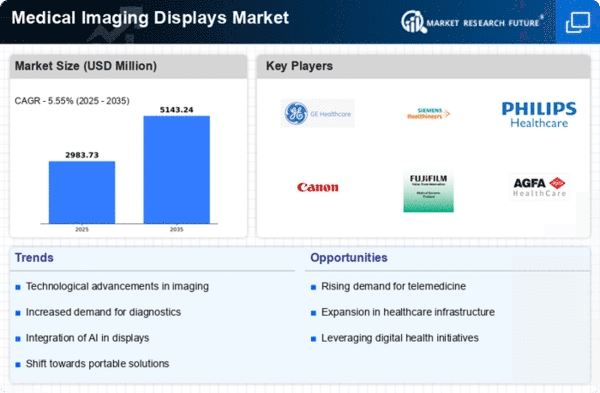
As per MRFR analysis, the Medical Imaging Displays Market Size was estimated at 2826.84 USD Million in 2024. The Medical Imaging Displays industry is projected to grow from 3016.12 in 2025 to 5143.24 by 2035, exhibiting a compound annual growth rate (CAGR) of 5.55 during the forecast period 2025 - 2035.

Key Market Trends & Highlights

The Medical Imaging Displays Market is poised for substantial growth driven by technological advancements and increasing healthcare demands.

  • The integration of advanced technologies is transforming medical imaging displays, enhancing diagnostic accuracy and efficiency.
  • Telemedicine is gaining traction, leading to a heightened demand for high-quality imaging solutions in remote healthcare settings.
  • A focus on patient-centric solutions is emerging, with displays designed to improve patient engagement and experience.
  • The increasing demand for diagnostic imaging and technological advancements in imaging displays are key drivers propelling market growth in North America and Asia-Pacific.

Market Size & Forecast

2024 Market Size 2826.84 (USD Million)
2035 Market Size 5143.24 (USD Million)
CAGR (2025 - 2035) 5.55%
Largest Regional Market Share in 2024 North America

Major Players

<p>GE Healthcare (US), Siemens Healthineers (DE), Philips Healthcare (NL), Canon Medical Systems (JP), Fujifilm Medical Systems (JP), Agfa HealthCare (BE), EIZO Corporation (JP), Barco (BE), Sharp (JP)</p>

Market Trends

The Medical Imaging Displays Market is currently experiencing a transformative phase, driven by advancements in technology and increasing demand for high-quality imaging solutions. The integration of artificial intelligence and machine learning into imaging systems appears to enhance diagnostic accuracy and efficiency, thereby improving patient outcomes. Furthermore, the growing prevalence of chronic diseases necessitates the adoption of sophisticated imaging modalities, which in turn fuels market growth. As healthcare providers seek to optimize their operations, the emphasis on digital imaging solutions is likely to rise, reflecting a shift towards more efficient and effective healthcare delivery. In addition, the trend towards telemedicine and remote diagnostics is reshaping the landscape of the Medical Imaging Displays Market. This shift necessitates the development of displays that can support high-resolution imaging while ensuring accessibility for healthcare professionals in various settings. The increasing focus on patient-centered care and the need for real-time data sharing may further drive innovation in display technologies. Overall, the Medical Imaging Displays Market is poised for continued evolution, with emerging technologies and changing healthcare dynamics playing pivotal roles in shaping its future.

Integration of Advanced Technologies

The Medical Imaging Displays Market is witnessing a notable trend towards the incorporation of advanced technologies such as artificial intelligence and machine learning. These innovations are enhancing the capabilities of imaging systems, leading to improved diagnostic accuracy and operational efficiency.

Rise of Telemedicine

The growing acceptance of telemedicine is significantly influencing the Medical Imaging Displays Market. As healthcare providers increasingly rely on remote diagnostics, there is a heightened demand for displays that facilitate high-resolution imaging and support real-time data sharing.

Focus on Patient-Centric Solutions

There is a discernible shift towards patient-centric solutions within the Medical Imaging Displays Market. This trend emphasizes the need for displays that not only provide high-quality imaging but also enhance the overall patient experience and engagement in their healthcare journey.

Medical Imaging Displays Market Market Drivers

Aging Population

An aging global population is a crucial factor influencing the Global Medical Imaging Displays Market Industry. Older individuals typically require more medical attention, leading to increased imaging procedures. As the demographic shift continues, healthcare facilities are compelled to upgrade their imaging technologies to cater to this growing patient base. This demographic trend is expected to drive the market significantly, contributing to a compound annual growth rate of 5.34% from 2025 to 2035, as healthcare systems adapt to the needs of an older population.

Technological Advancements

The Global Medical Imaging Displays Market Industry is experiencing rapid technological advancements, particularly in display resolution and image processing capabilities. Innovations such as 4K and 8K resolution displays enhance diagnostic accuracy by providing clearer images. For instance, hospitals adopting these advanced displays report improved detection rates of subtle pathologies. As technology evolves, the market is projected to grow from 3.5 USD Billion in 2024 to 6.2 USD Billion by 2035, indicating a robust demand for high-quality imaging solutions.

Regulatory Support and Standards

Regulatory support and the establishment of standards for medical imaging technologies are vital drivers for the Global Medical Imaging Displays Market Industry. Governments and health organizations are implementing guidelines that promote the use of high-quality imaging displays in clinical settings. Compliance with these regulations not only enhances patient safety but also encourages manufacturers to innovate. This regulatory landscape is likely to foster market growth, as adherence to standards becomes increasingly critical in the healthcare sector.

Increasing Healthcare Expenditure

Rising healthcare expenditure globally is a significant driver for the Global Medical Imaging Displays Market Industry. Governments and private sectors are investing heavily in healthcare infrastructure, leading to the procurement of advanced imaging systems. For example, countries with increasing healthcare budgets are prioritizing the acquisition of state-of-the-art imaging displays. This trend is expected to contribute to a compound annual growth rate of 5.34% from 2025 to 2035, reflecting a sustained commitment to enhancing diagnostic capabilities.

Growing Demand for Early Diagnosis

The growing emphasis on early diagnosis in healthcare is propelling the Global Medical Imaging Displays Market Industry forward. Early detection of diseases such as cancer and cardiovascular conditions relies heavily on high-quality imaging. As healthcare providers recognize the importance of timely interventions, the demand for advanced imaging displays is likely to surge. This trend aligns with the projected market growth from 3.5 USD Billion in 2024 to 6.2 USD Billion by 2035, underscoring the critical role of imaging technology in modern medicine.

Market Segment Insights

By Application: Radiology (Largest) vs. Cardiology (Fastest-Growing)

<p>The Medical Imaging Displays Market is notably diversified with segments including radiology, cardiology, oncology, orthopedics, and neurology. Among these, radiology holds the largest market share due to the widespread use of imaging technologies for diagnostic procedures. Cardiology, while smaller in market share, is rapidly expanding as advancements in cardiovascular imaging technology enhance diagnostic capabilities, leading to increased adoption in clinical settings. Growth trends within the Medical Imaging Displays segment are driven by technological advancements and the rising demand for precise imaging solutions. The cardiology segment is experiencing significant growth due to increased awareness and management of heart diseases, resulting in a surge in diagnostic imaging needs. Innovations such as 3D imaging and enhanced display resolutions are further accelerating market adoption across all applications, promoting improvements in patient care and clinical outcomes.</p>

<p>Radiology (Dominant) vs. Oncology (Emerging)</p>

<p>In the Medical Imaging Displays Market, Radiology stands as the dominant application, leveraging its critical role in diagnostics and treatment planning. Radiology's extensive integration into healthcare practices ensures a steady demand for high-quality displays that can accurately depict complex images for diagnosis. In contrast, the Oncology segment is emerging, driven by growing investments in cancer research and the implementation of advanced imaging techniques to monitor treatment efficacy. As treatments become more personalized, the demand for high-resolution imaging in Oncology is increasing, prompting a shift in focus toward specialty displays. This dynamic is shaping the competitive landscape, with manufacturers innovating in display technologies tailored for oncology to meet evolving clinical needs.</p>

By End Use: Hospitals (Largest) vs. Diagnostic Imaging Centers (Fastest-Growing)

<p>In the Medical Imaging Displays Market, the end use segment is primarily dominated by hospitals, which encapsulate a significant portion of the market share. Hospitals utilize advanced imaging displays to enhance diagnostic accuracy and patient care. Following closely are diagnostic imaging centers, which are rapidly gaining traction in the market due to increasing patient footfall and the demand for specialized imaging services. Research laboratories and outpatient facilities, while crucial, account for a smaller share comparatively, focusing on specific needs rather than broader applications.</p>

<p>End Use: Hospitals (Dominant) vs. Diagnostic Imaging Centers (Emerging)</p>

<p>Hospitals represent the dominant segment in the Medical Imaging Displays Market due to their comprehensive range of services and the necessity for high-quality imaging to support critical diagnoses and treatment plans. These institutions invest significantly in advanced imaging technologies, driving the demand for high-resolution displays that facilitate effective communication among healthcare professionals. In contrast, diagnostic imaging centers are rapidly emerging, emphasizing specialized services such as MRI and CT scans. This segment benefits from the growing trend towards outpatient care and technological advancements in imaging, positioning them as essential players catering to a specific and high-demand niche within the healthcare sector.</p>

By Technology: Liquid Crystal Display (Largest) vs. Organic Light Emitting Diode (Fastest-Growing)

<p>In the Medical Imaging Displays Market, the Liquid Crystal Display (LCD) technology holds the largest market share, thanks to its cost-effectiveness, wide availability, and established technology in healthcare settings. LCDs are widely used in various medical imaging applications, making them a reliable choice across hospitals and clinics. In contrast, the Organic Light Emitting Diode (OLED) technology is rapidly gaining traction due to its superior color accuracy, contrast ratios, and energy efficiency, which are crucial for precise medical imaging.</p>

<p>Technology: LCD (Dominant) vs. OLED (Emerging)</p>

<p>In the Medical Imaging Displays Market, Liquid Crystal Displays (LCDs) are dominant due to their extensive application in numerous medical imaging modalities, including ultrasound, MRI, and CT scans. Their established technology offers a solid balance of performance and cost that hospitals and medical facilities prefer. Conversely, Organic Light Emitting Diodes (OLEDs) are emerging rapidly within this market segment, boasting advantages such as deeper blacks and faster refresh rates. This makes OLEDs particularly attractive for medical imaging that requires precise detail and clarity, positioning them as a preferred choice for future advancements in imaging technology.</p>

By Display Type: Monitors (Largest) vs. Workstations (Fastest-Growing)

<p>The medical imaging displays market is predominantly characterized by the dominance of monitors, which hold the largest market share due to their widespread application in hospitals and clinics. Monitors are designed to provide high-resolution images necessary for accurate diagnosis and treatment planning. Workstations follow closely, and although they comprise a smaller slice of the market, their utilization is rapidly increasing as healthcare facilities invest in advanced imaging solutions for better diagnostic capabilities.</p>

<p>Monitors (Dominant) vs. Workstations (Emerging)</p>

<p>Monitors are the backbone of the medical imaging displays market, favored for their ability to deliver high-quality visuals essential for discerning complex medical conditions. They are specialized to meet stringent medical standards, ensuring consistency in brightness and color accuracy, which is critical for diagnostic purposes. On the other hand, workstations are emerging as essential tools, particularly in radiology and surgery. Their sophisticated software and hardware configurations facilitate image analysis at higher speeds, thereby improving workflow efficiency. The rise of telemedicine and remote diagnostics has further propelled workstation adoption, blending traditional imaging with modern technology to provide versatile solutions.</p>

By Resolution: Ultra High Definition (Largest) vs. High Definition (Fastest-Growing)

<p>In the Medical Imaging Displays Market, the resolution segment reveals a clear hierarchy where Ultra High Definition (UHD) dominates the landscape with the largest share. The UHD displays outperform other resolution types due to their superior image quality, enabling clinicians to discern minute details in medical images, which is essential for accurate diagnostics. Conversely, the High Definition (HD) segment is witnessing rapid adoption, fueled by its cost-effectiveness and enhanced capabilities over Standard Definition displays. As healthcare facilities aim to modernize their imaging systems, HD resolution continues to attract investment as a viable option for many institutions. Growth trends within the resolution segment are predominantly driven by advancements in display technology and increasing demand for enhanced imaging modalities in healthcare settings. The shift towards UHD is propelled by the need for precise diagnostic tools that enable better patient outcomes, while HD is rapidly expanding thanks to its affordability combined with effective performance. Moreover, the rise in telemedicine and remote diagnostics has created an increased necessity for high-quality imaging systems, further contributing to the need for both HD and UHD solutions. These dynamics indicate a competitive environment for Medical Imaging Displays, with UHD leading the way in innovation and HD emerging as a strong player in budget-conscious markets.</p>

<p>Ultra High Definition (Dominant) vs. High Definition (Emerging)</p>

<p>Ultra High Definition (UHD) displays are at the forefront of the Medical Imaging Displays Market, offering remarkable clarity and finer detail that are paramount in medical diagnostics. These displays utilize advanced technologies to deliver exceptionally high resolution images, ensuring that healthcare professionals can make informed decisions based on the best visual data available. The dominance of UHD in this market is backed by its superior performance particularly in fields like radiology and pathology, where detail is crucial. On the other hand, High Definition (HD) displays are emerging as a strong competitor within the sector. These displays provide a cost-effective alternative while still delivering significant improvements over Standard Definition displays. Their growing presence in healthcare facilities is indicative of a shift towards more economically viable imaging solutions without compromising on quality. As hospitals and clinics strive for better patient outcomes, the ability of HD displays to meet these demands while remaining budget-friendly positions them favorably in the market, thereby enhancing their growth prospects.</p>

Get more detailed insights about Medical Imaging Displays Market Research Report - Global Forecast till 2035

Regional Insights

North America : Market Leader in Innovation

North America continues to lead the Medical Imaging Displays market, holding a significant share of 1415.0M in 2024. The region's growth is driven by advanced healthcare infrastructure, increasing demand for high-resolution imaging, and stringent regulatory standards that promote innovation. The adoption of digital technologies and telemedicine further fuels market expansion, as healthcare providers seek efficient solutions to enhance patient care. The competitive landscape is characterized by major players such as GE Healthcare, Siemens Healthineers, and Philips Healthcare, which dominate the market with their cutting-edge technologies. The U.S. remains the largest contributor, supported by a robust healthcare system and significant investments in medical technology. The presence of these key players ensures continuous advancements in imaging solutions, catering to the evolving needs of healthcare professionals.

Europe : Emerging Market with Growth Potential

Europe's Medical Imaging Displays market is valued at 850.0M, reflecting a growing demand for advanced imaging technologies. Factors such as an aging population, rising chronic diseases, and increased healthcare expenditure are driving this growth. Regulatory frameworks in the region encourage innovation and ensure high standards in medical devices, which further supports market expansion. The integration of AI and machine learning in imaging solutions is also a significant trend. Leading countries in this region include Germany, France, and the UK, where healthcare investments are robust. Key players like Siemens Healthineers and Philips Healthcare are actively enhancing their product offerings to meet the rising demand. The competitive landscape is dynamic, with a focus on technological advancements and strategic partnerships to improve patient outcomes. The European market is poised for continued growth as healthcare providers seek to adopt the latest imaging technologies.

Asia-Pacific : Rapidly Growing Healthcare Sector

The Asia-Pacific Medical Imaging Displays market, valued at 500.0M, is witnessing rapid growth driven by increasing healthcare investments and a rising population. Countries like China and India are at the forefront, with expanding healthcare infrastructure and a growing demand for advanced imaging technologies. Government initiatives aimed at improving healthcare access and quality are also significant growth catalysts in the region. The competitive landscape features key players such as Canon Medical Systems and Fujifilm Medical Systems, which are focusing on innovation and localization of products to cater to diverse market needs. The presence of these companies, along with increasing collaborations and partnerships, is enhancing the market's growth potential. As the region continues to develop, the demand for high-quality medical imaging solutions is expected to rise significantly, positioning Asia-Pacific as a key player in the global market.

Middle East and Africa : Emerging Market with Challenges

The Middle East and Africa Medical Imaging Displays market is valued at 61.84M, reflecting a nascent but growing sector. The region faces challenges such as limited healthcare infrastructure and regulatory hurdles, yet there is a rising demand for advanced medical imaging solutions. Factors like increasing investments in healthcare and a growing awareness of diagnostic imaging are driving market growth. Governments are also focusing on improving healthcare access, which is crucial for market expansion. Countries like South Africa and the UAE are leading the way in adopting advanced imaging technologies. The competitive landscape includes players like Agfa HealthCare and EIZO Corporation, which are working to establish a stronger presence in the region. Despite the challenges, the market is poised for growth as healthcare providers seek to enhance diagnostic capabilities and improve patient outcomes.

Key Players and Competitive Insights

The Medical Imaging Displays Market is characterized by a dynamic competitive landscape, driven by technological advancements and increasing demand for high-resolution imaging solutions. Key players such as GE Healthcare (US), Siemens Healthineers (DE), and Philips Healthcare (NL) are at the forefront, each adopting distinct strategies to enhance their market positioning. GE Healthcare (US) focuses on innovation through the development of advanced imaging technologies, while Siemens Healthineers (DE) emphasizes strategic partnerships to expand its product offerings. Philips Healthcare (NL) is actively pursuing digital transformation initiatives, integrating AI capabilities into its imaging solutions, thereby shaping a competitive environment that prioritizes technological superiority and customer-centric solutions.

In terms of business tactics, companies are increasingly localizing manufacturing to reduce costs and enhance supply chain efficiency. The market structure appears moderately fragmented, with several key players exerting substantial influence. This fragmentation allows for a diverse range of products and services, catering to various customer needs while fostering healthy competition among established and emerging players.

In November 2025, Siemens Healthineers (DE) announced a strategic partnership with a leading AI firm to enhance its imaging software capabilities. This collaboration aims to integrate AI-driven analytics into their imaging displays, potentially improving diagnostic accuracy and workflow efficiency. Such a move underscores Siemens' commitment to leveraging cutting-edge technology to maintain its competitive edge in the market.

In October 2025, Philips Healthcare (NL) launched a new line of high-resolution imaging displays designed specifically for surgical environments. This product line not only enhances visualization during procedures but also incorporates sustainability features, aligning with the growing demand for eco-friendly medical solutions. The introduction of these displays reflects Philips' strategic focus on innovation and sustainability, positioning the company favorably in a market increasingly driven by environmental considerations.

In December 2025, GE Healthcare (US) unveiled a new initiative aimed at optimizing its supply chain through advanced analytics and machine learning. This initiative is expected to enhance operational efficiency and reduce lead times for its imaging display products. By focusing on supply chain reliability, GE Healthcare is likely to strengthen its market position, particularly in an environment where timely delivery and product availability are critical.

As of December 2025, the Medical Imaging Displays Market is witnessing trends such as digitalization, sustainability, and AI integration, which are reshaping competitive dynamics. Strategic alliances are becoming increasingly vital, enabling companies to pool resources and expertise to drive innovation. The competitive differentiation is likely to evolve from traditional price-based competition towards a focus on technological advancements, reliability, and sustainability, suggesting a transformative shift in how companies approach market positioning.

Key Companies in the Medical Imaging Displays Market include

Industry Developments

    • Novarad introduced its OpenSight AR system, an imaging display based on Augmented Reality. It has also been authorized by the US Food and Drug Administration (FDA). Patients are exposed to less radiation as a result of this, and surgeons have superior planning skills.
    • Siemens Healthineers introduced their organ digital twin technology, which Artificial Intelligence powers. It helps stimulate the organ's physiology and assist clinicians in selecting the best potential therapy based on virtual testing on the digital twin.
    • The "ProFound AI" solution from iCAD is a digital breast tomosynthesis solution (DBT). It allows radiologists to see each tissue layer more clearly, allowing them to spot cancer up to 8% earlier on average. This can save radiologists up to 50% of the time they spend reading breast imaging.
    • Google's DeepMind can analyze 3D retinal OCT images and accurately identify 50 distinct ophthalmic diseases. It can identify signs of eye illness. It ranks patients according to their urgency and makes therapy recommendations. These skills have the potential to reduce the time between scan and therapy. This enables patients to receive life-saving treatments promptly

Future Outlook

Medical Imaging Displays Market Future Outlook

<p>The Medical Imaging Displays Market is projected to grow at a 5.55% CAGR from 2024 to 2035, driven by technological advancements, increasing healthcare expenditure, and rising demand for diagnostic imaging.</p>

New opportunities lie in:

  • <p>Integration of AI-driven diagnostic tools in imaging displays</p>
  • <p>Development of portable imaging display solutions for remote healthcare</p>
  • <p>Expansion into emerging markets with tailored product offerings</p>

<p>By 2035, the market is expected to achieve robust growth, positioning itself as a leader in medical technology.</p>

Market Segmentation

Medical Imaging Displays Market End Use Outlook

  • Hospitals
  • Diagnostic Imaging Centers
  • Research Laboratories
  • Outpatient Facilities

Medical Imaging Displays Market Resolution Outlook

  • High Definition
  • Ultra High Definition
  • Standard Definition

Medical Imaging Displays Market Technology Outlook

  • Liquid Crystal Display
  • Light Emitting Diode
  • Organic Light Emitting Diode
  • Cathode Ray Tube

Medical Imaging Displays Market Application Outlook

  • Radiology
  • Cardiology
  • Oncology
  • Orthopedics
  • Neurology

Medical Imaging Displays Market Display Type Outlook

  • Monitors
  • Workstations
  • Mobile Displays
  • Portable Displays

Report Scope

MARKET SIZE 20242826.84(USD Million)
MARKET SIZE 20253016.12(USD Million)
MARKET SIZE 20355143.24(USD Million)
COMPOUND ANNUAL GROWTH RATE (CAGR)5.55% (2024 - 2035)
REPORT COVERAGERevenue Forecast, Competitive Landscape, Growth Factors, and Trends
BASE YEAR2024
Market Forecast Period2025 - 2035
Historical Data2019 - 2024
Market Forecast UnitsUSD Million
Key Companies ProfiledGE Healthcare (US), Siemens Healthineers (DE), Philips Healthcare (NL), Canon Medical Systems (JP), Fujifilm Medical Systems (JP), Agfa HealthCare (BE), EIZO Corporation (JP), Barco (BE), Sharp (JP)
Segments CoveredApplication, End Use, Technology, Display Type, Resolution
Key Market OpportunitiesIntegration of artificial intelligence in Medical Imaging Displays Market enhances diagnostic accuracy and workflow efficiency.
Key Market DynamicsTechnological advancements and regulatory changes drive innovation and competition in the Medical Imaging Displays Market.
Countries CoveredNorth America, Europe, APAC, South America, MEA

FAQs

What is the valuation of the Medical Imaging Displays Market?

Medical Imaging Displays Marketwas valued at USD 3.7 billion in 2032.

What is the Medical Imaging Displays Marketgrowth rate?

Medical Imaging Displays Market is expected to exhibit a strong 5.3% CAGR over the forecast period from 2023 to 2032.

What is the leading driver for the Medical Imaging Displays Market?

Medical Imaging Displays Market is mainly driven by the growing demand for minimally invasive medical imaging.

What is the key restraint on the Medical Imaging Displays Market?

The high cost of advanced medical imaging display systems is the major restraint on the global market.

What is the leading regional Medical Imaging Displays Market?

The Americas and Europe hold the dominant shares in the global medical imaging displays market.

  1. SECTION I: EXECUTIVE SUMMARY AND KEY HIGHLIGHTS
    1. | 1.1 EXECUTIVE SUMMARY
  2. SECTION II: SCOPING, METHODOLOGY AND MARKET STRUCTURE
    1. | 2.1 MARKET INTRODUCTION
    2. | 2.2 RESEARCH METHODOLOGY
  3. SECTION III: QUALITATIVE ANALYSIS
    1. | 3.1 MARKET DYNAMICS
    2. | 3.2 MARKET FACTOR ANALYSIS
  4. SECTION IV: QUANTITATIVE ANALYSIS
    1. | 4.1 Healthcare, BY Application (USD Million)
    2. | 4.2 Healthcare, BY End Use (USD Million)
    3. | 4.3 Healthcare, BY Technology (USD Million)
    4. | 4.4 Healthcare, BY Display Type (USD Million)
    5. | 4.5 Healthcare, BY Resolution (USD Million)
    6. | 4.6 Healthcare, BY Region (USD Million)
  5. SECTION V: COMPETITIVE ANALYSIS
    1. | 5.1 Competitive Landscape
    2. | 5.2 Company Profiles
    3. | 5.3 Appendix

Medical Imaging Displays Market Segmentation

Market Segmentation Overview

  • Detailed segmentation data will be available in the full report
  • Comprehensive analysis by multiple parameters
  • Regional and country-level breakdowns
  • Market size forecasts by segment
Infographic

Free Sample Request

Kindly complete the form below to receive a free sample of this Report

Get Free Sample

Customer Strories

Compare Licence

×
Features License Type
Single User Multiuser License Enterprise User
Price $4,950 $5,950 $7,250
Maximum User Access Limit 1 User Upto 10 Users Unrestricted Access Throughout the Organization
Free Customization
Direct Access to Analyst
Deliverable Format
Platform Access
Discount on Next Purchase 10% 15% 15%
Printable Versions